Getting my shots

I deliberately sickened myself multiple times in 2023 and 2024, and I’m glad that I did. I opted to take fourth and fifth booster doses of COVID-19 vaccine. I also took two doses of the Shingrix vaccine against shingles, a disease which has afflicted some of my colleagues and acquaintances over the years. Each time, I had immune system reactions that subsided after 36 hours.

After you recover from chickenpox, the varicella virus stays dormant in your body and can reactivate years later, causing shingles. That can mean a painful rash of blisters with an intense burning sensation, and the possibility of long-lasting pain from postherpetic neuralgia, as well as the risk of vision loss or blindness if the virus attacks an eye.

A varicella vaccine became available in 1995, and by 2014 that had reduced the incidence of chickenpox in the USA by over 90%. But of course I’m far too old to have been vaccinated as a child against chickenpox, and I contracted a severe case of it back in 1972 when I was six. I remember how my body was covered in blisters, and my mother having me wear mittens and plastic Baggies to ensure I wouldn’t pick at them.
Those memories were vivid enough for me to accept some mild and temporary discomfort to reduce my likelihood of shingles by well over 90%. A Zostavax shingles vaccine was approved in the USA in 2006, but it has been supplanted by Shingrix, which provides strong protection against both shingles and postherpetic neuralgia. Shingrix was approved in 2017, and the CDC recommends that healthy adults 50 years and older get two doses separated by two to six months, whether or not they previously had chickenpox.

I knew in advance that it would likely have some temporary side effects. I had my first dose of Shingrix in one arm, and my fourth COVID booster in the other. My arms were sore for a couple of days, and I had body aches and fatigue that began about 6 hours after the shots and lasted another 24 hours.

The Shingrix vaccine requires a second dose two to six months after the first. So I scheduled my second dose on a Friday afternoon four months after my initial dose. Sure enough, my arm was again sore and I began to have body aches by the time I went to bed. I had a slight fever, body aches, and headache that Saturday. Taking ibuprofen helped a bit, and I was actually fairly happy to have such symptoms, since they meant that my immune system was responding as intended. When I woke up on Sunday, I felt fine, other than a sore spot on my upper arm.

I went through a similar process recently, getting my fifth COVID booster and a Tdap booster against tetanus, diphtheria, and pertussis on a Friday afternoon. I again was sore and fatigued on Saturday and woke up on Sunday feeling fine. It had been nine years since my previous Tdap booster, and they recommend a booster every ten years. I advanced mine since our school district had numerous cases of pertussis this fall, so it is going around.

While my immune system ramped up, I thought back to my previous diseases and vaccinations. As a child, I contracted mumps, chickenpox, rubella, and scarlet fever, and later endured influenza and mononucleosis. But I was vaccinated against poliomyelitis, smallpox, measles, pertussis, diphtheria, and tetanus, so I avoided them.

Vaccinations are in the news because of vaccine skepticism and misinformation, so I decided to delve into diseases in this post, with some illustrations. I’m motivated because many younger people lack direct experience with a variety of diseases which have been largely vanquished by vaccines. Consider the following chart, which you can also view online in an interactive:
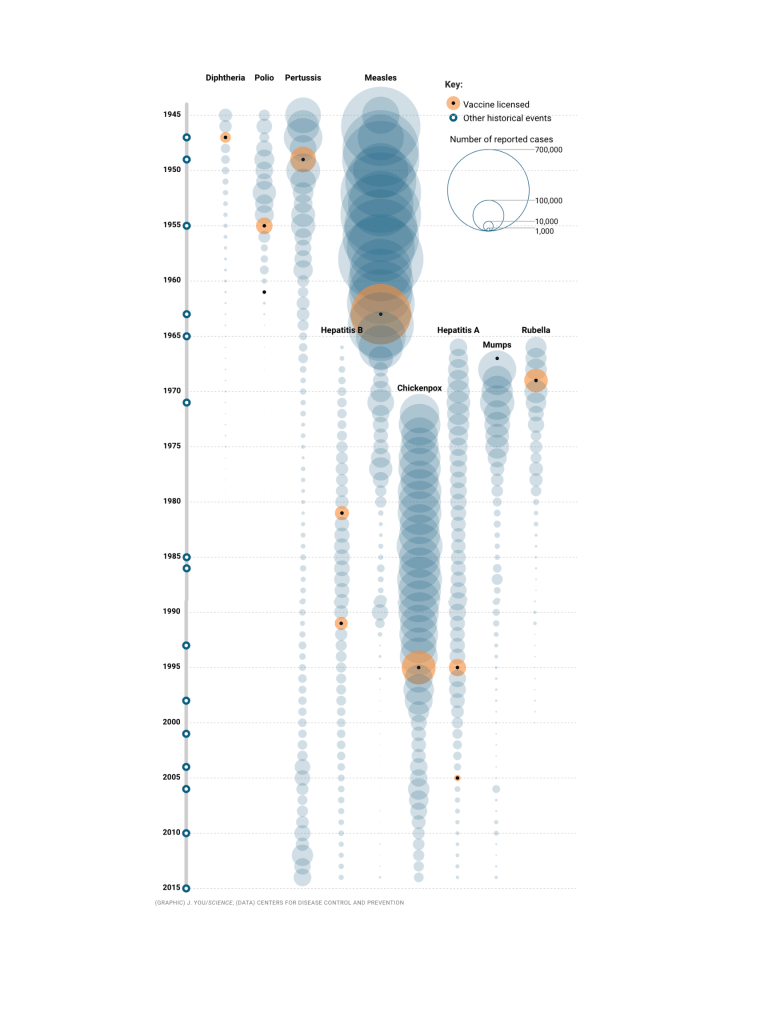
Vaccines have beat back many infectious diseases, as shown in the above timeline chart [Source]

So I’m going to provide you with a glimpse of various infectious diseases, including my own experiences with some of them.

Poliomyelitis
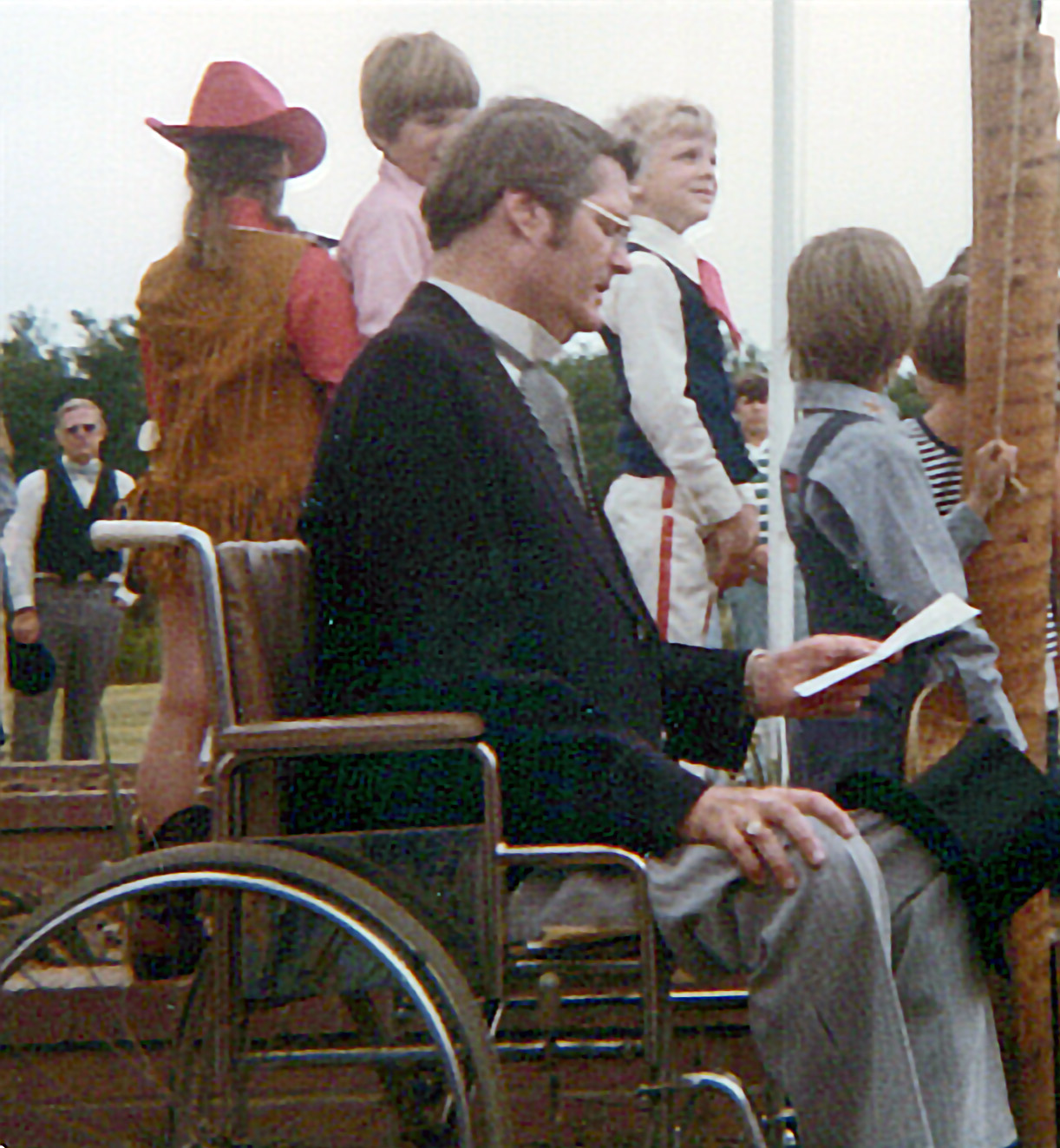
Our minister was paralyzed by polio; that’s me in the blue shirt and overalls looking away from the camera

Poliomyelitis was a scary disease for previous generations. My childhood minister and one of his brothers had been paralyzed by it, so while I was growing up I saw firsthand every Sunday how it could change lives.

My parents had witnessed the polio epidemic of 1952, with 58,000 cases in the USA which killed over 3,000 and left over 21,000 with mild to disabling paralysis. Those who were spared lasting paralysis could still suffer post-polio syndrome 15-30 years after an acute attack, with decreased muscular function or weakness with pain and fatigue. That is analogous to shingles: the polio virus lies dormant in the body for many years, but it can eventually reactivate.

Thankfully, the Salk vaccine became available in 1955, and the Sabin oral vaccine in 1961. So my parents ensured that from 1966-1971 I had three doses and a booster of the Salk vaccine, as well as three types of Sabin oral vaccine with a trivalent booster.

However, the scourge of polio didn’t disappear in 1955. The three Johnson brothers and their wives were together for Labor Day weekend in 1956. A few days later, all three of the brothers came down with polio. Our minister, Jerry, and his brother Tommy were paralyzed, while their brother Dale recovered with no long-term effects.

I vividly recall how every breath was a struggle for Tommy, a retired military veteran. He was so afflicted that he couldn’t work for a living, so he devoted himself to volunteer work, and he always sat behind his brother’s pulpit at church. That pulpit had a steep ramp that Jerry would be wheeled up, locking his wheelchair into place for most of the service.

Yet Jerry never dwelled on their disabilities. I only recall one sermon in which Jerry spoke of his own struggles with being confined to a wheelchair because a scarce vaccine had been prioritized for others. He never doubted the importance or efficacy of vaccination, as he and his brother were living proof of the consequences of not being protected by modern science.

Smallpox
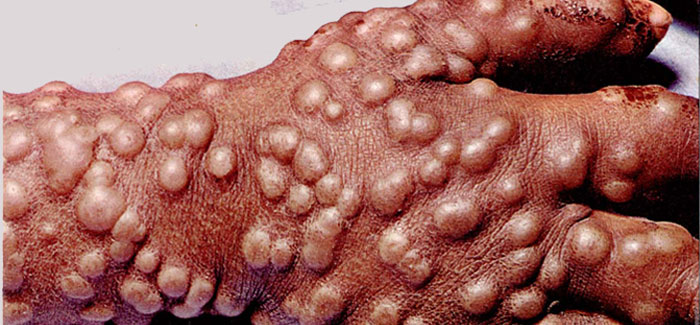
Smallpox was a terrible disease

Variola virus emerged thousands of years ago and killed 30% of its victims, leaving the rest with scars. My smallpox vaccination spared me from that scourge, which wiped out 50% of the First Peoples in America after Europeans brought it to these shores. The last outbreak in the USA was in 1949, and a concerted worldwide vaccination campaign led to the eradication of the disease by 1980.

That was the greatest victory of vaccinations, but smallpox and rinderpest are the only infectious diseases we have thus far managed to fully eliminate. Vaccinations can keep many, but not all, of the others at bay. For example, thanks to vaccinations, there were only 30 confirmed cases of polio worldwide in 2022.

Measles, Mumps, and Rubella
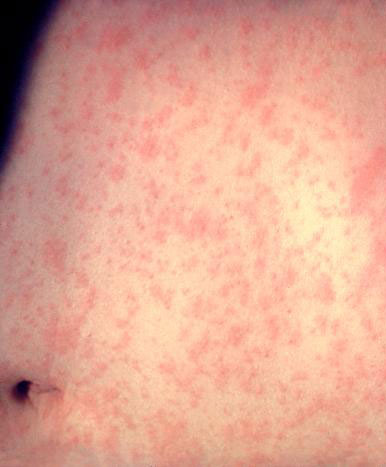
Measles is now rarely seen in the USA

Measles is an airborne disease that is extremely contagious and with no specific treatment. A measles outbreak at a boarding school outside Boston in 1954 provided an opportunity for the rubeola virus to be isolated and cultivated, leading to the first vaccine trials from 1958 to 1960 and licensing for public use in 1963. I had two shots of inactivated rubeola virus and an attenuated live rubeola virus vaccine in 1967, so I never had the measles.

Dr. Maurice Hilleman developed an improved measles vaccine with fewer side effects in 1968, and he combined vaccines against measles, mumps, and rubella into the MMR vaccine in 1971. It is estimated to be 97% to 99% effective in preventing measles after a second vaccination, and measles was declared eliminated in the USA in 2000. However, travelers continue to bring it into the country, and there can still be outbreaks among the unvaccinated, so children should still receive the MMR vaccine.

Vaccines have also virtually eliminated rubella here

Dr. Hilleman’s work came too late for me, and I had rubella in 1967 and mumps in 1970.

Rubella is sometimes called 3-day measles or German measles, but it is actually caused by a separate virus, against which the MMR vaccine is 89% effective. The MMR vaccine has virtually eliminated it in the USA, with less than 10 people contracting it each year.
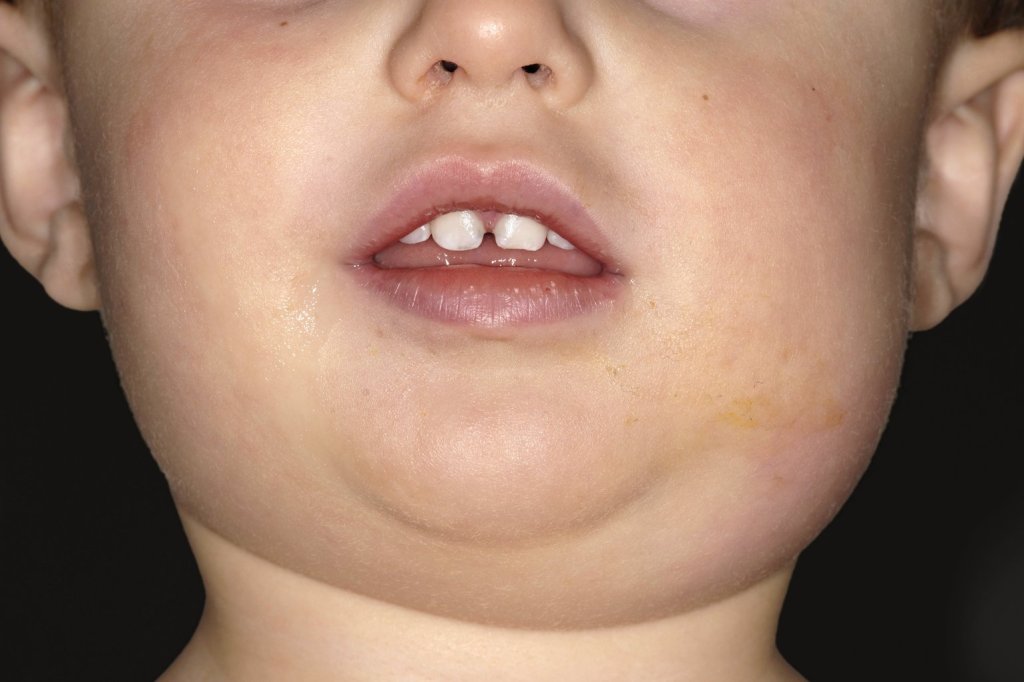
Mumps causes a swollen jaw

Mumps is caused by a third virus, and it doesn’t cause a rash. Instead, it makes the salivary glands swell, causing puffy cheeks and a tender, swollen jaw. Back when I got it, there were over 150,000 cases each year in the USA. The MMR vaccine is 86% effective against it, and now there are only a couple hundred to a couple thousand cases of it in the USA each year.

Chickenpox

Chickenpox blisters; photo source

While my rubella and mumps infections were mild, I was not so lucky when I contracted chickenpox in 1972. I was six years old, so I can remember the experience. Dr. Sam Sepkowitz had my mother apply Caladryl lotion to my skin and had me take Benadryl by mouth. The stratagem of mittens and Baggies to control my scratching and prevent picking did help me avoid having any of the telltale round, depressed marks on my skin caused by the varicella zoster virus which I noticed on several of my childhood friends.

Scarlet Fever
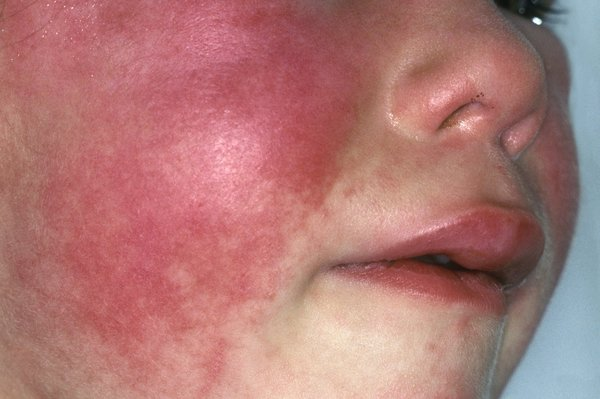
Scarlatina

Many a sore throat has been caused by an infection of the bacterium Streptococcus pyogenes; there are several million cases in the USA each year. When it causes scarlatina, or scarlet fever, a rash begins on your trunk and then quickly spreads outward, usually sparing your palms and soles. I contracted it in 1975, and that kept me out of school for several days.

My pediatrician, Dr. Eric Meador (no relation), was concerned that a future infection of Streptococcus pyogenes might lead to rheumatic fever, which could damage my heart. So from then on, he wanted to see me whenever I had a sore throat. He would culture my infection and, if it was caused by strep, he would prescribe an antibiotic.

Mononucleosis
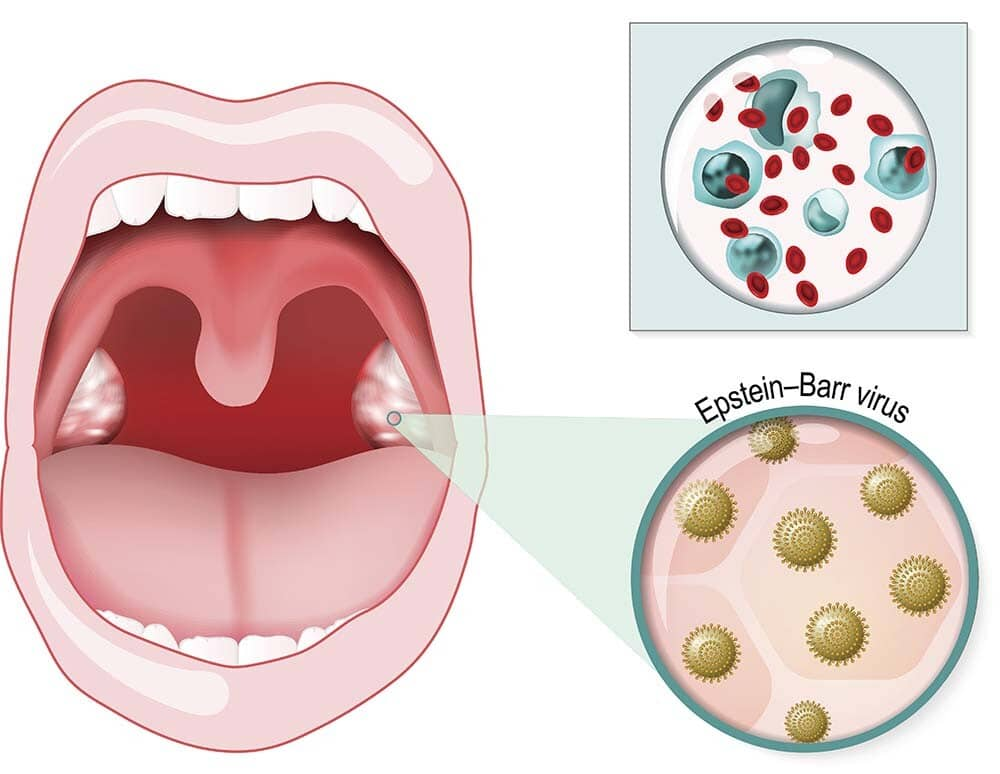
Mononucleosis is often accompanied by exudative pharyngitis

In college, I contracted mononucleosis, probably from the Epstein-Barr virus. About 10% of college students develop it. I had the typical fever, sore throat, and swollen glands. Even after those symptoms resolved, I had chronic fatigue for weeks, so when I returned to my classes, I sat far from everyone else. That precaution wasn’t necessary to prevent contagion, since mono is contracted through direct contact with infected body fluids, but I was so exhausted that I wanted to avoid interacting with my fellow students. There is still no vaccine for mono, and nearly 95% of people have had an Epstein-Barr viral infection by the time they are adults.

That experience gave me empathy for those afflicted with chronic fatigue; those were the most depressing weeks of my time in college. When I finally began to recover, my parents came to Norman to help me launder weeks of dirty clothes at a laundromat.

Influenza

As an adult, I didn’t think much about vaccinations, having no memory of the shots and oral doses of early childhood, until I contracted a severe case of influenza in 1989. I was moving into my first apartment after graduating from college, and I felt miserable for two weeks. Tamiflu had not been developed, and fever-reducing medications could only get my fever down to 103 degrees Fahrenheit.
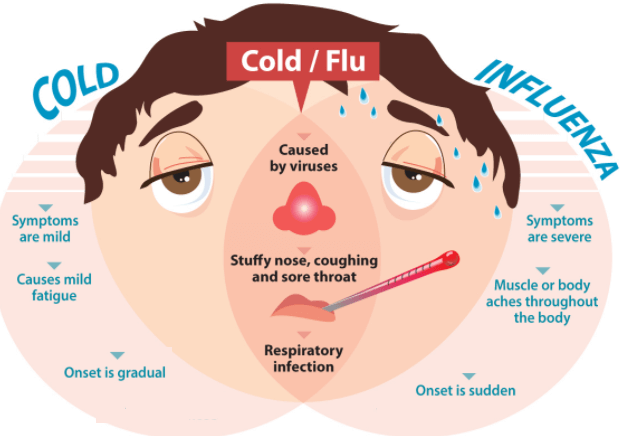
After that, I made sure to get a flu shot every year. Influenza mutates so much that over the last 20 years the vaccines’ efficacy ranged from 10-60%, averaging at a bit over 40%. But I haven’t had the flu since 1989, and I hope to never experience it again.

By the way, when people say they had the stomach flu, that means it wasn’t actually influenza, but rather a bacterial infection or infection by noroviruses or rotavirus.

About 8% of the USA population contracts influenza each year, while about 7% are infected by a norovirus. You can get vaccinated against the flu, but currently there is no available vaccine for norovirus. Children are especially susceptible to rotavirus, which infects 95% of them by 5 years of age, with about 2.7 million cases per year, although vaccines are now available.

Respiratory Syncytial Virus

Respiratory syncytial virus (RSV) infects nearly all children by age two, hospitalizing about 58,000 of them annually in the USA. It also hospitalizes about 177,000 older adults each year, killing about 14,000 of them. It was first identified in humans in the late 1950s, but a vaccine candidate in the mid-1960s was not effective and dozens of later attempts also failed.

In the 2000s, the structure of its proteins was determined, allowing an 80% effective vaccine to be developed for older adults. As of this writing, 22% of adults age 60+ get vaccinated for RSV. There is an RSV vaccine available for pregnant mothers, which protects infants from birth through 6 months of age, as well as an antibody product for infants.
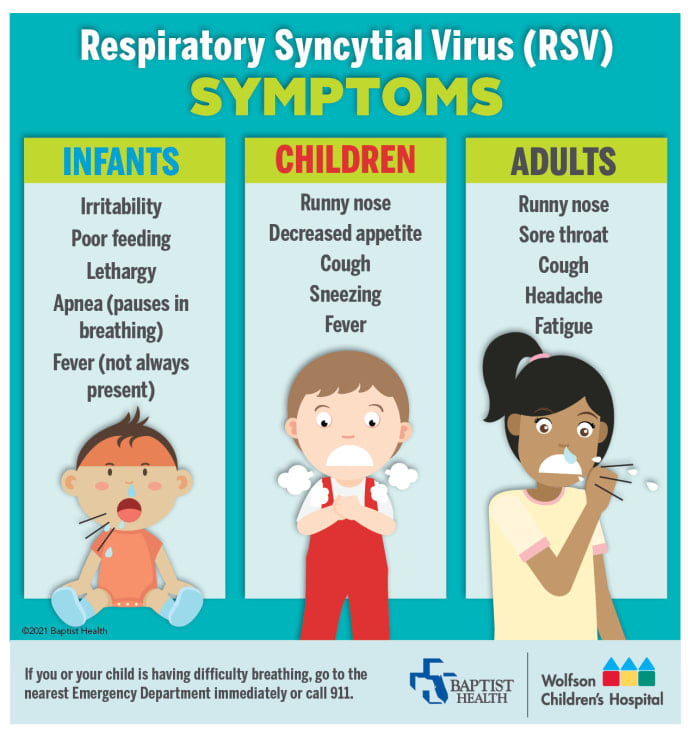
The work analyzing the protein structure of RSV paved the way for determining the spike protein structure of SARS-CoV-2, the virus that causes COVID, allowing for the famous COVID vaccines to be developed in record time.

COVID

I’ve written previously about my personal and professional experiences with COVID. I have been grateful for every COVID shot I could get. I had two doses of the first Pfizer vaccine in February and March of 2021, a Pfizer booster in October 2021, a Moderna booster in April 2022, and another Moderna booster in October 2022.
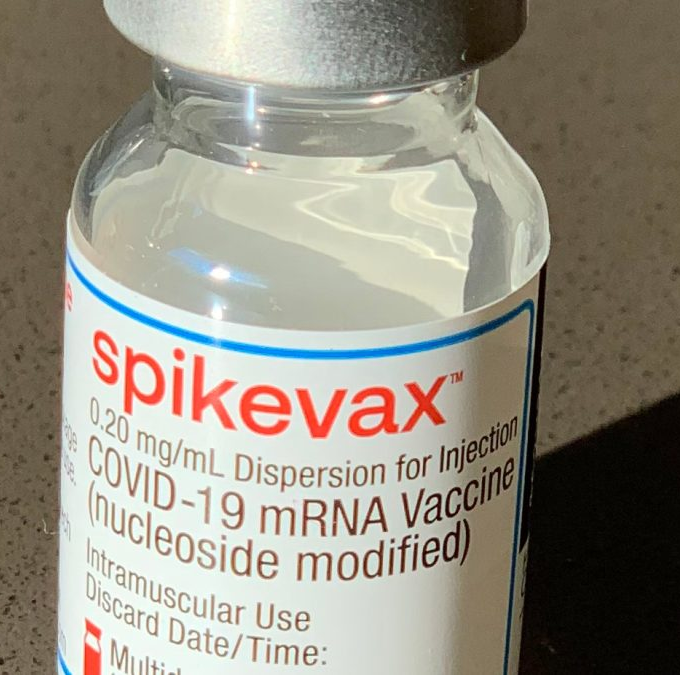
Unfortunately, I still contracted COVID in November 2022 and again in June 2024; the vaccines have proven to be highly effective at preventing hospitalization and death, but they are no guarantee against infection. My first bout with COVID included a chronic cough for several days, nasal congestion and a runny nose, fitful sleep, and chills but no fever. I began testing positive five days after my first symptoms, and didn’t get a negative rapid test until 14 days after I first suspected I might have the virus.

I contracted COVID again in June 2024 during a vacation to the California redwoods. That round brought congestion, fever, headache, body aches, fatigue, and chills and eventually a cough. No doubt all of that would have been much worse if I hadn’t been vaccinated.

Vaccinations and immunity via infection helped lower COVID from the third leading cause of death in these United States in 2020 and 2021 to fourth place in 2022 and tenth in 2023. I’ll gladly do whatever I can to keep improving that statistic.

Tetanus, Diphtheria, and Pertussis

Influenza and COVID mutate so rapidly that the smart money is on getting an annual dose of the latest tailored vaccine. Another vaccine that needs an occasional booster is the Tdap, which protects against the tetanus, diphtheria, and pertussis bacterial diseases.

Tetanus or lockjaw is caused by the bacteria Clostridium tetani. It causes painful stiffening of the muscles, which can lead to trouble opening the mouth, swallowing, and breathing, so it can be fatal. Vaccinations reduced it from 500-600 cases each year in the USA to only a few dozen.

Diphtheria is caused by the bacteria Corynebacterium diphtheriae, which product a toxin can lead to difficulty breathing, heart failure, paralysis, or death. Before vaccination, there were at least 200,000 cases each year in the USA, but now the average is less than one per year.

Pertussis or whooping cough, which is caused by Bordetella pertussis bacteria, is tougher to beat. It can cause uncontrollable, violent coughing making it hard to breathe, eat, or drink. It is especially dangerous for babies and young children. Babies and children younger than seven receive DTaP vaccines, while older children and adults receive Tdap.

Pertussis waxes and wanes. There were over a quarter-million cases in the USA back in 1934. The first triple-vaccines were licensed in 1949, and that dramatically reduced the cases to below 10,000 from 1964 to 2002. But it surged back to almost 50,000 in 2012, thanks to misinformation that led some parents to decline to vaccinate against it. As of this writing, the old epidemic cycle of pertussis peaking every two to five years has been re-established.
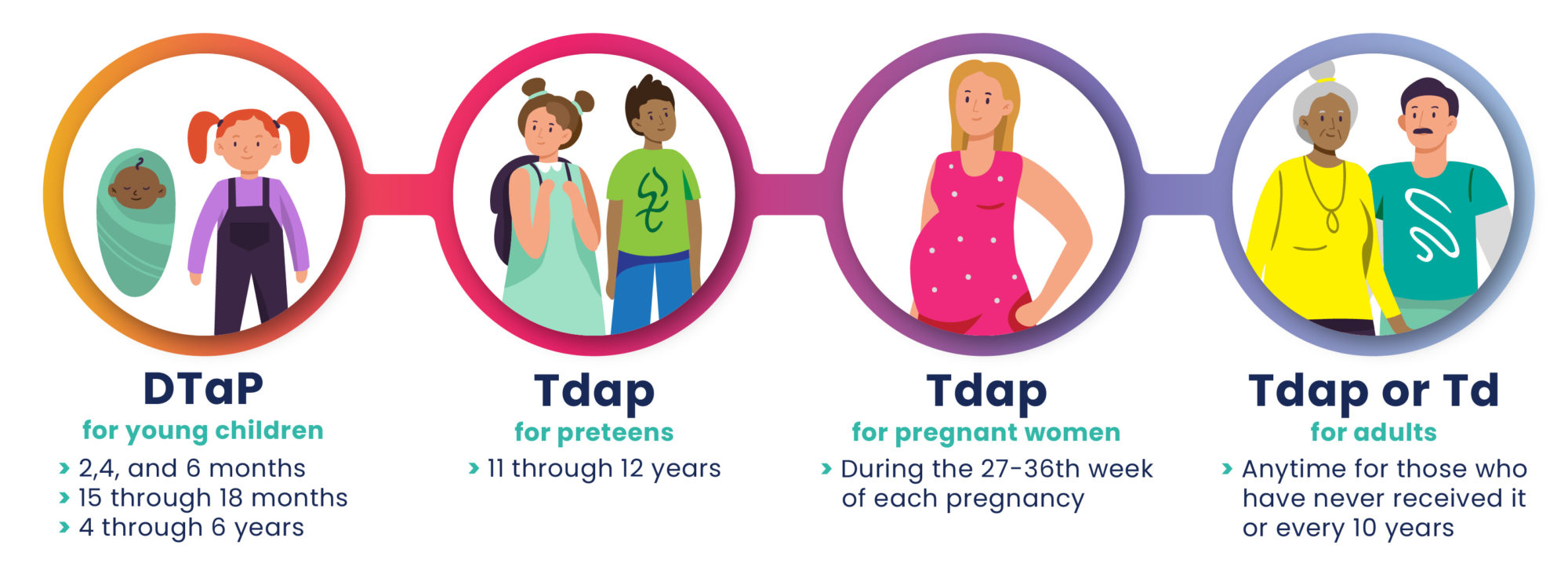
I’ve experienced paroxysmal coughing from pneumonia, so I am grateful that I’ve never had pertussis. Tdap is a little over 50% effective against pertussis, which beats the average efficacy of flu vaccines. Adults should get a Tdap booster every 10 years, and we had a significant number of pertussis cases in all of our local schools this fall, so I went ahead and got my booster a year early.

Get your shots!

I hope you found that informative and interesting. Don’t let news coverage of attention-seeking crackpots mislead you. The vast majority of people trust and support vaccination. 93% of kindergartners in the USA are up-to-date on their vaccinations, 88% of parents believe the MMR vaccine is important for their children, and over 90% of children are vaccinated against polio.

I am certainly grateful that modern medicine has protected me against many terrible diseases, and helped me battle through the ones I could not avoid. In the coming years, it is important that pediatricians, family doctors, community leaders, and friends and family leverage their relationships to promote accurate, evidence-based information. Recent events reinforce how useless it is to belittle or insult the ignorant or misled among us. Be kind and patient while holding firm. Don’t preach; educate…and get your shots!

Posted in history, pandemic | Leave a comment

The M4 Pro

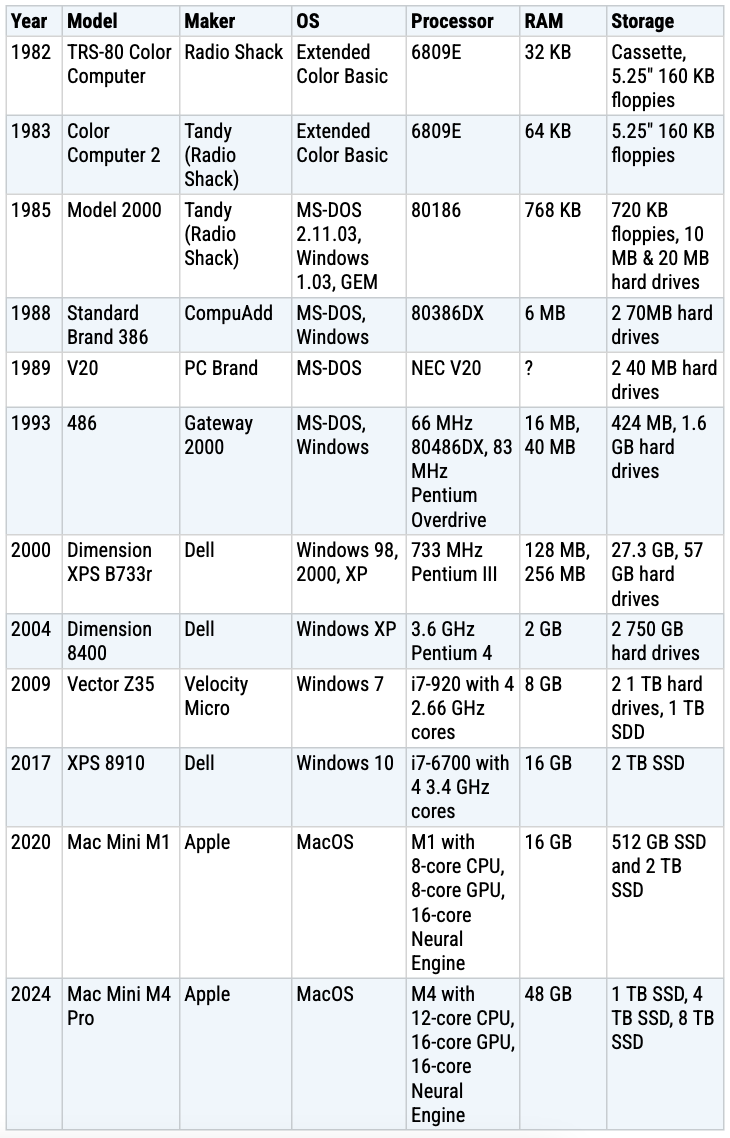
This week I set up the twelfth desktop personal computer for my use at home over the past 42 years. A new machine typically offers improvements in processing power, RAM, and storage size, and that is certainly true for my new Mac Mini M4 Pro, which replaced a Mac Mini M1 I purchased back in 2020 and had briefly experimented with when I was unable to travel due to the COVID-19 pandemic.

I didn’t actually use the M1 as my primary desktop machine until April 2024. Before that, I had used computers running Windows as my primary home platform for 30 years, and I had used MS-DOS machines for a decade before that.

A Mac Mini M4 atop a Mac Mini M1

My first computers were Color Computers I bought from Radio Shack in high school that used one of the most advanced of the various 8-bit microprocessors: the Motorola 6809E.

In college, I spent an amazing amount of money on an advanced Tandy Model 2000, which used the oddball 16-bit 80186 microprocessor and had much sharper graphics than the IBM PCs of that time. However, it wasn’t long until full compatibility with IBM PCs became a priority, and the Tandy 2000 was only semi-compatible. WordPerfect 4.2 worked fine for word processing, but I had to invest in a specific version of Lotus Symphony, as the IBM PC version of the Lotus 1-2-3 spreadsheet software was incompatible. So as I graduated from college in 1988, I invested in a PC clone with a 32-bit 80386DX microprocessor.

The only time I bought a desktop machine that was slower with less memory and storage than its predecessor was in 1989, when a friend and I bought a cheap desktop machine to run a bulletin board system (BBS) in Oklahoma City, which I soon transplanted to Bartlesville. That one used an NEC V20 microprocessor, which was a clone of the 16-bit 8088.

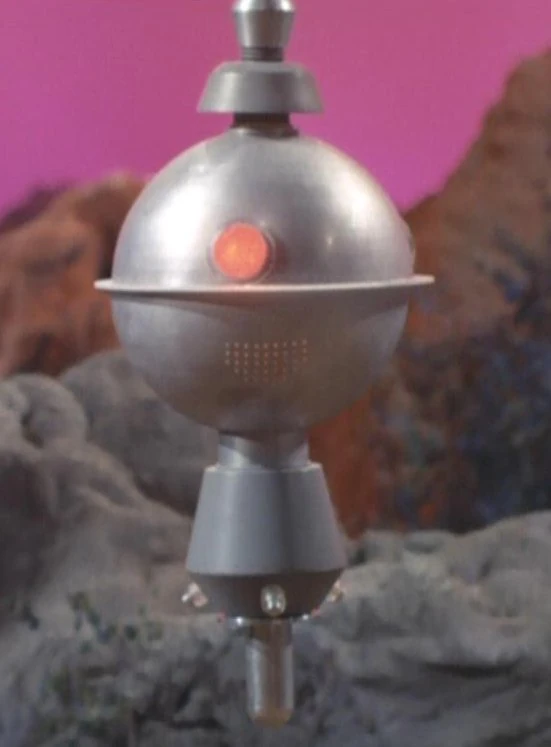
In Star Trek, M4 was a robot butler, housekeeper, gardener, and guardian for Flint, while the M-4 multitronic unit was an unseen failed computer designed by Dr. Richard Daystrom

I had a couple of other 32-bit machines after that, with a Pentium 4 being my first computer with a 64-bit microprocessor back in 2004. Twenty years later, my new computer’s processor cores still process data and instructions in 64-bit chunks, and the clock speed of my 2004 single-core machine was 3.7 gigahertz, not that much slower than the 4.5 gigahertz for my latest computer.

As heat generation and power consumption limited how much chip makers could boost clock speed, they started adding more computing cores and software incorporated multithreading to divide workloads across multiple cores working in parallel. Thus, instead of a single core like in 2004, my latest machine’s microprocessor has 12 cores plus a 16-core graphics processing unit and 16-core Neural Engine to speed up machine learning models.

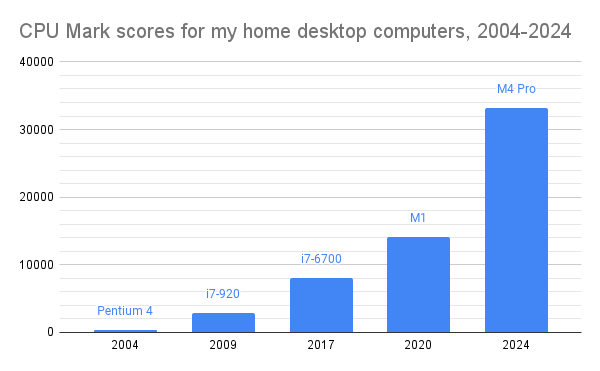
That allows my 2024 M4 Pro to score 86 times higher on CPU Mark than my 2004 Pentium 4 computer. The chart shows how computational power has improved for me at home over the past 20 years.

Source

Apple says that my new M4 Pro has up to 1.8x faster CPU performance and 2.2x faster GPU performance than my M1 Mac Mini of 2020, and I’ve configured it with quadruple the amount of RAM and about triple the available non-backup storage. Those specs should meet my needs for many years. Nevertheless, the M1 is no slouch, and I’m hanging onto it as a fallback machine should the M4 ever go down for awhile.

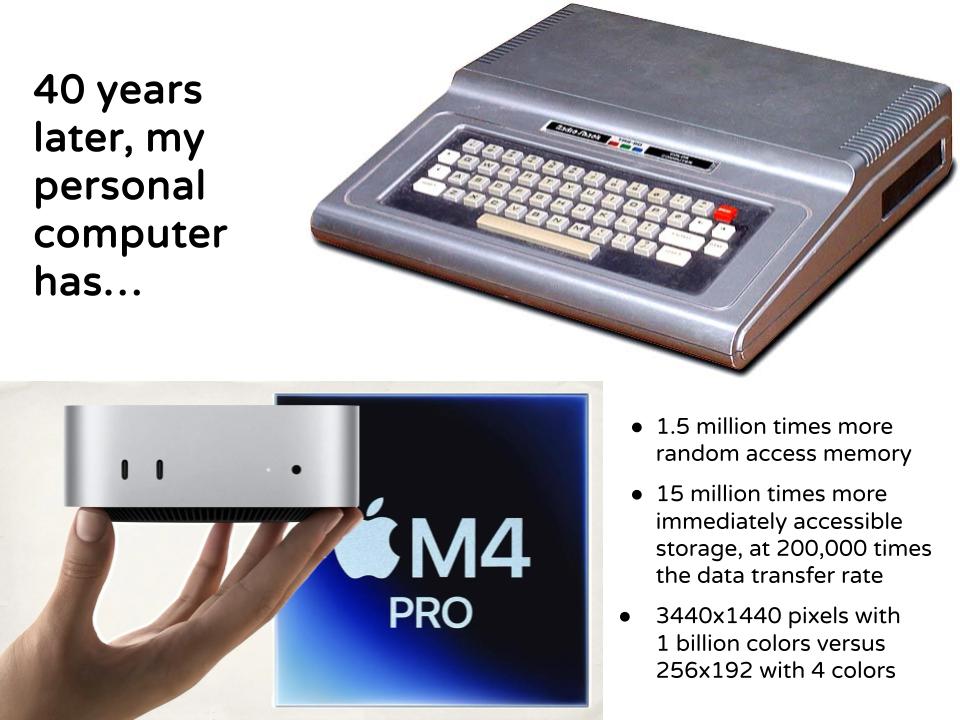
I couldn’t resist calculating some comparisons of my new desktop to my first computer over 40 years ago. My new desktop has 1.5 million times as much RAM, and immediate access to over 15 million times more storage. The M4’s internal 1 TB drive writes at about 6,300 MB/s and reads at about 5,100 MB/s, while the external 4 TB drive reads and writes at about 3,400 MB/s. Both are multiple times faster than the M1’s internal and external drives, and their data transfer rates are 100,000 to 200,000 times faster than the 156-kilobyte 5.25″ floppy disk drives on my first TRS-80 desktop computer.

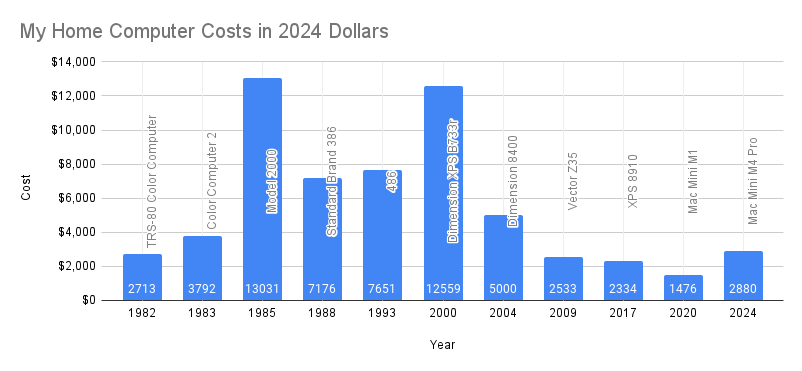
Of course, all of that progress came at some fiscal cost. Below I’ve charted the inflation-adjusted costs for my systems. (I don’t have the costs for the BBS system my friend and I purchased in 1989, so I’ve omitted it.)

My first 16-bit computer, the Tandy Model 2000 in 1985, was the most expensive system with my first Dell computer, a Pentium 4 in 2000, coming in close behind. I spent more on my latest system than I’ve spent on one since 2004, but it is still considerably below the average and the median costs over my past 42 years of buying home computer systems. Its power and capacity make it a bargain if I take the long view.

The new system will certainly suffice for the projects I have in mind for my last 18 months of gainful employment and the first years of my retirement. I consider myself quite lucky to have used personal computers since I was ten years old and to have owned them since I was fifteen. They were of immense benefit to my higher education and working life.

My grade school years were low-tech, and I certainly didn’t suffer with the issues that have led to recent recommendations that children not be given smartphones or allowed to use social media until they are 16: I didn’t have a cell phone until I was in my 30s, and I didn’t have a smartphone until I was in my 40s. That means I recognize the amazing benefits of the various technologies and services while knowing how to survive without them. That’s a sweet spot I can appreciate.

Posted in Mac, technology | Leave a comment

SKyline-1, SUnset-8, and WIndsor-2

In my previous post, I outlined the history of phone numbers in Bartlesville, which became my home in 1989. This post looks at my personal telephone memories from the late 1960s to present.

Bell Telephone, including the Southwestern Bell subsidiary serving Oklahoma City, had abandoned using exchange names in telephone numbers in 1968, before I could form lasting memories. So I never learned phone numbers using words. I first noticed old exchange numbers because one had been printed on a vintage yardstick my parents used. Ever curious, I asked my mother about it, and she filled me in.

SKyline-1

We lived in the Western Village neighborhood of northwest Oklahoma City until I graduated from kindergarten in the early 1970s. By the time I was memorizing phone numbers, my parents’ home phone number was no longer referred to as SKyline 1-#### but instead just 751-####.

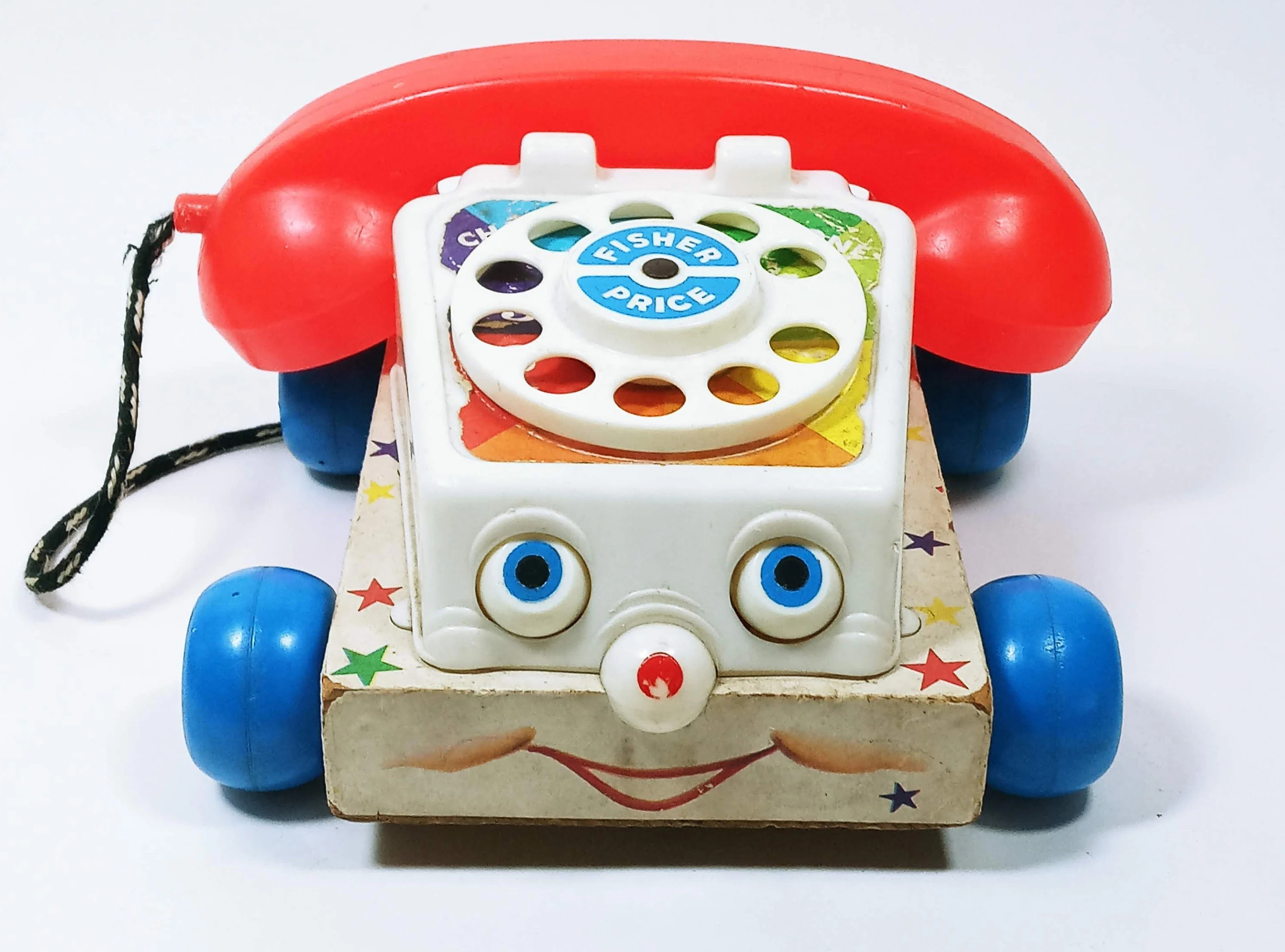
My memories of telephones when we lived in the Skyline exchange serving our Western Village neighborhood in Oklahoma City are limited to how my father had a separate “company phone” in his den that was tied into Cities Service Gas Company, and that I would yank my Fisher-Price Chatter Telephone into the room and jabber away, pretending I was taking care of important company business.

While I have always had a clear memory of the address of our home in Western Village, I had to look up our old phone number and its exchange.

SUnset-9

Our next stop was in Bethany, a town subsumed within northwestern OKC, while I was in the first through sixth grades. Our phone prefix changed from 751- to 789-, but I didn’t think of it as moving from the SKyline-1 exchange to SUnset-9.

I dimly recall a green rotary kitchen phone and that my parents had their own extension phone in their bedroom. It always took longer to dial the higher digits on a rotary phone, so I knew our number, which consisted entirely of phone numbers between 7 and 0, was something a business would have avoided if at all possible.

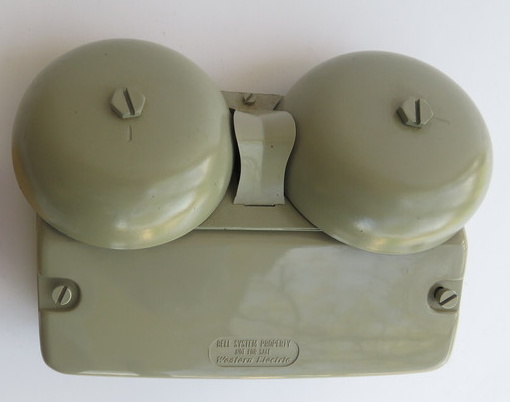
My father again had a company phone, which had its own bell installed under an eave in the backyard, ensuring he would hear it outside, since as a company executive he might need to deal with emergencies. It was important that natural gas service be maintained for multiple communities across several states, especially in the winter months.

Eventually, I was entrusted with updating my father’s company phone directory. That was a small binder with pages in different sections with company and staff phone numbers. Every month, updated pages would be provided and my job was to pull out the old ones and insert the new ones. I enjoyed what an adult would have found to be a tedious exercise.

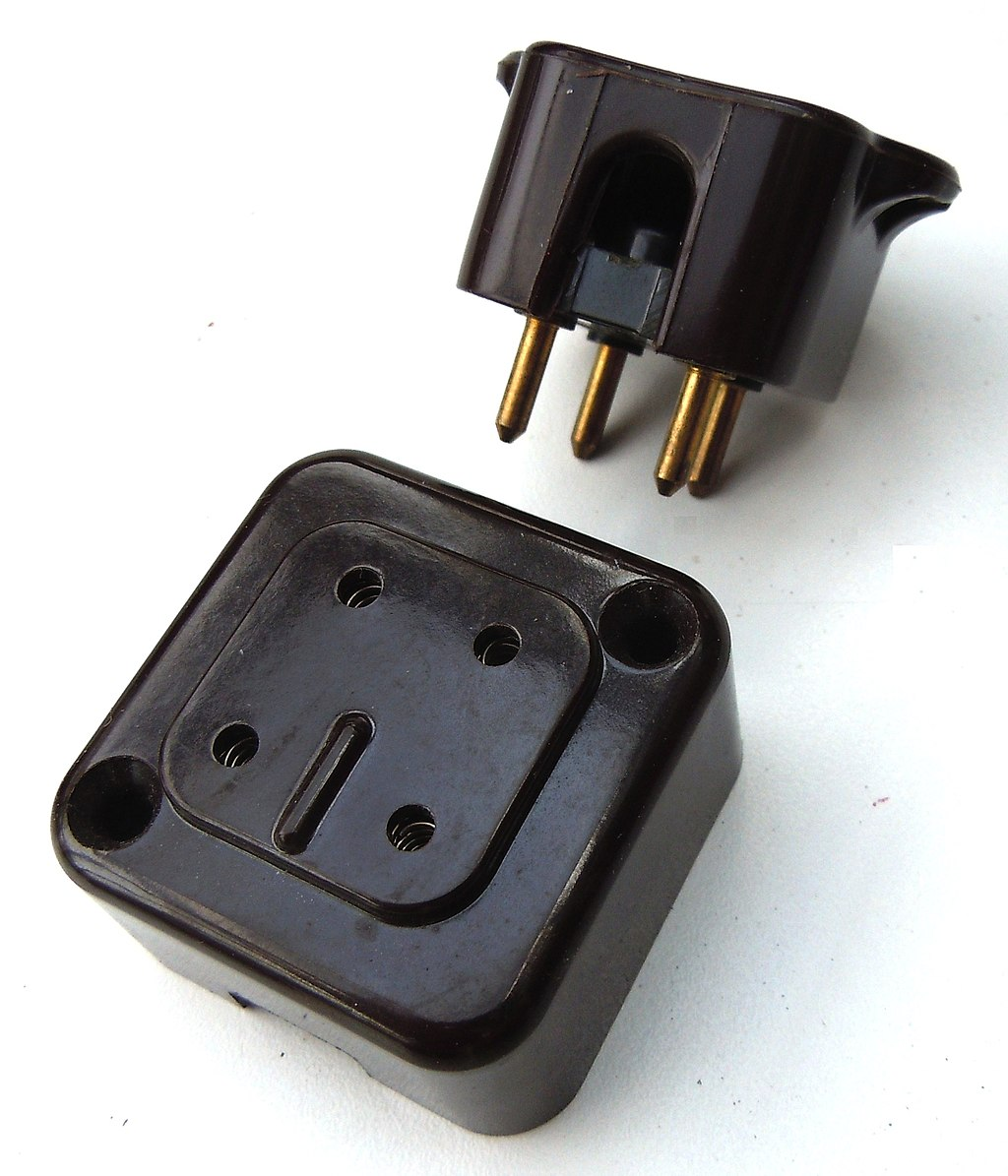
Bell System Type 404A jack and type 283B plug, circa 1960
RJ11 4P4C jack and plug

One other thing I remember about phone technology back then was that the wall plugs were not the modular RJ11 4-position 4-contact plugs of today but instead bulky things with four large prongs.

WIndsor-2

We moved again when I was entering junior high. Our new phone number began with 942-, and I soon realized that corresponded to WIndsor-2, which made sense because our new neighborhood was Windsor Hills. Some of the homes in the neighborhood with older lines were actually 946-, which matched up with WINdsor.

We felt pretty fancy when we upgraded to Princess Touch Tone phones

I associate our move to Windsor Hills with upgrading from rotary phones to Princess push-button ones with the mysterious * and # buttons. Eventually the * button became associated with various Custom Local Area Signaling Services, while the pound button (which some call hash, and the engineers originally called the octotherp) is still often used to indicate the end of a sequence of signals. While my parents paid to rent Princess phones with touchtone signaling, when premium signaling services like call waiting and Caller ID were rolled out, my folks declined.

The buttons lit up on our new phones, which required that each one be connected to an external electric transformer that plugged into a wall power plug, and the phones had a night light mode.

I got an extension phone in my bedroom. Throughout my childhood people would ask me for my favorite color, and I had settled on green, although I didn’t particularly care. So yes, I had a green phone. I found a 1978 photo of me proudly showing off my new phone, and I remember lying on the bed a few years later while on the phone for hours for many nights trying to puzzle through algebra homework with schoolmate Susan Plant.

In 1978 I got my own extension phone. Yes, there was an antique cash register on one side of my bed, and a bean bag chair in one corner of the room. Go figure.

Back then, you weren’t allowed to own your own telephone. You had to rent one from Southwestern Bell, although I noticed that at our vacation cabin in Missouri there was an old rotary phone even though we didn’t have a working phone line there. It had been left behind by the previous owners, and evidently the local phone company wasn’t too worried about it. Maybe it didn’t rent phones.

Long-distance phone calls were rather expensive before AT&T was broken up. I remember my father placing and receiving calls to relatives late at night at home. When we were at our cabin in Missouri, we would drive out to an old phone booth outside a general store some miles down the highway to make calls.

I would later experience that myself, and I remember fumbling with a card late on some cold winter nights at a phone kiosk so I could punch in a ridiculously long sequence of numbers to use a Southwestern Bell calling plan and talk to my girlfriend. I remember the cutting cold wind making me curse that they had taken out the phone booth and replaced it with a kiosk. Superman also found that change frustrating back in 1978.

Eventually my home phone became a Trimline model, but I found the buttons in the handset a mixed blessing.

In the early 1980s, the rental fee was $1.50 to about $5 per month depending on the type of phone. That finally changed in 1983, when the U.S. government broke up Bell Telephone into AT&T and various “Baby Bells” such as Southwestern Bell. Consumers in all parts of the country suddenly had the option to buy their own phone.

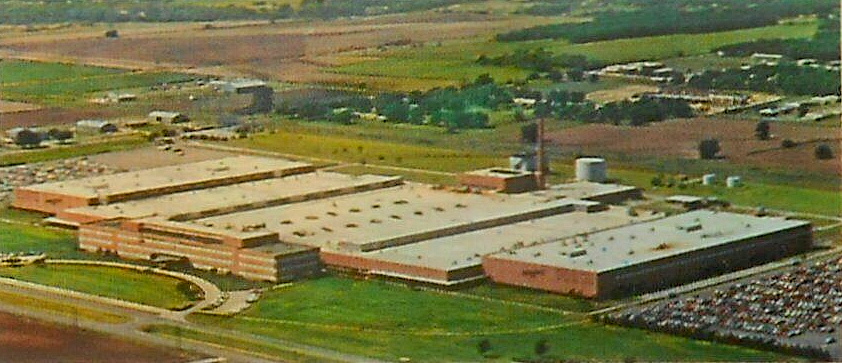
Before that, the Western Electric subsidiary of American Telephone & Telegraph was the primary manufacturer of equipment for the Bell System. One of my aunts worked at the big Western Electric plant in Oklahoma City, which made pay telephones and switching equipment.

One of my aunts worked at the big Western Electric plant in OKC making switching equipment

After the breakup

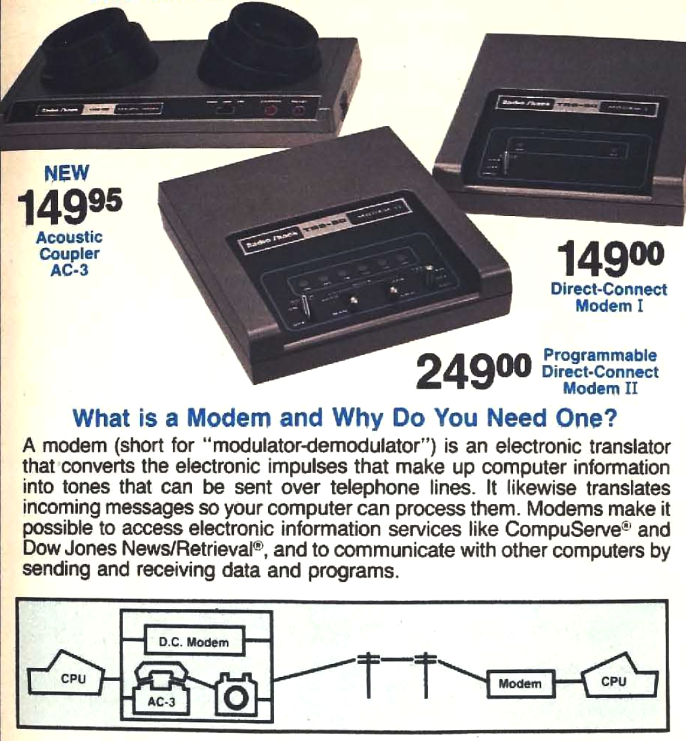
When I was in high school I did have my own phone line. That wasn’t for my privacy or convenience, but for my parents. I had a 300 baud Radio Shack modem with my TRS-80 Color Computer which I used to call electronic bulletin boards and early dialup services like Dow Jones and CompuServe. They didn’t want my long modem sessions to tie up the main house line.

I had the fancy Direct-Connect Model II that connected at a blazing 300 baud (sarcasm)

While living in Oklahoma City and then for a few of my first years in Bartlesville, I operated a computer-based bulletin board system that was part of FidoNet. To avoid any long distance charges, I programmed it with the codes of the telephone exchanges that were local calls, and that was probably the last time I paid much attention to phone exchanges.

Over the years I went through a multitude of modems to connect my personal computers to online services as baud rates increased from 300 baud to 56k. The sound of the connection handshake got longer and longer over time as different standards were implemented.

After the phone monopoly ended, my parents just purchased their existing Princess telephones from Southwestern Bell. When I moved to a dormitory at the University of Oklahoma, I went to the local Radio Shack and spent $100, which would be about $300 in 2024, on a fancy DUōFONE-140.

Initially, I placed that phone on my little built-in desk in the dorm, next to my 13″ Zenith CRT television. But after a month or so, I noticed the television picture had a color shift in one corner. The magnets in the phone were affecting the shadow mask and thus deflecting the electron beams. I had to move the telephone across the room and degauss the TV.

My favorite telephone was this model, but in white rather than black

Fascinated by technology, I later bought a couple of different cassette and later microcassette tape answering machines. I remember entering my different apartments, seeing the blinking red light on the answering machine, and wondering what message I would soon be receiving.

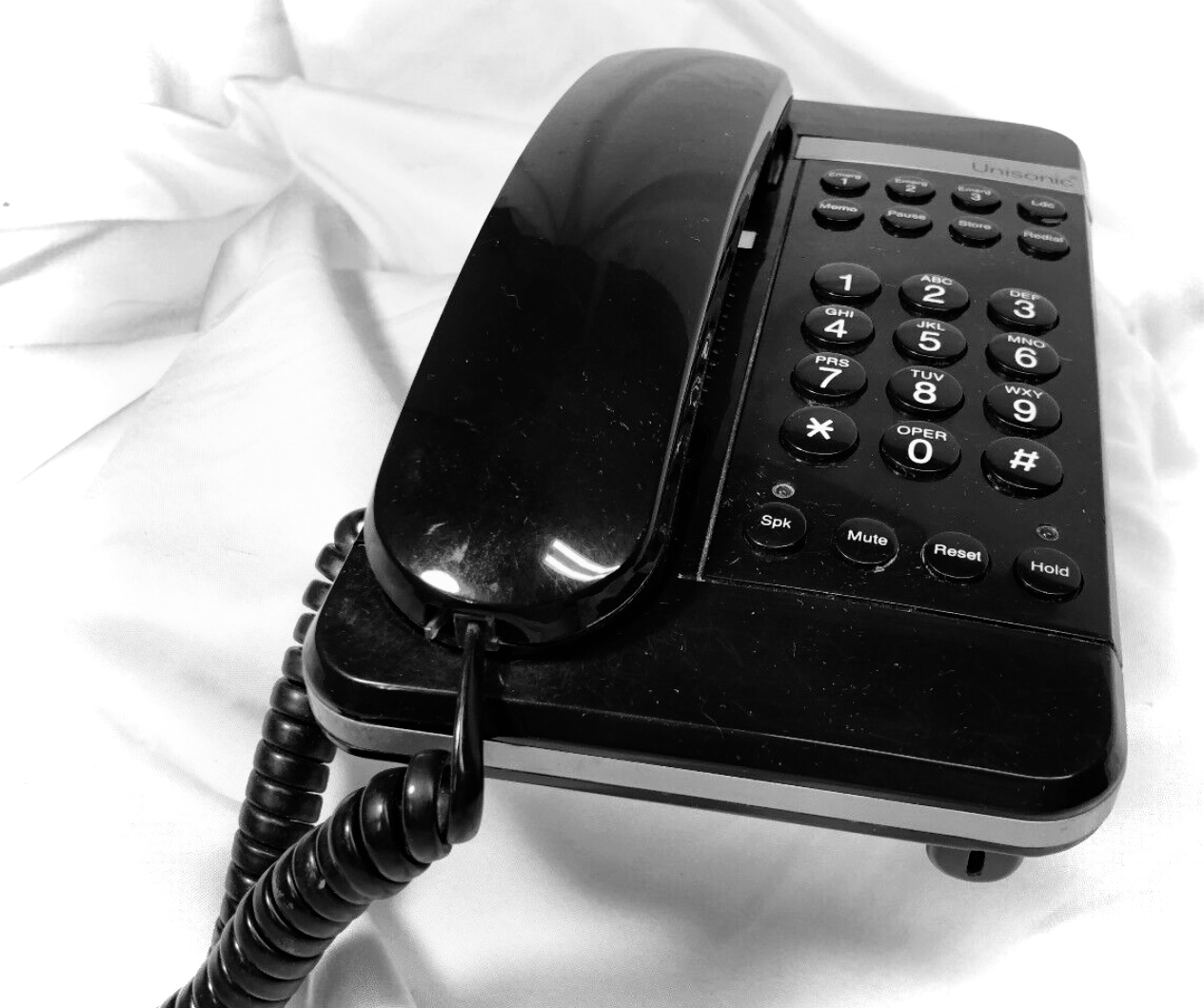
My favorite landline telephone was a Unisonic Model 9335, which had a particularly light, sleek, and comfortable handset and nice controls. I finally gave up on landline phones at home when I went fully cellular in May 2009.

The flip phone I used before getting my first iPhone in 2008

My early cell phones were flip phones and one of the Nokia “chocolate bar” phones, and their lack of full keyboards discouraged me from texting. That eased once I had an iPhone.

My last big involvement with wired telephones was reviewing and approving the purchase of a new internal phone system and handsets for the school district back in 2018. That system uses the Voice over Internet Protocol, not Plain Old Telephone Service. The only traditional landline phones we still have in the district are a single emergency phone in each school office and some lines for elevators.

In less than 20 months, I’ll be retiring. For the first time in my lifetime, after I turn 60 years of age I can expect to seldom interact with a wired telephone. Despite the nostalgia apparent in this post, that is one thing I shall not miss.

Posted in history, nostalgia, technology | Leave a comment

FEderal-6 and EDison-3

What do the song PEnnsylvania 6-5000, the book BUtterfield 8, and the movie Dial M for Murder have in common? All of their titles refer to telephone exchanges. Bartlesville only used exchange names in its phone numbers for about a decade, circa 1958 to 1968.

1907-1908 Bartlesville Directory advertisements with two and three-digit phone numbers

In the early days, there were so few telephone lines in smaller communities that phone numbers were just a few digits. The 1907-1908 Prewitt’s Directory for Bartlesville, Indian Territory, which was printed just before statehood, has phone numbers of two and three digits.

Telephone service in Bartlesville dated back to the late 1800s with an exchange above the Hull Drug Store on the south side of 3rd Street (now Frank Phillips Boulevard) between Johnstone and Dewey Avenues. It opened with three phones, which expanded to seven, and the bell was hooked to the bed of the operator. The first telephone operator was a Ms. Green, and many of the early phones were for doctors.

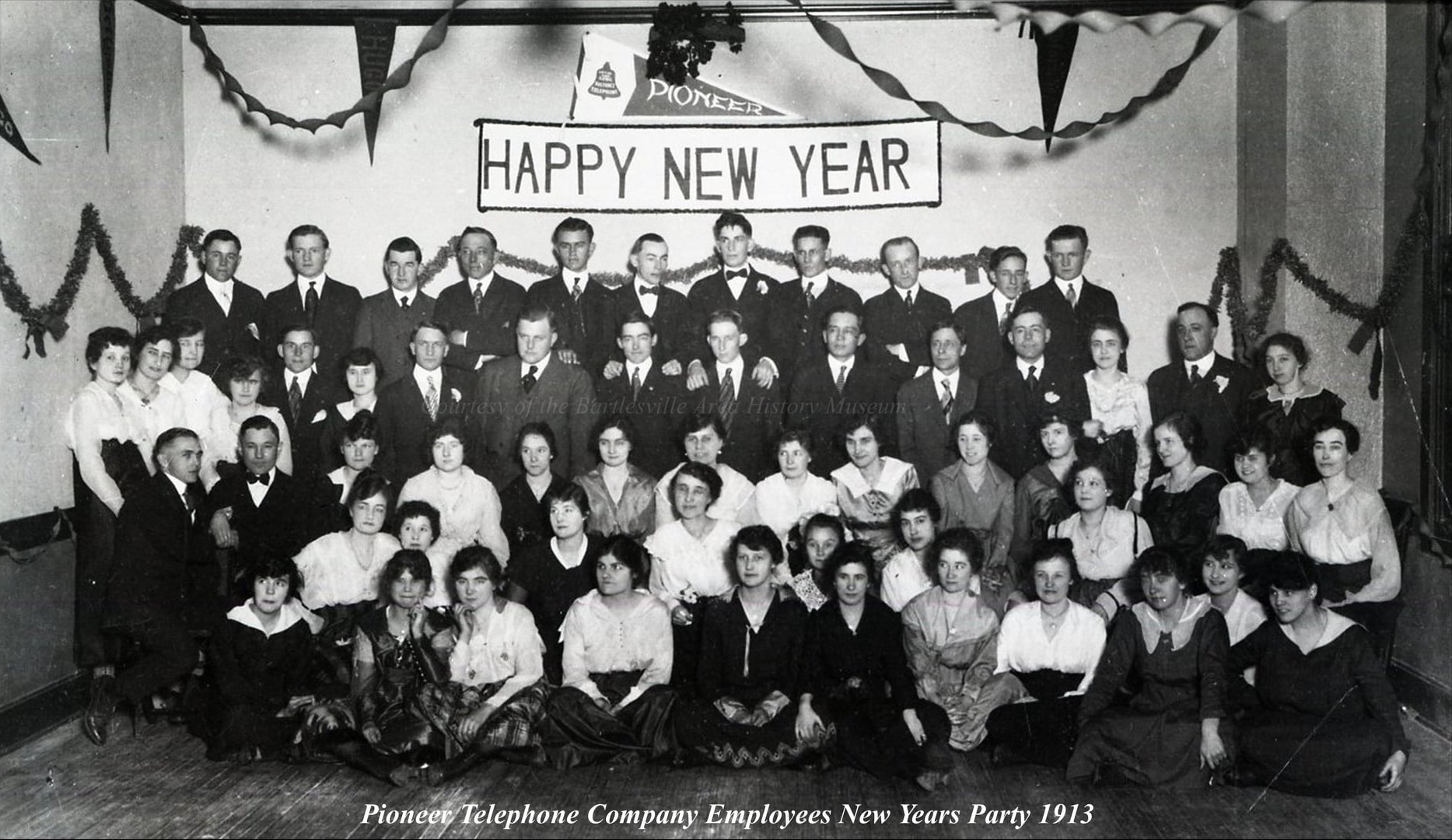
The Cherokee National Telephone Company established a Bartlesville exchange in 1901. In 1905 the Indian Territory Telephone Company had a copper line stretching from Bartlesville to Tulsa, and that same year the Cherokee National was purchased by Pioneer Telephone and Telegraph.

Bartlesville phone operators in 1906 [Source]
Source

As communities grew, phone numbers grew in length to where they would challenge the 4-9 digit short-term memory of a typical human being. So Bell Telephone started using telephone exchange names in locations needing over four digits. Those were memorable names assigned to a central office’s switching system. Usually the first two letters of the name corresponded to prefix digits in a two letters+five numbers format, although various combinations and lengths were in use in different communities.

BUtterfield-8 was a 1935 John O’Hara novel, and then a 1960 movie, in which BU-8, or 288, was the exchange for Manhattan’s well-to-do Upper East Side.

PEnnsylvania 6-5000 indicated 736-5000, which was the phone number for the Hotel Pennsylvania in New York City. Its phone number became the title of a swing jazz and pop standard of the Glenn Miller Orchestra.

As for Dial M for Murder, that was a 1954 Hitchcock film based on a stage play in which a scheming husband dials his home phone MAIda Vale 3499, or 624-3499, to awaken his wife and set in motion an attempted murder.

The rotary dial for a telephone was patented in 1892, with holes in the finger wheel introduced in 1904, but they weren’t common until the 1920s.

Area Codes

The popular culture references I cited all lacked something: an area code. That’s because at the time you didn’t need to dial an area code as part of a local phone number. In fact, Direct Distance Dialing, allowing one to make long-distance calls without the assistance of a human operator, didn’t begin until 1951, slowly expanding from New Jersey to become widespread in the 1960s as the system began to include automatic toll-switching centers, electronic switching systems, and automatic message accounting computers.

I’ve shown a page from the 1955 Bartlesville telephone directory with instructions on how to make a long distance call. You can tell they didn’t have Direct Distance Dialing yet!

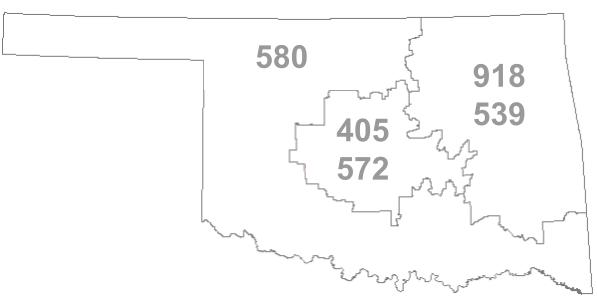
Oklahoma Area Codes as of 2021

The 405 area code had been established by AT&T and the Bell System in 1947 and covered the entire state of Oklahoma at that time. In 1953, the 918 code for northeastern Oklahoma was split off from 405. 580 for western and southern Oklahoma was split from 405 in 1997.

Until 2011, 7-digit local dialing was still possible statewide, but then 539 was added as an overlay to the 918 area code rather than doing a split. Having two area codes for the same geographic region forced a change to 10-digit dialing there, and that spread to the 405 area code region in 2021 when 572 was added as an overlay to it.

Pioneer Telephone

Oklahoma had 135 commercial systems and 63 incorporated phone companies at statehood in 1907. By 1912, Pioneer Telephone and Telegraph Company had 115 exchanges in Oklahoma, with 114,975 miles of aerial wire and 19,480 miles of underground wire.

I magnified one of the blue bells on the Pioneer building in downtown Bartlesville

The Pioneer Telephone Building still stands in downtown Bartlesville on the west side of Dewey Avenue north of 4th Street, with its distinctive blue bells on the pilasters. It was an early fireproof building in the city, erected just a couple of years before Southwestern Bell was formed in 1912 as a consolidation of the Southwestern Telephone Company of Texas, Louisiana, and Arkansas with the Pioneer Telephone and Telegraph Company, the Missouri and Kansas Telephone Company, and the Bell Telephone Company of Missouri.

Source

A few miles north was the small telephone office in Dewey. At one time, calling from Bartlesville to Dewey was a long distance call, something we struggle to imagine these days.

Source

Contrast that to the Bartlesville phone office in 1929, with over three times as many operators for local, toll inward, and outward stations.

Source

Back in 1954, Southwestern Bell had an open house at its Bartlesville office, inviting residents to come see the equipment in action, see a machine that “plays tick-tack-toe and never loses a game”, and see a demonstration microwave relay in which they could break the beam transmitting music with their hand and reflect it with a metal mirror.

I used to do a related demonstration when I taught Advanced Placement physics night lectures at Bartlesville High School. Instead of using a microwave transmitter and receiver, I would modulate a laser beam with the audio signal from my iPod or iPhone and aim it at a solar panel connected to an amplified speaker.

Before FEderal-6 and EDison-3

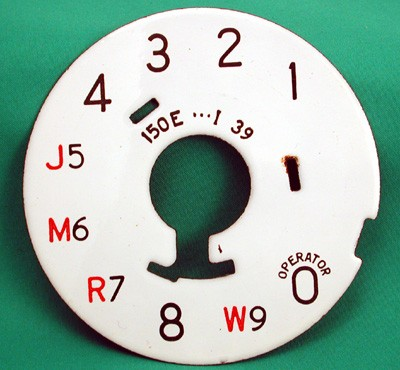
Back in the mid-1950s, Bartlesville did not yet use exchange names in its phone numbers, but it did have some numbers with party line suffixes. The 1955 city telephone directory is filled not only with three and four-digit numbers, but also four-digit numbers followed by the letter suffixes J, M, R, or W. Those indicate party lines, where multiple households shared a number. The suffix letters they used had been chosen to not be easily misheard when spoken.

1955 City Telephone Directory listings in Bartlesville, Oklahoma
Phone dial with party line letters
[Source]

Some dials back in the day lacked most of the letters, but still sported the letters needed to help you complete a party line call.

The concept of the party line was instrumental to the plot of another popular entertainment, the 1959 movie Pillow Talk, with Doris Day and Rock Hudson unhappily sharing a line.

Other phone number schemes were also in use. The same 1955 phone directory has two-digit numbers in Copan mixed in with longer sequences like 814-F-11 and 810-F-31.

Copan phone numbers in 1955

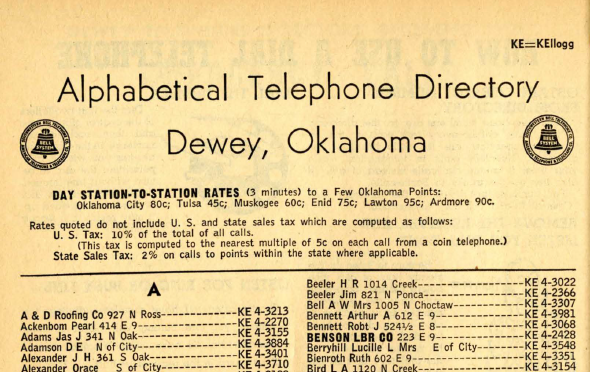
Dewey phone numbers in 1955 did use the exchange name system. They were all KE 4-#### or KEllogg-4 numbers.

Dewey phone numbers in 1955

A new building briefly brought FEderal-6 and EDison-3 to town

In 1957, Southwestern Bell constructed a $3 million Bartlesville office on the southwest corner of Dewey Avenue and 6th Street (now Silas Street). It was two stories with a basement, built such that a third floor could be added.

The ground floor had the big crossbar switching system and customer service, while upstairs was the microwave system and mobile phone equipment and operators. The basement had the test room, which could be used to determine if someone added an extra line without paying for it.

The microwave relay atop the Bartlesville phone building in 1968

That new facility also brought the use of seven-digit numbers with exchange names. Bartlesville started having FEderal-6 numbers associated with the west side of the Caney River and EDison-3 numbers on the rapidly expanding east side.

Witness the mix of FEderal, EDison, and Dewey KEllogg exchanges in a yellow pages listing for Cities Service gas stations in 1959.

Gas station listings in 1959 with phone exchanges

The use of phone exchange names in phone listings began to be phased out in the 1960s, so FEderal and EDison didn’t last very long in Bartlesville. I was assigned a 335-#### phone number when I moved to town in 1989, so I suppose I could have shared it as EDison5-####, but that would have elicited some stares and confusion.

Back then, the Bell Building next to the old Civic Center was still adorned with a large microwave antenna up top, hidden within a decorative shroud. That provided a wireless link to Tulsa, via a large relay antenna near Ramona, in case the regular lines were cut.

By 1968, 40% of all long-distance telephone traffic in the USA was carried by AT&T’s TD-2 microwave relay network, and it also carried 95% of the country’s inter-city television signals. The development of fiber optic cables and geostationary communications satellites eventually rendered the microwave relays obsolete, and in 1999 AT&T sold off the towers.

Nortel DMS-100 telephone switches were released in 1979 and can control 100,000 lines

They removed the KKB56 microwave antenna from atop our local phone building some years ago, and nowadays far fewer employees work in the building, which the internet indicates is still equipped with Ribbon/Genband/Nortel DMS-100/200 switches but has no public office.

There was a time when you had to dial 1 before a number to signal to the routing system that a call would be going outside the area code. But that is pretty much obsolete in the USA these days, at least when using a cell phone.

Landline Decline

Marshall McLuhan advised: “Obsolescence never meant the end of anything, it’s just the beginning.”

In 2007, I finally cancelled my old-style landline phone, briefly switched to Vonage, and then I went fully cellular in May 2009. So I said goodbye to the old EDison exchange and, since my original cell phone was with U.S. Cellular, joined the 440- exchange. I left U.S. Cellular a few years later, when I purchase my first iPhone, as AT&T was the only carrier for the iPhone at the time. But number portability meant I was able to remain with my old number in the 440- exchange. When my wife bought her first iPhone years later, it was through AT&T and that put her in the 766- exchange along with other new AT&T accounts. Thankfully our marriage has survived our being in different telephone exchanges, something that would have been more challenging in the old landline days.

When I gave up my landline, only about 1 in 5 adult Americans had only cell phones. That has increased to well over 70% in 2024.

Source
1966 OKC telephone book

So most homes no longer have landline telephones. When I was young we would receive an immense phone book each year in Oklahoma City. My mother would keep it on one of the seats at the dinner table to boost me up so that I could eat more comfortably. In the 1970s, it expanded into two separate books, each several inches thick, one with white paper phone listings and another with yellow pages of business listings and advertisements. When I moved to Bartlesville, the thinness of the local telephone book was only one of several lifestyle changes. The latest phone book was left beside our mailbox the other day, and it sure seems like a relic.

But time marches on, and now when we “reach out and touch someone”, most of us do that wirelessly and give little thought to an old meaning for “exchange”. In 2024, AT&T announced that by 2029 it would abandon landline service across 20 states, including Oklahoma.

Posted in history, nostalgia, technology | 1 Comment

The Worried Man of Delos

Over 2,000 years ago, someone sculpted a full-length lifesize bronze statue of a man on the Greek island of Delos. Such works cost about 3,000 drachmas — the equivalent of two years’ salary for a rich citizen.

Only about 200 of tens of thousands of such bronze sculptures crafted by Hellenistic artisans survive. Centuries of tarnish have given them dark mottled finishes, but when first minted they would have approximated the color of a tan Greek, with eyes of glass and colored stone, fringed with delicate bronze eyelashes.

Most of the sculptures have lost their lifelike eyes in their struggle against time, buried in sand or sea or ash. Yet this gaze endured.

In 1912 this head was unearthed at the Granite Palaistra, a training ground for athletes. It likely belonged to an honorific statue of a citizen, and antiquities experts say his expression was likely meant to portray civic devotion.

“The face is showing what he’s being honored for — the zeal, attention, care, and energy he’s expended on behalf of his fellow citizens,” shared Jens M. Daehner, a curator at the Getty Museum.

Nevertheless, we know him as the worried man of Delos.

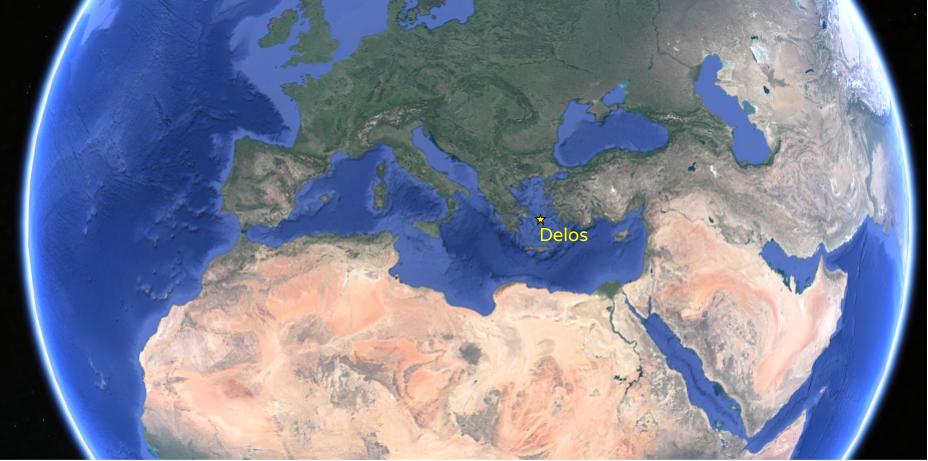
Delos is a tiny island, only a bit over one square mile in area, that was a cult center for the gods Dionysus and Leto. A Greek saying was “ᾌδεις ὥσπερ εἰς Δῆλον πλέων” meaning “you sing as if sailing into Delos” when someone was in a happy and light-hearted state.

But it is never that simple, is it?

When this statue was sculpted in the 100s BCE, the Romans had converted Delos into a free port, and it had become the center of the slave trade. Roman traders went there to purchase tens of thousands of slaves captured by Cilician pirates or abducted in the wars following the destruction of the Seleucid Empire.

It wasn’t long before trade routes changed, and Delos entered a sharp decline before the end of the first century BCE. It was attacked and looted by Mithridates, the King of Pontus, in 88 BCE and again by pirates in 69 BCE. By the second century of the Common Era, the traveler and geographer Pausanias noted that Delos was uninhabited save for a few sanctuary custodians, and six centuries later Delos was entirely abandoned.

We cannot know what our worried man was actually thinking or feeling amidst a prosperous time, but his expression mirrors my own at this point in the evolution of the constitutional republic I was fortunate enough to be born into.

He lived in the time of the Roman Republic, which began with the overthrow of the Roman Kingdom centuries earlier. That Republic was in a state of near-perpetual war, and in its last century was torn by civil strife, attributed by the ancients to moral decay from wealth and the hubris of Rome’s domination of the Mediterranean.

Modern sources cite its destruction to wealth inequality and a growing willingness by aristocrats to transgress political norms. Sound familiar?

Of course the Roman Republic later fell, to be replaced by an authoritarian Empire. That brought 200 years of relative order, economic prosperity, and stability, at the price of near-absolute rule by a series of emperors.

The last of Rome’s “Five Good Emperors”, Marcus Aurelius, wrote in his personal journal: “Never let the future disturb you. You will meet it, if you have to, with the same weapons of reason which today arm you against the present.”

I am armed by reason, comforted by experience, and counseled by patience. Yet my gaze is pensive.

Posted in art, politics | Leave a comment