Redwoods Trip III: Stout Grove

June 4, 2024 | Photo Album

We got around early on our third morning of the vacation so that we could reach the Stout Grove of redwoods before it became crowded.

The Stout Memorial Grove is in the heart of Jedediah Smith Redwoods State Park in northern California. The 44-acre grove has many 300-foot tall trees. It was donated to the Save the Redwoods League in 1929 by Clara W. Stout, the widow of lumberman Frank D. Stout, in memory of her late husband.

I remembered from my visit in 2006 that to reach the grove from the east, before you reach Hiouchi you have to exit the Redwoods Highway onto the long, winding, narrow, and mostly unpaved Howland Hill Road. I remembered it had frequent turnouts, so I wasn’t too concerned about taking our large rented GMC Yukon Denali SUV on it so long as we beat the crowds.

Map of Stout Grove
Stout Grove trailhead traffic on Tuesdays

Google Maps told me that visits to the trailhead pick up after 10 a.m. So we headed out at 6:15 a.m. from Rogue River and made it, after a few restroom stops, to the trailhead just before 9 a.m.

There were only a few vehicles at the trailhead when we pulled in, but by the time we left about an hour later, all of the parking spaces were taken with some vehicles parking in pullouts along the branch road off Howland Hill Road.
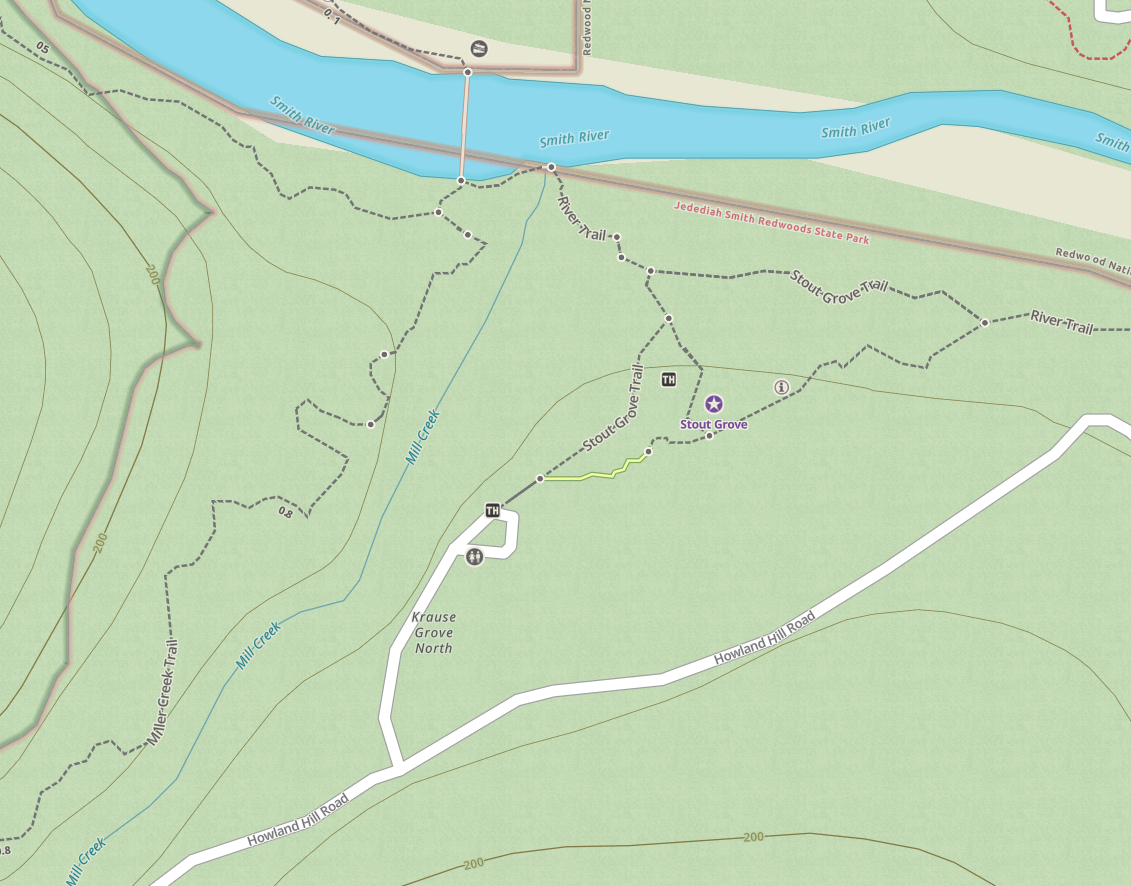
We walked the Stout Grove trail loop in less than an hour

The weather was perfect, sunny but cool and comfortable, as we walked the loop.

Stout Grove

Wendy was a bit surprised at seeing redwoods so early in our trip.

Wendy at Stout Grove

She told me it had been a 40-year-wait for her to get to see them.

Wendy at Stout Grove

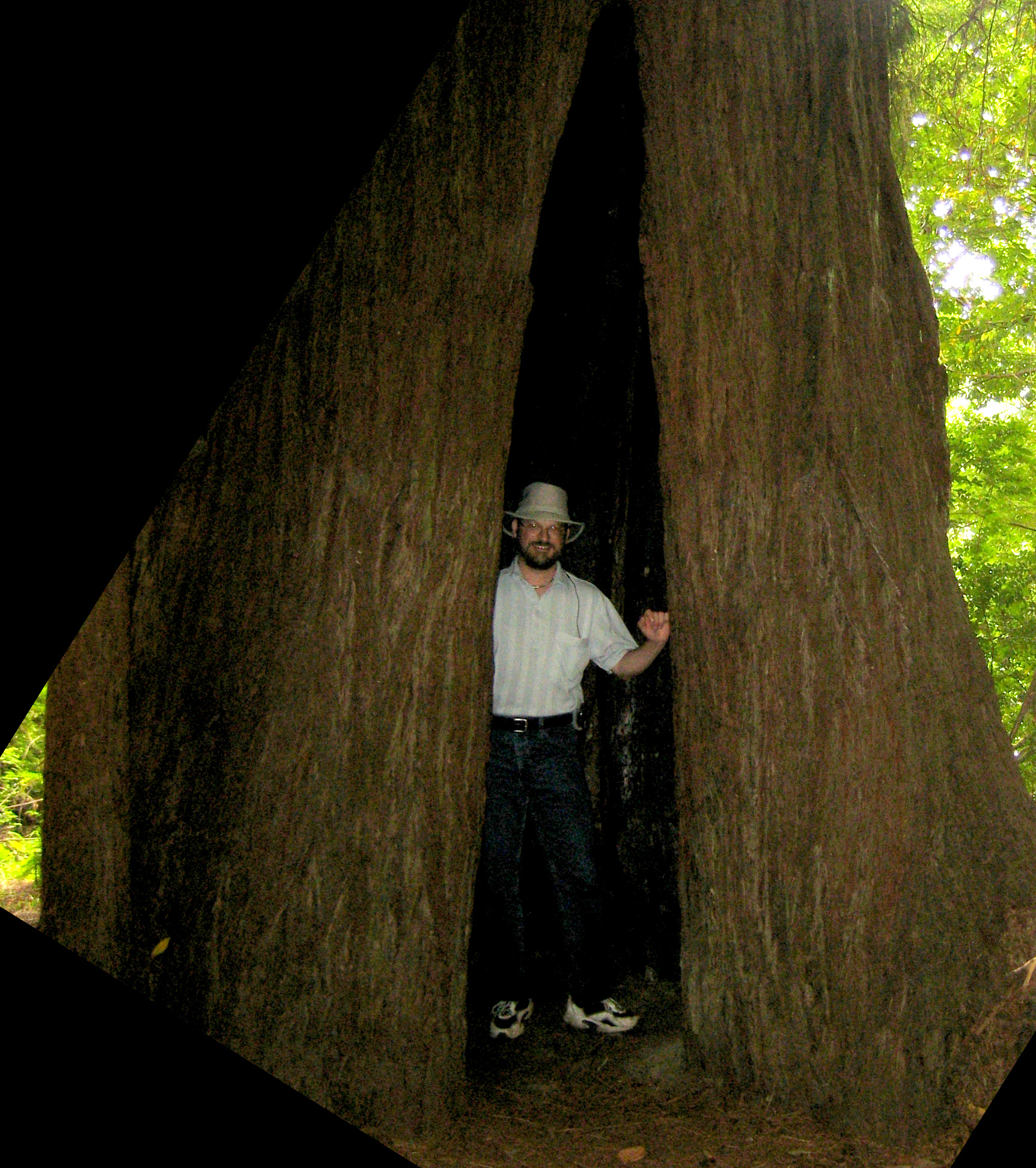
Wendy got a shot of me inside the same tree I had ducked into back in 2006. This time the camera wasn’t sitting on a nearby log, which had caused a severe list.
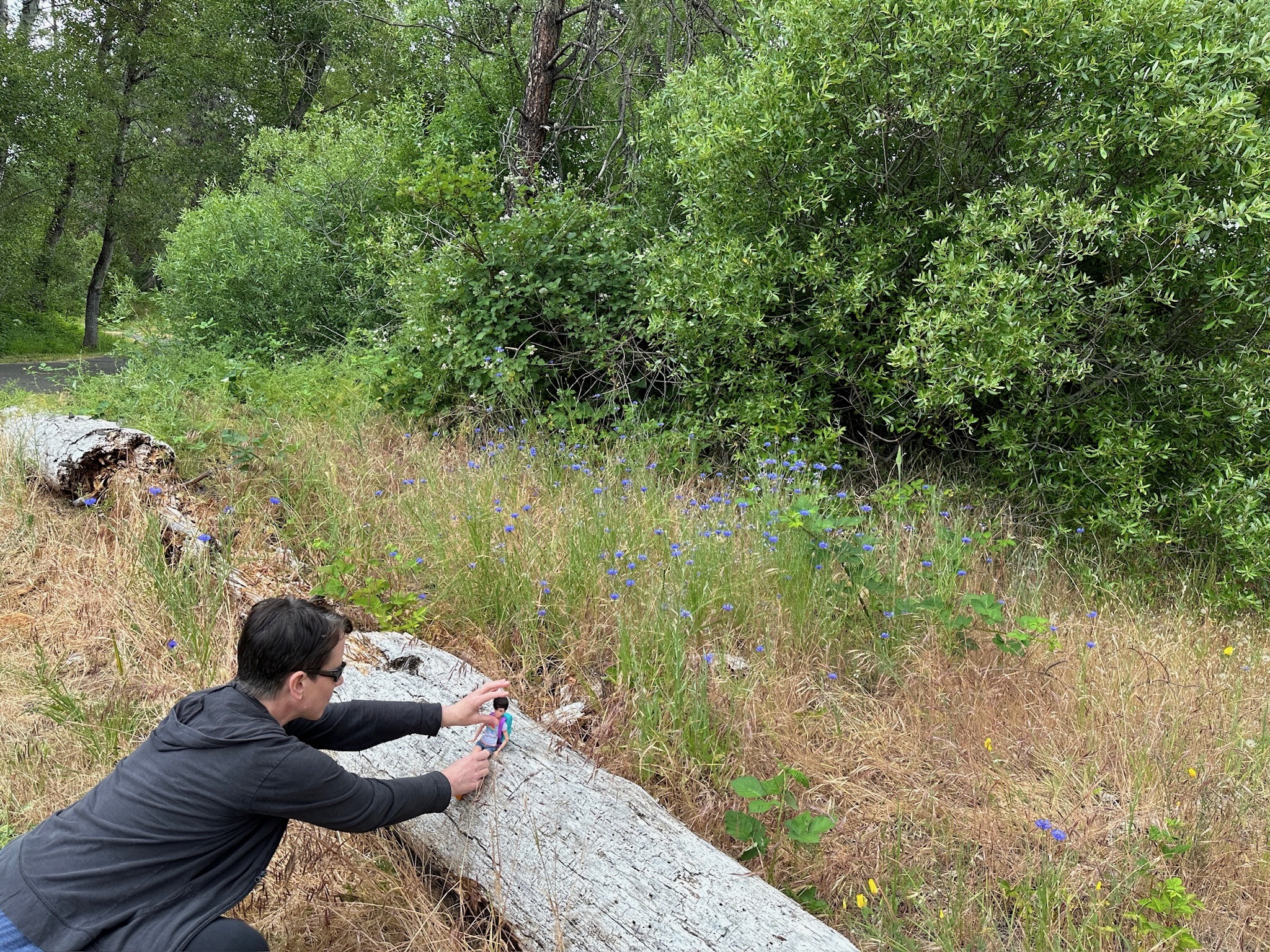
She had fun posing Barbie by one of the huge trees, and it took a video to provide scale.

Wendy posing Barbie
Wendy poses Barbie by one of the immense trees at Stout Grove

We ourselves were dwarfed by the giants. Pictures of the redwoods can be tricky. If you don’t have a person in the shot, your sense of scale tends to be WAY off.

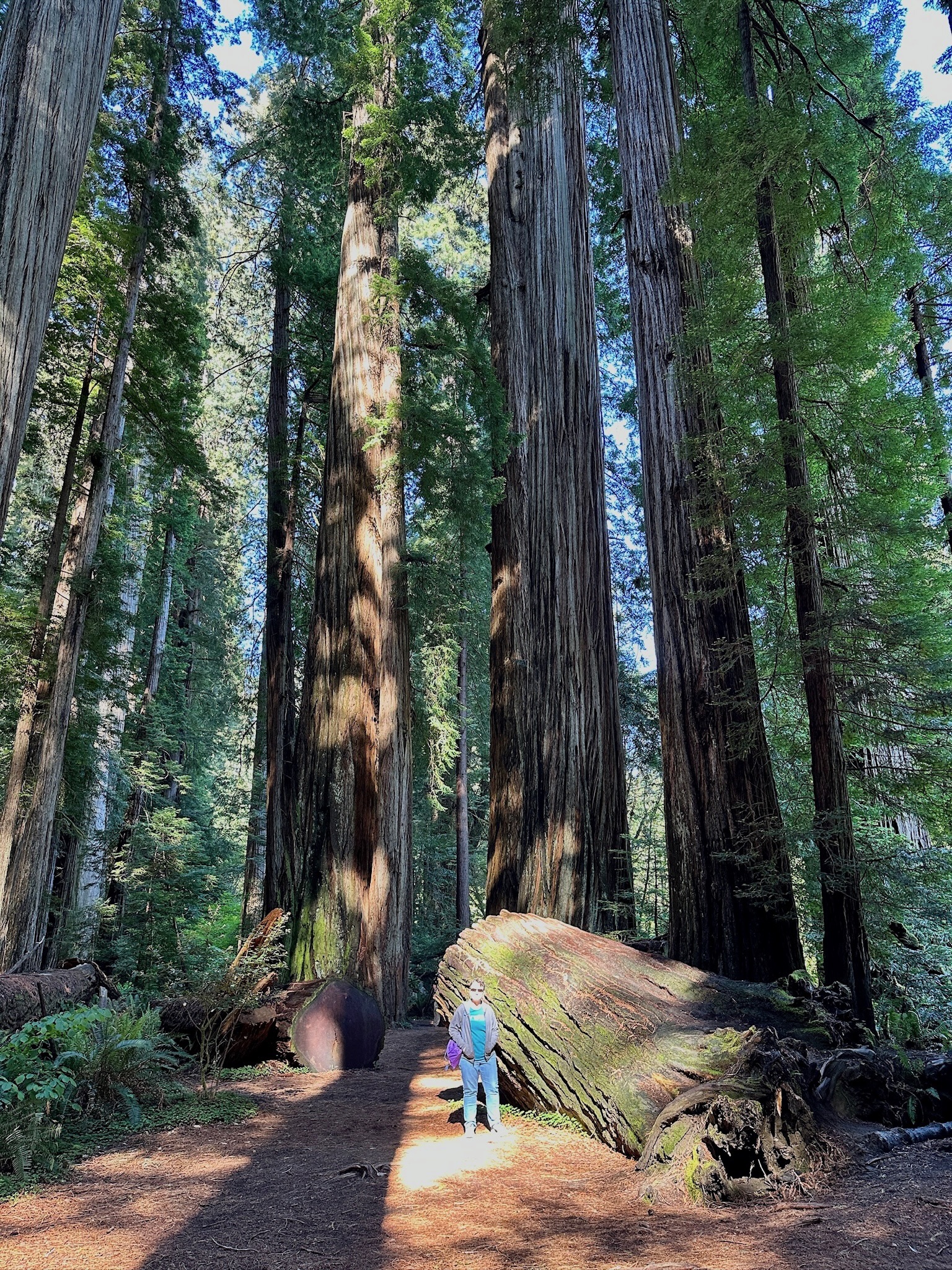
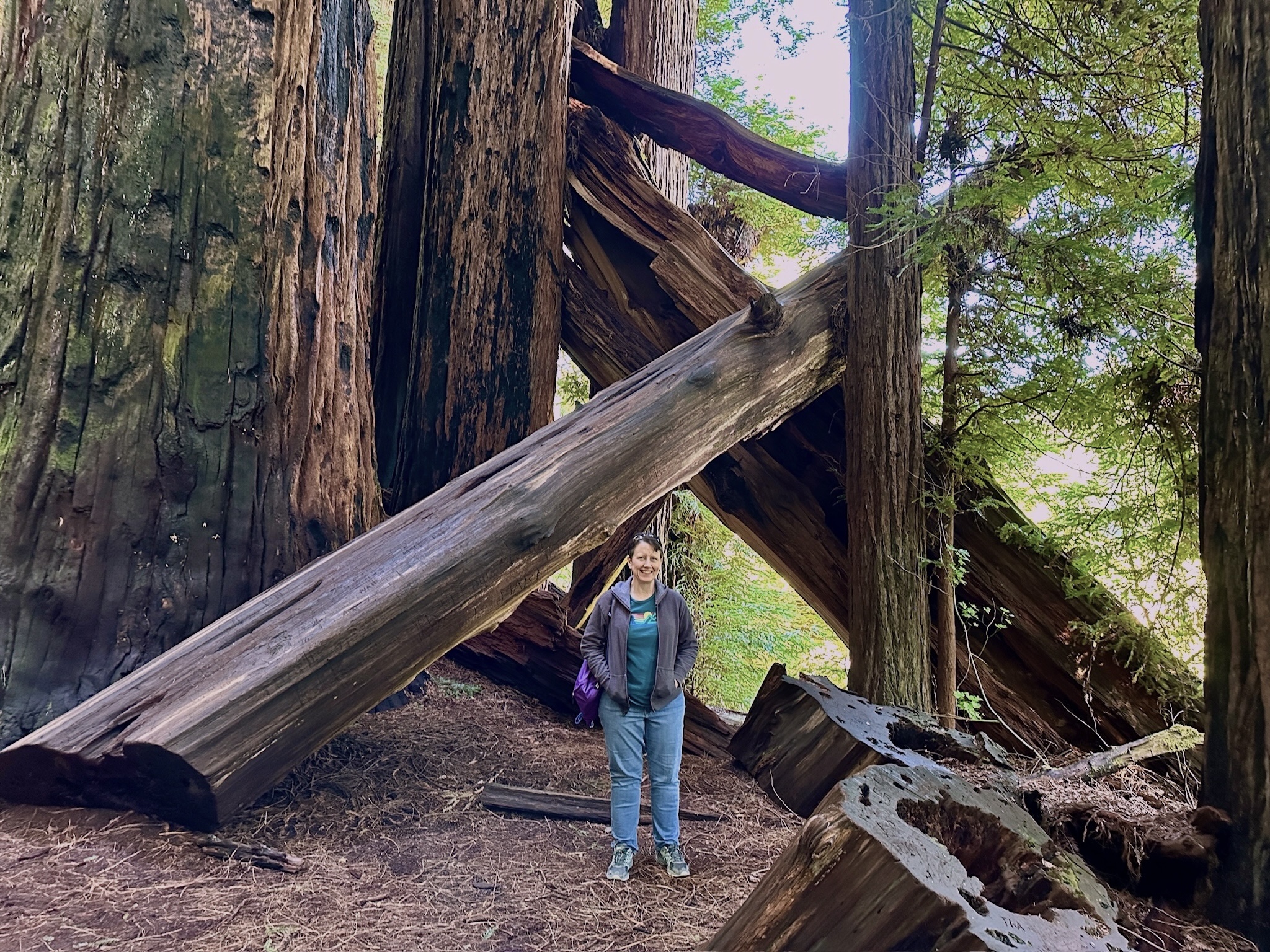
I remembered the diagonal fallen trees at one point along the loop, and this time was glad to have Wendy pose to provide scale that was lacking in my shot from 2006.

There were lots of photographers along the loop, shooting the trees in the morning light.

Photographer
One of several photographers we saw along the loop

Wendy had me pose by one of the fallen giants.

Granger at Stout Grove

A ranger was on hand to take photos, and shared with us how there were scorch marks on one of the big trees, yet there was no record of a fire in that area for over four hundred years, illustrating their immense age. The tallest tree in the grove is 342 feet high.

Wendy and Granger at Stout Grove

Since we had no problems navigating the first part of the six-mile Howland Hill Road, I opted to take it the rest of the way to Crescent City on the coast. It was once a stage coach road linking the Pacific Ocean harbor of Crescent City with mines in southern Oregon and weaves among the immense trees.

Road into Redwoods
Howland Hill Road

The road was surveyed by J.S. Howard in 1881 and in 1887 the Del Norte Board of Supervisors hired brothers Nels and Soren O. Christensen to build it. Redwood slabs or puncheon were added to the road in 1888 and 1892 during the “plank road” era.

Roads were often paved with redwood planks in segments in the redwood forests or where the soil was soft. Otherwise, wagon wheels dug beneath the surface of the powdery forest soil and became stuck. The road was graded and then the planks, called “puncheon,” were laid on top with dirt solidly packed between. The road was excellent as long as the packing remained in place. Winter rain, however, often washed dirt away, and water collected under the puncheon. As the vehicles drove over them, muddy water squirted up. In summer, dust on these roads was thick, with clouds trailing the stages through the woods. Vegetation along the sides was coated for months with a thick layer of road dust, and passengers often arrived at their destination coated in dust.

Howland Hill Road Map

One stage coach made the roundtrip between Gasquet and Crescent City every day, while another carried mail. Wagons hauling equipment to mining areas often were pulled up Howland Hill with six-horse teams.

Sunset Telephone Company ran a line parallel to the road in 1897, and the first car drove over the road in 1904. Jack Williams, a resident of Grants Pass, purchased a “White Steamer” and took delivery of it in Crescent City where it was unloaded from a ship. He managed to get over Howland Hill Road, but the rest of the journey was too much for his car. The trip almost shook the car to pieces, and it had to be hauled home on a springless lumber wagon to be repaired at a blacksmith shop.

Even today, US 199 from Gasquet to Idlewild is quite narrow and winding, with me glad to have had lane guidance for the GMC Yukon Denali while traversing it. I was patient with a guy hauling a recreational travel trailer; negotiating that combination around the narrow curves would be nerve-wracking.

US Route 199

In 1916, the Board of Supervisors hired contractors to improve Howland Hill Road for cars and remove the puncheon from it. The road was in active use for about 40 years as a link between Crescent City to Gasquet on the Smith River.

The Redwood Highway, now US 199, opened in 1926, bypassing Howland Hill Road, so Howland Hill has seen only minimal improvement since then. Thus it is one of the few popular scenic roads that still retain the feeling and character of travel on a dirt road from the 1920s.

Stout Grove was the first one donated along Howland Hill Road in 1929. The last of the redwood groves along the route was purchased and donated to the State of California in 1949 with funds raised by the Garden Club of America, the Daughters of the American Revolution, and thousands of other donors for a memorial grove for fallen soldiers of World War II.

I enjoyed driving the rest of Howland Hill Road into Crescent City, where we would have time to enjoy the seashore before heading south to more redwoods.
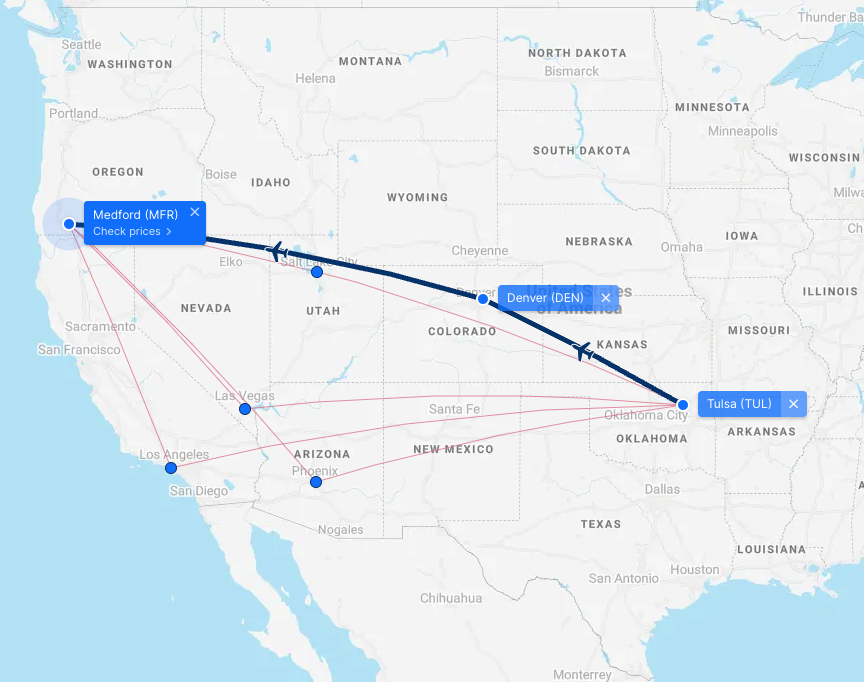
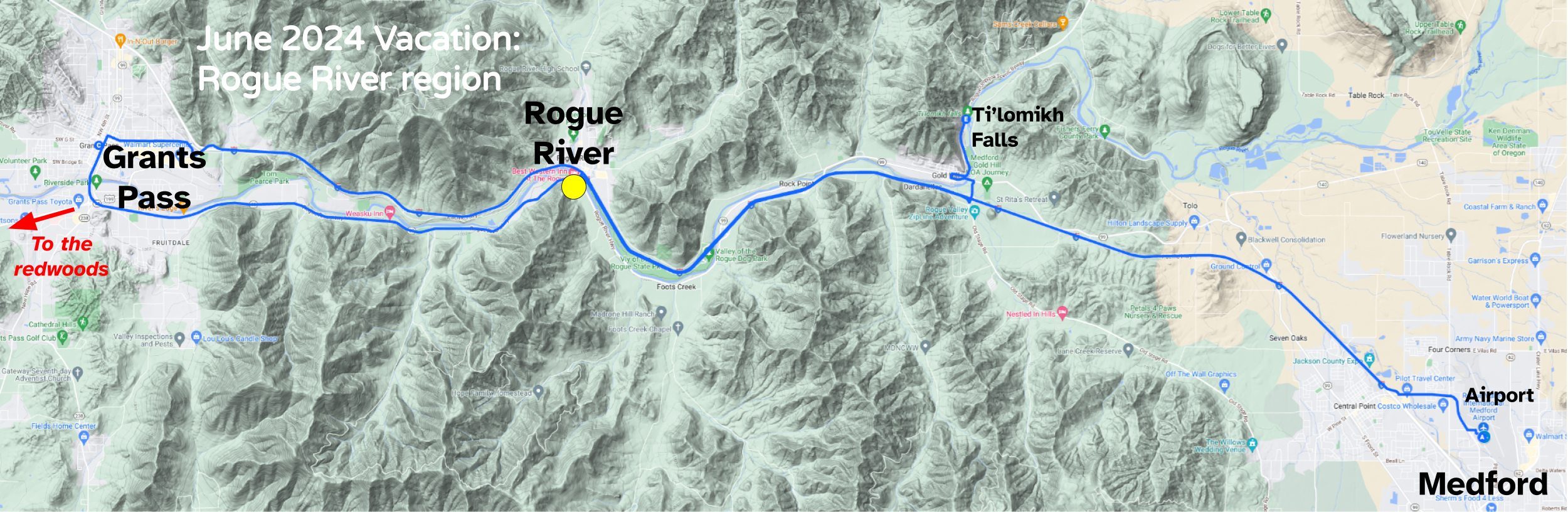
Photo Album | < Redwoods Part II | Redwoods Part IV >

Posted in day hike, history, photos, travel, video | Leave a comment

Redwoods Trip II: Rogue River

June 2-3, 2024 | Photo Album

We flew from Tulsa to Medford, Oregon by way of Denver. Our flights were easy and went well. The Rogue Valley International-Medford Airport is relatively small, with a 110,000 square foot terminal building that served over one million passengers in 2018. For comparison, Tulsa International Airport serves over three million passengers per year, and the immense Denver International Airport served almost 78 million passengers in 2023.

Wendy enjoyed the enchiladas she was served on the flight from Denver to Medford, while I was unimpressed with my brisket and the Dark Chocolate + Sea Salt Crisps by Undercover Snacks, but we had great service on all of our flights.

We loaded our rented GMC Yukon Denali SUV and headed along Interstate 5 to Rogue River, a town of 2,400 along the eponymous river which is known for salmon runs, whitewater rafting, and rugged scenery.

We exited the interstate and crossed the river on the Depot Street Bridge of 2006 to check into the Best Western Inn at the Rogue for a couple of nights. Dinner was at BeeGees Diner in the town across the river, where we were entertained by recordings like Red River Rock by Johnny & The Hurricanes.

Rogue River
Depot Street Bridge across the Rogue River; our hotel was the larger building with a dark roof; the town was on the opposite side of the river

After filling up on diner food, we returned to the river to walk along the Rogue River Greenway Trail, which is tucked between Interstate 5 and the north bank of the Rogue River. Organizers hope to eventually use it to link Grants Pass to Central Point just north of Medford.

The walk was most welcome after two flights and a meal. Wendy had fun posing her Barbie along the trail.

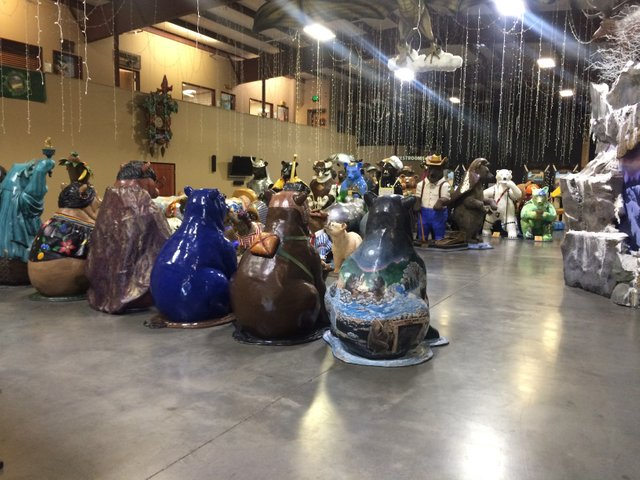
Bear Hotel warehouse in Grants Pass

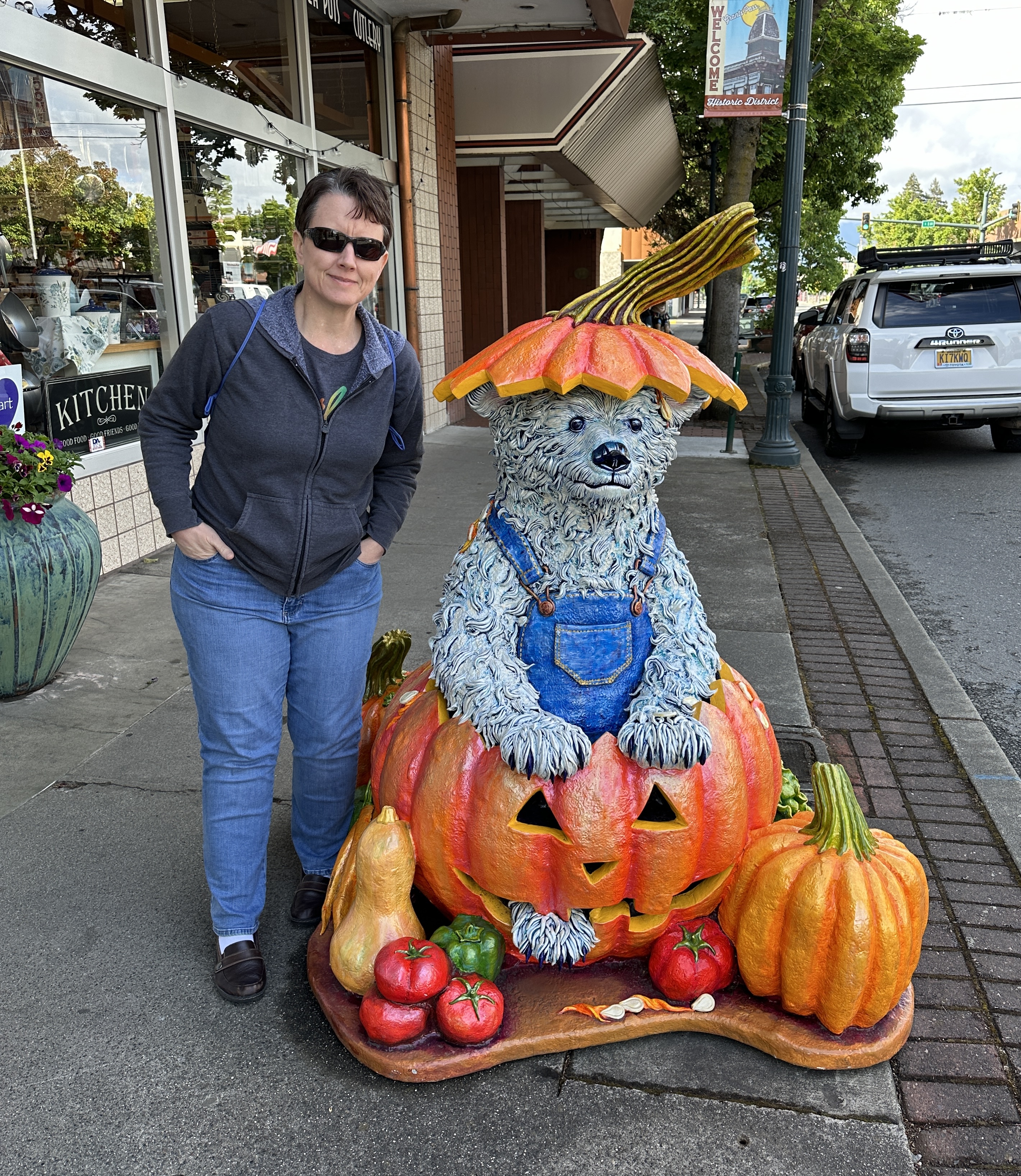
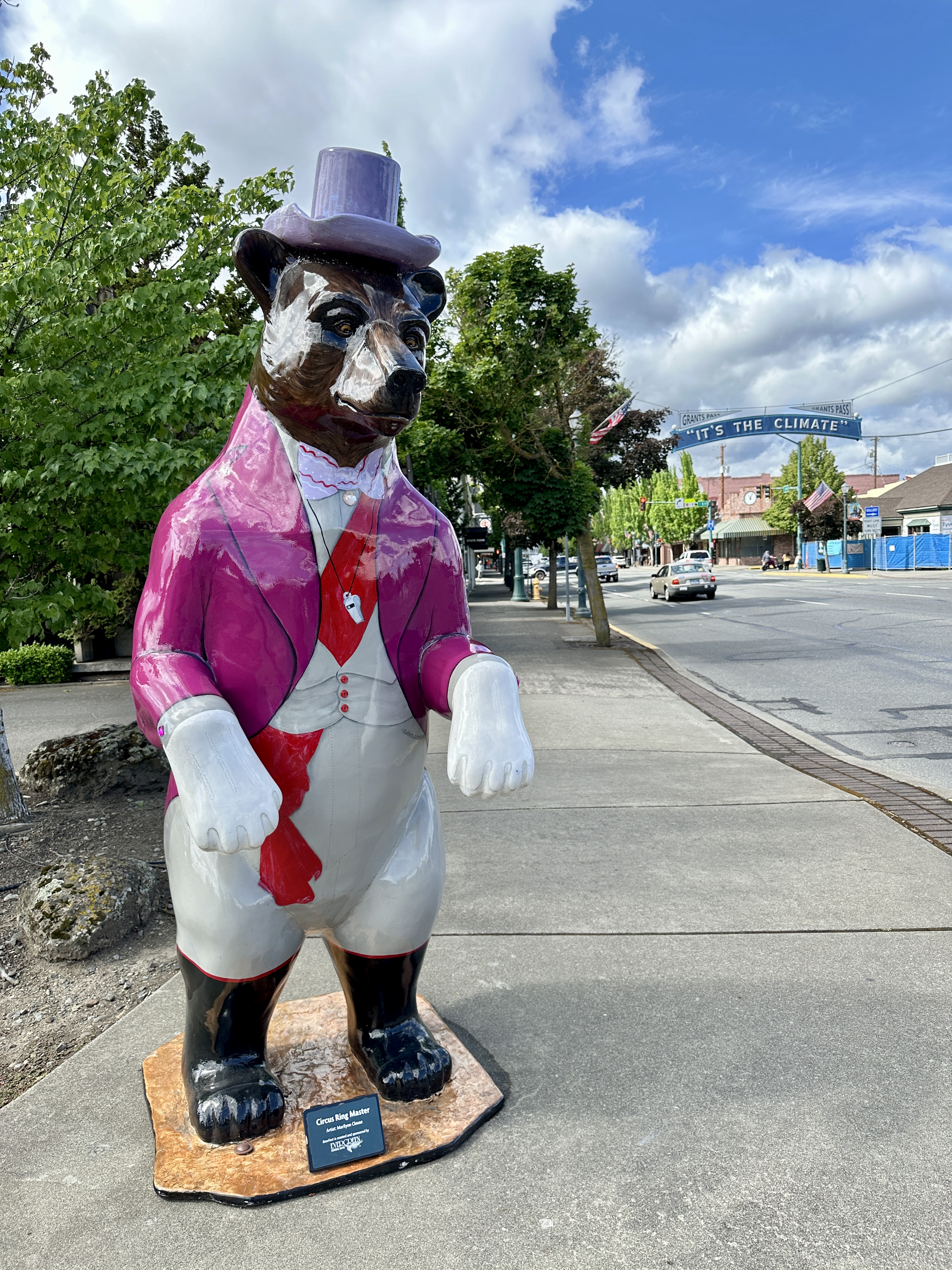
The next morning we returned to BeeGees Diner for breakfast, including an immense cinnamon roll. We drove west along state highway 99 to Grants Pass, which is similar in size to Bartlesville. While Bartlesville has over 30 fiberglass buffalo statues scattered across town and decorated by various groups, Grants Pass has a collection of various fiberglass bears that are stored in winter at a “Bear Hotel” warehouse and deployed on the downtown sidewalks in summer.

We strolled around the historic district, enjoying a Halloween bear, Carmen Bearanda, and the Circus Ring Master.

The Redwoods Hotel, also known as the Redwood Towers, is a historic six-story hotel building in Grants Pass. Built in 1926 of reinforced concrete with cast concrete ornamentation on its front facade, it was built as an expansion of the adjacent 3-story brick Josephine Hotel and originally contained 45 hotel rooms with retail space on its first floor. The old Josephine Hotel was completely gutted by fire in 1975 and was razed. After the fire, the owners of the Redwoods Hotel made the decision to convert its upper floors to office space. Artist John Michener created a trompe l’oeil mural on one side wall, remembering the Hotel Josephine.

Redwoods Hotel
Redwoods Hotel trompe l’oeil mural

We were in town too early for most businesses to be open, but Wendy did get to check a thrift store for Barbies, and we picked up some supplies at a Safeway store before returning to our hotel via the interstate. I was fatigued in the early afternoon, which I blame on Metoprolol slowing my heart rate. I’m hoping that a third blood pressure medication I am now on might eventually enable me to stop taking Metoprolol.

I wasn’t going to let my fatigue rob us of the chance to see the Rogue River up close, so later in the afternoon we ventured eastward along the interstate to Gold Pass to walk at Ti’lomikh Falls on the Rogue.

Near Ti'lomikh Falls on the Rogue River
Near Ti’lomikh Falls

They are a series of whitewater cascades popular with rafters. The Takelma people, meaning “People of the River”, once had a village there. They were relocated to a distant federal reservation in 1856, with their homelands taken over by miners and settlers.

That halted their annual Salmon Ceremonies, but Frances Harvey Johnson (1844-1934) had participated in the ceremonies as a child and at age 89 accompanied linguist John Harrington on a field trip to her homelands. She showed him where their village had been, and the “Story Chair” next to the falls where generations of Takelma tribal elders had awaited the arrival of the Chinook salmon. In recent years, Steve and Mary Kiesling co-hosted revived Salmon Ceremonies on their property by the falls and created a scenic overlook by the falls.

There was an eight-foot-high concrete dam spanning the Rogue River there from the 1940s until 2008, creating the second greatest barrier to fish passage in the Rogue River basin. Migrating salmon passed into a diversion canal, where some were trapped or injured. Thankfully the City of Gold Hill constructed a new municipal water supply, allowing for the removal of the dam. In 2010, a higher barrier dam farther upriver was also removed.

We enjoyed walking along the west bank of the river by the falls.

Ti'lomikh Falls on the Rogue River

Then we drove over to the scenic overlook on the opposite side of the river.

Ti'lomikh Falls from the scenic overlook
Ti’lomikh falls from the scenic overlook on the east side of the river

We spent a second night at Rogue River, planning to rise early on the next morning to head to the redwoods in nearby California.

Photo Album | < Redwoods Trip I | Redwoods Trip III >

Posted in day hike, photos, travel, video | Leave a comment

Redwoods Trip I: The Plan

Wendy wanted to see the redwoods. So for our annual June vacation, I looked into returning to northernmost coastal California, where 18 years earlier I had walked among the tallest trees on Earth.

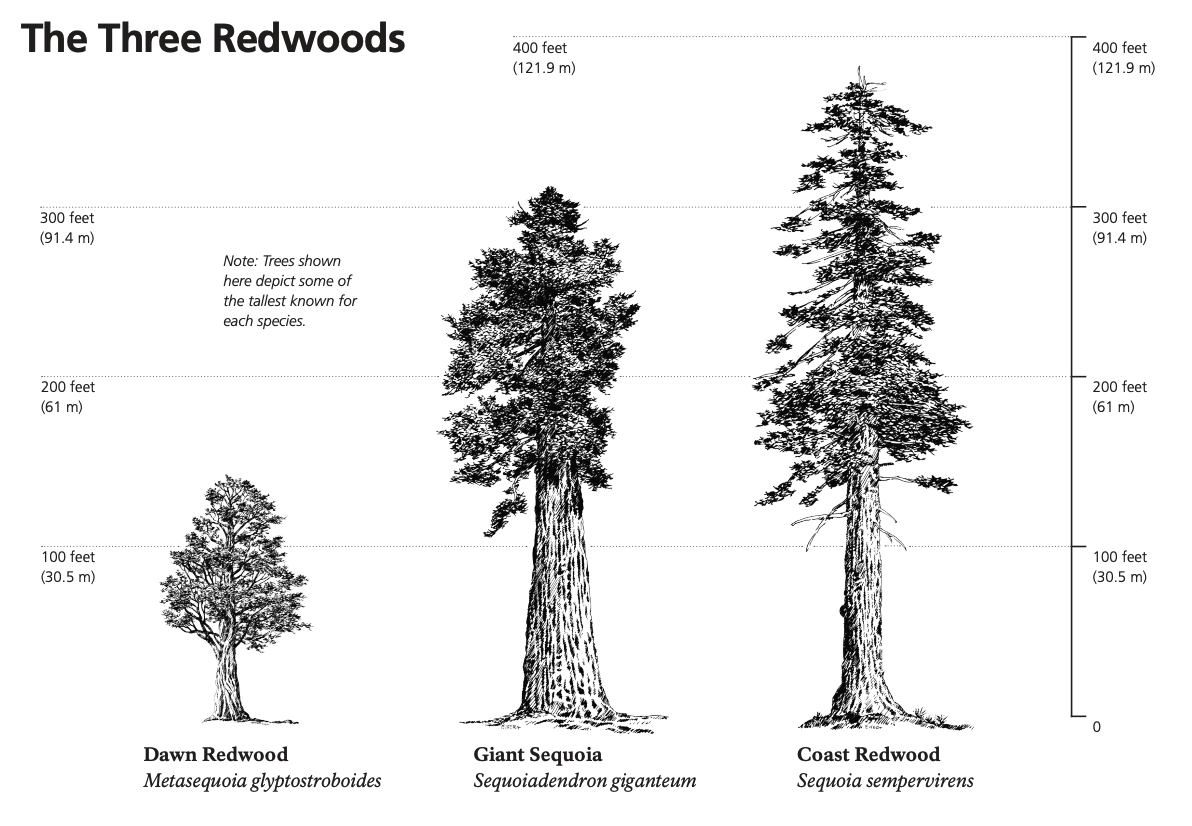
There are actually three distinct redwood species: the Dawn Redwood Metasequoia glyptostroboides, the Giant Sequoia Sequoiadendron giganteum, and the Coast Redwood Sequoia sempervirens.

Source

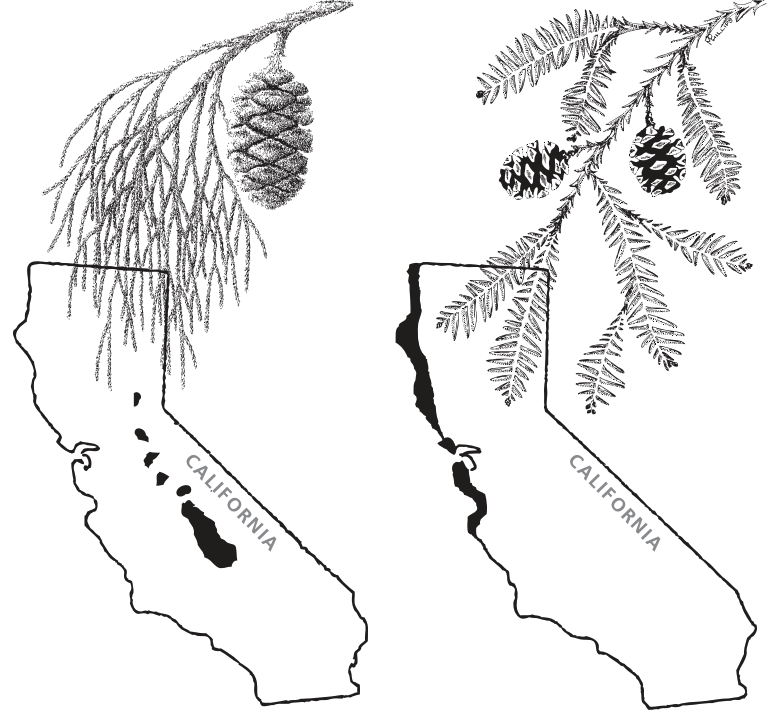
The Dawn Redwood was thought to have been extinct for millions of years until it was rediscovered in 1944 by a forester in the Sichuan-Hubei region of China. The Giant Sequoias can grow to be truly massive, reaching up to 314 feet high and 30 feet in diameter. They are found in over 70 groves along the western slopes of California’s Sierra Nevada mountain range.

The groves of Giant Sequoias are on the western slope of the Sierra Nevadas in central California, while the Coastal Redwoods are found along its northern coastline

I focused on the Coast Redwoods, which are the tallest in the world, reaching up to 379 feet in height and 26 feet or more in diameter. They are kept continually damp by heavy winter rains and fog from the Pacific Ocean, but June and July are often sunny and pleasant in the Pacific Northwest.

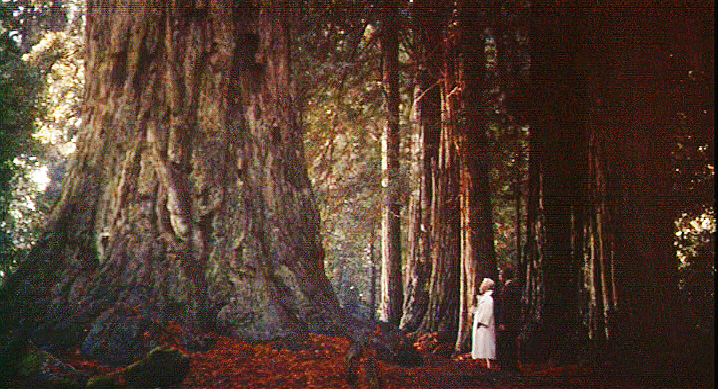
Since Wendy hates crowds, I immediately discarded visiting Muir Woods near San Francisco or Big Basin 70 miles north of the metropolis, a location used in one of my favorite films, Hitchcock’s Vertigo.

In Vertigo, Kim Novak and Jimmy Stewart were dwarfed by the Father of the Forest, a Giant Sequoia at Big Basin; Source

We needed something far more remote, yet still impressive, so I figured I should take her to Jedediah Smith Redwoods State Park near Crescent City, California and the Prairie Creek Redwoods State Park farther south, which I had visited in July 2006.

Jedediah Smith Redwoods State Park
Taken in July 2006 on a hike in Jedediah Smith Redwoods State Park; Flickr

However, back in 2006 I was on my own, happily bouncing down the coast of Oregon and into northern California, staying in 10 different hotels over two full weeks. Wendy wouldn’t enjoy that sort of trip. Instead, we needed to fly in close to the trees and spend most of our time in a rental cabin near the state parks.

So I booked us plane tickets from Tulsa to Medford, Oregon and booked a hotel in nearby Rogue River, from which we could drive to Jedediah Smith to see its Stout Grove and then spend a night in nearby Crescent City. I had fond memories of the beautiful Battery Point lighthouse there.

Battery Point Sunset
Battery Point lighthouse in Crescent City, California in July 2006

Then we could drive south to stay a few days at Elk Meadow Cabins and enjoy walks at Prairie Creek, before returning to Medford to fly home.

Knowing that flying to the Pacific Northwest from Oklahoma can be tiring, inevitably having to switch planes in Denver and always having the possibility of flight delays for mechanical issues or weather, I opted to bookend the trip with stays near the airport in Medford. To decrease the cost of the plane tickets, I extended our stay by one day in Medford to get a cheaper return flight on a Monday rather than a Sunday. So our vacation would consist of a week in the Pacific Northwest with flight days tacked onto each end.

As for transportation out west, I searched the rental possibilities at Medford and settled on the cheapest option of requesting a mini-van from Budget. We actually ended up with a full-size luxury SUV, as described in a previous post.

I have my 2006 trip budget for reference, so I thought I would compare the costs then, adjusted for inflation, to what I paid this time around. My solo coach-class round-trip plane tickets back in 2006 had cost $1,640 in 2024 dollars, so I didn’t mind paying $3,378 for two first-class tickets for this vacation. Our 8-day vehicle rental was $667 compared to $881 in 2024 dollars to rent a Ford Taurus for two weeks back in 2006. My hotel rooms back in 2006 had averaged $185 per night in 2024 dollars, while the multi-bedroom cabin and some hotel suites for our 2024 trip would boost our average nightly lodging to just over $250.

It was all good value for the money, as we had no issues on our flights, which were comfortable, I enjoyed driving the vehicle, and we had no problematic hotel rooms, with the cabin at Elk Meadow and then a Hilton Homewood suite we stayed at for a couple of nights in Medford being particularly peaceful and comfortable.

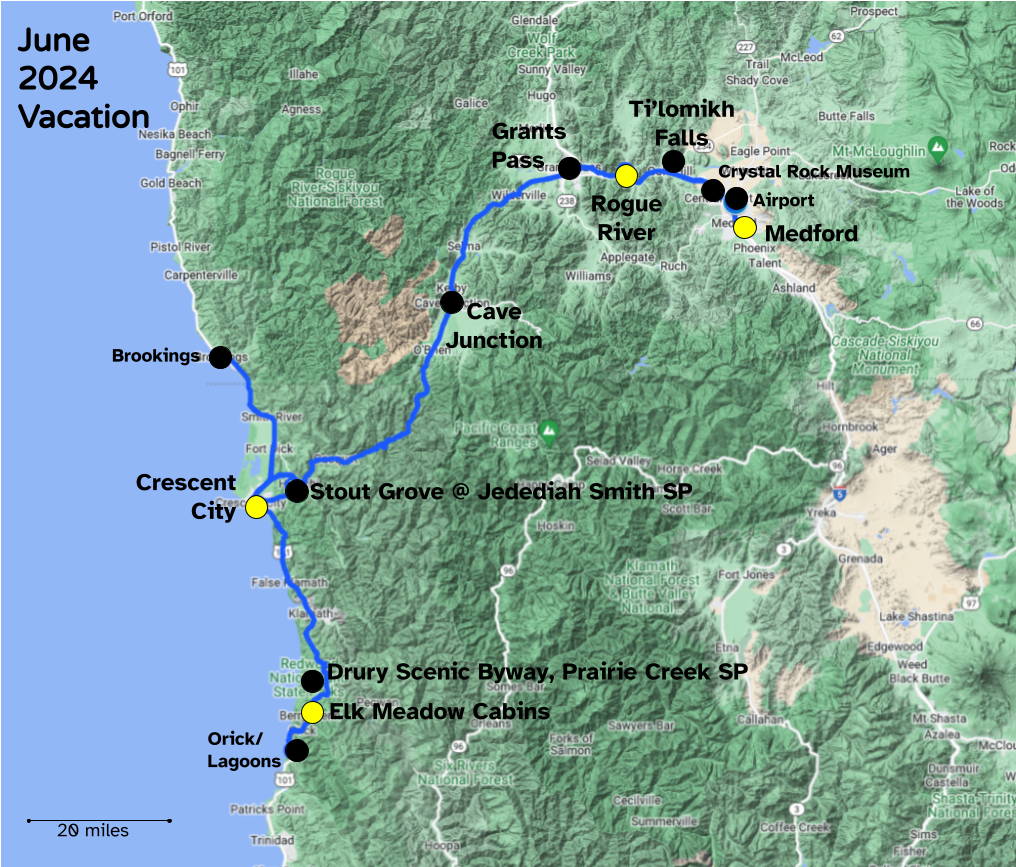
I will close with a map of our vacation, with details of the trip to follow in six subsequent posts over the coming week.

Redwoods Trip II >

Posted in photos, travel | Leave a comment

COVID 2: Electric Boogaloo

I have long subscribed to my “Law of Conservation of Happiness” where good news is balanced by bad news to keep things on an even keel.

We had a great vacation in early June 2024 to southwestern Oregon and the northern coast of California to see the redwoods. A trip that far away meant flying, and the previous time I had flown on a plane, in June 2023 for a conference in Philadelphia, I sat in coach on a return flight by a big guy with an obvious respiratory infection. I had no mask handy, so I endured it and unsurprisingly fell ill and was sick for the following week. It didn’t test as COVID, but it wasn’t fun.
Almost a year later, Wendy and I were flying first class, so I wouldn’t be crammed up against someone who was sick, but of course COVID aerosols could still spread through the plane and the airport restrooms, security checkpoints, and gate areas were high-risk. Since we were visiting more progressive areas of the country, we did see some folks in the airports and hotels, servers at restaurants, etc. who chose to mask up to reduce their risk of infection.

Sources: TMA & KWTX

A properly fitted N95, KN95, or KF94 mask is indeed worthwhile if you want to significantly reduce your chance of infection in high-risk environments. If you want all of the nuances about masks, read this.

Anyway, we took our chances, enjoyed our trip, and returned on a Monday night. I felt fine until Wednesday afternoon, when I started getting a stuffy nose and clogged sinuses.

Wednesday night I was feverish and slept quite poorly. On Thursday I took ibuprofen for a headache and body aches, and I began periodic nasal irrigation with my NeilMed Sinus Rinse bottle to clear my sinuses. I had continued thermal regulation issues, stuffy sinuses, both nasal congestion and a runny nose, aches, and fatigue on Thursday and Friday, which I treated with ibuprofen, sinus rinses, pseudoephedrine by day, and diphenhydramine at night. A cough developed on Saturday.

Since on Sunday I was planning to take my 87-year-old mother out for lunch, on Saturday I pulled out one of our remaining COVID tests and ran it, even though it expired in February. In less than a minute, it showed my sample as positive.

There is no reason for an expired test to give a false positive, while a breakdown of its components might give a false negative. So I am confident that I have been infected with COVID for the second time; my first round with it was in November 2022.

So I sure do wish I had masked up throughout our times in the airports and on the planes, although I can’t be certain those environments were where I was infected.

Now what?

The CDC’s COVID infection protocol was originally to isolate for ten days, with quarantines for close contacts. By the time I contracted COVID in November 2022, that had been shortened to five days , if no fever for 24 hours without fever-reducing medications, to be followed by distancing and masking precautions for another five days.

Back in 2022, my isolation overlapped into a week of vacation days. I chose the conservative route, isolating until I no longer tested positive on a rapid test. That was not until 14 days after my symptoms began, and 8 days after first testing positive.

These days, the CDC has simplified its recommendation to be the same for any respiratory illness:

Source

I may or may not be at the Go about normal activities, taking adding precautions phase by Tuesday, six days after my symptoms began. I hope to work remotely, but later in the week I will have to go in to do a few things that require my physical presence. I’ll be wearing a KF94 mask whenever I am around others, and I’ll be running the air purifier in my office at top speed.

COVID hospitalizations peaked with the Omicron surge in the winter of 2021-2022, but are now at an all-time low thanks to seasonal factors and protection via vaccines and prior infection; Source

The changes in the CDC guidance reflected how the hospitalization and mortality rates for COVID plummeted once vaccines were available, and particularly after the Omicron surge in the winter of 2021-2022. I had received the Pfizer vaccine in February and March 2021 with an October 2021 booster, and a Moderna vaccine in April and October 2022. I had an updated Moderna booster in October 2023.

The virus continues to mutate, so vaccine protection against infection wanes after a few months, while it still defends well against hospitalization and death. Actual infection with COVID usually protects you against reinfection for a few months.

I likely had the Omicron BA.4 or BA.5 variant back in November 2022, and currently the widely circulating variants include KP.3, KP.2, and LB.1. My symptoms this time are slightly less severe than with my first COVID infection, but the experience is another reminder for me of the consequences when I let down my guard in high-risk environments, even when the seasonal infection rate is low.

I’ll be flying again near the end of the month to attend a conference in Denver. My chance of getting reinfected by COVID will be very low for about four months, so I won’t be worried. But I do plan on wearing a KF94 mask while in the airports and on board the planes. And on future trips involving air travel, I plan to do the same. Masking while in those high-risk environments is a minor inconvenience compared to a week or more of unpleasant symptoms from various respiratory infections, including nasty old COVID.

Posted in pandemic | Leave a comment

Driving an $80,000 SUV

Wendy and I flew to southwestern Oregon in early June. We needed a rental vehicle I could drive over to the coast and down to the Redwoods in northwestern California, and when I went hunting online, the cheapest rental at the Medford airport was what Budget described as a “Dodge Grand Caravan or similar”. That was fine by me, since I have enjoyed driving Wendy’s Honda Odyssey mini-van on our vacations.

Renting a vehicle on a vacation is an opportunity to experience something different than my 2014.5 Toyota Camry or Wendy’s 2019 mini-van. The most unusual rental for me was way back in the late 1980s when a girlfriend arranged for me to drive a Firebird Trans Am in Baltimore and Atlantic City. That was a hoot until the hood latch malfunctioned. We had to trade it in, and the replacement was a Chevrolet Celebrity Eurosport station wagon, which was quite a contrast!

The last time Wendy and I rented a car was on our trip through Utah in 2018. We ended up with a Ford Fusion hybrid. While I loved its 45+ miles per gallon efficiency, the large battery reduced the trunk space so much that our largest piece of luggage had to be transported in the back seat, and the car could be sluggish. But it was interesting to drive a car that sometimes relied entirely on its electric motors and had regenerative braking.

Car rental agencies understandably can only approximate what you will get for their cheapest rates, and a mini-van is not what we ended up with in Medford. We were assigned a GMC Yukon Denali, which is a luxury full-size sport utility vehicle that sells for over $80,000.

Our 2024 GMC Yukon Denali rental SUV

We walked out of the airport to find a jet black vehicle that was 17’6” long, 6’9” wide, 6’4.5” high, and weighed over 5,500 pounds. That’s almost two feet longer, 9 inches wider, over 18 inches taller, and over a ton heavier than my own 2014.5 Toyota Camry.
I’ve driven full-size SUVs before; I’ve driven the Chevy Suburbans the school district has to transport small groups, a “People Mover” mini-bus, and I once rented a 15-passenger van to haul people around while at a conference. So I knew I could handle the big Denali, although parking it might be a challenge. One of the surprises of the trip was how easy it was to park the beast, thanks to one of its many luxury features.

The vehicle had many of the high-end features one finds on a Cadillac Escalade, and it was fun to discover them as I wheeled the beast along interstates, narrow winding mountain highways, gravel logging roads, and city streets.
Favorite Features

One of my favorite features was apparent once I pressed the Start button: a heads-up display (HUD) appeared on the driver’s windshield.

The heads-up display

I loved being able to see my speed without glancing down, although I had no use for the off-road elements in the display showing 4-wheel drive mode and vehicle pitch angle, steering angle, and roll angle. The HUD also displayed the cruise control settings, and there were convenient controls on the dash allowing me to adjust the height and brightness of the HUD.

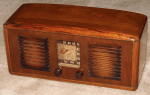
The three toggle switches on the right controlled the HUD

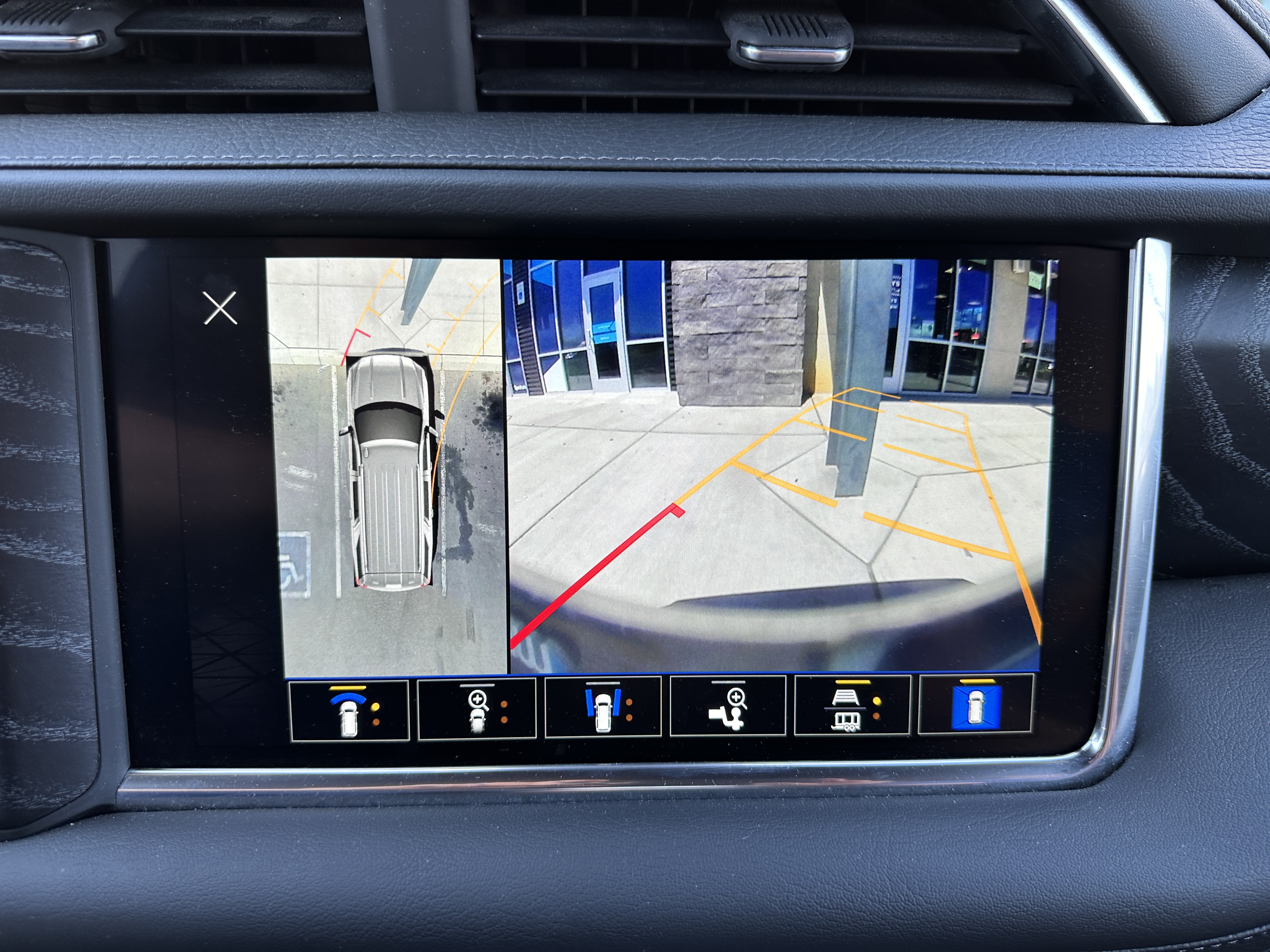
I discovered that other buttons on the dash left of the steering wheel were for the parking brake, lane assist, park assist, stop engine feature, traction control, hill descent control, and 360-degree surround vision system. That latter feature was splendid, showing on the large central display a 360-degree overhead view of the vehicle and its surroundings, with a larger view from any of the cameras, with both views showing guidance overlays.

The Surround Vision System made parking easy

It was wonderful how the cameras on the front, rear, and the two side mirrors were used to create the overhead view, making it easy for me to steer the beast into marked parking spots. Our vehicle didn’t have the additional Automatic Parking Assist feature for parallel parking, but we never needed it, either.

The other feature I appreciated was the power liftgate in the back, with a button you could press to lift it, another would lower it, and a sensor allowed you to wave a foot under the bumper to lift the gate.

Other Surprises

I was surprised by the heated steering wheel and how the seats not only had heat but also a fan that could push air through them for ventilation.

The steering wheel had the controls for the cruise control, heated steering wheel, voice calls, and infotainment system cursor

I wasn’t surprised to find that the vehicle had adaptive cruise control that would adjust its speed when following a slower vehicle, as I’ve grown used to that on Wendy’s mini-van. My older Camry just has old-fashioned cruise control, something I have to bear in mind when switching cars: my Camry would happily plow into a slower vehicle in front of me if I let it.

I also appreciated the lane assist feature, given the vehicle’s imposing size, while I deliberately de-activate that feature on Wendy’s mini-van as it is more annoying than helpful on it.

One can’t get good gasoline mileage on a behemoth like this, but it did manage to average over 20 miles per gallon. My 1978 Chevrolet Monte Carlo I drove for a couple of years in college could only get 17 miles per gallon in city driving and the low 20s on the highway, while my 2014.5 Camry averages about 28 mpg. One feature to save gas was the auto-stop function, which I first heard about a few years back. The engine would usually cut out when you stopped, restarting once you released the brake. Sometimes it would also start the engine in order to run the air conditioning compressor. There was a button to disable the auto-stop feature, but while it took awhile for me to grow accustomed to it, I left it on to save a bit of gasoline.

I see in the owner’s manual that the vehicle also has navigation on its center screen that can include guidance in the HUD, but I never tried using that feature. Instead, I just plugged in my Apple iPhone 14 Pro into the console and used CarPlay to access guidance from my TomTom GO app, which I routinely pre-program with various destinations before a vacation. One nice thing about the Denali was that it could do wireless CarPlay as well, while Wendy’s mini-van requires that you plug in the phone, although I always plugged in the phone to ensure it would stay charged.

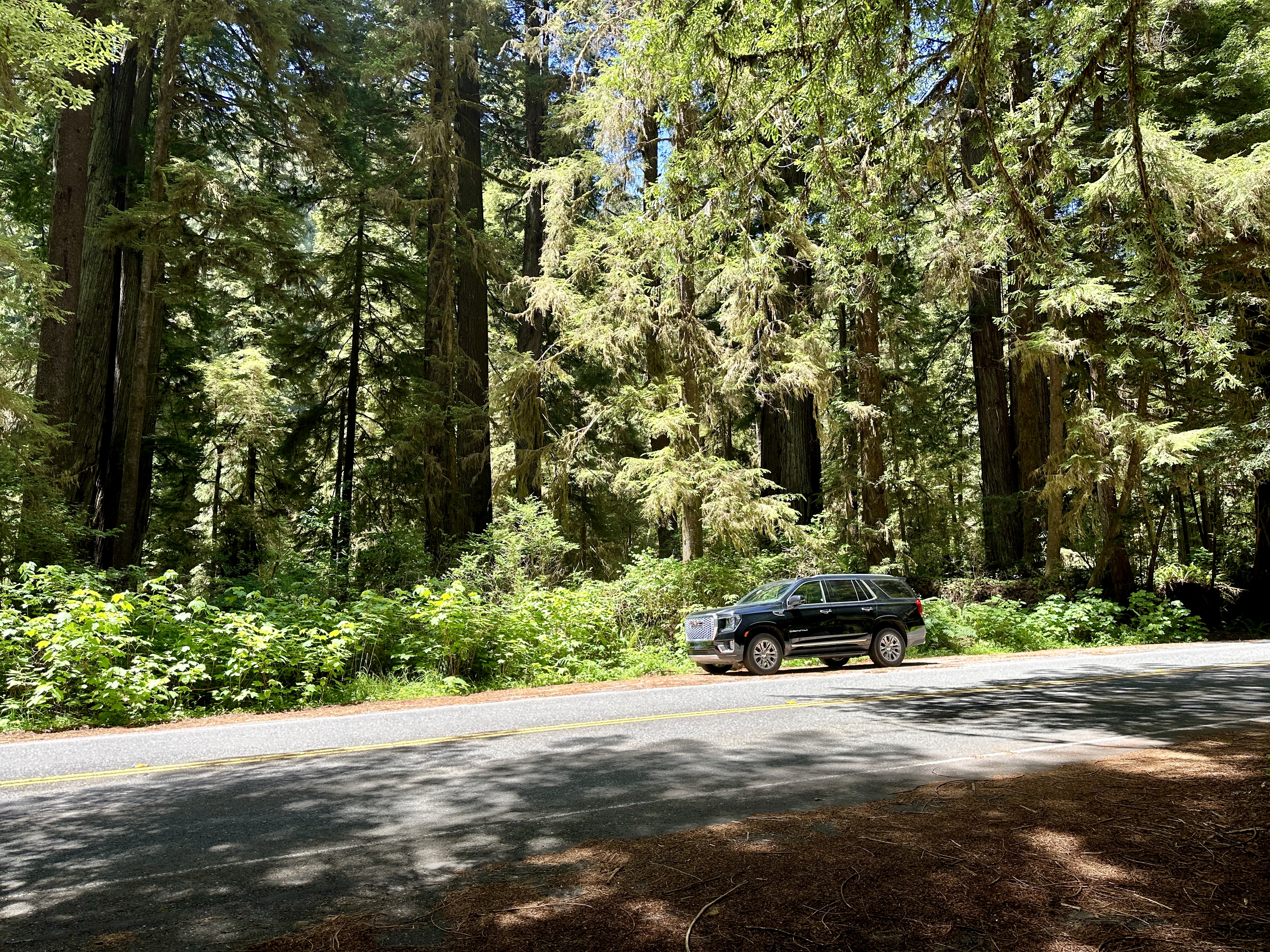
Redwoods are so large they can even dwarf a GMC Yukon Denali

I had fun trying out the various features on the vehicle. Although at first I wasn’t thrilled about having such a large rental vehicle, its features made it less annoying to maneuver than I had expected. I did feel a bit silly clambering up and down from the beast, and with just Wendy and me and our airplane luggage on board, the third row seats sat up and empty most of the time.

I would never contemplate buying such a vehicle; Wendy’s mini-van is all I would ever need for travel or cargo, and I was very glad to be back driving my Camry from the Tulsa airport back home. While I will avoid renting such a large vehicle in the future, it was a worthwhile experience.

Posted in photos, travel | Leave a comment