Welcoming 1930 to the Public Domain

On the first day of each new calendar year, for the rest of my life, thousands of copyrighted works from 95 years earlier will enter the US public domain. Here is a great article on what joined the public domain on January 1, 2026.

Books are the main attraction for me, although 1930 movies have also been liberated. Sound recordings have much more complicated terms, and the various releases into the public domain will become much more complicated in 2074, but it is highly unlikely I’ll live long enough to worry about that.
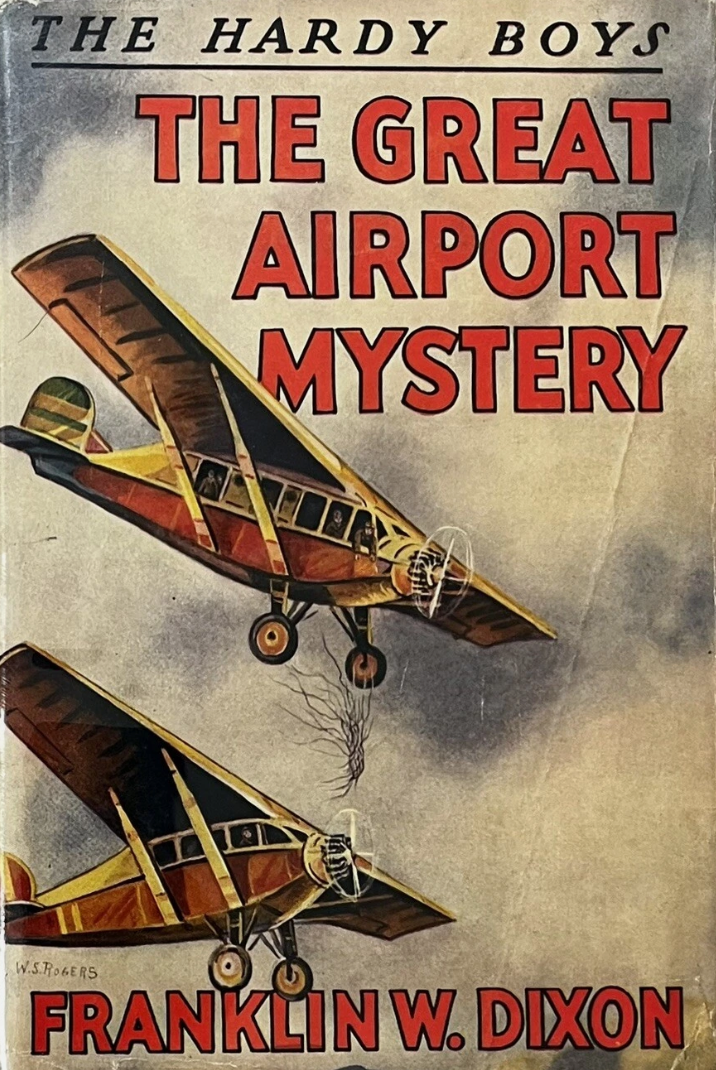
A dubious 2026 addition to the public domain

In recent years, the original editions of The Hardy Boys children’s books began their long slow march into the public domain. The first three were set free in 2023, three more in 2024, two in 2025, and The Great Airport Mystery is now fair game in 2026.

Mind you, only the older version written by Leslie McFarlane, involving pilot Giles Ducroy and an air mail robbery, has been freed. As I child in the 1970s, I read the more commonly available 1965 rewrite by Tom Mulvey, which is about pilot Clint Hill and stolen equipment. That revision will remain under copyright for 35 more years. Frankly, double pun intended, I always liked The Three Investigators better than the Hardy Boys, but those better-written children’s mysteries won’t start entering the public domain until 2060, and they too underwent revisions with a contemporary reboot that began this year.

The Nancy Drew series began in 1930, so its first four entries have also now entered the public domain. The same caveat applies, with only the original versions ghostwritten by Mildred Wirt Benson losing their copyrights, with revised versions from 1959-1961 still being protected.
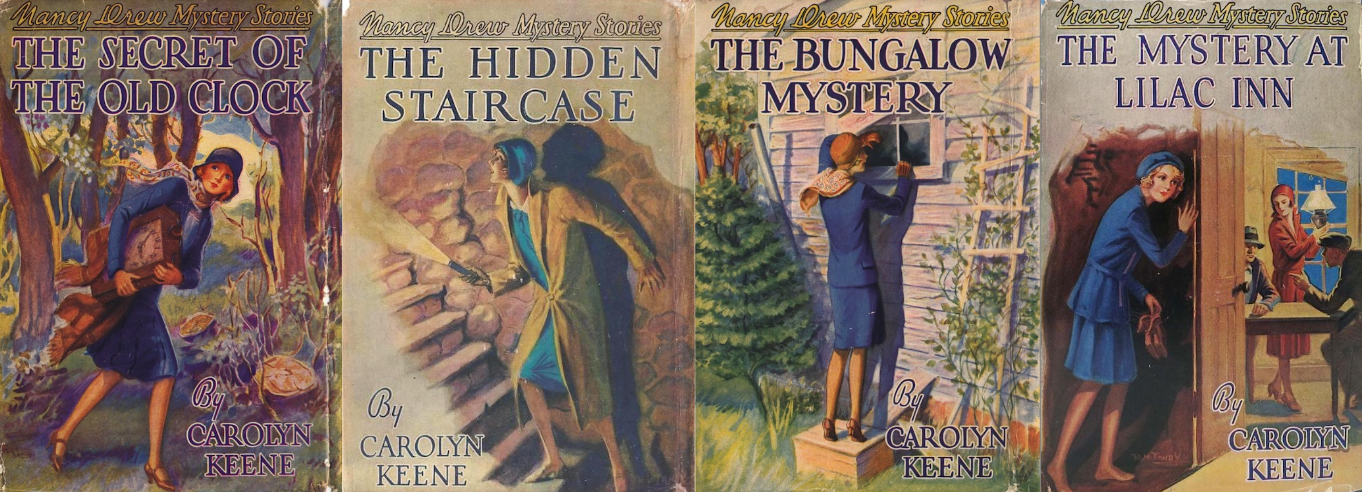
The original versions of the first four Nancy Drew books will be entering the public domain in 2026

Breaking the legal bonds holding The Hardy Boys and Nancy Drew captive is not much to crow about, so here are more significant 1930 books:

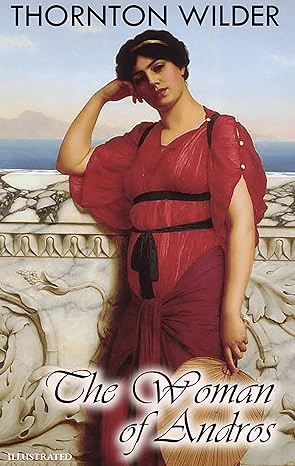
  • The Woman of Andros by Thornton Wilder
  • Agatha Christie’s The Murder at the Vicarage, The Mysterious Mr. Quin, and Giant’s Bread
  • The Maltese Falcon by Dashiell Hammett…the novel, not the 1941 Bogart film
  • Last and First Men by science fiction author Olaf Stapledon
  • As I Lay Dying by William Faulkner
  • Cimarron by Edna Ferber
  • Years of Grace by Margaret Ayer Barnes

The Woman of Andros by Thornton Wilder

This one has a simply magnificent opening:
The earth sighed as it turned in its course; the shadow of night crept gradually along the Mediterranean, and Asia was left in darkness. The great cliff that was one day to be called Gibraltar held for a long time a gleam of red and orange, while across from it the mountains of Atlas showed deep blue pockets in their shining sides. The caves that surround the Neapolitan gulf fell into a profounder shade, each giving forth the darkness its chiming or its booming sound. Triumph had passed from Greece and wisdom from Egypt, but with the coming on of night they seemed to regain their lost honors, and the land that was soon to be called Holy prepared in the dark its wonderful burden. The sea was large enough to hold a varied weather: a storm played about Sicily and its smoking mountains, but at the mouth of the Nile the water lay like a wet pavement. A fair tripping breeze ruffled the Aegean and all the islands of Greece felt a new freshness at the close of day.

There are multiple copies of Wilder’s third novel at the Internet Archive, and I hope that a nice public domain electronic book edition gets uploaded to Project Gutenberg. I am puzzled that they don’t capitalize on the annual publicity about the topic.

I would enjoy comparing Wilder’s take on ancient Greece to the works of Mary Renault that I read forty years ago for an undergraduate honors seminar.

Agatha Christie…and Mary Westmacott
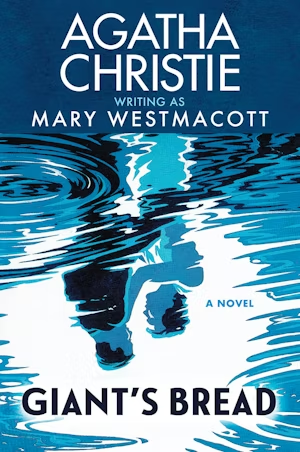
Years ago, I consumed all of Agatha Christie’s mysteries. The Murder at the Vicarage is the first of her Miss Marple series, while The Mysterious Mr. Quin is a collection of short stories featuring the mysterious and somewhat supernatural Harley Quin and his companion, Mr. Satterthwaite.

I have not read the non-mystery books that Christie published under pen names, including Giant’s Bread, the first of six she published as Mary Westmacott. It is about a young composer who reinvents his identity after being declared dead in World War I, and one reviewer recommended it, although she thought the ending rather farcical.

The Maltese Falcon Escapes the Copyright Cage
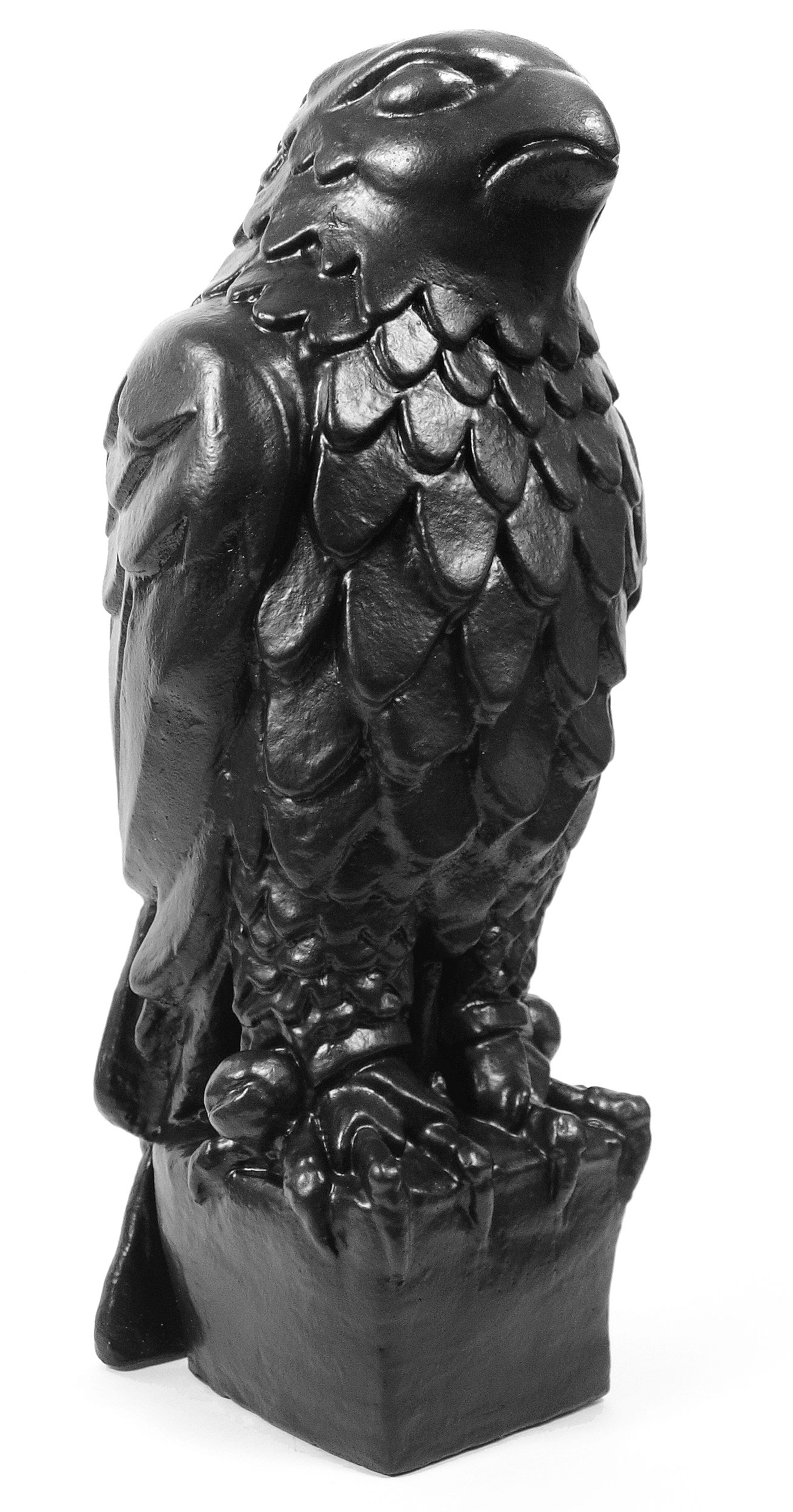
One version of this prop sold for a cool $4 million in 2013

Dashiell Hammett was a former Pinkerton operative who wrote most of his hard-boiled detective fiction while living in San Francisco in the 1920s. The Maltese Falcon was his third novel and is considered his best work. His fifth and final novel, The Thin Man, was published in 1934, so it won’t be long until all of his work is freely available.

In text form, that is. You are more likely to be familiar with Bogey in a film version of The Maltese Falcon or possibly the six The Thin Man films with William Powell and Myrna Loy. The falcon’s film form won’t be freed until 2037.

Odd bits of trivia attach to the falcon props from the movie. One was given by studio chief Jack Warner to actor William Conrad…yes, the same actor who portrayed the overweight detectives in the Cannon and Jake and the Fat Man television series, who narrated Rocky and Bullwinkle and The Fugitive, and who portrayed Marshall Matt Dillon on the radio version of Gunsmoke. His prop was auctioned in 1994 for almost $400,000.
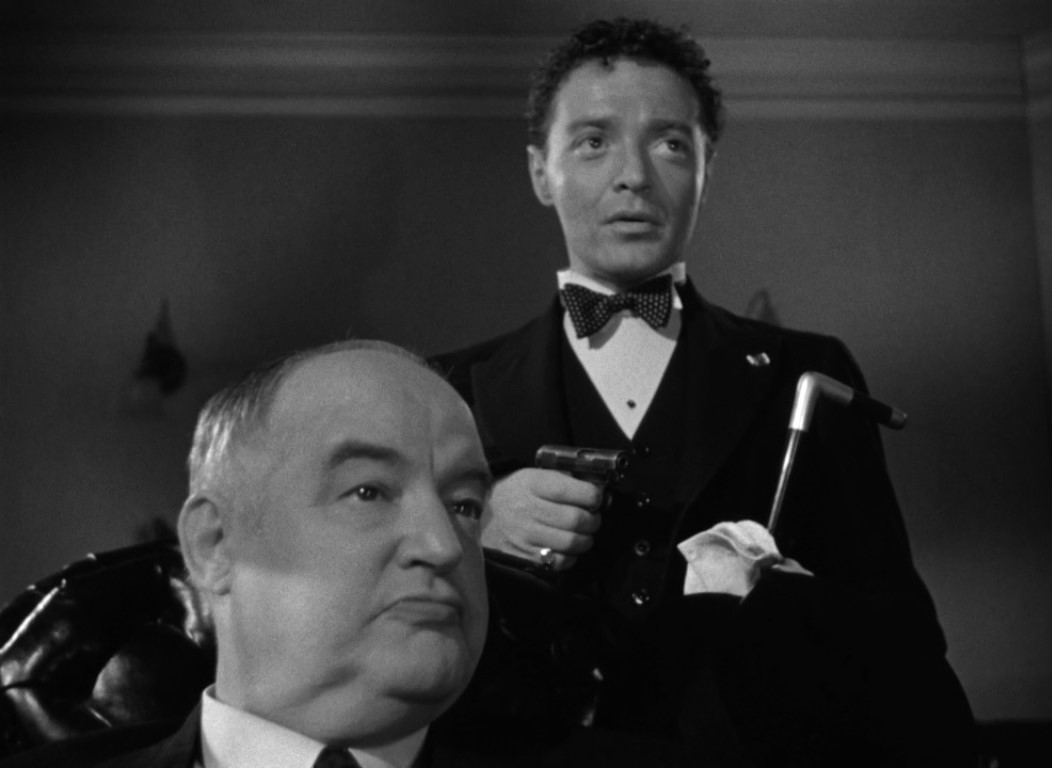
Sydney Greenstreet & Peter Lorre in the famous film noir

Not bad, but in the film, Sydney Greenstreet’s villain offered detective Sam Spade $50,000 for the statuette, which would be over a million 2025 dollars. Funly enough, a 45-pound metal version of the film prop was sold in 2013 for over $4 million.

The film was okay for me, with Sydney Greenstreet a standout, but I have no interest in reading the Hammett novel.

Olaf Stapledon’s Two Billion Years of Boredom
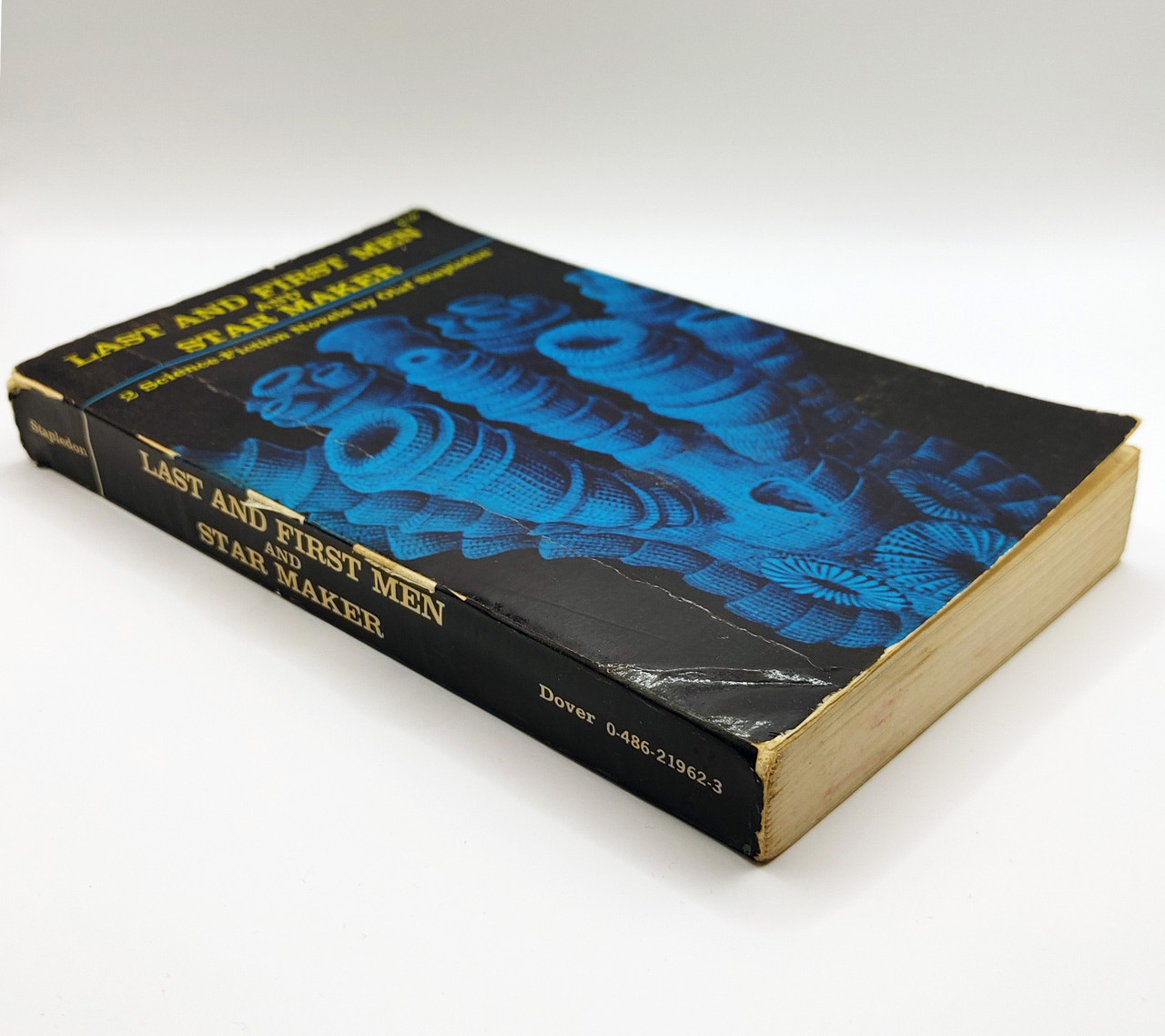
Not recommended

Stapledon’s Last and First Men: A Story of the Near and Far Future is a vast science fiction work reportedly summarizing two billion years of future development. I long had a 1968 paperback reprint of that 1930 work and his 1937 novel, Star Maker, but in my sampling of the former, I found it similar to J.R.R. Tolkien’s The Lord of the Rings appendices or The Silmarillion: quite soporific. I am in no manner tempted to read a summation of two billion years of fake history.

In 2017, Icelandic composer Jóhann Jóhannsson’s only film premiered, and it was based on the book. It isn’t encouraging to note that Jóhannsson died a year later from a deadly combination of flu medication and cocaine. His sparse film version only runs 70 minutes, which is about fifteen trillion times shorter than the span of time in the book…but I’m skeptical that the abridgment is worth your time.

However, decades ago I did enjoy Charles Sheffield’s 1997 science fiction novel Tomorrow and Tomorrow: A Love Story to the Edge of Time, which had an actual plot that managed to span billions of years, so successful novels with ridiculous time spans are feasible. However, Sheffield’s work won’t enter the public domain until…let’s see…it was published after 3/1/1989, so its copyright lasts for 70 years after the author’s death, and Sheffield died in 2002, so his book will be out of copyright in 2073.

Faulkner’s Streams

Decades ago I read, and actually appreciated, William Faulkner’s notorious The Sound and the Fury, which entered the public domain in 2025. It was ranked #6 on Modern Library’s 100 best novels of the 20th century.

The Sound and the Fury was told in stream-of-consciousness through the perspectives of three brothers, one of them being intellectually disabled, with a final chapter written in third-person narrative and focusing more on a black female household servant. I normally hate stream-of-consciousness, but it worked in that book, although I have no desire to repeat that experience.

As I Lay Dying is now in the public domain, but it is even more fragmented, with fifteen different narrators, and it also relies on stream-of-consciousness. Nevertheless, it was ranked #35 in the Modern Library’s list. Faulkner said that in writing it, he was spending the first eight hours of a twelve-hour shift at the University of Mississippi Power House shoveling coal or directing other works, spending the remaining four hours, from midnight to 4:00 a.m., in handwriting the manuscript on unlined onionskin paper. He said it took him six weeks to write the novel, and that he did not change one word.

Given my distaste for the stream-of-consciousness style of writing and disinterest in navigating fifteen different perspectives on a plot, I have no plans to read As I Lay Dying. I usually avoid Wikipedia plot summaries, but since I won’t be reading the work, I snuck a peek.

The Southern Gothic plot revolves about the transportation of a body in a coffin, and I liked a cover illustration on a 1980s paperback edition that was clearly in the style of Thomas Hart Benton. An internet search showed multiple Faulkner covers from that era that were designed by the late Carin Goldberg, with illustrator David Tamura imitating Benton.

This old cover art was obviously in the style of Thomas Hart Benton

If I had to read more Faulkner, I’m told that the seven short stories in his The Unvanquished don’t utilize stream-of-consciousness. However, I still have plenty of Southern Gothic stories by Flannery O’Connor awaiting my attention, and The Heart is a Lonely Hunter was so fascinatingly strange that I’m more likely to read more of Carson McCullers’ novels than to pursue reading Faulkner. I just finished a Mexican Gothic novel, The Hacienda, by Isabel Cañas, which was a treat. It was set in the 1820s, and I enjoyed that setting more than the uncomfortable Deep South of the USA.

Oklahoma in Cimarron
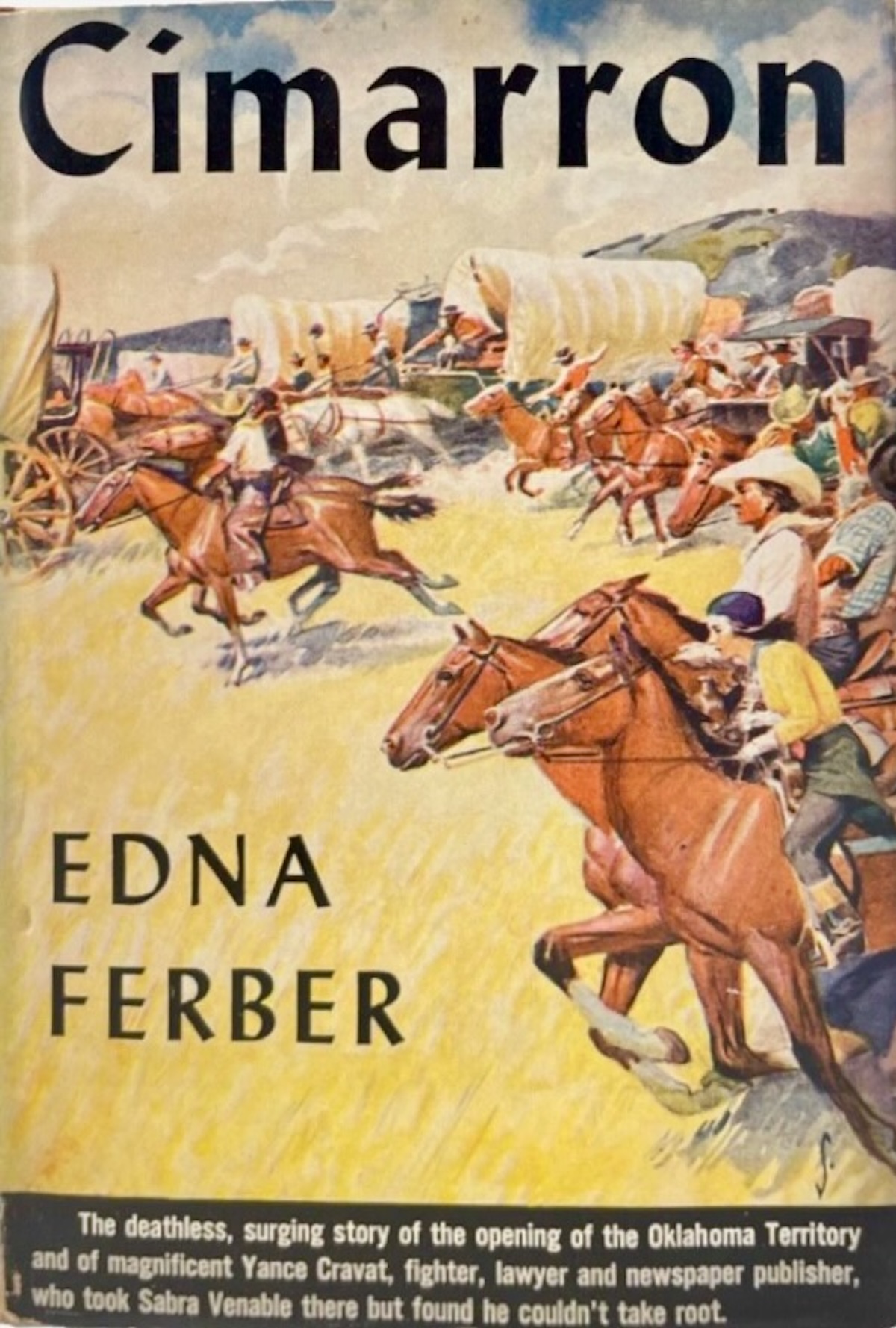
Two of the Oklahoma land runs, for the Unassigned Lands in 1889 and the Cherokee Strip in 1893, feature in Edna Ferber’s novel Cimarron. The first of those is how the land where I was born had been opened to white settlement 77 years earlier.

The novel takes its name from an old unofficial term for No Man’s Land, with the novel’s town of Osage likely based on Guthrie. Ferber intended it as a satirical criticism of American womanhood and sentimentality, and it was the best-selling novel of 1930. A 1931 film version was followed by one in 1960 featuring Glenn Ford and Maria Schell.

Jesse Schell described the novel as a story of “a bold southern lawyer who starts a newspaper in Indian territory”, with his wife being “a fish-out-of-water city-woman trying to raise her son and daughter on the frontier”. The book spans the period from 1889 to about 1925, and Schell liked this passage:

I’ve never read a Ferber book, although long ago I enjoyed watching Barbara Stanwyck and Bette Davis in the 1932 film adaptation of Ferber’s 1924 novel, So Big. Other Ferber titles in the fading cultural lexicon include Show Boat from 1926, which was adapted into a Kern and Hammerstein musical which had many Broadway revivals, and Giant from 1952, which led to a 1956 film with Liz Taylor, Rock Hudson, and James Dean.

The 1930 Pulitzer Novel
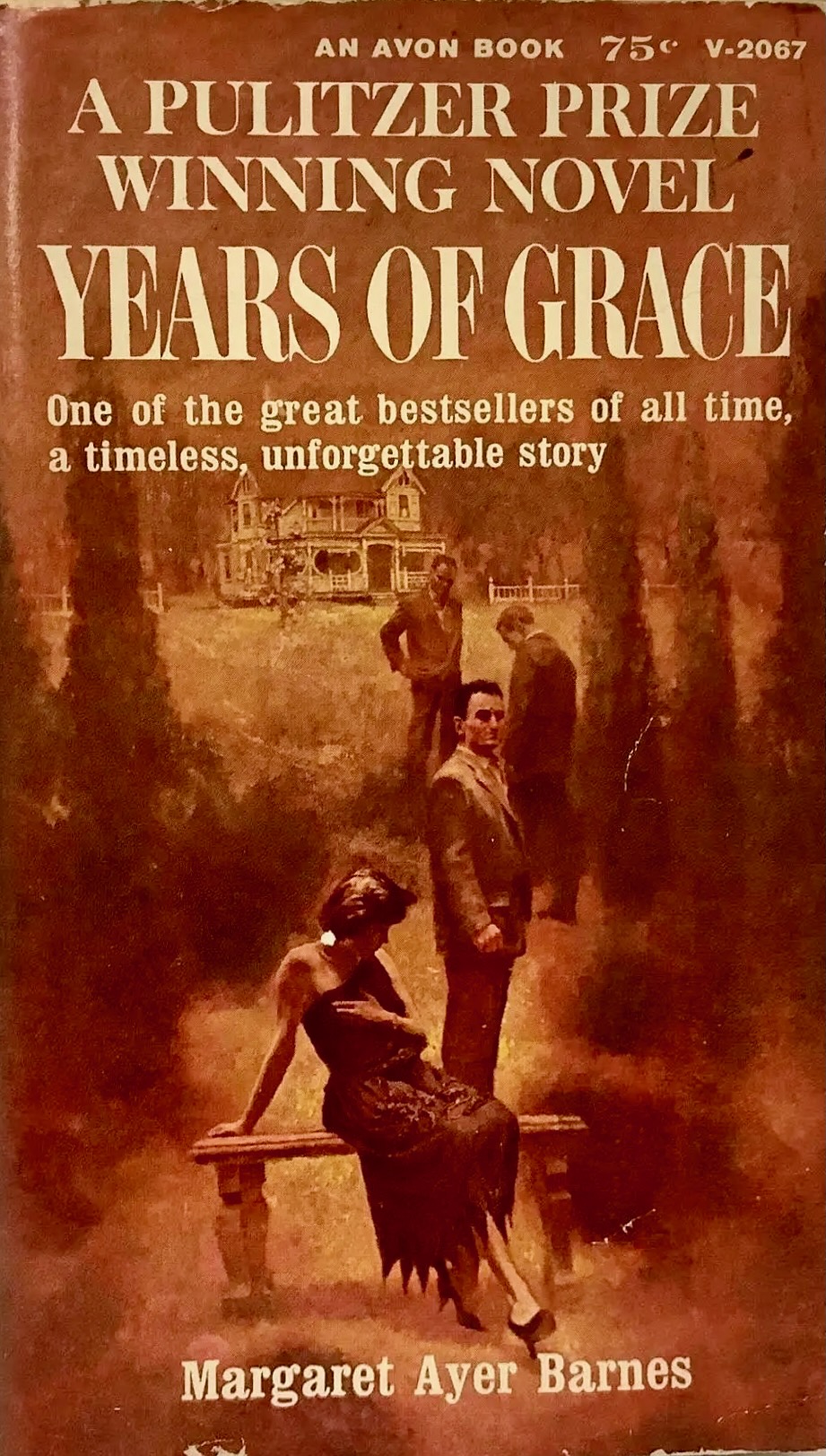
A 1930 work that has received less attention is Years of Grace by Margaret Ayer Barnes, which won the 1931 Pulitzer Prize for the Novel. Barnes earned at bachelor of arts from Bryn Mawr College in 1907, and she was the school’s alumnae director from 1920-1922. Barnes helped organize the Bryn Mawr Summer School for Woman Workers in Industry, which offered courses in progressive education, liberal arts, and economics mainly to young and single immigrant women with little to no academic background.

Barnes broke her back in a traffic accident in 1926, at age 40. Her friend Edward Sheldon was a playwright who encouraged her to take up writing. She wrote three short stories and three plays, with her first play, an adaptation of Edith Wharton’s 1920 novel The Age of Innocence, produced on Broadway with over 200 performances. Her best-known work is another play, Dishonored Lady, which she co-wrote with Sheldon.

In 1931, her first novel, Years of Grace, won the Pulitzer. It features Bryn Mawr College with a story, beginning in the 1890s and continuing into the 1930s, of a woman from her teens to age 54. The novel is said to follow many of the same themes as her other works, centering on the social manners of upper middle class society, with female protagonists who are often traditionalists struggling to uphold conventional morality in the face of changing social climates.

Great Books Guy John read the book in 2020 as part of reading through the early Pulitzer-Prize winners. He shared, “This is a delightful novel –it is surprisingly whimsical for a 600-page book– yet it is unfortunately wholly lacking in substance.”

John’s review shares that he enjoyed the book as a pleasant and simple work, but one populated with wooden characters with nothing much occurring. The prose provides carefully crafted glimpses into the life of a woman who goes from being a young romantic to a college feminist and finally a married woman who has a brief but intense affair with her best friend’s husband. John describes the book as conservative in tone, presenting the life of its character without judgment.


I’ll close with one of the sound recordings that has entered the public domain:

Posted in books | Leave a comment

Hammer or Glue

Here is an interesting thing to close out 2025. Hear the amazing physicist Richard Feynman talk about gravity. The physics content is told in his distinctive manner…but it isn’t Feynman talking.

If you want the real guy, he is here.

But how do I know that? Because I first saw that second clip decades ago, when he was still alive, before his voice could be faked. Before his image and video of him could be faked. However, now all that can be readily simulated, and the creators of the newer clip admit in the fine print that the narration is fake.

These days we must approach anything unfamiliar with skepticism — ANYTHING and ANYONE. Not just Feynman, but every person for whom there are sufficient audio recordings and photographic imagery…and that includes quite obscure figures like myself.

Years ago I demonstrated on Facebook how my voice could be simulated. Now a single image of me can be manipulated into infinite forms that continue to become more and more realistic. That is one reason that when a meme circulated of women creating a Christmas photo using an AI prompt on a single uploaded self-portrait, I chose to create and share a couple of silly AI Christmas photos that hundreds of my Facebook friends laughed at with me.

In December 2025, an AI prompt could easily transform my photograph as shown

But our laughter echoes in a shared world where typical evidence is becoming as uncertain, as misleading, as the typical false conceptions of matter and space. Skepticism is now required, but that brings with it the erosion of trust.

For decades we have stressed the importance of critical thinking skills, but social media continually reveals how uncritical and unintelligent many of us must inevitably remain, splayed out across the statistical bell curves of ability. The suckers continue to be born every minute.

Young and old fail to distinguish artificial intelligence hallucinations from established truths. Scientific evidence and rigorous research are discounted, misinterpreted, defunded, and demeaned by influential media and government figures, motivated by their personal politics and biases, who lack earned credentials or credibility. But to many that will not matter, for their trust in institutions and expertise has been steadily eaten away, replaced with blind beliefs built by partisanship, culture wars, and demagoguery.

We live in an age that is both wondrous and tragic. It will require time, effort, and patient perseverance for our cultural norms and institutions to adjust to our new capabilities, with no guarantees of success, only continued challenges.

I do not despair, for there is much utility in the new technologies, much potential to better inform and perform. Our quality of life need not collapse amidst wrenching change if enough of us heed the call to help each other cope. However, we must recognize that our shared reality, already misunderstood by most, continues to shatter. It is up to us to decide if we are to act as hammer or glue.

Posted in technology, video | Leave a comment

Jawhawkers Part 5: Family History

Our stay in Lawrence during Thanksgiving Break 2025 allowed me to explore some family history, since my father was a KU Jayhawk in the late 1940s. Dad had completed a freshman year of studies at Independence Junior College before being inducted into the U.S. Army in August 1943 at Ft. Leavenworth. He had been born blind in one eye, but he still managed to qualify for a marksmanship badge, and Dad served as a military policeman in Denver and then set up water purification plants as part of an engineering battalion in Germany and later the Philippines. He was honorably discharged in April 1946 and moved back home to Independence, Kansas.

In September 1946, Dad enrolled at KU to study engineering, funded by the G.I. Bill, which he recalled as paying some toward his tuition and books and providing a monthly stipend. Dad hitched a ride for the 140-mile trip to Lawrence, where he enrolled in chemical engineering.

Car Trouble

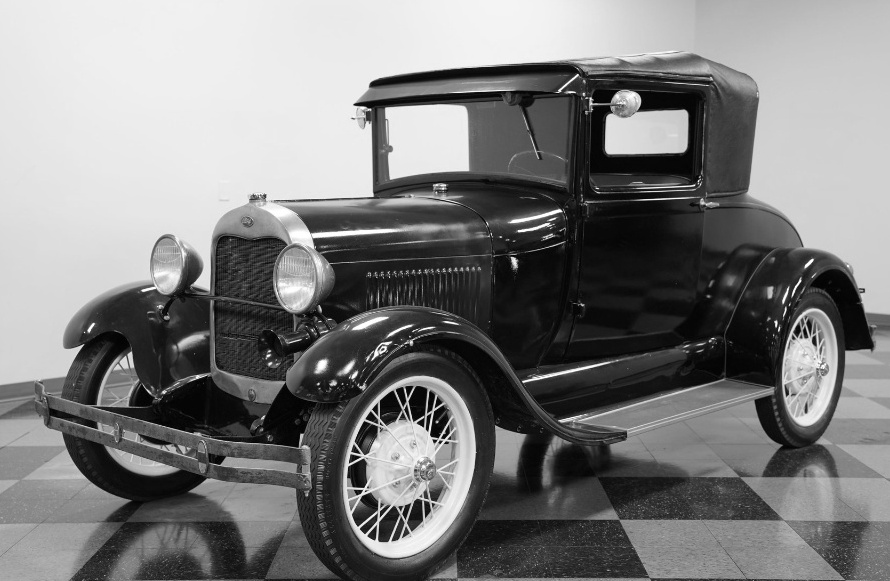
1929 Model A

Dad lived in a boarding house during that sophomore year and quickly realized he would need a car. He bought a 1930 black Chevy coupe, figuring out that its stalling was caused by a silk rag that had fallen into the gas tank. When a valve shot through the engine block, Dad had a shadetree mechanic replace it and braze shut the hole for $35. He drove the problematic vehicle down to Independence, borrowed $435 from his father, and bought a black 1929 Model A coupe with cream-colored wire wheels. Although his second car was a year older, it was far more reliable.

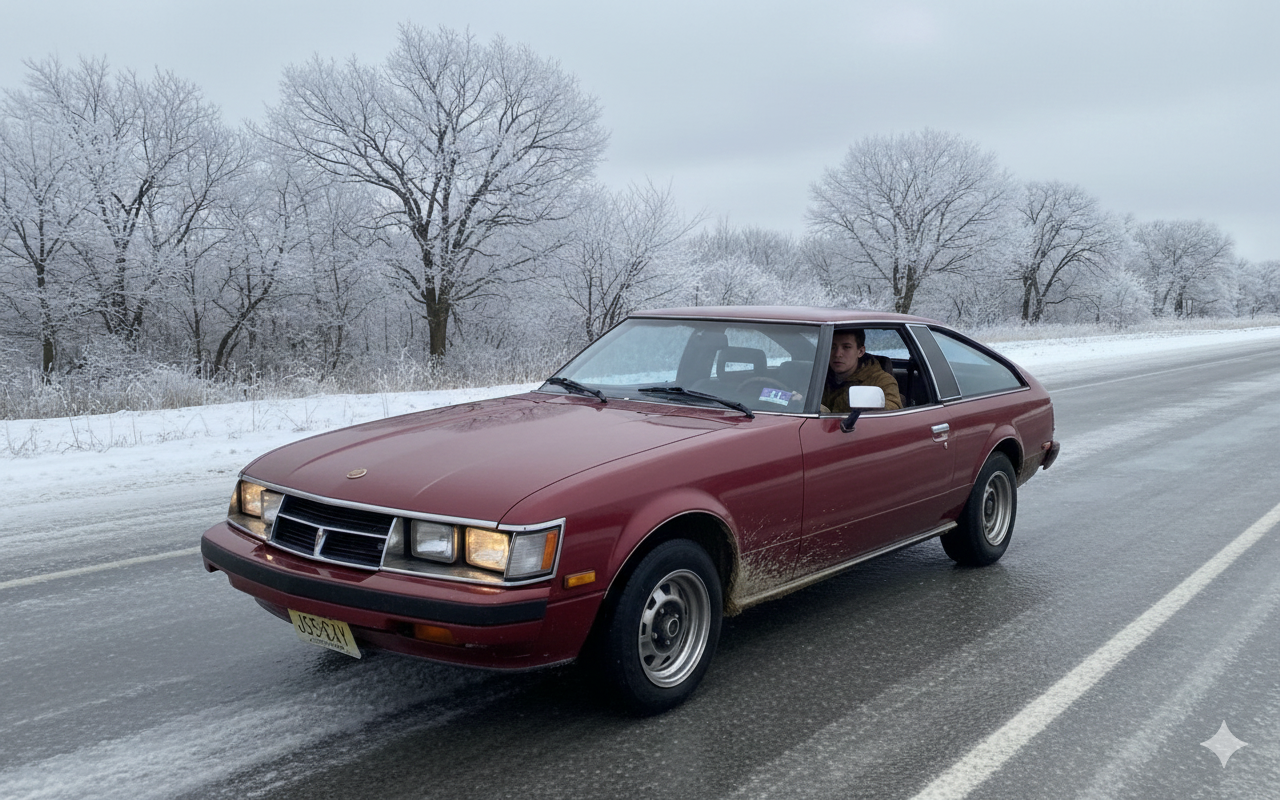
[created using Google Gemini]

Dad recalled how the streets leading from downtown Lawrence to the university campus would become quite icy, and once while driving up Mt. Oread the car did a 180-degree about face and he went back down the hill, thankfully with no damage. I had a similar incident forty years later while driving on icy US 77 into Norman on my way to the University of Oklahoma. My rear-wheel drive 1981 Toyota Celica Supra suddenly began a complete 360-degree spin. I followed the advice from driver’s education, turning into the skid and pumping the brakes, only to arrive back in place in my lane, again facing forward. Motorists around me had paused, their faces frozen in alarm, but there were no impacts, and I too was able to proceed with no damage. I was lucky, and I stuck with the decision I made that morning that every subsequent car I bought would feature front-wheel drive.

Apartment Living in Lawrence

Dad got married in December 1946 to his first wife. They found their first apartment, a furnished one with a few steps up to an entryway and a few steps down to a bathroom. However, when they turned on the water for the kitchen sink, there was an odd sound as it drained. They opened the cabinet to find the sink drained into a bucket, which had to be carried out the front door, down the steps to the sidewalk, down more steps to the basement bathroom, and then dumped.

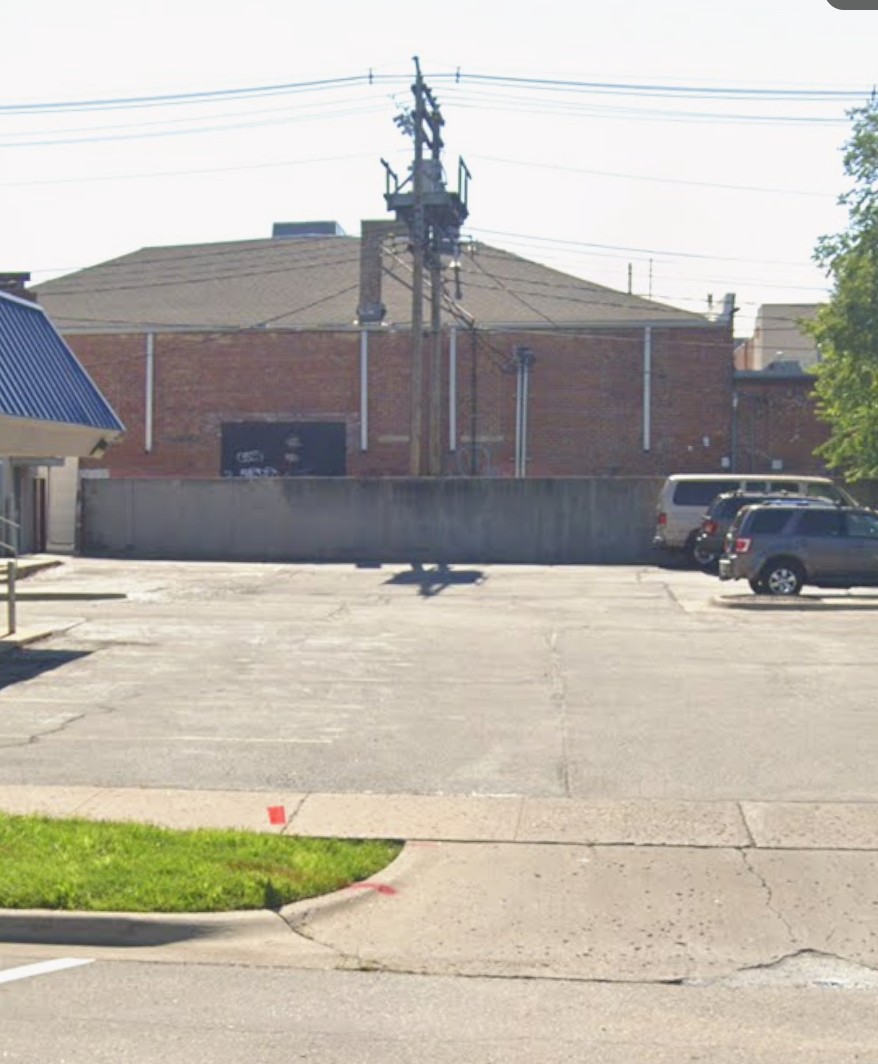
Needless to say, they looked for better accommodations. Downtown, just across the alley from the back wall of the Granada Theater, was a two-story red brick building that had once been a carriage house on the alley behind a house that had been reduced to just a foundation. The carriage house was split into four apartments, with the landlady in the front downstairs. Dad and his bride rented an upstairs unit, which was reached by a wooden stairway from the alley up to an enclosed landing, which had an ice box with two doors to the two upstairs apartments, which shared the ice box and a common bathroom.

My father lived in a carriage house behind this theater
My father once lived in a carriage house behind the Granada theater in Lawrence

One incident my father recalled was when he smelled smoke coming from down below. He realized it was coming from the landlady’s apartment. Banging the door yielded no response, but Dad knew she kept a hideout key in a small shed at the front of the house. He got the key, opened the door, and discovered a pan had been left on a lighted burner on the gas stove and had burned dry its contents. Thankfully the fire had not spread, so he turned off the burner, aired the house out, left a note, locked the door, and replaced the key.

When the landlady returned, “Here she came, not to thank me for saving her home but to ask me how I knew she had a hideout key in the shed out front. I don’t remember how I knew, but I had probably observed her retrieving it at some time. Bless her heart!”

The carriage house is long gone

While Wendy and I were in Lawrence, I checked the alleyway behind the Granada Theater. I could see the theater’s back wall against the alley, as my father had described. However, there was just an empty parking lot beyond. The carriage house, like the main home it had been built for, was long gone.

After completing his sophomore year, Dad switched to studying petroleum engineering. He managed to complete the degree in his three years at KU, graduating in the spring of 1949. Dad would spend 35 years in the petroleum industry, catching peak years of oil and gas activity.

Dad’s College Jobs

To make ends meet, Dad took several part-time jobs to supplement his G.I. stipend, including sanding the floors at one of the Lawrence school gymnasiums.

Dad later wrote:

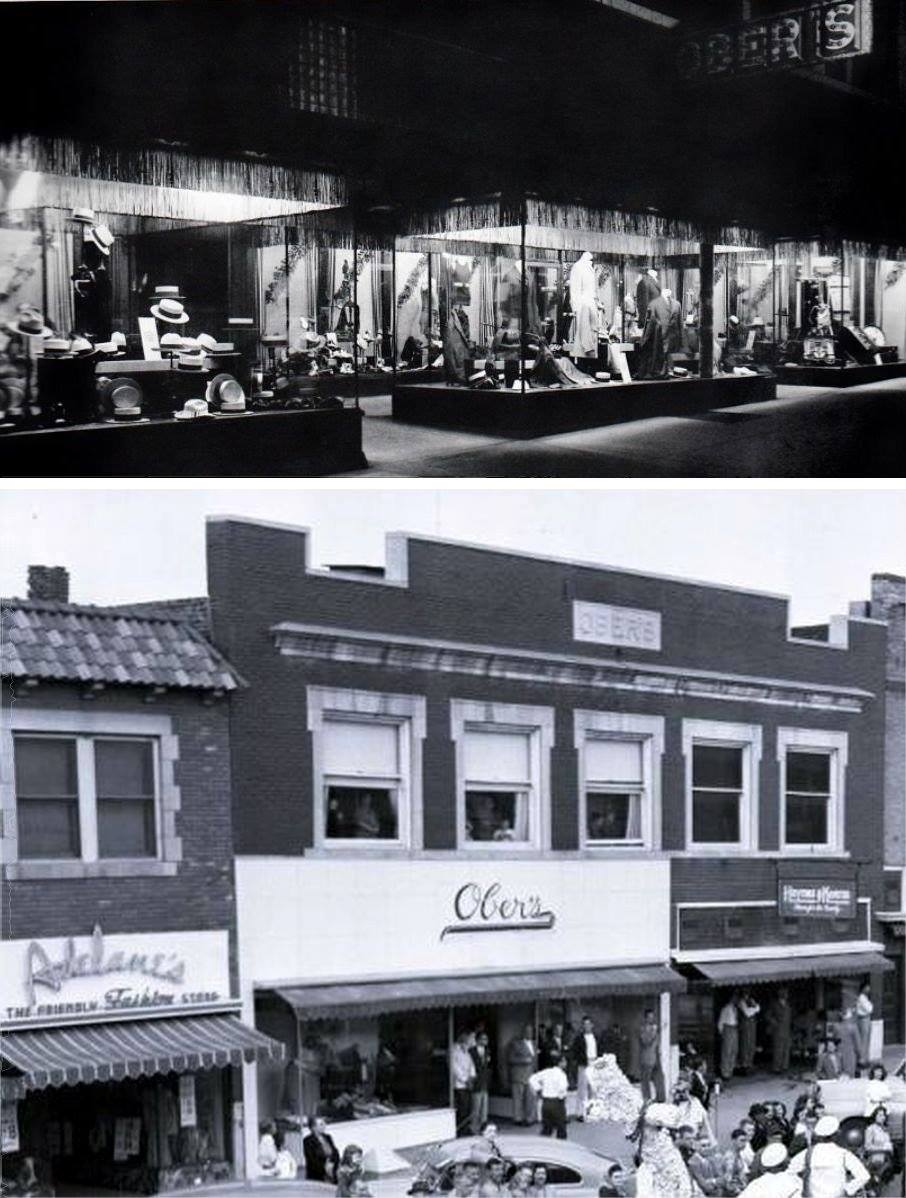
My best job, and one I kept from year to year, was presser of alterations at Oberʹs Menʹs Shop, the swankiest menʹs shop in downtown Lawrence. There was a balcony affair above and at the back of the store which served as an alterations and pressing room. Up there, high above the sales floor, a little lady seamstress did all the alterations of suits, pants, jackets, etc. sold in the store. After she was through with a garment she would hang it up to be pressed. I would come in and steam press the alterations she had done on a given day, or come in on Saturday and press all she had done over a period of a few days.

I was paid 43¢ an hour and was given a ten or fifteen percent discount on anything that I purchased from the store. I donʹt remember the exact percentage because I was never able to afford anything that they had for sale, not even a necktie. I recall being up there every Saturday afternoon pressing away and wishing I was out watching KUʹs home football games. All the time that I was at KU the University of Oklahoma team always beat our Kansas team. I contended that the reason the Oklahoma Sooners always beat our Jayhawkers was that they had their own football to practice with.

Ober’s in 1925 and 1950 [Source]

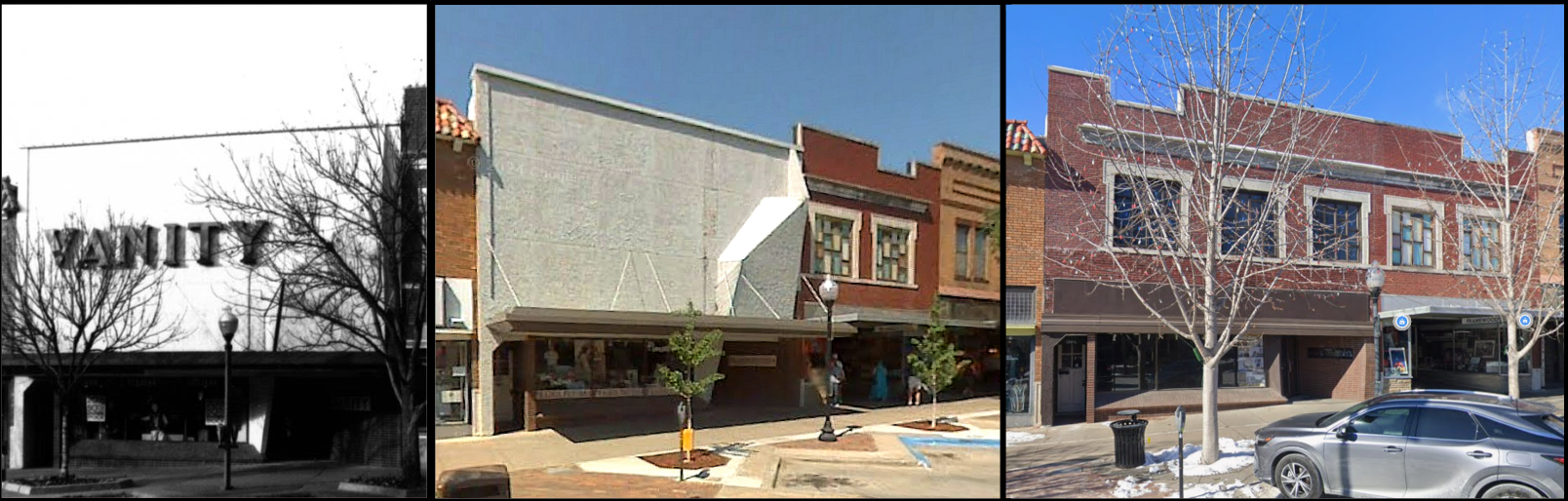
Henry “Bert” Buell Ober had purchased the store from Abe Levy way back in 1896. By the time my father worked there, Ober’s had downsized into the southern part of its building, and eventually the upstairs area was used to sell Boy Scouts apparel. I was unable to determine when the store closed, but in the 1980s or 1990s the south part of the building was “modernized” with a hideous new façade, causing the building to be designated as “non-contributing” in the historic downtown’s listings in the National Register of Historic Places. Thankfully, sometime between 2019-2021 the original brick design was restored. I was gratified that anything recognizable remained in downtown Lawrence that my father had mentioned from his time there over three-quarters of a century earlier.

The former Ober’s in 1993, 2007, and 2024

Back to B’ville

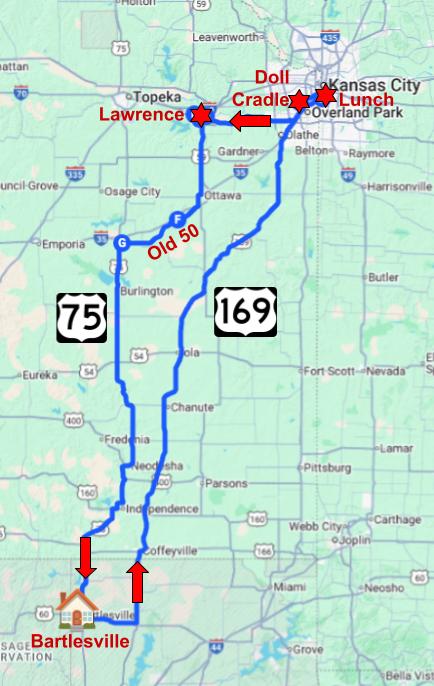
On our third day in Lawrence, we packed up and drove over the west side of town for breakfast at The Big Biscuit. Then we drove south on US 59 to Ottawa. We could have taken Interstate 35 southwest to US 75, which leads through Bartlesville 130 miles to the south.

However, I wasn’t in the mood for that, and opted to divert around the western edge of Ottawa and take Old Highway 50 to US 75.

What would have been a 28-mile 24-minute drive thus became a 29-mile 34-minute drive along a nearly deserted highway through the little towns of Homewood, Williamsburg, and Agricola.

Charles Kuralt did On the Road segments across a million miles for a quarter-century, riding in a motor home with a small crew, avoiding interstates in favor of the nation’s back roads in search of America’s people and their doings. I’d catch one from time to time on CBS. Kuralt once remarked, “Thanks to the Interstate Highway System, it is now possible to travel across the country from coast to coast without seeing anything.”

I enjoyed that mild detour, but soon we were on familiar US 75. After I moved to Bartlesville and first began traveling to Kansas City, I took 75, but it was so deadly dull that I switched to US 169, which is mildly, quite mildly, more interesting. We could have driven south from Ottawa to catch 169 at Garnett. Rather than repeat ourselves, however, I stuck with 75 through Burlington, Yates Center, past Buffalo and Altoona, turning to track through Neodesha.

US 75 briefly merges with US 400 south of there, and I often miss the turnoff where 75 resumes its dedicated track past Sycamore. Sure enough, I missed the turnoff again, having to make a U-turn to try again. Then we zipped through Independence, familiar to me from many childhood visits with relatives there. Having shamed myself at missing the earlier turnoff, I sought redemption by bypassing town via a diversion west on Taylor Road to then turn south on Peter Pan and then rejoining 75.

Peter Pan & Braums

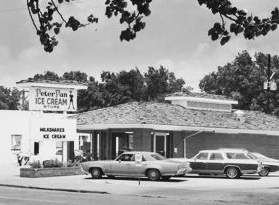
As a kid, I was amused that a section road near Independence was named Peter Pan. It was named for one of the Peter Pan Ice Cream Stores. In 1933, Henry H. Braum started a butter processing plant in Emporia, and in 1952 one of his sons, Bill, developed a chain of retail ice cream stores across Kansas.

One of the old Peter Pan Ice Cream Stores, started by Bill Braum

In 1967, the 61 Peter Pan Ice Cream Stores were sold off, but the sale did not include the Braum Dairy or its processing plant. The sale terms forbade the Braums from selling ice cream in Kansas for a decade, and Bill moved the business to Oklahoma City. The first Braum’s Ice Cream & Dairy Store opened in 1968 a few blocks from where I lived from 1978 to 1984. Now the family owns and operates over 300 stores across Oklahoma, Texas, Kansas, Missouri, and Arkansas. The Peter Pan store in Independence is long gone, but they do have a Braum’s!

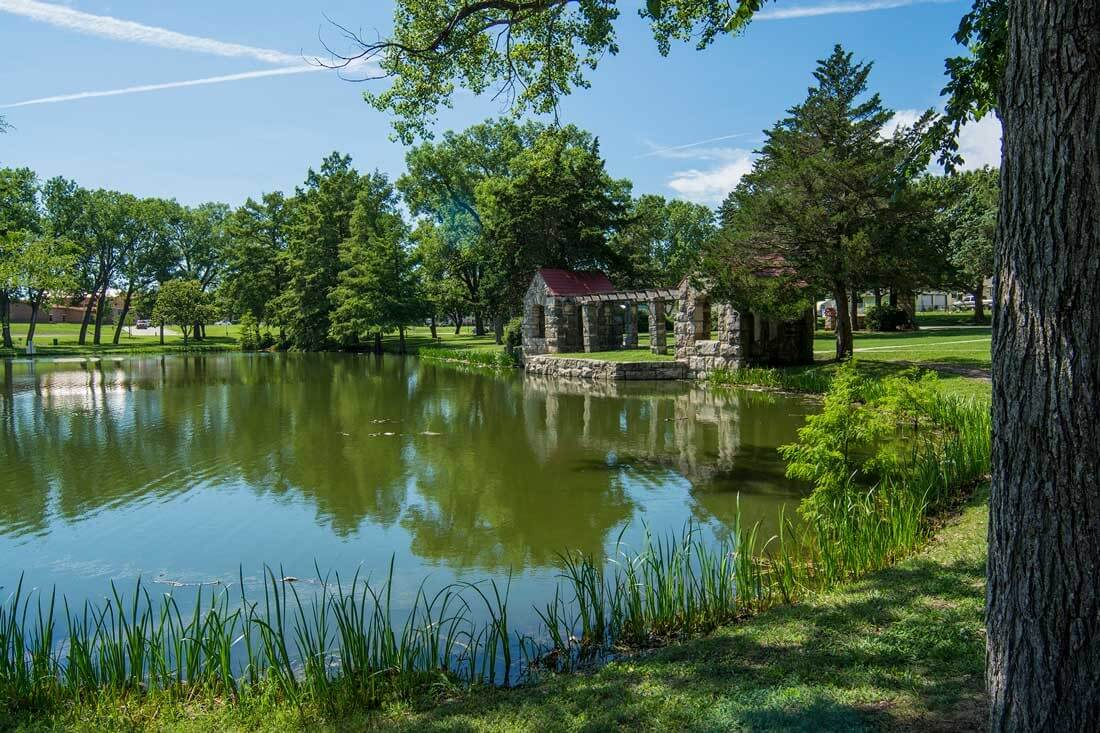
But why did Bill Braum call his first stores Peter Pan? Well, in Emporia there is a Peter Pan Park. It originated when a young girl, Mary White, died of injuries from a horse-back ride. Her father wrote an editorial about her life and funeral, and referred to his daughter as a “Peter Pan” girl who did not want to grow up. The article yielded contributions to the family, which they used to build a park.

Peter Pan Park in Emporia, Kansas

Little House on the Prairie

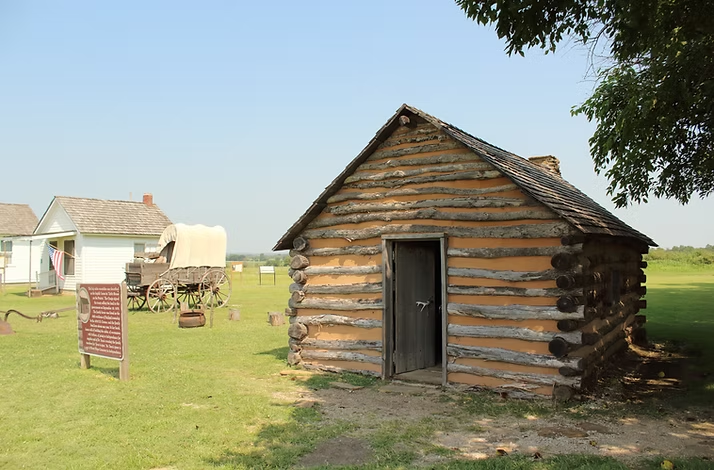
Just 11 miles southwest of Peter Pan Road in Independence, just a mile off US 75, is the site of the actual Little House on the Prairie, where Laura Ingalls lived in 1869-1870. Laura’s father had moved the family there from Wisconsin, thinking that the Kansas area would soon be up for settlement. However, their homestead was on the Osage Indian reservation, and they returned to Wisconsin.

Little House on the Prairie is the third book in the series of eight novels that Laura Ingalls Wilder published from 1932 to 1943. The first one will enter the public domain in 2027, and the third in 2030.

The Little House on the Prairie near Independence

There is a museum on the property, open Thursdays-Saturdays from March through October. It has a replica of the Ingalls family cabin, an old post office, and a one-room schoolhouse. However, we’ve been there, done that, and anyways, the museum isn’t open in November. So we continued on south through Caney, Copan, and Dewey to return home.

We enjoyed visiting Lawrence, and I expect that Wendy and I might do a similar trip someday, visiting Kansas City and staying overnight at the TownePlace Suites by Marriott in downtown Lawrence. However, I think we’ll again want to time that to match up with a holiday break…we aren’t college kids anymore, by a long shot.

< Jayhawkers Part 4: The Watkins

Posted in history, photos, travel | 2 Comments

Jayhawkers Part 4: The Watkins

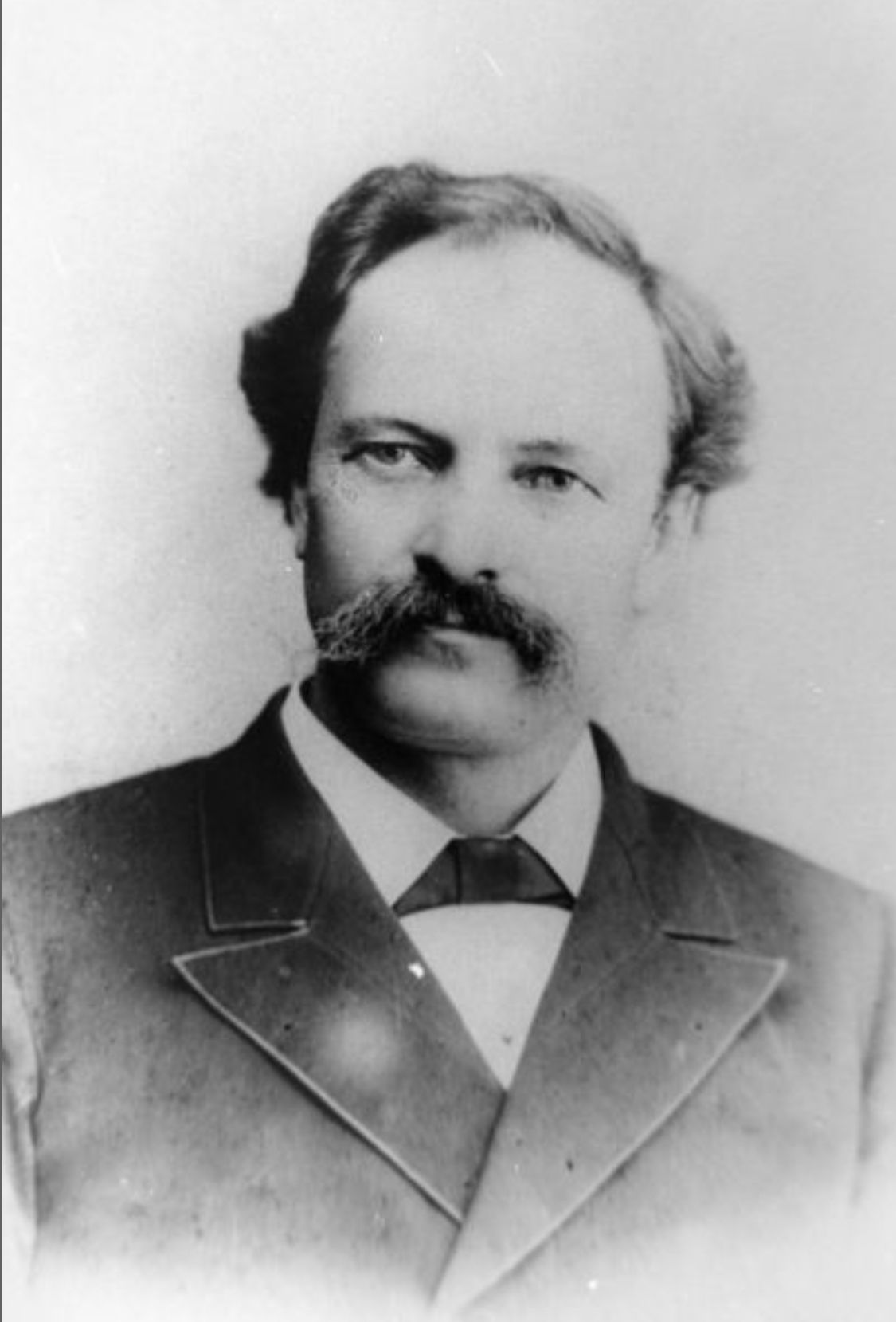
Jabez Bunting Watkins was born in 1845 near Punxsutawney, Pennsylvania, about forty years before its Groundhog Day celebrations commenced. He had humble beginnings, studying law and settling in Lawrence, Kansas in 1873, where he established a land mortgage firm connecting eastern investors with Kansas farmers needing loans.

Jabez Watkins

He developed an empire, owning more than 300,000 acres in Kansas and 1,500,000 in Louisiana. He organized the Merchants National Bank in Lawrence in 1876, and a decade later work began on a new headquarters for his business ventures.

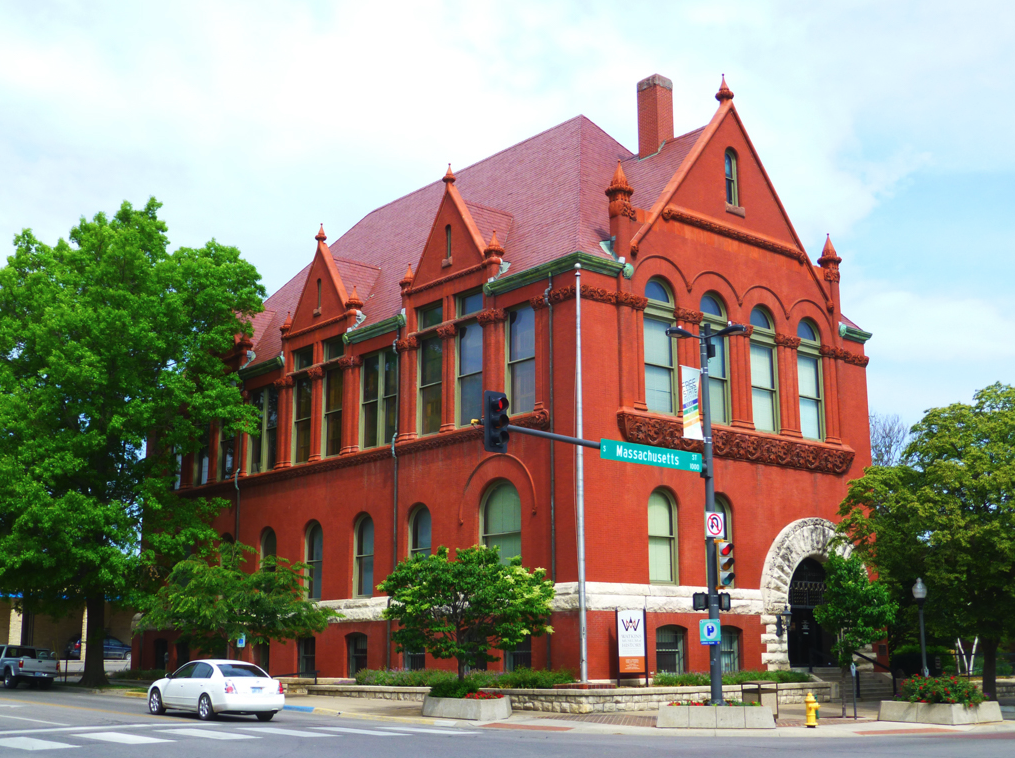
The imposing red brick building was Richardsonian Romanesque, with a limestone entry arch and profuse ornamentation achieved via terra cotta borders between the floors, decorative turrets at the corners, and window ornaments.

Photo by David Sachs [Source]

The main entrance features a grand stair which ascends to a second floor that was Watkins National Bank and a third floor for his land mortgage company, with a mezzanine between that floor and the attic for company employees. Beautiful decorative paneling and door and window frames were ash on the ground floor, white oak on the second, and curly yellow pine on the third. Watkins spared no expense in outfitting his HQ, including multiple vaults and expensive custom furnishings. The building had ventilation chases and was plumbed for gas lighting but also wired for electricity to take advantage of the hydroelectric dynamos at the Kansas River dam.

Watkins died at his home in Lawrence in 1921, and the bank closed in 1929. His widow gave the building for use as City Hall, which remained until 1970, when the Douglass County Historical Society acquired the building and began restorations. The Elizabeth M. Watkins Community Museum opened in 1975.

Wendy and I walked in the main entrance, finding ourselves on a landing of a large stairwell. The landing was large enough that to one side, seated at a desk, was a lady who welcomed us and outlined the building’s layout.

We ascended to the banking floor, struck by the beautiful stained glass windows on the stairs leading up to mortgages. They are original to the 1888 building and were recently restored.

Watkins Building Windows

You couldn’t miss the original function of the floor we entered, as BANK was spelled out in a lovely floor mosaic.

Watkins Building Floor Mosaic

The old bank had beautiful ceilings.

Watkins Building Architecture

Black Minstrels

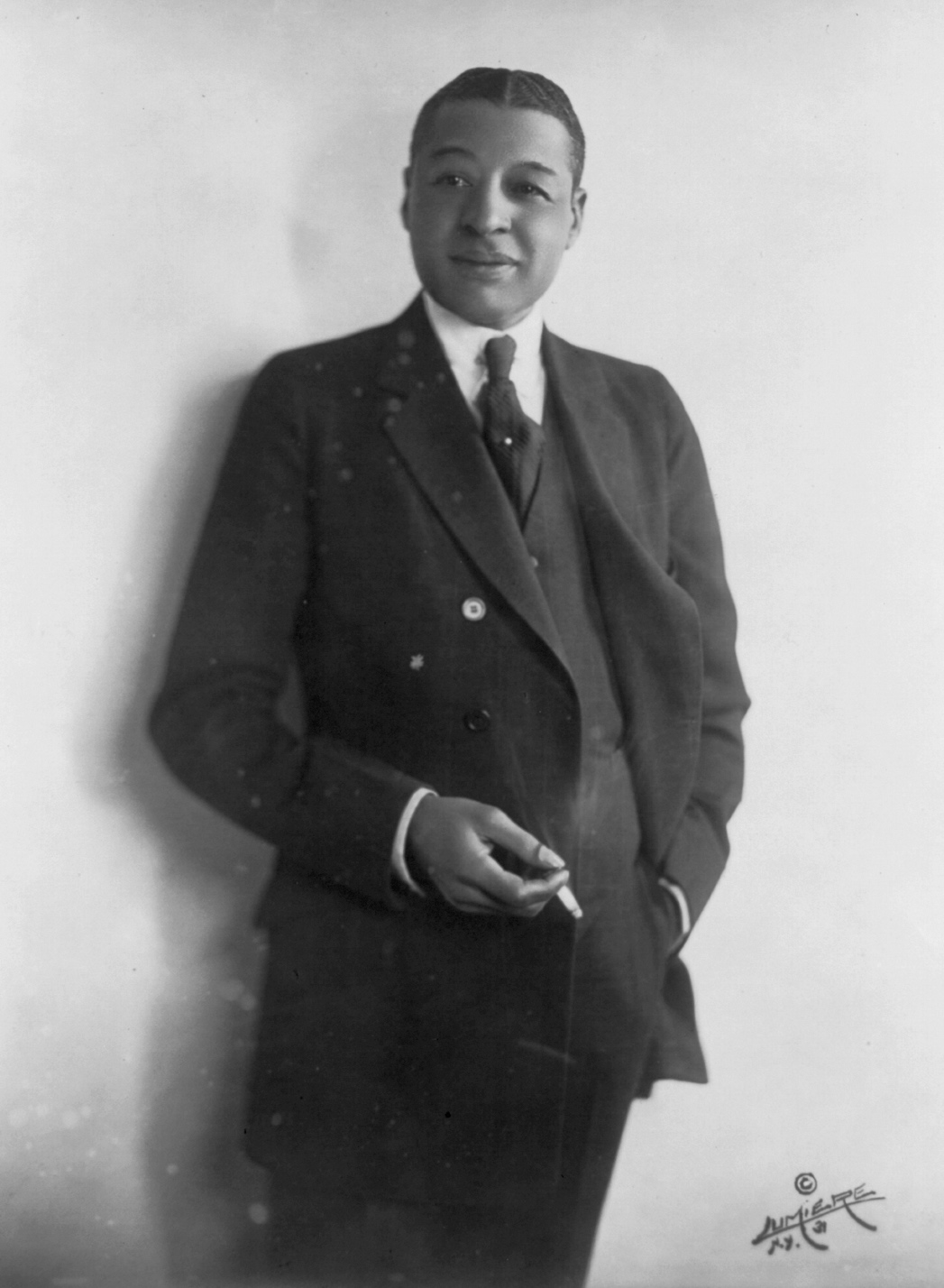
A fascinating temporary exhibit was In the Spotlight: Lawrence’s George “Nash” Walker featuring the research and personal collection of author Daniel Atkinson. It followed the career of Walker from Lawrence to the lights of Broadway. He and his partner, Bert Williams, performed a highly successful vaudeville act on Broadway and overseas.

Jim Crow era black minstrel George "Nash" Walker
Atkinson’s book is available from the SUNY Press as well as via Amazon

Wendy’s and my eyes bugged out to see the Jim Crow era sheet music on display from 1897. It was striking that when George and Bert did their black minstrel shows, George was a “dandy” who performed without makeup. Bert had fair skin, giving him easier access to the white vaudeville scene.

The two billed themselves as “The Two Real Coons” since many vaudeville minstrels were whites painted in blackface. At first, the lighter-skinned Bert would trick the darker Walker in their skits. With lighter skin expressing some European ancestry, and a fine voice, by the expectations of the time Williams would have performed as the “straight man” in comedy routines. Williams was very talented, and he played all instruments very well. Walker had darker skin, and was a great comedian and dancer. He would be expected to play the fool.

However, they discovered that audiences found them much funnier when they subverted the stereotypes and played against their appearances. Williams applied the burnt cork to his face to become a black man in blackface, while Walker performed without any makeup, dressing a little too high-style and spending all the money he could borrow or trick out of the lazy, carefless, and unlucky character Williams portrayed.

Jim Crow era minstrel sheet music, 1897

There was a photograph of George and his beautiful wife, Ada, who was “The Queen of the Cake Walk” and later also became a choreographer. Here is an example of a Cake Walk.

Ada Overton Walker and George Walker

Sadly, in 1909 Walker began to stutter and suffer memory loss due to syphilis. He died in early 1911, at age 37 or 38, in a sanitarium on Long Island, and he was buried in Lawrence. Ada died suddenly of kidney failure in 1914 at age 34.

Jim Crow era minstrel sheet music, 1897
Bert Williams

As for Bert Williams, back in 1910, Booker T. Washington had written of him: “He has done more for our race than I have. He has smiled his way into people’s hearts; I have been obliged to fight my way.”

Walker’s death made it a struggle for Williams to keep their company operating, and he was approached by Florenz Ziegfield to perform in his famous Follies. Williams agreed and signed a three-year contract. The white actors threatened to walk out because they did not want competition from a black actor, but they changed their minds when Ziegfeld said he could replace any of them except for Williams, because he was unique and talented. After his contract was up, Williams performed for another three years with the Follies because of his success.

However, his career lagged after his final Follies appearance in 1919, and his final years were marred by chronic depression, alcoholism, and insomnia. He died in 1922 at age 47. A private funeral service held at a Masonic Lodge in Manhattan broke a color barrier, being the first Black American to be so honored by the all-white Grand Lodge. When the doors were opened for a public service, nearly 2,000 mourners of both races were admitted.

Other Exhibits

I liked a Life in Early Lawrence exhibit that Abby Magariel, who was the museum’s education and programs coordinator from 2011 to 2019, had unveiled a decade earlier.

Fun smells exhibit

The architecture of the old building fascinated me, including its five sliding banks of shutters for the large windows, some of which are a whopping 12 feet tall.

Original shutters at Watkins Museum of History

We ascended the beautiful stairway to the upper floor, which re-opened in 2022 after an eight-year remodeling project.

Watkins Building Stairwell

A prime display there was a Milburn Light Electric Car from the early 1900s. Its only customary owner had been Eleanor Henley, who drove it around downtown Lawrence in the 1920s. It was restored in 1973.

Milburn Light Electric Car

The woodwork continued to impress.

Beautiful woodwork in the Watkins Building

One of the more unusual items was a sculpture of shoe soles. Lloyd Burgert had asked his customers to sign the worn soles he removed, and he assembled that piece of folk art in the late 20th century.

Sculpture of shoe soles

After completing our tours of the second and third floors, we took an elevator to the lowest floor, which appeared to be used as meeting and research space, and I enjoyed seeing an old fuse box preserved in the men’s bathroom.

Watkins Building Fusebox

We returned to the entrance, and I was glad to find they had a booklet by Jack Newcomb with the story of the Watkins building. The docent said it was $5, so I pulled out a $20. She confessed she did not have change, and I said that was no bother, that we had enjoyed the free museum so much that the remainder should be considered a donation.

Unbeknownst to us, Steve Nowak, the museum’s Executive Director, was on the stairway above us. He greeted us, identified himself, and shared that witnessing that sort of spontaneous moment warmed his heart. I am truly grateful to all of the past and present staff of the museum and its board members for their successful efforts to curate such a beautiful, interesting, and happily diverse experience. If you are ever in Lawrence, I highly recommend stopping in at the Watkins.

Jayhawkers Part 5: Family History >

< Jayhawkers Part 3: Past Purposes

Posted in history, photos, travel | Leave a comment

Jayhawkers Part 3: Past Purposes

After enjoying the Spencer Museum of Art, Wendy and I returned to the TownePlace Suites to reset before heading out to lunch. We again took advantage of its location just east of the Massachusetts Avenue strip to go find lunch. On our walk, a couple of structures caught my attention.

A Phillips 66 Cottage Station

Just south of the hotel, on the southeast corner of 10th & New Hampshire, was a ceramics store. If its shield sign wasn’t enough of a giveaway that it had once been a Phillips 66 gasoline station, the store was in one of the telltale cottage-style buildings that date back to almost a century ago.

Former Phillips 66 Gas Station

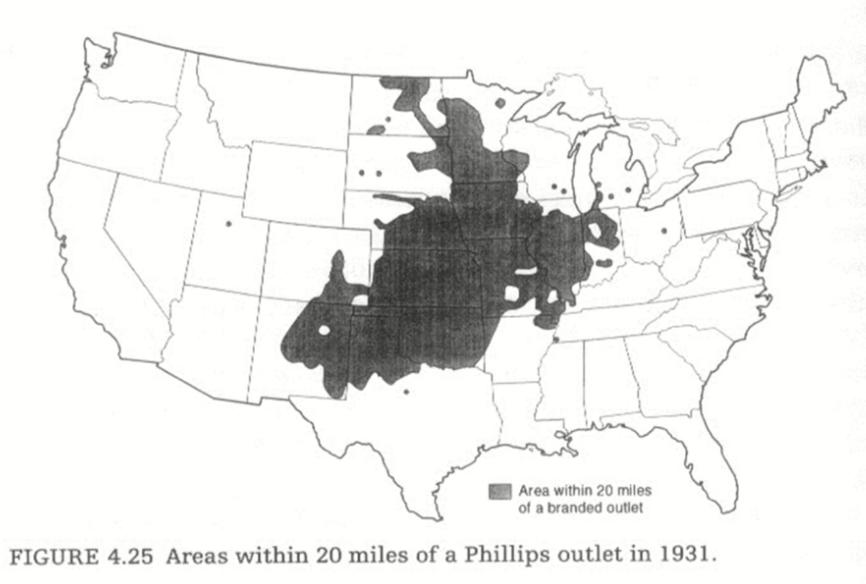
Phillips built over 500 of the structures across the mid-section of the country from the late 1920s through the 1930s.

[Source]

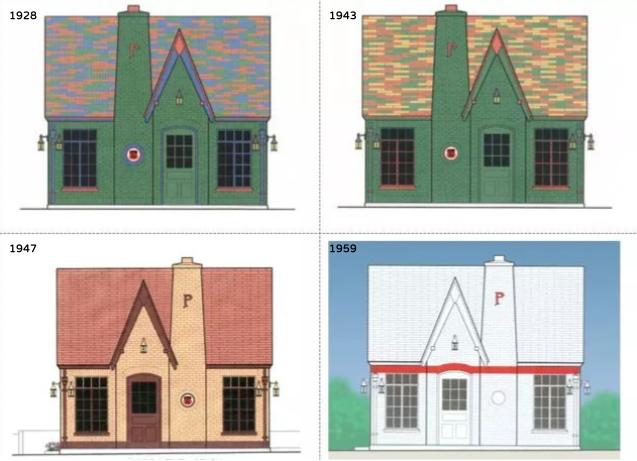
The first of them was at 805 Central Avenue in Wichita, and the building has survived. The cottages’ company color schemes changed over time.

Phillips Stations by Mike Kertok [Source]

Back in 2018, at a roadsite architecture and attractions forum in Tulsa, Mike Kertok provided a half-hour overview of the cottage stations, showing that many other petroleum companies also made use of the style, and I appreciated his fun categorization of 66 of the surviving stations. His work is also available in text form.

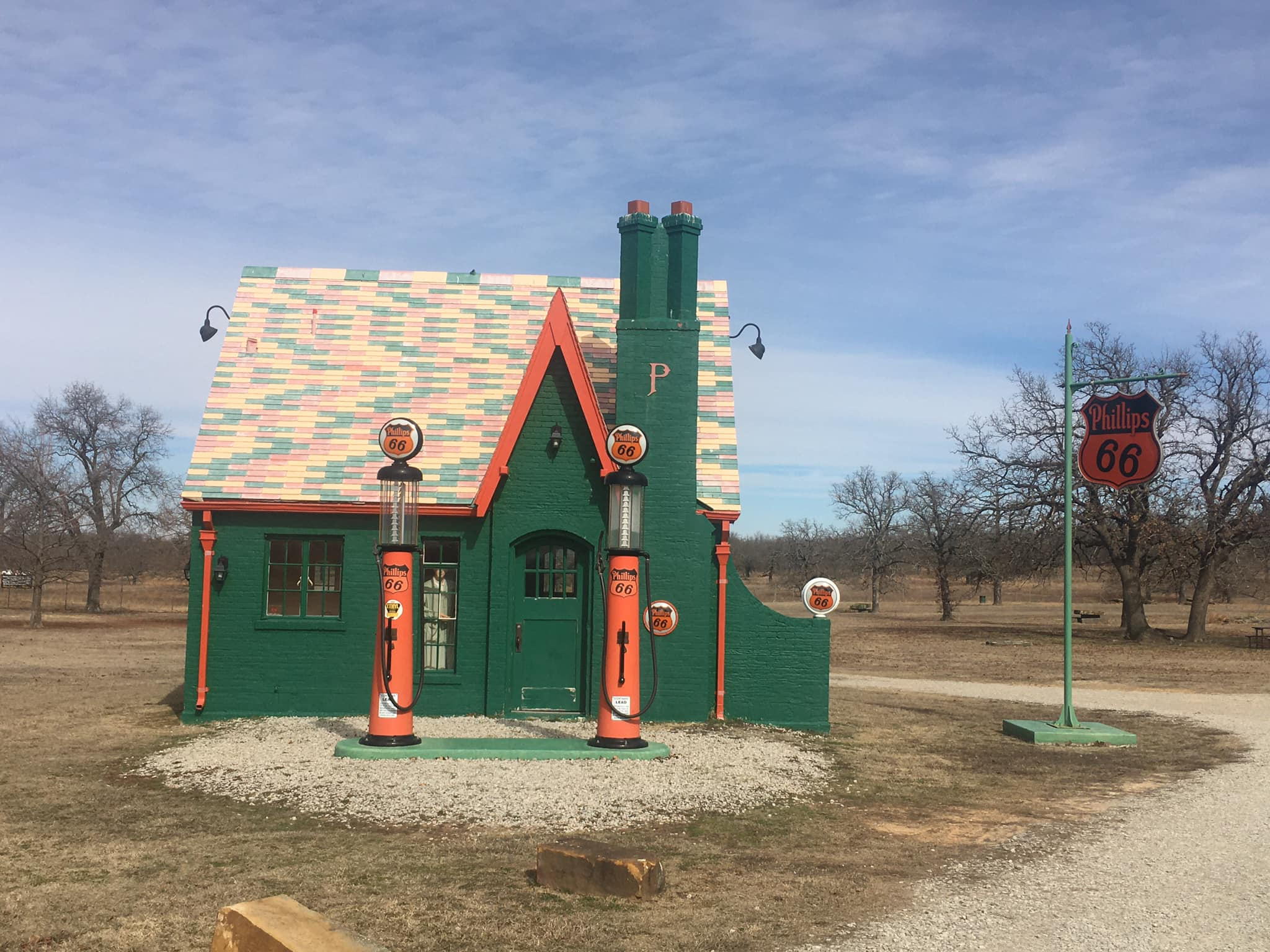
Kertok’s roll call was impressive, given that less than 100 of the old Phillips 66 cottage buildings have survived. Woolaroc Museum has a cottage that was never actually a gasoline outlet, but instead served as Bartlesville’s airport office for several years and was donated to the museum in 2015. It has been renovated to show what a little cottage gas station was like a century ago.

The former airport office turned Woolaroc gas station [Photo by Eric J. Wedel]

Many of the cottage stations were tiny, making them difficult to repurpose. However, Cramers Phillips 66 in Lawrence, built in 1928, had one garage bay, increasing its adaptability.

A Former Masonic Temple

Another building that caught my eye was the town’s old Masonic Temple, a 1910 building in the Egyptian Revival style. The three-story 14,197 square foot former temple was for sale, with a list price of $1.15 million or leasing at a bit over $7,000 per month.

Masonic Building in Lawrence

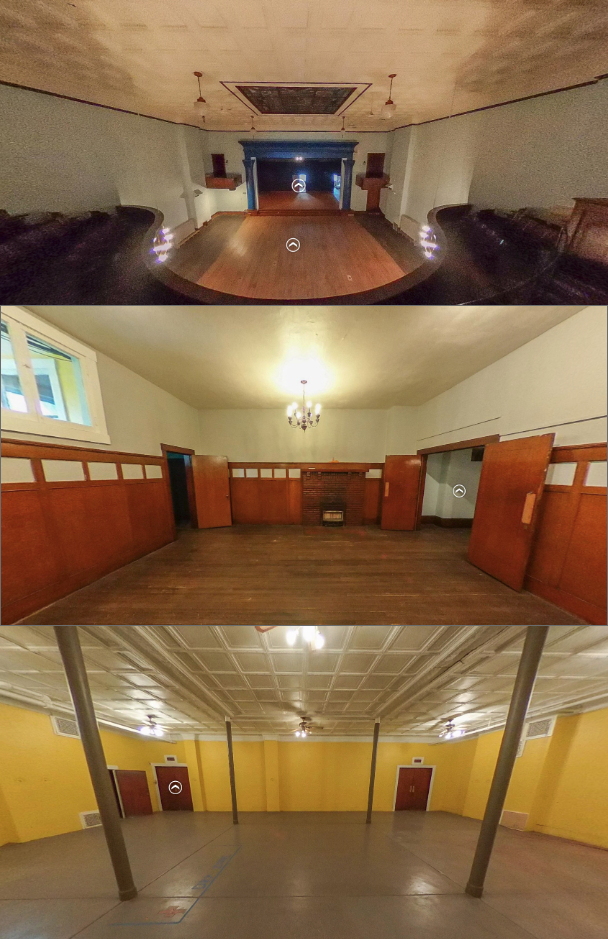
It retains tin ceilings, wood floors, and marble accents, and I was glad to find an interior virtual tour.

Like many Christian churches in the old mainline denominations, many fraternal organizations are having to sell off facilities that are too much for their declining memberships. The fraternal organizations have been weakening for decades, as documented back in 2000 by Robert Putnam in Bowling Alone.

That process has accelerated throughout the digital age as the developing internet and social media offered virtual connections that made in-person lodge meetings less attractive. The Covid-19 pandemic was another powerful accelerant in their decline.

Another factor is that a century ago the fraternal organizations had an important function of serving as a social safety net, but the New Deal reforms made those supports less vital.

At their peak, it has been estimated that as much as 40% of the adult male population held membership in at least one fraternal order. In Bartlesville there were Knights of Columbus, Knights of Pythias, Knights Templar, Woodmen of the World, Odd Fellows, Freemasons, and Patrons of Husbandry, along with a menagerie of Eagles, Elks, Lions, Owls, and Moose. Then there was a much longer list of various civic organizations. A few chapters and lodges endure, but many are long gone.

There were once over four million Masons in the USA, about 4.5% of all American men. However, in 2024, the Masonic Service Association of North America reported 869,429 members under their associated Grand Lodges, a drop of over 75% from their peak, even as the country’s population expanded significantly.

Rebuilding

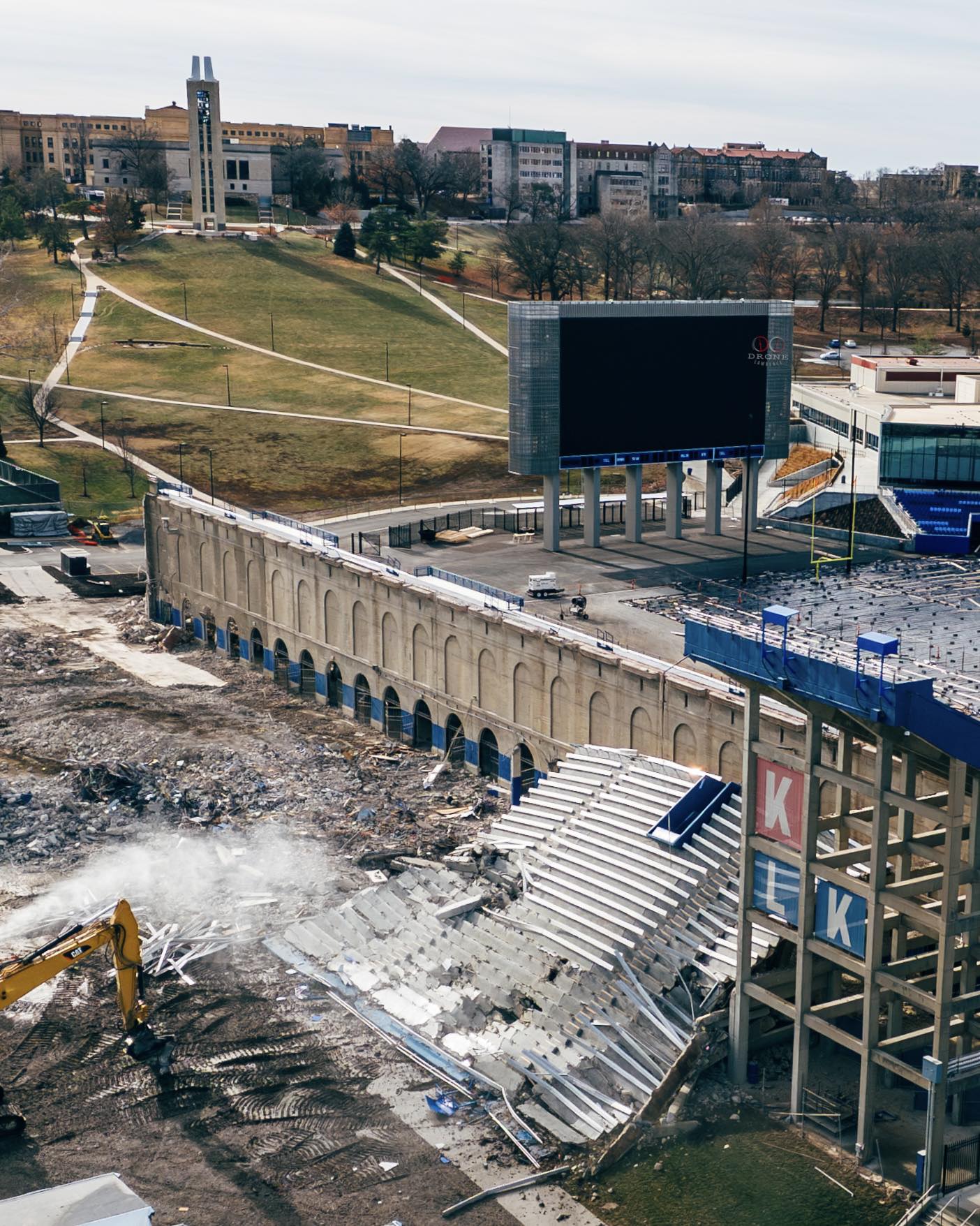
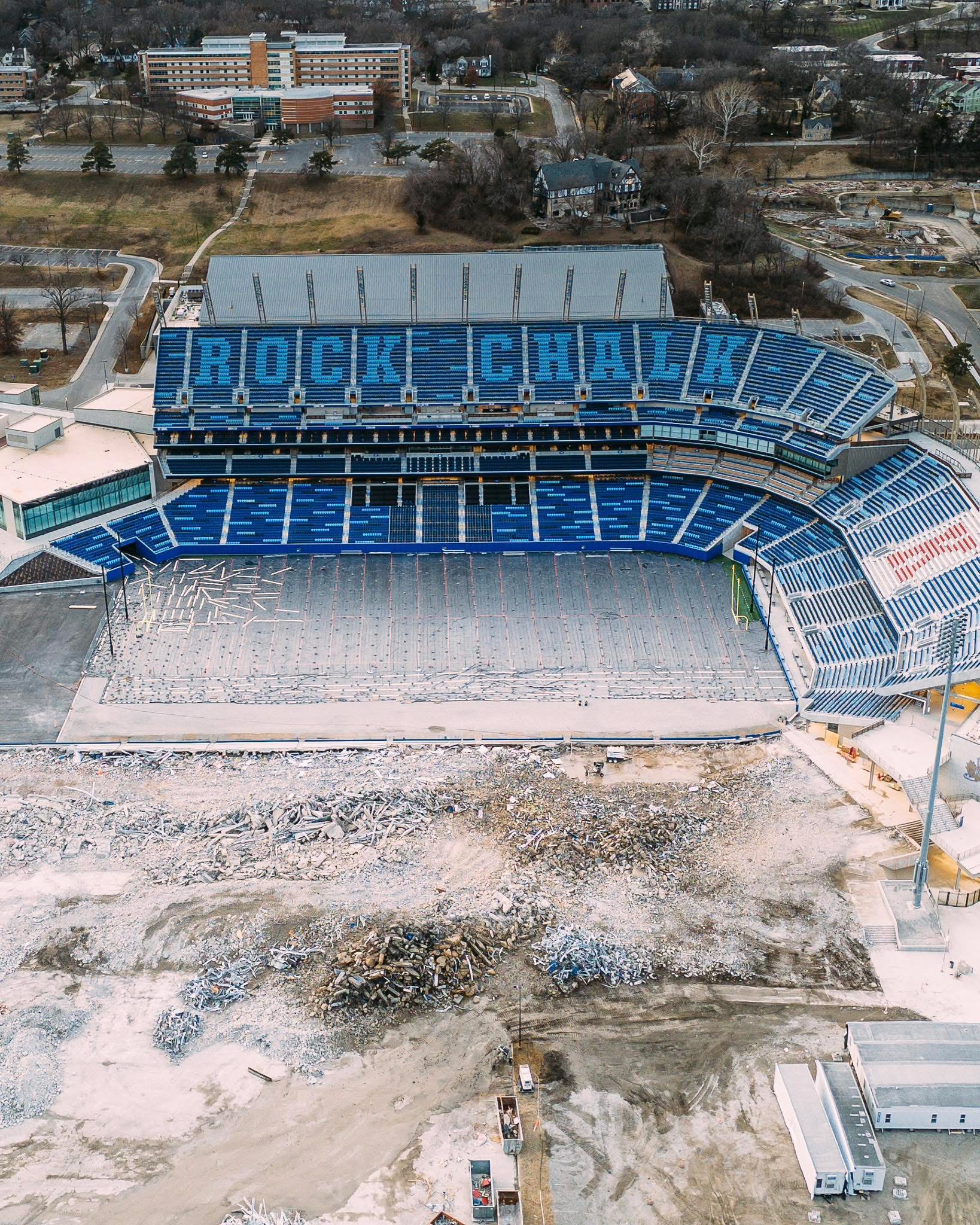
A month after our visit, an image on the internet captured my attention. It showed the huge football stadium we had driven by during our visit half-destroyed.

Not being sports fans, Wendy and I had been unaware that the stadium was part-way through a complete rebuild. The west stands had already been demolished and rebuilt before our visit, and the east stands were brought down in December 2025.

Memorial Stadium was built in 1920 with only east and west bleachers, which expanded southward in 1925. A north bowl was added in 1927, and the west bleachers were expanded upward in 1963 and the east ones in 1965. The rebuild will cost hundreds of millions of dollars, with KU alumnus David G. Booth kicking the project off with a $50 million donation that resulted in the stadium being renamed in his honor. Booth later donated another $300 million to KU.

Latchkey Deli

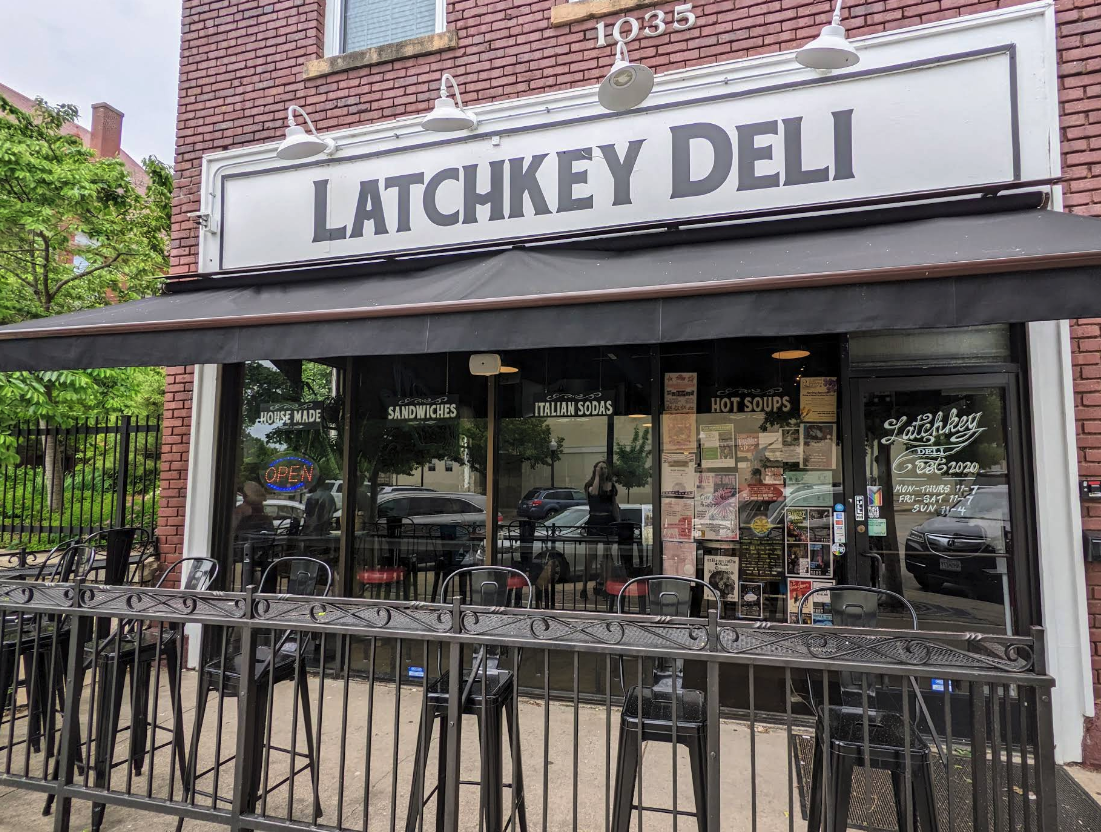
We walked down Mass to a 1910 two-story brick building to have lunch at the Latchkey Deli. There were no tables left in the tiny restaurant, but the weather had improved so that we were able to just take our trays out front to eat at the streetside counter. I recommend their delicious mac & cheese for a side. I had a cherry Italian soda that once again reminded me why I find those confections more fun to look at than to consume.

We then walked past a little Japanese Friendship Garden, established in 2000, to tour the Watkins Museum of History, which will be the subject of the next post.

Jayhawkers Part 4: The Watkins >

< Jayhawkers Part 2: The Spencer

Posted in photos, travel, video | Leave a comment