Tech Transitions Part 1: Analog to Digital

January 17, 2015

My experience is that my habits lag, sometimes considerably, behind the relentless improvements in technology in which I am immersed. As one of the the long-time experts in computer technology in my school district, I provide a great deal of support for teachers transitioning to new ways of doing business. Yet it is not surprising that younger generations who grow up with a new technology embrace it more quickly than those of us who already have built our lives around older models of productivity and entertainment. I am starting a series of posts to outline my progression through technology transitions, comparing that to general trends. This is the first of a projected four posts: analog to digital, broadcast to on-demand media, fixed to mobile computing, and local storage to cloud. Here I’ll look at my analog to digital transitions in video, audio, reading, and recordkeeping.

Video: VHS to DVD to Blu-Ray (and later the cloud)

Physical media for home video

Physical media for home video

I witnessed the videotape format war in analog home video back in the late 1970s and early 1980s. Sony’s Betamax eventually lost the battle with the inferior but more popular VHS videotape format: being better and first is no guarantee of success. I backed the winning side in that war, but only because by the time I could afford a player, Betamax was clearly the loser. (Almost 30 years later, Sony would win the high-definition optical disc format war between Blu-ray and HD-DVD; I wasn’t so lucky in that conflict, investing first in a HD-DVD player and several discs, but then having to switch to Blu-ray.)

In the early 1980s, I was in high school and started college, and home video players were still too expensive for me to purchase. Instead, I would go to a video store and rent both the player and the movie. Since I had no credit yet, I’d have to put down a deposit of several hundred dollars for the player, but it seemed magical to be able to watch any of dozens of movies after growing up with only broadcast television and eventually cable TV.

I still use Kereluk's videotapes

I still use Kereluk’s videotapes

That history of renting the technology, plus the low quality of VHS recordings, meant that I seldom purchased analog videotapes. But, after I could afford a home player/recorder, I did record a few shows off broadcast and cable television. I still have a number of those tapes, and I still play an analog videotape most weekday mornings! In 1993 I began doing aerobics in the morning with Cynthia Kereluk’s Everyday Workout show, and over the next four years I filled up 13 tapes with extended-play recordings of it. I’ve been doing those 130+ workouts for over 20 years now, cycling through the tapes, hitting PLAY to work along with a tape each morning for another installment. I’m surprised all of the tapes have lasted this long, and Wendy, my sweet girlfriend, painstakingly converted all of them into digital movies for me so that I could have them even after the tapes wear out.

Now, why in the world don’t I give up on those decades-old tapes? Newer isn’t always more convenient. Having those shows on optical disc would require that I remember which episode I’d just completed, since my Blu-ray player will only remember where I left off on a disc under certain conditions. Watching them via my Apple TV or some other connection to my networked storage would require thumbing through episode listings to find the next recording. I don’t want to hassle with that when, with the old analog tape, I can always start right where I left off by just re-starting the 10-episode tape; the only inconvenience is having to rewind the tape after 10 shows and switch to the next tape on the shelf.

Video format changes from 1998 to 2008

Video format changes from 1998 to 2008

The above graph shows how the transition from VHS to DVD to Blu-ray went in the 2000s. The lower bar chart shows how video-on-demand, both downloaded and streaming, has skyrocketed in the 2010s, but it generates less revenue for the industry than physical media. Analog video is now completely dead as a revenue source, but physical media still provide the bulk of the U.S. home entertainment industry’s revenue in our country. I’ll analyze this issue in more detail in my next post in this series, the one on broadcast vs. on-demand technologies. On the home front, I still buy or rent some Blu-ray discs to access director commentaries and special features, but many of the movies Wendy and I watch are downloaded or streamed.

Home Video Revenue, 2006 to 2013

Home Video Revenue, 2006 to 2013


Audio: Vinyl and tape to MP3 (and later streaming)

Analog and digital audio media

Analog and digital audio media I once used

In junior high and high school I amassed a collection analog audio recordings, with dozens of 45 rpm singles and 33 1/3 LPs on vinyl. I even had a few awful 8-track tapes (shudder). Then digital compact discs came along. My transition from analog to digital music dates back to the late 1980s, about 20 years ahead of my transition from analog to digital home video. I remember a Christmas party at my house back in the mid-1990s when students commented on my “large” CD collection of about 40 discs. That would eventually grow almost ten times larger, filling up wall cabinets in my living room. In my cars, digital also replaced analog. I once had some big cases in my cars, filled with cassette tapes, and made and shared mix tapes with girlfriends. However, I never used a portable cassette player much.

All of that changed ten years ago when I bought my first iPod for $500. It was an amazing device, allowing me to quickly access any of a thousand songs, anywhere. One of the happiest moments of my life was a hike on a glacier on Mt. Rainier in Washington State, skipping along to Hanson’s bouncy and infectious MMMBop from 1997. That 2004 iPod was quickly succeeded by iPod Nanos in 2005 and 2007, and then a biennial series of iPhones beginning in 2008.

The iPod led me to eventually abandon CDs for the MP3 digital file format. Ripping my CDs and buying MP3 led to a collection of almost 14,000 MP3 files in my iTunes library by the end of 2014, having finished my complete transition to the format back in 2010 when I sold off over 350 CDs to fund the purchase of my first iPad tablet.

Below we see how the rest of the country also shifted from analog to digital music before 2010, with plummeting revenues as CDs gave way to lower-paying downloaded MP3s.

Music revenue sources, 1973-2009

Music revenue sources, 1973-2009

Album sales also declined, with a tremendous rise in lower-revenue digital singles in the 2000s:

Albums give way to singles

Albums give way to singles

I’ll close this section with a summary of music revenue over the past three decades, where we see the industry still heavily reliant on CD sales, even at this late stage, with digital downloads comprising the biggest portion of revenue. But, as I’ll show in more detail in a later post, digital downloads declined for the first time in 2014 as on-demand streaming continued to grow. Vinyl record sales have surged in recent years, thanks to hipsters, but they are the smallest fraction of total revenue.

Music revenue, 1973-2013

Music revenue, 1973-2013


Reading: Magazines, Newspapers, and Books to Internet Tablet and e-Reader

I have always been an avid reader. Back in 2010 I also sold off about 1/5 of my roughly 1,000 books, but I still have two-dozen shelves of previously-read books in my home office, with two more shelves of books I’ve purchased but not managed to read. And that is just my remaining analog collection. I bought the first Amazon Kindle e-Reader back in 2008 and have purchased and enjoyed four more of the electronic-ink units since then, and am currently paying off my latest Kindle Voyage. I have bought over 250 electronic books for my Kindles since 2008.

My early Kindles generated more comment when I was out and about than any device I’ve ever owned. Tablets like the iPad have somewhat more market penetration than e-readers, but electronic ink is still easier on your eyes for long-term reading, and much more readable outdoors. Sales of electronic books are projected to keep rising, but print books will still be dominant for years to come.

The dominance of print books continues in our own school. As we prepare to finally adopt new science textbooks in Oklahoma after a disgraceful nine-year wait, I wish our district could transition to electronic textbooks, but we lack the funding to supply each student with a device. I certainly look forward to the day when backpacks and sling bags loaded down with heavy textbooks are a thing of the past, especially since I use textbooks only sparingly in my own teaching.

Book revenues by format

Book revenues by format

I'm reading far fewer books these days

I’m reading far fewer books these days

Since 2008 I’ve read over 250 Kindle books and uncounted additional print ones, and from 2009 to 2012 I listened to dozens of audiobooks on my day hikes. But in the past three years, my personal book reading has fallen off sharply while my audiobook listening has stopped completely. Part of that is my increasing use of a tablet to read online articles along with my decision to subscribe (and later this year, probably unsubscribe) to the print edition of The New Yorker magazine. A heavy workload has also taken away much of my evening leisure time this school year. But the biggest reason for the decline in my book reading in the past few years, and also why I’ve stopped listening to audiobooks, is the welcome change of dating Wendy. On the weekends, we spend a lot of time together at home and out on the road, so I don’t need audiobooks to keep me entertained when I travel, and naturally I’d rather spend my limited leisure time with Wendy than with my Kindle.

Most of my reading these days is news via my iPad, with a morning ritual of reading the Tulsa World along with top stories from USA Today and Bartlesville Radio. I should read the local Bartlesville Examiner-Enterprise in the same way, but haven’t made that transition from analog to digital yet, and I’m paying for it. As my reading habits have shifted to virtual and digital media, stacks of unread newspapers have repeatedly built up in my dining room. I’ve tried to switch to digital-only on the E-E, but was told I had to make a phone call to an out-of-town service to make a complete switchover. Having to do that via a voice call seems rather ironic and calls into question the sophistication of their digital provider, but I need to get that done before I drown in newsprint. I like the local news the paper affords me…but what do I call it when it is no longer on paper? Hmmmm…

I'm down to two print magazines

I’m down to two print magazines

As for printed media other than books, I read two weekly print magazines: Time and The New Yorker. I’ve subscribed to Time for almost 30 years, while I’ve only taken The New Yorker for a few years. Too many editions of the latter pile up, unread, despite my love for their higher-level long-form articles. So I’ll probably let that subscription lapse, hoping to spend more time with books.

Recordkeeping: Checkbooks to Spreadsheets, Paper Bills to Online, and Analog vs. Digital Gradebooks
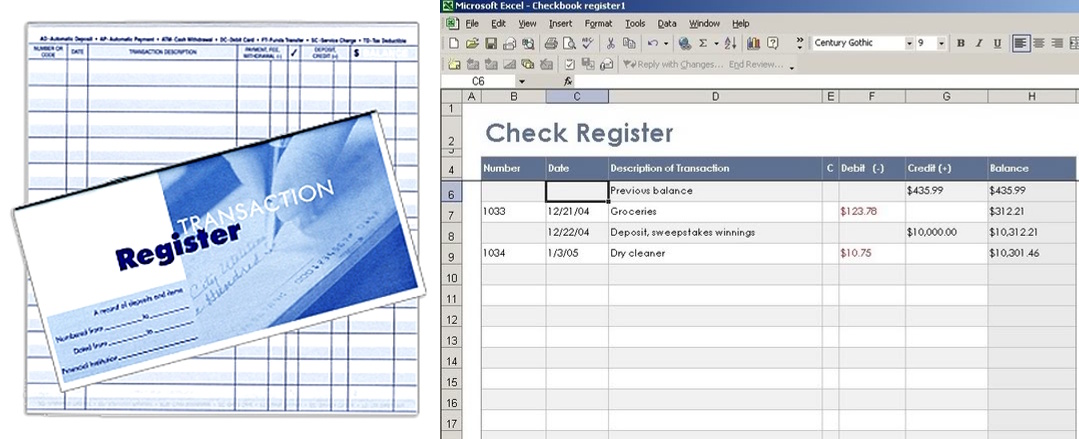
Analog vs. digital checkbook registers

Analog vs. digital checkbook registers

I’ve kept an Excel spreadsheet of my monthly household finances for 30 years, tracking all of my bills, spending, and income. But, out of habit, I have always kept paper checking and savings account registers to help me manage my budget. I did start using my bank’s iPhone app last year, and that lets me review transactions and conduct transfers more quickly than through their website, and now I can even deposit checks by taking a photograph of them with the phone. For 2015 I’m going to try making a complete switch to digital bookkeeping by using an online spreadsheet to track my checking account. Up until now, the paper registers were more convenient since they were always handy, not requiring me to sit down at my desktop computer and fire up an Excel spreadsheet. But now I can use Google Drive or Excel on mobile devices. Since I have a personal Microsoft Office 365 subscription which lets me use Office on up to five computers, five tablets, and five phones, I’ve finally switched to using an Excel spreadsheet for my account registers.

The ecological argument for paperless billing

The ecological argument for paperless billing

I’ve had direct deposit for years, and some time ago our district finally stopped issuing paper checks and paystubs in a cost-cutting move. My own cost-cutting move was to switch to electronic bank statements since the bank started charging for paper ones. That has worked out okay, so as part of my accounting modernization, I’ve also finally given up on paper utility bills. That’s a huge change for me, since I really didn’t care about the ecological cost of paper billing, and I haven’t seen any companies passing the savings from paperless billing directly to participating customers. My bank, you’ll notice, used a stick, instead of a carrot, to get me to switch. Up until last year, I had a copy of every utility bill I’d ever received, a pointless collection of paper that I finally culled, prompted in part by the derision of my more modern girlfriend. Now I’ve signed up for paperless billing for almost all of my utilities, which should be fine since I’ve had everything on automatic payment plans for decade. The only holdout is the city, since I couldn’t find online a way to switch to paperless billing with them, even though my payments to them are already automated.

Again, Wendy’s all-digital bookkeeping helped prompt my move, although I’ve refused to give up the paper credit card bill nor paying that bill via old-fashioned checks. Keeping my card fully paid off is a point of pride for me, and I need to see how well I do at keeping up with paperless utility billing before I consider any changes on the credit card, which is not set up for automatic payments. Looks like about 1/4 of bills and statements nationwide are now paperless:

Paperless billing trend nationwide

Paperless billing trend nationwide

Why are bills and account registers some of the last things I’ve switched to digital formats? First, because an oversight or mistake can have costly consequences, I’ve been reluctant to alter tried-and-true habits. Second, because the digital formats were slightly less convenient. Paper bills have been physical reminders to keep up with my accounts, and the paper register was instantly accessible and editable, even though it required use of an old desktop calculator. Hopefully emailed reminders and the accessibility of spreadsheets on mobile devices, with instant retention of changes to the cloud and automated calculations, will make the switch worthwhile. I would hope the utilities would just email me a statement as an attachment, but more likely I’ll have to login to each service and click things to see the statements, which will a pain. The username/password system used across services is a dumb model which we desperately need to update with biometrics and other simplifying measures.
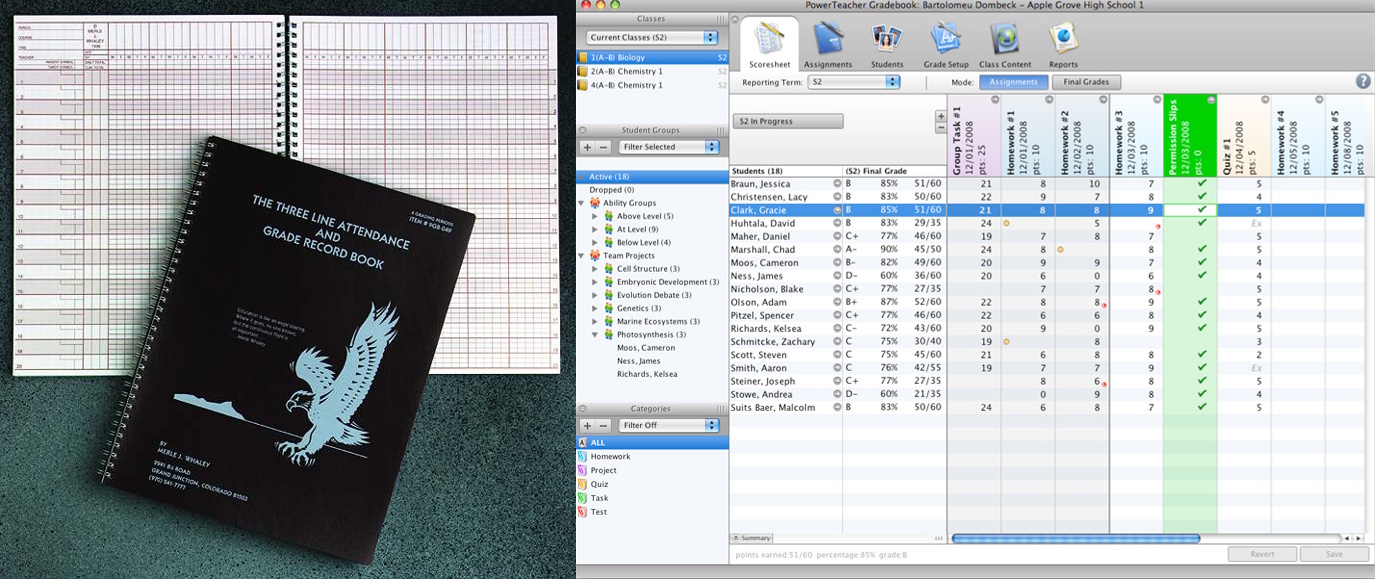
My analog vs. digital gradebooks

My analog vs. digital gradebooks

On the work front, I link to online digital versions of all of my assignments for students who lose a paper, but I still hand out and grade only paper copies of assignments. That won’t change until our school eventually provides students with computing devices.

I’m also still very analog when it comes to classroom record-keeping. I’m no Luddite on this issue: I like the feedback our online gradebook provides to students and parents, and I do take full advantage of its flags, comments, assignment links, reports, and so forth. Few of my fellow teachers have all of their assignments digitized with links already set up in a digital library in the gradebook; I create the district’s user manual for online gradebook, have provided trainings on its use, and gradebook questions in the district are often routed to me. So colleagues are shocked when I reveal that I still keep a paper gradebook. Why in the world would I do that?

I maintain a paper gradebook for three reasons. First, I am a stickler for tracking attendance and tardies, and the PowerTeacher program at school isn’t designed to help me keep close track of that at a glance during my hectic class time. Second, I hate scrolling up and down or mousing about in a digital gradebook to put in grades. So after I grade a set of papers, which I sort by the seating chart since lab groups sit together in my room, I manually write the grades into my paper gradebook. That lets me quickly type them into PowerTeacher using a numerical keypad. Finally, I like having an analog copy of the gradebook so that I never have to print nor save a digital copy of the gradebook in case of a database disaster or data breach; I always have that analog copy on hand just in case.

A Bonus Entry – Photography: Film to Files

I gave up on film photography back in 2000, as detailed in my All My Cameras history.

Assessing My Analog-to-Digital Transition

Video: Still playing daily workouts in analog format, but otherwise fully digital for many years; currently a mix of physical media, digital files, and streaming services

Audio: Completely digital by 1994; no physical media as of 2010

Reading: Printed books still preferable for some visuals, but whenever feasible I prefer a Kindle e-book; most of my reading is digital format on an e-reader, tablet, phone, or computer and soon I’ll be down to only one printed magazine and no printed newspapers

Recordkeeping: 2015 is my transition to almost entirely digital and online accounting, but classwork is still analog and I use both analog and digital grading records

Photography: Entirely digital since 2000

Will all of these areas go completely digital? Even highly visual printed books may eventually give way to high-resolution mobile screens. In my next post in this series I tackle another technology transition: broadcast to on-demand media.

Tech Transitions Part 2: Scheduled Broadcast to On-Demand Media >

Posted in books, education, music, technology, video | Leave a comment

Twixtmas in Kansas City

Late December 2014

Wendy and I decided to spend some of the time between Christmas and New Year’s, a period which I shall term Twixtmas, in Kansas City, MO. This shorter trip 200 miles north was a deliberate contrast to our longer vacation the prior Winter Break, when we drove 575 miles south to San Antonio, TX. Rather than fleeing it, we would allow winter to embrace us in its grip. It made our time together in the Paris of the Plains all the cozier. The map below provides the locations of the Kansas City attractions we visited, and you can click here for a slideshow of our trip.

Osage Hills

A couple of days before we embarked, we hiked 3.5 miles at Osage Hills, knowing that we’d soon be walking cold urban sidewalks. It was relatively warm and sunny on the bluff above Sand Creek. The Creek Loop was mushy, and Sand Creek was running well from recent rains.

Country Club Plaza at night

Union Station

Copan Truck Stop Cinnamon Roll

The day after Christmas we headed north out of Bartlesville, stopping at the Copan Truck Stop for a huge and delicious cinnamon roll, slathered in thick icing. We arrived at Kansas City’s Union Station in time for lunch at Harvey’s. The immense Grand Hall and North Waiting Room were decked out for Christmas. At one end was a lovely, huge Christmas Tree, with more trees and nutcracker guards up high. Holiday lighting at the entrance and along the length of the North Waiting Room invited one to walk its length to arrive at a nice display at the entrance to the Model Railroad Experience.

Christmas Train at Union Station

Crown Center

Wendy with Maxine and Floyd

We took the The Link, the enclosed elevated walkways, over to Crown Center, enjoying the view of the downtown skyscrapers. We toured the Hallmark Visitor Center, where Wendy posed with crabby old Maxine and her dog Floyd. Then we walked over to the lobby of the former Hyatt hotel, the site of the infamous skybridge collapse I analyze in my Failure By Design lesson.

Country Club Plaza

Our own hotel for this stay was a few miles to the south at Country Club Plaza. I eschewed the Best Western Seville Plaza, where I’ve previously stayed, for fancier top-floor accommodations at the well-located Courtyard by Marriott, which is housed in the 1925 building which was once the Park Lane Apartments. I am always glad when an old building is successfully renovated for continued use, and judged this renovation as a great success.

Buca di Beppo

During the trip Wendy and I enjoyed dining at Buca di Beppo and other Plaza restaurants, although I regretted not planning ahead so that we could finally have dinner out with a gracious former student living in the KC area who has repeatedly offered her and her husband’s hospitality during my infrequent visits to the area. Wendy loves KC, so hopefully we can finally connect on a future trip.

The Plaza was outlined in lights at night, although it was not nearly as impressive as the Christmas lights we saw earlier in the break in OKC.

Art Museums

Synthesis column by Tom Price

We walked over to the Nelson Atkins Museum, my favorite KC destination, which was also decorated for Christmas. Wendy liked Wayne Thiebaud‘s Apartment Hill, and I thought that the Synthesis resin columns by Tom Price looked like something out of Star Trek. We quested through the museum for truly small treasures: a few items from the city’s Toy & Miniature Museum deposited in various rooms while the museum undergoes renovation. Then we enjoyed a chocolate cupcake in the museum’s Rozzelle Court before venturing upstairs where we found an interactive create-your-own-Rodin-sculpture kiosk. Both my effort, Despair, and Wendy’s creation, Strengthmake me question what was in that cupcake.

The bright sky beckoned us back outdoors, where teepees set up on the grounds contrasted with the stately nearby residences. Along our walk back to the Plaza, we discovered, on the grounds of the Kansas City Art Institute, the life-size statue of Thomas Hart Benton sculpted by Charles Banks Wilson and Nick Calcagno in 1989.

Crying Giant by Tom Otterness

On another day we walked over to the Kemper Museum of Contemporary Art, which inevitably disappoints me. Crying Giant by Tom Otterness reflected my view of most of the works on display, while Wendy is more accepting of contemporary art and enjoyed June Ahrens’ Used and Worn display of used soap and other materials. She also got a kick out of Elizabeth Layton’s I am LovedIn it, Grandma Layton (she didn’t begin drawing until she was 68) depicted an elderly woman holding her wedding dress up to her body.

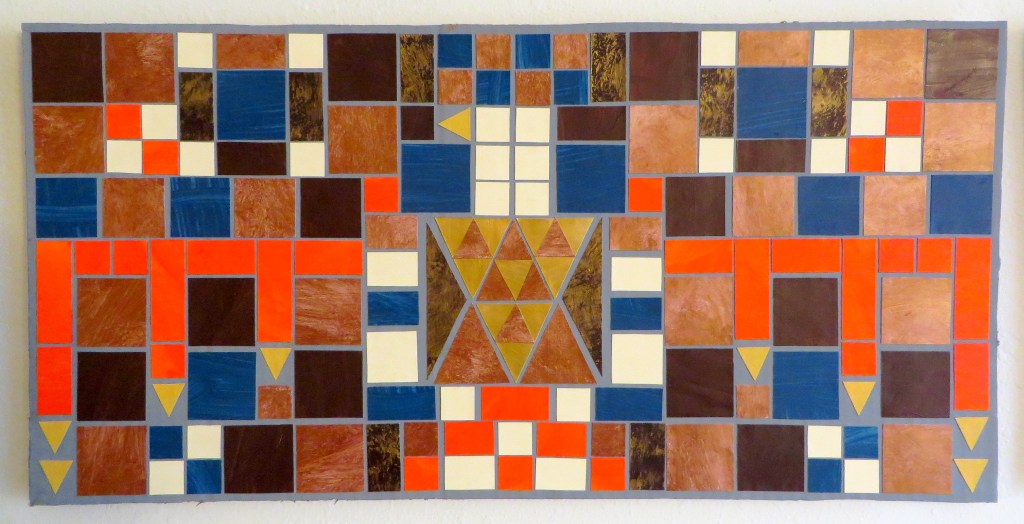
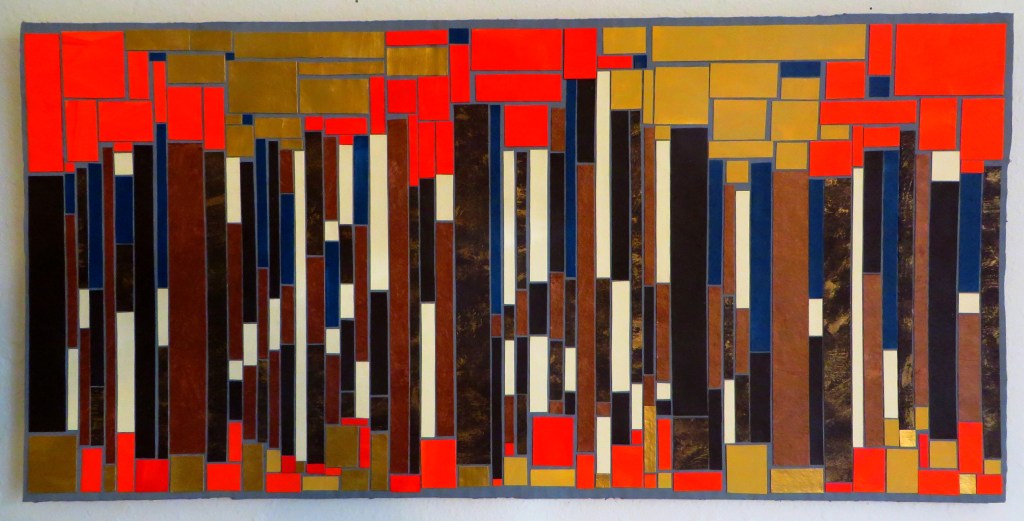
Myself, I am a great admirer of Wendy’s own creations. Just before we left for Kansas City, she completed her third paper mosaic, depicting a bear hidden amongst autumn trees. It joins her earlier depiction of a winding snake and a thunderbird, all originally inspired by the tile work we saw this summer at Albuquerque’s KiMo Theatre.

Downtown

My Treasure

We ventured downtown to tour the public library housed in a renovated bank building, including the big vault turned into a film room and a small vault Wendy had fun posing inside. Out of one window we spied two pigeons huddled together atop a stone eagle. Wendy and I agreed that snuggling was the best remedy for the cold weather.

We also drove to the very northern end of Main Street to walk the Town of Kansas Bridge which leads out over railroad tracks to a platform above the south bank of the Missouri River. A train passed under us as we walked toward the river’s edge, where stairs led to the Riverfront Heritage Trail. Signage provided history on the early years of Kansas City and told of the task of taming the riverfront bluffs in the mid-1850s. I found the stark riverfront and industrial zone unwelcoming, but Wendy liked it, posing atop a giant round concrete platform adjacent to the trail.

I wanted to drive along Cliff Drive northeast of downtown, but it was at least temporarily closed to vehicular traffic, and the surrounding area was too sketchy for me to feel comfortable with a long walk along it. A petition seeks to close the drive to vehicles permanently; I don’t live there, so I only have the out-of-towner perspective that I’d rather drive it than walk it. A beautiful sunset compensated for the inaccessibility of the planned cliffside drive.

Sunset behind downtown Kansas City

Wendy and I also visited The Scout statue overlook of downtown after dark to see the lights and the red glowing flame effect atop the tower at Liberty Memorial. The cold and the lack of a tripod prevented me from getting a sharp panorama, so we drove over to Liberty Memorial for a closer look at the tower and its top as well as nice views of Union Station and the old Western Auto sign. I was able to steady myself there for a sharper panorama of downtown Kansas City.

Union Station at Night

Heading Home with a stop in the 1950s

On our way back home, we stopped at the Johnson County Museum in Shawnee to tour their 1950s All-Electric House. The colors, fabrics, materials, and items of that era have been faithfully gathered together or reproduced in it. Some of the “modern features” were laughable, such as the switch to slide back a painting and reveal the black-and-white tube TV behind it, but some of the home automation features were quite similar to today’s Smart Home ideas. I think the real highlight of Shawnee for Wendy and me was their large Russell Stover store, where I stocked up on half-price milk-chocolate-coated marshmallow Santas.

Kansas City is always fun, and Wendy and I both look forward to returning there someday. Winter’s cold grip will probably keep us off the trails for awhile, but a wonderful New Year awaits.

Click here for a slideshow of this trip

Posted in art, day hike, photos, travel, video | Leave a comment

Winter Break Began in OKC

December 20-21, 2014
Chesapeake Christmas Tree Lights

Featured in the slideshow:

Posted in photos, travel | 1 Comment

Overcast Day at Kight Hill

December 13, 2014

It was an overcast and somewhat dreary day, but Wendy and I needed a hike to help us recover from a burdensome week at work. We did not have the energy nor time to venture far, but I didn’t feel like re-treading the trails at Osage Hills or up at Elk City. So we drove 45 minutes southeast to Lake Oologah for my second visit, and her first, to Kight Hill.

The Will Rogers Country Centennial Horse Trail provides up to 18 miles of equestrian pathway along the south shore of Lake Oologah. The south end has a couple of miles of trail out on a hilly peninsula projecting into the lake. Websites and maps incorrectly refer to it as Kite Hill, not realizing it is actually named after H. Tom Kight, the Claremore legislator who sponsored the establishment of the Oklahoma Military Academy, now Rogers State University.

Kite Hill Trail Tracks

We parked at the end of the side road by the Outpost Mobile Home Park and trod the rather boring mile-long straight-away to the peninsula. The trail was slightly soft from an earlier light rain, but not too muddy despite the churning from horse hooves. We’d seen a herd of horse trailers at the official trailhead nearby.

Equestrians Pass Onward

So it was no surprise that we encountered a group of riders, who greeted us. The leader complimented us on our protection against hunters: I was wearing a bright orange knit hat and Wendy was in a bright orange vest. Deer gun season ended last weekend, but I figured some scofflaws might be a threat. After the riders departed, Wendy spotted a shotgun shell on the trail, and toward the end of our hike we would hear repeated shotgun blasts nearby.

The churned mud and horse manure impeded my enjoyment of Kight Hill, but I was glad to be out on a trail with frequent views of the lake. I spotted some rocks projecting out of the lake just before the trail turned away southward. The sky was finally showing some strips of blue amidst the clouds.

Rocks

On the west part of the hill trail we could plainly hear the distant roar of the power plant, while on the south part the plaintive wail of train whistles and rumble of the rails of the many trains which intersect Claremore called out across the darkening afternoon sky.

We saw several snapped trees along the trail, with stairsteps of fungi decomposing them. When the main trail finished circumnavigating the hillside and climbed up top, I took a fork that led us away from the upper loop I had trod three years earlier. Soon I recognized Trail H, which I’d used for a steep descent on the earlier hike. This time my MotionX GPS app’s satellite map reassured me that the main path would eventually loop back down and Wendy and I took that longer, but still steep, way down.

We ended our trip with a tasty meal at the nearby Hammett House in Claremore, where I enjoyed a small steak and Wendy thoroughly enjoyed her seared pork loin with honey mustard glaze and cranberry relish. It had not been a good day for photographs, but at least we were back on the trails as we headed into finals week and then a much-needed Winter Break.

Click here for a slideshow from this day hike

Posted in day hike, photos, travel | Leave a comment

Thankful for Quartz Mountain and the Wichitas

November 27-29, 2014
The Narrows

Warm and sunny days on Thanksgiving Break 2014 allowed Wendy and me to take short hikes around Baldy Point at Quartz Mountain and The Narrows in the Wichita Mountains in southwestern Oklahoma.

On Thanksgiving Day we drove down to Oklahoma City to visit my parents before heading on down to the Quartz Mountain Resort for a couple of days, following up our previous visit in June 2013. Wendy had asked to return to what I consider the best of the state resorts. We enjoyed a traditional Thanksgiving meal at the lodge’s Sundance Cafe that evening, although, of course, it couldn’t compete with my mother’s home cooking earlier in the day.

Quartz Mountain’s Future in Doubt

Quartz Mountain Lodge Lobby

I’m sad to see the resort is enduring a state feasibility study in this time of ill-advised income tax cuts and business tax breaks. Wendy and I can attest to how schools have suffered mightily because of the shortsighted fiscal policies of our legislators and governor, which have put immense stress on all state services. The rich folks who get almost all of the benefits from state income tax cuts can afford fancy private resorts, but the rest of us rely heavily upon state lodges and state parks, which are especially important to day hikers like me. The severe drought has only made things worse for Quartz Mountain, with Lake Altus barely above its conservation pool level and dead as a fishery. If you’ve stayed at Quartz Mountain Resort and would like to keep it operating, take the survey to help with the feasibility study.

Baldy Point

Baldy Point Trail Track

On Friday morning we had breakfast at the lodge restaurant and then were ready for a day hike. We had already hiked the trails around the lodge on our previous visit, so I drove us westward to Baldy Point, which I’d hiked back in December 2010. This time Wendy and I would almost completely circumnavigate the hill, which rises over 260 feet above the surrounding farm fields. We would ascend on its gentler northern slopes, rather than the steep southern side which attracts rock climbers.

Rock Climbing Area
Baldy Point Berries

This time I could not locate the Summit Trail at first; it was faint and overgrown. So we started out on the broad trail along the southern base of the hill, which leads through cedar and mesquite trees with frequent openings to the southern face. Where I see a crack in the rock, a climber sees a challenge. As usual, I was more focused on large features and vistas, with Wendy discovering berries, odd-looking plants, and crystalline rocks as we rounded the hill onto the Cedar Creek Trail. Most of the trail signs have been wiped clean by time and neglect, and the Cedar Creek area has been literally burned out in the drought.

Panorama of Burned Cedar Valley

The burned trees meant we were not tempted to walk the Cedar Valley Trail, and the Black Jack Pass Trail was closed due to hunting. So we ascended the northern slope of the hill, onto unfenced private property, for a sweeping view of the valley below and the fields and granite hills to the west. We descended and walked east to the area’s other trailhead before returning west through the mesquite forest.

Buffalo Gourd

I finally located the Summit Trail’s faint path, and we made our way around the west end of the summit. Wendy had remarked earlier how she’d love to pitch golf balls from the slopes and was laughing when she found a golf ball along the trail. She also spotted a buffalo gourd, which she cracked open on a tree to examine its fibrous interior. At the time we had no idea what the gourd was, but my mother’s guidance and Wendy’s exhaustive internet research identified the plant and its uses.

Prickly pear cacti spilled from a huge boulder as we ascended the western slope, where Wendy was feeling adventurous and crawled through gaps in the rocks. I found a pivot rock, and we turned back once it was clear we’d nearly made it back around the hill. Our 2.7 mile hike thus included two forays a couple of hundred feet up the slopes.

Baldy Point Summit Trail Panorama
Lake Altus Dam

From on high we’d seen the Lake Altus Dam, so we drove over to see it and the lake. Then we returned to the lodge to relax, taking a walk along the Twin Peaks Trail before dinner. Afterward, Wendy got a kick out of Suzanne Klotz’s The Dancer of Illusion mixed media work on a corridor wall, and we later encountered a half-dozen deer on a walk around the lodge buildings.

The Manchurian Candidate

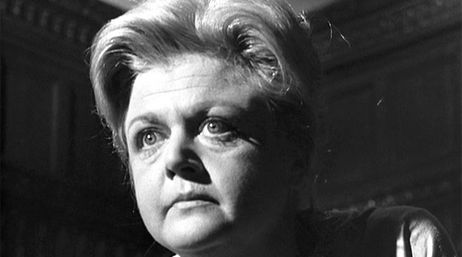
Angela Lansbury knocks it out of the park in The Manchurian Candidate

We ended the day with me treating Wendy to the classic 1962 movie The Manchurian Candidate on the DVD player I’d brought and hooked into the lodge television. It is a disturbing and unusual film, with Angela Lansbury giving the performance of her career as the domineering mother. Her intensity is truly frightening when the film makes its big reveal. It is hard to believe she was only three years older than the actor portraying her son, let alone that this is the same actress who played Miss Price in Bedknobs and Broomsticks and was Jessica Fletcher for 20 years. Wendy and I loved how director John Frankenheimer captured her twitching cheek on the stage in Madison Square Garden as she awaits the climactic shot.

The Narrows

Cotton to be picked

The next morning, after a final breakfast at the lodge, we drove eastward through Kiowa county. Wendy had been fascinated by the cotton fields in the area, and we stopped by a huge bale near Roosevelt so she could get a close look and feel. My mother and her siblings picked a great deal of cotton back in the day, as did members of Wendy’s family. The mechanical picker has thankfully brought an end to that hard labor, but the economies of scale consolidated the small cotton farms.

Prairie Dog

We were headed to the Wichita Mountains Wildlife Refuge to hike. The oaks in the refuge still had some autumn colors, and we first stopped at the refuge’s Prairie Dog town, watching the dogs watch us and listening to their high-pitched barks. There have been at least six colonies of Blacktail Prarie Dogs at the refuge over the years. One of my favorite photographs is a snapshot I took of wildflowers at one of those colonies back in 1989.

The highlight of our day was a hike 1.3 miles out and back on The Narrows, a short but rigorous trail along West Cache Creek.

The Narrows Trail Track
The Narrows

We found a record number of cars at the Boulder Camp trailhead, and I took us down the trail’s right fork along the low route before we made the steep ascent for a view of the narrow channel below, the vista to the north and lovely cliffs to the east, and the Narrows to the south.

Eastern wall of The Narrows
Hikers on Eagle Mountain

We heard a group of repellers celebrating their successful ascent farther down the creek and could see fellow hikers high above the chasm up on Eagle Mountain.

A nearby hiker gave scale to the view south. We descended partway down the hill for the views and then turned back, since Wendy was not inclined to bushwhack down The Narrows as I did back in 2010, reaching the junction with Panther Creek.

We happily returned along the trail, soon passed by an energetic Army guy running along the rough trail while carrying a heavy load of rappelling ropes. Later we encountered a large Asian American family which had scampering kids and teens out front, followed by the parents, one of whom was belting out Motown’s Ain’t No Mountain High Enough on a boom box, with a clumsy teenager who bounced her way among us, and at last the polite elders in the back. It was quite a show!

Fall Colors in the Wichitas

We enjoyed dinner with my folks in Oklahoma City before returning to Bartlesville. It was great to get away from our mutual school workloads for a few days before facing the hectic final weeks of the semester. We’ve both been so overwhelmed by schoolwork, with big projects still working their way down the pipeline, that I suspect our Winter Break will feature a few nearby get-aways rather than one long trip.

Click here for a slideshow from this trip

Posted in day hike, movie, photos, travel | 2 Comments