Elegiac, a term I associate with high school literature classes, came to mind as I was reading the beautiful A Month in the Country, a novella by English author J.L. Carr which was published in 1980.
Carr, like many authors, draw upon his own experiences to flesh out his eight short novels. He was born in 1912 into a Wesleyan Methodist family in northern England. Carr became a teacher and spent 1938 as an exchange teacher in South Dakota, of all places. He took the long way back across the Pacific and Asia to England, visiting various countries, and then volunteered for service in the Royal Air Force in World War II.
Carr’s county maps were to be read and “not to be used for navigation, except in the broadest of terms”
He married a Red Cross nurse, returned to teaching in Birmingham, and spent 15 years as the headmaster of a primary school, with a break in 1956 to return to teach in South Dakota. He retired from education in 1967, after having novels published in 1963 and 1967. Devoting himself to publishing and writing, he produced and published from his own house a series of small pocket-sized books of English poetry, historical events, and the like with each featuring a lower price for children.
Carr also published a series of English county maps and wrote six more short novels that contain elements of comedy and fantasy, as well as darker passages, based on his varied experiences of life as teacher, traveller, cricketer, footballer, publisher, and restorer of English heritage.
“All’s grist that comes to the mill” is a phrase he used in his introduction to the former as well as in a lovely interview with writer Annie Dalton back in 1988.
I don’t recall how I found out about A Month in the Country, but it might have been from some list such as this. I had read two prizewinning novels by Thornton Wilder and cleansed my palate with a couple of light Mary Stewart suspense romances and an obscure future dystopia. I was ready to return to “literature” but desired something short after the long slog through the 141,000-word The Eighth Day. I checked the samples I had downloaded onto my Kindle, and Carr’s book beckoned.
I didn’t know until after I had read it that A Month in the Country, which had been shortlisted for the Booker Prize and won the Guardian Fiction Prize, held the impressive rank of 1,353rd greatest book of all time in The Greatest Books meta-analysis, considerably higher than The Eighth Day at 10,696 but lower than Wilder’s The Bridge of San Luis Rey at 623. Personally, I’d rate Carr’s book above either of them, and it is wonderfully short at only 20,000 words…a brief but powerful work in which even short scenes exude atmosphere and meaning.
Here is the synopsis from The Greatest Books:
This novel unfolds the story of a World War I veteran who spends a summer in a peaceful Yorkshire village to restore a medieval mural in a local church. As he immerses himself in this tranquil setting, he finds solace and a sense of healing from the traumas of war. The narrative beautifully captures the essence of rural English life, the complexities of human relationships, and the profound impact of art and history on the human spirit. Through his work and interactions with the villagers, the protagonist embarks on a journey of self-discovery, finding a temporary refuge from his tormented past and glimpses of a more hopeful future.
I enjoyed Annie Dalton’s insight that, “The whole story is as much about what doesn’t happen as what does.” Carr jokingly responded, “It’s quite a nice way of writing a novel, writing a novel about something that doesn’t happen. It saves no end of imaginative effort.”
Carr wrote that when starting the work, his “idea was to write an easy-going story, a rural idyll…” but he admitted, “Then again, during the months whilst one is writing about the past, a story is colored by what presently is happening to its writer. So, imperceptibly, the tone of voice changes, original intentions slip away. And I found myself looking through another window at a darker landscape inhabited by neither the present nor the past.”
That final line struck me as particularly beautiful, and as with several elements in his novel, Carr left just enough unsaid to spark the reader’s speculative imagination without creating frustration at the lack of definition.
For example, an old eccentric Colonel makes one brief in-person appearance in the novella, and the first-person narrator then comments:
I never exchanged a word with the Colonel. He has no significance at all in what happened during my stay in Oxgodby. As far as I’m concerned he might just as well have gone round the corner and died. But that goes for most of us, doesn’t it? We look blankly at each other. Here I am, here you are. What are we doing here? What do you suppose it’s all about? Let’s dream on. Yes, that’s my Dad and Mum over there on the piano top. My eldest boy is on the mantelpiece. That cushion cover was embroidered by my cousin Sarah only a month before she passed on. I go to work at eight and come home at five-thirty. When I retire they’ll give me a clock—with my name engraved on the back. Now you know all about me. Go away: I’ve forgotten you already.
The novella transports you to another time and place, and it is not without humor. I cherish the description of the preaching of the stationmaster Mr. Ellerbeck:
…[He]…had left a village school at fourteen and had become a local preacher in his late teens. Though the mildest, most self-contained of men, once in the pulpit he became his own father who, it appeared, had been a passionately violent and irrational man.
It’s not strictly true that climbing the pulpit stairs transformed him; he was mild enough when announcing hymns and only mildly extravagant in his tediously supplicatory obeisance at his oriental despot’s skirts. But once launched upon the waves and billows of his sermon, he roared and raved like a madman, now and then bashing down his big fist on the podium so that the water decanter leapt. The while, his wretched wife hung her head in shame and only her twitching fingers revealed suffering. Mercifully, once at ground level again, he came-to like one revived from a convulsive fit and not remembering it.
J.L. Carr
An example of Carr’s skill is when the first-person narrator learns, from an Army sergeant he runs into, the military history of his acquaintance, Charles Moon. He learns that Moon earned a Military Cross for his gallantry in the war, but then a corporal who disliked him led the military police to discover him in bed with his personal servant.
The narrator then recalls how, in their next meeting, Moon somehow already knew that his homosexuality had been revealed. However, that is impossible, and Carr leaves it to the reader to recognize that the narrator unconsciously telegraphed his knowledge, such as by his body language or manner.
Don’t ask how but, from that day, Moon knew that I knew. Next day, for no reason at all, he said, ‘Sex! It’s the very devil. Quite merciless! It betrays our manhood, rots our integrity. Isn’t it, perhaps, the hell you were asking about, Birkin?’ And from that time on, things were never quite the same between us.
It is so quick, so deft, and so true. The heartbreak of the story is that amidst the war-damaged narrator’s healing in the countryside, in fact a key part of it, is the unspoken and unpursued love that develops between him and his employer’s wife. It only took a paragraph for Carr to invoke the pain:
I should have lifted an arm and taken her shoulder, turned her face and kissed her. It was that kind of day. It was why she’d come. Then everything would have been different. My life, hers. We would have had to speak and say aloud what both of us knew and then, maybe, turned from the window and lain down together on my makeshift bed. Afterwards, we would have gone away, maybe on the next train. My heart was racing. I was breathless. She leaned on me, waiting. And I did nothing and said nothing.
Anyone who has been in such a moment recognizes the anguish of what one might justifiably term a decision or indecision…the wrenching moment that once passed cannot be revisited, except in mind when the scars tenderly ache.
Carr quickly draws his novella to a close:
We can ask and ask but we can’t have again what once seemed ours for ever—the way things looked, that church alone in the fields, a bed on a belfry floor, a remembered voice, the touch of a hand, a loved face. They’ve gone and you can only wait for the pain to pass.
All this happened so long ago. And I never returned, never wrote, never met anyone who might have given me news of Oxgodby. So, in memory, it stays as I left it, a sealed room furnished by the past, airless, still, ink long dry on a put-down pen.
Computer cables have entangled me for almost a half-century, forcing me to twist recalcitrant asymmetrical connectors, twirl painful little thumb screws, and regularly trawl through junk drawers and boxes for various specialized cables or adapters.
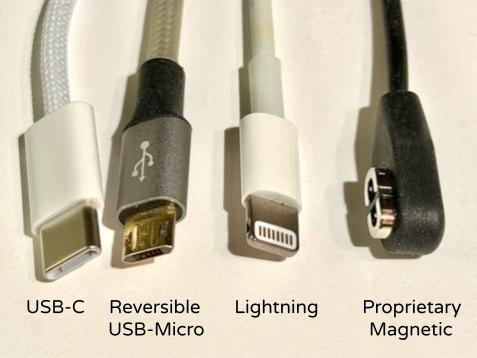
Not too long ago, I needed four different cables in a holder stuck to the side of my recliner’s lampstand so that I could charge my iPad with USB-C, my Kindle with USB-Micro, my iPhone with Lightning, and my bone conduction headset with a proprietary magnetic connector. I also have MagSafe induction chargers for my Apple Watch and iPhone.
Now, a decade after USB-C debuted, I can use it for all of my portable devices that require wired charging. It took that long for it to become universal and for my older gadgets to age out. In 2024, I replaced my Kindle Oasis with a Kindle Paperwhite Signature Edition, and this year I bought a new SHOKZ OpenRun headset that replaced their convenient-to-use but proprietary magnetic charger connector with USB-C. Replacing my iPhone 14 Pro with an iPhone 17 Pro finally allowed me to abandon the Lightning cables, adapters, and earbuds I have accumulated since 2012.
Thankfully all of these have been replaced by USB-C
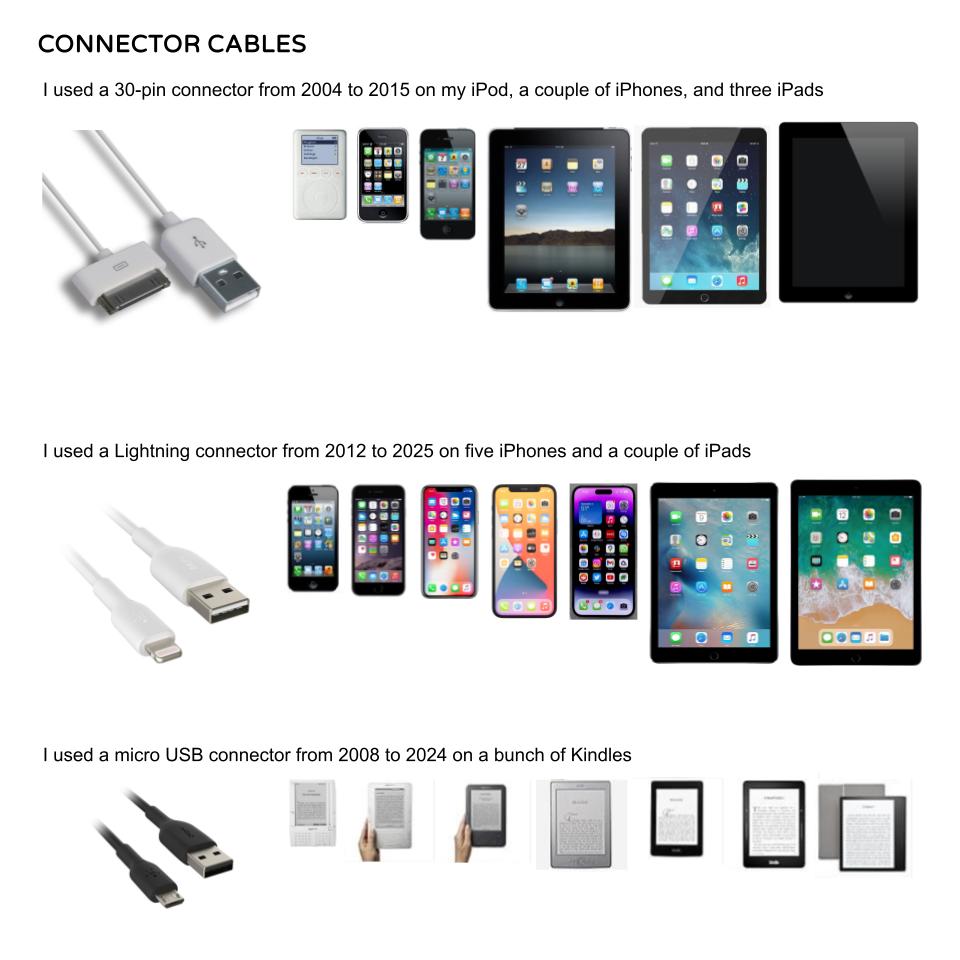
Before Lightning, I endured Apple 30-pin connectors from 2004 to 2015 on various devices. Lightning was an improvement, being diminutive and symmetrical, meaning it didn’t matter which way you plugged in the cable, unlike most USB cables until USB-C came along. The convenience of not having to twist a cable into the correct orientation to insert it led me to buy an unusual reversible USB-Micro cable for charging my Kindle back in 2020. First world problems!
My Mac Mini also features USB-C ports for its accessories, but it still has some USB-A ports and a 3.5 mm audio jack that remain in active use. I remember when USB-A debuted back in 1996, while 3.5 mm jacks were designed in the 1950s, originally for transistor radio earpieces.
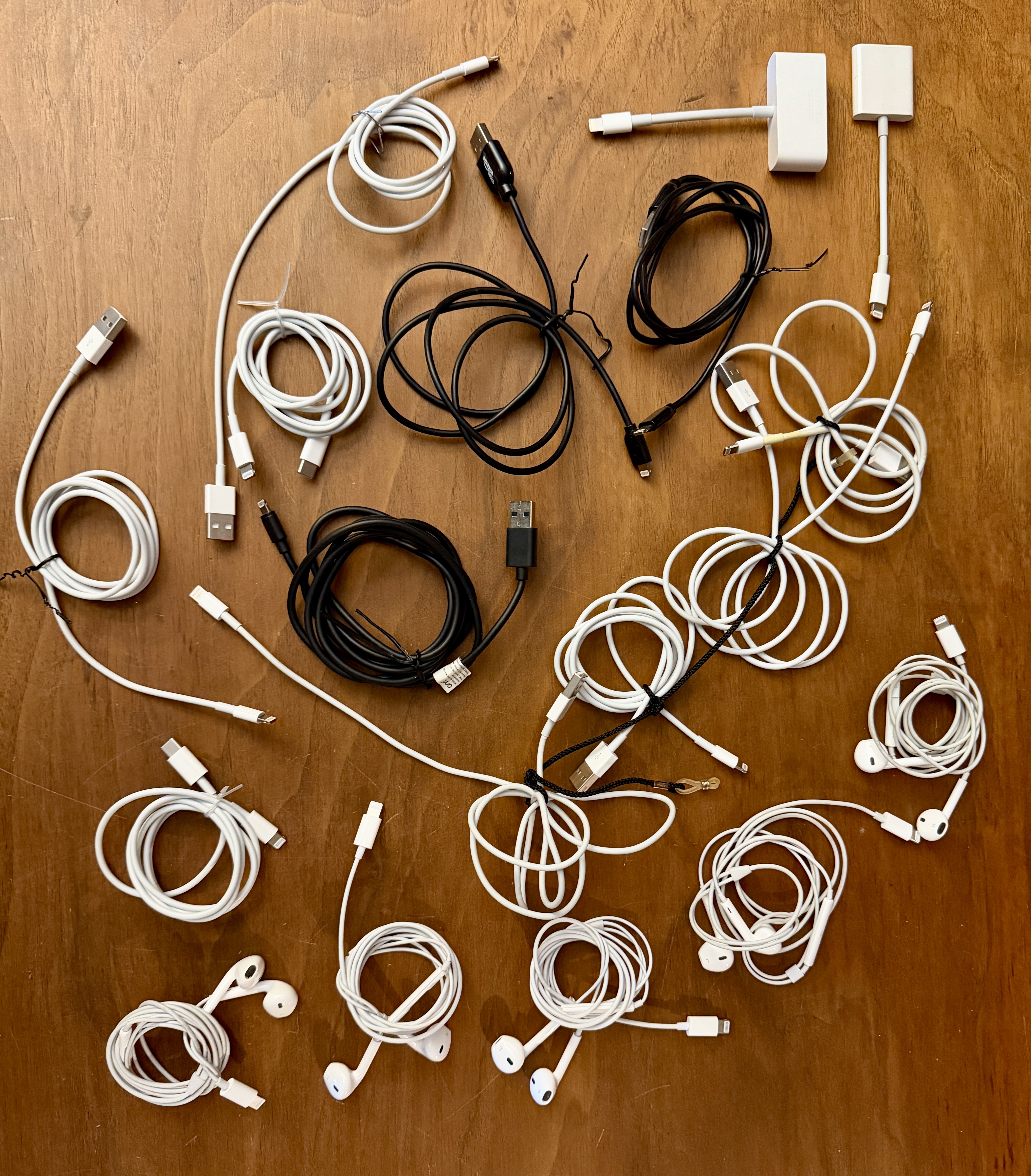
I went through the house gathering my Lightning cables, adapters, and earbuds. I found five sets of earbuds, nine USB-A cables, two USB-C cables, and a couple of adapters. I’m sure there are even more Lightning items lurking at work.
Apple stopped including EarPods and power adapters with new iPhones back in 2020, and while I have oodles of power adapters, I only had one off-brand set of USB-C earbuds I could use with my new iPhone 17 Pro. So I ordered two sets of Apple EarPods. I’ve tried various wireless earbuds, including one set of AirPods back in 2017. While I like my wireless bone conduction headset for use around the house, on walks I just want the wired EarPods. They never need charging and are more comfortable for me to wear than various alternatives. I do have a set of over-the-ear Tribit XFree Tune Bluetooth Headphones, purchased in 2019, that I use on the rare occasions that I want high-quality headphone sound.
Prior Connections
The first computers I used were the Radio Shack TRS-80 Model I and Color Computers in the late 1970s and early 1980s. They used 5-pin DIN ports and cables. I always called them DIN plugs, but I didn’t know until composing this post what DIN stood for: Deutsches Institut für Normung, or the German Institute for Standardization, which developed a 3-pin version in the mid-1950s and expanded to five pins a few years later as stereo gear became commonplace.
From the 1981 “Victory by Computer” comic starring “The TRS-80 Computer Whiz Kids”
My far more functional 1985 Tandy Model 2000 had a DE-9 video port, proprietary parallel printer port, and a DB-25 port for a RS-232 serial connection. The common D-subminiature connectors were introduced by Cannon (not to be confused with Canon) back in 1952 for the military/aerospace market, with the “D” referring to the shape of their perimeter metal shield. A fun bit of trivia is that the second letter referred to the type of metal shield. The DB-25 was so common on early computers that when the DE-9 began to be used as well, computer people unfamiliar with the D-subminiature nomenclature mistakenly called them DB-9 ports, not realizing that a DB-9 would have been a 9-pin connector in the large “B” shield used for the 25-pin connectors, whereas the video ports actually were using the smaller “E” shield.
DB-25 ports were often serial RS-232 ones that followed the “Recommended Standard 232” introduced by the Electronic Industries Association in 1960 for serial communications. You might wonder why older computers would use 25-pin ports and cables for serial communications that later could run over four-wire USB-A cables. The older devices needed more pins so that they could support a full two-channel serial communication standard with pins for data and a multitude of control signals. Eventually, technological advancements allowed for a shift to 9-pin RS-232 serial ports before USB supplanted them.
A venerable Centronics connector
For years, my various printers used bulky parallel ports, eventually standardizing on Centronics ones (aka IEEE 1284) that came from a subsidiary of Wang Laboratories, which made the first and only dedicated word processor I ever used back when I worked for the Oklahoma Department of Tourism. Parallel ports could send an entire 7-bit or 8-bit ASCII value across its multiple wires, while devices using serial ports would have to buffer the data bit-by-bit and turn that back into multi-bit values.
I never had any personal computing equipment that used the SCSI or Small Computer System Interface ports, although at work I did have a physics laboratory equipment interface that used it. Of course, there have been a slew of different audiovisual connectors, but that is a whole ‘nother level of complexity I chose to avoid in this post.
PS/2 keyboard and mouse ports
Keyboards and mice might use 5-pin, DE-9, DB-25, or proprietary connectors, but eventually many used color-coded 6-pin mini-DIN connectors commonly called PS/2 ports. Those were introduced with the IBM Personal System/2 series of computers in 1987. Nowadays I like wired USB keyboards and wireless mice.
Eventually computers advanced to where most of the cables and connectors could standardize on the Universal Serial Bus, which was introduced in 1996. Of course, that was hardly the end of the story, with many variations on the USB connectors being introduced over the decades.
Universal Serial Bus connectors have proliferated
The USB trident logo is on the “up” side
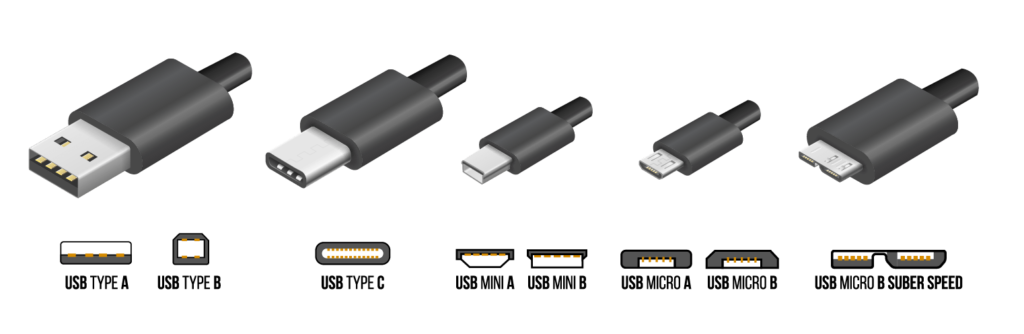
We still see plenty of USB Type A ports and cables, with the more square-shaped USB Type B still frequently used on printers. We’ve all been frustrated countless times by the asymmetrical design of the USB-A, -B, -Mini, and -Micro connections forcing us to struggle to twirl cable ends around to plug them in. The trident-like USB logo is required to be on the “up” side of a cable end, which can help if you can even see it and also figure out which way is considered “up”.
The later USB 3.0 standard calls for nine wires instead of four. The insulators in such “SuperSpeed” plugs and receptacles are supposed to be a specific blue color (Pantone 300 C) and you need to use an appropriate cable, which has SS for SuperSpeed at the base of the trident indicating it has the extra wires in it. Using an old cable will slow everything back down to the older 4-wire standard.
SuperSpeed ports have blue insulators
SuperSpeed cables have SS at the base of their trident logo
Notice how USB 3.0 used nine wires instead of four
Printers still use the USB Type B port because originally that was considered the sturdy one to be used for “client” devices, and they don’t need to bother with a smaller port. However, many other devices needed smaller Mini and Micro ports, which I always found truly annoying. I don’t know how many times I have stared at a port or a cable end to figure out if it is a Mini or a Micro, and then have to squint to see which way I would need to orient the cable. Thankfully you can now get reversible USB-Micro and even USB-A cables.
USB-C made things easier to plug in with its small reversible design, with up to 24 wires to provide higher transfer rates and power while supporting various data types:
USB-C can have as many as 24 wires compared to 9 in USB 3.0 and 4 in the original USB [Source]
However, that very flexibility can confuse folks. Some of our school Chromebooks have USB-C ports that are not just for charging or serial data, but can also function as DisplayPorts for multiple external monitors and the like. People used to HDMI or, heaven forbid, VGA, can be surprised when I use a USB-C DisplayPort.
The many different capabilities of USB-C have led to a profusion of labels:
These aren’t as awful as laundry labels, but they keep trying to get worse [Source]
Apple has a long history of screwing users over with its various specialized connectors, and it only abandoned Lightning and switched to USB-C because the European Union adopted a Common Charger Directive in October 2022 that required USB-C charging, beginning in late 2024, for mobile phones, tablets, digital cameras, headphones, headsets, videogame consoles, portable speakers, e-readers, keyboards, mice, portable navigation systems, and earbuds sold in the European Union. That requirement expands to laptops in late April 2026.
So in the technology world, the EU is like California is for cars in the USA; they have enough market clout to force manufacturers to cooperate and standardize, which often makes things better for consumers. However, regulations can also backfire, such as the annoying cookies notices we see on websites all of the time and most people just blast through.
I’m grateful that Lightning was arrested by the EU, however. Good riddance, and here’s hoping that USB-C can remain a viable standard for many years to come.
December 2025 Update: I had bagged up and stored the many Lightning cables and chargers. That proved its worth when I realized that the remote control for my 2017 Apple TV 4K needed a Lightning cable for recharging. So a spark remains…for now.
What is the second-largest religious group in the United States of America? We all know the largest is Christianity, which subsumes Catholicism and numerous Protestant denominations, and can include the more diverse beliefs of Mormons and Jehovah’s Witnesses, along with an increasing number of non-denominational churches. However, it might surprise you, given the outsize media attention given to the 2% who are Jewish and 1% who are Muslim, that the second-largest group are the Nones, those who identify as religiously unaffiliated.
The General Social Surveys of U.S. adults show the Nones have grown from about 5% in 1972 to over 25% today. This post is meant to inform, not evangelize. I have no interest in impacting your personal religious beliefs or nonbelief; rather, I seek to inform your understanding of over one-fourth of us.
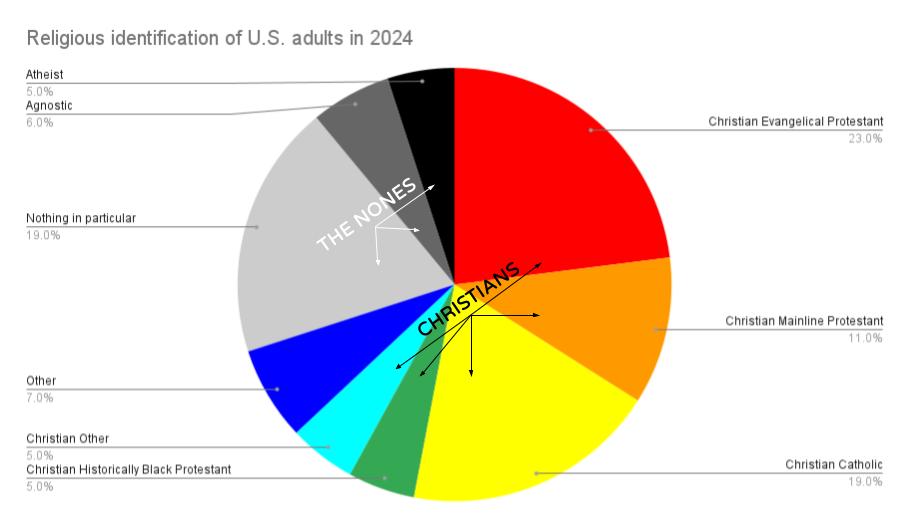
Pew Research has found that the Nones vastly outnumber the Jews, Muslims, Buddhists, Hindus, or other non-Christian religions in America even when all of the non-Christian religious folks are grouped together. In fact, if we group the three basic types of Nones — those who believe nothing in particular, agnostics, and atheists — they collectively outnumber each of the primary Christian categories.
In 2024, 62% of U.S. adults identified as Christian and 29% as religiously unaffiliated. The largest Christian category was Evangelical Protestant at 23%, followed by Catholics at 19% and Mainline Protestants at 11%.
Oklahoma is a hotbed of Evangelical Christianity, with 47% of adults identifying as such, a proportion only exceeded in Arkansas. 70% of Oklahomans identify as Christians of one sort or another, 26% identify as Nones, and only 4% claim other forms of religious belief.
We can break this down even further to compare the religious make-up of Washington County in Oklahoma, where I live, to the nation as a whole, thanks to the Public Religion Research Institute’s 2023 Census.
Religious Affiliation
Washington County, OK
USA
White Evangelical Protestant
39.3%
13%
Religiously Unaffiliated (The Nones)
21.2%
27%
White Mainline Protestant
15.4%
14%
Other Protestants of Color (e.g. First Peoples)
7.8%
2%
White Catholic
5.3%
12%
Hispanic Catholic
2.5%
8%
Black Protestant
2.2%
8%
Hispanic Protestant
2.0%
4%
Mormon
0.6%
2%
Other Non-Christian Religion
0.6%
2%
Jehovah’s Witness
0.5%
1%
Other Catholics of Color (e.g. First Peoples)
0.5%
2%
Jewish
0.4%
2%
Muslim
0.4%
1%
Buddhist
0.4%
1%
Orthodox Christian
0.3%
<1%
Hindu
0.3%
1%
Unitarian Universalist
0.3%
<1%
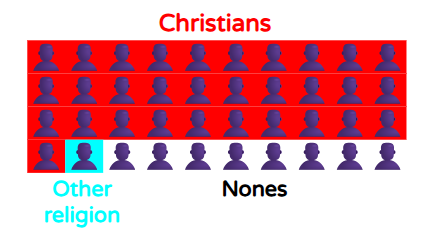
If tables aren’t your thing, here’s a visualization of Washington County’s religious make-up:
Washington County, Oklahoma religious identifications
So if you gathered 40 random people where I live, about 31 would be Christians, one would adhere to some other religion, and eight would be Nones.
“Agnostics” are among the negative/weak/soft atheists while also being explicit about non-belief, while those who identify as “Atheists”, which I’ll distinguish when feasible with capitalization, are known as the positive/strong/hard type who are also, like the Agnostics, explicit about their non-belief but then go beyond skepticism and freethought to contend that God does not exist. You might expect the “nothing in particular” group to be among the negative/weak/soft and implicit atheists, but there is a contraindication for that.
Many nones are not actually atheists
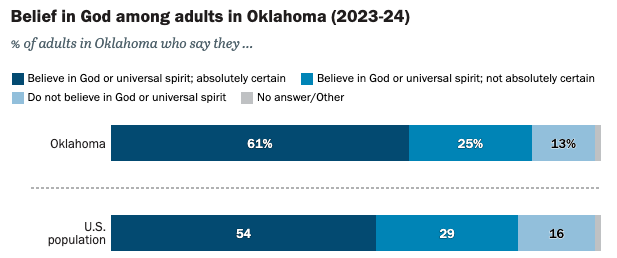
When people are asked about their belief in God instead of their religious affiliation, only 13% of Oklahomans do not believe in God or a universal spirit, which generally corresponds with the explicit atheism of the 9% who identify as Agnostic and 5% who identify as Atheists. But that implies that many of the “nothing in particulars” do in fact hold some sort of spiritual beliefs or are uncertain about their beliefs.
2024 Pew Religious Landscape Study results
Political scientist and former Baptist pastor Ryan Burge wrote a whole book about the Nones. He points out that the religiously unaffiliated in the USA have grown in recent years, from 5% of adults in the early 1970s to 29% today, and that grows to over 40% among the youngest adults. He views that as “the largest shift in American culture in at least the last 40 years.”
Burge examined a wide range of factors that might have played a role in that trend, such as secularization, the rise of the internet, social isolation, changing family structures, etc. However, he concluded that “the best and clearest explanation of the rapid rate of religious disaffiliation can be traced back to the recent political history of the United States.” He cites an exodus of liberals from Christian churches since the rise of the religious right. As some religious leaders and groups became more visible and aligned with conservative politics, many young, liberal, and moderate Americans chose to disassociate from organized religion.
Ryan Burge
Burge says there has been a homogenization process where white religion has become overwhelmingly Republican, with no surviving large liberal white Christian tradition, and pockets of liberalism are often confined to urban and suburban areas.
He notes that only 1 in 20 Americans are positive Atheists, and the textbook Atheist is an upper-educated, upper-class white guy living in an urban or suburban area; the stereotype arises because 60% of Atheists are men and about half earned a four-year college degree. However, the “nothing in particulars” are the least educated religious group in America, with only 25% having a college degree, 1/3 having a high school diploma or less, and 60% of them making less than $50,000 per year as a household. He says many of them are struggling economically and socially.
Burge notes that many of the “nothing in particulars” are not politically active and “feel left out, left behind, lost, unmoored, and disconnected from the larger society.” Counter-intuitively, 15% of those who say their religion is nothing in particular actually attend religious services at least once a month.
Burge also points out that Campbell, Layman, and Green noted differences between being secular and nonreligious. He comments, “Secular people have thrown off the religious worldview and replaced it with something else. Nonreligious people have gotten rid of religious thought but have not replaced it with anything else. They are defined by what they are not rather than by what they are.“
He adds, “I think these ‘nothing in particulars’ are not antagonistic toward religion. They’re antagonistic towards a lot of institutions, and religion just happens to be an institution like banks or big business or politics or whatever. But they don’t have a specific beef against religion. That’s why they are still somewhat open to the idea of religious practice. A third of them say religion is at least somewhat important in their lives. They still see some value in it. But they’re not willing to be labeled as Protestant, Catholic, Mormon, Buddhist, or whatever.”
Burge’s categories
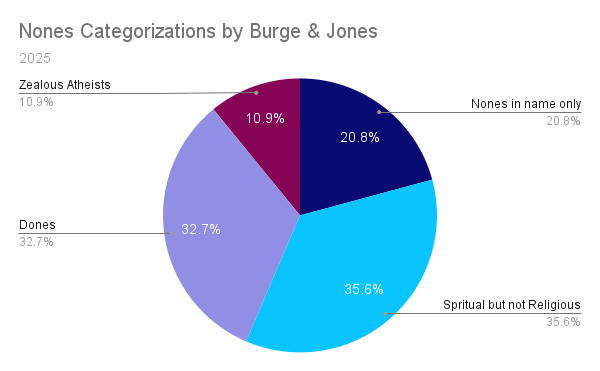
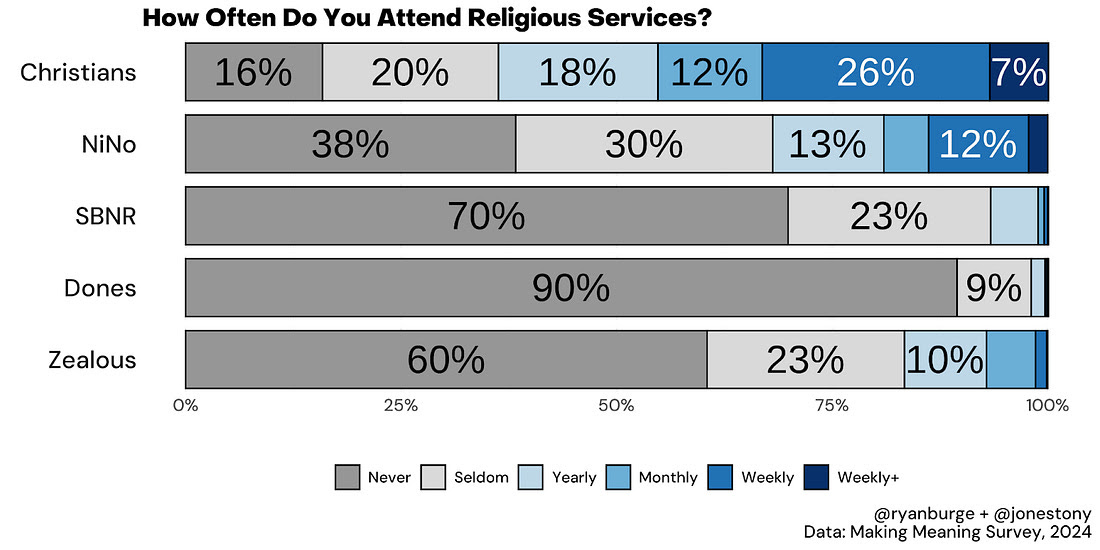
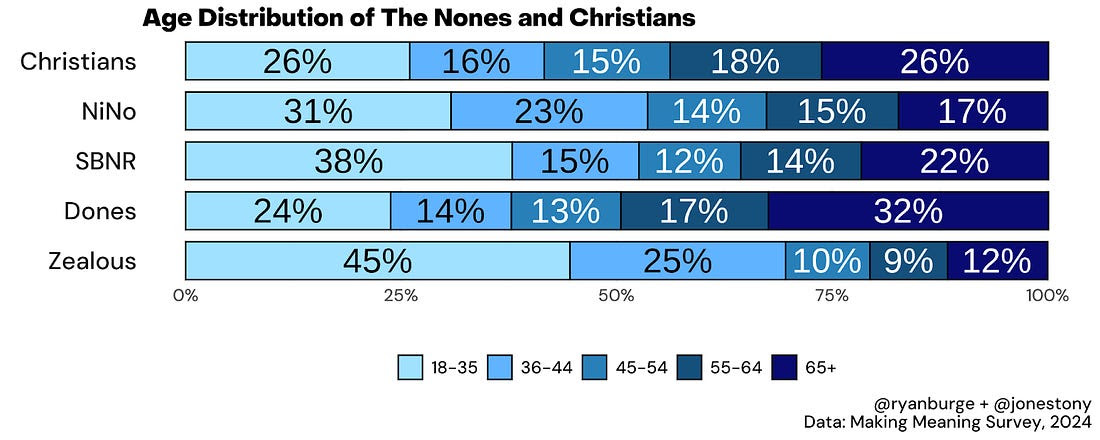
In The Four Types of Nones, an August 9, 2025 post on his Graphs About Religion substack, Burge shared some results from a grant he and Tony Jones won from the John Templeton Foundation for a large survey of the non-religious. Their questions were tailored to explore nuances and craft a new typology of the Nones. They identified four groups among the 30% of Americans who identify as non-religious:
From The Four Types of Nones post on Graphs About Religion
Nones in Name Only
20% of 30% means about 6% of U.S. adults are NiNOs.
The NiNOs are actually fairly religious on various measures, but they don’t classify themselves as part of a religious group. 3/4 of them choose “nothing in particular” in the usual surveys, 1/3 attend a house of worship at least once per year, and over half of them say they pray on a daily basis, with a similar fraction holding a firm belief in God.
Spiritual But Not Religious
36% of 30% means about 11% of U.S. adults are SBNRs.
The SBNRs are deeply skeptical of religion but highly interested in spirituality. Few of them ever attend church, barely 1 in 10 of them ever prays, and only 1 in 20 holds a firm belief in God. They are the folks who say, “I believe in some Higher Power” and the like. New Age spiritualists who like crystals, yoga, meditation, nature walks, and the like are among the SBNRs.
Dones
33% of 30% means about 10% of U.S. adults are Dones.
They are done with religion entirely. Their metrics on the importance of religion and spirituality are in the basement. Over 2/3 of the Dones rated both religion and spirituality as not at all important to them, whereas only 1% of the SBNRs felt that way, and less than 1% of the NiNos. Burge says, “there is no clearly articulated ‘God-shaped hole’ in the hearts of these folks.”
Burge also shares that when asked if they agreed with, “When I die, my existence ends.”, 26% of NiNos agreed versus 39% of the SbnRs and 77% of the Dones.
Zealous Atheists
11% of 30% means about 3% of U.S. adults are ZAs.
77% of them have tried to convince someone else to leave religion in the past year, versus only 6% of the NiNos and almost none of the SBNRs or Dones. The ZAs tend to be much more visible on social media than the other Nones. As Burge phrased it, they are the folks who “are quick to point out that religious people believe in fairy tales or that they don’t need to pray to Sky Daddy or they mockingly worship the Flying Spaghetti Monster.”
One driver for ZAs, at least in Oklahoma, are frequent public proclamations of faith on social media by their evangelizing coworkers, acquaintances, and fellow community members, especially when that is accompanied by repeated attacks on and occasional breakdowns of the separation of church and state. Zealous Atheists get fired up by the public bullying and lifestyle oppression from demagogues and various wackadoodles. Those who push inevitably inspire pushback.
The ZAs actually engage with religion more than the Dones, with 17% of ZAs attending church once per year or more and about the same share praying in the past year. Burge and Jones speculate that such folks interact with religion enough to remind themselves why they dislike it. Perhaps their spouse or parents are still religious, and they get dragged to some services.
Notice how the share who attach absolutely no importance to spirtuality or religion is more than double among the Dones compared to the Zealous Atheists. Interestingly, 44% of the ZAs pray at least occasionally, while 88% of the Dones never do:
As Burge puts it, “In other words, these two categories represent entirely different generations of non-religion in the United States. The Dones are worn out from all the fights about religion. They’ve tried to evangelize their Christian friends to leave church behind. But they just sit back and shake their heads now. On the other hand, the Zealous Atheists still have a fire in their belly to try and change the world.”
Personalities
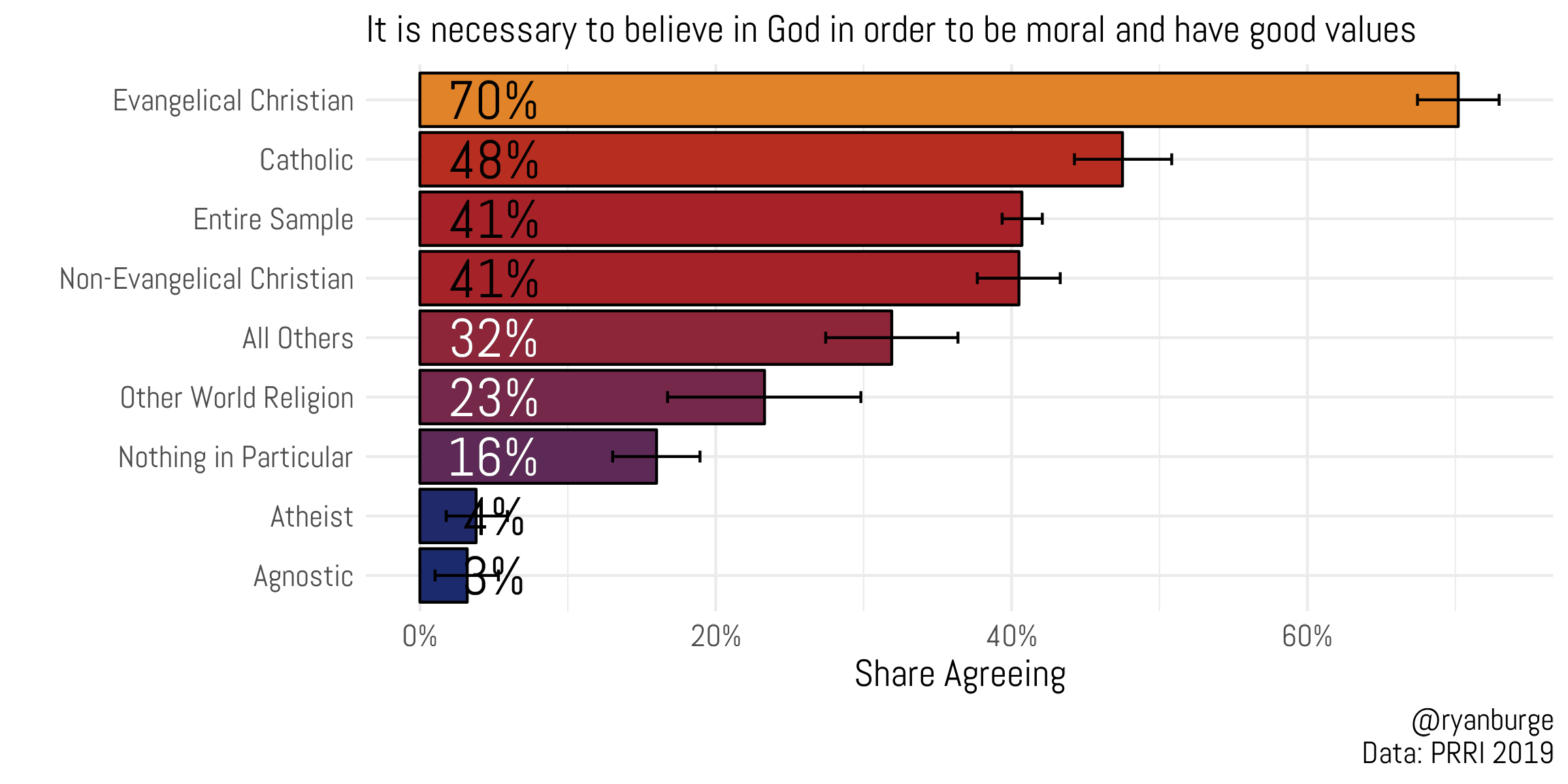
Evangelical Christians take a particularly dim view of Atheists since 70% of evangelicals think one must believe in God in order to be moral and have good values. Only 41% of people overall think that way, but that still means many people believe Atheists are immoral and lack good values. Unsurprisingly, only 4% of Atheists share that view.
The 2008 American Religious Identification Survey showed that most atheists in the USA were members of Christian churches as children and “deconverted” as adults. Baker explored how conservative Christians have cited selfishness, arrogance, anger at God, and poor father-child relationships as possible explanations for such deconversions. His research did not support those hypotheses. Less religious emphasis during childhood, deliberation in the pursuit of truth, and higher intelligence did appear to play a role, but they were not nearly as statistically significant as personality traits.
It went on to share that Agreeableness and Conscientiousness seem to predict religiosity rather than be influenced by it. Baker found a much greater link between atheism and the Thinking and Perceiving personality types in the Myers-Briggs personality test, which conforms to those findings.
Unfavorable views
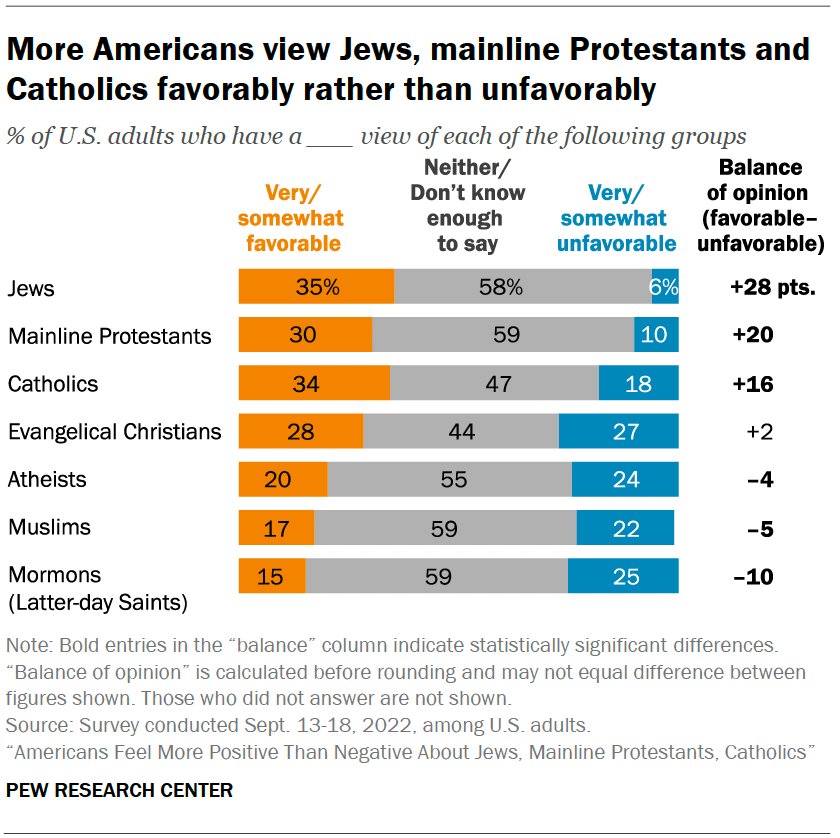
Evangelical Christians often portray themselves as being disfavored or persecuted, and they did indeed enjoy less favor than some other religious groups in a September 2022 survey by the Pew Research Center, faring far worse than Catholics, Mainline Protestants, or Jews, although the balance of opinion on Evangelicals was still marginally favorable.
However, the balance of opinion went into the negative for Atheists, Muslims, and Mormons.
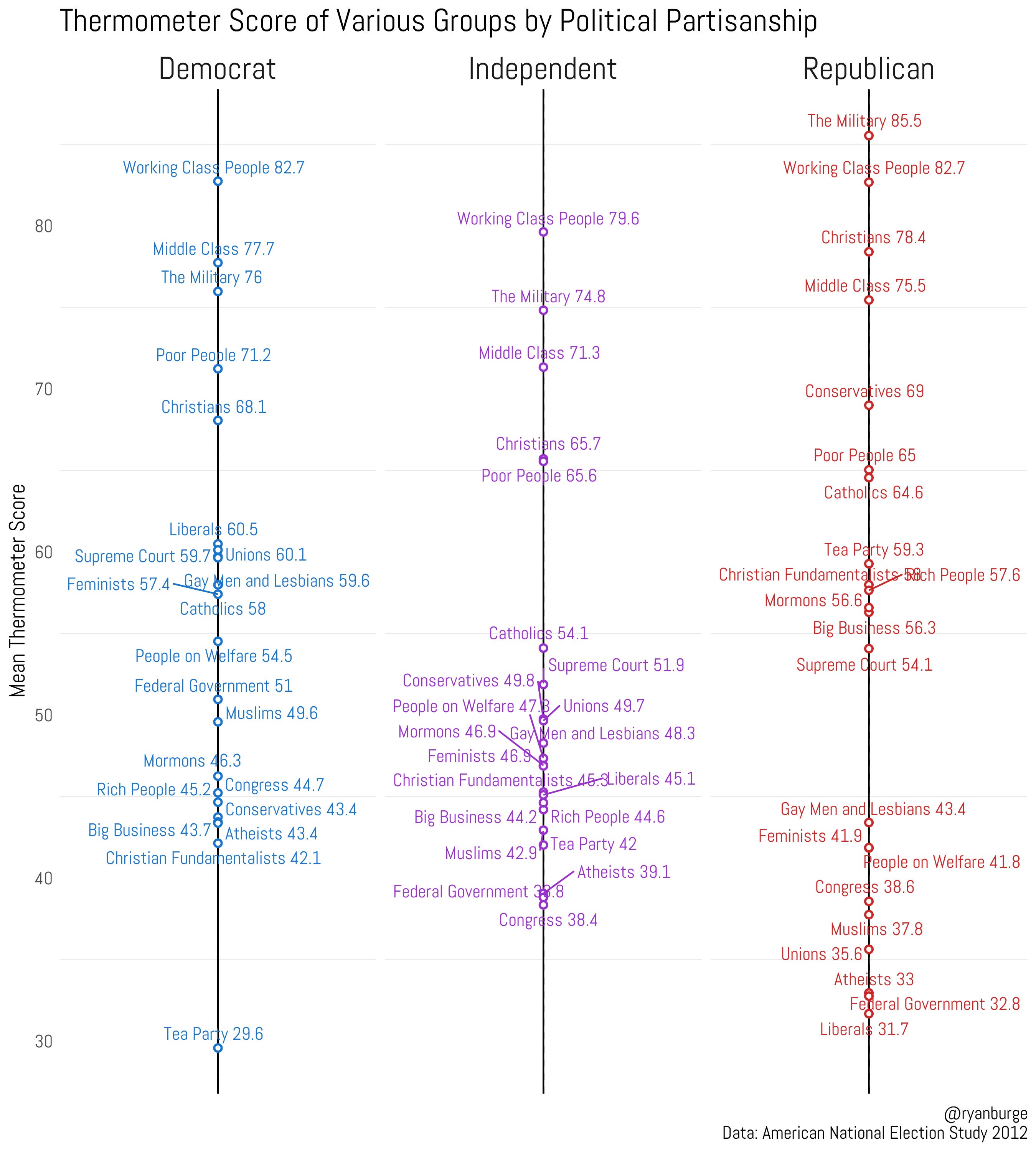
When thermometer scores of feelings toward various groups in 2012 were broken down by partisanship, the military and the working class always came out near the top, but Atheists were rated much less warmly than Christian Fundamentalists by Republicans (33% versus 58%), noticeably less by Independents (39% versus 45%), and they were virtually tied as the least favored groups by Democrats (at 42-43%), except for the Tea Party. You know you’re unpopular when both Democrats and Republicans feel more warmly toward Congress than toward you.
Other indicators of the dim view most people take of atheists is that about half of Americans would be unhappy if a close family member married one, while only 1 in 10 would react that way to a born-again Christian. 77% of white evangelical Christians don’t want an atheist in their family. Interestingly, among the Nones, 28% don’t want a family member to marry an evangelical, but 13% don’t want them to marry an atheist, either, again illustrating there are Nones who are certainly not Atheists.
The bias against atheism displayed by people across the political spectrum helps explain why the social media presence of Nones is dwarfed in Oklahoma by the religious comments and posts by various Christians, particularly evangelicals who are enculturated to publicly share their views with and preach to others. Only the Zealous Atheists are likely to stick their necks out and actively promote their disbelief in such an environment, while the Dones are, well, Done.
Time and tide tarry for no one, and both are on my mind these days due to the political change that is transforming our republic. The United States of America has the oldest continuously operating written constitution, but its structures are being rapidly eroded by a tide of populism. Be forewarned that I am going to share my perspectives on that in this post, so skip it if that is not your thing.
I am far more hesitant about political posts than I once was, given the polarization driven by social media algorithms that increase engagement by amplifying posts that are emotionally charged. Also, Oklahoma is still dominated by evangelical Christians, and over my six decades they have become far more politically active and aligned with the Republican party. If people conflate political stances with religious beliefs, that can supercharge disagreements.
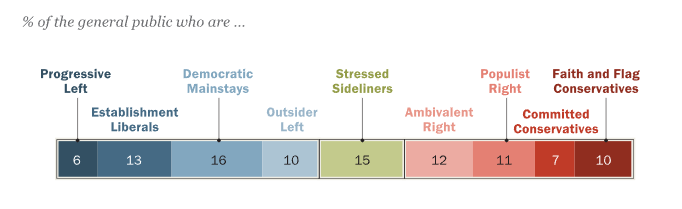
This post reflects my biases, so know that I am among the oldest members of Generation X, and my political typology is that of Outsider Left in the Pew Research Center’s Political Typology Quiz. 90% of my fellow citizens are of a different political type, and that’s A-OK. Given Oklahoma’s partially closed primary system, I routinely change my party registration between Democrat and Republican as needed to allow me to vote for more moderate candidates in primary elections. Like George Washington, I consider political parties the bane of our republic.
My Ground Rules:
This is my personal blog, not a debate forum. I am not interested in debating politics or religion with you here or on social media. Hence I turned off comments for this blog post. If you want to argue with someone, you’ll find willing victims in abundance on social media.
I am not seeking to evangelize here, but instead to share my possibly idiosyncratic takes, in my own detailed fashion, for those who are interested.
I fully support your right to disagree or disengage. There is plenty else on the internet, and in this blog, that might be more to your liking.
Finally, as always, nothing here in any way reflects the views of my employer — and I’m grateful that in July 2026 I’ll be retiring from employment and consequently the need for such a disclaimer.
The founders crafted a constitutional system of checks and balances among three branches of government that endured, mostly intact, for well over two centuries. The genius of amendments gave it the needed flexibility to evolve as our nation’s practices slowly and unevenly approached its ideals.
The most painful correction led to the Civil War, when well over 600,000 people were sacrificed in the struggle to end the Constitution’s original sin of chattel slavery. Later notable improvements included expanding rights for women, First Peoples, and, within my lifetime, various ethnic and sexual minorities.
Our system of government survived the rise of autocratic regimes which plagued most of the world across the 20th century, but not without sacrifices. The U.S.A. lost 117,000 people in the first World War, which led to the collapse of the German, Austro-Hungarian, Ottoman, and Russian empires.
Much of the world experienced autocracy in the 20th century [Source]
My father served in World War II in the struggle against Nazi Germany, Fascist Italy, and Imperial Japan, which claimed over 400,000 of his countrymen. I grew up during the Cold War, amidst the détente with the Soviet dictatorship enforced by mutually assured destruction.
Populism
Populism is an anti-establishment approach to politics which views “the people” as being opposed to “the elite”. It shares those characteristics with fascism, but fascism is distinct in its obsessive focus on national or racial purity and aggression. Also, while there are both liberal left-wing and conservative right-wing forms of populism, fascism is inherently right-wing.
In the U.S.A., populism reaches back to the presidency of Andrew Jackson in the 1830s and blossomed again as the People’s Party in the 1890s, with William Jennings Bryan as one of its famous figures. White settlers brought that populist movement from Kansas into Oklahoma in the land runs of the late 1800s. While the People’s Party faded rapidly after 1896, Oklahoma’s 1907 constitution contained various populist components, including popular election of all officeholders, an initiative and referendum process, and a corporation commission.
One of the dangers of populism, both in its left-wing and right-wing forms, is that it undermines democratic institutions, erodes social cohesion through its “us” versus “them” mentality, and often leads to negative economic consequences and violations of human rights.
Left-wing governments in 2024
A populist tide rose across the world in the 21st century. In the Americas south of the U.S.A., it manifested as a “pink tide” of left-wing governments extending from Mexico across Central and South America that has cyclically waxed and waned. Several of the new governments were authoritarian, while others remained democratic.
In Europe, populist movements empowered Viktor Orbán in Hungary, the Law and Justice party in Poland, and Brexit, the withdrawal of the United Kingdom from the European Union.
The European Center for Populism Studies has crafted a world map in which darker shades of purple indicate weaker democratic institutions and norms, with numerical ratings on a scale from dictatorships to full democracies, based on a country’s performance across fundamental human rights, civil liberties, rule of law, and elections.
Populism rankings in 2025 by the European Center for Populism Studies [Source]
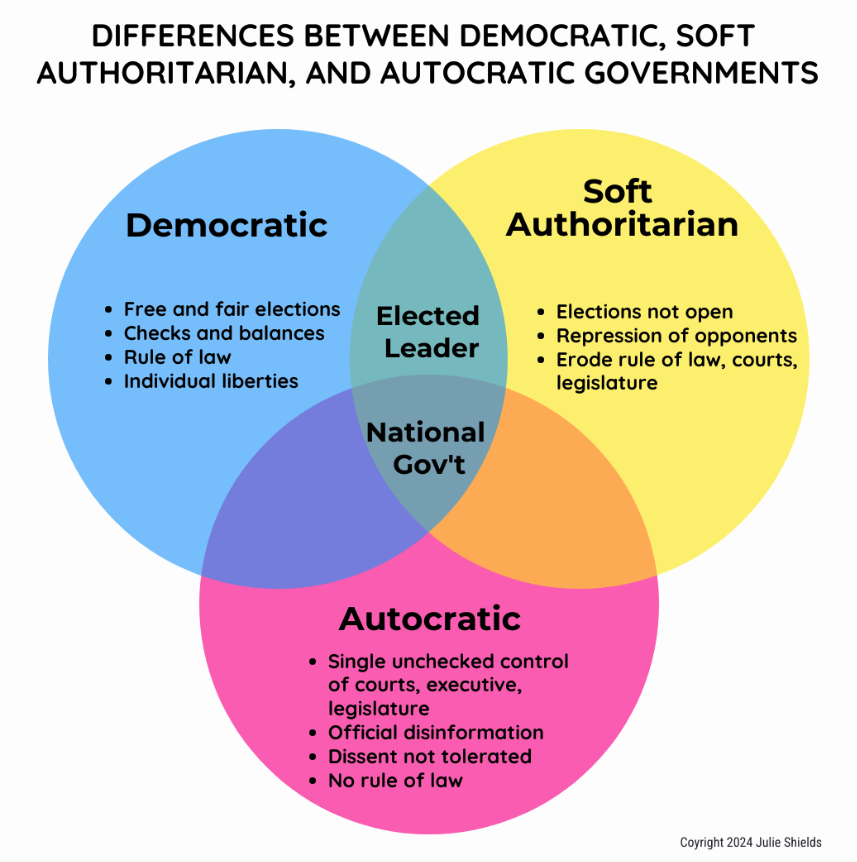
In their ratings, the United States of America is on the verge of slipping from full to flawed democracy. Our democratic institutions and norms now fall below those of Canada, northern Europe, and Australia.
The end of norms
Donald Trump openly undermines democratic institutions, discredits opponents, and erodes the rule of law. He has been empowered by the ever-increasing polarization of the populace, and thus Congress, and the collapse of the Republican establishment’s foundations of sand, which were swept away by the populist tide.
That populism explains why Republican politicians have abandoned past conservative stances that stressed state rights and the separation of powers while promoting free trade and a pretense of fiscal discipline. The seeming cognitive dissonance or hypocrisy of championing state rights in the causes of abortion restrictions yet embracing the use of troops for immigration enforcement is less surprising once you recognize that the Republicans are now more populist than truly conservative.
Populism also explains Trump’s virulent attacks on science, public health, mainstream media, entire governmental divisions, and higher education. Trump and his supporters leverage the real and earned resentments of the working class, but not to provide tangible benefits to their supporters but instead to destroy institutions and cultural norms associated with a rival, progressive elite.
It is illuminating to examine the political polarization in confidence in our various institutions. Consider this chart of Democrat and Republican confidence in the 1970s, when there wasn’t much difference between their trust in most institutions save for Democratic confidence in labor versus Republican confidence in business:
Compare that to the 2010s, when Democrats had more confidence in knowledge-producing institutions while Republicans had more confidence in order-preserving ones.
Now consider which institutions Trump has decimated, with the Republicans in Congress mostly acquiescent even when that damages their own constituencies’ long-term interests.
This story begins in the 1960s, when high school grads had to go off to fight in Vietnam but the children of the educated class got college deferments. It continues in the 1970s, when the authorities imposed busing on working-class areas in Boston [and OKC] but not on the upscale communities like Wellesley [and OKC suburban districts] where they themselves lived.
The ideal that we’re all in this together was replaced with the reality that the educated class lives in a world up here and everybody else is forced into a world down there. Members of our class are always publicly speaking out for the marginalized, but somehow we always end up building systems that serve ourselves.
The most important of those systems is the modern meritocracy. We built an entire social order that sorts and excludes people on the basis of the quality that we possess most: academic achievement. Highly educated parents go to elite schools, marry each other, work at high-paying professional jobs and pour enormous resources into our children, who get into the same elite schools, marry each other and pass their exclusive class privileges down from generation to generation.
Armed with all kinds of economic, cultural and political power, we support policies that help ourselves. Free trade makes the products we buy cheaper, and our jobs are unlikely to be moved to China. Open immigration makes our service staff cheaper, but new, less-educated immigrants aren’t likely to put downward pressure on our wages.
Like all elites, we use language and mores as tools to recognize one another and exclude others. Using words like “problematic,” “cisgender,” “Latinx” and “intersectional” is a sure sign that you’ve got cultural capital coming out of your ears. Meanwhile, members of the less-educated classes have to walk on eggshells because they never know when we’ve changed the usage rules so that something that was sayable five years ago now gets you fired.
We also change the moral norms in ways that suit ourselves, never mind the cost to others. For example, there used to be a norm that discouraged people from having children outside marriage, but that got washed away during our period of cultural dominance, as we eroded norms that seemed judgmental or that might inhibit individual freedom.
After this social norm was eroded, a funny thing happened. Members of our class still overwhelmingly married and had children within wedlock. People without our resources, unsupported by social norms, were less able to do that.
It’s easy to understand why people in less-educated classes would conclude that they are under economic, political, cultural and moral assault — and why they’ve rallied around Trump as their best warrior against the educated class. He understood that it’s not the entrepreneurs who seem most threatening to workers; it’s the professional class. Trump understood that there was great demand for a leader who would stick his thumb in our eyes on a daily basis and reject the whole epistemic regime that we rode in on.
The Democrats once enjoyed strong support from the working class, thanks to their old alignment with labor and the Republicans’ long-term alignment with business interests. But the very successes of unions — the 40-hour workweek, minimum wage, child labor laws, worker’s compensation, workplace safety laws — were secured long before most of us were born. Those successes promoted the growth of the middle class, but with such rights secured, unions began to fade away with the decline of manufacturing, the rise of the service economy, and economic recessions.
Since the 1970s, central features of our politics have been social, cultural, and racial issues. That has affected our beliefs about institutions. Professions have become more ideologically homogenous and extreme, which in turn has fueled partisan distrust. Henry E. Brady of the American Academy of Arts & Sciences shared:
On a 2019 survey, we asked respondents how they would feel about someone close to them choosing a career or marrying someone involved with various institutions. We were shocked and surprised to find that Republicans do not want their kin or friends to have a close association with journalists or with anyone working in higher education. Democrats do not want close connections with anyone in the police, the military, or religious institutions.
Constitutional erosion
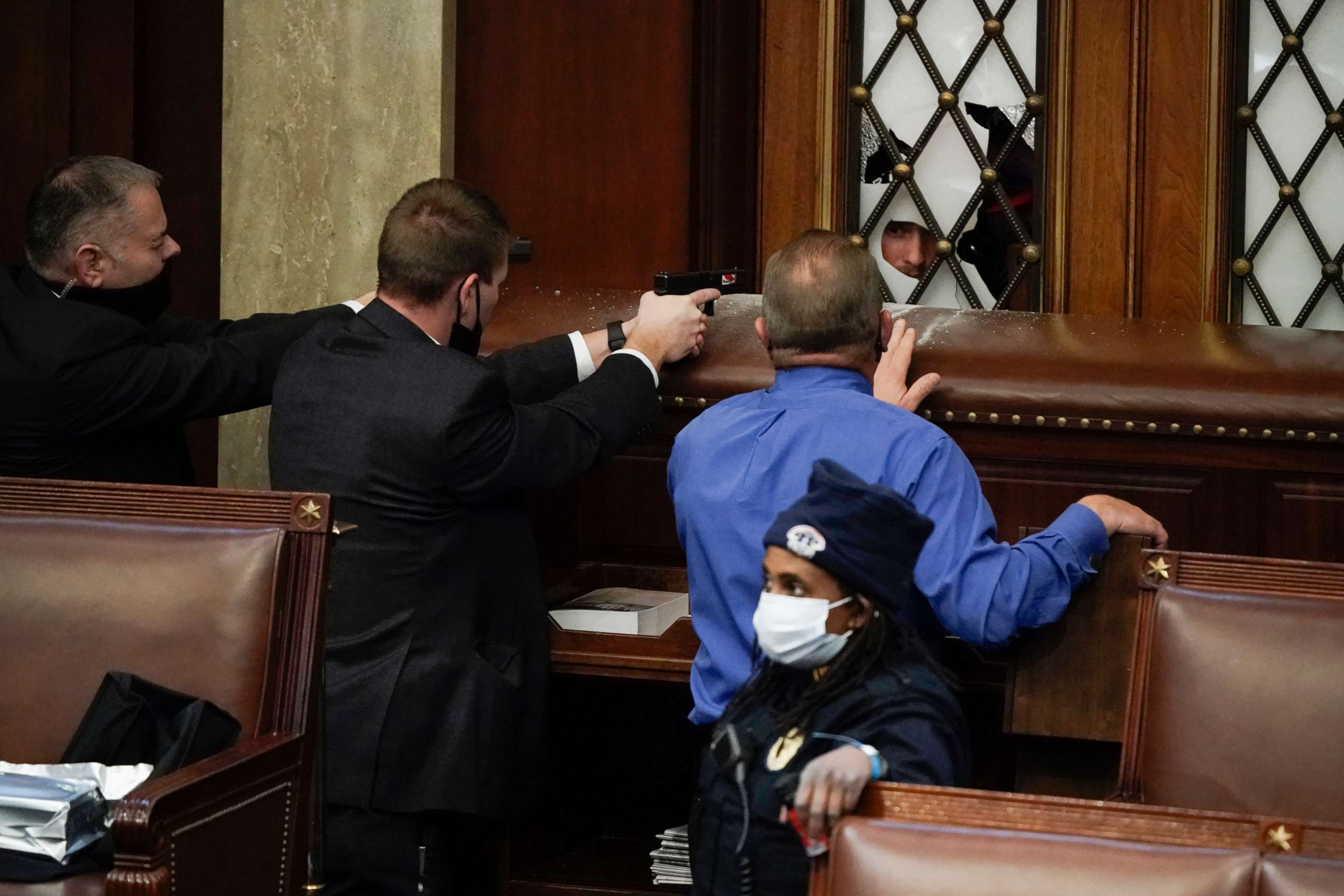
Police with guns confronted rioters trying to break into the House chamber on January 6, 2021
The first Trump impeachment failing to result in a conviction was not surprising, given that the prior impeachments of Andrew Johnson and Bill Clinton failed to yield convictions.
The failure to convict in his second impeachment, after his disruption of the peaceful transfer of power for the first time in the nation’s history, was far more disturbing. That confirmed that populism had taken control of the Republican party, with 43 of the 50 Republican senators abandoning their oaths to support, defend, and bear true faith and allegiance to the Constitution by failing to prevent Trump from running again for the office he had betrayed. No doubt many of them felt that if they stood up for the Constitution their own populist base would consequently turn them out of office: a few days after the attack on the Capitol, over 3/4 of Trump voters, and about 1/3 of all voters, believed “the big lie” that Biden’s election was illegitimate.
Operational norms were mostly reinstated for a few years under Biden, but then his personal hubris led him to betray his party’s and the national interest. Instead of stepping aside to support a healthy Democratic primary process that might have identified a Presidential candidate who could appeal to liberals, moderates, and some populists, he wanted a second term. When his declining abilities made that impossible, the Democratic party made the elitist and fatal choice to have a black woman as its presidential candidate amidst a populist tide in a country in which both racism and sexism remain commonplace. Their blinkered identity politics ensured that Trump, despite his crimes, cruelty, and advanced age, won both the popular and electoral votes.
Thus far in Trump’s second term, Congress, with slim Republican majorities in both the House and Senate, has completely capitulated to the executive. The President routinely violates the law, and Madison’s plan that “Ambition must be made to counteract ambition”, harnessing the natural jealousy and ambition of political actors to prevent any one branch of government from becoming too powerful, has failed.
Many of the Republicans in Congress were elected as populists, and some of them simply do not believe in government. That is why they are quite effective at destroying programs and institutions yet repeatedly fail to produce promised alternative plans for health care, infrastructure, or other common interests. Their primary achievements are continuing tax cuts, despite the consequent explosive growth in the national debt.
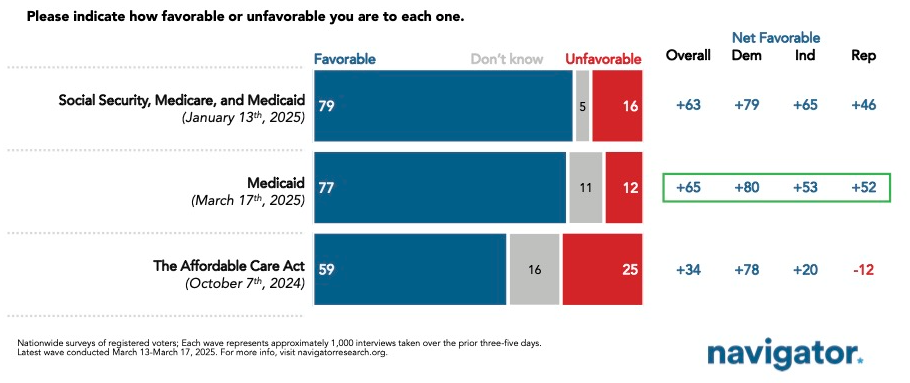
A portion of them genuinely believe in the long-discredited theories of trickle-down economics, while others no doubt hope that the unsustainable debt will eventually force the curtailment of the Social Security, Medicare, and Medicaid entitlements and further weaken the Affordable Care Act (ACA). Bear in mind that the GOP opposed the creation of all of those programs, which enjoy broad overall support. Only the ACA has a net unfavorable rating among Republican voters, but Republicans in Congress still passed legislation that will result in millions of people losing Medicaid coverage, and they joined Democrats in continuing to ignore the depletion of the Social Security Trust Fund in 2033.
Republicans know that most of their policy goals would not survive senatorial filibusters. They could vote to further weaken or fully eliminate the filibuster, but that would in turn make them vulnerable when their control of the Senate slips. So they have adopted a long-term strategy of allowing the executive to illegally enact their policy goals. Their hope is that, whenever the Democrats eventually do regain majorities in Congress and control of the White House, the Democrats’ more diverse and moderate coalition would be restrained by the filibuster and the rule of law.
Also, by allowing Trump to accomplish their policy goals by fiat, they avoid direct votes that would attach to them blame for his various destructive acts that will inevitably have significant negative long-term consequences.
The considerable cost of that strategy is how it empowers a cruel and incompetent executive branch and accelerates the slide into competitive authoritarianism. While authoritarianism appeals to many people who value short-term action over long-term stability, it inevitably lowers economic growth and restricts civil rights and liberties.
One reason the Republicans in Congress are allowing the executive branch to violate the law and the Constitution is their misplaced trust that the judicial branch will eventually contain the worst excesses. However, the machinations of Mitch McConnell that created a supermajority of right-wing Supreme Court justices has severely undermined the judicial branch’s legitimacy and enforcement of the rule of law. The unitary executive theory that a majority of the court now embraces is a concentration of executive power that betrays the clear vision and intent of the founding fathers, who deliberately made the legislative branch the most powerful. It is also at odds with why the American Revolution was fought.
The increasingly unmoored reasoning of the partisan Supreme Court has freed the president from the rule of law, but even that might not suffice for Trump. His administration could become more brazen in its repeated violations of lower court orders and, if the Supreme Court eventually ends its campaign of appeasement, he might refuse to follow its rulings.
If that happens, the only remaining Constitutional tool to constrain him would be his impeachment in the House and conviction in the Senate, which is unlikely given that most Republicans in Congress have already abandoned their oaths. A military coup is unlikely, so I expect that it would require massive civil unrest to overturn Trump’s authoritarian regime in such a scenario.
However, I do not actually expect Trump to be so deranged. My prediction is that he will continue to flaunt his power while avoiding too direct a confrontation with the judicial branch. His corruption of the government has already enriched him greatly, and he will grant himself and his cronies pre-emptive federal pardons when he leaves office. His narcissism leads him to expect to continue to elude justice, and I expect he might, as our legal system has always been too slow, corrupt, and politicized to hold him to account. His greatest enemy is time in the form of his ongoing physical and mental decline.
A longer view
There is also the long-term issue that while Trump’s charisma, brazenness, and demagoguery have channeled the populist tide to power his pulverizing mill, his departure from office and eventual death will not dissipate it. The class resentment he manipulated will remain a potent force that future charismatic demagogues could wield.
The Democrats need to rebuild themselves
Democrats remain disorganized, and they are distinctly and deservedly unpopular. Their best hope for retaking parts of the federal government is that the economic shocks of Trump’s policies will trigger a significant recession in 2026 or 2027. Of the eleven recessions after World War II, ten occurred under Republican presidents. Republicans rely far too heavily on tax cuts and deregulation for economic growth, while Democrats are usually more pragmatic in heeding economic and historical lessons.
However, I expect little long-term success for Democrats so long as they continue to fail to recognize and harness the energy of the populist tide. Their coalition relies far too much on minority identity politics, is out of touch on cultural issues, alienates young men and rural voters, and is more reactive than visionary in directly addressing more problems of the working class.
David Brooks highlighted the populist problem for me, and he posits that America’s historical distinction from class-driven Europe could be parlayed into a counter-narrative to Trumpism that rejects class conflict and embraces social mobility. He notes that, “Trump’s ethos doesn’t address the real problems plaguing his working-class supporters: poor health outcomes, poor educational outcomes, low levels of social capital, low levels of investment in their communities, and weak economic growth.”
He points out how the Populist Progressive movement of the late 1800s was a response to the political corruption, concentration of corporate power, huge inequality, and racial terrorism of that period. Progressives in big cities and populists in small towns “wanted to help those who were being ground down by industrialization” and “believed in using government to reduce inequality and expand opportunity.” He wonders if a new coalition could help us cope with the rise of the Information Age, reforming our universities, Congress, corporations, the meritocracy, and the new technocracy.
Brooks envisions an alliance that is “economically left, socially center right, and hell-bent on reform” and rejects the endless class and culture wars. However, he also points out one of the bleak realities of our age: “Americans have at most a two-week attention span, so to control the conversation, you need to stage a series of two-week mini-dramas, each with high-stakes confrontations and surprises.” Any counter-movement may have to become part of that depressing milieu.
Brooks closes his essay by noting that America’s cyclic process of rupture and repair follows a sequence: “Cultural and intellectual change comes first — a new vision. Social movements come second. Political change comes last.”
All that takes time, and I am genuinely concerned that the stable government I grew up with, featuring bipartisanship, general respect for the rule of law, a belief in and agreement with the deeper operating principles of our constitution, and a hope for a better tomorrow might not return in the few decades I hope to endure.
I read oodles of science fiction stories authored in the second half of the 20th century that involved interstellar travel, but the reality is that we never managed to get anyone beyond Earth orbit after 1972, and arguably even the dozen men who briefly walked on the moon were still orbiting the Earth. Only five robot spacecraft have interstellar trajectories, and they won’t be exiting our Oort cloud for tens of millennia. Physics tells me that nothing material can exceed the speed of light, so many sci-fi stories are just a form of fantasy.
I was an avid fan of the original Star Trek and The Next Generation, but the cultural momentum built up in childhood that carried me through Deep Space Nine, Voyager, and Enterprise was dissipated by the friction of my increasing skepticism, and I haven’t been able to muster any enthusiasm for the later series. In recent years I read a few still-active sci-fi authors, such as Alastair Reynolds and Becky Chambers, but I’m increasingly uninterested in stories that ignore physics or pretend there are workarounds to its limitations. As for cinema, many movies are now crafted by people who obviously grew up on video games, and the suspension of disbelief their computer-generated spectacles require is often simply beyond me.
There are still plenty of science fiction stories that take place within our solar system, however, and during the Covid-19 pandemic, I discovered the Bookpilled channel where Matt, a liberal arts major, offers thoughtful and insightful reviews of science fiction works. I respect his opinion, although we inevitably differ in our tastes, evidenced by how recently on Patreon he absolutely hated Niven’s Ringworld, which was one of my teenage favorites.
I am glad to support Matt on Patreon, as he approaches the genre from a more literary perspective and exposes me to many potential new reads, which is helpful since I am now so resistant to much of science fiction. He sometimes takes on classics from the major authors of my childhood, but he ranges widely across 20th century sci-fi.
This was a harsh but memorable read
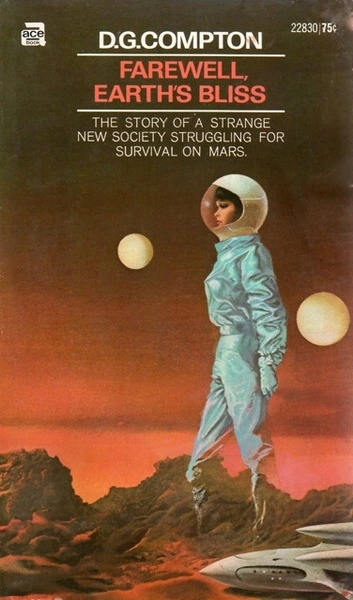
Back in May 2023, Matt reviewed D.G. Compton’s Farewell, Earth’s Bliss from 1966. He described it as one of the bleakest books he had ever read, with “wonderfully sharp and crystalline and well-realized characters” and being truly immersive. I was sufficiently intrigued to purchase and read the book, and it was as he had described. I certainly didn’t find it a pleasant read, but it was memorable and worthwhile.
In December 2023 he reviewed an even more obscure book, One on Me by Tim Huntley. He said it was a funny and well-written dystopia set on the Earth in a distant future, but significantly flawed by its inclusion of forbidden relations. Matt said, “I don’t know that I recommend it. If you can just hold your nose and plug your ears for a couple parts, it is a good book, but I don’t know if you should.”
The book is certainly not well known. I found only one review online, by Kenny in north Texas from 2019, and he opened with a paragraph of complaints about its objectionable elements, condemning it as “vulgar and gross”. However, he then echoed Matt by stating, “Despite all that, there is a compelling story.”
My “banned” book
Well, that was enough to interest me. The book wasn’t available electronically, so I bought a used paperback copy on Amazon for $7, and if Amazon had not had a copy, I would have checked AbeBooks. I received it in early January and tossed it on a shelf.
Seventeen months later, finding the various possible reads in my Kindle library unappealing, I scanned my shelves and noticed that 221-page DAW paperback published in 1980. I vaguely recalled that it was considered off-putting, it didn’t appear to involve impossible interstellar travel, and since it happened to be Banned Books Week, I decided to read it.
My used copy had been embossed on its title page as having once been in the library of George H. Siehl III, and I had some fun tracking down who that was.
Going beyond the title page, I was thankful to discover that there was little detail in the novel’s treatment of disturbing relations, and they did serve a purpose in showing how different the dystopian culture was from our sensibilities, an effective illustration of the decadence of both sides in a later conflict. A bit of earthy humor about the narrator also struck me as far more comedic than offensive. It lacked the explicit intercourse that graces some trashy romances, but it certainly mentioned unfortunate sexual behavior, torture, and the like. I was glad to find those topics handled fairly quickly and at a remove; the book didn’t strike me as seeking to titillate.
Donald A. Wollheim
The disturbing elements actually served the plot, which made sense to me since the book was published by DAW in 1980, when founder Donald A. Wollheim was still in charge. He was one of the major science fiction and fantasy editors, publishing pulp authors Robert E. Howard, Clark Ashton Smith, and H.P. Lovecraft in the 1930s and later nurturing future greats like Poul Anderson, Philip K. Dick, and Andre Norton at Avon and Ace Books before creating his own imprint.
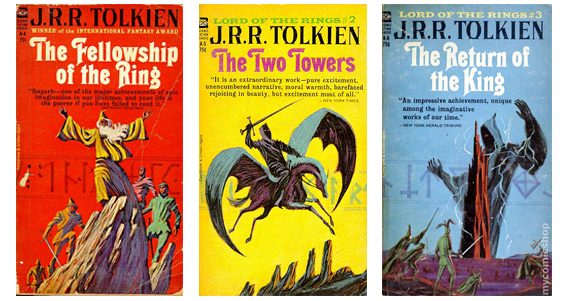
A fun story about Wollheim was how he called up J.R.R. Tolkien in 1964 to ask if he could publish Lord of the Rings as Ace paperbacks. Tolkien reportedly said he would never allow his work to appear in so “degenerate a form”. That is said to have incensed Wollheim, who discovered that Tolkien’s American hardcover publisher had neglected to protect the work in the USA, so he went ahead and published them as unauthorized Ace paperbacks.
Tolkien rewrote the books enough to obtain a new copyright, sold them to Ballantine, and successfully pressured Ace to stop publishing the unauthorized versions and pay him some royalties on the 100,000+ copies they had sold. The squabble helped ignite the Tolkien boom and launch the modern high fantasy field, but it also damaged Wollheim’s reputation.
The unauthorized Ace editions of The Lord of the Rings are now collectors’ items
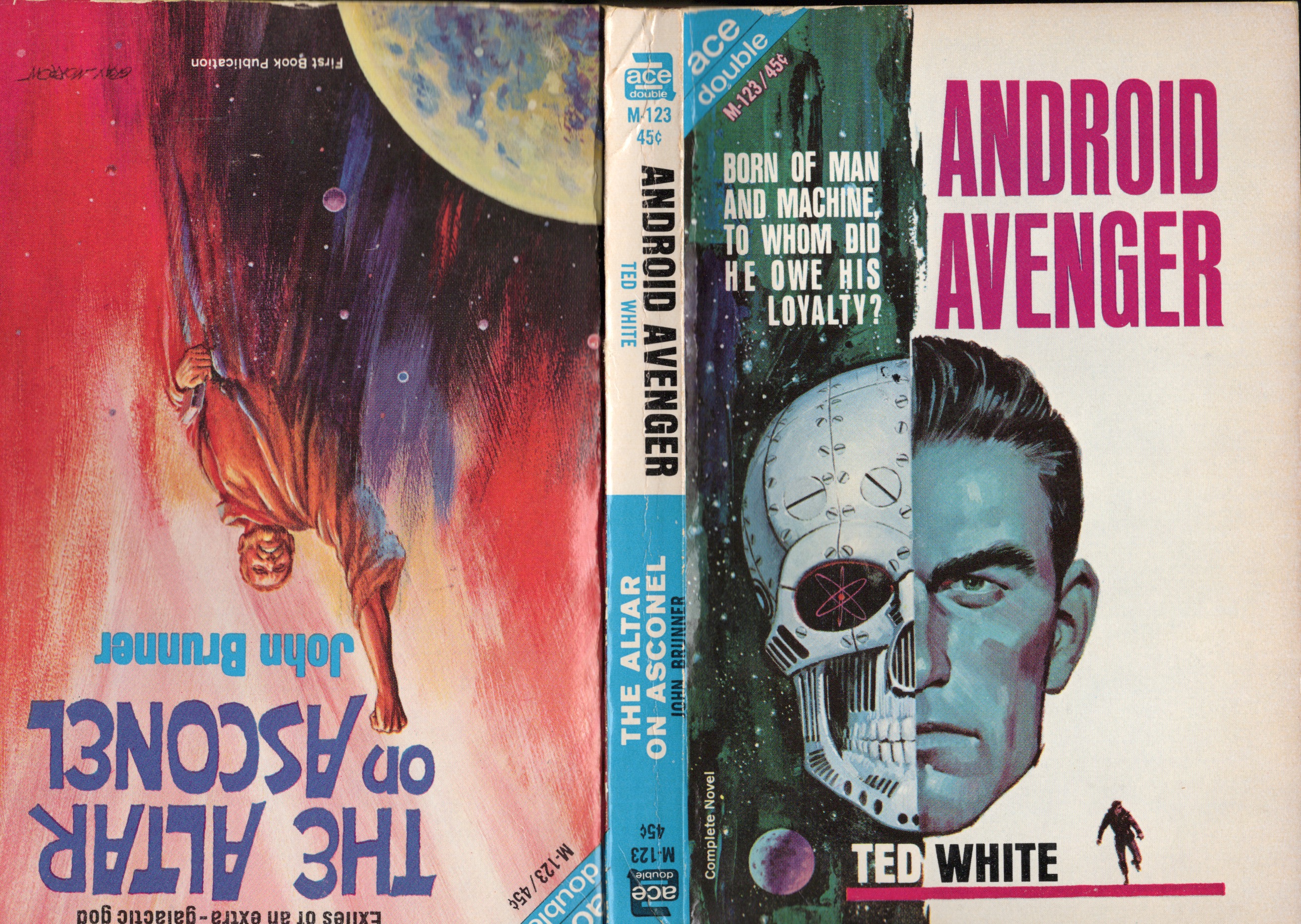
I have a soft sport for Ace paperbacks. When I was a young teenager, one of my uncles gifted me his science fiction paperbacks, which included several of the Ace doubles. The tête-bêche format books published from 1952 to 1973 each contained two novellas, with the front cover and interior of one novella rotated by 180 degrees and bound back-to-back with the front cover and interior of the other. That way neither novella is preferred, and if you buy one and end up abandoning it, you can always flip the book around and try again. I suppose you might occasionally like both stories! One of the old doubles managed to survive my Digital Age Downsizing in 2010.
As for DAW, you can read more about that imprint here. Wollheim published popular, though not always critically acclaimed, works. I wouldn’t expect him to publish outright trash, and I enjoyed One on Me. I couldn’t predict how its tale would unfold, and I found it prescient in several ways.
The book was good enough that I downloaded a sample of Huntley’s other novel, which was self-published 30 years later when he was about 70. It is even more obscure, but EarthGame: A Player’s Guide came out late enough that it is available on Kindle. The title is misleading, as the book is a comic novel. I’m not ready to try EarthGame, having just wrapped up One on Me, but it is on my list as a tempting final outing with Huntley, who died in 2019 a week before he would have been 79 years old.
My tastes have evolved considerably over the 40 years since I was a teenager, and I seldom seek out science fiction these days. Thankfully there are countless other books on offer, and my amazing access to them still strikes me as, ahem, feeling like science fiction.












































 Meador Manor
