
When reading book reviews and blurbs, I bear in mind the disclaimer I often heard in 1970s car commercials: your mileage may vary. A few weeks ago I read Gary Shteyngart’s May 2024 article in The Atlantic: “Crying Myself to Sleep on the Biggest Cruise Ship Ever“. I enjoyed it, although it could not compete with David Foster Wallace’s “A Supposedly Fun Thing I’ll Never Do Again“, which originated in a 1996 article for Harper’s titled “Shipping Out”. Wallace set the standard for writers forced to suffer through a boat cruise.
Looking for a new Kindle read, I noticed that I had Shteyngart’s Super Sad True Love Story from 2010 marked as Read in my Kindle, although I had not logged it at LibraryThing or Goodreads. The character names seemed familiar, but the plot summary on Wikipedia did not, so maybe that was a Did Not Finish before I created such a list in Goodreads.
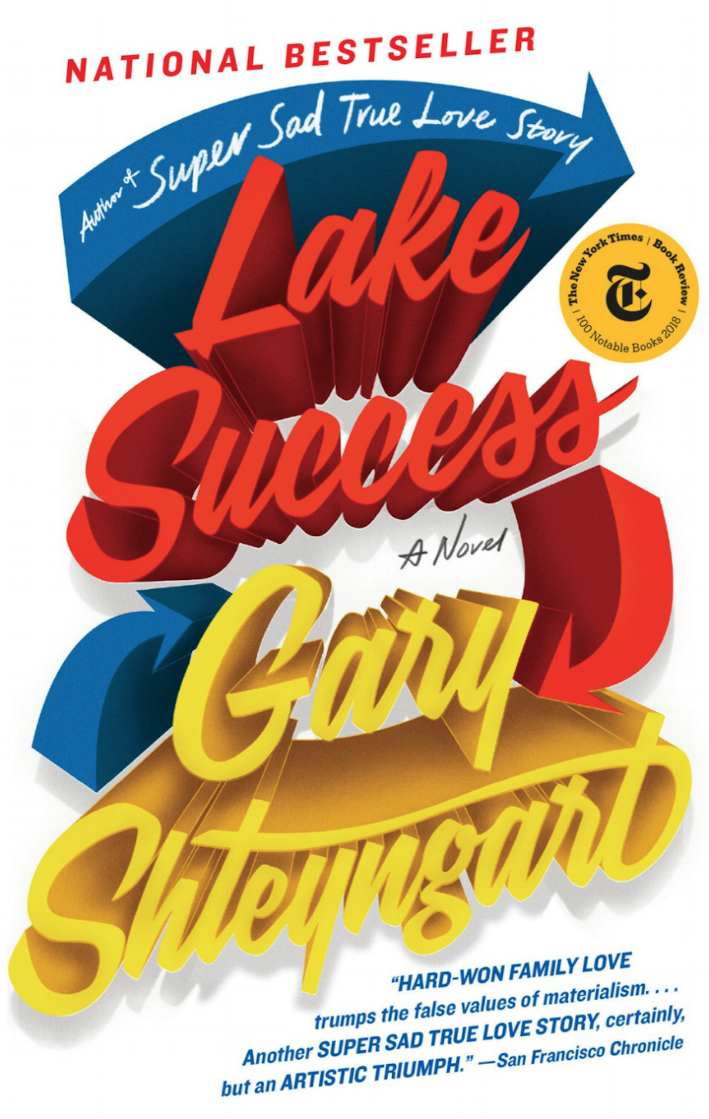
I decided to scout around for other Shteyngart novels and came upon Lake Success, which was a bestselling work with these incredibly abridged blurbs: “Spectacular.” -NPR, “Uproariously funny.” -The Boston Globe, “An artistic triumph.” -San Francisco Chronicle, “A novel in which comedy and pathos are exquisitely balanced.” -The Washington Post, “Shteyngart’s best book.” -The Seattle Times.
AND…it was named one of the best books of 2018 by Maureen Corrigan on NPR’s Fresh Air and The New York Times Book Review, NPR, The Washington Post, O: The Oprah Magazine, Mother Jones, Glamour, Library Journal, Kirkus Reviews, etc.
AND…it received a Salon Book Award, a Bollinger Everyman Wodehouse Prize, and was one of Amazon’s Best Books of the Month in August 2010. As for relative ranks, while composing this post I found it ranked as the 11,518th Greatest Book of All Time at The Greatest Books, with four of Shteyngart’s other novels ranked higher. Super Sad True Love Story was in the lead at 3,055th.
Well, okay, but Lake Success is about a multi-millionaire New York investment banker who goes on a road trip to escape a failing marriage and an approaching indictment. I knew that I, as an underpaid Oklahoma educator who is happily married and free of legal jeopardy, would not be likely to relate to the lead character, but the book was promoted as being funny, so…maybe?
I read the free Kindle sample and was gripped by the first part of the opening chapter, in which the unlikable banker struggles to get a ticket on a Greyhound bus out of New York as his odd way of fleeing the metropolis and his troubles. What I did not know was that in addition to his investment banking errors, he was fleeing from his wife and their young autistic son, nor that he would turn out to be a dim but successfully gregarious character who has some characteristics some might associate with autism.
Soon after I had purchased the book and read onward, the wife appeared in the story. She would pursue a relationship with a fake Latino writer who lived in the same garishly expensive Manhattan high rise, although he and his doctor wife’s third-floor apartment only cost $4.1 million in 2015, compared to the banker’s 4,000 square foot one up on the 21st floor which cost five times more. Let’s see…adjusting for inflation, that’s well over 100 Meador Manors.
What I soon noticed was that I did not like any of the main characters. They were all repulsive, engineered to empower various wry observations and parodic satires. I didn’t find anything “uproariously funny”, although before quitting the book 1/3 of the way in, I did highlight this paragraph about a Richmond restaurant:
The noisy restaurant the Hayeses had chosen looked like it had been tractor-trailered in from the part of Brooklyn where Seema’s funny Asian friend (Tina?) lived. There were gilded Victorian mirrors, drawings of horses, and a giant, pointless map of Latin America. Bearded bartenders were slinging tiki drinks, and the young clientele was in full possession of their looks.
The Did Not Finish killing blow was my going on a walk in a park on an unseasonably warm winter afternoon, listening to John Hodgman’s Vacationland. He essayed about a Maine summer home, repeatedly mentioning how a famous writer had once lived nearby:
That summer I thought about the famous writer in a new way. It won’t surprise you to know that he is white, and he wrote about the rhythms of his life in this white place. There is nothing wrong in this: all places and experiences deserve writing about. But what made the writer a greater hero to me in that moment was, unlike so many white men, he wasn’t braggy. He never suggested that his experience was heroic, or correct, or even unusual. In fact, it was profoundly usual, beautifully mundane, and merely his to offer. His offering was his insight into the small joys of his particular life, which by extension could help us recognize the small joys that exist everywhere, even outside of Maine. And he offered it humbly. You really should use your detective skills and find his work. He’s great.
Well, I had already deduced that Hodgman was referring to the co-author of The Elements of Style and the sole author of Stuart Little and Charlotte’s Web: E. B. White. I’ve only read the story of the spider and “some pig”, and that was five decades ago in a school building that itself would perish thirty years later. Some day I’ll perish too, and might my limited time be better invested in some essays by E. B. White than in Shteyngart’s horrid characters?
I spent a whopping $2 on Essays of E. B. White, which he had compiled in 1977, sharing:
The arrangement of the book is by subject matter or by mood or by place, not by chronology. Some of the pieces in the book carry a dateline, some do not. Chronology enters into the scheme, but neither the book nor its sections are perfectly chronological. Sometimes the reader will find me in the city when he thinks I am in the country, and the other way round. This may cause a mild confusion; it is unavoidable and easily explained. I spent a large part of the first half of my life as a city dweller, a large part of the second half as a countryman. In between, there were periods when nobody, including myself, quite knew (or cared) where I was: I thrashed back and forth between Maine and New York for reasons that seemed compelling at the time. Money entered into it, affection for The New Yorker magazine entered in. And affection for the city.
I have finally come to rest.
That beckons to me, while I personally related to this part of his Foreward:
There are as many kinds of essays as there are human attitudes or poses, as many essay flavors as there are Howard Johnson ice creams. The essayist arises in the morning and, if he has work to do, selects his garb from an unusually extensive wardrobe: he can pull on any sort of shirt, be any sort of person, according to his mood or his subject matter—philosopher, scold, jester, raconteur, confidant, pundit, devil’s advocate, enthusiast. I like the essay, have always liked it, and even as a child was at work, attempting to inflict my young thoughts and experiences on others by putting them on paper. I early broke into print in the pages of St. Nicholas. I tend still to fall back on the essay form (or lack of form) when an idea strikes me, but I am not fooled about the place of the essay in twentieth-century American letters—it stands a short distance down the line. The essayist, unlike the novelist, the poet, and the playwright, must be content in his self-imposed role of second-class citizen. A writer who has his sights trained on the Nobel Prize or other earthly triumphs had best write a novel, a poem, or a play, and leave the essayist to ramble about, content with living a free life and enjoying the satisfactions of a somewhat undisciplined existence. (Dr. Johnson called the essay “an irregular, undigested piece”; this happy practitioner has no wish to quarrel with the good doctor’s characterization.)
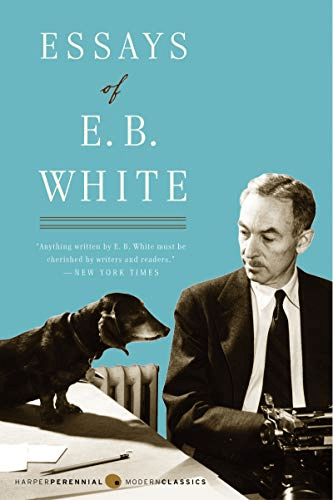
Oh, what a blogger E. B. would have been. I laid aside the 11,518th Greatest Book of All Time in favor of the 976th. Even before reading a single essay in that book, I also ordered a rather thin used tome, from a Dallas bookstore, containing two of White’s other essays: “Farewell to Model T” and “From Sea to Shining Sea” about his 1922 trip, when he was just out of college and at loose ends, crossing America in a Ford Model T. Sorry, Shteyngart, there’s someone a short distance down the line I want to meet who has his own road stories to share.