Avoiding the Nostalgia Trap

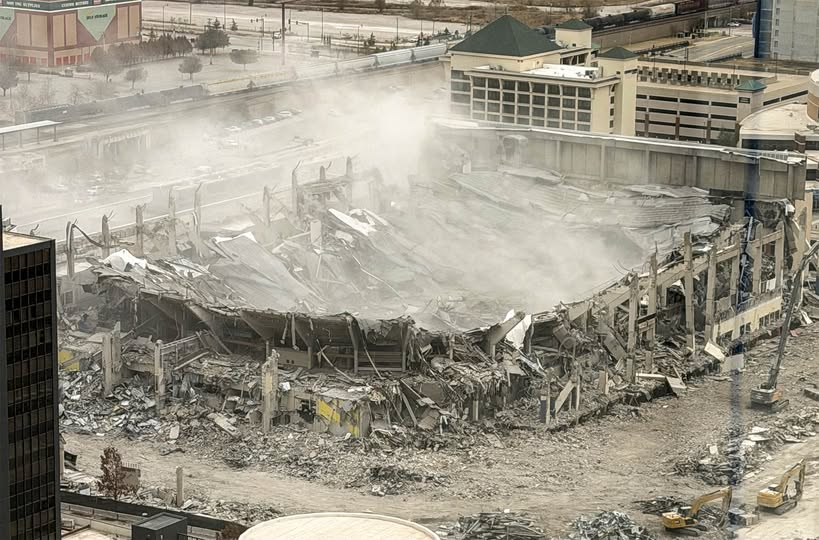
This week they really got going on destroying the old convention center in Oklahoma City. There was a dramatic photograph showing the arena bowl half destroyed, and then they brought the remaining roof down.
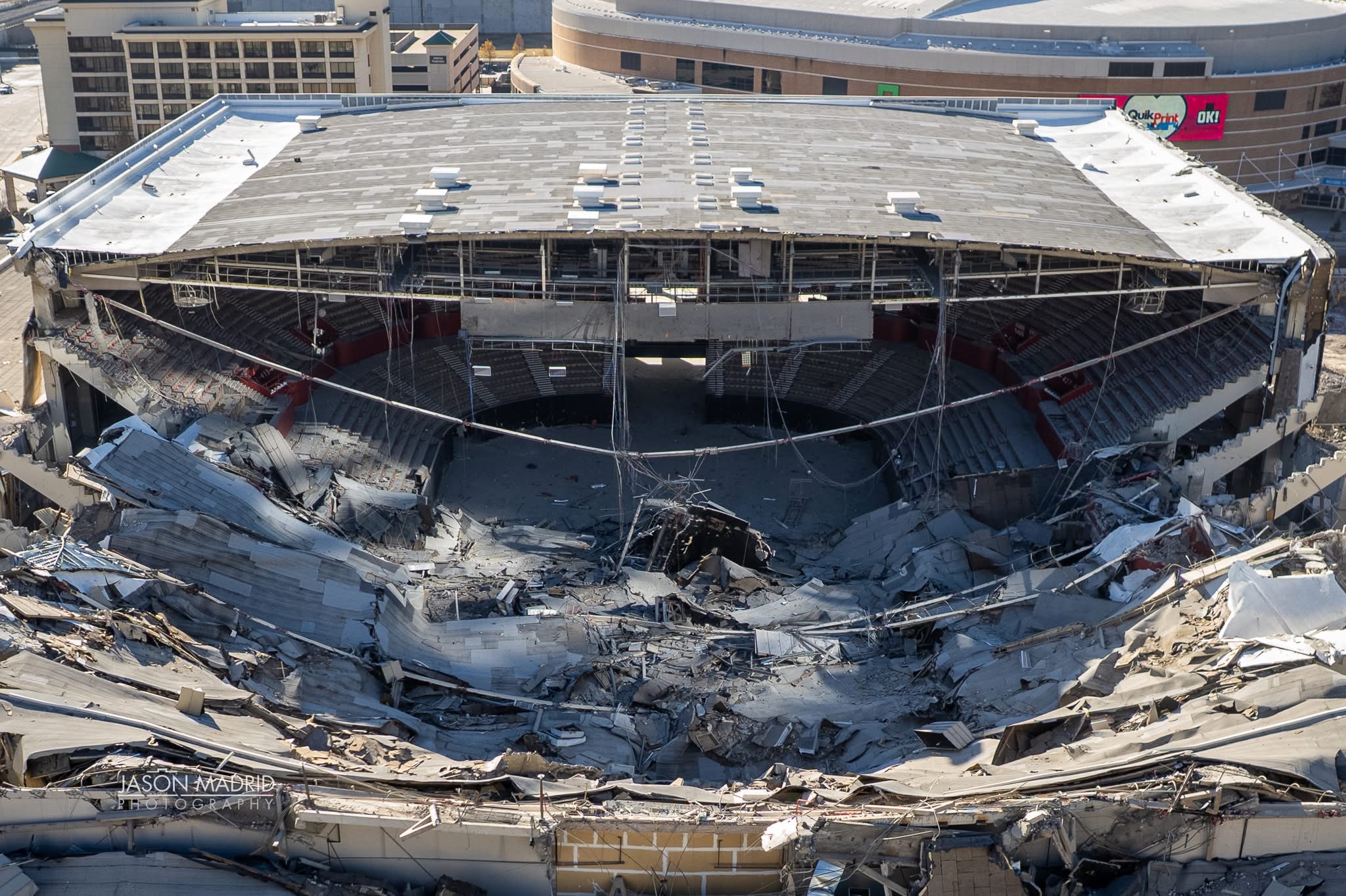
The Myriad is coming down [Source]

At the start of 2025, I wrote about the history of that huge facility, which was constructed from 1969-1972. It hosted my junior and senior proms and I gave a speech in it at my high school graduation. I also attended multiple conferences there over the years. The old Myriad is a few years younger than I am, but its time is up.

I’ll confess that it hurt a bit to see the former Allen Morgan Street Memorial Myriad Convention Center destroyed, despite its various shortcomings and obvious obsolescence. The pang I felt reminded me of a similar issue facing Bartlesville when I arrived here in 1989.

My Childhood Library

I’m a big fan of public libraries. I’d grown up using the Bethany branch of Oklahoma City’s Metropolitan Library System, and I remember checking out Curious George books there, along with Esphyr Slobodkina’s Caps for Sale. Years later, I prowled its shelves looking for science fair project ideas. I remember the giant checkers game in the children’s area that always caught my eye…but I’ll confess that I never learned to play checkers, let alone chess.

Another thing I noticed as I grew up was the simple elegance of the little branch’s architecture. It had opened in 1965 and was designed by Ray Bowman, the head of the Art Department at what was then Bethany Nazarene College, just blocks away. OkieModSquad posted a nice look back at it in 2017.
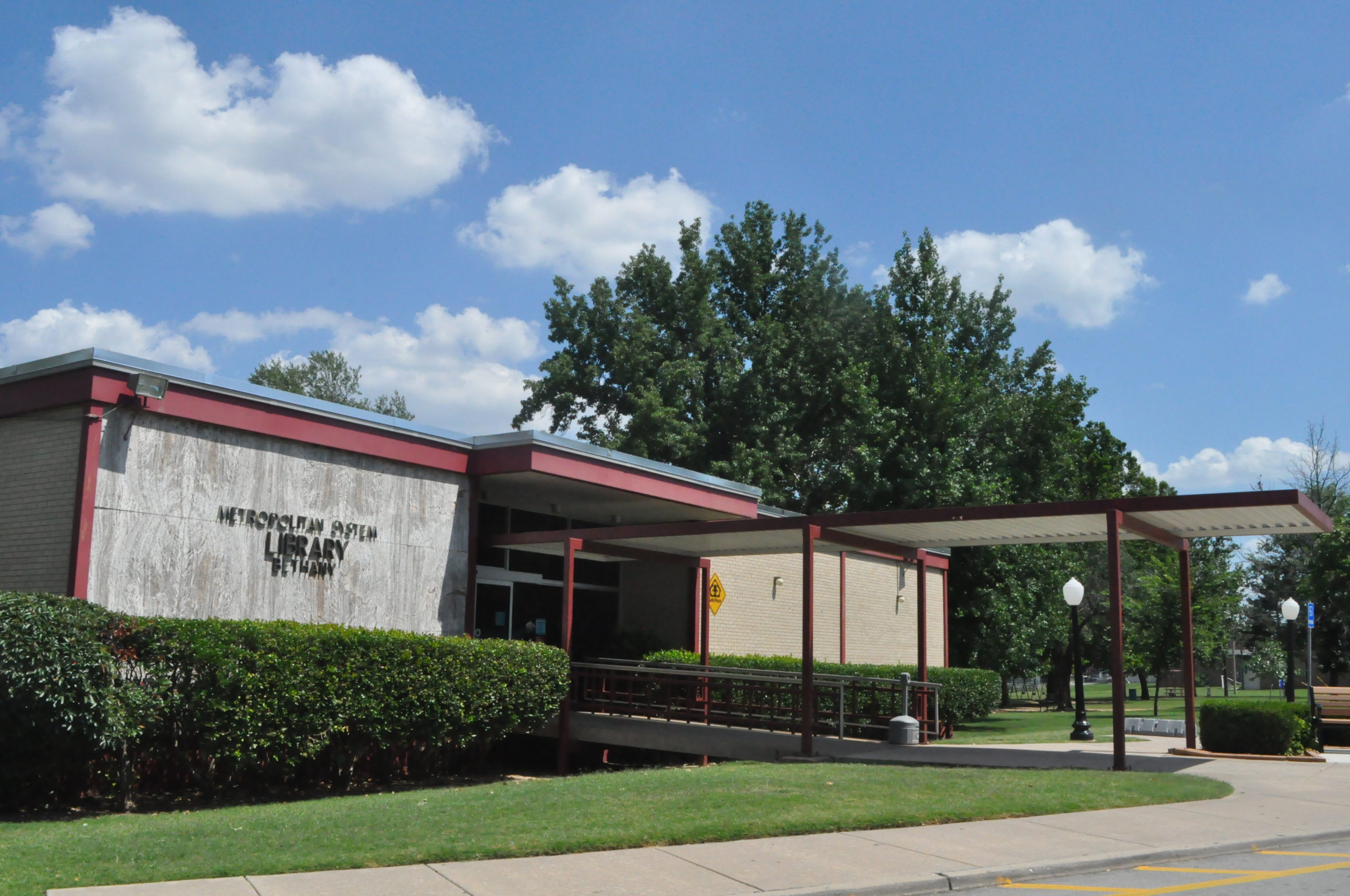
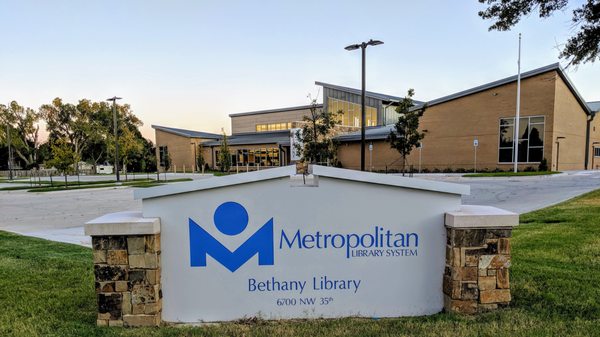
The little library I grew up with
Its 2019 replacement by Dewberry Architects

However, it was only 8,400 square feet and became woefully obsolete for the area’s needs. So it was replaced with a 23,000 square foot facility that opened in 2019, expanding its collection from 58,000 items to almost 90,000.

I have nostalgic memories of happily crossing the little bridge when entering or leaving one of my favorite places from childhood, but nostalgia is a trap. It is a good thing that they razed the old library and built a new and better one. It wouldn’t have made sense, given the money, the lot, etc. to try and expand the old library or repurpose it and build elsewhere.

Bartlesville’s Libraries

So let’s jump to 1989. I was 23 years old and had just moved to Bartlesville. Until then, I’d only caught glimpses of it along Highway 75 and over by Sooner High, since whenever we would head from OKC to Independence, Kansas to visit relatives, we would stop in Bartlesville to have lunch with some retired former coworkers of my parents; they lived in the Madison Heights addition.

I knew Bartlesville as an outlier town, awash in oil money, that produced lots of National Merit scholars and Advanced Placement students I had helped to recruit and advise while working in Scholars Programs at OU. Bartlesville had a symphony orchestra, a magnificent community center, a then-thriving shopping mall, and multiple skyscrapers, despite only having a population of 35,000. Surely its public library would be similarly impressive…right? Well, frankly, not at that time.

The First Bartlesville Library
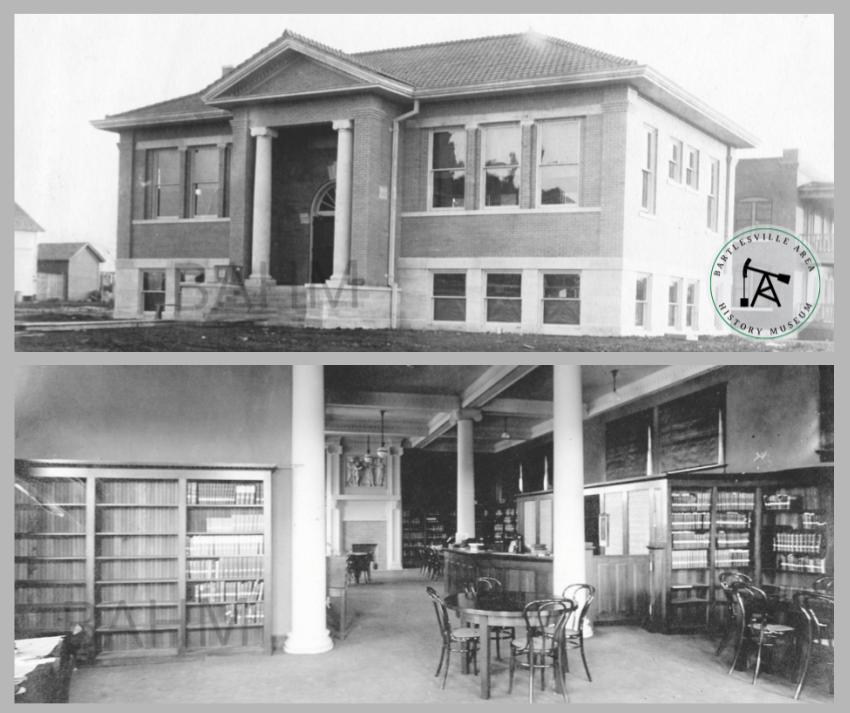
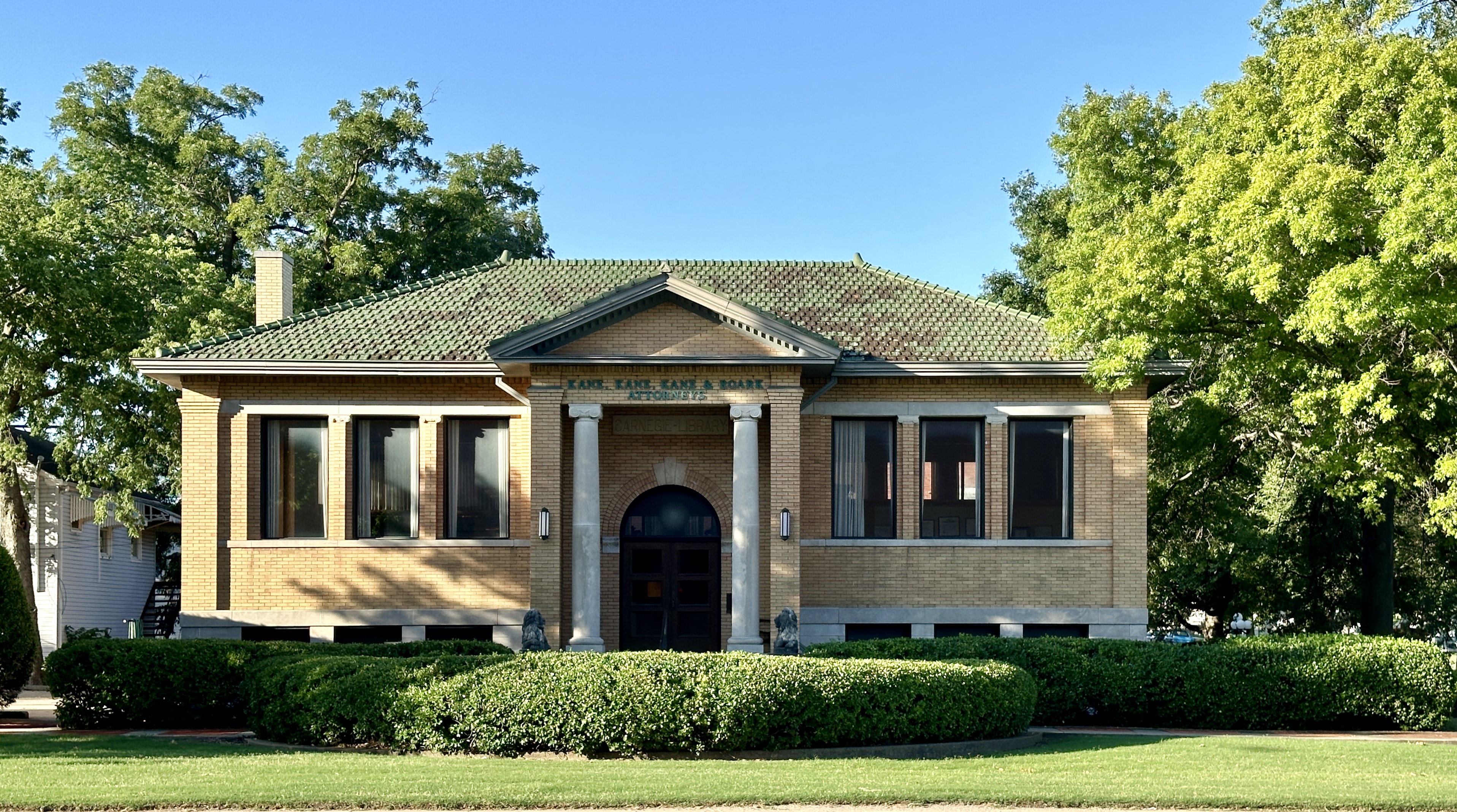
Carnegie Library [Source]

The former Carnegie Library building is just across Adams Boulevard from the Community Center. The town’s Tuesday Club had begun campaigning for a library in 1908, and the Carnegie Corporation provided a $12,500 grant to help build it.

The town grew from 6,000 in 1908 to 21,000 in 1927, and the library’s collection grew with it. From 1913 to 1927, it expanded from 1,250 volumes to over 10,000 and the building was bursting at the seams. In April 1927, a city election for a $25,000 library bond passed with over 75% approval: 2,155 to 689. Frank Phillips promptly pledged another $12,500 to the project, an unconditional gift for the library to use as it saw fit.

However, just days before the election, the Oklahoma legislature passed a law, taking immediate effect, that invalidated full-term bonds like the ones in Bartlesville’s election. That forced a revote in May for serial bonds, which earned over 82% approval: 1,407 to 298.

However, by July the state’s Assistant Attorney General held that the city had no statutory authority to issue bonds for a library. The city had already begun renovating the north wing of the Civic Center, which had opened in 1923, as a temporary home for the library while the original building was prepared for expansion.

The Second Bartlesville Library

The city library board decided against a third attempt at a bond issue, voting to have local architect Arthur Gorman draw up plans to remodel the ground floor of the Civic Center’s north wing into a permanent home for the library and rid itself of the Carnegie building. I’m guessing they were just relying on Frank Phillips’ unrestricted donation. The move would help popularize the relatively new Civic Center, avoid another bond issue that might encounter yet more technicalities in debt-averse Oklahoma, and reduce the city’s operating expenses by combining facilities.
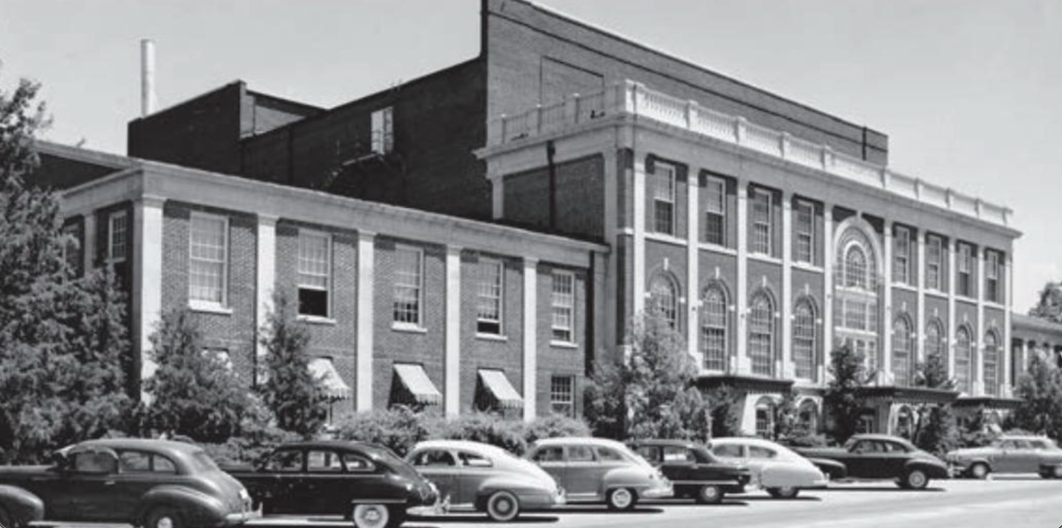
The north wing of the Civic Center, at left, became the library
The Carnegie Library became law offices

The Red Cross headquarters moved out of the Civic Center’s north wing, which was opened up into one big room, becoming the library’s new home in September 1927. The school system wound up taking over the old Carnegie library, making it an administrative building until 1974, when it was sold off to become law offices.
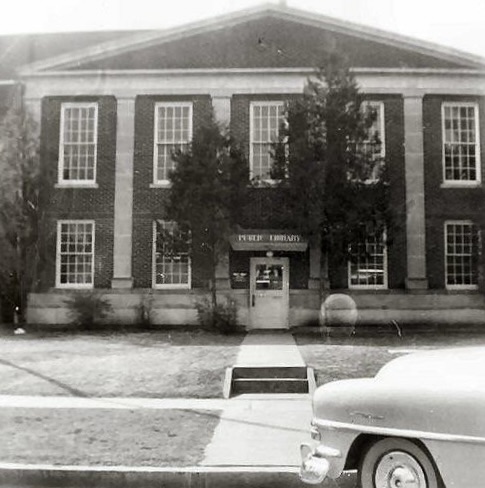
The library moved into the Civic Center

By the summer of 1930, the library was outgrowing its new quarters, and in March 1931 it was operating branches at three of the schools and the hospital. In May 1931, it opened another branch near the West Side Park that was open on one morning and another afternoon each week.

However, despite heavy patronage, a bond issue to enlarge the library was defeated in 1940, and it was embroiled in controversy in 1950 when Ruth Brown, the librarian since 1919, was fired for her support of Civil Rights, under the pretense of her being a Communist subversive.

The town continued to grow, but the library was wholly inadequate. Bond elections in 1957 and 1959 failed.
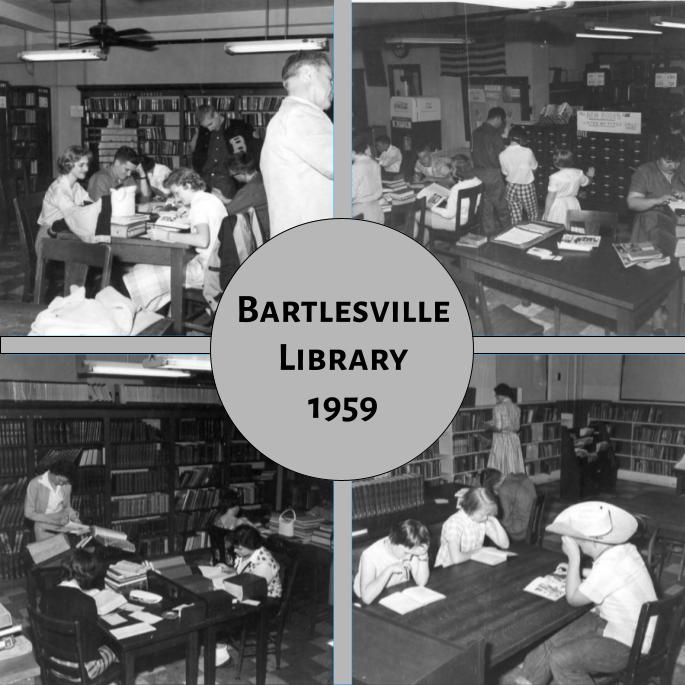
By 1959, the library needed help [Source]


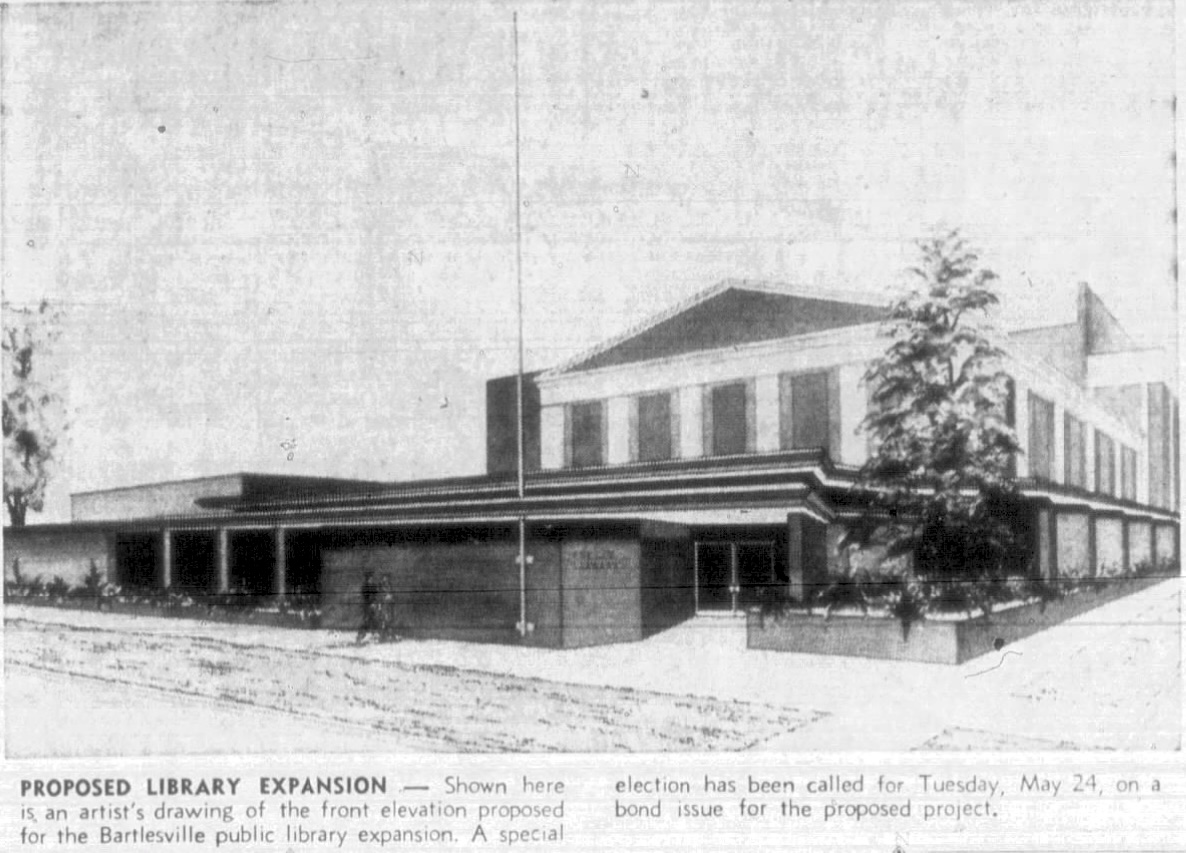
1960 architectural rendering of the proposed library addition

In 1960, 59% of the voters, by 1,873 to 1,275, finally approved a library bond issue. The resulting modernist appendage tripled the library’s size, but it in no way complemented the architecture of the older structure.

In 1989, Bartlesville still depended on that aging 1960 wraparound on the north end of a 1922 building that had been mostly abandoned for about a dozen years.
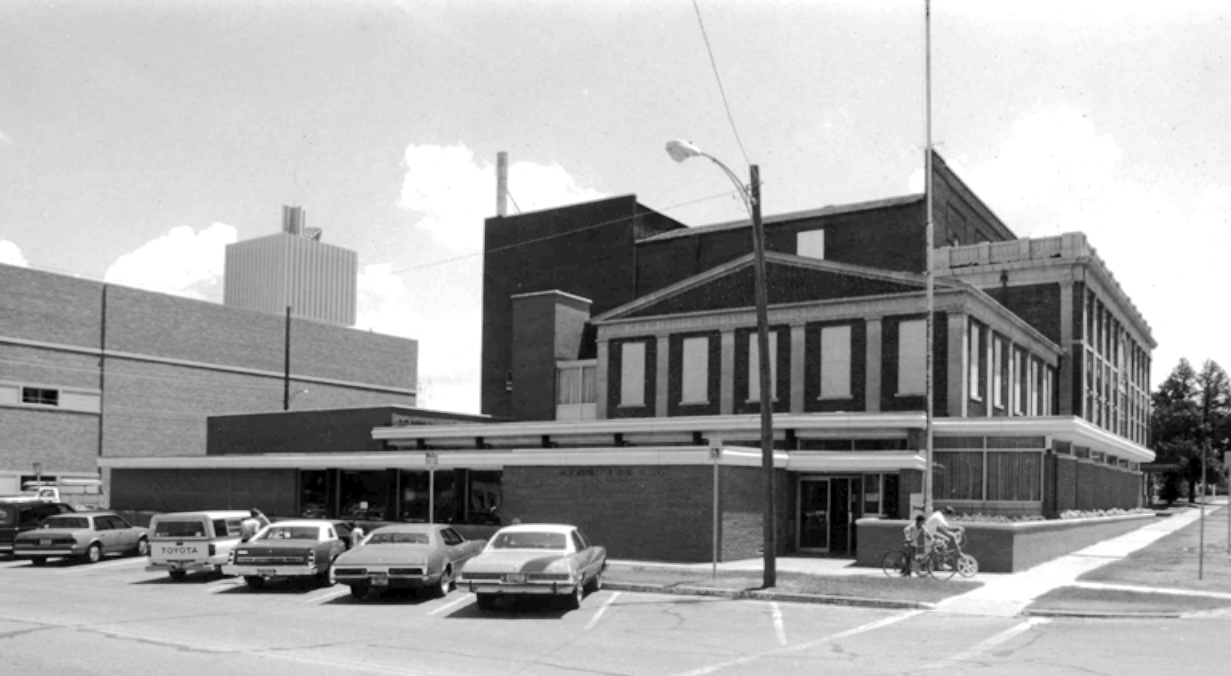
I was unimpressed by the public library in 1989 [Source]

The Controversy I Moved Into

Just a block or so to the east of the old Civic Center was the mothership, the Bartlesville Community Center. Designed by the son-in-law of Frank Lloyd Wright, it featured an impressive 1,700-seat performing arts hall accompanied by a large events room, art display gallery, and basement drama room. The facility was built from 1979 to early 1982 for $13 million, funded by private and corporate donations and a three-year penny sales tax. Space for it was created by razing the city’s first brick school building, Garfield, and the wounds lingered.
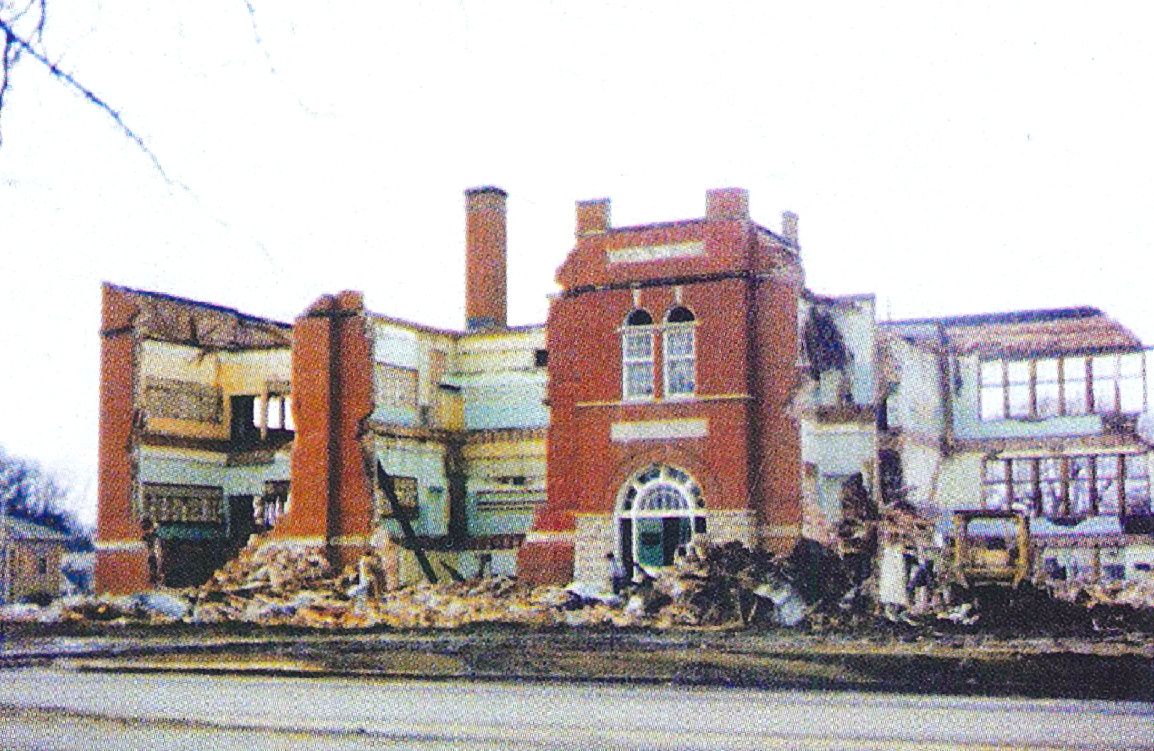
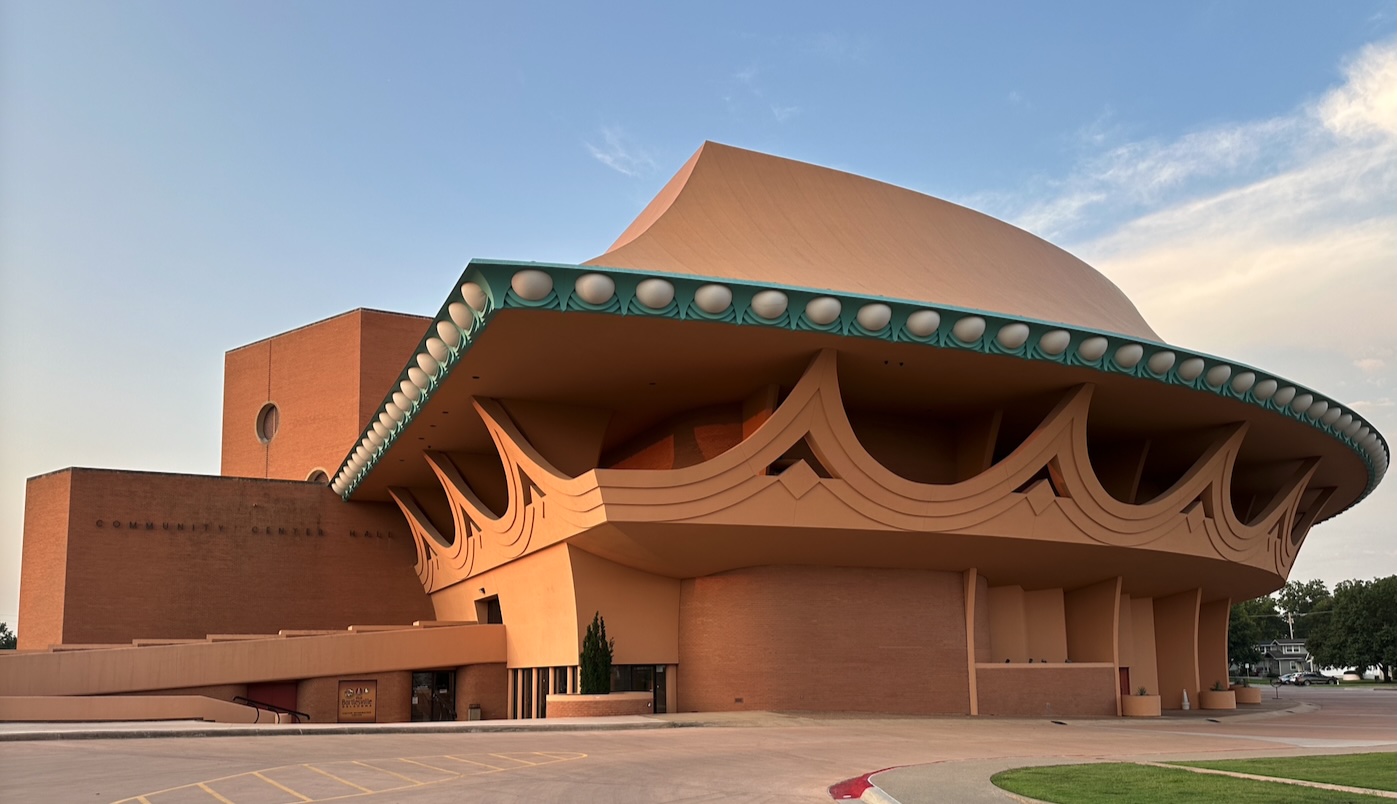
The city had abandoned much of the Civic Center in 1976, amidst competing claims about its structural integrity. The new Community Center reflected how Phillips Petroleum, a Fortune 500 company, was then still headquartered in little Bartlesville. An oil boom meant the company was expanding rapidly, and it wanted better amenities to help it attract and retain workers.

However, oil booms are often followed by busts. Phillips peaked in the early 1980s with over 9,000 workers in town but then came decades of downsizing. In 1985, amidst the oil bust, a 3/4-cent sales tax proposal to demolish the Civic Center and build a new library failed with only 36% approval: 3,107 for to 5,455 against. By 1989, Phillips employment in Bartlesville had declined by almost 40%, to about 5,400 workers.

Phillips was still so dominant at the time that when I rented an apartment at The Village, they mistakenly assumed I was a young Phillips hire. They asked me what “grade” I was, and I thought they meant what grades I’d be teaching at Bartlesville High School, so I answered, “Both 11 and 12.” They were puzzled by that response, and it turned out that they were asking about my Phillips employment classification. It was an introduction to life in what was still very much a “company town”.

No Attachments

As an outsider moving into town, I explored the library, but considered it quite lackluster amidst the town’s striking amenities. Sure, it was 70% larger than the tiny branch library I grew up with in OKC, and it did feature a history room, over a decade before the Bartlesville Area History Museum would come about.
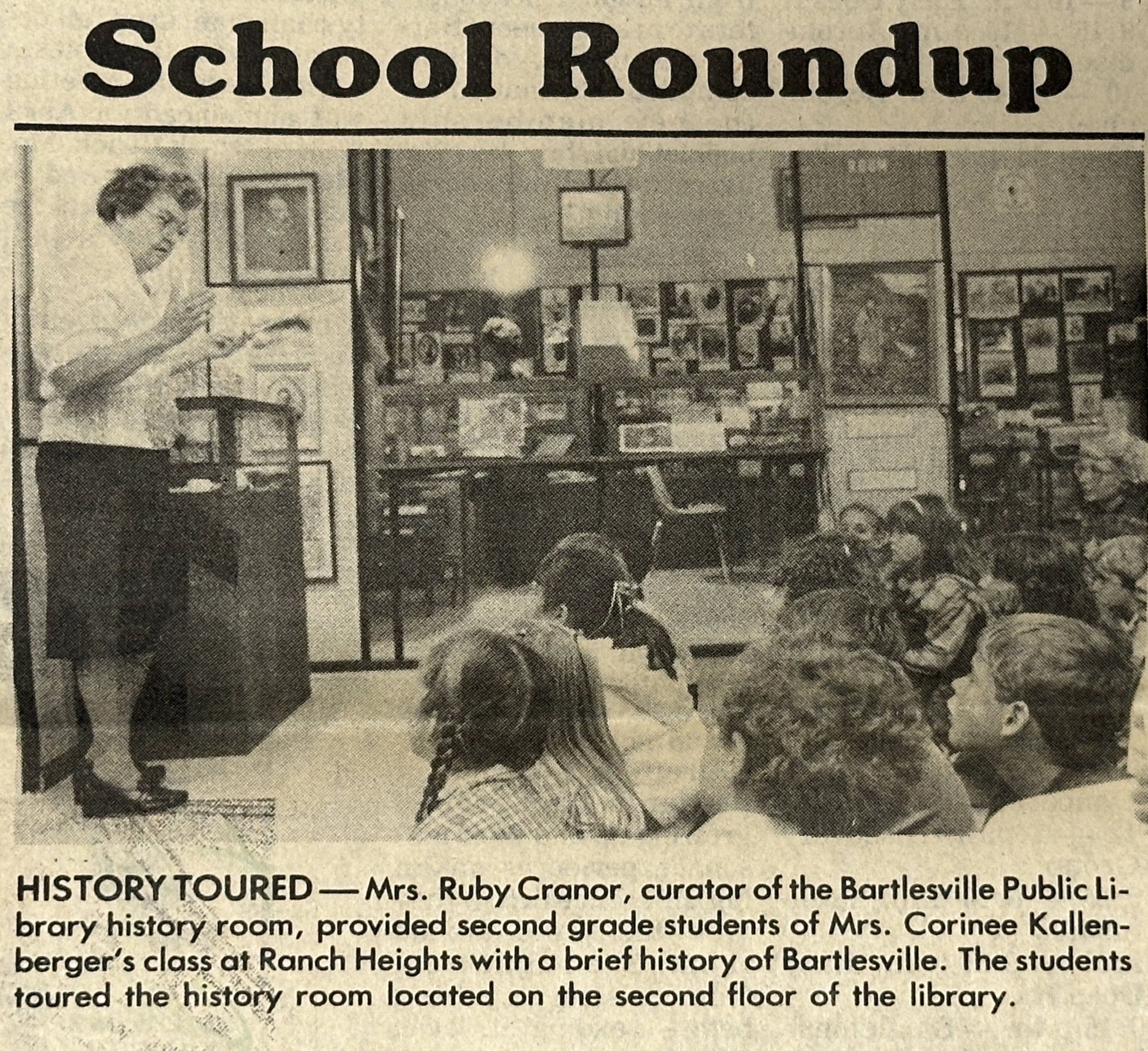
A glimpse into the library’s history room back in 1982

However, to my eyes, having never been in the Civic Center in its heyday and only seeing it in its partially abandoned state, it was an obsolete eyesore that served no purpose save for an old mismatched library retrofitted into its north end. It made perfect sense to me, having no nostalgia for the structures, that the city should tear it down and build a larger and much more modern library in its place.

Well, some did not agree, because they had been captured by the nostalgia trap, which doesn’t care about economic viability or functional suitability. A retired Phillips employee in his early 60s, not much older than I am while composing this post, organized a 25-member Concerned Citizens of the Bartlesville Area. They collected 1,409 signatures on a petition against demolishing the old Civic Center, demanding a citywide vote on the issue. I did not find a sensible or economically viable proposal from them on what to do with the obsolete and redundant facility, just a demand that it not be destroyed. It would have been very expensive to renovate the entire old Civic Center into an adequate new library, and the result would have been compromised by the mismatch with its original design.

Thus, on September 12, 1989, I participated in my first Bartlesville election, voting Yes on a $2.5 million bond issue to demolish the Civic Center and construct a new library in its place. It passed with 56% approval: 5,161 to 4,061.
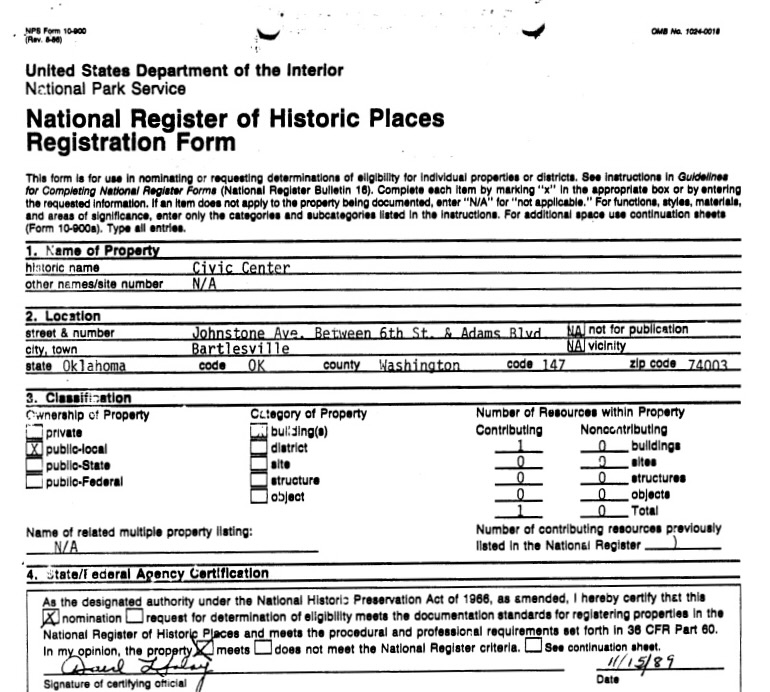
The Civic Center was listed on the National Register of Historic Places, but that did not prevent its destruction

The fellow opposing the demolition finally succeeded in getting the old Civic Center on the National Register of Historic Places, but that recognition didn’t come until November 1989, months after the vote. Contrary to popular belief, such recognition merely encourages preservation by making some properties eligible for rehabilitation tax credits. It does nothing to prevent owners from remodeling, selling, or demolishing a listed property.

I learned another lesson about Bartlesville politics when another citizen took the city to court, trying to invalidate the election. I, for one, did not take kindly to someone trying to override my vote. I’ve disagreed with the majority in many an election, but I was taught to adapt to, rather than try to subvert, majority rule. The district court ruled against the complaint, but then he appealed to the Oklahoma Supreme Court on various technical grounds. They affirmed the district court in April 1990, and the Civic Center was demolished in the summer of 1990.
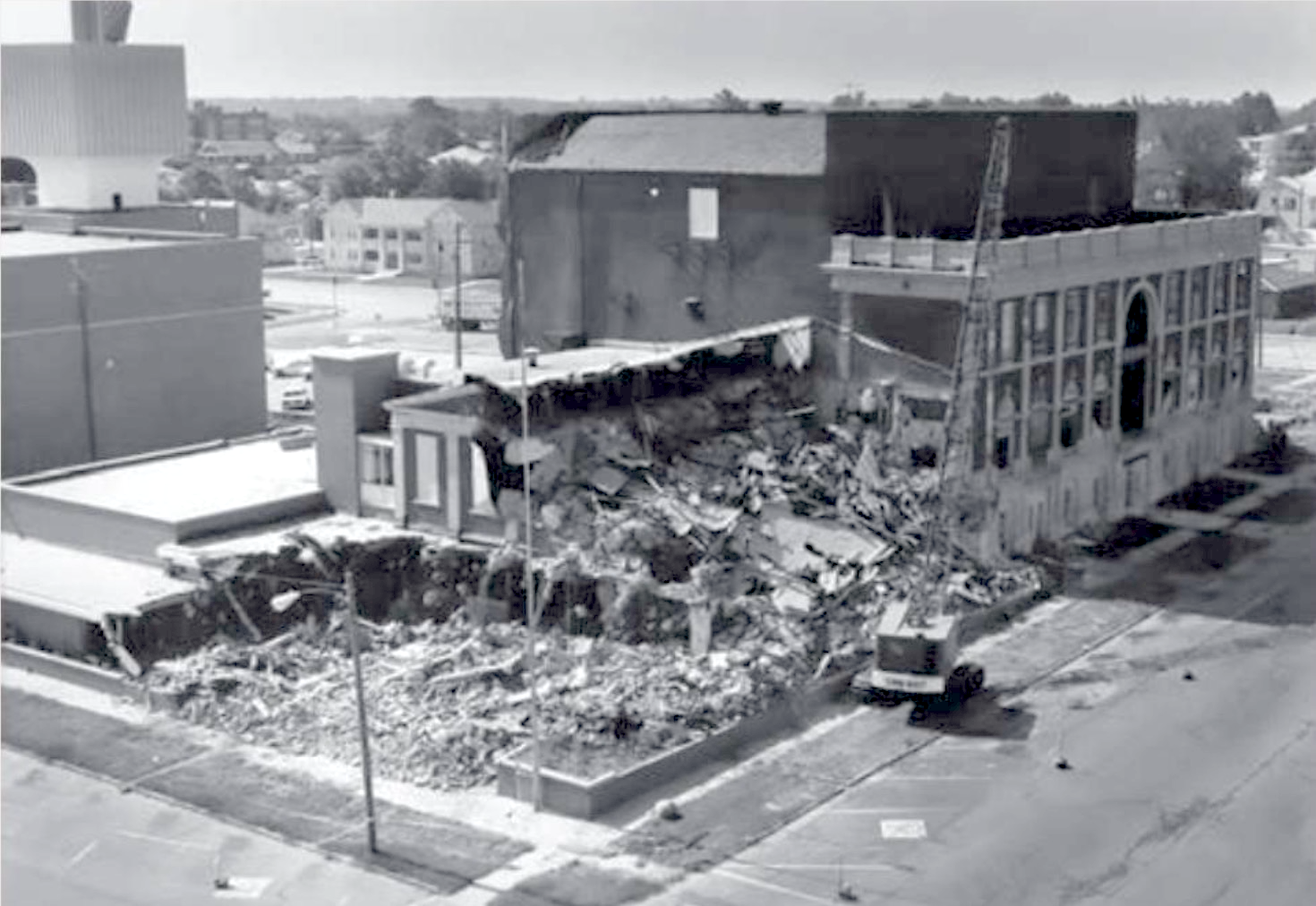
This was a heartbreaking time for some Bartians, but not for me

I was very glad to see the library temporarily move into what appeared to be a former T.G.&Y. and for the Civic Center to come down, because I had no experience with nor nostalgia for that old building, while I was genuinely excited for a new library slated to replace it. If I had grown up in Bartlesville, I would still have supported the project, but the destruction would have been much more impactful.

Sound familiar? 35 years later, I get to watch OKC demolish a facility that hosted major events in my life. I couldn’t care less about sports, so the new arena that will replace the old convention center will do little for me, but it will serve many sports fans who are eagerly awaiting the new venue. The tables have been turned!

The Third Bartlesville Library

Back in Bartlesville 35 years ago, the library campaign raised another $1.5 million in private donations to augment the bond election, and the project broke ground in February 1991 and the new library opened in January 1992. It was the last project of architect Thomas McCrory, who would soon sell his business to Scott Ambler, who had been heavily involved in the design of the new building. In 2017, Joseph Evans, once one of my physics students at Bartlesville High School, who worked on major additions to that campus in 2015, became the President of Ambler Architects. Now he owns the firm, which in 2025 was renamed HorizonLine Architecture and Interiors. How time flies.
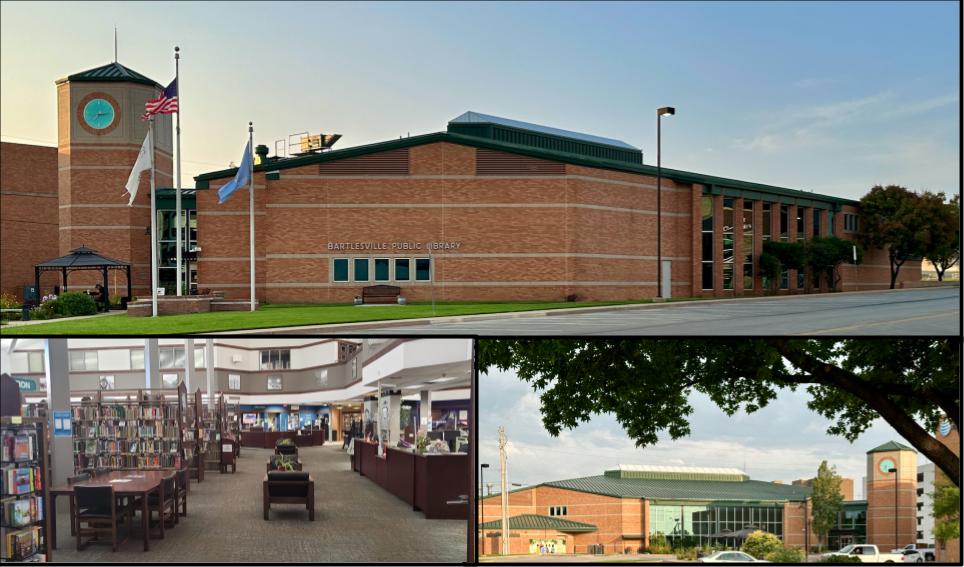
The 1992 library in the mid-2020s

I’ve always appreciated the “new” library, which is still a beautiful and functional space, continuing to adapt to changing times. I am grateful that the nostalgia trap did not prevent its construction.

Avoiding the Trap
[Source]

The nostalgia trap is open and waiting, but it shan’t capture me. I’m impacted, but not upset, that what I knew as the Myriad is going away. I know that it wouldn’t make any sense for the city to preserve it, since a $288 million replacement opened in 2021. The old convention center had plenty of shortcomings throughout its half-century of existence, and the new arena that will replace it was approved by the voters.

Yes, there’s already an indoor arena just to the south, built in 2002 for $89 million. Back in 2008, the city raised over $103 million to improve that facility for the relocated Seattle Supersonics NBA team, which became the Oklahoma City Thunder. (My lack of interest in sports was evident when people starting talking about the team back then: at first I thought they were discussing some sort of weather event.) Now OKC is raising a billion dollars to keep the Thunder playing there for a quarter-century, and I presume the 2002 arena will be redundant once the new one opens in 2029.

Given the significance of the Myriad in my own life, I could decry its destruction. Given the mismatch in interests, I might be tempted to consider a billion-dollar arena a waste of resources. However, I won’t take the bait. I’ll continue to enjoy the public library in Bartlesville, and no doubt many will soon enjoy OKC’s new arena.

The past deserves honor, but not necessarily publicly funded preservation. Oklahoma has always limited its public investments, meaning we must often destroy in order to create. The vote was taken. So be it.
Posted in history, nostalgia | 2 Comments

A Quixotic Baptist

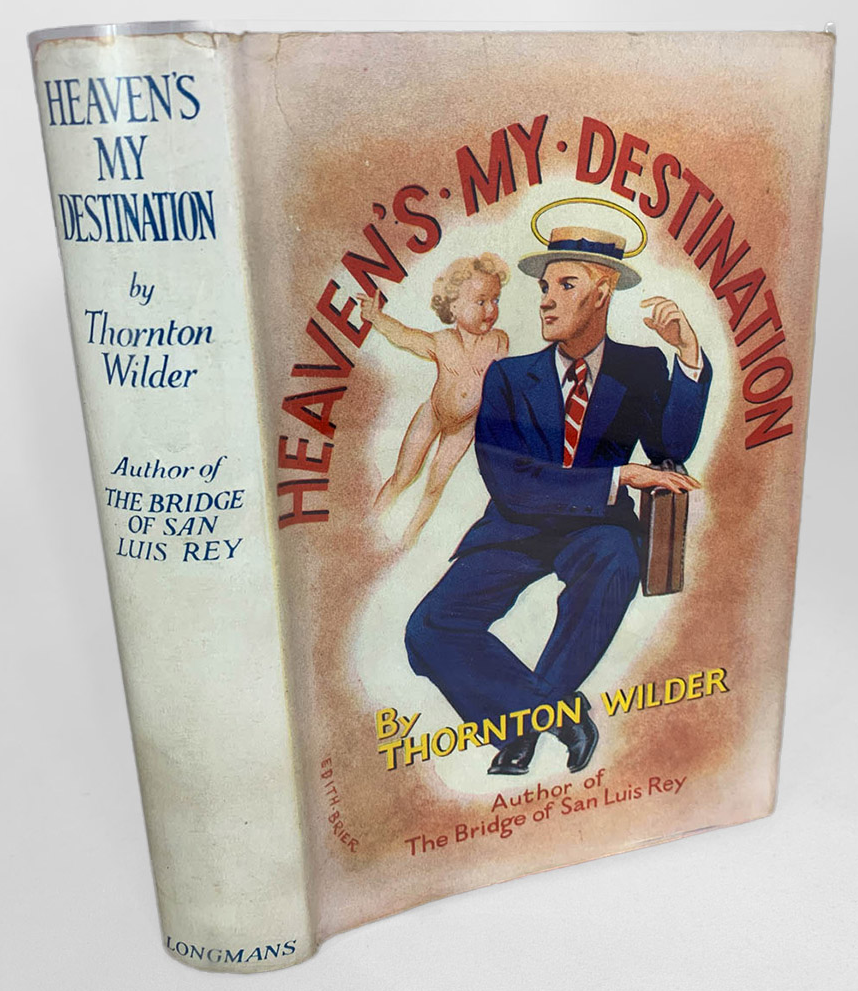
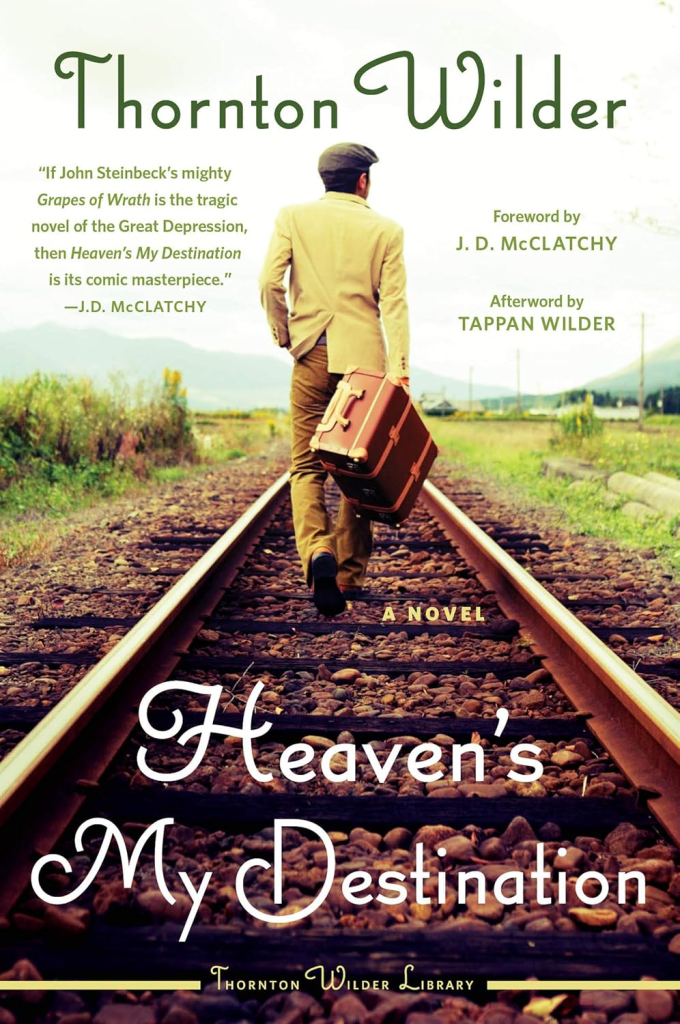
In 1930, Thornton Wilder jotted down, “Ideas for Novels or Novellas — Picaresque: Baptist ‘Don Quixote.’ Selling educational textbooks through Texas, Oklahoma.”

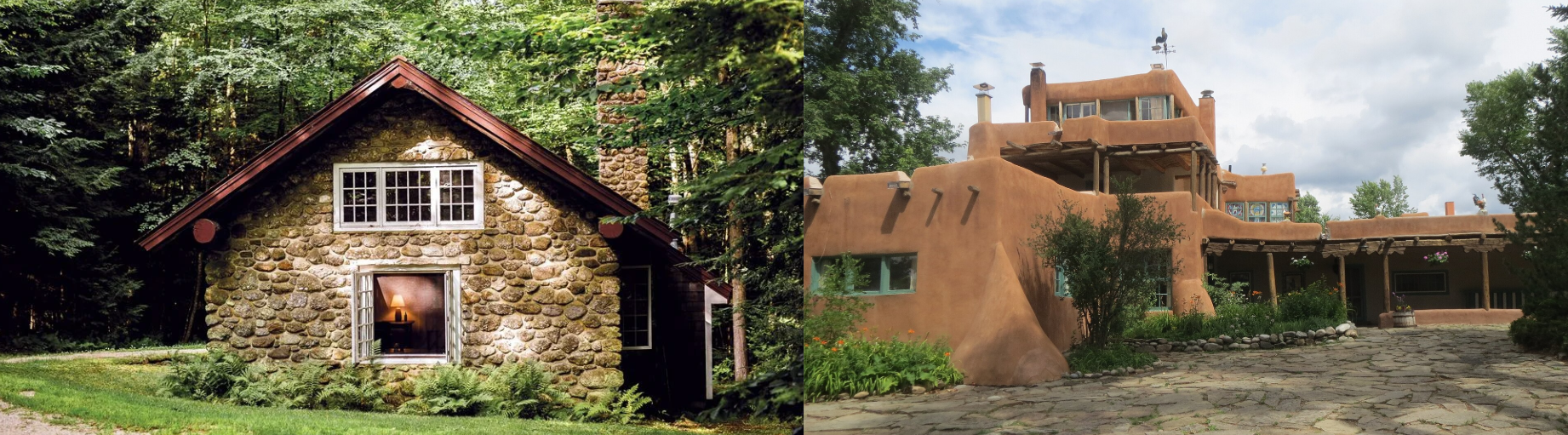
The result was his 1934 comic novel Heaven’s My Destination. He began serious work on it at the MacDowell Colony in New Hampshire, where he also worked on more famous works like Our Town and The Bridge of San Luis Rey. The peripatetic playwright and author continued to work on it in Chicago, Kansas City, and New Haven, finishing it at Mabel Dodge Luhan’s ranch in Taos.

A couple of the artist colonies where Wilder worked on his comic novel amidst the Great Depression

The satirical take on American idealism and faith features George Brush as a fervant young traveling textbook salesman whose sincere but naive attempts to convert others and live by religious dogma lead to a series of humorous, bizarre, and sometimes tragic situations.

The title came from doggerel verse which Wilder claimed that children of the Middle West were accustomed to write in their schoolbooks:

Granger Meador is my name;
 America’s my nation;
Bartlesville’s my dwelling-place
And Heaven’s my destination.

No doubt he was knowingly echoing an identification rhyme from James Joyce’s 1916 A Portrait of the Artist as a Young Man:

Stephen Dedalus is my name,
Ireland is my nation.
Clongowes is my dwellingplace.
And heaven my expectation.

Wilder delivered 113 lectures across the USA and Canada from 1929 to 1934, travelling by trains that brought him face-to-face with Depression-era America, especially in Texas, Oklahoma, and Kansas. Wilder had read Don Quixote, the classic example of a Picaresque novel detailing the humorous adventures of a roguish hero, in three languages, and he had both taught and lectured about it.

Wilder channeled all that into a somewhat autobiographical novel. He shared, “It’s all about my father and my brother and myself, and my years among the missionaries in China, and my two years at Oberlin College, and the Texas and Oklahoma of my lecture tours.”

Wilder thought, “The novel is very funny and very heartrending–a picaresque novel about a young traveling salesman in textbooks, very ‘fundamentalist’ pious, pure and his adventures among the shabby hotels, gas stations and hot dog stands of Eastern Texas, Arkansas, Oklahoma etc. His education, or development from a Dakota ‘Bible-belt’ mind to a modern Großstadt [big city] tolerance in three years; i.e. the very journey the American mind has made in fifty years.”

Bear in mind that the Scopes monkey trial of 1925 had drawn intense national publicity and that and the death of William Jennings Bryan resulted in a decline in the influence of Christian fundamentalists that persisted until the 1970s.

I was drawn to the novel because after reading The Bridge of San Luis Rey and the ponderous The Eighth Day earlier this year, I wanted to try his most humorous work. Plus, about 15 years ago, I tried to read Don Quixote, but I gave up out of boredom about 1/6 of the way in. It was simply too far removed from me chronologically, geographically, and culturally. Perhaps Wilder’s picaresque would better suit, being a 91-year-old quest across America’s heartland, versus Cervantes’ tales of the Iberian Peninsula of over 400 years ago, which formed what is considered the first “modern” novel.

The book’s chapters have the old-fashioned “capitulations” where they begin with brief sentence fragments summarizing the action:

1 George Brush tries to save some souls in Texas and Oklahoma. Doremus Blodgett and Margie McCoy. Thoughts on arriving at the age of twenty-three. Brush draws his savings from the bank. His criminal record: Incarceration No. 2.

Our hero, “an earnest, humorless, moralizing, preachifying, interfering product of bible-belt evangelism,” is on a train to Wellington, Oklahoma. There is, of course, no such place, although there is a Wellington, Kansas and Wellston, OK would become a tiny stop along Oklahoma’s Turner Turnpike. Dragnet comes to mind: Ladies and gentlemen: the story you are about to hear is true. Only the names have been changed to protect the innocent.

George attempts to “save” an amiable man in the smoking car of the train. George inquires, “Brother, can I talk to you about the most important thing in life?”

The man stretches and responds, “If it’s insurance, I got too much. … If it’s oil wells, I don’t touch ’em, and if it’s religion, I’m saved.”

George has been trained to deal with such answers: “That’s fine. There is no greater pleasure than to talk over the big things with a believer.”

“I’m saved,” continued the other, “from making a goddam fool of myself in public places. I’m saved, you little peahen, from putting my head into other people’s business. So shut your damn face and get out of here, or I’ll rip your tongue out of your throat.”

Well, that got us off to a rollicking start. The novel features a few set pieces, and Wilder has fun with the age-old trope of a peddler’s roll in the hay with a farmer’s daughter, exploring the aftermath if the peddler were a religious idealist who had briefly strayed. The Ozark farmer’s daughter characters I recall from my youth included Daisy Mae in the strange comic strip Li’l Abner and Elly May Clampett in The Beverly Hillbillies, while in the 1980s Deep South there was Daisy Duke in The Dukes of Hazzard. I never found them relatable, so I appreciated that Wilder was more thoughtful in his portrayal, introducing a smart sister who could talk sense.

At the end of the novel, George has a crisis of faith, and that spills over into a mental and physical crisis. He confesses to a Methodist minister: “I’ve broken all the Ten Commandments, except two. I never killed anybody and I never made any graven images. Many’s the time I almost killed myself, though, and I’m not joking. I never was tempted by idols, but I guess that would have come along any day. I don’t say these things to you because I’m sorry, but because I don’t like your tone of voice. I’m glad I did these things and I wish I’d done them more. I made the mistake all my life of thinking that you could get better and better until you were perfect.”

However, Brush’s crises are resolved by a comedically trivial gesture from someone he never even met, which inevitably restores his faith and physical well-being, fluffing up the matted wool in his head.

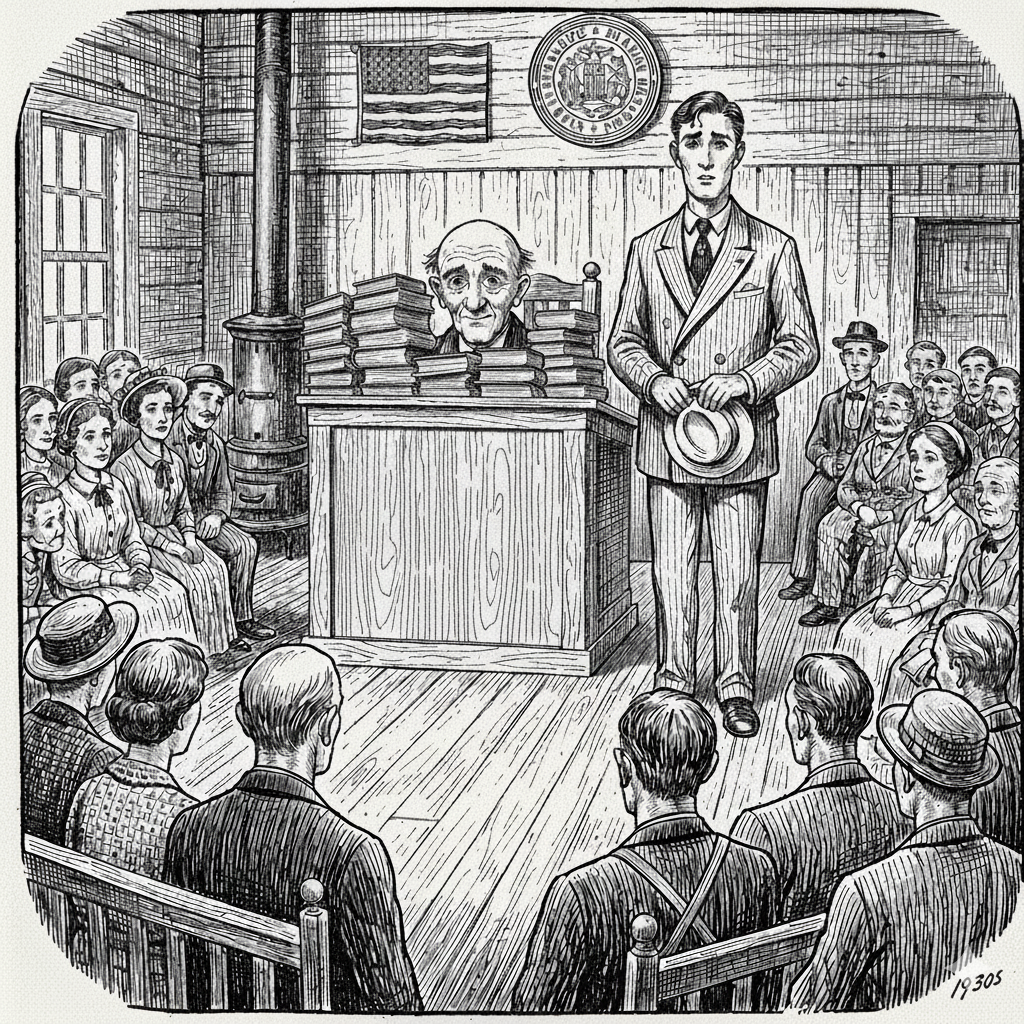
Created with Google Gemini

The best part of the novel, by far, is the courtroom scene with Judge Darwin Carberry. It is brilliantly sketched, with Wilder’s strengths as a dramatist coming to the fore, and yes, I noted the judge’s first name.

I particularly liked the jurist’s interaction with the idealist as he sets him free:

Judge Carberry put his hand on Brush’s shoulder and stopped him. Brush stood still and looked at the ground. The judge spoke with effort:

“Well, boy . . . I’m an old fool, you know . . . in the routine, in the routine. . . . Go slow; go slow. See what I mean? I don’t like to think of you getting into any unnecessary trouble. . . . The human race is pretty stupid, . . . Doesn’t do any good to insult’m. Go gradual. See what I mean?”

“No,” said Brush, looking up quickly, puzzled.

“Most people don’t like ideas.”


The Pedant Pronounces

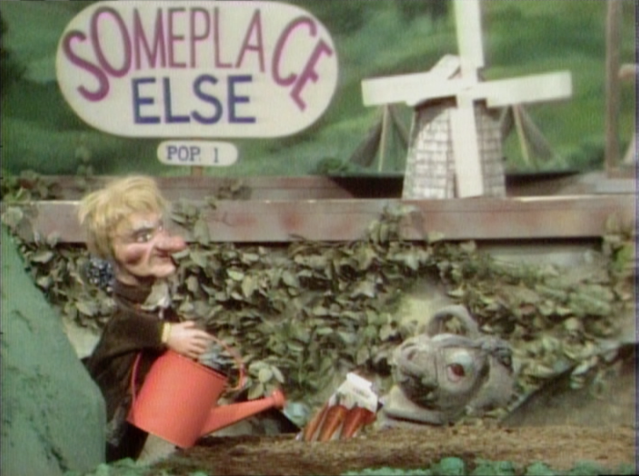
Lady Elaine Fairchilde visits with Donkey Hodie on Mister Rogers’ Neighborhood

I am amused by how mispronunciations of Quixote are formalized by the adjective quixotic. I grew up with Mister Rogers’ Neighborhood, which included Donkey Hodie, an idealist who lived in a windmill. Part of the joke for adults would be that Don Quixote tilted at windmills, believing he was fighting giants, instead of living in them.

I pronounce Quixote as “kee-HO’tee” or sometimes “kee-HO-tay” although I have been told that in old Castillian it would be closer to “kee-SHO-teh” and I regard the English degradation into “quick-sot” as bizarre. Nevertheless, that weirdness afflicts quixotic, which is typically pronounced as “quicks-AW-tick” while logically it would be more like “kee-HO-tick” or “kee-SHO-tick” . . . but trying to convince folks to adopt those pronunciations would be, er, like tilting at windmills.

Posted in books | Leave a comment

The Dutch House

After J.L. Carr’s short and moving novella A Month in the Country, I remained in the mood for something of “quality” to read. Don’t get the wrong impression; I have always enjoyed genre books, being an avid consumer of mysteries and, in my younger days, of science fiction, and too much fine writing can produce intellectual indigestion.

Ugh, Henry

However, I do deliberately seek out LIT-rah-chur when the mood strikes. I couldn’t readily try another book by Carr, as most of his works aren’t available as e-books but as printed works from the tiny press he founded in England. I had ordered a couple of used copies from Abebooks, but those wouldn’t arrive for weeks.

So I consulted my highlighted version of Modern Library’s 100 best novels of the 20th century and noted that Henry James captured three spots with his late-period works of 1902-1904. I couldn’t remember why I hadn’t read him earlier, so I downloaded The Ambassadors from Project Gutenberg.

It only took two long paragraphs in his introduction to convince me to abandon him. Here is the first:

No doubt that appeals to some, but certainly not to me. I shuddered, for the lengthy and complex sentences, with subordinate clauses and digressions which repeatedly interrupted their flow, dredged up from my memory an aborted attempt at The Turn of the Screw. I had made it all of four pages into that simpler work. I lack the patience to decode Henry James.

Funly enough, I found a clip of Ann Patchett, who wrote the book that prompted this post, and The Ambassadors is her favorite of his books. However, she wrly advises one to read his earlier, simpler works and gradually build up to his late “impossible” ones. That is a reading marathon I shan’t run, which wouldn’t surprise Ann.

Another time, perhaps, Saul

Returning to the Modern Library listing, I noticed that Saul Bellow had two entries, and I actually saw him in person at Bartlesville High School in the early 1990s, back when famous authors were lured in by significant honoraria to speak in a Man and His World program. He was irascibly intelligent, and so I downloaded a sample of his bildungsroman, The Adventures of Augie March.

Alas, several pages in, I was bored by the characters and found his style annoying. A pushy immigrant boarder led me to suspect that one of Corrie Ten Boom’s intimidating aged aunts from The Hiding Place had wandered into a Neil Simon play. I have had my fill of that sort of thing, and of most bildungsromans to boot. I might try a different Bellow book…someday.

I considered another E.M. Forster novel, but I felt like something American set in more recent times. I save various samples on my Kindle as I come across possible future reads, and thus I noticed Ann Patchett’s The Dutch House.

Hmm…I had heard of her, the book was set in America, its plot spanned 1957 to early 2000s, and the Kindle About this book noted these accolades:

Ann Patchett

Okay, sure. I started the sample, and nine pages in, before finishing the first chapter, I was ordering the book. I had never read her work, although I remember seeing Bel Canto featured at bookstores at the dawn of this century.

The Greatest Books meta-analysis recently ranked Bel Canto at 924, and The Dutch House was 6,986th. Just for fun, let’s see…The Ambassadors was 243rd and The Adventures of Augie March was 283rd. I grant relative rankings little validity between authors, let alone genres, but I do find them useful in discerning differences within a given author’s work.

The Dutch House

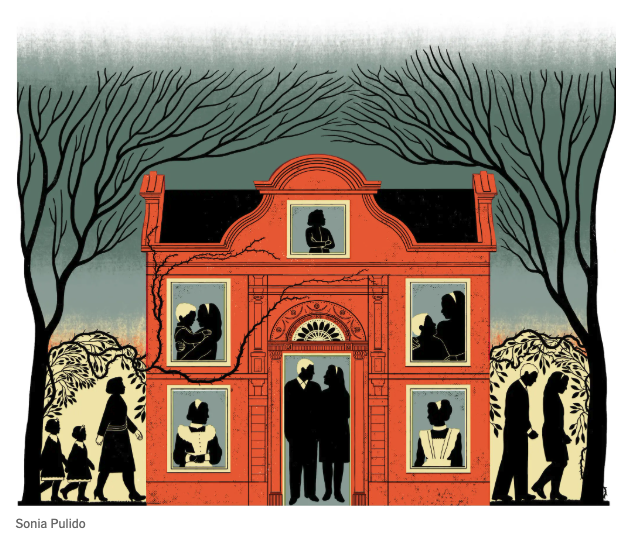
Sonia Pulido’s illustration from the NYT book review

According to The Greatest Books, “The novel tells the story of siblings Maeve and Danny Conroy, who are raised in a grandiose mansion known as the Dutch House in suburban Philadelphia. After their mother abandons the family and their father dies, they are exiled from the house by their stepmother, Andrea. The siblings’ bond deepens as they navigate their lives, haunted by the loss of their home and the impact of their past. The narrative explores themes of memory, forgiveness, and the inescapable nature of family history, as Maeve and Danny grapple with their shared experiences and the legacy of the Dutch House.”

The protagonist being a damaged and detached son and the centralization of the relationship between the siblings reminded me of another novel that I read this year: Ann Napolitano’s Hello Beautiful. That book also centered on a son, unloved by his parents, while its sibling relationships were among four sisters. Both books explored complexities of family dynamics.

I have no siblings or children, so there are distinct gaps in my direct experience with several types of family relationships. I can only drawn upon my indirect and sporadic glimpses of the sibling relationships of my wife and closest friends, among my various aunts, uncles, and cousins, and what I read in books and see in media. When asked what influences their views of what makes a good family arrangement, well over half of U.S. adults said that what they read in books or see on television or in movies don’t matter much.

[Source]

Then again, only about half of U.S. adults even read a book in a given year. Given my lack of direct experience with siblings and offspring, I am among those who do depend somewhat on books and media to better understand such relationships.

Family Stats

In the book, the protagonist’s mother leaves when he is three, and he is fifteen when his father dies in 1963. In 1968, over 85% of children lived with two parents, but that declined to about 70% by the mid-1990s before roughly stabilizing.

[Source]

As for siblings, the baby bust from 1960 to 1975 ended in a plateau that has been slowly eroding since 2007 with a declining fertility rate.

[Source]

The percentage of mothers in the USA with only one child doubled between 1976 and 2021, rising to 22%, while in the European Union half of families with children have only one child. A meta-analysis of 115 studies found no significant differences in academic achievement, social skills, or personality traits between only children and those with siblings, although only children do tend to be more independent and creative and have better relationships with their parents. While I don’t seek them out, I do find it interesting to read books about siblings, and I am struck by how many of my acquaintances have experienced both short-term and long-term sibling estrangements.

The Book

Patchett’s prose flowed smoothly, being graceful but seldom arresting. I was interested in how the protagonist was very detached and often oblivious, with his lack of curiosity hampering our own ability to understand his family members and their motivations. However, he did have moments of insight, and while I didn’t believe in his success at and abandonment of his medical school training, I did appreciate his relationship with his wife. Her transference of blame for his faults to his sister rang true, as did the eventual fate of their relationship and him repeating some of his father’s errors.

The house was a character in the story, and its lack of change over the decades was not credible, but rather reflected the novel’s connections with fairy tales. I felt that the ending of the novel involving the protagonist’s daughter was contrived — Patchett understandably resisted echoing Poe’s The Fall of the House of Usher, but her opposing solution wasn’t to my liking.

This novel stayed true to what Patchett said back in 2016: “I’ve been writing the same book my whole life — that you’re in one family, and all of a sudden, you’re in another family and it’s not your choice and you can’t get out.”

The cover of the book is terrific. Patchett is based in Nashville, where she runs her own bookstore, Parnassus Books. She turned to Nashville-based artist Noah Saterstrom to create a real version of a fictional painting featured in the novel. After his move to Tennessee in 2016, Patchett had mounted a show of his author portraits in her bookstore.

They flipped the portrait painting for the book cover

Patchett stipulated a few key details for the portrait: black hair, red coat, extravagant background wallpaper, with “her eyes bright and direct” as her brother narrates in the novel. Unlike Norman Rockwell, the famed illustrator who relied on live models, Saterstrom tends to source his portraits from old archival or family photographs, preferring that remove to avoid including his own engagement with the sitter in his work. However, I noticed the unusual pose of the girl’s empty hands, and those were in fact modeled on the hands of the artist’s six-year-old daughter.

I enjoyed my first outing with Patchett, although it did not move me like Napolitano’s Dear Edward and Hello Beautiful. I certainly hope to read more of Patchett’s work. While I’m not interested in Bel Canto, her best known work, as it centers on terrorists and their hostages and I find that repulsive, I am intrigued by Commonwealth, Tom Lake, and her early work The Magician’s Assistant.

Posted in books | Leave a comment

Western Village in Millennial Gray

Real estate websites have a secondary function as time machines since when properties are marketed for resale we may catch glimpses into houses we left long ago. The home my parents built in 1962 was “flipped” in 2022. I lived there from 1966-1972, with us moving once I completed kindergarten. Seeing it transformed by millennial gray prompted me to revisit the few ghostly fragments that escaped infantile amnesia.

The Village

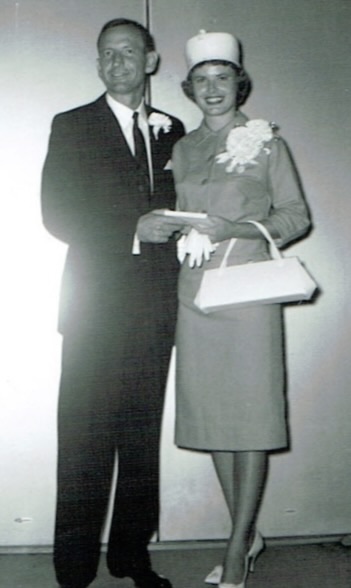
My Greatest Generation father and Silent Generation mother were newlyweds when they built the house in 1962, four years before I came along as an early member of Generation X. My father had previously been living in a home he had purchased for his first family in 1957 in The Village, then a north central suburb of Oklahoma City. Dad worked for Cities Service Gas, which had both its executive and operational offices in Bartlesville until 1943 as part of the sprawling Cities Service empire. During World War II, the natural gas company’s executive offices were shifted to Oklahoma City and its operational ones to Wichita, while the oil company remained in Bartlesville until the late 1960s.

In 1957 the operational offices in Wichita, where my father was a gas measurement engineer, were consolidated with the executive ones in Oklahoma City. So Dad moved his first family to The Village, a suburb that had originated in 1949 when developer Clarence E. Duffner, Sr. purchased 40 acres of land near the old railroad town of Britton, itself located seven miles north of Oklahoma City’s core.

Over the years, OKC would grow to encapsulate multiple towns, including The Village, Nichols Hills, Warr Acres, Bethany, Woodlawn Park, Mustang, Spencer, Forest Park, and Lake Aluma while annexing Britton, Belle Isle, Forest Park, Deer Creek, and many square miles of unincorporated land.

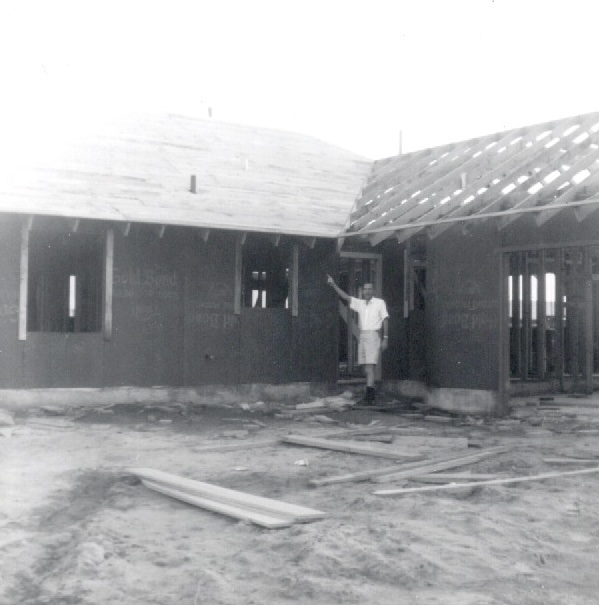
My parents built the house as newlyweds

Oklahoma City annexed Britton in 1950, prompting Duffner and fellow developers Floyd and Joe Bob Harrison and Sylvanus Felix to incorporate The Village to avoid a similar fate for their additions. There were only seven residents at the time, with six voting in favor and none against!

The community started with 160 acres but annexed additional housing developments to grow to encompass 2.5 square miles which are bordered by Oklahoma City on all sides except for rich Nichols Hills to the south.

My father’s first marriage ended in divorce in 1960. Dad spotted my mother at a Cities Service Gas Company Christmas party that year, their first date was in March 1961, and they were married five months later. Mom had come to OKC in late 1957 and had lived in a couple of apartments with other girls. She was 11 years younger than my father, so I am much younger than most of my paternal cousins.

Western Village Addition

Dad put the house in The Village up for sale by owner, and he and his new bride lived in a nearby rental home while a new house was constructed for them in the Western Village addition of Oklahoma City. You might be surprised that “Western Village” is situated on the east side of The Village, but the name came from it being bordered by Western Avenue on the east and The Village on the west.

In January 1962, Ferguson Investment Company began constructing over 500 new homes in that quarter-mile section.

May 1962 advertisement for Ferguson’s Western Village

My parents’ home was the first to be constructed on its block, with them visiting the site when it was nothing but a dirt field with completed homes lined up along a street to the south. They made almost daily checks as the house went up: a three-bedroom wood frame home with red used-brick veneer and white trim, a wood-burning fireplace, and a patio in the back.

The homes were marketed as featuring heavy “floating” concrete slab floors with windbraced wood framing anchored every four feet with steel bolts. The roof trusses were marketed as “tornado-resisting” and the homes were said to be “100% insulated — floors, walls, and ceilings.”

Another advertisement for the new housing addition

The exterior of the home changed very little over its first 60 years, with the 2022 flip repainting its trim in a dark bluish-gray that toned down the fake shutters but made the white garage doors even more prominent; thank goodness they are perpendicular to the street.

The 1962 marketing for the homes reflected the gender norms of the era: “The cheerful kitchens, a trade-mark of Ferguson homes, truly are a woman’s dream — built-in wall-oven and tabletop range, disposal unit and exhaust-hood. Beautiful mill-built cabinets, with counter space provided next to range and refrigerator.”

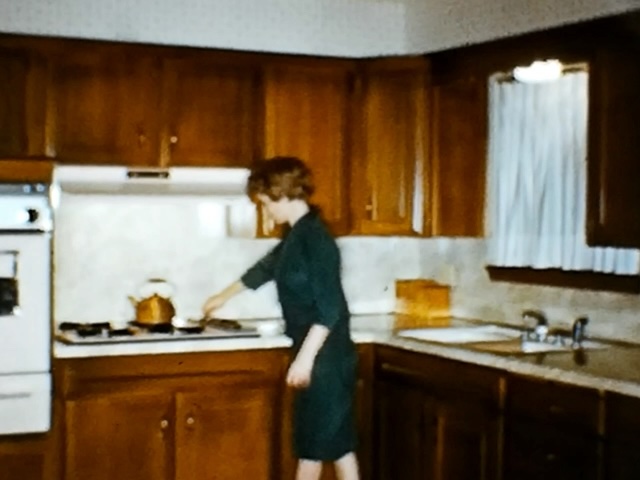
My mother in her new kitchen

My parents reported only having one minor issue with the builder, and that involved the kitchen built-ins. They were indeed made in a cabinet shop and were delivered to the home site to be stored in the garage until installation. My mother had specified the corner built-in was to have standard shelving rather than a Lazy Susan option that was being offered. They were delivered with a Lazy Susan already installed. She advised the builder of the error, and they had quite a contest of wills before my mother made her point and regular shelving was put in the place of the Lazy Susan.

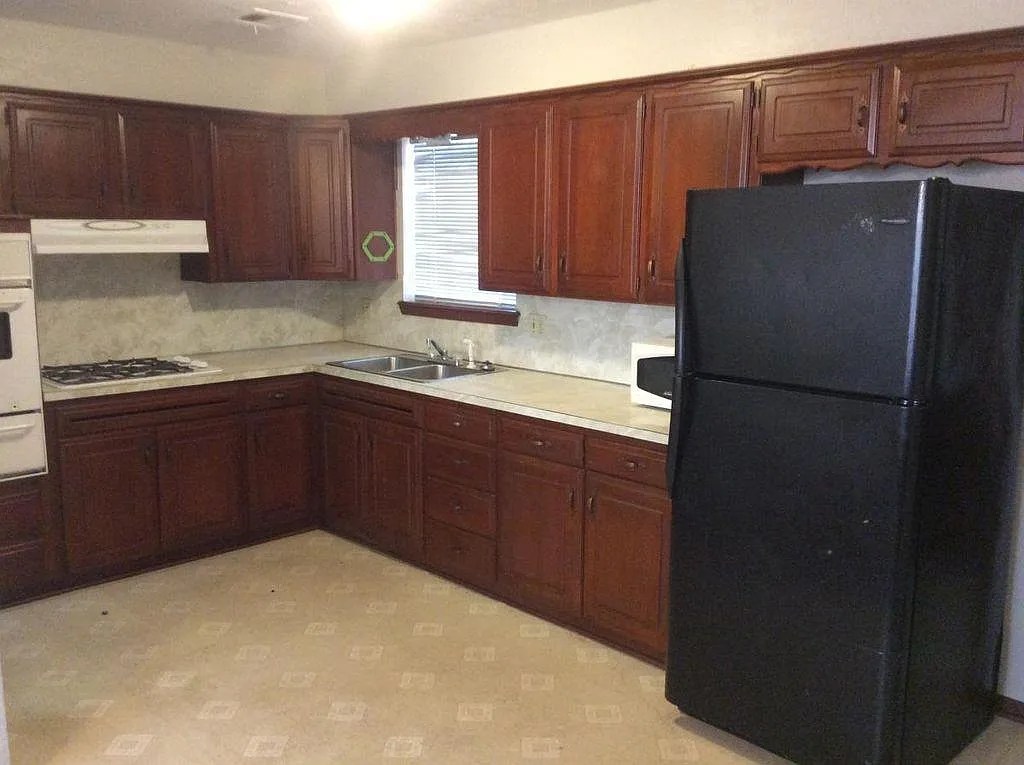
The color image of my mother in the kitchen is from a silent 8mm film my father shot in their new home around Christmas in 1962, and the other shot of me in my high chair is from 1968. That kitchen changed very little for decades after we moved away. Below is its appearance sometime before 2022. The appliances, sink and cabinet hardware had been updated, but the cabinets were still varnished instead of painted and it still had its formica countertops and backsplash and a vinyl floor.

Before the 2022 flip

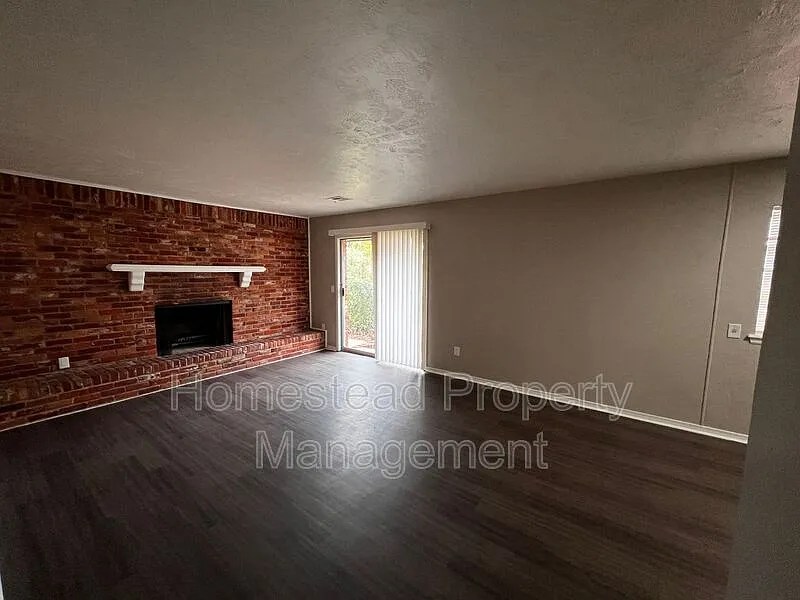
Flippers like to paint wood cabinets and replace any wall-to-wall carpet or vinyl flooring with engineered wood floors. A variety of materials may be used to replace formica countertops and backsplashes.

As for colors, my memories of the late 1960s are fragmentary, but I know the appliances were light pink. Later, while growing up in the 1970s, I was surrounded by lots of earth tones — harvest gold, oranges, and terracottas — coupled with plenty of wood paneling and avocado green appliances. Those would all appear in my parents’ next home to the southwest in the town of Bethany. Eventually beige would sweep through homes as a more neutral color, and by the early 2010s grays began to dominate. The aesthetic adopted by the flippers was the later stereotype.

I never lived in a golden house

I don’t like wood wall paneling, but I do like wood tones in cabinetry and wainscoting, so we have left those intact in our 1981 home in Bartlesville. I am grateful that our home’s contractor cabinetry was stained dark and not the honey gold that became popular later that decade and endured into the 1990s. I do have to break out the Old English scratch remover, however, to touch up our dark woodwork.

The flippers extended the engineered flooring through the entire Western Village house. They also painted the mantle, but thankfully resisted painting the back brick wall.

The eleven homes and apartments where I have resided had mostly wall-to-wall padded carpet, allowing me to walk around in comfort in socks or barefoot without fear of tripping. I developed an aversion to bare hard floors at the house we moved to after leaving Western Village. It had a den paved in red quarry tile, the same kind later used in QuikTrips. A large rug softened the area around the sofas, but there was a big cold zone I had to traverse to reach the long green shag carpet of the living room and bedrooms.

Yes, I used one of these in the early 1970s; it was a dark time

Shag was an example of carpeting at its worst, with one of my household chores being to rake it. My parents invested in a massive self-propelled Kirby vacuum cleaner, and I remember the constant pings when my mother swept the living room shag. The previous homeowners had kept a caged bird in there, and I figure she swept up many pounds of birdseed. My father finally reacted by replacing the shag with commercial short-loop pile carpet that Cities Service surplussed from its downtown offices.

In 2018, Wendy and I replaced the 37-year-old saxony carpet in our home in Bartlesville. We still wanted wall-to-wall carpet, and we had Sooner Carpet install a frieze carpet that looks and feels great, doesn’t track like saxony, and thank goodness doesn’t require raking. However, I understand the appeal of having robot vacuums sweep hard floors and rugs and that owners of indoor pets want ways to address stains, smells, and allergens. I’m also sure that the popularity of open-plan spaces also contributed to the return of rugs, which can create functional zoning.

Back at Western Village, the bathrooms were also refinished. Gray again dominated, covering the walls and woodwork, with another gray mix countertop. I suppose they expected millennials to love its neutrality, versatility, and practicality. However, it all seems so bland to me. I also read that millennial gray is “oversaturated” in the cultural sense and losing favor, and “beige ‘n sage is the new greige.” Well…er…time marches on.

The Western Village development at the end of the Baby Boom continued into the early years of the Baby Bust, with the last lots filled by 1970. Pied Piper Park was just to the south and in 1963 Western Village Elementary School was built on the western side, just inside the borders of The Village.

So I lived just an 8-minute walk from the park and a 12-minute walk to the school. I do recall the walk to and from kindergarten, as I had a hernia that made the trek painful when I was in a hurry. Getting that fixed when I was five years old was my only significant surgery. Below is a clip from early 1971, months before I would start walking to kindergarten.

One clear memory of kindergarten was the day I was selected to be the “wake up fairy” for our naptime. I was given a yardstick and was supposed to gently tap each student to signal them to get up and go to recess. One of my friends had made me angry earlier, so when I came to him I stabbed the yardstick down hard on his back. That indiscretion led Mrs. Brewer to revoke my privileges to play with the wooden stove in the little kitchen area, one of my favorite things in the classroom, for what seemed like an eternity. Lesson learned!

1970s busing protest in OKC

In 1972, the court-ordered and rather complicated Finger Plan of forced busing began to desegregate the Oklahoma City school system. Oklahoma City’s long history of racism and redlining meant that many schoolchildren across the sprawling city would be bused across town to address de facto segregation that had endured for almost two decades after Brown v. Board of Education.

To avoid a plan that by fifth grade would bus me to a school many miles away, my parents joined the consequent “white flight” and sold their home of ten years. We moved to the Nazarene suburb of Bethany in far west OKC where I would be in the Putnam City school district. Oklahoma City had 71,000 students in its school district in 1971, and within a decade over 30,000 white students had left. White flight and the Baby Bust meant that the district dropped to about 35,000 students. Forced busing ended in the elementary schools in 1985, by which time the district had about 20,000 white students and 15,000 black students. The U.S. Supreme Court lifted the desegregation order in 1991. By 2011, the OKC school district had rebuilt to 43,000 students, with over half of them being Hispanic.

Western Village Elementary struggled with declining enrollment and poor outcomes. It was facing closure in 1998 when INTEGRIS Health started an after-school program there, and it officially transformed the facility into Oklahoma’s first public elementary charter school in 2000. It was renamed Stanley Hupfeld Academy at Western Village in 2010.

That concludes my look back at my first home. I already did a series of three posts on the Windsor Hills neighborhood where I lived during junior high and high school:

One of these days the house in Bethany, where I lived while attending the first through sixth grades, will be resold. If I’m lucky, photos of it will make it into a real estate time machine, allowing me to revisit that home as well, which had a more complex history and layout than the contractor home my parents purchased in Western Village.

I don’t really miss my first neighborhood, as my memories are so fragmentary. However, earlier this year Wendy and I stopped in Oklahoma City on our way to Santa Fe, NM. We had lunch at Johnnie’s Charcoal Broiler on Britton Road, and I deliberately exited the Broadway Extension to drive west on Britton Road through the old downtown, half a mile south of Western Village. The sense of déjà vu was rather eerie, even after over a half-century.

Posted in history, nostalgia | Leave a comment

Okie Stereotypes

A memorable encounter with Okie stereotyping came in 1984, right after I graduated from high school. One boy and one girl had been selected from each state for an academic recognition in Washington, DC. I was flown out, on my first-ever ride in an airplane, and checked into a dormitory at Georgetown. The dorm’s reception hall was filling up, like a weird variant of Noah’s ark, with the guy and the gal from each state. I was greeted and instructed to state my first name and my state.

“Howdy! I’m Granger from Oklahoma.” I could hear my accent from the first syllable, and I flushed at the smirks and sideways looks that appeared around the room. While my accent is not what you’ll hear down in Little Dixie, I remained acutely aware of my South Midland accent all that week. It would have been cuter if I’d been wearing a cowboy hat and boots with my jeans, but I didn’t own such items.

Various exchanges at our first mixer:

How often do you get dust storms? The Dust Bowl was mostly out west in the panhandle area, and farming practices have improved since the 1930s, so we see few dust storms.

How many tornadoes have you been in? Well, we have tornado watches and warnings a few times each year, but I’ve never seen a twister myself. [I wouldn’t see one until a few years later as an undergraduate in Norman.]

Do you live in one of those, uh…sod houses? No, our home is like the third little pig’s, with a brick exterior.

Do you have an outhouse? No, we have indoor plumbing…and central heat-and-air to boot.

Do you have trouble with Indian raids? Are you kidding? No, we don’t circle the wagons and fend off Indian attacks.

So you get along okay with the Indians? Well, I’m dating a half-blood Cherokee, if that tells you anything.

And so on…from some of the best-educated kids across the nation. Mind you, I was pretty ignorant as well. My roommate was from Connecticut, and one night he suggested we go out and get some “Häagen-Dazs”. I had no idea what that was, but it sounded similar to Heineken, and we were years away from being of legal drinking age. So I asked, “Is that legal?”

Hopefully over the past 40 years the internet has improved things somewhat, but I noted some Oklahoma stereotypes that Heather Koontz once identified and decided to explore them both statistically and personally.

Everyone drives a truck and wears boots

Welp, less than 20% of Okie vehicles are trucks, and trucks are more popular in 22 of the 50 states. While I have ridden in and driven pick-ups, I have never owned one. My parents drove sedans, station wagons, and Volkswagen campers, while I’ve only owned sedans and coupes, and my wife owns a minivan which we use for our driving vacations.

[Data source]

However, cowboy boots are indeed the most popular footwear in Oklahoma, a status only shared with Alabama, Arkansas, Mississippi, and Tennessee. (The most popular footwear in Texas is, funnily enough, open-toed slip-on slides. Shameful.) I had a pair of boots when I was eleven, and I bought one pair as an adult which I wear on rare occasions, but I like sneakers.

Everyone lives on a farm

Farms are now often large corporate entities, so even in South Dakota, which has the greatest proportion of farmers among its population, they peak at 5.6%. You have to travel down through North Dakota, Iowa, Nebraska, Montana, Wyoming, and Kansas before you’ll encounter Oklahoma at 8th place with 3.1% of its people being farmers. However, my first name does come from farming, and my mother grew up on an Oklahoma farm until age 13.

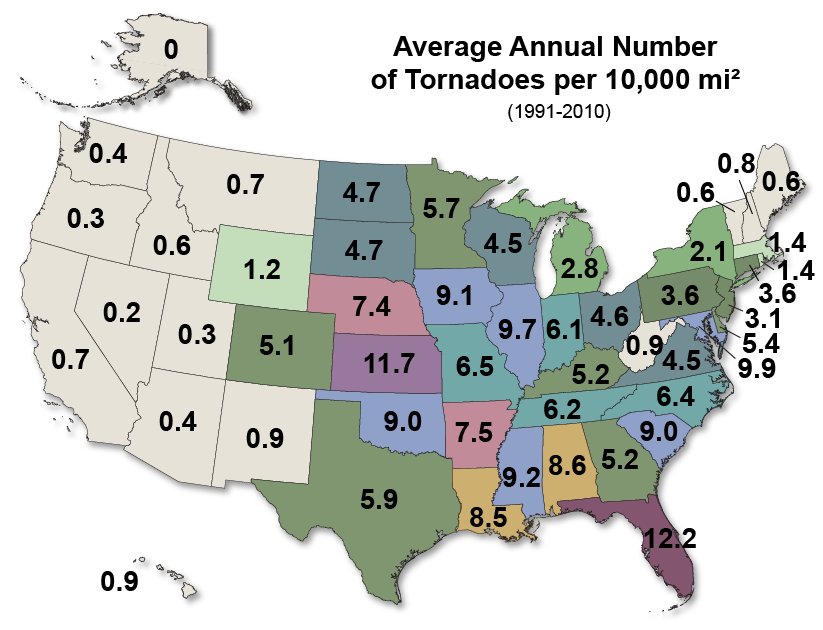
Tornadoes happen every day

Oklahoma is in tornado alley where warm, moist air from the Gulf of Mexico meets cool, dry air from the northern plains.

[Source]

However, the region of higher tornadic frequency has been shifting eastward.

[Source]

From 1991 to 2010, Oklahoma was tied for 7th place in the number of tornadoes per square mile.

[Source]

I’ve heard a few twisters while taking shelter, and we had some tornado damage in Bartlesville in 2024, but I’ve only seen one, from a mile or two away, back in the late 1980s in Norman. Oklahoma averaged 59 tornadoes per year from 1950 to 2024.

It’s just red dirt

Steinbeck’s The Grapes of Wrath about the Dust Bowl has long influenced popular perceptions of the Sooner State. However, the Dust Bowl primarily affected the remote panhandle region, not the cross timbers of central Oklahoma where I grew up, let alone Green Country in northeastern Oklahoma where I have lived my adult life.

The Dust Bowl areas in the Great Depression
Where you’ll find red Port Silt Loam soil [Source]

The western half of Oklahoma is indeed mostly prairie grass, and “red dirt” music gets its name from the Port Silt Loam soil found in 33 of the state’s 77 counties.

However, the east central area is dominated by the Cross Timbers mix of prairie, savanna, and woodland of post oak and blackjack oaks. I live at the boundary between the Cross Timbers and the bluestem prairie mosaic, with oak-hickory forests to the southeast, while the southeast corner of Oklahoma has oak-hickory-pine forests spread across the Kiamichi and Ouachita Mountains.

[Source]

Oklahoma also has over 200 man-made lakes, while there are 62 natural oxbow lakes that are 10 acres or more in surface area. Oxbows are old U-shaped bends of rivers cut off from the main channel.

Football is life

Football is indeed a major cultural phenomenon in Oklahoma, although the professional basketball team in Oklahoma City is the state’s only major league sports franchise. The rivalry between the University of Oklahoma and Oklahoma State University football teams is intense. I earned my undergraduate degree from OU and did hours of graduate work at OSU, so I don’t favor either one, especially since sports in general don’t interest me.

It’s full of cowboys & Indians

Oklahoma certainly features cowboys. Between 1866 and 1890, a number of cattle trails crossed what later became Oklahoma, transporting livestock to railheads.

[Source]
Local cattle ranchers include John & Alicia Kane

At the beginning of this century, over five million cattle were still to be found on farms, feedlots, and ranches of Oklahoma, which in 2022 was ranked fifth among the beef-producing states. There are indeed some cattle ranches around Bartlesville.

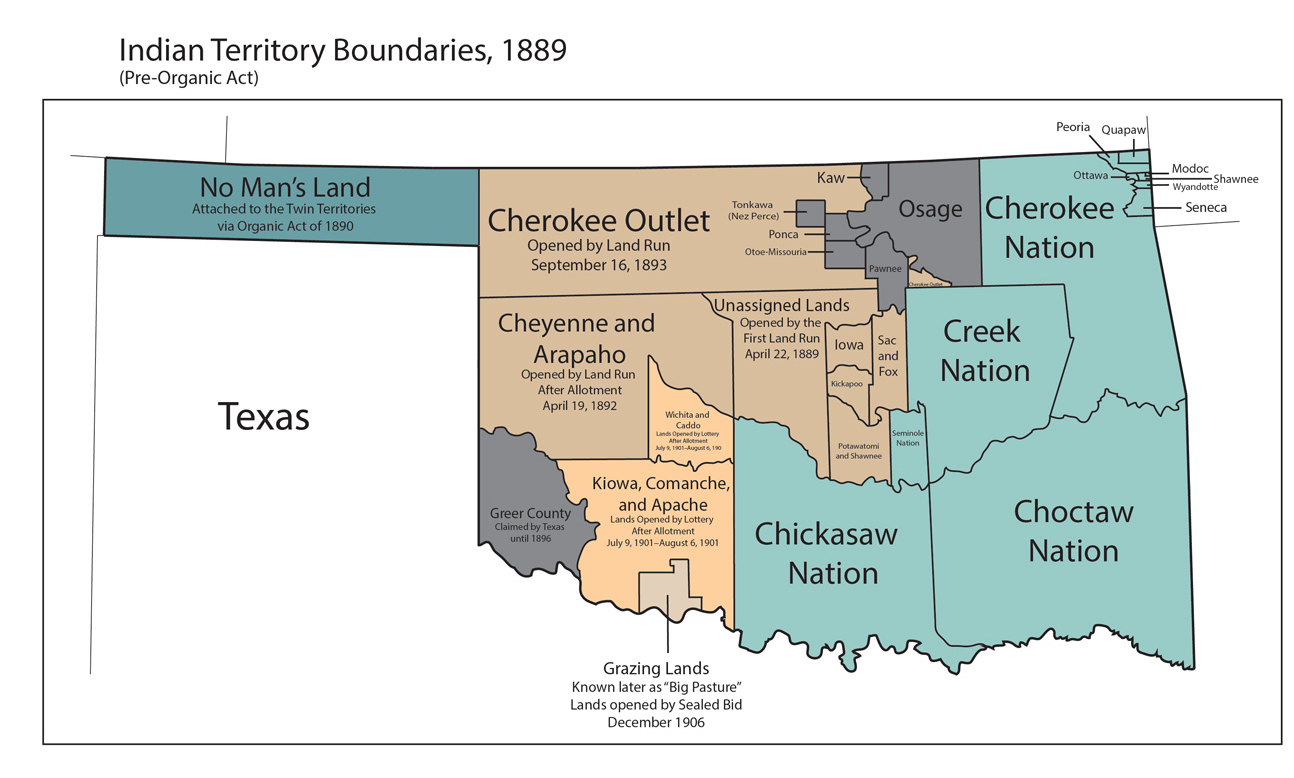
Oklahoma is also very much a state of First Peoples, being once divided into the Oklahoma and Indian Territories. Many of its 39 tribes were forcibly removed to this region between 1830 and 1862, with more pressured onto reservations here between 1867 and 1892.

[Source]

In 2023, Oklahoma had 555,598 First People forming 13.5% of its population, mostly in the eastern half of the state which was once Indian Territory. The only state with a higher percentage of First Peoples was Alaska. While only 1.2% of the total U.S. population lives in Oklahoma, it is home to 7.6% of the nation’s First Peoples.

Oklahoma had strong ties to western movies featuring Tom Mix, Gene Autry, Will Rogers, Dale Robertson, et al. as well as institutions such as the 110,000-acre 101 Ranch and characters like Pawnee Bill. The Rodgers & Hammerstein musical Oklahoma! also established a popular image of farmers and cowmen.

The “cowboy and Indian” stereotype dates back to later half of the 19th century, with the “Wild West” only lasting from 1865-1895, ending over a decade before Oklahoma’s 1907 statehood. The classic cowboy era began to decline in the winter of 1886-1887 when thousands of cattle died during an extreme cold spell. The open ranges being fenced off with barbed wire, plus extensions of the railroads, eventually made cattle drives obsolete. Cowboys transitioned from being nomadic drovers to working for private ranch owners.

The American Indian Wars concluded a century ago, and the 1924 Indian Citizenship Act finally granted citizenship to all First Peoples. Today the most prominent tribes in Oklahoma are the “five civilized tribes” of the Cherokee, Choctaw, Chickasaw, Muscogee (Creek), and Seminole. Bartlesville is in the Cherokee Nation, just east of the Osage Nation, and the town is home to one of the three federally recognized tribes of Lenape or Delaware Indians, with the others based in Anadarko, Oklahoma and Shawano County in Wisconsin.

On the personal front, I have little to no Native American ancestry, with my DNA categorized as 60% British, 16% French & German, and 15% general northwestern European. I’ve never ridden a horse, so my cowboy hat, boots, and duster are just costume wear.

Tipis are everywhere

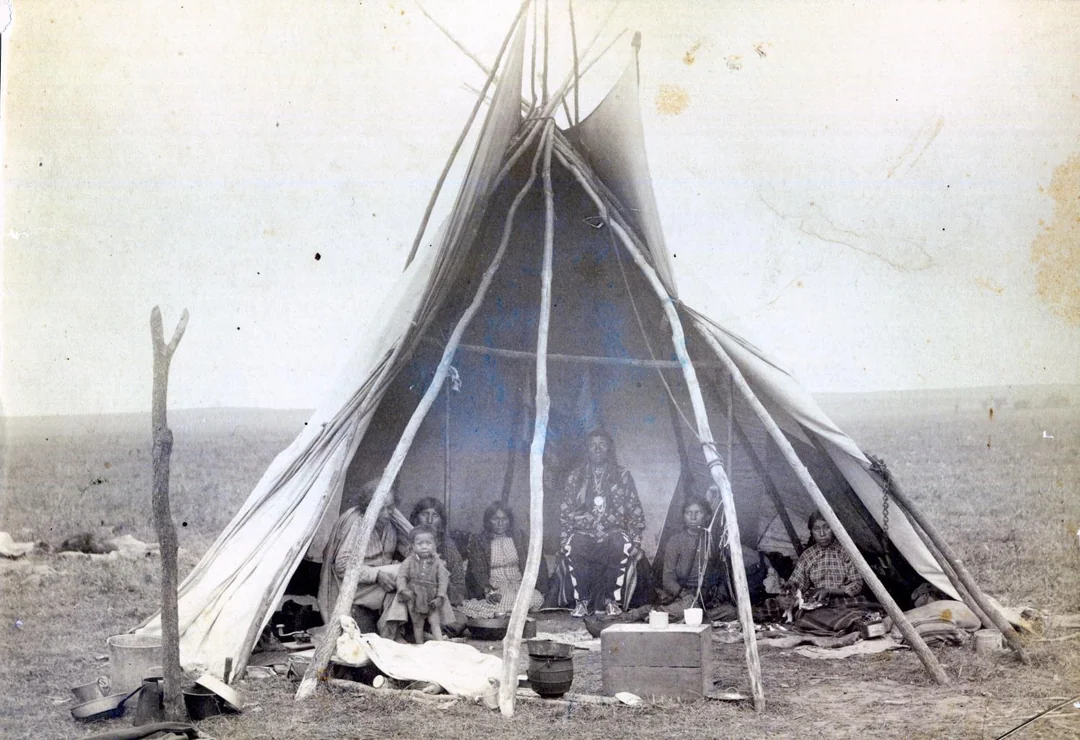
Pawnee tipi in Oklahoma territory in 1889

Several Plains tribes used tipis, with the Osage using them during hunts but also using longhouses made of wood and animal hides for their permanent villages.

The Oklahoma Historical Society does have a Lakota tipi made from buffalo hide around 1852 and a 1916 Kiowa tipi that was featured in the 1920 film The Daughter of Dawn which was filmed in Oklahoma’s Wichita Mountains. When I was a kid, a large tipi was displayed on an upper floor of the old historical society building at the capitol complex.

However, I’ve only seen a few tipis in tourist or historical contexts. Oklahoma tribes employed diverse styles of traditional housing in the historic and early reservation periods.

It is covered in oil wells

These days, Texas, New Mexico, North Dakota, Colorado, and Alaska produce more oil than Oklahoma.

[Source]
Oklahoma was among the top five oil-producing states throughout the 20th century
[Source]

However, Oklahoma was the largest producer at statehood in 1907 and remained in the top three with the much larger California and Texas until the end of World War II, and then remained in the top five for the rest of the 20th century.

Tulsa was billed as “the Oil Capital of the World” until the late 1960s and 1970s when Houston assumed prominence, and the Oklahoma petroleum industry led to some beautiful art deco buildings, Ponca City’s Marland Mansion, Woolaroc near Bartlesville, and much more.

The state’s long history of petroleum production has left most of it dotted with over 450,000 oil and gas wells, with about 30,000 being active in the 2020s. Unfortunately, the state has over 260,000 unplugged wells. Bartlesville still has some stripper wells, and it was the location of the state’s first commercial oil well and was once the headquarters for both Phillips Petroleum and Cities Service.

Oil and gas wells across Oklahoma [Source]

My father was a petroleum engineer for Cities Service Gas Company, and my mother did some office work at Cities Service and Oklahoma Natural Gas before her career at a savings and loan. I was drawn to Bartlesville by the opportunity to teach high school physics all day, something that was possible for a few decades thanks to the socioeconomic impact of Phillips Petroleum and its successors.

It’s all conservative evangelicals

Change “all” to “mostly” and it works. 70% of Oklahomans are Christians, and 2/3 of its Christians are Evangelical Protestants; only Arkansas has a greater percentage of evangelicals. Oklahoma is a top-10 state in overall religiousness, religious attendance, and prayer frequency, positioned at the northwestern end of the Bible Belt.

In 2022, 51% of Oklahomans described themselves as politically conservative, with only 26% claiming to be moderates and 23% as liberals. Oklahoma was solidly Democratic back in the Jim Crow era, shifting in the late 20th century to be completely dominated by Republicans. Donald Trump won every county in 2016, 2020, and 2024, and Republicans hold veto-proof supermajorities in both chambers of Oklahoma’s legislature.

Google Gemini crafted this image from various Oklahoma stereotypes

The dominance of religious conservatives was long evident in Oklahoma’s vice laws, although that has changed significantly over my lifetime:

Alcohol: The state officially prohibited liquor from 1907 to 1959, with predictable inconsistent enforcement. Beer with only 3.2% alcohol was allowed after national prohibition ended in 1933, but Oklahoma didn’t allow sale of individual alcoholic beverages for on-premise consumption, “liquor by the drink”, until 1984, and grocery stores were not allowed to sell wine and beer until 2018. For decades, liquor stores weren’t allowed refrigeration nor Sunday sales.

Drugs: In 2018, voters, not the ultra-conservative legislature, approved a state question legalizing marijuana for medical use. A 2023 study estimated that almost half of Oklahomans use cannabis.

Gambling: This was largely prohibited until 1988, when tribes were allowed to operate certain types of gaming on sovereign land. In 2004, voters authorized tribal gambling, including slot machines and table games, and now there are over 100 tribal casinos dotting the state. A statewide lottery began in 2005, and sports betting was legalized in 2020.

Sex: The state once banned oral and anal sex along with interracial marriage and cohabitation, and homosexual acts were illegal until the 2003 U.S. Supreme Court decision in Lawrence v. Texas. Sex education is still rare, and abortion is a felony with almost no exceptions, so it is no surprise that the state’s teen birth rate is in the top five.

As for me, my politics is Outsider Left, and while I abstain from alcohol, drugs, and casinos, that isn’t attributable to religious beliefs.

It’s a land of poor, backward people

Oklahoma is among the bottom 10 states in median income. One source lists it as the sixth-poorest state, with many jobs falling short of living wages. U.S. News & World Report ranked Oklahoma #42 overall, with dismal rankings in education and health care, and it ranks #47 in the Opportunity Index. The state was similarly ranked 47th in health and well-being by the United Health Foundation. WalletHub likewise ranked Oklahoma as the 8th worst state to live in, although it did fare better than neighboring Arkansas and New Mexico. Oklahoma ranks 42nd in its overall state tax burden, but that translates into underfunded schools, roads, and various other services.

On the plus side:

  • 49th in cost of living, with extremely affordable housing, low taxes, and affordable utilities
  • Business-friendly with a strong job market in the energy, agriculture, and healthcare sectors
  • Surprising geographic diversity with varied landscapes including plains, forests, and mountains that are accessible via over 200 parks, wildlife refuges, and national forests
  • Welcoming and friendly residents who have a strong sense of community

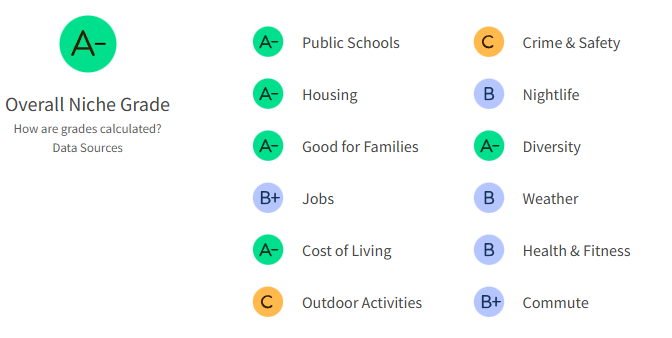
Bartlesville was ranked the 11th best place to retire in Oklahoma by Niche magazine in 2025, and I would rank us higher than they did in outdoor activities given my appreciation of the Pathfinder Parkway, but we understandably lost points for lack of access to beaches and snow skiing.

Niche magazine’s 2025 ratings for Bartlesville

Stereotypes

I’d say that several of the above Okie stereotypes ring true, even though few of them apply to me on a personal level. Every state has its quirks!

Stereotypes fall in the face of humanity. We human beings are best understood one at a time.

Anna Quindlen
Posted in random | Leave a comment