Withrow Springs

September 23, 2012

War Eagle Creek

The forecast said one of the remaining hiking spots on my list would only hit the mid-70s on Sunday, so on Saturday I graded in the morning and did the laundry to leave the next day free for the three hour drive to Withrow Springs State Park in Arkansas. It is less than 20 miles south of Eureka Springs, which I’ve visited countless times, but I don’t recall ever hearing of it until I scoured the internet for hiking trails in northwest Arkansas. The park has three trails which I walked in a loop, along with some connecting roads, to form a 4.4 mile hike.

Dawn Along Hwy 75

The rising sun fought obscuring clouds as I drove south from Bartlesville, away from a small lightning storm and then through the rain along the familiar straight shot along 412 east of Tulsa into Arkansas. As soon as I entered our neighboring state, my progress was slowed by the interminable series of uncoordinated stoplights through Siloam Springs, Tontitown, and Springdale. Twenty-five miles after finally punching my way through the long north-south sprawling strip of Bentonville/Rogers/Springdale/Fayetteville, I turned north on familiar Arkansas 23 to pull off at the War Eagle trailhead immediately after crossing War Eagle Creek.

I’ve heard of War Eagle my entire life, but in association with the annual fall craft show at the mill 15 miles northwest along the creek, not Withrow Springs. The War Eagle Hiking Trail just north of the Highway 23 bridge led east along the bluffs of the north bank of the creek, the path using narrow shelves of rock. I passed a small cave and then the main cave entrance. Precautions against white-nose bat syndrome meant I could only intrude with my flash and zoom lens, however.

Bluff Trail

A more treacherous section of trail along a high part of the bluff had a steel cable handrail for security. The trail widened but still rode the bluff edge above a dry fork of the creek until the creek area widened out. There a couple of kayaks had been landed on the shore. I walked out on a thin ledge for a panorama of the creek and a view eastward of the mirror-smooth water. I sat on the thin ledge for a self-portrait. It would have been a perfect spot for lunch, but I wasn’t hungry yet.

The trail began to climb uphill, with a narrow animal trail leading off along the base of a high bluff. I climbed upward to a series of overlooks, where I shot a panorama and a view of a home situated above the creek. A tall young Native American male came bounding down the trail, joining a fellow hiker at one of the overlooks. I speculated that they might be the kayakers, since a stout old fellow and the younger woman with him whom I’d spied earlier hardly seemed likely to be out kayaking.

I followed the trail across fields, passing a state park sign to cross Highway 23. The War Eagle trail ends here but the Dogwood Trail begins right across the highway. It began with a climb uphill along an old roadbed and then wound past a dry waterway. I passed what was once a tree with two trunks and now was one surviving trunk beside a hollow stump. There were toadstools along the trail.

Forest Trail Fungus

I reached a spur of Highway 23 and followed the road northeast until I reached a campground. Across the road was the start of the Forest Trail, which is an old forest road leading uphill northwest and then heading southwest across the rolling landscape. I lunched at a bench at the trailhead and then followed the old road. There were some enormous mushrooms along this trail; I placed a Sacajawea dollar beside one to provide scale. The road trail led onward, with more of the big mushrooms along the way and other fungi.

The trail curved past an large old dead tree and then ended at a paved road which I followed downhill to the main park area. Withrow Spring pours out of the mountainside here and the channel has been lined with rock and then dammed to form a large fishing pond. Plaques mounted above the spring were pleased to inform me that Roscoe Hobbs donated 320 acres to form this park back in 1962 and that the park is named for Richard Withrow, who homesteaded here in 1872 and built the first grist mill in the area.

Withrow Spring

I crossed the dam to follow an old neglected trail over to the park office. Past the park office in a picnic area I located the other end of the War Eagle Trail and followed it back to my car. I’d completed one of the few remaining trail sets on my to-do list, which I may wrap up this autumn.

It had only reached the mid 70s, but the humidity was sufficient to have me sweating. I cleaned up and decided I’d rather go back to Tulsa to see Paul Thomas Anderson’s latest flick, The Master, than walk more trails. Princess’s odometer reached the 200,000 mile mark near Tontitown and thankfully she kept on purring. I enjoyed the challenging film, a welcome break from the summer pap in the cinemas, and then dined at El Chico to bring the day to a close. A hike in the Ozarks, an art house film, and Tex-Mex food make for a fine weekend outing.

Click here for a slideshow from this day hike

Posted in day hike, photos, travel | Leave a comment

Gobbler Mountain

September 17, 2012

As I mentioned yesterday, the return of cooler weather has lured me back out onto the trails. This past weekend two of my fellow teachers joined me for a hike down in Tulsey Town. Our initial goal was the Oxley Nature Center, but the road in Mohawk Park was blocked by some sort of run by military reservists.

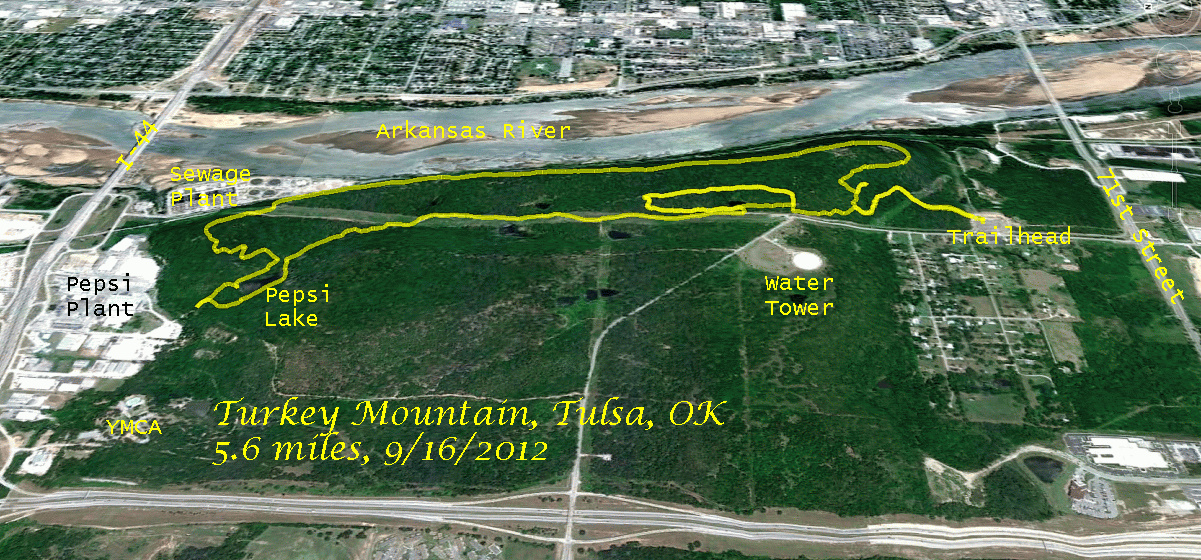
That diverted us south to Turkey Mountain, which I’ve hiked a number of times. The urban wilderness, just west of the Arkansas River between I-44 and 71st Street, has seen some major improvements in recent years. There is a big new parking area with restrooms, better trail markings and signs, and even a fancy website these days. All of that has brought far more people out to the mountain to run and mountain bike, although the heaviest traffic seems confined to the red, blue, and yellow trails with far less traffic on the other unblazed trails and the newly blazed pink trail in the western part of the wilderness.

Our 5.6 mile trek on Turkey Mountain

We sprayed our feet and pant cuffs with Cutter to ward off any ticks and headed out on the blue trail, completing that loop and then hiking north along the Powerline road until I veered us off northwest to Pepsi Lake.

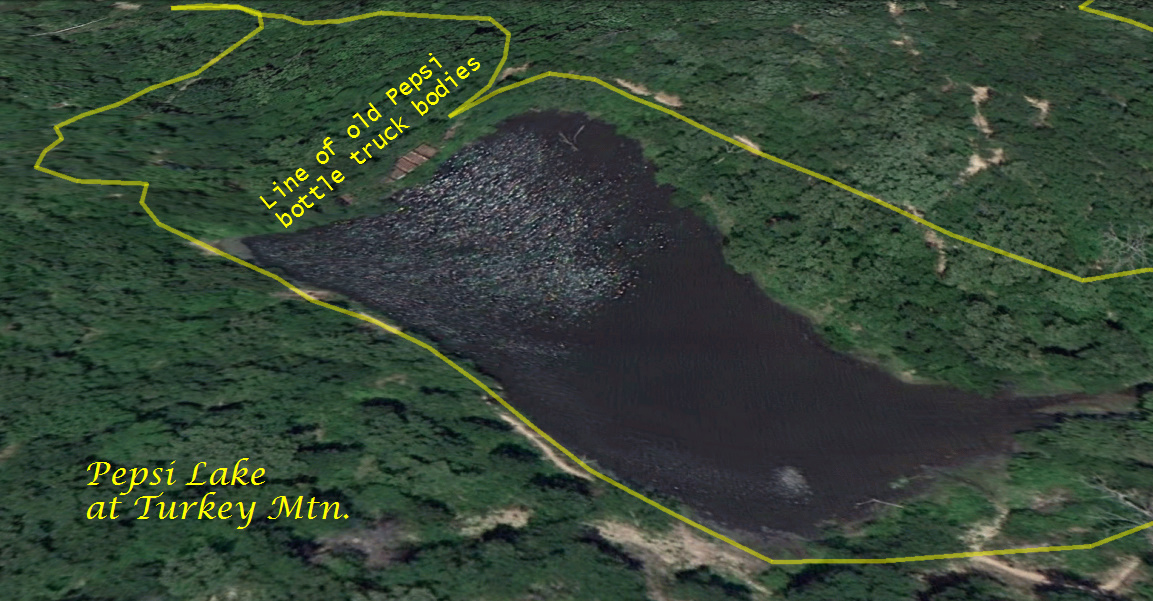
I’d never heard of that name before, but a new sign proclaimed it so. I had steered us to the lake/pond to show my friends the weird row of abandoned truck bodies parked shoulder to shoulder along an old road on its northwest edge. A little online research later revealed those to all be old Pepsi bottle truck bodies from the nearby Pepsi plant, which explained the nomenclature.

A weird row of old Pepsi bottle truck bodies gives this pond its name

There is a shot of the trucks from Marshmatt on Flickr. They aren’t the only big debris to be found on the mountain, which was a producing oil field a century ago. There are some large concrete bases left from old oil field engines, large spools of cable, and more. A rusting wheel attached some long wooden beams was sitting by one small pond off the blue loop, and the steadily diminishing remains of a pickup are slowly being scavenged away by the side of Powerline road.

Urban remains

We followed the newly blazed pink trail around Pepsi Lake and northeast back through the powerline cut to the north end of the yellow loop. Since this same group of friends had hiked the entirety of the yellow loop back in April, I led us down the less travelled track that runs directly between the low east side of the yellow loop near the Arkansas on the eastern edge of the mountain and the high ridge-running west side of the yellow loop.

We followed that middle trail back to the trailhead, having completed 5.6 miles. When I tried to save our GPS track in my MotionX app on my iPhone 4 (yes, I’ve ordered the iPhone 5, which should arrive in a couple of weeks), it complained there was already a track for Turkey Mountain from a previous foray. So I named this track Gobbler Mountain.

My friends and I had built up an appetite for some delicious food, so we retired to Kilkenny’s Irish Pub, where I feasted on a Chatsworth Boxty. That’s a potato pancake stuffed with chicken breast chunks sauteed with fresh garlic, shallots, mushrooms and red peppers in white wine, topped with white wine sauce. Oh, it is so good!

Boxty in the griddle,
Boxty in the pan,
If you can’t make boxty,
You’ll never get your man.

And we shared some Irish Balloons for dessert: fried pastry balls dusted with powdered sugar and served with sweet Irish whiskey butter sauce. My good friend Carrie introduced me to Kilkenny’s and its Irish Balloons years ago, for which I’ll forever be grateful.

It was a fun outing and my friends will likely ask me to guide them on some more hikes around the area in the future. I’m learning to be more sociable on my hikes – I even tolerated a friendly dog on a 4.5 mile hike along the eastern end of the Elk River Trail in Kansas with another friend (not the dog) last month. And lord knows I do NOT like dogs, even if they want to be my best friend. But I’m really looking to autumn when I can head out for some long solo hikes on novel trails.

Pickup Remains

Turkey Mountain Map

Posted in day hike, photos, travel | 3 Comments

Hitting the Trails Once Again

September 16, 2012

The summer heat kept me from hiking from June 22 until August 12, other than some early-morning walks along the Pathfinder Parkway trails here in Bartlesville. I finally broke the hiking drought (but not the real drought affecting the region) when some friends decided to take advantage of a break in the summer heat with a hike at the Red Bud Valley Nature Preserve near Catoosa. That was the first of five hikes over the next six weeks, all at locations where I’ve hiked previously on multiple occasions: Roaring River, two visits to Elk City Reservoir, and Turkey Mountain. Friends have joined me on three of those five hiking days, making repeating those trails more interesting since I could play trail guide. Later this week I’ll post about the latest return to Turkey Mountain.

Through my 155 days of hiking over the past three years I have travelled most of the decent trails which are feasible on a day trip. So it is no surprise that I find myself mostly repeating old trails these days, leaving me far less inclined to take and post photographs and blog about them.

I’ve hiked most of the trails I know of which are feasible on a day trip from home

Thankfully there are still several targets on my list which I’ve yet to hit:

And when a break from school affords overnight visits, I’ll hike more sections of the Ozarks Highland Trail, such as Hare Mountain in Arkansas, and more of the Ouachita Trail and its cousins in Oklahoma and Arkansas.

Posted in day hike, travel | Leave a comment

The Blues for Norma Jean

My August 2012 Song of the Month

The Blues for Norma Jean is from the soundtrack to Blonde

August was eaten by locusts: I was extensively involved in promoting a successful school bond issue, creating  a web site, PowerPoints, narrated video, doing radio spots, helping with newspaper ads, and more. As that wound down I filled what little free time I had after the start of the new school year by coding from scratch a new version of the school district website, which I hope will go live soon. It was a case of, “If you don’t like it, why don’t you do something about it?”

The hot weather kept me from all but a couple of hikes on familiar trails and my lack of travel kept me from acquiring much new music since I’m most likely to run across a new piece in the car. But one piece playing during a trip to my local Food Pyramid was special enough to have me sitting in my car, scrambling to run the Shazam app on my iPhone to identify it.

It was playing on Alan Lambert’s Big Band Saturday Night on KWGS out of Tulsa, and the solos stood out for me. The app identified the song as The Blues for Norma Jean from the soundtrack to the miniseries Blonde from 2001. But the app couldn’t find a link in the iTunes store and when I was back home Amazon didn’t have it on MP3 either. I quested in vain, even checking torrent sites, but no dice – the death of the record label seems to have left the song stuck on CD.

So I paid a few bucks for a used CD from Amazon and loaded it into iTunes when it arrived a few days later. The whole album, created by Patrick Williams for the short-lived Playboy Records label, is quite good, but the solos on The Blues for Norma Jean still stand out. Dan Higgins on the alto sax is superb and then the late Snooky Young shows just how expressive a muted trumpet can be. You can hear a sample of his playing here.

September should bring cooler weather for hikes, and I’m more than ready to head back out on the trails, although finding novel ones do-able without an overnight stay is becoming difficult.

September 2012 Song of the Month >

< July 2012 Song of the Month

Posted in music | Leave a comment

Dunces, Emma and Nora, and The Woman in White

August 3, 2012

July in Joklahoma, and August for that matter, are not conducive to happy hiking. So this isn’t a post about yet another day hike with photos. I’ve been spending my summer break in the air conditioning, reading classics on my Kindle. Or at least I was until I became immersed in promoting a vital new school bond issue, which has left me little time for a relaxing read.

Childhood Friends
Childhood mysteries

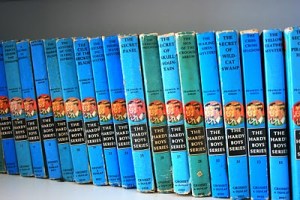
Over the course of a year, my reading rate these days is about a book a week, although with all of my hiking since the summer of 2009 much of that “reading” has been in form of listening to audiobooks on the road and on the trail. I’m too distracted in transit for anything deep, so I listen to mysteries or podcasts. As a child I read all of the mystery and adventure series I could find: I owned and read every one of the original 58 Hardy Boys books repeatedly and then about 35 of the Three Investigators books. Careful to only read them in private to avoid mockery, I also raided my aunt’s collection of Nancy Drew, Trixie Belden, and Dana Girls titles from the 1960s and earlier. The author of the Encylopedia Brown stories passed this summer, but I always found those stories far too short and trite.

Mystery and History for the Road
Old school audiobooks

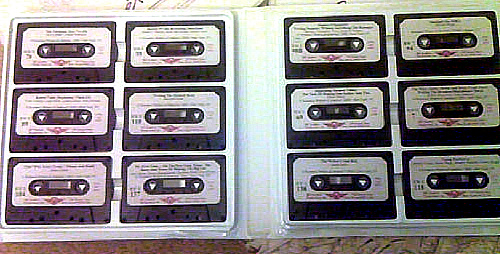
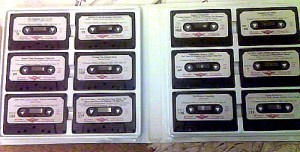
My good friend Carrie the Librarian, or Media Specialist in these times, kindly introduced me to the Ellis Peters mysteries years ago. I steadily worked my way through all of the Cadfael books, and a few others of Edith Pargeter‘s books which I could find in audiobook form, whenever I was driving on an extended trip. That was back in the audiocassette days and I was borrowing them from the Tulsa Public Library with a paid membership since I live outside that county. Since Ellis Peters’ audiobooks were filed at the library next to those of Elizabeth Peters, I eventually read through all of her Vicky Bliss and Jacqueline Kirby mysteries and her stand-alones, but the one book I read in her Amelia Peabody series was a turn-off.
Christie audiobooks

Then I took on Agatha Christie, who was a far better writer than either of the Peters. Given my rapid burn rate on books when I began the regular day hikes, I was grateful Dame Agatha was so prolific. I bought from Audible, for use on my iPhone, all of the Hercule Poirot and Miss Marple novels and most of the stand-alones, and now have only a couple of Tommy and Tuppence novels left. There are still many Christie short stories I can listen to, but I find the novels more satisfying.

And for podcasts there is nothing I find more entertaining than listening to the incomparable OU historian and classicist J. Rufus Fears. His delightful lectures range from ancient history to great books to democracy. He’s a superb storyteller and listening to him is always a splendid treat.

Another favorite person for me to listen to is polymath author Simon Winchester. I must agree with Linda Hart that his “smooth-as-satin baritone English accent is sublime.” I was lucky enough to hear him in person at one of the University of Tulsa’s Presidential Lectures and he was quite charming.

But when I’m not in transit and can actually sit down by the window in my favorite recliner and read, I want something different than a typical mystery or lecture. I want science fiction or history or a great novel from another genre.

A Confederacy of Dunces
A Confederacy of Dunces

My summer reading began with the Pulitzer-prize winning A Confederacy of Dunces by John Kennedy Toole. The contrast between the hilarity to be found in its chapters and the tortuous journey of the book into print, along with the author’s tragic end, is quite poignant. David Foster Wallace also did himself in, but Toole is a far more entertaining companion than the too-clever Wallace, although Wallace’s essay A Supposedly Fun Thing I’ll Never Do Again is a classic.

Toole had a great ear for New Orleans patois and a true gift for great characters. The protagonist Ignatius J. Reilly is declared in the foreward to be a “slob extraordinary, a mad Oliver Hardy, a fat Don Quixote, a perverse Thomas Aquinas rolled into one.” Well, I tried to read the renowned Don Quixote awhile back, and gave up out of boredom about 1/6 of the way in, but Ignatius J. Reilly never bored me a bit. I was so amused at his reactions while he was watching the Doris Day flick That Touch of Mink at the cinema that I rented the movie on Netflix to see what he was blubbering on about.

Doris Day plays an out-of-work office worker who is lured by a wealthy businessman, played by Cary Grant, to Bermuda to embark on an affair. Ignatius, watching this in the cinema and to the consternation of fellow movie watchers, erupts:

“Filth!” Ignatius shouted, spewing wet popcorn over several rows. “How dare she pretend to be a virgin. Look at her degenerate face.” . . . “They’re photographing them through several thicknesses of cheesecloth,” he spluttered. “Oh, my God. Who can imagine how wrinkled and loathsome those two really are? I think I’m getting nauseated. Can’t someone in the projection booth turn off the electricity? Please!”

. . .

Good grief. Is this smut supposed to be comedy?” Ignatius demanded in the darkness. “I have not laughed once. My eyes can hardly believe this highly discolored garbage. That woman must be lashed until she drops. She is undermining our civilization. She is a Chinese communist agent sent over to destroy us. Please! Someone with some decency get to the fuse box. Hundreds of people in this theater are being demoralized. If we’re all lucky, the Orpheum may have forgotten to pay its electrical bill.”

Ah, the days before VCRs, DVDs, and streaming movies.

Emma
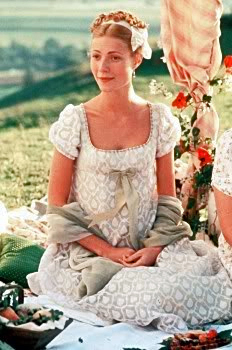
Paltrow was perfect as Emma

Last summer I examined several lists of great novels and took on Lolita and Under the Volcano. I’d thoroughly enjoyed the Pulitzer Prize winner I started off with this summer and felt brave enough to finally try some Jane Austen, emboldened by how often adaptations and mentions of her books crop up. I had really liked the movie version of Emma when I stumbled across it some years back, so I decided to try that novel. One nice thing: Aunt Jane is out of copyright, so her work is free for the asking.

These days, with my aging eyesight, I truly prefer to read my e-ink Kindle over a paper book, but I was reminded of one drawback of that format as I slowly made my way through Emma. I found myself wondering just how long the darn book was!

Granted, I was taking my time in the book. The prose reads as stilted to my modern ear, showing, or perhaps I should say shewing, its age since the book dates back to 1815. It is hard to imagine people talking as they do in Emma, especially after years of listening to Agatha Christie, who had a marvelous ear for dialogue, brought to life in the audiobooks. English has changed noticeably over that time, something I’ve thoroughly explored in fun lectures by John McWhorter, with an obvious example from Emma being how nice has changed its meaning over time. I was also pausing to read the SparkNotes after every three chapters, mostly to savor what I’d read since it was all pretty clear despite my lack of familiarity with the life of an aristocratic young woman in England in the early nineteenth century. Emma was a breeze compared to the embedded humor in Lolita or, lord have mercy, the complexities of Under the Volcano.

Anyhow, I really started to wonder how long this glacially paced story was going to be. Later at a Barnes & Noble bookstore I used the time-honored method of gauging the thickness of different Austen books which had similar formatting. Sure enough, Emma was much thicker than the rest. Online I find Emma is about 158,000 words, with only Mansfield Park coming in higher at 160,000. Sense and Sensibility has 119,000 while Pride and Prejudice is svelte at 83,000 words, and I suspect that its length assists the latters’ popularity.

I finally finished Emma and don’t regret that I read it, but I’m not inclined to sit and read through more of dear old Aunt Jane, although I might watch some of the recommended movie adaptations of her work.

Cleansing the Palate: Nora Ephron and SciFi

Nora and her neck

After the close and confined world of Emma, both geographically and culturally, I was ready for a change. Nora Ephron, the writer of one of my favorite movies, When Harry Met Sally, had just died. Obituaries mentioned one of her recent books, I Feel Bad About My Neck. I sampled it on my Kindle and enjoyed it enough to buy the thin volume, although who can really tell on an e-Reader? The essays were quick and funny, a relief after the slow pace of Emma.

An Honored Classic

I decided to advance further in time by returning to Isaac Asimov’s crystal clear galactic prose. I’d re-read the original Foundation trilogy at the start of the summer, so now I re-read the two sequels. I remember being astonished to see Foundation’s Edge in the old Henry Higgins bookstore at the Windor Hills shopping center when I was in high school. After over 30 years, Asimov was taking up the Foundation saga again? Oh boy!

I still liked Foundation’s Edge, although it is weaker than the original trilogy, and the later Foundation & Earth was always too contrived for me and still annoys with its endless revisiting of the question over whether or not the choice of a Galactic Gaia over a Second Empire was the right one. After those books, I was not at all tempted to re-read the weak very late Asimov Foundation prequels nor those by Benford, Bear, and Brin.

Old-Fashioned Asimov

Instead, I chose to re-read, for the first time in decades, Asimov’s very early Empire novel The Stars, Like Dust. It was fun to see echoes of the pulpy bombast one finds in E.E. “Doc” Smith‘s now very dated tales popping up in that early Asimov work. And I will point out that even though I own all of the Asimov science fiction novels as paperback or hardback books, I downloaded and read them on the Kindle because I like its portability and font size control so much.
The book is NOT atrocious

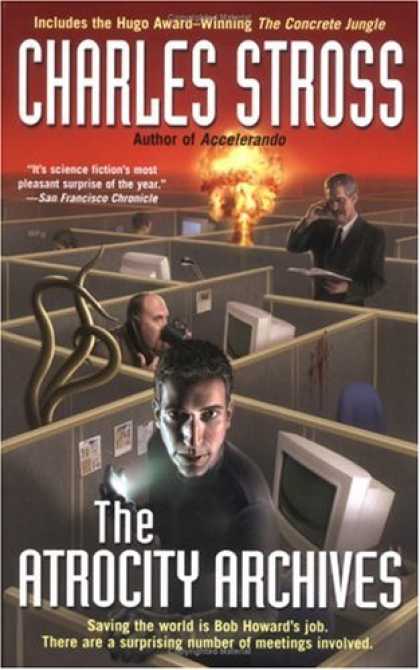
After soaking in old Asimov tales for awhile I was ready for something new. I saw reviewer praise for Charles Stross’s new The Apocalypse Codex, and I had loved Saturn’s Children, his tribute to Heinlein’s late career novel Friday, and also enjoyed his Eschaton novels. But Codex is the fourth novel in his Laundry Files series, so I started at the beginning with The Atrocity Archives, which is a novel and novella in one volume. That was a wild ride, one which I could enjoy the better since this year I’ve read for the first time many of H.P. Lovecraft’s tales. The Laundry Files books mix science fiction and horror, being set in a world where mathematics and the many-worlds model in quantum theory lead to phenomena commonly misinterpreted as witchcraft and demonology. I thoroughly enjoyed the first volume and will read the rest, but for me a little bit of horror goes a long way.

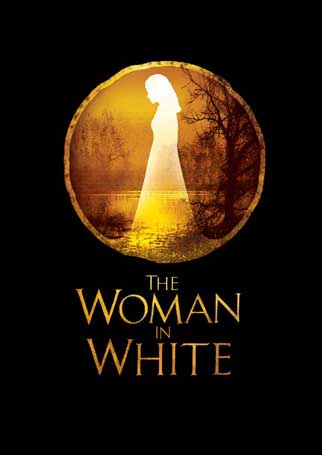
The Woman in White
This isn’t Dickens

I was ready to shift genres and read something old that would be new to me. I came across a couple of mentions of The Woman in White by Charles Dickens’ friend Wilkie Collins, as an example of an early fine mystery and “sensation novel”, so I downloaded and read it next; another freebie out of copyright!

I generally don’t like epistolary novels, but The Woman in White uses many different unreliable narrators, which made it far more interesting. The main villain is a memorable character, vividly brought to life, and there is a fairly strong female character who contrasts well to her milquetoast companions. I think the protagonist was foolish to not pursue her over her sister, but who can explain love?

I liked this passage:

So the ghostly figure which has haunted these pages, as it haunted my life, goes down into the impenetrable gloom. Like a shadow she first came to me in the loneliness of the night. Like a shadow she passes away in the loneliness of the dead.

Which brought to my mind the epitaph of the great astronomer and mathematician Johannes Kepler. We know what he wrote, although his grave was lost in war:

Mensus eram coelos, nunc terrae metior umbras: mens coelestis erat, corporis umbra jacet.

“I measured the skies, now I measure the shadows; sky-bound was the mind, earth-bound the body rests.”

I enjoyed the book enough that I’ll put Collins’s The Moonstone on my reading list, but I think I’ll head back to the future for my next read.

Posted in books, movie | Leave a comment