Junebug Day 10: Santa Fe on Foot

June 23, 2012

Strolling in Santa Fe (click image for slideshow)

Having driven thousands of miles as part of Operation Junebug, I decided it was fitting that my final day before the long slog from Santa Fe to Oklahoma City be spent entirely on foot. I left my car in the parking garage next to the Luxx Hotel all day long, spending the entire day tramping about downtown Santa Fe.

Facebook friends had been recommending places to eat and the suggestion to try Tomasita’s caught on because it is located at the railyard, which was in walking distance but which I had not visited before. So I started the morning in my hotel room, editing photos and composing a blog post, but left at 10:30 a.m. to give me plenty of time to walk the 0.8 miles, which Google Maps said should take about 16 minutes.

My Morning Stroll

I pretty much followed the route Google Maps recommended, with a minor deviation. I walked to the Plaza and turned to follow Palace Avenue and pass by several art galleries, where I encountered a version of Cougar by Star Liana York at Manitou Galleries, a bronze of Forever One by Ed Natiya at HueysFineArt, and just down the way a Daffy Duck by Chuck Jones. I would purchase a piece of art today, but not at these galleries. A few steps farther along, at the corner of Palace Avenue and Sandoval Street, is a parking lot where the Santa Fe Society of Artists has a show each weekend. Last year I bought a print of Shiprock by Amadeus Leitner there and today I knew I’d be back to see what was on offer. But the last thing I needed to carry to lunch was a valuable piece of art, so I saved that visit for later in the day.

Hilton Flowers

I stopped to admire the flowerbeds at the Hilton, with a mix of blooms, some purple petunias, and a lovely lavender-shaded bloom catching my eye. I also spotted a flawed specimen of Indian Paintbrush, made infamous to me by my friend Betty: she calls any unidentified flower “Indian Paintbrush.” You’d need quite a paint mixer to keep up with her claims.

On Guadalupe Street I passed a monument of the Cabelleros de Vargas, who each year parade La Conquistadora, the Virgin Mary replica that accompanied the Spaniards in their conquest of New Mexico, from the Cathedral Basilica of St. Francis of Assisi to Rosario Chapel at Rosario Cemetery for a nine-day novena. In an attempt to reconcile her violent past with Native American sensibilities, they now call her Our Lady of Peace. Well, peace did follow conquest, but her original role was hardly peaceable.

Santa Fe Railyard

I arrived at the railyard, where the Santa Fe depot, and by this for once I mean the depot in Santa Fe, looked a bit run-down. There was a passenger train at the station, part of the Rail Runner service. Tomasita’s didn’t open its doors until 11 and I had some time to kill. So I walked down the tracks to the farmers market.

As I completed my brief walk through the market, a Rail Runner train came charging backwards into the station, disgorging passengers. I shot a video of its arrival, incorporating a pan across a very long panorama of the Rail Runner train which had already been parked in the yard. In the process of composing the panorama, I managed to clone one fellow four times in the process, although he only appears twice in the video. 🙂

Tomasita’s

Lunch at Tomasita’s

I hightailed it over to Tomasita’s doors, knowing that a line would queue up quickly with the train’s arrival, and it did. We all waited in the hot sun until the door opened and we were ushered inside and rapidly sent throughout the large restaurant to waiting tables.

Frankly, I’m no fan of hot chile sauce. I like things pretty mild. So when Mimi, the waitress, asked if I wanted to sample their red and green sauce, I eagerly agreed since I wanted to ensure I had the  milder choice. I usually prefer red, as green often reads hotter to me, and Tomasita’s was no exception when I tried their chile on some blue corn chips. So I ordered the Blue Corn Chicken Enchilada special. It was wonderful, but I was grateful for the big dollop of sour cream to help ease the burn in my mouth. My acid reflux was going to get a workout this day! Like at La Fonda, a sopapilla was standard with my order. It was light and fluffy.

Shakespeare in Santa Fe

My Afternoon Stroll

I decided to return to the site of the Society of Artists show to see if Mr. Leitner was in attendance. So I began my afternoon stroll headed north, this time passing the Sanbusco Market and being surprised to see an old truck, filled with flowers, up on a pedestal. It was a 1941 Dodge half-ton pick-up similar to those used by Sanbusco, Santa Fe Builders Supply Company. A man and woman walked up and asked if I would take their picture in front of the truck with their iPhone. I did, and they asked for a shot in the portrait orientation too, and the lady decided they should smooch. No one volunteered to kiss me in thanks for the photo, however.

I walked on, past a door with the phrase, “What is past is prologue” above it. That’s from The Tempest by Shakespeare, but why put that above the door? Well, the building was a governmental archive. The Cielo Tabletop store had a pretty windowbox of flowers, and then I reached Santuario de Guadalupe. The adobe building dates back over 200 years and is the oldest surviving shrine to Our Lady of Guadalupe, the patroness of the poor in Mexico. I didn’t make it inside to see the carved images of the saints and various paintings, although I shall do so on a future visit. However, I did admire the roses and see the 12’ bronze outside.

I recrossed the wide dry ditch that is the Santa Fe River. There were colorful plantings on the sidewalk here, but the river was designated the most endangered river in the nation back in 2007. Groups are working to improve things, but I noticed too much trash and too little water in my glimpse down into the river. Oklahoma City’s Bricktown ditch is thriving by comparison.

On the corner of Alameda and Sandoval was an odd sight: dozens of old wooden doors, gates, and columns behind a wrought iron fence, with a smiling Buddha carving at the corner. What a treasure trove! It was the outdoor yard for Seret & Sons, which has 80,000 square feet of display space for its south Asian and Tibetan furnishings. Some day I must explore in there, but first I had a smaller acquisition to consider, at least in physical size.

Fine Art

I walked through the booths at the Santa Fe Society of Artists and found Amadeus Leitner there. He received New Mexico’s highest artistic honor, the Governor’s Award for Excellence in the Arts, last year. His Shiprock work, a print of which graces my living room, has such wonderful light and color that guests always ask me if it is a painting or a photograph. Another great work of his is a very wide cinematic version of the Piedra Lumbre view from Chimney Rock, which I’d photographed in my own fashion a day earlier at Ghost Ranch. An enthusiastic amateur of landscape photography like me can certainly appreciate a master at work, and Mr. Leitner, a charming and affable young man, agreed to make a large framed print of his panorama and have it shipped to Bartlesville, giving me a tiny version to treasure until it arrives. I can’t wait to hang it on the wall above my piano, another reminder of the startling austere beauty of New Mexico.

Museum Courtyard

My love for fine art was stirred by the interaction with Mr. Leitner, so my next stop was the New Mexico Museum of Art to see what was on offer. I toured it two years ago and thoroughly enjoyed my visit, including the lovely courtyard. This building was the inspiration for the Santa Fe Style and the power of its elements are on full display when you sit on a bench under the overhang of the courtyard, relax, and let your eye perceive the forms and geometries created by the building’s interaction with the sunlight, wind, and sky. The exterior towers adorning the Saint Francis Auditorium are echoed nearby at the Museum of Contemporary Native Arts. While reviewing the exhibit at the museum I could softly hear an orchestral rehearsal going on in that adjoining auditorium.

I enjoyed the exhibitions, particularly one on 14,000 years of art in New Mexico, with a standout piece from Raymond Jonson, with whose art-deco-influenced transcendentalist paintings I was until now unfamiliar. I like his Cycle of Science series, of which the Chemistry painting was on display. Some day I hope to see all of that cycle in person.

The Plaza

People Watching at the Plaza

Venturing out to the Plaza, past the Native American craftspeople selling their wares on the porch of the Palace of the Governors, I saw pigeons posing on the American Indian War Memorial obelisk. I’m not much of a bird watcher, but people watching is always a fun pastime at the Plaza, with colorful characters of all types in all sorts of dress. Even the trees are interesting.

I enjoyed listening to the buskers, such as electro-acoustic harpist Roark Bannon, who plays beautifully and dresses eclectically.

Mariachi Buenaventura was billing itself as Santa Fe’s first all-female mariachi and reaped the requisite rewards for their enthusiastic performance. Oh yes, I made another video, of course!

Snapping Shots

I shot new photos of the Bell Tower at La Fonda, Saint Kateri Tekakwitha at the Saint Francis Cathedral, and caught two girls walking the labyrinth in front of the cathedral. The shading of the intense desert light as I gazed at the cathedral from the shadows of the trees was quite lovely.

Cathedral Basilica of Saint Francis of Assisi

Having Fun with Saint Francis

I decided to take a walk around the area for a “found objects” tour where I snapped photos or even video of anything which caught my eye. I snapped a rose with an inner glow, a prancing pony, a tiny hillside shrine, a house with some supporting stone, a secluded example of the Santa Fe Style, and a shot of a contemplative Saint Francis of Assisi who was quite unaware of the playfulness in the background. I wound up back at the Plaza with its old Spitz Clock.

I blogged for an hour or two in my hotel room and then headed out for dinner. I was unable to snag a spot at Café Pasqual’s, even at the communal table, and Tia Sophias was closed, but I did get one of the last free tables at The Shed and enjoyed some blue corn tortillas and another sopapilla. The local food this day was quite tasty, although I wasn’t surprised to awaken in the wee hours of the following morning with rollicking heartburn.

This day closed out Operation Junebug; the remaining days would simply be the dull long drive back to Oklahoma City and then eventually home. I came away from my annual summer vacation refreshed and delighted by the beautiful sights I’d seen and the splendid sites I’d walked, with ideas already forming for my inevitable return to Colorado and New Mexico some future summer. My memories from this trip would help sustain me as I faced a long string of 100-plus degrees days back home as June evaporated into July.

Click here for a slideshow from this day

< Junebug Day 9: Ghost Ranch

Posted in photos, travel, video | 1 Comment

Junebug Day 9: Ghost Ranch

June 22, 2012

Gentle readers: I think you’ll find this was worth the wait…it took awhile to get a chance to edit all of the beautiful photos and several video clips from my hike at Ghost Ranch last week. And this isn’t quite all yet…there is still one last post forthcoming from Operation Junebug.

Chimney Rock (click image for slideshow)

On the penultimate day of Operation Junebug, the Little Sand fire drove me south from Pagosa Springs towards Santa Fe. I’ve driven this route a few times now, and had pondered, noticing the beautiful colors of the rocks, stopping in to hike at Ghost Ranch. That ranch now occupies 21,000 acres which are part of the old Piedra Lumbre or “Valley of the Shining Stone” land grant of almost 50,000 acres from the King of Spain to Pedro Martin Serrano in 1766.

Ghost Ranch History

The history of this parcel is interesting; I read all about it in a copy of Lesley Poling-Kempes’ Ghost Ranch, which I bought at the Welcome Center. The ranch used to be known locally as Rancho de los Brujos or “Ranch of the Witches” because it was homesteaded by two Archuleta brothers who used the narrow canyon as a holding pen for their cattle rustling operation. They were unfriendly to locals and suspected of murdering passersby. In the end one of the brothers killed the other over some hidden gold from the sale of stolen cattle. The dead brother’s widow and daughter fled the area and locals moved in and hanged the remaining Archuleta brother and his henchmen.

Several decades passed and in the 1920s the location was developed as a dude ranch by Carol Bishop Stanley, who later partnered with and eventually sold out to Arthur Pack, a noted conservationist. He donated the ranch to the Presbyterian Church in 1955 and it has been a retreat and conference center ever since. The ranch is most famous as artist Georgia O’Keeffe’s summer home for decades, the area serving as the inspiration for many of her paintings.

I knew there were several hiking trails at Ghost Ranch which were open to the public, but they were shut down in the summer of 2011 by area fires. Fires are again ravaging areas of Colorado and New Mexico this summer, but at this time the trails at Ghost Ranch were open and would serve as a substitute for my intended hike along the Piedra River trail 100 miles to the north.

Ghost Riders

Registration and Lunch

A two-hour drive southeast on US 84 took me from the smoke-hazed mountains around Pagosa Springs to the Ghost Ranch gate, decorated with the ox skull emblem associated with the Ranch. O’Keeffe was drawn to animal bones as subjects and the skulls of horses, cows, and the like for many years served as a marker for the turnoff for the ranch back when this area had nothing but rough dirt roads. One of O’Keeffe’s neighbors at the Ranch, a Navajo named Juan de Dios, had a pet steer and she made him promise to give him the skull whenever it died. He followed through on the promise, she sketched it, gave the sketch to Arthur Pack, and that became the logo for the Ranch.

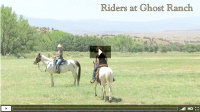
Soon after entering you see a wood cabin to the side of the road, left over from when the movie City Slickers was filmed at the ranch in 1991. The unpaved road leads a mile northeast towards the striped cliffs of the narrow canyon where the main facilities are located. I immediately spotted Chimney Rock, the target for my first hike, and when I parked at the Welcome Center two young ladies on horseback rode by, stopping over at the Dining Hall.

Registering to hike for a day at the ranch costs $3, but clearly the whole place runs on the honor system. Although almost everyone wore badges as attendees for various conferences, no one ever asked to see my receipt or ticket, even when I went to the Dining Hall to join in the cafeteria-style lunch, for which I’d paid an extra $7. The ranch serves thousands of meals each week and my lunch of area-grown vegetables and chicken was tasty.

Video of the Riders

Outside the ladies were practicing with their horses and, as I walked over to the Chimney Rock trailhead, I passed the colorful statue Ghost Ranch Ponyscapes by Claudia Tommen, Pomona Hallenbeck, and Leonard Morfin at the Ranch’s Agape Center. It is decorated with the image of Cerro Pedernal, the sharp and narrow mesa jutting up 12 miles southwest of the Ranch, of which Georgia O’Keeffe said, “It’s my private mountain. It belongs to me. God told me if I painted it enough, I could have it.”

Chimney Rock Trail

I walked over to the Chimney Rock trailhead, where a cholla cactus was in bloom. My target was in plain sight, but its outsize proportions made it seem closer than it was; it was over a mile walk from the trailhead up to the formation. The trail led through a gate and then made a steep climb to a higher level, from which I shot a panorama illustrating how the ranch buildings are nestled down in the canyon and thus detract less from the views.

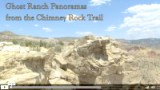
Panorama

Still higher up I shot a 360-degree panorama, showing Chimney Rock, the mesa next to it tapering off to form the western edge of the canyon, the mesa protruding through the ranch, the Kitchen and Orphan mesas on the east side of the canyon, and the open view across the Piedra Lumbre with Cerro Pedernal projecting upward in the distance beyond the shining waters of the Abiquiu Reservoir.

The view out across the Piedra Lumbra was truly beautiful, as were the colorful layers of stone exposed by the ravine. The trail led up beside the ravine, providing a sweeping view down it of the mesas forming the eastern side of the canyon and the strip of green down below from the Rito del Yeso, the little stream which provides the water making a ranch here in the desert feasible.

The Piedra Lumbre

I passed through an upper gate and climbed up to the top of the mesa, the last section of which eroded away to form Chimney Rock. Now I had a higher sweeping view across the Valley of Shining Stone of the Jemez Mountains, with the twin stubs of Chimney Rock looking out across at the tilted linear top of Cerro Pedernal. Someone had constructed a little pile of stones up here.

Up here I could get a view of the mesa cliffs on to the northwest of Chimney Rock, below which Arthur Pack built his Rancho de los Burros, which he later sold to Georgia O’Keeffe for use as a summer home. The Bob Johnson home, built by one of the Johnson & Johnson heirs, is also down there.

More Chimneys

I crossed a narrow saddle of rock between remnants of the mesa near Chimney Rock, peering down into the chasm, to make my closest approach to the formation. There I shot another large panorama and a separate view across the Piedra Lumbre.

The beautiful cliffs to the northwest had stunning colors and their own collection of smaller chimneys.

Chimney Rock Trail Videos

Video Panoramas

I shot some video panoramas from this beautiful walk.

I also appreciated the shadows slowly gliding across the Valley of Shining Stone, washing up and over the mesas at Ghost Ranch. Here’s a timelapse video of the cloud shadows; please forgive my lack of a tripod while filming.

Shadows

Drummers Video

Strolling Across Campus

I descended the trail and crossed the campus, drawn by sound to one of the conference groups where some were drumming in the shade of a giant tree. I ventured into the Welcome Center for a much-appreciated ice cream bar, which I consumed outside on a free chair under one of the trees. I then walked past several casitas, small houses for guests. There are many more rooms higher up on the mesa. I walked past the rebuilt Ghost House, which dates back to the Archeluta brothers in 1881, the last of whom ended his life being hung from a tree outside. Now that I know the history of this place, on my next visit I shall venture inside the historic structure.

Kitchen Mesa

I was following my map and trail signs far up one of the ranch roads to the Box Canyon trailhead, which adjoins the Kitchen Mesa trailhead, a trail I look forward to traversing in the future. I passed Kitchen Mesa itself, with its side dimple, and passed the trail leading off to climb it. I passed by little Navajo-style hogans built under the direction of Jim Hall, the late great director of the Ghost Ranch Conference Center. They don’t rent these out – they are very short and small and you’d feel rather ascetic if you stayed in one.

Camposanto

Box Canyon Trail

At last I reached the gate for the Box Canyon trail. Ahead of me was the edge of the mesa, below which is the ranch’s Camposanto, a memorial area set below this striking prominence. There is a prominent curving wall of plaques with an altar and there are also numerous individual sites scattered about the area.

I followed a marker out of the Camposanto area to the first of a series of coffee can trail markers, under the pipe taking water from the Rito del Yeso to the irrigation pond and through a gate to follow the Rito del Yeso’s carved channel along the very narrow box canyon.

A sign pointed out an eagles’ nest tucked into a slot high up into the canyon wall. A landslide tumbled large boulders all over the creek bed near and around a small pool. I approached a huge rock and was startled when a large young black man came bounding and sliding over the rock, landing a few feet in front of me. We both laughed and I remarked he had made quite an entrance! He was with a group of conference-goers who were returning from their hike up the canyon.

A long knotted rope was anchored on the large rock to allow hikers to scramble up and down it to continue the hike. I posed on the rock with the rope. It doesn’t look that steep in the photo, but without the rope I’d never attempt crawling up its smooth flat face: that rope was about as close as I get to rock climbing.

Box Canyon

The canyon walls were jagged from erosion through here, with fallen trees and boulders in the narrow channel. And then I reached the scooped-out end of the box canyon. It took some navigating about the rocks, but I could climb around to the level oasis at its head. The scene was like a smaller and drier version of Hemmed-In Hollow in Arkansas.

A large flat rock, which I first posed upon to provide some scale, was a welcome spot to rest and enjoy a drink as I craned my head to look around this hollow and gaze up at the tall trees above me. I then made my way back down the channel of the Rito del Yeso, deviating at one point to follow a side channel, which led past stone portals looking down into the irrigation system.

A Promise to Return

As I walked back to my car, I stopped to shoot a cholla cactus bloom in front of Kitchen Mesa, promising myself that in some future summer I would return to Ghost Ranch and hike the Kitchen Mesa trail. I was tired but happy after seven miles of more strenuous hiking than I had expected, still up high at 6,500 to 7,000 feet of elevation. I passed the Agape Center, pondering how the welcoming people I’d met here illustrated that concept in their love of this place and their love for others. Ghost Ranch is truly a special place, way out there in what Georgia O’Keeffe called the Faraway Nearby. I don’t believe in ghosts, but I do believe in love – of places and people.

A Promise

The Luxx

The Luxx

I drove south to Santa Fe. The road felt like it was descending all of the way from Abiquiu, but the terrain map says otherwise. A couple of the blocks from the historic Plaza was the Luxx Hotel & Casitas, an obscure boutique hotel I’d selected because of its privacy and access to downtown. For parts of the day there is no one on duty at this hotel, although Alex was there in the interior courtyard to check me in that evening. The rooms are left open when unoccupied, allowing you to browse the corridors and see the individualized décor in each one. Mine had an African theme with zebra and leopard prints, grasses, and warm colors throughout. I noted the desk where I’d no doubt spend much time blogging during my two-night stay.

The Plaza

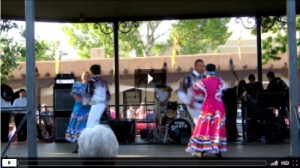
I showered and dressed to walk over to the Plaza, where the Vintage Car Club’s Cruise Night was underway. A yellow Triumph was catching everyone’s eye and there was dancing on the pavilion. I strolled over to La Fonda‘s La Plazuela for some delicious fajitas and a sopapilla, content in my plan to not drive the car at all on my next and final tour day of Operation Junebug. I’d spend Saturday enjoying Santa Fe…on foot.

Plaza Dancers Video

Click here for a slideshow from this day hike

Junebug Day 10: On Foot in Santa Fe >

< Junebug Day 8: Silver Thread Scenic Byway

Posted in day hike, photos, travel, video | 2 Comments

Junebug Day 8: Silver Thread Scenic Byway

June 21, 2012

Lake San Cristobal (click image for slideshow)

On Thursday, Day 8 of Operation Junebug, it was time for me to leave Gunnison and head south for a couple of days before returning home. The Hendersons had packed up at Taylor Park Reservoir and drove down to meet me at Gunnison, as they had never been to the Black Canyon of the Gunnison National Park and my vehicle pass was still valid. We had breakfast at the busy W Cafe downtown, which had been closed the previous two days for its annual cleaning. Then I drove us all west along US 50 to the national park.

Hendersons at Black Canyon

With the Hendersons at Black Canyon

This time we stopped at the visitor center at Gunnison Point, something I had omitted on my visit almost a week earlier. I peeked in at part of the video they were showing, but its pace was too slow for me and I’d already seen some photos and heard the story of some of the expeditions that first explored the canyon.

I snapped a photo of the Hendersons out on Gunnison Point and the river far below. We visited Pulpit Rock and The Chasm and the Painted Wall, where I caught a shot of it on this cloudless day, compared to the overcast late afternoon shot from my earlier visit.

We saw Sunset View and then hiked the Warner Nature Trail, passing a fallen tree with its exposed twisted trunk. It was a hot and tiring, albeit short, hike over to the view of the canyon at Warner Point. In the bright light the extrusions of rock were quite visible. Betty, who doesn’t like heights, posed as close to the edge as she would go.

The Hendersons were glad to have seen the Black Canyon, but it was time for them to drive to Salida and for me to make my way south to Pagosa Springs for the night. I drove us back to Gunnison and we parted, with them heading east on US 50 while I drove south on scenic highway 149.

Scenic Highway 149

Scenic Highway 149

I’d passed the turnoff for this highway repeatedly over the past week without realizing I’d be taking it south through two mountain passes to reach US 160, which is my usual route through Wolf Creek Pass to drop way down into Pagosa Springs, where I vacationed in July 2010 and July 2011. The last 75 miles of the route, from Lake City to South Fork, is called the Silver Thread Scenic Byway because of the silver mining towns lining the route across the San Juan Mountains. The famous Million Dollar Highway, which I drove in 2011 as part of the San Juan Skyway, runs between Silverton and Durango to the west of this route. The views were less dramatic along 149, but the road had much less traffic and was far less terrifying!

Lake San Cristobal & the Slumgullion Earthflow

At first the mountains were distant backdrops. I drove through Lake City, population 375, which developed in the 1870s when gold was discovered near the Lake Fork of the Gunnison River. I pulled over south of town for the view looking south down the broad valley, with a subpeak of Red Mountain looming on the western slope.

There was an overlook of Lake San Cristobal, which formed 700 years ago when the first of a series of huge landslides, the Slumgullion Earthflow, dammed the Lake Fork of the Gunnison. The beauty here contrasts to the grisly tale of Alfred Packer, who dined upon some of his fellow prospectors when they became lost in the mountains somewhere around here in the winter of 1873-1874. A sketch appeared in Harper’s Weekly of the horrific remains which were discovered. The mountains here have unforgiving winters: John C. Frémont’s ill-fated fourth expedition had tried to pass through these mountains in 1848. He lost all 120 of his mules and 10 of the 35 men died, with some of the party also resorting to cannibalism to survive.

The road wound upwards past the current phase of the earthflow, with its own overlook. The crumbling earth was visible both above and beside the highway. The earth continues to slip about twenty feet per year on parts of the flow.

Slumgullion Earthflow

At the Windy Point Overlook the view of the San Juan peaks to the west was marred by the evening sun and heavy haze from a forest fire to the south, but there was another great vantage point of the Slumgullion Earthflow from there. I crossed the Slumgullion Pass at 11,530 feet.

Mount Baldy Cinco, Bristol Head, and the Rio Grande Pyramid

I drove past Mount Baldy Cinco which, as you might guess, has five summits with the tallest at 13,838 feet. Clouds made huge shadows across its slopes. I drove across Spring Creek Pass at 10,901 feet and then descended past Bristol Head, jutting up above the plain at 12,713 feet. I noticed a number of trailheads around this area, so that’s good news for future hiking trips.

Rio Grande Headwaters

The north face of the 13,821 foot Rio Grande Pyramid forms the headwaters of the Rio Grande, which flows 1,885 miles from here to the Gulf of Mexico, making it the third longest river in the United States of America. The haze above the forest from the fire to the southwest was becoming noticeable.

I pulled in at one trailhead to see a high mesa to the northeast which culminated in Bristol Head. Not much farther along was Stony Pass, used from 1871 and 1882 to reach the mining town of Silverton until the Durango-Silverton railroad line was completed.

Creede in the Golden Hour

I rounded the mountains and passed sunlit bluffs above the Rio Grande to arrive in Creede, the only incorporated town in Mineral county, home to 290 of the 712 people living in all of the county’s 878 square miles. 96% of the county, which is surrounded by the Rio Grande National Forest, is under the control of the federal government. Named after the discoverer of the Holy Moses mine, Creede produced much silver and copper, surviving the silver panic of 1893 by relying on the mining of lead and zinc. Its population declined by almost 25% in the past decade. There is a great mining loop north of town which I hope to walk some day.

Mine at Creede

The town is nestled at the foot of Mammoth Mountain, which rises over 2,000 feet above it. The clouds and setting sun gave a painterly look to the mountain ridge, and I shot a panorama during the golden hour.

All along this stretch the highway turnouts were blocked for some sort of event, but I was still able to capture golden hour snapshots of the cliffs at the base of Pool Table Mountain as the Silver Thread Scenic Byway came to an end at South Fork.

Beetles and Smoke

I remembered from last year how spruce beetles had been eating away at Wolf Creek Pass and was sad to see entire slopes of Engelmann spruces devastated by them as I descended to Pagosa Springs. I could also see heavy haze from the Little Sand fire hanging in the sky. The sun set as I drove to my hotel, and I could see the smoke hanging over the forest, reflecting off a pond in the pink twilight.

The south fire line is the Piedra River Trail I had hoped to enjoy again on this trip, so the next morning I would vacate Pagosa Springs, heading south to Ghost Ranch.

Click here for a slideshow from this day

Junebug Day 9: Ghost Ranch >

< Junebug Day 7: Aboard the Curecata 2

Posted in day hike, photos, travel | 2 Comments

Junebug Day 7: Aboard the Curecata 2

June 20, 2012

Gentle Readers: I am still catching up on my posts for Operation Junebug. This one goes up three days late, and there are three more still to come.

The Curecanti Needle (click image for slideshow)

A week into Operation Junebug I awoke and drove 16 miles west on US 50 to the Elk Creek Visitors Center of the Curecanti National Recreation Area. I arrived just after they opened and for $16 obtained a slot on the 10 o’clock boat tour on Morrow Point Reservoir. I’d wanted to do this since my hike down Curecanti Creek on Day 4 had not yielded a satisfactory view of the famed Curecanti Needle, the 700 foot high granite spire which graced the logo of the old Denver & Rio Grande Western Railroad. Aboard the boat I would get to see it in all of its glory, and I’d get a chance to walk the Pine Creek trail which I’d seen from high above on Highway 92.

Descent Along Pine Creek

Descent Along Pine Creek

I drove another 13 miles west to a gravel road leading down off US 50 to where Pine Creek feeds into what was once the Gunnison River and is now the shallow and narrow eastern end of Morrow Point Reservoir, just below the dam for Blue Mesa Reservoir.

I followed other riders down the 232 stairs leading into Black Canyon alongside Pine Creek to the railroad grade of the old Denver & Rio Grande, blasted out of the side of the canyon back in 1881 and 1882. The railroad tracks in this area were removed in 1949 and the only operating part of the railroad’s narrow gauge system are the Durango and Silverton Narrow Gauge Railroad, which I last rode in 2010, and the Cumbres & Toltec Scenic Railroad, which I rode in 2011. So on my third consecutive summer vacation in Colorado I was visiting the old rail line yet again, but this time I’d be walking and boating along part of its route, rather than riding in a steam train.

Along the Railbed to the Boat Dock

Along the Railbed

The canyon walls are always crumbling, and some huge stones had crashed onto the trail since it was constructed. You can see more rockfalls in the background of the picture. The ranger aboard the boat would later say that these piles are building up since the river no longer floods through here to sweep them away; one source says the building of the three dams has reduced the strength of the flooding Gunnison River by 80%.

It was a mile-long walk from the trailhead to the boat dock, at which were docked the 40-foot long Curecata 2 I’d be riding, along with some smaller launches. Two men were already aboard the large pontoon boat: Ranger Greg and Captain Steve.

Two More Great People in Our Park Service

Ranger Greg

Another couple and I were the first to arrive at the dock. Ranger Greg came out to greet us, a tall charming high school English teacher who lives nearby and has worked seasonally here and up at the isolated North Rim of the Black Canyon of the Gunnison National Park farther downstream. He showed off a photograph he’d taken the night before, combining several long exposures to get a twilight shot beneath one of the park bridges.

He did a great job of making everyone comfortable as he checked arrivals in and got us into our life jackets, repeatedly urging us to use the available restroom before boarding. I asked and he laughingly admitted that he’d seen someone sneaking a leak off the back of the boat before when in extremis. Altogether 40 people would be aboard the boat on this morning tour.

Captain Steve

Captain Steve was from Juneau, Alaska, where he spends the winter. (Interesting choice!) He was also quite friendly and accommodating, offering advice that if you really want to see Alaska, take the Alaska state ferries from town to town up the coast. Captain Steve, who was older than Greg, piloted the boat while Greg donned a microphone so he could tell us about the history, geology, and ecology of the area on our 45-minute cruise downstream. So in a way it reminded me of Gilligan’s Island, but this time around the skipper was thin and smart and Gilligan was actually The Professor. And instead of a three-hour tour, ours would be half that. Oh yeah, we didn’t get stranded on an island, either!

Sheared Wall

Heading Downstream

The lake is incredibly narrow at the boat dock, not all that much wider than the boat itself. That and the strong current coming from the dam makes piloting tricky, but Captain Steve made it look easy.

I could see the large veins of intruding rock in the canyon walls, and we passed sharp towering spires and rockfalls. I used my bionic vision to see one spire close up. There was one spot where the canyon wall was sheared off vertically.

Chipeta Falls

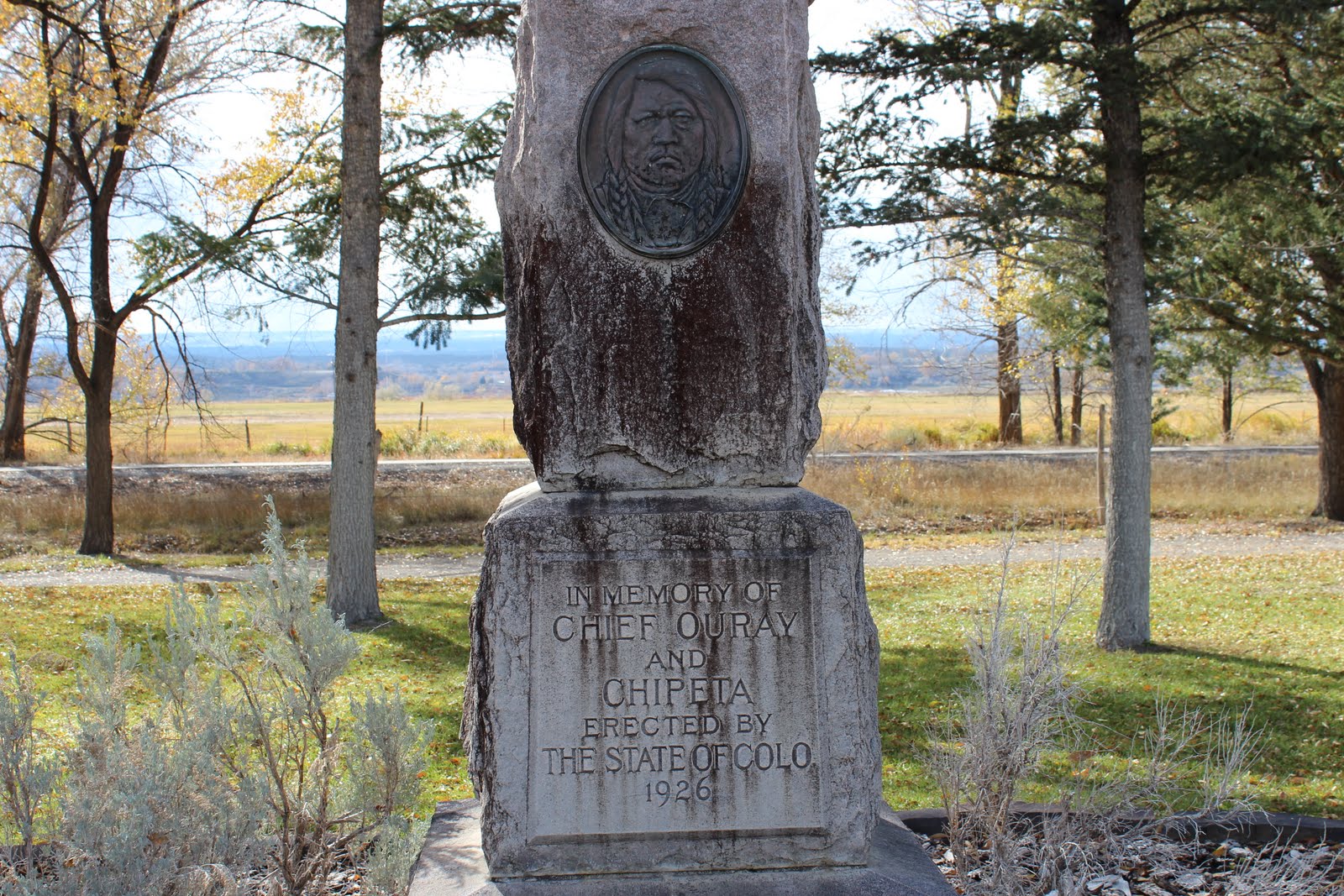
We passed Chipeta Falls, named after the wife of Ute chief Ouray. After the Meeker massacre in 1879, which Ouray’s group had not been involved in, Ouray helped negotiate the release of white captives by the Ute, with Chipeta helping searchers locate them. Nevertheless, Ouray’s group was forcibly relocated to Utah along with the other Utes and he died soon after. Chipeta lived on until 1924, a proponent of peace known late in life for spending her money on orphan children. She was buried in the appropriately named Bitter Creek in Utah but subsequently reinterred with her husband at their farm in Montrose.

Chipeta Falls

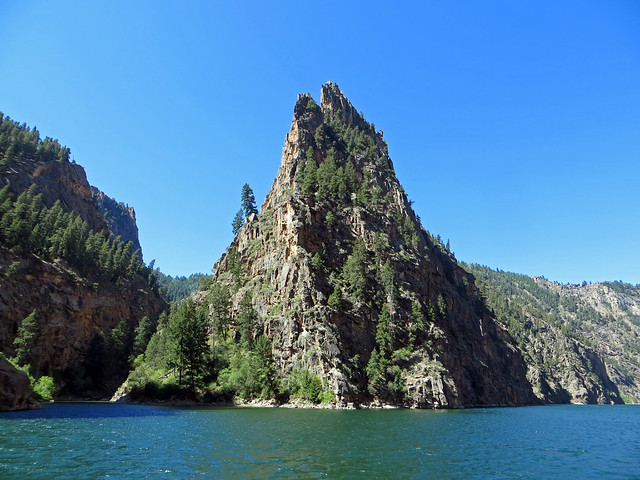
The Curecanti Needle

At last Ranger Greg held up the logo of the Denver & Rio Grande, explaining that we were approaching the Curecanti Needle. I snapped a photo of it looking downstream.

The Curecanti Needle

Later I shot it looking upstream, the vantage point the original lithograph was made from. This was also where Curecanti Creek empties into the lake, the spot where I had stood on the shore at the end of the Curecanti Creek Trail a few days earlier.

Cliff Projection

Turnaround

We passed an enormous rockfall, which had left a fin of rock projecting from the canyon wall. Some canyon walls showed many layers of eroding rock.

When the lake suddenly widened, we had reached the far end of our journey. I took a final look downstream and then the Curecata 2 turned about and headed back upstream.

More projections stuck out from the side of the canyon. As the reservoir’s bottom lifted beneath us, occasional metal bars became visible from the side of the canyon. Ranger Greg explained those were the remains of the old telegraph line which ran above the railroad bed. One was stuck into a rock which protruded from the lake.

Captain Steve had to be careful through here what with the ever-shallower lake bed and the occasional driftwood. Finally the old railroad bed began to emerge from the waters of the lake – the end of the Pine Creek Trail. I got a good shot of one of the old telegraph poles sticking out of the canyon wall.

The Railbed Disappears

I Walk the Line

We disembarked, thanking the Park Service men, and while the rest of the group headed back toward the trailhead, I was the only one who chose to head downstream along the remains of the railroad bed. I wanted to hike all of the Pine Creek Trail, plus I wanted to avoid being stuck on those interminable stairs behind a large group of elderly couples and families with children.

I was rewarded with a close-up look at the interesting rock along the canyon wall. It was 0.55 miles from the boat dock to the end where the railroad bed sank beneath the water. I followed the example of a bird and posed out on a rock, and walked past a very dark section of wall where erosion exposed lighter rocks.

On my return trip I passed the boat dock, where Ranger Greg was prepping the next boat load of tourists. The lake narrowed and the current increased to where you would swear this was just a river. I reached Pine Creek, where the railroad bed disappeared again and the many stairs beckoned.

Pine Creek Stairs

Climbing Up

The stairs are a combination of stone and wood sections, sometimes dodging trees which provided valuable shade during the ascent next to burbling Pine Creek. I had walked a total of three miles going down to the boat, from the boat to the end of the line, and back up to the trailhead, while the boat had made an 11-mile round-trip on Morrow Point Reservoir.

Video Aboard the Curecata 2

Superb Mexican Food at Añejo Bistro & Bar

Añejo Bistro & Bar

I drove back to Gunnison for lunch, thankfully heeding TripAdvisor’s advice to eat at Añejo Bistro & Bar. It is a narrow and deep little bar/restaurant tucked in along the west side of Main south of US 50. The online advice said there were a few tables in the back and indeed the waitress offered to let me sit at the bar up front or walk past the kitchen unit to the tables at the rear. I ordered my usual, steak fajitas, unaware that I was about to have some of the best Mexican food of my life.

The cook prepared fresh salsa for me. I grew up eating cooked salsa at El Chico and it remains my preference, but this fresh salsa was amazing. It had just the right mix of ingredients, flavor, and spiciness. Oh, this boded well!

My steak fajitas were an excellent cut of meat. The biggest downfall of Bartlesville’s Mexican restaurants is the poor to mediocre quality of their meat. El Chico has much better meat, but even it pales in comparison to what is served at El Plazuela at Santa Fe’s famous La Fonda Hotel and, now I know, what they serve at Añejo’s in Gunnison. Even better, it was served with superbly cooked onions and peppers and portabello mushrooms. The rice was fluffy and flavorful, and so on. There is now a three-way tie for the best fajitas ever: La Rosa in Bend, Oregon; La Plazuela in Santa Fe, New Mexico; and Añejo’s in Gunnison, Colorado. And Anejo’s had the best salsa and was the cheapest. The Hendersons called a bit later and I told them I’d already had lunch but they should try Anejo’s. They did and reported it was indeed superb. Bravo!

It was a delightful end to my adventures for the day. I spent the remainder of the day editing photos and blogging. This trip has been so packed with adventures that I was often three days behind on posts. The next day I would rise for breakfast with the Hendersons and a return to the Black Canyon of the Gunnison, then take a scenic drive south to Pagosa Springs.

Click here for a slideshow from this adventure

Junebug Day 8: The Silver Thread Scenic Byway >

< Junebug Day 6: Three Lakes

Posted in day hike, photos, travel, video | 2 Comments

Junebug Day 6: Three Lakes

June 19, 2012

Lost Lake Slough (click image for slideshow)

Having done moderately well above 10,000 feet for part of the previous day, I agreed to meet my friends the Hendersons for lunch at Crested Butte on Day 6 of Operation Junebug. I worked on my blog posts in the morning until about 11 a.m. and then drove up to Crested Butte.

Crested Butte

Downtown Crested Butte

That big lump reaches 12,160 feet at its pinnacle but thankfully the main town of about 1,500 permanent residents is only 8,900 feet above sea level. I parked downtown, with the mountain looming to the east, and walked the main drag of Elk Avenue. I was surprised by a banner proclaiming “Urinetown” at the old city hall. Urinetown is a musical comedy, it turns out.

There were scads of restaurants and a few hippie stores, but thankfully no truly tacky tourist shops. I liked the Old Rock Community Library building’s exterior, built as a school back in 1883.

Upper Loop Trail

The Hendersons called and I had a bit of time left before they arrived from Taylor Park Reservoir, so I drove up to Mount Crested Butte and took Hunter Hill road to an overlook which serves as the trailhead for the Upper Loop trail, which winds along the mountainside through aspen groves down to a subdivision.

The southwestward panorama from the overlook was sweeping. From left to right in the panorama are Crested Butte, Red Mountain, Whetstone Mountain, and Mount Emmons. The last one is the place of continuing controversy over attempted development of a molybdenum mine, thus far fought off by Crested Butte.

Overlook Panorama

Below me I could see the little ski town and ahead and left of the trail was the mountain itself. The trail made a steep but short ascent as it headed southeast and then descended into the aspens, with occasional wildflowers. A Tiger Swallowtail butterfly alighted and I was enjoying the aspens when the Hendersons called and I had to return to town for lunch. We had a tasty pizza at the Brick Oven and Betty and John posed on a cute bench out front. Then John drove us west about 19 miles to the Lost Lake Slough.

Lost Lake

Three Lakes Trail

John had camped with a buddy here over 20 years ago when they were elk hunting, and wanted to hike up to the waterfall at Lost Lake. We set forth on Trail #843, the Three Lakes Trail, climbing through groves of tall trees and aspens.

We soon arrived at Lost Lake with East Beckwith Mountain rising beyond. There was a significant logjam near the trail. John led us around the lake and we bushwhacked through a meadow with a few wildflowers. We rejoined the trail and made our way to the waterfalls.

Lost Lake Waterfalls

The falls was a cascade tumbling through a slot in the slope. I shot a video, of course.

Dollar Lake

Dollar Lake

Next we headed over to the third lake, Dollar. Along the way another Tiger Swallowtail was enjoying a field of wildflowers. The Anthracite Range to the southeast still sported a bit of snow. The nearest slope of East Beckwith looked like it would be a dreadful climb, being a huge rubble field.

There were mountain bluebells and we had ascended to about 10,000 feet and could now see Lost Lake Slough below us with Marcellina Mountain as a backdrop, inviting a panorama shot.

We reached the short spur leading to Dollar Lake, which was close to the East Beckwith peaks. The Hendersons and I again traded taking shots. Some of the nearby peaks were quite sharp and jagged.

Descent

We were all feeling the effects of the altitude on our stamina and glad to head downhill back to Lost Lake Slough. We again saw shifts from pines to aspens and back again, with the aspens rustling in the wind as we walked. When Lost Lake Slough was in sight, we could see a couple out in an inflatable boat. They floated out across the lake as we descended.

Lost Lake Slough

A large beaver lodge was also visible on the lake. There were more wildflowers along the path such as scarlet trumpet phlox. The view of the slough was quite beautiful in the late afternoon sun. The peaks resembled a snowy saddle. I closed out my photography for the day with a panorama.

Hobbling Home

We returned to Crested Butte to eat dinner at the Wooden Nickel, worn out from a mere three mile hike. But we had been hiking at elevations between 9,600 and 10,000 feet. As we left the restaurant, Betty commented on how John and I were walking. I said we were swaggerin’, but John admitted we were really hobblin’.

We parted ways, with plans to join up again in two days. The Hendersons have never been to the Black Canyon of the Gunnison National Park and my pass was good for a week, so I would be taking them over there. But before that there was a boat ride I wanted to take…

Click here for a slideshow from this day hike

Junebug Day 7: Aboard the Curecata 2 >

< Junebug Day 5: River and Mountains

Posted in day hike, photos, travel, video | 3 Comments