Knob Noster and Truman Parks

May 28, 2012

My third and final day of my brief foray to Kansas City would feature day hikes at Knob Noster and Harry S Truman State Parks southeast of Kansas City, closing the second half of a big loop back to Bartlesville that night. The Hampton Inn breakfast area was again packed so I returned to Denny’s for another Grand Slam and then, as I’d done the day before, headed east on US 50. This time I continued on past Powell Gardens for another 30 miles, turning south at Knob Noster. Noster is Latin for “our” so the town’s name means “our hill” and refers to two knob features in the landscape just northeast of the town, which I did not view. Instead I turned south for the short drive to the state park.

Whiteman AFB

Adjacent to the park on the east is Whiteman Air Force Base. It opened in World War II as Sedalia Army Air Field for glider and paratrooper training, later became Sedalia Air Force Base for the B-47 Stratojet bomber, and was renamed after 2nd Lt. George A. Whiteman of Sedalia, a fighter pilot who perished in the Pearl Harbor attack. The base became home to the fourth Minuteman intercontinental ballistic missile wing, with large underground bunkers and launch control centers, for thirty years. It is now the only permanent base for the B-2 Spirit Stealth Bomber, which can strike high-value targets anywhere in the world from this base in central Missouri. The large base also hosts various other air force, army, and navy units. I didn’t see any of the B-2s flying while I was at Knob Noster, but evidently aviation enthusiasts do like to camp at the state park and watch the big flying wings take off and land over at the air base.

Knob Noster Park (click image for slideshow)

Knob Noster State Park

Using a park map as a guide, I parked on the east edge of the park at the south end of the developed area, at the trailhead for the Clearfork Woodland Trail, which is actually a small loop off the larger Hawk Nest Trail. I’d spend this first visit in the park’s northeast quadrant, where the campgrounds and most of the hiking trails are located. The southeast quadrant is a golf course, while the northwest quadrant has a group camp and a newer trail shared with mountain bikes and with denser growth which has not been managed as long as the Clearfork Woodland area. The southwest quadrant has another group camp and an equestrian trail, which was damaged and under repair.

Clearfork Woodland Trail

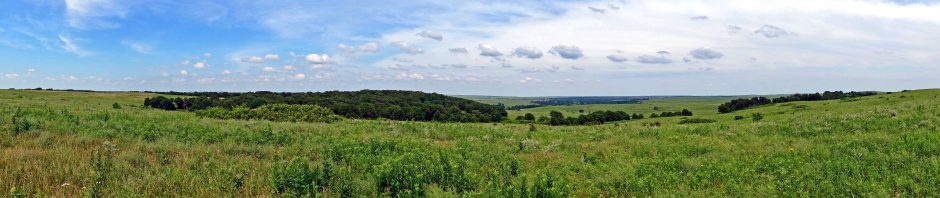
I immediately saw some prairie roses, which would be the most colorful feature of the landscape in this area. I was on the Hawk Nest Trail, arcing through the woods toward the Clearfork side loop. I shot a full panorama of the area and followed the trail as it bobbed around one of the hollows. A butterfly posed on the trail, showing its wings, and the view across the loop was quite beautiful. Prescribed burns have helped clear out some of the undergrowth, making this a charming area with good circulation on a hot and humid day.

Hawk Nest Trail

Hawk Nest Trail

Soon I was back on the Hawk Nest Trail, heading south. This wider trail led around beautiful tall oak and hickory trees, with denser undergrowth. Sturdy bridges led over creeks, with the tall trees reminding me of some of the more scenic portions of Bartlesville’s Pathfinder Parkway. The trail climbed and curved between the tall trees and sunlight streamed across the undergrowth. The sun filtering through the trees and curving trail made this a perfect woodland hike. The park includes an orienteering courses, and I passed their starting point at a bridge, where I crossed another creek and then popped out of the woodland at the special use area, a huge clearing with a few picnic tables and fire rings as well as more prairie roses.

Discovery Trail

I walked through a picnic area and over to the campground, missing the trailhead for the North Loop at the playground but finding the one for the Discovery Trail on one side of the camp area road. The Discovery Trail is a loop trail off the larger North Loop Trail to the west. The main feature of the smaller Discovery loop is No Name Creek, which runs nears the park’s Visitor Center. The trail runs along the high bank above the creek, climbing to afford a view of the meandering creek below. I found a spot where I could climb down into the creek bed to a fallen tree and strike a pose. I walked up the creek bed a ways, and then returned to the trail and made my way around past the Visitor Center and back around the loop until I intersected the North Loop Trail.

North Loop Trail

North Loop Trail

This trail led through some creek bottomland and then up through some more pretty trees to a clearing and fire line. The park is managed to control some of the second and third growth timber of what was prairie land in presettlement days. I see plenty of prairies in Kansas and Oklahoma, so I don’t at all mind the pretty woodland of tall trees which has developed here. While I liked portions of the North Loop Trail, I preferred the Hawk Nest area.

Lake Buteo

I crossed the park road and walked down past the WPA area and a modern shelter to Lake Buteo. This pretty little eight acre lake was built in 1927 and is quite shallow. It has beaver, muskrat, frogs, snakes, a variety of fish, and even freshwater jellyfish. I suppose there should be hawks about too, since Buteo means hawk in Latin. There is a trail encircling the lake, which crosses the small spillway on stones scavenged from the crumbling walls, made superfluous on this day with no outflow. The old curving stone walls of the spillway had a significant erosion gap.

Lake Buteo

I crossed the earthen dam, enjoying the panorama of the lake, and walked southeast along the lake shore, past a tree with a large distinctive knot and on along the lakeside. I clambered down to sit on a tree which had fallen into the lake and enjoyed a snack lunch there, watching dragonflies darting about the water plants, including large skimmers constantly zooming back and forth.

Leaving my perch, I walked to the marshy southeast end of the lake, which often floods through the action of beavers. One tree had a great gall. I began the trek back along the other side of the lake, seeing my lunch perch across the way. I passed a huge but dead tree and a bridge led across a small inlet back to the dam area, where two butterflies were mating.

I’d walked a total of 6.8 miles on the five trails in the eastern section of the park, and someday shall return to explore Opossum Hollow to the west. And I’ll no doubt revisit the two best trails in the east: Hawk Nest and Lake Buteo.

Tightwad Bank

Tightwad

I wanted to be back home by 10 p.m., which explains why I forsook the long Opossum Hollow Trail to the east and instead drove 50 miles south to Harry S Truman State Park. I leave out the period after the S since Harry’s middle name really was S; that is not an abbreviation. Along the way I had to chuckle at the town of Tightwad, population 69. I was even more delighted when I found there was a Tightwad Bank.

Harry S Truman State Park

Harry S Truman State Park has only two trails, neither of which turned out to amount to much. The Bluff Ridge Trail was rocky and a bit overgrown in places. A tree had two large galls and the trail eventually led along the ridge, with only glimpses of the lake far below. Finally at its far end was an overlook with a panoramic view. On the return loop was another tree festooned with galls.

Harry S Truman Reservoir Overlook

It was in the 90s and with full sun and I was quite heated, but I decided to brave the short nearby Western Wallflower Trail. It led across an open prairie top to another overlook, this time viewing westward across another arm of the lake. I could see the Highway 7 bridge I had passed over to reach the peninsula upon which the park is situated. Powerboats roared by, with a large marina visible across the lake. On the return trek I saw a Zebra Swallowtail butterfly.

Homeward Bound

I ended my third day of summer break zigzagging my way homeward across Missouri, feeling I was in the boonies when I saw a turnoff for either highway Z or highway ZZ. I pulled over to shoot the pavilion in downtown El Dorado Springs and later passed a turnoff for highways N or M, which was coincidentally the name of the Agatha Christie mystery I’d listened to on this trip: N or M? I had a tasty dinner at Cheddar’s in Joplin, and afterward was startled by the rays of sunlight bursting through the clouds near the Baxter Springs exit on I-44. I pulled over to see the setting sun pouring through a donut hole cloud. I admired the way the clouds around me were lit and then headed down the interstate with sunset-banded clouds above. This trip was a great start to my summer break!

Donut Hole Sunset

Click here for a slideshow from these day hikes

< Day 2 of Summer Break 2012: Pirates of Powell Gardens

Posted in day hike, photos, travel, video | 2 Comments

Pirates of Powell Gardens

May 27, 2012

It took a long time to edit all of the photos from my first day of summer vacation and even longer to get them and the video posted via the Overland Park Hampton Inn’s very slow WiFi. So that post did not go up until the next evening, and my post about my Sunday adventures would not go public until noon on Tuesday.

On Sunday I awoke to find the hotel breakfast room packed, so I drove down the road for a Denny’s Grand Slam and then headed east down US 50 to Powell Gardens.

Powell Gardens

Powell Gardens (click image for slideshow)

Back in 1948 Kansas City businessman George E. Powell acquired a 640 acre farm 30 miles southeast of downtown in Johnson County. Soon he was a co-owner of Yellow Transit Freight Lines and after years of enjoying the farm on weekends he donated it to the Boy Scouts in 1969 and they used it as a camp until 1984. Then the Powell Family Foundation teamed up with the University of Missouri’s School of Agriculture to develop the farm into a horticultural facility called the Powell Center. They parted ways in 1988 and Powell Gardens was established as a not-for-profit. It now employs 35 to 70 people through the year, with a new garden area opening every few years.

I arrived at 10:30 a.m., paid the $10 entry fee, and picked up maps at the Visitors Center. It wasn’t long before I was seeing colorful orchids and more as I headed southeast toward the Island Garden. The nearby lake was surrounded by seven small fairy houses and forts for youngsters and the young at heart to enjoy. Various girls dashed into the Light Wings fairy house, a rounded wooden structure reminding me of a hive.

From the shore I could see the wide lowest waterfall of the Island Garden and, up high on the hill to the side, the Meadow Pavilion which, like the visitor center and the later garden chapel, was designed by renowned Arkansas architect Fay Jones. He is well regarded for Thorncrown Chapel near Eureka Springs.

A fellow photographer was down by the shore as well, shooting the nearby Island Garden falls. I’d see many folks with lenses dwarfing mine this day, but I did not see any of them on the long nature trail later that afternoon. It pays to travel light!

Island Garden

The Island Garden

Soon I was crossing the bridge to the Island Garden, with its multilevel waterfalls and pools. The wind was buffeting spray back across the wide arc of the lowest waterfall, and across the lake was what looked like a pink tent: another fairy house.

The island pools have a Monet theme with pink and white water lilies and lotuses to admire. I soon left the Island Garden behind for the Woodland Garden, or what they term the Rock and Waterfall Garden.

Rock and Waterfall Garden

Rock and Waterfall Garden

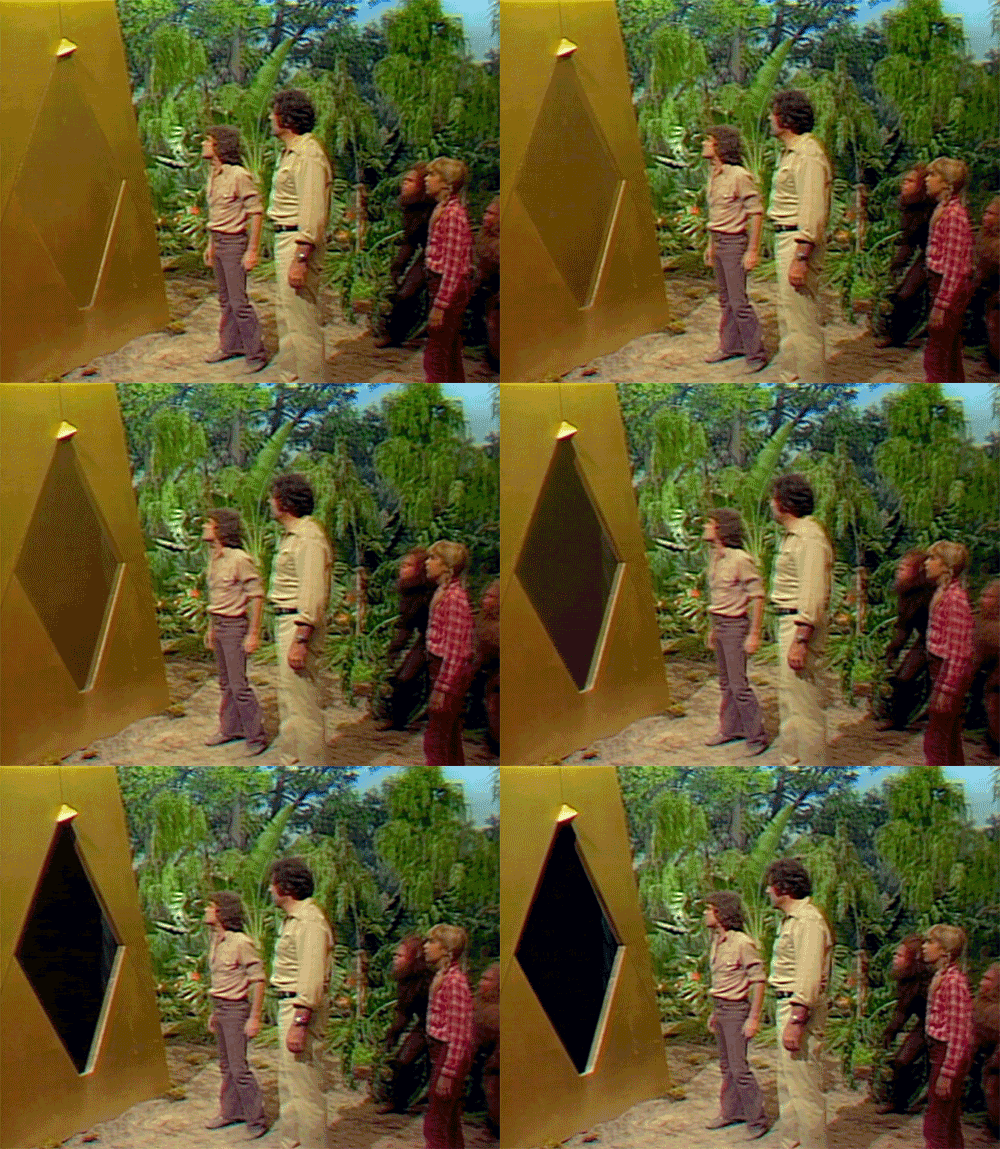
It was warming up, so I was grateful for the cool shade of the woods with a meandering waterfall stream created with dirtcrete. I found a perfect shady spot near the shore to relax and view the panorama of the Island Garden and Chapel. Nearby was the Star Tetrahedron Fairy House, which now reminded me more of a Land of the Lost pylon than a pink tent. A wind toy was making the most of the stiff variable breeze.

Perennial Garden

Adjacent to the woodland is the Perennial Garden, with its Miss Mary and New Testament Daylilies and Oriental Lilies. There was more color by the trailside, including Arabella Clematis, Asiatic Lilies, and Oakleaf Hydrangeas.

Asiatic Lily

By now I was quite thirsty, so I sidetracked to a restroom building which sported on its exterior a pop machine as well as Coronation Gold Yarrow and Bush Clematis, which required inversion to see into its bell. Beside the trail was a profusion of Sichuan Deutzia, which I approached for a macro shot.

As I re-entered the woodland, I passed a Fairy Outpost, covered in colorful paintings with equally colorful children’s scrawls. Along came Bigleaf Hydrangeas which earned a closeup. A low plant nearby had even larger pink petals, but there was no sign to aid in identification. Also near was a botanist’s creation: Let’s Dance Starlight Reblooming Hydrangea. I rested on a bench in the cool shade, posing for a self-portrait. A fence beside my bench framed one of the tiny waterfalls.

Skeleton Island

The Meadow and a Kiss on Skeleton Island

Then I was out of the woodland and climbing the big hill of the meadow. I ascended to the pavilion, where I used my 20x zoom to spy on what for this boy was the best fort, the Skeleton Island one across the lake. I caught an elderly couple up who were up on the lookout sneaking a kiss.

The Marjorie Powell Allen Chapel

I walked over to the chapel. Like Thorncrown, it has a winding approach through the woods, but this one is situated out into the open with a view of the lake, whereas Thorncrown is thoroughly ensconced in the woods. Fay Jones learned the trick of an more confined entry which then explodes outward from his mentor, Frank Lloyd Wright, although here Fay does this in the outdoors, in contrast to Frank’s use of confined interior home entryways.

I entered through the big doors to an impressive interior quite reminescent of Thorncrown, but with a big view of the lake and sky behind the altar area. The design has a nice diamond motif at the top of its doors and each ceiling support, which struck me as similar to the tetrahedron atop the Star Tetrahedron Fairy House.

Marjorie Powell Allen Chapel

I exited the chapel and walked around to its low pavilion, finding a lower level there with restrooms and a plaque about Marjorie Powell Allen. Back out front was the matching fountain, echoing some of the chapel forms in metal rather than wood.

Skeleton Island Flag

Over to Skeleton Island

I crossed the bridge back over the Island Garden, past the largest living wall in North America, where they leave out the mortar between the sandstone blocks and culture plants which spring through the cracks. Some Prickly Pear Cacti were in bloom, with even more color by the island shore.

I crossed over to tiny Skeleton Island, the wonderful fort created by Convergence Design and Henderson Engineers. There was a fun “treasure map” for the kids. A chain of geese swam by as I approached Shipwreck Cove.

It was only a few steps to the Pirate Fortress, with its fake cannon and ship’s wheel, although they hadn’t solved the problem of keeping the wheel mounted with all of the tugs and turns from the children. I mounted to the lookout, with the skull and crossbones flapping overhead.

Then I crossed back onto the mainland to see the Ice Haus fort and deliberately broke the rule of keeping the cameraman out of the shot when I shot the final fort, Mirror-Mirror, although I was disguised a tad by the distortion, which turned me into a daddy long-legs.

Butterfly Garden

Butterfly Garden

Speaking of long legs, there was a giant Praying Mantis watching over a big splashpad for the kids over by the multilevel Butterfly Garden, with its stairstep falls. Oh, and various butterflies, of course, which deigned to pose amidst the conspicuously colorful flowers.

Heartland Harvest Garden

The 12 acre edible landscape of the harvest garden is the largest in the nation and so new only bare ground appears in my Google Earth satellite shot of that area. I posed in the Apple Court and liked the Vineyard with its Hyssop planted beneath the vines. I trooped onward toward a big barn and silo in the distance. The silo had a spiral staircase leading up to an observation deck. There’s also an elevator, but I eschewed that, of course.

Fun Foods Farm

I took in the panorama of four food gardens laid out in quilt patterns and the farm area. Then I climbed back down the spiral and made my way over to the large working windmill, busy pumping water for two fiberglass animals awaiting climbers.

There was a mint garden with a selection of leaves to sample. I disliked most of them except for the Candy Mint. A giant metal mantis was begging to be climbed, so I obliged it. Thank goodness no one was about, since my first attempt at the self-portrait just looked wrong in so many ways.

A bird looked much better on his branch than I did mounting my metal mantis. Another bird hopped on the ground ahead of me, calling out to warn others of this weird farm prowler. I took that as my cue to quit the farm and hit the trail.

Turtle on the Trail

Byron Shutz Nature Trail – A Day Hike!

It was 90 degrees with full sun, so I was the only one of the dozens of patrons at the gardens who braved the 3.25 mile Byron Shutz Nature Trail. It leads around the rim of the farm acreage, making its way past wetlands, across an old Osage Orange fencerow, over creeks, across remnants of the former prairie, and past a pond built to cool the rock saws at a former quarry. The pond featured lotuses and cattails, and the trail had some coneflowers, but for the most part it lacked the varied color of the manicured gardens. There are bird boxes all along the trail.

A low ridge provided an eastern view across Johnson County and then the trail dived down into some abandoned orchards and pines with cones dating back to the Powell Center days. I was impressed that almost all of the 24 marker signs along the trail were present and intact: few marked nature trails endure so well.

I tried to get a turtle to walk with me along the trail, but he was just too slow to keep up. I popped out at the other end of the trail, between the meadow and the woodlands. I traipsed back across the island to the visitor’s center. There I visited the last garden, the tiny Courtyard Garden at one end. In a rare lapse, this one was a bit neglected even though it has the plaque remembering the Powells.

I’d walked 6.75 miles and was hot and hungry. So I drove back to Overland Park, showered, and headed out for an early dinner at a nearby restaurant, fortifying myself for another late night of editing. The final day of this three-day sojourn would take me southeast of Kansas City to Knob Noster and Harry S Truman State Parks.

Here’s a video I shot at Powell Gardens:

Click here for a slideshow from this day hike

< Day 1 of Summer Break 2012: Starting Summer in the Paris of the Plains

Day 3 of Summer Break 2012: Knob Noster and Truman Parks

Posted in day hike, photos, travel, video | 4 Comments

Starting Summer in the Paris of the Plains

May 26, 2012

Kansas City Here I Come

Friday was my 23rd commencement at Bartlesville High and I decided to launch my summer break by skipping town for Memorial Day weekend. But the forecast everywhere was in the 90s, too hot for a comfortable hike. So I decided a stroll in air conditioned environments was in order. My favorite nearby metropolis is Kansas City, so by noon on Saturday I was ensconced in McCormick and Schmick’s at Country Club Plaza, enjoying the decor as well as some fish and chips.

Country Club Plaza

Country Club Plaza (click image for slideshow)

I’m not much of a shopper anymore, but I love strolling the Plaza to view its many fountains and architectural elements. In the 1920s J.C. Nichols transformed this dumping ground with a hog farm and brickyard into a Spanish-themed suburban center.

The City of Fountains

Pomona

As I strolled around I enjoyed a wall fountain with a playful child, a 300-year-old mermaid blowing her horn, one of the clock towers and then another, the beautiful Pomona, splendid building accents and encrustations, a cat wall fountain, and the tower of the Plaza Medical Building. A little girl was giving her brother a stroll in their stroller; I thought about asking for a ride myself, but decided there wasn’t room for both of us.

There was a wall mural of a ship, possibly the Santa Maria, and a larger wall mural of a bullfight, crafted in Seville, was near the replica of Seville’s Giralda Tower. I used the 20x zoom on my camera to focus in on one of its lilies. They toil not, neither do they spin, but these are in a vase, not a field.

The Neptune Fountain was running, including its horses’ noses – thank goodness the artist didn’t treat Neptune himself that way. Bacchus was still surrounded by nymphs and satyrs outside the Cheesecake Factory, which seems a suitable spot given the great vice of our age: gluttony.

Four Horsemen

The Mississippi Horseman

I walked over to the Seville Light, with its theatrical faces of varying expression, and then cooled off by the immense J.C. Nichols Memorial Fountain with its four horsemen, representing four of the mightiest rivers of the world, sculpted by Henri Greber in 1910 and installed here in 1958. The ones for the Seine and Rhine have mermen attacking the horsemen, while the Volga has a bear attack and an alligator and Native American represent the Mississippi.

On my way back to the parking garage I passed a mother having a very quiet talk with her boy. Perhaps she was telling him how he would need to behave at our next stop, my favorite art museum.

The Nelson-Atkins Museum of Art

Some of my most popular photos on Flickr are from my July 2010 visit at the Nelson-Atkins Museum of Art, when I shot several of my favorite paintings and sculptures. So I took my camera along for this latest visit, although I could not use it in the temporary exhibit of exquisite furniture and art pieces from various world fairs. The most memorable piece was Morning Sea, a gorgeous Japanese screen by Hashio Kiyoshi, with waves created from 250 different shades of silk thread which shimmered as I paced back and forth in front of it, entranced.

Planets in My Head

Planets in My Head

In the Bloch Building’s regular exhibit I found a new piece, Planets in My Head, Physics, by Yinka Shonibare. I liked the girl figure gazing through a telescope, her head a celestial globe acknowledging our debt to the astronomers of the past.

In front of the entrance to the beautiful Nelson-Atkins building was a golf cart, used to transport handicapped guests down the long Bloch building to the temporary exhibit, transformed into a gilded cage. I decided to seek out some more favorite pieces in the permanent collection which I had not shot on my previous visit.

Gods and Men

Looking over Eros’s Shoulder

I found three brothers admiring the two Italian knights. I strode on past the Romans and then a 17th century German boxwood sculpture of Apollo and Daphne caught my eye, as did the expression on the face of the god Eros atop an ivory Pokal, or covered goblet, with Franz Hal’s Portrait of a Man lurking in the background.

A small scale replica of the equestrian statue Louis XIV as a Roman General by Girardon survives, although the original was predictably destroyed in the French Revolution. Saint Michael looks like a poof, but I did like the expressions on the downtrodden in Saint Michael Casting Down the Rebel Angels, a wood sculpture which reminds us that in the past sculptures were usually painted.

I took some more shots of Benzi’s copy of the Venus de Medici, which I had previously shot with a halo effect from a background light fixture. This time I showed more of her body, defeating her attempt at modesty and including an incongruous background mural. At her feet is a dolphin being ridden by her son Cupid.

The Guard

The Guard

Back in the Bloch gallery I had noticed that a real guard had replaced Duane Hanson’s fun Museum Guard. Well, I found him standing in another room, pondering the outside world. Meanwhile, a Pueblo clown by Roxanne Swentzell was pondering his hand. I won’t try to guess what either one was thinking.

I decided to include a close-up of Bingham’s portrait of Dr. Troost, a founder of Kansas City whose eponymous street seemed inescapable to my friend Carrie and to me on previous visits to the Paris of the Plains.

Asian Art

Funerary Urn Dragons

Then I went in search of Asian art, but a Chinese Portal Guardian gave me a queer look. I enjoyed looking at the album of 74 Chinese portrait heads, a mysterious 19th century collection using Western shading techniques which could have been a catalog book for a studio creating pictures of clients’ ancestors. One portrait in particular was quite handsome, especially after I used Photoshop to enhance the contrast of the faded image.

There were many more striking faces in the Asian art collection, including a Thai Standing Buddha and a Luohan Buddhist disciple, although another Head of a Luohan was plain ugly. One of the most popular of my Flickr photos is a portrait of the Guanyin Bodhisattva of the Southern Sea and I opted to shoot a more complete view of him from both angles and a close-up of his face.

The dragons on some juxtaposed funerary urns were quite fun, as was the tomb figure of a wrestler. And I like how the impressive Shiva Nataraja, The Dancing Lord, which is a highlight of the collection of art from India, is stamping out ignorance.

That concluded my interior shots for the day. I headed to the Rozzelle Court in the museum for a rich dessert and then braved the hot and muggy afternoon to view a totem pole. As usual, my visit to the Nelson-Atkins had been darn near perfect.

Union Station

Union Station

It was not yet evening, so I drove over to Crown Center and walked its shops, then took The Link, a series of skybridges, to Union Station. I had nice views of the Western Auto building along the way, although the air conditioning was out in part of the The Link, making it sweltering. The 850,000 square foot building, designed by Jarvis Hunt, was the second largest in the nation when it was built in 1914, but by the 1980s it was abandoned and neglected. Fully renovated from 1997-1999, it now houses a science museum and exhibit space, restaurants, and more.

This is a place where it pays to look up. The 95-foot-high ceiling in the Grand Hall has three 3,500 pound chandeliers, there is beautiful high stonework, and a 6-foot diameter clock. A colorful train mural livens up the steps leading down to the exhibit area, where I saw an exhibit of artifacts recovered from RMS Titanic. The respected Bob Ballard, who discovered the wreck, considers it a grave and is outraged over this sort of salvage, while those who profit by the salvage work argue they are preserving its legacy. Personally I’d rather see a recreation of parts of the ship and models of the wreck than exhumed bits and pieces, but I didn’t put my money where my mouth is, did I?

The station’s immense north waiting room was built out over the tracks with 16 gates and could hold thousands of people. Gate 16 unfortunately still has Bartlesville misspelled as Bartleville. The afternoon was waning as light filtered through the high flag. The days of train travelled have waned as well: AmTrak does operate out of the station, but uses only a tiny fraction of its space. So it seems symbolic to close with a lone woman in the great north hall…waiting.

Here’s a video montage from my day:

Click here for a slideshow from this day

Day 2 of Summer Break 2012: Pirates of Powell Gardens >

Posted in art, photos, travel, video | 3 Comments

Return to Roaring River

May 18, 2012

Roaring River (click image for slideshow)

Another Friday off for an unused snow day = another day hike. The coolest place within a day’s round trip was the childhood source of my love for day hikes: Roaring River State Park in Missouri. So by 11 a.m. I was in the lobby of the Emory Melton Inn perched above the park and enjoying the view along with a French Dip in the restaurant. I then parked at the store and began my 7.6 mile hike with a stroll to the hatchery, passing the fisherfolk on the riverside along the way. I admired some vetch and the closed section of the mossy spring pool falls. The open pools at the hatchery were teeming with trout, and the usual bigger trout were to be found in the spring pool. The camera’s GPS had finally locked in, so it was time to hit the trails.

Deer Leap Trail

Deer Leap Trail

I climbed up the hillside on Deer Leap Trail along carved bluffs and huge stone steps laid by the CCC boys. The trail’s many steps were quite a challenge when I was a tot, but after hiking 300 miles a year as of late, they are a breeze. At the top I posed at the hatchery overlook, with a bird flying overhead in one shot. Youngsters below were busy feeding the fish in the big pool, having already enjoyed the thrashing feeding frenzies at the strip pools.

Firetower Trail

Firetower Trail

I backtracked past the upper spring to the Firetower trailhead and ascended to follow the bluffside trail to the fork, where instead of heading across the knob to the old tower, as I’ve done on the last few visits, I instead headed along the narrow high ridge toward the former CCC kitchen, now the nature center. There was some trailside color as I walked along the fairly level ridge before the long and sometimes steep descent, with a Mourning Cloak butterfly alighting on the trail ahead of me. I passed the bluff, where a tree had fallen, and continued the descent toward the nature center.

Riverside Trails

Riverside Trails

I crossed what was once Bass Lake over to the river, clambering out on some rocks for a shot downstream. I followed the riverside trail downstream, a peaceful walk with only a few fly fisherfolk. I passed the remains of the old Bass Lake dam and headed east along the newer connector trail linking the campground to the far trailhead of the Firetower Trail.

Throughout this walk along the north bank of the river, I herded three huge blue herons ahead of me down the river, with them always careful to stay out of camera range. I passed a big tree which had snapped and at the end of my walk, where a short gravel road runs out from Highway F to the river, a butterfly collection awaited me. I managed to catch one in flight with the camera. A sulphur butterfly tried to pose as a leaf, but I was not fooled. I rested by the river a bit and then retraced my steps past the bluff.

Eagle’s Nest Trail

Eagle’s Nest Trail

I then took the low bridge across the river to the sewage irrigation area. The pretty field here is well fertilized! You can’t smell anything, but you definitely don’t want to hike through here, especially when the big sprayers start up. The eastern trailhead for the Eagle’s Nest trail is at the edge of the irrigation zone and leads west up the mountain. Soon it splits into an upper branch which leads up to the ridge and across to the Mountain Maid’s homestead and dead ends at Highway 112. I took the lower branch, which descends to parallel the river below alongside the campground. Where the river turns away and the trail leads past a hillside creek, they’ve put up a sign to divert you into the campground. But I ignored that and continued on the hillside trail paralleling the separate little campground over to Highway F.

River Trail

River Trail

I then crossed on the river bridge to the old CCC river trail with its riverside bluffs. I passed white rock walls and enjoyed the triple treat of bluff, trail, and river. A Spangled Fritillary posed on a leaf for me and a Tiger Swallowtail followed suit. Following their lead, I posed too, but seated on the bluff instead of hanging from a leaf. The bluff here is notched due to the erosion of a middle layer of stone, making a scenic spot. In one spot you can shelter under the overhang.

Devil’s Kitchen Trail

Devil’s Kitchen Trail

The trail led to the CCC lodge and I crossed over to the Devil’s Kitchen Trail. I crossed the short walkway at the south trailhead and began to ascend the knob. I reached the small cave at the north end and then headed back south past the knob on the knob. The trail made another steeper rise as it crested the top, where a fallen tree was hosting some fungi. On the far side were tall pine trees with pretty bark. I tumbled down the logs which hold back the trail erosion on this side of the hill as trucks roared past, climbing the big north hill on Highway 112 out of the park.

The trail descended to the big bluff which has the partially collapsed stone room which is its namesake. The old entrance was sealed by a collapse during my lifetime, so I made my way around to the side where you can climb up to the roof and drop in through the top or peer in from the side. I didn’t feel like jumping down into the kitchen, so I peered in through the end and was startled to see a big buzzard inside. I’m sure glad I didn’t pop in on him! He helpfully flapped out onto the roof to pose for me. I bid the bluff adieu and made my way down to the river, where two boys were playing in the same pool where I lost a treasured fake jewel in my distant childhood. Maybe they found it for me. From there it was a short walk to the park store to conclude my 7.6 mile hike.

Along with the oodles of photos, I shot some video while at the park.

Neosho’s Big Spring Park

Big Spring Park in Neosho

I drove over to the campground where I washed up and changed clothes in one of the showers. Refreshed, I drove through Cassville, disappointed to find that The Rib restaurant is closed again. So I drove on to Neosho, where TripAdvisor recommended Sam’s Cellar. It was located on courthouse square and when I opened the door the smell of beer washed over me along with uninhibited voices from below. Neither appeals to me, so I retreated three blocks to Big Spring Park, where I found an attractive waterfall.

Neosho means clear or abundant water, fitting since Big Spring’s flow is almost 900,000 gallons per day and is only one of nine springs in the city. The park is pleasant, although a neglected odd amphitheater on one wall of the former quarry is a bit strange with steps leading up to an abandoned area. You can walk down to where Big Spring flows out of the rock on the west side of the hollow. I liked the styling of the big wading pool, which reminded me of the Neptune pool at San Simeon, featured in the climax of the film version of The Great Gatsby.

The east side of the old quarry has a bluff and small cave. There is supposed to be a large cave in one end of the park, sealed up by the townsfolk in the late nineteenth century after some children were briefly lost in it. The first chamber has been found and is 125 feet wide and 5 feet deep. Some believe a much larger cavern lies beyond. What fun for local kids to have a mystery cave in their park!

I found a marker remembering the local Rocketdyne plant, which built rockets used in space missions through 1968. Located on 2,000 acres of the former Fort Crowder, the plant is now Premier Turbines, which repairs and overhauls airplane engines. Just across the street from the park is a ceramic tile mural on the side of the former Safeway store. It was commissioned and designed by local artist Lawrence J. “Larry” Sanchez, who had studied at the Boston Museum School of Fine Arts and won a mural-design contest sponsored by Safeway Stores.

Spring River Overlook

Spring River Overlook

I had a quiet and relaxing dinner at El Charro in Neosho and then drove west, stopping at Twin Bridges State Park for the overlook of the Spring River. The sun was setting as I drove into Bartlesville after a nice relaxing day in the Ozarks.

Click here for a slideshow from this day hike

Posted in day hike, photos, travel | 5 Comments

Sunday Walk in Nature’s Cathedral

Nature’s Cathedral (click image for slideshow)

Sunday afternoon I took a walk in nature’s cathedral: the tall trees section of Bartlesville’s Pathfinder Parkway. Click here for a slideshow.

Posted in photos | Leave a comment