NW Passage Day 3: Shattuck’s Windmills

Shattuck's Windmill Museum (click image for slideshow)

I awoke late in Guymon in the Oklahoma Panhandle on the third and final day of my northwest Oklahoma trip, too late for the hotel breakfast. So I drove over to J&J’s Cafe for a hot breakfast and then headed out on what I knew would be a very long driving day. I would drive 120 miles to visit the windmills of Shattuck, then proceed 170 miles for a live concert at 7:30 p.m. in Oklahoma City, then make a final 150 mile drive back home.

My journey began with the boring drive eastward along highway 3. One thing I noticed about this road was the frequent roadside tables. I stopped at one long enough to show its construction, although the wind had damaged a portion of the shelter roof. Roadside tables were once de rigueur on highways, but have fallen out of favor since folks are more likely to just grab a bite at a restaurant these days. I certainly am never tempted to dine at these little stops.

I also pulled over at infamous Slapout, Oklahoma. The story goes that a merchant there was always “slap out” of everything. There still isn’t much there, and even that is in poor repair. Nor is there much along the straight shot south off highway 3 on US 283 to Shattuck. I made that deviation from the NW Passage because of Shattuck’s Windmill Museum.

The north entry into town had a telltale sign and windmill since the museum on the south edge of town is a volunteer effort. The open-air museum has over 50 windmills of various types and volunteers come from states across the country to repair and maintain them. The most valuable windmill is right by the entrance, although its value is due to its rarity more than its effectiveness.

The windmills were all used as windpumps to pump well water for animals, and the riot of different styles showed much experimentation in rotors, unusual tail vanes, and even some lacking a tail vane. The kindly docent told me that the larger rotors with oodles of blades turned out to offer little, if any, advantage over the simpler styles and were harder to maintain. There was enough wind to shoot some video of the windmills in operation.

The museum park also features a half-dugout soddy, a re-creation using the stones from one which was seven miles southwest of town. Alex and Eva Ehrlich hewed the caliche rock from their own land in 1904 and their original dugout had two rooms, but all of the rocks could not be moved for the re-creation. They turned the dugout into a cattle shed after their lumber house was built.

The museum park also has a one-and-a-half story homestead house built in 1900 for David Steinert and his wife Hannah, who raised four children in the tiny two-room house with a combination bedroom/living room and kitchen and upstairs a bedroom attic, reached by a very steep stairway, for the kids. The children sometimes woke to find snow sifting down upon their quilts, and a curtain strung on a wire was the only separation for the single daughter from the three sons. A female schoolteacher sometimes shared the daughter’s bed in the tiny attic, which also had a large wooden box to store 50 pound sacks of flour. That’s togetherness! Fittingly, the top of the homestead house had an original wind rotor which powered the water pump of the kitchen sink.

Knowing I’d be burning a tankful of gas on my travels this day, I filled up in Shattuck and memorialized the high price I paid. I stopped briefly in Vici to shoot an old deck gun and noticed the nearby windmill had no rotor at all – they just can’t compete with Shattuck on that front.

I then drove into OKC to visit my folks and then enjoyed another great live performance by Pink Martini at the Civic Center Music Hall. The group was relaxed yet energetic and it was great to hear China Forbes singing so well after her throat surgery. The encore wrapped up at 10:30 p.m. and I headed back to Bartlesville, knowing I’d be spending hours on Sunday writing up the trip for the blog before heading back to work on Monday.

I enjoyed my outing to northwest Oklahoma, but am not tempted to return anytime soon. My forthcoming trips will be focused more on the other quadrants of the Sooner State and the forests and mountains of Missouri and Arkansas.

Click here for a slideshow from this adventure

<- NW Passage Day 2

Posted in photos, travel, video | 1 Comment

NW Passage Day 2: Black Mesa

The summit of our state (click image for slideshow)

On the second day of my adventure in northwestern Oklahoma I awoke late in my Guymon hotel room, had the hotel breakfast, and began the lonely 60 mile drive due west to Boise City. As pronounced locally, that rhymes with voice. The town’s dubious start was as a 1908 scam by developers J. E. Stanley, A. J. Kline, and W. T. Douglas, who promoted the town as a tree-lined city of paved streets, thriving businesses, railroad service, and an artesian well. The buyers of 3,000 lots would discover that none of that was true, so the scoundrels went to Leavenworth Federal Penitentiary while the suckers stayed on. The town is the birthplace of actress Vera Miles (who portrayed the sister of Janet Leigh’s Marion Crane character in Psycho) and Boise City is the only city in the continental United States to have been bombed in World War II.

Boise City Bomb

No, the Axis Powers did not penetrate to the heartland to attack No Man’s Land. The U.S. did the bombing, by accident, when the crew of a B-17 Flying Fortress on a training mission mistook the city lights for the target field and dropped six sand-and-powder bombs on the unsuspecting populace. No one was hurt, but they blew out some windows in the Baptist church and took out the roof of a garage, causing $25 in damage. Fifty years later the chamber of commerce erected a small remembrance of the event and invited the plane crew, who went on to participate in successful bombing raids on Berlin, to attend. But they declined, to a man.

Can’t blame them, really. Boise City isn’t the most congenial destination. It has recently endured the worst draught since 1908 and is the seat of Cimarron County, which has lost over 20% of its population this past decade. There are only 1.3 people per square mile in this cruel corner of Oklahoma, which explains why Boise City School District No. 2 covers an astonishing 888 square miles.

Cruel Landscape

I did not linger long in Boise City, determined to cover the 40 additional road miles to Black Mesa, the highest, coolest, and driest spot in Oklahoma. My friend Jeff and I tried to hike here about a quarter century ago, but we had no information to go by except a road map showing a state park. We mistakenly thought Black Mesa State Park would be at Black Mesa – that seems logical, does it not? But we found to our chagrin that the mesa itself is 8.5 miles northeast of the park. If you want a small lake, go to the state park. If you want the mesa, go to the Black Mesa Nature Preserve. There is a great online map of the preserve these days. Its 1600 acres were acquired by the Nature Conservancy and protects about 60% of the mesa top in Oklahoma. But a quarter century back Jeff and I had no maps and ran out of daylight. We only managed to reach lonely Kenton, Oklahoma just south of the mesa before dark. We wound up driving many hours in New Mexico, searching for a hotel room on a Labor Day weekend when every room was booked due to a racing event, and never made it to the mesa.

That unrewarding experience prevented me from ever returning until now, motivated by my day hiking and photography hobby. Dim unpleasant memories were revived by the dreary drive, with more contrails in the sky than cars along the road. On the south side of the mesa was a long building of false fronts, which I would guess is an unfinished hotel. I parked at the trailhead, with four hikers heading out ahead of me down the 4.25 mile trail to the obelisk up top marking the state’s highest point.

Black Mesa Trail Track

Helpful green arrow markers guide you along the flat part of the trail as you hike westward below the north slope of the mesa. This is definitely fly-over country: the sky was crisscrossed by contrails. A welcome bench was found about 1.25 miles into the journey. The scouts who built it took creative license and called it the Mile 1 bench and placed it at the edge of a dam which held back no water. A woodpecker had built a home in the adjacent tree, a rarity in these parts.

Black Mesa

During the next mile a clearly visible gash in the side of the mesa showed where the trail had been cut to the top, about 500 feet above the floor where I was treading over to the Mile 2 bench. A spill of black basaltic rock from the top edge of the mesa gave proof of how it acquired its name. I passed an intriguing set of large white boulders as I began the climb towards the mesa top, in an environment too tough even for some of the cholla cacti. I passed layer after layer of different rock with an expanding view back along a wide gully. Large rocks showed outgassing from their volcanic origins: the black mesa top is Raton basalt of a lava flow which originally filled a river valley in the Pliocene age millions of years ago. Later erosion exposed it and weathered down the older lower layers, leaving the flat mesa top towards which I was bound.

Panorama

Mile 3 Bench

I climbed to the Mile 3 bench and enjoyed the view, with mesas dotting the plains to the north. As I approached the top, the layer cake nature of the mesa was clearly visible. I reached the top, enjoying a tremendous view to the north along a wide rift. I shot a panorama and noted the eponymous black basalt spilling from the mesa’s edge. The track led across the flat top of the mesa towards the high point. I passed spiky plants with sharp quills and dried-up pods. One of the few remaining trail badges up top told me I was only 0.3 miles from the summit.

Obelisk

Soon the granite obelisk marking the summit, situated 4,973 feet above sea level, came into view. Several hikers were relaxing on a nearby bench. That came in handy, as we were able to take photos of each other. The granite obelisk was funded by Tulsa Tribune editor Jenkin Lloyd Jones, replacing an earlier one erected in 1928. I photographed its south and east sides, then its west and south sides, and finally its shadowed north face. I did not bother to sign in on the visitor books in the strongbox at the base of the obelisk, but instead relaxed at the bench kindly provided by Woodward’s Boy Scout Troop 251 before retracing my journey.

The sharp edge of the mesa makes it look like the road ends in a void, which it does, in a way, with a sweeping panorama. The trail cut brought a belt of sandstone protruding from the prairie into view, and a distant mesa had a very different thick hard layer forming its top. Down on the flat a survey team drove past on their 4-wheelers, stopping to check if I needed any water. I thanked them but declined and trod slowly after them, finally reaching the car to end the 8.5 mile trek. Golly, I’d hate to do this hike in the summer!

I popped down the road a few yards to stop and view some dinosaur tracks visible in the bed of North Carizzo Creek, which looks like a wide ditch. Silt meant I could only locate one of the three sets of tracks near some concrete reinforcement in the creek bed. Upstream trees struggled to survive along the creek bank in this hostile environment. More than eighteen tons of camptosaurus, stegosaurus, brontosaurus, diplodocus, and edmontosaurus bones have been quarried in this area of the Panhandle, revealing it to once have been a lush swampy forest – a far cry from its current dessicated state.

I then drove through Kenton, which is almost a ghost town these days with no businesses left in operation. It wasn’t long before I was in New Mexico and I promptly turned heel and returned across the dry headwaters of the Cimarron River. The setting sun behind me created a wide bank of pink across the sky which slowly rose, widened, and faded along the journey eastward toward my hotel room in Guymon. There I would discover that while my sunscreen had protected my nose, forearms, and the back of my neck, I really should have spread some around the front of my neck as well!

On the next and final day of my trip I would journey back along the Northwest Passage towards Oklahoma City, with a notable stop in Shattuck.

Click here for a slideshow from this day hike

NW Passage Day 3 ->

<- NW Passage Day 1

Posted in day hike, photos, travel | 2 Comments

NW Passage Day 1: Marland and Midgley Manors

Marland's Grand Home (click image for slideshow)

I decided to spend the last part of my 2012 Spring Break at tourist sites I’d previously neglected in far northwestern Oklahoma, extending out to the very tip of the panhandle, or “No Man’s Land”. I spent many hours driving what signs proclaim as Oklahoma’s “Northwest Passage” during this three-day adventure.

I began with the exasperating drive west from Bartlesville to Ponca City along US 60. The route remains mostly a shoulderless two-lane road bobbing through the Osage Hills. I was delayed by the typical problems created by this inadequate road, stuck behind the slow wide load of a section of metal grain silo until the driver was able to pull over by the entrance to Osage Hills State Park and allow the accumulation of cars behind him to pass.

The weather was misty and overcast with frequent light rain all of the way to Ponca City, where the weather had the refinery producing immense clouds over the road as I turned north to visit Marland’s Grand Home.

E.W. Marland was a colorful oil man who became a self-made millionaire twice, married his adopted daughter, and became Oklahoma’s tenth governor. He made his first oil fortune back east and lost it in 1907, came west to the Ponca City area and by 1920 he was almost a billionaire in inflation-adjusted dollars. From 1914-1916 he had built for him and his first wife, Mary, a great home on Ponca’s Grand Avenue. He and Mary adopted her niece and nephew, Lydie and George, in 1916. After Mary died in 1926 E.W. had his adoption of Lydie annulled and married her in 1928. I’ve repeatedly visited the gorgeous Marland Mansion he built between 1925 and 1928, one mile from his Grand Avenue home. He only briefly enjoyed that grander estate with Lydie before his company was taken over by J.P. Morgan. Marland and Lydie vacated the mansion for its smaller artist studio and guest house by 1930.

Marland’s bad experiences with eastern banking interests made him an oddity among his fellow Oklahoma oil men: a New Deal Democrat who would be elected to congress for 1932-1934 and elected Oklahoma’s tenth governor from 1935-1939. He seemingly took his oath of honesty seriously, as he and Lydie were impoverished at the end of his term and moved into the former chauffeur’s quarters at the mansion in 1941, selling off the remaining mansion property, with E.W. Marland dying a few months later. Lydie lived in the chauffeur’s quarters until 1953, then roamed the country for 22 years working odd jobs. A childhood friend of hers financed her return to the chauffeur’s cottage in Ponca City in 1975, and Lydie lived there until her death in 1987.

I have thoroughly enjoyed each of my previous visits to the 1928 mansion and what remains of its grounds, but had never toured what is called “Marland’s Grand Home” – a fun play on words for the 22-room mansion he and Mary shared on Grand Avenue from 1916 to 1926. While the pink stucco home on Grand Avenue may pale in comparison to the magnificent mansion a mile to the northeast, the 16,500 square foot Italian Renaissance Revival home on Grand Avenue was a wonder for its day with its central vacuuming system, automatic dishwasher, attached three-car garage, and the first indoor swimming pool in Oklahoma.

The Grand Home once had extensive formal gardens stretching several blocks eastward as part of the 15 acre property, and despite later being sold for housing parcels you can see its traces to this day on the Ponca City street map, where 11th,12th, and 13th streets oddly do not connect Grand Avenue to Central Avenue one block south. The property had four hundred trees transplanted from the Arkansas River Valley as well as scores of magnolias from Avery Island, Louisiana.

While his later mansion was designed by architect John Duncan Forsyth, who would later design Bartlesville High School, the Grand Home was designed by Solomon Andrew Layton, whose firm designed many Oklahoma City landmarks including the State Capitol and Skirvin Hotel, and also designed such landmarks of the University of Oklahoma campus in Norman as the Evans administration building, Bizzell Memorial Library, and Oklahoma Memorial Stadium.

The entry foyer has a large hanging staircase with turned spindle balustrade, illuminated by a Waterford Crystal chandelier which is worth more than my annual take-home pay. To the right is the oak-paneled library, which features a large wall painting, commissioned by Mary and later retrieved from the mansion, of Marland and friends out on one of the silly fox hunts he set up out at Lake Ponca. A Marland Oil sign hangs nearby, its familiar form reminding us that his company became part of Conoco. Fireplaces and chandeliers are a focus of attention in the home, including the library.

To the left of the foyer is the living room, with a fireplace featuring marble from the palace of Maximilian and elegant accents. Farther east is my favorite room in any mansion, the sun room. This cheerful and more relaxed room has a floor of black and white marble squares and would have provided a view of the four city blocks of formal gardens. The adjoining dining room has dark walnut wainscoting with silver and mirror wall sconces, along with another Waterford Crystal chandelier. Artist George Stanley Lasarsky hand painted the walls above the wainscoting and later would do the same for Philbrook in Tulsa.

That was followed by the functional butler’s pantry and kitchen with the entire home reminding me greatly of the larger mansion nearby in style and comfort. Even the less showy areas of the home feature wonderful Art Deco light covers of varying styles.

The most unusual feature of the home is the indoor swimming pool under the east patio, reminding me of the former one at the White House, which is now the press briefing room. It originally was lit from above via glass squares in the patio deck. The remainder of the basement level has archeological displays and an extensive and fun collection of memorabilia from the Miller Brothers 101 Ranch and Wild West Show. Located seven miles south of Ponca City, the immense ranch was home to a touring show which thrived in the early twentieth century. The former three-car garage is home to some Daughters of the American Revolution memorabilia.

I took the grand staircase up to the second floor, which has a few Native American displays scattered about the former bedrooms. The stand out for me was a girl’s room with hand painted scenes of active teenage girls reminding me of the little vignettes decorating the interior covers of Grosset & Dunlap’s Nancy Drew books. I wonder if Lydie had any notion of what adventures awaited her?

I exited the home and admired the façade another pretty home on the northwest corner of 10th and Grand, and then drove a few blocks to the Spanish Colonial style City Hall built in 1917 and designed by Layton and Smith. I saved a tour of its interior for a future trip, but admired the statue of E.W. Marland, which was sculpted by Jo Davidson and moved from his estate when it was donated by Lydie to the city in 1941. There is a nice Cherokee Strip Land Run bronze out front, sculpted by Jo Saylors and funded by citizens to celebrate the centennial of the run. Ponca City is smaller than Bartlesville and has a similar oil industry history. It is interesting how Bartlesville retains a much larger corporate presence and a healthier economy, yet Ponca City has a grander public space.

It was time for a delicious lunch of fajitas with puffy chips at Enrique’s at the Ponca City airport. Then I drove 70 road miles southwest to Enid for my next stop: the bizarrely magnificent Midgley Museum.

Midgley Museum

I pulled up in front of a small rock house, and do I mean ROCK. Dan and Libby Midgley used their oil money to go a-hunting for animal trophies along with rocks, fossils, and petrified wood. They encrusted the entire house with 34 different kinds of stone, including immense petrified logs. The stones were collected in Oklahoma, Texas, New Mexico, and Arkansas, with most of the rocks and fossils found near Lake Texoma. I’m not sure all of the collection was acquired legally, since the kindly volunteer couple manning the museum for the local Masonic lodge mentioned that one load of petrified wood hauled in by Dan’s workers from Arizona turned out to be from the protected petrified forest and he was fined $40,000 for the transgression and then had to have it all hauled back home to Arizona.

Out front is an odd little Masonic display and a truly immense petrified stump. The Midgley home’s interior is a collection of both valuable and worthless bric-a-brac with more rock encrustations on both fireplaces. A big trophy room has mountings of many animals both Dan and Libby shot, although I preferred other oddities such as a large Pond Creek School stage fire curtain adorned with painted advertisements. Amongst the many impressive rock specimens lurked a space monkey image, which gives you a pretty good idea of the wackiness on display. It was a fun stop with friendly docents.

Then I headed out west on US 412 to intersect Highway 3, proclaimed repeatedly by highway signs as Governor George Nigh’s Northwest Passage. He spearheaded funding to improve that road leading northwest from Oklahoma City up into and along the Panhandle. I drove over 200 miles from Enid to Guymon, my resting place for the night before hiking Black Mesa the following day.

The heavy clouds were a pretty addition to a rather monotonous drive through farm fields and ranching pastures as low mesas began to dot the landscape. The sun was setting as I approached Guymon for a late pizza and a welcome hotel bed.

Click here for a slideshow from this adventure

NW Passage Day 2 ->
Posted in photos, travel | 1 Comment

Skyscrapers in the Mist

Driving past downtown Tulsa tonight I was lured into circling the skyscrapers by the First Place Tower blasting broadsides of light into the mist above the other buildings. Click here or the image below for a slideshow.

Skyscrapers (click image for slideshow)

(With apologies to Dian Fossey)

Posted in photos | Leave a comment

The Phillips 66 Speedway and Signs of Spring

Through June 2018 the Bartlesville Area History Museum has an exhibit on display all about Micro-Midget Racing in Bartlesville!

The Museum is open M-F from 10-4 on the top floor of the City Center at 401 S Johnstone


Speedway Remains (click image for slideshow)

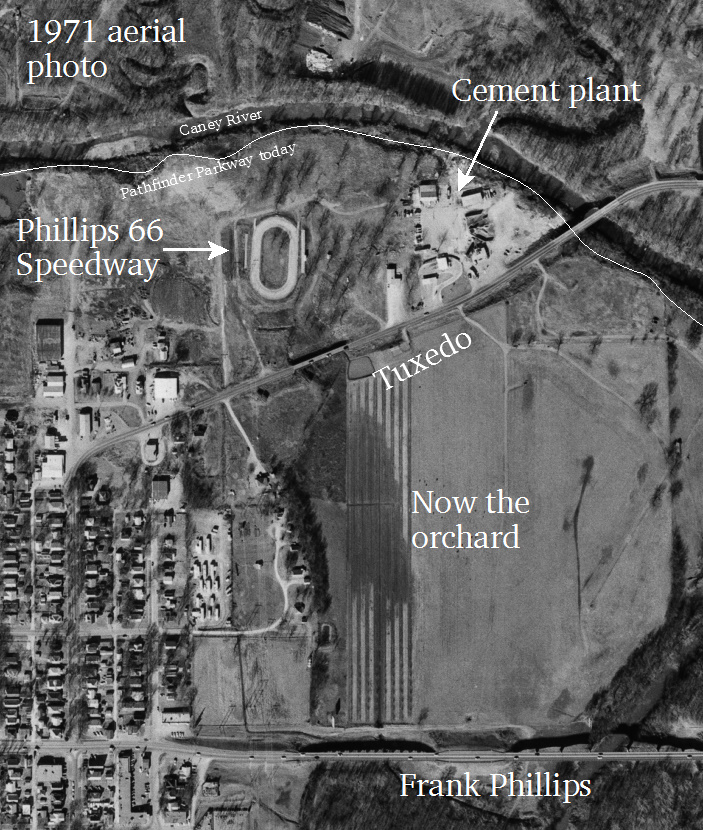
I walked the Pathfinder Parkway on a warm but overcast March afternoon on a quest to find the remains of The Phillips 66 Speedway, a Micro Midget racetrack which was tucked between Tuxedo Boulevard and the Caney River just east of Quapaw and Comanche. In a previous post I tracked down aerial views of the track and I wondered how much still remained in 2012.

The asphalt track disappeared long ago and the entire area is now heavily overgrown. Heavy growth and trees mark the center island of the speedway, with the remains of the east and west stands to either side, slowly succumbing to the relentless encroachment of nature.

The speedway is just south of my favorite bench on the Pathway, with horses grazing on the property immediately west of the former speedway. The area is along the power line route leading to and from the big PSO plant just south of Frank Phillips Blvd.

The area in question.

During my 4.75 mile walk from Atwoods to the location, I shot every little spring flower I encountered. I can never remember the names of plants, but I managed to identify wild blue phlox (both furled and unfurled), henbit, dog violet, the ubiquitous red buds, Bradford pear blossoms, and dandelions of different styles, and finally two examples of white flowers which I leave unidentified.

Click here for a slideshow from this walk

Posted in day hike, photos | 3 Comments