June 16-17, 2023 | Photo Album

There are two roads from Santa Fe to Taos. Each begins in Española, a 30-minute drive north of Santa Fe. The high road is more scenic, winding through the Sangre De Cristo mountains for 105 miles. Wendy and I took it in 2019.
So this time we took the low road, which winds for 70 miles, much of that along the Rio Grande. We stopped at the Rio Grande Gorge Visitor Center, where they had a print of a view from the west rim by Geraint Smith. It was priced at $450, and I’ll allow you to compare it to my own iPhone 14 Pro snapshot of the view from the road.


The Rio Grande is the fourth longest river in the USA. The Missouri is 2,341 miles, the Mississippi is just barely shorter at 2,340 miles, the Yukon is 1,979 miles, and the Rio Grande stretches 1,759 miles from southwestern Colorado to El Paso, Texas where it then forms the southern border of both the state and the country to the Gulf of Mexico.
We enjoyed tamales and tacos at Mante’s Chow Cart SouthSide in Taos, and then headed east on US 64 across the Sangre de Cristo mountains, the southernmost sub-range of the Rocky Mountains. They are generally much lower in New Mexico than in Colorado. The portion in Colorado has ten peaks above 14,000 feet, but there are several peaks over 13,000 feet near Taos and Santa Fe.
The two-lane highway is edged by giant, sandy-colored rocky cliffs with distant green peaks. It follows the Rio Fernando de Taos stream through the mountains for 20 miles to the Moreno Valley. The Angel Fire ski resort is at the south end of the valley, and we drove into town to use a restroom at a grocery store there.
Then we drove north to Eagle Nest and turned east to cross another section of the Sangre de Cristos to Cimarron. That took us across the midsection of the immense Philmont Scout Ranch.

Philmont covers over 140,000 acres of wilderness and was donated to the scouts by oil baron Waite Phillips. Waite was based out of Tulsa, and donated his 72-room mansion there to become the Philbrook Museum of Art. When he donated Philmont to the scouts, he not only included its water, mineral, and timber rights, but also endowed it by donating the Philtower building in downtown Tulsa. He was the brother of Frank and L.E. Phillips who founded Phillips Petroleum in Bartlesville.
From Cimarron we drove northeast to intersect Interstate 25, which took us north through Raton, a few miles south of the border with Colorado, and on to Trinidad. Once we could see Fishers Peak, I knew we were close.

Trinidad
My first visit to Trinidad was in 2012, and I liked it enough to take Wendy there last year. We were pleasantly surprised at the accommodations of the Family Suite at its La Quinta and booked it again for this visit.
We turned off Interstate 25 to follow the route of the old Santa Fe Trail into town. Wendy wanted a sandwich, and TripAdvisor led us to the Sub Shop at the Whistle Stop convenience store. Our sandwiches were top-notch, as was the service.
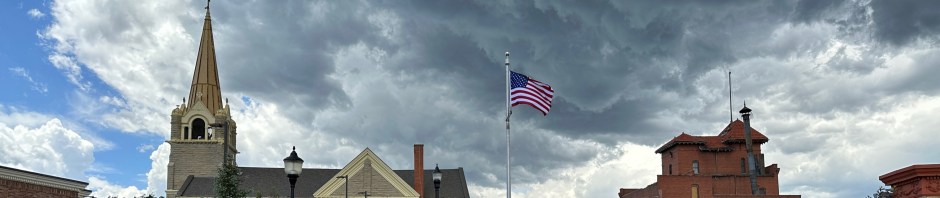
We had breakfast the next morning at the La Quinta and then drove downtown to return to the A.R. Mitchell museum we had enjoyed last year. We again parked a couple of blocks away in the public lot east of the Most Holy Trinity Catholic Church and the imposing old abandoned brick Schneider Brewery. It was built in 1866 and was one of four breweries in Colorado to survive prohibition by making non-alcoholic beer or malted milk or by bottling soda water.

The brewery fell into disrepair in the late 1950s and has been mostly vacant for decades. New owners plan to demolish parts of the structure that have become structurally unsound while renovating much of it. We shall see in the coming years if they can make a go of it.
We strolled through the Sister Blandina Wellness Gardens and then along Main Street, popping in at a thrift store so Wendy could see if they had any Barbie dolls. She has been re-rooting the hair on old dolls as a hobby. They didn’t have any dolls, but I loved the melting pot of old phonograph albums they had on display.

The A.R. Mitchell Museum of Western Art was again a treat, with us admiring Robert Martinez’s Blue on Black Coyote.

Upstairs was a fun exhibit about the Fox West Theatre with old projector equipment and many old movie posters.


Seeing the poster of George Pal’s 1961 movie about Atlantis set my mind pinballing around the world of science fiction of my youth.
I first thought about a book I enjoyed as a youngster: Lester Del Rey’s Attack from Atlantis of 1953. Its premise included crystals from undersea volcanoes that created forcefilm bubbles that excluded liquids and solids with unlimited force. The poster reminded me that Pal’s film also featured crystals, albeit ones that absorbed sunlight and could fire heat rays.
Before I fixated on the poor physics of both works, my mind dredged up that the special effects and miniatures in the film were by Project Unlimited, a group that included Wah Chang. He was the non-union artist who built several creature costumes used in the original Star Trek series, designed the communicator and Vulcan harp props for it, and built the original Romulan spaceship model.

Then my mental railcar jumped tracks to how Project Unlimited had also built masks, creatures, and special effects for the earlier series The Outer Limits. I wondered if Wah Chang built the eponymous hand for my favorite episode, Demon with a Glass Hand.
To escape the mental ricochets, I strode past the wall of posters to look at a large old sign near the front windows, which thankfully diverted me from science fiction to westerns.
It was an advertisement about Hopalong Cassidy promotional gifts. William Boyd portrayed that fictional cowboy in 66 films from 1935 to 1948 and then in radio and television series until 1952. I’ve never seen a Hopalong Cassidy show nor read any of the stories; my childhood experiences with western series were limited to The Lone Ranger and the genre-blending The Wild Wild West.
But the internet informs me that Boyd’s portrayal of Cassidy was of a clean-cut sarsaparilla-drinking hero who never shot first, while the character in the original novels of Clarence E. Mulford was rude, dangerous, and rough-talking. The name came from his walk, which had a little “hop” in it after he was shot in the leg during a gun fight.

Another exhibit was of framed photographs by Edward S. Curtis. I liked The Rush Gatherer – Arikara, and a photograph of Chief Joseph of the Nez Perce inspired a previous post.

For lunch, we walked a half-mile up Main Street to Tony’s Diner, where Wendy enjoyed a BLT while I indulged in a French Dip and a chocolate shake.
After lunch, we returned to the minivan. Lowering clouds were an omen of a tornado and hail storm brewing up north, along our path to Manitou Springs.

Photo Album | Next Stop: Manitou Springs | Previous Stop: Santa Fe







 Meador Manor