
We barely left town over the 2024-2025 Winter Break, and while we had planned to get away to Oklahoma City during Spring Break, a dust storm led us to just enjoy lunch at one of the two surviving El Chicos in Tulsa and then return to Bartlesville. So when making reservations on April Fools’ Day for my annual two-week June vacation, I decided we should try to hit OKC again, as we were way overdue for burgers at Johnnie’s Charcoal Broiler.
I knew that we would be anxious to escape the summer heat and humidity by mid-June, and that Wendy did not wish to fly. That meant driving to either northern New Mexico or western Colorado, where high altitudes could provide some climatological relief.
Both April and June turned out to be unusually wet in Bartlesville, so I was glad I ended up choosing our typical summer vacation spot of Santa Fe, New Mexico. Santa Fe’s altitude provides a welcome summertime escape from Bartlesville’s humid subtropical weather (Cfa). For those not keeping track, I had stayed in Santa Fe ten times over the previous fifteen years, with Wendy joining me for the last seven of those trips.
This trip began with a drive down the Turner Turnpike. For decades, I made that pilgrimage multiple times each year to see my parents in Oklahoma City, but in 2022 my father passed and my mother moved to Bartlesville. So my visits to my hometown increased drastically in early 2022 but then were abruptly curtailed.
Back in 2017-2018, the turnpike was widened to three lanes between Sapulpa and Bristow. Thankfully, the Access Oklahoma project will widen the remaining 68 miles of the turnpike. The project might conclude in 2036 and is projected to cost $2.5 billion. I welcome it, having endured decades of ever-increasing truck traffic over the Turner’s route through the hilly crosstimbers. The road is currently being widened southwest of Bristow, and a new bridge is going up at Wellston.

One way I dealt with the severed connection to my hometown was a plethora of posts in 2022 and 2023 about Windsor Hills, Putnam City, and Tex-Mex food, pizza, and burgers I enjoyed in my youth. After our failed attempt to visit OKC in the spring, I ordered some of Johnnie’s hickory sauce for Wendy, and it was a fait accompli that we would return to Britton Road so Wendy could order a #1 with Johnnie’s sauce while I opted for my usual burger with just cheese and mayonnaise. We were both loyal to the late Johnnie Haynes’ preference, ordering our burgers with shredded, not sliced, cheese.
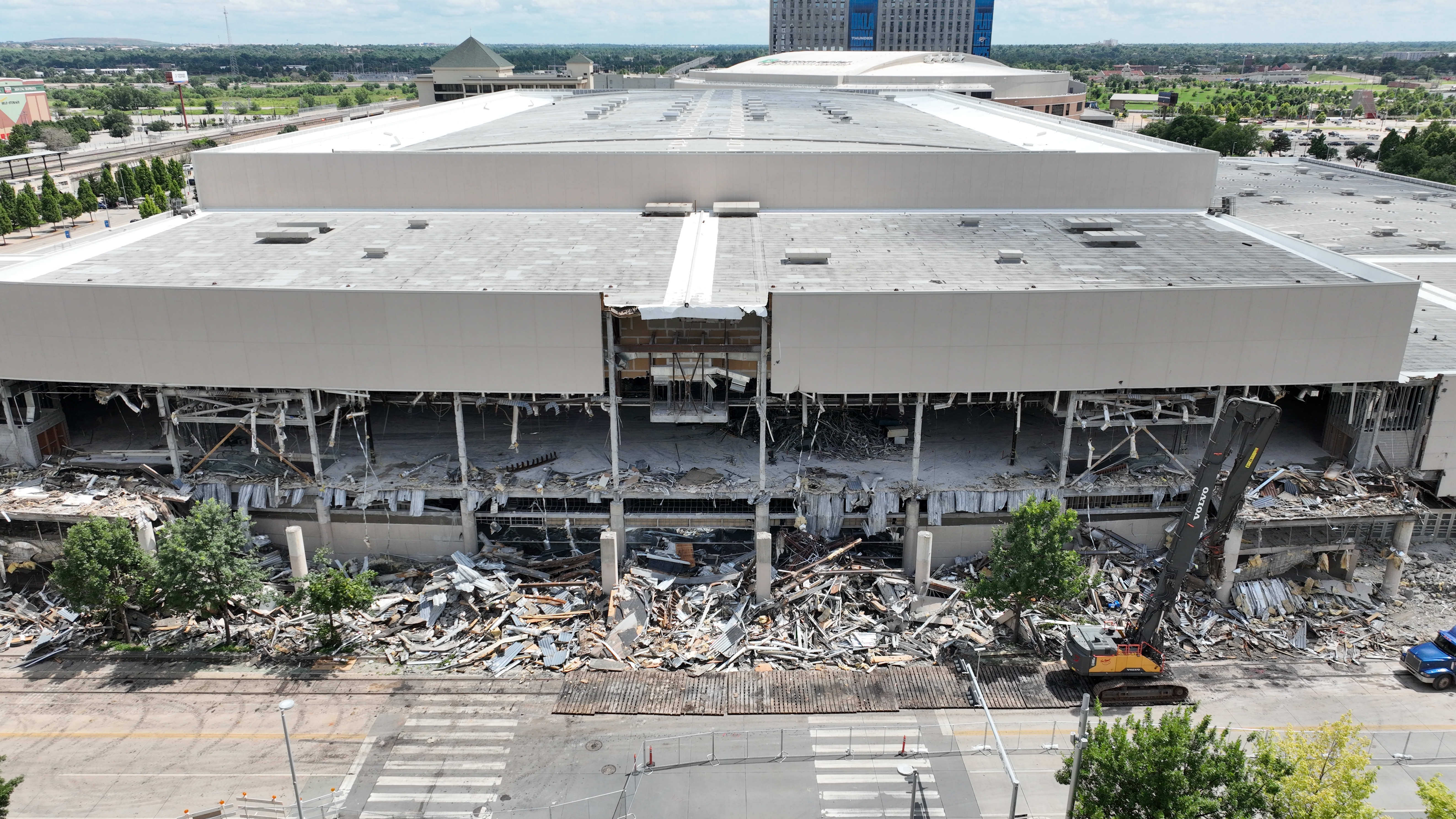
Although we ventured downtown for its art museums, I resisted going by the former Allen Morgan Street Memorial Myriad Convention Center, which is being demolished and was featured in my January 2025 post on OKC Urban Renewal. I preferred not to witness the destruction of the place where I attended a couple of proms, graduated from high school, and participated in various conferences over the decades.
We exited Interstate 40 to follow Oklahoma City Boulevard westward, which in my youth was the original route of the elevated crosstown expressway. We caught passing glimpses of the large new Omni hotel, the new convention center, and Scissortail Park before turning north on Walker Avenue and then east on Colcord to park in the Arts Garage by City Hall.
Oklahoma City Museum of Art
While I was growing up, the city’s art museum was in a building on the state fairgrounds and concentrated on 20th-century American painting and photography. There was a second museum, the Oklahoma Museum of Conservative Art, that exhibited European representational works, but it was up in snooty Nichols Hills, and I don’t recall ever visiting it.
The current and vastly improved museum opened in 2002, and it has always featured glass creations of Dale Chihuly. We took a quick stroll through that gallery but focused our attentions elsewhere.
There was an exhibit of Ansel Adams’ photography, but that has never appealed to Wendy, and I’ve seen enough exhibits of his work, including a large show at Gilcrease in 2008, to satisfy my interest. We paid far more attention to a Postwar Abstraction exhibit.
Wendy liked the color field Willem de Looper created without brushes by flooding his canvas with layer after layer of thinned acrylic paint. It reminded me of some of the paint pours she created before shifting to her current interest in rerooting the hair of Barbie dolls. She accessorizes and donates many of them to children at one of our underprivileged schools.

We both liked Cool Staccato, a large color bar painting by Gene Davis, and I convinced Wendy to pose in front of it.

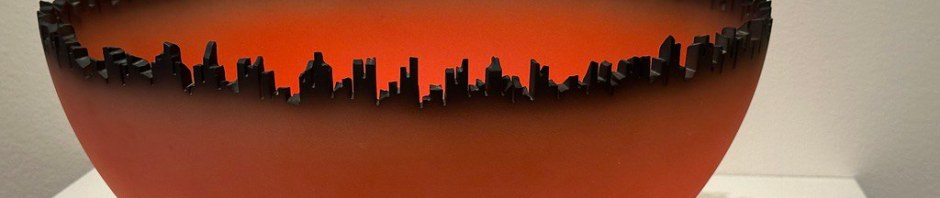
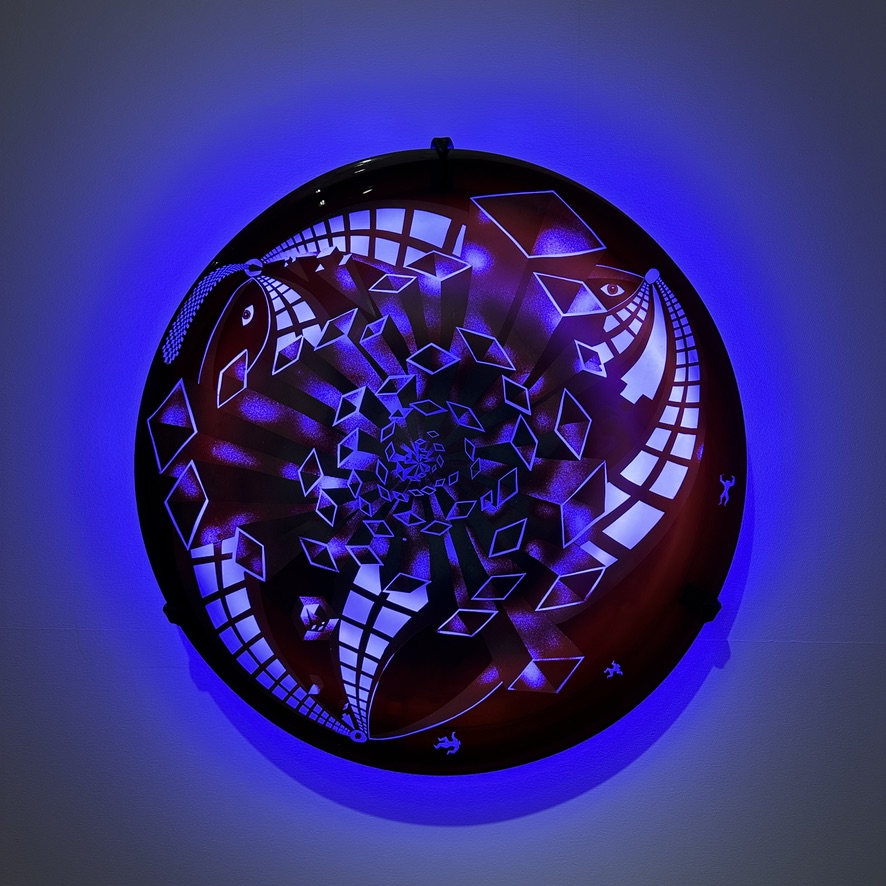
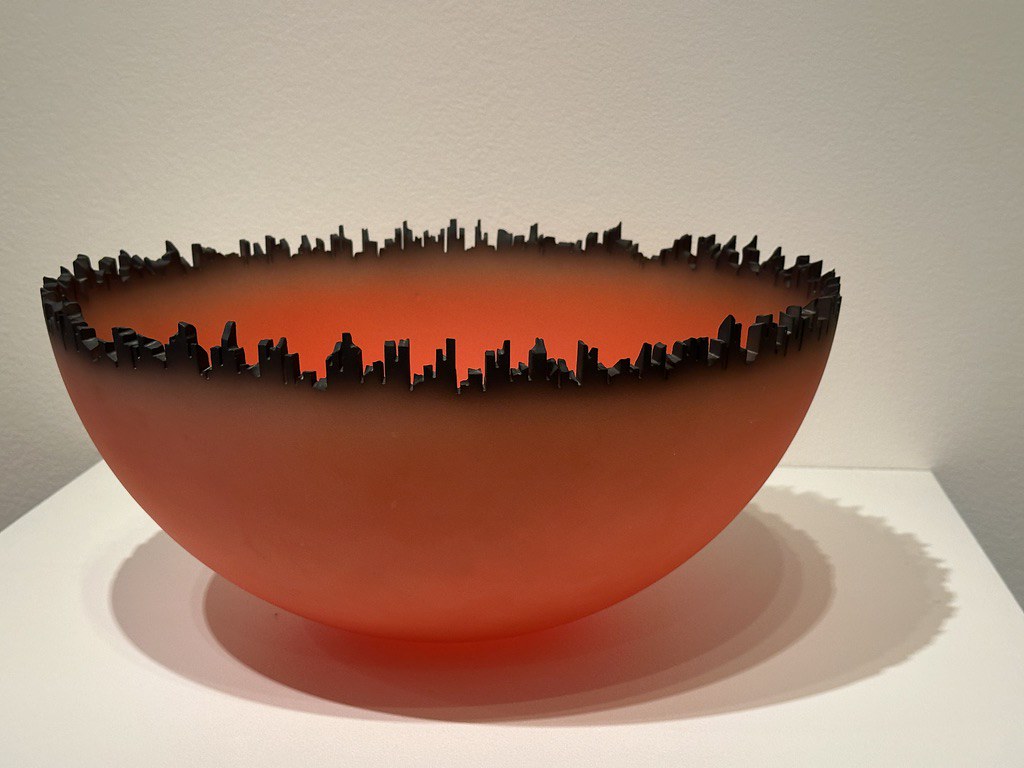
A couple of glass pieces, not by Chihuly, caught my eye: Steve Tobin’s Neon Wall Piece and Cityscape by Jay Musler. The latter was a sphere of blown Pyrex glass that had been cut in half with a notched skyline created around the rim by high-pressure sandblasting, followed by airbrushing with oil paint.
I like anything by Thomas Moran, and Oklahoma City has long had one of his Grand Canal paintings.

I also like View of the Basin of San Marco by Ippolito for its lovely sky.


Wendy liked Port of Cassis (Marseille) by Charles Camoin.
Oklahoma Contemporary
We next drove over to the west side of the railroad tracks at 12th Street to visit the Oklahoma Contemporary Arts Center. It opened in 2020, and we had never visited it before.
We noticed a t-shirt with Folding Light by Matt Goad, and we liked that enough for me to order a print for Wendy since the only print at the museum had been damaged.

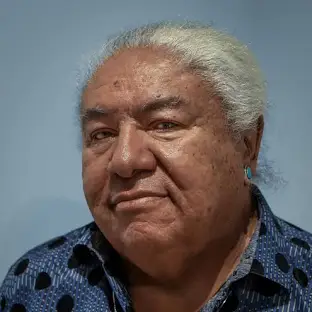
The entire museum was being used to display works by Hock E Aye Vi Edgar Heap of Birds, a multi-disciplinary artist who is Southern Cheyenne. He was born in Wichita, Kansas.
His works include public art messages, acrylic paintings, prints, and monumental porcelain enamel on steel outdoor sculpture.
Several of the installations were groupings of monoprints with brief lines of text. A red grouping spoke of the troubled history of the First Peoples and European conquests. One of the panels, Do Not Dance for Pay, is a repeated element in his artwork. It is a critique of the expectation that indigenous artists should primarily create art for commercial purposes or to entertain non-indigenous audiences, rather than expressing their own culture and addressing social and political issues.

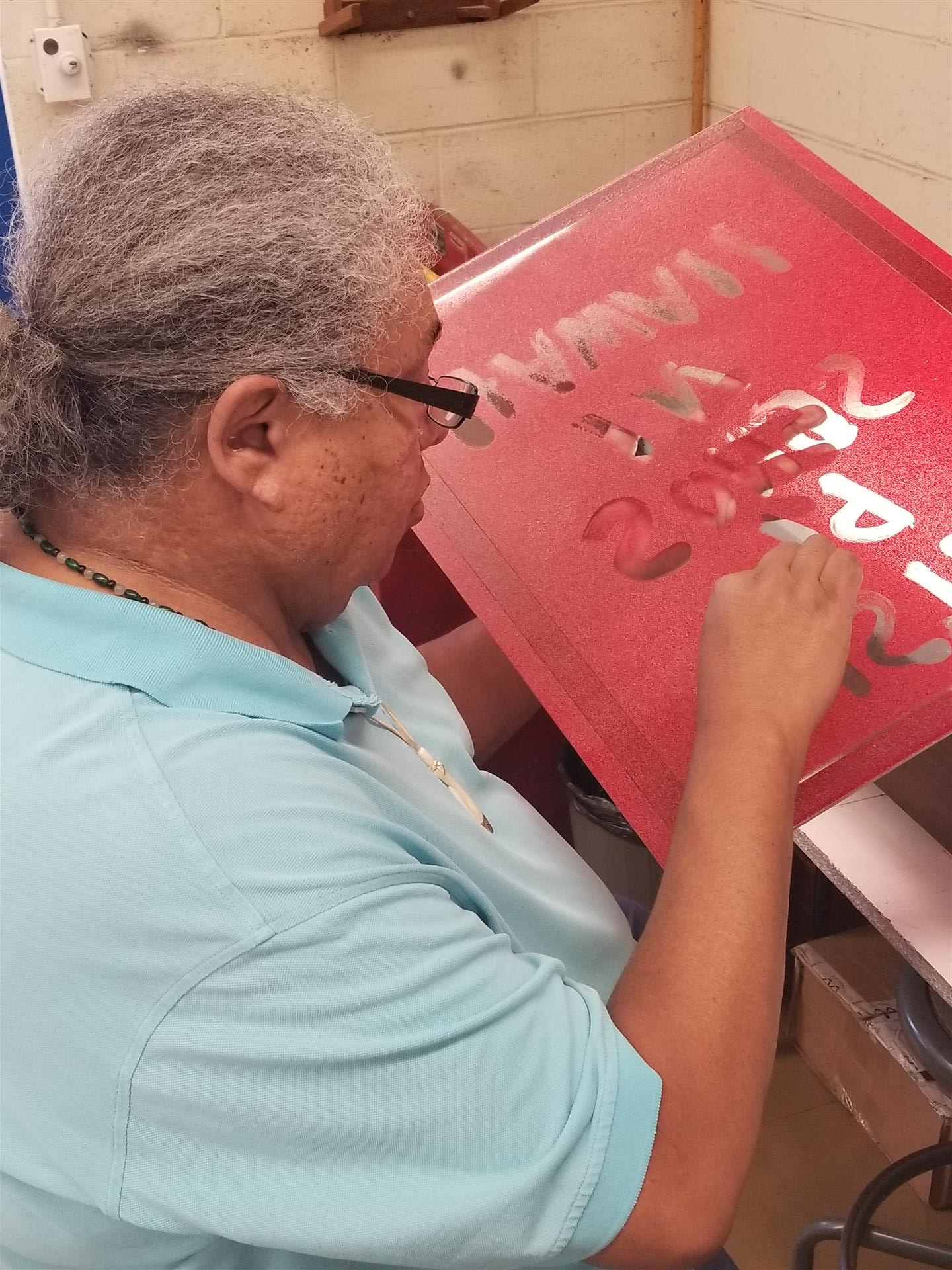
A set of typeset posters also spoke to exploitation of Indian culture.

A large brown display spoke to immigration and border policies.

A set of blue prints had a mix of messages.

The museum included a print of Prairie Fire by Francis Blackbear Bosin, who was both a teacher and a major influence on Heap of Birds’ artistic practice with his Flatstyle painting.

There was a print from the Highway 77 Series by Kiona Wooten Millirons, with her naked form layered in among rocks. An Oklahoma City artist, her more recent works have explored her journey through the aftermath of her sister’s death and the trial of her sister’s murderer.
We enjoyed exploring the studio spaces along a hallway in the museum, which were in use for summer art camp. Happily the creators of the bold linear designs along the corridor walls were credited.

Wendy and I make a point of visiting both the Nelson Atkins Museum of Art and the Kemper Museum of Contemporary Art whenever we visit Kansas City, and the New Mexico Museum of Art and the IAIA Museum of Contemporary Native Arts when we stay in Santa Fe. Now we can similarly visit the Oklahoma City Museum of Art and the Oklahoma Contemporary whenever we visit OKC. Our NARM cards from our Woolaroc memberships grant us free access to all of those institutions. (They also work at Philbrook and Gilcrease in Tulsa, but Gilcrease won’t re-open in its new facility until the fall of 2026.)
Hotel
Wendy and I used to stay at the DoubleTree by Hilton north of the airport, but later shifted to an Embassy Suites off Northwest Expressway. I decided to try the older Embassy Suites north of the airport on this trip; I remember when it was constructed in 1983.
The hotel was okay, having been renovated in 2012, but it was showing its age. I think we might shift back to the one on Northwest Expressway in the future. We didn’t bother with the hotel breakfast, instead driving to the Jimmy’s Egg on Highway 66 just west of Portland Avenue, which was one of my father’s three favorite breakfast places along the Mother Road near my parents’ home from 1978 to 2022. The others were a Dunkin’ Donuts east of Meridian Avenue and Jim’s Diner at Council Road.
Mall Memories
The only other stop we made in OKC was an evening visit to Penn Square Mall. It was built in 1960 as open-air shops in various styles. I preferred the enclosed Shepherd Mall, especially in summer and winter, which was the city’s first enclosed mall in 1964. Penn Square was enclosed in 1982, enabling it to outlast Shepherd, which lost its last anchor store in 2003 and became an office complex.
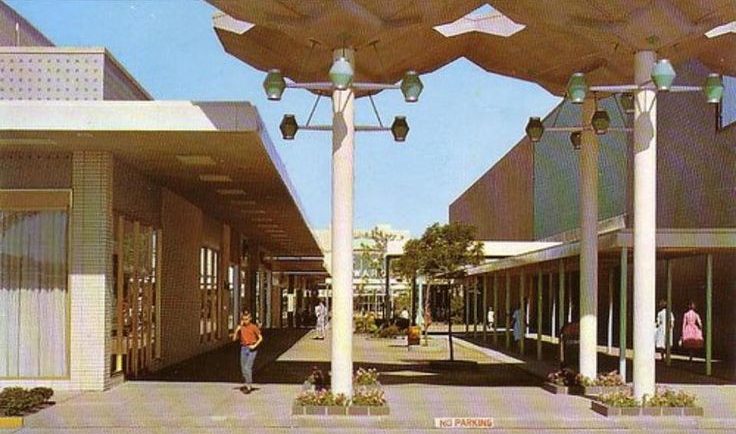
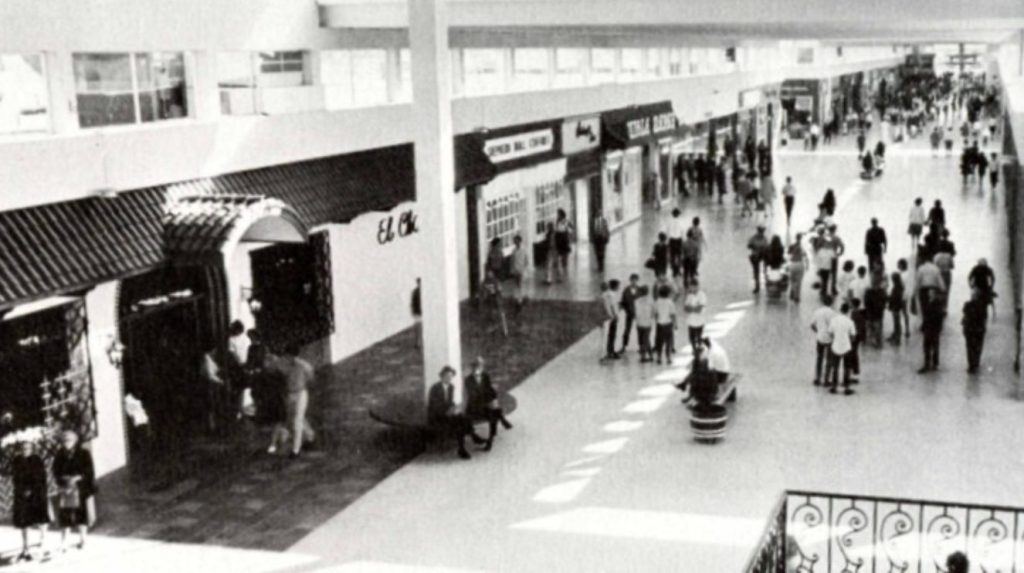
OKC once had several thriving malls: Shepherd from 1964 to the 2000s, Penn Square since its enclosure in 1982, Crossroads from 1974 to the 2000s, and Quail Springs since it opened in 1980. There was also Northpark since 1972, although in my youth I found it dark and dreary, and French Market Mall, which we seldom visited although I did get up early once for a Black Friday opening sale at an Office Depot there, in its unenclosed section, to purchase my first flatscreen monitor.
My impression is that today the only malls in OKC that still have anchor stores are Penn Square and Quail Springs. It appears that Shoppes at Northpark is still populated, but lacks the classic department store anchors to draw in customers. Tulsa has seen a similar diminishment, with Woodland Hills still going strong while Eastland, Promenade, Southroads, and the Kensington Galleria malls are kaput.
It was nice to walk around a J.C. Penney’s and a Macy’s again and stride through a mall with plenty of customers instead of walking through an eerie liminal space such as the zombie Arrowhead Mall in Muskogee.
Bartlesville’s Washington Park Mall was built by Sears in 1984, and is about the same size as the Muskogee mall. It lost its anchor Sears and J.C. Penney stores years ago. Dillard’s owns its building at that mall’s eastern end, but it has been converted into a Dillard’s Clearance Center. Here is a look at Bartlesville’s mall in 2025, which is trying to revive with small local businesses:
The next morning, after our breakfast at Jimmy’s Egg, we rolled westward along Interstate 40 to Amarillo, but with a slight detour to Erick. That means the next post will concentrate not on visual art, but on music.





 Meador Manor