
Home appliance repairs are hardly my forte, but I have successfully replaced motors in bathroom fans, done minor repairs to our furnace, oven, and a washing machine, and managed to replace home thermostats and install a doorbell camera. Living on Oklahoma public school educator incomes in a home that is 45 years old has provided such opportunities.
When Zeus zapped the television, I didn’t bother trying to open up the back of the unit and check its electronics; I just recycled it and bought a new one. My lack of ambition on that issue led me to attempt to redeem myself on another that had plagued Meador Manor for weeks: the noisy ice maker in our refrigerator.
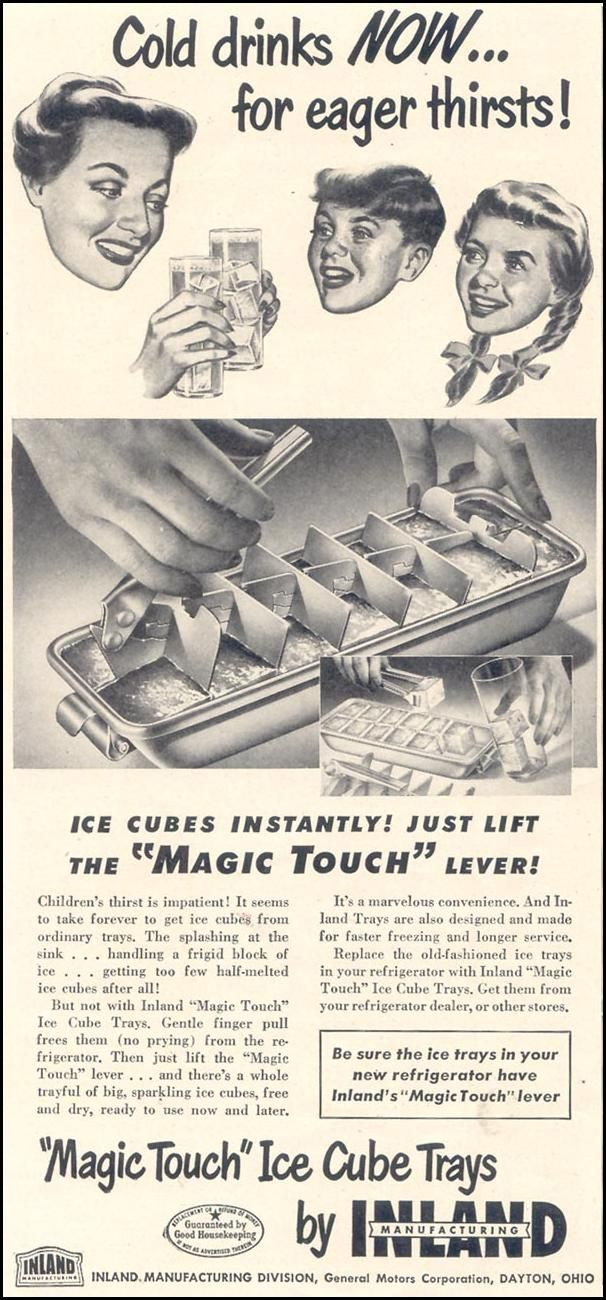
I grew up in a household that used ice, sometimes coming from an ice maker but also sometimes frozen manually in trays. I remember Magic Touch aluminum trays with the lever and interconnected flexing dividers, produced by a division of General Motors in the late 1940s to 1960s. Ed Roberts patented that gimmick, which sort of worked but I suspected was also designed to teach homeowners some cold, hard truths about the conservation of happiness.
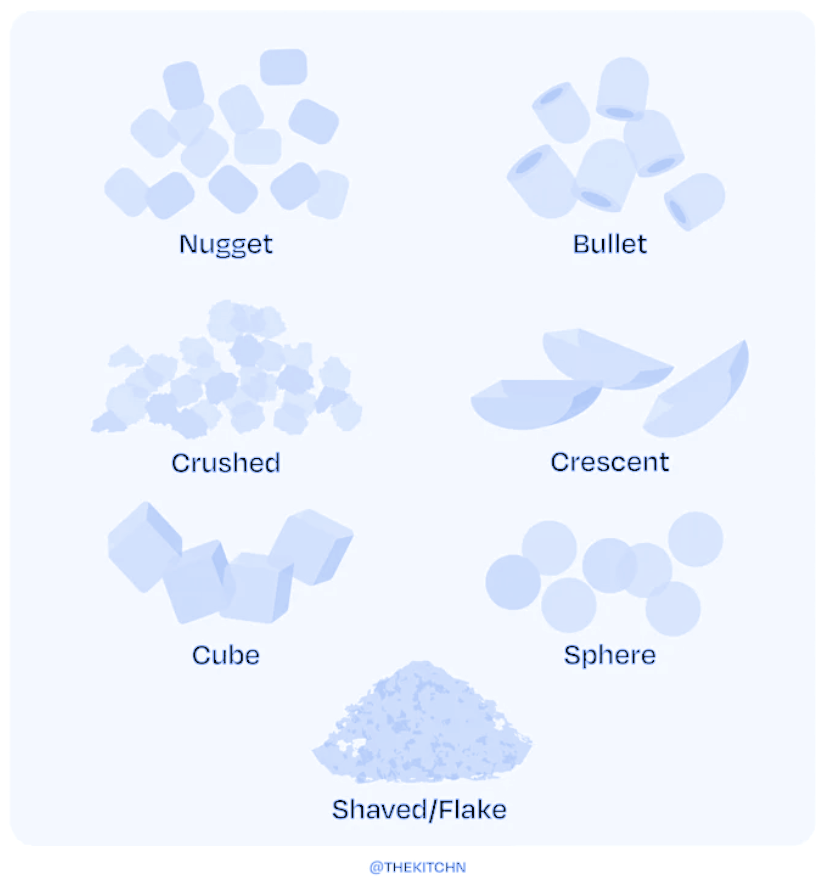
Then along came plastic and silicone trays you flexed to release at least some of their cubes, pills, or shards of frozen dihydrogen monoxide. The automatic ice makers for the home were offered by the Servel company around 1953, producing crescent-shaped ice cubes from a metal mold. In 1965, Frigidaire introduced ice makers that dispensed from the front of the freezer door.
When I was single, I didn’t run the ice makers in my refrigerators, relying on cold cans of soda, and I only had ice at restaurants. However, Wendy likes to drink filtered water with ice chunks in it, and that brought me back to the ice follies.
Wendy didn’t care for the large ice cubes our previous refrigerator produced, so for several years she used a countertop ice maker that produced hollow bullets. I also bought her one that made crushed or pellet ice, known in Oklahoma as Sonic Ice, but that melted too fast in the insulated container she carries around the house, so she gave that away.
It was a hassle for her to spend time filling the countertop maker with filtered water and steadily collecting its bullets in bags and trays for later use. Years back, we stayed overnight with friends out of state who had a refrigerator with in-the-door water and ice dispensers. Wendy loved that, so I consulted Consumer Reports and bought a new General Electric GSS23GMKKCES side-by-side refrigerator with in-the-door water and ice dispensers.
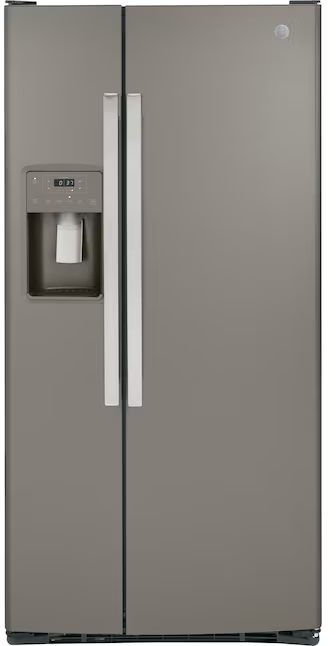
Our narrow galley kitchen meant that the narrower doors on the appliance were an improvement over the wide ones of the previous freezer-on-top unit. However, the refrigerator slot between the wall and the 1981 counter and cabinetry in the kitchen forced me to special order a 33″-wide model since the usual 36″ one couldn’t fit our space.
Side-by-sides already have limited freezer space, and the narrower model exacerbated the issue enough for me to buy a quiet three cubic foot upright freezer that we placed in the dining area.
The Ice Auger
Over the past 6.5 years, the ice auger has failed twice. The ice collects in a bucket on a shelf in the freezer above the door dispenser. A motor spins a plastic auger in the bucket that shoves the ice along. If you have it in crushed ice mode, that engages spinning chopping blades at the end of the auger where the ice drains out a hole in the door.
Wendy noticed chunks of plastic in her ice one day, which turned out to be parts of the auger that had broken away. I bought a new bucket and auger assembly from GE in September 2023 for a ridiculous $250. That lasted for less than two years before it was taking forever to get ice to come out crushed from the dispenser. I figured the second auger had partially failed in some fashion, so I bought another assembly for $220 plus a spare to have on hand.
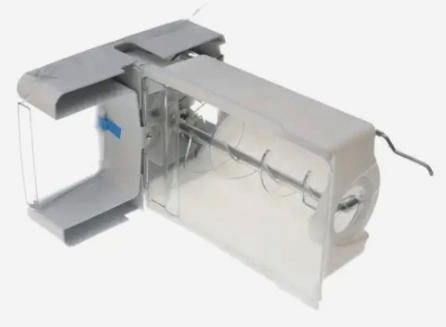
I could have tried just replacing the auger itself, but I know my handyman limitations, so I took the easy way out. At that point I had spent over 40% of the cost of the entire refrigerator on three bucket and auger assemblies.
That meant that I was anything but thrilled when the ice maker started making Woody Woodpecker noises. Not the annoying laugh, but a loud tap-tap-tap that would continue off and on for several minutes each hour.
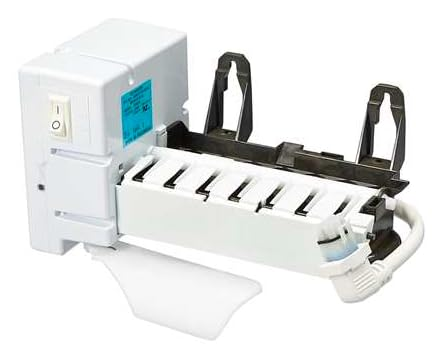
It still produced plenty of ice, and the third auger was still working. I examined the unit, discovering that water pours into a small trough attached to the back of the ice maker to flow into the freezing mold, with a motorized mechanism that lifts the resulting frozen crescents out to drop into the bucket. It sounded to me like the teeth on the gears turned by the ejector motor were slipping.
I tried using a blow dryer on the ice maker in case there was some ice jammed somewhere in the mechanism, and then I turned it off for 15 seconds, turned it back on, and quickly toggled the plastic shutoff arm back and forth three times to initiate a “harvest cycle”, but nothing improved. Tugging on the ejector arm rotated by the motor didn’t help, either.
I let the thing tap and click away for weeks, avoiding insanity because it wasn’t continuous, plus I was still away at work much of the time. However, in a few weeks I would be retiring from my office, and that infernal noise would be with me on weekdays, not just evenings and weekends. It was time for action…so I checked for recommendations and pricing on an entirely new refrigerator.
I didn’t really intend to go buy a new refrigerator, but seeing that cost, and the limited options given our priorities and space, helped me deal with the expense of buying a new ice maker unit. Thankfully, since it is used in many different models, I could get it for $136, or about 3/5 of the cost of a bucket and auger assembly.
GE Appliances said that the WR30X28695 ice maker in our fridge had been superseded by the WR30X35285, which I ordered via Amazon. A YouTube video by Keith of Appliance Factory & Mattress Kingdom assured me that I could handle installing the replacement unit.
Another video by Fix.com was a closer match to our model and provided further reassurance.
I had to unscrew the auger motor assembly to lay that down and thus gain access to the wiring harness for the ice maker. I turned the ice maker off and then unplugged the harness, and then I removed the two screws on the ice maker’s mounting brackets. I couldn’t just loosen them and slide out the ice maker, as shown in one video, because our extra-narrow model had too tight a fit. In fact, I also had to take out a screw from one of the ice bucket rails and rotate the rail downward to gain enough clearance to just barely squeeze the ice maker out of the freezer compartment.
I took the water trough off the back of the old ice maker and put it on the replacement, installed that in the freezer, and put everything back together. I’ll admit that some mounting screws slipped out and had to be located in the freezer compartment or on the kitchen floor multiple times during my anything-but-handy work, but I did finally get everything put back together.
I was so confident in my repair that I didn’t wait overnight for the new ice maker to cool down enough to actually make some ice. I just chucked Woody Woodpecker into the trash bin and hoped for the best. I was relieved the next morning to find the new ice maker quietly working.
I’m so happy I might just put a glass up to the outside of the freezer door and enjoy some cool filtered water with crushed ice.








 Meador Manor
For some reason it seems that the handles on our Magic Touch ice trays were diabolically made from an inferior aluminum than the rest of the tray assembly. (Maybe my dad bought knockoff models, without the GM imprimatur.) Inevitably the handle would bend up. The result would be that the ice cubes weren’t totally freed from the tray. Nobody seemed to have the wherewithal to use pliers to bend them back. Application of a little warm tap water got all of the ice debris out of the tray and that was poured into a waiting ice bucket, there to freeze solid when returned to its lair within the freezer. I gained a critical knowledge in profanity at a tender young age, watching my father wrestle with the vagaries of the Magic Touch. It took vigorous action with an ice pick to prepare a cold drink. We maintained a selection of ice picks in the kitchen in case there was a family event – like dinner. I still remember the Marlex bowl that served as our ice bucket and the ice pick scars that it bore along the interior surface. I never remember any kind of ice machine in our house up until the time I left home, at eighteen. Maybe we graduated to plastic ice trays in the 70s.