
The autumn of 2020 featured pandemic travel restrictions, and one of my responses was to collect from around the world each of the six adult mysteries authored by Carlton Keith, a pseudonym for Keith Robertson, who used his real name for his successful children’s books, many of them featuring the character Henry Reed.
Tomes came via post from used bookstores in Illinois, Ohio, New York, Tennessee, and New Zealand. By the summer of 2026, I had read four of them:
- The Diamond-Studded Typewriter (1958) — Also published under the title A Gem of a Murder
- Missing, Presumed Dead (1961)
- Rich Uncle (1963)
- The Hiding Place (1965)
I had liked Rich Uncle the most, the third outing with document expert / amateur detective Jeff Green, although The Hiding Place had its own naive charm, reading like a Nancy Drew mystery for adults and being the only one of the Carlton Keith novels to not center around the red-headed Jeff Green.
That left two final novels: The Crayfish Dinner of 1966 [Internet archive scan] and A Taste of Sangria from 1968. The earlier book was published in the United Kingdom as The Elusive Epicure. None of those titles would attract my interest, but I’m no foodie.
The Crayfish Dinner

My copy of The Crayfish Dinner was a 1983 reprint from Garland Publishing’s book series Fifty Classics of Crime Fiction 1950-1975, reflecting selections by respected mystery critics Jacques Barzun and Wendell Hertig Taylor. They reportedly had identified volumes they considered of literary and historical significance based on their plots, characterization, and adherence to “fair play” detection. Garland was founded in 1969 and endured until the end of the 20th century, and they also published 45 titles in a Garland Library of Science Fiction, with those selections made by Lester del Rey, although the sci-fi series has been criticized as having some weak selections and inferior unedited versions of its titles.
The Garland reprint had an ugly plain green hardcover with no dust jacket, but the 181 pages were of “acid-free, 250-year-life paper” with comfortable spacing and have held up well after 43 years. In contrast, my mass-market paperback reprint by Curtis Books of A Taste of Sangria has stiff yellowed pages with tight spacing to squeeze it into 143 pages.

The Garland reprint did have a noticeable flaw in its preface, falsely asserting that Jeff Green had appeared in only three of the six Carlton Keith mysteries. I borrowed the Internet Archive’s copy of A Catalogue of Crime by Barzun and Taylor, and found the listing for The Crayfish Dinner, in which the critics wrote, “The several persons in the environment are well marked off and everything is credible, including the denouement and the reason for the crayfish dinner.”
Their catalogue also listed The Diamond-Studded Typewriter, The Hiding Place, and A Taste of Sangria. To their credit, they pointed out flaws in each of those works, so I gathered that they considered The Crayfish Dinner the best of the group. I was interested to see how it compared to Rich Uncle, my favorite Jeff Green tale thus far.
The story had some similarities to The Hiding Place, with an isolated old house with secrets, and Jeff Green was his usual brash self, unafraid of laying traps and confronting miscreants, and getting the usual stunning blow to the head. He and the Hardy Boys would have had concussions and traumatic brain injuries from their various adventures.
This had a bit of the whodunit to it, but it was more a story of figuring out what happened to a man with a crooked character. It was a pleasant read, but not as atmospheric as the previous Carlton Keith outings, and I still considered Rich Uncle my favorite Jeff Green book. However, there was still one left unread. I had not the heart to read that immediately after my repast of crayfish, so I interjected a handful of other books first. I finally packed the mass market paperback in my carry-on to read on airplane flights from Tulsa to Seattle.
A Taste of Sangria
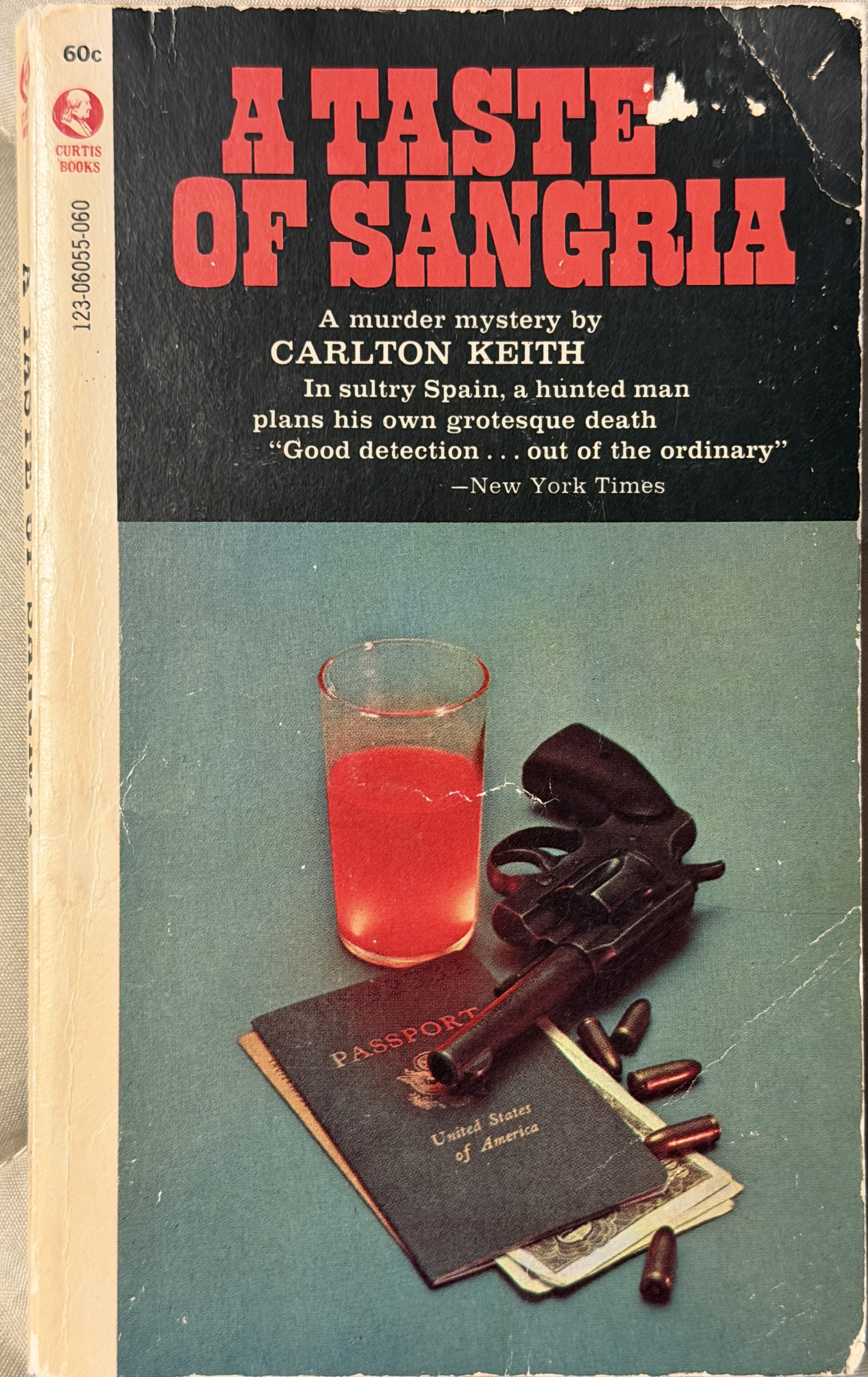
Barzun and Taylor’s take on A Taste of Sangria was, “Possibly a trifle too smooth and easygoing, but the plot (finding a missing man who may have made off with money which he was supposed to deposit to the Swiss account of a bastard) is good, all the characters except one well portrayed, the local color delightful (Zurich and Segovia), and the end satisfying.”
I enjoyed the book, and presume that the reviewers took exception with the character of Mr. Grundy, a sepulchral hit man of plodding gait. I visualized him as a thin version of Solomon Grundy from the Superman comic books of my childhood. His relentless pursuit of his victims made him a threatening if not entirely believable presence. The plot kept most of the precise killings at a remove and Jeff Green was capable as usual, making use of his brains over his brawn except in one instance. In that case, which seemed unnecessary, he at least delivered, rather than received, a knockout blow.
One part I got a kick out of was this:
Jeff called Lou Ford when he got back to the office Wednesday morning. Lou dropped by a short while later.
“I’m back on this man Hanscomb,” Jeff told him. “It appears that there’s a little more to it than I first thought. I have an informant who tells me that he is mixed up in the drug trade, gambling, and I don’t know what all. Maybe prostitution, too.”
“In my opinion, that’s a dying business,” Lou said gravely. “Technological change. The automobile comes along and puts all the carriage people out of business and now the pill comes along and will put most of the madams out of business. Too much amateur competition.”
Let’s see…the paperback came out at the start of 1968. The FDA approved the first oral contraceptive in 1960, but such contraceptives were not available to married women in all states until Griswold v. Connecticut in 1965, by which time one in four married women under 45 were already using them. They were not routinely available to unmarried women in all states until Eisenstadt v. Baird in 1972.
I wondered if Robertson’s prediction had any merit. The internet responded that it did not, with prostitution primarily driven by economic disparity, substance abuse, and structural vulnerabilities rather than the availability of oral contraception.
Anyway, I was sad to have exhausted the adult mysteries by Keith Robertson under his Carlton Keith pen name. I still rank Rich Uncle [Open Library link] as my favorite. I’m not finished with mysteries by Keith Robertson, however. Between reading his final Carlton Keith works, I read the first of his four Carson Street Detective Agency books for older boys, and I plan to read the rest of those, relying on the Internet Archive since they are long out of print. If you enjoy Keith Robertson’s books, check out Fans of author KEITH ROBERTSON on Facebook.