Scholastic Corporation was founded in 1920, initially publishing a four-page magazine on high school sports and social activities which was distributed in 50 high schools near Pittsburgh, Pennsylvania. It gradually added more magazines and then entered the book club business in 1948, and became a book publisher in the 1960s.
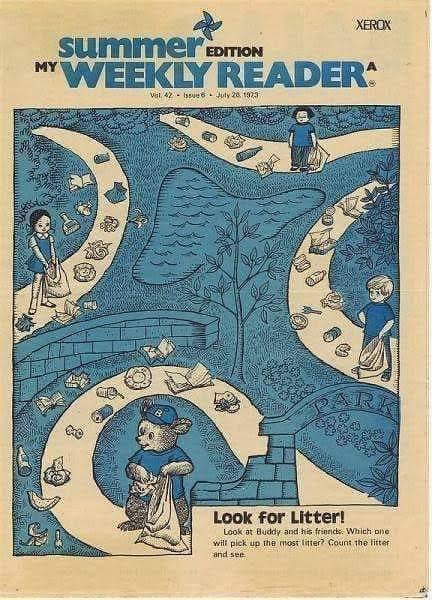
When I was in elementary school in the 1970s, we would get little newspapers called My Weekly Reader. It had originated in 1928 but was owned by Xerox throughout my grade school years, and I was familiar with it before reaching school age thanks to the Captain Kangaroo television show. Weekly Reader had a mail-order book club from the 1950s to the 1980s and was acquired by Scholastic in 2012.
In my later elementary school years, our teachers periodically handed out cheap, newsprint-style order catalogs from Scholastic, and we could circle favorite paperbacks which typically cost $1 or less, bring cash or checks from home, and weeks later a cardboard box would arrive in class with our purchases.
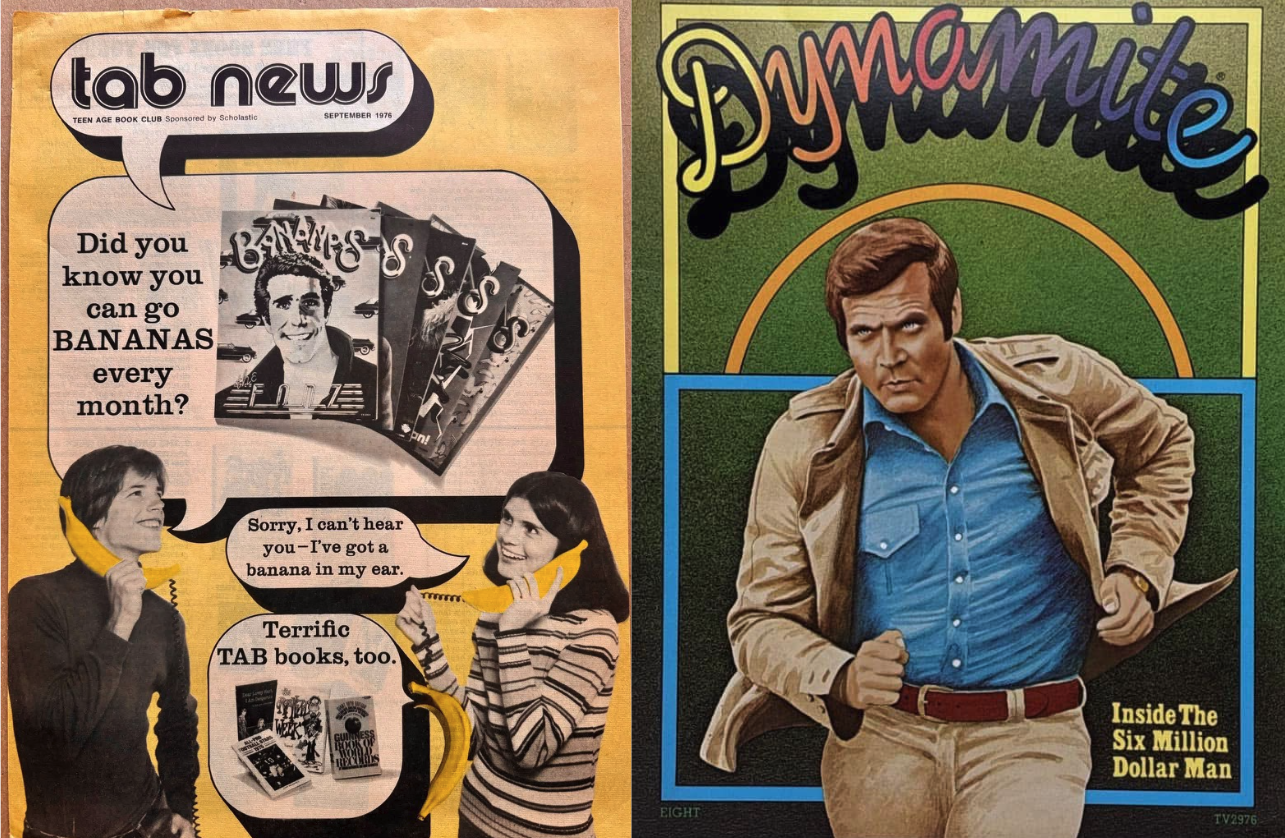
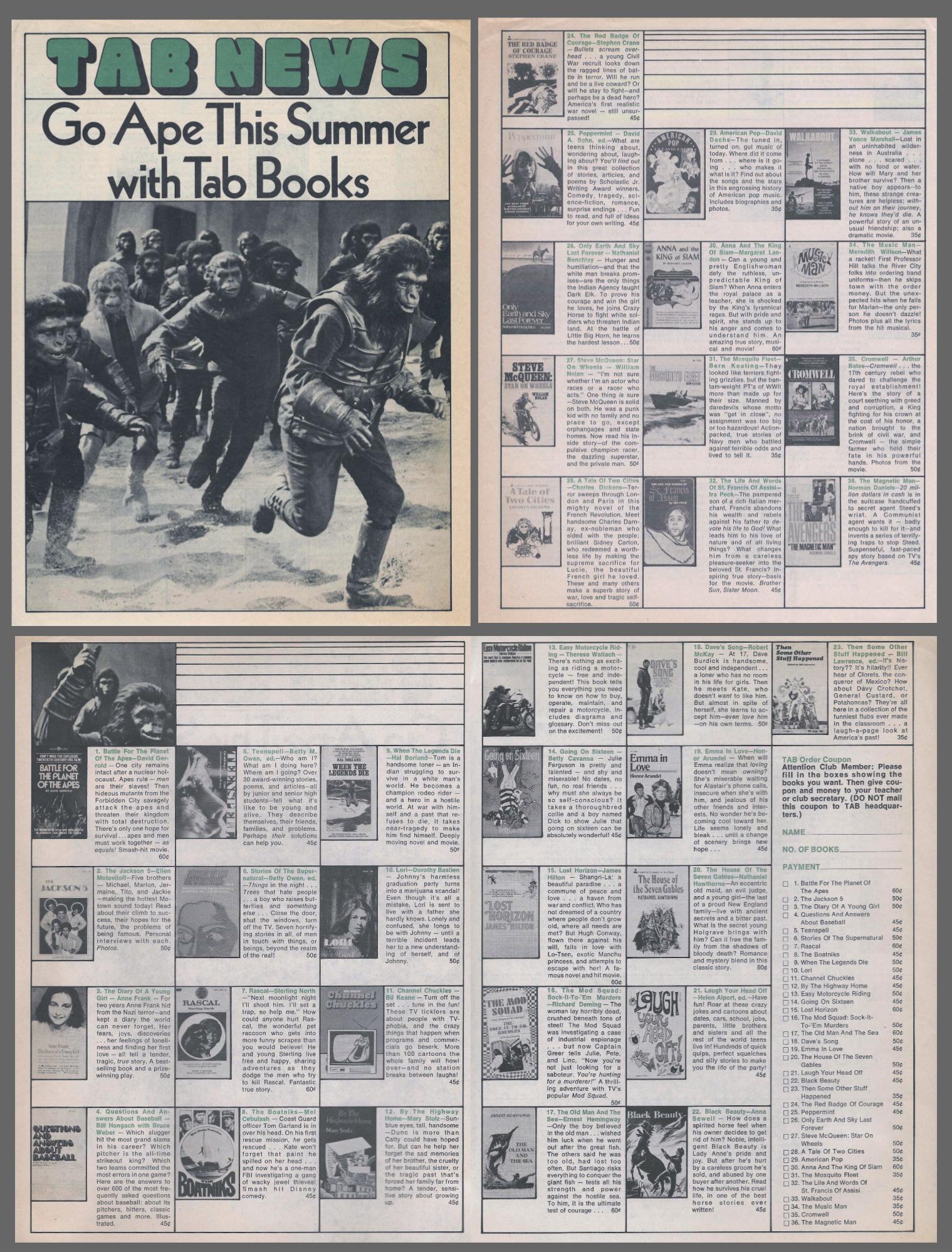
Eventually we graduated to TAB NEWS brochures for the “Teen Age Book” club that targeted kids in junior high or what would often now be called middle school. Mind you, we didn’t have Scholastic book fairs at my schools; those weren’t launched until 1981 after it purchased a California-based book fair business. However, our libraries and teachers always had us reading “Sequoyah books” sponsored by the Oklahoma Library Association.
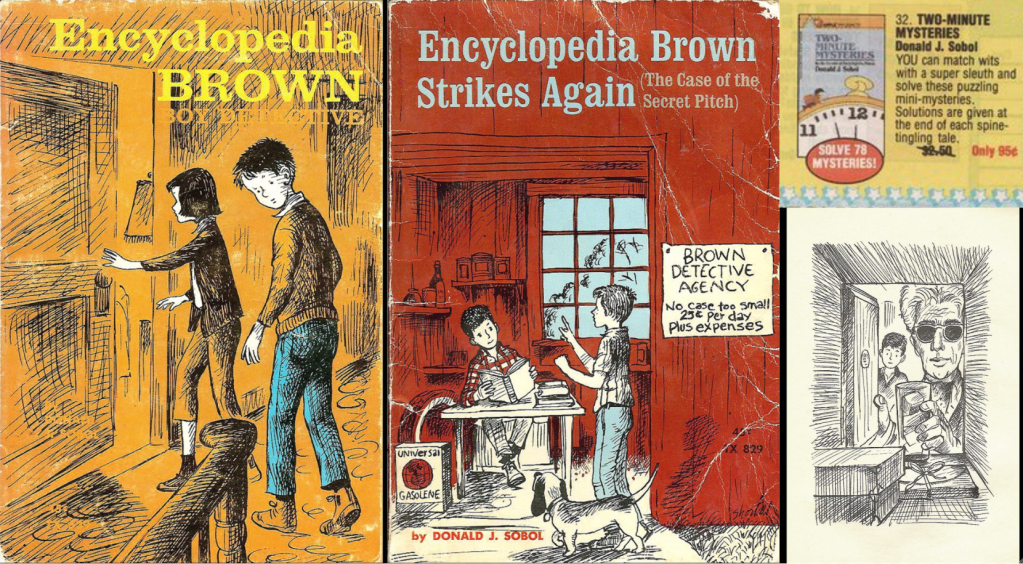
I remember Scholastic’s offerings of Donald J Sobol books. His popular Encyclopedia Brown books for juveniles was rejected a couple dozen times before he could find a publisher, but since then that series has been translated into a dozen languages and has never been out of print.
I was a bit disappointed at their tameness and simplicity, so I tried his Two-Minute Mysteries, which were more murderous. However, they were like text versions of the old Lance Lawson comic strip, and puzzles interested me less than novels with plot, setting, style, and mood.
Recently I read a couple of old Scholastic books I found online, which are tiny drops in the ocean of content it has produced. The company now releases over 750 new titles each year and distributes hundreds of millions of books annually.
Danny Dunn and the Homework Machine
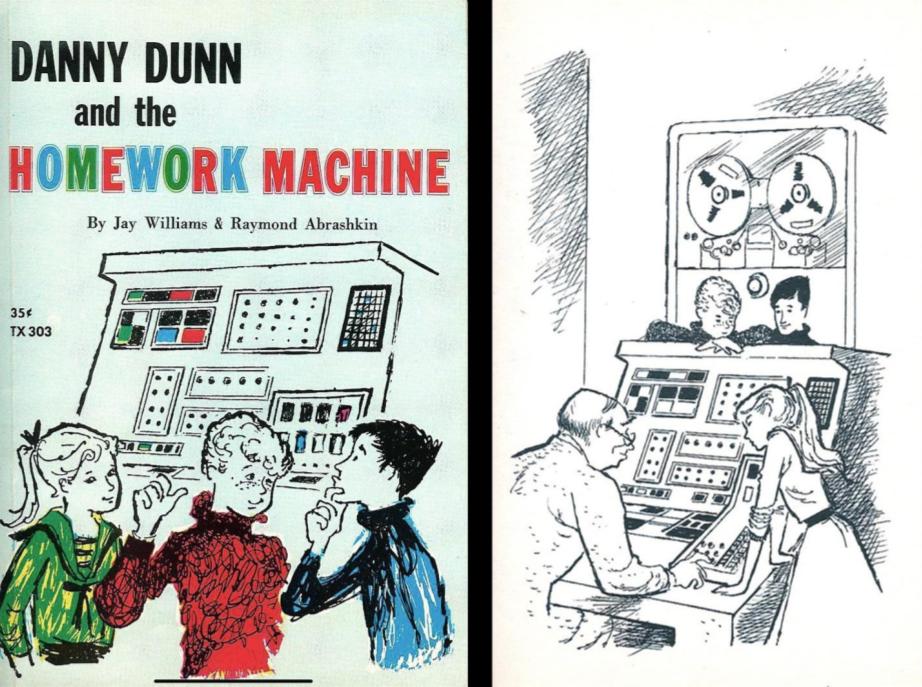
A vintage Scholastic book with a familiar cover was Danny Dunn and the Homework Machine, originally published in 1958 as the third entry of a juvenile science fiction and adventure series by Jay Williams and Raymond Abrashkin. I think I read it a half-century ago, but I don’t recall reading another book featuring that character, who was in the fifth or sixth grade. Abrashkin co-wrote the first five books with Williams from 1956 to 1960, with Williams adding another ten by 1977, although he insisted that Abrashkin still be given co-author credit.
I was unaware that the book was turned into a musical children’s album, with music composed by Julie Mandel. I couldn’t endure past the one-minute mark, but should you somehow make it all the way through side one, then here is side two.
Little did I realize back in the 1970s that forty years later I would be tasked with providing access to a Chromebook computer for each of over 6,000 students in a school district and the consequent teacher training, support, and logistics that would entail. Danny Dunn and the Homework Machine is now almost 70 years old, and my curiosity was aroused as I remembered nothing of the plot.
Among the reasons I was happy to retire this year was the rise of artificial intelligence and the many challenges it creates for education — after 37 years of integrating technology into teaching, it was time for younger folks to lead. In my retirement I had time to explore if that old book had predicted some of the issues schools are now facing after almost 70 years of technological progress. I found that David Owen already pursued this topic in a February 2023 article in The New Yorker, but I decided to re-read the book myself. I skipped the musical version of Danny Dunn and the Homework Machine, instead borrowing a copy of Scholastic’s 5th printing from 1966 on the Internet Archive while also purchasing a Kindle version using $2 in Amazon Rewards Points.
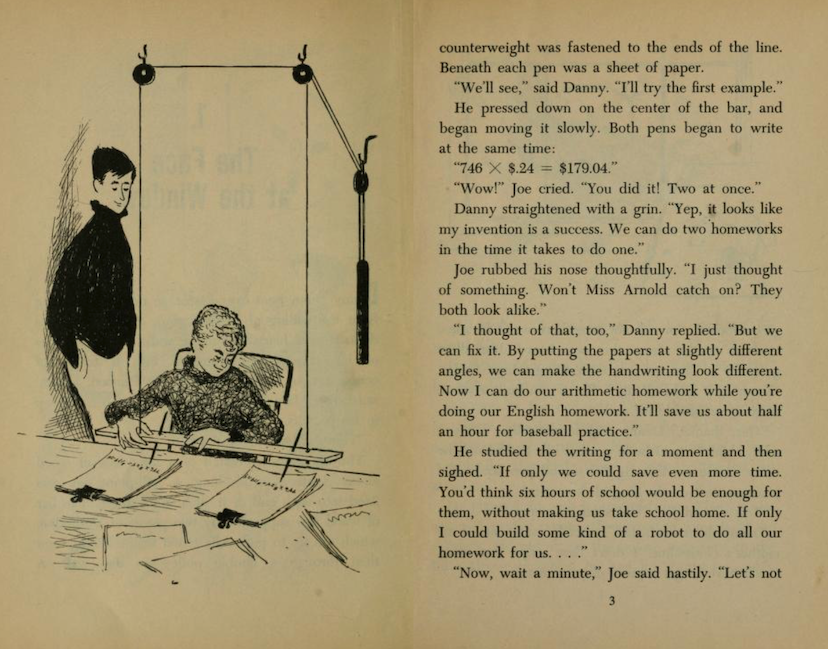
The Kindle version was a digitization of a 1986 printing by Wildside Press. Sadly, that edition omitted the many interior illustrations by Ezra Jack Keats. Right off the bat, in the first chapter, text about a homemade pantograph was greatly enhanced in the Scholastic version by one of Keats’ illustrations.
The authors acknowledged at the beginning of the book their gratitude to Miss Terry di Senso, who had guided them through two of the computers from IBM in the late 1950s, and to Dr. Louis Robinson, IBM’s manager of mathematics and applications, for reviewing and advising on the manuscript. They also wrote, “In all fairness to both Professor Bullfinch and Danny, we wish to point out that their position on homework is supported by Bulletin 1248-3 of the Educational Service Bureau, University of Pennsylvania.” Does such a bulletin, reputedly entitled, “What About Homework?” exist? The internet knows not, but later studies showed a negative relationship between higher homework amounts and student achievement in elementary schools, a small benefit to some homework in middle schools, and high school students who did 30 to 90 minutes of homework per night had higher test scores than those who did none or those who studied more than four hours per night.
Danny and his friends are able to speak their questions to the computer, and it responds on a typewriter. It editorializes a bit in its response, acting like a limited A.I. from the late 2010s. Professor Bullfinch explains, “The computer can reason…It can do sums and give information and draw logical conslusions, but it can’t create anything. It could give you all the words that rhyme with moon, for instance, but it couldn’t put them together into a poem.”
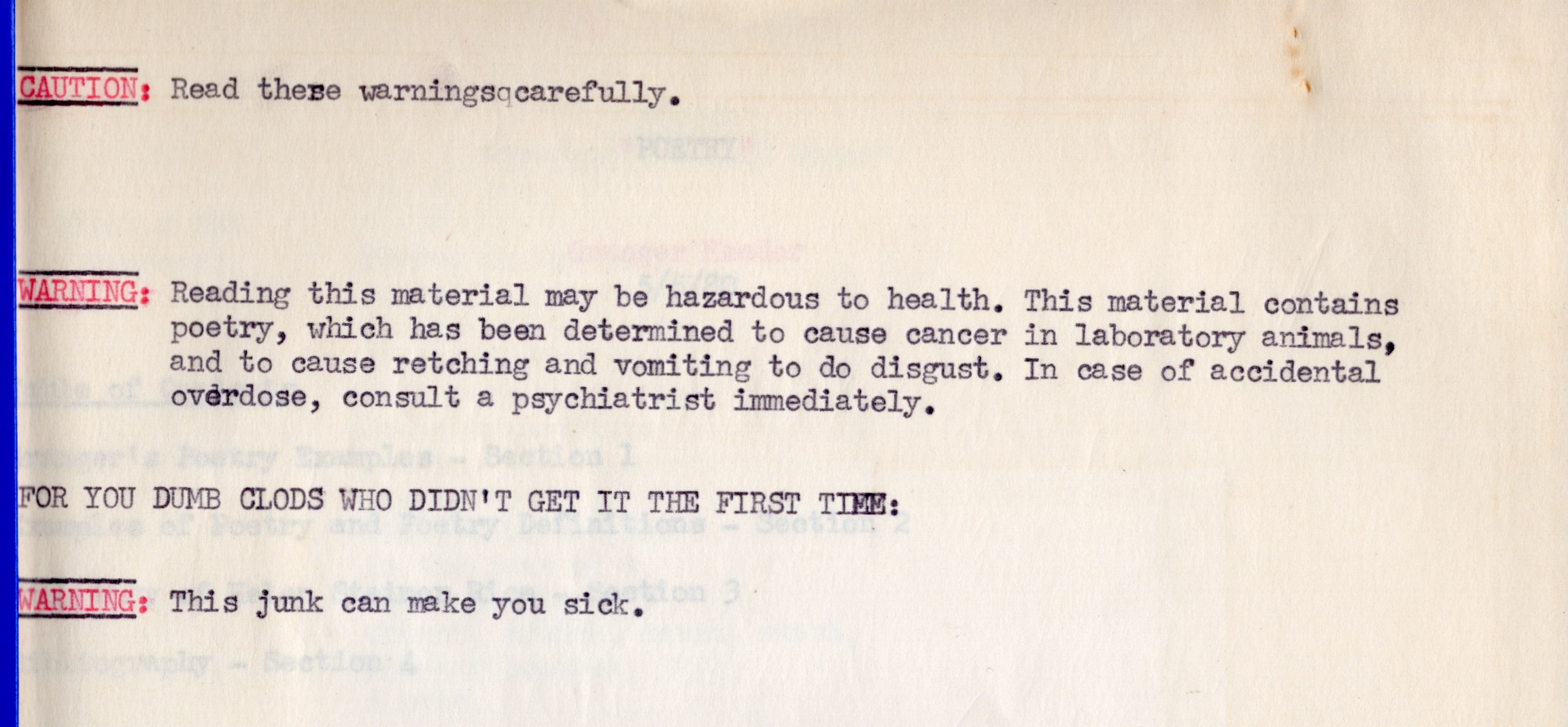
Well, in the 2020s we have A.I.s that can write poetry, compose music with vocals, and more. When I was 13, I had to create a poetry folder in junior high, and I judged my efforts to be nauseating. For your own health, I’m only reproducing the warning I provided on my folder’s first page.
For fun, I asked four different A.I.s to compose a poem about the moon while drawing elements from Danny Dunn and the Homework Machine.
ChatGPT
The Homework Moon
The moon hung bright above the town,
While Danny’s machine was humming down.
It solved the sums and spelled the words,
While moonlight silvered fields and birds.
But even machines, so clever and wise,
Could never explain the moonlit skies.
So Danny looked up, his homework forgotten—
And wondered what secrets the moon had gotten.
Gemini
A glowing screen of silver light,
A super-brain to guide the night,
It calculates with silent grace,
And solves the problems of deep space.
Punching through the midnight blue,
With punch-cards made of cosmic dew,
It ticks and hums a quiet tune—
The ultimate Machine: the Moon!
Claude
Moonlit Homework
Beneath the moon’s pale, silver glow,
A boy sat up with sums to do,
When Professor Bullfinch’s lab hummed low,
And Irene, Joe, and Danny knew
The great machine could think and learn,
Its tubes and wires all aglow.
“Let it do the work,” they’d turn,
But shortcuts bring a price, you know.
The moon looked down, serene and wise,
On schemes of boys and borrowed brains.
It saw through every clever guise:
True learning’s earned through honest pains.
So, Danny, let the circuits sleep,
And trust the mind that’s all your own.
The moon keeps watch while sums you keep,
And knowledge grows when it’s self-grown.
Copilot
Beneath the moon’s pale, silver gleam,
Danny Dunn chased a homework dream.
His Homework Machine hummed soft and bright,
Like a tiny moon-powered star at night.
While answers clicked with whirs and spins,
Moonlight danced on its metal skins.
Yet Danny learned, as the moon sailed high,
No machine can replace a curious eye.
So under that lantern in the sky above,
He mixed science, wonder, and learning with love.
And the moon, like a teacher, seemed to say:
“The best discoveries come when you find your own way.”
Note the em dash in Gemini’s composition, which is currently a tell for some A.I. responses. Claude also commented on its creation: “A few nods to the book: the homework-doing computer built by Professor Bullfinch, Danny’s friends Joe Pearson and Irene Miller, and the story’s lesson that taking shortcuts with schoolwork doesn’t pay off in the end.”
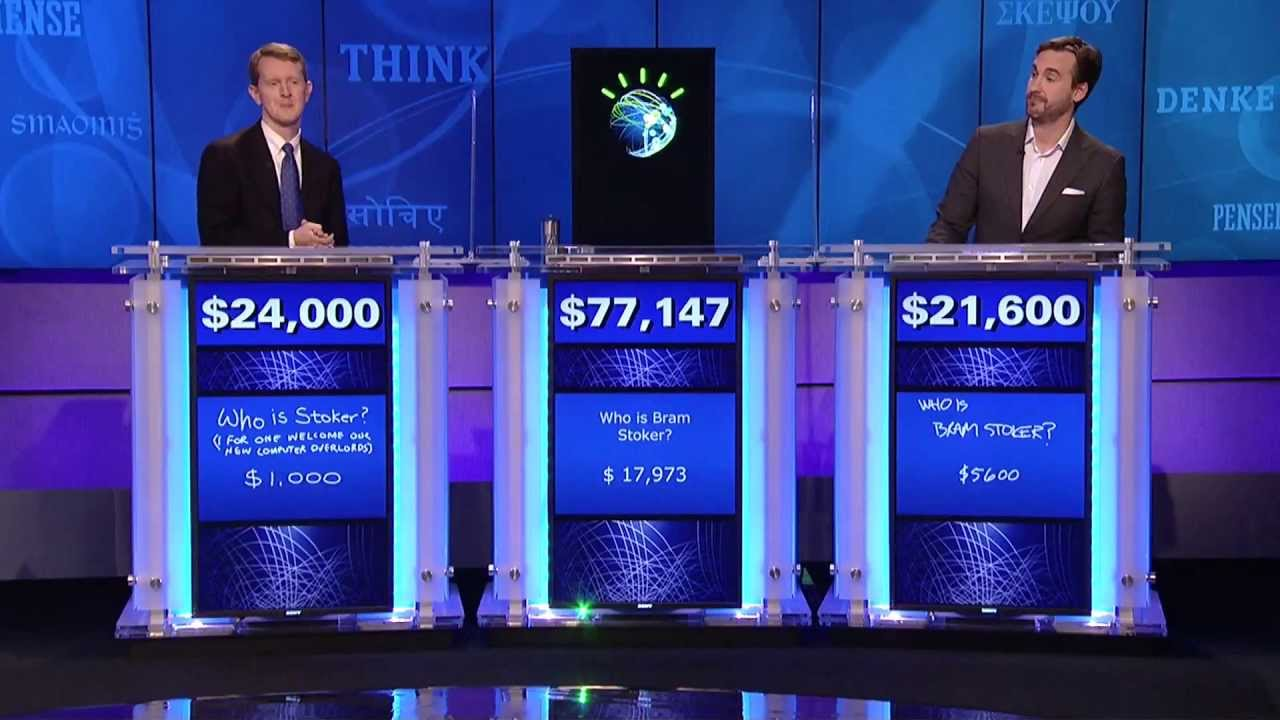
About halfway through the book, one of the kids programming the computer to do homework comments, “You know, we ought to enter her in one of those TV quiz shows. We could make a fortune.”
Well, in February 2011, IBM’s supercomputer Watson defeated human Jeopardy! champions Ken Jennings and Brad Rutter in a historic two-game, three-day exhibition match.
The book concludes with Danny realizing that he and his friends had to learn a lot in order to program the computer to do their homework. However, there are plenty of caveats with that overly tidy conclusion, and the end of the book is now rather dated. The Professor programs the computer to compose a sonata for piccolo and bull fiddle, and Danny’s mother laughs and comments, “It isn’t bad…but it isn’t exactly Beethoven, either.”
The professor responded, “No. It never can be Beethoven, Mrs. Dunn. No matter how intelligent the computer is, it is only a machine. It can solve problems in minutes that would take a man months to work out. But behind it there must be a human brain. It can never be a creator of music or of stories, or paintings, or ideas. It cannot even do our homework for us—we must do the homework. The machine can only help, as a textbook helps. It can only be a tool, as a typewriter is a tool.”
However, 70 years later, the immense datasets and prediction engines in A.I.s can create music, stories, and paintings, and they certainly can do our homework with us learning very little in getting them to do it. The tells that give away that an A.I. created something persist for now, but some of the A.I.s have passed the Turing Test, understandably causing human consternation, trepidation, and discomfort.
I had bailed on Mandel’s musical after a minute of Side 1, but I had Suno compose this little ditty with a similar prompt to what I had given the large language models. Jeepers, Danno.
Just this week I heard about 20 seconds of a beautiful song at the end of a YouTube video. I spent some time tracking down a complete version, but I wouldn’t be surprised to find it was generated entirely by artificial intelligence. Recently platforms like Deezer reported that about 75,000 synthetic songs were being added every day, but currently fully A.I.-generated tracks account for just a few percent of total streams on major platforms. However, almost 9 out of 10 music producers are actively using A.I. tools in their workflows, such as for vocal isolation, mastering, audio restoration, and social media promotions.
The Riddle of the Lonely House
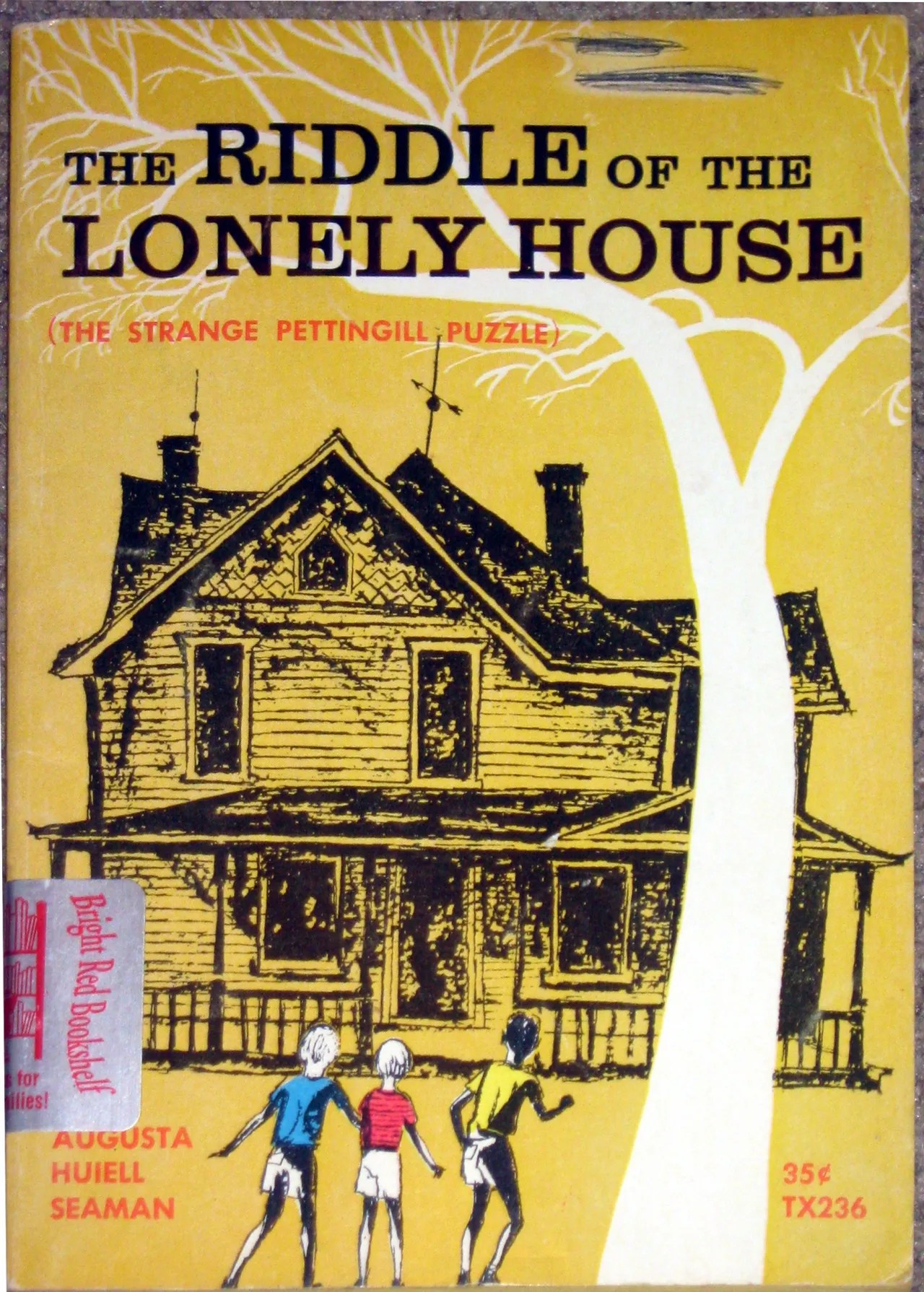
Another vintage Scholastic book that caught my eye, which I might have read as a kid, was The Riddle of the Lonely House by Augusta Huiell Seaman. The Internet Archive has Scholastic’s TAB Books reprints of it with cover prices of 25¢ in 1961, 35¢ in 1964, and 50¢ in 1968, but quantity prices were available on request.
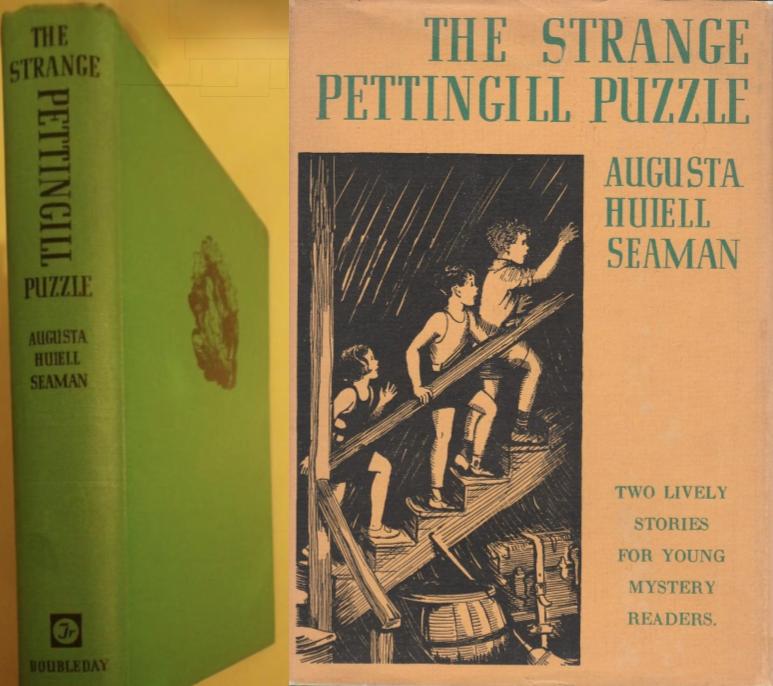
The book was copyrighted in 1935 and 1936 and originally published as The Strange Pettingill Puzzle: Two Mysteries for Boys and Girls by Doubleday, Doran & Company. The second story in the original book was Calista, about a century-old doll with a strange message in a hidden pocket of her dress.
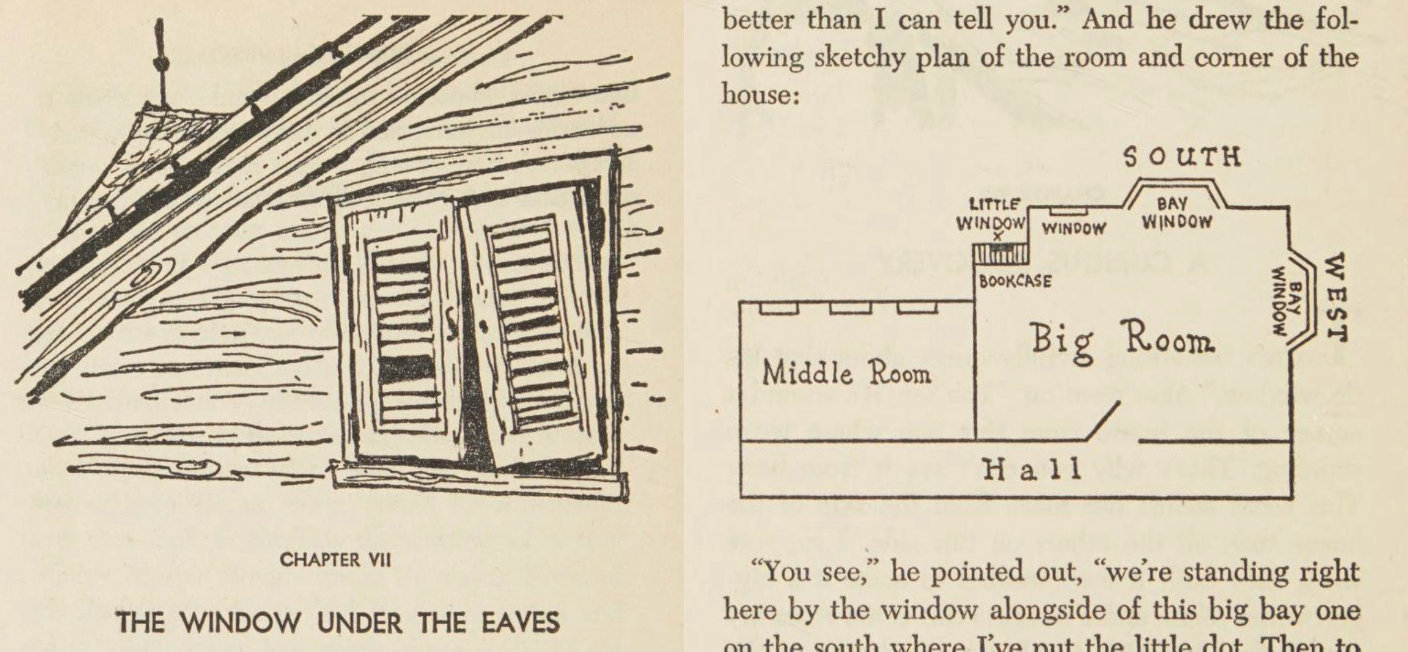
I borrowed one of the copies of The Riddle of the Lonely House on the Internet Archive and found the book an easy and pleasant tale. Each chapter had an opening illustration by Charles Beck, and it included a nice floorplan making it easier to understand where a hidden room was located.
Seaman published 42 books for older children between 1910 and 1949, along with many short pieces for popular magazines. In a detailed post, Christine M. Volk wrote, “In many ways, Seaman’s books are as pat and formulaic as the traditional ‘series books’; in fact, some booksellers who specialize in series books call them a ‘non-series series.’ Since the characters were different in each book, readers did not have the same impetus to collect them all, as they did with the conveniently numbered juvenile series, like Nancy Drew, Hardy Boys, and Tom Swift. Nevertheless, most of her books had the same comforting familiarity: the plot frequently involved two ordinary young girls, often with a pesky, but clever, younger brother or sister, solving a mystery that they just happened to stumble on (usually in a small town).”
The Internet Archive has several of Seaman’s books, and Project Gutenberg has 10 of them. I don’t plan to read more of her work, but if you are interested, Christine M. Volk’s wonderful post about Seaman includes a detailed biographical sketch that draws upon the 1984-1986 The Seaman Log newsletter for Seaman collectors which was published and edited by Donald J. Summar. Volk nicely summarizes Seaman’s output and offers some recommendations.
Star Trek Puzzle Manual
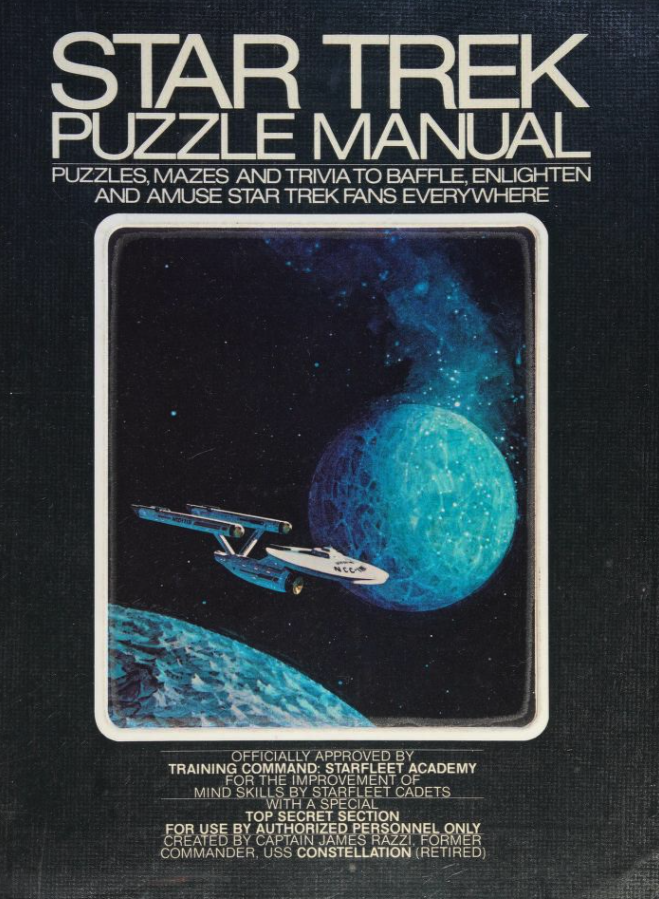
In 1978, Scholastic published an abridged edition of Jim Razzi’s Star Trek Puzzle Manual, which was originally published by Bantam Books in late 1976, when I was ten years old, as an 8.5″ by 10.5″ trade paperback for $5.95. That edition provided readers with plenty of room to write, map out mazes, and solve puzzles, but it was out of my price range.
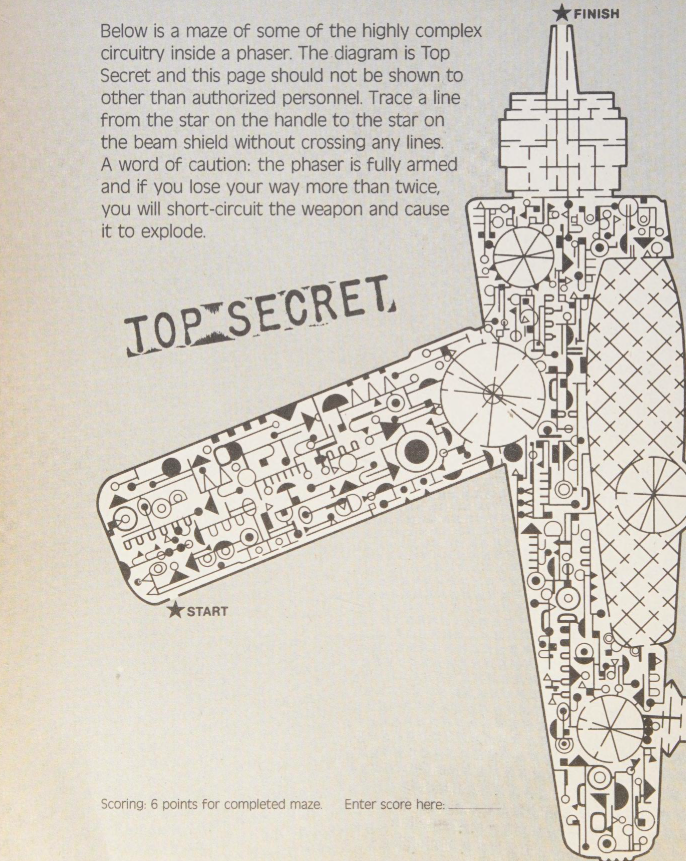
Later, Bantam released a more affordable mass-market edition. It was pocket-sized with less than half the square inches per page. Thus spatially complex puzzles had to be resized or modified, and mazes that relied on fine details were cut. While the 1976 trade paperback cost $5.95, the 1978 mass-market paperback cost $1.95, and Scholastic would offer the mass-market edition for $1.25 to $1.50.
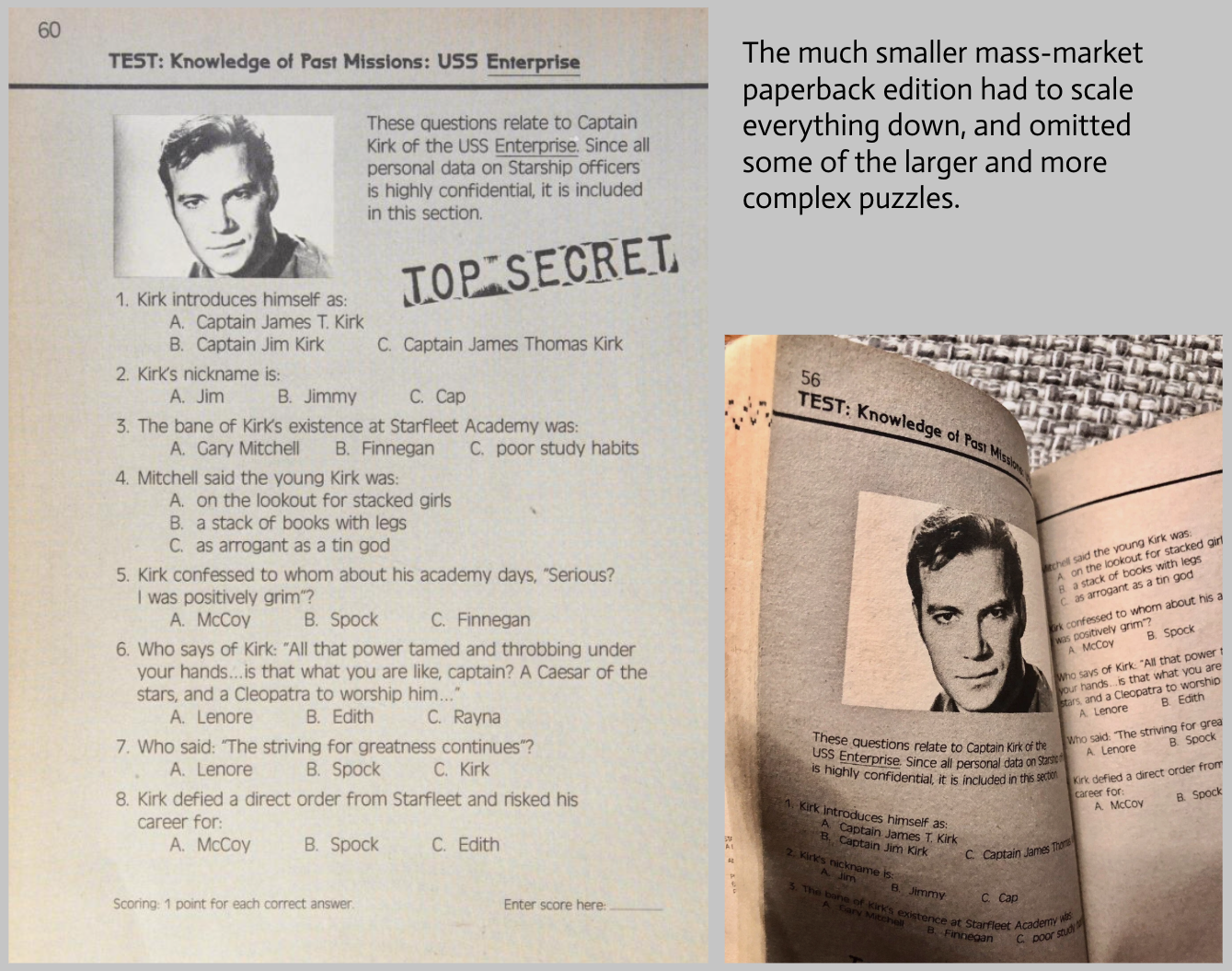
Both versions featured Lou Feck’s splendid painting as cover art, which Bantam also cropped for the cover of a mass-market paperback edition of the Star Trek 4 adaptations of original series episode scripts by James Blish. I was excited to be able to get the Scholastic edition, but that taught me a lesson in economics when I realized how it differed from the trade edition.
The Evolving Book Trade
While vintage Scholastic books have some nostalgic value and they kept some works in print, I have no interest in collecting them, although I am glad some of them have been scanned into the Internet Archive for online borrowing and that some out-of-copyright original works are at Project Gutenberg.
The internet claims that electronic books have had little negative impact on Scholastic Book Fairs, since print books continue to heavily dominate children’s literature. While e-books found a permanent home with adult fiction readers, print books still reportedly out-sell e-books roughly 4 to 1, and children’s books are still mostly physical.
The mass-market paperback has gone extinct, and Scholastic has reportedly followed the industry trend of transitioning to trade paperbacks, which have heavier paper, higher durability, and significantly better profit margins. However, that means many of their books for older kids now cost $8.99 to $12.99 instead of the previous mass-market pricing of $4.99 to $6.99. My guess is that has priced some kids out, given that 44% of Americans have trouble paying for basic necessities, which increases the importance of free access to books via school and public libraries.
I’m glad that librarians in my school district host Scholastic Book Fairs and that children in our county under age five can receive a free book each month through Dolly Parton’s Imagination Library, which is locally sponsored through the Bartlesville Public Schools Foundation. Reading has always been a big part of my life and foundational to my personal success and satisfaction. Scholastic played a role in that, both through the cheap paperbacks I could order and its publications like Bananas and Dynamite magazine.