
Loyalty taxes are a corporate practice of offering deep discounts on subscriptions to attract new sign-ups while quietly keeping long-term, loyal customers on older, more expensive pricing tiers.

It is especially egregious when, even after the initial discounts expire, newer customers stay on lower-cost plans while leaving unaware long-term customers on outdated expensive ones with no discernable difference in services. Companies employing that strategy rely on customer inertia, hoping that most people will remain unaware of the disparity, won’t notice slow price creeps, or will find switching providers too tedious, if it is even practical.
I first encountered this with AT&T decades ago, which was gouging my parents on an ancient calling plan while I was paying much more reasonable rates. When I saw my parents’ bill, I told them about the discrepancy and used their overpriced service to call AT&T and get them on a much better plan.

Back in 2011, I caught CableOne in Bartlesville doing the same thing to me. It was offering newer customers 10 Mbps internet service at the same cost as my legacy 5 Mbps service. I inquired over the phone, and they switched me to the faster service.

By 2022, CableOne had become Sparklight and was charging me $116 per month for 200 Mbps service while quietly offering gigabit per second service, to anyone who asked, for only $86. When I found that out, I went into their office and switched plans.
I’m not surprised when monopolists engage in such tactics, since their customers have nowhere else to go. Competition can help: once Bluepeak fiber optic service became available in Bartlesville, it offered the same download bandwidth and far more upload bandwidth than Sparklight but charged $60 per month while Sparklight was charging $94. I had Bluepeak installed and cancelled Sparklight, but despite a service call, our Bluepeak service had oodles of service outages. That led me back to Sparklight after a couple of months, long enough for me to qualify for an initial rate of $39 per month, less than 40% of what the Sparklight had previously been charging me, for six months. And after that, they only charged me $49 per month for fourteen more months. Last month, they snuck in a new “network management fee” to increase the rate to $52.92, but it is still cheaper than the unreliable Bluepeak service to our address.
My Digital Subscription to the Tulsa World

My latest experience with a loyalty tax was courtesy of the venerable Tulsa World newspaper. It was owned by the Lorton family from 1917 to 2013 and then sold to Warren Buffet’s BH Media Group until it was sold again to Lee Enterprises in 2020. I posted in December 2023 and March 2026 about the struggles in the newspaper industry, so I understand why the paper’s news staff has been whittled down from around 180 at one point to just a couple of dozen today across all roles.
I once subscribed to their paper in physical form, along with the Bartlesville Examiner-Enterprise, but once I got an iPad, I got rid of the physical newspapers. Back in May 2010 I wrote, “…I like reading the Tulsa World in regular webpage mode on my iPad with its Safari browser, although I worry about the World and hope they can get an economic model that keeps them afloat – I’m no longer a subscriber but still get all of their great content, and I doubt their online ad revenues are making up the difference.”
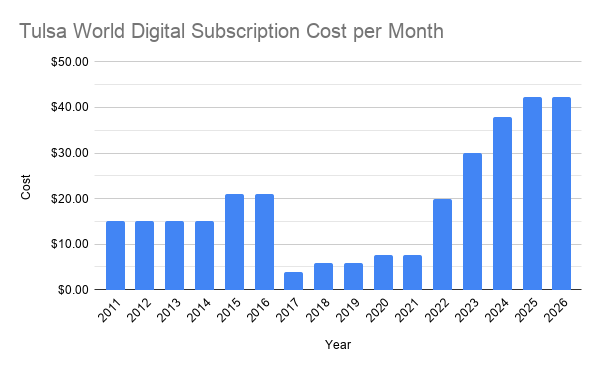
The paper did have to adapt to the new technology, and in 2011 they started charging $15 per month for their e-Edition, which would be about $23 per month in inflation-adjusted 2026 dollars. They kept it at that rate until 2015, when they bumped it up to $21 per month, which would be $30 today.
Things got weird in 2017, when BH Media Group started providing me with the e-Edition for only $3.95 per month, so about 19% of the price I had been paying. I naturally agreed, and they bumped it up to $5.95 per month in 2018, then $7.58 in 2020. In 2022, over a year after Lee Enterprises took over, the cost suddenly jumped to $20, and it was $30 by 2023. In 2024, they started getting sneaky, like the New York Times, charging me $34.99 every four weeks. They hope you’ll think of that as $34.99 per month, but 52/4=13, so they were getting a baker’s dozen of $34.99 charges in per year, for a net cost of $37.91 per month. In 2025, citing inflation and world tariffs, they increased that to $38.99 every four weeks, or effectively $42.24 per month.
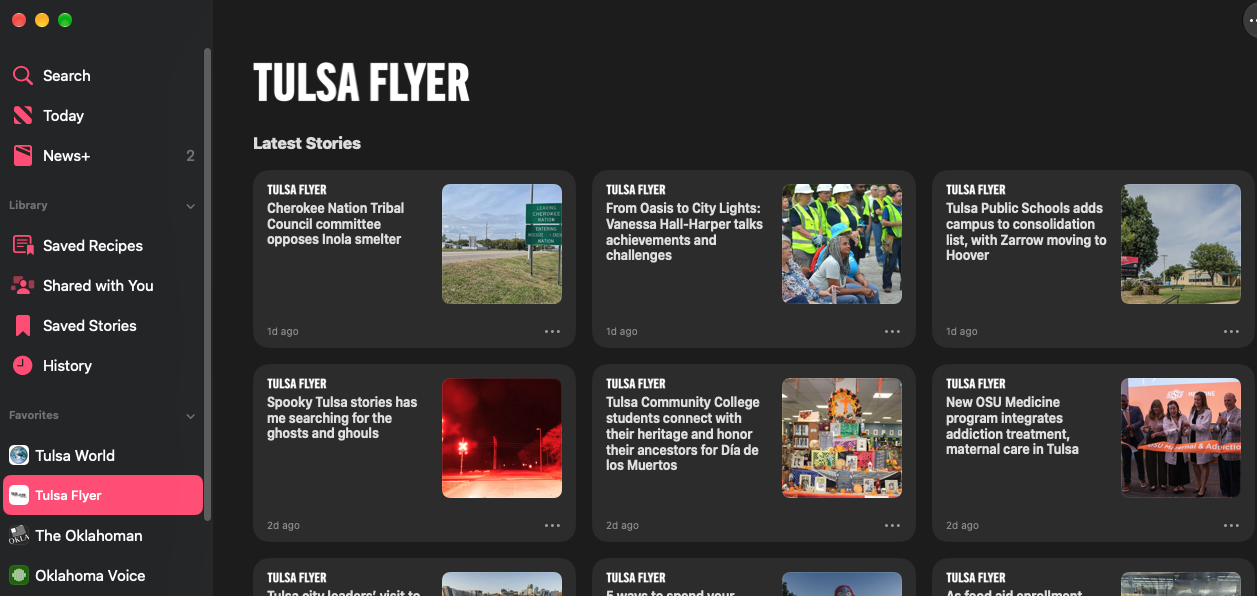
A little over a year ago, the World’s executive editor resigned rather than implement deeper staff cuts, and still the latest cutbacks included columnist Ginnie Graham, an assistant city editor, a features editor, a features reporter, a copy editor, and a photographer. Ginnie landed at the Tulsa Flyer, a nonprofit with free daily news which launched a year ago with over 20 journalists. I can readily access three to five articles per day from it using Apple News.
I’d been hanging onto my Tulsa World subscription in appreciation of the work of veteran reporter Randy Krehbiel, but its value proposition for me was in poor shape at over $500 per year. Bear in mind that unlike many social media freeloaders, I don’t mind paying for news. The Bartlesville Examiner-Enterprise is now a zombie paper, so I cancelled it. Thankfully, its last reporter created The Wiley Post, and while for now its online articles are available for free, I happily contribute a dollar per day to support its local journalism, given its importance for an informed community and good governance. The Wiley Post had 17 articles in October 2026, and ten of them were of great interest to me.
However, I never appreciate a loyalty tax. For years, the New York Times has repeatedly notified me of a large increase in my annual subscription rate, and I respond by telling their system to cancel my subscription. It always responds by offering me $1 per week, which was an 84% discount for 2026. If that tactic ever fails, I’ll just cancel them completely, given how little I use their iPad app.
The Oklahoman Incident
A few weeks ago, I awoke to a notification of “suspicious credit card activity” in the form of a $149 charge for USAToday Co Digital. Well, the USA Today newspaper was once completely free, and then it started charging for its app, but I cancelled that years ago. I told the credit card company to not pay it and to send me a new credit card. After I had breakfast, I realized that the charge was effectively from Gannett, which had acquired The Oklahoman newspaper. I’d been taken off guard since I’ve been paying $99 per year for The Oklahoman, and now they were trying to charge me 50% more.

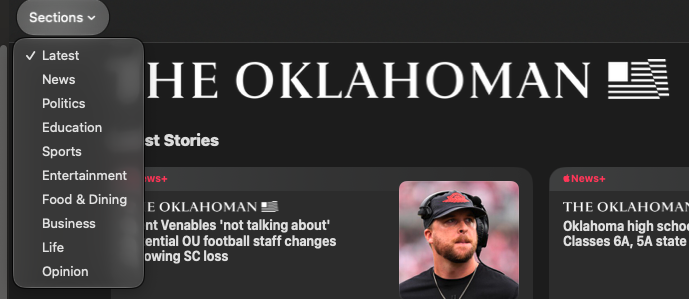
Well, since I’m now a retiree on a fixed income, I had time and motivation to research my options. I discovered that I can access many of their articles via Apple News, which is part of my $40 per month Apple One subscription. Even better, I can filter their feed in Apple News by section, thus avoiding the many sports articles I have no interest in. So I went online and cancelled my subscription, and they didn’t offer a discount.
Evading the Tulsa World Loyalty Tax
That put me in the mood to finally deal with the loyalty tax from the Tulsa World. I couldn’t just log into my account and ask to cancel, as I have done annually with the New York Times. Instead, for years the Tulsa World‘s dashboard said I had to call them during business hours, but this time they also coughed up an email address I could write to.
So I sent them an email to cancel my subscription, and their automated email response offered me four weeks at no charge with the “Ad Free experience” added in. That’s only an 8.3% discount, meaning they would just waive the sneaky 13th charge in a year under their “four week” pricing plan, and no doubt once the month was up, they’d hope to be charging me more than ever for the new “Ad Free experience”.
I put my web browser into incognito mode and checked their pricing on a brand new e-Edition subscription.
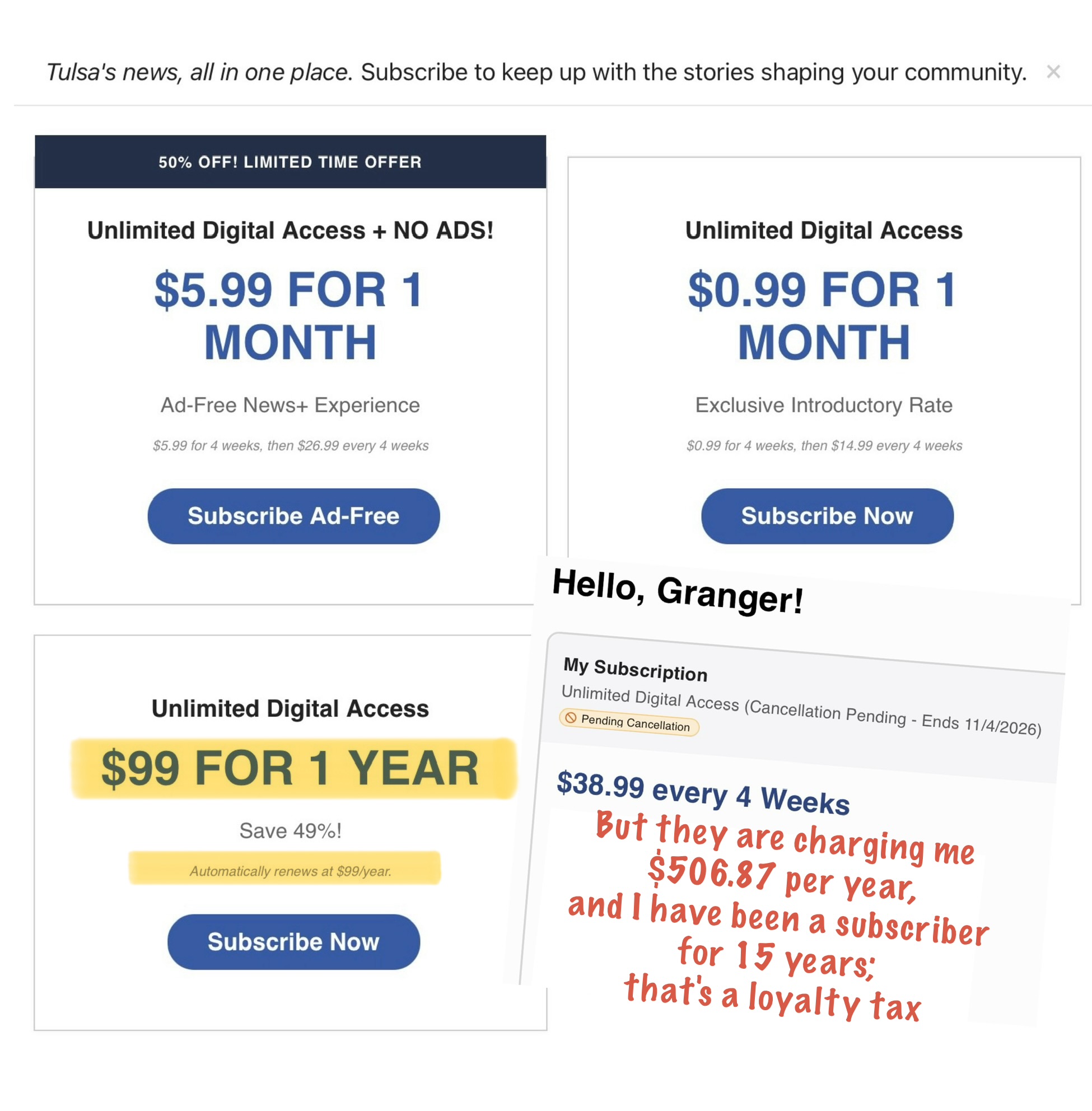
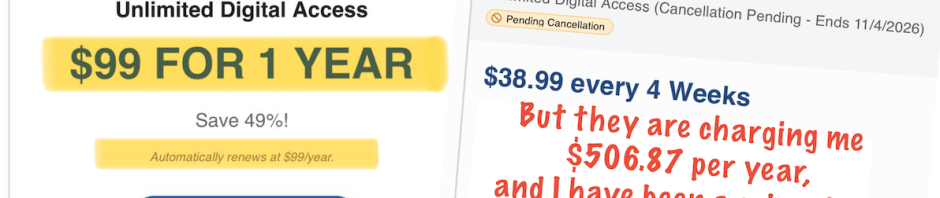
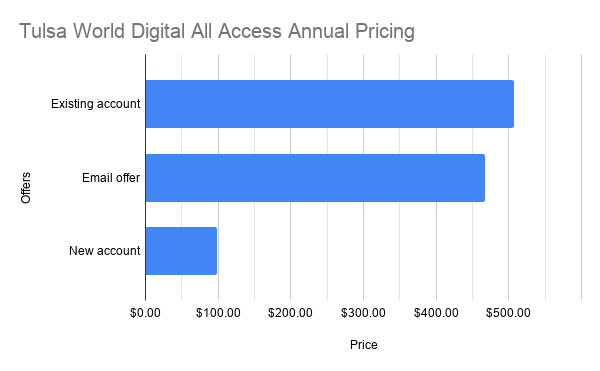
They had been charging me $506.87 per year for Unlimited Digital Access, and my cancellation led them to offer to skip the 13th annual charge to reduce that to $467.88. However, new accounts were available for $99. That is over 80% off.
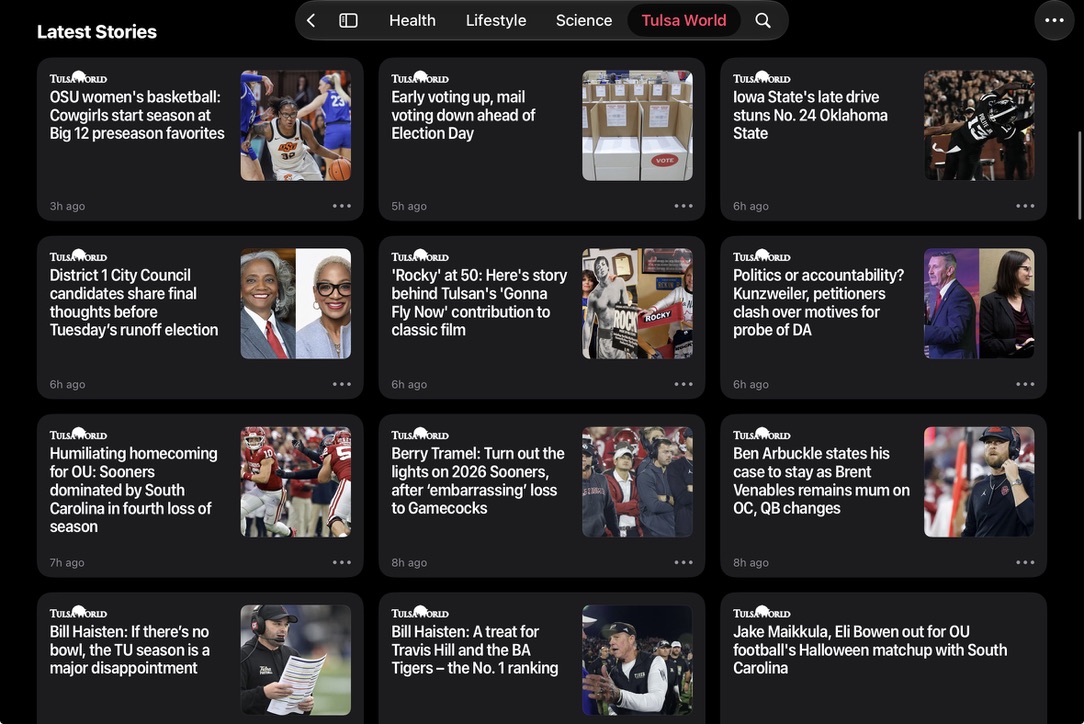
I checked Apple News, and it also has a Tulsa World feed, although I can’t filter it by section — it is just a Latest Stories feed, and doesn’t include all of their reporters’ work.
I compared the articles available there to the ones in the latest Sunday e-Edition that were of interest to me. Two of the three articles on the front page were also in the Apple News feed.
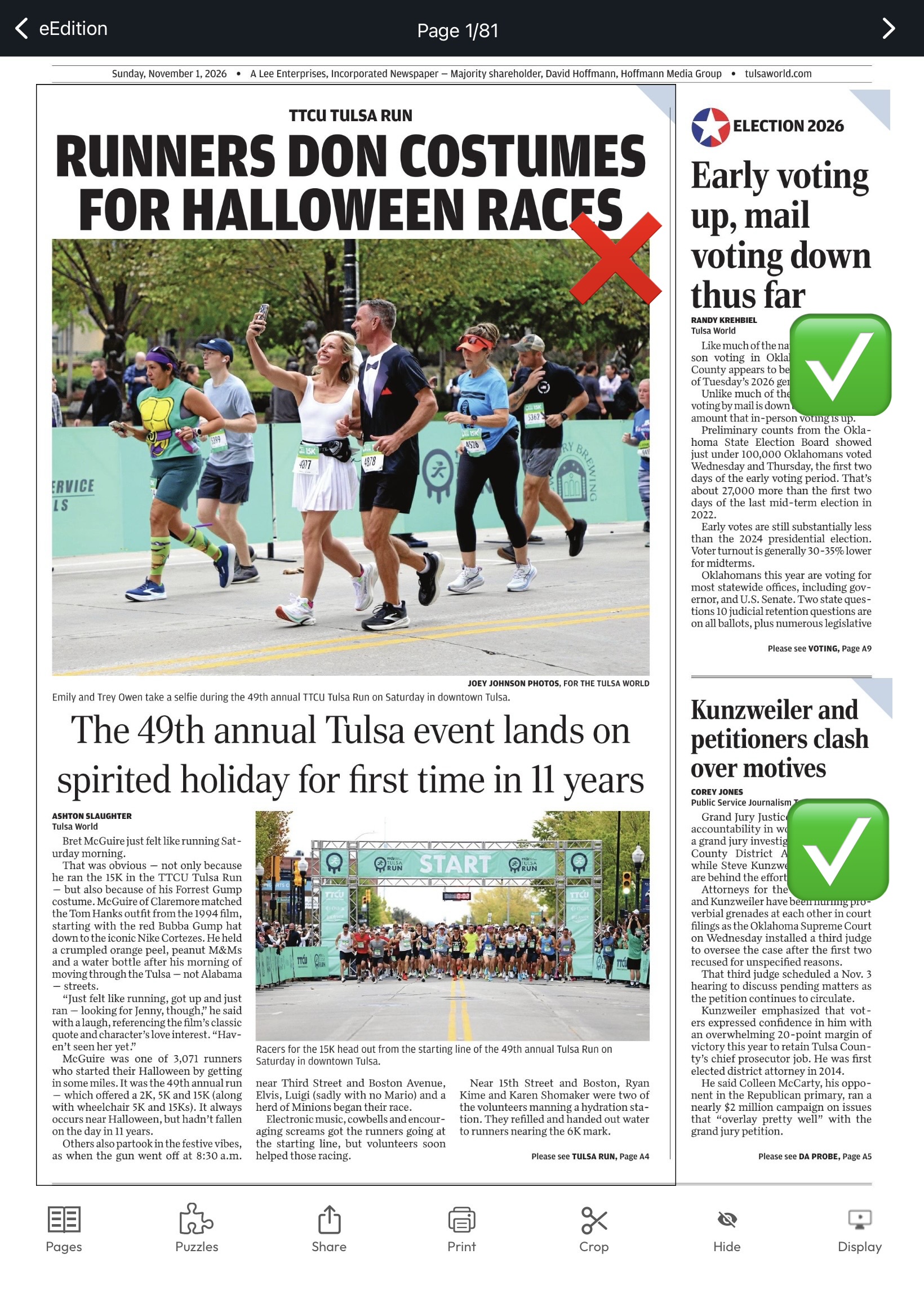
Browsing through the paper, I found three more articles in the e-Edition that were not in Apple News: Randy Krehbiel‘s Political Notebook and a couple of articles by veteran reporter Steve Metzer.
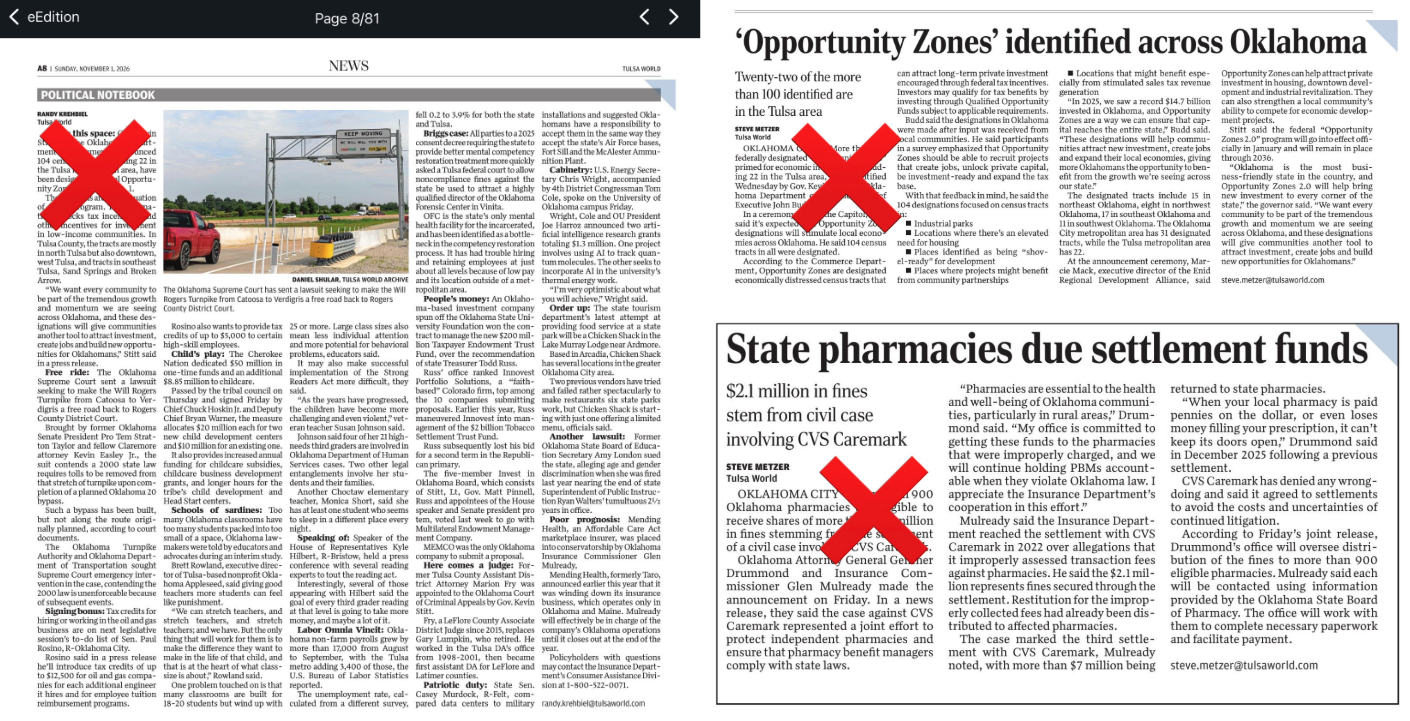
So I decided to continue my subscription if I could get the $99 per year pricing instead of $506.87. I didn’t respond to the Tulsa World email offering to reduce it to $467.88, nor did I go online to chat with a supposedly live representative, nor did I telephone them. I just let my subscription run out on November 4, waiting to see if they would contact me with a better offer or improve their renewal offer in my online account.
The subscription expired, and a renewal link just offered the loyalty tax pricing. So I went into incognito mode in my browser and signed up for a new account with a different email address, purchasing a year’s access for $99. So now I’m paying $8.25 per month instead of $42.24.
I appreciate the challenges faced by the paper’s 11th executive editor, Kristen Wright. I believe her when she writes, “It’s a weird time for me. I just turned 50. I’m working more than I have at any other job, yet I feel invigorated, challenged and hopeful.”
I also appreciate her sharing in her most recent column:

I get phone calls, emails and handwritten letters from loyal subscribers — some who’ve been with us 50 years or more — who ask me to take the Tulsa World back to the paper it was when they were young.
I understand the romanticism. I fell under the same spell, and it turned me into a journalist.
But progress and stagnation cannot happen together. When’s the last time you went to Blockbuster, bought a Kodak camera, got a computer at RadioShack, ran to Sears for a new lawnmower or typed on your BlackBerry? Each of these companies was an industry leader. Today, they’re footnotes in MBA programs about what settling into stagnation will do to a company.
So I understand that she is working hard to lead the paper’s evolution and hopefully ensure its survival. I doubt she has much influence on the loyalty tax that Lee Enterprises is imposing on long-term subscribers, but that doesn’t mean we should accept that tax. Go incognito and check your various subscriptions across services for loyalty taxes, and good luck on evading them.