
The Case of the Crashing Kindle

I’ve always loved mysteries.  As a child I began reading Hardy Boys books long before I reached their target age.  My generous parents allowed me to eventually own all of the hardcover versions and reread them countless times.  Then, desperate for new material, I read all of my maiden aunt’s Nancy Drew, Trixie Belden, and Dana Girls books – being always careful to never be seen in public reading those girl books!  It didn’t take me long to read all of the short Encylopedia Brown tales, and I was running out of sources until I discovered the Three Investigators books at my junior high library.  That series was better written than the Hardy Boys, although the original author expired and later books jumped all over the library in keeping with the varying authors’ last names.  We didn’t have the internet or catalog systems of today, so it was a challenge to track them all down, but eventually I would own all of them as well.

For years I didn’t read hardly any adult mysteries, although I adored The Name of the Rose for its use of Latin, pseudohistory, and mystery.  Knowing that I listened to audiobooks during car trips, my dear friend and librarian Carrie Fleharty gave me An Excellent Mystery: The Eleventh Chronicle of Brother Cadfael as an audiobook, and that set me to listening to every one of Ellis Peters’ (or should I say Edith Pargeter’s) tales of that mystery-solving Benedictine monk.  After exhausting those (and finding them growing a tad formulaic) I listened to some of her standalone tales, especially enjoying City of Gold and Shadows with its setting at a Roman ruin on the border of Wales.  There are still many other tales of Inspector Felse by Ellis Peters which I have yet to listen to.  Tulsa’s main library had many of these stories on audiotape and I paid for a membership in their system so I could check them out regularly.

Happily Barbara Mertz had chosen Elizabeth Peters as one of her pseudonyms and thus was filed by the library next to Ellis.  That led me to try out one of her stories, and I then listened to many more.  They tend to be rather formulaic after awhile, but I greatly enjoyed her Jacqueline Kirby and Vicky Bliss tales.  Narrator Barbara Rosenblatt’s portrayal of Vicky’s comic boss, Anton Schmidt, is quite charming.  However, Mertz/Peters’ more famous Amelia Peabody tales did nothing for me.
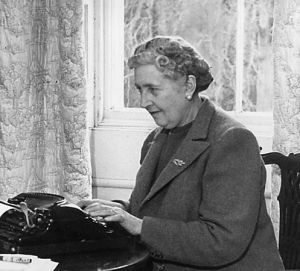
When I bought my first Kindle e-reader I decided to give Agatha Christie a go, being only familiar with her work through the old Peter Ustinov movies of Hercule Poirot.  Ustinov was poorly cast for the part, which was played far better by Albert Finney in The Orient Express and then portrayed masterfully in the long Poirot television series by David Suchet.  Suchet’s audiobook narrations of some of the Christie tales are also quite good.  Most of Christie’s works are still under copyright, but her first Poirot story, The Mysterious Affair at Styles, is in the public domain.  So I loaded it onto the Kindle and was hooked.

I begin buying Poirot audibooks via Audible.  One of the very best is The Murder of Roger Ackroyd.  I then listened to every single Poirot audiobook I could find, especially enjoying Hugh Fraser’s readings.  Having exhausted the available titles, I’ve listened to other stand-alone Christie tales and one of the Miss Marples.  Christie is tremendously skilled with dialogue, quickly sketching out characters, and ingenious plot twists.  She is far less adept at thrillers – Poirot is much more entertaining solving a typical murder case than when bringing down silly supervillains.  I’m still steadily listening to Christie’s work, but eventually I’ll exhaust it as well and move on.

By now you’re wondering what in the devil I meant by titling this post The Case of the Crashing Kindle.  Well, that’s a simple mystery I finally solved this week.  I’ve owned and loved a Kindle 1 and Kindle 2, and I bought a WiFi-only Kindle 3 some months back after giving the first two Kindles away to family and friends.  But the Kindle 3 had a flaw in the screen so I had to get a replacement.  I got that done and ordered Amazon’s matching cover for the unit and have happily read several novels on the Kindle 3.

Do NOT buy Amazon's case for the Kindle 3

But my latest Kindle was constantly forgetting my place in a book and often frozen or rebooting when I opened the case.  This was quite annoying and I finally figured out the cause this week.  The stupid case from Amazon is at fault.  Once I removed the Kindle from the case the problems with the forgotten bookmarks, seizures, and reboots went away.  I’ll admit that I got a clue from the internet where another user experiencing frequent reboots mentioned that the case appeared to be involved.

The return window for the case is over, so I can ship it back to Amazon at my own cost and get some sort of refund or I suppose I can call their support number and whine until they agree to fully refund me for it.  I certainly won’t give up on the Kindle, however, even though I have an iPad and iPhone with the Kindle apps.  I love its size, convenience, and reflective e-ink screen.  But I do hope they do a better job on cases in the future.  And I look forward to more mysteries, although I’d prefer they be in book and audiobook form rather than annoying real-life technology puzzles.

Posted in books, technology | 2 Comments

Woods, Lakes, Rocks…and Art

Woolaroc (click image for slideshow)

The best attraction in the Bartlesville vicinity is Woolaroc, the museum and 3,700 acre wildlife preserve oilman Frank Phillips established in 1925 as his ranch retreat.  It originated from a large oil and gas strike on Lease 185, with a gas plant built at “Phillipsburg” and the construction of Clyde Lake, named after Phillips General Manager Clyde Alexander, to supply water for the plant. Frank Phillips loved the lake and surrounding canyon and made it the centerpiece of a cattle ranch.

I’ve visited it many times since childhood, but usually my focus has been on the art and artifacts in the museum.  The collection of western paintings and sculpture is remarkable and the Native American collection is a showcase of artifacts removed from the Spiro Mounds 125 miles away.  I also visited Woolaroc regularly back when my father participated in its annual Mountain Man Trader Camp.  A few years back I drove its long-closed North Road, and I’ve been down around Clyde Lake and walked to the Phillips Mausoleum where Uncle Frank has been entombed since 1950.  But I had never taken the time to walk the short nature trails north of the museum until this sunny, chilly, and windy December day.

It had been a hectic work week replete with meetings and tutoring students preparing for a big unit test before we hit finals this next week.  Some evenings were spent preparing my home for a potluck dinner for 14 of my friends from work and their spouses.  The dinner and the company were great, but I was in no shape for a long road trip on the weekend.  So I opted to fill in one gap in my Woolaroc experiences and hike the Outlaw and Warrior Loop trails.  The online hand-drawn trail map was hardly accurate, greatly overestimating the walk, but I enjoyed getting out in the crisp weather for a stroll in the sun and was grateful for the warmth of the museum afterward.

I drove the 20 miles to the retreat and paid the $8 entry fee.  One of the familiar Indian statues greeted me.  These cast zinc-alloy works are 11’ tall and were produced in the 1920s and 1930s by the Palacine Oil Company for their Wirt-Franklin gas stations in the state.  I passed Sitka deer and one of the artificial waterfalls, easing through the Haunted Grove with its eerie skulls and bones nailed to the tree trunks.  Parking by the museum, I strolled over to the entrance to the Thunderbird Nature Trail.

I first turned eastward for the Outlaw Loop, strolling along its native stone.  I was pleased to find I was benefiting from a Boy Scout Eagle Project performed by Alan Davis, a former student of mine.  The trail paralleled a stream which had eroded a bluff before feeding into tiny Elk Lake.  After crossing Elk Bridge the trail wound through some rock formations and reached a high point where I could see the museum perched on a hilltop in the distance.

Soon I’d finished the loop and began the Warrior Loop to the west, which crossed interesting eroded rock beds where water had carved its own channels.  Eventually it paralleled the stream again and at one point ran through a hollow where, protected from the cold wind, some of the grass was still stubbornly green despite winter being only about a week away.  A short side trail led to Princess Falls and then I passed the aptly named Mossy Ledge.  I’d had the trails all to myself, but I could easily imagine children enjoying this scamper spot.

Concluding the walk, which was only about 1.75 miles, I passed the concession area, making sure to visit the famous taxidermied buffalo which sucks up trash.  He was redone a few years back and is a big hit with the kiddies, but I had nothing to offer him.

I strolled about the grounds, enjoying various sculptures.  Thanks for the Rain was created by Joe Beeler and dedicated in 1987.  A series of other statues once graced Monument Road at the wonderful Marland Mansion in Ponca City.  Oilman and spendthrift E.W. Marland asked Frank to buy much of his collection in 1940 over a decade after Marland Oil was consumed by J.P. Morgan and renamed Conoco.  Far more than half a century would pass before Conoco merged with Phillips Petroleum.  I shot four of Marland’s statues which had been sculpted by Joseph “Jo” Mora. The Cowboy was modeled on George Miller of the famous 101 RanchThe Outlaw was Belle Star.  The Indian Maiden was modeled on Mrs. John Bull.  A nearby sculpture of a spear fisherman had a backdrop of enormous petrified wood pieces and was the focus of tossed-coin wishes.

The entrance to the museum was adorned with Christmas lights.  Woolaroc says over 600,000 lights are in place for its annual Wonderland of Lights.  I should venture out with a friend and see that.  The usually stark foyer was invitingly decked out with Christmas trees flanking Uncle Frank’s statue.  Bryant Baker’s The Pioneer aka The Plainsman was on one side and modeled on oilman W.H. McFadden.  On the other side was Jo Mora’s The Indian.

I briefly looked over the artifacts from the Spiro Mounds, having visited there a few years ago and being surprised at how few artifacts they had left on site.  I recalled that Frank’s collection of shrunken heads was somewhere near by, and although they fascinated me when I was young I did not seek them out today.  Instead I passed by the striking Dance of the Mountain Gods by Jim Hamilton to ponder the wonderful Pioneer Woman models, the product of the 1926 artist competition staged by Marland for what would become the 12,000 pound 17-foot tall Pioneer Woman statue in Ponca City.

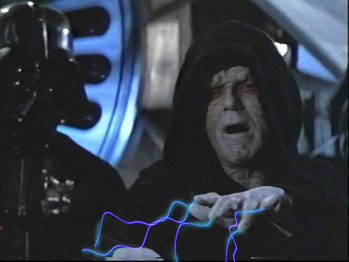
The Trusting version by Jo Davidson was said to be Marland’s personal favorite, but the museum’s lighting made her look like the mother of Star Wars’ Emperor Palpatine.  It seems appropriate that she have a power socket nearby should she need to shoot out some force lightning.  I love the woman’s face and hair in the Challenging version by H.A. MacNeil.  Adventurous by F. Lynn Jenkins has a nice pose but a cloying visage.  Affectionate is the bare-breasted version by James E. Fraser that would never do for Oklahoma, although she does manage to hang onto her rifle while exposing herself.  But the clinging gown on Faithful by Arthur Lee is downright sexy. The rear of that model, however, is unbecoming.  The severe lines of the bonnet clash with the art-deco styling of the flowing gown.  The bottom almost looks snakelike to me, and it would be a pity to visit Ponca City and be reminded of Harryhausen’s Medusa.  So Bryant Baker earned his win with his Confident version.  I like her laced boots, the matching stride of her son, and her expression is simply perfect.

After ogling the ladies I relived my childhood by activating the Crow Indian Dance machine.  I then admired a series of great paintings by William Robinson Leigh, a master of composition and action:

These paintings also caught my eye:

As for sculpture, I liked Joe Beeler’s Lord of the Southern Plains. His sculpture Crazy Horse reminded me a bit of my father, although you’d have to draw in the cheekbones quite a bit, narrow the mouth, cut the ponytail, lose the feathers and the earrings…oh, never mind.  Maybe it doesn’t resemble him at all.

The museum began as a hangar for Frank’s Woolaroc airplane, and I took shots of it from the front and from the side both above and below the wings.  Below the plane was a rope tool drilling rig from over a century ago.  I’m not at all sure, but this may be the one donated to the museum by Jay Ramey, the husband of one of my first cousins, once removed.

I left the museum and wandered over to the old Y-Indian Guide Center, now called the Heritage Center.  The YMCA decided its Y-Indian Guide program, with its faux Indian rituals and regalia, was racist and renamed them Adventure Guides back in 2003.  Out front was another work of Joe Beeler, Night Song.  I like the dreamlike images on its base.  Thankfully the building still sports the big stained glass window where a Y-Indian Guide tells some youngsters about the high road and the low road.  In past years I could never get a decent shot of it, but this time I was able to take upper and lower shots of it from the balcony, correct the visual distortions from the angles in Photoshop, and stitch them back together into a coherent whole.

After clambering about the rocky bluff between the Woolaroc Lodge and Clyde Lake, I got back in my car and drove out through the refuge.  A chain of buffalo were ambling down the side of the road, sometimes pausing to check me out.  You don’t expect to see this view in your side mirror!  The leaders paused to look back at the stragglers as I left the refuge.

It was an easy and enjoyable trip, although I wound up spending far more time editing the photos and writing up this post than I spent out at Woolaroc!  But this way my memories are preserved and shared.  A two-week winter vacation begins at the end of next week and I am more than ready for it.

Click here for a slideshow from today’s day hike and museum tour

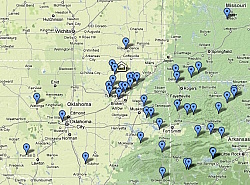
My day hikes since July 2009: Map; Listing

Posted in art, day hike, photos, travel | Leave a comment

Three Pools and a Rough Canyon at Robbers Cave

Rough Canyon near Robbers Cave (click image for a slideshow)

After a somewhat disappointing outing at Sequoyah State Park the prior week, I was determined to make the next expedition more rewarding, especially since I’d be passing the 400-mile mark since I began my series of day hikes in July 2009.  The weather was sunny and warm for December, rising into the 50s, although a chilly north wind constantly reminded me that winter was only a couple of weeks away.

Still leery of hunters, I scoured the map for state parks and at first considered a hike at Arrowhead on Lake Eufala.  The state once had twin lodges on that lake, Arrowhead and Fountainhead, with their own decorative motifs maintained throughout their respective parks.  All of the state lodges lost money, but those two really bled it, and the state finally disposed of them.  Fountainhead Lodge was sold to the Muscogee (Creek) tribe a couple of years ago for $2 million.  They’ve emptied it out to build a resort and casino – big surprise.  Arrowhead Lodge was sold off in 2000 to the Church of Scientology, of all things, which uses it as a Narconon drug and alcohol abuse treatment center.

I’d visited both parks back in high school and, while I liked the decorative motifs at the parks, I didn’t remember being impressed by the trails.  Lake Eufaula State Park and Arrowhead State Park each have a few short hiking trails and Arrowhead has several long bridle trails.  They’d do in a pinch, but I wanted something better.  My eye wandered eastward on the map to Robbers Cave State Park.  I was last there in September 2009, scrambling over the impressive cave area formations on a hot day with oodles of kids and climbers about.  While I had no real desire to explore the cave area again, I knew the park had some other long trails, although I had never followed them for more than a few hundred yards near the cave area.  A little web research convinced me to drive three hours to that park’s north end for what would become an 8.2 mile hike to Lost Lake, Cattail Pond, Lake Wayne Wallace, and Rough Canyon.

The drive was uneventful, although there were many little road construction projects along each phase of the journey.  A combination of toll fees and federal stimulus money at work, I suppose.  I’d driven the Muskogee Turnpike down to I-40 many times for day hikes in Arkansas, and was glad to be turning west for once for the jog over to Highway 2.  Here a bridge project, rather than simply reducing lanes, turned the narrow two-line highway into a one-lane road for a spell.  A stoplight at either end allowed cars through in waves.  You know you’re in the mountains when they take that approach.

Reaching the park, I drove over to the cave lot, opting to handle the weather by layering an undershirt, heavy microfiber button shirt, and jacket.  Unsure of how near the trail strayed to the adjoining Wildlife Management Area, I added a fourth layer in the form of my orange “don’t shoot me” vest and quickly scrambled up through the eastern edge of the cave area on the old CCC trail until I found the trail sign and blue blazes of the Lost Lake/Rough Canyon Trail.

It led northeast around the rear of the cave area, forming a rocky path protruding through the fallen leaves.  A mix of pine trees in with the deciduous prevented the landscape from looking too denuded.  None of my online maps showed the bridle trails, so when I came across one I followed it a bit to see if it led anywhere interesting (no) and then doubled back.  Eventually the trail reached Lost Lake.

I had not seen another hiker and the little lake was a lonely spot.  Part of the surface featured lily pads, and a fallen pine tree was still alive, although it projected out from shore at about 30 degrees above the horizontal.  The low concrete dam was aged and cracked, with an old CCC pump house at one end.  The pretty rock work was holding up, but the abandoned building’s wood was rotting away.  It was almost time for lunch, but Lost Lake was too depressing, so I forged onward.

The trail soon featured a greater abundance of pines, providing a lovely cushion of needles for the trail.  I reached the junction with Cattail Pond Trail and decided to take it and have lunch at the pond.  Near the trail junction I bushwhacked my way down to the rocky bed of the stream that was dammed to form Lost Lake.  I liked how a small boulder was propping up a rock ledge down in the bed, and nearby a tree was serving a similar function.

A sign announced Cattail Pond, where I spotted a sunny picnic area on the opposite shore.  I bushwhacked my way over there, finding it to be a camp on a bridle trail.  I enjoyed my usual turkey sandwich, this time a tasty one I’d purchased at a Bartlesville QuikTrip.  It was a welcome break, with a relaxing view of the grassy shore and nearby tree blooms.

I followed the trail across the earthen dam, which had been planted with pines.  It had merged with a bridle trail, but as I tread onward I noticed that the blue blazes for my hiking trail were absent.  I had missed a turn.  I backtracked and had a difficult time locating the turnoff, which was overgrown.  The section of the Cattail Pond Trail between the pond and the junction with the Lake Wallace trail was clearly seldom used.  It was quite faint and overgrown in places, sometimes only discernible by the frequent blue blazes on the trees.  I presume many people camping in the south portion of the park follow the Mountain and Lake Wayne Wallace Trails northward, but then turn off eastward to take the Rough Canyon Trail to Robbers Cave.  Few choose to instead travel on north to Cattail Pond.

Soon the trail was running beside a deeper rugged canyon created by the stream flowing from Lost Lake into the northern end of Lake Wayne Wallace.  I later realized that this section of Cattail Pond Trail parallels the Rough Canyon trail, travelling along the northwestern edge of the canyon, while the eponymous trail travels along its southeastern side.  I could not resist bushwhacking down to the stream bed.  This steep descent marked the only time on the hike when I used my trekking poles.  I memorialized the victorious descent with a silhouette shot of myself holding my poles aloft over the stream.

A series of fallen trees across the stream made me think back to the series of bridges across the Chicago River I remember seeing in the credits of the original Bob Newhart show as a child.  It was warming up and there had been no sounds of hunters, so I stripped off the hunting vest and had fun scrambling over the huge slabs of rock, posing for a self-portrait.  Clambering back up to the trail, I followed the gradually descending canyon rim and as the canyon ended I made another descent to the stream bed.  In the distance I could still see the series of “tree bridges” which I had now passed.

I reached a trail junction and noted I had just enough time for an out-and-back trip to the north end of Lake Wayne Wallace before I needed to head down the Rough Canyon Trail back to the cave area.  Along this stretch of trail I finally encountered other hikers, a group of six or more outfitted with small day packs like my own, but sporting some long wood staves as hiking poles.  Stumbling past them, I slunk onward to cross Ash Creek Road and a rock ledge ford across a stream.  Near here I heard the sound of a powerful engine laboring away.  A side trip showed it was a compressor for high-pressure gas pipeline.  I don’t envy the workers and engineers who installed that pipeline through the San Bois Mountains.

I finally reached the northwest end of the biggest lake in the park.  A bridle trail ran along here and the water level was down, so the shoreline was a muddy mix of stones, twigs, and the remains of many tiny mussels which crunched beneath my boots.  I paused for a macro shot of one and then reversed course, noticing that the trail blazers had gotten a bit carried away at times.  Pausing only briefly to capture a shot of a particuarly nice trail stone, the trail forded the stream I’d followed for much of the day across a broad ledge of rock.

I eventually reached the Rough Canyon Trail.  Before following it east back to the cave area, I walked northward far enough to reach a scenic portion of the canyon and bushwhacked my way down to the stream bed.  I was not surprised to find that I was only a few yards south of where I’d visited earlier via my bushwhack from the Cattail Pond Trail.  Climbing back up, I found a fallen branch of a pine tree, with a cone still attached.

At one point the eastward trail descended a rough slope.  A nearby section of bluff had what appeared to be a small cave, but a short bushwhack showed it only to be a crevice.  The trail made a stony descent to Fourche Maline Creek (Wicked Fork in French), which is the main flow into Lake Wayne Wallace and headwater to the Poteau River.  Here I encountered a family of hikers.  The father asked if I had just seen the two bald eagles flying past above the creek, but I confessed I had missed the opportunity, durn it.

After four-and-a-half hours out on the trails I was back at the cave area with the sun setting behind me.  I needed to run back to Tulsa for dinner with friends, but I’ll definitely return to Robbers Cave later, as in the southern part of the park there is still a Coon Creek loop trail and much more of the Mountain Trail to explore.

Click here for a slideshow from this day hike

Posted in day hike, photos, travel | 6 Comments

Straying at Sequoyah

Sequoyah State Park (click image for slideshow)

For my last day of Thanksgiving Break I decided to find some new trails to hike.  I’d spent the prior day on housework, mulching leaves and doing laundry.  The weather was warm for November, if blustery.  I scanned the map for trails I had not visited, with the constraints of them not being more than a two-hour drive away and being free of any hunters.  My eyes alighted on Sequoyah State Park at Fort Gibson Lake near Wagoner, home to one of the state’s remaining lodges, the oddly named Western Hills Guest Ranch.

I’d briefly visited with some friends staying at the park some months back and they’d mentioned there were hiking trails.  The state’s online map showed a variety of hiking and biking trails, although my own explorations would later show it to be out of date, which, when combined with very poor park signage, led me astray several times.  Thankfully freezes had killed off the underbrush and made the consequent bushwhacking tolerable.

I crossed the Highway 51 bridge over Fort Gibson Lake and arrived at the park around 10:15 a.m.  I turned west off the main road down past the Paradise Cove Marina, noticing that one of the trailheads shown on the map was not marked.  I drove to the adjoining picnic area to the south, where the map showed another trailhead for the small Eagle Roost loop trail.  I parked in a sandy lot at the trailhead near some of the planted pines which line many of the park roads.

Here there was a trailhead sign, although what I presume was once a registry box was a cobwebbed shambles.  The trail had been mowed and looped about a small hill, with occasional green signposts providing direction at junctions.  Other numbered signposts were presumably explained by some nature trail map I did not have.  I find it most irritating that many state parks do not post all of their trail maps and guides online, forcing one to either inquire at a park office or do without.  And Oklahoma’s travelok.com website was redesigned a year or so ago, for the worse, and now provides only sketchy information on most of the parks.

The only notable aspect of the trail was the Cockrum Cemetery, a burial plot of about a dozen graves which had a picket fence and reconstructed tomb which were put up a decade ago.  The cemetery began with the burial of Ka-tee Cockrum in 1884 in a tomb of native stone.  By the 1920s the area was so neglected that the stones were reused for a grain silo and the headstone moved to the family homestead.  It returned to this site in 2000 when the cemetery was restored.  The sign explaining this mentioned a North Ray cemetery – later I would realize that the peninsula the park occupies was once home to a ghost town called Ray.  A church, the Ray Mission, is nearby with another, larger cemetery.

When the trail returned to the lake, I followed a mountain bike trail not shown on my map around a small and muddy cove with abandoned picnic tables and debris scattered about.  It was depressing until some waterfowl appeared to lift my spirits.  Returning to my car, I’d hiked about 1.25 miles and was hungry, so I drove down to the tip of the peninsula and had a tasty lunch at the lodge restaurant.  I was the only customer for some time, although eventually three elderly couples appeared.  Some crabbed about breakfast no longer being served (at 11:15!) and another old fellow was being very picky about ordering his side salad just so.  Overhearing these other customers, I wondered if the restaurant not having Coke or Pepsi on hand, which had forced me to settle for a Dr. Pepper, might be symbolic: prune juice cola seemed fitting for the lodge’s clientele.  (Of course I know it is an old wives’ tale that Dr. Pepper has prune juice in it.)

After lunch I drove over to the nature center and found a modern trail sign for the Three Forks Nature Trail, indicating part of it headed off north along a paved pathway.  I shouldn’t have trusted the sign – the paved path was a mountain bike trail and, as far I could tell with later exploration, there is no Three Forks Nature Trail segment heading north from the Nature Center anymore.  A north loop for the trail is shown on the park maps, but the area is overgrown and only a few sections of the former trail, discernible by field stone curbing, remain and are cut through by barbed wire fencing.

I don’t like hiking on asphalt trails in my boots, but I persevered and headed north for over a mile, passing the riding stables, until the paved trail petered out at the road to the closed Cherokee area.  I could see it had been planned to extend the trail north from there, but that work had not been completed.  My map indicated another section of bike trail to the west, and I found it was there and was happily unpaved but cleared.  So I followed it and noticed that it branched off to the north to join with the Eagle Roost Trail – I’d seen red tree blazes for that section of bike trail earlier, although it was not shown on the online maps.

My section of bike trail turned south and then, frustratingly, ended at the road to the Seminole area.  The silly map acted like it just crossed the road, but that wasn’t true.  I turned east along the access road, arriving at the Ray Mission church and graveyard, close to the main road.   No trail signs, but I did see a cleared path to the south.  I followed it and it lead to a sewer lagoon, again with no signage.  I took another southern trail, which popped out on the Creek area access road, with no further trail to the south in evidence.  Maybe I was on the wrong path entirely or hadn’t stuck to the perimeter of the sewer lagoon for long enough.  Oh bother.

I wandered through a mowed field looking for a path south, but no dice.  So I returned to the access road and guessed the promised trail might lie to the west.  After passing another large mowed field, I found the bike trail again and followed it south to a creek close to the lake shore before it turned southeast to finally pass another sewer lagoon and terminate at the Chickasaw area access road by the golf course.  I walked back east along the road and found a large sign for the bike trails which showed the supposed path of several different sections.  It was only approximate for the bike trails and, like the online map, showed a north loop for the Three Forks Nature Trail which I would later find had been abandoned.  One hopes they have more accurate maps available at the park office or nature center, but given the shoddy park signage, I wouldn’t count on it.

Returning to the nature center area, I scouted around and confirmed that the west part of the north trail loop was non-existent.  So I walked south along the road to where I’d earlier spotted a sign for the Fossil Nature Trail, or Fossil Trails, as the sign put it.  This trail (or trails?) did exist, and was the most scenic in the park.  It made its way along the rugged and rocky eastern shoreline of the peninsula, allowing me a chance to scramble down to the water and along the rocky bluff.  When the shoreline bluff became impassable I backtracked and found an unmarked and crumbling cemented stone pathway back up to the main southbound trail.

This last bit of southbound trail had some abandoned and crumbling picnic tables, reminding me of the neglected cove I’d seen at the start of the day.  A big driftwood tree was interesting and the trail ended at a dock to the east of the lodge, where I could see Fort Gibson dam in the distance.  I retraced my path northward, following an abandoned unpaved roadbed for part of the way.  Soon I was heading north on the remaining part of the Three Forks Nature Trail, which then reached an unmarked fork.  The path to the left appeared to head back toward the nature center, while that to the right headed downhill toward the lake and was presumably part of the north loop toward the Choctaw area.

I took the right fork.  The trail could only be discerned by native curb stones lining its sides, which stuck up through the plentiful leaves.  A short side trail led down to abandoned equipment where what I take to be the park’s water pipes run down into the lake.  Eventually the trail popped out at the Choctaw RV area.  A dilapidated sign pointed westward, but I couldn’t easily spot a trail and wasn’t in the mood to ask the camp host, the only trailer in the area, for directions.  So I bushwhacked my way westward along a barbed wire fence and eventually came across a north-south section of what was once the Three Forks Nature Trail’s north loop.  The trail petered out to the north, and to the south it ran into new barbed wire fencing, forcing me to bushwhack westward to a road and return to the nature center.

I’d hiked 8.5 miles and was ready to call it a day.  While I’d enjoyed the walk, the inaccurate and outdated trail maps and pitiful signage, along with several derelict picnic areas, left me unimpressed.  I’m glad the Osage Hills State Park near me is kept in better shape, although it too could use better trail maps and signs.  Sadly I can’t expect any improvement for some time, given ongoing severe cuts in the state budget.  Much of the stimulus money is going to highway projects.  That way I can save time getting to our neglected state parks.  <sigh>

Click here for a slideshow of today’s day hike

Posted in day hike, photos, travel | 1 Comment

Black Friday at Platt

November 27, 2010

Platt’s Lincoln Bridge (click image for slideshow)

That which we call a rose by any other name would smell as sweet.
Shakespeare’s Romeo and Juliet

The bard’s maxim is put to the test by what was once Sulphur Springs Reservation, then Platt National Park, and is now the Chickasaw National Recreation Area.  In 1902 that tribe sold the land around Travertine and Rock Creeks to the government and the popular summer resort grew up with the adjacent community of Sulphur.  It was a major CCC project during the Depression and eventually Lake Arbuckle was built to the south.  When I was a child my parents took me there several times for camping, hiking, and biking and since then I’ve returned a few times with friends.  I was ten when its awkward new name was applied, but many of us still call it Platt out of both nostalgia and convenience.

Thanksgiving 2010 was cold, but it warmed on Black Friday and I found myself in Oklahoma City ready for a day hike.  My proximity to south central Oklahoma made it a tempting target, but I wanted to stick with a popular and well-developed park since we are now in gun hunting season for deer.  My Oklahoma Hiking Trails book mentioned the Rock Creek Trails at Platt, just south of the campground I recalled from my youth.  Those might be dicey with hunters about, but I knew there were also some trails along Travertine Creek where no hunters would dare stray.

So I drove south to Sulphur and into the park for a day hike which would extend to 5.75 miles.  The most picturesque area I could recall was the Little Niagra falls to the east, so I drove to them first through an almost empty park.  The combination of freezing rain on Thanksgiving and Black Friday shopping had cleared the park, but it was now in the 40s and the trees were rapidly shedding their icicles.  For the first time in my life, I had the falls all to myself.

The CCC constructed the beautiful twin falls, which cascade on Travertine Creek.  The upper falls are nice, but the lower falls are far more fun, having a series of stepping stones across the top.  I shot a short video of Little Niagra and then trekked eastward past the Nature Center toward two of the springs which feed the creek.  The trail, as I vaguely remembered, was long and linear as it both followed and traversed Travertine Creek amidst the glistening trees.  I ignored the three side loops to the south, concentrating on the two springs.  The wide circular pool at Buffalo Springs was strewn with leaves.

Above me one tall tree gave a final burst of autumn color and I crossed another slab bridge over a small waterfall in good flow and fed entirely by Antelope Springs.  They flow from the base of a pile of boulders formed of conglomerate rock.  I returned to my car, having hiked a bit under two miles along the creek.

Driving to the west part of the park, I stopped at Lincoln Bridge, which was built in 1909 on the centennial of Abraham Lincoln’s birth.  Although lacking the usual flock of children scampering about its little flagpole turrets, the bridge had its usual charm as it spanned Travertine Creek.

I drove past Bromide Hill through the Rock Creek campground on the northwest corner of the park, past the many narrow numbered turn-ins.  I recalled riding my bike past these as a child wondering when I’d finally reach our slot in what seemed like an endless series.  The deeper portions of the campground were gated off since there were only about three campsites in use in the entire park.  I was disappointed to find that the entire Veterans Lake area was closed, denying me access to the Rock Creek multi-use trail, parts of which I remember scrambling across decades ago.  I later discovered that the Lake was closed in July for a nine-month project to rehabilitate the dam to modern standards and replace the road across it with a new mile-long North Shore trail connecting to Rock Creek campground.

Not knowing what was afoot at the time, I decided to check out the other entrances to Veterans Lake but found them all blocked.  Thinking I might try the southern trailhead to the Rock Creek trail system, I drove seven miles south to the Buckhorn Area on the southeast shore of Lake of the Arbuckles.  But there were orange-vested utility workers all about and signs indicated the area was open to hunting, so I opted for safety and returned to the historic part of the park to hike around Bromide Hill.

This long mound of conglomerate rock rises 140 feet above Sulphur and the park.  For millennia rivers washed rocks down from the Arbuckle Mountains and lime in the water cemented them into what is today’s Bromide Hill, which is tall enough to transition from oak, ash, and elm trees into short grass and prickly pear cacti.   An overlook provides a great view of Sulphur to the south and is called Robbers Roost since local legend says outlaws once used the location.  These days it serves tourists and, evidently, beer-swilling polluting partiers who leave aluminum cans scattered in the crevices.

Parking in the Bromide Pavilion area, I took the east bridge across the creek, which I remember being constructed in the 1970s, and climbed the east trail up the hill, happily finding that the trail to the top was still open even though the road at the top was closed and fenced off due to the work at Veterans Lake.  At Robbers Roost I enjoyed the view while dining on a hefty turkey sandwich I’d picked up down in town.  That reminded me of cold campsite mornings when my father would drive a few blocks to pick up delicious warm square donuts in the city, which we feasted on back in camp.  As a child the fact that a full-fledged city was only a few blocks to the north struck me a singularly odd, and from above it is striking to see the park only extend a few blocks northward to the walls separating it from the city.

Extended westward along and then down the peak was a narrow overgrown trail.  I vaguely recalled taking it in the past, but was not clear on its destination.  As it descended into the trees I startled a large buck who, like me, was hiding from hunters.  Soon I managed to stir up a doe as well.  Eventually the trail ended at the western edge of the hill, providing an overlook of the fork in the road where you either turn into Rock Creek campground or towards Veterans Lake.  Ah yes, I remembered being here before in my younger days.

Backtracking and bushwhacking, I descended from the roost to a well-remembered spot where the main trail crosses a rockfall of massive boulders.  I was tempted to climb on up to the crevices, but decided it was too treacherous for a solo expedition.  I then trod eastward to circumnavigate the fenced Bison Pasture.  Although I never spotted any of the buffalo, descendants of a small group brought over from the Wichita Mountain Wildlife Refuge decades ago, I did see another doe and a buck, barely managing to capture a shot of one of them through the trees before they bolted.

I passed a large hollow tree stump and followed my shadow around to the Ranger Station, built in 1894 as a family home by Graves Leeper and put to use in 1904 as the superintendent’s office.  It was expanded in the CCC area.  It is adjacent to Hillside Spring, which flows at about 80 gallons per minute with a heavy sulphur content.  The arsenic in the water is why it was once used to help lighten the skin.  Today the bacteria content makes the water undrinkable.

Nearby is the former center of the park, an old buffalo wallow which became Pavilion Springs and brought together the flow of seven springs.  One is grateful for the open sides to the pavilion, as the sulphurous stench is quite strong.  You can safely cross Highway 177 to the pavilion via an underpass with the spring water flowing in a small side channel.  The sulphurous smell through the short underpass is quite powerful, and I remember being both fascinated and repulsed by it as a youngster.

The first part of the trail back westward toward Bromide Pavilion along Travertine Creek was scenic, but became less interesting as it curved south through the woods.  The sun was streaming into the south side of the beautiful old pavilion, where until the 1980s the big fountains allowed you to compare bromide and medicine spring waters to the city’s tap water.  The building had tanks to store up low-flow spring water for peak usage, but the springs eventually dried up completely.

I wrapped up my trip with a trek back up Bromide Hill, this time using the west trail with its memorable high walls and switchbacks.  The hill’s long shadow was eating away at the park below as I descended to my car for a drive to Tulsa for dinner with friends.  I look forward to returning to Platt, er, the Chickasaw National Recreation Area, after the Veterans Lake projects are finished.  I want to refresh my memory of the lake and the Rock Creek trails and partake of the new trail they are a-building.

Click here for a slideshow of today’s day hike

Posted in day hike, photos, travel, video | 1 Comment