Stay Loose with Belle & Sebastian

Recently I’ve been playing two Belle & Sebastian albums a lot: Dear Catastrophe Waitress and The Life Pursuit.

Stay Loose is from the earlier album and is an example of how their lyrics are anything but mindless. While it lacks the brilliant couplets that Martin Fry of ABC puts in his songs, I do like this song a great deal. And this song, like the best songs of ABC, was produced by the wonderful Trevor Horn, formerly of The Buggles, Yes, and The Art of Noise.


Video of Stay Loose

I was choking on a cornflake
You said, “Have some toast instead”
I was sleeping maybe three hours
You said, “You should get to bed”
I was waiting at the church door
For the minister to show
I was looking at the new year
You said, “Walk before you crawl”

I was feeling like a loser
You said, “Hey, you’ve still got me”
I was feeling pretty lonely
You said, “You wanted to be free”
I was looking for a good time
You said, “Let the good times start”
With a quiver of your eyelid
You took on someone else’s part

But what about me
I don’t really see
How things will improve
All you want is to stay…

Maybe I’m a little greedy
You said, “Think before you speak”
Sometimes I’m a little seedy
You said, “Everyone is weak”
Now I feel a little better
Is there something I can do?
But I never heard the answer
I never had a clue

But what about me
I don’t really see
How things will improve
All you want is to stay…
The lights are out in the house tonight
And I creep around
And I creep into your head
All you want is to stay loose

There’s a little echo calling
Like a miner trapped inside
If I tell her of this moment
She will in me doubt confide
And she’s on me like a blanket
Like a stalk of wilting grass
I’m not sure about her motive
I’m not sure about her past

But my faith is like a bullet
My belief is like a bolt
The only thing that lets me sleep at night
A little carriage of the soul
If it starts a little bleaker
Then the year may yet be gold
Happiness is not for keeping
Happiness is not my goal

So what about me
I don’t really see
How things will improve
All you want is to stay loose
Oh what about them
You play mother hen
To a gaggle of gangling youth
All you want is to stay…
The lights are out in the house tonight
And I creep around
And I creep into your head
All you want is to stay…

I was living through the seconds
My composure was a mess
I was miles from tenderness
It was dark outside, the day it was broken in pieces
Everything is flat and dreary
I couldn’t care what’s in the news
Television is the blues
Television is hysterical laughter of people

And I know it could be me
I’m always asking for more, more, more, more
I keep running round in circles
I keep looking for a doorway
I’m going to need two lives
To follow the paths I’ve been taking.

Posted in music | Leave a comment

Visiting the Devil’s Den

Yellow Rock at Devil's Den State Park (click image for slideshow)

Several friends who read my day hike posts recommended a trip to Devil’s Den in the Boston Mountains of northwestern Arkansas. Unfortunately this year its famous caves were closed to help protect its bats from the white-nose syndrome which has killed millions of bats in the northeast.  But the hikes are still great, so on a warm November weekend, with autumn’s colors fading fast, I headed out on a three-hour drive to the park.  I wanted to get started before it got too crowded, as the park is quite popular and I knew I’d see fellow hikers all day even though the spectacular fall foliage was on the wane.

I had a Silver Dollar breakfast at Eggberts and dawn was breaking as I drove down US 75 to Tulsa, then heading due east on 412 to Fayetteville to catch the I-540 bypass south to the park.  Arriving at the visitor center before 10 a.m., I picked up a trail map, but it had no more detail than what I’d already found online.  I planned to hike four trails in the park, making several loops for a total of six or seven miles.  I first hit the nearby Devil’s Den Nature Trail which sports several geological formations.  Fellow hikers, including some of the fairer sex in colorful regalia, were in evidence.  But I often had areas of the trail to myself, including the Devil’s Den area with its eroded sandstone bluffs with their many layers, some lichen, and sealed caves.  The area was very rocky and treacherous both due to slipping rocks and the many leaves covering them – I made heavy use of both trekking poles and still managed to tumble once onto my rear.

Returning to the main trail, I ascended to another sealed cave where a series of wide crevices have opened up.  I decided to go off the main trail to see more of them, ascending to the top of the mountain into a wilderness area where I found crevices with crisscrossed trees, crevices with mossy walls, and a crevice topped by a felled tree trunk.  I then bushwhacked in a large circle to return to the main trail, which had a crevice running alongside it and a right-angle crevice which is near one entrance to the Devil’s Ice Box, a now-sealed cave which pours out a stream of cool air blown through it from above.

The trail then wound past bluffs with heavy bowl erosion patterns.  The many large stone steps were clearly the blessed work of the good old CCC.  Eventually I reached the Twin Falls area, although it was too dry to see much.  The large upper falls area did have some drips.  One of the most fascinating parts of this trail was the building-sized hunk of eroded sandstone which reminded me of the Casa Milà in Barcelona by Spanish architect Antoni Gaudí.  Bowl erosion had formed various portholes and tunnels through the stone.  The trail eventually wound back down the Lee Creek, which created the valley the park occupies.  There I found a few ruins at the location of the old Donald homestead.

Having completed my first trail I decided to set off south down the west side of the creek along the Lake Trail.  The CCC built a dam to create the eight acre Lake Devil along here and there was a low-lying building near the north edge of the lake which was quite picturesque.  The big rock dam was interesting and climbable.  Some boys were fishing from one end and I enjoyed scrambling over to the spillway to get a close look at it.  A statue of a CCC worker had been erected nearby.

Then I was off along the shore of Lee Creek.  The Lake Trail became the Woody Plant Nature Trail as it wound by a campground.  A large bluff drew me down to the creek and nearby I saw a fellow traversing the creek via a suspended line, cheered on by onlookers.  Farther on I found a spot where a huge slab had fallen beside the creek and took advantage of a convenient rock as a lunch spot, dining on a turkey sandwich I had bought on the road.  I took the time to snap a self-portrait and then, rather than retrace the lake trail back to the other trailhead I wanted, wound my way uphill along Highway 170 up to a CCC overlook.

Far below I could see the bridge in the heart of the park which I’d crossed earlier to reach the west side of Lee Creek.  The Yellow Rock Trail ran from the shelter northeast along and down the mountainside.  There were some nice eroded bluffs and I was delighted to see my shadow as the sun finally broke through the overcast which had lingered all day.  Perfect!  I scampered down sunlit steps, knowing I’d have good light when I reached the famous Yellow Rock Overlook.  I’d saved it for the end of the hike so the sun would have more time to break through.

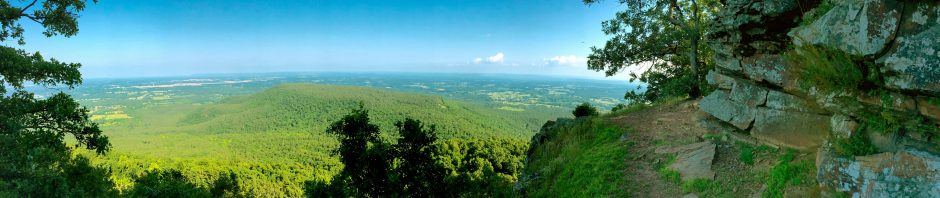
The overlook was larger than I’d expected and I faced north to shoot the famous Yellow Rock itself with both my regular camera and my iPhone, as well as in a panorama.  The side of the mountain was dotted with trees bearing the final remains of autumn.  I had plenty of company at the overlook, including a fellow who lay down facing the edge.  But not wanting to interfere with other shutterbugs, I waited until all the other hikers had vacated the area to venture out on the rock for a self-portrait, although my timer didn’t last long enough to get a side shot.  The view was tremendous, and the view south was spectacular as well.   Farther along the ridge I saw a twisted cedar and bluff crevices.  The remainder of the Yellow Rock Trail back to Lee Creek was also scenic, with bluffs viewed from overhead and some nice overhangs above the trail.  One section of bluff had Halloween rocks of black and orange.

I’d hiked about 6.75 miles by then and was ready to call it a day.  So I drove back to Tulsa for dinner and just managed to beat the evening crowds at Zio’s and get a table without waiting.  I then drifted through a Borders for book ideas – bless them, Amazon is eating their lunch and I’m not helping, using the Tulsa bookstores to browse but then purchasing books on my Kindle.

Thanksgiving Break approaches, but I don’t know yet if my schedule will allow for more day hiking then or not.

Click here for a slideshow of today’s day hike

Posted in day hike, photos, travel | 4 Comments

The Shrinking Portable Computer

November 19, 2010

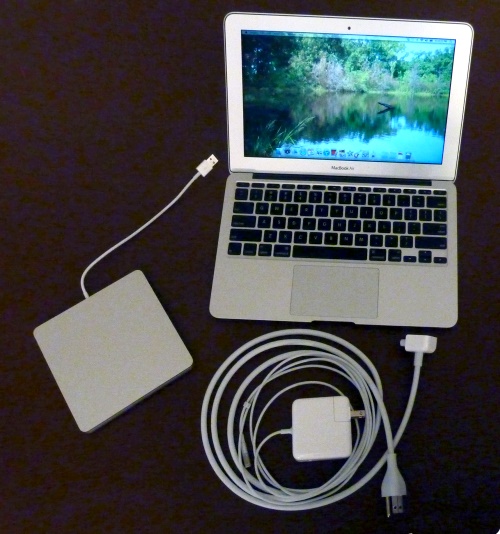
My new MacBook Air

As noted in the summary of my personal computers, I bought my first laptop computer back in 1997.  I’ve bought three laptops since then, including a new MacBook Air which arrived yesterday.  I brought them together for a side-by-side comparison.

The Averatec had a full-size keyboard and sluggish trackpad, the Asus had a slightly-reduced keyboard and small but responsive trackpad, while the MacBook Air has a full-size keyboard and big glass trackpad which is very responsive and supports multi-touch gestures.  But I miss the dedicated right-click buttons of Windows machines and am not at all used to the current application’s menu bar being at the top of the screen instead of the top of its own window.

I accessorized the MacBook Air with an external SuperDrive DVD +/- burner and VGA-to-Display Port adapter.  A carrying bag is on order from WaterField Designs as well as a Full Install DVD for Windows 7 Home Premium so I can run my Windows applications on it along with native OS X apps.

2005Averatec 3270 EE-1(PADD) 2008Asus Eee PC 1000H (PADDe) 2010MacBook Air 11” (Droxine)
Native Operating
System
Windows XP Home,
Service Pack 3
Windows XP Home, upgraded to Windows 7 Home Premium Mac OS 10.6.5 (Snow Leopard)
Microprocessor 1.6 GHzMobile Athlon Sempron 2800+ 1.6 GHzIntel Atom n270 1.6 GHzIntel Core 2 Duo
Random-Access Memory 480 MB 2 GB 4 GB
Disks 60 GB hard drive,
DVD +/- burner
160 GB hard drive 128 GB flash drive, separate DVD +/- burner
Weight Without Accessories 4.5 pounds 3.2 pounds 2.3 pounds
Screen 12.1 inch,  1024×768 10.2 inch,  1024×600 11.6 inch,  1366×768
Battery Life about 1.5 hours 3-4 hours about 5 hours
Connectivity 3 USB, PCMCIA II, SD card, microphone, headphone, ethernet, modem, VGA, 802.11 b/g (built-in speakers) 3 USB, SD card, microphone, headphone, ethernet, VGA, 802.11 b/g/n (built-in speakers and 1.3 megapixel camera) 2 USB, headphone, Mini DisplayPort, 802.11 b/g/n, Bluetooth 2.1+EDR (built-in microphone, speakers, and camera)
My Cost Without Accessories / Today’s Resale Value at gazelle.com $890 / none $464 / $85 $1350 / $700

It is interesting how the microprocessor speed has maxed out, making additional computing cores, on-board cache memory, and better disk speed vital to improved performance.  Over time the weight has dropped significantly and the screen and battery life have improved, but my new Mac’s improved specs carry a hefty price premium.

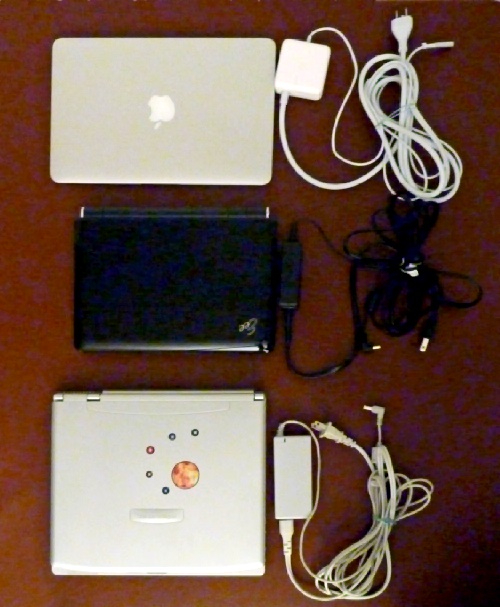
My three laptop computers

Below is what they look like when closed alongside their power adapters.  The silver Averatec’s at the bottom extends 12 feet while the black Asus’ extends 11 feet.  I like how the MacBook Air’s power adapter has a retractable two-prong plug that goes directly to the wall for a reach of 6 feet, or you can swap that two-prong plug for a three-prong extension cord for a total reach of 12 feet.  The other adapters have detachable cords, but no direct plug-in option.

My laptop computers

Below you see how thick they are, and why I find the slimness of the new MacBook Air quite stunning.

Thickness of my laptop computers

As for approximate boot times, below is how they stack up with their existing operating systems.  Soon I’ll update this with times for the Mac when booting into Windows 7 Home Premium.

2005Averatec 3270 EE-1(PADD) 2008Asus Eee PC 1000H (PADDe) 2010MacBook Air 11” (Droxine)
Time from boot to login screen 80 s 46 s 13 s
Time from boot to  responsive desktop screen 102 s 65 s 17 s
Time to boot from hibernation to responsive desktop screen 58 s 26 s 1.5 s

The solid state flash drive in the MacBook Air really makes it boot up quickly, while the sluggish hard drive in the old Averatec is a huge performance bottleneck at all times.

I’ve never owned an Apple Macintosh computer before, so I’ll have more to report on the MacBook Air as I learn more about its operating system, experiment with native software, and get Windows 7 on it via Boot Camp and/or a virtual machine.

Here’s a shot of my current portable devices side-by-side: the Apple iPhone 4, Amazon Kindle 3, Apple iPad, and Apple MacBook Air.

My portable technology devices

For my parting shot I set the iPad and iPhone atop the MacBook Air to show how that laptop is the same width as the iPad and the same length as the iPad alongside the iPhone 4.

My portable Apple devices

Posted in technology | 4 Comments

Roman Nose

Roman Nose State Park (click image for slideshow)

November 15, 2010

I have visited Roman Nose State Park, situated a few miles north of Watonga, Oklahoma, on multiple occasions.  Watonga is famous for its cheese, although the remnants of Hurricane Erin back in 2007 blew away the cheese factory which had operated there since 1940.  Just recently the factory reopened, but sadly it is now located in Perryman, Texas since that town offered a financial incentive.

My most vivid memories of Roman Nose are from a camping trip my friend Jeff and I made there over two decades ago.  We went up a trail and decided to head cross-country downhill rather than make a long loop.  Big mistake – the hillside was littered with hidden cacti and my feet and legs took a beating.  I think it was on that same campout that we got so cold in our tent that we gave up and drove over to the lodge and rented a room to warm up!

On a mid-November Sunday morning I breakfasted in Oklahoma City with my father and then drove out to Roman Nose.  My Oklahoma Hiking Trails book recommended a 6.25 mile loop around the edges of the park, and I followed that plan with a small deviation to avoid repeating part of a trail.  As for the lodge, it sits down on its own drive down by Boecher Lake and I only saw it from across the water on this trip.  A Daily Oklahoman newspaper article that same morning indicated the lodge had been renovated, but I was far more interested in the trails.

Roman Nose Park Entrance

Entering the park I saw the striking and familiar sign of an American Indian with a Roman Nose.  Arkansas has erected beautiful three-dimensional painted signs at each of its state parks, and Oklahoma has at least one park with a memorable sign.  The park is named for Henry Roman Nose, a Cheyenne Indian Chief who owned the 600 acre allotment that encompasses the present-day park.  He wintered in his tepee in the canyon from 1887 until his death in 1917, escaping the cold winds up on the plains.

I drove past the golf course and lodge drive and turned to pass the general store and travelled up the western shore of Boecher Lake and adjoining Watonga Lake.  There were several people in the campgrounds and a number of fishermen out on Watonga Lake.  At the end of the drive I parked beside the trailhead for the Lake Loop, shooting a photo of the park’s trail map sign with my camera since it provided more detail than the one in my hiking book.  I should have shot that sign with my iPhone instead of my Panasonic superzoom camera, as it is easier to zoom and scroll images on the iPhone’s display.

Just to the left of the trail was a steep hill.  I took a rough side trail to the top to get a nice view of Watonga Lake.  I could see a boat along the shore near the earthen dam, with the lake surrounded by eroded mesa walls.  Then I clambered back down to the trail and followed it across the dam.  There I had a nice view of a fisherman out enjoying the placid water.

Fisherman on Watonga Lake

After crossing the dam, the mown grass led me past the base of Inspiration Point, the highest point in the park, and led (or misled) me back around to a field on the east side of Bitter Creek before suddenly ending in a loop.  I’d noticed a branching trail a ways back, which must have been the intended route.

So I backtracked a bit and took the side trail, which wound around the northeast side of Inspiration Point.  This section of trail, like many others, is open to horses.  I tried to dodge their deposits but as I took a switchback up the east side of the hill toward Inspiration Point I kept smelling horse manure.  Sure enough, I’d managed to get some on my boots and I was hard pressed for awhile to find a suitable surface or plant material to rid myself of it.  The hillsides were covered with red cedars and eventually I had reached Inspiration Point for a panoramic view of the lake and dam below and the gap in the mesas where Bitter Creek runs northeast to eventually join the Cimarron River, changing its name to Salt Creek along the way.  Through the gap I could see the white gleam of grain silos scattered about the landscape.

Bitter Creek Gap

From the peak I could see a housing development crouched on the hillside just above the park boundary.  The entire park is only 540 acres, so it was practical to circumnavigate much of it by trail in a few hours.  It has an interesting history.  What I’ve pieced together is that the road I had driven to the trailhead was once the railroad bed for tracks that led to a gypsum mining operation that was once located right where Lake Watonga is today, with employees living in the ghost town of Bickford a mile or so to the northeast.  Bickford died out in the 1920s and John Buell Cronkhite and his brother, Cap, designed and began building a recreational facility in the canyon in 1925.  They were sons of Will Cronkhite, who owned the Bitter Creek Ranch adjoining the area to the west.  The family constructed a forty-foot dam to form a 15 acre lake that was 35 feet deep at the dam.  However, a tragedy occurred on June 17, 1926 when Loree Cronkhite drowned in the lake.  The family abandoned development of the resort and in 1935 sold the park site’s 540 acres to the city of Watonga, which in turn gave the land to the State Parks Department.  Officially titled Roman Nose Resort Park, it was one of the original seven Oklahoma State Parks, constructed by the Civilian Conservation Corps and opened to the public in 1937.

Leaving Inspiration Point, I followed a trail along the park’s eastern boundary with a canyon stretching out along my right.  Eventually it dipped down into the canyon’s trees and then popped back up to the rim, making a series of switchbacks along the park’s southern border.  Sometimes the path crossed extensive patches of cacti jutting out from the gypsum rocks, looking just as sharp as I remembered from the 1980s.  At one point a ghostly white deciduous tree stuck out in the canyon below, surrounded by cedars.  The trail eventually passed by a cave-in where a spring had undermined the gypsum beds.

Eventually the trail ran back north to Boecher Lake and I visited a scenic lookout I remembered from years back.  I could see colorful paddle boats, which I was tempted to commandeer for an unauthorized excursion.  Off to one side of the trail was a hidden side outlet where Boecher Lake feeds into Watonga Lake.

Boecher Lake Outlet

I took a trail across the Boecher Lake dam for a panoramic view across Watonga Lake.  I passed a miniature golf area.  Its vine-covered trees and odd figurines helped make the scene a tad eerie without children scampering about.

I brought the 6.3 mile hike to a close after three hours, feeling famished.  So I drove an hour northeast to Enid for a late and, unfortunately, lamentable lunch at its El Chico.  They no longer had El Chico’s “old way” queso available at this franchise, only proferring a thicker complimentary queso that was quite inferior.  I then zipped back to Bartlesville to end the weekend with laundry duties.  Next weekend I hope to make another day hike, perhaps to Missouri or Arkansas, weather permitting.

Click here for a slideshow from today’s hike

<- Previous hike: Charon’s Garden
Posted in day hike, photos, travel | 4 Comments

Charon’s Garden

Charon's Garden (click image for slideshow)

After a couple of weekends without day hikes due to a conference in Kansas City and subsequent illness, I was anxious to hit the trails again.  Former student Quincy Amen, currently living in Lawton, had invited me to visit him for a day hike in the Wichita Mountains Wildlife Refuge.  I did not have to be asked twice, having first visited the Refuge with my friend Jeff back in 1989 and returned multiple times with friends and family.

My new Oklahoma Hiking Trails book recommended the Charon’s Garden trail at the western end of the Refuge, running south from Sunset Pool to Treasure Lake.  So on Friday evening I drove to Oklahoma City to visit my parents.  On Saturday morning I took the H.E. Bailey turnpike to Lawton.  Soon Quincy and I were driving northwest out of Lawton with Sunset Pool as our destination.  We never made it.

As we drove along the south border of Fort Sill, we saw a rocket launch from a ground unit, sending a long contrail off to the northeast.  The only Southern Plains fort built during the Indian Wars which is still an active Army installation, Fort Sill trains marine artillerymen.  Back in 1989, while searching for Geronimo’s grave at the fort, I managed to drive into one of the fort’s live shell areas.  Decades later my navigation skills are now bolstered by GPS, but as Quincy and I drove up highway 115 through the fort toward the main part of the Refuge, soldiers blocked our way.  They politely informed us the road was closed, perhaps wanting to ensure I did not blunder into rocket fire.

So we ducked back westward and took Indiahoma Road to the Treasure Lake Job Corps Civilian Conservation Center, which employs 16-24 year olds in vocational and academic training.  That way we could simply reverse our intended hike, trekking northward from Treasure Lake toward Sunset Pool.  We parked between Treasure Lake and Post Oak Lake and began our northward trek through Charon’s Garden.  The mountains there are about 300 million years old, composed of coarse granite that formed about 500 million years ago.  The central peak is Elk Mountain.

The trail took us above Treasure Lake, with Elk Mountain visible to the north.  I made sure to have Quincy pose in front of both Treasure Lake and Elk Mountain and I included him in a panorama, since I’ve worked with his mother at BHS for over twenty years and knew she’d want some shots.  Some of the fall foliage was quite beautiful, although the cacti did not participate.  Quincy was allowing me to lead, so it wasn’t long until I managed to veer off the main trail onto one skirting along Post Oak Creek.  We stopped to snack at a pool along the creek and then strode into a relatively open area on the southern flank of Elk Mountain where a stream came in from the east.  The eroded boulders atop the mountain were striking.

Knowing I’d already left the main trail some time back, I decided to head eastward along a side trail toward a peak separating our little side creek from the headwaters of Fawn Creek to the east, where the Bonanza Mine operated in the early 1900s.  These creeks carried runoff westward and eastward from Elk Mountain to the north and Mount Lincoln to the south.  Up ahead we spotted a huge boulder that had rolled down from the mountain.  The trail eventually wound over to it, and Quincy posed to provide some scale.

We climbed the slope between the two mountains, paralleling  the eroded ridge of Elk Mountain.  But the trail petered out and we could not safely scale the peak separating us from Fawn Creek.  So after a breather Quincy and I headed back west to the big boulder and then bushwhacked to the southwest, splitting briefly to follow two parallel trails on the mountainous terrain.  He took the high road and I took the low road, which might just reflect our respective characters.  Up atop the mountain I could see the landmark rock called the Pear, with its companion, the Apple, snuggled behind it.  Directly to the west were a series of other smaller mountains.  Soon Treasure Lake was visible to the south.

When we returned to Post Oak Creek my erring navigation skills had me leading us back north again even though we had abandoned our quest to reach Sunset Pool.  Quincy politely hinted that we were going in circles, but it wasn’t until we were back at the snack spot that I caught on.  Soon enough we were heading back south, with a family of hikers on our heels.  This time we followed the main trail all the back to Treasure Lake.  That trail ran on higher ground to the west of the creek trail we took on our northward trek.  We ventured over to Post Oak Lake, which served as another reminder that what they call a lake in the Wichitas we’d call a pond elsewhere.

We then drove north and east through the Refuge, declining to take the road north to Meers.  That little mining town boomed to perhaps 500 in the early 1900s but all that is left these days is a dilapidated restaurant about a half mile south of the original town site.  It is known for its huge thin hamburgers served in pie pans, but neither Quincy nor I had been impressed by our separate visits to the establishment in prior years.  So we drove on east and took the three-mile-long road up Mount Scott, which looms 1000 feet above the flat plains to the east.

The summit was swarming with people, including a couple enjoying the view of Elmer Thomas Lake to the south and another couple looking westward while boys scrambled about the slope.  The Wichita range stretched out to the west just as it has for uncounted years.  But the view to the north had changed dramatically with the addition of a large wind farm.

Descending Mount Scott, we drove into the resort town of Medicine Park to dine at the Riverside Cafe.  Driving about town, I spotted a mountain lion sculpture, but it did not compare well to one I snapped in Estes Park, Colorado a decade ago.  That brought our excursion to the Wichita Mountains to a close and I dropped Quincy off in Lawton, returning to Oklahoma City for the night so I could head out the next morning for a hike at Roman Nose State Park just north of Watonga.

Click here for a slideshow from today’s day hike

Next hike: Roman Nose ->

Posted in day hike, photos, travel | 3 Comments