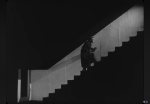
Green Weak, and I Don’t Mean Tea

A test for deuteranomaly

Twice this past week I’ve been reminded of my deuteranomaly.  I was diagnosed with it during my physical to enter college, and no, it isn’t contagious.  I didn’t even know I had it for the first 17 years of my life.  Deuteranomaly is “green-weak” color vision, the most common form of so-called colorblindness.  It afflicts about 5% of the male population and is caused by a mutated form of the medium-wavelength “green” pigment in our retinal cones.

The one sure diagnostic I’ve found for my condition is the Ishihara 9.  That’s the image on this post, part of the color test published in 1917 by Tokyo physician Shinobu Ishihara.  If you have normal color vision, you should see the number 74 in it.  I see the number 21 instead.

The irony is that in childhood I was often asked what my favorite color was, and I answered “green”.  I can see the color green, but now I know that I don’t see it as vividly as others do.  I have trouble discriminating small differences in hues in the red, orange, yellow, and green portion of the color spectrum, as they are shifted toward the red for me.  So my favorite color was the one I could perceive less vividly than others did.

The most dramatic evidence of my condition came four years ago.  I was attending a presentation on new textbooks and as part of it we looked at a text on a projected computer screen and the salesperson was pointing out how, with a click of the mouse, all of the verbs would change color to help poor readers identify them.  She clicked to change her projected image of the text, and nothing happened.  All of the words stayed their normal black – to me.  I had to ask a colleague if there was a malfunction, and that brought a stare, first at the screen and then at me.  We expect others to see what we see, but of course they really don’t, do they?

This past week I was surprised when a luncheon companion remarked about the green in my shirt – I only perceive it as gray and black, but she could see greenish hue hidden from my eyes.  And today I’m recharging my Kindle 2 and am annoyed that I have a terrible time distinguishing when its LED light changes from the yellow “charging” status to the green “charged” color.  Hardly much to trouble with, but it does point out the pitfalls of perception.

I am selfishly and naïvely convinced that I perceive the world accurately, but here is direct evidence that my senses are betraying me.  Over time I’ve belatedly learned that a fellow teacher’s pickup truck and some of my hats, shirts, and socks were dark green, not black.  My favorite Tilley hat is khaki, but where I see gray, perhaps others see green.  When I take a picture of the greenery on a day hike, what do others see in it that I can only partially perceive?

And if my physical vision is biased, what about my other ‘vision’ – the philosophical one?  In the certainty of my own rationalist viewpoint, firmly grounded in my senses, experiences, and flawed perception of the world, what am I missing that others may perceive?  Is there something there, hidden from me by spiritual blindness?  I don’t think there’s an Ishihara test for that.

Posted in random | 7 Comments

Scouting the Osage Trail


On the Osage Trail (click for a slideshow)


I spent the first weekend of Winter Break on activities that were predictable yet enjoyable.  On Saturday I drove to Tulsa to eat and shop.  The day began on a sad note, as I drove to 51st and Lewis for lunch at my favorite El Chico, only to discover it had been demolished.  I had eaten there since childhood and am sad to see it go.  I have known for a few years that it would be a victim of the widening project for the section of I-44 which was once known as the Skelly Bypass.  Thankfully that project has spared, barely, the Marie Callendar’s restaurant farther east.  And there are still three El Chico locations in Tulsa, so I drove to Promenade Mall for my El Chico fix.

The holiday crowds were just right – the mall was busy and boisterous without being annoying and I had no trouble parking.  I finished my Christmas shopping in the festive atmosphere, including wasting some money on an absurd Snuggie, and watched a group of young girls do a rather loose imitation of tap dancing in the noisy food court.  Having imbibed enough noisy fun, I drove over to Woodward Park for a quiet stroll in the chilly overcast afternoon and took a photograph of Appeal to the Great Spirit.

Sunday lived up to its name with a bright sunny afternoon in the 50s, so I of course set out for a day hike on the final day of autumn.  I drove to Osage Hills State Park after lunch and parked by the office.  I first trooped up the Tower Trail to the observation tower, noting that its view remains mediocre even with the trees bare of leaves.  So I quickly clambered on up to the old CCC camp site, past the clattering stripper well, and over to Lookout Lake, where I took one shot of the rippling water beyond the trees.  Farther along the Lake Trail I took a side trip to a seamed bluff, admiring a tree hanging onto the edge above.

Popping out onto the main road, I spied a red metal trail marker on the signpost for the next section of the Tower Loop, and similar red markers on another signpost pointing to a nearby clearing.  I’d wandered over there once before, but had only noticed an old storehouse with barred windows and a sturdy door.  There were vehicles parked there today, so I figured there must be some sort of trail there, although it is not documented on the park map.  Sure enough, there was a sign for three mountain bike trails, and my iPhone informed me that one of them is over three miles long.  I’m certainly going to hike it some day.  But those bike trails lacked the red circle marker which I associated with some sort of pedestrian trail.

I then located a nearby gap in a fence with a wide trail leading down to a stream.  The only sign indicated it was a game preserve and no hunting was permitted.  There was no red marker, but I decided to scout ahead.  Scout is a most appropriate term, for later I would discover I had indeed found the trail of the red markers – the Osage Trail.  It leads about three miles southeast out of the park over to Camp McClintock of the Boy Scouts.  This trail is marked only by those red metal signs, which are infrequent in Osage Hills State Park but show up more prominently as you approach McClintock.  Now that I have seen a map of where I was going, I realize I should have obtained permission from the Cherokee Area Council of the Boy Scouts of America to travel the southern portion of the trail once the bike trail heads northeast from it.  The Osage Trail was registered as an historic trail with the Boy Scouts of America in 1999, and reportedly is part of the path taken by the Osage Indians back in the 1800s when they travelled from the Bartlesville area to modern-day Pawhuska.

But I was ignorant of all that as I embarked down the path, soon fording a stream and then ascending and turning south to follow the trail through grassy woodlands.  I could tell some mountain bikes had been in use, and there were recent boot prints and the paw prints of a large dog which I thought might be from a party on the trail today.  I was growing quite curious, since the trail was in good repair and clearly used about as much as the properly marked and mapped hiking trails elsewhere in the park.  What was this thing, and where did it go?  Surely it wasn’t just for mountain bikes.

After leaving the grassy area the trail forded another stream, with a pretty watery grotto, and then ascended to follow a ridgeline southeast out of the park.  I knew I might be approaching the park boundary, although there was no fence blocking my path.  Along some bluffs, with Sand Creek winding past me far below, a bike trail veered eastward from the main trail and at the junction I encountered a father, mother, daughter, and Great Dane.  Aha!  Maybe I should have been a Boy Scout, since I had correctly interpreted those trail prints.  I asked them if the trail looped, and the father informed me that the trail went to the Boy Scout camp.  That explained it – many a scout troop has helped keep this trail up.  I thanked them by taking a group picture of them on the bluffs and then forged ahead.

UPDATE: I belatedly realized that not far beyond this point is the currently unmarked park boundary.  To hike the rest of the Osage Trail requires permission of the Cherokee Area Council of the Boy Scouts of America.  So it is best to just hike the red mountain bike loop – that way you’ll stay in the park.  Here’s my version of the park map.

I didn’t know how far it would be to the park boundary towards Camp McClintock, but I still had over two hours of daylight left. Following the red trail markers, which had become more frequent, I travelled along the ridge and forded another small stream.  I finally ascended into a grove of cedars and was reassured to see a small power line overhead – that must be powering something at the Boy Scout camp.  Sure enough, it wasn’t long until I spied a large rock building looming overhead on a nearby bluff.  It turned out to be the Cub Cabin, a large bunkhouse with a nice view of the countryside.  I never did see a posted boundary to the state park.

So I had stumbled my way out of the park onto private land to Camp McClintock, the first time I recall being in a Boy Scout camp.  I’ve slept overnight at a Girl Scout camp, but it isn’t as lewd as it sounds, since it was for a faculty retreat one summer at Camp Wah-Sha-She near Woolaroc.  I didn’t even explore the countryside on that retreat, since it was blazing hot and only the scorpions roaming the area felt at ease.  I didn’t explore Camp McClintock, either, since I had clearly entered private land, although I did make use of the pit toilet before taking the Osage Trail back to the state park.

On my return journey I paused to take a self-portrait on the bluffs above Sand Creek and later took a shot of the creek shimmering off in the distance down below the trail.  Upon reaching the stream near the rock storehouse in the park, I wandered down its slick bed and found where a big piece of the overhanging bluff had broken off and fallen into the stream.  What a noise that must have made!  I went on downstream until I could spot Sand Creek far ahead.  With the sun rapidly setting, I took the Tower Loop trail back to my car at the park office.

So I closed the autumn with yet another great day hike, and on a newly discovered trail to boot!  As for the coming winter, Osage Hills still has some unexplored trails that beckon to me – when the weather cooperates you’ll find me on those mountain bike trails, although I’ll be afoot rather than pedaling.

UPDATE: A Flickr contact found an interesting online map of the Osage Trail layout.

Click for a slideshow of today’s day hike

Posted in day hike, photos | 1 Comment

Science Party Tricks

I love this video of science party tricks from magician and psychologist Richard Wiseman.

Posted in physics, video | Leave a comment

A Return to Elk City

Elk City Lake (click image for a slideshow of the day hike)

Today I took advantage of a spurt of warmer weather, after a very cold week, to hike at Elk City State Park.  It is located just west of Independence, KS and is about an hour north of Bartlesville.  I haven’t hiked there in about 15 years, and last fully completed a trail there almost 30 years ago, back when my father’s family held summer reunions amidst its frequently flooded campsites.  As a child I loved to clamber along the Green Thumb Nature Trail, which I remembered as a challenging slog with some very steep hills, somewhat steeper than most of the hills at Roaring River State Park in Missouri where we usually hiked.  My mother recalls how my Aunt Mildred would take the mile-long trail with me time and again, saying she didn’t mind since I always showed her something new on each walk.

About 15 years ago a friend and I drove up to Elk City to hike, but we didn’t hike a full trail.  But today, in very late autumn, I knew any underbrush would be gone and it should be good hiking since there is now a 2.75 mile Table Mound Trail, adjacent to the mile-long Green Thumb loop, which travels north up the east shore of Elk City Lake to an overlook.  Table Mound has been designated as National Recreation Trail, which sounded promising.

I set out after lunch as the sun began to punch its way through overcast skies and the temperature was reaching the low 50s.  Arriving at the park, I paid my $3.70 day use fee and parked at the trail head.  The Green Thumb loop was not particularly photogenic this time of year, but I had fun recalling different aspects of it.  I traversed two 30-to-40 foot wooden pedestrian bridges across some creeks and puffed my way uphill, warming right up so that I could shed my coat.  I had traded in my usual Tilley hat for a knit cap today, given the nippy temperatures.

Completing the Green Thumb loop without one picture taken, I set off north along the Table Mound Trail.  It began along an old roadway above the eastern shore of the lake, and it wasn’t long until I came to a nice overlook providing a panoramic view southwest across the lake.  The trail then bobbed along the forested hillside, traversing three creeks and one old stone fence.  After crossing Table Mound Road, it got more interesting with vertical rock walls, boulder fields, and large stacked rocks.  I loved how the trail wound under one large slab, held up by an Atlas among rocks.  There were some nice short side spurs with views out toward the lake.

But the rocks were slick in places, and once I did take a tumble, crashing a leg and my little backpack into the unyielding rocks.  But the trail was so rough I couldn’t find a flat spot to lie back and whimper.  Every so often I would hear the muffled boom of hunters’ distant gunfire, so I pretended they were after me and that got me going again in no time.

Soon the trail snuggled its way through a narrow crack in the twenty foot high bluff and eventually I clambered up onto Table Mound, noticing my breath made visible against the rocks in the chilly air.  Flat as its name implies, it provides a nice panoramic view of fields to the north.  A denuded tree created a striking screen across one part of the view, and a dead tree along the trail provided a close-up look of its decaying core, with a green tinge of moss.

Both Table Mound Road and the far better trail lead to a parking area and memorial overlook pavilion atop the mound, but the view there focuses on the riprap dam and isn’t nearly as impressive as the panorama on the north end.  There is a 2/3 mile Post Oak Nature Trail atop Table Mound, which I walked along a bit to check the lake view, which was obscured by trees, and quickly abandoned as it was past four o’clock and I knew by five-thirty it would be growing dark.  So I descended the bluff and wound my way through the rocks, admiring how the topmost table rock projected out in spots.  After a quick self-portrait in the setting sun, I returned to the final overlook near the south trailhead and snapped the dusky purple sky and lake.

By then I was quite grateful for my knit cap, pulling it low over my tingling earlobes.  I zipped back to Bartlesville for some warm pizza at Mazzio’s and no doubt puzzled some people with the weird pattern the knit cap had left across my balding pate…I guess I had tugged it down pretty hard!  We’ve only one week of autumn left, so I don’t know if the weather will allow me to squeeze in another day hike this season.  But if it should hit some sunny 50s again, I’ll be ready.

Click for a slideshow of this day hike

Posted in day hike, photos | 2 Comments

Camera Antiqua

SEE THE PERMANENT “ALL MY CAMERAS” PAGE FOR A CONTINUOUSLY UPDATED RECORD OF MY CAMERAS OVER THE YEARS

December 12, 2009

While I’ve used cameras for years, only since my second trip to the Pacific Northwest in 2005 have I paid much attention to taking quality landscape photographs.  I’ve already documented the computers I’ve used over the years, and now will look back at the still-photograph cameras of my past.
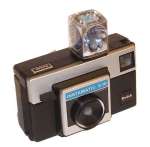
My Dad’s Instamatic

I grew up with photographs, although they were always small snapshots.  My earliest experience with a snapshot camera was my parents’ Kodak Instamatic X-15 with its “126” film cartridges and rotating flash cube.  It shot a 26.5 mm square on-film image.  About 10 million cameras used that film format, but it is now extinct.

The camera was extremely simple to operate – you just looked through the viewfinder and pushed a lever.  If you thought you might need flash, you popped in a flash cube and it would explode one of its four bulbs, rotating for the next shot.  After taking a shot you had to shove a spring-loaded lever on its back a couple of times to advance the film.  Sometimes you forgot, and that created interesting double-exposed images.  Of course, you might not know that for weeks or months, depending on when you finally sent in the film to be developed – and we didn’t have one-hour photo processing back then.
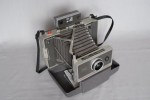
My awful Polaroid camera

My own first camera was a bulky used Polaroid unit we had inherited.  It took dreadful pictures which literally stank – from the chemicals used for its instant pictures.  It was definitely not a case of instant gratification, however, as most of its output was sickly green shots with brown smears, and none were worth keeping or even looking at.  Some of my relatives loved taking Polaroids, but I never cared for them.
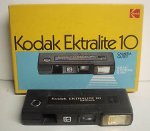
My first functional camera was a Kodak 110

I took a one-semester photography class in junior high, and for that occasion received my own Kodak Ektralite unit.  It took poor point-and-shoot pictures on “110” film cartridges, but at least it had a built-in flash instead of the rotating flashcubes.  Its pitiful 13 x 17 mm on-film images did not hold a candle to the fancy 35 mm single lens reflex camera they had at school.  But even when I used the school camera, my photography was utterly uninspired.

Our photography classroom had chalkboards on three walls, and the coach who taught the class often already had them filled with notes when we walked in.  I remember writing down the notes from one set of boards, rotating my seat to face another wall and copy down more notes, and then rotating again to copy down the third wall of notes.  The only real fun was when we’d get our turn to work in the dark room with the chemical baths and enlarger.  So at least we got to develop contact sheets and some black-and-white prints.  Our end-of-year project was an 8×10 print, and my choice to shoot a garbage can in the school corridor was a mixture of rebellion and apathy.

I took the 110 with me on a trip to Washington, DC in 1984, and afterward noticed how awful its prints looked.  So I bought a cheap 35 mm point-and-shoot to replace it.  The new camera did much better on vacations, and I did manage to take one great photograph with it, of wildflowers in the Wichita Mountains Wildlife Refuge near Lawton.  But now I can’t even recall what brand of camera it was.  I used it sparingly for about a decade of vacation snapshots.
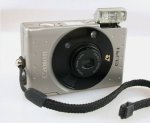
My last film camera, the Canon Elph APS

The late 1990s brought my last, and by far my favorite, film camera.  My original Canon Elph was an APS point-and-shoot camera with a 24-48 mm zoom lens.  APS stood for Advanced Photo System and meant you had a convenient 35 mm cartridge.  The APS let you rewind a roll mid-way through using it if you liked, and you could glance at a roll’s indicator to see if it was fresh, partially shot, or expended.  You could shoot in three different aspect ratios up to a 30.2 × 16.7 mm on-film image, and your prints came with contact sheets and an intact cartridge which made storage easy and allowed for convenient reprocessing for enlargements and duplications.

All of that in a camera the size of a package of cigarettes was pretty amazing at the time, and the Elph was in its day the world’s smallest autofocus zoom camera.  But APS never caught on and it was rapidly made obsolete by the digital revolution.  The most significant use of this camera was my first trip to the Pacific Northwest back in 1998, and the panoramic prints from that trip still look great today, although I haven’t bothered to scan any onto Flickr.

My first digital camera was the Nikon Coolpix 990

In 2000 I made the transition to digital photography with my most expensive camera ever, the $1,000 Nikon CoolPix 990.  Huge by today’s standards, it is split down the middle with a swivel lens.  The 3.1-megapixel camera takes 2048 x 1536 images and has a 3x optical zoom.  It also shoots 320 x 240 movies, although I hardly ever used that mode.  The camera used 64 MB Compact Flash cards for storage, which at the time cost $250 each!

I took far more pictures on the Nikon than on any other camera, ever, because I used it to create the now-retired Building on Excellence website that fully documented a series of construction projects at my workplace.  The camera still works, but I haven’t had occasion to use it in years.

My wonderful little Canon Elph SD300

It was superseded in 2005 by the tiny Canon Powershot Elph SD300, a $350 4-megapixel unit that takes 2272 x 1704 images and has a 3x optical zoom.  It also shoots quite acceptable 640 x 480 videos.  This camera was my delightful little companion on four summer trips to the Pacific Northwest and a slew of day hikes this autumn.

Thinking I might shoot some longer videos, last year I bought a cheap Flip video camcorder, but was singularly unimpressed by its output.  I’ve only used it a couple of times, and consider its abilities to be almost as poor as the camera in my iPhone 3G.  That fixed-focus camera has grainy, off-color, and blurry output.  It’s just a nasty little thing, which none of the many camera and photo applications I’ve downloaded can really help much.  But it does allow you to instantly upload a photo to the cloud, which is fun.

My latest camera is the DMC-ZS3

Last month I replaced the tiny Elph SD300 with my new Panasonic Lumix DMC-ZS3, a $280 10.1-megapixel unit that takes 3648 x 2736 images and has an amazing 12x optical zoom.  It can also shoot 1280 x 720 video, and has image stabilization, panorama assist, and other neat features.  I’m amazed by how much more powerful, yet far smaller and cheaper, this camera is when compared to the Coolpix 990.

My next digital camera will be whatever is built into my next iPhone, which I will likely purchase in the summer of 2010.  I’m sure it will be far better than the one in my iPhone 3G, but it certainly won’t compete with my Lumix superzoom.

Posted in photos, technology | 3 Comments