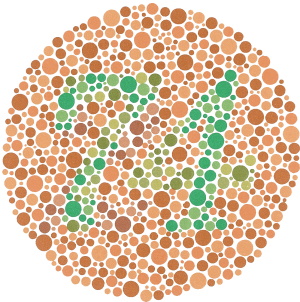
A test for deuteranomaly
Twice this past week I’ve been reminded of my deuteranomaly. I was diagnosed with it during my physical to enter college, and no, it isn’t contagious. I didn’t even know I had it for the first 17 years of my life. Deuteranomaly is “green-weak” color vision, the most common form of so-called colorblindness. It afflicts about 5% of the male population and is caused by a mutated form of the medium-wavelength “green” pigment in our retinal cones.
The one sure diagnostic I’ve found for my condition is the Ishihara 9. That’s the image on this post, part of the color test published in 1917 by Tokyo physician Shinobu Ishihara. If you have normal color vision, you should see the number 74 in it. I see the number 21 instead.
The irony is that in childhood I was often asked what my favorite color was, and I answered “green”. I can see the color green, but now I know that I don’t see it as vividly as others do. I have trouble discriminating small differences in hues in the red, orange, yellow, and green portion of the color spectrum, as they are shifted toward the red for me. So my favorite color was the one I could perceive less vividly than others did.
The most dramatic evidence of my condition came four years ago. I was attending a presentation on new textbooks and as part of it we looked at a text on a projected computer screen and the salesperson was pointing out how, with a click of the mouse, all of the verbs would change color to help poor readers identify them. She clicked to change her projected image of the text, and nothing happened. All of the words stayed their normal black – to me. I had to ask a colleague if there was a malfunction, and that brought a stare, first at the screen and then at me. We expect others to see what we see, but of course they really don’t, do they?
This past week I was surprised when a luncheon companion remarked about the green in my shirt – I only perceive it as gray and black, but she could see greenish hue hidden from my eyes. And today I’m recharging my Kindle 2 and am annoyed that I have a terrible time distinguishing when its LED light changes from the yellow “charging” status to the green “charged” color. Hardly much to trouble with, but it does point out the pitfalls of perception.
I am selfishly and naïvely convinced that I perceive the world accurately, but here is direct evidence that my senses are betraying me. Over time I’ve belatedly learned that a fellow teacher’s pickup truck and some of my hats, shirts, and socks were dark green, not black. My favorite Tilley hat is khaki, but where I see gray, perhaps others see green. When I take a picture of the greenery on a day hike, what do others see in it that I can only partially perceive?
And if my physical vision is biased, what about my other ‘vision’ – the philosophical one? In the certainty of my own rationalist viewpoint, firmly grounded in my senses, experiences, and flawed perception of the world, what am I missing that others may perceive? Is there something there, hidden from me by spiritual blindness? I don’t think there’s an Ishihara test for that.







 Meador Manor
