FEderal-6 and EDison-3

What do the song PEnnsylvania 6-5000, the book BUtterfield 8, and the movie Dial M for Murder have in common? All of their titles refer to telephone exchanges. Bartlesville only used exchange names in its phone numbers for about a decade, circa 1958 to 1968.

1907-1908 Bartlesville Directory advertisements with two and three-digit phone numbers

In the early days, there were so few telephone lines in smaller communities that phone numbers were just a few digits. The 1907-1908 Prewitt’s Directory for Bartlesville, Indian Territory, which was printed just before statehood, has phone numbers of two and three digits.

Telephone service in Bartlesville dated back to the late 1800s with an exchange above the Hull Drug Store on the south side of 3rd Street (now Frank Phillips Boulevard) between Johnstone and Dewey Avenues. It opened with three phones, which expanded to seven, and the bell was hooked to the bed of the operator. The first telephone operator was a Ms. Green, and many of the early phones were for doctors.

The Cherokee National Telephone Company established a Bartlesville exchange in 1901. In 1905 the Indian Territory Telephone Company had a copper line stretching from Bartlesville to Tulsa, and that same year the Cherokee National was purchased by Pioneer Telephone and Telegraph.

Bartlesville phone operators in 1906 [Source]
Source

As communities grew, phone numbers grew in length to where they would challenge the 4-9 digit short-term memory of a typical human being. So Bell Telephone started using telephone exchange names in locations needing over four digits. Those were memorable names assigned to a central office’s switching system. Usually the first two letters of the name corresponded to prefix digits in a two letters+five numbers format, although various combinations and lengths were in use in different communities.

BUtterfield-8 was a 1935 John O’Hara novel, and then a 1960 movie, in which BU-8, or 288, was the exchange for Manhattan’s well-to-do Upper East Side.

PEnnsylvania 6-5000 indicated 736-5000, which was the phone number for the Hotel Pennsylvania in New York City. Its phone number became the title of a swing jazz and pop standard of the Glenn Miller Orchestra.

As for Dial M for Murder, that was a 1954 Hitchcock film based on a stage play in which a scheming husband dials his home phone MAIda Vale 3499, or 624-3499, to awaken his wife and set in motion an attempted murder.

The rotary dial for a telephone was patented in 1892, with holes in the finger wheel introduced in 1904, but they weren’t common until the 1920s.

Area Codes

The popular culture references I cited all lacked something: an area code. That’s because at the time you didn’t need to dial an area code as part of a local phone number. In fact, Direct Distance Dialing, allowing one to make long-distance calls without the assistance of a human operator, didn’t begin until 1951, slowly expanding from New Jersey to become widespread in the 1960s as the system began to include automatic toll-switching centers, electronic switching systems, and automatic message accounting computers.

I’ve shown a page from the 1955 Bartlesville telephone directory with instructions on how to make a long distance call. You can tell they didn’t have Direct Distance Dialing yet!

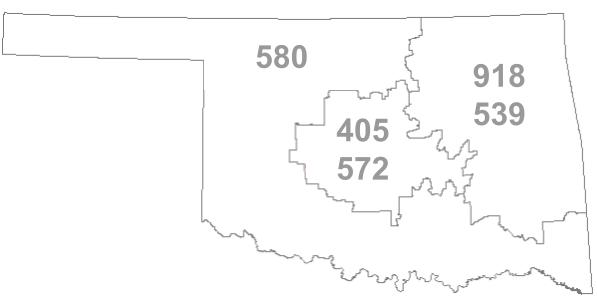
Oklahoma Area Codes as of 2021

The 405 area code had been established by AT&T and the Bell System in 1947 and covered the entire state of Oklahoma at that time. In 1953, the 918 code for northeastern Oklahoma was split off from 405. 580 for western and southern Oklahoma was split from 405 in 1997.

Until 2011, 7-digit local dialing was still possible statewide, but then 539 was added as an overlay to the 918 area code rather than doing a split. Having two area codes for the same geographic region forced a change to 10-digit dialing there, and that spread to the 405 area code region in 2021 when 572 was added as an overlay to it.

Pioneer Telephone

Oklahoma had 135 commercial systems and 63 incorporated phone companies at statehood in 1907. By 1912, Pioneer Telephone and Telegraph Company had 115 exchanges in Oklahoma, with 114,975 miles of aerial wire and 19,480 miles of underground wire.

I magnified one of the blue bells on the Pioneer building in downtown Bartlesville

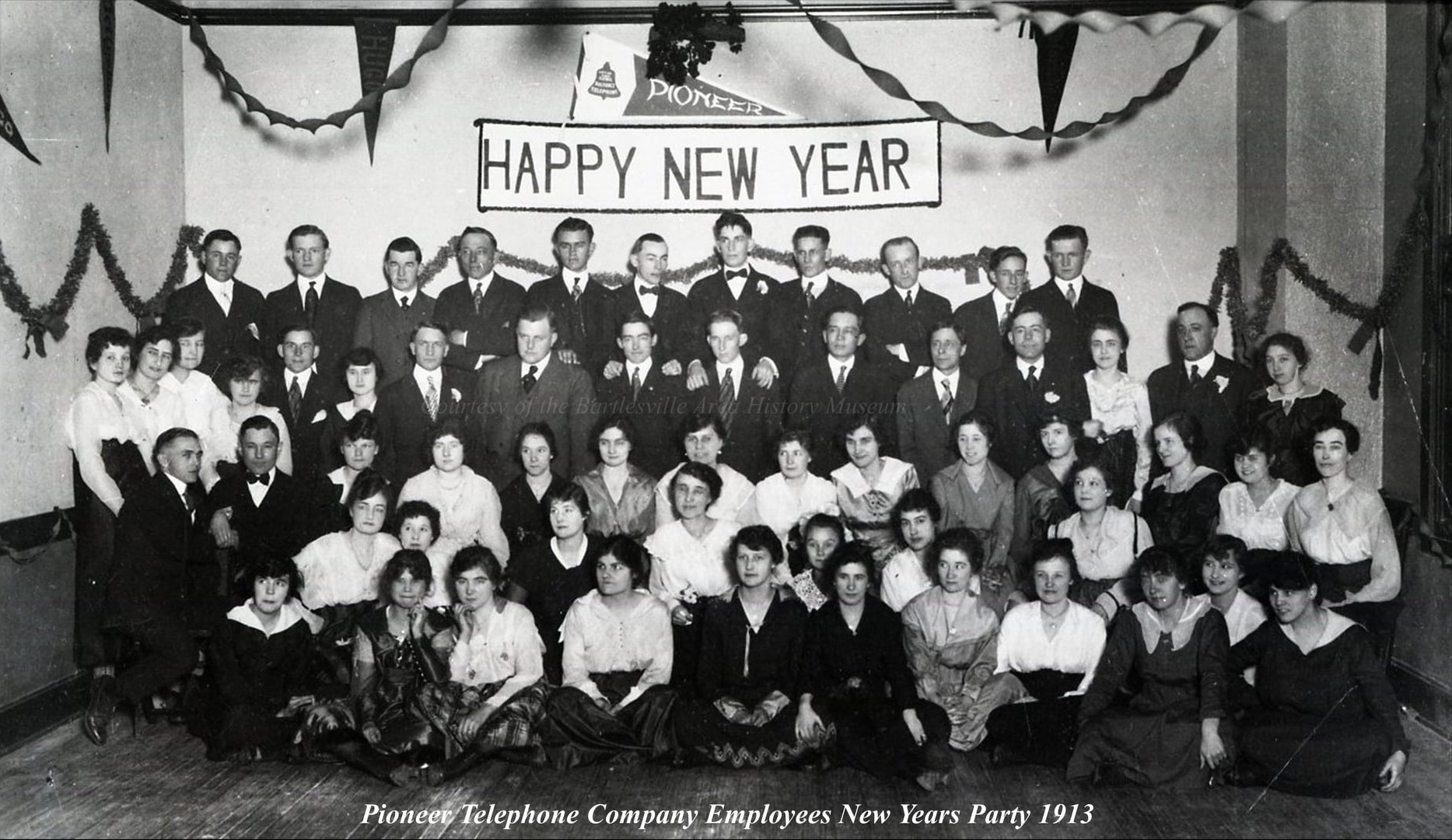
The Pioneer Telephone Building still stands in downtown Bartlesville on the west side of Dewey Avenue north of 4th Street, with its distinctive blue bells on the pilasters. It was an early fireproof building in the city, erected just a couple of years before Southwestern Bell was formed in 1912 as a consolidation of the Southwestern Telephone Company of Texas, Louisiana, and Arkansas with the Pioneer Telephone and Telegraph Company, the Missouri and Kansas Telephone Company, and the Bell Telephone Company of Missouri.
Source

A few miles north was the small telephone office in Dewey. At one time, calling from Bartlesville to Dewey was a long distance call, something we struggle to imagine these days.

Source

Contrast that to the Bartlesville phone office in 1929, with over three times as many operators for local, toll inward, and outward stations.

Source

Back in 1954, Southwestern Bell had an open house at its Bartlesville office, inviting residents to come see the equipment in action, see a machine that “plays tick-tack-toe and never loses a game”, and see a demonstration microwave relay in which they could break the beam transmitting music with their hand and reflect it with a metal mirror.

I used to do a related demonstration when I taught Advanced Placement physics night lectures at Bartlesville High School. Instead of using a microwave transmitter and receiver, I would modulate a laser beam with the audio signal from my iPod or iPhone and aim it at a solar panel connected to an amplified speaker.

Before FEderal-6 and EDison-3

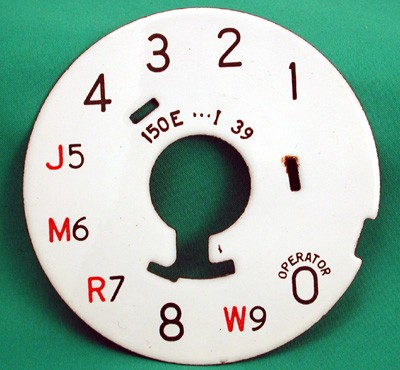
Back in the mid-1950s, Bartlesville did not yet use exchange names in its phone numbers, but it did have some numbers with party line suffixes. The 1955 city telephone directory is filled not only with three and four-digit numbers, but also four-digit numbers followed by the letter suffixes J, M, R, or W. Those indicate party lines, where multiple households shared a number. The suffix letters they used had been chosen to not be easily misheard when spoken.

1955 City Telephone Directory listings in Bartlesville, Oklahoma
Phone dial with party line letters
[Source]

Some dials back in the day lacked most of the letters, but still sported the letters needed to help you complete a party line call.

The concept of the party line was instrumental to the plot of another popular entertainment, the 1959 movie Pillow Talk, with Doris Day and Rock Hudson unhappily sharing a line.

Other phone number schemes were also in use. The same 1955 phone directory has two-digit numbers in Copan mixed in with longer sequences like 814-F-11 and 810-F-31.

Copan phone numbers in 1955

Dewey phone numbers in 1955 did use the exchange name system. They were all KE 4-#### or KEllogg-4 numbers.
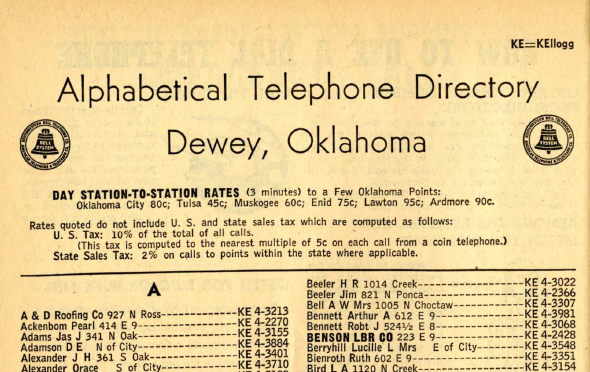
Dewey phone numbers in 1955

A new building briefly brought FEderal-6 and EDison-3 to town

In 1957, Southwestern Bell constructed a $3 million Bartlesville office on the southwest corner of Dewey Avenue and 6th Street (now Silas Street). It was two stories with a basement, built such that a third floor could be added.

The ground floor had the big crossbar switching system and customer service, while upstairs was the microwave system and mobile phone equipment and operators. The basement had the test room, which could be used to determine if someone added an extra line without paying for it.

The microwave relay atop the Bartlesville phone building in 1968

That new facility also brought the use of seven-digit numbers with exchange names. Bartlesville started having FEderal-6 numbers associated with the west side of the Caney River and EDison-3 numbers on the rapidly expanding east side.

Witness the mix of FEderal, EDison, and Dewey KEllogg exchanges in a yellow pages listing for Cities Service gas stations in 1959.

Gas station listings in 1959 with phone exchanges

The use of phone exchange names in phone listings began to be phased out in the 1960s, so FEderal and EDison didn’t last very long in Bartlesville. I was assigned a 335-#### phone number when I moved to town in 1989, so I suppose I could have shared it as EDison5-####, but that would have elicited some stares and confusion.

Back then, the Bell Building next to the old Civic Center was still adorned with a large microwave antenna up top, hidden within a decorative shroud. That provided a wireless link to Tulsa, via a large relay antenna near Ramona, in case the regular lines were cut.

By 1968, 40% of all long-distance telephone traffic in the USA was carried by AT&T’s TD-2 microwave relay network, and it also carried 95% of the country’s inter-city television signals. The development of fiber optic cables and geostationary communications satellites eventually rendered the microwave relays obsolete, and in 1999 AT&T sold off the towers.

Nortel DMS-100 telephone switches were released in 1979 and can control 100,000 lines

They removed the KKB56 microwave antenna from atop our local phone building some years ago, and nowadays far fewer employees work in the building, which the internet indicates is still equipped with Ribbon/Genband/Nortel DMS-100/200 switches but has no public office.

There was a time when you had to dial 1 before a number to signal to the routing system that a call would be going outside the area code. But that is pretty much obsolete in the USA these days, at least when using a cell phone.

Landline Decline

Marshall McLuhan advised: “Obsolescence never meant the end of anything, it’s just the beginning.”

In 2007, I finally cancelled my old-style landline phone, briefly switched to Vonage, and then I went fully cellular in May 2009. So I said goodbye to the old EDison exchange and, since my original cell phone was with U.S. Cellular, joined the 440- exchange. I left U.S. Cellular a few years later, when I purchase my first iPhone, as AT&T was the only carrier for the iPhone at the time. But number portability meant I was able to remain with my old number in the 440- exchange. When my wife bought her first iPhone years later, it was through AT&T and that put her in the 766- exchange along with other new AT&T accounts. Thankfully our marriage has survived our being in different telephone exchanges, something that would have been more challenging in the old landline days.

When I gave up my landline, only about 1 in 5 adult Americans had only cell phones. That has increased to well over 70% in 2024.

Source
1966 OKC telephone book

So most homes no longer have landline telephones. When I was young we would receive an immense phone book each year in Oklahoma City. My mother would keep it on one of the seats at the dinner table to boost me up so that I could eat more comfortably. In the 1970s, it expanded into two separate books, each several inches thick, one with white paper phone listings and another with yellow pages of business listings and advertisements. When I moved to Bartlesville, the thinness of the local telephone book was only one of several lifestyle changes. The latest phone book was left beside our mailbox the other day, and it sure seems like a relic.

But time marches on, and now when we “reach out and touch someone”, most of us do that wirelessly and give little thought to an old meaning for “exchange”. In 2024, AT&T announced that by 2029 it would abandon landline service across 20 states, including Oklahoma.

Posted in history, nostalgia, technology | 1 Comment

The Worried Man of Delos

Over 2,000 years ago, someone sculpted a full-length lifesize bronze statue of a man on the Greek island of Delos. Such works cost about 3,000 drachmas — the equivalent of two years’ salary for a rich citizen.

Only about 200 of tens of thousands of such bronze sculptures crafted by Hellenistic artisans survive. Centuries of tarnish have given them dark mottled finishes, but when first minted they would have approximated the color of a tan Greek, with eyes of glass and colored stone, fringed with delicate bronze eyelashes.

Most of the sculptures have lost their lifelike eyes in their struggle against time, buried in sand or sea or ash. Yet this gaze endured.

In 1912 this head was unearthed at the Granite Palaistra, a training ground for athletes. It likely belonged to an honorific statue of a citizen, and antiquities experts say his expression was likely meant to portray civic devotion.

“The face is showing what he’s being honored for — the zeal, attention, care, and energy he’s expended on behalf of his fellow citizens,” shared Jens M. Daehner, a curator at the Getty Museum.

Nevertheless, we know him as the worried man of Delos.

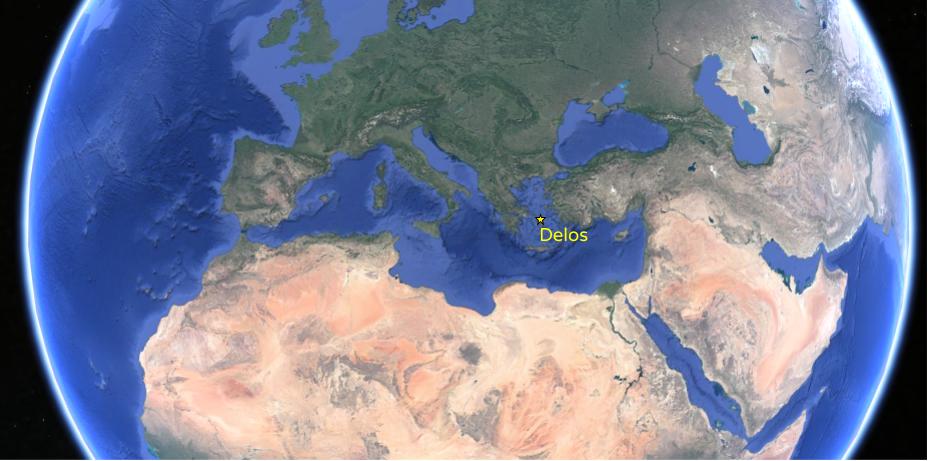
Delos is a tiny island, only a bit over one square mile in area, that was a cult center for the gods Dionysus and Leto. A Greek saying was “ᾌδεις ὥσπερ εἰς Δῆλον πλέων” meaning “you sing as if sailing into Delos” when someone was in a happy and light-hearted state.

But it is never that simple, is it?

When this statue was sculpted in the 100s BCE, the Romans had converted Delos into a free port, and it had become the center of the slave trade. Roman traders went there to purchase tens of thousands of slaves captured by Cilician pirates or abducted in the wars following the destruction of the Seleucid Empire.

It wasn’t long before trade routes changed, and Delos entered a sharp decline before the end of the first century BCE. It was attacked and looted by Mithridates, the King of Pontus, in 88 BCE and again by pirates in 69 BCE. By the second century of the Common Era, the traveler and geographer Pausanias noted that Delos was uninhabited save for a few sanctuary custodians, and six centuries later Delos was entirely abandoned.

We cannot know what our worried man was actually thinking or feeling amidst a prosperous time, but his expression mirrors my own at this point in the evolution of the constitutional republic I was fortunate enough to be born into.

He lived in the time of the Roman Republic, which began with the overthrow of the Roman Kingdom centuries earlier. That Republic was in a state of near-perpetual war, and in its last century was torn by civil strife, attributed by the ancients to moral decay from wealth and the hubris of Rome’s domination of the Mediterranean.

Modern sources cite its destruction to wealth inequality and a growing willingness by aristocrats to transgress political norms. Sound familiar?

Of course the Roman Republic later fell, to be replaced by an authoritarian Empire. That brought 200 years of relative order, economic prosperity, and stability, at the price of near-absolute rule by a series of emperors.

The last of Rome’s “Five Good Emperors”, Marcus Aurelius, wrote in his personal journal: “Never let the future disturb you. You will meet it, if you have to, with the same weapons of reason which today arm you against the present.”

I am armed by reason, comforted by experience, and counseled by patience. Yet my gaze is pensive.

Posted in art, politics | Leave a comment

Not Going to the Movies

October 2024

A year ago, Wendy and I watched a movie in a cinema together for the first time in over 4.5 years. The COVID-19 pandemic was part of the reason for our absence from the multiplexes, but another year has passed, and we haven’t returned to a cinema.

Back in the 1950s, Hollywood started competing with television for audiences and revenue. That led to gimmicks like 3-D movies and wider aspect ratios, offering audiences something they couldn’t readily obtain on their home televisions.

So did we just switch to watching TV? Well, no. Wendy and I don’t watch any television shows. Instead, we stream niche videos on our respective iPads. As for movies, I’ve been logging our movie watching on Letterboxd, which shows that we have watched an average of seven movies annually over the past four years. The chart shows when those movies were first released:

The decades in which the movies we watched from November 2020 to October 2024 were released

Yes, the preponderance of films from the 1940s means that over half of the movies we watched in the past four years were in monochrome, and many were in the academy screen ratio. So I guess technical innovations aren’t much of a draw for us!

The pandemic dealt a mighty blow to box office revenues and ticket sales, with the later making only a fractional recovery, plateauing in 2022 and 2023 at less than 2/3 of the average in the 2010s. So the future of movies is cloudy, and that prompts me to take a look back at some of my cinematic experiences.

Before My Time

My father was of the Greatest Generation, and as a kid he would go to the “picture show” on Saturday afternoons and pay a dime for a cartoon, a newsreel, a feature film, and an episode of a continuing serial. He continued to see movies in cinemas while serving in the army in World War II, but 20 years later, when I came along, he rarely went to a cinema.

The movie my parents saw on their first date

My mother is of the Silent Generation, and her strict Pentecostal father did not allow his children to attend movies or even watch films presented at school. He died too early for me to remember him, but I clearly recall how my maternal grandmother had no television and would only tolerate news and weather reports on a radio and nothing more. When I was seven and stayed with her for a week one summer, I asked her about that. She replied that the devil was the “prince of the power of the air” and thus television and radio entertainments were not to be trusted.

However, my mother did allow my father to take her to a movie for their first date. They saw The World of Suzie Wong, a film about an American painter in Hong Kong who falls in love with prostitute he hires as a model. No doubt my maternal grandparents would have been horrified. Years later, when I was around, my parents did not frequent cinemas; we instead watched television at home.

General Audiences

When I was a kid, movies were rated G, M, R, or X. M was renamed GP and then PG, which finally stuck, but the added PG-13 rating didn’t come along until 1984 when I went to college, and X eventually became NC-17.

Until I could drive, what few movies I saw in cinemas were mostly G-rated Disney re-releases such as Pinocchio in 1971, Dumbo and Lady and the Tramp in 1972, and so forth. I recall getting to see Bedknobs and Broomsticks when it was first released in 1971, and having a picture book of Doctor Dolittle, although I never saw the film.

Parental Guidance Suggested

So I was taken aback when a friend took me to see my first PG film, The Bad News Bears, in 1976. The film features an alcoholic baseball coach of young foul-mouthed players. I remember sinking into my seat at the “N” word being used. I was still nine years old and found kids cursing like that quite shocking. Needless to say, my parents had not seen the trailer. When my mother asked me about the movie when I came home, her usually loquacious son became quite taciturn. For context, in my entire lifetime I have only heard my parents curse one time each: I knew what was and was not acceptable in our family.

A month of so after my first PG film, I was invited to go to another movie with a friend. It seemed safe enough: the G-rated Hawmps! slapstick film at the MacArthur Park cinema, which was a 4-screen theater built in 1971. However, in the adjacent theater was the PG war film Midway. That wouldn’t have been an issue except that the MacArthur Park cinema had gone to the expense of installing banks of low-frequency subwoofers in one theater. Only five films were ever released to take advantage of its ability to vibrate viewers’ innards…and Midway was one of them.

Stuck between Midway and Hawmps! when I was 9

So I was sitting there, suffering through the stupidity of Hawmps!, when suddenly the wall near me began to vibrate, and I could clearly hear explosions and curse words. Midway featured about five dozen instances of profanity, and I heard quite a few of them. Let’s say I was left shell-shocked.

The next film I remember seeing in a cinema was Superman over winter break in 1978. The movie was fun, if corny, and I remember thinking that the opening title sequence looked impressive but took way too long, something my 7th grade math teacher also complained about when we returned to school in January 1979.

A film I saw in 1979 happened to be the last of the five films released in Sensurround: Saga of a Star World, which was just the pilot of the Battlestar Galactica television show. So I saw pretty much what I had already seen on television, just bigger and LOUDER. You haven’t really experienced Lorne Green’s stentorian delivery until you have heard it in Sensurround. Like Superman, that film was rated PG, but they were both pretty mild.

Overtures

Over the next winter break, I convinced my mother to take me to see Star Trek: The Motion Picture at the Westpark Twin. I remember being surprised that the film began with a three-minute overture played against a black screen.

Soon thereafter I saw The Black Hole in a cinema, and it too had an overture. Movie overtures were popular in Hollywood musicals of the 1950s and 1960s and part of the old roadshow tradition. Robert Wise, who directed Star Trek: The Motion Picture, also directed the famous musicals West Side Story and The Sound of Music, which may explain it having an overture, but the two science fiction films I happened to see in cinemas in 1979 were the last to feature overtures for many years.

Star Trek: The Motion Picture was one of the last movies to feature an overture

Overtures were a vestige of the old roadshow theatrical releases where films were opened in a limited number of theaters with presentations that mimicked live theatre. There were no short subjects and few, if any, promotional trailers. Screenings were limited to one or two a day, sold with reserved seating and souvenir programs, and included an overture and an intermission between the two “acts” of the film, with the first act usually longer than the second. The heyday of the roadshow releases were the 1950s and 1960s, and they were gone by 1973.

Seeing Star Trek: The Motion Picture in the cinema was an odd experience after years of watching television reruns that relied on old 16 mm prints. I was impressed with the opening sequence with three Klingon ships and the dramatically different appearance of the Klingons themselves. The special effects by John Dykstra and the make-up blew away what I had seen in the television show. I glanced over at my mother to see how she was reacting, and she was already sound asleep! The overture served as her lullaby.

Date Movies

Movie buffs who are science fiction fans might have noticed that I failed to mention the blockbuster Star Wars of 1977. While I had a few friends in sixth grade who saw it and were crazy about it, I just wasn’t interested. I loved Star Trek on television but regarded Star Wars with its robots and laser swords — er, droids and lightsabers — as rather childish.

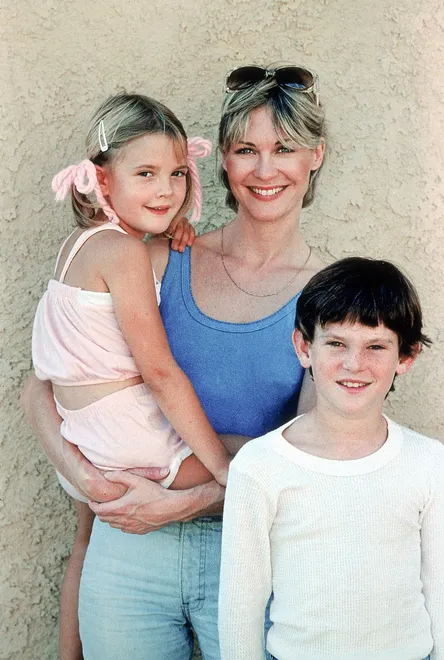
I was surprised at how rude the kids in E.T. were to their single mother

One of the inspirations for Star Wars was old movie serials, and I was put off by what I’d seen of Flash Gordon and reruns of the old Commando Cody serials on the HOHO and Pokey show on television, so I opted out. I remember staring in disbelief at my friends as they jabbered on about “Artoo-Deetoo” and “See-Threepio” and the like. After years of thrusting my Star Trek obsession upon others, the tables had been turned!

I actually didn’t see any of the Star Wars films until I was dating in high school, and I actually saw the third one first. But a few months before that, the first movie I remember taking a girl to on a date was E.T. the Extra-Terrestrial. I was still so sheltered that I was taken aback by how rude and disrespectful the kids in that movie were to their single mother.

A few months later, we saw Return of the Jedi at the Westwood Theater. Having missed the first two films, I was baffled by some of it. My girlfriend helpfully whispered occasional guidance to me, as I had little understanding of Darth Vader, Luke Skywalker, Princess Leia, Han Solo, Yoda, and the rest. I was reminded of that experience at our cinematic outing last year, watching The Marvels with Wendy without having seen any Marvel movies or television shows since Avengers: Endgame over 4.5 years earlier.

Restricted Shows

The first R-rated movie I recall seeing was when some high school friends rented the slasher film My Bloody Valentine. I’d already seen Psycho on late night television, so I thought I was prepared, but I found the slasher film made two decades later rather sickening, even with nine minutes of its violence and gore cut by the Motion Picture Association of America.

When I turned 17, one of the first R-rated motion pictures I saw in a cinema was Silkwood, which lured me in not for its rating but because it was a factual story about a whistle-blower in Oklahoma. The next year I saw another R-rated film in a cinema, Amadeus, which is still one of my favorite films. But after that I saw far more movies on videotape than at a cinema.

There aren’t very many shots of Mathilda May in Lifeforce that I can share in my blog

The first truly raunchy film I saw in a cinema was Lifeforce in 1985. The nudity was titillating, but I was put off by how some of the film’s plot stole heavily from a better and older horror/scifi film, which had no sex or nudity: Quatermass and the Pit. The other memorable thing about that showing of Lifeforce is that was the only time I saw a sneak preview. When my friend and I purchased our tickets, we were asked if we would agree to see another film first for free and fill out comment cards about it. As college guys not dealing with a curfew, my friend and I agreed. But I remember absolutely nothing about the preview we watched…I suppose Lifeforce was too distracting.

In 1986, I saw David Lynch’s Blue Velvet at a cinema in Norman. My recollection is that two old ladies were in the audience, commenting before the film started that they looked forward to seeing Elizabeth Taylor. Evidently they had confused Blue Velvet with National Velvet, and boy were they in for a surprise! Obviously they hadn’t watched a trailer for the film.

Before the Show

Television ended the era of serials

Movie trailers began in 1913 and back then were shown after, or trailing, the feature film. Later they were mixed into the program shown before a film, alongside cartoon shorts, newsreels, and serials, but the old name stuck.

In the 1940s, many folks went to a theater weekly. But as television viewership expanded in the 1950s, what was on offer at the cinemas had to evolve.

Serials were a series of short subject films exhibited in consecutive order, usually advancing weekly for 12-15 episodes. Universal, Columbia, and Republic Pictures made many of them. Flash Gordon is a famous example, and I had fun a few years back watching Rifftrax mock the 1949 Batman and Robin serial. Serials lasted until 1956, but they were gone a decade before I was born.

Television news also doomed cinema newsreels

Cinema newsreels were also doomed by television, although they persisted about a decade longer. The last American newsreel was released on December 26, 1967. I remember references to newsreels when I was young and being nonplussed since those simply didn’t exist in my world.

Animated cartoon shorts migrated to television as well, with MGM closing its cartoon animation studio in 1958, Warner Brothers giving up in the 1960s, and Walter Lantz closing his studio in 1972.

Trailers, however, survived. If you partake of Trailers from Hell, it becomes obvious that they changed in the early 1960s. Earlier ones showed key scenes, often with large descriptive text and a stentorian narrator. In the 1960s, quick-editing montage trailers became popular.

In the 1960s, many trailers were about two minutes long, with blockbusters getting trailers about twice that duration. The typical trailer was three minutes long in the 1990s, and is now back to two minutes, with cinemas often showing four or five trailers before a feature film.

Trailers have survived

However, at the Regal Warren Broken Arrow in November 2023, Wendy and I endured 18 minutes of trailers. While that alone isn’t too far out of line with the past, the intensity of modern trailers can be exhausting with fast editing, explosions, giving away key moments, and showing off their “money shots”. They usually fail to engage me emotionally, and I often find them tedious.

In the 1990s and 2000s, they would run slides in a cinema before a movie. They were often a mix of still advertising and trivia questions. The trivia and lack of full video kept them from becoming annoying, but I remember when pre-trailer video advertising began in cinemas, blurring the line between a cinematic experience and watching television at home. By 2005, pre-trailer ads were standard, with infomercials and promotions for television shows, video games, and products.

In our return to a cinema, Wendy and I were subjected to 12 minutes of such commercials before the 18 minutes of trailers. Only then could we enjoy the 105-minute movie. Spending 22% of our time at the cinema watching commercials of one sort of another, at a movie matinee costing us $25.66, wasn’t a good experience to us.

My annoyance was magnified by changes in how I have experienced video at home. When I was a kid watching broadcast television, about 15-16% of each hour was consumed by advertising and station breaks. Over time, the amount of time consumed by advertising increased to about 24%, and in 2022 broadcast networks in prime time were reportedly running ads for 20% to 28% of each hour.

But I haven’t watched broadcast or cable television in decades. Instead, I watch lots of YouTube videos on my iPad. I’ve had a YouTube Premium membership since May 2019, so I don’t see ads except for ones embedded by the video creators, which I can readily fast-forward through. So I’m now used to watching esoteric videos with very little advertising. That meant the ads and trailers at the cinema were excruciating for Wendy and me.

Home Video v. Cinema

Looking back, most of my movie-watching has been at home. When I was young, they were provided via broadcast television, with plenty of commercial interruptions. Videocassette players cost $1,000 or more in the 1970s, the equivalent of about $5,000 in 2024. So I didn’t rent home movies until high school and college in the early 1980s, having to rent not only the tape cartridges but also a player. During my early years in college, I remember writing a check for $200 as a deposit on a rented player at the Sound Warehouse in Norman, knowing that check would bounce if they tried to cash it.

Later in the 1980s, I was able to afford a videocassette recorder of my own. By then, there were 15,000 video rental stores across the country. I found one small store in Norman that had a collection of Hitchcock films on VHS, which I would watch back in my apartment on a 19″ Zenith television that lacked a remote control.

However, some of my most memorable college movie experiences were in a cinema of sorts. The film appreciation classes at the University of Oklahoma held public screenings on campus in lecture hall 211 of Dale Hall.

Room 211 of Dale Hall, where I first saw Vertigo

During my freshman year, I saw Citizen Kane and Vertigo there. It was a treat to view such masterworks on a large screen in a room full of undergraduates. I remember the end of Citizen Kane, with a few dummies seated in front of me who were only there because of a class assignment. They decided to beat the crowd by leaving a little bit early. A minute later, what a reaction there was from the audience when Rosebud finally appeared amidst the flames!

Vertigo got a warm reception at the screening at OU in 1984

The screening of Vertigo was even more memorable. It had been unavailable since 1973, and the audience was utterly spellbound despite its slow burn. After the conclusion, with James Stewart framed in the doorway of the bell tower, like a man standing before a huge tombstone looking down into a grave, the entire room remained dead quiet until the members of the audience did something unexpected: a standing ovation.

Over the years, I upgraded my home video from VHS to DVD, HD-DVD, Blu-Ray, and then 4K Ultra HD Blu-Ray. Now Wendy and I can watch a disc, or stream a movie, on our 55″ OLED HDR 4K television with 5.1 surround sound. But the cinema can still offer something our home video setup cannot match.

For years I enjoyed laughing in a crowded Tulsa theater at fun Rifftrax Live movies. I enjoyed that so much that back in 2011, when I was in Kansas City with a bunch of science teachers, I treated them at an AMC cinema to the Rifftrax showing of House on Haunted Hill. And in 2016, after Gene Wilder passed, Wendy and I greatly enjoyed a special revival showing of Blazing Saddles on a big screen in Oklahoma City.

Sharing a great film in a big theater with a large, lively, and appreciative audience is something to treasure which we cannot recreate at home. Perhaps some day Wendy and I will add more experiences like that to our movie memories, but I wouldn’t want to bet on it.

Posted in movie, random | Leave a comment

Hushabye, Richard

Chitty Chitty Bang Bang is a 1968 children’s film that I loved catching on television during the 1970s. Given that it is a children’s fantasy musical starring Dick Van Dyke with songs by the Sherman Brothers, you might think it was by Disney. But the gimmicky car is the giveaway that the movie was produced by Albert Broccoli, one of the creators of the James Bond movie franchise.

The original story was actually by Ian Fleming, the author of the Bond novels. Fleming had a heart attack in 1961 and decided to write a children’s novel based on stories about a flying car he once told his infant son. He wrote the book in longhand since his wife, in a vain attempt to get him to rest, had confiscated his typewriter.

The novel was released in installments from October 1964 to January 1965, a few months after Fleming’s death. 1964’s Mary Poppins was a huge hit for Walt Disney, featuring Julie Andrews and Dick Van Dyke, with songs by the talented Robert and Richard Sherman. They would go on to write more movie musical song scores than any other team in history, including later works like Bedknobs and Broomsticks, The Jungle Book, and Charlotte’s Web.

The success of Poppins convinced Broccoli to produce a film version of Chitty Chitty Bang Bang. He tried to cast both Andrews and Van Dyke, but Andrews declined and instead Sally Ann Howes played the female lead. Broccoli convinced Disney to release the Sherman Brothers from their contract so they could compose the songs for his film, which included a beautiful but melancholy ballad, Hushabye Mountain.

Dick Van Dyke sang it in the movie, in an orchestral arrangement by Irwin Kostal.

National treasure Tony Bennett released a version before the film was even released, but the real treat is to watch him sing it live.

The song has been covered by many artists over the decades, but here is a clip in which the creators of the song, the Sherman Brothers, perform a bit of it.

We lost Robert Sherman in 2012 and Richard in May 2024. A famous story about them was how Walt Disney’s favorite song was their Feed the Birds from Poppins. Walt would often invite the brothers to his office after work on Fridays and, after discussing work at the studio, wander to a window, look into the distance, and just say, “Play it.” Richard would go to the piano and play the song. One time, as the song was ending, they heard Disney say under his breath, “Yep. That’s what it’s all about.”

The Sherman brothers wrote many great songs, with half of the songs from Mary Poppins becoming standards. I will forgive them for the lengthy earworm It’s a Small World, which they wrote as a slow ballad but Walt had them play uptempo in counterpoint for the eponymous ride in Disney’s amusement parks.

Richard shared in a 2014 interview that Hushabye Mountain is one of his favorite songs. I concur, although it often makes me tear up.

For me, one of the most interesting covers of the song is on the last album by torch singer Julie London. I grew up seeing her on the paramedic television drama Emergency! in the 1970s, where she played Nurse Dixie. Julie and her husband in real life, jazz composer and singer Bobby Troup, were cast in the show by Julie’s ex-husband, Jack Webb of Dragnet fame. As for Troup, he famously composed (Get Your Kicks on) Route 66.

Here’s Julie’s take on the Sherman Brothers classic.

A gentle breeze from Hushabye Mountain
Softly blows o'er Lullaby Bay
It fills the sails of boats that are waiting
Waiting to sail your worries away

It isn't far to Hushabye Mountain
And your boat waits down by the quay
The winds of night so softly are sighing
Soon they will fly your troubles to sea

So close your eyes on Hushabye Mountain
Wave goodbye to cares of the day
And watch your boat from Hushabye Mountain
Sail far away from Lullaby Bay

Robert and Richard, rest in peace on Hushabye Mountain.

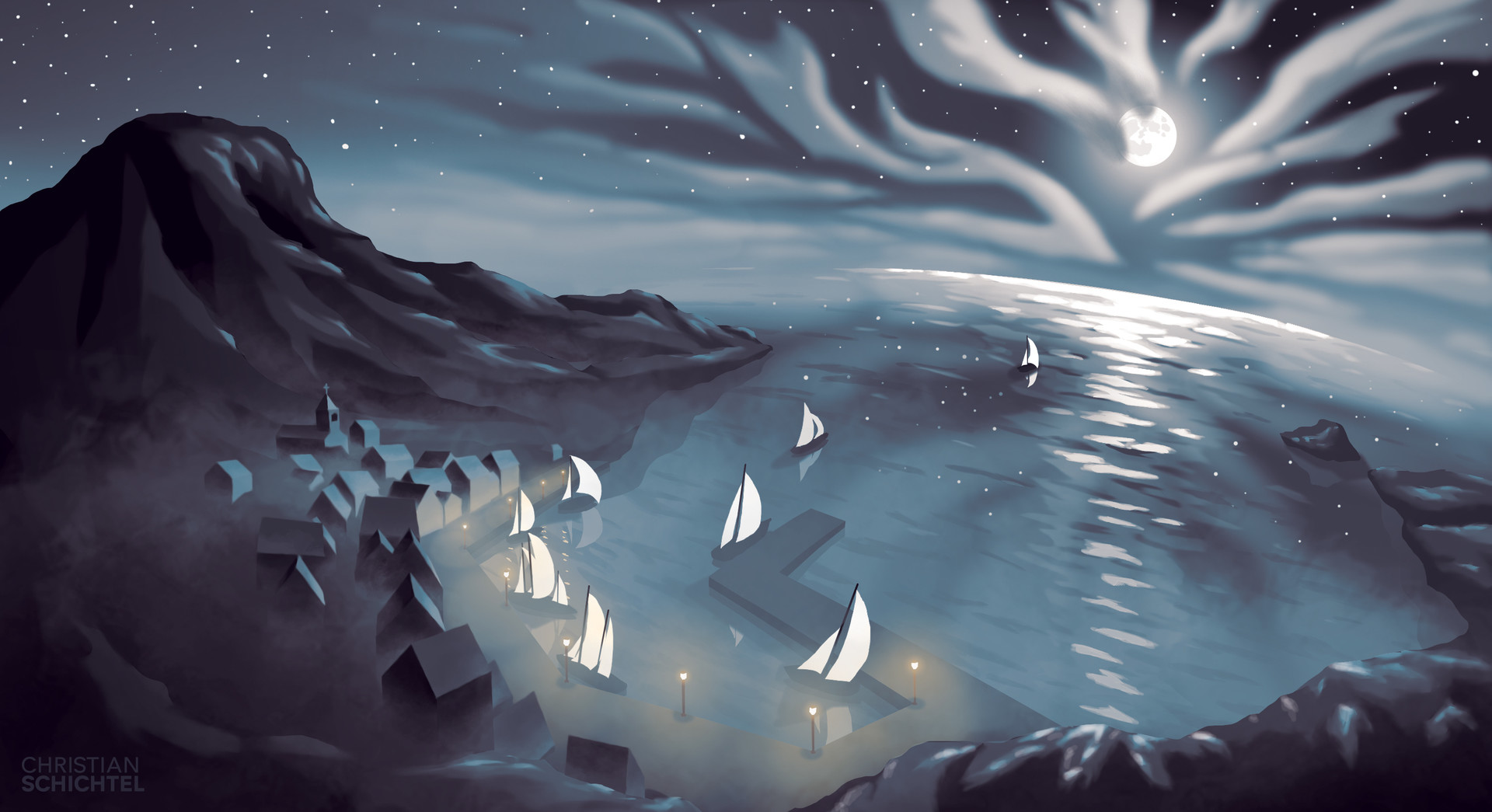
Illustration by Christian Schichtel
Posted in movie, music, video | Leave a comment

How to Make Them Pay?

How often do you still use cash? Do you still write some checks? Did you notice credit cards are no longer issued with raised numbers for imprinters? Do you even know what an imprinter is? Do you or should you tap to pay? How we pay for things continues to evolve, and the pandemic accelerated several trends.

The Decline of Personal Checks

It made news when Target stopped accepting personal checks in July 2024, but Aldi, Whole Foods, Old Navy, and Gap had stopped accepting them a decade earlier. While checks have been around for centuries, they are slow, cumbersome, and prone to fraud compared to other payment methods. The average American was writing over sixty checks a year in 2000, but by 2024 that had fallen to less than ten.

Source

Back in the day, schoolchildren would go on field trips to a bank and learn how to write and use a check.

Schoolchildren visit a bank in Bartlesville in 1969

In my case, we rode a school bus to Fidelity Bank’s new tower in downtown Oklahoma City, completed a couple of years earlier in 1972 as part of urban renewal. I remember sitting in a large white room with high ceilings and tall windows as they went over banking procedures, including showing us how to write a check. My mother worked for years at a savings and loan, so I already knew all about that stuff.

My father worked for Cities Service Gas in the First National Bank’s skyscraper a few blocks away. One of my favorite things when visiting his building in the 1970s was to ride the escalator up into its tremendous marble banking hall. The hall is still there, but now refurbished into a restaurant and event space.

The amazing Banking Hall at OKC’s First National
Jack Conn

At the time, Fidelity was run by Jack Conn, who spearheaded the Conncourse system of underground tunnels connecting buildings across downtown OKC. It is now known as the Underground with a mile of tunnels that cover more than 20 square blocks.

George Kaiser’s Bank of Oklahoma merged with Fidelity bank in the 1980s oil bust, and I see that Arvest bank took over the former Fidelity/BOK tower in downtown OKC back in 2019. I’ve banked with Arvest, which is owned by the Walton family of Wal-Mart fame, for thirty years.

When I came to Bartlesville in 1989, I opened checking and savings accounts with WestStar, the major local bank at the time, which had begun in 1900 as Frank Phillips’ First National Bank of Bartlesville. In 1994, the Waltons bought out WestStar for $470 million. While I still have around 20 transactions in my checking account each month, I only write one or two checks annually. I’ve heard that fewer and fewer people even know how to properly write a check.

What Took Their Place?

Years ago I started eliminating having to write and mail in personal checks for household utilities. I signed up to have those charges deducted automatically from my checking account. I later started having home and automobile insurance deducted from my checking account as well, although I still write the occasional check for a specialized service like tree removal or fence installation.

The Federal Reserve has released its 2024 Findings from the Diary of Consumer Payment Choice, giving us some insights into the shifts in payment methods. Below are the shares of payment instrument use for all payments each year from 2016 to 2023.

Source

Over those eight years, the share of payments handled via personal check dropped by more than half and cash transactions almost halved. Debit transactions increased by 11%, and credit card payments increased by 78%. ACH refers to electronic money transfers between banks and credit unions across the Automated Clearing House network, and those are up 30%. I generate an ACH each month since the school district direct deposits my pay into my Arvest checking account, and I transfer some of that to another bank for my long-term savings since their interest rates are higher.

Cash

For three consecutive years, consumers have reported making an average of seven cash payments per month, so it appears to have a “floor” level. When consumers are asked which payment method they prefer for in-person payments, there has been a significant shift from cash to credit.

Source

That, along with a continuing shift from in-person purchases to online and remote ones, is helping keep the number of cash transactions steady even as the total number of transactions increases post-pandemic.

Source

I should add that the type of payments one makes is correlated to household income. As income increases, the share of transactions done with cash declines in favor of credit cards.

Source

People like me, who are 55 and older, use cash more than younger generations.

Source

But all age groups are making the switch from cash to credit.

Source

Person-to-person payments have shifted greatly from cash to payment apps.

Source

I’ve experienced that myself, with Wendy routinely sending me money via Venmo when she charges something via an app on her iPad.

Credit Cards

Old-style store credit cards had no magnetic strip, just embossed numbers and a name for an imprinter

Back in 1970, when I was a kid, only 16% of U.S. families had a bank-type credit card. However, 45% had a retail store card. I recall that my mother had specific credit cards for Sears and J.C. Penney. The latter seemed ironic since she remembered how Penney’s was a cash-and-carry operation until 1958, originally promoting their lack of store credit as a way for consumers to avoid building up debt.

Mom kept using the same cards for decades. They had no expiration date and no magnetic strip, just embossed numbers and her name.

Credit card imprinters of yesteryear

Eventually when she would hand her card over, the clerk would pause, comment on how old the card was, and would have to reach under the counter to pull out an old manual imprinter since the card couldn’t be scanned by the register. They would place the carbonized sales slip and the card in the device and either pull down a lever or slide a bar back and forth to create an impression of the embossed card data.

Finally, sometime in the 21st century, the stores forced Mom to give up her old cards, replacing them with modern ones with magnetic strips.

By the late 1990s, two-thirds of families had bank-type credit cards. The retail cards where the store, instead of a bank, issued the credit began to wane.

Credit card use plateaued at about 75% for the first years of the 21st century, but then rose to over 4 out of 5 families in the late 2010s.

Source 1; Source 2

These days imprinters are utterly obsolete, and our latest credit and debit cards lack embossing. They still have have the magnetic strip on the back for old-style swiping. Encoded on the strip are the credit card number, your name, the expiration date, etc.

Since imprinters are no longer used, credit cards have lost the embossed name and number; the information is instead encoded in the magnetic strip, while the embedded chip can be used for more secure transactions

But in 2015 EMV chips began to be added to the credit cards in the USA, over a decade after they were introduced in Europe and five years after they came to Canada. EMV stands for Europay, Mastercard, and Visa, and using the chip is more secure than the magnetic strip, since it generates a transaction-specific, one-time code that cannot be duplicated ahead of time instead of sharing the actual credit card number.

Most credit cards are still “dip and sign” ones in which you insert the card in the reader, wait for the signal, and then may be prompted to provide your signature, although most card issuers no longer require a signature since signatures are not effective at preventing fraud.

However, some stores still require a signature for transactions over a given amount, have old card terminals that rely on the magnetic strip instead of the chip, and restaurants that lack pay-at-the-table terminals often, but not always, require a signature to validate a tip the customer adds to the merchant slip.

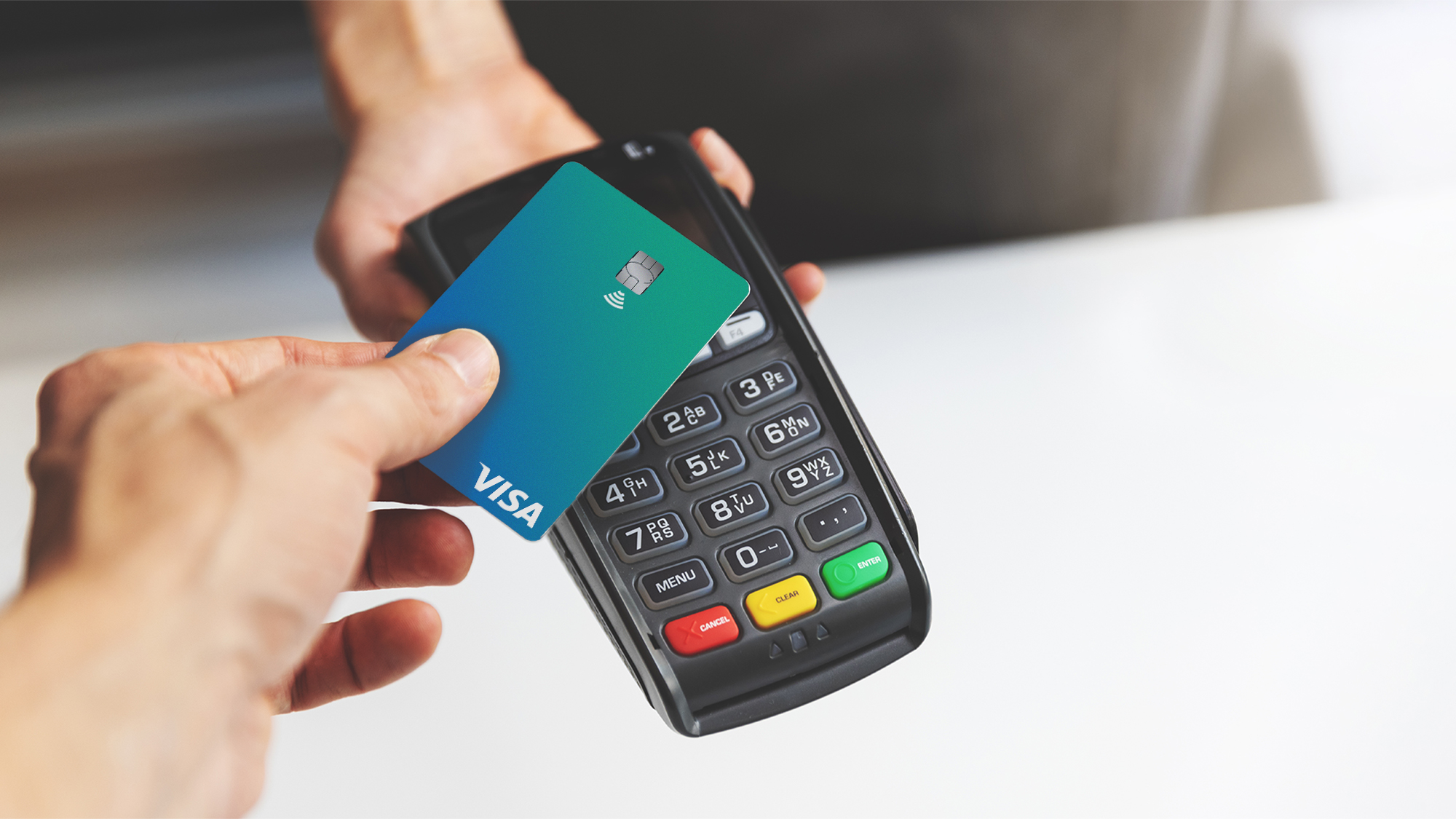
Some expect us to migrate to cards where using the chip in a terminal also requires that you enter a Personal Identification Number, as one commonly must do with bank debit cards. But a newer technology offering better security is preferred: tap-to-pay. A card (or smart phone) with tap-to-pay capability has an embedded antenna.

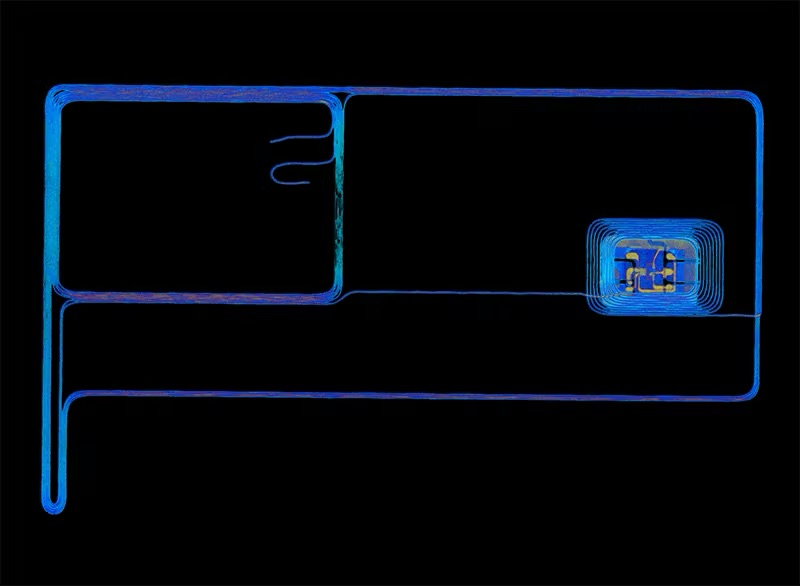
Modern credit cards have lost the embossing, but gained the EMV chip and a tap-to-pay antenna

A CT or computed tomography scan of a contactless pay credit card reveals the antenna wires around its perimeter which then coil tightly around the EMV chip.

Tap-to-pay credit cards have antenna wires embedded in them around the perimeter of the card and its EMV chip

When you use tap-to-pay, the pay terminal uses alternating current to generate an electromagnetic field at a frequency of 13.56 million cycles per second. That field oscillates across the wires in the credit card, inducing an electrical current in it to power a tiny integrated circuit in the card. The card rapidly changes its resonance to create detectable fluctuations in the terminal’s electromagnetic field, thus communicating with the terminal.

Like transactions where you insert the card to read the chip, each contactless card payment creates a one-time code and avoids transmitting the actual credit card number. But contactless tap-to-pay is even better since you never have to insert your card in a terminal. That avoids falling victim to a terminal secretly outfitted by criminals with a skimmer that actually reads the magnetic strip to gain your credit card number and other information.

I love the tap-to-pay feature. I even instructed one bank to issue me a replacement card since the new one would have tap-to-pay and that was lacking on the card they had issued me a few years ago. But does the use of radio waves for tap-to-pay mean that crooks could walk by you and scan your credit card?

No. The effective range for tap-to-pay is deliberately designed to be quite short, maybe a few centimeters, and the card doesn’t actually transmit the account number, but instead a one-time code. The risk of electronic pickpocketing is minimal compared to physical card theft. So I don’t bother worrying about wallets that block radio waves.

Plus, in the U.S. there is little if any consumer liability if a fraudulent purchase is made. The real danger inherent to using a credit card is in its name: credit.

Source

As people use credit cards more, the debt associated with them is building even as the personal saving rate, which spiked during the pandemic, has fallen. Bear in mind that the debt is volumetric while the saving rate is a flow, but the contrast in the trends is still interesting.

Source

As the Federal Reserve raised interest rates from March 2022 to July 2023 in order to combat high inflation, that prompted credit card interest rates to spike. Axios reported that in September 2024 the average credit card interest rate was at 20.78%, close to the highest on record, and the current average interest rate on store-branded retail cards is a whopping 30.45%.

Commercial bank interest rate on credit cards plans in the USA from 1994 to 2024; Source

So if you’re not paying off your credit card bill each month, it might behoove you to start using debit cards instead. Merchants prefer them anyway since their processing fees are lower, disputes and chargebacks are easier to handle, and the money is available to the merchant more quickly.

How we pay will continue to evolve. Here’s hoping we can continue to reduce the friction as well as the fraud.

Posted in history, technology | Leave a comment