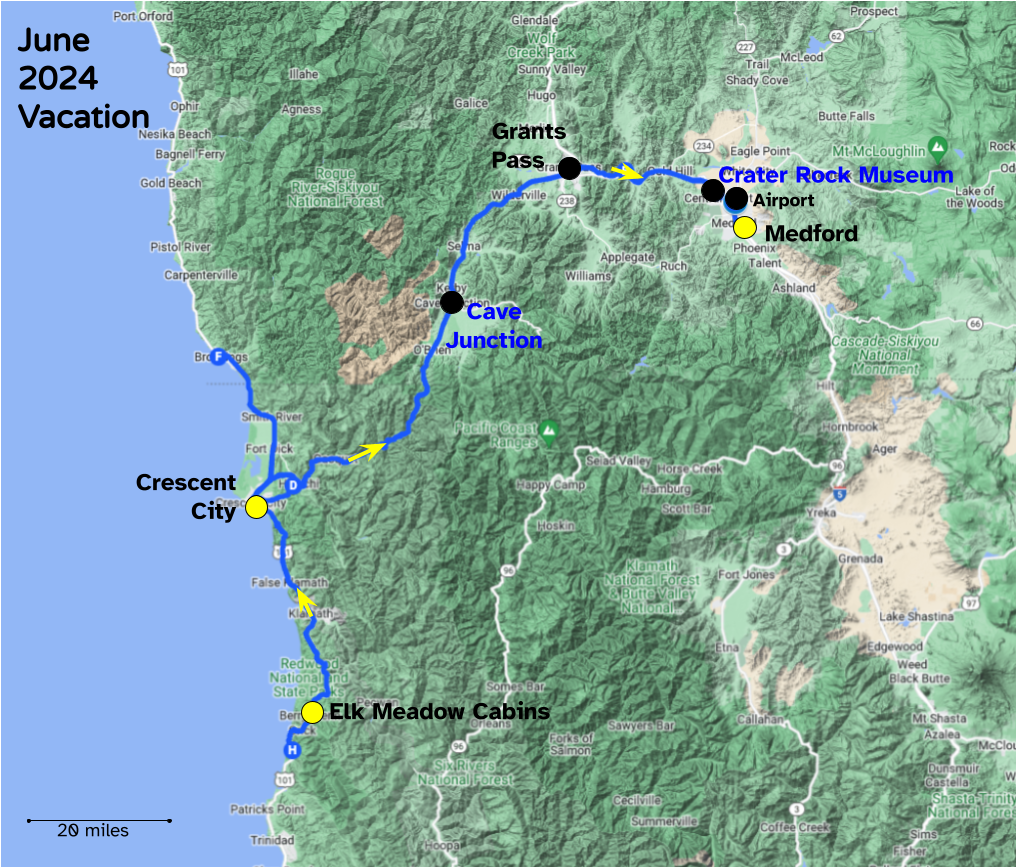
Having enjoyed several walks in the redwoods, it was time to head back to Medford so that we could catch a flight back home. We packed out of Elk Meadow Cabins and began retracing our route along US 101.
We turned off 101 after Crescent City to rejoin US 199, the Redwoods Highway, which led through Hiouchi and Gasquet onward to Cave Junction. The road is particularly narrow and winding east of Gasquet, and I was glad when, three hours after departing our cabin, we reached Cave Junction.
Back in 2006, I had turned off here to see the Oregon Caves National Monument. However, Wendy and I have been through several caves, and she was content to skip them on this trip.
Cave Junction sits in the Illinois Valley, which had a gold mining boom from the 1850s into the 1870s. As the gold played out, Elijah Davidson found a cave on a hunting trip in 1874. The Oregon Caves were a tourist attraction in the 1890s and converted into a National Monument in 1909, with a chalet and cabins in place by 1926 when Cave City was established at the junction of the Redwood Highway and a branch leading to the caves. It became Cave Junction in 1935.
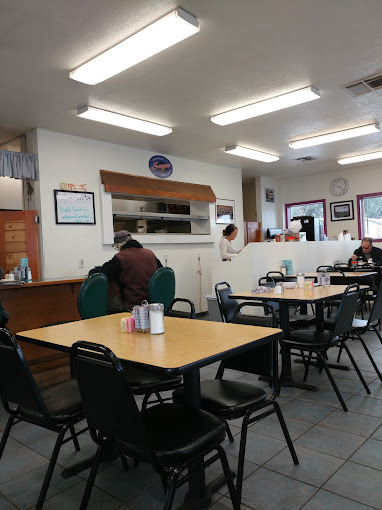
The town has now surpassed 2,000 and offers the only restaurants and public restrooms I saw after Hiouchi. We had lunch at the River Valley restaurant, which had good food and service, although I wish its dining room had some acoustic dampening.
The remainder of the trip back to Medford was relatively quick, especially once we joined Interstate 5 at Grants Pass. After about an hour, we had reached the Crater Rock Museum in Central Point, just north of Medford.
Crater Rock Museum
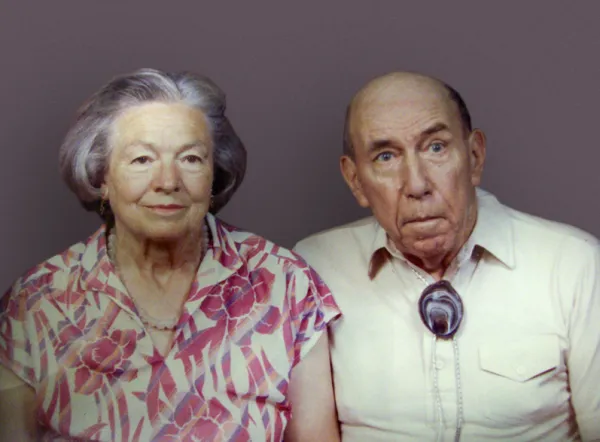
Frieda and Delmar Smith founded the Crater Rock Museum in 1954. It grew from a small shed into what is now a 12,000 square foot facility. Wendy enjoyed browsing the large shop. Then we paid $13 ($7 for her and $6 for her “senior citizen” hubby) for admission to the museum.
Frieda and Delmar Smith
As one might expect, there were some small children enjoying the exhibits, and Wendy was glad to have earplugs to dampen the louder yammerings of toddlers.
The first displays we saw had some 19th century sand paintings and ivory carvings.
After that, we saw many varied rocks. Here are Wendy’s favorites:
Then we drove south into Medford, relaxed with some ice cream at a Dairy Queen, and then checked into the Homewood Suites by Hilton.
Our suite was the most comfortable of the trip, which made up for how it was situated on the second floor at the farthest back corner of the property. I figured out how to use the courtyard as a shortcut to and from the lobby.
We’d noticed some Asian restaurants on our drive through downtown, and I ordered us a meal via Grubhub from Dragon Express, which was pricey but good.
We had a day to kill before flying out on Monday, so on Sunday we filled up the rental SUV with gasoline, shopped at a nearby Fred Meyer’s, ate at a Five Guys, and I bought Wendy some baklava at the Harry & David store.
Baklava from Harry & David
Harry & David was established in 1914 and specialized in the Comice pears grown in the area. They became a premier marketer of fruit and food gifts and one of the nation’s oldest catalog mail-order companies. Harry & David is still one of the largest employers in the Rogue Valley.
We were introduced to the company via a Christmas gift a few years ago from Truity Credit Union back when I served on their Technology Committee. Wendy loved the baklava in that gift assortment, so it was fun to visit the home of Harry & David and purchase some in their store rather than via mail order.
Their baklava is made by buttering 60 paper-thin leaves of phyllo pastry with intermittent layers of a filling made from Sumatran cinnamon and finely chopped and toasted English walnuts. The confection is baked until golden and flaky and then bathed in honey and lemon. Wendy loves it.
On Monday we checked out of the hotel, dropped the SUV off at the airport, and had lunch in its second-floor Sky House restaurant. I was glad we did, as I didn’t particularly care for the lunch served later on our flight to Denver, although we both liked the warm Chocolate Chip Cookie Pie in the Sky treats we were served.
We again enjoyed carefree flights home, although we both came down with COVID after our return, making us wish that we had masked up while at the airports and aboard the planes. Those high-risk environments were most likely where the latest variants caught us.
I visited the Pacific Northwest in 1998, 2005, 2006, 2008, 2009, and for our honeymoon in 2016. This seventh visit was again rewarding, and I am certain we shall return to the region to escape some future summer in Oklahoma.
I was asked to share information about Teacher Retirement at our school district’s Leadership Day after the conclusion of the 2023-2024 academic year. My own retirement is a couple of years away, so I enjoyed doing some research about the topic. I’m sharing some of my findings and personal experiences here for anyone who is interested. Bear in mind that I am certainly not a qualified financial advisor; I’m a former physics teacher and current school district administrator who knows how to use the internet.
Deciding when to retire
While the average over-50 worker expects to retire at 67, and 2/3 of older employees plan to retire after 65, the average retirement age in the USA was 57 back in 1991, rising to 59 by 2002, and it has averaged 60 to 62 for over a decade.
The truth is that many people don’t get to retire when they want. Annual surveys show “…actual retirement tends to arrive abruptly and unexpectedly, triggered by declining health or corporate downsizing.”
More than half retired earlier than planned, for a variety of reasons, most often for health or job-related reasons.
My mother retired at 54 and my father at 58 when their respective corporate employers were sold. Neither of them earned income after they retired.
In an EBRI survey, 3/4 of workers expected to continue working for pay in retirement, but only 3 in 10 retirees had ever done so. In an AARP survey, “over three in five (64%) believed workers face age discrimination in today’s workplace and few see the situation improving. And, two in five (41%) report experiencing some type of ageism at work in the past three years.”
Since over 2/3 of retirees will not be working for pay, it is important to understand retirement income sources. More discrepancies between worker expectations and retirement realities are apparent in the chart below, with workers underestimating how much of their retirement income will come from Social Security and overestimating how much will be from workplace and individual retirement savings and working for pay.
Social Security is a retirement income source that most workers tend to envision as minor, while 2/3 of actual retirees find it to be major. Over half of workers think workplace retirement savings plans will be major sources of retirement income, but only 1 in 5 of retirees find it to be so. Work for pay is a major source of income for only 1 in 20 retirees, and so forth.
Social Security
Social Security became law in 1935, with payroll tax collections beginning in 1937 and benefit payouts beginning in 1940. There are some common myths about the program, including that is was raided to help with the national debt, while in fact the Social Security Trust Fund was created in 1939 and has always worked the same way. It has never been part of the general fund of the government. The confusion arose because from 1969 to 1990 the trust fund was included in the “unified budget”, but whether or nor trust funds are “on-budget” or “off-budget” are questions of accounting practice that have no effect on the trust fund operations.
Increasing life expectancies and changing birth rates inevitably impact the program. It was heavily amended in 1983 when I was a junior in high school. Those changes helped stabilize it for a half-century. The full retirement age of 65 was adjusted to advance to age 67 for people like me who were born after 1959. The early retirement age of 62 was retained, but the consequent benefit cut was increased from 20% to 30%. Benefits for those with higher incomes were taxed, with the proceeds going into the trust funds, and in 1993 that taxation was increased.
Almost 3 in 10 took Social Security as soon as they could, and almost half took it before the full retirement age of 65 for those born before 1943. There was a surge taking it at age 65, which is still when Medicare begins, since it is considerably cheaper than private health insurance.
About 1 in 4 took Social Security at age 66, which was the full retirement age for people back in 2021. I expect that surge to shift to age 67 in 2027. Less than 1 in 5 waited past full retirement age to draw their benefits, even though the monthly benefit is increased by 8% for each year of delay up to age 70.
Inflation erodes fixed retirement income sources
The biggest advantage to Social Security over some other retirement income sources is that its benefits are not fixed amounts. Instead, they are adjusted annually to compensate for inflation. Below is a chart of the annual inflation rate over my lifetime:
That includes the “great inflation” period from 1974 to 1982. Inflation was finally brought under control by Paul Volcker of the Federal Reserve, who led the raising of the federal funds rate to a peak of 20% in 1981. That impacted construction, farming, and industry and triggered a recession, but inflation was tamed. The only significant outbreak since then was the post-pandemic peak of 8% in 2022.
Inflation inexorably erodes the spending power of fixed retirement incomes. From 2000 to 2024 the average annual inflation of 3.5% allowed the cost of all goods and services to grow by 85%.
As shown in the chart, medical care costs rose even faster, at an average annual rate of 4.9% for a cost increase of almost 120% over that time period.
The average person’s length of retirement has increased over time. For men, it grew from 13 years in 1970 to almost 19 years today, while for women it increased from 17 years in 1970 to over 21 today. Inflation of 3.5% could erode the purchasing power of fixed income sources by almost 50% over the length of the typical retirement.
However, actual retirement length can vary widely. My father had a retirement that lasted about 38 years, and my mother is currently in independent living at Green Country Village, and she has been retired for about 33 years. The John Hancock and Northwestern Mutual calculators say I have about a 50% chance of a retirement that lasts 28-30 years, but it is of course all just probabilities.
Social Security’s uncertain future
Happily, since 1975 Social Security has had an automatic annual Cost-of-Living Adjustment (COLA) based on the Consumer Price Index for Urban Wage Earners and Clerical Workers. So it is protected against inflationary erosion.
Unhappily, by 2033 or so, the reforms of 1983 will have run their course in propping up the system. With the larger baby-boom generation retiring, costs began to exceed income for the Old-Age, Survivors, and Disability Insurance Trust Funds in 2021. Without reforms, the Old-Age and Survivors Insurance Trust Fund will be exhausted around 2033 and all Social Security retirement benefits would then be cut by about 20% as it would rely on a pay-as-you-go basis using only incoming payroll taxes.
I am one of the oldest members of Generation X, and my full retirement age of 67 in 2033 is when the trust fund will be exhausted. All three branches of our government have become so partisan and dysfunctional that I am dubious that there will be intelligent and reasonable adjustments to increase payments to the system that might avoid at least some significant benefit cuts for younger generations and/or an erosion of the systems’ COLAs.
Even if Social Security were reformed in a way that did not impact me, it might be only 1/4 of my overall retirement income, the majority of which will come from my teacher pension with a substantial boost from defined contribution plans I have contributed to throughout my working life. I delve into those later in this post.
You should get an annual Social Security statement with your projected benefits, or you can access it at ssa.gov. My benefits would be cut by 14% if I start them at age 65. They would be cut by 30% if I start them at age 62. When I take them will depend on when Wendy decides to retire and how comfortable I am living on my teacher retirement and the income I derive from defined contribution plans I have funded.
Insurance before age 65
A major issue to consider for retirement is health insurance. As Oklahoma teachers, Wendy and I each receive HealthChoice High Medical insurance at no cost while we work for the public schools. When I retire before age 65, I will have to pay to stay on that plan along with my HealthChoice Dental plan, and medical costs typically inflate at 5% per year.
If you’re part of HealthChoice, you can get more information at oklahoma.gov/healthchoice.html and as I wrote this post, the HealthChoice premiums could be found at the OMES Employee Group Insurance Division website. Why you can’t find the premiums at the HealthChoice website is another example of how Oklahoma state government is dysfunctional, under-resourced, and poorly managed.
By staying with HealthChoice, the Oklahoma Teacher Retirement System (OTRS) will reimburse about $100 of my health insurance cost each month until I go on Medicare, so my projected monthly health insurance costs until I am 65 would consume about 1/3 of my monthly Social Security benefit, dropping to about 1/5 once I begin Medicare.
Medicare
When I do reach age 65 and go on Medicare, I will have a choice of Original Medicare or Medicare Advantage (which is also called Part C).
Consumer Reports reviewed the pros and cons of each. While Medicare Advantage often has lower monthly costs and enrollees often receive more preventive care, if you have chronic conditions or significant health needs, Medicare Advantage has risks you should consider.
With Original Medicare, you usually have access to a larger network of health providers, and Medicare Advantage plans may require pre-authorization to see specialists. About half of all Medicare Advantage enrollees pay more than those in Original Medicare for a seven-day hospital stay, and Medicare Advantage is problematic for those in rural areas, where the smaller network of providers makes it harder to make appointments and get care.
Medicare Advantage’s share of Medicare enrolles has been steadily climbing, and now more than half of the eligible Medicare population are enrolled in it. However, in 2023 only 1/3 of those eligible in my county were enrolled. [Source]
Personally, I associate Medicare Advantage, which is more profitable for insurers than their other lines of business, with managed care and Health Maintenance Organizations (HMOs). I plan to instead piece together my coverage via Original Medicare Parts A, B, and D plus Medigap, along with my existing HealthChoice Dental plan and cancer policy.
Part A, for in-patient hospital and skilled nursing care, should be free. I’ll pay a premium for Medicare Part B, which covers doctor services, outpatient care, and durable equipment. I will also want a Medigap plan for copays, Medicare Part A deductibles, and wellness, but people my age cannot access Medigap plans for vision, dental, hearing aids, or Part B deductibles.
I will have to research my options when I approach age 65, but if I were making the decision today, I might enroll in AARP’s Medigap Plan G. There is also a G+ plan with wellness benefits, but my dentist is not in their Dentegra network for that, so I plan to just stay on HealthChoice Dental for the long term and stick with G instead of G+. But someone with retirement experience has shared that they were happy to be on Plan N from Mutual of Omaha. Definitely do some research before you pick a Medigap Plan!
As for prescription drugs, you can input your routine medications and check costs for various Medicare Part D prescription drug plans at both AARP and Medicare itself. My cheapest option, after I input my medications, was the AARP Part D plan with Walgreens and UnitedHealthcare, but of course your location, preferred pharmacies, and routine medications will cause all of that to vary.
I am increasingly frustrated having to go to a local pharmacy for refills, so I’m currently trying Amazon Pharmacy for my routine medications for chronic conditions.
If you are willing to take the risk, you can research the various Medicare Advantage plans, but bear in mind that if you go that route and later switch back to Original Medicare, you will no longer be guaranteed access to a Medigap plan.
Currently, my estimates are that my monthly insurance costs under Original Medicare with Part A, Part B, Part D, and Medigap, plus HealthChoice Dental and my cancer insurance, would be about 40% lower than my monthly insurance costs from ages 60-64 when I plan to be retired yet ineligible for Medicare. If I took Social Security at age 62, I would expect health insurance to consume 33% of it for three years, declining to 20% once I could join Medicare.
Defined contribution and defined benefit plans
It is only because I have significant sources of retirement income besides Social Security that I can contemplate retiring as I turn 60. In my case, I have both a defined benefit pension plus defined contribution plans I have contributed to throughout my career, although I have no employer matches for the latter.
There was a time when many workers had defined benefit plans, such as the typical pension, guaranteeing a certain payout throughout retirement. However, many businesses abandoned offering pensions, opting to instead sponsor defined contribution plans where money is deposited into an account, but the amount of the eventual payout may not be guaranteed.
401(k) plans, along with their 403(b) counterparts for health care, education, and tax-exempt organizations, are common examples of defined contribution plans. In some cases, the employer will match some employee contributions to a plan.
There is a stark difference in access to the different types of retirement plans for those who work in private industry versus those working for state and local governments:
Access to a defined benefit pension has become a key feature in recruiting and retaining state and local government workers since their salaries are often significantly below what could be earned in private industry. I am among the 34% of state and local government workers with access to both a defined benefit pension as well as defined contribution plans.
Early in my career, the Oklahoma Teacher Retirement System (OTRS) that funds my defined benefit pension was severely underfunded. It was put on a path to solvency by increasing required contributions and essentially eliminating cost-of-living adjustments. There have only been two COLAs for it since 2008, averaging out to maybe 0.25% per year, which is a tiny fraction of the inflation rate. Politicians have sometimes proposed eliminating defined benefit plans for teachers, replacing them with defined contribution plans as has happened to most private industry workers. However, without younger workers contributing to OTRS, the state would have to raise taxes to keep its promises to those still in it. That poison pill has protected the system thus far.
Meanwhile, only 15% of those in private industry even have access to a defined benefit plan, while over half only have access to defined contribution plans. Over 90% of private companies will match employee contributions to a 401(k) up to a certain amount, most commonly capped at 6% of the employee’s salary. The equivalent to private industry 401(k) plans for those working in public schools, churches, and other tax-exempt organizations are 403(b) plans. The funny names come from the tax code.
OTRS
The scarcity of COLAs means that a pension from the Oklahoma Teacher Retirement System is essentially a fixed amount these days. The beneficiaries lack the political power to obtain more than an occasional token COLA. So if you are an OTRS member looking at your projected pension amount, bear in mind that its purchasing power will steadily erode by perhaps 2.5% or more each year, or perhaps by half over the length of a typical retirement.
Getting more accurate projections
Speaking of OTRS projections, the annual statements the OTRS mails out are not useful if, like me, you want your spouse to continue to receive all or part of your pension should you die first. That’s because the amount of your benefit depends on how long your spouse is expected to live. To get an accurate projected benefit for “Option 2” or “Option 3” to provide a spouse with all or half of your pension if they survive you, you need to go online and select the Retirement Projection option at My OTRS:
Use Retirement Projection to account if you want a surviving spouse benefit and/or expect to have sick leave you can cash in
The online Retirement Projection lets you input your accumulated sick leave and your spouse’s birthdate
There you can put in your spouse’s birthdate if you want Option 2 or Option 3 surviving spouse benefits.
That same Options page is where you can input any unused sick leave you will have at retirement, which purchases you additional credit in OTRS and increases your benefit. The maximum increase is with 120 days of accumulated sick leave, which provides a full year of additional credit. In my case, that translates to about $2,000 per year more, or about $50,000 over the length of my projected retirement.
Of course, another factor is when you expect to retire. Over time, the age at which you could automatically receive full benefits from OTRS has increased from 62 to 65. Some can qualify before those ages if the sum of their age and years of creditable service is at least 80 or 90. They’ve also tweaked the amount of benefits you can receive if you retire early.
Rule of 80
Rule of 90
Rule of 90 Revision
Those who joined…
prior to July 1, 1992
between July 1, 1992 and October 31, 2011
after October 31, 2011
Full retirement age
Age 62
Age 62
Age 65
Service & age combination if below retirement age
Age + Years of Creditable Service = 80
Age + Years of Creditable Service = 90
Age + Years of Creditable Service = 90 and at least Age 60
Early retirement amounts
100% at age 62 declining to 56% at age 55
100% at age 65 declining to 80% at age 62 and 65% at age 60
Benefit calculation
Highest three salaries
Highest consecutive five salaries
My attempt to summarize how OTRS varies depending on when you joined it
Salary caps for service before July 1995
I joined back in 1989, so I am under the Rule of 80. But that also meant that I made an election in August 1989 of whether to have my salary cap for OTRS set at $25,000 or $40,000. I was only making $17,657 per year starting salary, which would be equivalent to $44,433 in 2024 if adjusted for inflation.
I opted for the $40,000 cap, so when I qualified for full OTRS retirement in 2018 under the Rule of 80, my benefit was reduced because it was calculated as 2% of the average of my three highest salaries only for the years 1996 and beyond. For 1989 through 1995, it was calculated using 2% of $40,000.
To encourage Rule of 80 folks like me to not retire so early, the “Education Employees Service Incentive Plan” eliminated two years of the salary cap for each year I stayed beyond my eligibility year. So after July 2021 I had worn away the old salary caps for my first six years in the system. The confusing statement from OTRS still acts like my old salary caps are in place, but when I run the calculations, its projections are correctly based on my having no caps any more.
Coupling OTRS & Social Security
To gauge how OTRS and Social Security could fund my lifestyle if I retired at various ages, I divided my projected benefits, as well as my projected insurance costs, by my current taxable monthly wages.
To get a more accurate handle on things, I also backed out, with negative percentages, my expected health insurance costs. Here are the results:
A common rule of thumb is that you should aim to replace 80% of your pre-retirement income in retirement. So retiring at 60 on just my teacher pension would not be comfortable. Things would be better once I could start collecting Social Security. Waiting to retire until age 62 would allow Social Security & OTRS to replace 100% of my current taxable income, while retiring at 60 would reduce my OTRS such that when I reached 62 and could start Social Security, together they could replace 95% of it. Bear in mind that in all scenarios, inflation eats away at the purchasing power of my pension.
Some people go to the trouble of calculating, based on their life expectancy, their net lifetime retirement benefits if they delay starting Social Security to various ages, but remember that over half of retirees take it before reaching their full retirement age.
The reason I am comfortable retiring before I qualify for Social Security is that for my entire adult working life I have been contributing to optional defined contribution retirement plans.
Defined contribution plans
As a member of Generation X, I knew that I was unlikely to enjoy the same Social Security benefits as my parents, who were of the Greatest Generation and the Silent Generation. I figured that the immense Baby Boom Generation, with its sense of entitlement and political power, would protect itself while cutting benefits for us in Generation X and the later Millennials and Generations Z and Alpha.
So I began contributing to an Individual Retirement Account (IRA) when I started teaching in 1989, and I started contributing to a 403(b) annuity plan in 1992. 403(b) plans are like 401(k)s in which your contribution is usually deducted from your paycheck from pre-income-tax dollars, so your eventual benefits are subject to income tax. Traditional IRAs work similarly.
Roth IRAs became available later, where you could only input after-income-tax money, but your earnings and eventual withdrawals would not be subject to income tax. Roth IRAs also have fewer penalties and restrictions on early withdrawals.
There are also 457(b) plans, multiplying your options. Below is a chart I made comparing the different plans, but remember, I’m not a financial advisor:
My attempt to summarize types of defined contribution plans
So how many people take advantage of these plans? In a May 2023 Yahoo Finance survey, 37% of retirees have no savings. An AARP survey in April 2024 found 20% of adults ages 50 and older had no retirement savings.
The Census Bureau reported that in 2020 18% of working-age individuals had IRA or Keogh Accounts and 35% had 401(k), 403(b), 503(b), or Thrift Savings Plans.
The old 4% rule says that a person with $185,000 in savings might be able to draw $617 per month for retirement and keep up with inflation. That’s far less than my Social Security benefit, let alone my teacher pension.
So this cynical Gen-Xer made decades of sacrifices to bolster his retirement income. I will caution, however, that I also never had children and was an only child of generous middle-class parents. So I had the opportunity to save more than the typical head of household, even during the 28 years I was earning an Oklahoma teacher salary, before I became a higher-paid administrator. I will also note that my salary has always been a fraction of what I could earn in private industry; thank goodness Oklahoma has a very low cost of living.
Fiduciaries versus financial advisors
Before I go any further about investments, I will also caution that if you are seeking advice about investments, including defined contribution retirement plans, be sure you understand the differences between fiduciaries and financial advisors. A fiduciary has a legal obligation to act for the beneficiary’s benefit and not their own, while the title “financial advisor” implies no legal obligation. Certified Financial Planners and Chartered Financial Analysts are fiduciaries who must avoid conflicts of interest, but that also means you may have to pay up front and/or higher fees for their services, versus some financial advisors who make money by selling products that might not be in your best interest.
Types of investments
There are many types of investments. As I have repeatedly warned, I am not a financial advisor, so take my summary chart below with a grain of salt:
My summary of some common types of investments
CDs
When I was young, some CDs still had high interest rates as a result of Volcker’s battle to tame inflation, and they are very safe investments. I had some for my personal savings and I also invested my Traditional IRA in them, despite their faltering interest rates. When I bought my home in 1994, I cashed all of them out except for the ones in my IRA.
My Traditional IRA was originally with Liberty Bank, but they eventually shifted it to Bank of America, which then shifted it to MBNA, which eventually shifted it to Commercial Bank out of Parsons, Kansas. I wasn’t at all happy with the interest rate there, so in 2016 I consulted a financial advisor and shifted the money into a Nationwide New Heights 9 annuity with an income rider…in other words, a way to simulate a smaller additional pension.
Annuities
The Traditional IRA I contributed to from 1989 until 2016 is now set up for a joint fixed income annuity, which can be thought as a way to finance your own fixed pension by buying a policy from a large, stable insurance firm. Your investment compounds over the years and, upon retirement, the firm uses your invested money and actuarial tables to calculate a fixed amount they will pay to you, or if you’re like me and buy a joint life annuity, they will pay to you and then to your spouse if they survive you.
I was interested in annuities because I worried about outliving my savings if I instead invested and just used the old 4% rule. My paternal grandfather lived to age 100, my father to age 97, my paternal grandmother to age 91, and my mother is still living in an independent living facility at age 87.
I have always been able to control which funds the 403(b) plan was invested in, so I could alter the ratio of stocks versus bonds, the size of companies I was indirectly investing in (large, medium, or small-capitalization), and how much was invested in foreign versus domestic companies.
Stocks
One rule of thumb is that stock-based investments average 9-10% annual returns while bonds average 4-5%. The reason one invests in bonds, despite their lower returns, is that they are far less volatile than stocks. A stock, as well as a stock index based on a large number of stocks, can rapidly rise and fall, and individual stocks can become worthless.
We lost money on this hog farming investment
I’m certainly not a fan of investing in individual stocks. Back in the early 1980s, my father invested some money in the stock of a new hog finishing operation in Lexington, Oklahoma called Sooner State Farms. Its stock price dipped from a high of $1.38 per share to only 31 cents by April 1985. Dad gave me $7,500 in stock in 1989, and I watched it crash to $1,800 within a year. I sold all of my stock in 1995 and from then on only invested in managed or index funds that were a mix of equities from many companies, as I had no interest in tracking the stock market, let alone trying (and failing) to outperform it.
Investment mixes
With my Traditional IRA invested in low-risk and low-return CDs, when I began contributing to a 403(b) in 1992, I opted for higher returns, which meant higher volatility. In general, my approach was to keep a majority of the funds in balanced funds and/or stock index funds. Index funds outperform the typical managed fund.
Volatility and dollar-cost averaging
I’ve certainly seen volatility in my 403(b). There have been three recessions over its lifetime. The recession of 2001, triggered by the dot-com bubble burst, dropped my account’s compounded value below the inflation rate for four years. Then the Great Recession of 2008, triggered by the housing bubble, dropped it below inflation for over five years.
But I was still far from retirement, so I trusted in dollar-cost averaging, where you continue to invest steadily through booms and busts. Over the long haul, continuing to invest when the market is poor eventually pays off in what you’ll own when stocks recover. You just have to not panic.
The first recession led to annual returns for my account in 2000-2002 of -10%, -18%, and -22%, while the Great Recession wiped out 40% of its value in 2008. It also lost 19% of its value in the post-pandemic recession of 2022. But I just kept steadily investing, and over its lifetime my 403(b), despite my lack of investment expertise, has had an overall lifetime return of between 6% and 7%.
Roth IRA
When I rolled my Traditional IRA over into the fixed annuity investment, I started a Roth IRA. Those first became available in 1998. Unlike Traditional IRAs and traditional 403(b)s, your contributions to them are not tax deductible, but the earnings and withdrawals are tax free. The usual advice is to invest in a Roth if you expect your tax rates will rise, either because your wealth and income will be higher when you retire or due to expected changes in tax law.
Since most of my retirement savings was in pre-tax vehicles, I liked having some in a Roth, and I appreciated how it has no minimum distribution rules. One can only contribute earned income to a Roth, but since Wendy and I file a joint married tax return, I can still contribute to my Roth after I retire for as long as Wendy, who doesn’t contribute to an IRA and is younger than me and under the OTRS Rule of 90, chooses to continue to work.
How much to save
Most financial experts recommend a retirement savings goal of 10% to 15% of your pre-tax income, but whether or not that is feasible depends on your income, lifestyle, general cost of living, and the big expenses of children, housing, vehicles, and vacations.
I was fortunate to be able to contribute the maximum to my IRA each year, whether it was a Traditional or a Roth, including the larger “catch-up” amounts available to me once I was older. Over the past 35 years, my IRA contributions have averaged at 9% of my gross salary.
My annual contributions to my 403(b) averaged at 10% of my gross salary. I increased my monthly contributions to it in 1993, 1997, 2015, 2018, 2019, and 2024.
So over the years I’ve put 19% of my gross salary into voluntary defined contribution retirement plans. But many of my colleagues have not been so fortunate, with some not having defined contribution plans while others had one but then raided it when a life crisis occurred.
Spouses
Throughout retirement planning, if you’re married, you must take into account your spouse’s situation, especially with any differences in age, retirement, or insurance plans. I’ve concentrated on my own retirement situation in this post, but behind the scenes I have also run various scenarios based on Wendy’s situation. Since she is nine years younger than me, she won’t even qualify for a reduced OTRS benefit until several years after I retire, and her Social Security and Medicare eligibilities arrive almost a decade after mine.
Our Plan
I’ve met with my financial advisor and she has developed an initial plan for our retirement income. We will revisit that plan periodically to see if anything needs adjusting. A large uncertainty is when Wendy will choose to retire, so I will be opting to increase our flexibility by taking a partial lump sum from my teacher retirement. That will decrease what is essentially my fixed teacher pension while increasing the funds I can choose how to invest, increasing my options on when and how much of those funds to utilize for income.
If you are still working and this post has you thinking about your own retirement plans, I will count that as a success. Please do not interpret this post as personal or financial advice; everyone’s situation is different, and if you are looking at investing, I would advise you seek out a Certified Financial Planner who is also a fiduciary.
Bartlesville had tremendous luck with the tornado. As it reached town, the storm intersected with a squall line. That weakened it considerably to EF1 and it tracked along the Caney River floodplain that separates Bartlesville into two populated areas. So the most significant damage to structures was in the southwest, to the south of 20th Street, atop Circle Mountain, and in the northeast of the city near the old Tuxedo community, damaging buildings near the intersection of Tuxedo and Washington boulevards.
The tornado’s path across Bartlesville
The tornado ripped across the most scenic area of the Pathfinder Parkway trail system between its entrances on Shawnee and Polaris, marked C and D on my map of the trail system shown below.
For eight weeks, volunteers and city crews worked to clear the trail system and address tree damage that could harm pedestrians. The city parks department had portions of the trail blocked off, but they reopened everything on June 27. So on the morning of June 28, I walked from the Shawnee Avenue entrance at the new Agricultural Center to the Polaris Drive entrance at Silver Lake Road to document how things have changed.
That section of the Parkway is among the most heavily travelled, probably because it had some of the best scenery with large overhanging trees along the floodway and the large pedestrian bridge across the Caney River. For the sake of this narrative, I’ll show the Parkway from the Polaris Drive entrance, walking west and north to the Shawnee Avenue entrance.
My walk to survey the damage along the Pathfinder Parkway
Polaris Drive/Rotary Shelter
There was no apparent damage at the Polaris Drive entrance off Silver Lake Road, which has the Rotary Shelter.
I passed the shifted barrier that had been blocking this part of the trail system.
I didn’t have to walk far to see an area where crews had to clear damaged trees.
The area around the concrete culvert that crosses a small creek was unscathed.
But just west of there a large tree had shattered.
Crews had labored to clear multiple trees that had been damaged.
One of the Bird Trail signs along there had been bent; later I would find one that was completely destroyed.
Bent Bird Trail sign
Here is a shot from the eastern approach to the pedestrian bridge over the Caney River in September 2022 compared to one from June 2024:
I am so glad that the pedestrian bridge was spared, with even the saplings around it undamaged.
My own board on the bridge remained undamaged, along with the many others.
The river views from the bridge did not appear to be greatly changed.
I spotted a large tree west of the pedestrian bridge that crews had to cut.
Most of the tree had been pushed to the other side of the trail.
One large tree had collapsed, but thankfully away from the trail.
The most startling change was along the entire length of what I call the “east-west straightaway” where the trail leading north from the pedestrian bridge turns to head almost due west until it turns due north at what I call the “wetlands”. This was where the Pathfinder directly traversed the central destruction zone.
The area used to have some of the tallest overhanging trees along the pathway, but it is now far more open to the sky. Here is what the straightaway looked like in 2012:
And here is what it looks like now:
The change is quite startling.
A bench along the straightaway took a beating, but it was still functional.
The other area that is greatly changed is the small wetlands at the west end of the straightaway. That low area is often flooded, and the pathway briefly changes from 8-foot-wide asphalt to a narrower concrete path.
There has always been an oilfield road there that wound around the east side of the wetland to reach some pumpjacks. Before, that road was greatly obscured by trees, but now it is quite visible as it crosses the denuded landscape.
Here is another comparison, of walking along the narrow concrete sidewalk across the wetland in 2020 versus today:
This was probably the most dramatic change for me.
North of the wetland the trail crosses a deep gully, which was filled with debris while one of the stripper well pumpjacks accessed by the oil road appeared undamaged.
Just yards away, both a bench and a Bird Trail sign had been destroyed.
The friendly Kissacks, parents of some of my former students, passed me along the trail today as I documented the changes. They are walking away toward the wetland in the shot below with the destroyed bench in the foreground.
The destruction continued as the trail turned for a short jog westward to what was once a large sheltered clearing surrounded on three sides by tall trees.
A water fountain and bench were still accessible at the edge of the clearing, but it is now completely choked with debris. I expect park crews may tackle clearing it next winter.
The destruction was coming to an end as I walked north from the former clearing.
By the intersection with the path leading west to the Shawnee Avenue entrance, all was back to normal.
In the trees at that intersection is an old Superior engine that once was connected to a two-stage Ingersol-Rand vacuum plant. That pulled vacuum on the natural gas coming from the casing-head of oil wells in the area, which was once supplied to the city. None of that was damaged by the storm.
I took the side branch leading to the Shawnee Avenue entrance. I passed the barrier the park department had erected there while the trail was officially closed.
And presto, I was on the new concrete part of the pathway at the parking lot for the Agricultural Center.
Back on May 6, the district superintendent and I were worried as the tornado tracked so close to the new Agricultural Center, so new that we haven’t even had an Open House for it yet. Thankfully, it was spared as was the extensive and historic Bartlesville High School/College High School campus to the north and west.
The tornado tore up the trees along some of the most beautiful and popular parts of the Pathfinder Parkway, but volunteers and city crews have done a marvelous job cleaning up most of the mess. The Parkway is so extensive that there are still miles of undisturbed trail one can enjoy.
As one of my fellow walkers remarked this morning, the clearings made by the storm will benefit the pawpaws for awhile. Tornado damage is part of life here on the Great Plains, and the ecosystems have evolved to deal with it. The parts of the Pathfinder crossing the destruction zone are certainly different now, but we now have another show to enjoy as nature adapts and renews itself.
Loss is nothing else but change, and change is Nature’s delight.
After our initial trek along part of the Cathedral Trees Trail, on subsequent days we had two more walks at Prairie Creek Redwoods State Park, along with a brief return to the ocean shore.
I researched the trails in the park and selected the Moorman Grove Trail. It is one of the least-travelled trails, following Sweet Creek up the hillside, rising 175 feet over a half-mile. Unlike most of the other trails in the park, it doesn’t connect to any others, so it seemed likely we might have the trail all to ourselves, and indeed we did.
We arrived at the trailhead along the Newton Drury Scenic Parkway in the afternoon, with no one else around.
We noticed that the trees near the road had plenty of moss.
Mossy tree
We also noticed a memorial marker near the start of the trail.
Morris Belknap donated the grove in memory of two twin nephews who were killed in action while serving in the D-Day operations in Normandy, France in World War II. Morris was an artist who never married, the son of Morris Burke Belknap, Sr. and Lily Buckner. One of his sisters was another Lily Buckner Belknap, who married Judge Charles Harwood Moorman. The judge died in 1938, and their twin sons had gone into the army directly from prep school. Their deaths left her a widow with no living children or parents. While her brother chose to memorialize the twins by donating the redwood grove, she left $225,000 in their memory to The University of the South in Sewanee, Tennessee, where they had intended to enroll.
At one point the trail led under a fallen giant.
We decided to take a selfie in that spot as well.
We saw a few trees that had withstood past fires.
Coastal redwoods are fire resistant
It was a beautiful walk in some very tall woods.
Later we drove south along 101 to the Thomas H. Kuchel Visitor Center on the Pacific shore.
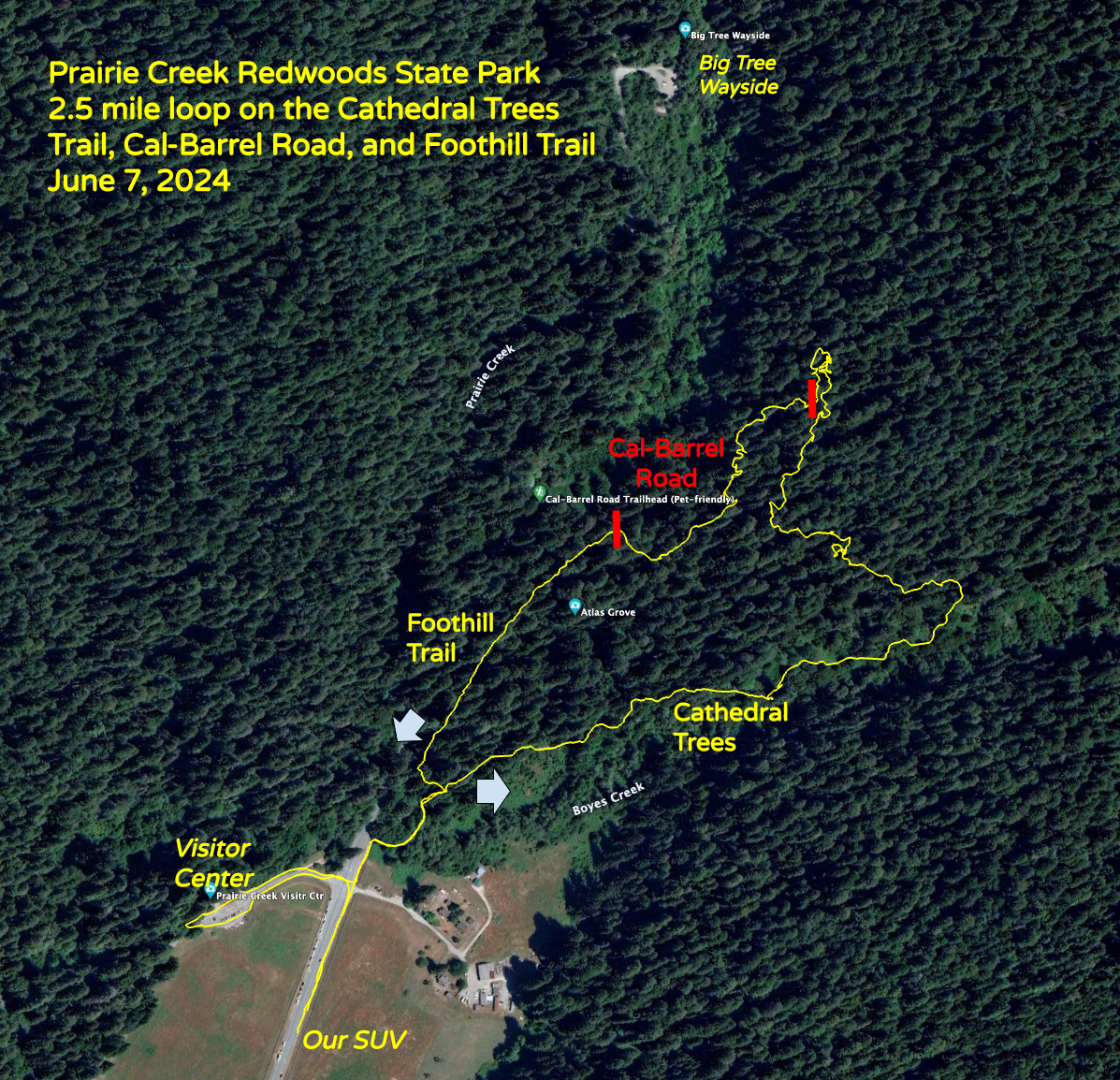
The next day we returned to Prairie Creek Redwoods, parking on the parkway near the visitor center to walk a 2.5-mile loop formed of part of the Cathedral Trees Trail, the Cal-Barrel Road, and the Foothill Trail.
We had walked a segment of the Cathedral Trees Trail two days earlier between the Big Tree Wayside and Cal-Barrel Road. This time we started out at its southern terminus and followed it northeast with Boyes Creek to the south.
We saw some more mossy trees.
At one point, a group of fellow walkers provided scale for a shot.
I had to crane my neck to see the tops of the trees.
Wendy had me pose by the roots of one of the fallen giants.
The trail was steep at times, with us ascending over 300 feet in the first mile. When Wendy was ready to head back, instead of retracing our steps, I diverted us onto the Cal-Barrel Road, which I had driven in a rental car back in 2006.
The narrow logging road looked much like an extra-wide trail.
This part was on the Cal-Barrel logging road instead of a trail
The road was built for the California Barrel Company, which had a mill 35 miles to the south in Arcata, California from 1902 to 1956 and was that town’s main employer.
We never encountered any cars along the road.
I chose not to follow the road all the way to the parkway drive, as I didn’t want to walk along the parkway itself to return to our car. Instead, I diverted again, off onto the Foothill Trail, which parallels the parkway from the Visitor Center north to the Big Tree Wayside.
We almost immediately encountered the Rotary Memorial Grove.
That was dedicated in 1952 by the Rotary Clubs of California. Rotarian Harvey Lyon, of Oakland, had thought of a memorial grove since his son, Bruce, died in a B-24 over Germany in 1945; Bruce had loved the redwoods. The Rotarians raised over $10,000, which was matched by the State of California, to acquire the grove.
At the dedication, Dr. Holland Burr remarked, “It would be a singularly unresponsive soul which could remain unimpressed by the redwoods. They stimulate reverence, wonder, and awe – and are an ever-living inspiration. . . .These great trees are scarred by fire and storm, but they carry on. Let that be an example.”
That was a fitting close to our walks in the redwoods. We would soon return to Medford to fly home, but we had one more adventure in store at a rock museum. See the next and final post in this series for that.
The highlight of our trip were the walks associated with a three-night stay at Elk Meadow Cabins, which are nestled on private land between the Prairie Creek Redwoods State Park and Redwood National Park. The state park began with just over 5,000 acres in 1923 and over time grew to 14,000 acres. The Civilian Conservation Corps built the present visitor center, trail system, campground, and picnic facilities.
In October 1968, the National Park Service created Redwood National Park in Del Norte and Humboldt counties, and in 1994 the service and California State Parks agreed to co-manage four parks: Del Norte Coast, Prairie Creek and Jedediah Smith Redwoods State Parks, and Redwood National Park. Together the four parks preserve over 105,000 acres of redwood forest.
We had enjoyed Stout Grove and driving Howland Hill Road through the Jedediah Smith Redwoods State Park to the north. Now we drove down coastal highway 101 to the entrance of the Newton B. Drury Scenic Parkway running through the heart of Prairie Creek Redwoods State Park, shown at the top of the map below.
Screenshot
Newton Drury saved the redwoods
Newton Drury was born in San Francisco in 1889. He and his brother had an advertising and public relations agency which was approached by the Save the Redwoods League in 1920 to manage their organization. An ardent conservationist, he was instrumental in raising $25 million to preserve 135,000 acres of redwoods across thirty state parks in California. He was the Land Acquisitions Officer of the State Park Commission, and later Director of the National Park Service.
We drove along the ten-mile parkway named in his honor through the old growth forest until we reached the Big Tree Wayside. There were plenty of people taking the short trail to the photo opportunity at the Big Tree. I preferred to avoid the crowd and instead shot it from a side angle.
The Big Tree
The Big Tree is not the biggest in the park, but it is over 1,500 years old, 304 feet high, and almost 22 feet in diameter. I then drew us away from the families down the Cathedral Trees Trail, and we did not have to walk far to lose almost everyone.
As the giant trees surrounded us, Wendy was struck by how we could no longer hear the people at The Big Tree and all sounds died away. She whispered to me, “Isn’t this great?”
I could tell it was an emotional experience for her. She later described it as feeling protected by giants, sheltering her and giving her the peace she has sought on our many travels.
Wendy with the giants
We continued along the hilly trail, watching our steps to avoid stumbling over the many tree roots. I had Wendy pose by the upended roots of a fallen giant.
Wendy took a shot of me with some of the redwoods.
And I returned the favor, with her providing much-needed scale for the spectacle.
I shot a video pan upward, and Wendy photographed me in the act.
Here is the pan I was shooting:
We couldn’t resist some more shots of the outlandish scale of the trees.
And I wrapped up the walk shooting upwards.
We returned to our vehicle and drove the short distance to the Prairie Creek Visitor Center, where we could use the restroom, and Wendy got a poster and some mugs to remember this favorite place.
Then we drove past our rented cabin to Orick, where we bought groceries for our stay; there are few restaurants in the region. Then it was back up 101 to Elk Meadow Cabins. I had reserved the Johnny Redwood cabin, which was quite nice.
We knew that one of the Roosevelt Elk herds in the parks lived nearby, and on the first evening I saw one meander by our back porch.
Later, on one of our drives along US 101, a herd of elk crossed near our cabins.
We would return on the following days for two more walks at Prairie Creek park, which will be described in the next post.