Spring Break 2015, Days 3 & 4: Another Drowning, but not at Beaver Lake

March 18-19, 2015

Day 3: A Drowning

The third day of our Spring Break 2015 vacation was rainy and bleak, so it was a good day for me to drown…again. Every time I’ve gone to an exhibit about the infamous sinking of the ocean liner RMS Titanic, I’ve been given a card identifying me with some male passenger or member of the crew, so that I could look for linked objects and information in the exhibit and find out, near the end, if that person survived. Given that only 1 out of 5 males aboard survived, it is no surprise that every man I’ve been assigned ended up dying in the disaster.

RMS Titanic (click photo for slideshow)

Most of my life I’ve been fascinated by the story of the Titanic going down on its maiden voyage, my interest first peaked by the 1953 movie version. It strays far from historical accuracy and concentrates its attention on Clifton Webb‘s and Barbara Stanwyck‘s troubled marriage and the story arc of Clifton’s character redeeming himself in the final hour. But that flawed film led me to Walter Lord’s great 1955 book, A Night To Remember. They say that the 1958 movie based on Lord’s book is the most historically accurate version. The best known movie version, James Cameron’s 1997 blockbuster, has impressive effects and attention to detail, but primary characters which are entirely fictional.

The ship became a worldwide sensation when Bob Ballard located the wreckage in 1985. It was thrilling when, back in the 1990s, we were able to bring Mr. Ballard to Bartlesville for an evening community presentation and a talk to science teachers as part of a science teacher workshop sponsored by Phillips 66. He was a wonderful speaker, and he has long been an outspoken critic of salvaging items from the wreck. So I always feel a bit queasy about Titanic exhibits of salvaged items, although they are interesting.

Branson has a large Titanic museum on music row, one of a few temporary and permanent collections around the country. In previous visits to this and other exhibits, I’ve drowned as a member of the crew and as a passenger. This time, Wendy was with me and got the card for a second class passenger who survived the sinking, albeit only for a year, while I was a poor third class immigrant. The moment I saw our cards, I knew the cold waters of the Atlantic would claim me while she would likely be spared; only 16% of the male third class passengers survived, versus 86% of female second class passengers.

Southwest to Sugar Ridge

We enjoyed the exhibit and then journeyed westward along the full length of Table Rock Lake, although by car rather than ocean liner, to reach an upstream entry in the chain of lakes along the former White River: Beaver Lake in northwest Arkansas. I spent thirty years of my life vacationing at the west end of Table Rock Lake at my parents’ vacation home near Eagle Rock, so I am intimately familiar with the Eureka Springs area just northwest of the lake.

Last June, Wendy and I greatly enjoyed our stay at Sugar Ridge Resort on a bluff above the lake, so we returned there for the second half of this vacation. I’ve been tremendously overworked this school year by a greater number of demanding and overlapping projects than I’ve ever undertaken: school construction and reconfiguration with lots of work at BHS and science lab work at three different sites, extensive teacher appraisal system work, science textbook adoption, a $1.7 million dollar STEM grant at three different sites, and much more on top of my usual teaching load, which itself has been made harder by a new AP Physics 1 curriculum. Wendy has also had a rough year in her always-demanding work as a special education teacher. So we were looking forward to rest and relaxation at Sugar Ridge.

The view from our cabin at Sugar Ridge

We stopped for breakfast groceries at Hart’s in Eureka Springs, and found that the lake was shrouded from view by fog and mist when we arrived at our ridgetop cabin. Dinner was at the always-good Local Flavor in Eureka Springs since Ermilio’s, as usual, had a very long wait.

Sugar Ridge Area Stops

Story Time

Story Time

We snuggled in at the cabin for a relaxing evening, with Wendy reading to me “The Life You Save May Be Your Own” by Flannery O’Connor, while I read to her “The Last Night of the World” by Ray Bradbury and “The Recollection” by Percy Bysshe Shelley.

As with our previous visit, a raccoon enjoyed the birdseed out on the deck, entertaining us when we weren’t entertaining each other with story time.

Day 4: Slow Day at Sugar Ridge

Relaxing at Sugar Ridge

Cloudy and colder weather gave Wendy and me a good excuse to relax at our cabin for much of the next day, watching and photographing birds of various species who were dining on the birdseed the raccoon had not finished off the night before.

The day gradually brightened, and we finally had an early dinner at Myrtie Mae’s and drove over to Beaver town to hike the short trail along the old railroad grade for a nice 0.75 mile out-and-back stroll.

Beaver Railroad Grade Trail

It was nice to walk along the shore and through the gap blasted through the rock bluff, with reflected views of the old suspension bridge and a nearby home. Castle Rogue’s Manor loomed up on the bluff; I’d love to visit that interesting venue some day.

The following and final day of our vacation would start with a nice hike on a trail new to us, the nearby Bench Rock Trail at Indian Creek.

Click here for a slideshow from this day

Day 5: Bench Rock Nature Trail >

Day 2: Foster’s Museum & Owen’s Forest

Posted in day hike, photos, travel | Leave a comment

Spring Break 2015, Day 2: Foster’s Museum & Owen’s Forest

March 17, 2015

Wendy and I spent the second day of our Spring Break getaway in Branson. We visited the odd Ralph Foster Museum at the College of the Ozarks and hiked some of the trails at Lyle Owen’s Lakeside Forest above Lake Taneycomo just off the strip.
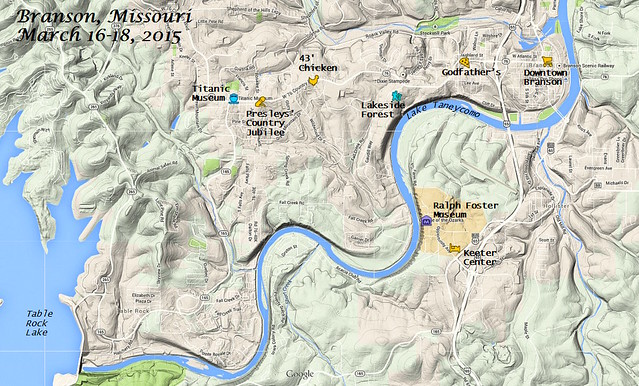
Branson Sites (click map for slideshow)

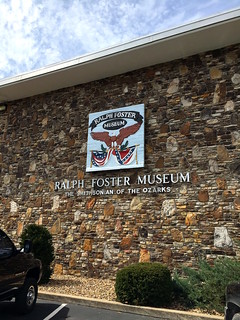
Ralph Foster Museum
Ralph Foster Museum

A bird collection in a men’s dormitory basement at the School of the Ozarks grew over time to include a multitude of items which eventually took over the entire dorm, turning it into the self-proclaimed “Smithsonian of the Ozarks.” The possibly unintended humor of that description applies to what became the Ralph Foster Museum when that radio mogul of southwest Missouri, founder of KWTO (“Keep Watching The Ozarks”) and of 1950s television’s Ozark Jubilee, donated money and a considerable number of artifacts. Repeated expansions have created a building that is as disjointed as the collections, which range from museum-quality displays of guns (and animals shot by guns) to cringe-worthy amateurish displays of someone’s treasures which others might term junk. A glimpse of the diversity of the collection is provided by its online Artifact of the Month entries.

Admission was $6 each, and my heart sank upon discovering that the front half of the first floor was a poorly lit assemblage of “special collections” of antique dolls, clocks, and furniture. Thankfully it turned out the museum shows its worst stuff first, hiding better displays upstairs.

The museum’s most famous item is there on the first floor: the cut-down 1921 Oldsmobile Model 46 Roadster which was the truck used in the original Beverly Hillbillies television series. The show’s producer, Paul Henning, also created Green Acres and Petticoat Junction. If you know those shows, you can guess that he grew up nearby and drew upon his background for those rural comedies.

Beverly Hillbillies Truck

Henning bequeathed to the state over 1500 acres for a conservation area and gave to the School of the Ozarks the famous truck, which visitors to the museum can pay to sit in and have their picture taken, with Uncle Jed, Granny, Jethro, Ellie May, Mr. Drysdale, and Miss Hathaway as backup. Wendy and I declined to spend over $10 for the privilege. Instead we took, in the dim lighting, blurry but free photos of the truck and the creepy dolls lurking nearby. It turned out that Rose O’Neill, the inventor of the Kewpie doll, spent much of her life in the region.

Wendy liked the 1940s-era wood carvings by a Mr. Gallagher and was intrigued by the coral jewelry on display, which was worn in the Civil War era. I admired a 1931 Rolls-Royce Phantom II Continental automobile.

Spring

The other half of the first floor was the art gallery, which had a few nice works and some execrable ones. My favorite was the oil painting Spring by Mary (Lee) Ilena O’Neill, the younger sister of Rose O’Neill of Kewpie doll fame. The painting is deteriorating badly but was intriguing with its personification of the season in a tree forming into a human figure.

Wendy attacks

Our favorite part of the museum was on the upper floor, with an 8,000-pound mountain diorama with goats, coyotes, and other North American animals along with many other stuffed animals, including lions and a number of bears. There were some interesting poses, and Wendy participated in one exhibit. I used my camera to menace some museum guests with one of the polar bears, while Wendy used hers to make a lion peer over a wall at us.

A lion peers at us

Back to Branson

What are YOU looking at?

After we toured the museum, we drove north into Branson for lunch at Godfather’s Pizza. The previous night Wendy had been delighted by the 43′ tall chicken at the Great American Steak & Chicken House, so we drove by for daytime snapshots of it and its disturbing gaze. Then we drove just a block off the strip at the Lakeside Forest Wilderness Area for a day hike.

The Lakeside Forest

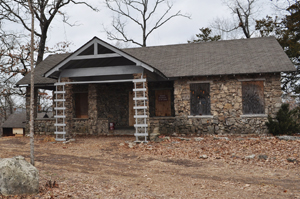
The area that is now the Lakeside Forest Wilderness Area was first homesteaded in the mid 1800s by Bill Berry, who settled his claim to the land by trading for it a mule and a barrel of molasses. Wilbur Winchester built a three-room stone vacation home on the land in 1911. In the early 1930s, 90 acres were sold by Winchester, at $14/acre, to Dr. Lyle Owen, who taught economics at the University of Tulsa. During the McCarthy period some people referred to him as “Red Lyle”, with a graduate student explaining, “His ‘hue’ consisted of, (1) trying to get the students to look at economic systems as they really were, not as the propaganda said they were, and (2) giving assistance to the poor.” The student also related that:

Owen was actually more renowned for his grading system in his introductory course of American Government. All questions were true-false, but he penalty graded, meaning that, if you got a question correct, you received one point, but, if you got one wrong, you lost two points. This discouraged guessing and getting correct answers by sheer 50-50 chance. This could result in a student getting a negative grade. But Owen told his students the first day of class that, in the event they had a negative score, he would magnanimously raise their grade to ‘a respectable zero.’

Lyle Owen was born in Kiowa County, Oklahoma Territory in 1906, and the family later lived in Oklahoma City, moving to Erie, Kansas when he was 12 and on to Branson in 1923, where he finished his final year of high school, living with his parents across Lake Taneycomo along Coon Creek. In 1987 he related this tale about his move to the hilltop site in Branson:

I still have an amusing memory of my early moving, from my folks’ Coon Creek home to my new-bought house on the opposite side of Branson, about a four mile move. I bought my place 46 years ago, in 1934, when still in my twenties, and our family didn’t have a car then, to take over the things I wanted to borrow from them for use at the new place. I needed first a bunch of tools, and also our old iron-wheeled wheelbarrow. So I pushed that contraption, loaded full of tools, the whole rocky, rattling distance. Those four miles were all unpaved then, and my load made quite a racket. I pushed down the Coon Creek trail, around the Seven Falls way and along the present Lakeshore Drive, across the old Main Street bridge leading into town, up that long Main Street hill, and on out what is now West 76 Highway to Fall Creek Road, where I turned into my place. I am amused when I think about how impossible that wheelbarrowing would be now, what with West 76 traffic competition and all. But I did it way back in those simple, unpaved, days. My house is about 300 feet higher than the river, so there was a good deal of uphill pushing. And the barrow had the iron wheel of those days, not a modern pneumatic rubber tire.
Owen House

Owen House

His mother moved into the house in 1936 and lived there for over 30 years. His father was a wanderer who finally settled in his final years at the house in Branson with his wife until he died in 1962 at age 95. Dr. Owen retired there himself in 1973, and his mother died in 1981 at age 104. In 1998 Lyle Owen sold all but the seven acres around his home to the city for use as a public natural wilderness area and passed away a few years later. In 2010 the city acquired the homestead itself, and there are now six different trails on the property. Dr. Owen remarked in 1999:

One wonders, as the years go by, and he gets older and older, what he ever did that was wise. In thinking back, one of the things I think I did that was right, was buying the land and preserving it for the present and the future. And so I hope that people enjoy it for many years, as I have during my long ownership of that land.

Our Hike

Our hike at Lakeside Forest

The trailhead and parking lot, with a good restroom, is located right off Highway 76 on Fall Creek Road. Wendy and I hiked all of the Bluff Trail, following its route off the park map all of the way to the east property line. Our return was along parts of the Stone Wall and Owen Drive trails for a total hike of about three miles. The trails begin on level ground at the top of the property, and we walked about one-half mile south to the stone house. There was a sweeping view of a curve of Lake Taneycomo 250 feet below us, and on the opposite shore were the green lower fields of the College of the Ozarks. We could see a guy using a tractor out on the fields. With my camera’s zoom lens I could get a good view of the Keeter Center where we were staying.

Great view of Lake Taneycomo
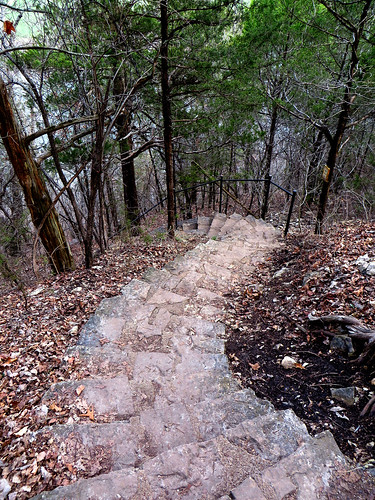
Impressive stairs

The trail intersected the first flight of a total of 338 stone stairs which Dr. Owen and six paid laborers, including his brothers Max and Dale, installed down the bluff in 1937 and 1938 to reach a ledge above the lake which has several caves. Their work was well designed and quite durable, including nice curves. At the bottom, one step is inscribed with a start date of August 5, 1937 and a finish date of August 10, 1938 and the names Dave Layton, Layne Russell, Max Owen, Lyle Owen, Dale Owen, C.W. Sare, and Wilbur Lee. Another inscription reads:

Let those who tread here not forget, that these steps were not made of stone and mortar alone, but of sweat, blood, and agony.

We were certainly glad to benefit from their hard work! I later discovered the stairs were the aftermath of a project that built 360 feet of mortared wall flower beds and 200 feet of retaining walls around the home. The large pile of unused rock at the end of the wall-building program set off the stairs project.

One stairway landing had a large cleft in the rock that could serve as a tight shelter. At the bottom, a rock ledge led northeast along the bluff line to the Grotto, a large rock cutout which has a waterfall during rainstorms. A lady was situated there, awaiting the rest of her party who had made their way across and up to the next trail segment. I was glad she was there to provide scale for the scene.
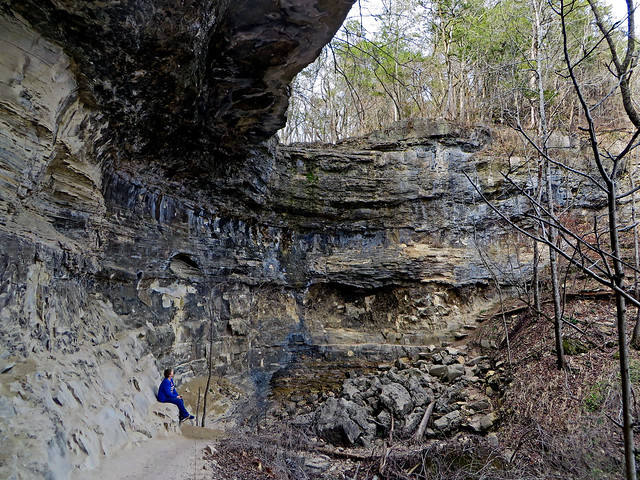
The Grotto

Civil War Cave entrance

Wendy and I clambered across to climb the other side and followed the trail onward to the Old Soldier’s Cave, which served as a hideout during the Civil War for local gunsmith Calvin Gaylor. In 1862, at age 38, he sought refuge in the cave to avoid “helping the other side” during the war, when there was a real threat of being press-ganged into service. His wife would sneak out to the cave after dark to bring him food, up above what was then White River. There is a lot of my father’s family history in this area of the Ozarks, with ancestors serving on both sides of the Civil War. Calvin’s story reminded me of one of my great-great-grandfathers, who was shot and killed by Union guards while crossing White River many miles upstream from Branson at Golden Ford near Mano. My father still has the vest his great-grandfather was wearing, complete with bullet hole.

The cave which sheltered Calvin Gaylor has a single room about 20 feet across and up to seven feet in height, with a narrow entrance that was difficult to spot back in the war. As a boy, Dr. Owen was led to the cave by Calvin Gaylor’s great grandson, which prompted him to purchase another 40 acres in 1940 adjacent to his original purchase so as to include the cave.

Wendy above the second cave

Farther along the bluff trail I posed along a large rock shelf, and Wendy posed on an outcropping directly above the entrance to a second cave. It was a cleft which wriggled back into the rock some ways before finally shrinking to an end. We could easily walk through most of it.

The next landmark was a large rock outcropping from the bluff with large holes through it. I made a half-sphere photosynth out of it to allow one to view it in 3D, and Wendy enjoyed scrounging for interesting rocks. She managed to find one with crystals, something she always treasures.

Rock outcropping

Eventually the trail ended at a neglected set of stone stairs leading upward. We climbed them, but the trail only led a short way over to the final stream on the property and then faded away. Descending the steep stairs, whose railings were long gone, we ventured over to the bottom of the final stream, where I shot a full-sphere photosynth.

We then made our way down to the shore of Lake Taneycomo, where a couple of fishermen were out in a boat. The bluff was on our right for the trek back to climb the hundreds of stairs back up to Dr. Owen’s house.

The view from the Owen home

After ascending to the top, we admired the panoramic view of the lake and the fields. Up top were the remains of the gardens where Stella Owen, Lyle’s mother, grew wildflowers and peaches. In the 1940s Dr. Owen’s three children would spend weekends and vacations at the homestead. At the end of each day, they would head down to Lake Taneycomo to clean up, and Lyle Owen would send them down the stairs with coffee cans. Each trip up, they’d bring a can of soil from the banks of Taneycomo for the flower beds and vegetable gardens. After World War II he was able to get the house hooked up to electric power, although it would never have air conditioning, just electric ceiling fans and a wood-burning stove.

One of Owen’s many walls

Wendy and I plan to return some day to the Lakeside Forest to walk the remaining trails, but the daylight was waning, and the forecast called for rain throughout the next day. So we followed the wall along the northwest side of the homestead northeast until it petered out, and then we followed the old driveway back to the trailhead. Driveway is somewhat a misnomer, given that Lyle Owen sold the only car he ever owned when he graduated from college. He must have been a very interesting fellow; he certainly left a lasting legacy.

Dinner was at a burger joint along the strip, and the next day’s weather would keep us indoors, visiting the Titanic Museum in Branson and then driving westward the full length of Table Rock Lake to reach our rented cabin on Sugar Ridge above Beaver Lake.

UPDATE: In November 2018 I found a copy at Gardner’s Used Books in Tulsa of Dr. Lyle Owen’s 1978 book Memories of an Ozark Mother about his mother Stella’s first 100 years.

Click here for a slideshow from this day

Day 3: Beaver Lake >

< Day 1: Jubilee in Branson

Posted in day hike, photos, travel | 1 Comment

Spring Break 2015, Day 1: Jubilee in Branson

March 16, 2015

Wendy and I began our Spring Break 2015 separately, with her enjoying some antique and thrift store shopping in Claremore while I ventured to Wichita, Kansas to visit the Wichita Art Museum. Wendy discovered a disturbing doll and other troubling items, while I enjoyed seeing a father hoisting his young son overhead for a close-up of Chihuly’s Confetti Chandelier.

Art appreciation in Wichita


But on Monday we reunited for a five-day getaway to Branson, Missouri and Beaver Lake in Arkansas.

Day 1 Trip Map (click map for slideshow)

Springfield

Our cupcakes from The Cup

We had a lunch stop at Houlihan’s in Springfield, Missouri, where I enjoyed a wonderfully prepared French Dip. Then we headed downtown for decadently delicious cupcakes from The Cup. I say decadent since each of their cupcakes packs in 500 Calories, which is rather ridiculous.

Also ridiculous, but amusing, was the odd parking meter sculpture on the nearby street corner. It turned out to be a “giving meter” for which the proceeds go to charity; the city has installed a number of these in an attempt to reduce panhandling.

We were glad to see that the 1910 Woodruff building is being renovated, and I took some video of the large crane elevator along one side of it. The building will become the Sky Eleven high rise, with space on the bottom floor for shops and restaurants, while the rest will be residential units, recently refocused on student housing. The building had a handsome exterior back in the early 1900s, but a late 1950s expansion apparently gave it an unfortunate aqua veneer which the new developers will evidently embrace.

Branson

Our vacation would begin with three days in Branson, which boomed in my lifetime to become a significant entertainment destination with a slew of live music shows. My parents had a vacation home on Table Rock Lake for thirty years, but it was on the opposite end of the lake at Eagle Rock. We mainly visited Branson for Silver Dollar City, and I don’t recall seeing any music shows there until my father and I saw Shoji Tabuchi’s act when I was an adult, although I did hear the Foggy River Boys back in the early 1970s, back before they moved to a Branson theater. I did not hear that group at their Kimberling City theater, but at coon hunts held in Thomas Hollow west of Exeter at Bazil and Glee Duncan’s homestead, where my grandparents would always be camped out in their tiny trailer.

Branson thrift store treasures

When Wendy and I decided to visit Branson, which she had never seen before, I had her pick out a music show for us. She picked one of the oldest acts in town, and after lunch Wendy and I drove south to the Branson Tourism Center to pick up the tickets I had reserved. Then we drove downtown and shopped in the old 5 and 10 and several thrift stores, where we found more creepy dolls, a Foxy Lady, salt and pepper skulls, and disco outfits. Thankfully we passed on all of these treasures.
Dining and Lodging at the College of the Ozarks

Then we drove to the College of the Ozarks, a storied school known these days as “Hard Work U” because its students work instead of paying tuition. The concept arose in 1901 when a pastor encountered a boy on a squirrel hunt whose parents couldn’t afford to send him to the closest high school 40 miles away in Springfield. The School of the Ozarks opened in 1907 as a tuition-free high school whose students worked to earn their keep, with support including a donation from some of the founders of Nabisco. It soon moved to Point Lookout south of Branson, and in the 1950s it expanded and became a junior college, then became a four-year college in 1965, and became the College of the Ozarks in 1990.

My father introduced me to the school’s restaurant years ago, with dishes featuring food grown on the campus and prepared and served by students. All of the college’s students must work 15 hours a week at an on-campus work station and two 40-hour work weeks during break. On this trip, Wendy and I would not only enjoy their labors in a nice dinner, but over a two-night stay on campus.

The central building of the campus back in the early 20th century was the Maine Hunting and Fishing Club building, which had been transported to the site by sportsmen from the 1904 St. Louis World’s Fair. It was renamed the Dobyns Building in honor of W. R. Dobyns, president of the trustees at the time. The building burned on February 1, 1930 but has been somewhat recreated in the Keeter Center, which has the Dobyns Dining Room as well as beautiful suites at the Mabee Lodge. We stayed in a 672 square foot Loft Suite, which was a spectacular room featuring turn-down service each night where students bring you fresh milk from the campus dairy, chocolate chip oatmeal cookies, and pillow chocolates. A student had called the week before so that our refrigerator could be pre-stocked with free water and soft drinks of our choice, and we were pleasantly surprised to also find a campus-created bag of potato chips, shortbread, and granola bar in our room.

Loft Suite at the Keeter Center’s Mabee Lodge

We had dinner at the Dobyns Dining Room, with me ordering the Keeter Cordon Bleu with campus ham, while Wendy enjoyed the Pork Pomodoro, proclaiming her pork medallions the best she’d ever tasted. We indulged in delicious campus ice cream for dessert and were spoiled the next morning with a hot breakfast brought to and set out in our room by a student. Every student was extremely polite and cheerful, making us feel special. It was a great experience through and through.

Presley’s Country Music Jubilee

Our evening entertainment was the classic Presleys’ Country Music Jubilee. Three years before I was born, the Presley family began a music show at The Underground Theater near Talking Rocks Cavern in Kimberling City, and they made history in 1967 when they built the first music theater on Highway 76, which is now renowned for its collection of music shows and other attractions.

Today, Presleys’ Country Jubilee stars multiple generations of Presley family members and features a variety of musical styles on a wide range of instruments.

Gary Presley provided his classic cornpone humor as “Herkimer” and was joined by his son as “Cecil” in fun skits to break up the rapid succession of musical numbers. It was like being at a live version of the old Hee Haw television show.

Beyond the Presley family, Wendy and I both enjoyed the singing and sincerity of Jay Wickizer and Bruce Haynes, although she didn’t care for Chuck Crain’s high tenor. Here is a sample of these singers as a gospel quartet with Crain singing tenor, lead by Tim Gregg, baritone by Haynes, and bass by Wickizer:

It was a fun-filled first day, and the next day would find us touring the odd Ralph Foster Museum at the College of the Ozarks and hiking just off the Branson strip along the bluff of Lake Taneycomo.

Click here for a slideshow from this day

Day 2: Foster’s Museum and Owen’s Forest >

Posted in photos, travel, video | Leave a comment

The Beautifully Sad Lana Del Rey

March 15, 2015
Pop Leibel tells a story

Pop Leibel tells a sad story

Oh yes, I remember. Carlotta, beautiful Carlotta, sad. It [the McKittrick Hotel] was hers. It was built for her many years ago…by…the name I do not remember, a rich man, powerful man.

It is not an unusual story. She came from somewhere small to the south of the city. Some say from a mission settlement. Young, yes, very young. And she was found dancing and singing in cabaret by that man. And he took her and built for her the great house in the Western Addition. And, uh, there was, there was a child, yes, that’s it, a child, a child.

I cannot tell you exactly how much time passed or how much happiness there was, but then he threw her away. He had no other children. His wife had no children. So, he kept the child and threw her away. You know, a man could do that in those days. They had the power and the freedom.

And she became the sad Carlotta, alone in the great house, walking the streets alone, her clothes becoming old and patched and dirty. And the mad Carlotta, stopping people in the streets to ask, ‘Where is my child?’ ‘Have you seen my child?’

She died…by her own hand. There are many such stories.

So relates the character of Pop Leibel, portrayed by Konstantin Shayne, in Alfred Hitchock’s magnificent film Vertigo.

sad lana

Lana Del Rey

I was reminded of his tale when listening to Lana Del Rey’s most recent album, Ultraviolence. As Caryn Ganz said in Rolling Stone, “Ultraviolence is a melancholy crawl through doomed romance, incorrigible addictions, blown American dreams.”

I love it.

Back in 2012 I highlighted Lana Del Rey’s Born To Die from the album of the same name, and later the track American from her Paradise album. I have lots of bouncy and happy music in my collection; heck, I’ve bopped along a glacier to Hanson’s Mmmbop. But I also embrace the dark and sad pathos evoked by Del Rey in her songs.

Pop Leibel’s story of the sad Carlotta echoes in Lana’s track Old Money:

Blue hydrangea, cold cash, divine,
Cashmere, cologne, and white sunshine.
Red racing cars, Sunset and Vine,
The kids were young and pretty.

Where have you been? Where did you go?
Those summer nights seem long ago,
And so is the girl you used to call,
The Queen of New York City.

But if you send for me you know I’ll come,
And if you call for me you know I’ll run.
I’ll run to you, I’ll run to you, I’ll run, run, run.
I’ll come to you, I’ll come to you, I’ll come, come, come.

Ohh-oh oh, ahh-ahahaah ah.

The power of youth is on my mind,
Sunsets, small town, I’m out of time.
Will you still love me when I shine,
From words but not from beauty?

My father’s love was always strong,
My mother’s glamour lives on and on,
Yet still inside I felt alone,
For reasons unknown to me.

But if you send for me you know I’ll come,
And if you call for me you know I’ll run.
I’ll run to you, I’ll run to you, I’ll run, run, run.
I’ll come to you, I’ll come to you, I’ll come, come, come.

Ohh-oh ohh-ohh-oh, ahh-ahahahah ah.

And if you call I’ll run, run, run
If you change your mind, I’ll come, come, come
Ohh-oh ohh-ohh-oh, ahh-ahahahah ah

Blue hydrangea, cold cash, divine,
Cashmere, cologne, and white sunshine.
Red racing cars, Sunset and Vine,
And we were young and pretty.

For Carlotta, the answer to the question, “Will you still love me when I shine from words but not from beauty?“, was “No.” We know instinctively that the answer is the same for the girl portrayed in this song, despite her desperate hope and knowledge that she would run to him if he would only send for her.

Dan Heath worked with Del Rey on many of my favorite songs of hers

Dan Heath

I shouldn’t be surprised that the track is produced by Dan Heath, who also worked with Del Rey on other favorites of mine, including American, National Anthem, and Summertime Sadness. The track opens with only piano chords and Del Rey’s voice, then brings in beautiful strings. The chorus is nicely emphasized by multitracking Del Rey.

Part of Old Money is taken from Nino Rota’s theme for Franco Zeffirelli’s 1968 film version of Romeo and Juliet. The happier take on this melody was A Time for Love, as sung by Johnny MathisAndy Williams, and other crooners. Contrast that positive, somewhat sappy, take to the melancholy desperation of Del Rey:

Listening to Lana is to look into a darkling mirror

Listening to Lana is to gaze into a darkling mirror

Listening to Lana can be like gazing into a darkling mirror. Sometimes her melancholy suits a song, as in her take on Blue Velvet, a song which will now be forever haunted by David Lynch’s movie masterpiece.

Del Rey understands parody, illustrated by her commercial for H&M, which evokes the ambiance and displays characteristic visual and audio motifs from the film-maker’s oeuvre.

But to use her on a happy song can slip into into ineffective parody, as in her take on Once Upon A Dream in Disney’s rather good Maleficent, a dark retelling of Sleeping Beauty which the studio presented a half-century later. I liked the film, but did not care for her version of Once Upon A Dream. She needed the freedom to only take themes from the song and modify the lyrics to truly make it her own, as she did in turning A Time for Love into Old Money.


The Mad Lana

There are many fine tracks on Ultraviolence, with most of the tracks produced by Black Keys frontman Dan Auerbach. I like several of the tunes they did together. But another standout for me, that Auerbach did not produce, is Money, Power, Glory. Greg Kurstin produced and co-wrote the song with Del Rey, and in it she seethes with venom and naked, nasty ambition:

You say that you wanna go
To a land that’s far away
How are we supposed to get there
With the way that we’re living today?

You talk lots about God
Freedom comes from the call
But that’s not what this bitch wants
Not what I want at all

I want money, power, and glory
I want money and all your power, all your glory
Hallelujah, I wanna take you for all that you got
Hallelujah, I’m gonna take them for all that they got

The sun also rises,
On those who fail to call
My life, it comprises
Of losses and wins and fails and falls

I can do it if you really, really like that
I know what you really want, b-b-b-b-baby
I can do it if you think you like that
You should run, boy, run

I want money, power, and glory
I want money and all your power, all your glory
Hallelujah, I wanna take you for all that you got
Hallelujah, I’m gonna take them for all that they got

Dope and diamonds, dope and diamonds, diamonds.
Dope and diamonds, dope and diamonds, that’s all that I want.
Dope and diamonds, dope and diamonds, diamonds.

I want money, power, and glory
I want money and all your power, all your glory
Hallelujah, I wanna take you for all that you got
Hallelujah, I’m gonna take them for all that they got

This song makes me think of the many sleazy televangelists and their prosperity theology. But Del Rey is having fun here, engaging in some biting satire, sarcasm, and irony for the critics who disparage her and her music and for the worryworts who anguish over the misogyny and self-destruction in her songs. She said of this song:

I was in more of a sardonic mood. Like, if all that I was actually going to be allowed to have by the media was money, loads of money, then f@#$ it … What I actually wanted was something quiet and simple: a writer’s community and respect.

She has my respect. I continue to gaze into her dark mirror, seeking the sad Carlotta, the mad Carlotta, reincarnated when Lizzie Grant became Lana Del Rey.

Posted in movie, music, video | Leave a comment

Tech Transitions Part 4: Heading into the Cloud

March 4, 2015

This is the fourth and final entry in a series of posts about my progression through technology transitions.This one tackles the transition from local to cloud storage and applications. Earlier posts dealt with the transition from fixed to mobile computing, the transition from scheduled broadcast to on-demand media and the transition from analog to digital.

I find myself relying more and more upon computer storage and services hosted on remote server farms in “the cloud“. While I still have massive amounts of data stored and accessed locally, I use the cloud to synchronize (and thus effectively backup) essential data for work and I find myself sharing data through cloud services such as Dropbox, Google Drive, and Microsoft OneDrive. I’m also using more cloud applications, ranging from the simplistic but sometimes adequate Google Drive spreadsheets and word processor to the online versions of Word, Excel, and Powerpoint through my $99/year Microsoft Office 365 Home subscription.

Storage Space

Too much stuff!

Too much stuff!

Our consumer society means that most of us keep accumulating items, veering off into collecting and hoarding on occasion. I see many folks parking their expensive cars out on the driveway since their garage is filled with junk they seldom use. I’ve managed to avoid that trap and keep my garage clear for vehicles by throwing worn things out and donating gently used items to Goodwill. But the cabinets and closets and shelves of Meador Manor are stuffed with seldom used items, and the edges of the garage are filling up too, so this summer I plan to do a massive purge.

The problem of too much little-used stuff also plagues my digital life. My desktop system in my home office now has a one-terabyte primary solid state drive along with two older one-terabyte spinning hard drives which I now use for backups. Over in the living room there is a 1.25 TB network storage drive attached to my 4th generation Apple Airport Extreme router, along with a 0.5 TB external drive attached to my old Tivo HD digital video recorder. Whenever I have a big chunk of data files which I really don’t think I’ll ever need, such as television series which I purchased on iTunes and don’t plan to re-watch, I shove that over onto the network drive. I know that someday that big spinning drive will crash, but I probably won’t miss it when it goes. I originally bought that network drive to access files via my 3rd generation MacBook Air, but I seldom use that functionality.

Here is a breakdown of the data I’m storing locally on my primary computer drive and online, ignoring the various backups and omitting software and overhead:

File type Primary Local Drive Cloud
Work documents 100 GB 89 GB (Dropbox)
Photographs 150 GB 43 GB (Flickr)
Audio files 160 GB
Video files 180 GB
I love the Dropbox cloud storage service

I love the Dropbox cloud storage service

I only infrequently backup my primary drive to one of its spinning cousins in the desktop computer, and backup about twice a year to a portable drive which I store offsite. That isn’t the frequency of backup which professionals recommend, but was enough for me back when I was running two local hard drives in a RAID 1 mirrored setup. I eventually abandoned RAID 1 because system support for it was problematic, but I switched to solid state, which should be quite reliable and immune to crashes.

But the cloud is what truly eases my concern about adequate backups. All of my crucial documents are stored in my Dropbox cloud account. I spend $99/year for that service, plus an additional $39/year for their “packrat service” that preserves every previous version of a file. Dropbox started out with less capacity, but now my account allows for a full terabyte of storage. I can have specific Dropbox directories synchronized to any desktop or laptop computer as needed for convenience, and I can access any file on Dropbox via the web browser or app on any desktop, laptop, tablet, or smart phone.

Limited upload bandwidth has kept me from syncing everything onto Dropbox

Limited upload bandwidth has kept me from syncing everything onto Dropbox

Thus you may wonder why I don’t simply shift everything I’m storing locally onto Dropbox. Bandwidth is one reason: my CableOne home internet connection’s upload bandwidth is only three megabits/second, plus there is a soft bandwidth cap of 300 GB of data transfer per month on my account. I use between 50 and 100 GB per month already, mostly downloads at 50 megabits/second for home video streaming of movies and podcasts, plus internet surfing. So it would be problematic to try and upload another 700 GB of data to my Dropbox unless I spread that out over several months.

I have considered shifting my audio files onto Dropbox, but those thousands of audio files are managed via the cumbersome iTunes, so shifting their storage location would cause some hiccups and trigger a long rebuild of the iTunes media library. Plus, the theoretical upload time would be about five days and overhead will make it still longer. However, the cloud helps me out in this area even without using Dropbox. Any MP3 files I purchase from Apple’s iTunes or from Amazon are always available in their respective cloud libraries, and I pay $25/year for iTunes Match so that all of my iTunes music, including the many songs I ripped years ago from my former huge collection of CDs, are available in the cloud. My infrequent local and offsite drive backups are sufficient to protect the old ripped MP3 files in my collection. I don’t worry much about my video files, either, because that collection seldom changes much. I’m relying more these days upon streaming video from Amazon for movies, and any movie I really want to hang onto I already own on Blu-Ray or DVD.

Finally, my photographs used to take up much more space, but I now use JPEGmini to optimize their compression, almost halving their size. All of my edited photographs are already on the online Flickr service up in the cloud, so I’m not worried about the infrequent local backups for them, either. Overall, the cloud has brought me a great deal of convenience and peace of mind on data storage and backup. While I’ve never lost any data over the decades, I have suffered through many disk crashes, and I’m very glad to now have solid state local storage plus cloud storage.

Computing in the Cloud

drive

Google Drive is a great free service

Google has long been associated with cloud services. I have used Google Docs, now re-branded and expanded as Google Drive, for many years. We’ve kept our science department curriculum maps there for convenient access and editing, and I’ve long maintained a spreadsheet about my day hikes using that service. I maintain a number of websites using Google Sites, since it is easy to update and customize without going overboard, and I’ve long enjoyed making custom Google Maps.

An Asus Chromebox has been a great machine for my mother

An Asus Chromebox has been a great machine for my mother

Google’s extensive cloud services have even made it possible for it to market Chromebooks and the lesser-known Chromeboxes. These units are really not much more than a web browser, but with cloud services from Google, Microsoft, Dropbox, and others, that is good enough to do a lot of basic computing tasks. Their huge advantages are low costs and maintenance. A decent Chromebook laptop only costs a few hundred bucks, and I bought an Asus Chromebox for my mother for only about $175. I hooked it up to her existing monitor, keyboard, and mouse, and she now happily does her web surfing, email, word processing, and spreadsheets on that simple unit. Her Google account includes 100 GB or more of storage on Google Drive, compensating for the extremely limited local storage on the Chromebox, which is used for buffering and offline access.

What is particularly nice about her using a Chromebox is that she is now virtually invulnerable to viruses and malware. Her last desktop machine, a refurbished Dell unit, was heavily infected by malware, which prompted me to consider the Chromebox as an alternative platform for her computing needs. Even if she somehow managed to get malware onto her Chromebox, which doesn’t seem likely, it is simple to wipe the system clean and start over, because all of her settings and files are always up in the cloud. That means I can access her files as needed, from Bartlesville or anywhere else, by simply logging into the appropriate service with her credentials. Since she is effectively using a web browser to do almost everything, I can see in my browser pretty much what she sees via her Chromebox, making it easy to troubleshoot and help her out with any issues. All of this is so much easier than trying to use Windows Remote Assistance to take over her computer remotely or paying for an expensive service like GoToMyPC.

Microsoft OneDrive is now quite compelling

Microsoft OneDrive is now quite compelling

Mom uses the free Microsoft OneDrive service, rather than Google Drive, for her productivity software needs. She was already using the traditional desktop versions of Word and Excel, and OneDrive gives her access to online versions of those applications, which do everything she needs, and includes a free 15 GB of storage. I’ve been paying $99/year for Dropbox for both her files and the ones generated by my father on his Windows 7 desktop machine, but they only have 4 GB of files on there. So when their Dropbox plan expires, I will just shift everything onto their free OneDrive and/or Google Drive accounts.

I’m actively using both my free school cloud-only version of Microsoft Office 365 along with home version, with its downloadable local Office 2013 applications. The service is well integrated with Windows and makes sharing PowerPoints and other documents a breeze. If I only used Word for word processing, I’d be tempted to just do everything in OneDrive and consider dropping Dropbox, but I still use WordPerfect for most of my student handouts (I greatly prefer its interface and model of word processing to that of Word), and I need to experiment to see if OneDrive would work easily with WordPerfect. Plus I like the Dropbox apps on my iPad and iPhone and the extensive integration of Dropbox with a variety of iOS apps, and I haven’t experimented to see how well OneDrive works on those platforms. Finally, Microsoft has re-branded and re-jiggered its cloud services so many times (Windows Live Folders became Windows Live Skydrive became Skydrive became OneDrive) that I want to be sure they’ve settled down into a steady and reliable mode before shifting my allegiance.

The Future

Chromebooks and Chromeboxes make more sense for schools than iPads

With our limited resources, Chromebooks and Chromeboxes make more sense for our local schools than do iPads

A Chromebox or Chromebook can do most things a student needs to do at school, so I am very glad our district is finally piloting some Chromebooks next school year. I hope we can shift to using Chromebooks and Chromeboxes in most classrooms and non-dedicated laboratories in the coming years. They would be far less expensive in capital costs and maintenance burden, although I expect we’ll still need traditional Windows machines for the business computing labs and science labs which use probeware. The biggest challenge may be training teachers to use cloud services instead of traditional desktop applications, but I expect students won’t have much trouble with that. If our district is ever going to reach the 1:1 student:computer ratio to revolutionize instruction, Chromebooks seem the best way to get there. We simply can’t afford that many iPads, and from what I’ve seen, managing iPads in the school setting can be difficult, time-consuming, and frustrating.

I'll probably eventually replace my MacBook Air with a cheap Chromebook

I’ll probably eventually replace my MacBook Air with a cheap Chromebook

As for my own personal use, I love the iPad for use around the house, but I don’t find it as useful or compelling for meetings. I no longer use my MacBook Air much, and as it ages into obsolescence I am likely to replace it with a cheap Chromebook. That would be far less expensive and the maintenance-free aspect is very compelling. I can’t imagine not having a desktop machine for my work at school and at home, but my increasing reliance on cloud services means it will be that much easier to use a Chromebook for meetings and presentations.

< Tech Transitions, Part 3: Fixed to Mobile Computing

Posted in technology | Leave a comment