January 17, 2015
My experience is that my habits lag, sometimes considerably, behind the relentless improvements in technology in which I am immersed. As one of the the long-time experts in computer technology in my school district, I provide a great deal of support for teachers transitioning to new ways of doing business. Yet it is not surprising that younger generations who grow up with a new technology embrace it more quickly than those of us who already have built our lives around older models of productivity and entertainment. I am starting a series of posts to outline my progression through technology transitions, comparing that to general trends. This is the first of a projected four posts: analog to digital, broadcast to on-demand media, fixed to mobile computing, and local storage to cloud. Here I’ll look at my analog to digital transitions in video, audio, reading, and recordkeeping.
Video: VHS to DVD to Blu-Ray (and later the cloud)

Physical media for home video
I witnessed the videotape format war in analog home video back in the late 1970s and early 1980s. Sony’s Betamax eventually lost the battle with the inferior but more popular VHS videotape format: being better and first is no guarantee of success. I backed the winning side in that war, but only because by the time I could afford a player, Betamax was clearly the loser. (Almost 30 years later, Sony would win the high-definition optical disc format war between Blu-ray and HD-DVD; I wasn’t so lucky in that conflict, investing first in a HD-DVD player and several discs, but then having to switch to Blu-ray.)
In the early 1980s, I was in high school and started college, and home video players were still too expensive for me to purchase. Instead, I would go to a video store and rent both the player and the movie. Since I had no credit yet, I’d have to put down a deposit of several hundred dollars for the player, but it seemed magical to be able to watch any of dozens of movies after growing up with only broadcast television and eventually cable TV.

I still use Kereluk’s videotapes
That history of renting the technology, plus the low quality of VHS recordings, meant that I seldom purchased analog videotapes. But, after I could afford a home player/recorder, I did record a few shows off broadcast and cable television. I still have a number of those tapes, and I still play an analog videotape most weekday mornings! In 1993 I began doing aerobics in the morning with Cynthia Kereluk’s Everyday Workout show, and over the next four years I filled up 13 tapes with extended-play recordings of it. I’ve been doing those 130+ workouts for over 20 years now, cycling through the tapes, hitting PLAY to work along with a tape each morning for another installment. I’m surprised all of the tapes have lasted this long, and Wendy, my sweet girlfriend, painstakingly converted all of them into digital movies for me so that I could have them even after the tapes wear out.
Now, why in the world don’t I give up on those decades-old tapes? Newer isn’t always more convenient. Having those shows on optical disc would require that I remember which episode I’d just completed, since my Blu-ray player will only remember where I left off on a disc under certain conditions. Watching them via my Apple TV or some other connection to my networked storage would require thumbing through episode listings to find the next recording. I don’t want to hassle with that when, with the old analog tape, I can always start right where I left off by just re-starting the 10-episode tape; the only inconvenience is having to rewind the tape after 10 shows and switch to the next tape on the shelf.

Video format changes from 1998 to 2008
The above graph shows how the transition from VHS to DVD to Blu-ray went in the 2000s. The lower bar chart shows how video-on-demand, both downloaded and streaming, has skyrocketed in the 2010s, but it generates less revenue for the industry than physical media. Analog video is now completely dead as a revenue source, but physical media still provide the bulk of the U.S. home entertainment industry’s revenue in our country. I’ll analyze this issue in more detail in my next post in this series, the one on broadcast vs. on-demand technologies. On the home front, I still buy or rent some Blu-ray discs to access director commentaries and special features, but many of the movies Wendy and I watch are downloaded or streamed.

Home Video Revenue, 2006 to 2013
Audio: Vinyl and tape to MP3 (and later streaming)

Analog and digital audio media I once used
In junior high and high school I amassed a collection analog audio recordings, with dozens of 45 rpm singles and 33 1/3 LPs on vinyl. I even had a few awful 8-track tapes (shudder). Then digital compact discs came along. My transition from analog to digital music dates back to the late 1980s, about 20 years ahead of my transition from analog to digital home video. I remember a Christmas party at my house back in the mid-1990s when students commented on my “large” CD collection of about 40 discs. That would eventually grow almost ten times larger, filling up wall cabinets in my living room. In my cars, digital also replaced analog. I once had some big cases in my cars, filled with cassette tapes, and made and shared mix tapes with girlfriends. However, I never used a portable cassette player much.
All of that changed ten years ago when I bought my first iPod for $500. It was an amazing device, allowing me to quickly access any of a thousand songs, anywhere. One of the happiest moments of my life was a hike on a glacier on Mt. Rainier in Washington State, skipping along to Hanson’s bouncy and infectious MMMBop from 1997. That 2004 iPod was quickly succeeded by iPod Nanos in 2005 and 2007, and then a biennial series of iPhones beginning in 2008.
The iPod led me to eventually abandon CDs for the MP3 digital file format. Ripping my CDs and buying MP3 led to a collection of almost 14,000 MP3 files in my iTunes library by the end of 2014, having finished my complete transition to the format back in 2010 when I sold off over 350 CDs to fund the purchase of my first iPad tablet.
Below we see how the rest of the country also shifted from analog to digital music before 2010, with plummeting revenues as CDs gave way to lower-paying downloaded MP3s.

Music revenue sources, 1973-2009
Album sales also declined, with a tremendous rise in lower-revenue digital singles in the 2000s:

Albums give way to singles
I’ll close this section with a summary of music revenue over the past three decades, where we see the industry still heavily reliant on CD sales, even at this late stage, with digital downloads comprising the biggest portion of revenue. But, as I’ll show in more detail in a later post, digital downloads declined for the first time in 2014 as on-demand streaming continued to grow. Vinyl record sales have surged in recent years, thanks to hipsters, but they are the smallest fraction of total revenue.

Music revenue, 1973-2013
Reading: Magazines, Newspapers, and Books to Internet Tablet and e-Reader
I have always been an avid reader. Back in 2010 I also sold off about 1/5 of my roughly 1,000 books, but I still have two-dozen shelves of previously-read books in my home office, with two more shelves of books I’ve purchased but not managed to read. And that is just my remaining analog collection. I bought the first Amazon Kindle e-Reader back in 2008 and have purchased and enjoyed four more of the electronic-ink units since then, and am currently paying off my latest Kindle Voyage. I have bought over 250 electronic books for my Kindles since 2008.
My early Kindles generated more comment when I was out and about than any device I’ve ever owned. Tablets like the iPad have somewhat more market penetration than e-readers, but electronic ink is still easier on your eyes for long-term reading, and much more readable outdoors. Sales of electronic books are projected to keep rising, but print books will still be dominant for years to come.
The dominance of print books continues in our own school. As we prepare to finally adopt new science textbooks in Oklahoma after a disgraceful nine-year wait, I wish our district could transition to electronic textbooks, but we lack the funding to supply each student with a device. I certainly look forward to the day when backpacks and sling bags loaded down with heavy textbooks are a thing of the past, especially since I use textbooks only sparingly in my own teaching.

Book revenues by format

I’m reading far fewer books these days
Since 2008 I’ve read over 250 Kindle books and uncounted additional print ones, and from 2009 to 2012 I listened to dozens of audiobooks on my day hikes. But in the past three years, my personal book reading has fallen off sharply while my audiobook listening has stopped completely. Part of that is my increasing use of a tablet to read online articles along with my decision to subscribe (and later this year, probably unsubscribe) to the print edition of The New Yorker magazine. A heavy workload has also taken away much of my evening leisure time this school year. But the biggest reason for the decline in my book reading in the past few years, and also why I’ve stopped listening to audiobooks, is the welcome change of dating Wendy. On the weekends, we spend a lot of time together at home and out on the road, so I don’t need audiobooks to keep me entertained when I travel, and naturally I’d rather spend my limited leisure time with Wendy than with my Kindle.
Most of my reading these days is news via my iPad, with a morning ritual of reading the Tulsa World along with top stories from USA Today and Bartlesville Radio. I should read the local Bartlesville Examiner-Enterprise in the same way, but haven’t made that transition from analog to digital yet, and I’m paying for it. As my reading habits have shifted to virtual and digital media, stacks of unread newspapers have repeatedly built up in my dining room. I’ve tried to switch to digital-only on the E-E, but was told I had to make a phone call to an out-of-town service to make a complete switchover. Having to do that via a voice call seems rather ironic and calls into question the sophistication of their digital provider, but I need to get that done before I drown in newsprint. I like the local news the paper affords me…but what do I call it when it is no longer on paper? Hmmmm…

I’m down to two print magazines
As for printed media other than books, I read two weekly print magazines: Time and The New Yorker. I’ve subscribed to Time for almost 30 years, while I’ve only taken The New Yorker for a few years. Too many editions of the latter pile up, unread, despite my love for their higher-level long-form articles. So I’ll probably let that subscription lapse, hoping to spend more time with books.
Recordkeeping: Checkbooks to Spreadsheets, Paper Bills to Online, and Analog vs. Digital Gradebooks

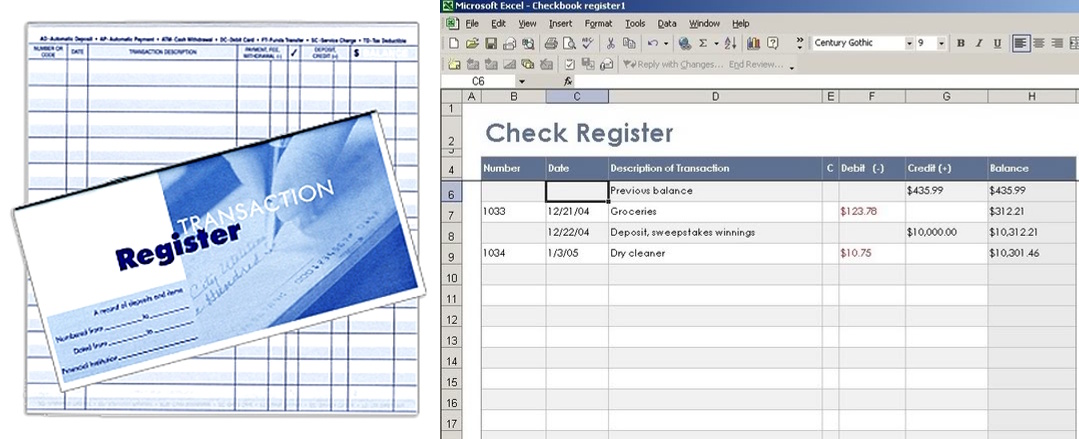
Analog vs. digital checkbook registers
I’ve kept an Excel spreadsheet of my monthly household finances for 30 years, tracking all of my bills, spending, and income. But, out of habit, I have always kept paper checking and savings account registers to help me manage my budget. I did start using my bank’s iPhone app last year, and that lets me review transactions and conduct transfers more quickly than through their website, and now I can even deposit checks by taking a photograph of them with the phone. For 2015 I’m going to try making a complete switch to digital bookkeeping by using an online spreadsheet to track my checking account. Up until now, the paper registers were more convenient since they were always handy, not requiring me to sit down at my desktop computer and fire up an Excel spreadsheet. But now I can use Google Drive or Excel on mobile devices. Since I have a personal Microsoft Office 365 subscription which lets me use Office on up to five computers, five tablets, and five phones, I’ve finally switched to using an Excel spreadsheet for my account registers.

The ecological argument for paperless billing
I’ve had direct deposit for years, and some time ago our district finally stopped issuing paper checks and paystubs in a cost-cutting move. My own cost-cutting move was to switch to electronic bank statements since the bank started charging for paper ones. That has worked out okay, so as part of my accounting modernization, I’ve also finally given up on paper utility bills. That’s a huge change for me, since I really didn’t care about the ecological cost of paper billing, and I haven’t seen any companies passing the savings from paperless billing directly to participating customers. My bank, you’ll notice, used a stick, instead of a carrot, to get me to switch. Up until last year, I had a copy of every utility bill I’d ever received, a pointless collection of paper that I finally culled, prompted in part by the derision of my more modern girlfriend. Now I’ve signed up for paperless billing for almost all of my utilities, which should be fine since I’ve had everything on automatic payment plans for decade. The only holdout is the city, since I couldn’t find online a way to switch to paperless billing with them, even though my payments to them are already automated.
Again, Wendy’s all-digital bookkeeping helped prompt my move, although I’ve refused to give up the paper credit card bill nor paying that bill via old-fashioned checks. Keeping my card fully paid off is a point of pride for me, and I need to see how well I do at keeping up with paperless utility billing before I consider any changes on the credit card, which is not set up for automatic payments. Looks like about 1/4 of bills and statements nationwide are now paperless:

Paperless billing trend nationwide
Why are bills and account registers some of the last things I’ve switched to digital formats? First, because an oversight or mistake can have costly consequences, I’ve been reluctant to alter tried-and-true habits. Second, because the digital formats were slightly less convenient. Paper bills have been physical reminders to keep up with my accounts, and the paper register was instantly accessible and editable, even though it required use of an old desktop calculator. Hopefully emailed reminders and the accessibility of spreadsheets on mobile devices, with instant retention of changes to the cloud and automated calculations, will make the switch worthwhile. I would hope the utilities would just email me a statement as an attachment, but more likely I’ll have to login to each service and click things to see the statements, which will a pain. The username/password system used across services is a dumb model which we desperately need to update with biometrics and other simplifying measures.

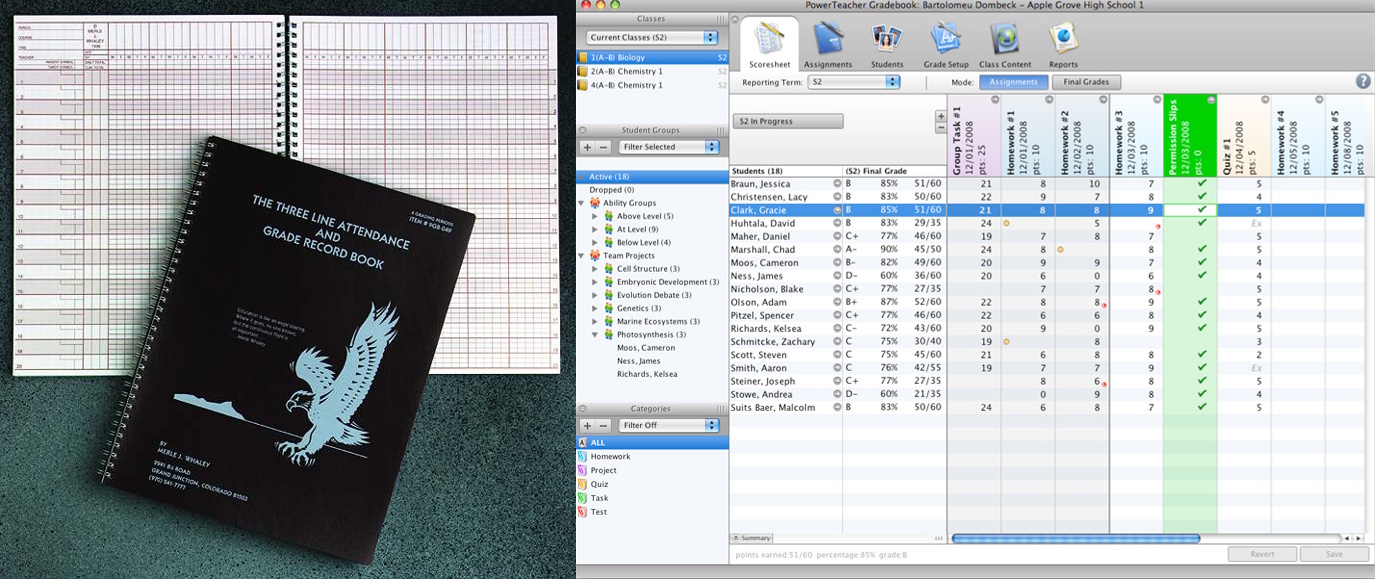
My analog vs. digital gradebooks
On the work front, I link to online digital versions of all of my assignments for students who lose a paper, but I still hand out and grade only paper copies of assignments. That won’t change until our school eventually provides students with computing devices.
I’m also still very analog when it comes to classroom record-keeping. I’m no Luddite on this issue: I like the feedback our online gradebook provides to students and parents, and I do take full advantage of its flags, comments, assignment links, reports, and so forth. Few of my fellow teachers have all of their assignments digitized with links already set up in a digital library in the gradebook; I create the district’s user manual for online gradebook, have provided trainings on its use, and gradebook questions in the district are often routed to me. So colleagues are shocked when I reveal that I still keep a paper gradebook. Why in the world would I do that?
I maintain a paper gradebook for three reasons. First, I am a stickler for tracking attendance and tardies, and the PowerTeacher program at school isn’t designed to help me keep close track of that at a glance during my hectic class time. Second, I hate scrolling up and down or mousing about in a digital gradebook to put in grades. So after I grade a set of papers, which I sort by the seating chart since lab groups sit together in my room, I manually write the grades into my paper gradebook. That lets me quickly type them into PowerTeacher using a numerical keypad. Finally, I like having an analog copy of the gradebook so that I never have to print nor save a digital copy of the gradebook in case of a database disaster or data breach; I always have that analog copy on hand just in case.
A Bonus Entry – Photography: Film to Files
I gave up on film photography back in 2000, as detailed in my All My Cameras history.
Assessing My Analog-to-Digital Transition
Video: Still playing daily workouts in analog format, but otherwise fully digital for many years; currently a mix of physical media, digital files, and streaming services
Audio: Completely digital by 1994; no physical media as of 2010
Reading: Printed books still preferable for some visuals, but whenever feasible I prefer a Kindle e-book; most of my reading is digital format on an e-reader, tablet, phone, or computer and soon I’ll be down to only one printed magazine and no printed newspapers
Recordkeeping: 2015 is my transition to almost entirely digital and online accounting, but classwork is still analog and I use both analog and digital grading records
Photography: Entirely digital since 2000
Will all of these areas go completely digital? Even highly visual printed books may eventually give way to high-resolution mobile screens. In my next post in this series I tackle another technology transition: broadcast to on-demand media.
Tech Transitions Part 2: Scheduled Broadcast to On-Demand Media >














 Meador Manor