
In my younger days, I was an avid reader of science fiction, and long ago I documented my favorites. One Golden Age author whose name was familiar to me was A.E. van Vogt, born Alfred Vogt in a tiny Russian Mennonite community in Manitoba back in 1912.
In the 1940s, he wrote science fiction short stories for magazines with a narrative style that was sometimes fragmented and bizarre, claiming many of his ideas came from dreams.
Vogt’s predilections were wildly different from my own. He valued inductive reasoning, monarchies, and ran a pseudoscientific Dianetics center in the 1950s, although he rejected the mystical grift of Hubbard’s Scientology.
His decade-long involvement with Dianetics curtailed his writing, with him inventing the “fix-up” novel in which he patched together multiple previously published stories, sometimes creating new interstitial text to bridge narrative gaps. Three of those were significant enough to enter my consciousness as influences on later authors.
The Weapon Shops of Isher
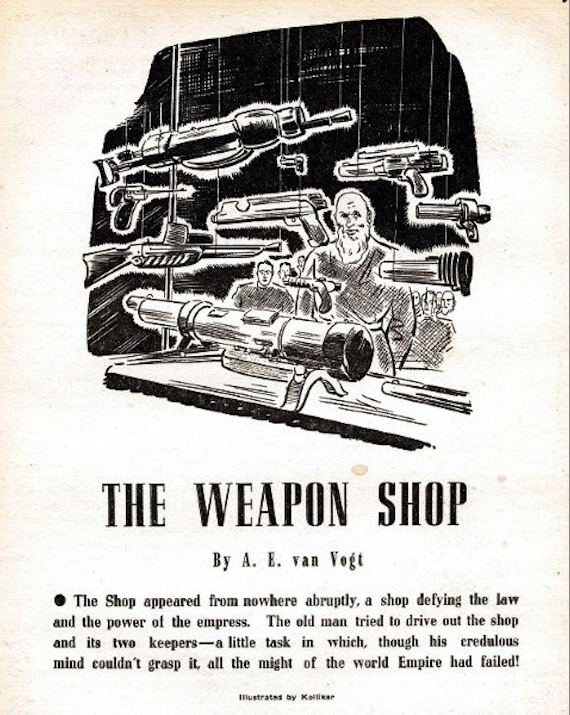
In June 2024, I read this 1951 fix-up of three earlier works:
- The Seesaw, 1941
- The Weapon Shop, 1942
- The Weapon Shops of Isher, 1949
I had read The Weapon Shop over 40 years earlier since it was included in the 1970 anthology The Science Fiction Hall of Fame, Volume One, 1929-1964. I had only the vaguest recollection of that story, so when I discovered it had been incorporated into a fix-up novel, I took that on.
I found the novel a strange, naive, pulpish, and disjointed mess with its bizarre Empress Innelda Isher reminding me at times of Suzerain Cleolanta of the laughable Rocky Jones, Space Ranger television serial of 1953. I still liked elements of the 1942 story, but the others did not impress me, and the switches in lead character were off-putting.
The unevenness in van Vogt’s fix-ups was a feature, not a shortcoming, to some readers. Later science fiction author Philip K. Dick, whose works inspired several terrific movies, commented about one of the fix-ups: “All the parts of that book did not add up; all the ingredients did not make a coherency. Now some people are put off by that. They think that’s sloppy and wrong, but the thing that fascinated me so much was that this resembled reality more than anybody else’s writing inside or outside science fiction.”
I could sense some of what Dick had liked, but I also sympathized with critic Damon Knight, who in an essay denigrated van Vogt as a “Cosmic Jerrybuilder” and correctly noted, “You can at least be sure that a van Vogt character will never break down into sentimental altruism at a crucial moment; his villains are thoroughgoing bastards, and so are his heroes.”
Mixed Men
I had my doubts about reading more of van Vogt after that. However, in November 2025, Matt of Bookpilled released a Patreon video review of Mission to the Stars of 1955, also published as The Mixed Men in 1952. It was one of the first of the fix-ups, and combined three short stories with some new linking material.
- Concealment, 1943, as Prologue
- Lost: Fifty Suns, new material as chapters 1-7
- The Storm, 1943, as chapters 8-15
- The Mixed Men, 1945, as chapters 16-22
- Is it True?, new material as chapter 23
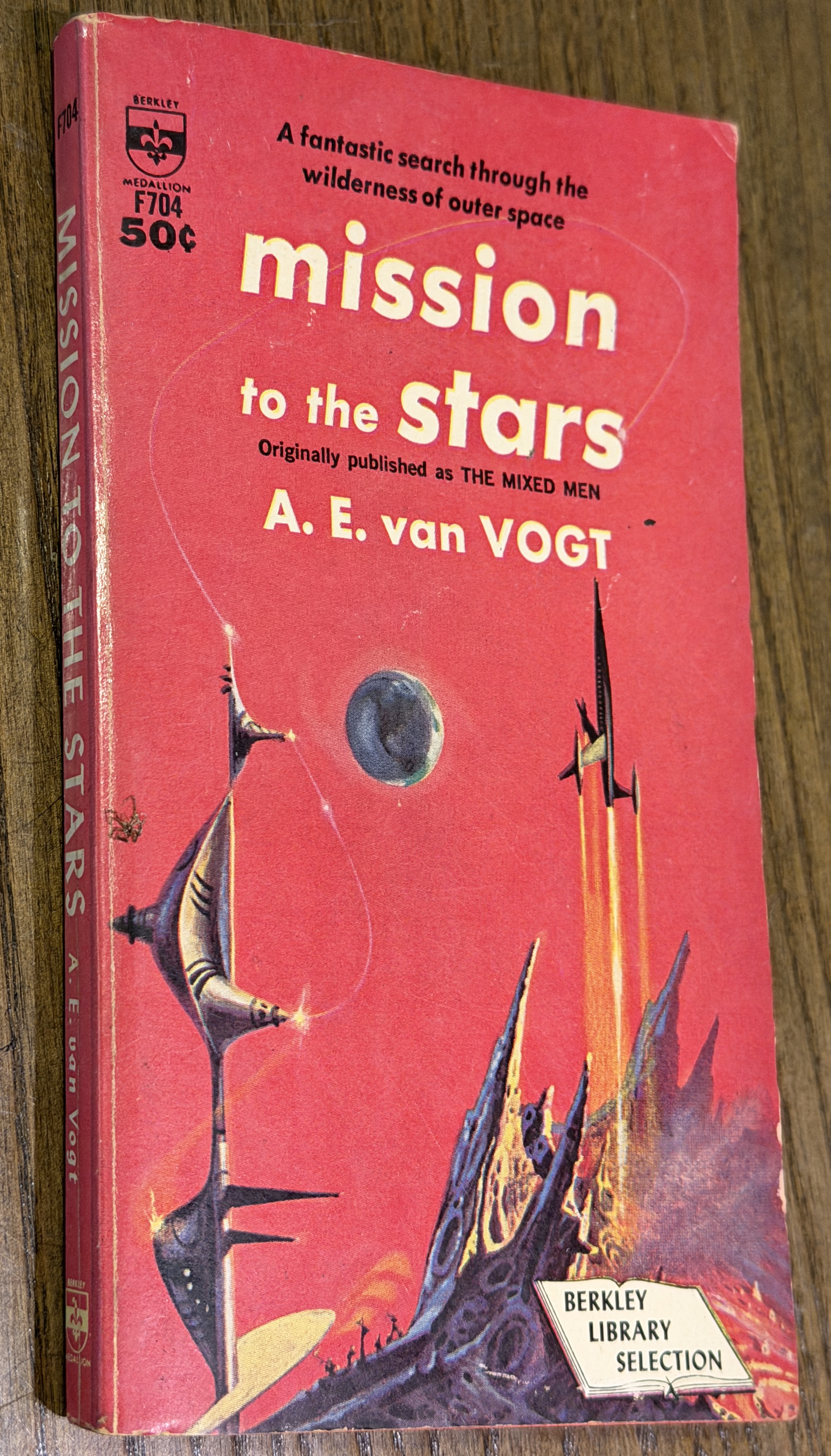
It was an old-school space opera, thankfully in a far more compact form than would become the norm decades later. Matt credited it as a smarter book than he had expected, crammed with inventive ideas. He described it as a serious, if wacky, work, describing van Vogt’s weirdness as “uncalculated” and “unstudied”. His description of the plot was intriguing enough for me to seek out the book.
There is an eBook version at archive.org, but I seldom enjoy reading full novels with that service. So I purchased a 1950s pulp paperback version from a used book dealer in Siloam Springs, Arkansas. It cost me nothing, as I used accumulated Amazon Rewards Points. I’ll admit it was somewhat nostalgic to use my book clip again on an old mass market paperback, a format that has died out. And yes, the cheap pulp paper in that paperback reeked from the breakdown of its lignin and overall acid hydrolysis.
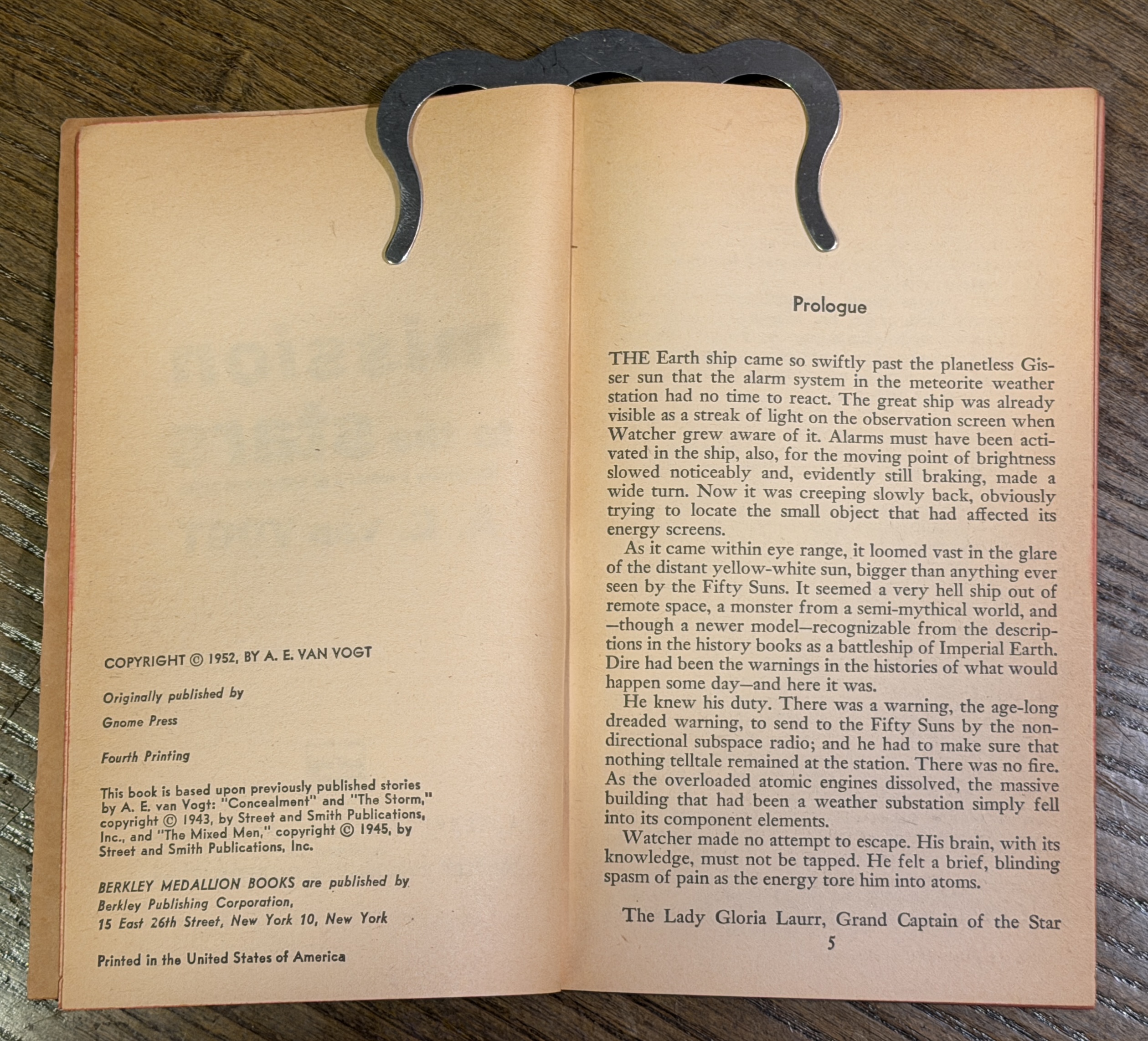
The Prologue, which was really Concealment, grabbed my attention. Below I show the original short story text, with strikethroughs and [bracketed additions] detailing the changes made in the fix-up:
The Earth ship came so swiftly around the planetless Gisser sun that the alarm system in the meteorite weather station had no time to react. The great machine [ship] was already visible [as a streak of light on the observation screen] when Watcher grew aware of it. Alarms must have blared [been activated] in the ship, too [also], for it [the moving point of brightness] slowed noticeably and, [evidently] still braking, disappeared [made a wide turn]. Now it was coming back, creeping along [creeping slowly back], obviously trying to locate the small object that had affected its energy screens.
[As it came within eye range,] It loomed vast in the glare of the distant, yellow-white sun, bigger even at this distance than anything ever seen by the Fifty Suns. [It seemed] a very hell ship out of remote space, a monster from a semi-mythical world, [and —though a newer model—] instantly recognizable from the descriptions in the history books as a battleship of Imperial Earth. Dire had been the warnings in the histories of what would happen someday—and here it was.
He knew his duty. There was a warning, the age-long dreaded warning, to send to the Fifty Suns by the non-directional subspace radio; and he had to make sure [that] nothing telltale remained of [at] the station. There was no fire. As the overloaded atomic engines dissolved, the massive building that had been a weather substation simply fell into its component elements.
Watcher made no attempt to escape. His brain, with its knowledge, must not be tapped. He felt a brief, blinding spasm of pain as the energy tore him to atoms.
Renowned science fiction magazine editor John W. Campbell once wrote of van Vogt: “The son-of-a-gun gets hold of you in the first paragraph, ties a knot around you, and keeps it tied in every paragraph thereafter—including the ultimate last one.”
The newer bridging material in chapters 1-7 was interesting, albeit often ridiculous with minimal characterization. Technology tens of thousands of years from now is hard to judge, but I rolled my eyes at the absurdity of a protein mutation allowing some people to control the minds of others. Then again, when I was a kid watching Star Trek, Mr. Spock’s Vulcan mind melds didn’t particularly bother me, although they were almost as preposterous.
I did like how van Vogt used mutations caused by a matter transporter as the basis for his three types of human mutants, oddly called robots, who had taken refuge 15,000 years earlier in one of the Magellanic Clouds. I also appreciated his portrayal of the difficulty of locating inhabited planets there, even with a ship capable of travelling a light year of distance in a mere minute, and how both the female Grand Captain of an immense space ship and the male hereditary leader of the “Mixed Men” mutants each faced challenges to their leadership.
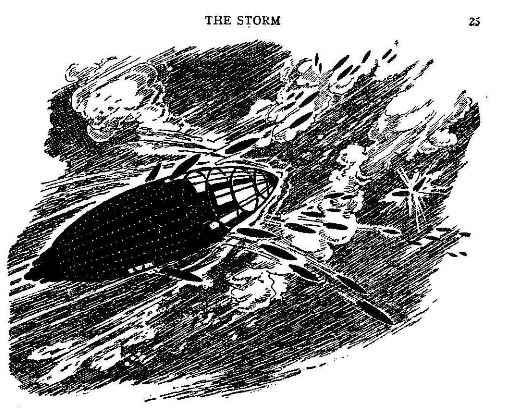
The Storm segment was interesting in its portrayal of the Earth ship’s various protective mechanisms, and although a planetbound interlude slowed the pace, that also provided additional depth to the book’s most interesting character, Grand Commander Lady Laurr.
I agreed with Matt of Bookpilled that the first half of the book was stronger, but the entire book felt choppy, with plenty of clever ideas with only skeletal outlines. There was often little meat, let alone fat, on the bones.
In 1984, David Hartwell wrote: “No one has taken van Vogt seriously as a writer for a long time. Yet he has been read and still is. What no one seems to have noticed is that van Vogt, more than any other single SF writer, is the conduit through which the energy of Gernsbackian, primitive wonder stories have been transmitted through the Campbellian age, when earlier styles of SF were otherwise rejected, and on into SF of the present.”
I would certainly rather read some of van Vogt’s nonsense over the earlier drivel of E.E. “Doc” Smith, who is considered a founding father of space opera. After abandoning the The Skylark of Space, the only Smith work I would consider reading is Spacehounds of IPC, said to be his most realistic work.
The Voyage of the Space Beagle
This fix-up is sometimes mentioned, alongside the movie Forbidden Planet, as an influence on the original series of Star Trek. It was a 1950 assemblage of four short stories:
- Black Destroyer, 1939
- War of Nerves, 1950
- Discord in Scarlet, 1939
- M33 in Andromeda, 1943
I love the videos by J. Scott Phillips in which he shares classic works and delves into associated artwork such as book covers and illustrations. He took a look at Black Destroyer, which was published at the start of science fiction’s Golden Age, and was clearly an influence on the first episode of Star Trek that was broadcast, The Man Trap.
J. Scott Phillips also looked at Discord in Scarlet, which was obviously an influence on the movie Alien.
I wasn’t surprised that J. Scott Phillips found Black Destroyer had some good ideas but suffered from disjointed writing. That fits the pattern I had observed with the Weapons Shop and Mixed Men fix-ups. I wasn’t sufficiently interested in the ideas van Vogt might share in The Voyage of the Space Beagle to put up with his limitations as a writer.
If I ever want to read more van Vogt, I will try to remember to stick with his original short stories and avoid the fix-ups. My next sci-fi read was called a fix-up, but the author actually wrote a new novella as a sequel to an original one in James Blish’s A Case of Conscience.








 Meador Manor