
After reading A.E. van Vogt’s fix-up novel Mission to the Stars, I was still in the mood for some classic science fiction, but I hoped for something of higher literary quality. Matt of Bookpilled has described James Blish as one of the most erudite science fiction authors, so I looked for any award-winning works by him.
Two Types of Awards
The two big science fiction awards are the Hugos and Nebulas. Since the 1950s, the World Science Fiction Society has given out Hugo Awards each year in various categories for the best works in the genre published in the previous year. There are now Hugos in over a dozen categories, with the best novel, novella, and short stories being the most prominent. Since they are awarded based on popular votes by fans, they reflect the popularity of various works.


They are named after the Golden Age publisher and editor Hugo Gernsback. Although he was certainly one of the fathers of the genre, he was also a shady businessman who did not treat authors well. So it is not surprising that the Science Fiction and Fantasy Writers Association (SFWA) chose, in 1966, to establish their own Nebula awards, which are peer-based authorial awards that emphasize literary quality.
There is considerable overlap where some works win both the Hugo and the Nebula in their category. For example, over the past 59 years, 26 novels have won both the Hugo and the Nebula, starting with Frank Herbert’s Dune and extending to notable works like Ursula K. Le Guin’s The Left Hand of Darkness, Larry Niven’s Ringworld, and William Gibson’s Neuromancer.
Of course there were many works published before those awards began, and back when I was in high school I read The Science Fiction Hall of Fame, Volume One, 1929-1964, a 1970 anthology of 26 classic science fiction short stories selected by the SFWA to honor works predating the Nebulas.

One of those stories was “Surface Tension” by James Blish, which originally appeared in the August 1952 edition of Galaxy Science Fiction, although I frankly don’t remember that tale of a crew of human colonists who crash-land on a planet and genetically engineer a race of microscopic aquatic humanoids to colonize a landmass covered in shallow puddles of water. Its selection reflects that fellow authors did respect some of his work.
Blish and Star Trek
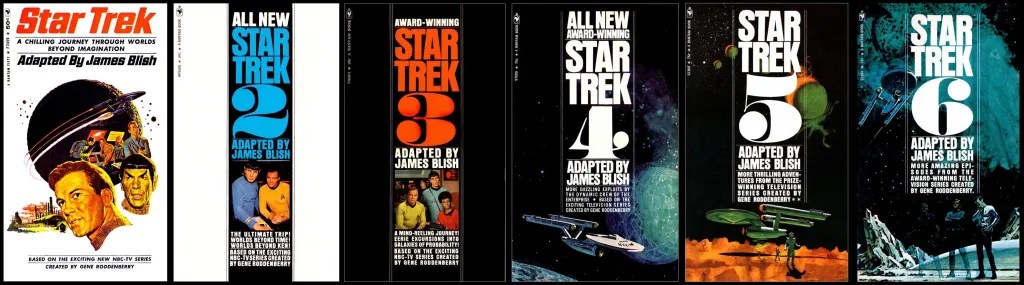
However, Blish is best known for work which pleased him the least: a dozen books that novelized most of the episodes of the original series of the Star Trek television show. I have owned 11 of those collections for decades, but I quickly gave up on them once I realized they were based on draft teleplays and thus often have significant differences from the broadcast episodes. Blish did the first ones without ever having seen an episode, and that hampered the tonal alignment of the early volumes with the actual show.
The only one which I recall reading was the adaptation of Spock’s Brain in Star Trek 8, and I was pleasantly surprised how that silly episode read much better on the page, as a humorous sendup of pulp science fiction, than the off-putting episode itself played. If the direction for the actors had them playing their roles more broadly, to bring out the humor in it, that might have salvaged the premiere episode of the show’s compromised third season, but the reality was that the Bright Knight Batman series of 1966-1968 handled camp far better.
Blish had studied microbiology at Rutgers, and he authored short stories throughout the genre’s Golden Age. Along with Asimov, Pohl, Wollheim, Kornbluth, Knight, and Merril, he was one of the Futurians, an influential group of science fiction fans, writers, and editors. He married fellow Futurian Virginia Kidd in 1947.

Blish adapted to the decline of science fiction pulp magazines by pivoting to novels, fix-ups, and literary criticism. To make ends meet, he worked for the Tobacco Institute as a writer and critic from 1962 to 1968. He and Kidd divorced in 1963, and the next year he married artist J.A. Lawrence and moved to England.
While he generally despised tie-ins, the Star Trek adaptations, at $2,000 per volume, provided Blish financial stability. However, Blish’s willingness to write for the tobacco lobby not only dovetailed with his smoking, but also with him developing lung cancer in his early 50s. As his health declined, his second wife, along with her mother, assisted with the adaptations after Star Trek 6. So I’m not sure how much Blish’s background as a Golden Age writer assisted with bringing out the pulp fiction send-up that was Spock’s Brain in Star Trek 8.
Blish did, however, write the first independent adult novel based on the television show. 1970’s Spock Must Die! earned him a $3,000 advance. I read it decades ago, and I disliked it, finding it did not meld well (pun intended) with the series, which by then had been cancelled. Blish was so done with Star Trek by 1974 that he did not write any of Star Trek 10. Fellow Futurian and Bantam editor Fred Pohl was unaware of Lawrence’s contributions until sometime in 1973, and Star Trek 12 of 1977, published after Blish’s death in 1975 at age 54, was co-credited with her.
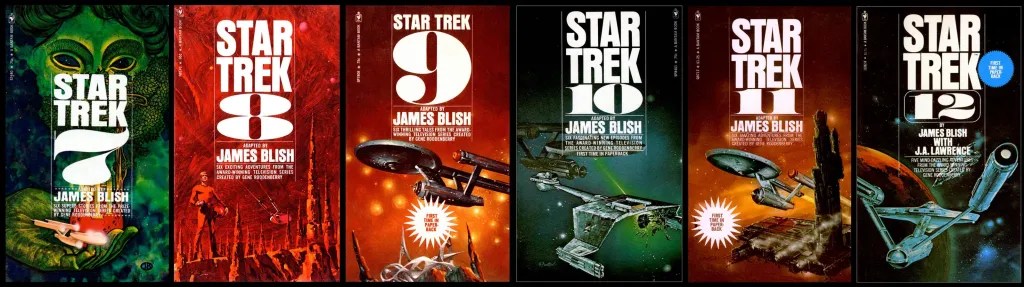
J. Scott Phillips did a nice overview of the great cover art for Blish’s Star Trek adaptations, and he also reflected on Blish’s standalone Star Trek novel.
After Such Knowledge
Although nominated a few times, Blish never won a Nebula, but A Case of Conscience won a Hugo for best novel. It was an expansion of a novella which later won a Retro-Hugo.
Blish identified as an agnostic, but he was still profoundly interested in theology. That motivated him to write multiple novellas and one full-length novel with religious themes, which were later packaged as After Such Knowledge, consisting of the A Case of Conscience in novel form, the sequential novellas of Black Easter and The Day After Judgment, and the historical novel Doctor Mirabilis.
The inherent friction between the scientific method and religious faith have led to several interesting works. Notable examples include Walter Miller’s A Canticle for Leibowitz and Frank Herbert’s Dune. When I was young, I read Arthur C. Clarke’s classic novel Childhood’s End, in which alien contact brings about a peaceful utopia and a consequent collapse of human religions. That made sense to Clarke, an outspoken atheist, but I was unable to suspend my disbelief and accept, despite my alignment with many of Clarke’s philosophies, that religions would collapse in the face of logic, contrary physical evidence, or an idyllic existence. Since religions rely on unprovable, supernatural, and often scientifically contradictory claims and have proved adaptable across centuries, I expect some of them to continue to exist, even as their scope waxes and wanes. Several old religions have lost all of their believers, but about three out of four people worldwide identify with a religious group.
Some years ago, I enjoyed the mix of science fiction and religion in Dan Simmons’ Hyperion Cantos novels, with their cruciform parasites which become essential to interstellar travel. The Catholic Church becomes a dominant force in that series, and it certainly figured in Blish’s After Such Knowledge works.
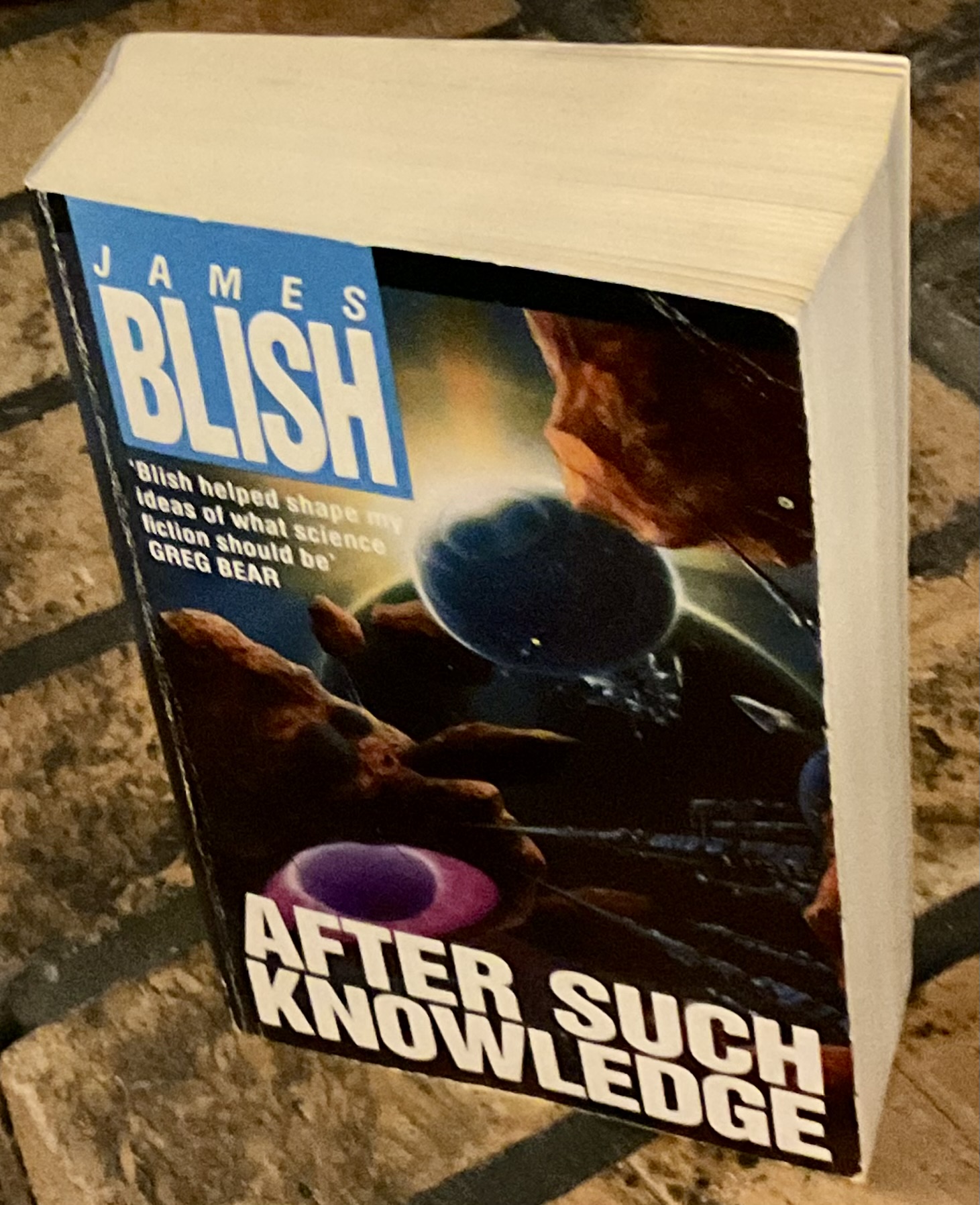
I purchased a used mass market paperback of After Such Knowledge, but it was too thick, even with small text, for my comfortable use. I’ve been spoiled by Kindles, and while I could readily purchase Kindle editions of Black Easter, The Day After Judgment, and the novel-length expansion of A Case of Conscience, I could only find a PDF of Doctor Mirabilis from a questionable source.
So I gritted my teeth and began reading Doctor Mirabilis in the mass market paperback. It dropped me into Oxford, England in 1231 in the company of Roger Bacon, and I read the first of its sixteen chapters and then abandoned the work.
I wasn’t in the mood to be embedded in medieval England in a historical novel with no science fiction elements. Yes, I loved Umberto Eco’s The Name of the Rose, set in a fictional Italian monastery in 1327, but that was a historical murder mystery with a protagonist who was a mix of Sherlock Holmes and the Franciscan friar and philosopher William of Ockham. I also enjoyed the many Brother Cadfael novels by Ellis Peters, with a mystery-solving monk. However, what Blish was offering was the life of a real-world Franciscan friar who was caught up in political intrigue and battled the Franciscan Order for freedom to study, possibly leading to temporary imprisonment. Er, no thanks, and I’m not surprised that work has no Kindle edition.
I didn’t abandon the entire effort, however, as Matt of Bookpilled had greatly enjoyed the other three works, and A Case of Conscience had won a Hugo. So I took that up next in its Kindle edition.
A Case of Conscience
Book One of the novel was the original A Case of Conscience novella that first appeared in the September 1953 issue of If magazine and received a Retro-Hugo in 2004.
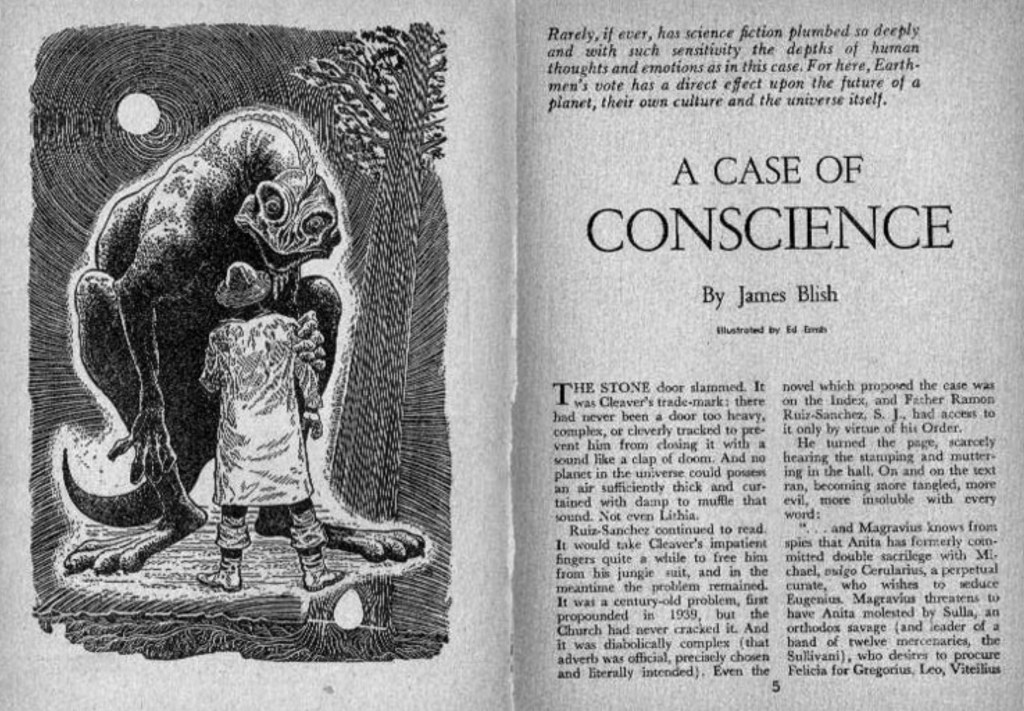
It started strong, with a Jesuit biologist helping treat a physicist during their first contact stay on a world populated by tall intelligent reptiles. I immediately noticed striking similarities between Blish’s reptile Lithians and Becky Chambers’ Aandrisk reptiles in her Wayfarer series published 60 years later. At first, the novella drew me in with its world-building, but all too soon it devolved into a talk-fest.
Four human characters spent page after page debating their verdict on opening the planet to human contact. The Jesuit could not help but filter his recommendation through his faith, with differences from current Catholic faith explained as reflecting fictional future doctrines. The Jesuit recommends a quarantine, as he concludes the planet is a trap created by Satan to cast doubt on Earthly religious faith. I admired how the story confronted the real-world issues that geocentric religions would face if intelligent aliens made contact, but I found the long discussion among the scientists a bit stultifying, and their verbal dialogue did not seem realistic. Most importantly, I could not suspend my disbelief to accept a race of beings who live without crime, conflict, ignorance, or want.
The Fix-Up
Blish later added a novella-length addition to create the novel version of A Case of Conscience, which won the Hugo back in 1959. Book Two dealt with an immature Lithian who was sent back to Earth with the human contact team. Multiple reviewers thought Book Two was weaker than Book One, but I found the opening chapters of it quite interesting. First you are in the mind of the young Lithian, and then you are taken through a sybaritic party which reminded me of an amplification of the crazy party in Midnight Cowboy. Its intensity struck me, as an introvert, as a segue into social horror, with a considerable amount of sardonic humor.
Blish built out, back in the 1950s, a very different future Earth of 2050 than what I expect as someone living in 2026. His projection of a “Shelter Race”, in which nations invested heavily in underground cities as a defense against thermonuclear war, reflected the fallout shelter craze of his era. It made me want to listen to Donald Fagen’s New Frontier.
The novel ended with the young alien making use of commercial telecasts to incite social unrest. Heinlein’s bizarre Stranger in a Strange Land came to mind, and not in a good way. I did not find Book Two of Blish’s novel any more believable, and it suffered mightily from providing paltry explanations of the alien’s personality and motivations.
As with so many classic science fiction stories, characterization in general was sorely lacking, especially for the few female characters. While the novel had some interesting ideas, the execution was poor, and I’m dreadfully tired of dystopias, as I’m living in the prolonged childhood of one here in Joklahoma.
I would much rather read classic and more optimistic tales of Known Space by Larry Niven or David Brin’s Uplift Saga. That desire already led me to start Becky Chambers’ Wayfarer series, Google Gemini has recommended Lois McMaster Bujold’s Vorkosigan Saga, and I know that I should try reading an Andy Weir novel.
A Case of Conscience was rated the 11,698th Greatest Book of All Time, with Black Easter coming in higher at 3,281th and The Day After Judgement at 3,531st. The only other Blish book ranked in that meta-rating system was Cities in Flight at 15,574th. The higher ratings for the other two works in the After Such Knowledge collection did not convince me to read them, however, as they are more in the realm of fantasy, horror, and the occult than science fiction, and if I were going to read horror, I already have on my Kindle The Possession of Alba Díaz by Isabel Cañas, and for fantasy I might try Roger Zelazny’s Lord of Light, which won the Hugo and was nominated for the Nebula, since he wrote that to be interpreted as either science fiction or fantasy.
I doubt I’ll read any more of Blish, and he left me needing the comfort of an author who could deftly sketch characters and craft a believable mise-en-scène, so I jumped into Wildfire at Midnight, Mary Stewart’s second short tale of romance suspense.








 Meador Manor