
Today’s postcard from a 1940 Oklahoma souvenir pack is a depressing one, since it shows the Eagle-Picher Central Mill, of the lead and zinc mining district near Miami. If you aren’t already aware, Picher is now a ghost town that was turned by its own industry into an environmental disaster.
Decades of unrestricted subsurface excavation dangerously undermined most of Picher’s town buildings and left giant piles of toxic metal-contaminated mine tailings, known as chat, heaped throughout the area. The discovery of cave-in risks, groundwater contamination, and health effects associated with the chat piles and subsurface shafts resulted in the site being included in 1983 in the Tar Creek Superfund site by the US Environmental Protection Agency (EPA).
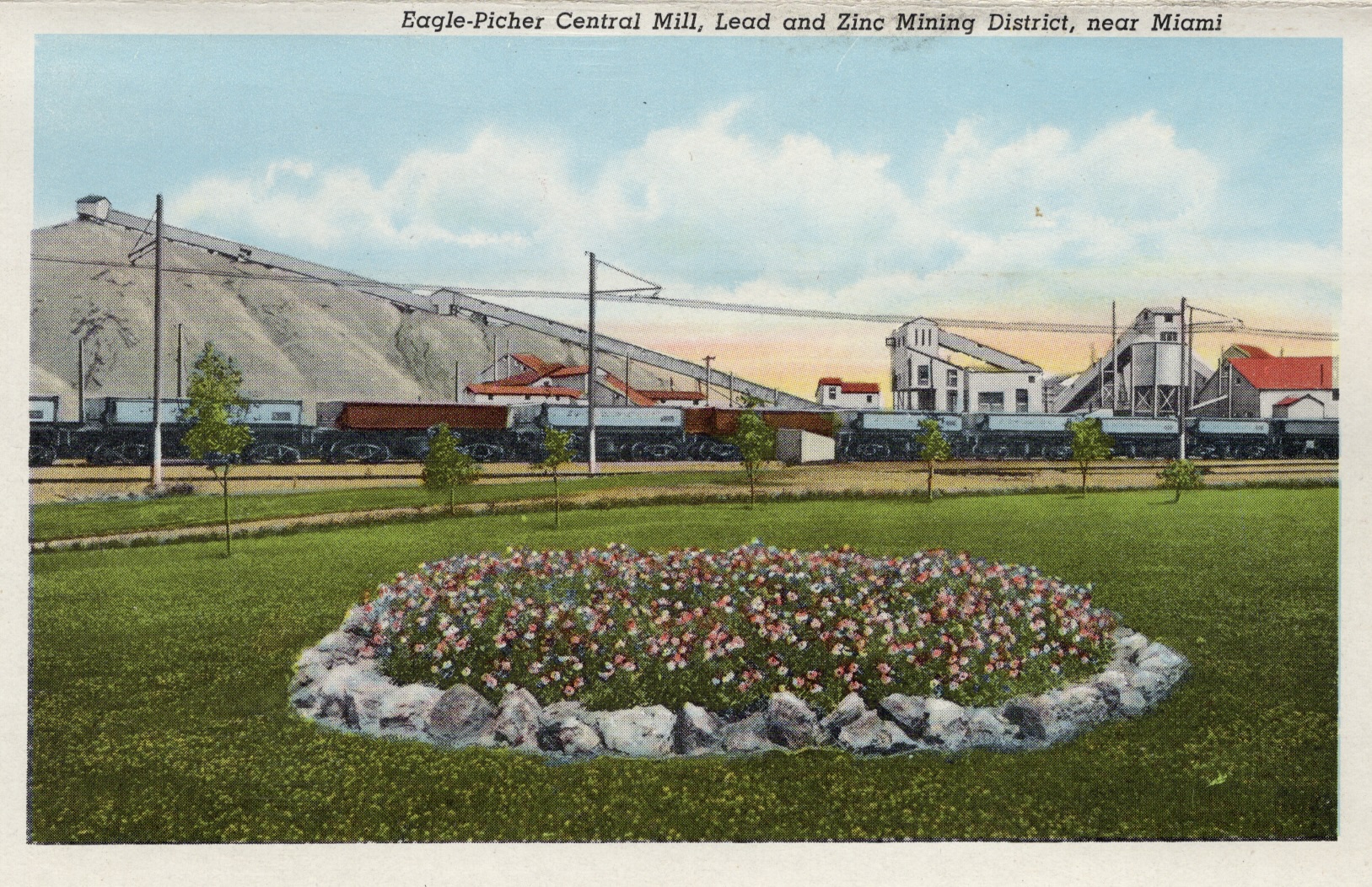
The “Picher postcard” is something else, with its composition of the flower bed in the foreground while in the background looms one of the immense chat piles by the railroad and the mill.
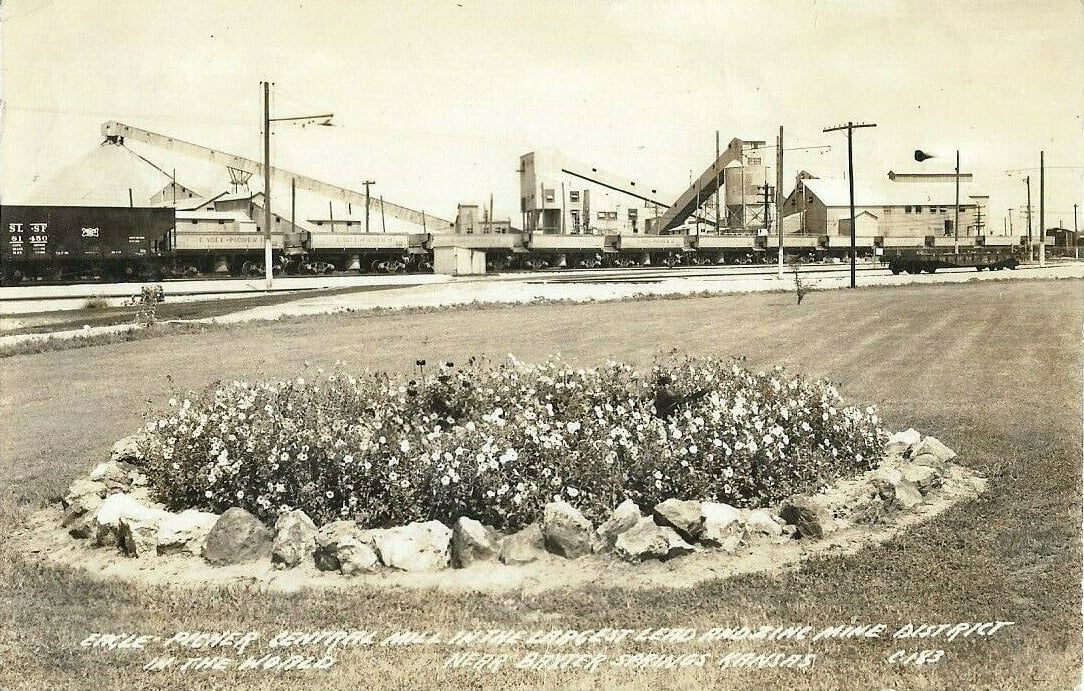
The lead and zinc ore mined in Picher was concentrated in on-site mills and then sent out for final smelting and refining at the Eagle-Picher smelter in Galena, Kansas a dozen miles to the northeast as well as plants farther east and northeast in Joplin and Webb City, Missouri.
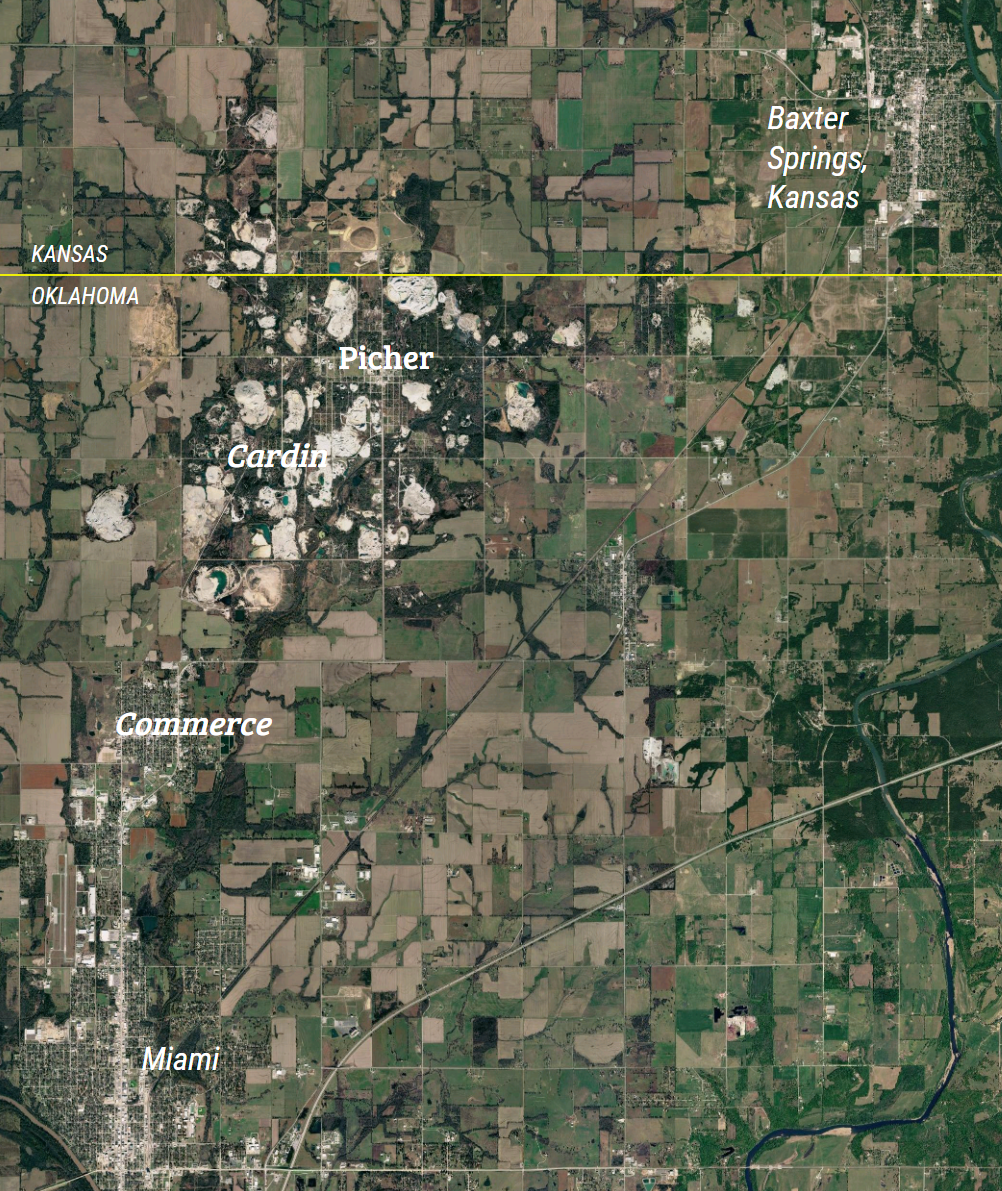
At its peak in the 1920s, Picher had over 200 mills. The one in the postcard was located a few miles southwest of the town of Picher, between the towns of Cardin and Commerce. Another postcard, not part of the souvenir pack, gives some perspective.
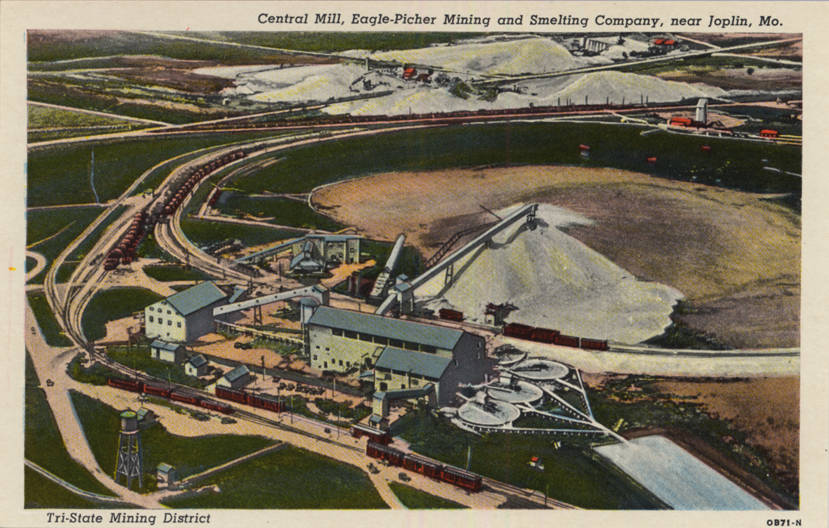
Below is an aerial view of the town of Picher in 2009.
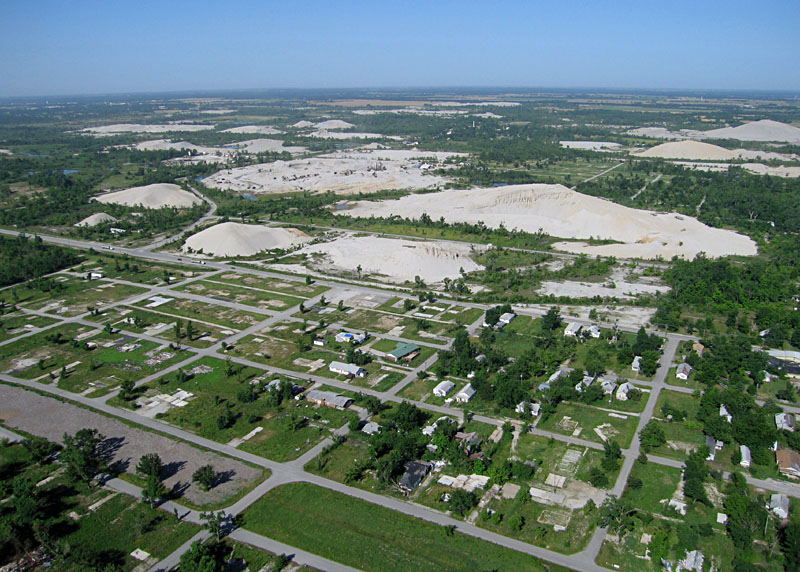
A 1994 study found that 1/3 of Picher’s children had lead poisoning, and the EPA and state agreed to a mandatory evacuation and buyout of the entire township. A 2006 study showed 86% of Picher’s buildings were undermined and subject to collapse. In May 2008, 150 of its homes were destroyed by a tornado, and in 2009 Picher was dis-incorporated. A satellite view shows the scale of the mining mess.
A Bartlesville Connection
Bartlesville had its own past pollution from three zinc smelters which located there in the early 20th century because of the cheap natural gas from the Bartlesville and Osage oil fields. The smelters polluted the soil across southwest Bartlesville. In the period of 1988-1991, approximately 13% of Bartlesville children living on or near the old smelter sites had blood lead levels greater than or equal to 10 µg/dL, the concentration set by the U.S. Centers for Disease Control as the indicator for potentially elevated blood lead levels. None of the children in a control group from areas of Bartlesville not in the vicinity of the former smelters had levels exceeding that threshold.
That led to a cleanup from 1994 to 2001 across eight square miles. However, most of the ore brought into Bartlesville came from Canada and South America, and it reportedly did not process domestic ore. So it was not undermined by tunnels nor did it have huge toxic piles of chat.
Eagle-Picher was a merger of the Picher Lead Company and Eagle White Lead, with the former established by O.S. Picher. His namesake area was the most productive mining field in the tri-state area, producing more than $20 billion in ore from 1917 to 1947. More than 50% of the lead and zinc metal consumed in World War I came from the Picher Field, with it peaking in the 1920s with about 14,000 miners and another 4,000 people working in about 1,500 mining service businesses. An extensive trolley car system once brought in workers all the way from Carthage, Missouri over 30 miles northeast of Picher. However, perhaps 20 square miles around Picher became a toxic wasteland.
Other nearby communities like Cardin, OK and Treece, KS are also now abandoned. There are various videos of what remains of Picher; below is one.
Old towns sometimes die hard, and there is still a Christmas parade each year through Picher; at least 1,500 reportedly attended the one on December 5, 2025. If you ever have the strange urge to visit Picher, don’t be surprised if a highway patrol car or a car from the Quapaw nation force keeps tabs on you. Mind your Ps and Qs.
Tomorrow’s postcard will be on a happier note, showing a famous Oklahoman’s birthplace near Claremore.







 Meador Manor