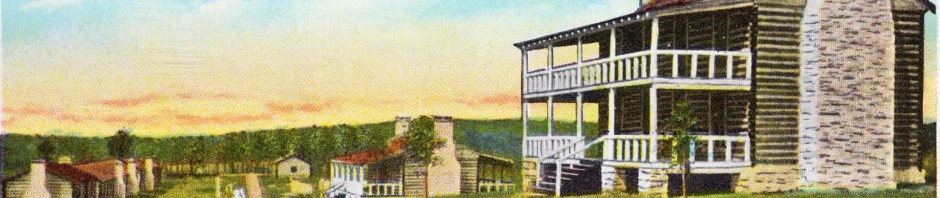

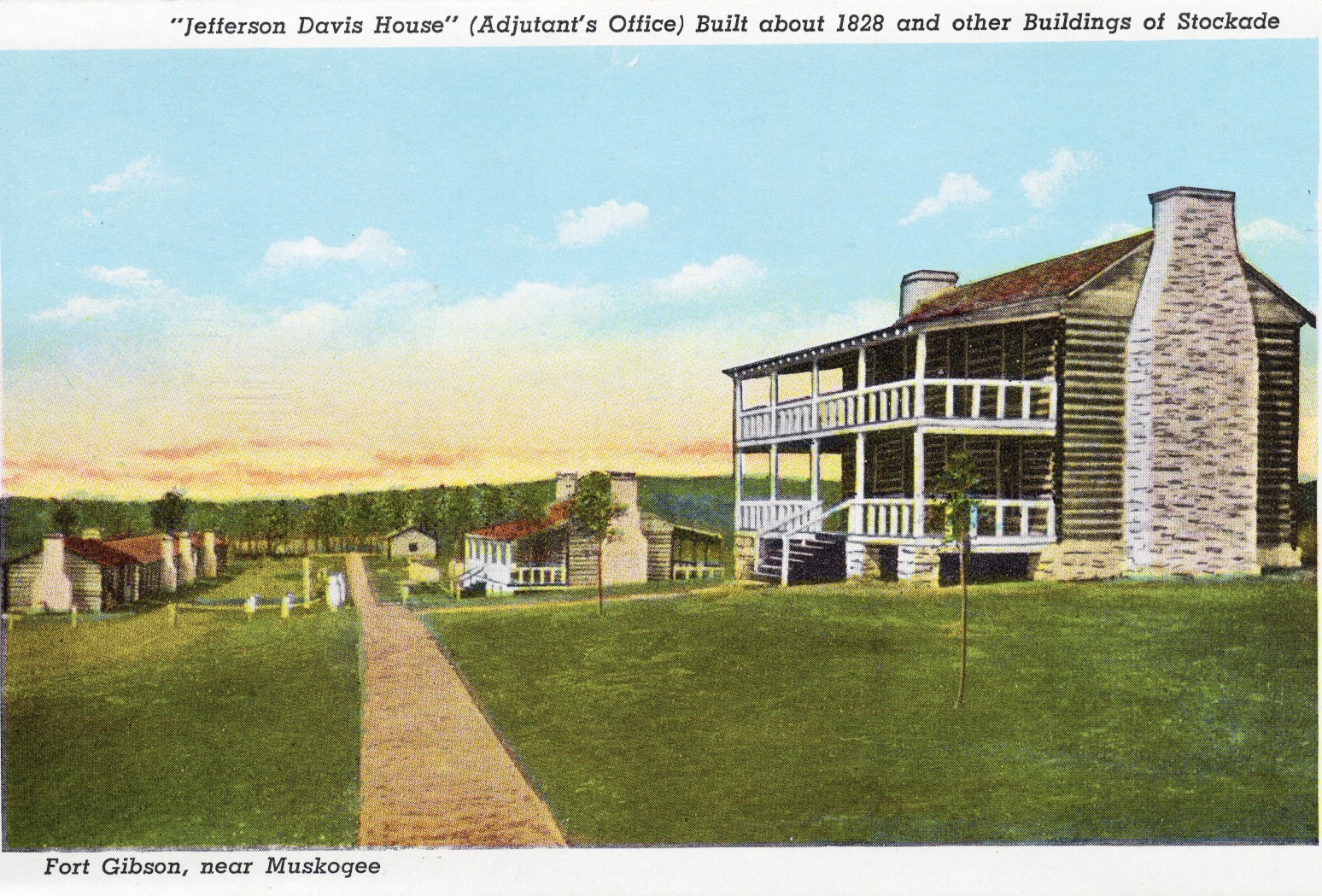
Today’s postcard from a 1940 Oklahoma souvenir pack is of Fort Gibson, which is across the Arkansas River from Muskogee in the east central part of the state.
I’ve never been particularly interested in old forts. Years ago my father and I took a summer trip out west in his Volkswagen camper. He took me to various places he had previously visited. I especially liked the Durango-Silverton train and the Grand Canyon. However, I vetoed two potential stops. I refused to spend any time at Canyon de Chelly, as I felt it would pale in comparison with our earlier visit to Mesa Verde, and I also vetoed stopping to tour Bent’s Old Fort.
So I’ve never toured, just driven past, Fort Gibson. The postcard was correct to put “Jefferson Davis House” in quotes since any claim that Jefferson Davis had occupied that building is false. Davis and over 100 other West Point cadets were stationed at the fort from 1833 to 1835, but his regiment actually stayed in tents about a half-mile from the fort’s location.
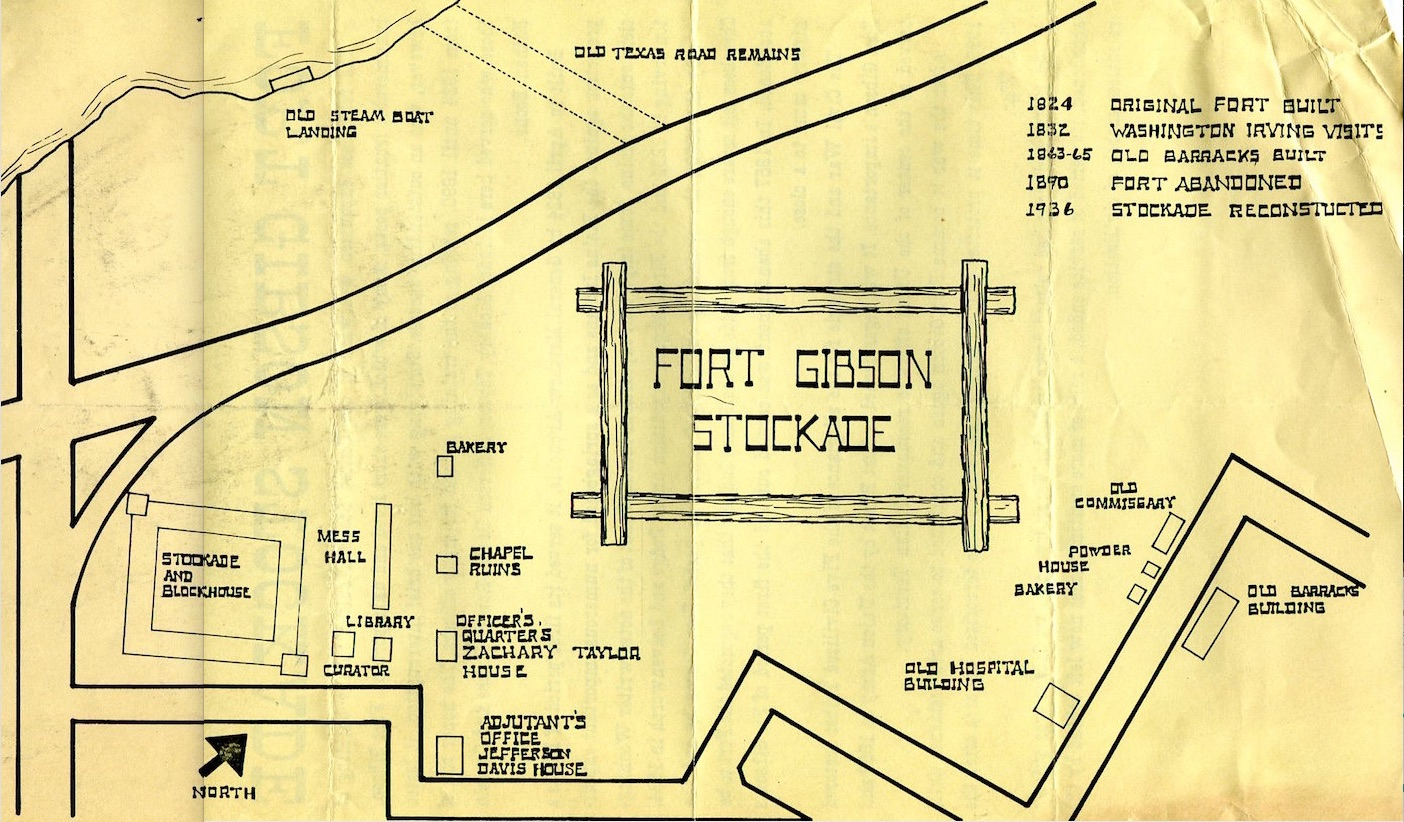
Established as Cantonment Gibson in 1824, the young nation’s westernmost military post at the time, it became a fort in 1832 to deal with First Peoples forcibly removed from eastern states to Indian Territory as well as the indigenous plains tribes.
A series of expeditions marched west in search of nomadic plains tribes which endangered traders on the Santa Fe trail, but the first two in 1832 and 1833 had no success. Author Washington Irving accompanied the troops in 1832, and he wrote A Tour of the Prairies in 1835 from his experiences. It wasn’t until 1834 that a dragoon expedition finally made contact. Many of the soldiers on those various expeditions became ill, with a high mortality rate.
The original 1824 cantonment was 222 by 238 feet and all structures were of wood, inside and out, except for a stone powder house and a water well. By 1835, those log structures were decaying from periodic floods from the river. In 1845 the fort was shifted uphill to the northeast.
The Army would occupy and abandon the fort multiple times, finally departing for good in 1890. The civilian town of the same name which had developed in the area then expanded into the former military grounds.
A Bartlesville Connection
Bartlesville is situated right on the border between the Cherokee and Osage nations and is the headquarters for the Delaware, so its initial developments in the 1870s and its oil-driven settlement in the 1900s were made possible by the eventual peace between those groups of First Peoples.
As the Osage and Cherokee were forced westward, they came into conflict over hunting lands. In 1817, a group of Cherokees, Shawnees, and Delawares ambushed an Osage village near present-day Claremore. That led the U.S. government to establish Fort Smith. A peace pact in 1818 was quickly breached, and hostilities continued. The army moved from Fort Smith to Cantonment Gibson in 1824, and in 1825 a treaty shifted the seat of the Osage Nation from within the drainage area of the Missouri River to that of the Arkansas River.
Delawares and Osages still fought and killed each other until they joined the Choctaw, Kickapoo, and Shawnee in a mutual peace agreement in late 1827. The Cherokee refused to participate, having had multiple deadly disagreements with the Osage since the Cherokee had first been forced into the region. In 1831 an unratified treaty between the Cherokee, Western Creek, and Osage was agreed upon at Cantonment Gibson, which marked the end of major inter-tribal hostilities among those groups.
The Osage still attacked the Pawnee in 1833, leading to a loss of federal aid, and Missouri conducted an Osage War in 1837 that expelled them from that state. The Claremore Band of the Osage, which had refused to comply with the 1825 treaty, dwelled near Three Forks until the Treaty of 1839 at Fort Gibson led most of the Osage to remove to Kansas, alleviating tensions with the flood of Cherokees arriving in its Trail of Tears.
The Osage finally signed a treaty in Montgomery County, Kansas in 1870 in which they sold their lands in Kansas, and in 1872 they purchased their own reservation in Indian Territory, just west of the Cherokee Nation, which became Osage County west of Bartlesville.
The Caney River which runs through Bartlesville was once called the Little Verdigris and it feeds into the Verdigris River. Both the Verdigris and the Neosho feed into the Arkansas River at Fort Gibson.
In the 1930s, the Works Project Administration reconstructed several of the buildings, so that explains why a postcard of it made it into the 1940 souvenir pack. It is now operated by the Oklahoma Historical Society, and there are stone barracks, a dogtrot cabin, a sutler store, mess hall, commissary, garden, bakehouse, and a palisade with barracks, a cannon, and a blockhouse.
Grants are currently funding restoration of the 1840s barracks, with repairs also slated for the commissary, ammunition storage building, blacksmith shop, and bake house.
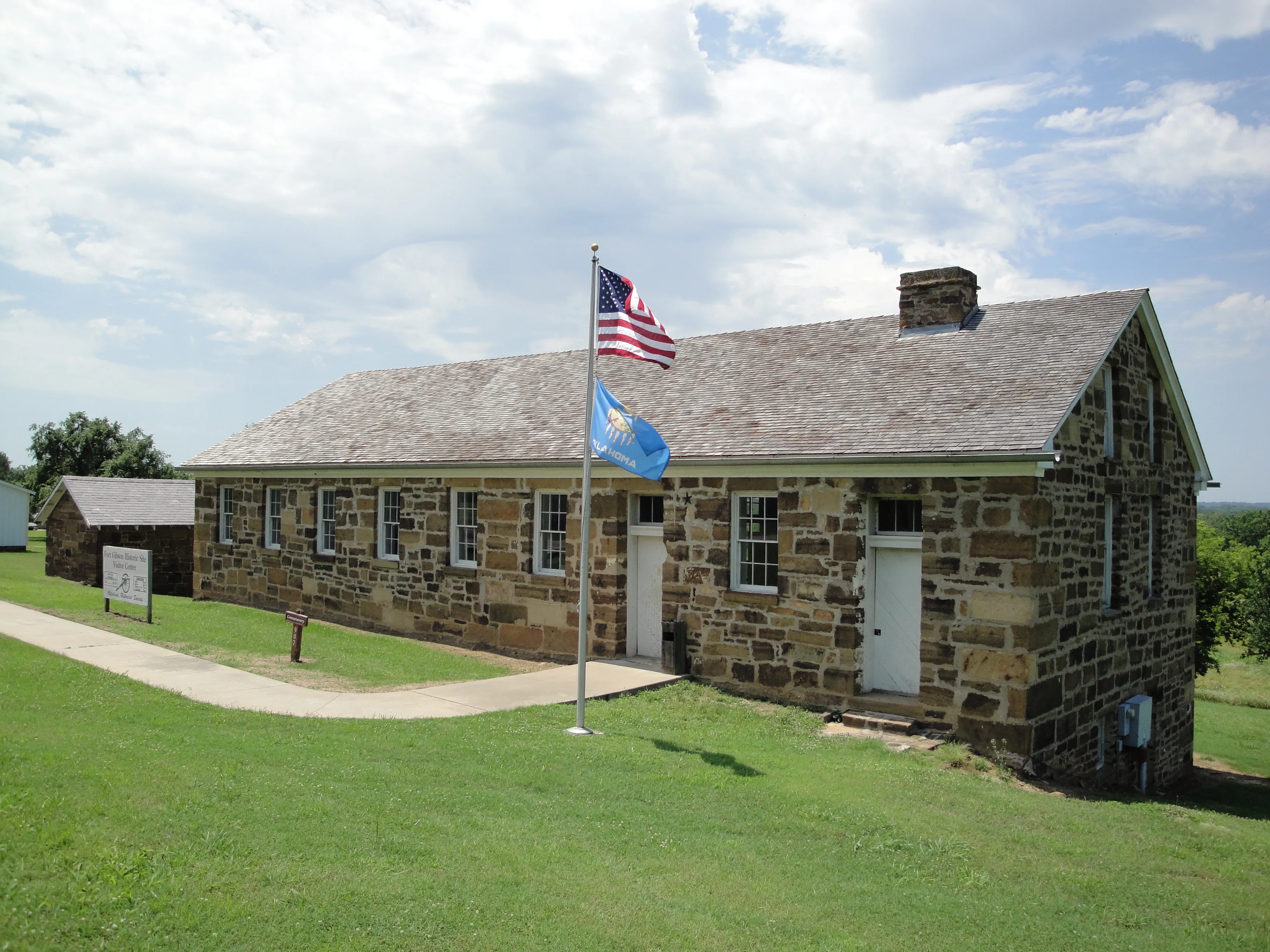
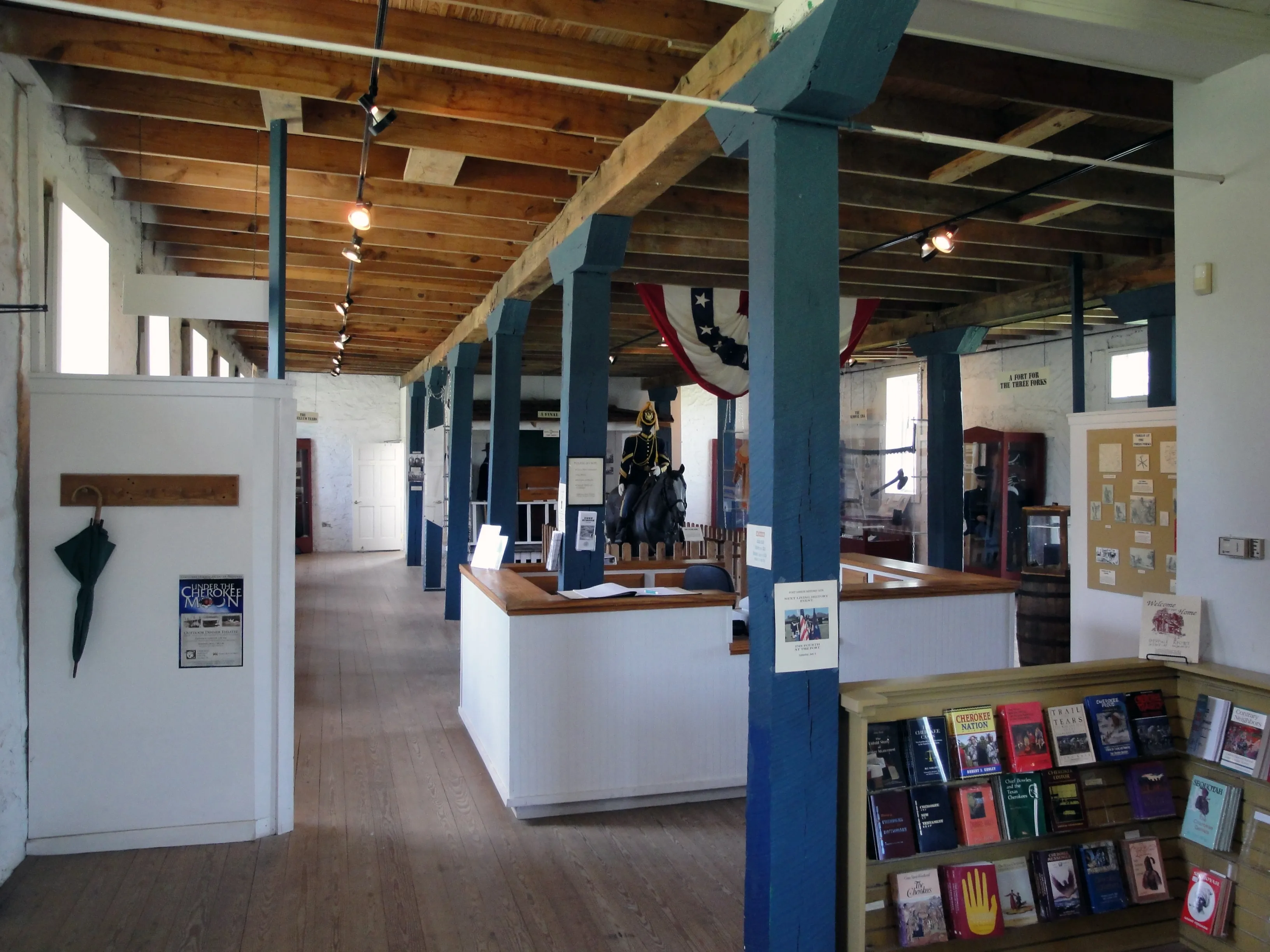
The commissary was built in 1845 by Seminoles and slaves, and it is the oldest stone military building still standing in Oklahoma. The 1,000-square-foot building is now the Visitor Center.
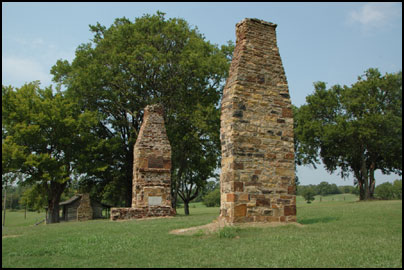
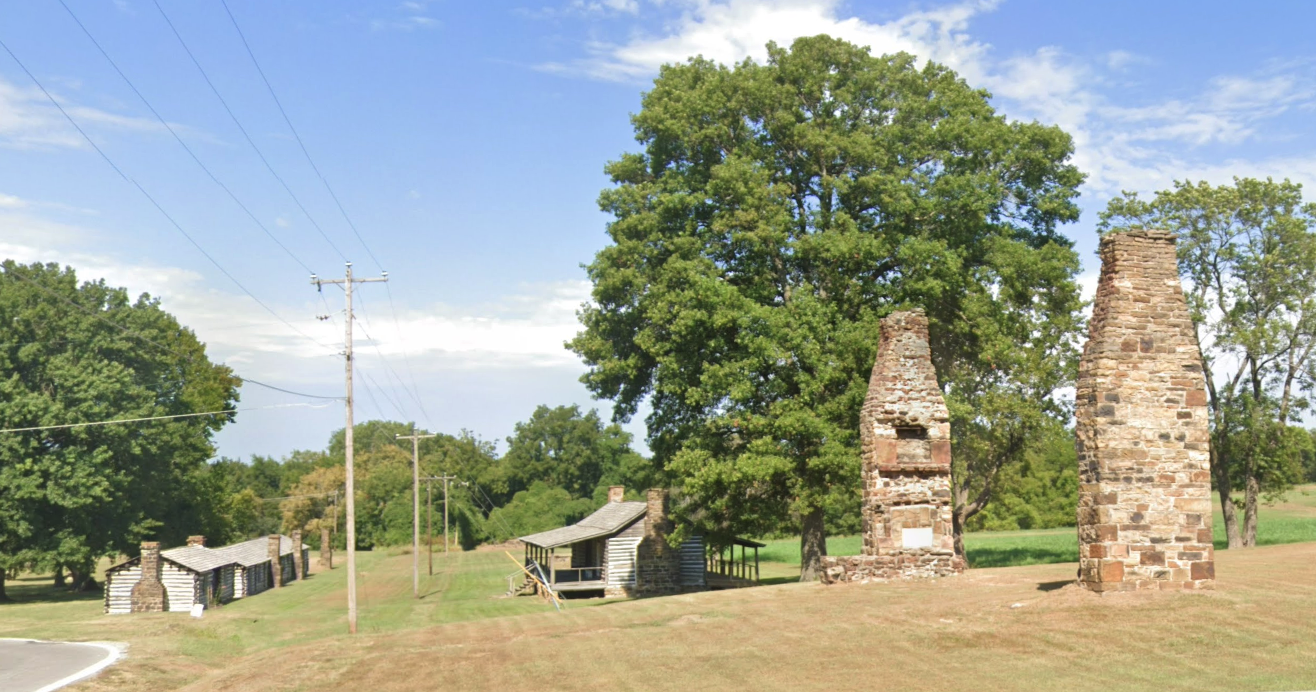
The misnamed Jefferson Davis House was gone in 1919, with only two mounds of stone and earth that marked where its two large chimneys had stood.
The WPA rebuilt the chimneys and recreated the log building between them, but now only the chimneys remain, with a misleading plaque in one of them repeating the false claim that Jefferson Davis once occupied the building.
There is a small recreated log cabin on the property that was also sometimes incorrectly associated with Davis, when that location actually had a cabin used by General Zachary Taylor for a few weeks in the summer of 1841. He was the 12th President of the U.S. from March 1849 to July 1850.
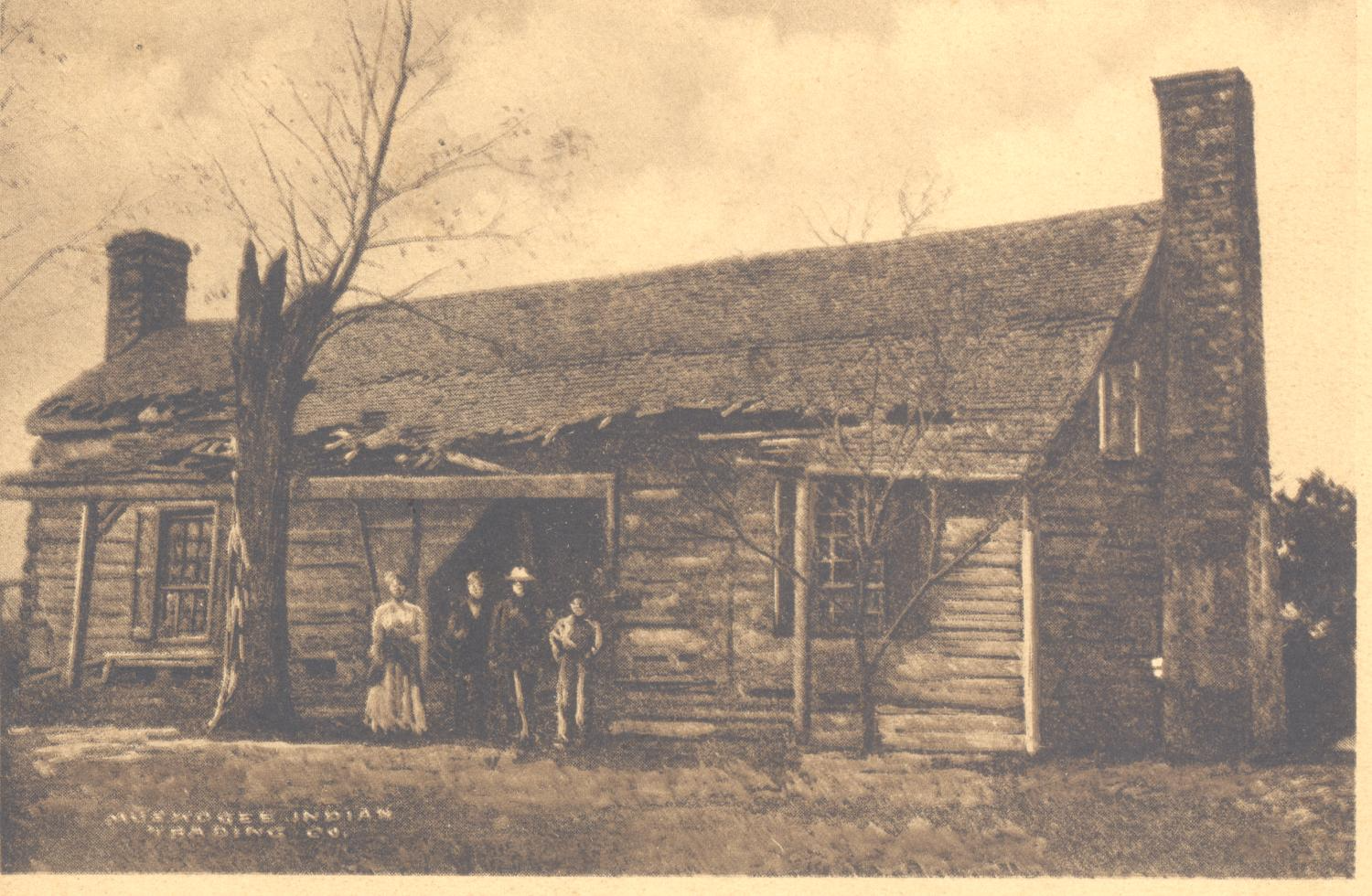
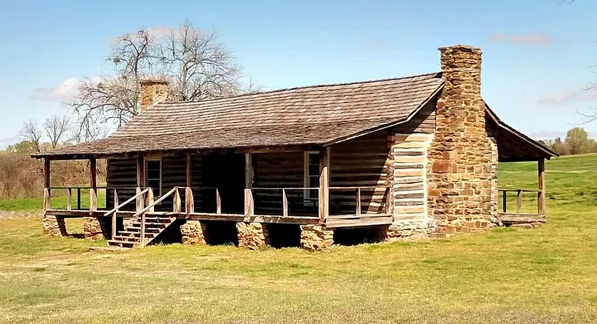
When I was a kid, the Oklahoma City fairgrounds had a fake stockade which was named Cottonwood Post. It endured long enough for me to spend one afternoon there in high school selling Neapolitan ice cream tacos (don’t ask), but about a decade later it was destroyed by winds. The stockade at Fort Gibson was reconstructed by the Works Progress Administration on new foundations at a slightly different location than the 1824 original, using a map from 1835.
Well, that’s about all the patience I have for an old fort. Tomorrow’s postcard will take us to something of far greater interest to this city boy: downtown Tulsa.