I recently finished listening to the 40 hour Audible version of Battle Cry of Freedom, a Civil War history. I’d been inspired to listen to it after finishing Erik Larson’s compelling The Demon of Unrest, which covered the attack on Fort Sumter. The second book was far more comprehensive, but also much drier. So I was ready for something different yet familiar as I thumbed through the purchases I’d made for my Audible library.
I considered starting David McCullough’s John Adams or Truman, but those are 30 and 54 hours long, respectively, and I wasn’t ready for such a long commitment to a nonfiction work.
I also have James Michener’s Hawaii, which is historical fiction. I remember reading a two-part condensation of his report on Kent State in the March and April 1971 issues of Reader’s Digest. Mind you, I wasn’t reading those at age four. Rather, in junior high I acquired a collection of Reader’s Digests dating back to the 1930s from a friend of my father’s, a man who had purchased a lifetime subscription during the Great Depression. I would sometimes grab one to get a slice of life from the past, although I finally got rid of the magazines as they were infested with silverfish. Anyway, I also rejected starting Hawaii, since it runs 52 hours.
That led me to consider a Mary Roberts Rinehart mystery, but I’ve consumed a dozen of them over the past six years, and I couldn’t remember if I’d already listened to The Great Mistake or not, and my Audible library didn’t show it as finished, so I started that.

I didn’t recognize the first chapters, and by the time it was ringing a bell, I was so far along, and realized I didn’t remember whodunnit, that it became the first Rinehart re-listen for me.
Later, checking my blog posts, I saw that in my 2024 end-of-year book review summary, I wrote: “I listened to Mary Roberts Rinehart’s The Great Mistake from 1940, but it was far less memorable than her mysteries The After House of 1914, The Window at the White Cat of 1910, or her comedic Where There’s a Will in 1912.”
Well, I guess that helps explain why I could re-listen to it only a couple of years later. I’d been walking 1.5 to 2 hours almost every morning, leaving the house early since August and September had been miserably hot. Yeah, I know, I live in a town with an economy based on fossil fuels, so we’re all just part of the problem.
Anyway, my walking routine could get me through the book in a week or less. I kept on with it, and meanwhile finished reading the superb Lessons in Chemistry on my Kindle, which was much more modern in tone than Rinehart, even though its fictional events took place in the early 1960s.
If I’m listening to fiction, I like to be reading non-fiction, and vice versa. So I looked for something non-fiction on my Kindle or, better yet, a physical book since it was too @#$% hot to go anywhere, and thus I didn’t mind something bulky.

My eyes wandered to the stack of books beside my recliner and spotted one that arrived a couple of months ago. Over 7″ wide, over 10″ long, and almost 1.5″ thick, weighing in at over 2.5 pounds, it was Trek Star: The Geek Life of Doug Drexler – How Star Trek’s Legendary Designer Made All His Idiotic Adolescent Dreams Come True. I love Drexler, and in late 2025 I had backed a documentary about him on Kickstarter. My autographed Blu-Ray might arrive in a few months, so it was a good time to read the book.
It was a fun read, and admittedly, the Rinehart book was a good listen the second time around. I’m not really into the whodunit puzzles of most classic mysteries, spending little mental energy trying to figure out a solution, but instead relaxing in the atmosphere and enjoying them more as procedurals and escapist adventures.
Listening to it again had me spending more time trying to remember the eventual solution, with only dim recollections of late revelations. Surprisingly, that actually enhanced the book for me, but not enough that I plan to go back and listen again to any more Rineharts. There are so many other novel experiences, pun intended, that await in Audible, Kindle, and physical book formats.
After my Rinehart re-listen snafu, I made amends by making my next Audible listen Richard Osman’s fourth entry in his Thursday Murder Club series: The Last Devil to Die from 2023. It was also quite fun, while also, as that series often does, leaving me deeply moved. It focuses on four pensioners with deep characterizations. Over the previous books we’ve seen the worsening Alzheimer’s of one character’s husband, and that became a central emotional focus for this outing. I was crying as I walked along the Pathfinder Parkway, listening to the couple bravely confronting their dilemma, and I appreciated how Osman allowed that tragedy to realistically cripple the capacity of one of the main characters. The continuity in his series, where old foes can linger on and events leave lasting scars, is one of its strengths.
That leaves one more in the Thursday Murder Club series to go in my Audible library, and Osman is now alternating publishing entries in the series with ones from his new We Solve Murders series. I’ve already got the first one of that newer series in my Audible library, and the second was just released.
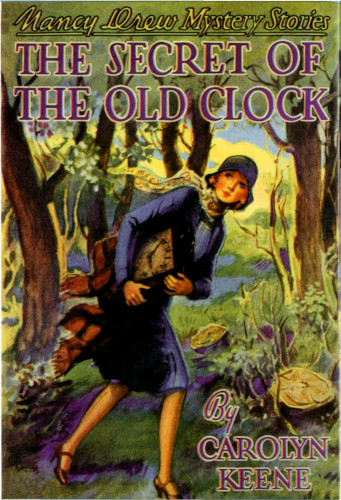
While finishing The Last Devil to Die, I completed Trek Star and on a whim opted for a rather odd re-read. I’ve been paying attention to what enters the public domain each year, and I recalled that the first four of the Nancy Drew books from 1930 are now free and would likely be available at Project Gutenberg. I read all of them decades ago, back when a spinster aunt loaned me her old mysteries to keep me busy. Having consumed all of the Hardy Boys and Three Investigators I could find, she set me onto Nancy Drew, Trixie Belden, and the Dana Girls.
I downloaded The Secret of the Old Clock, which was as thin as I remembered it. My favorites of the Nancy Drew books were The Clue in the Crumbling Wall, which will become public domain in 2041, and The Crooked Banister, which included a robot programmed with a cassette tape, but it won’t be public domain until 2067.
The re-read reminded me that Nancy’s first “chum” was Helen Corning; her athletic female friend George and the “pudgy” Bess Marvin, a counterpart to the Hardy Boys’ Chet Morton, did not appear until the fifth book.
While I appreciate that ghostwriter Mildred Wirt Benson, who wrote 23 of the first 30 books, gave Nancy more agency and capability than the norm a century ago, the books were already so dated by the late 1950s that they were gradually revised. Ethnic stereotypes and offensive slang that afflicted many of the Stratemeyer Syndicate‘s series were addressed, such as the drunk black caretaker character in the first book, with his heavily stereotyped black English vernacular. Technology and social norms were updated, although sadly Nancy lost some of her agency and spunk, and, as so often happens, the books were made cheaper by shortening them.
I might or might not re-read any more of the “starter set” of Nancy Drews, given that I still have a slew of adult Mary Stewart, Edith Pargeter, and Louise Penny books that would be fresh for me. As for novel children’s books, a few months ago I read the first of four Carson Street Detective Agency or “Neil and Swede” books by Keith Robertson. Those are all out of print, but they are all available for online borrowing via scans in the Internet Archive.
Happy reading!