
Once upon a time, short stories were quite popular. They were a dominant form of mainstream entertainment from the 1920s through the 1940s before television and mass market paperbacks became widespread.
Countless genre magazines offered horror, mystery, romance, science fiction, and westerns. Those were often “pulps” printed on cheap paper, while various “slicks” with expensive glossy paper offered more literary fare. Illustrations were vital for rack sales, while interior illustrations could convince someone thumbing through a magazine to stop and read a story they might otherwise pass by.
The 1950s through the 1980s were a transitional period. Almost all of the pulps were gone by the end of the 1950s, and short stories migrated into slick high-culture monthlies and low-print-run academic magazines. A few genre publications survived, such as Alfred Hitchcock’s Mystery Magazine, which I subscribed to when I was in junior high and high school.
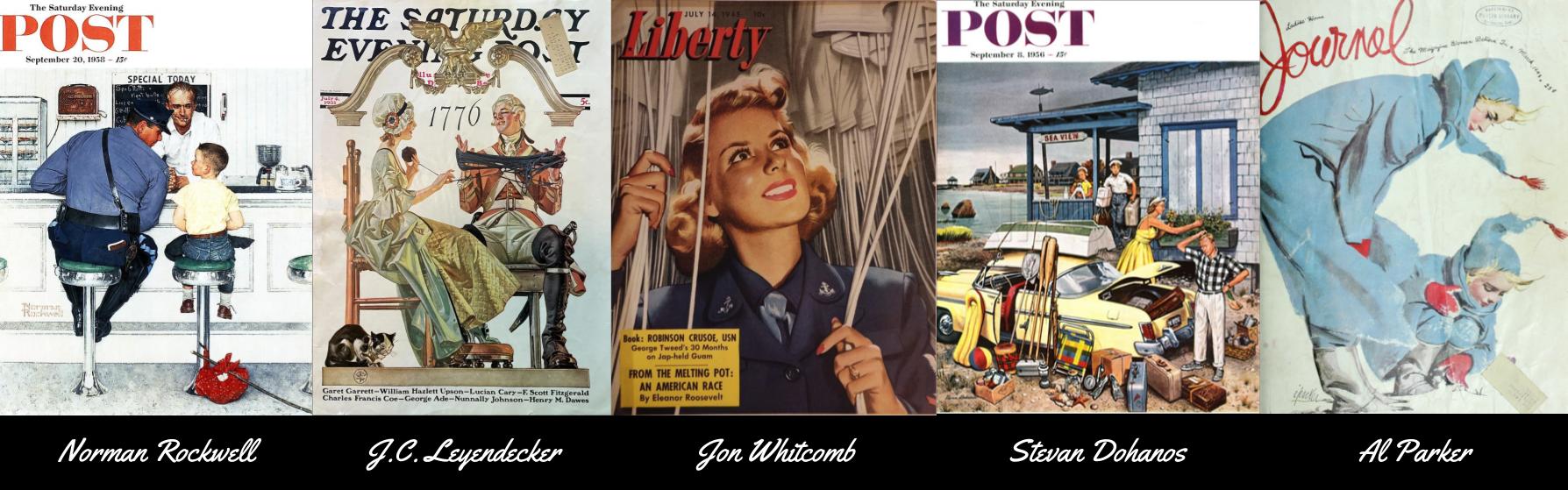
Norman Rockwell was the famous illustrator for many covers of The Saturday Evening Post, which I wrote about two weeks ago, but there were plenty of other talented artists enhancing periodicals before cheaper photography took over, such as J.C. Leyendecker, Jon Whitcomb, Stevan Dohanos, and Al Parker.
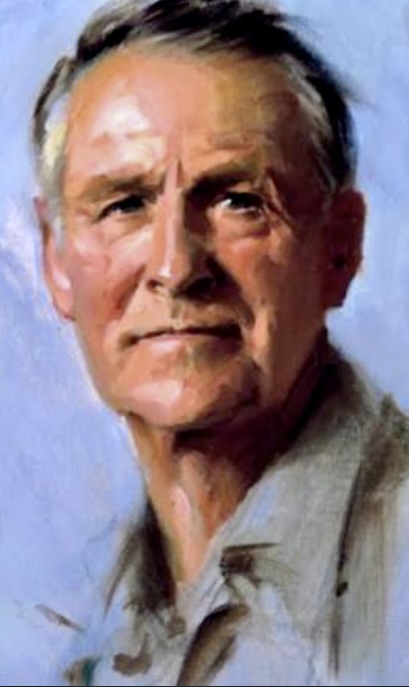
A gifted illustrator whose art was particularly compelling was Tom Lovell. He started in the pulp genre magazines but then graduated to the slicks, while during World War II he was a sergeant in the Marines doing illustrations for Leatherneck.
After the market for illustrating magazines dried up, he did work for National Geographic and some commissioned artwork for the Latter Day Saints before focusing on western art. You can readily borrow on the Internet Archive the book The Art of Tom Lovell: An Invitation to History, which focuses on his later historical art for National Geographic and the western art he concentrated on after 1969.
His Late Western Art
Lovell twice won the Ann Noble Brown Purchase Award, the highest honor of the National Academy of Western Artists Prix de West invitational art sale and exhibition sponsored by the the National Cowboy & Western Heritage Museum in Oklahoma City. Wendy and I have toured several of the annual shows in my hometown.
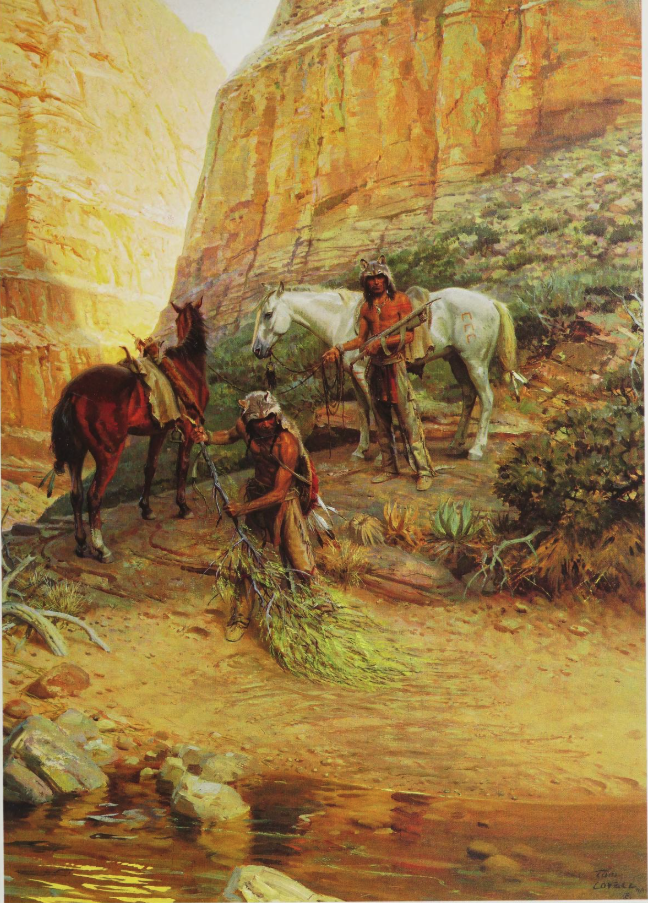
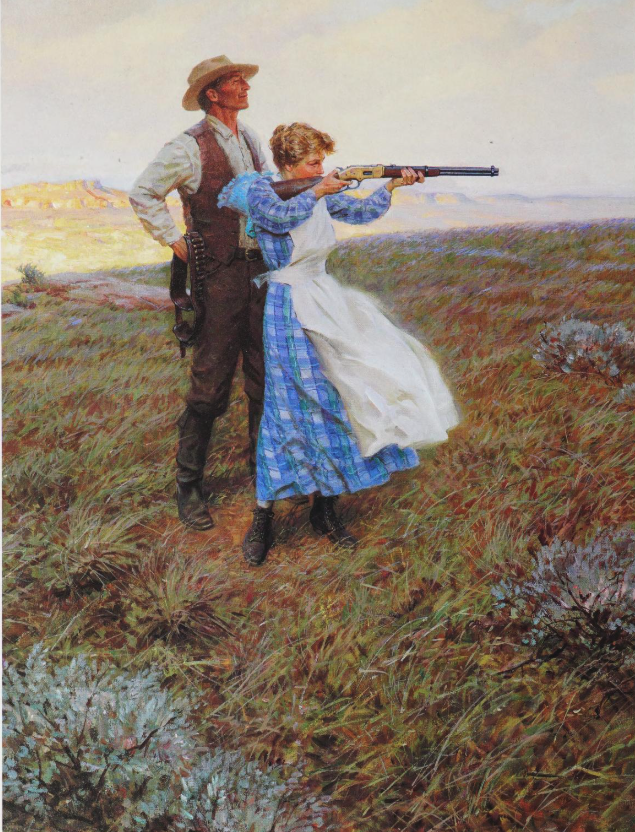
The Wolf Men won in 1974, depicting Comanche warriors wearing wolfskin headdresses. Don Hedgpeth shared that such dog soldier societies “guarded the camps during periods of intertribal raiding, preserved discipline during tribal hunts, provided leadership in war, conducted dances and ceremonies for the tribal gatherings, and passed on tribal history and folklore”. In the painting, two dog solders “are covering the tracks of a war party which has crossed the river into enemy territory”. A dozen years later, Lovell won again with Target Practice.
Those paintings show the disparate First People and colonizer cultures of the west, while The Heirloom depicts their intersecting differences, not through conflict but in lifestyle. “…more than ten thousand wagons rolled across the western Plains along the Oregon Trail during the decade of the 1840s. … Hardship and hunger rode alongside the overland immigrants. … Hope was abandoned along the trail, and with the weakening of the team of horses, so were cherished items which had been intended for new homes and new lives in the promised land.”
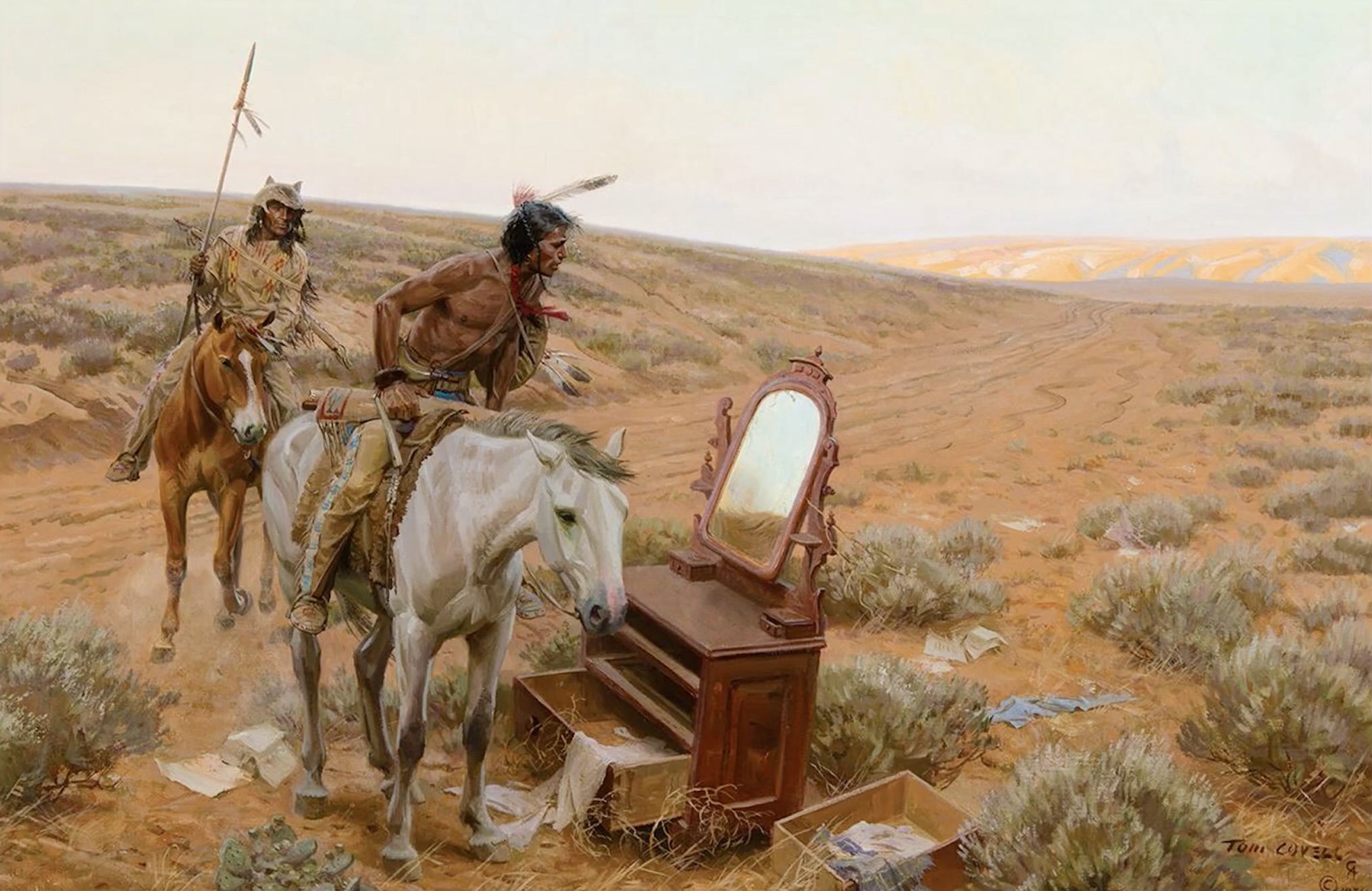
Lovell painted it in the year of the bicentennial, and it sold in 2018 for $134,550. Lovell wrote of it, “Two Sioux Indians ride by and pause to sadly note the beginning of white man’s pollution of their world, which continues to this day.”
That reveals his sympathies, and he noted the topic of his valedictorian speech to his New Jersey high school class was, “The Ill-treatment of the American Indian by the U.S. Government”. He commented, “In retrospect, I wonder how the three hundred hapless parents felt, being scolded by a sixteen-year-old on an otherwise cheerful occasion.”
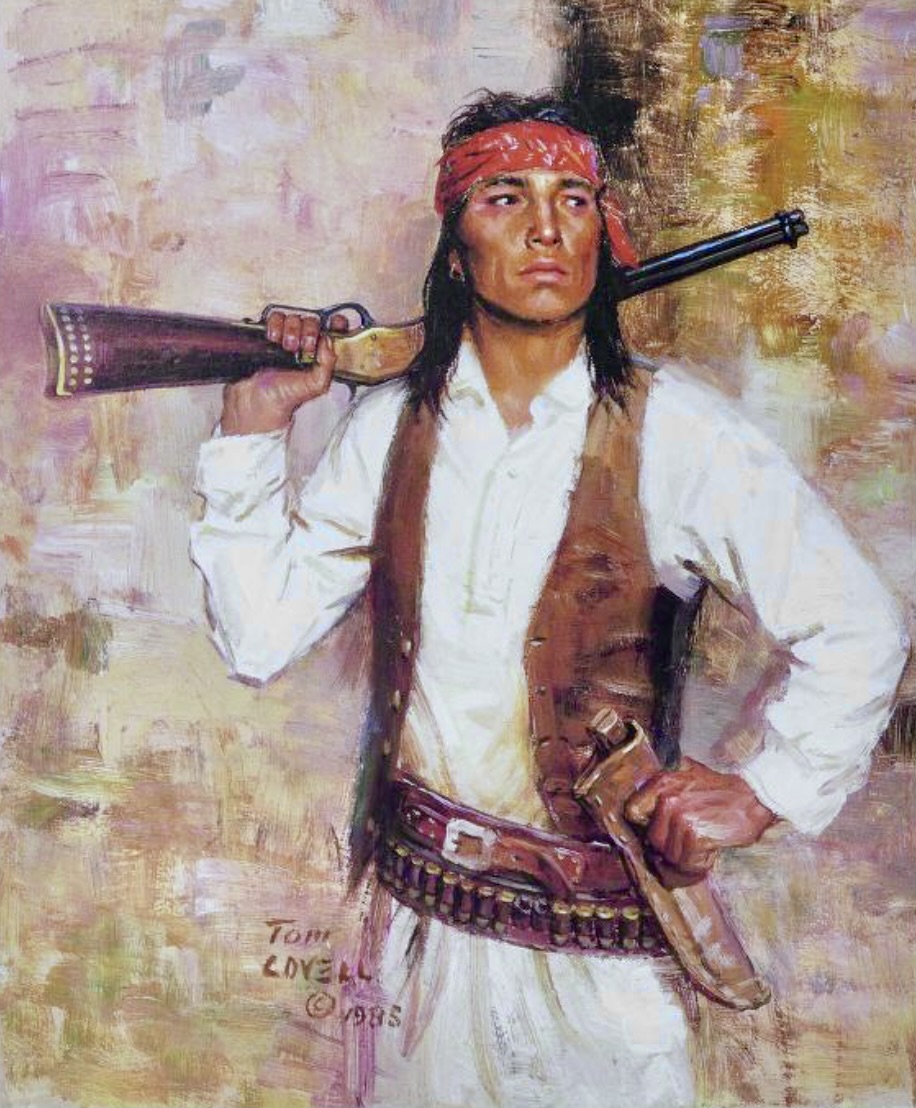
So this guy was both bright and talented, which helps explain why National Geographic would entrust him to do the painstaking research to bring authenticity to his historical paintings. I can admire his paintings that lack a clear narrative, such as Chiricahua Scout. But a bit of research lets us know that the red headband signifies he was an Apache scout for the Army and issued the Springfield 45-70 rifle to help in the tracking and capture of Geronimo, who spent his final 15 years at Fort Sill in Indian Territory and the new state of Oklahoma.
Lovell noted, “The U. S. Cavalry, sometimes numbering 5,000 troops, tried unsuccessfully to capture Geronimo. Finally with the aid of Chiricahua scouts this was accomplished. As a disgraceful climax, these very scouts were rounded up with other Apache hostiles and sent to Florida as prisoners of war. They were separated from their families, contrary to promises made by Gen. Miles.”
Lovell could also depict livelier aspects of the west, such as Culture at Silver City. There is humor in the formal setting and the uncouth audience. Lovell said he created it with no models or scrap of any kind, except for his wife posing for the diva on the stage.
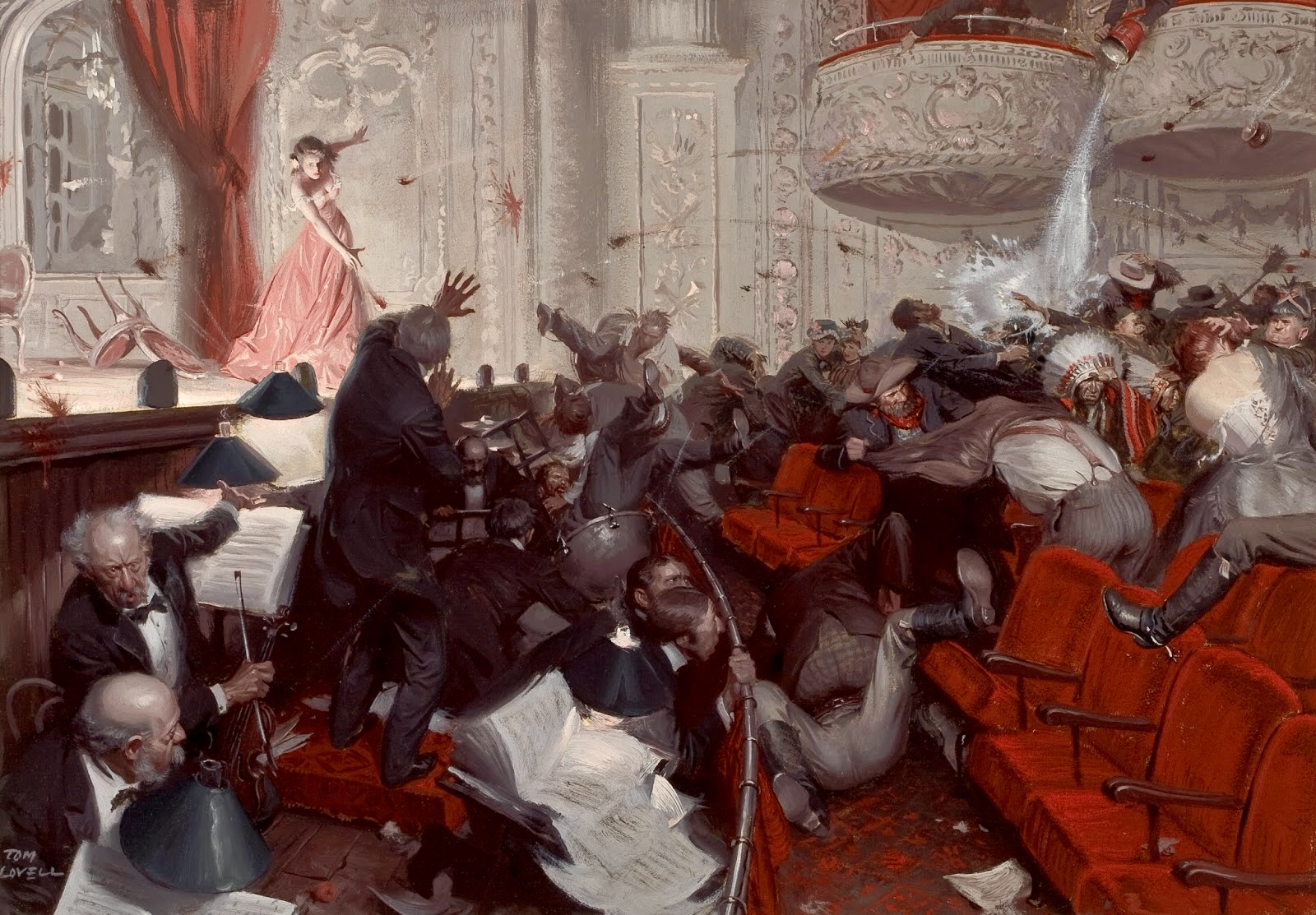
You’ll notice how the painting is almost entirely red and black, which reflects the two-color printing process that was often used for interior illustrations in the middle of the 20th century. So I would speculate the work was created for one of the slicks.
His Short Story Illustrations
Lovell’s later work is impressive, but more engaging for me are his works crafted to illustrate various short stories. The images lead the viewer to speculate about the unseen story. An example, which also features mostly red and black, is his Shot in the Dark from 1943.
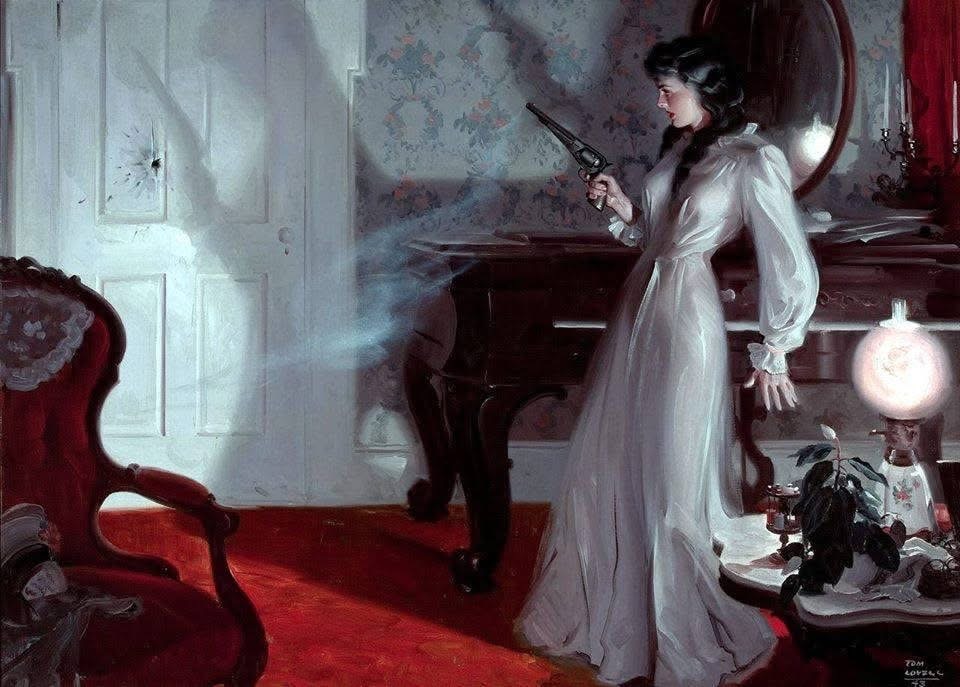
We see an elegantly dressed woman holding a big revolver that has just been fired, leaving a large hole in a doorway. It is obviously night, and she is in a parlor or music room, given the rectangular pianoforte in the background. Did she fire at some intruder who was on the other side of the door? The double shadow adds intrigue.
The time period is uncertain, as the revolver is reportedly an 1863 Remington New Model Army, and the furnishings seem Victorian. The coloration leads one to think this was created as an interior illustration for some short story, but I found no confirmation of its origin.
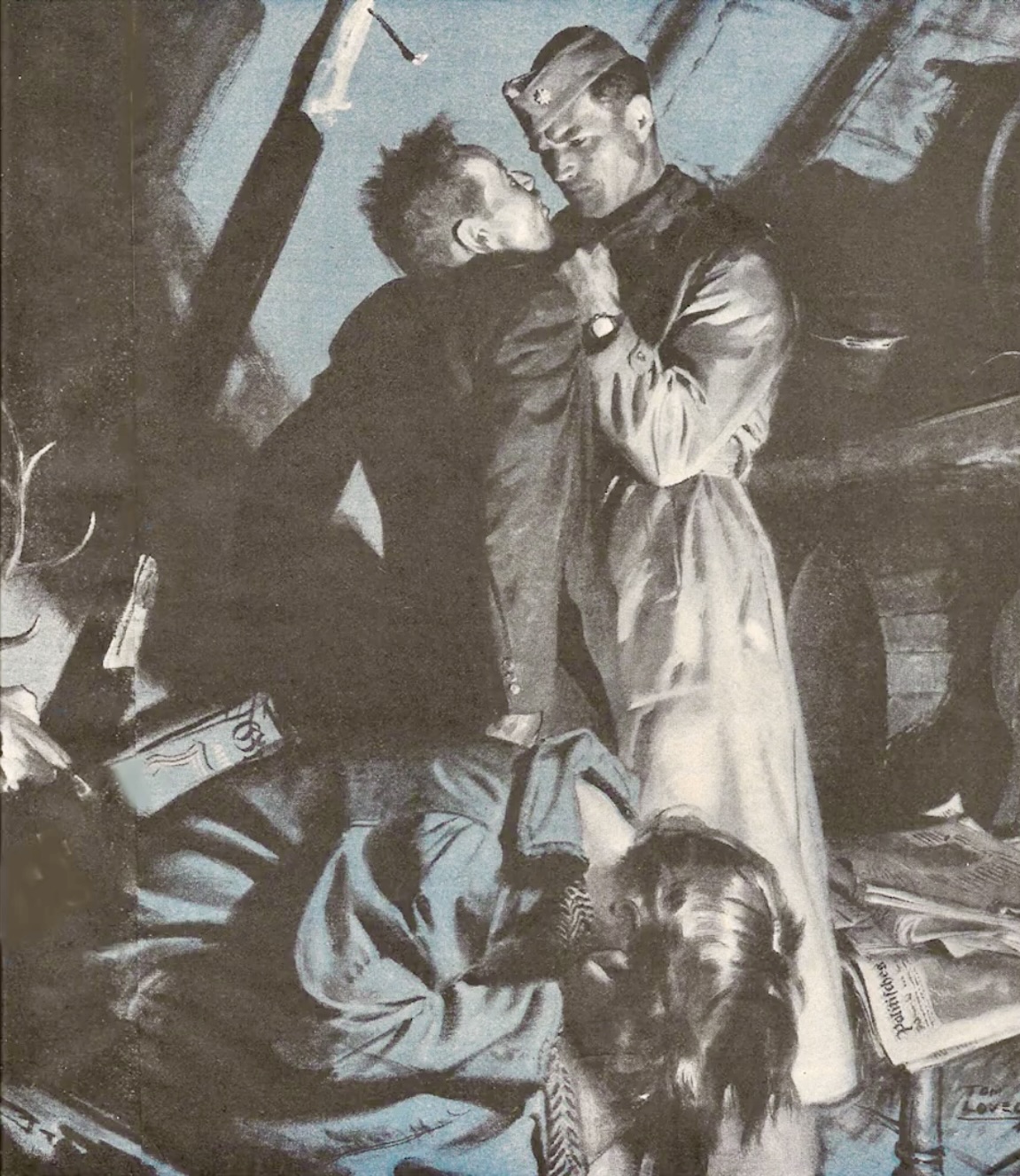
A work limiting itself to black and blue shows a confrontation between a military man and some civilian, with a woman slumped over, holding her head in her hands. German books and newspapers are seen. So does this involve espionage or an underground resistance?
Google Gemini claimed that the piece was captioned, “His hand went up and fastened into the collar of the civilian’s coat. ‘Now, then,’ he said roughly. ‘Let’s have it.'”
It then went on to claim that it accompanied “The Dynamic Man” by C.E. Scoggins in the August 29, 1942 issue of The Saturday Evening Post. However, that might well be just another stupid A.I. hallucination.
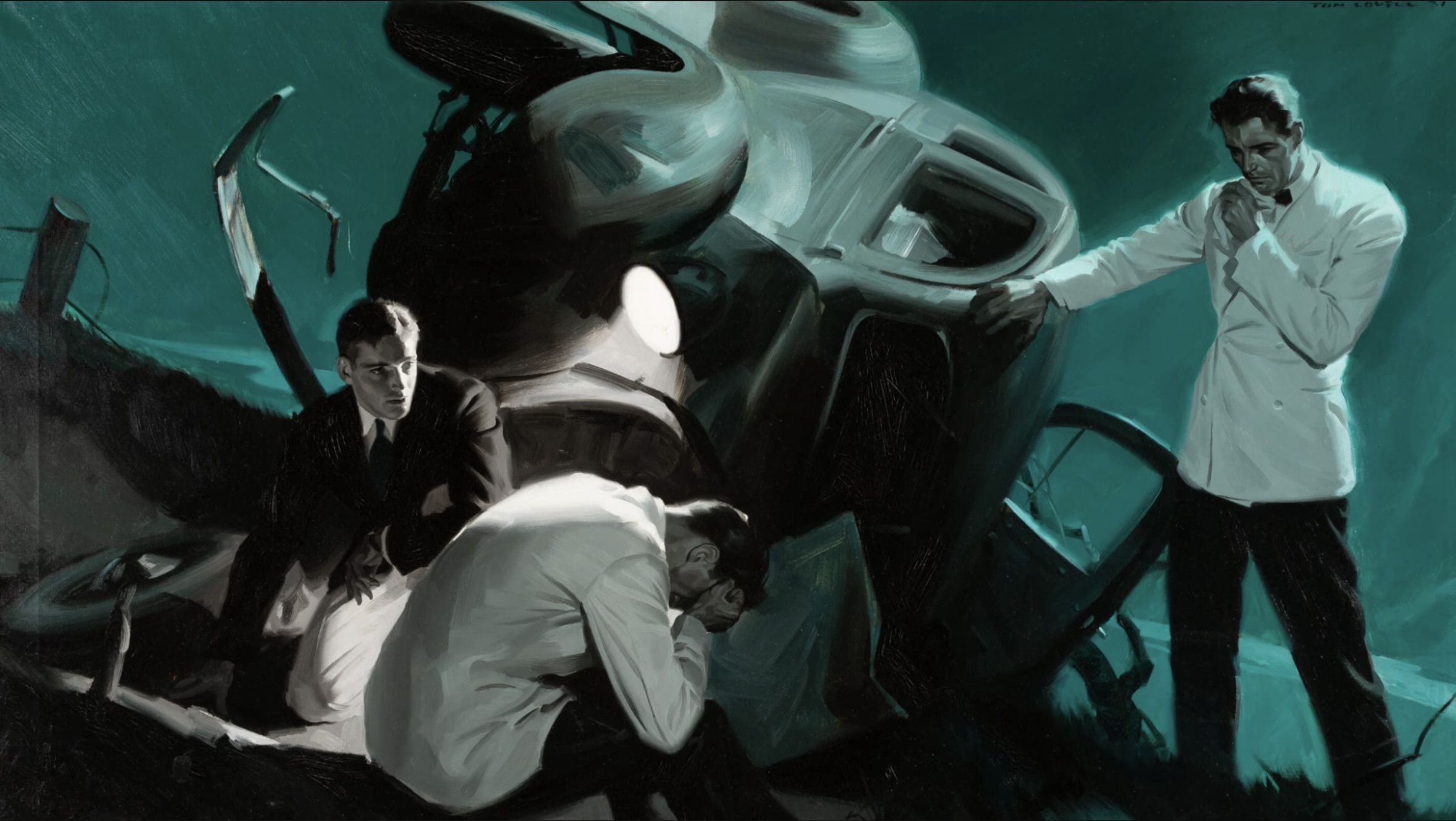
Another scene in black and green shows the aftermath of a car accident, with a wonderful contrast of the men illuminated by car’s headlight versus the moonlit man at right. Were these men in the car, and is there anyone left inside? Is the man holding his head upset about someone’s injury, or just the car wreck? Perhaps he has a concussion? We don’t know, but the crouching man at the left appears in better shape than the others.
The illustration is from another era, not only in the design of the sedan but in the recognizable but now quite uncommon formal wear. One man is wearing a dark suit coat with tie and white pants, while the others are in white dinner jackets and dark pants we would associate with daytime events and warmer climates. The contrasting clothing makes for a more interesting illustration, but is there a story reason as well?
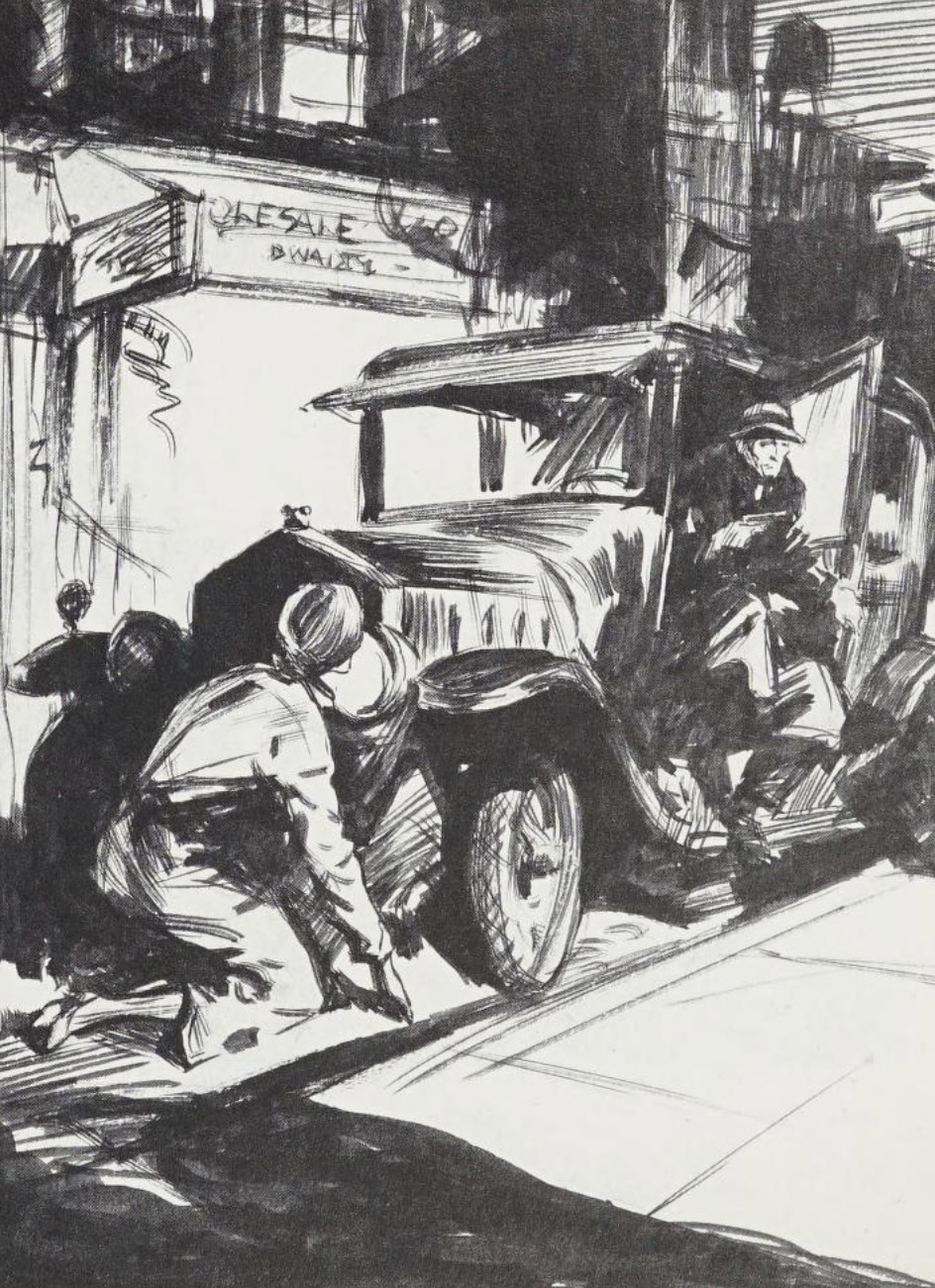
Next let’s step back to the early days of Lovell’s career. It is the late 1920s, and after jobs as a ship deckhand and a construction company timekeeper, he was working on a Bachelor of Fine Arts degree from Syracuse University when he went looking for illustration work in New York City. A pulp editor asked if he could handle “dry brush” and Tom, like many a newcomer, said he could and then rushed home to learn how.
The technique was to dip a brush into a bottle of India ink, brush out most of the ink on a scratch pad to spread the hairs on the brush, and then apply it to create a stroke of many fine parallel lines. That created a gray tone while still just using a single color of ink, and was important to the inexpensive pulps which could use them for cheap line engravings instead of more expensive halftone printing. Lovell could earn six dollars for an illustration and sixty dollars for a magazine cover.
Lovell went on to earn his degree, married a fellow student, and was getting work illustrating The Shadow and Wild West Weekly and various other pulps. After gaining enough experience, he stopped working for the pulps and spent six months preparing new samples to break into the glossy magazines like Good Housekeeping, The American Magazine, The Ladies Home Journal, and Cosmopolitan.
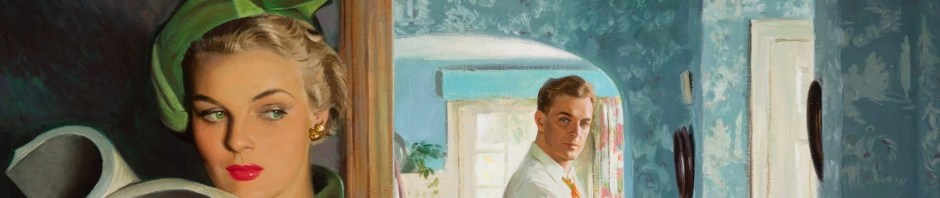
Let’s consider an illustration for the story “Blackmail” by Allan Vaughan Elston in The American Magazine‘s December 1949 issue. We see a blond woman in a nice green dress and hat with black gloves standing in the shadows of a home, holding a telephone directory. She is glancing sideways at a man standing in a bright daylit room beyond. What is going on?
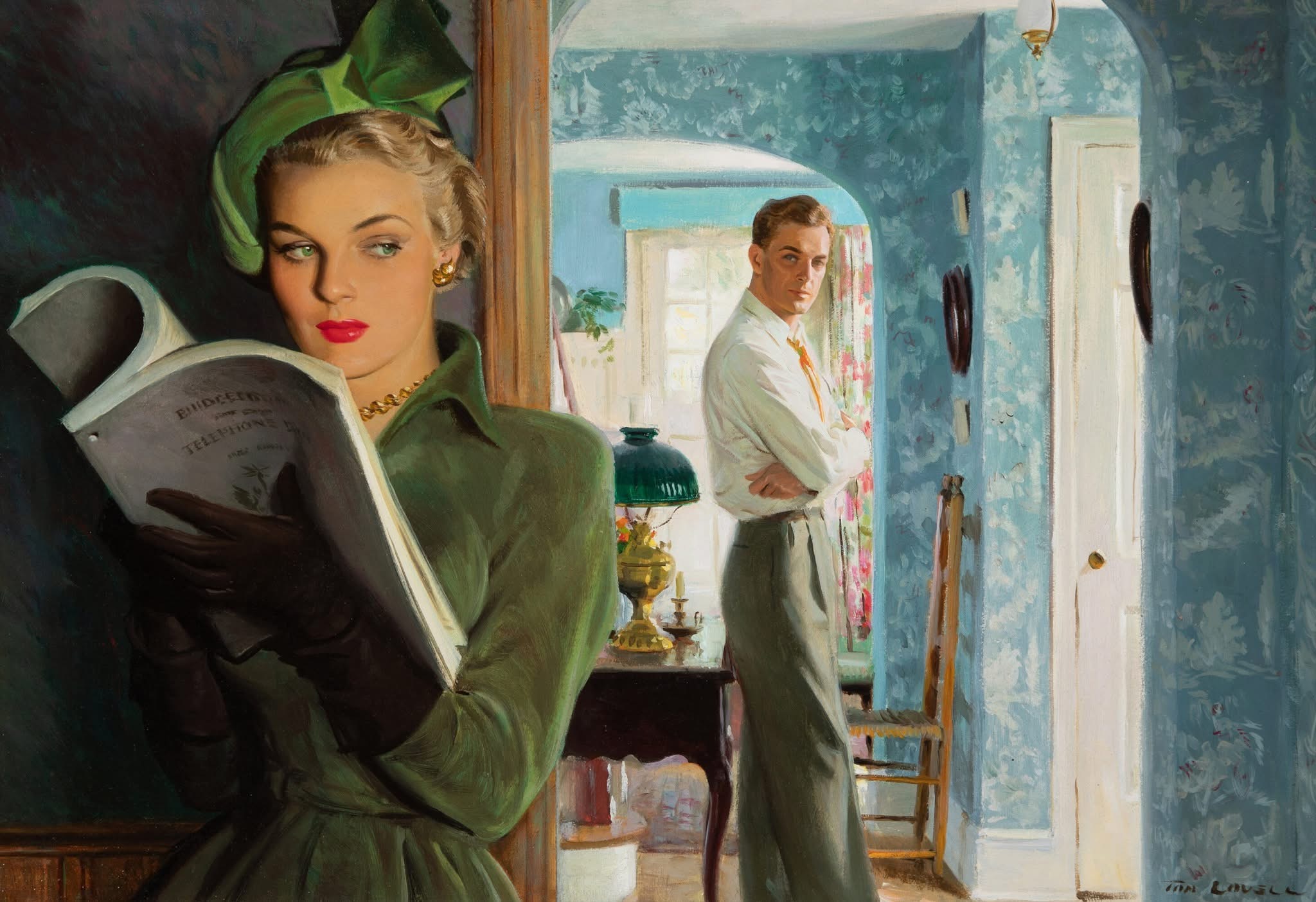
My theory is that she has asked to use his telephone, but is up to something nefarious, and he is suspicious. The internet summarized the story thusly: “An attractive blond goes to the home of Congressional candidate James Norman under false pretenses to plant a fake trail they are having an affair and blackmail him.”
Okay, that fits. However, a pet peeve of mine is when illustrations don’t match the story content, and I wondered if Lovell’s supposedly scrupulous accuracy in later works would be reflected in his earlier short story illustrations. I was able to track down a reprint of the story on pages 26-37 of the March 1953 issue of Ellergy Queen’s Mystery Magazine. The story begins: “The woman was blonde and attractively thiryish. Her suit, handbag, and hat matched, rather startlingly, in a pale shade of green.” Check.
She rings Norman’s front door and asks to look up an address in his phone book, claiming to be late for a dinner party in the neighborhood she had thought was in that block. He invites her in, directing her to an alcove. There she picks up the phone book, thumbs through it, and emerges a bit later. So far, so good.
However, in the story the scene occurs after 7 p.m. when “twilight hadn’t yet faded” which doesn’t at all match the daylight streaming into the front room in the illustration. Worse, the woman in the story stares ruefully at smudges on her finger tips that look like garden mud, using that as an excuse to access a bathroom and plant her make-up compact in it. Yet in the illustration, she is wearing black gloves, which would ruin her plan.
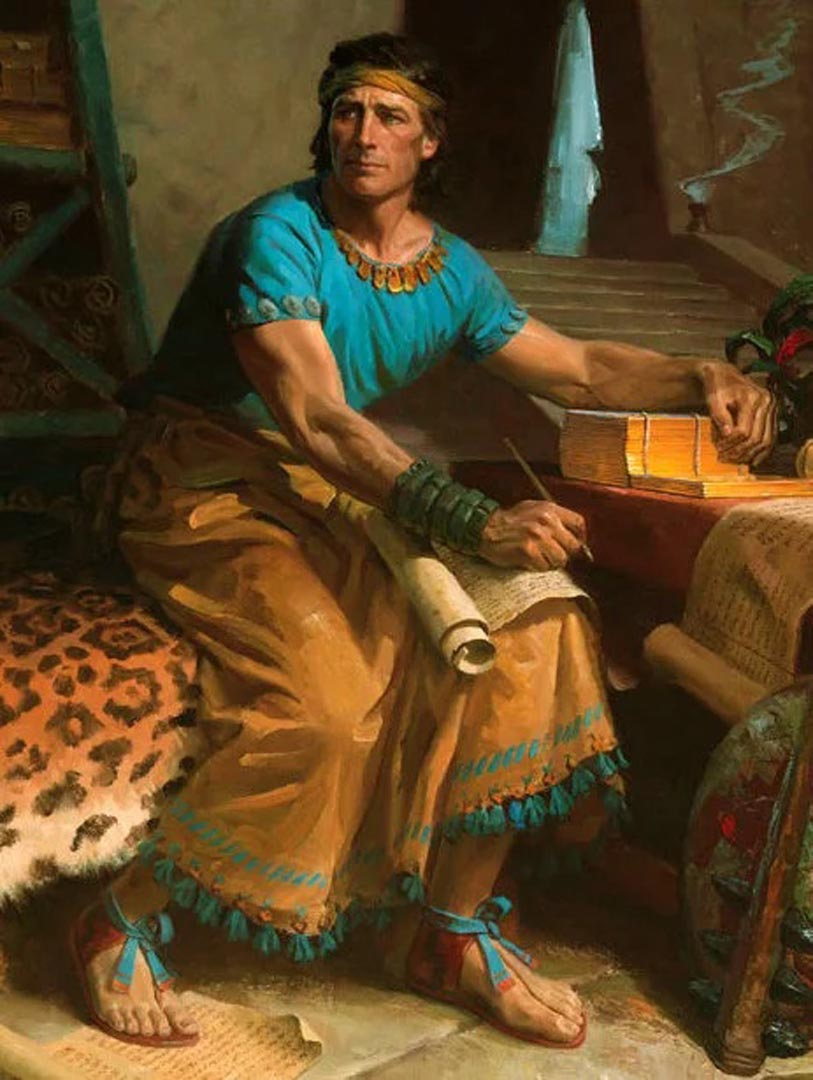
So while I admire Lovell’s artwork, and it did get me to read the entire short story, it failed to properly illustrate that story. Hopefully he did better in his later work for National Geographic and in the illustrations he created for the Book of Mormon in the 1960s and early 1970s when he was desperate for commissions. Reportedly his paintings continue to appear alongside others by Harry Anderson, Arnold Friberg, and Ken Riley in the church’s magazines, digital media, and curricular materials.
Common Ground
I had fun tracking down the story for his 1949 “Blackmail” work, but I had no such luck for a more intriguing painting from 1940, created for Sarah-Elizabeth Rodger’s short story “Common Ground” in the June 1940 issue of Ladies Home Journal.
The painting shows two women. One is sitting upright and stoic, with a tear glistening in her eye, comforting a woman slumped across her lap. The seated woman is wearing a wedding ring, but Lovell has carefully positioned the other to show she wears no ring. So what is going on?
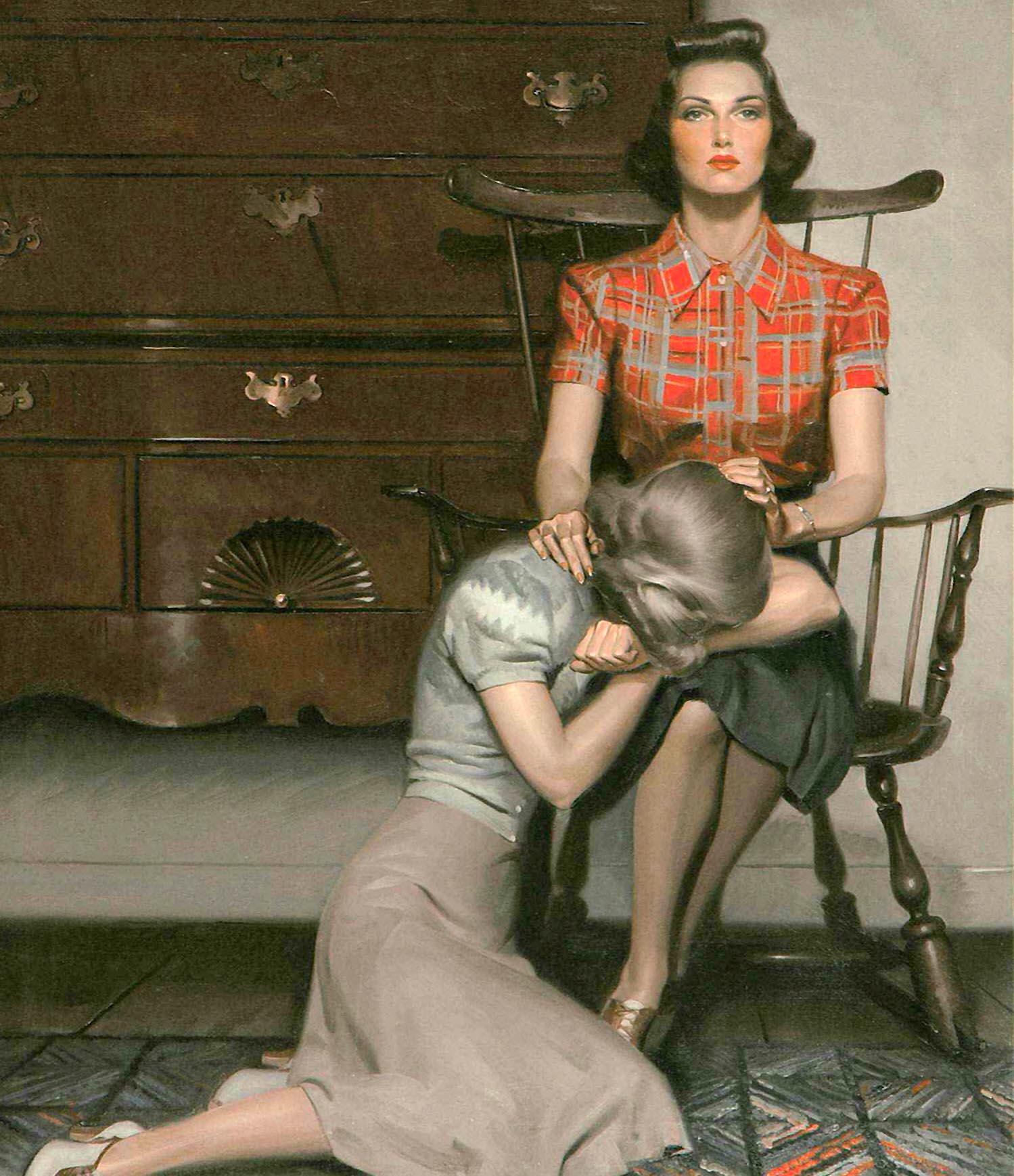
The title of the short story has led people to speculate that the seated woman is the wife, and the slumped one is the mistress, of a man who had been reported killed in World War II. However, the timing of the short story is rather early for that if the ladies were Americans. Some have speculated that it might show a mother comforting a daughter, but to me the women aren’t far enough apart in age for that. The platinum blonde being comforted is interesting since genuine platinum blondes are quite rare, and her subdued and stylish clothing and heels are more posh than the cheaper and bolder textiles of the seated woman’s outfit.
I couldn’t locate the text of the story, but a Facebook post reported that the story is about two friends, poor Anne and wealthy Helena. Helena is a wealthy hardware heiress who married Karl, a baron in Europe. She divorces him and returns to America, sheltering at a small cottage in Connecticut to visit Anne and her husband and baby. The husband’s job pays $30 per week, while Helena receives $300,000 per year from a trust. Helena gives the husband a lead on a new better-paying job, which he accepts. Anne is in a panic that her husband is about to run off with Helena.
Then Helena receives a cable that her ex-husband has died in an air race in Austria. She weeps on the lap of Anne: “When the cable came about Karl, Anne’s tears fell with her own. ‘Helena, it’s much better than many endings,’ Anne said.”
I can’t check on the accuracy of the illustration, but I do think Lovell did a marvelous job conveying the sadness and fear that grip Anne, and the dark wood of the dresser provides a lovely contrast for the silver and gray for Helena. The spoiler ending is that a friendly neighbor of Anne and David declares his love for Helena, they quickly marry, and they leave for Europe. Anne, David, and baby are left behind together in Connecticut, looking forward to an easier life with David’s new job. My guess is that the European conflict might not enter into the story at all, what with Helena happily moving back and forth between Europe and America.
Storytelling with a Brush
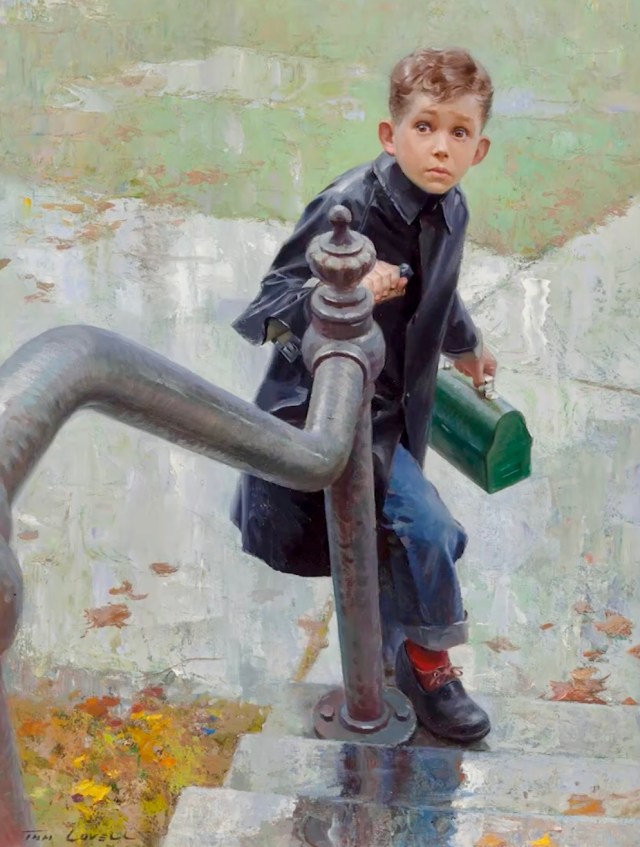
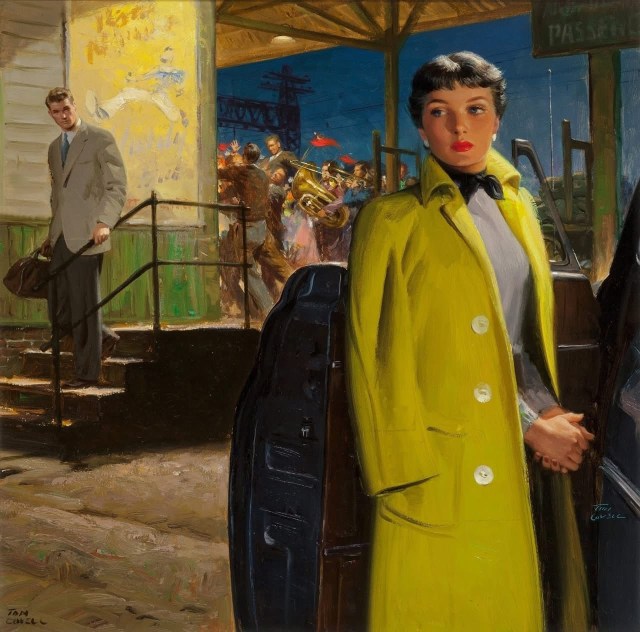
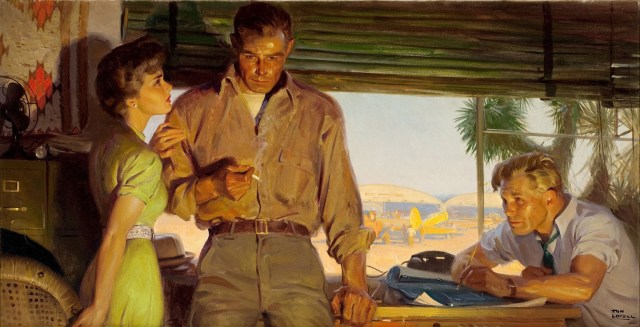
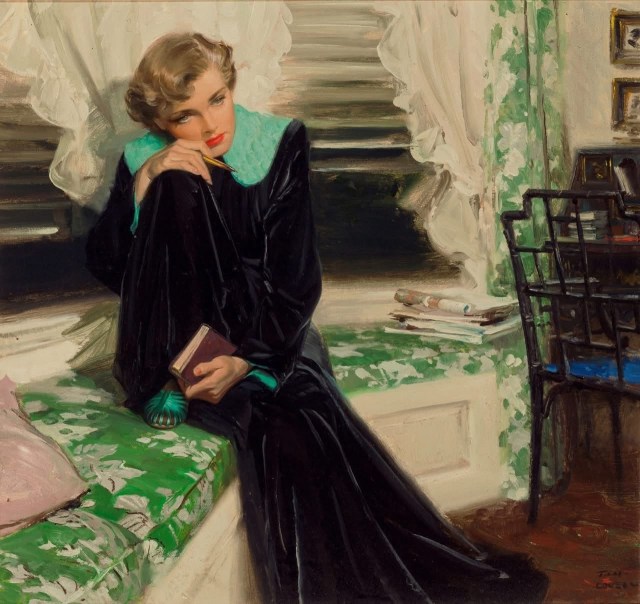
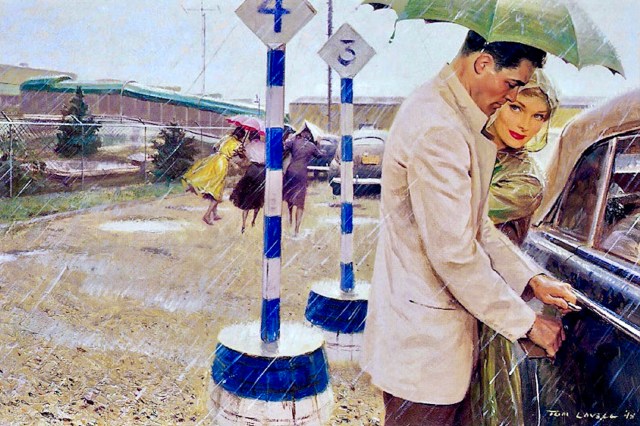
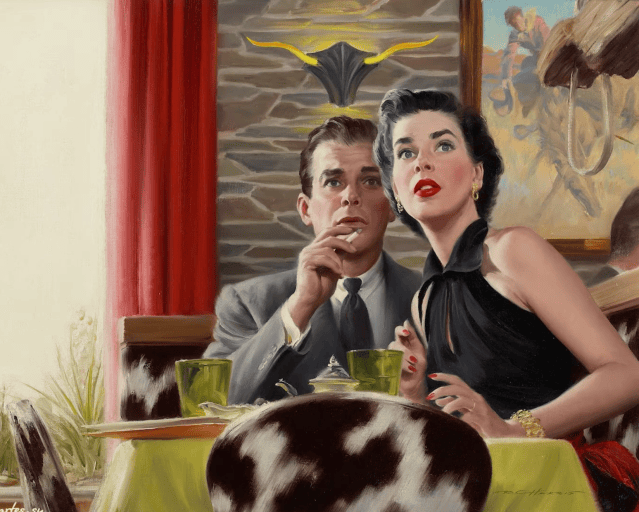
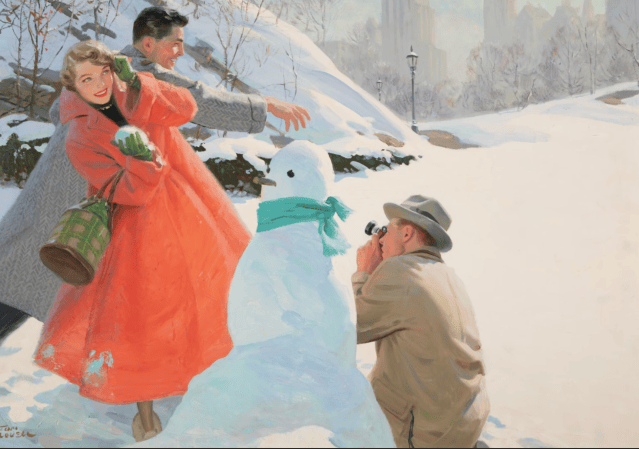
Lovell’s lingering illustrations, separated from their inspirations, inevitably invite speculation. In invite you to use the controls to click through the 19 images in the slideshow below.
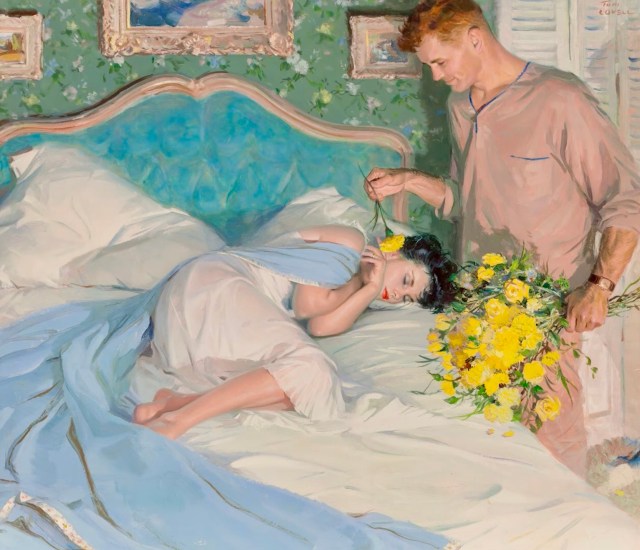
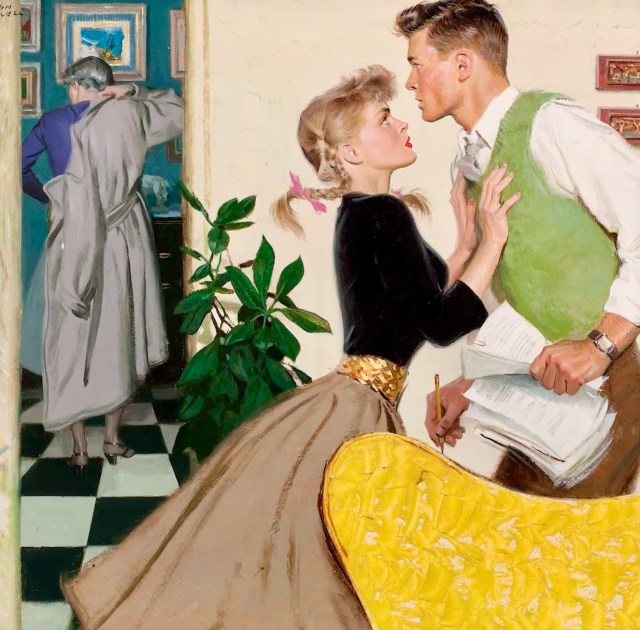
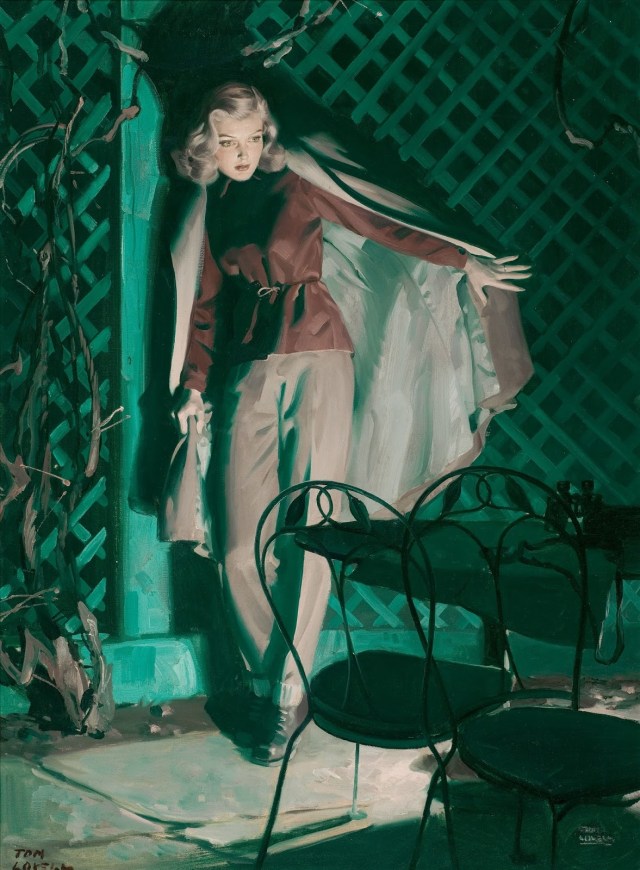
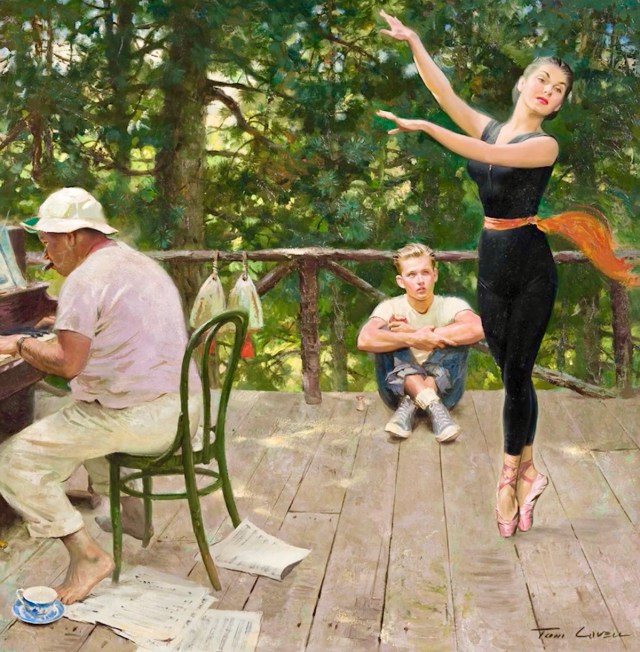
One particular mystery is this painting of a white woman frightened by a burning cross in the yard outside her room. Lovell skillfully directs our attention first to the woman’s face, then the burning cross, and only if we examine the picture more carefully do we spot the hooded Klansman peering in at her. Wouldn’t you like to know what story that is from? I surely would.
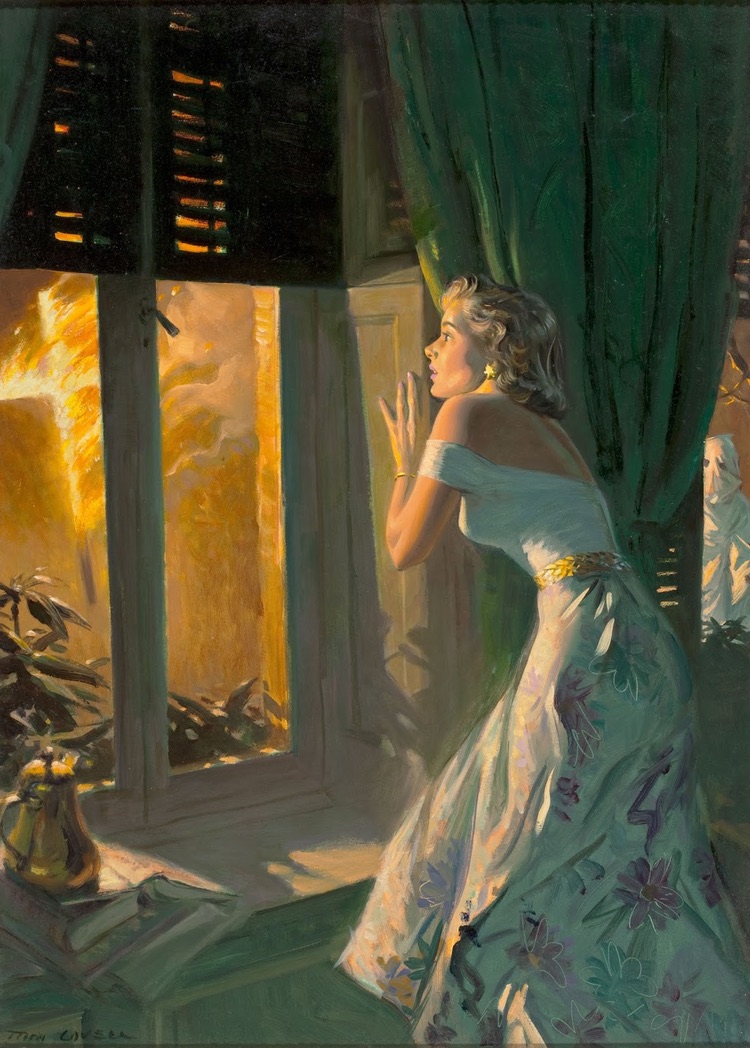
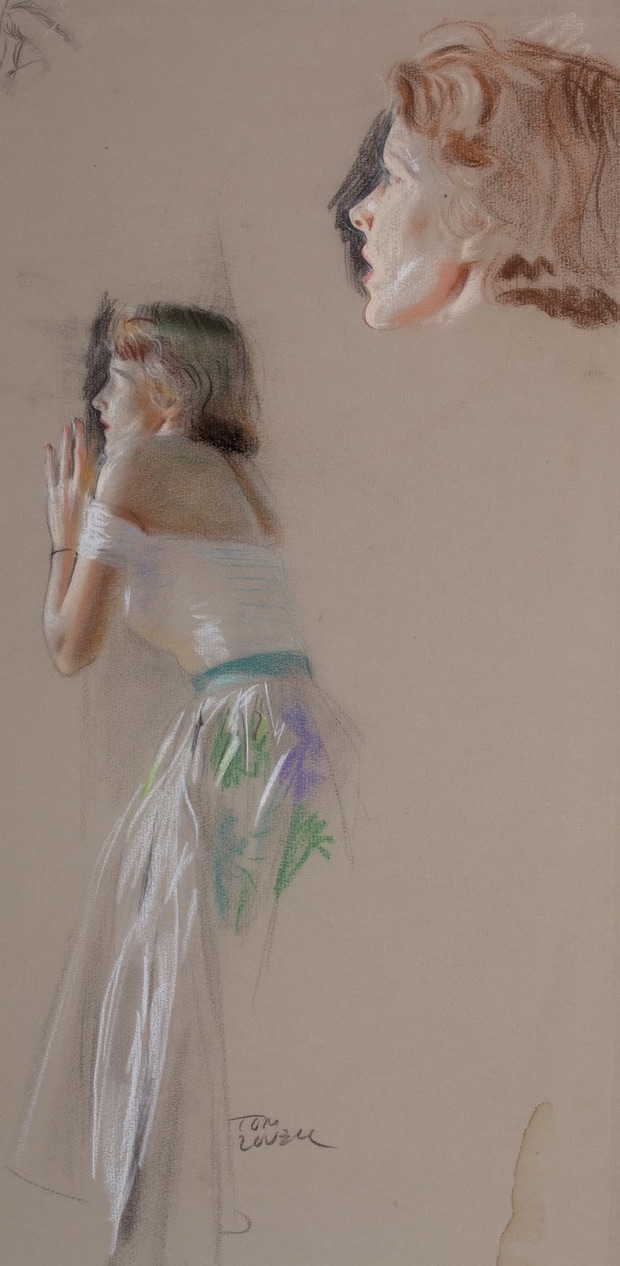
In this case, I located some chalk studies for the piece. Notice how much older the woman appears in them. My guess is that his wife was the initial model, while he adjusted the face in the final painting to better match the accompanying story.
A Final Mystery
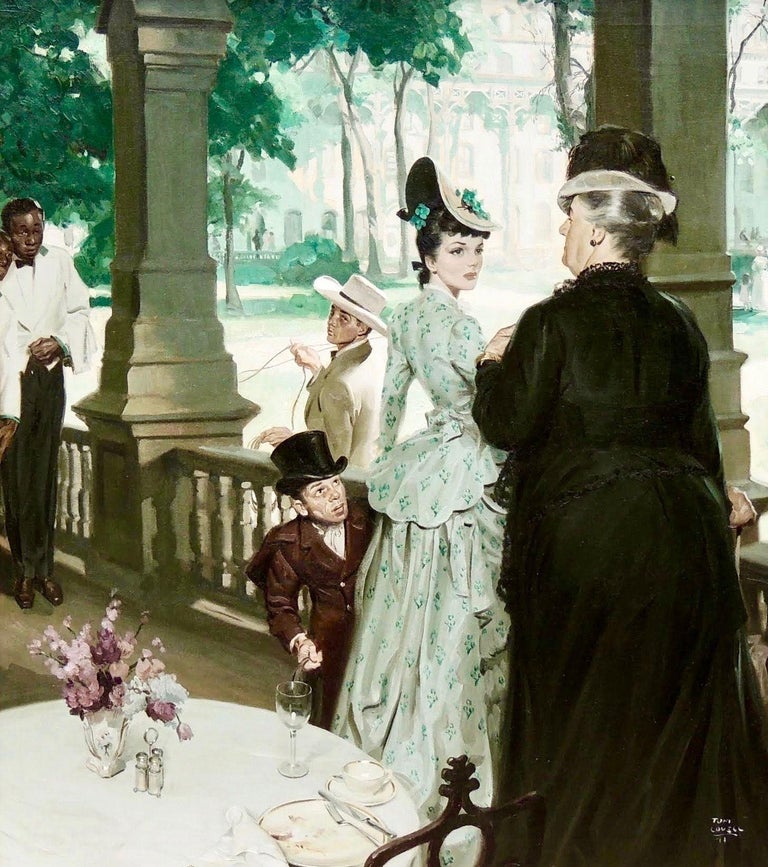
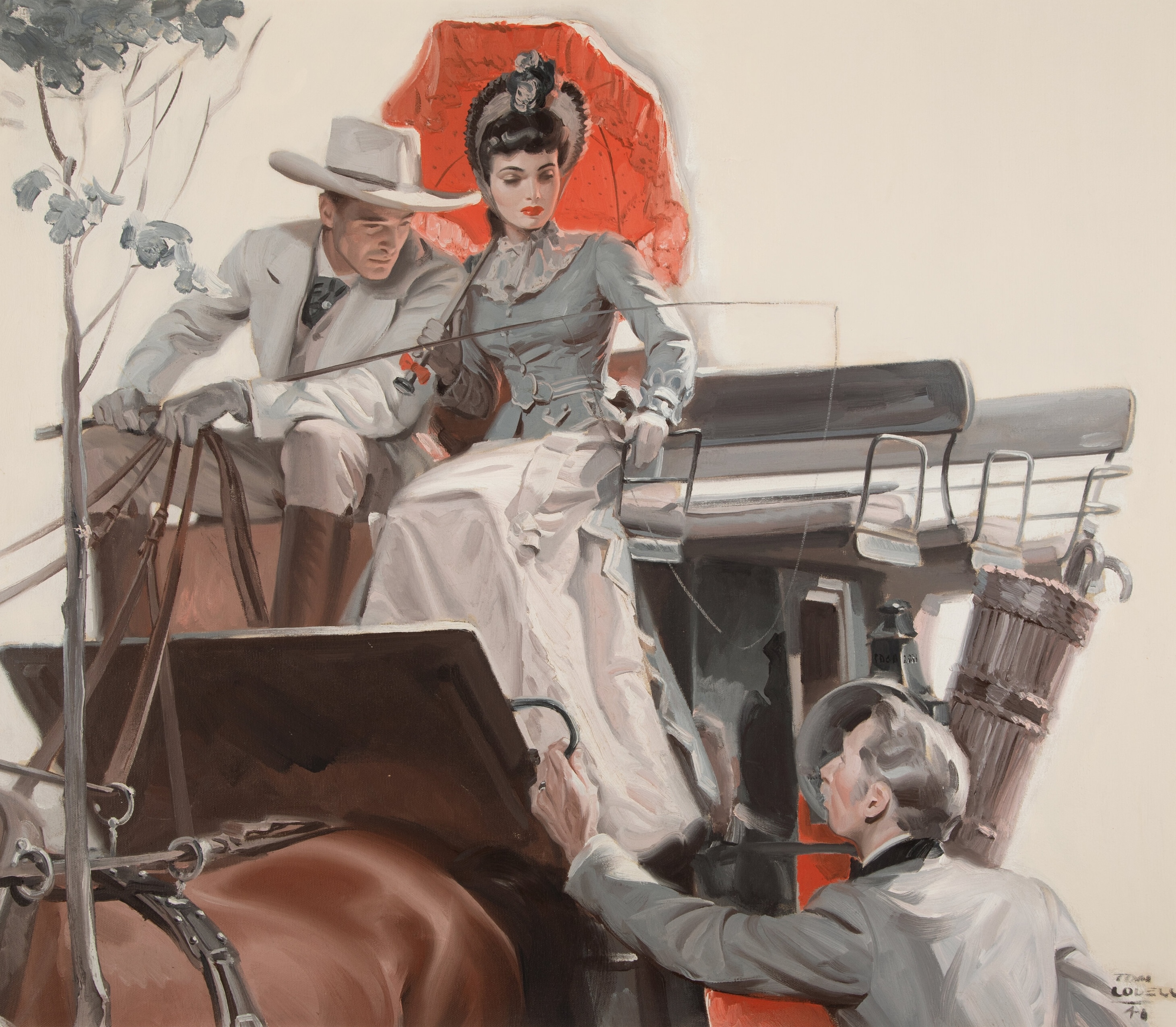
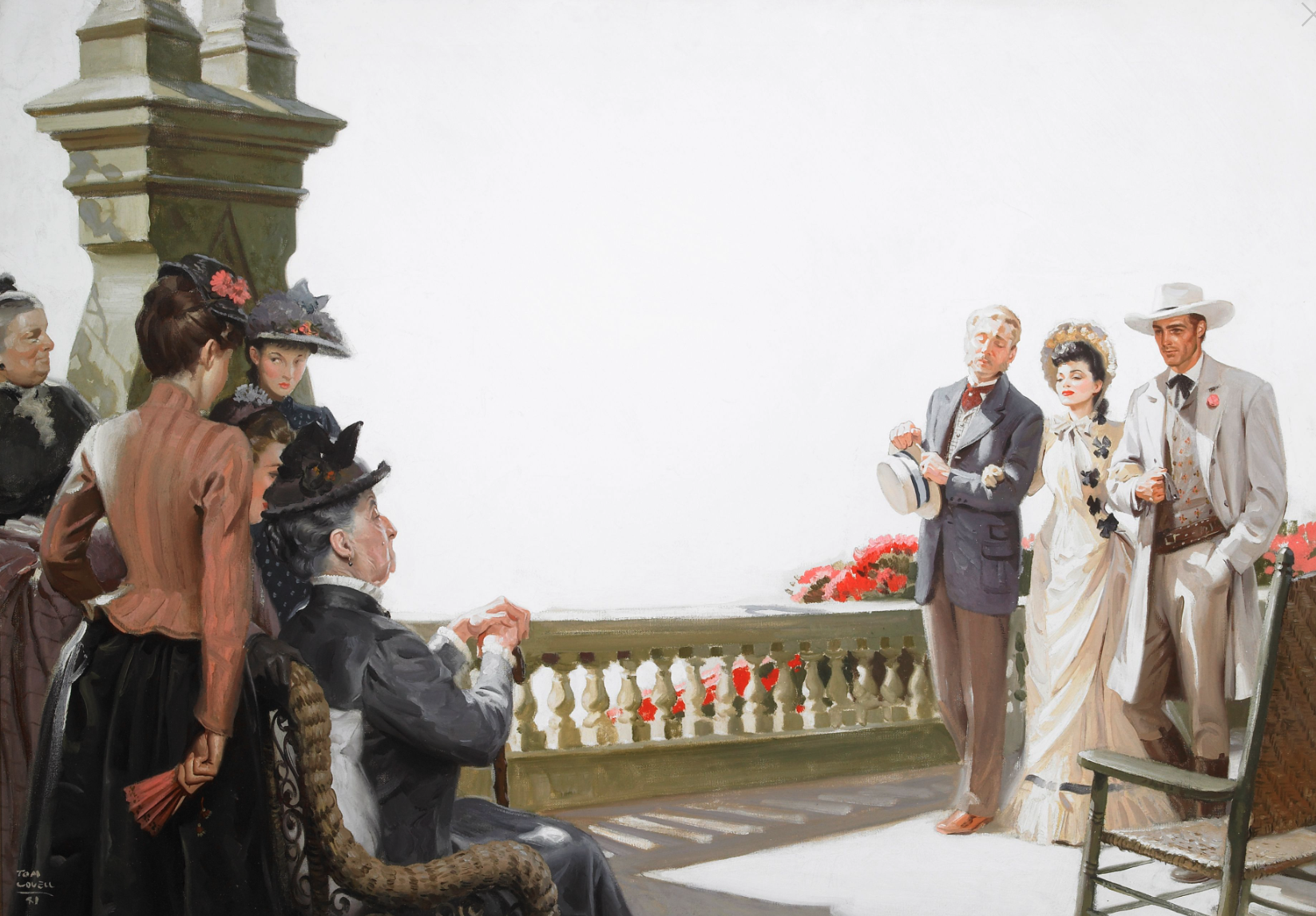
In my gathering of images for this post, I came across two that were clearly from the same story. They include a tall black woman and an older white little person with a young lady in stylish clothes of the late 19th century. I couldn’t help but wonder what story included such diverse characters.
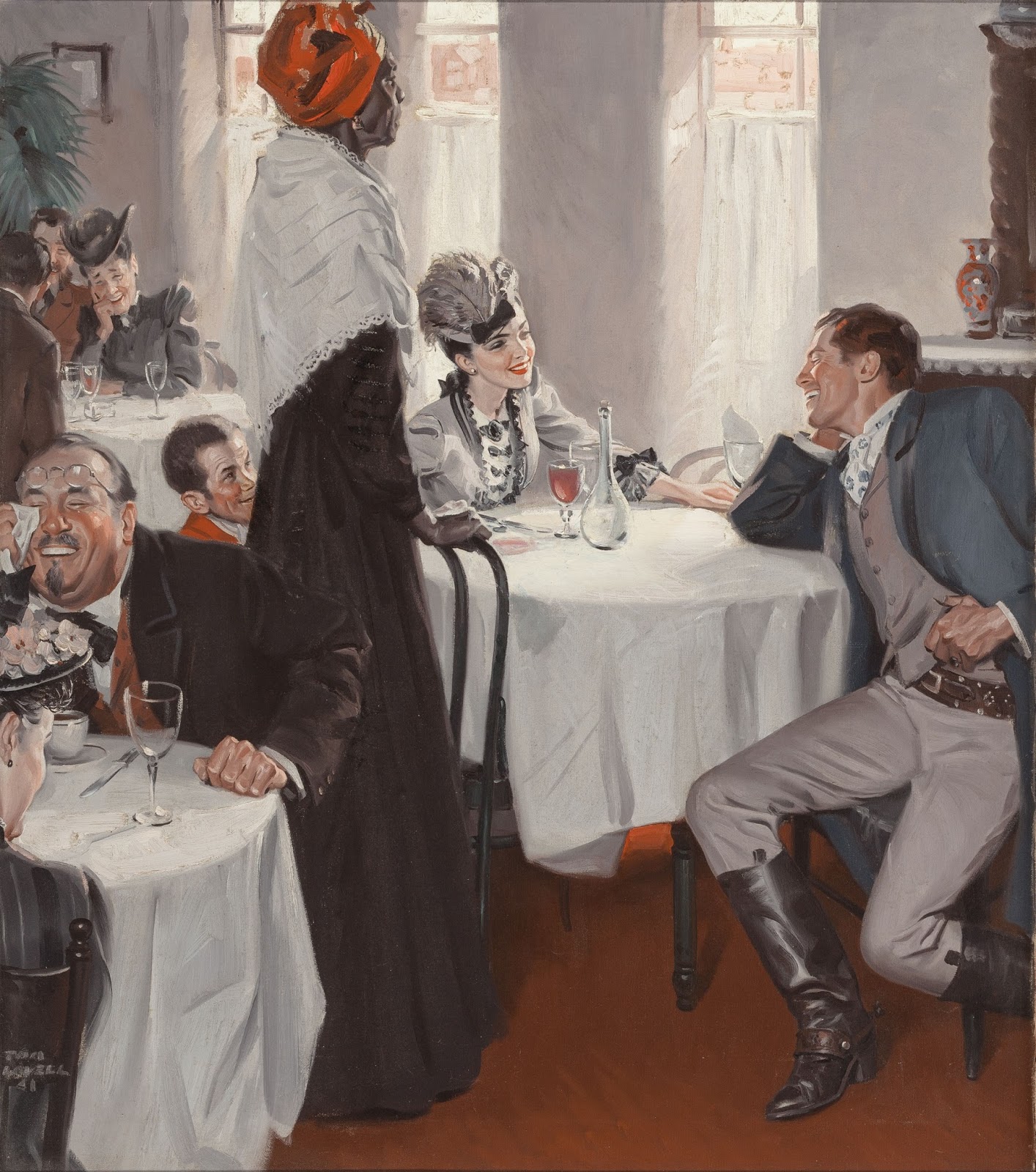
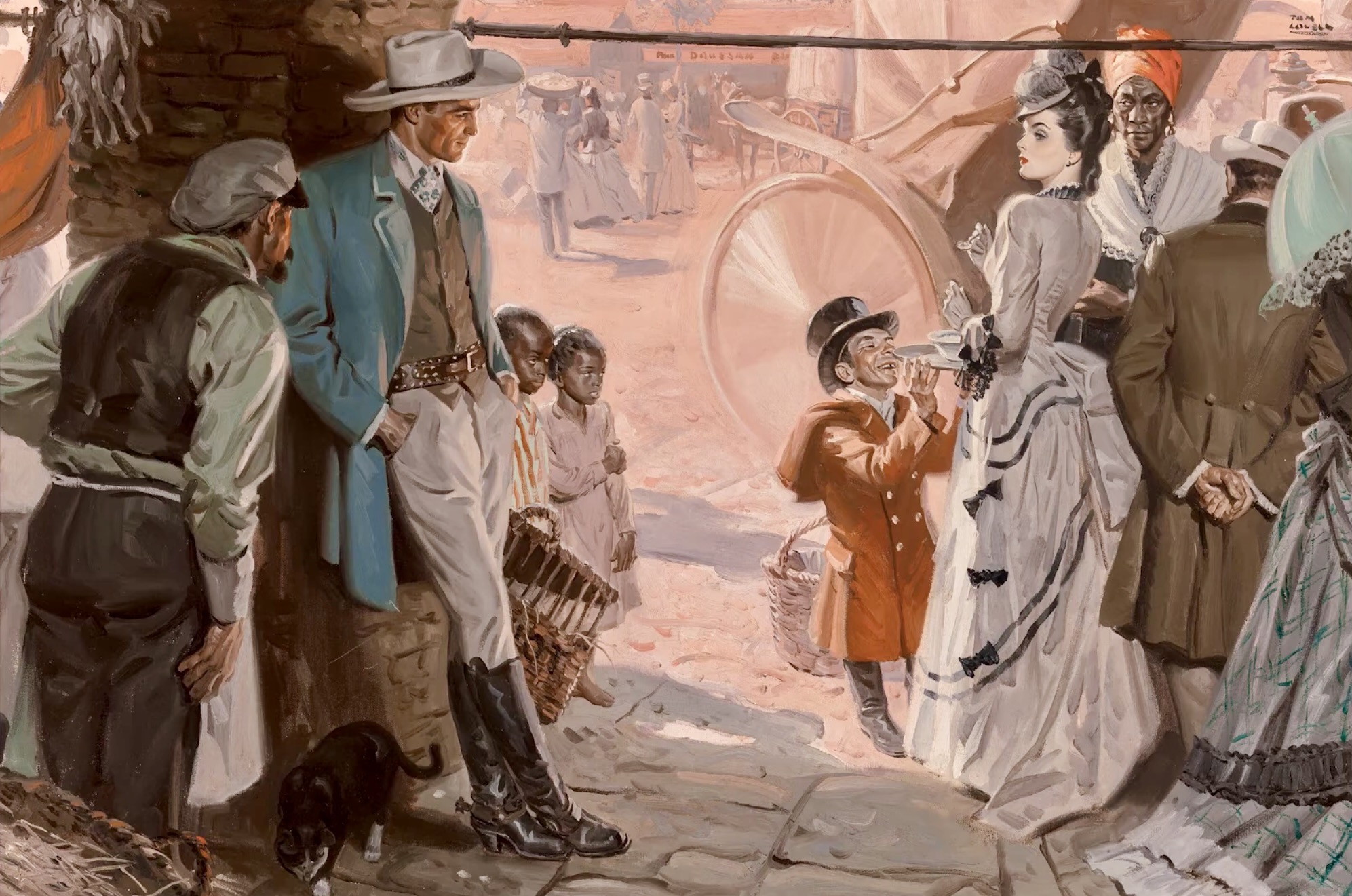
In this case, Google Gemini wasn’t able to figure it out from just the illustrations, but when I added to my prompt that they illustrated a story featuring a tall black woman and a white little person, it deduced they were from Edna Ferber’s Saratoga Trunk, which was serialized in Cosmopolitan in 1941. My knowledge of Cosmopolitan was limited to it being a women’s magazine, popularly called Cosmo, edited for decades by Helen Gurley Brown, and featuring silly romance quizzes.
Well, Cosmopolitan is still hanging on in 2026 after 140 years of publication. It began as a family magazine, and later evolved into a monthly literary one featuring such authors as Willa Cather, Rudyard Kipling, Jack London, Edith Wharton, and H.G. Wells. In the 1940s it was subtitled The Four-Book Magazine since it first section might include a novelette, six or eight short stories, two serials, six to eight articles, and eight or nine special features while the remaining three featured novels and a digest of current non-fiction books. It had sales of 2,000,000 during World War II and could run 150 pages, so I reckon many of its novels were abridged.
After the war, the magazine declined until Helen Gurley Brown became chief editor in 1965 and radically changed it to serve modern single career women. It became racy, contentious, and quite successful. Brown remained editor for 32 years, and the magazine survived the long slow death of print by changing from a monthly to a bimonthly in 2020 and has been published quarterly since 2024.
As for the novel that Lovell was illustrating, Carolyn Kolb wrote: “Clio Dulaine, heroine of the 1941 blockbuster novel Saratoga Trunk, is the beautiful daughter of a free woman of color and her wealthy white partner. Returning to New Orleans from Paris, she styles herself a Countess and has two goals: finding a rich husband and vengeance against her late father’s family (his accidental death while grabbing the gun from her suicidal mother was the cause of the mother’s and Clio’s exile to France). Meeting her match in guile and ultimately her life partner, gambler-cowboy Clint Maroon, Clio scrambles to the top of Gilded-Age society, exemplified by the Saratoga Springs, New York, resort.”
Google Gemini added that the characters I identified in Lovell’s illustrations were “the faithful, unusual servants” who accompany Clio Dulaine when she returns to New Orleans: Angélique Buiton, her tall, fiercely protective West Indian/Haitian maid, and Cupidon, her fiercely loyal manservant and coachman.
Well, I’ve never read a Ferber novel, but I’ve seen Barbara Stanwyck and Bette Davis in the 1932 movie version of So Big, I’ve seen snippets of the movie adaptation of Giant, and I’ve heard of Show Boat as the first serious musical. I also know that Cimarron recently entered the public domain.
A few months before the publication of Saratoga Trunk, Ferber wrote to her editor, “I’ve loathed every writing minute of it … Nothing can convince me that anyone will read this mass of blubber.” Yet the novel was a best seller.
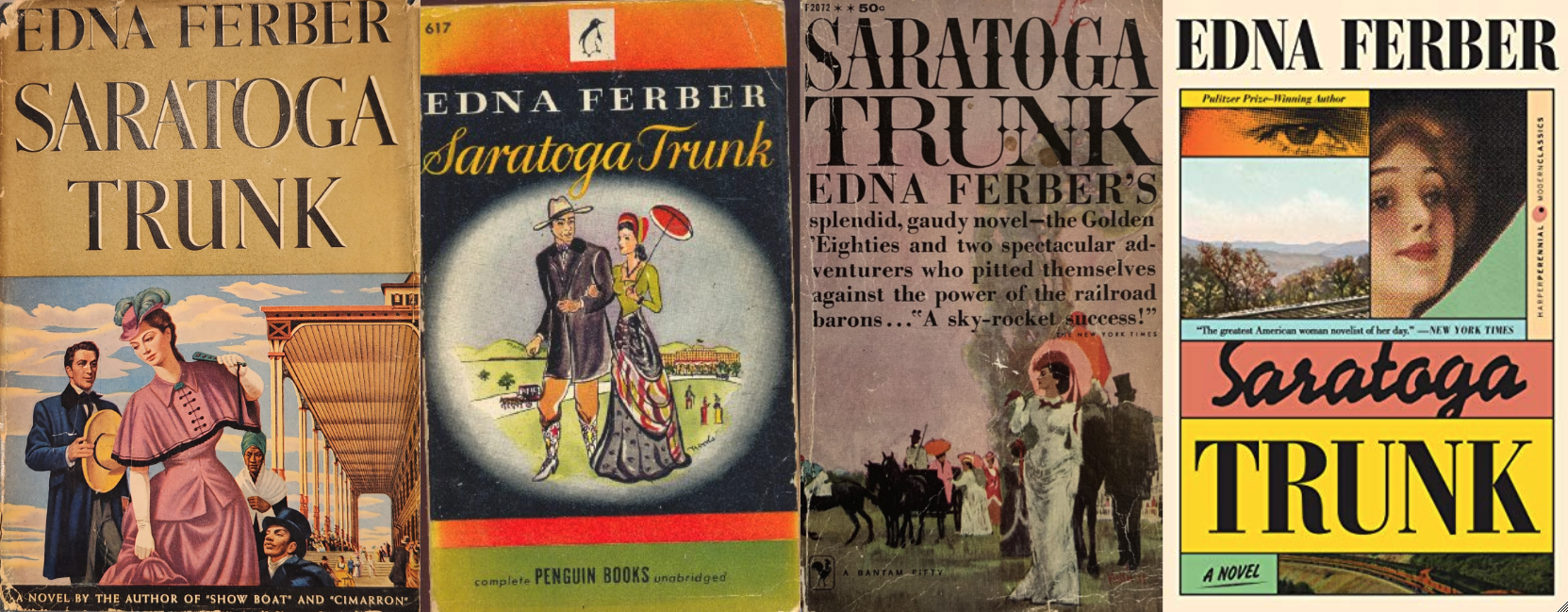
It was also made into a movie starring Ingrid Bergman and Gary Cooper, notable as the only movie in which Bergman sang. I’ve gathered more of Lovell’s work for the serialization by Cosmopolitan, and the five images might tempt me to try my first Ferber novel. I do love Lovell.