Getting to Know the Nones

What is the second-largest religious group in the United States of America? We all know the largest is Christianity, which subsumes Catholicism and numerous Protestant denominations, and can include the more diverse beliefs of Mormons and Jehovah’s Witnesses, along with an increasing number of non-denominational churches. However, it might surprise you, given the outsize media attention given to the 2% who are Jewish and 1% who are Muslim, that the second-largest group are the Nones, those who identify as religiously unaffiliated.

The General Social Surveys of U.S. adults show the Nones have grown from about 5% in 1972 to over 25% today. This post is meant to inform, not evangelize. I have no interest in impacting your personal religious beliefs or nonbelief; rather, I seek to inform your understanding of over one-fourth of us.

[Data source]

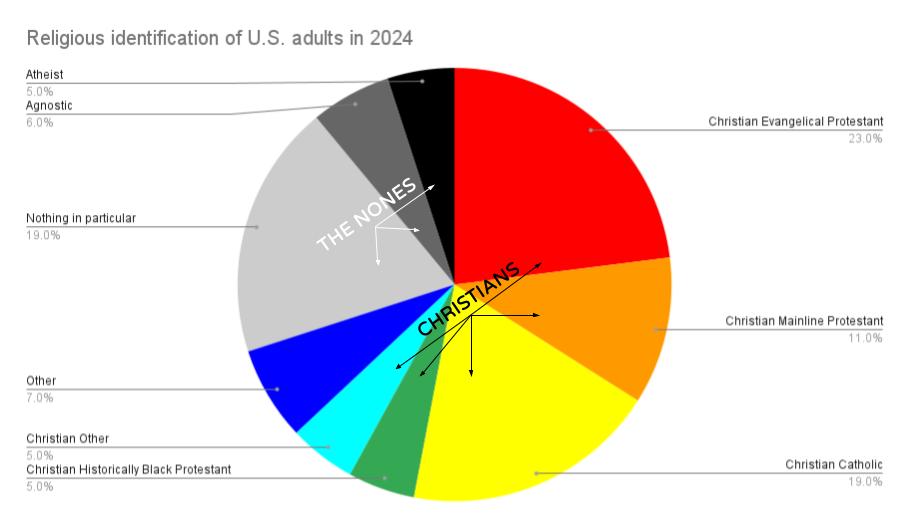
Pew Research has found that the Nones vastly outnumber the Jews, Muslims, Buddhists, Hindus, or other non-Christian religions in America even when all of the non-Christian religious folks are grouped together. In fact, if we group the three basic types of Nones — those who believe nothing in particular, agnostics, and atheists — they collectively outnumber each of the primary Christian categories.
[Data source]

In 2024, 62% of U.S. adults identified as Christian and 29% as religiously unaffiliated. The largest Christian category was Evangelical Protestant at 23%, followed by Catholics at 19% and Mainline Protestants at 11%.

Oklahoma is a hotbed of Evangelical Christianity, with 47% of adults identifying as such, a proportion only exceeded in Arkansas. 70% of Oklahomans identify as Christians of one sort or another, 26% identify as Nones, and only 4% claim other forms of religious belief.

[Data source]

We can break this down even further to compare the religious make-up of Washington County in Oklahoma, where I live, to the nation as a whole, thanks to the Public Religion Research Institute’s 2023 Census.

Religious AffiliationWashington County, OKUSA
White Evangelical Protestant39.3%13%
Religiously Unaffiliated
(The Nones)
21.2%27%
White Mainline Protestant15.4%14%
Other Protestants of Color
(e.g. First Peoples)
7.8%2%
White Catholic5.3%12%
Hispanic Catholic2.5%8%
Black Protestant2.2%8%
Hispanic Protestant2.0%4%
Mormon0.6%2%
Other Non-Christian Religion0.6%2%
Jehovah’s Witness0.5%1%
Other Catholics of Color (e.g. First Peoples)0.5%2%
Jewish0.4%2%
Muslim0.4%1%
Buddhist0.4%1%
Orthodox Christian0.3%<1%
Hindu0.3%1%
Unitarian Universalist0.3%<1%

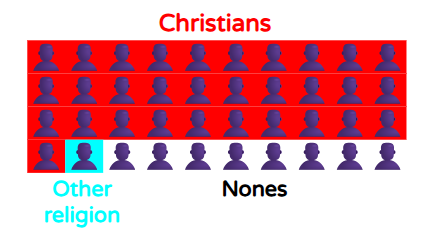
If tables aren’t your thing, here’s a visualization of Washington County’s religious make-up:

Washington County, Oklahoma religious identifications

So if you gathered 40 random people where I live, about 31 would be Christians, one would adhere to some other religion, and eight would be Nones.

Atheists versus atheists

The Nones are not a cohesive group. The Pew Research Center breaks them down into those who identify as nothing in particular, agnostics, and atheists. Matt Baker of UsefulCharts earned his doctorate in education with a dissertation titled “Psychological type and atheism: why some people are more likely than others to give up God” and subdivides the Nones into Negative and Positive as well as Implicit and Explicit atheists.

Agnostics” are among the negative/weak/soft atheists while also being explicit about non-belief, while those who identify as “Atheists”, which I’ll distinguish when feasible with capitalization, are known as the positive/strong/hard type who are also, like the Agnostics, explicit about their non-belief but then go beyond skepticism and freethought to contend that God does not exist. You might expect the “nothing in particular” group to be among the negative/weak/soft and implicit atheists, but there is a contraindication for that.

Many nones are not actually atheists

When people are asked about their belief in God instead of their religious affiliation, only 13% of Oklahomans do not believe in God or a universal spirit, which generally corresponds with the explicit atheism of the 9% who identify as Agnostic and 5% who identify as Atheists. But that implies that many of the “nothing in particulars” do in fact hold some sort of spiritual beliefs or are uncertain about their beliefs.
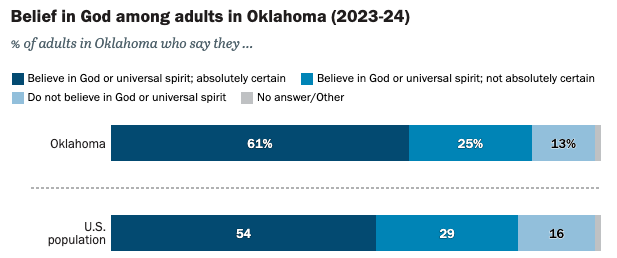
2024 Pew Religious Landscape Study results

Political scientist and former Baptist pastor Ryan Burge wrote a whole book about the Nones. He points out that the religiously unaffiliated in the USA have grown in recent years, from 5% of adults in the early 1970s to 29% today, and that grows to over 40% among the youngest adults. He views that as “the largest shift in American culture in at least the last 40 years.”

Burge examined a wide range of factors that might have played a role in that trend, such as secularization, the rise of the internet, social isolation, changing family structures, etc. However, he concluded that “the best and clearest explanation of the rapid rate of religious disaffiliation can be traced back to the recent political history of the United States.” He cites an exodus of liberals from Christian churches since the rise of the religious right. As some religious leaders and groups became more visible and aligned with conservative politics, many young, liberal, and moderate Americans chose to disassociate from organized religion.

Ryan Burge

Burge says there has been a homogenization process where white religion has become overwhelmingly Republican, with no surviving large liberal white Christian tradition, and pockets of liberalism are often confined to urban and suburban areas.

He notes that only 1 in 20 Americans are positive Atheists, and the textbook Atheist is an upper-educated, upper-class white guy living in an urban or suburban area; the stereotype arises because 60% of Atheists are men and about half earned a four-year college degree. However, the “nothing in particulars” are the least educated religious group in America, with only 25% having a college degree, 1/3 having a high school diploma or less, and 60% of them making less than $50,000 per year as a household. He says many of them are struggling economically and socially.

Burge notes that many of the “nothing in particulars” are not politically active and “feel left out, left behind, lost, unmoored, and disconnected from the larger society.” Counter-intuitively, 15% of those who say their religion is nothing in particular actually attend religious services at least once a month.

Burge also points out that Campbell, Layman, and Green noted differences between being secular and nonreligious. He comments, “Secular people have thrown off the religious worldview and replaced it with something else. Nonreligious people have gotten rid of religious thought but have not replaced it with anything else. They are defined by what they are not rather than by what they are.

He adds, “I think these ‘nothing in particulars’ are not antagonistic toward religion. They’re antagonistic towards a lot of institutions, and religion just happens to be an institution like banks or big business or politics or whatever. But they don’t have a specific beef against religion. That’s why they are still somewhat open to the idea of religious practice. A third of them say religion is at least somewhat important in their lives. They still see some value in it. But they’re not willing to be labeled as Protestant, Catholic, Mormon, Buddhist, or whatever.”

Burge’s categories

In The Four Types of Nones, an August 9, 2025 post on his Graphs About Religion substack, Burge shared some results from a grant he and Tony Jones won from the John Templeton Foundation for a large survey of the non-religious. Their questions were tailored to explore nuances and craft a new typology of the Nones. They identified four groups among the 30% of Americans who identify as non-religious:
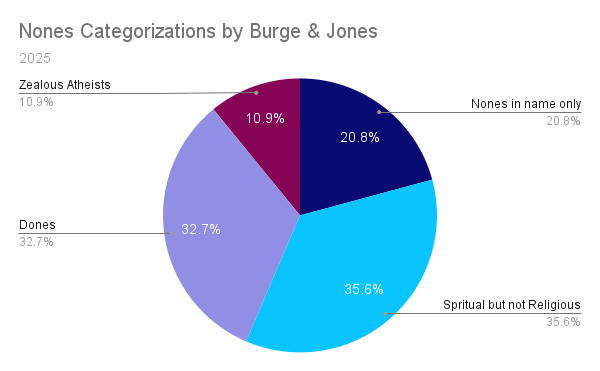
From The Four Types of Nones post on Graphs About Religion

Nones in Name Only

20% of 30% means about 6% of U.S. adults are NiNOs.

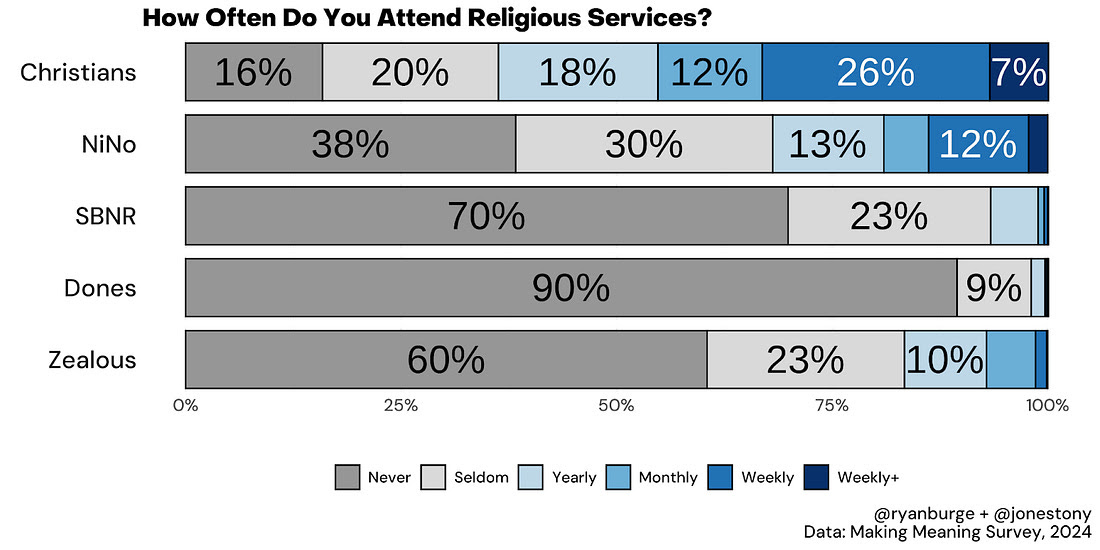
The NiNOs are actually fairly religious on various measures, but they don’t classify themselves as part of a religious group. 3/4 of them choose “nothing in particular” in the usual surveys, 1/3 attend a house of worship at least once per year, and over half of them say they pray on a daily basis, with a similar fraction holding a firm belief in God.

Spiritual But Not Religious

36% of 30% means about 11% of U.S. adults are SBNRs.

The SBNRs are deeply skeptical of religion but highly interested in spirituality. Few of them ever attend church, barely 1 in 10 of them ever prays, and only 1 in 20 holds a firm belief in God. They are the folks who say, “I believe in some Higher Power” and the like. New Age spiritualists who like crystals, yoga, meditation, nature walks, and the like are among the SBNRs.

Dones

33% of 30% means about 10% of U.S. adults are Dones.

They are done with religion entirely. Their metrics on the importance of religion and spirituality are in the basement. Over 2/3 of the Dones rated both religion and spirituality as not at all important to them, whereas only 1% of the SBNRs felt that way, and less than 1% of the NiNos. Burge says, “there is no clearly articulated ‘God-shaped hole’ in the hearts of these folks.”

Burge also shares that when asked if they agreed with, “When I die, my existence ends.”, 26% of NiNos agreed versus 39% of the SbnRs and 77% of the Dones.

Zealous Atheists

11% of 30% means about 3% of U.S. adults are ZAs.

77% of them have tried to convince someone else to leave religion in the past year, versus only 6% of the NiNos and almost none of the SBNRs or Dones. The ZAs tend to be much more visible on social media than the other Nones. As Burge phrased it, they are the folks who “are quick to point out that religious people believe in fairy tales or that they don’t need to pray to Sky Daddy or they mockingly worship the Flying Spaghetti Monster.”

One driver for ZAs, at least in Oklahoma, are frequent public proclamations of faith on social media by their evangelizing coworkers, acquaintances, and fellow community members, especially when that is accompanied by repeated attacks on and occasional breakdowns of the separation of church and state. Zealous Atheists get fired up by the public bullying and lifestyle oppression from demagogues and various wackadoodles. Those who push inevitably inspire pushback.

The ZAs actually engage with religion more than the Dones, with 17% of ZAs attending church once per year or more and about the same share praying in the past year. Burge and Jones speculate that such folks interact with religion enough to remind themselves why they dislike it. Perhaps their spouse or parents are still religious, and they get dragged to some services.
[Source]

Comparing the Categories

Consider these heat maps of spiritual and religious importance:

[Source]

Notice how the share who attach absolutely no importance to spirtuality or religion is more than double among the Dones compared to the Zealous Atheists. Interestingly, 44% of the ZAs pray at least occasionally, while 88% of the Dones never do:

[Source]

Another distinction between the Dones and the ZAs are their ages:
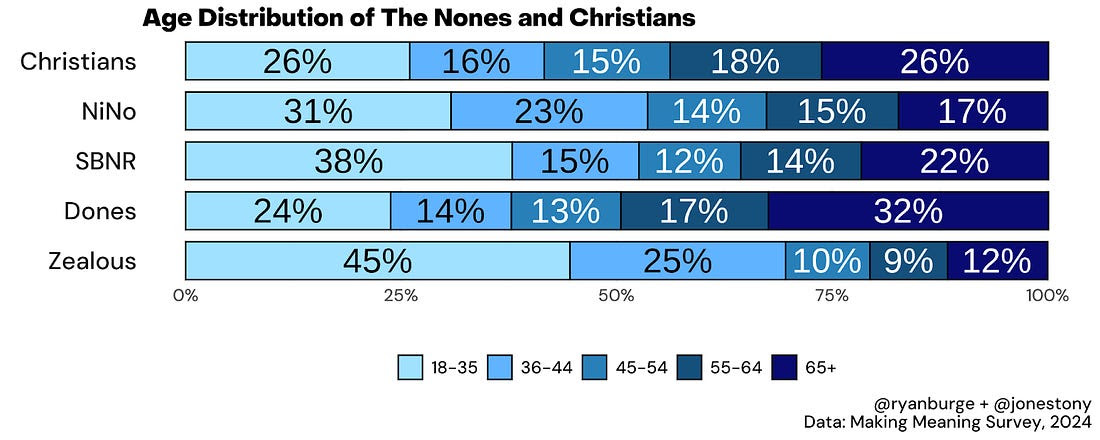
[Source]

As Burge puts it, “In other words, these two categories represent entirely different generations of non-religion in the United States. The Dones are worn out from all the fights about religion. They’ve tried to evangelize their Christian friends to leave church behind. But they just sit back and shake their heads now. On the other hand, the Zealous Atheists still have a fire in their belly to try and change the world.”

Personalities

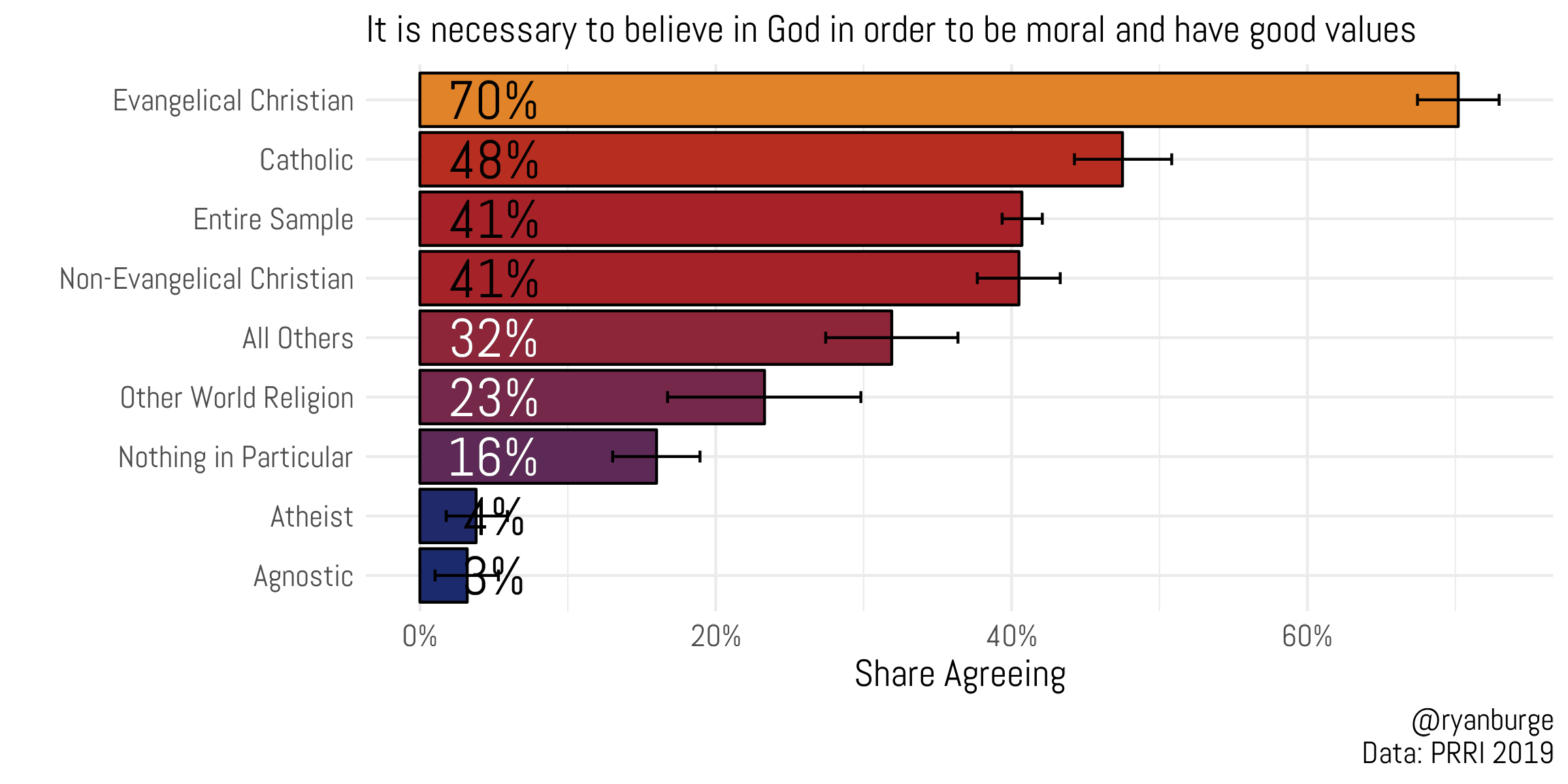
Evangelical Christians take a particularly dim view of Atheists since 70% of evangelicals think one must believe in God in order to be moral and have good values. Only 41% of people overall think that way, but that still means many people believe Atheists are immoral and lack good values. Unsurprisingly, only 4% of Atheists share that view.
[Source]

The 2008 American Religious Identification Survey showed that most atheists in the USA were members of Christian churches as children and “deconverted” as adults. Baker explored how conservative Christians have cited selfishness, arrogance, anger at God, and poor father-child relationships as possible explanations for such deconversions. His research did not support those hypotheses. Less religious emphasis during childhood, deliberation in the pursuit of truth, and higher intelligence did appear to play a role, but they were not nearly as statistically significant as personality traits.

In a previous post I outlined several different personality measures. The one with the most scientific support is the five-factor model, and it is interesting to explore how it correlates with religiosity. A meta-analysis of 71 samples with over 20,000 participants from 19 countries showed that “individual differences in religiousness can be partly explained as a cultural adaptation of two basic personality traits, Agreeableness and Conscientiousness.”

It went on to share that Agreeableness and Conscientiousness seem to predict religiosity rather than be influenced by it. Baker found a much greater link between atheism and the Thinking and Perceiving personality types in the Myers-Briggs personality test, which conforms to those findings.

Unfavorable views

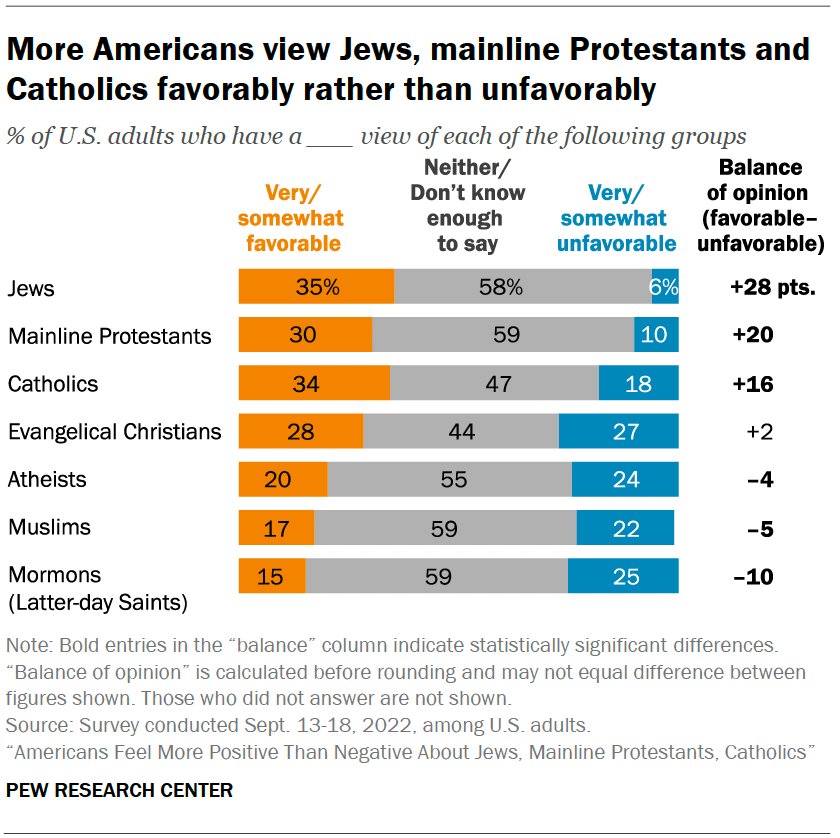
Evangelical Christians often portray themselves as being disfavored or persecuted, and they did indeed enjoy less favor than some other religious groups in a September 2022 survey by the Pew Research Center, faring far worse than Catholics, Mainline Protestants, or Jews, although the balance of opinion on Evangelicals was still marginally favorable.
[Source]

However, the balance of opinion went into the negative for Atheists, Muslims, and Mormons.

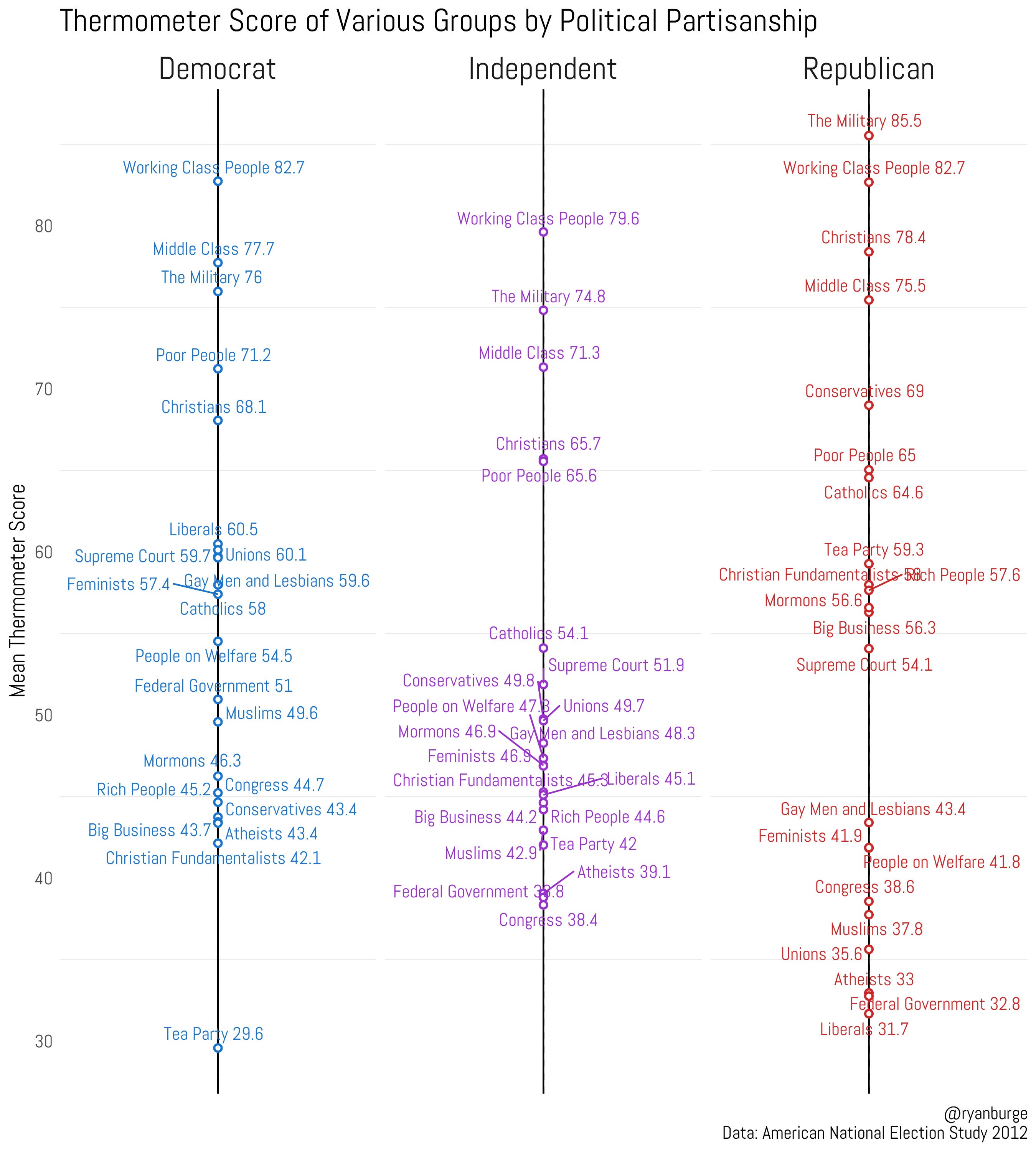
When thermometer scores of feelings toward various groups in 2012 were broken down by partisanship, the military and the working class always came out near the top, but Atheists were rated much less warmly than Christian Fundamentalists by Republicans (33% versus 58%), noticeably less by Independents (39% versus 45%), and they were virtually tied as the least favored groups by Democrats (at 42-43%), except for the Tea Party. You know you’re unpopular when both Democrats and Republicans feel more warmly toward Congress than toward you.
[Source]

Different data from a decade later showed that on balance, Democrats viewed Atheists positively, while Republicans viewed them negatively.

[Source]

Other indicators of the dim view most people take of atheists is that about half of Americans would be unhappy if a close family member married one, while only 1 in 10 would react that way to a born-again Christian. 77% of white evangelical Christians don’t want an atheist in their family. Interestingly, among the Nones, 28% don’t want a family member to marry an evangelical, but 13% don’t want them to marry an atheist, either, again illustrating there are Nones who are certainly not Atheists.

The bias against atheism displayed by people across the political spectrum helps explain why the social media presence of Nones is dwarfed in Oklahoma by the religious comments and posts by various Christians, particularly evangelicals who are enculturated to publicly share their views with and preach to others. Only the Zealous Atheists are likely to stick their necks out and actively promote their disbelief in such an environment, while the Dones are, well, Done.
Posted in religion, video | Leave a comment

The Populist Tide

Time and tide tarry for no one, and both are on my mind these days due to the political change that is transforming our republic. The United States of America has the oldest continuously operating written constitution, but its structures are being rapidly eroded by a tide of populism. Be forewarned that I am going to share my perspectives on that in this post, so skip it if that is not your thing.

I am far more hesitant about political posts than I once was, given the polarization driven by social media algorithms that increase engagement by amplifying posts that are emotionally charged. Also, Oklahoma is still dominated by evangelical Christians, and over my six decades they have become far more politically active and aligned with the Republican party. If people conflate political stances with religious beliefs, that can supercharge disagreements.

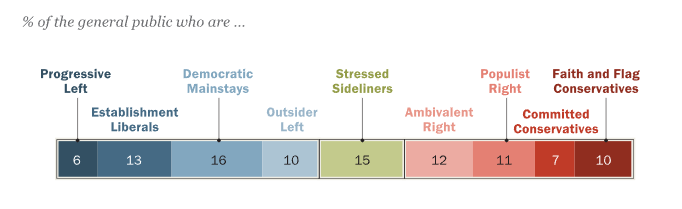
This post reflects my biases, so know that I am among the oldest members of Generation X, and my political typology is that of Outsider Left in the Pew Research Center’s Political Typology Quiz. 90% of my fellow citizens are of a different political type, and that’s A-OK. Given Oklahoma’s partially closed primary system, I routinely change my party registration between Democrat and Republican as needed to allow me to vote for more moderate candidates in primary elections. Like George Washington, I consider political parties the bane of our republic.

  • My Ground Rules:
    • This is my personal blog, not a debate forum. I am not interested in debating politics or religion with you here or on social media. Hence I turned off comments for this blog post. If you want to argue with someone, you’ll find willing victims in abundance on social media.
    • I am not seeking to evangelize here, but instead to share my possibly idiosyncratic takes, in my own detailed fashion, for those who are interested.
    • I fully support your right to disagree or disengage. There is plenty else on the internet, and in this blog, that might be more to your liking.
    • Finally, as always, nothing here in any way reflects the views of my employer — and I’m grateful that in July 2026 I’ll be retiring from employment and consequently the need for such a disclaimer.

Our enduring political heritage

Our system of government was a product of The Age of Enlightenment which promoted ideals of individual liberty, religious tolerance, progress, and natural rights, being heavily influenced by the Scientific Revolution as well as the trauma from centuries of religious conflict in Europe.

The founders crafted a constitutional system of checks and balances among three branches of government that endured, mostly intact, for well over two centuries. The genius of amendments gave it the needed flexibility to evolve as our nation’s practices slowly and unevenly approached its ideals.

The most painful correction led to the Civil War, when well over 600,000 people were sacrificed in the struggle to end the Constitution’s original sin of chattel slavery. Later notable improvements included expanding rights for women, First Peoples, and, within my lifetime, various ethnic and sexual minorities.

Our system of government survived the rise of autocratic regimes which plagued most of the world across the 20th century, but not without sacrifices. The U.S.A. lost 117,000 people in the first World War, which led to the collapse of the German, Austro-Hungarian, Ottoman, and Russian empires.

Much of the world experienced autocracy in the 20th century
[Source]

My father served in World War II in the struggle against Nazi Germany, Fascist Italy, and Imperial Japan, which claimed over 400,000 of his countrymen. I grew up during the Cold War, amidst the détente with the Soviet dictatorship enforced by mutually assured destruction.

Populism

Populism is an anti-establishment approach to politics which views “the people” as being opposed to “the elite”. It shares those characteristics with fascism, but fascism is distinct in its obsessive focus on national or racial purity and aggression. Also, while there are both liberal left-wing and conservative right-wing forms of populism, fascism is inherently right-wing.

While a significant majority of Republicans today embrace fascistic treatment of illegal immigrants, much of the party’s behavior, and its ascendency, are better understood as consequences of it being consumed by populism, not fascism.

In the U.S.A., populism reaches back to the presidency of Andrew Jackson in the 1830s and blossomed again as the People’s Party in the 1890s, with William Jennings Bryan as one of its famous figures. White settlers brought that populist movement from Kansas into Oklahoma in the land runs of the late 1800s. While the People’s Party faded rapidly after 1896, Oklahoma’s 1907 constitution contained various populist components, including popular election of all officeholders, an initiative and referendum process, and a corporation commission.

Later notable populists were Louisiana’s Huey Long, Alabama’s George Wallace, Ross Perot, and Sarah Palin. Currently Donald Trump and Bernie Sanders are populists on opposite ends of the political spectrum.

One of the dangers of populism, both in its left-wing and right-wing forms, is that it undermines democratic institutions, erodes social cohesion through its “us” versus “them” mentality, and often leads to negative economic consequences and violations of human rights.

Left-wing governments in 2024

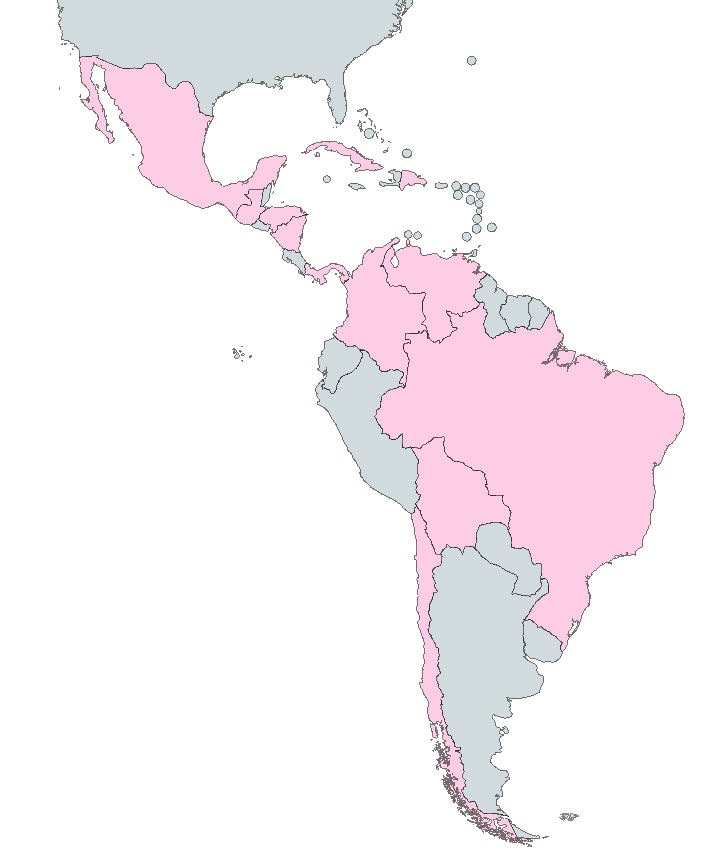
A populist tide rose across the world in the 21st century. In the Americas south of the U.S.A., it manifested as a “pink tide” of left-wing governments extending from Mexico across Central and South America that has cyclically waxed and waned. Several of the new governments were authoritarian, while others remained democratic.

In Europe, populist movements empowered Viktor Orbán in Hungary, the Law and Justice party in Poland, and Brexit, the withdrawal of the United Kingdom from the European Union.

The European Center for Populism Studies has crafted a world map in which darker shades of purple indicate weaker democratic institutions and norms, with numerical ratings on a scale from dictatorships to full democracies, based on a country’s performance across fundamental human rights, civil liberties, rule of law, and elections.

Populism rankings in 2025 by the European Center for Populism Studies
[Source]

In their ratings, the United States of America is on the verge of slipping from full to flawed democracy. Our democratic institutions and norms now fall below those of Canada, northern Europe, and Australia.

The end of norms

Donald Trump openly undermines democratic institutions, discredits opponents, and erodes the rule of law. He has been empowered by the ever-increasing polarization of the populace, and thus Congress, and the collapse of the Republican establishment’s foundations of sand, which were swept away by the populist tide.

That populism explains why Republican politicians have abandoned past conservative stances that stressed state rights and the separation of powers while promoting free trade and a pretense of fiscal discipline. The seeming cognitive dissonance or hypocrisy of championing state rights in the causes of abortion restrictions yet embracing the use of troops for immigration enforcement is less surprising once you recognize that the Republicans are now more populist than truly conservative.

Populism also explains Trump’s virulent attacks on science, public health, mainstream media, entire governmental divisions, and higher education. Trump and his supporters leverage the real and earned resentments of the working class, but not to provide tangible benefits to their supporters but instead to destroy institutions and cultural norms associated with a rival, progressive elite.

It is illuminating to examine the political polarization in confidence in our various institutions. Consider this chart of Democrat and Republican confidence in the 1970s, when there wasn’t much difference between their trust in most institutions save for Democratic confidence in labor versus Republican confidence in business:

[Source]

Compare that to the 2010s, when Democrats had more confidence in knowledge-producing institutions while Republicans had more confidence in order-preserving ones.

[Source]

Now consider which institutions Trump has decimated, with the Republicans in Congress mostly acquiescent even when that damages their own constituencies’ long-term interests.

Why is populism ascendent?

I am a fan of the political and cultural commentator David Brooks. He composed a compelling narrative to explain the populism of the working class:

The Democrats once enjoyed strong support from the working class, thanks to their old alignment with labor and the Republicans’ long-term alignment with business interests. But the very successes of unions — the 40-hour workweek, minimum wage, child labor laws, worker’s compensation, workplace safety laws — were secured long before most of us were born. Those successes promoted the growth of the middle class, but with such rights secured, unions began to fade away with the decline of manufacturing, the rise of the service economy, and economic recessions.

Since the 1970s, central features of our politics have been social, cultural, and racial issues. That has affected our beliefs about institutions. Professions have become more ideologically homogenous and extreme, which in turn has fueled partisan distrust. Henry E. Brady of the American Academy of Arts & Sciences shared:

On a 2019 survey, we asked respondents how they would feel about someone close to them choosing a career or marrying someone involved with various institutions. We were shocked and surprised to find that Republicans do not want their kin or friends to have a close association with journalists or with anyone working in higher education. Democrats do not want close connections with anyone in the police, the military, or religious institutions. 

Constitutional erosion

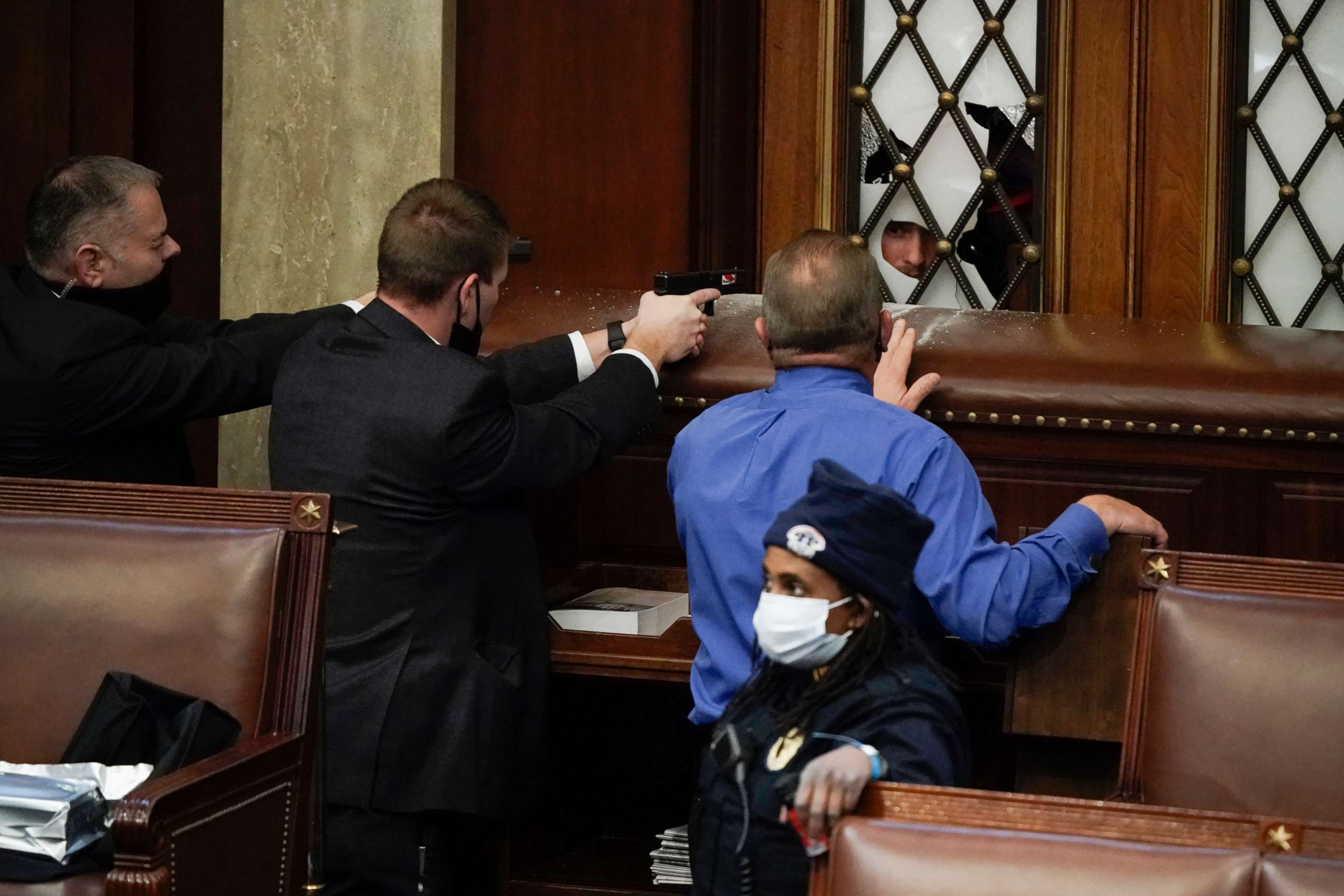
Police with guns confronted rioters trying to break into the House chamber on January 6, 2021

The first Trump impeachment failing to result in a conviction was not surprising, given that the prior impeachments of Andrew Johnson and Bill Clinton failed to yield convictions.

The failure to convict in his second impeachment, after his disruption of the peaceful transfer of power for the first time in the nation’s history, was far more disturbing. That confirmed that populism had taken control of the Republican party, with 43 of the 50 Republican senators abandoning their oaths to support, defend, and bear true faith and allegiance to the Constitution by failing to prevent Trump from running again for the office he had betrayed. No doubt many of them felt that if they stood up for the Constitution their own populist base would consequently turn them out of office: a few days after the attack on the Capitol, over 3/4 of Trump voters, and about 1/3 of all voters, believed “the big lie” that Biden’s election was illegitimate.

Operational norms were mostly reinstated for a few years under Biden, but then his personal hubris led him to betray his party’s and the national interest. Instead of stepping aside to support a healthy Democratic primary process that might have identified a Presidential candidate who could appeal to liberals, moderates, and some populists, he wanted a second term. When his declining abilities made that impossible, the Democratic party made the elitist and fatal choice to have a black woman as its presidential candidate amidst a populist tide in a country in which both racism and sexism remain commonplace. Their blinkered identity politics ensured that Trump, despite his crimes, cruelty, and advanced age, won both the popular and electoral votes.

Thus far in Trump’s second term, Congress, with slim Republican majorities in both the House and Senate, has completely capitulated to the executive. The President routinely violates the law, and Madison’s plan that “Ambition must be made to counteract ambition”, harnessing the natural jealousy and ambition of political actors to prevent any one branch of government from becoming too powerful, has failed.

James Madison outlined checks and balances in The Federalist, Number 51

Many of the Republicans in Congress were elected as populists, and some of them simply do not believe in government. That is why they are quite effective at destroying programs and institutions yet repeatedly fail to produce promised alternative plans for health care, infrastructure, or other common interests. Their primary achievements are continuing tax cuts, despite the consequent explosive growth in the national debt.

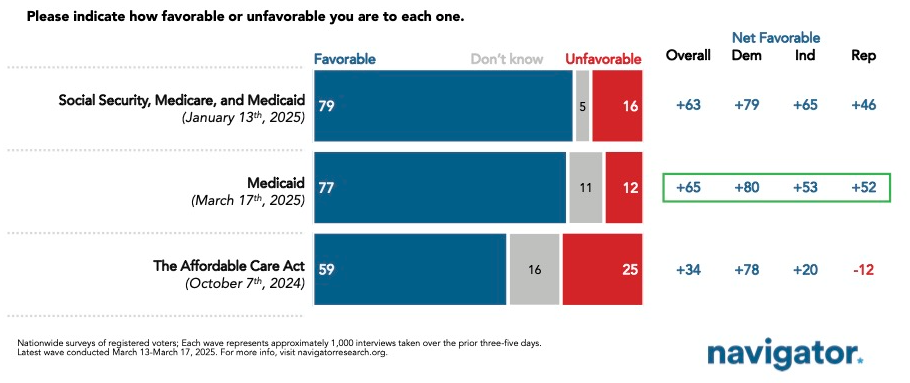
A portion of them genuinely believe in the long-discredited theories of trickle-down economics, while others no doubt hope that the unsustainable debt will eventually force the curtailment of the Social Security, Medicare, and Medicaid entitlements and further weaken the Affordable Care Act (ACA). Bear in mind that the GOP opposed the creation of all of those programs, which enjoy broad overall support. Only the ACA has a net unfavorable rating among Republican voters, but Republicans in Congress still passed legislation that will result in millions of people losing Medicaid coverage, and they joined Democrats in continuing to ignore the depletion of the Social Security Trust Fund in 2033.

[Source]

Republicans know that most of their policy goals would not survive senatorial filibusters. They could vote to further weaken or fully eliminate the filibuster, but that would in turn make them vulnerable when their control of the Senate slips. So they have adopted a long-term strategy of allowing the executive to illegally enact their policy goals. Their hope is that, whenever the Democrats eventually do regain majorities in Congress and control of the White House, the Democrats’ more diverse and moderate coalition would be restrained by the filibuster and the rule of law.

Also, by allowing Trump to accomplish their policy goals by fiat, they avoid direct votes that would attach to them blame for his various destructive acts that will inevitably have significant negative long-term consequences.

The considerable cost of that strategy is how it empowers a cruel and incompetent executive branch and accelerates the slide into competitive authoritarianism. While authoritarianism appeals to many people who value short-term action over long-term stability, it inevitably lowers economic growth and restricts civil rights and liberties.

[Source]

One reason the Republicans in Congress are allowing the executive branch to violate the law and the Constitution is their misplaced trust that the judicial branch will eventually contain the worst excesses. However, the machinations of Mitch McConnell that created a supermajority of right-wing Supreme Court justices has severely undermined the judicial branch’s legitimacy and enforcement of the rule of law. The unitary executive theory that a majority of the court now embraces is a concentration of executive power that betrays the clear vision and intent of the founding fathers, who deliberately made the legislative branch the most powerful. It is also at odds with why the American Revolution was fought.

The increasingly unmoored reasoning of the partisan Supreme Court has freed the president from the rule of law, but even that might not suffice for Trump. His administration could become more brazen in its repeated violations of lower court orders and, if the Supreme Court eventually ends its campaign of appeasement, he might refuse to follow its rulings.

If that happens, the only remaining Constitutional tool to constrain him would be his impeachment in the House and conviction in the Senate, which is unlikely given that most Republicans in Congress have already abandoned their oaths. A military coup is unlikely, so I expect that it would require massive civil unrest to overturn Trump’s authoritarian regime in such a scenario.

However, I do not actually expect Trump to be so deranged. My prediction is that he will continue to flaunt his power while avoiding too direct a confrontation with the judicial branch. His corruption of the government has already enriched him greatly, and he will grant himself and his cronies pre-emptive federal pardons when he leaves office. His narcissism leads him to expect to continue to elude justice, and I expect he might, as our legal system has always been too slow, corrupt, and politicized to hold him to account. His greatest enemy is time in the form of his ongoing physical and mental decline.

A longer view

There is also the long-term issue that while Trump’s charisma, brazenness, and demagoguery have channeled the populist tide to power his pulverizing mill, his departure from office and eventual death will not dissipate it. The class resentment he manipulated will remain a potent force that future charismatic demagogues could wield.

The Democrats need to rebuild themselves

Democrats remain disorganized, and they are distinctly and deservedly unpopular. Their best hope for retaking parts of the federal government is that the economic shocks of Trump’s policies will trigger a significant recession in 2026 or 2027. Of the eleven recessions after World War II, ten occurred under Republican presidents. Republicans rely far too heavily on tax cuts and deregulation for economic growth, while Democrats are usually more pragmatic in heeding economic and historical lessons.

However, I expect little long-term success for Democrats so long as they continue to fail to recognize and harness the energy of the populist tide. Their coalition relies far too much on minority identity politics, is out of touch on cultural issues, alienates young men and rural voters, and is more reactive than visionary in directly addressing more problems of the working class.

David Brooks highlighted the populist problem for me, and he posits that America’s historical distinction from class-driven Europe could be parlayed into a counter-narrative to Trumpism that rejects class conflict and embraces social mobility. He notes that, “Trump’s ethos doesn’t address the real problems plaguing his working-class supporters: poor health outcomes, poor educational outcomes, low levels of social capital, low levels of investment in their communities, and weak economic growth.”

He points out how the Populist Progressive movement of the late 1800s was a response to the political corruption, concentration of corporate power, huge inequality, and racial terrorism of that period. Progressives in big cities and populists in small towns “wanted to help those who were being ground down by industrialization” and “believed in using government to reduce inequality and expand opportunity.” He wonders if a new coalition could help us cope with the rise of the Information Age, reforming our universities, Congress, corporations, the meritocracy, and the new technocracy.

Brooks envisions an alliance that is “economically left, socially center right, and hell-bent on reform” and rejects the endless class and culture wars. However, he also points out one of the bleak realities of our age: “Americans have at most a two-week attention span, so to control the conversation, you need to stage a series of two-week mini-dramas, each with high-stakes confrontations and surprises.” Any counter-movement may have to become part of that depressing milieu.

Brooks closes his essay by noting that America’s cyclic process of rupture and repair follows a sequence: “Cultural and intellectual change comes first — a new vision. Social movements come second. Political change comes last.”

All that takes time, and I am genuinely concerned that the stable government I grew up with, featuring bipartisanship, general respect for the rule of law, a belief in and agreement with the deeper operating principles of our constitution, and a hope for a better tomorrow might not return in the few decades I hope to endure.

Posted in politics | Comments Off on The Populist Tide

My Increasing Sci-Fi Skepticism

I overindulged on “literature” in recent months. In August 2025, I read Thornton Wilder’s Pulitzer-winning The Bridge of San Luis Rey and in September I followed that up with his ponderous National Book Award-winning The Eighth Day. I used a light Mary Stewart romance suspense in my recovery, but that was not enough. I didn’t feel like reading another mystery, so I opted for science fiction, which I consumed greedily in my teenage years but have read much less of in the 21st century.

I read oodles of science fiction stories authored in the second half of the 20th century that involved interstellar travel, but the reality is that we never managed to get anyone beyond Earth orbit after 1972, and arguably even the dozen men who briefly walked on the moon were still orbiting the Earth. Only five robot spacecraft have interstellar trajectories, and they won’t be exiting our Oort cloud for tens of millennia. Physics tells me that nothing material can exceed the speed of light, so many sci-fi stories are just a form of fantasy.

I was an avid fan of the original Star Trek and The Next Generation, but the cultural momentum built up in childhood that carried me through Deep Space Nine, Voyager, and Enterprise was dissipated by the friction of my increasing skepticism, and I haven’t been able to muster any enthusiasm for the later series. In recent years I read a few still-active sci-fi authors, such as Alastair Reynolds and Becky Chambers, but I’m increasingly uninterested in stories that ignore physics or pretend there are workarounds to its limitations. As for cinema, many movies are now crafted by people who obviously grew up on video games, and the suspension of disbelief their computer-generated spectacles require is often simply beyond me.

There are still plenty of science fiction stories that take place within our solar system, however, and during the Covid-19 pandemic, I discovered the Bookpilled channel where Matt, a liberal arts major, offers thoughtful and insightful reviews of science fiction works. I respect his opinion, although we inevitably differ in our tastes, evidenced by how recently on Patreon he absolutely hated Niven’s Ringworld, which was one of my teenage favorites.

I am glad to support Matt on Patreon, as he approaches the genre from a more literary perspective and exposes me to many potential new reads, which is helpful since I am now so resistant to much of science fiction. He sometimes takes on classics from the major authors of my childhood, but he ranges widely across 20th century sci-fi.

This was a harsh but memorable read

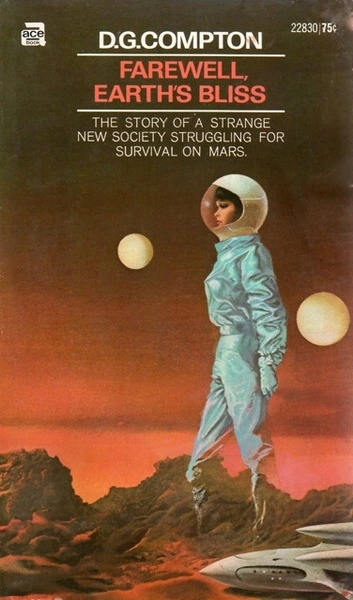
Back in May 2023, Matt reviewed D.G. Compton’s Farewell, Earth’s Bliss from 1966. He described it as one of the bleakest books he had ever read, with “wonderfully sharp and crystalline and well-realized characters” and being truly immersive. I was sufficiently intrigued to purchase and read the book, and it was as he had described. I certainly didn’t find it a pleasant read, but it was memorable and worthwhile.

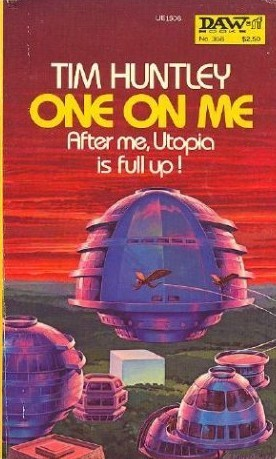
In December 2023 he reviewed an even more obscure book, One on Me by Tim Huntley. He said it was a funny and well-written dystopia set on the Earth in a distant future, but significantly flawed by its inclusion of forbidden relations. Matt said, “I don’t know that I recommend it. If you can just hold your nose and plug your ears for a couple parts, it is a good book, but I don’t know if you should.”

The book is certainly not well known. I found only one review online, by Kenny in north Texas from 2019, and he opened with a paragraph of complaints about its objectionable elements, condemning it as “vulgar and gross”. However, he then echoed Matt by stating, “Despite all that, there is a compelling story.”

My “banned” book

Well, that was enough to interest me. The book wasn’t available electronically, so I bought a used paperback copy on Amazon for $7, and if Amazon had not had a copy, I would have checked AbeBooks. I received it in early January and tossed it on a shelf.

Seventeen months later, finding the various possible reads in my Kindle library unappealing, I scanned my shelves and noticed that 221-page DAW paperback published in 1980. I vaguely recalled that it was considered off-putting, it didn’t appear to involve impossible interstellar travel, and since it happened to be Banned Books Week, I decided to read it.

My used copy had been embossed on its title page as having once been in the library of George H. Siehl III, and I had some fun tracking down who that was.

Going beyond the title page, I was thankful to discover that there was little detail in the novel’s treatment of disturbing relations, and they did serve a purpose in showing how different the dystopian culture was from our sensibilities, an effective illustration of the decadence of both sides in a later conflict. A bit of earthy humor about the narrator also struck me as far more comedic than offensive. It lacked the explicit intercourse that graces some trashy romances, but it certainly mentioned unfortunate sexual behavior, torture, and the like. I was glad to find those topics handled fairly quickly and at a remove; the book didn’t strike me as seeking to titillate.

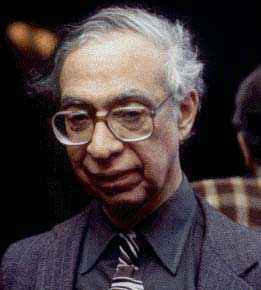
Donald A. Wollheim

The disturbing elements actually served the plot, which made sense to me since the book was published by DAW in 1980, when founder Donald A. Wollheim was still in charge. He was one of the major science fiction and fantasy editors, publishing pulp authors Robert E. Howard, Clark Ashton Smith, and H.P. Lovecraft in the 1930s and later nurturing future greats like Poul Anderson, Philip K. Dick, and Andre Norton at Avon and Ace Books before creating his own imprint.

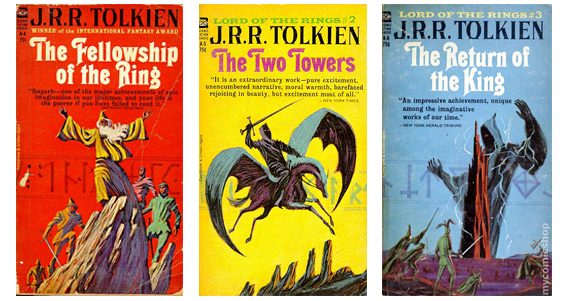
A fun story about Wollheim was how he called up J.R.R. Tolkien in 1964 to ask if he could publish Lord of the Rings as Ace paperbacks. Tolkien reportedly said he would never allow his work to appear in so “degenerate a form”. That is said to have incensed Wollheim, who discovered that Tolkien’s American hardcover publisher had neglected to protect the work in the USA, so he went ahead and published them as unauthorized Ace paperbacks.

Tolkien rewrote the books enough to obtain a new copyright, sold them to Ballantine, and successfully pressured Ace to stop publishing the unauthorized versions and pay him some royalties on the 100,000+ copies they had sold. The squabble helped ignite the Tolkien boom and launch the modern high fantasy field, but it also damaged Wollheim’s reputation.

The unauthorized Ace editions of The Lord of the Rings are now collectors’ items

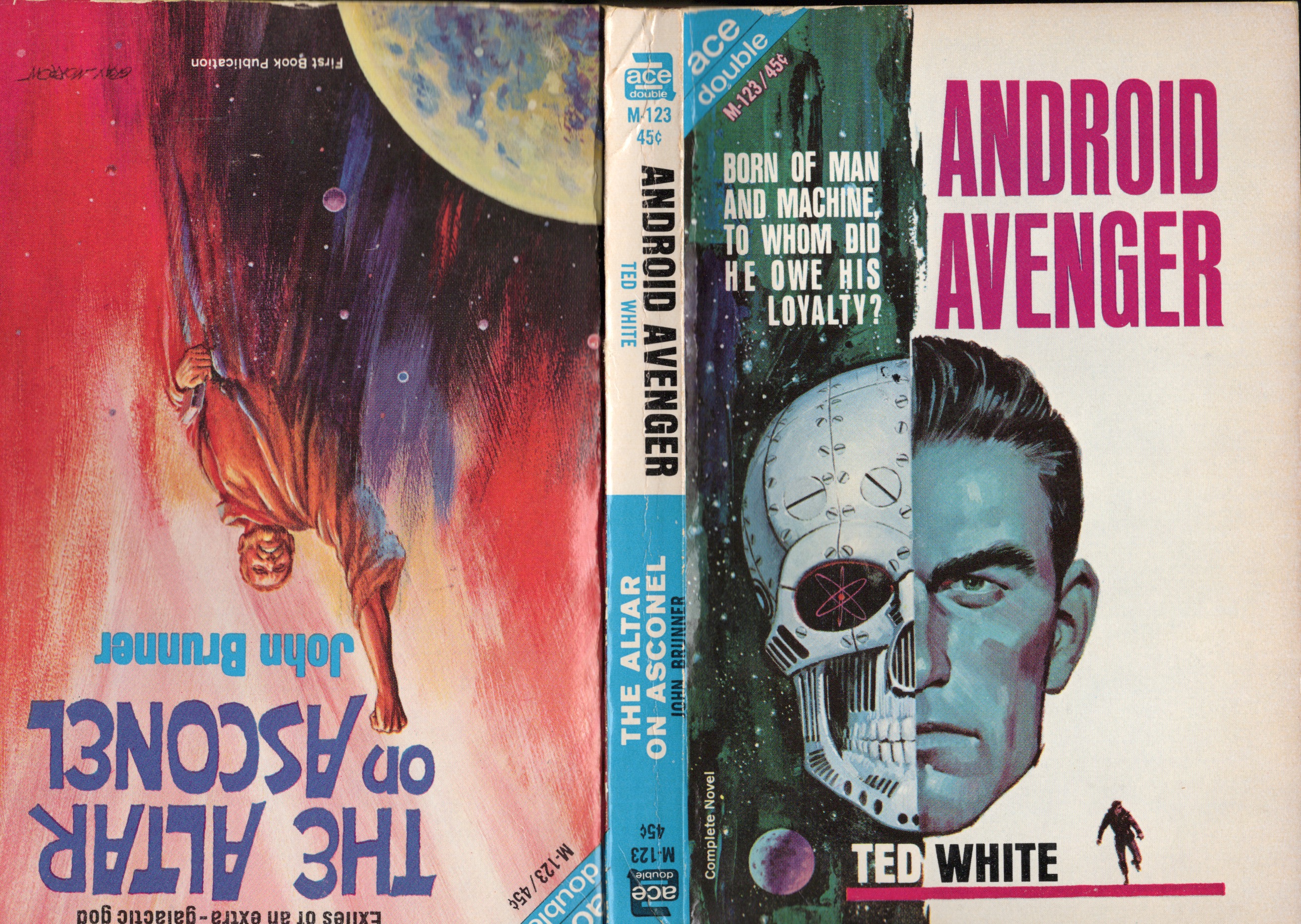
I have a soft sport for Ace paperbacks. When I was a young teenager, one of my uncles gifted me his science fiction paperbacks, which included several of the Ace doubles. The tête-bêche format books published from 1952 to 1973 each contained two novellas, with the front cover and interior of one novella rotated by 180 degrees and bound back-to-back with the front cover and interior of the other. That way neither novella is preferred, and if you buy one and end up abandoning it, you can always flip the book around and try again. I suppose you might occasionally like both stories! One of the old doubles managed to survive my Digital Age Downsizing in 2010.

My remaining Ace double from July 1965
One on Me was DAW #368

As for DAW, you can read more about that imprint here. Wollheim published popular, though not always critically acclaimed, works. I wouldn’t expect him to publish outright trash, and I enjoyed One on Me. I couldn’t predict how its tale would unfold, and I found it prescient in several ways.

The book was good enough that I downloaded a sample of Huntley’s other novel, which was self-published 30 years later when he was about 70. It is even more obscure, but EarthGame: A Player’s Guide came out late enough that it is available on Kindle. The title is misleading, as the book is a comic novel. I’m not ready to try EarthGame, having just wrapped up One on Me, but it is on my list as a tempting final outing with Huntley, who died in 2019 a week before he would have been 79 years old.

My tastes have evolved considerably over the 40 years since I was a teenager, and I seldom seek out science fiction these days. Thankfully there are countless other books on offer, and my amazing access to them still strikes me as, ahem, feeling like science fiction.

Posted in books | Leave a comment

Crystal Caves and Moon-Spinners

Mary Stewart was a British novelist, born Mary Florence Elinor Rainbow in 1916. She taught in grade schools and lectured part-time at Durham University before moving to Scotland with her husband in 1956. After nearly dying from an ectopic pregnancy and left unable to bear children, she wrote her first novel and effectively launched the genre of romantic suspense, producing a score of novels that sold over five million copies.

Mary Stewart

A very private person, she reacted against the “silly heroine” of mid-20th-century thrillers who “is told not to open the door to anybody and immediately opens it to the first person who comes along”. She reportedly crafted poised, smart, highly educated young female characters who drove fast and knew how to fight but were also tender-hearted with a strong moral sense.

A change of direction came in the 1970s when she surprised her publishers with a novel about the early years of Merlin, The Crystal Cave, which led to four more Arthurian books. I presume she was influenced by T.H. White’s success with The Once and Future King as well as her own fascination with Roman-British history.

Arthurian Attempts

An early exposure to Arthurian retellings

I read The Crystal Cave back in 2020, a few months before Covid-19 changed our world. I’d waited decades to try another book based on Arthurian legends.

As a child, I’d enjoyed The Hidden Treasure of Glaston by Eleanore M. Jewett, which was published in 1946 and was a Newbery Honor book about a medieval boy’s search for the Holy Grail in an area associated with the mythical King Arthur. In junior high or high school, I recall reading a modern English translation of Sir Gawain and the Green Knight in one of my English classes.

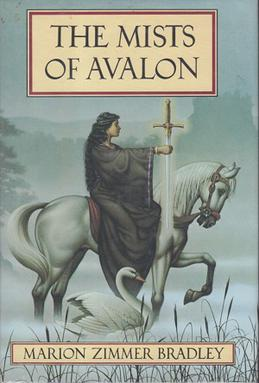
In 1983, when I was in high school, Marion Zimmer Bradley’s The Mists of Avalon was published. I noticed its striking cover at the Henry Higgins bookstore in our local shopping center and eventually read it. That retelling of Arthurian legends from the perspective of the female characters was quite popular in its day, long before disturbing allegations about the author’s behavior came to light.

However, I did not enjoy The Mists of Avalon, despite the praise heaped upon it. I don’t recall if I finished it or not, but I remember finding it obscure. I also didn’t care for most movies or miniseries set in King Arthur’s time, save for the hilarious Monty Python and the Holy Grail. So I generally avoided Arthurian books, although I did listen to the engaging J. Rufus Fears lecture on Arthurian myths.

Sorry, but this cover looks like an Ozarks cave pamphlet to me

In early 2020, for reasons I do not recall, I decided to read something Arthurian. I had no intention of trying 1485’s Le Morte d’Arthur, and I wasn’t ready to commit to T.H. White’s fantasy retelling. I chose Mary Stewart’s The Crystal Cave because it was praised as being more realistic and historical and is told from Merlin’s viewpoint.

It was yet another bildungsroman, following Merlin from age six to young manhood. Thankfully it was indeed light on the fantasy. Instead of a young adult sword and sorcery tale, it was a more serious evocation of fifth century Britain. I recall it as well-written, but I was repelled by Merlin’s machinations to allow Uther Pendragon to tryst with Ygraine and thus create Arthur, and I didn’t continue with the later books in the trilogy. I generally dislike tales of feudalism outside of listening to the Kingsbridge series by Ken Follett or the Chronicles of Brother Cadfael by Edith Pargeter, who wrote them as Ellis Peters.

The onslaught of Covid-19 disrupted my world for some time, and I forgot about Mary Stewart, remaining oblivious that she had pioneered romance suspense with capable female protagonists.

A Forgotten Disneyfication

Then, over five years later, whilst wasting my time on YouTube, the algorithm offered up The Moon-Spinners never had a chance by Once Upon a Record. For whatever reason, I clicked on the video about a 1964 Disney film that was completely overshadowed by Mary Poppins.

As a Gen-Xer, I wasn’t around in 1964, but I’ve seen that year’s Mary Poppins many times, while I had never heard of The Moon-Spinners, and I’ve never seen Hayley Mills other than in some episodes of The Love Boat back when I was a bored teenager in a home with only broadcast television. Hayley’s 1964 film was edited into a three-part movie of the week and shown on The Wonderful World of Disney in 1966, but it was never reissued in theaters.

I had no interest in watching the Disney film, although I was intrigued by the beautiful shots of real-world locations in Crete. Ever since reading Mary Renault’s The King Must Die and The Bull from the Sea for an undergraduate college seminar on ancient Greece, I’ve been interested in Minoan Crete and Sir Arthur Evans‘ fantastical recreations.

The Moon-Spinners has some beautiful locations

The Once Upon a Record video mentioned that Mary Stewart had authored the 1962 book the movie was loosely based upon and how she was not pleased with Disney’s adaptation — a common authorial complaint for Disneyfications. I’ll blame the intervening Covid chaos for the mention of Mary Stewart in the video failing to remind me of reading The Crystal Cave a half-decade earlier.

Ever curious, I downloaded a sample of The Moon-Spinners e-book on my Kindle and also read about the author, finally realizing she had also written The Crystal Cave.

Ugh

When I was a child, my mother and my spinster aunts read hundreds of Harlequin Romances, which I dismissed as boring trash, although I never actually read one. In 1957, Harlequin had acquired the North American distribution rights to the romance novels published by Mills & Boon in the British Commonwealth. It eventually acquired Mills & Boon and published six novels each month which were sold in supermarkets, drug stores, and the like. My aunts remodeled an entire room of their house, filling it with shelf after shelf of Harlequin Romances. The company has published about 5,000 titles under that imprint but has many others, and it currently publishes over 120 new titles each month in North America and over 800 globally. I wouldn’t be surprised if many of the storylines are now developed with artificial intelligence and eventually are entirely drafted by AI with human proofreader edits.

I have always enjoyed mysteries, and romances have blended into many of them. Given that Mary Stewart is touted as a talented pioneer in romance suspense, and remembering how her first Merlin book was well-written, albeit unable to prompt me to continue that series, I decided to read The Moon-Spinners. I needed a palate cleanser after reading Thornton Wilder’s ponderous The Eighth Day.

The Romance Suspense

Mary Stewart sketched a Cretan windmill for her publisher as a design idea for the book cover. Hodder in the UK used that for its first edition hardback book cover, but I notice that a later paperback edition added a running male figure to the scene and “Nicola — in an island nightmare of terror and pursuit”. Neither were improvements to my eye, but they would have been helpful to casual shoppers, although they are confusing since Nicola is actually the female protagonist of the story and not pictured on the cover. The US cover was similar to the original UK one, but instead of depicting a windmill in the bright Mediterranean sunlight, Charles Geer‘s illustration was dark and moody.

You might think the windmill has something to do with the title, but while a windmill does play some role in the plot, the character of Nicola shares the tale of the moon-spinners to help lull someone to sleep:

They’re naiads – you know, water nymphs. Sometimes, when you’re deep in the countryside, you meet three girls, walking along the hill tracks in the dusk, spinning. They each have a spindle, and onto these they are spinning their wool, milk-white, like the moonlight. In fact, it is the moonlight, the moon itself, which is why they don’t carry a distaff. They’re not Fates, or anything terrible; they don’t affect the lives of men; all they have to do is to see that the world gets its hours of darkness, and they do this by spinning the moon down out of the sky. Night after night, you can see the moon getting less and less, the ball of light waning, while it grows on the spindles of the maidens. Then, at length, the moon is gone, and the world has darkness, and rest, and the creatures of the hillsides are safe from the hunter, and the tides are still . . .

Then, on the darkest night, the maidens take their spindles down to the sea, to wash their wool. And the wool slips from the spindles into the water, and unravels in long ripples of light from the shore to the horizon, and there is the moon again, rising above the sea, just a thin curved thread, re-appearing in the sky. Only when all the wool is washed, and wound again into a white ball in the sky, can the moon-spinners start their work once more, to make the night safe for hunted things . . .

The novel begins with Nicola being dropped off after a car ride at a trailhead to a small Cretan village by the American tourists Mr. and Mrs. Studebaker. It may not have been Stewart’s intention, but I interpreted those as names the protagonist gave to them that merely reflected the make of car they drove.

On her walk toward the village, Nicola pauses at a bridge and then takes a side path up to the villagers’ fields where windmills whirl, pumping irrigation water through the ditches. She then opts to follow an egret up a ravine. Stewart’s writing is evocative:
For some reason that I cannot analyse, the sight of the big white bird, strange to me; the smell of the lemon flowers, the clicking of the mill sails and the sound of spilling water; the sunlight dappling through the leaves on the white anemones with their lamp-black centres; and, above all, my first real sight of the legendary White Mountains . . . all this seemed to rush together into a point of powerful magic, happiness striking like an arrow, with one of those sudden shocks of joy that are so physical, so precisely marked, that one knows the exact moment at which the world changed.

She ascends the hillside and is soon threatened by a knife-wielding man, tends a man with a bullet wound, and is drawn into ‘skulduggery’. Nicola’s independence and self-assurance are rapidly made evident.

Nicola’s first hint of trouble was a sudden shadow, and near the conclusion of the resulting scene, with the immediate threat vanquished, Stewart adjusts her grip on the reader with Nicola thinking, “Suddenly, out of nowhere, fear jumped at me again, like the shadow dropping across the flowers.”

Nicola & Mark in the Disney universe

Her style is light and deft in a speedy first-person narrative that was a welcome contrast to the pontificating third-person prose in the Thornton Wilder novel I had just finished. I was soon 1/8 into the book and struck by how Stewart’s elegant prose elevated scenes reminiscent of the childhood Nancy Drew or Trixie Belden mysteries my spinster aunt loaned me when I had exhausted the Hardy Boys.

While as a kid I was fine with the minimal involvement of the teenage sleuths’ nearly invisible romantic partners, I quickly sensed that in this story the 22-year-old Nicola might well end up romantically entangled with Mark, the young man who had been shot, even though Stewart was careful not to overplay their initial introduction.

Mind you, Stewart moved fast in her own romance. Elsie of the Tea & Ink Society shares this: “Mary met her husband Frederick at a Victory in Europe Day celebration dance in 1945. It was a costume party, and Frederick was unselfconsciously wearing a girl’s gym tunic, lilac socks, and a red hair ribbon. It was pretty much love at first sight, and the couple were married three months later.”

Stewart begins each chapter with a brief literary excerpt. For Chapter 3 she selected, “When the sun sets, shadows, that showed at noon but small, appear most long and terrible.” That is drawn from Nathaniel Lee and John Dryden’s 1679 adaptation of Sophocles’ Oedipus. A fuller quotation is:

Nathaniel Lee

When the Sun sets, Shadows that shew’d at Noon
But small, appear most long and terrible;
So when we think Fate hovers o’er our Heads,
Our Apprehensions shoot beyond all Bounds,
Owls, Ravens, Crickets seem the Watch of Death,
Nature’s worst Vermin scarce her godlike Sons,
Echoes, the very Leavings of a Voice,
Grow babling Ghosts, and call us to our Graves:
Each Mole-hill Thought swells to a huge Olympus,
While we fantastick Dreamers heave and puff,
And sweat with an Imagination’s Weight;
As if, like Atlas, with these mortal Shoulders
We could sustain the Burden of the World.

Heady stuff!

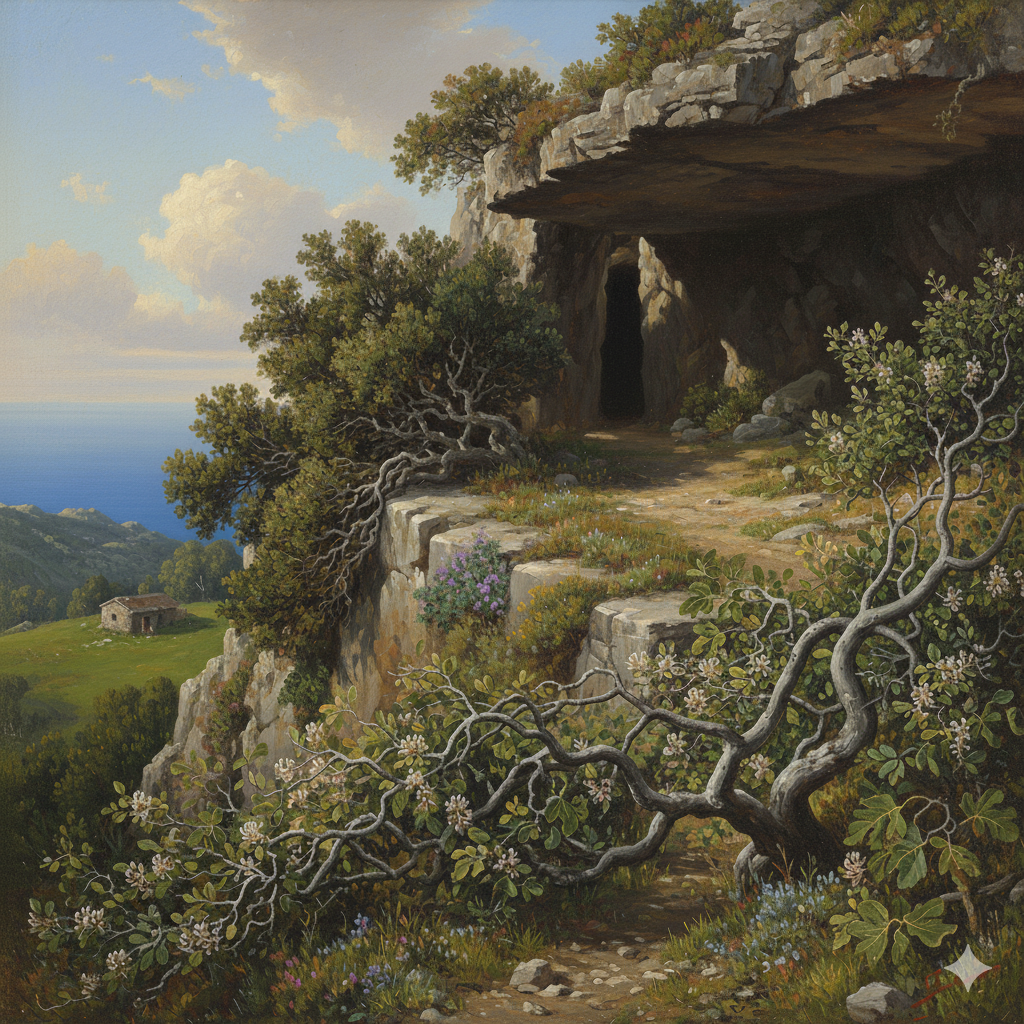
Stewart’s descriptions of the settings were superb. I could readily visualize them, thanks to paragraphs like this:

Google Gemini produced this based on that description; not bad, although the ledge is tilting the wrong way

The story zips along at a fairly rapid clip, with Nicola showing no hesitation in staying overnight to care for the wounded man with a murderer on the prowl, with the next 1/8 of the novel spent on the mountainside avoiding his search. Nicola reaches the village 1/3 of the way into the story and immediately starts to piece together the puzzle.

Nicoloa’s much older female cousin appears, as the character herself phrases it, “at half-time”, and I appreciated this description of her: “Some people, I know find her formidable; she is tall, dark, rather angular, with a decisive sort of voice and manner, and a charm which she despises, and rarely troubles to use.”

The story includes a major red herring, so Stewart does not shy away from manipulating the reader. Overall, I enjoyed the novel, although I did not discern deeper meanings in it beyond a fun adventure, and it lacked the emotional depth and connection that Edith Pargeter could bring to some of her characters in the Brother Cadfael and Inspector Felse mysteries. The first person narrative sometimes shifts plot points into remote retrospectives that are relayed, not related, to the reader. I didn’t find Stewart’s tale particularly romantic, with little time given for Nicola and Mark to develop any sort of relationship beyond trying to protect each other and implausible feats of derring-do, although the settings were suggestive.

I regard the work as a well-written adult version of a Nancy Drew mystery with superb travelogue elements. I’m certainly willing to read more of Stewart’s romance suspense stories, but I would only expect them to be light reads that serve as quick escapes and palate cleansers.


The current Kindle edition cover art

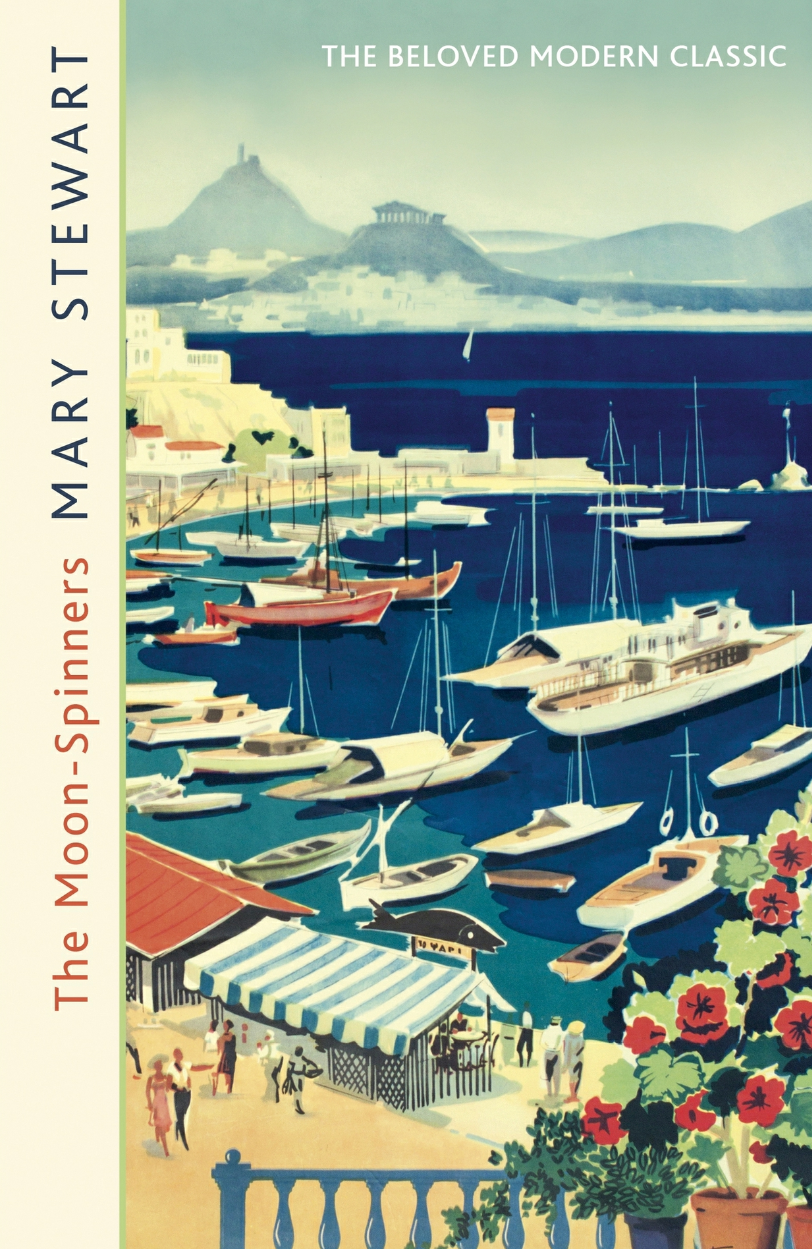
Publishers Hodder & Stoughton have reissued much of Mary Stewart’s fiction under the Beloved Modern Classics label, at least in Kindle editions. I appreciate their beautifully restrained cover designs featuring illustrations that resemble travel posters.

Given her evocative descriptions of the settings, her standalones seem well-suited to armchair travelers. This fast-paced adventure set on the sunny isle of Crete would have been especially welcome on a cold wintry day.

Stewart wrote 15 standalone novels in the romance suspense genre, separate from her five Arthurian books. Elsie of the Tea and Ink Society says, “Her earlier books supply greater drama and thrills and are more Gothic in tone, while her later novels are gentler but still masterfully plotted.”

For both yours and my reference, here is Elsie’s listing with her Amazon links and brief descriptions of Stewart’s standalones:

Madam, Will You Talk? (1955) – set in Provence, France
Wildfire at Midnight (1956) – set on the Isle of Skye, Scotland. Murder mystery elements.
Thunder on the Right (1957) – a Gothic novel set in the Pyrenees in France
Nine Coaches Waiting (1958) – elements of Gothic, fairy tale, and fugitive story. Set in the mountainous Savoy region of France.
My Brother Michael (1959) – set in mainland Greece
The Ivy Tree (1961) – an impostor/mistaken identity story set in Northumberland, England
The Moon-Spinners (1962) – set in Crete
This Rough Magic (1964) – set in Corfu
Airs Above the Ground (1965) – a murder mystery with a touch of espionage, set in Austria
The Gabriel Hounds (1967) – set in Syria and Lebanon
The Wind Off The Small Isles (1968) – a novella set in the Canary Islands, Spain
Touch Not the Cat (1976) – set in the Malvern Hills in the West Midlands of England. Fantasy/supernatural elements.
Thornyhold (1988) – set in Wiltshire in South West England. Fantasy/supernatural elements.
Stormy Petrel (1991) – set on a fictional island in the Hebrides of Scotland
Rose Cottage (1997) – a gentle mystery of family secrets, set in a small village in the North of England

Stewart’s quick story was most welcome after my failing to complete V.S. Naipaul’s A House for Mr. Biswas and reading Thornton Wilder’s remote The Bridge of San Luis Rey and stolid The Eighth Day, but I’m not ready to tackle more “literature” just yet.

As I compose this post, I am still listening to film director William Friedkin’s splendid memoir on my weekend walks, so I want to stick with fiction in my physical or electronic book reading for now. My Kindle collection still has five unread Ellis Peters novels, along with a couple of novellas and sixteen short stories, but I’m not ready for another mystery, either.

So, since it is now Banned Books Week, I’ve started Tim Huntley’s little-known 1980 novel, One on Me, a science fiction pulp paperback I bought at the end of 2023 after Bookpilled cited it as funny but having some controversial content. I doubt there were ever enough copies in circulation to get it banned, but it certainly would offend the blue-nosed bullies.

Posted in books, movie | Leave a comment

Four Measures of Personality

Hippocrates promulgated the first known personality model over 2,400 years ago, which led Galen to name four temperaments: sanguine, choleric, melancholic, and phlegmatic, which were associated with proportions of four bodily fluids. Thankfully little of that nonsense survives outside of adjectives authors employ for their characters. We modern enlightened folk (yes, that is intentional sarcasm) instead rely upon a mix of pseudoscientific and psychospiritual humbug, some useful behavior patterns, and a handful of traits measured on a continuous scale.

Myers-Briggs

The pseudoscientific Myers-Briggs Type Indicator is probably the best-known of the personality tests. It uses answers to 93 questions to assign people one of 16 personality types based on four sets of opposing qualities: Extraverted/Introverted, Sensing/iNtuiting, Thinking/Feeling and Perceiving/Judging. Its publisher makes millions per year on the test and related products.

The test is based on Carl Jung’s interesting but empirically unsupported theories on how the human brain works. Jung’s made-up principles were adapted by Katherine Briggs and her daught Isabel Briggs Myers, who had no formal training in psychology.

Myers-Briggs uses false, limited binaries for its categorizations although human traits are generally spread across a spectrum. For example, people are not true extraverts or introverts, but have a mix of extraverted and introverted qualities. The test is also inconsistent, with up to half of people arriving at a different result if they take it over a month later. It uses flattering, vague descriptions and thus benefits from the Forer-Barnum effect, a technique used in astrology, fortune-telling, and pseudoscience.

The Forer-Barnum Effect in action; don’t all of these sound wonderful?

However, so long as you recognize its severe limitations, the test is still fun for most people. Its four traits also correlate roughly to four of the five personality factors that do have some scientific support, although the five factors exist on continuous scales. I’ll delve into that later.

When I first encountered some version of Myers-Briggs decades ago, I was classified as INTJ. Nowadays that type is often given the flattering labels of The Architect or The Mastermind.

Who wouldn’t want to be a quick, imaginative, strategic, self-confident, independent, decisive, hard-working, determined, open-minded, jack-of-all-trades? As for the weaknesses attributed to INTJ people, I certainly can be arrogant, clueless in romance, and judgmental, but surely those weaknesses are fairly common across a range of personalities, not merely the tiny fraction who are categorized as INTJ.

For the first time in many years, I took one of the free tests based on Myers-Briggs (refusing to pay for the real thing), and it categorized me as ISTJ, The Logistician. Did I really shift from iNtuiting to Sensing over the years? Maybe, but I wasn’t taking the actual for-profit Myers-Briggs test and the various classifications are a false binaries…our traits map out across spectra.

I think of Myers-Briggs as a fun exercise in narcissism or, if you want to put a nice spin on it, as a tool for introspection. Most of us enjoy being categorized, especially when various positive traits are then attributed to us, although I’ve also noticed a trend of people embracing being labeled as neurodivergent, which can be a fraught topic.

Enneagram

I couldn’t make much sense from my Enneagram result

Another pseudoscientific personality test is the Enneagram of Personality, which has been popularized by Truity Psychometrics, not to be confused with our local Truity Credit Union. Its typology traces back to the Bolivian psycho-spiritual teacher Oscar Ichazo and the Chilean psychiatrist Claudio Naranjo, but it doesn’t originate from a validated scientific theory.

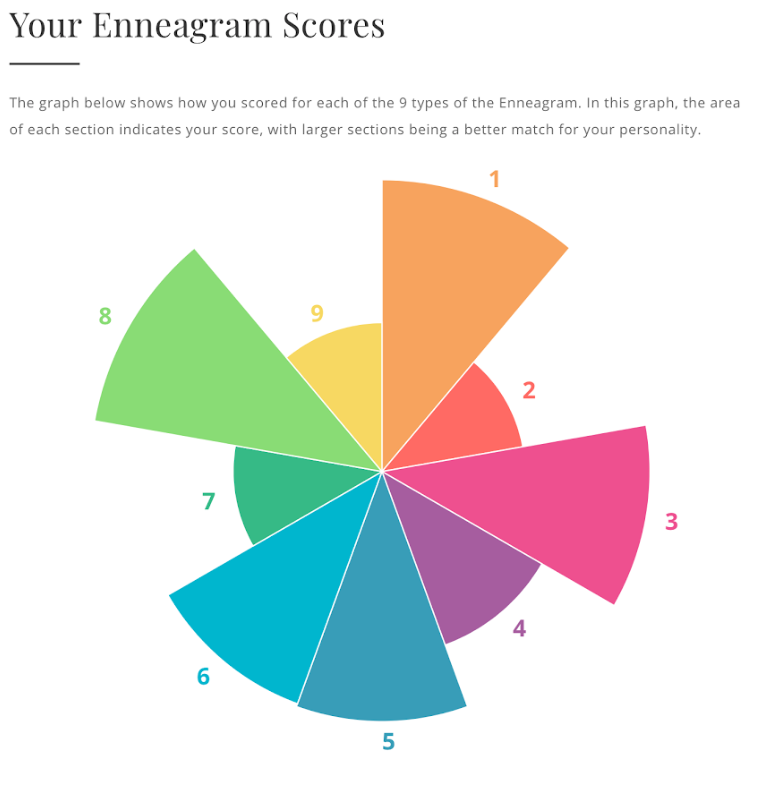
I took the test five years ago and retook it for this post. My results were quite stable, which is an improvement over Myers-Briggs, although I found the Enneagram less interesting. My Enneagram score categorizes me as a Type 1 Moral Perfectionist, Reformer, or Improver. But golly, I also scored high in Type 8, the Protective Challenger, and what did my high scores for Types 3, 5, and 6 mean? Not much, at least to me.

BEST Communication Styles

The personality pattern instrument I have found the most useful in my professional life measures the BEST Communication Styles. Dr. James Brewer adapted and expanded work by William Marston and Ned Herrmann on measuring dominant behavior patterns; Marston was quite a character and invented both the polygraph and Wonder Woman. Brewer developed a basic description of four personality types: Bold, Expressive, Sympathetic, and Technical.

Aspects of the BEST Communication Styles

My clear preferences were for Technical and Bold, with minimal scores in the Sympathetic and Expressive styles. Interestingly, my wife has very similar scores.

What I appreciated about the BEST system was learning the scores for some of my fellow administrators and using that to tailor my interactions with them, in hopes of communicating more clearly and effectively. It also helped me understand better where other leaders were coming from. It is also simple enough that I can make some use of it, while some corporate-style trainings I’ve endured had so many complex steps, acronyms, categorizations, and procedures that I couldn’t be bothered to try to apply them in real life.

The Five Factor Model

In psychometrics, the five-factor model is the most common these days, and at least it was based on empirical research. It measures five factors on a continuous scale: extraversion, neuroticism/emotional stability, amicability/agreeableness, conscientiousness, and openness/intellect & imagination.

A problem with the five-factor model is the naming of the five factors. As you can see, at least three of them have alternate names. This in part reflects how some terms carry positive or negative connotations. Many people might dislike being found less agreeable or conscientious or more neurotic. So alternate terminology is often employed at the cost of confusion.

I took the Open-Source Psychometrics Project’s Big Five Personality Test. Its names for the five factors are shown in the results, including misspelling extraversion, which comes from the Latin extra vertere or “to turn outside”, as “extroversion”. That arose from folks who do not know Latin and thus misspell extraversion to match the spelling of introversion.

My insistence on using extraversion reflects my personality: relatively low in agreeableness and high in conscientiousness.

My Big Five Personality Test results

While Myers-Briggs-style tests always classify me as introverted, I actually scored as more extraverted than 2/3 of those taking the test. People often confuse introversion with shyness or depression, neither of which I suffer from, but I definitely prefer less stimulation and more time alone than those I consider extraverts, and I have to recharge after social interactions.

Emotional stability is an inverse measure of neuroticism. My result says I have an above-average tolerance for stress and change, which I suppose is a function of brain chemistry and also might reflect a happy childhood with few adverse experiences. It might also be influenced by my embrace of Stoicism in adulthood. This factor has no parallel in Myers-Briggs.

Almost 4 out of 5 test-takers scored higher than I did on agreeableness/amicability. My result is thus associated with a lower motivation to maintain social harmony and being more likely to express my opinions forcefully. I’m useful to have on a committee if you don’t want a yes-man. It is also associated with lower levels of compassion, cooperation, and empathy along with enhanced critical thinking, independence, and self-sufficiency. The Thinking/Feeling binary in Myers-Briggs corresponds to this factor. Thinking is associated with low agreeableness while Feeling is associated with high agreeableness.

Independent empirical measures such as my career-long low absenteeism, job stability, and exercise routine correlate with my high score in conscientiousness. I’m a planner with strong impulse control and self-discipline, but that also means that I am quite stubborn and am irritated by those who are impulsive or disorganized. The Judging/Perceiving binary in Myers-Briggs corresponds to this factor. Judging is associated with high conscientiousness while Perceiving goes with low conscientiousness.

My most extreme score was for intellect/imagination, which is most commonly known in the literature as Openness to Experience and is associated with a general appreciation for art, emotion, adventure, unusual ideas, imagination, curiosity, and variety of experience. Folks like me are said to be more likely to hold unconventional beliefs. The Sensing/iNtuiting binary in Myers-Briggs corresponds to this factor. Sensing is associated with low openness while iNtuiting goes with high openness.

My results illustrate some of the problems with personality tests. I have many of the characteristics of introversion, but was rated as more extraverted than 2/3 of the test-takers. I also had a very high score in Openness in the more scientific test, which matches up with the N in my early INTJ label on Myers-Briggs, but I’ve also had tests offer the contradictory label of ISTJ.

The star positions reflect my percentile scores on the Big Five Personality Test

Note that these traits are not fixed; most people shed some of their neuroticism and thus gain emotional stability as they age, and we tend to become more conscientious over time. I do like the continuum of the traits in the Big Five test, which reminds me of how the Kinsey Reports broke ground in the mid-20th century by classifying sexual orientation on a continuum rather than strict binaries. The limitations of heterosexuality and homosexuality spectra then led to initialism in the form of LGBTQ, then LGBTQIA2S+, etc. Golly, but people do love to label and identify themselves and each other.

The utility of most personality tests is dubious, but I do find them interesting. I wouldn’t recommend spending any money on versions of Myers-Briggs or Enneagrams, which I regard as more suitable for entertainment. However, I have found the BEST Communication Styles useful in working with team members, and the Open-Source Psychometrics Project’s Big Five Personality Test is completely free and the five-factor model does enjoy some scientific support.

Posted in random | Leave a comment