Western Village in Millennial Gray

Real estate websites have a secondary function as time machines since when properties are marketed for resale we may catch glimpses into houses we left long ago. The home my parents built in 1962 was “flipped” in 2022. I lived there from 1966-1972, with us moving once I completed kindergarten. Seeing it transformed by millennial gray prompted me to revisit the few ghostly fragments that escaped infantile amnesia.

The Village

My Greatest Generation father and Silent Generation mother were newlyweds when they built the house in 1962, four years before I came along as an early member of Generation X. My father had previously been living in a home he had purchased for his first family in 1957 in The Village, then a north central suburb of Oklahoma City. Dad worked for Cities Service Gas, which had both its executive and operational offices in Bartlesville until 1943 as part of the sprawling Cities Service empire. During World War II, the natural gas company’s executive offices were shifted to Oklahoma City and its operational ones to Wichita, while the oil company remained in Bartlesville until the late 1960s.

In 1957 the operational offices in Wichita, where my father was a gas measurement engineer, were consolidated with the executive ones in Oklahoma City. So Dad moved his first family to The Village, a suburb that had originated in 1949 when developer Clarence E. Duffner, Sr. purchased 40 acres of land near the old railroad town of Britton, itself located seven miles north of Oklahoma City’s core.

Over the years, OKC would grow to encapsulate multiple towns, including The Village, Nichols Hills, Warr Acres, Bethany, Woodlawn Park, Mustang, Spencer, Forest Park, and Lake Aluma while annexing Britton, Belle Isle, Forest Park, Deer Creek, and many square miles of unincorporated land.

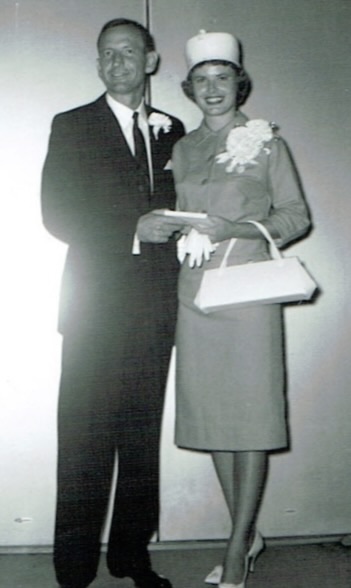
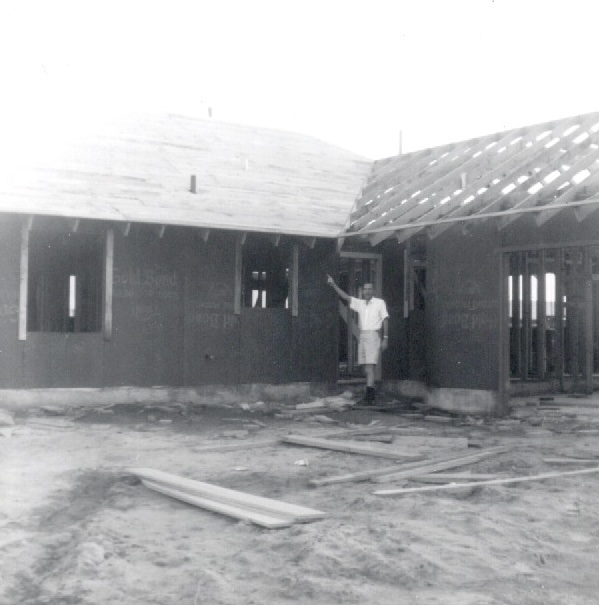
My parents built the house as newlyweds

Oklahoma City annexed Britton in 1950, prompting Duffner and fellow developers Floyd and Joe Bob Harrison and Sylvanus Felix to incorporate The Village to avoid a similar fate for their additions. There were only seven residents at the time, with six voting in favor and none against!

The community started with 160 acres but annexed additional housing developments to grow to encompass 2.5 square miles which are bordered by Oklahoma City on all sides except for rich Nichols Hills to the south.

My father’s first marriage ended in divorce in 1960. Dad spotted my mother at a Cities Service Gas Company Christmas party that year, their first date was in March 1961, and they were married five months later. Mom had come to OKC in late 1957 and had lived in a couple of apartments with other girls. She was 11 years younger than my father, so I am much younger than most of my paternal cousins.

Western Village Addition

Dad put the house in The Village up for sale by owner, and he and his new bride lived in a nearby rental home while a new house was constructed for them in the Western Village addition of Oklahoma City. You might be surprised that “Western Village” is situated on the east side of The Village, but the name came from it being bordered by Western Avenue on the east and The Village on the west.

In January 1962, Ferguson Investment Company began constructing over 500 new homes in that quarter-mile section.

May 1962 advertisement for Ferguson’s Western Village

My parents’ home was the first to be constructed on its block, with them visiting the site when it was nothing but a dirt field with completed homes lined up along a street to the south. They made almost daily checks as the house went up: a three-bedroom wood frame home with red used-brick veneer and white trim, a wood-burning fireplace, and a patio in the back.

The homes were marketed as featuring heavy “floating” concrete slab floors with windbraced wood framing anchored every four feet with steel bolts. The roof trusses were marketed as “tornado-resisting” and the homes were said to be “100% insulated — floors, walls, and ceilings.”

Another advertisement for the new housing addition

The exterior of the home changed very little over its first 60 years, with the 2022 flip repainting its trim in a dark bluish-gray that toned down the fake shutters but made the white garage doors even more prominent; thank goodness they are perpendicular to the street.

The 1962 marketing for the homes reflected the gender norms of the era: “The cheerful kitchens, a trade-mark of Ferguson homes, truly are a woman’s dream — built-in wall-oven and tabletop range, disposal unit and exhaust-hood. Beautiful mill-built cabinets, with counter space provided next to range and refrigerator.”

My mother in her new kitchen

My parents reported only having one minor issue with the builder, and that involved the kitchen built-ins. They were indeed made in a cabinet shop and were delivered to the home site to be stored in the garage until installation. My mother had specified the corner built-in was to have standard shelving rather than a Lazy Susan option that was being offered. They were delivered with a Lazy Susan already installed. She advised the builder of the error, and they had quite a contest of wills before my mother made her point and regular shelving was put in the place of the Lazy Susan.
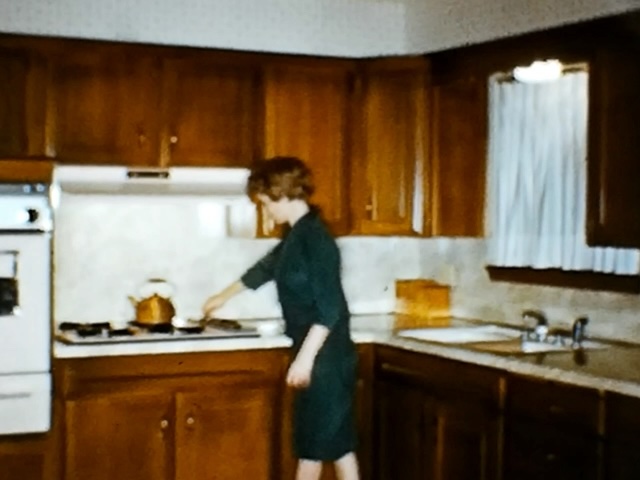
The color image of my mother in the kitchen is from a silent 8mm film my father shot in their new home around Christmas in 1962, and the other shot of me in my high chair is from 1968. That kitchen changed very little for decades after we moved away. Below is its appearance sometime before 2022. The appliances, sink and cabinet hardware had been updated, but the cabinets were still varnished instead of painted and it still had its formica countertops and backsplash and a vinyl floor.

Before the 2022 flip

Flippers like to paint wood cabinets and replace any wall-to-wall carpet or vinyl flooring with engineered wood floors. A variety of materials may be used to replace formica countertops and backsplashes.

As for colors, my memories of the late 1960s are fragmentary, but I know the appliances were light pink. Later, while growing up in the 1970s, I was surrounded by lots of earth tones — harvest gold, oranges, and terracottas — coupled with plenty of wood paneling and avocado green appliances. Those would all appear in my parents’ next home to the southwest in the town of Bethany. Eventually beige would sweep through homes as a more neutral color, and by the early 2010s grays began to dominate. The aesthetic adopted by the flippers was the later stereotype.

I never lived in a golden house

I don’t like wood wall paneling, but I do like wood tones in cabinetry and wainscoting, so we have left those intact in our 1981 home in Bartlesville. I am grateful that our home’s contractor cabinetry was stained dark and not the honey gold that became popular later that decade and endured into the 1990s. I do have to break out the Old English scratch remover, however, to touch up our dark woodwork.

The flippers extended the engineered flooring through the entire Western Village house. They also painted the mantle, but thankfully resisted painting the back brick wall.

The eleven homes and apartments where I have resided had mostly wall-to-wall padded carpet, allowing me to walk around in comfort in socks or barefoot without fear of tripping. I developed an aversion to bare hard floors at the house we moved to after leaving Western Village. It had a den paved in red quarry tile, the same kind later used in QuikTrips. A large rug softened the area around the sofas, but there was a big cold zone I had to traverse to reach the long green shag carpet of the living room and bedrooms.

Yes, I used one of these in the early 1970s; it was a dark time

Shag was an example of carpeting at its worst, with one of my household chores being to rake it. My parents invested in a massive self-propelled Kirby vacuum cleaner, and I remember the constant pings when my mother swept the living room shag. The previous homeowners had kept a caged bird in there, and I figure she swept up many pounds of birdseed. My father finally reacted by replacing the shag with commercial short-loop pile carpet that Cities Service surplussed from its downtown offices.

In 2018, Wendy and I replaced the 37-year-old saxony carpet in our home in Bartlesville. We still wanted wall-to-wall carpet, and we had Sooner Carpet install a frieze carpet that looks and feels great, doesn’t track like saxony, and thank goodness doesn’t require raking. However, I understand the appeal of having robot vacuums sweep hard floors and rugs and that owners of indoor pets want ways to address stains, smells, and allergens. I’m also sure that the popularity of open-plan spaces also contributed to the return of rugs, which can create functional zoning.

Back at Western Village, the bathrooms were also refinished. Gray again dominated, covering the walls and woodwork, with another gray mix countertop. I suppose they expected millennials to love its neutrality, versatility, and practicality. However, it all seems so bland to me. I also read that millennial gray is “oversaturated” in the cultural sense and losing favor, and “beige ‘n sage is the new greige.” Well…er…time marches on.

The Western Village development at the end of the Baby Boom continued into the early years of the Baby Bust, with the last lots filled by 1970. Pied Piper Park was just to the south and in 1963 Western Village Elementary School was built on the western side, just inside the borders of The Village.

So I lived just an 8-minute walk from the park and a 12-minute walk to the school. I do recall the walk to and from kindergarten, as I had a hernia that made the trek painful when I was in a hurry. Getting that fixed when I was five years old was my only significant surgery. Below is a clip from early 1971, months before I would start walking to kindergarten.

One clear memory of kindergarten was the day I was selected to be the “wake up fairy” for our naptime. I was given a yardstick and was supposed to gently tap each student to signal them to get up and go to recess. One of my friends had made me angry earlier, so when I came to him I stabbed the yardstick down hard on his back. That indiscretion led Mrs. Brewer to revoke my privileges to play with the wooden stove in the little kitchen area, one of my favorite things in the classroom, for what seemed like an eternity. Lesson learned!

1970s busing protest in OKC

In 1972, the court-ordered and rather complicated Finger Plan of forced busing began to desegregate the Oklahoma City school system. Oklahoma City’s long history of racism and redlining meant that many schoolchildren across the sprawling city would be bused across town to address de facto segregation that had endured for almost two decades after Brown v. Board of Education.

To avoid a plan that by fifth grade would bus me to a school many miles away, my parents joined the consequent “white flight” and sold their home of ten years. We moved to the Nazarene suburb of Bethany in far west OKC where I would be in the Putnam City school district. Oklahoma City had 71,000 students in its school district in 1971, and within a decade over 30,000 white students had left. White flight and the Baby Bust meant that the district dropped to about 35,000 students. Forced busing ended in the elementary schools in 1985, by which time the district had about 20,000 white students and 15,000 black students. The U.S. Supreme Court lifted the desegregation order in 1991. By 2011, the OKC school district had rebuilt to 43,000 students, with over half of them being Hispanic.

Western Village Elementary struggled with declining enrollment and poor outcomes. It was facing closure in 1998 when INTEGRIS Health started an after-school program there, and it officially transformed the facility into Oklahoma’s first public elementary charter school in 2000. It was renamed Stanley Hupfeld Academy at Western Village in 2010.

That concludes my look back at my first home. I already did a series of three posts on the Windsor Hills neighborhood where I lived during junior high and high school:

One of these days the house in Bethany, where I lived while attending the first through sixth grades, will be resold. If I’m lucky, photos of it will make it into a real estate time machine, allowing me to revisit that home as well, which had a more complex history and layout than the contractor home my parents purchased in Western Village.

I don’t really miss my first neighborhood, as my memories are so fragmentary. However, earlier this year Wendy and I stopped in Oklahoma City on our way to Santa Fe, NM. We had lunch at Johnnie’s Charcoal Broiler on Britton Road, and I deliberately exited the Broadway Extension to drive west on Britton Road through the old downtown, half a mile south of Western Village. The sense of déjà vu was rather eerie, even after over a half-century.

Posted in history, nostalgia | Leave a comment

Okie Stereotypes

A memorable encounter with Okie stereotyping came in 1984, right after I graduated from high school. One boy and one girl had been selected from each state for an academic recognition in Washington, DC. I was flown out, on my first-ever ride in an airplane, and checked into a dormitory at Georgetown. The dorm’s reception hall was filling up, like a weird variant of Noah’s ark, with the guy and the gal from each state. I was greeted and instructed to state my first name and my state.

“Howdy! I’m Granger from Oklahoma.” I could hear my accent from the first syllable, and I flushed at the smirks and sideways looks that appeared around the room. While my accent is not what you’ll hear down in Little Dixie, I remained acutely aware of my South Midland accent all that week. It would have been cuter if I’d been wearing a cowboy hat and boots with my jeans, but I didn’t own such items.

Various exchanges at our first mixer:

How often do you get dust storms? The Dust Bowl was mostly out west in the panhandle area, and farming practices have improved since the 1930s, so we see few dust storms.

How many tornadoes have you been in? Well, we have tornado watches and warnings a few times each year, but I’ve never seen a twister myself. [I wouldn’t see one until a few years later as an undergraduate in Norman.]

Do you live in one of those, uh…sod houses? No, our home is like the third little pig’s, with a brick exterior.

Do you have an outhouse? No, we have indoor plumbing…and central heat-and-air to boot.

Do you have trouble with Indian raids? Are you kidding? No, we don’t circle the wagons and fend off Indian attacks.

So you get along okay with the Indians? Well, I’m dating a half-blood Cherokee, if that tells you anything.

And so on…from some of the best-educated kids across the nation. Mind you, I was pretty ignorant as well. My roommate was from Connecticut, and one night he suggested we go out and get some “Häagen-Dazs”. I had no idea what that was, but it sounded similar to Heineken, and we were years away from being of legal drinking age. So I asked, “Is that legal?”

Hopefully over the past 40 years the internet has improved things somewhat, but I noted some Oklahoma stereotypes that Heather Koontz once identified and decided to explore them both statistically and personally.

Everyone drives a truck and wears boots

Welp, less than 20% of Okie vehicles are trucks, and trucks are more popular in 22 of the 50 states. While I have ridden in and driven pick-ups, I have never owned one. My parents drove sedans, station wagons, and Volkswagen campers, while I’ve only owned sedans and coupes, and my wife owns a minivan which we use for our driving vacations.

[Data source]

However, cowboy boots are indeed the most popular footwear in Oklahoma, a status only shared with Alabama, Arkansas, Mississippi, and Tennessee. (The most popular footwear in Texas is, funnily enough, open-toed slip-on slides. Shameful.) I had a pair of boots when I was eleven, and I bought one pair as an adult which I wear on rare occasions, but I like sneakers.

Everyone lives on a farm

Farms are now often large corporate entities, so even in South Dakota, which has the greatest proportion of farmers among its population, they peak at 5.6%. You have to travel down through North Dakota, Iowa, Nebraska, Montana, Wyoming, and Kansas before you’ll encounter Oklahoma at 8th place with 3.1% of its people being farmers. However, my first name does come from farming, and my mother grew up on an Oklahoma farm until age 13.

Tornadoes happen every day

Oklahoma is in tornado alley where warm, moist air from the Gulf of Mexico meets cool, dry air from the northern plains.

[Source]

However, the region of higher tornadic frequency has been shifting eastward.

[Source]

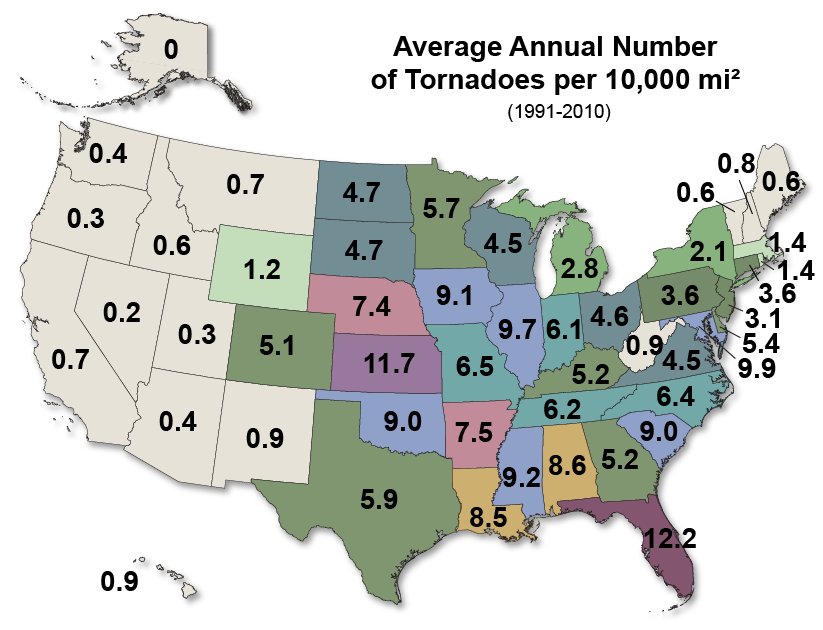
From 1991 to 2010, Oklahoma was tied for 7th place in the number of tornadoes per square mile.

[Source]

I’ve heard a few twisters while taking shelter, and we had some tornado damage in Bartlesville in 2024, but I’ve only seen one, from a mile or two away, back in the late 1980s in Norman. Oklahoma averaged 59 tornadoes per year from 1950 to 2024.

It’s just red dirt

Steinbeck’s The Grapes of Wrath about the Dust Bowl has long influenced popular perceptions of the Sooner State. However, the Dust Bowl primarily affected the remote panhandle region, not the cross timbers of central Oklahoma where I grew up, let alone Green Country in northeastern Oklahoma where I have lived my adult life.

The Dust Bowl areas in the Great Depression
Where you’ll find red Port Silt Loam soil [Source]

The western half of Oklahoma is indeed mostly prairie grass, and “red dirt” music gets its name from the Port Silt Loam soil found in 33 of the state’s 77 counties.

However, the east central area is dominated by the Cross Timbers mix of prairie, savanna, and woodland of post oak and blackjack oaks. I live at the boundary between the Cross Timbers and the bluestem prairie mosaic, with oak-hickory forests to the southeast, while the southeast corner of Oklahoma has oak-hickory-pine forests spread across the Kiamichi and Ouachita Mountains.

[Source]

Oklahoma also has over 200 man-made lakes, while there are 62 natural oxbow lakes that are 10 acres or more in surface area. Oxbows are old U-shaped bends of rivers cut off from the main channel.

Football is life

Football is indeed a major cultural phenomenon in Oklahoma, although the professional basketball team in Oklahoma City is the state’s only major league sports franchise. The rivalry between the University of Oklahoma and Oklahoma State University football teams is intense. I earned my undergraduate degree from OU and did hours of graduate work at OSU, so I don’t favor either one, especially since sports in general don’t interest me.

It’s full of cowboys & Indians

Oklahoma certainly features cowboys. Between 1866 and 1890, a number of cattle trails crossed what later became Oklahoma, transporting livestock to railheads.

[Source]
Local cattle ranchers include John & Alicia Kane

At the beginning of this century, over five million cattle were still to be found on farms, feedlots, and ranches of Oklahoma, which in 2022 was ranked fifth among the beef-producing states. There are indeed some cattle ranches around Bartlesville.

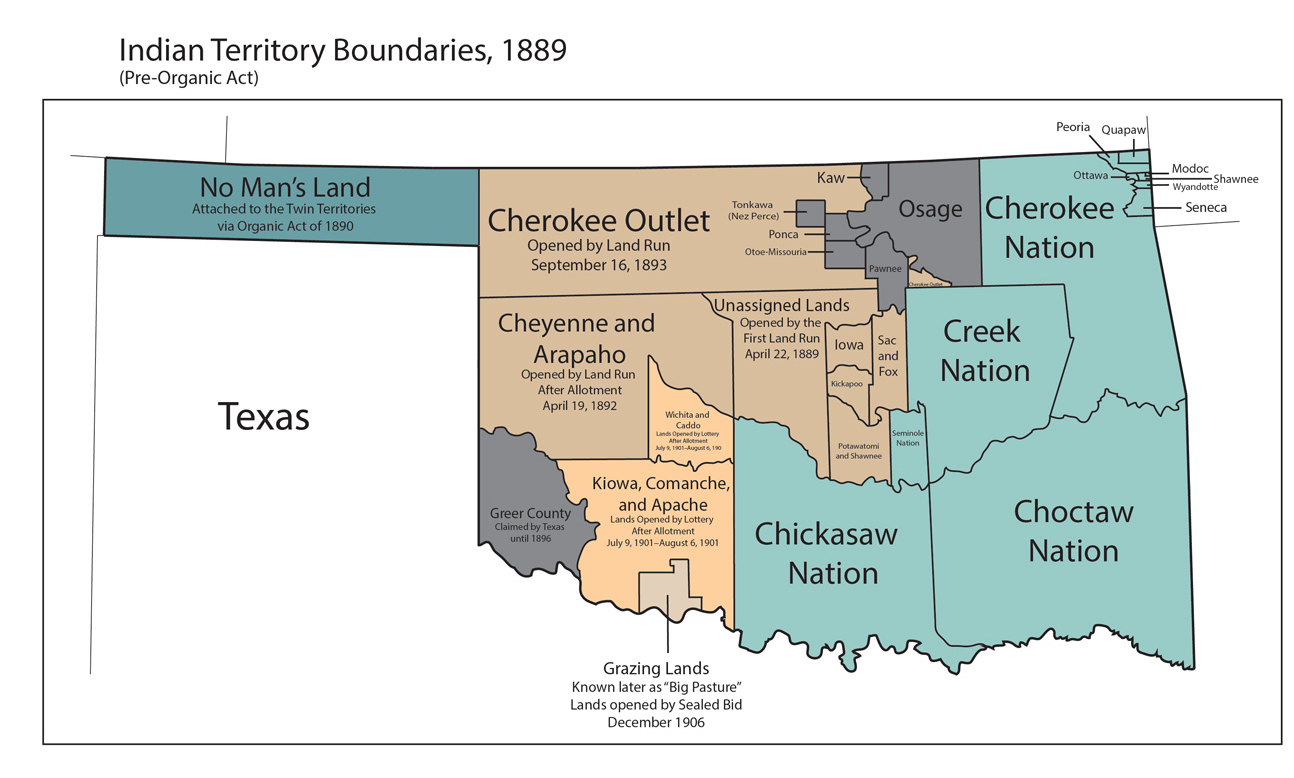
Oklahoma is also very much a state of First Peoples, being once divided into the Oklahoma and Indian Territories. Many of its 39 tribes were forcibly removed to this region between 1830 and 1862, with more pressured onto reservations here between 1867 and 1892.

[Source]

In 2023, Oklahoma had 555,598 First People forming 13.5% of its population, mostly in the eastern half of the state which was once Indian Territory. The only state with a higher percentage of First Peoples was Alaska. While only 1.2% of the total U.S. population lives in Oklahoma, it is home to 7.6% of the nation’s First Peoples.

Oklahoma had strong ties to western movies featuring Tom Mix, Gene Autry, Will Rogers, Dale Robertson, et al. as well as institutions such as the 110,000-acre 101 Ranch and characters like Pawnee Bill. The Rodgers & Hammerstein musical Oklahoma! also established a popular image of farmers and cowmen.

The “cowboy and Indian” stereotype dates back to later half of the 19th century, with the “Wild West” only lasting from 1865-1895, ending over a decade before Oklahoma’s 1907 statehood. The classic cowboy era began to decline in the winter of 1886-1887 when thousands of cattle died during an extreme cold spell. The open ranges being fenced off with barbed wire, plus extensions of the railroads, eventually made cattle drives obsolete. Cowboys transitioned from being nomadic drovers to working for private ranch owners.

The American Indian Wars concluded a century ago, and the 1924 Indian Citizenship Act finally granted citizenship to all First Peoples. Today the most prominent tribes in Oklahoma are the “five civilized tribes” of the Cherokee, Choctaw, Chickasaw, Muscogee (Creek), and Seminole. Bartlesville is in the Cherokee Nation, just east of the Osage Nation, and the town is home to one of the three federally recognized tribes of Lenape or Delaware Indians, with the others based in Anadarko, Oklahoma and Shawano County in Wisconsin.

On the personal front, I have little to no Native American ancestry, with my DNA categorized as 60% British, 16% French & German, and 15% general northwestern European. I’ve never ridden a horse, so my cowboy hat, boots, and duster are just costume wear.

Tipis are everywhere

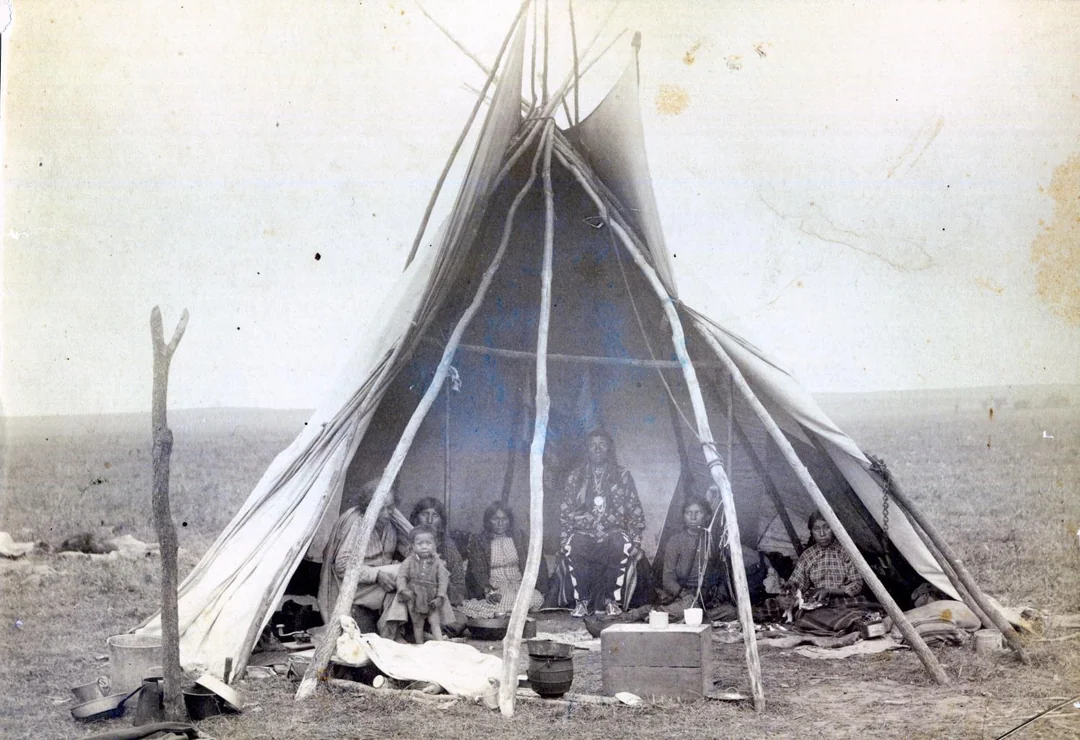
Pawnee tipi in Oklahoma territory in 1889

Several Plains tribes used tipis, with the Osage using them during hunts but also using longhouses made of wood and animal hides for their permanent villages.

The Oklahoma Historical Society does have a Lakota tipi made from buffalo hide around 1852 and a 1916 Kiowa tipi that was featured in the 1920 film The Daughter of Dawn which was filmed in Oklahoma’s Wichita Mountains. When I was a kid, a large tipi was displayed on an upper floor of the old historical society building at the capitol complex.

However, I’ve only seen a few tipis in tourist or historical contexts. Oklahoma tribes employed diverse styles of traditional housing in the historic and early reservation periods.

It is covered in oil wells

These days, Texas, New Mexico, North Dakota, Colorado, and Alaska produce more oil than Oklahoma.

[Source]
Oklahoma was among the top five oil-producing states throughout the 20th century
[Source]

However, Oklahoma was the largest producer at statehood in 1907 and remained in the top three with the much larger California and Texas until the end of World War II, and then remained in the top five for the rest of the 20th century.

Tulsa was billed as “the Oil Capital of the World” until the late 1960s and 1970s when Houston assumed prominence, and the Oklahoma petroleum industry led to some beautiful art deco buildings, Ponca City’s Marland Mansion, Woolaroc near Bartlesville, and much more.

The state’s long history of petroleum production has left most of it dotted with over 450,000 oil and gas wells, with about 30,000 being active in the 2020s. Unfortunately, the state has over 260,000 unplugged wells. Bartlesville still has some stripper wells, and it was the location of the state’s first commercial oil well and was once the headquarters for both Phillips Petroleum and Cities Service.

Oil and gas wells across Oklahoma [Source]

My father was a petroleum engineer for Cities Service Gas Company, and my mother did some office work at Cities Service and Oklahoma Natural Gas before her career at a savings and loan. I was drawn to Bartlesville by the opportunity to teach high school physics all day, something that was possible for a few decades thanks to the socioeconomic impact of Phillips Petroleum and its successors.

It’s all conservative evangelicals

Change “all” to “mostly” and it works. 70% of Oklahomans are Christians, and 2/3 of its Christians are Evangelical Protestants; only Arkansas has a greater percentage of evangelicals. Oklahoma is a top-10 state in overall religiousness, religious attendance, and prayer frequency, positioned at the northwestern end of the Bible Belt.

In 2022, 51% of Oklahomans described themselves as politically conservative, with only 26% claiming to be moderates and 23% as liberals. Oklahoma was solidly Democratic back in the Jim Crow era, shifting in the late 20th century to be completely dominated by Republicans. Donald Trump won every county in 2016, 2020, and 2024, and Republicans hold veto-proof supermajorities in both chambers of Oklahoma’s legislature.

Google Gemini crafted this image from various Oklahoma stereotypes

The dominance of religious conservatives was long evident in Oklahoma’s vice laws, although that has changed significantly over my lifetime:

Alcohol: The state officially prohibited liquor from 1907 to 1959, with predictable inconsistent enforcement. Beer with only 3.2% alcohol was allowed after national prohibition ended in 1933, but Oklahoma didn’t allow sale of individual alcoholic beverages for on-premise consumption, “liquor by the drink”, until 1984, and grocery stores were not allowed to sell wine and beer until 2018. For decades, liquor stores weren’t allowed refrigeration nor Sunday sales.

Drugs: In 2018, voters, not the ultra-conservative legislature, approved a state question legalizing marijuana for medical use. A 2023 study estimated that almost half of Oklahomans use cannabis.

Gambling: This was largely prohibited until 1988, when tribes were allowed to operate certain types of gaming on sovereign land. In 2004, voters authorized tribal gambling, including slot machines and table games, and now there are over 100 tribal casinos dotting the state. A statewide lottery began in 2005, and sports betting was legalized in 2020.

Sex: The state once banned oral and anal sex along with interracial marriage and cohabitation, and homosexual acts were illegal until the 2003 U.S. Supreme Court decision in Lawrence v. Texas. Sex education is still rare, and abortion is a felony with almost no exceptions, so it is no surprise that the state’s teen birth rate is in the top five.

As for me, my politics is Outsider Left, and while I abstain from alcohol, drugs, and casinos, that isn’t attributable to religious beliefs.

It’s a land of poor, backward people

Oklahoma is among the bottom 10 states in median income. One source lists it as the sixth-poorest state, with many jobs falling short of living wages. U.S. News & World Report ranked Oklahoma #42 overall, with dismal rankings in education and health care, and it ranks #47 in the Opportunity Index. The state was similarly ranked 47th in health and well-being by the United Health Foundation. WalletHub likewise ranked Oklahoma as the 8th worst state to live in, although it did fare better than neighboring Arkansas and New Mexico. Oklahoma ranks 42nd in its overall state tax burden, but that translates into underfunded schools, roads, and various other services.

On the plus side:

  • 49th in cost of living, with extremely affordable housing, low taxes, and affordable utilities
  • Business-friendly with a strong job market in the energy, agriculture, and healthcare sectors
  • Surprising geographic diversity with varied landscapes including plains, forests, and mountains that are accessible via over 200 parks, wildlife refuges, and national forests
  • Welcoming and friendly residents who have a strong sense of community

Bartlesville was ranked the 11th best place to retire in Oklahoma by Niche magazine in 2025, and I would rank us higher than they did in outdoor activities given my appreciation of the Pathfinder Parkway, but we understandably lost points for lack of access to beaches and snow skiing.

Niche magazine’s 2025 ratings for Bartlesville

Stereotypes

I’d say that several of the above Okie stereotypes ring true, even though few of them apply to me on a personal level. Every state has its quirks!

Stereotypes fall in the face of humanity. We human beings are best understood one at a time.
Anna Quindlen
Posted in random | Leave a comment

Mary Stewart’s First Novel

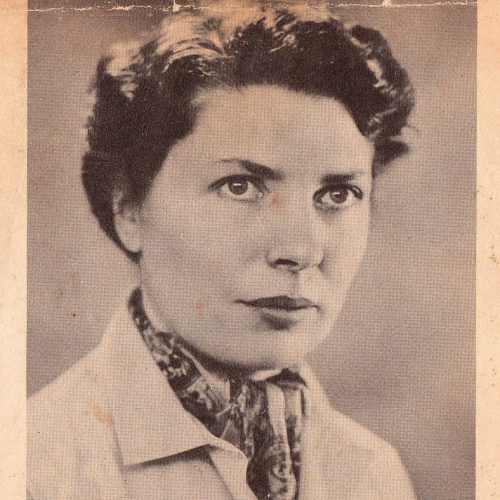
Mary Stewart was a lecturer in English at Durham University when she wrote her first book in the 1950s. She was prompted to finally take the leap and write a book after an ectopic pregnancy nearly killed her and led to her inability to have children.

“I’d always wanted to be a writer, but I suppose what really started me was losing an unborn child and being told I could never have another one. Something was needed to take the place of a family, which I’d always desperately wanted, and writing was the thing.”

Mary Stewart in the 1950s

However, Stewart was a very private person, and receiving a 50-pound advance and a proof copy from publisher Hodder and Stoughton sent her into a panic.

“A novel is such an intensely personal thing,” she said. “I couldn’t stand the thought of thousands of eyes reading my private thoughts. I was terrified . . . it felt like walking naked down the street. I told Hodders to stop publication at once.”

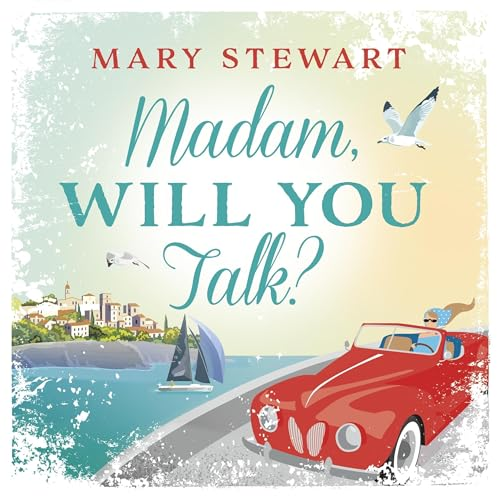
Thankfully, her book about a schoolteacher involved in a murder case in the south of France did get published as Madam, Will You Talk?, becoming the first of many bestsellers.

Stewart was also protective of her work. When she was sent back an edited version of her first novel, her niece reported, “She scribbled it out and said ‘My writing is better than your edits – please don’t edit my books if you want to publish them’.” They worked it out, as she remained with that publisher for her entire career.

According to her obituary in The Times, “Stewart travelled for several months a year around locations such as Damascus, the Greek islands, Spain and France, carrying tape recorders everywhere and talking to local people. . . . Each book would entail four drafts and she was as disciplined as the neat award-lined shelves in her study, working from 2pm after finishing household chores and breaking only to cook for and dine with her husband.”

Stewart demurred at classifying her novels into genres, saying, “I’d rather just say that I write novels, fast-moving stories that entertain. To my mind there are really only two kinds of novels, badly written and well written. Beyond that, you cannot categorise . . . Can’t I say that I just write stories? ‘Storyteller’ is an old and honorable title, and I’d like to lay claim to it.”

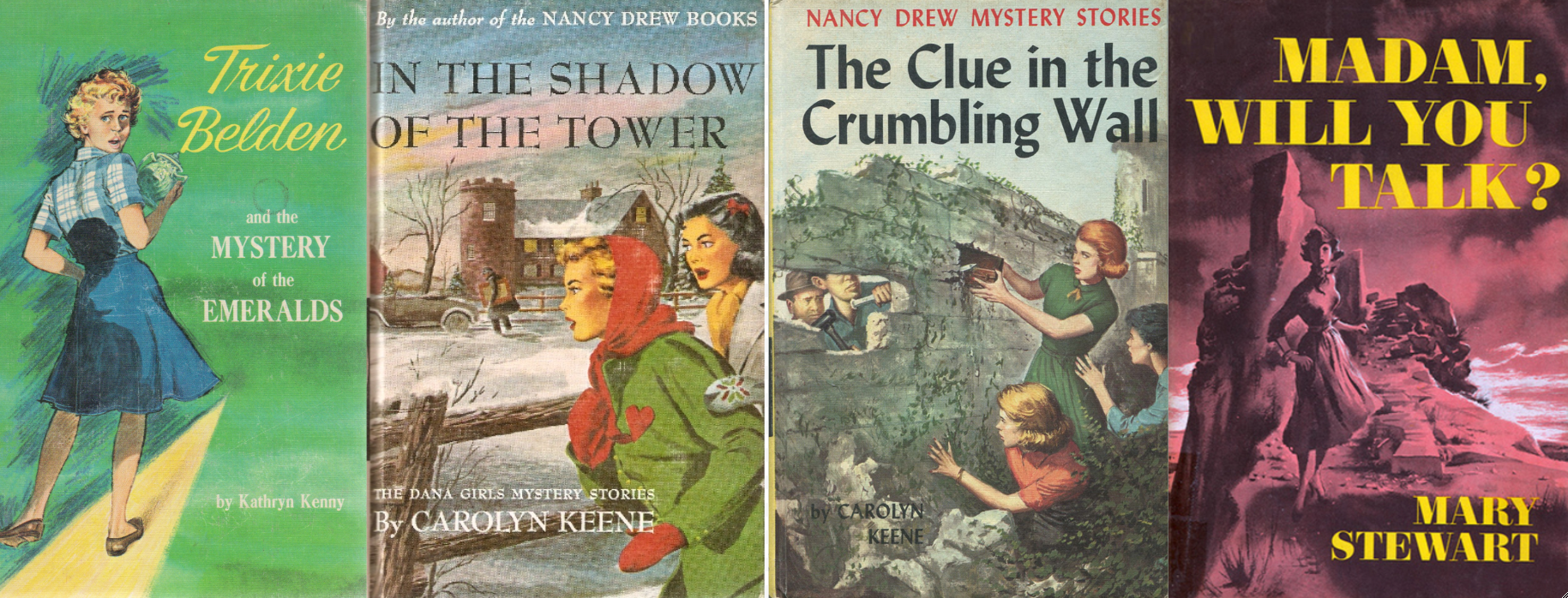
I enjoyed reading The Moon-Spinners a few weeks ago, as a welcome storytelling respite after an overindulgence in literature. It read to me like a much more adult and literary version of a Nancy Drew mystery, with deft prose, good pacing, and action. As a youngster, I collected and repeatedly re-read the original Grosset & Dunlap hardbacks of The Hardy Boys mysteries, and a spinster aunt then let me consume her collection of Trixie Belden, Dana Girls, and Nancy Drew stories.

A progression, of sorts

Stewart was more talented, and allowed to be far more painstaking, than the ghostwriters of the Stratemeyer Syndicate like Leslie McFarlane and the intrepid Mildred Wirt Benson, who had to dash off children’s texts based on preset outlines for flat fees. Stewart was especially adept at describing environments and evoking a sense of place, unafraid of making frequent literary allusions drawn from her studies of English literature. That habit fed my insatiable curiosity, which I evidently shared with the lady of Madam, Will You Talk?

In the first chapter, the protagonist declared, “I get on well with cats. As you will find, I have a lot in common with them, and with the Elephant’s Child.”

The what? Context told me she likely meant either curiosity or resiliency, and you know that I couldn’t resist looking it up. I’ll share with you my findings to illustrate the games of ping-pong I sometimes play.

ping

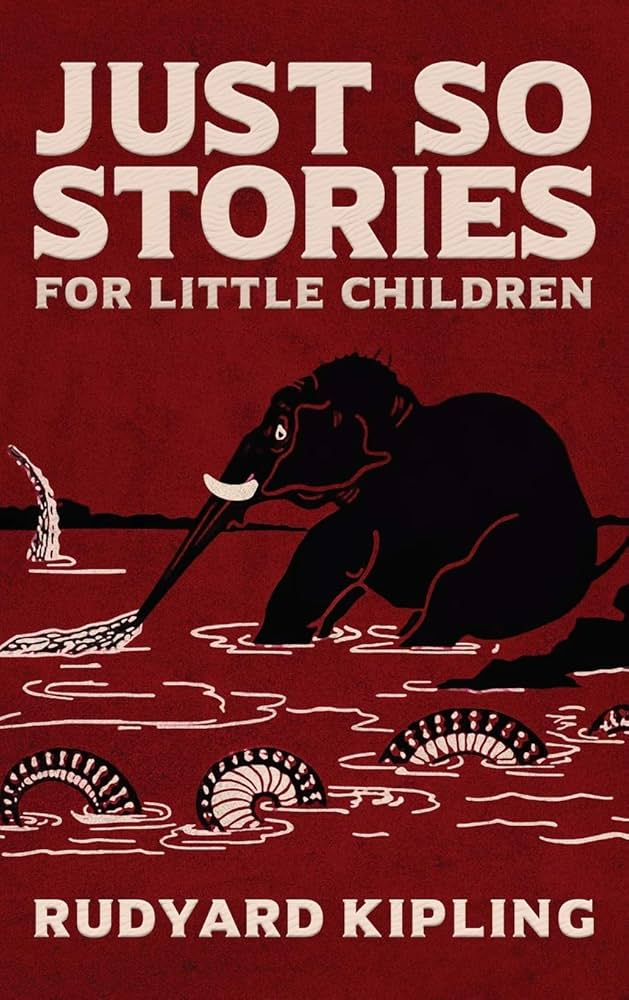
The Elephant’s Child turned out to be one of Rudyard Kipling‘s stories in Just So Stories from 1902 about how a very curious young elephant acquired his trunk. I read the story in question and suppose that Mary Stewart née Rainbow and many other British children were familiar with it back in the day. Kipling’s book was a collection of what had originated as bedtime stories for his young daughter, who insisted on them being told “just so” and who had tragically died of pneumonia in 1899 at age six.

pong

Kipling is far removed from me both culturally and temporally, so if I had ever read anything by him, it was in some forgotten school literature book. In my lookup, I noticed that Kipling also wrote the poem “Gunga Din”. I’d seen references to that character over the years with no understanding of its meaning beyond it involving the British Raj. So I read that poem as well, not caring for it one bit, and I was mightily annoyed to find that in it “Din” is rhymed with “green” and “spleen”, not “pin” as I’d presumed and heard said. Yet another reason to trace things back to their source.

ping

I vaguely knew Cary Grant had starred in a movie oh-so-loosely based on “Gunga Din”, and I watched the movie’s trailer, curious as to how they pronounced the name. The trailer didn’t include it, but I found more excerpts that reassured me.

pong

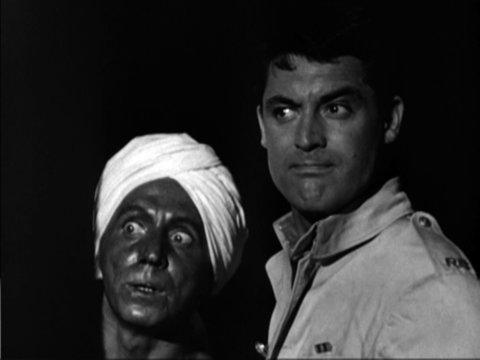
Sam Jaffe and Cary Grant in 1939’s Gunga Din

I was surprised to see New York Jew Shalom “Sam” Jaffe playing the Indian water bearer in brown makeup, which struck me as appropriately problematic for a movie based on a poem by the same guy who wrote “The White Man’s Burden” exhorting the United States to colonize the Philippines.

point

And then I bounced back into Stewart’s tale, all the better for my game break. The first chapter also included, in rapid succession, references to Nighug at the root of Yddrasil, the paintings of Ma Yüan, and how a tree’s shadow “dissolved into the image of a ragged witch’s besom”, from which I learned that a besom is the old-fashioned broom constructed from a bundle of twigs bound to a pole.

Mind you, the writing flowed well, and context would have allowed me to flow past such references were I not an elephant’s child. Stewart’s writing talent is illustrated by this description of a beautiful woman’s outfit: “The simple cream dress she wore must have been one of Dior’s favorite dreams, and the bill for it her husband’s nightmare.”

Stewart’s sharp mind is also illustrated by mention of how, at age 97, she astounded lunch guests by reciting 23 verses of The Rime of the Ancient Mariner, and when one of her niece’s friends quoted from Beowulf in English, Stewart replied in fluent Anglo-Saxon.

As I finished the first chapter, I pondered the book’s title. What was that a reference to? Why, an old Cheshire song: I Will Give You the Keys of Heaven. Ugh, although I did enjoy this in the fine print: “In many the lady’s cupidity is at last excited by some especially magnificent offer, and, on her consenting, the man refuses to have anything to do with her.”

For what it is worth, Stewart’s original title for the novel was Murder for Charity, and one manuscript had Decoy to Danger scratched out and replaced with Madam, Will You Talk?, with lyrics from it used to begin chapters 15-17.

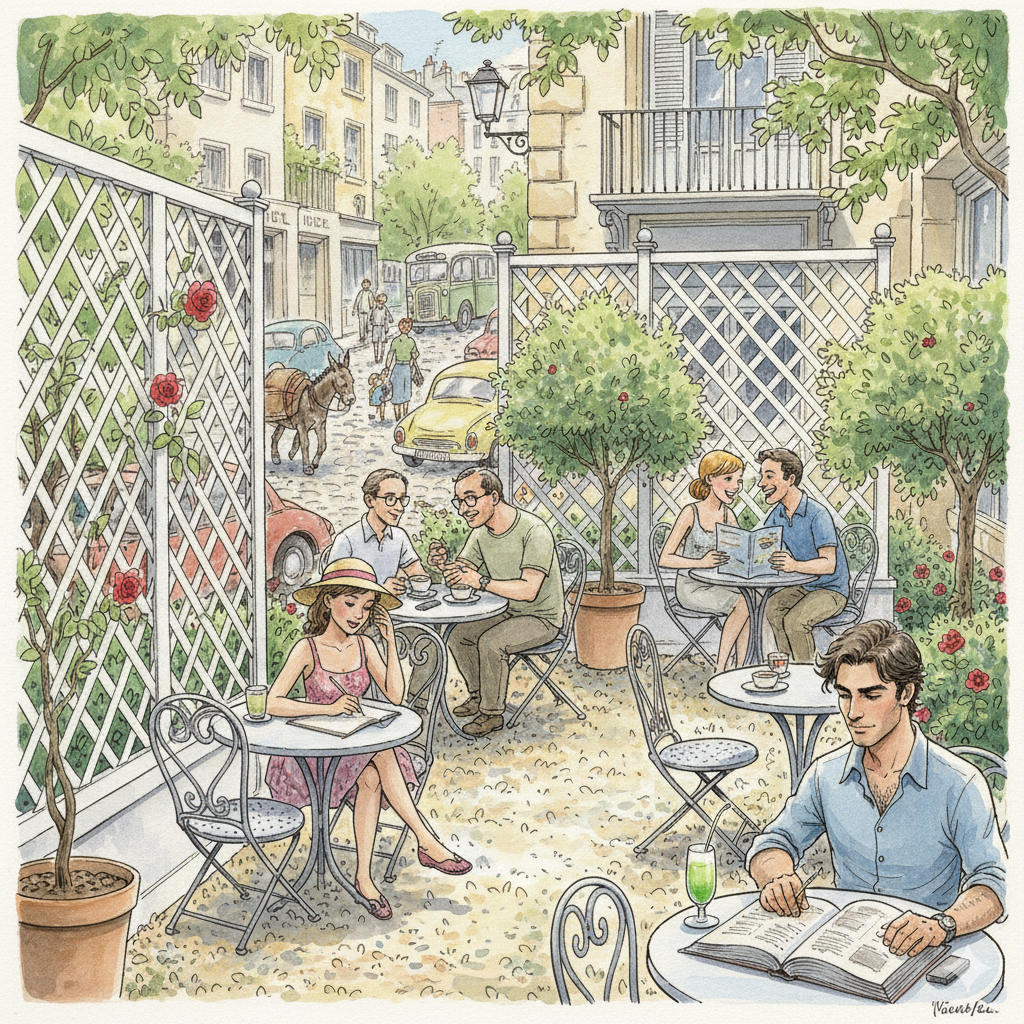
True to form, her second chapter initiated with a quote from Chaucer, and the vacationing schoolteacher, serving as first-person narrator, playing an internal guessing game about people populating a hotel courtyard. She noticed a man sitting alone, “sipping a bright green drink with caution and distrust” who was reading T.S. Eliot’s Four Quartets, which the internet told me explores the nature of time, spiritual redemption, and the struggle for meaning. Here is what Google Gemini made of the scene:

Google Gemini’s impression of the hotel courtyard

I laughed when the schoolteacher’s gossiping friend entered and said of the man with the poetry book: “His name is John Marsden and he is almost certainly a Boy Scout and a teetotaller as well.”

When asked why on earth she would think that, she replied, “Because any lonely male I ever get within reach of these days seems to be both, and to eschew women into the bargain. Is that the right word, eschew?”

My guess was that the schoolteacher would end up in a romance with Mr. Marsden. Before the end of Chapter 2, about 10% into the story, the travelogue was underway with a walk into the central square of the medieval walled city, and the plot began to unfold with mention of a jealous and possibly murderous husband on the loose, looking for some of the guests we’d met at the hotel. I was glad to see honest mentions in the work of beggars, heat, and less salubrious areas which made the town seem real and not something gussied up with an Instagram filter.

The suspense ratcheted up about 1/4 of the way into the book, and as the action built, the literary allusions were less noticeable, something I’d also noticed in Stewart’s The Moon-Spinners, which was published seven years later. I laughed when Marsden was spied again reading poetry one morning in the courtyard:

‘At breakfast!’ said Louise in an awed voice. ‘A man who can read poetry at breakfast would be capable of anything.’

However, there had yet to be any romance developing for the lead character, with Marsden seemingly involved with another woman, so I was beginning to doubt my initial guess. Half-way through the novel, after an extended and well-written chase, the schoolteacher took an unexpected swerve in romance that I didn’t find at all realistic, but it did make the story far less predictable.

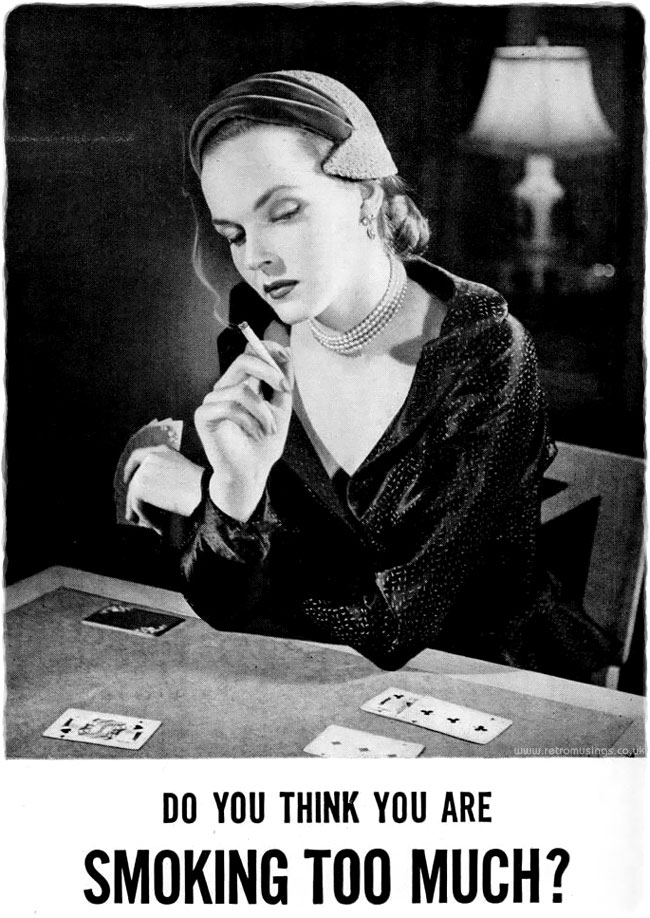
Most of the characters in the novel smoked cigarettes. I wonder if today’s authors, when writing about the mid-20th century, would make the effort to include its pervasiveness. About half of the adult population in France was smoking in the 1950s and 1960s, which declined to a bit above one-fourth by the 2020s. About 42% of adults in the United States were smoking in 1965, and that has declined to about 11%, with about 7% vaping with electronic cigarettes. Recently my wife and I went to a show that was held at an event center in one of the many casinos in Oklahoma, and she was struck by the smell of cigarettes that pervaded the gaming areas. What was once quite commonplace has become a rarity.

The story remained fast-paced, with fun twists and turns. I was struck by Stewart’s evocative prose in conveying a sense of speed and excitement.

The wind of our own speed beat against us, whining along the great bonnet and clawing at the wind-screen, but I could tell from the drift of the high clouds against the starlight that the upper air, too, was alive. The moon had vanished, swallowed by those same clouds, and we raced through a darkness lit only by faint stars, save where the car’s great lights flooded our road for what seemed half a racing mile ahead. And down that roaring wedge of light she went, gathering speed, peeling the flying night off over her shoulder as a comet peels the cloud. Along that rushing road the pines, the palisaded poplars, the cloudy olives, blurred themselves for an instant at the edge of vision, and were gone. The night itself was a blur, a roar of movement, nothing but a dark wind; the streaming stars were no more than a foam in our wake.

I enjoyed Stewart’s red herrings, although the first-person narrative required that the novel’s denouement spend awhile tying up loose ends and the plot relied on too many coincidences, with characters tripping upon each other with abandon.

Stewart was definitely no Christie or Pargeter, but she created light confections that blended mystery, suspense, and romance. I look forward to more of her tasty treats.

Posted in books, music, video | 2 Comments

A Month in the Country

Elegiac, a term I associate with high school literature classes, came to mind as I was reading the beautiful A Month in the Country, a novella by English author J.L. Carr which was published in 1980.

Carr, like many authors, draw upon his own experiences to flesh out his eight short novels. He was born in 1912 into a Wesleyan Methodist family in northern England. Carr became a teacher and spent 1938 as an exchange teacher in South Dakota, of all places. He took the long way back across the Pacific and Asia to England, visiting various countries, and then volunteered for service in the Royal Air Force in World War II.

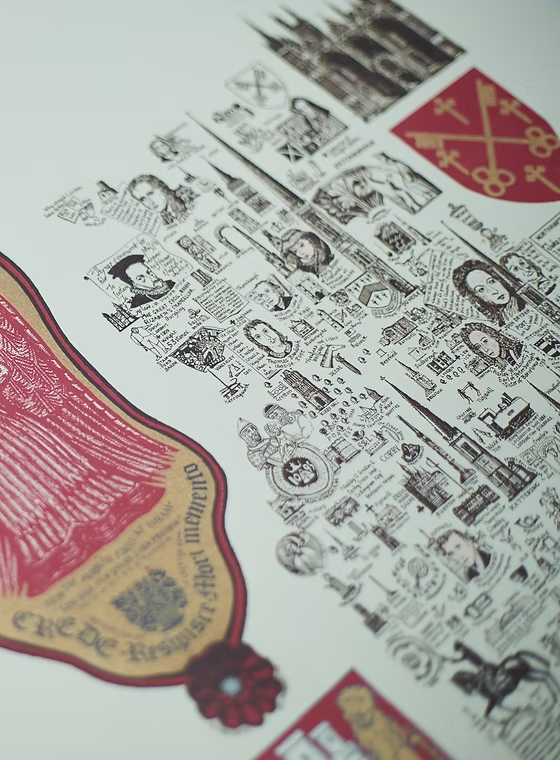
Carr’s county maps were to be read and “not to be used for navigation, except in the broadest of terms”

He married a Red Cross nurse, returned to teaching in Birmingham, and spent 15 years as the headmaster of a primary school, with a break in 1956 to return to teach in South Dakota. He retired from education in 1967, after having novels published in 1963 and 1967. Devoting himself to publishing and writing, he produced and published from his own house a series of small pocket-sized books of English poetry, historical events, and the like with each featuring a lower price for children.

Carr also published a series of English county maps and wrote six more short novels that contain elements of comedy and fantasy, as well as darker passages, based on his varied experiences of life as teacher, traveller, cricketer, footballer, publisher, and restorer of English heritage.

Two of his tales were made into films: A Month in the Country and A Day in Summer.

“All’s grist that comes to the mill” is a phrase he used in his introduction to the former as well as in a lovely interview with writer Annie Dalton back in 1988.

I don’t recall how I found out about A Month in the Country, but it might have been from some list such as this. I had read two prizewinning novels by Thornton Wilder and cleansed my palate with a couple of light Mary Stewart suspense romances and an obscure future dystopia. I was ready to return to “literature” but desired something short after the long slog through the 141,000-word The Eighth Day. I checked the samples I had downloaded onto my Kindle, and Carr’s book beckoned.

I didn’t know until after I had read it that A Month in the Country, which had been shortlisted for the Booker Prize and won the Guardian Fiction Prize, held the impressive rank of 1,353rd greatest book of all time in The Greatest Books meta-analysis, considerably higher than The Eighth Day at 10,696 but lower than Wilder’s The Bridge of San Luis Rey at 623. Personally, I’d rate Carr’s book above either of them, and it is wonderfully short at only 20,000 words…a brief but powerful work in which even short scenes exude atmosphere and meaning.

Here is the synopsis from The Greatest Books:

This novel unfolds the story of a World War I veteran who spends a summer in a peaceful Yorkshire village to restore a medieval mural in a local church. As he immerses himself in this tranquil setting, he finds solace and a sense of healing from the traumas of war. The narrative beautifully captures the essence of rural English life, the complexities of human relationships, and the profound impact of art and history on the human spirit. Through his work and interactions with the villagers, the protagonist embarks on a journey of self-discovery, finding a temporary refuge from his tormented past and glimpses of a more hopeful future.

I enjoyed Annie Dalton’s insight that, “The whole story is as much about what doesn’t happen as what does.” Carr jokingly responded, “It’s quite a nice way of writing a novel, writing a novel about something that doesn’t happen. It saves no end of imaginative effort.”

Carr wrote that when starting the work, his “idea was to write an easy-going story, a rural idyll…” but he admitted, “Then again, during the months whilst one is writing about the past, a story is colored by what presently is happening to its writer. So, imperceptibly, the tone of voice changes, original intentions slip away. And I found myself looking through another window at a darker landscape inhabited by neither the present nor the past.”

That final line struck me as particularly beautiful, and as with several elements in his novel, Carr left just enough unsaid to spark the reader’s speculative imagination without creating frustration at the lack of definition.

For example, an old eccentric Colonel makes one brief in-person appearance in the novella, and the first-person narrator then comments:

I never exchanged a word with the Colonel. He has no significance at all in what happened during my stay in Oxgodby. As far as I’m concerned he might just as well have gone round the corner and died. But that goes for most of us, doesn’t it? We look blankly at each other. Here I am, here you are. What are we doing here? What do you suppose it’s all about? Let’s dream on. Yes, that’s my Dad and Mum over there on the piano top. My eldest boy is on the mantelpiece. That cushion cover was embroidered by my cousin Sarah only a month before she passed on. I go to work at eight and come home at five-thirty. When I retire they’ll give me a clock—with my name engraved on the back. Now you know all about me. Go away: I’ve forgotten you already.

The novella transports you to another time and place, and it is not without humor. I cherish the description of the preaching of the stationmaster Mr. Ellerbeck:

…[He]…had left a village school at fourteen and had become a local preacher in his late teens. Though the mildest, most self-contained of men, once in the pulpit he became his own father who, it appeared, had been a passionately violent and irrational man.

It’s not strictly true that climbing the pulpit stairs transformed him; he was mild enough when announcing hymns and only mildly extravagant in his tediously supplicatory obeisance at his oriental despot’s skirts. But once launched upon the waves and billows of his sermon, he roared and raved like a madman, now and then bashing down his big fist on the podium so that the water decanter leapt. The while, his wretched wife hung her head in shame and only her twitching fingers revealed suffering. Mercifully, once at ground level again, he came-to like one revived from a convulsive fit and not remembering it.

J.L. Carr

An example of Carr’s skill is when the first-person narrator learns, from an Army sergeant he runs into, the military history of his acquaintance, Charles Moon. He learns that Moon earned a Military Cross for his gallantry in the war, but then a corporal who disliked him led the military police to discover him in bed with his personal servant.

The narrator then recalls how, in their next meeting, Moon somehow already knew that his homosexuality had been revealed. However, that is impossible, and Carr leaves it to the reader to recognize that the narrator unconsciously telegraphed his knowledge, such as by his body language or manner.

Don’t ask how but, from that day, Moon knew that I knew. Next day, for no reason at all, he said, ‘Sex! It’s the very devil. Quite merciless! It betrays our manhood, rots our integrity. Isn’t it, perhaps, the hell you were asking about, Birkin?’ And from that time on, things were never quite the same between us. 

It is so quick, so deft, and so true. The heartbreak of the story is that amidst the war-damaged narrator’s healing in the countryside, in fact a key part of it, is the unspoken and unpursued love that develops between him and his employer’s wife. It only took a paragraph for Carr to invoke the pain:

I should have lifted an arm and taken her shoulder, turned her face and kissed her. It was that kind of day. It was why she’d come. Then everything would have been different. My life, hers. We would have had to speak and say aloud what both of us knew and then, maybe, turned from the window and lain down together on my makeshift bed. Afterwards, we would have gone away, maybe on the next train. My heart was racing. I was breathless. She leaned on me, waiting. And I did nothing and said nothing.

Anyone who has been in such a moment recognizes the anguish of what one might justifiably term a decision or indecision…the wrenching moment that once passed cannot be revisited, except in mind when the scars tenderly ache.

Carr quickly draws his novella to a close:

We can ask and ask but we can’t have again what once seemed ours for ever—the way things looked, that church alone in the fields, a bed on a belfry floor, a remembered voice, the touch of a hand, a loved face. They’ve gone and you can only wait for the pain to pass.

All this happened so long ago. And I never returned, never wrote, never met anyone who might have given me news of Oxgodby. So, in memory, it stays as I left it, a sealed room furnished by the past, airless, still, ink long dry on a put-down pen.

It has been a couple of years since a book hit me this hard. I’ll close with the poem by Herbert Trench that Carr began his tale with:

Painting by Earl Daniels

She comes not when Noon is on the roses—
     Too bright is Day.
She comes not to the Soul till it reposes
     From work and play.

But when Night is on the hills, and the great Voices
     Roll in from Sea,
By starlight and by candlelight and dreamlight
     She comes to me.

Posted in books | Leave a comment

Lightning Arrested

Computer cables have entangled me for almost a half-century, forcing me to twist recalcitrant asymmetrical connectors, twirl painful little thumb screws, and regularly trawl through junk drawers and boxes for various specialized cables or adapters.

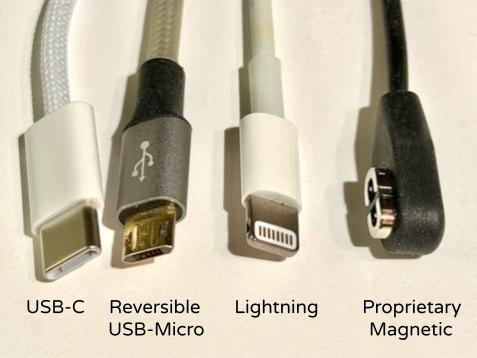
Not too long ago, I needed four different cables in a holder stuck to the side of my recliner’s lampstand so that I could charge my iPad with USB-C, my Kindle with USB-Micro, my iPhone with Lightning, and my bone conduction headset with a proprietary magnetic connector. I also have MagSafe induction chargers for my Apple Watch and iPhone.

Now, a decade after USB-C debuted, I can use it for all of my portable devices that require wired charging. It took that long for it to become universal and for my older gadgets to age out. In 2024, I replaced my Kindle Oasis with a Kindle Paperwhite Signature Edition, and this year I bought a new SHOKZ OpenRun headset that replaced their convenient-to-use but proprietary magnetic charger connector with USB-C. Replacing my iPhone 14 Pro with an iPhone 17 Pro finally allowed me to abandon the Lightning cables, adapters, and earbuds I have accumulated since 2012.

Thankfully all of these have been replaced by USB-C

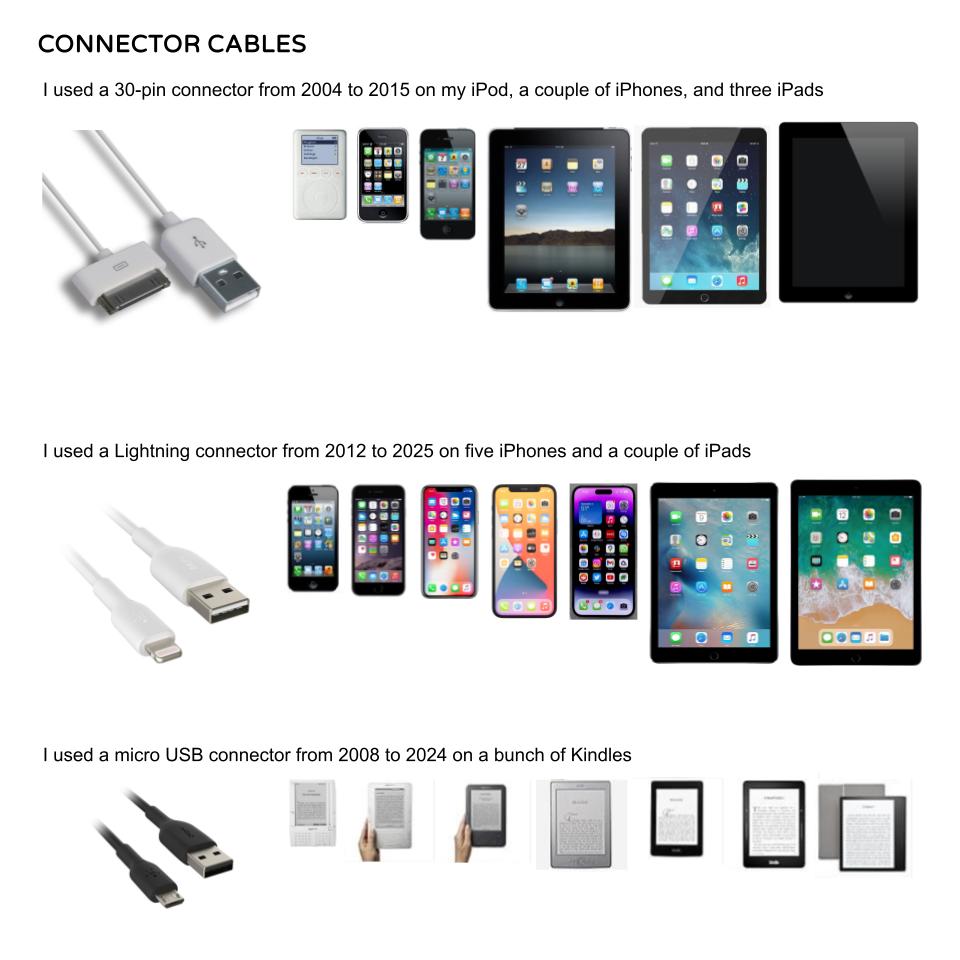
Before Lightning, I endured Apple 30-pin connectors from 2004 to 2015 on various devices. Lightning was an improvement, being diminutive and symmetrical, meaning it didn’t matter which way you plugged in the cable, unlike most USB cables until USB-C came along. The convenience of not having to twist a cable into the correct orientation to insert it led me to buy an unusual reversible USB-Micro cable for charging my Kindle back in 2020. First world problems!

My Mac Mini also features USB-C ports for its accessories, but it still has some USB-A ports and a 3.5 mm audio jack that remain in active use. I remember when USB-A debuted back in 1996, while 3.5 mm jacks were designed in the 1950s, originally for transistor radio earpieces.

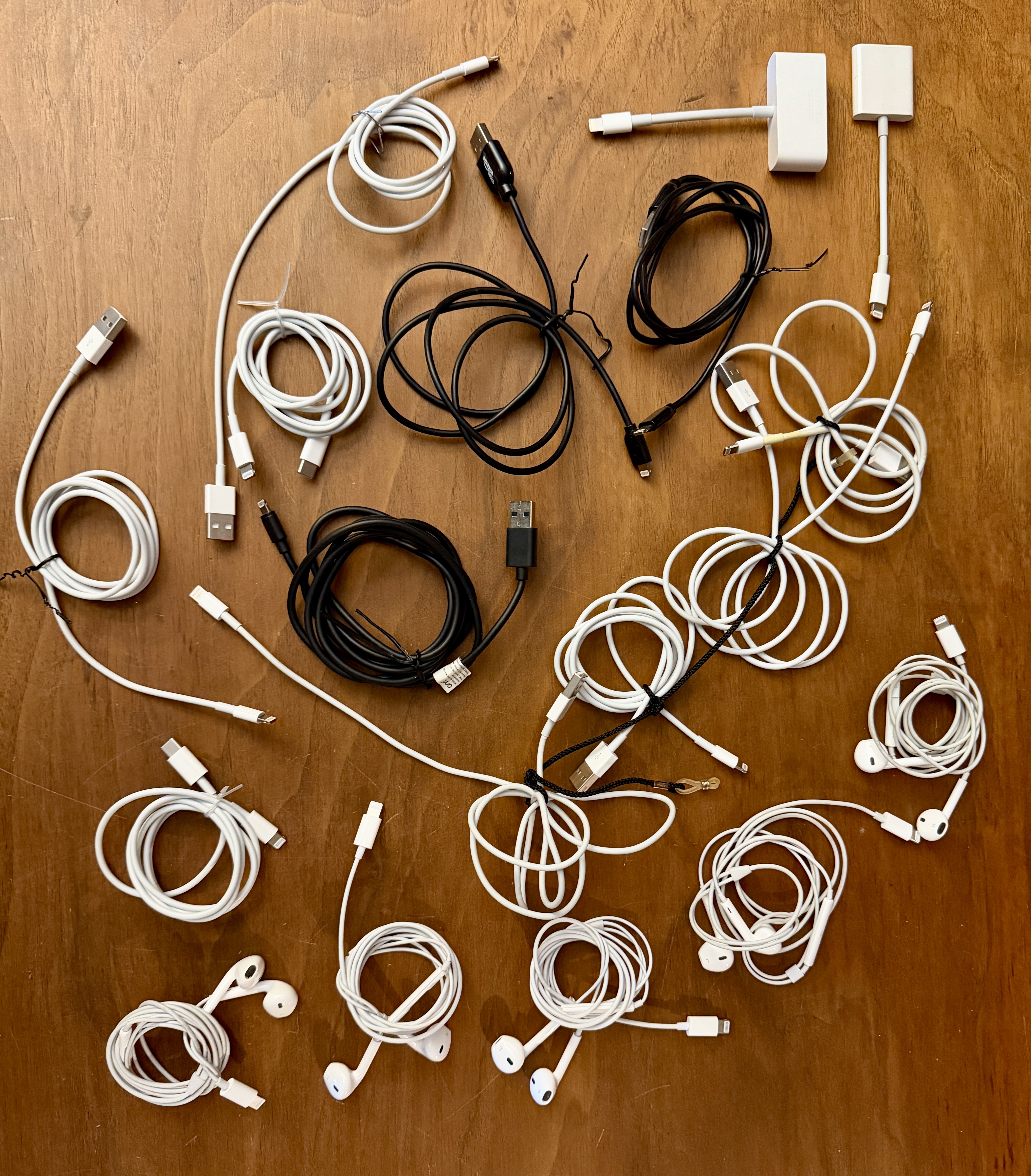
I went through the house gathering my Lightning cables, adapters, and earbuds. I found five sets of earbuds, nine USB-A cables, two USB-C cables, and a couple of adapters. I’m sure there are even more Lightning items lurking at work.

Apple stopped including EarPods and power adapters with new iPhones back in 2020, and while I have oodles of power adapters, I only had one off-brand set of USB-C earbuds I could use with my new iPhone 17 Pro. So I ordered two sets of Apple EarPods. I’ve tried various wireless earbuds, including one set of AirPods back in 2017. While I like my wireless bone conduction headset for use around the house, on walks I just want the wired EarPods. They never need charging and are more comfortable for me to wear than various alternatives. I do have a set of over-the-ear Tribit XFree Tune Bluetooth Headphones, purchased in 2019, that I use on the rare occasions that I want high-quality headphone sound.

Prior Connections

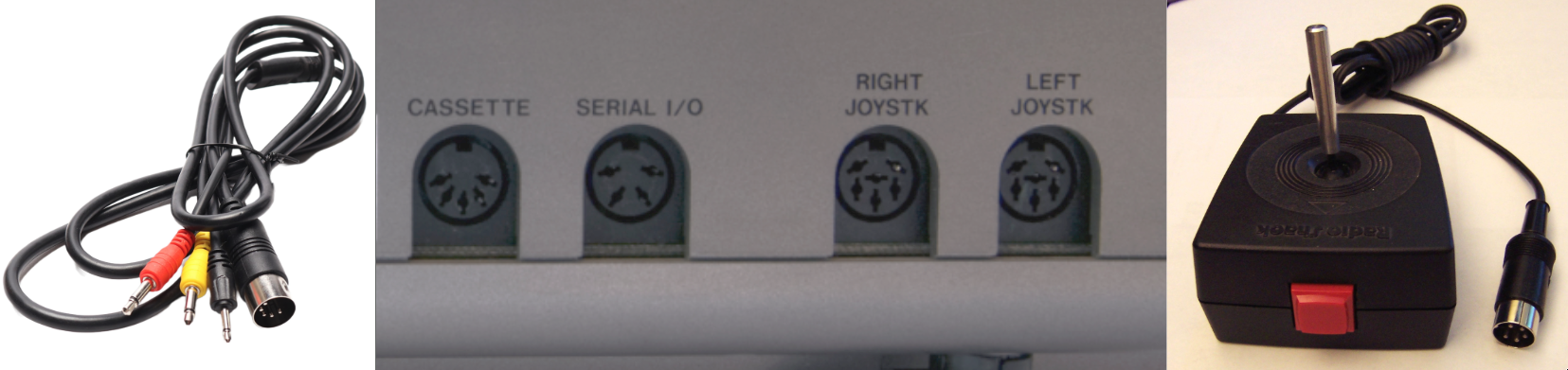
The first computers I used were the Radio Shack TRS-80 Model I and Color Computers in the late 1970s and early 1980s. They used 5-pin DIN ports and cables. I always called them DIN plugs, but I didn’t know until composing this post what DIN stood for: Deutsches Institut für Normung, or the German Institute for Standardization, which developed a 3-pin version in the mid-1950s and expanded to five pins a few years later as stereo gear became commonplace.

My first computers used 5-pin DIN ports

Standardization was important for vendors, although I stuck with Radio Shack for both my cassette recorder, the first way I had to store and retrieve programs, and my joysticks. I’d say their lousy original and marginally better Deluxe joysticks contributed to my relative lack of interest in video games, although I did enjoy playing Lancer, Pooyan, and Zaxxon on my CoCos. Hey, SuperGirl was impressed by the Coco, so I was in good company.

From the 1981 “Victory by Computer” comic starring “The TRS-80 Computer Whiz Kids”

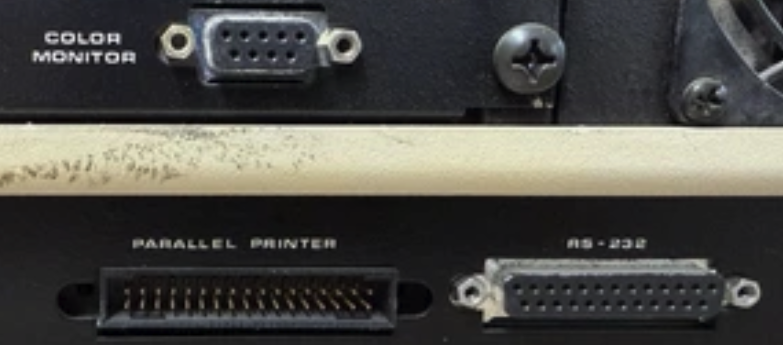
My far more functional 1985 Tandy Model 2000 had a DE-9 video port, proprietary parallel printer port, and a DB-25 port for a RS-232 serial connection. The common D-subminiature connectors were introduced by Cannon (not to be confused with Canon) back in 1952 for the military/aerospace market, with the “D” referring to the shape of their perimeter metal shield. A fun bit of trivia is that the second letter referred to the type of metal shield. The DB-25 was so common on early computers that when the DE-9 began to be used as well, computer people unfamiliar with the D-subminiature nomenclature mistakenly called them DB-9 ports, not realizing that a DB-9 would have been a 9-pin connector in the large “B” shield used for the 25-pin connectors, whereas the video ports actually were using the smaller “E” shield.

DB-25 ports were often serial RS-232 ones that followed the “Recommended Standard 232” introduced by the Electronic Industries Association in 1960 for serial communications. You might wonder why older computers would use 25-pin ports and cables for serial communications that later could run over four-wire USB-A cables. The older devices needed more pins so that they could support a full two-channel serial communication standard with pins for data and a multitude of control signals. Eventually, technological advancements allowed for a shift to 9-pin RS-232 serial ports before USB supplanted them.

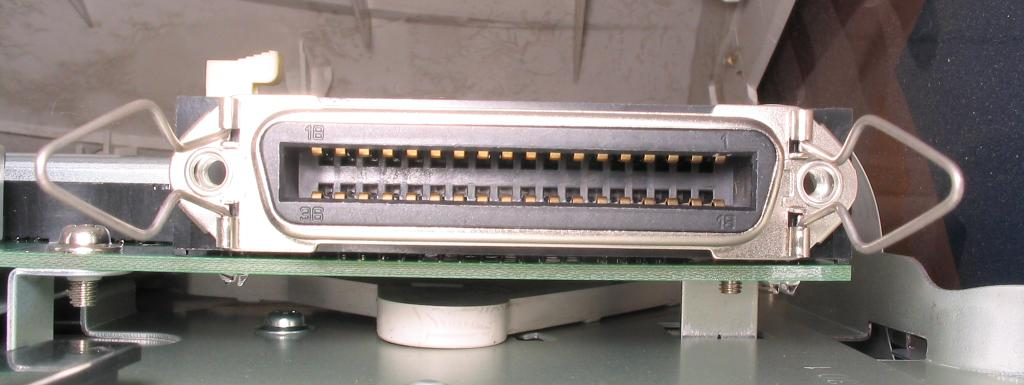
A venerable Centronics connector

For years, my various printers used bulky parallel ports, eventually standardizing on Centronics ones (aka IEEE 1284) that came from a subsidiary of Wang Laboratories, which made the first and only dedicated word processor I ever used back when I worked for the Oklahoma Department of Tourism. Parallel ports could send an entire 7-bit or 8-bit ASCII value across its multiple wires, while devices using serial ports would have to buffer the data bit-by-bit and turn that back into multi-bit values.

I never had any personal computing equipment that used the SCSI or Small Computer System Interface ports, although at work I did have a physics laboratory equipment interface that used it. Of course, there have been a slew of different audiovisual connectors, but that is a whole ‘nother level of complexity I chose to avoid in this post.

PS/2 keyboard and mouse ports

Keyboards and mice might use 5-pin, DE-9, DB-25, or proprietary connectors, but eventually many used color-coded 6-pin mini-DIN connectors commonly called PS/2 ports. Those were introduced with the IBM Personal System/2 series of computers in 1987. Nowadays I like wired USB keyboards and wireless mice.

Eventually computers advanced to where most of the cables and connectors could standardize on the Universal Serial Bus, which was introduced in 1996. Of course, that was hardly the end of the story, with many variations on the USB connectors being introduced over the decades.

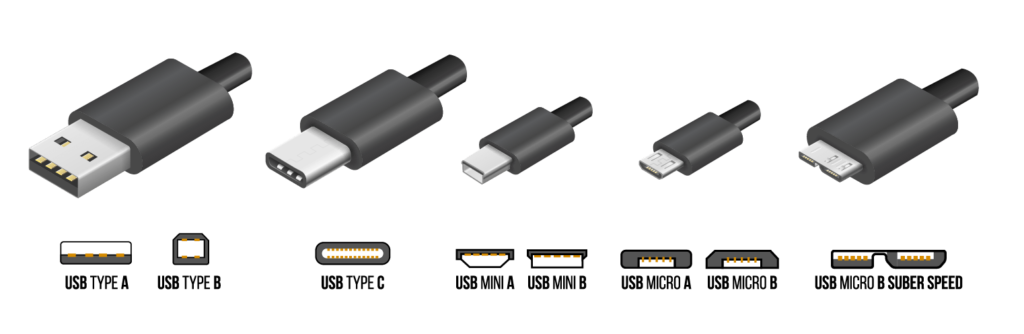
Universal Serial Bus connectors have proliferated
The USB trident logo is on the “up” side

We still see plenty of USB Type A ports and cables, with the more square-shaped USB Type B still frequently used on printers. We’ve all been frustrated countless times by the asymmetrical design of the USB-A, -B, -Mini, and -Micro connections forcing us to struggle to twirl cable ends around to plug them in. The trident-like USB logo is required to be on the “up” side of a cable end, which can help if you can even see it and also figure out which way is considered “up”.

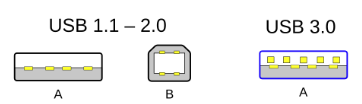
The later USB 3.0 standard calls for nine wires instead of four. The insulators in such “SuperSpeed” plugs and receptacles are supposed to be a specific blue color (Pantone 300 C) and you need to use an appropriate cable, which has SS for SuperSpeed at the base of the trident indicating it has the extra wires in it. Using an old cable will slow everything back down to the older 4-wire standard.

SuperSpeed ports have blue insulators
SuperSpeed cables have SS at the base of their trident logo
Notice how USB 3.0 used nine wires instead of four

Printers still use the USB Type B port because originally that was considered the sturdy one to be used for “client” devices, and they don’t need to bother with a smaller port. However, many other devices needed smaller Mini and Micro ports, which I always found truly annoying. I don’t know how many times I have stared at a port or a cable end to figure out if it is a Mini or a Micro, and then have to squint to see which way I would need to orient the cable. Thankfully you can now get reversible USB-Micro and even USB-A cables.

USB-C made things easier to plug in with its small reversible design, with up to 24 wires to provide higher transfer rates and power while supporting various data types:

USB-C can have as many as 24 wires compared to 9 in USB 3.0 and 4 in the original USB [Source]

However, that very flexibility can confuse folks. Some of our school Chromebooks have USB-C ports that are not just for charging or serial data, but can also function as DisplayPorts for multiple external monitors and the like. People used to HDMI or, heaven forbid, VGA, can be surprised when I use a USB-C DisplayPort.

The many different capabilities of USB-C have led to a profusion of labels:

These aren’t as awful as laundry labels, but they keep trying to get worse [Source]

Apple has a long history of screwing users over with its various specialized connectors, and it only abandoned Lightning and switched to USB-C because the European Union adopted a Common Charger Directive in October 2022 that required USB-C charging, beginning in late 2024, for mobile phones, tablets, digital cameras, headphones, headsets, videogame consoles, portable speakers, e-readers, keyboards, mice, portable navigation systems, and earbuds sold in the European Union. That requirement expands to laptops in late April 2026.

So in the technology world, the EU is like California is for cars in the USA; they have enough market clout to force manufacturers to cooperate and standardize, which often makes things better for consumers. However, regulations can also backfire, such as the annoying cookies notices we see on websites all of the time and most people just blast through.

I’m grateful that Lightning was arrested by the EU, however. Good riddance, and here’s hoping that USB-C can remain a viable standard for many years to come.


Posted in technology | 2 Comments