There are several cultural touchstones I remain rather ignorant of, despite countless references to them throughout my six decades of existence.
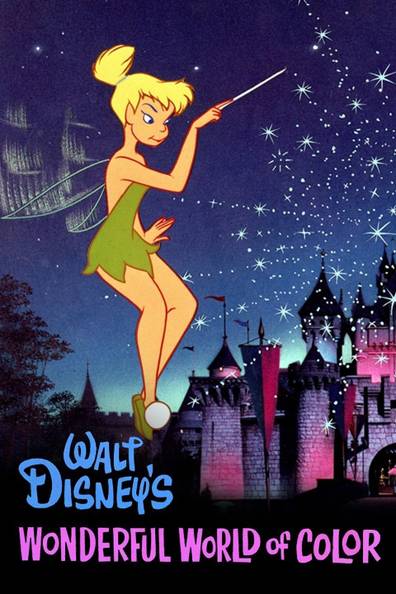
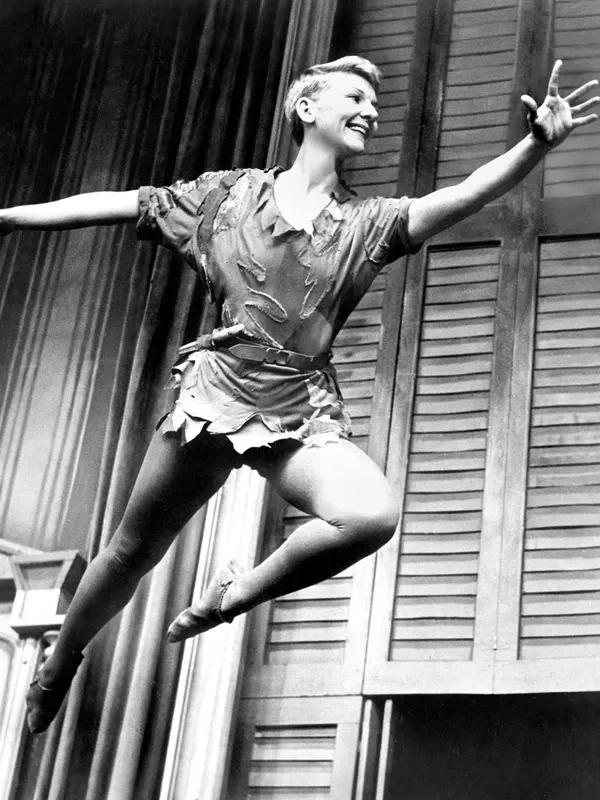
Peter Pan, for example. As a child, I ate plenty of his peanut butter, saw the animated Tinker Bell at the start and end of Walt Disney’s Wonderful World of Color (a lie broadcast weekly into our home, which didn’t have a color television until 1973), and my mother had a phonograph record by Mary Martin with a photograph on the album’s back showing her flying across a room as the character in the 1950s musical.
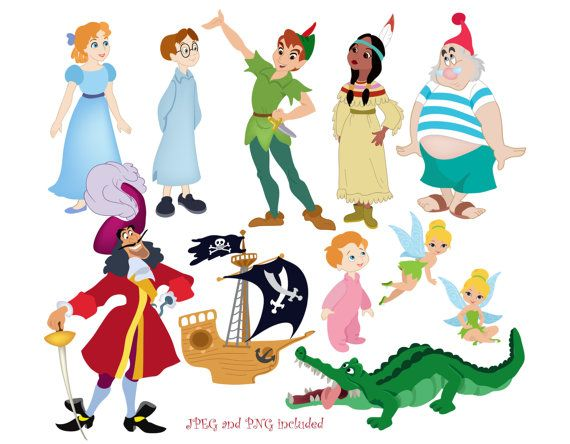
I recognize these characters, but I don’t know their stories
However, I never saw the animated Disney film or the Peter Pan plays or musicals, and despite being an avid reader, I never read a Peter Pan book. So while I can recognize some of the Disney characters, I don’t know their stories. I did see the Spielberg film Hook in 1991, but I was somewhat mystified by the crocodile and other plot elements.
The character first appeared in Chapter XIV of J.M. Barrie’s 1902 book The Little White Bird, followed by the 1904 play Peter Pan, or The Boy Who Wouldn’t Grow Up, and the 1911 novelization Peter and Wendy. Disney’s animated film came out in 1953 and was re-released in cinemas in 1958, 1969, 1976, 1982, and 1989. I was too young to see the June 1969 re-release, and I was almost ten when it came back around in June 1976, and by then, it was far too juvenile to interest me. Nowadays, many parents can readily make it, or virtually any other suitable film, available to their children at the appropriate age, but I missed out.
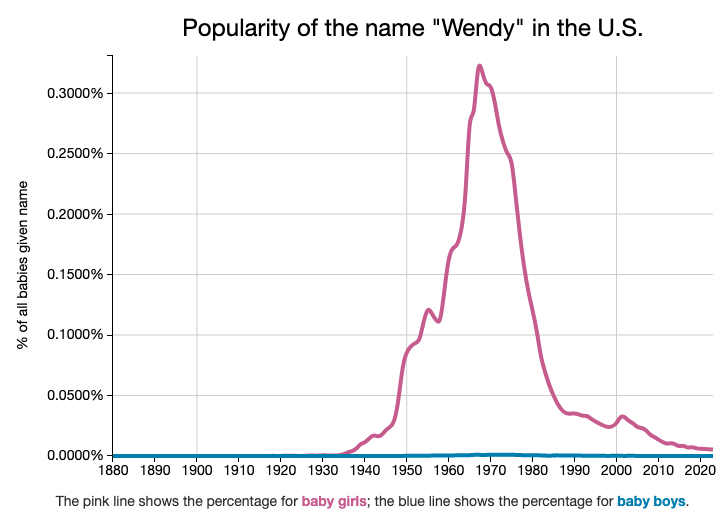
My wife is named Wendy, a name which became quite popular in the second half of the 20th century due to the character of Wendy Darling in Peter Pan. Yet my knowledge of the story is so limited, despite its many related works, that I had to go look up that character’s last name.
Peter Pan created a surge of popularity for the name Wendy
The video went on to theorize that the father character might be the son of Captain Hook. However, none of that is enough to motivate me to watch the movie nor actively partake of any of the multitude of other media offerings about a boy who won’t grow up.
I followed that distasteful experience with downloading and reading L. Frank Baum’s original The Wonderful Wizard of Oz. While it was interesting to note the various differences from the beloved classic movie, I didn’t care for that book, either. It was too nonsensical and disjointed for my taste.
I’m also somewhat ignorant of less fantastic cultural touchstones. I’d wager that while most of us are quite familiar with the basic plot and characters of Robin Hood, few have actually read Howard Pyle’s influential The Merry Adventures of Robin Hood from 1883, let alone the various earlier ballads. I certainly haven’t.
Similarly, I’m often ignorant of the origins of various memes that populate the internet. Recently, several of the video channels I watch on YouTube have used inserts like these to indicate a passage of time:
At first, I thought they might be imitating CuriousMarc, a French electrical engineer who documents restorations of exceptional vintage electronics. But then I noticed the meme on channels that certainly wouldn’t be referencing anything that nerdy. So I looked it up and found out they are taken from the SpongeBob SquarePants television show.
Wendy once had me watch an episode, but it definitely wasn’t to my taste. Similarly, I doubt that I’ve ever seen a complete episode of The Simpsons despite its hundreds of episodes since 1989. I’ve seen various clips, which I often found funny, but they were hardly engaging enough to tempt me to watch the series. Gosh, whenever I hear Marge, I think of Brenda Morgenstern from Rhoda.
I haven’t discerned any meaningful handicaps from my cultural ignorance. I’m fine with remaining unable to recognize any Taylor Swift songs, opera librettos, or many sports references. As I approach retirement, I’m skeptical about investing my forthcoming free time in such pursuits; FOMO is not healthy.
Freedom to choose your own life; freedom to pursue your own interest; freedom to enjoy your own likes, provided they are not harmful to you and the society. I feel I was very fortunate to grow up with so much of freedom, like a tree in the forest…
-Sudha Marty, How I Taught My Grand Mother to Read: And Other Stories
Thornton Wilder is still widely remembered for his 1938 play Our Town, and his second novel, The Bridge of San Luis Rey, won the Pulitzer in 1927 and made Modern Library’s list of the 100 best novels of the 20th century.
I only found one YouTube video about The Eighth Day, and it was AI slop. I found a handful of online articles about it and reference a couple of them in this post, but it has fallen utterly out of fashion despite winning the National Book Award for fiction in 1968.
The Neglected Book Page offered, “…it sold over 70,000 copies in hardback, was picked up by the Book of the Month Club as a featured title, and stayed on the New York Times best-seller list for half a year. Nor was it a complete critical failure. Edmund Wilson [the influential literary critic who championed Hemingway, Faulkner, Fitzgerald, and Nabokov] called it Wilder’s best work ever, and it received the National Book Award for fiction.”
However, the Neglected Book Page also shared: “Stanley Kauffmann, writing for The New Republic, called it ‘a book that means nothing.’ Josh Greenfield in Newsweek assessed Wilder’s message in the novel ‘a worthless bauble.’ In The New Yorker, Edith Oliver judged that ‘none of the characters, major or minor, rings credible to the reader.'”
The Greatest books of All Time‘s meta-analysis ranked the book at 10,696 considerably below other works of his such as The Bridge of San Luis Rey, Ides of March, Theophilus North, and Our Town. Nevertheless, I opted to read it, based on its national award and its plot device of a murder mystery.
I purchased and read the Kindle edition, with little initial impression of its considerable length. Wilder’s early novels were quite short; his most famous work, The Bridge of San Luis Rey, is only 33,000 words. The Eighth Day turned out to be his longest novel at 141,000 words.
While that is not nearly as daunting as All the King’s Men, which we were assigned in high school, despite its word count of 286,000, or Jonathan Strange and Mr. Norell at a rather numbing 309,000 words, it is still considerable. Wilder split his longest work into six parts, which reminds me of how Tolkien’s 455,000-word Lord of the Rings was similarly subdivided, although it was wisely published as a trilogy.
The character of Dr. Gillies in the novel says, “The Bible says that God created man on the sixth day and rested, but each of those days was many millions of years long.” Reading The Eighth Day similarly took me awhile…about a month.
I was thankful that Wilder structured his meandering tale around the mysteries of a murder and a daring rescue from execution. That provided an impetus to carry me through his digressions and the multitude of pronouncements by his omniscient narrator.
Wilder began the book during a self-imposed exile of 20 months in the desert town of Douglas, Arizona along the Mexican border. In 1962, a month after turning 65, Wilder fled the distractions of too much travel, talk, and busy-ness and steered his Thunderbird convertible out of his Connecticut driveway towards the Southwest. He broke down outside Douglas and stayed there, enjoying “solitude without loneliness.”
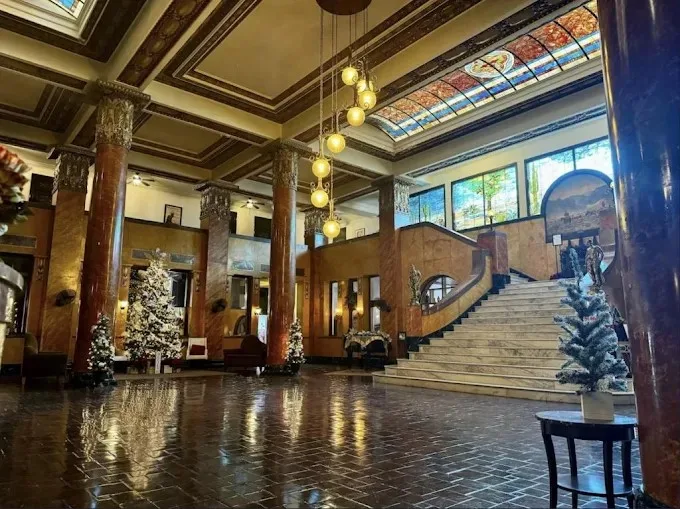
Wilder stayed at The Gadsden Hotel in Douglas, AZ for a couple of months
Wilder rented an apartment in Douglas for about 18 months
He extended a night at the Gadsden Hotel into a stay of a couple of months and then rented a three-room furnished apartment in what is now, over sixty years later, an assisted living center.
Wilder had earned three Pulitzers, including ones for the plays Our Town and The Skin of Our Teeth. Over the 15 years since his last novel, he had written five plays, but during his Arizona exile an idea took shape that was more suited for the page than the stage.
During his exile, he went by his middle name, Niven, and peppered people with questions, including how one would set up a boardinghouse, with the answers becoming part of his new novel. Wilder didn’t finish it in Douglas, leaving town in late 1963 to resume his peripatetic ways. He accepted the Medal of Freedom from President Johnson and continued writing during trips to Nice and Cannes, to the Netherlands Antilles, to Casablanca, and more. It was finally published in 1967, three weeks before his 70th birthday.
But what of the book itself? Wilder shared that its writing was influenced by the works of the Danish theologian and philosopher Søren Kierkegaard, the German novelist and Nobel laureate Thomas Mann, and the French Jesuit and polymath Pierre Teilhard de Chardin. I confess to possessing only fragmentary interest in and frequent exasperation with literary analysis and philosophy, so I read Wilder’s novel with little regard to such influences.
1927’s The Bridge of San Luis Rey was set in 1714. I leapt ahead four decades in Wilder’s career in following that up with 1967’s The Eighth Day, which was set between 1880 and 1905. The later novel consists of six parts, identified by location and durations of years. I enjoyed Part I, set in Coaltown, Illinois from 1885 to 1905. The Horatio Alger story of how a daughter of a convicted murderer rescued her family by setting up their home as a boardinghouse intrigued me with its sharply drawn character portraits, although I found the mother figure rather bland and impervious to empathy.
Here is an example of the maxims and observations that pepper the pages:
So defenseless is hope before the court of reason that it stands in constant need of fashioning its own confirmations. It reaches out to heroic song and story; it stoops to superstition. It shrinks from flattering consolations; it likes its battles hard won, but it surrounds itself with ceremonial and fetish.
Hope, like faith, is nothing if it is not courageous; it is nothing if it is not ridiculous. The defeat of hope leads not to despair, but to resignation. The resignation of those who have had a grasp of hope retains hope’s power.
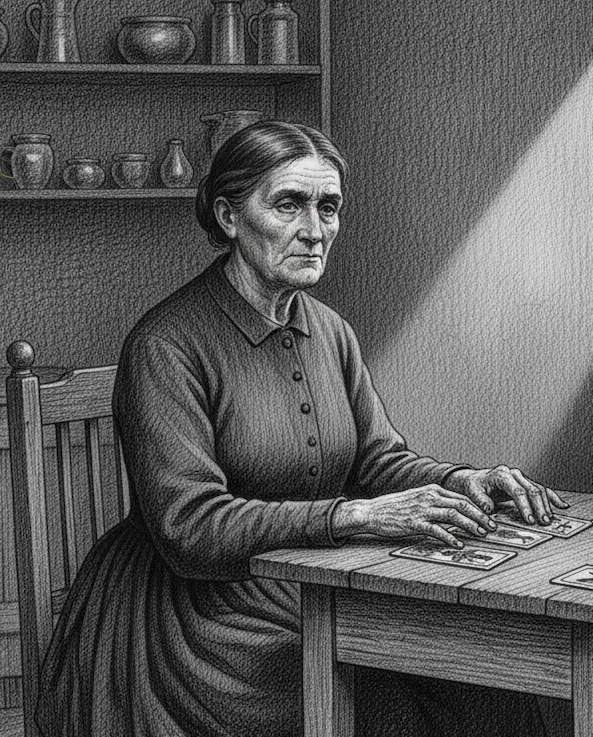
Fortune telling [generated by Google Gemini]
Part II relates the story of the escaped fugitive’s travels and adventures as he fled south to Chile from 1902 to 1905 and was quite a diversion. While I enjoyed some of the character sketches, particularly of three wise independent women who spirit him along different phases of his flight, the fugitive remained a remote personality to me, perhaps intentionally so.
He is a figure of faith, but not piety. Wilder shares these views on such people:
We have described these men and women in negative terms—fearless, not self-referent, uninteresting, humorless, so often unlearned. Wherein lies their value?
We did not choose the day of our birth nor may we choose the day of our death, yet choice is the sovereign faculty of the mind. We did not choose our parents, color, sex, health, or endowments. We were shaken into existence, like dice from a box. Barriers and prison walls surround us and those about us—everywhere, inner and outer impediments. These men and women with the aid of observation and memory early encompass a large landscape. They know themselves, but their self is not the only window through which they view their existence. They are certain that one small part of what is given us is free. They explore daily the exercise of freedom. Their eyes are on the future. When the evil hour comes, they hold. They save cities—or, having failed, their example saves other cities after their death. They confront injustice. They assemble and inspirit the despairing.
When the evil hour comes, they hold. That’s a good line, worthy of Tolkien, but I particularly like We were shaken into existence, like dice from a box.
The entertaining and empowered character of Mrs. Wickersham is a humanitarian and widow who runs a hospital, school, and orphanage in addition to her hotel. She labors to save the fugitive from capture and destruction, and shares this amidst a torrent of words after the fugitive shares his story:
“. . . Cities come and go, Mr. Tolland, like the sand castles that children build upon the shore. The human race gets no better. Mankind is vicious, slothful, quarrelsome, and self-centered. If I were younger and you were a free man, we could do something here—here and there. You and I have a certain quality that is rare as teeth in a hen. We work. And we forget ourselves in our work. Most people think they work; they can kill themselves with their diligence. They think they’re building Atenas, but they’re only shining their own shoes. When I was young I used to be astonished at how little progress was made in the world—all those fine words, all those noble talkative men and women, those plans, those cornerstones, those constitutions drawn up for ideal republics. They don’t make a dent on the average man or woman. The wife, like Delilah, crops her husband’s hair; the father stifles his children. From time to time everyone goes into an ecstasy about the glorious advance of civilization—the miracle of vaccination, the wonders of the railroad. But the excitement dies down and there we are again—wolves and hyenas, wolves and peacocks.—What time is it?”
And then, abruptly, just as the fugitive appears to have again escaped into the future, we get this lonely line about his fate as Part II comes to a close: He was drowned at sea.
What? We have travelled many miles with this character and the mysteries swirling about him, with hopes and plans for an eventual redemptive return to his family, buoyed by a mention in the book’s prologue that he would eventually be exonerated, but then nature sweeps him into the abyss? There is a disquieting and disturbing symbolism in that.
Part III shifts us back north in geography and backward in time to Chicago in 1902, where the son of the fugitive stumbles his way into good works as a newspaper columnist, reminding me of the early idealistic portrayal of Orson Welles’ protagonist in Citizen Kane. Various characters are introduced, offering their own takes on life and its meanings or lack thereof. One garrulous character pronounces:
“What’s that? What’s that you’re saying? Listen to me: there is no sense behind the universe. There is no reason why people are born. There is no plan. Grass grows; babies are born. Those are facts. For thousands of years men have been manufacturing interpretations: life’s a test of our character; rewards and penalties after death; God’s plan; Allah’s Paradise, full of beautiful girls for everybody; Buddha’s nirvana—we get that anyway, it means ‘see nothing, feel nothing’; evolution, higher forms, social betterment, Utopia, flying machines, better shoelaces—nothing but THISTLE DUST! Will you get that into your draughty head?”
Contrast that to a hospital orderly who shares his vision of people reborn countless times as they ascend a ladder of merit, with none able to step over a threshold into supreme happiness until “all of the men on all the stars have purified themselves.”
Wilder’s characters frequently break with convention, in ways that challenge our expectations for the late Victorian and early Edwardian eras. The future fugitive and his common law wife had four children in nineteen years without having been formally married; the son who fights injustice and suffering has affairs with girls of many races and nationalities before marrying the daughter of the man his father supposedly murdered; a daughter who becomes a famous concert singer supports herself and her bastard son by singing in churches; and so forth.
Part III concludes as the fugitive’s son meets the daughter of the murdered man, with promises of revelations that might solve the murder mystery. We are given no satisfaction, however, as Part IV leaps way back to 1883 in Hoboken, New Jersey, and we are treated to more paragraphs extolling the virtues and delineating the shortcomings of the future fugitive. He hunts for a wife, making a choice by a process of elimination, and then elopes with her.
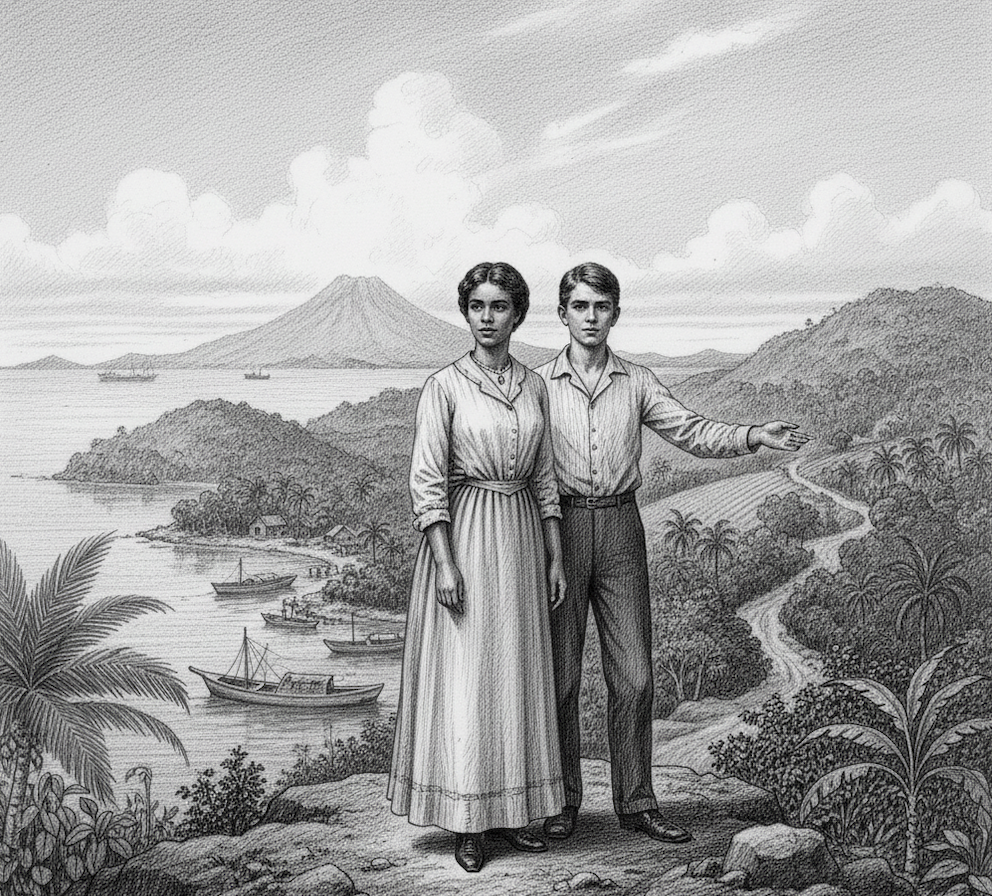
St. Kitts [generated by Google Gemini]
Part V jumps back a bit further and much farther, to St. Kitts, an island in the West Indies, in 1880. We are finally provided background on the murder victim’s family, something that had been given short shrift in the first 2/3 of the novel. Staging stories in long separate parts, as Wilder did in the 1960s, seems quite old-fashioned to the modern reader. I am used to books that interleave chapters, quickly jumping back and forth, often changing voices or narrators to increase the contrasts versus the drone of an omniscient narrator. I suspect that broadcast and cable television made such tight interleaving more commonplace, as holding the viewer’s attention was vital to the advertising that funded the programming back in the day, with frequent advertising breaks acting like chapter breaks.
Epistolary novels use a series of letters or other fictional documents for such interleaving. 1897’s Dracula is perhaps the most famous example, being composed entirely of letters, diary entries, newspaper clippings, telegrams, doctor’s notes, ship’s logs, etc. Wilder’s Ides of March is another example.
Part V finally provides a motive, previously portrayed as inexplicable, for the murder. I enjoyed the re-introduction of the murder victim:
Breckenridge Lansing was born in Crystal Lake, Iowa. As a boy he planned to enter the Army of the United States and to become a famous general. With his brother Fisher he did a great deal of hunting. Good Baptists cannot take life or do anything else enjoyable on Sunday, but they killed and killed on Saturdays and holidays.
The final Part VI was thankfully the strongest, with a superb opening:
This is a history.
But there is only one history. It began with the creation of man and will come to an end when the last human consciousness is extinguished. All other beginnings and endings are arbitrary conventions—makeshifts parading as self-sufficient entireties, diffusing petty comfort or petty despair. The cumbrous shears of the historian cut out a few figures and a brief passage of time from that enormous tapestry. Above and below the laceration, to the right and left of it, the severed threads protest against the injustice, against the imposture.
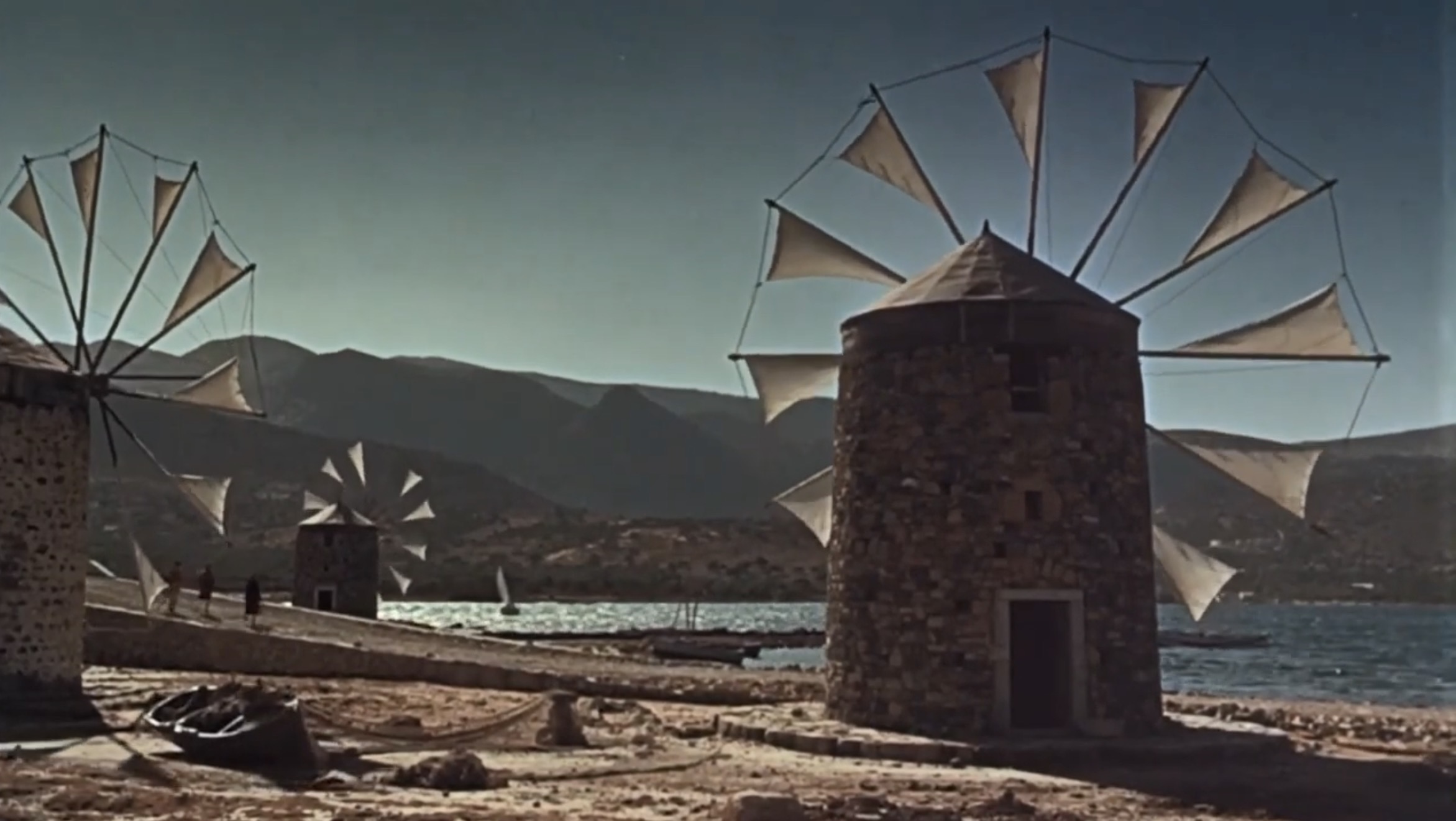
Herkomer’s Knob [misinterpreted by Google Gemini]
There is a superb sequence in which the fugitive son learns how his father was spared from execution. I especially enjoyed the symbolism of a home-made rug:
He returned into the house and placed the letter on the table beside the Deacon and sat down. The Deacon was gazing intently at the home-made rug at his feet and Roger’s eyes followed his. It had been woven long ago, but a complex mazelike design in brown and black could still be distinguished.
“Mr. Ashley, kindly lift the rug and turn it over.”
Roger did so. No figure could be traced on the reverse. It presented a mass of knots and of frayed and dangling threads. With a gesture of the hand the Deacon directed Roger to replace it.
“You are a newspaperman in Chicago. Your sister is a singer there. Your mother conducts a boardinghouse in Coaltown. Your father is in some distant country. Those are the threads and knots of human life. You cannot see the design.”
There was such a rag rug in one of my grandparents’ homes. The chaos of knots created a soft cushion beneath the order presented to the world. While I do not share the perception of a weaver, but instead only human pattern-seeking, the symbol is strong.
Existentialism is addressed as well:
Again he pointed to Coaltown: “They walk in despair. If we were to describe what is Hell it would be the place in which there is no hope or possibility of change: birth, feeding, excreting, propagation, and death—all on some mighty wheel of repetition. There is a fly that lives and lays its eggs and dies—all in one day—and is gone forever.”
I appreciated the novel’s concluding paragraph, once I defined arras as a rich tapestry:
There is much talk of a design in the arras. Some are certain they see it. Some see what they have been told to see. Some remember that they saw it once but have lost it. Some are strengthened by seeing a pattern wherein the oppressed and exploited of the earth are gradually emerging from their bondage. Some find strength in the conviction that there is nothing to see.
Less welcome were the glum glimpses of characters’ futures, reminding me of the epilogue montages in some movies. Wilder confessed in a 1965 letter, “It’s only lately come clear to me what an awful lot of suffering there is in the book. I never intended that. I hope it’s not immediately apparent to the reader because most of the characters don’t regard themselves as suffering—they’re learning and struggling and hoping.”
Well, Thornton, it was certainly apparent to me, as was your excision of much of one daughter’s story, not that I cared to read it. The book would have greatly benefited from a revival of his early “habit of compression” and, if he could not bring himself to do it, an editor demanding a culling, that the historian’s cumbrous shears be grasped far more firmly.
Nevertheless, I am glad to have read it given the exquisite prose he regularly manifested and the sharp wit he could deploy. However, while I found some of the characters interesting and well-drawn, the ones he spent the most time with remained too nebulous, vague, and impenetrable for my liking.
The Thornton Wilder Library
From 2016 to 2022, HarperCollins worked with the Wilder family on a reprinting of Wilder’s seven completed novels and three of his plays in what it called the Thornton Wilder Library. Paperbacks with new covers, linked by the use of the Londonderry Air font, incorporated revised afterwords by his nephew Tappan Wilder, who has served as the literary executor for a quarter-century. That Library is also available in audiobook and e-book formats.
Back in 1967, The Eighth Day became a bestseller in its second week and remained on the list for half a year. Before falling out of print in 1992, two million copies were printed and it had 17 foreign editions. It became his second-best selling and earning book.
I remain intrigued by Thornton Wilder’s handling of matters of faith and existentialism. I enjoy how he subverts expectations while incorporating biblical and Puritan traditions into his works. His Christian humanism led him to a sense of optimism grounded in a faith in improvement and redemption, without shying away from portraying the dull triteness, rank hypocrisy, and intellectual vacuity which readily afflict both the pious and the profane.
The length and many paragraphs of philosophy of The Eighth Day haven’t put me off reading Wilder, but I do need to be selective. I have not found ratings on Goodreads to be of any value, although the number of ratings is an indicator of a book’s popularity. I still prefer using LibraryThing over Goodreads to track my reading, but I continue to update both services given Goodreads’ popularity.
Book
Greatest Books Rank
# of Goodreads Ratings
Words
Kindle Edition length
Year
The Cabala
—
258
43,000
144 pages
1926
The Bridge of San Luis Rey
623rd
37,997
33,000
115 pages
1927
The Woman of Andros
—
227
23,000
75 pages
1930
Heaven’s My Destination
—
416
54,000
250 pages
1935
The Ides of March
2,683rd
2,180
87,000
315 pages
1948
The Eighth Day
10,696th
1,822
141,000
454 pages
1967
Theophilus North
4,915th
1,214
133,000
425 pages
1973
Statistics on Wilder’s Novels
After gathering the statistics and reviewing synopses, two of the remaining novels pique my interest the most. Heaven’s My Destination is a road farce about a born-again evangelist traveling across Texas, Oklahoma, Kansas, Missouri, and Arkansas peddling textbooks in the Great Depression. Having spent a lifetime surrounded by evangelicals, with one grandmother who was a Holy Roller Pentecostal who spoke in tongues, that sounds like fun since Jonathan Rosenbaum holds that the protagonist spreads “havoc and consternation wherever he goes with his hilarious and maddening fanaticism.”
I’m also somewhat intrigued by The Woman of Andros after reading its exquisite opening paragraph. Even if it proves to be a humorless tragedy, it is sublimely short. Theophilus North is lengthy, but portrayed as a series of related short stories, which prevents its immediate dismissal. The Cabalawas early but also short, while I’ve little interest in The Ides of March having had my fill of Gaius Julius Caesar in various histories, plays, and in translating Commentarii de Bello Gallico in the original Latin decades ago.
However, after successive Thornton Wilder books, I need to cleanse my palate. My next target is The Moon-Spinners by Mary Stewart.
This is a lengthy post about Oklahoma’s public schools. I’ll explore the state’s low rankings and delve into its history of student testing and achievement, student poverty, and finally school spending and taxation. I expect this might be my final post on such matters given that I am now in the twilight of my career.
Bona fides
My retirement in June 2026 will come at the end of 38 years working in Oklahoma public schools. I spent a semester student teaching at Norman High School, then a semester substituting in various classes at the three high schools in the Putnam City district. I then moved from the state’s central metroplex to Green Country in the northeast to teach physics for 28 years at Bartlesville High School, and this is my ninth and final year as a district administrator in Bartlesville.
My familiarity with the state’s educational spending, policies, and reforms includes how early in my teaching career I participated in the school suspension of 1990 that helped push through House Bill 1017, a vital educational reform law. I was afforded a significant role in another school suspension in 2018 that again boosted educational funding. I also learned about school funding during my 22 years on the local teachers’ union contract bargaining team, including 16 as the chief negotiator, and my varied involvement in the planning, promotion, and implementation of 15 school bond issues. I gained experience with achievement assessments during my decades chairing our district’s science department.
I also grew up in Oklahoma’s public schools. Kindergarten was at Western Village Elementary in Oklahoma City, grades 1-6 at Putnam City Central in Bethany, and I attended Putnam City’s Mayfield Junior High and Putnam City West High School. So I have spent over a half-century attending or working in the state’s public schools.
Oklahoma’s education and health care rankings are extremely low [Source]
The truth is not always simple
This political meme is somewhat misleading
One political meme in circulation has laid the blame for the state’s low ranking on its recent Republican governors. The one shown has been circulating for some time, using old Quality Counts rankings from Education Week.
What that meme conveniently leaves out is how Oklahoma’s ranking in Quality Counts might have started at 19 when the Democrat Brad Henry took office, but it dipped as low as at least 28 during his term before rising to 17. While it did drop precipitously to 48th during Republican Mary Fallin’s eight years as governor, that drop took only four years and coincided precisely with the term of the controversial State Superintendent Janet Barresi. The meme also leaves out that the basis for the Quality Counts rankings changed over time, so comparing its overall ranking over the years is sometimes comparing apples to oranges, and Quality Counts was discontinued back in 2021.
Only three components of Quality Counts persisted from 2008 to 2021: achievement, finance, and “chance for success”, with the last one consisting of factors over which schools have no control such as family income, parent education, and parental employment.
Oklahoma’s overall, achievement, and finance rankings in Education Weeks’ Quality Counts from 2008 to 2021
Comparing the Quality Counts reports from year to year, the perilous drop from 17th overall in 2011 to 48th in 2015 was driven mostly by policy changes, with Oklahoma losing ground in a “teaching profession” component that was discontinued after 2014. We were docked for discontinuing teacher mentoring, teacher professional development, and teacher incentives under Supt. Barresi.
The state’s achievement rank also dropped in Quality Counts from 35th to 41st across those same years. However, it is interesting to note that most of the state’s scores in reading and math on the National Assessment of Educational Progress, which features prominently in most ranking systems, actually improved, sometimes markedly, during Supt. Barresi’s tenure.
Oklahoma’s 4th and 8th grade reading and 4th grade math scores actually improved markedly from 2011 to 2015 even though the state’s achievement ranking in Quality Counts dropped from 35th to 41st [Data source]
The other thing of note in the NAEP scores is how Oklahoma’s 2022 and 2024 scores fell, along with the nation’s, due to the Covid-19 pandemic, often with a widening gap between the state and national averages.
Student achievement testing history
Let’s pull back and look at the national NAEP Long Term Trends scores, which are more statistically valid for long-term comparisons since their format is more stable, while the other NAEP assessments evolve over time to reflect current educational trends. Since they began for students of ages 9 and 13 in reading in 1971 and in math in 1973, the Long Term Trends assessments have only had one change in format and accommodations in 2004.
In 1983, the A Nation at Risk report focused attention on public school reforms. It pushed for increased rigor and standards, including requiring more high school courses in core subjects, increasing instructional time and teacher quality, and so forth. You can see how that correlated with a significant increase in age 9 math scores in the 1980s and age 13 math scores in the 1990s, but reading scores showed no improvement.
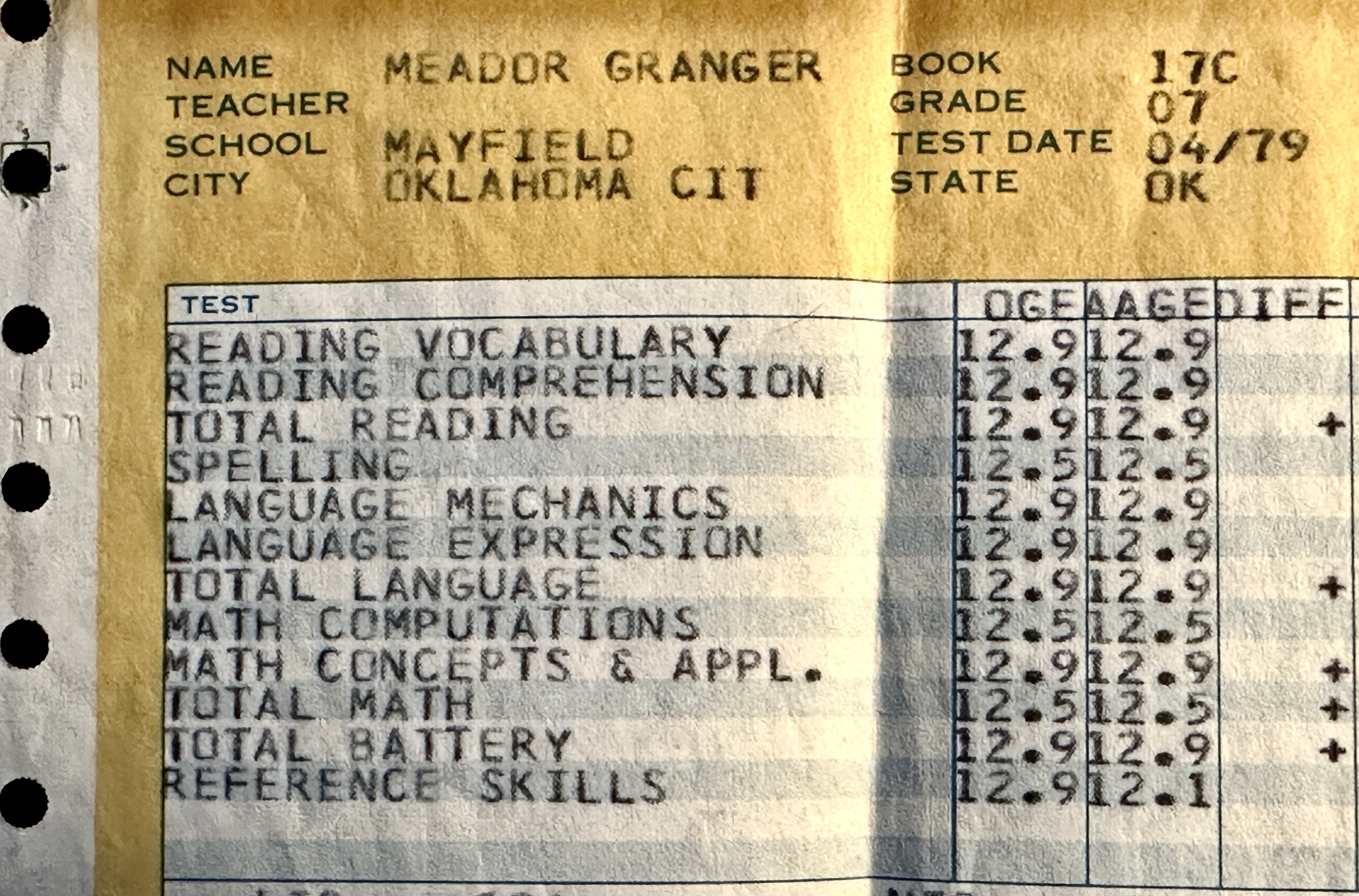
My grade equivalencies on the CAT as a 7th grader
Back in 1984, Oklahoma had about 600 public school districts (it now has about 500), and about half of them gave the California Achievement Test (CAT) and the others gave the Iowa Test of Basic Skills. I took the CAT throughout my time in Putnam City Schools, and both tests were norm-referenced, comparing relative student performance to national norms, as opposed to criterion-referenced exams which show how well students have met various standards.
A Nation at Risk spurred the legislature to establish the Oklahoma School Testing Program, and it mandated ever more tests over the next thirty years. The mandates grew from norm-referenced tests in grades 3, 7, and 10 in 1985 to over two dozen different tests by 2007.
State-mandated testing metastasized from three tests in 1985 to over two dozen by 2007 [Source]
Over the years, more and more norm-referenced tests were then replaced by Oklahoma Core Curriculum Tests which were criterion-referenced. End-of-instruction tests began in seven high school subjects, with students eventually having to pass four of those tests to graduate.
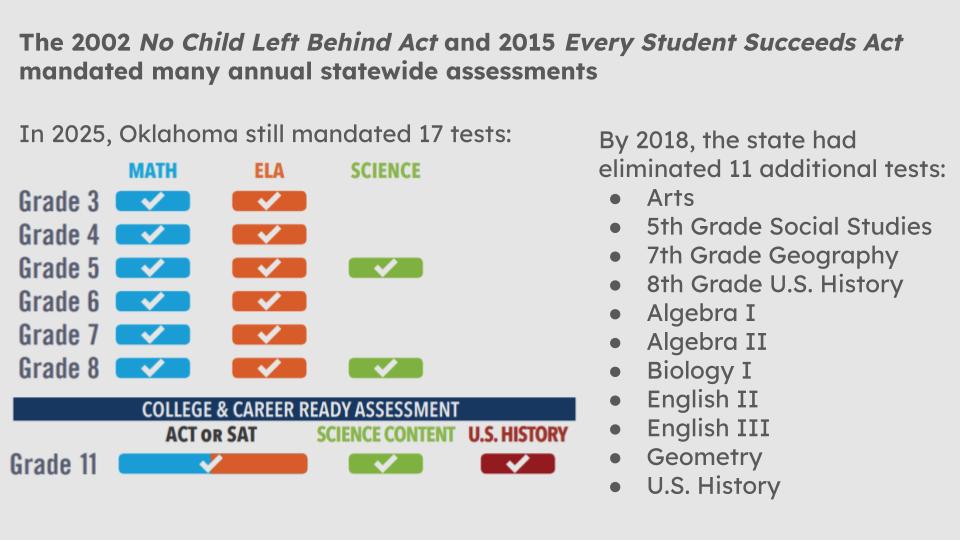
In 2002, the federal No Child Left Behind Act mandated about 16 tests across grades 3-8 plus more in high school. There was an increase in both math and reading scores on the NAEP Long Term Trends in 2008 and 2012. However, after that act was replaced in 2015 by the Every Student Succeeds Act, the legislature finally reduced the time and money spent on state-mandated testing. It had scaled back to 17 tests in 2025, with most of those required by federal law.
The NAEP scores declined in 2020 and 2022 amidst the Covid-19 pandemic. In Oklahoma, all public schools were forced to close for ten days in the spring of 2020, with virtual instruction or distance learning for the remainder of the 2019-2020 academic year. For Bartlesville that meant 33 days of virtual instruction in the spring of 2020.
Bartlesville returned to in-person classes that August, but quarantines, isolations, and staff shortages, along with inclement weather, led to 25 virtual days in 2020-2021 and 14 in 2021-2022. After that, vaccinations and the Omicron wave of infections essentially ended the pandemic emergency. However, in later school years Bartlesville and many other districts then had some planned virtual days and others for inclement weather.
Virtual and cancelled school days for Bartlesville Public Schools
Bartlesville doesn’t plan to have any virtual days in the 2025-2026 school year, anticipating a near-total ban on them in public schools statewide starting in 2026-2027. Things seem likely to return to just some school day cancellations for inclement weather.
It is enlightening to see how the oodles of state-mandated tests, higher standards, and various other reforms after 1982 in the end only yielded a 3% increase in age 9 reading scores and 2% increase for age 13, with all of those gains erased by the pandemic. Math scores showed a bit more lasting improvement, peaking with increases of 11% for age 9 and 8% for age 13 in 2012, but now those have declined to 7% and 3% respectively. In my opinion, the slew of mandates from A Nation at Risk, No Child Left Behind, and the Every Student Succeeds Act had only a limited effect on outcomes while the endless criticism and controls they promulgated exacerbated a nationwide teacher shortage that is especially acute in Oklahoma.
Student poverty
Three factors that we know have an impact on statewide achievement scores are student poverty, per pupil spending, and teacher quality. I’ll illustrate the first of those factors by having you ponder this chart of the NAEP 8th Grade Reading scores over time for our region.
Colorado has led the region in reading achievement since 2010 while New Mexico has been the lowest regional performer for the entire 21st century [Data source]
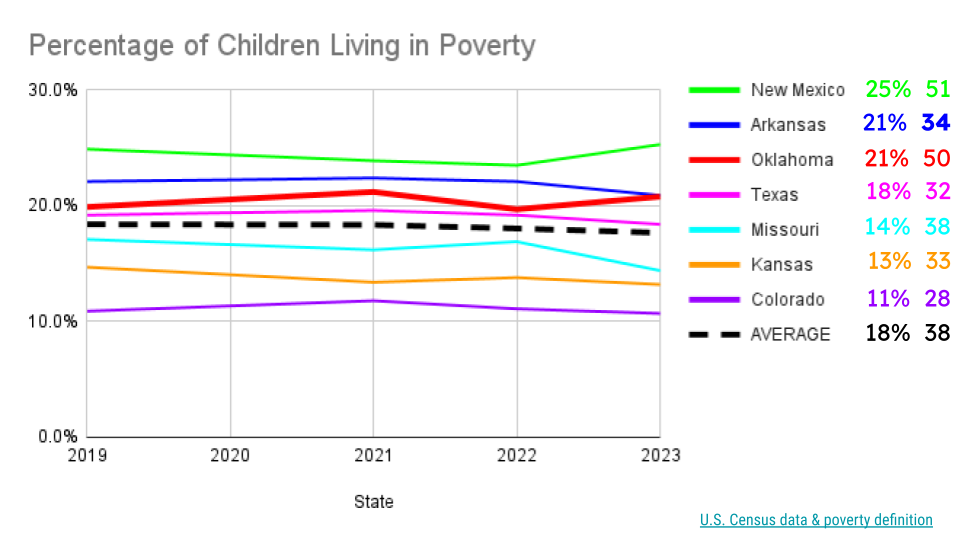
Why is Colorado at the top and New Mexico the bottom? I’d say the most significant reason is because they occupy the opposite extremes when you chart the percentages of children living in poverty.
New Mexico has the most poor children in the region, and Colorado the least; the rightmost numbers in the legend are the states’ 2025 WalletHub school system rankings [Data source]
However, child poverty is not destiny when it comes to a state’s school rank. The outlier in the poverty chart is Arkansas. It usually had more of its children living in poverty than Oklahoma, yet it was ranked 34th in WalletHub 2025, while we ranked 50th. Perhaps Arkansas is investing a lot more in its public schools, or it has measures that drive better outcomes. Let’s first check the regional per pupil expenditures.
Per pupil spending
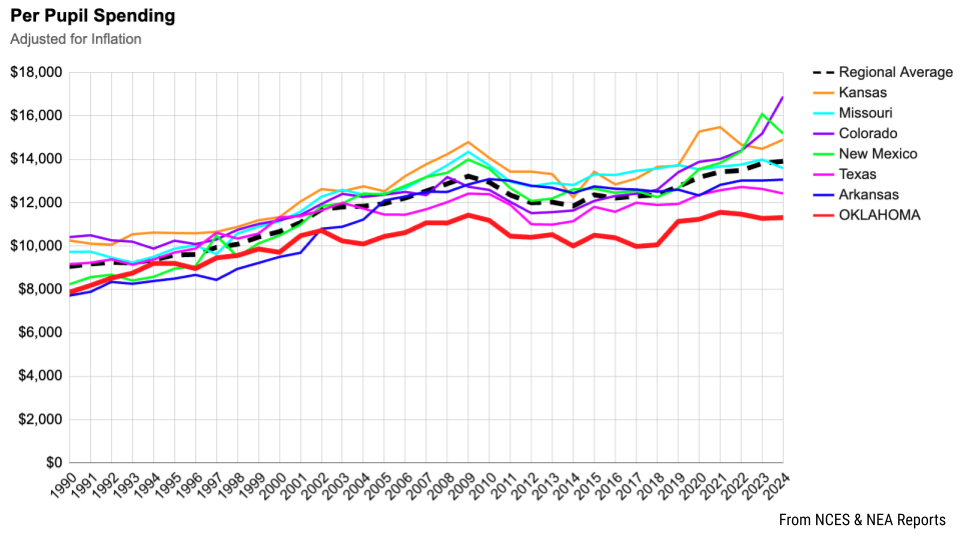
Per pupil spending in the Oklahoma region [from the National Center for Education Statistics’ Revenues and Expenditures for Public Elementary and Secondary Education annual reports and the 2024 National Education Association’s Rankings & Estimates Report]
That chart is adjusted for inflation, so the region increased its real per pupil spending by over 50% during my time in Bartlesville, while Oklahoma’s only grew by about 33%, and Oklahoma’s spending fell away from the group after 2002 for a reason I will identify below.
Per pupil spending is not destiny, either, when it comes to school rankings. In the 1990s, Oklahoma outspent Arkansas, but that changed after 2002. Arkansas has certainly invested more in its students than Oklahoma for over 20 years, but it has spent less than the regional average since 2020 yet its ranking is above average for the region. Also notice how New Mexico has dramatically increased its per pupil funding in recent years, yet its school systems are still ranked dead last by WalletHub. Money alone can’t solve New Mexico’s problems, and I presume Arkansas benefits from some policy and/or demographic differences that raise its rank, although I haven’t been able to tease those out from the data.
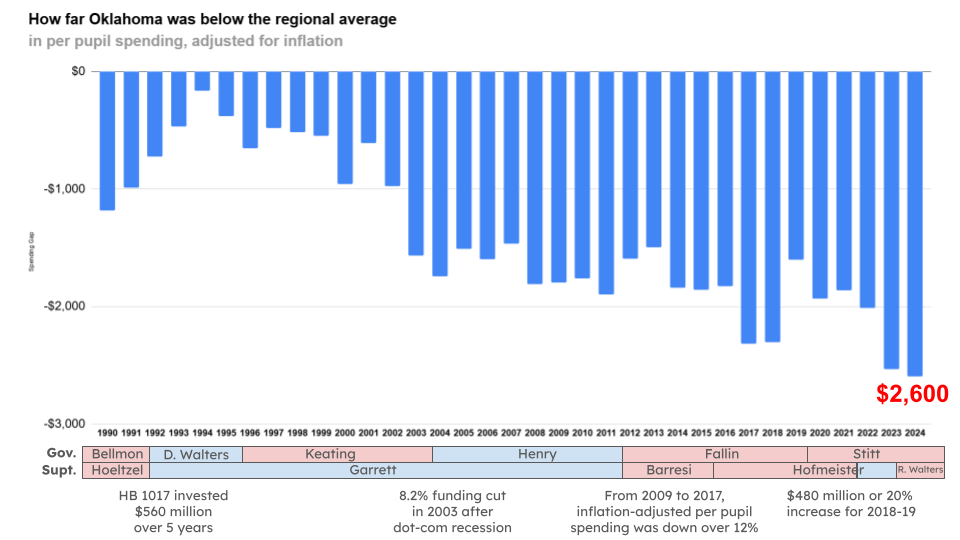
However, we certainly can’t ignore Oklahoma’s outlier status in low per pupil spending since 2003. Here’s a chart of its per pupil spending as a percentage of the regional average with some helpful annotations to explain the salient features.
Oklahoma’s per pupil spending took a real hit after 2002 and is now dreadful [from the National Center for Education Statistics’ Revenues and Expenditures for Public Elementary and Secondary Education annual reports and the 2024 National Education Association’s Rankings & Estimates Report]
Taxation
The dramatic rise in spending in the early 1990s was due to House Bill 1017, the most significant education reform law in state history. It lowered class sizes, improved salaries, introduced curriculum standards and testing, and…raised taxes. That’s never popular in Oklahoma, and led to a failed attempt to repeal the law in 1991 and then to State Question 640 in 1992, which made it nearly impossible to raise state taxes. I knew at the time that was a ticking time bomb in the state’s finances. It took about 11 years for it to detonate.
SQ 640 requires that tax increases be approved by a vote of the people or by 75% supermajorities in both legislative chambers. Each method only succeeded once over the following 33 years. In 1994, voters approved a state question that increased tobacco taxes. However, when the dot-com recession hit in the early 2000s, the legislature couldn’t muster the 75% supermajority votes to raise taxes to compensate. So it slashed public school funding by over 8% and the state’s per pupil spending stayed in the mid 80% range for a dozen years, including during and after the Great Recession from December 2007 to June 2009.
Governors and legislators repeatedly cut state income taxes after SQ 640 was passed, which exacerbated the danger of state revenue shortfalls whenever a sharp economic downturn arrived, particularly given the volatility of the petroleum industry.
The legislature repeatedly cut the top marginal income tax rate after 1992, ensuring severe funding cuts in 2003 and revenue shortfalls in 2016 and 2017
Such cuts are heavily weighted toward the wealthy. Below are the average tax cuts by income level in 2016 after a decade of tax cuts.
By 2016, the state suffered dramatic mid-year revenue shortfalls. In Bartlesville, we had to cut 39 positions, including 21 teaching positions, which was 5% of the overall teaching workforce, plus over 20% of the district-level administrators. Average class sizes jumped to levels once banned under HB 1017.
Voters rejected a 2016 state question that would have increased the state sales tax by one penny to help out the schools. However, Bartlesville voters did approve a bond issue to absorb as many of its schools’ operational costs as possible, with limitations given how it is illegal in Oklahoma to pay for salaries or consumable goods with bond issue funding. Shifting about $700,000 in annual operational costs to bond dollars allowed the district to avoid cutting another 15 teachers, but things were at a low ebb.
In 2018, state legislative leader Earl Sears and I devised a tax increase package and Bartlesville Public Schools led a statewide school suspension movement that pressured the legislature into finally achieving 75% supermajority approval in both of its chambers to increase gross production, fuel, and tobacco taxes. That increased state funding for schools by 20%, with most of the money going to salary increases for teachers and support staff to try and slow a growing shortage of qualified teachers, who had been abandoning Oklahoma for better salaries and working conditions in adjoining states.
Even with that historic investment, Oklahoma’s per pupil funding remained the lowest in the region. Unfortunately, the legislature soon returned to cutting sales, corporate, and income taxes. So-called flat budgets for schools consequently eroded our regional per pupil spending percentage back to record lows by 2024.
Below is a look at the inflation-adjusted spending gap: how much less Oklahoma spends per pupil than the regional average.
After adjusting for inflation, Oklahoma’s spending gap is now the worst in my career
It simply wasn’t like that when I was a student in Oklahoma’s public schools in the 1970s and early 1980s. Let me illustrate by broadening the view out to Oklahoma’s per pupil funding rank among the 50 states and the District of Columbia from 1970 to 2024.
[Data from the NEA Rankings & Estimates Reports and National Center for Educational Statistics’ Digests]
When I was an elementary school student in the 1970s, the state’s per pupil spending oscillated, but averaged about 42nd out of 51. The late 1970s and early 1980s oil boom allowed that to balloon to about 30th when I was in junior high and high school. However, the oil bust in the mid-1980s led to a dramatic drop while I was in college. Our spending dropped from 33rd in 1983 to 46th by 1989 when I started teaching in Bartlesville. That huge drop is what propelled the House Bill 1017 education reform law and its tax increases.
Funding alone can’t ensure better student achievement or higher overall school rankings, but Oklahoma’s outlier status of having the lowest per pupil funding in the region for over 20 years has crippled its ability to recruit and retain highly qualified teachers. Fifteen years ago, emergency certified teachers were a rarity in Oklahoma. By the budget crises of 2016-2018, 5% of its teachers lacked proper certification. Since then that has more than doubled. A key focus of the 2002 No Child Left Behind Act was to have a “highly qualified teacher” in every classroom. Oklahoma’s political leadership has simply abandoned that goal, keeping school funding flat while emergency certifications continued to climb.
For the past few years in Bartlesville, about 1 of every 7 teachers has been emergency certified, with a corresponding impact on the quality of instruction.
The state recently eliminated its sales tax on groceries, something crowed about by both Democrats and Republicans in the legislature. That brought our sales and excise taxes to the lowest in the region save for Missouri, which has much higher property and income taxes. That dubious cut, corporate tax cuts, and 10 cuts in personal income taxes since 2003 have left Oklahoma with the lowest tax burden in the region…and woefully underfunded schools, health care, roads, and other services.
The state’s politicians continue to bemoan our personal income taxes, even though they are now the second lowest in the region, because they aren’t zero like Texas. They conveniently ignore that Texas compensates for a lack of income tax with property taxes that are 2.25 times higher than Oklahoma’s, along with higher sales and excise taxes.
Why, since Oklahoma’s per pupil funding is so dire, haven’t teachers risen up like they did back in 2018? Because their salaries aren’t low enough yet in relation to adjoining states, and they would be vilified by the state’s current political leadership.
Back in 2016-2017, Oklahoma’s teachers salaries were the lowest in the region. In 2024-2025, they were below the regional average but still above Missouri, Kansas, and Arkansas. So teachers and boards of education don’t have enough incentive to mount another difficult campaign to improve the situation and bolster record-low per-pupil spending via some sort of tax increase.
Things will inevitably take a turn for even worse in the next moderate or significant economic recession. In 2024, the legislature’s own LOFT budget stress test showed, “Oklahoma’s State Budget is not prepared to manage the effects of a moderate downturn with only its current reserves”. The study pointed out that states should hold at least 15% of prior year spending in their reserves, and states like Oklahoma that are more reliant on volatile sources of revenue should exceed that. However, Oklahoma had only 12% in reserve, and it would need a 25% reserve to cover the projected impact of even a mild downturn.
Oklahoma has only raised taxes twice in the past 33 years while repeatedly cutting various revenue sources. That has reduced the tax burden from 9.5% of personal income in 1995 to 7% in 2025 as its public schools foundered.
Given the state’s conservative politics, I don’t expect Oklahomans to significantly increase their investment in their own quality of life with meaningful spending increases on schools, health care, roads, or other state services. Thankfully there are some communities, such as Bartlesville, that are willing to pass bond issues and sales taxes to invest in their schools and their city services, but such efforts can only go so far. That reality makes the conclusion of my career in Oklahoma’s public schools both welcome and bittersweet.
Culture wars and identity politics, initially amplified by broadcast media and now metastasized by social media, corrode our quality of life.
Recently Judith Martin and her children Nicholas and Jacobina, writing in their Miss Manners column, shared this take:
The old rule was that politics, sex and religion should not be discussed in casual conversation among people whose sensitivities and opinions were unknown to one another. The rationale was to avoid offending anyone unintentionally.
This rule fell into disuse — and ridicule from some, who responded, “So, we are only supposed to talk about the weather?” They would argue that those three subjects are important, and that people can be trusted to handle them in a mature way.
Ha.
Now, almost any topic causes offense. Politics, of course. Sex, not because people are squeamish (which has not been the case in a century, if ever), but in regard to issues of orientation and identity. Religion, not only because it is intertwined with politics and sex, but also as an identity issue.
But those three are not all. Food, for example, has become a controversial subject in terms of both nutrition and ethics. As for the weather being the only “safe” topic left — not if the conversation turns to climate change.
The real problem is not subject matter, but people who no longer care whether they cause casual offense. They may relish doing so — not only to those whose affiliations and opinions they do not know, but also, perhaps especially, among those they do know. Such as their own relatives.
Their justification is that they are challenging ignorance, prejudice and bigotry of whatever kind. Which would be noble, if only it worked.
Miss Manners regrets to observe that the usual current method of pointing out others’ errors is to belittle them. And oddly enough, this does not prod them to respond, “Wait, you have a point. I am totally wrong. Please straighten me out.”
Miss Manners does not want to limit topics; she just wants to limit the way they are discussed. People who listen respectfully to those with whom they disagree, refrain from using personal invectives, state their points objectively and, if necessary, accept that differences remain, should be able to hold conversations on any topic with those who observe the same courtesies.
But such people seem to be in short supply now.
Demagogues harness culture wars and identity politics to propel themselves into high elective offices. Sadly, it is no longer surprising for autocratic federal and state elected and appointed officials to routinely demonize people they should instead be serving and to portray segments of society as threats to the community rather than members of it.
In broadcast and social media, people are freely labeled as racists, bigots, misogynists, homophobes, xenophobes, fascists, socialists, communists, ad nauseam. Labels lack nuance and often mischaracterize the complex and contradictory behavior inherent in human nature. Even when they accurately reflect past or current behavior, they imply permanence. However, we all know that people often change and evolve.
Malcolm X and George Wallace famously renounced their prior racist views. Bill Clinton went from signing the Defense of Marriage Act to being an outspoken supporter of marriage equality. Charlie Kirk shifted from supporting the separation of church and state to views associated with Christian nationalism. Ronald Reagan went from being a committed liberal and admirer of Franklin D. Roosevelt to become the leader of a conservative political movement.
If we don’t believe people can change, then what is the point of argument, debate, or other attempts at persuasion? Moderation, mutual respect, and compromise are key tools in creating strong communities, but increasingly those have receded behind extreme public partisanship, intransigence, and hateful words and actions.
Stereotypes have developed about right-wing violence and left-wing cancel culture, but violence and cancel culture are now utilized by extremists on both ends of the political spectrum to the detriment of everyone. People of widely polarized political and cultural beliefs invoke supposed rights of free speech without understanding its legal limits, and sometimes suffer doxing, employer discipline, loss of employment, and worse.
Kate Harner has written about how digital and broadcast media promote anger-provoking content to increase engagement, create detachment that promotes cruelty to others and a lack of empathy, and feed an attention economy that exploits extreme emotions for profit. She wrote:
If you stay true to your principles, they will offend somebody and you will get ‘canceled’. With a large enough audience that is a guaranteed outcome. Someone would wake up in a bad mood and forget to take their pills, and your principles would become a convenient target for their rage. . . . So for self-preservation, people stay silent – and who can blame them? In America you may not face imprisonment if someone does not like your views, but be prepared to lose your job.
Increasingly, we see government being weaponized in the culture wars. Partisans may temporarily rejoice as political norms are violated and authoritarian tactics promote their views while suppressing others, but power will eventually shift with victors transformed into victims.
Identity politics
Progressives often promote the rights of interest groups, particularly people who have historically suffered discrimination and persecution. However, when progressive politics is perceived as mostly about promoting disfavored groups, autocrats can portray progressive policies as favoring the disfavored few at the expense of the majority. Human rights are portrayed as a zero-sum game with winners and losers, as if someone else gaining equality somehow robs you of it. Autocrats use that mindset to divide and conquer.
Examples of how much people can change are Americans’ views on sexual orientation. Gay marriage had spread across 36 states before the Supreme Court nationalized it in 2015 with Obergefell v. Hodges. While only 27% of U.S. adults supported it thirty years ago, now over 2/3 do, albeit it with the usual partisan divide.
Over time, views on homosexual relations had shifted, and the courts were following that trend. Whereas only 40% of Americans held that homosexual relations were morally acceptable back in 2001, that has risen to 64%.
However, condemnation of minority sexual orientations and unusual gender identities is still quite common in Oklahoma, where 47% of adults are Evangelical Protestants and 42% say homosexuality should be discouraged, compared to only 30% nationwide who feel that way. Bartlesville has ongoing efforts to censor library books, ban drag shows, and so forth.
Transgender politics is especially fraught. Less than 1% of the U.S. adult population, and only 0.7% of Oklahoma adults, identify as transgender, but in recent years they have been treated as cannon fodder in the culture wars.
Equality v. equity
Things get particularly dicey when people seek to use the law in pursuit of equity rather than equality.
A commonplace illustration of equality versus equity
At first glance, we’re glad that equity means everyone can reach an apple. But what if the apple is employment or certification and the taller boxes represent identity-based scholarships, admittance requirements, or test score adjustments? How one achieves equity can drastically reduce support for interventions. For example, if we want more racial, economic, or religious diversity in certain professions, are we willing to enact quotas? Would we support scholarships and programs targeted at underprivileged groups? What about lower standards for groups that have suffered historic discrimination?
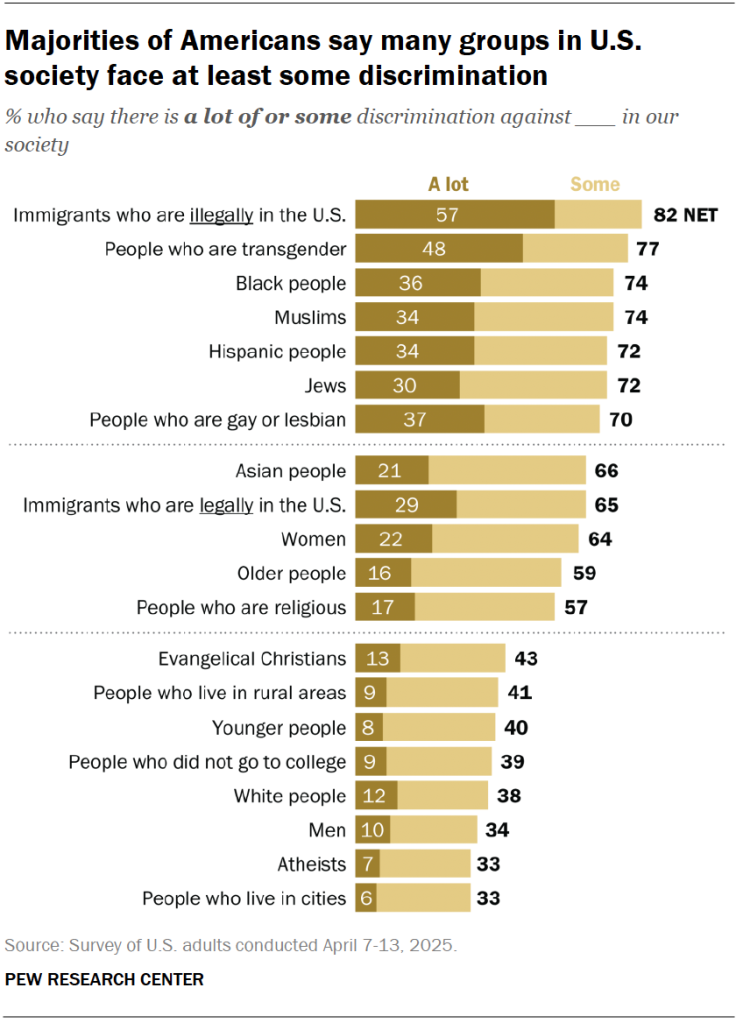
Majorities of Americans say many groups do face some discrimination, but equality before the law is embraced far more broadly than are attempts at creating equity.
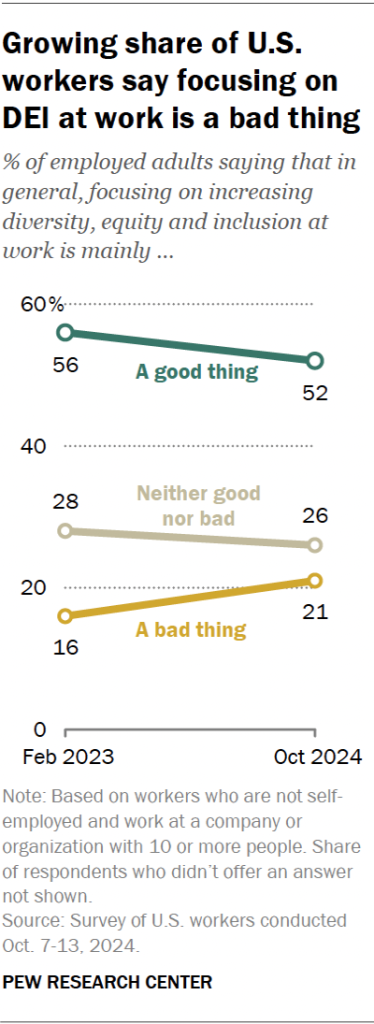
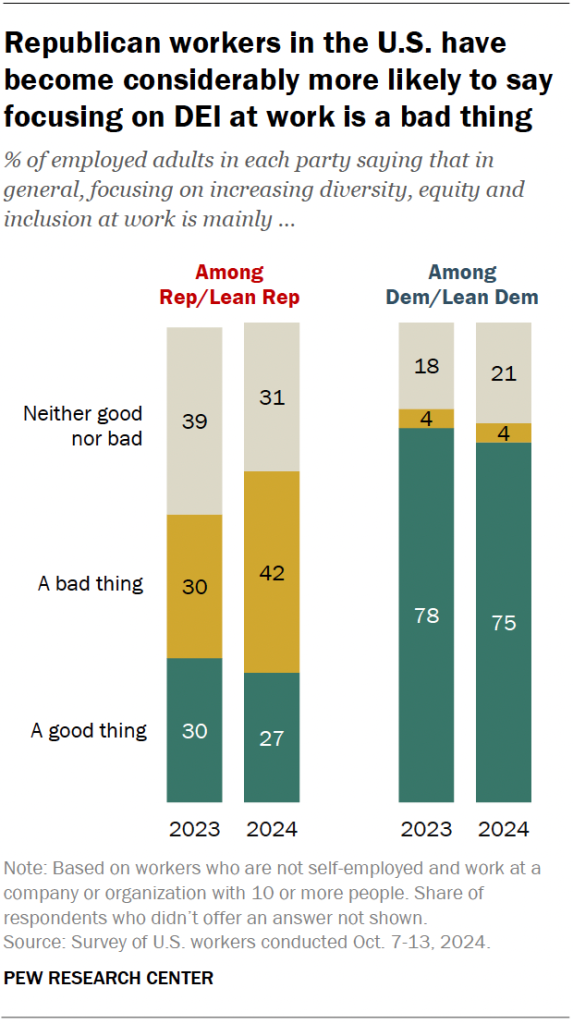
Recently many Republican politicians have pushed to ban diversity, equity, and inclusion (DEI) efforts in the government, workplace, and education. Support for DEI in the workplace has been slipping as it has become an extremely partisan issue.
Evangelicals
The aspects of the culture war that I am most frequently exposed to as an Oklahoman are promoted by Christian evangelicals, with a strong uptick this month after Charlie Kirk’s assassination.
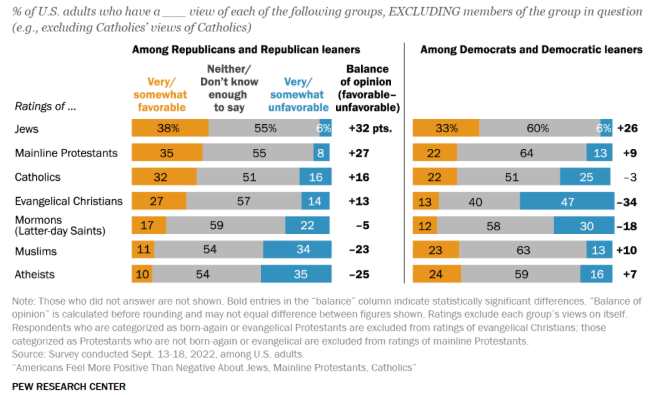
Evangelicals often think of themselves as one of the most marginalized groups in American society. Data from the American National Election Study does show that feelings toward Christian fundamentalists have steadily deteriorated over the past 20 years, with the average feeling toward them now being far colder than toward Muslims, Jews, or Christians in general.
When interpreting that chart, please bear in mind that while all fundamentalists are evangelicals, not all evangelicals are fundamentalists.
I would attribute some of the negativity toward evangelicals as arising from the very nature of evangelizing, the active preaching of their beliefs in hopes of conversions. Backlash becomes inevitable whenever that strays into harnessing secular power to impose their values and beliefs on others. Such bullying behavior is particularly noticeable in Oklahoma, with elected state officials who repeatedly violate the separation of church and state, capitalizing on how Christians still compose 70% of the state’s adult population.
Oklahoma’s demagogues are well aware that evangelicals are anything but marginalized in this state, with only Arkansas having a larger share of its population identifying as evangelical Protestants.
Evangelicals who are particularly strident in seeking to impose their beliefs on others have little fear of being ‘canceled’ in Oklahoma since they now outnumber even Mainline Protestants by over four to one.
However, the state’s 70% share of Christians is down from 85% in 2007, with drops from 2007 to 2024 in the overall share of Oklahomans in the Evangelical Protestant, Mainline Protestant, and Catholic divisions of Christianity. The share of Oklahomans who are religiously unaffiliated has more than doubled over that same timespan, with over 1 out of 4 now identifying as atheists, agnostics, or professing nothing in particular.
Modern society provides access to different worldviews through the internet, offering moral guidance outside of religion and reduced social pressure to conform to religious norms. Some evangelicals view the rise of the religiously unaffiliated as both a challenge and an opportunity, but the strong alignment of many evangelical groups with conservative political ideologies is a “push factor” driving some people away from religion; the religiously unaffiliated tend to be more politically liberal.
The religiously unaffiliated nevertheless have diverse beliefs. Only about 5% of people, both nationwide and in Oklahoma, identify as atheists. That’s up from 2% nationwide and less than 1% among Oklahomans back in 2007. As one would expect, atheists and evangelicals often take a dim view of each other.
I take a dim view of both culture wars and identity politics. My decade of directing my school district’s communications efforts has led me to avoid “feeding the beast”. Some state officials make outrageous proclamations and demands, which usually lack legal force. My approach is to avoid actively responding to those provocations, which are really about “ginning up the base” and fanning the flames of the culture war or distracting from the latest scandal arising from incompetency and corruption.
The reality is that both broadcast media and most social media warriors of both liberal and conservative bents have an extremely short attention span. Rapid scrolling and constant notifications foster a need for immediate emotional gratification, regardless of whether that is positive or negative. The warriors typically move on within days, and sometimes hours, minutes, or seconds, to their next outrage, with little if any follow-up.
My advice is to minimize your engagement with such posts and avoid broadcasting to entire groups about issues that likely only interest the fringes. When you do respond to direct inquiries, stick to the facts as much as possible using neutral language and tone. If the warrior you are directly communicating with is an acquaintance, you may be able to disarm them with some mild humor so long as it is not aimed at them or their concerns. Model mutual respect and, if it is not returned and you are disrespected, bear in mind this advice Marcus Aurelius gave to himself:
Keep this thought handy when you feel a fit of rage coming on—it isn’t manly to be enraged. Rather, gentleness and civility are more human, and therefore manlier. A real man doesn’t give way to anger and discontent, and such a person has strength, courage, and endurance—unlike the angry and complaining. The nearer a man comes to a calm mind, the closer he is to strength.
In regards to your own posts on social media, I don’t believe they can change most people’s minds. I’ve seldom seen anything approaching a reasoned or productive debate in the comments. Rather, social media reinforces existing beliefs through personalized algorithms and echo chambers.
Furthermore, research published in Nature showed that decreased exposure to like-minded views made little difference. Over 23,000 Facebook users had their exposure to content from like-minded sources reduced by about 1/3 during the 2020 U.S. presidential election. That increased their exposure to content from cross-cutting sources and decreased their exposure to uncivil language, but it had no measurable effects on ideological extremity, candidate evaluations, belief in false claims, or affective polarization, a term I define below.
There are significant psychological barriers which make social media users resistant to contrary arguments:
Confirmation bias: people seek out and favor information that aligns with their existing beliefs and dismiss contradictory information
Motivated reasoning: when confronted with counter-arguments, people are more critical of information that contradicts their views and more lenient toward information that confirms them
Cognitive dissonance: confronting a contrary argument creates mental discomfort, motivating people to reject new information to avoid the discomfort and protect their ego and public image
Affective polarization: social media intensifies dislike and distrust of the opposing side, making purely factual arguments less effective than those rooted in identity
So my advice is to save your fingers. Avoid engaging in online “debates” and arguments with strangers. Avoid reacting to every little outrage. Avoid insults, both created by you and directed at you. Focus on the genuine positive aspects of social media: keeping in touch with real-world friends and acquaintances; enjoying positive posts of beauty, nature, and fun events; providing positive support, information, and advice for those who seek it out.
Each of us shall continue to make mistakes, but we can embrace a growth mindset. As Maya Angelou’s advice to Oprah Winfrey has been paraphrased:
A lightning strike prompted me to simplify our home theater. The bolt early one morning struck quite close to our house, disrupting our next door neighbor’s telephone landline wiring and one of its attached telephones. I had to reboot both our cable modem and its eero router to get the internet back up in Meador Manor, and later that day our television was making clicking noises while in standby mode.
Unplugging the television for awhile solved the clicking issue, but a few days later, when Wendy wanted to watch a DVD with me, I couldn’t get our Sony Blu-Ray Ultra HD player to work. I tried a different HDMI cable, a different disc, and powering everything down and back up to no avail. I presumed that a power surge might have damaged the player, despite it being plugged into a surge protection power strip, since that power strip had been in use for years and thus its protective metal oxide varistors could have worn out.
So I ordered a Panasonic Blu-Ray Ultra HD player, but when I plugged it in, it was still no go. Oh dear…what had I missed? Our complex home theater system, which I had rebuilt in 2017, had always been too complex for Wendy’s comfort and now its crankiness was exasperating me as well.
The Receiver
The Sony AV receiver I purchased in 2017
Back in 2003, I had bought a Panasonic SA-HE100S receiver for $300 along with a $300 Onkyo SKS-HT500 home theater speaker system. Fourteen years later, when I bought an LG OLED television, my old receiver didn’t have any HDMI capabilities to help everything link up, and I wanted to keep using the surround sound speakers. Wendy and I were newlyweds, and I hoped to build a system with push-button ease of use.
So at that time I invested $598 in a Sony STR-DN 1080 receiver, which became an HDMI hub for our television, Apple TV, and disc player while powering the five old surround sound speakers and powered subwoofer. I also upgraded my old Logitech Harmony universal remote to a Harmony Companion.
With considerable effort, I got everything to work, but Wendy was never comfortable with the system. In recent years, more often than not I would activate a function on the Harmony universal remote and have something go haywire, requiring me to tweak various settings and break out dedicated remote controls to get a video to play correctly in surround sound.
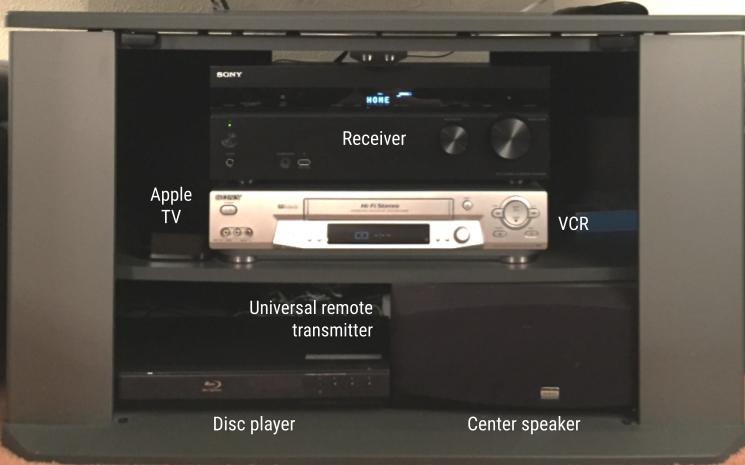
Earlier this year I stopped using my 2001 VCR to watch my 1990s workout videos, since I now have digital copies of the shows on my Mac Mini home computer which I can stream to the television using my iPad. I decided it was time to radically simplify, with a goal of clearing out everything in the TV cabinet except for the Apple TV and the disc player and having a system Wendy and I could operate much more easily and reliably.
The equipment in our TV cabinet from 2017-2025
Simplification
I abandoned the Logitech Companion universal remote along with using the receiver as an HDMI hub. Instead, I plugged the 2025 disc player, the 2017 Apple TV, and a 2018 Chromecast Ultra directly into the television. We will now rely on the LG television’s “Magic Remote”, which I managed to program to control the basic functions of the new Panasonic disc player and I had previously programmed to adequately control the Apple TV.
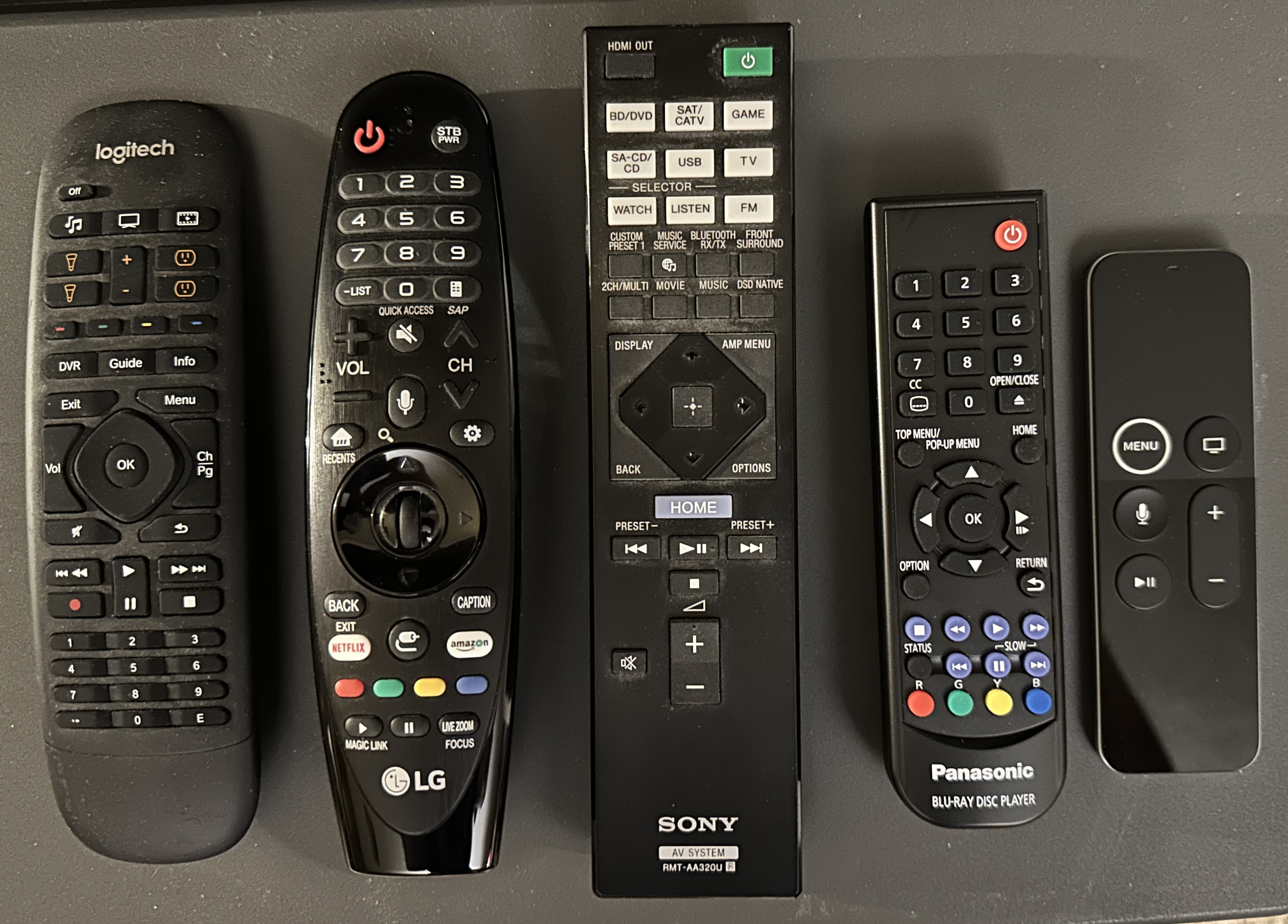
Our remote controls included the Logitech Companion, the LG television’s “Magic Remote”, another for the Sony receiver, and little-used ones for the Panasonic disc player and the Apple TV
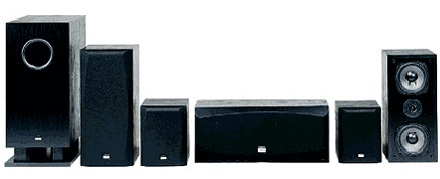
My 2003 5.1 surround sound speakers
Eliminating the complexity of the receiver also meant abandoning the Onkyo surround sound speakers I had purchased in 2003. After I retire in 2026, Wendy plans to continue to work for a few years. So I expect to be making more use of our home theater, and I opted to invest in a new sound system that doesn’t need a receiver/amplifier and supports Dolby Atmos for a three-dimensional soundscape.
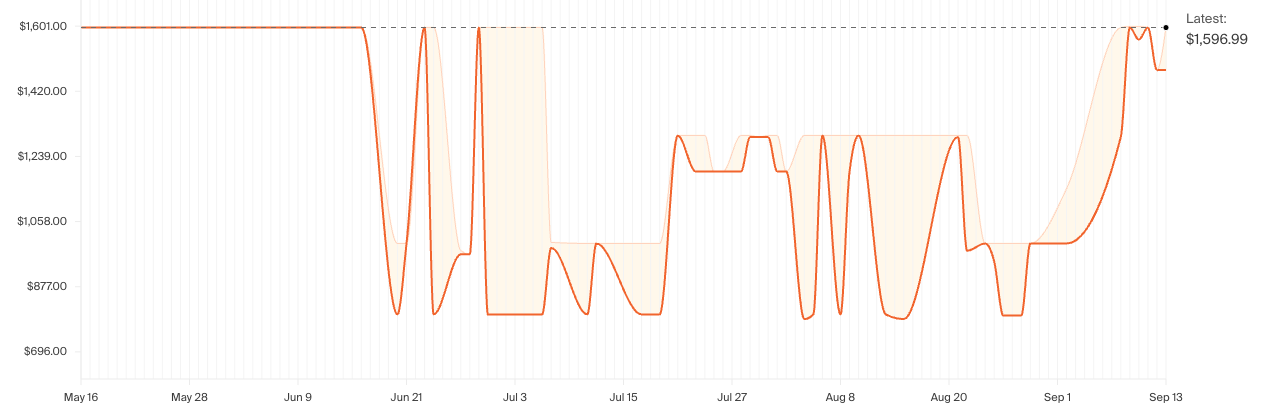
I spent $1,000 on an LG S95TR 9.1.5 channel soundbar with two wireless remote surround speakers and a subwoofer; it was LG’s flagship model last year, and Amazon was willing to let me spread payments across several months. I noticed that its price has fluctuated between $800 and $1,600 over the past months, so don’t pay list.
How the new soundbar system’s price has fluctuated at Amazon over the past four months
My old system was termed a 5.1 because it had five obvious full-range speakers — front left, front right, center, left surround, and right surround — and one subwoofer for deep bass. But what did the new system’s 9.1.5 designation mean, given that physically it is one long soundbar, two satellite speakers, and a subwoofer?
The new LG S95TR 9.1.5 surround sound system
Well, it has 9 regular channel speakers, 1 subwoofer, and 5 up-firing speakers. Those last speakers are used for Dolby Atmos. The soundbar actually has ten speakers in it, three of them firing upward.
The subwoofer went on the floor near the television. The two satellite speakers replaced the two in our old Onkyo system. One of those old speakers had always sat up high on a fireplace mantle on one side of our couch, while its companion sat on the floor on the other side. The older units did not need power cords but had long speaker wires leading back to the Sony receiver under the television, and because of the speaker wires they were never really behind us, just beside us.
The new system’s satellite speakers just have power cords since they receive the sound signals wirelessly from the soundbar. In addition to front-firing drivers, they each have one firing upward. I put those about nine feet behind the couch along walls near power outlets.
Back when I set up the Sony receiver, it came with a little calibration microphone to tune my old 5.1 system speakers. The new system had me use the LG ThinQ app — the same app that controls our LG washing machine — to calibrate the speakers. (I wondered why they call the app “thin Q” and the internet told me to think about it. 🙄)
I just sat with my iPhone on the couch, triggered the test, and each speaker sequentially made loud noises that were picked up by the iPhone to adjust the settings in about a minute. Wendy has better hearing than I do, and I then used the app to reduce the volume of the subwoofer since she doesn’t like so much bass.
My LG television is too old to support LG’s WOW interface, so it can’t properly integrate its own internal speakers into the sound mix, but I have the soundbar plugged into the HDMI port on the television that supports audio return channel and consumer electronics control, so I can use the television’s remote control for the surround sound volume, and the soundbar powers on if I set the television’s audio out to the HDMI port.
Comparison
After setting up and calibrating the new sound system, and before dismantling the old receiver and Onkyo speakers, I did a comparison. Our Apple TV 4K supports Dolby Atmos, so rather than scour our collection of physical media for a suitable Blu Ray or trying something in the television’s Amazon Prime app, which I presume also supports Dolby Atmos, I checked to see what the internet suggested as movie scenes with noticeable Dolby Atmos effects that I could rent or buy on the Apple TV. One was the seawall segment of Blade Runner 2049.
Wendy and I watched the scene, with me switching between the television’s optical output, which fed the old 5. 1 speakers, and the HDMI output driving the new 9.1.5 system. I didn’t really notice Dolby Atmos, and the sound was fine with either system. I’m glad my motivation to invest in a new sound system wasn’t a lack of Atmos or other limitations with the older speaker system, but rather just me needing to simplify operations.
My impression was that dialog was a bit clearer with the new system, which would be welcome. We both noticed a lag between the video and the sound, and I tried adjusting the audio delay in the television’s sound settings, but the solution was to activate the “bypass” function. That sends the audio information out directly, without any delay from the television’s video processing. On some systems, that can create its own lag since the television might be slow in processing video, but bypass seemed to work fine for our test.
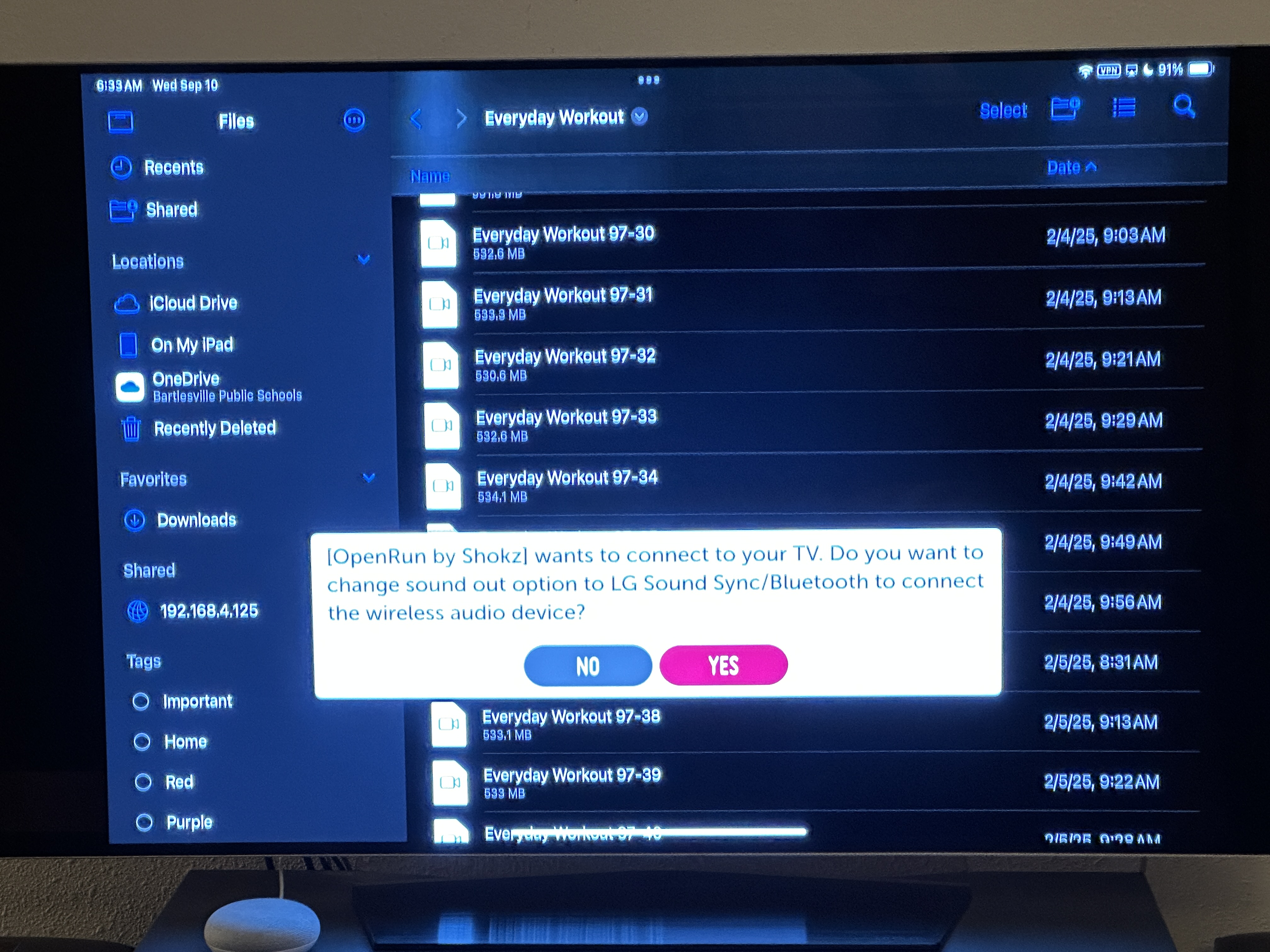
The prompt I see each weekday morning
I use Bluetooth bone conduction headphones when mirroring my aerobics videos from my Mac through my iPad to the television each weekday morning. When I turn on the headphones, the television asks me if I want to use them.
That all worked normally after the upgrade except that when the soundbar is on, the Bluetooth reception has interference. I couldn’t find a way to turn off the soundbar but keep the television on with the Magic Remote, so I have to manually power down the soundbar each morning, either with its own dedicated remote, the LG ThinQ app, or the power button on top of the soundbar.
When I turn on the system at other times, it either defaults to the television’s internal speakers or to the HDMI audio output for the surround sound. That setting is fairly easy to adjust, although I’d like to have a shortcut key for that on the “Magic Remote”.
My only real complaint about the new soundbar is that when I adjust the volume, neither the television or the soundbar show a meter or number indicating the sound level. The television displays a level number when using its internal speakers, and the old receiver showed its own number on its display. It could be that the ThinQ app shows a volume meter, but using a smartphone app to control the system does not appeal to me.
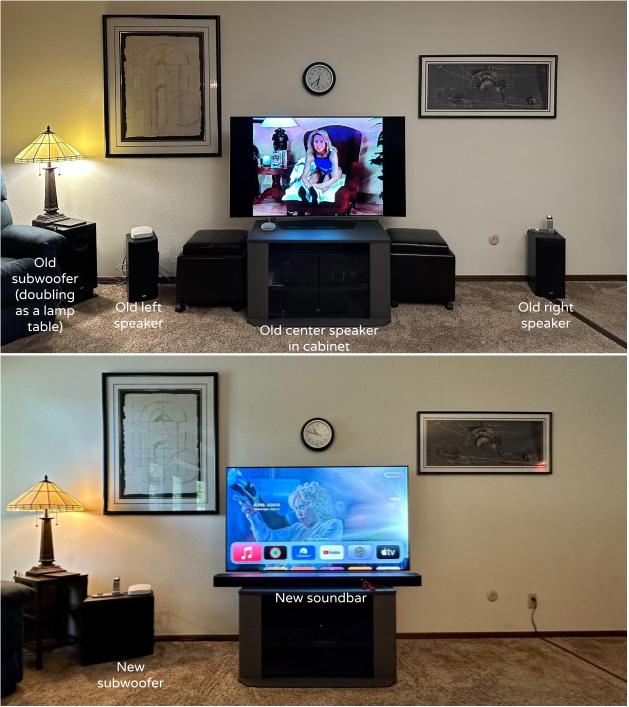
The living room setup is now cleaner without the left and right speakers that once sat on the floor and a center speaker that was tucked in the television cabinet.
Before and after (those things on each side of the television stand in the before photograph are our ottomans we roll over to the couch when we watch a show)
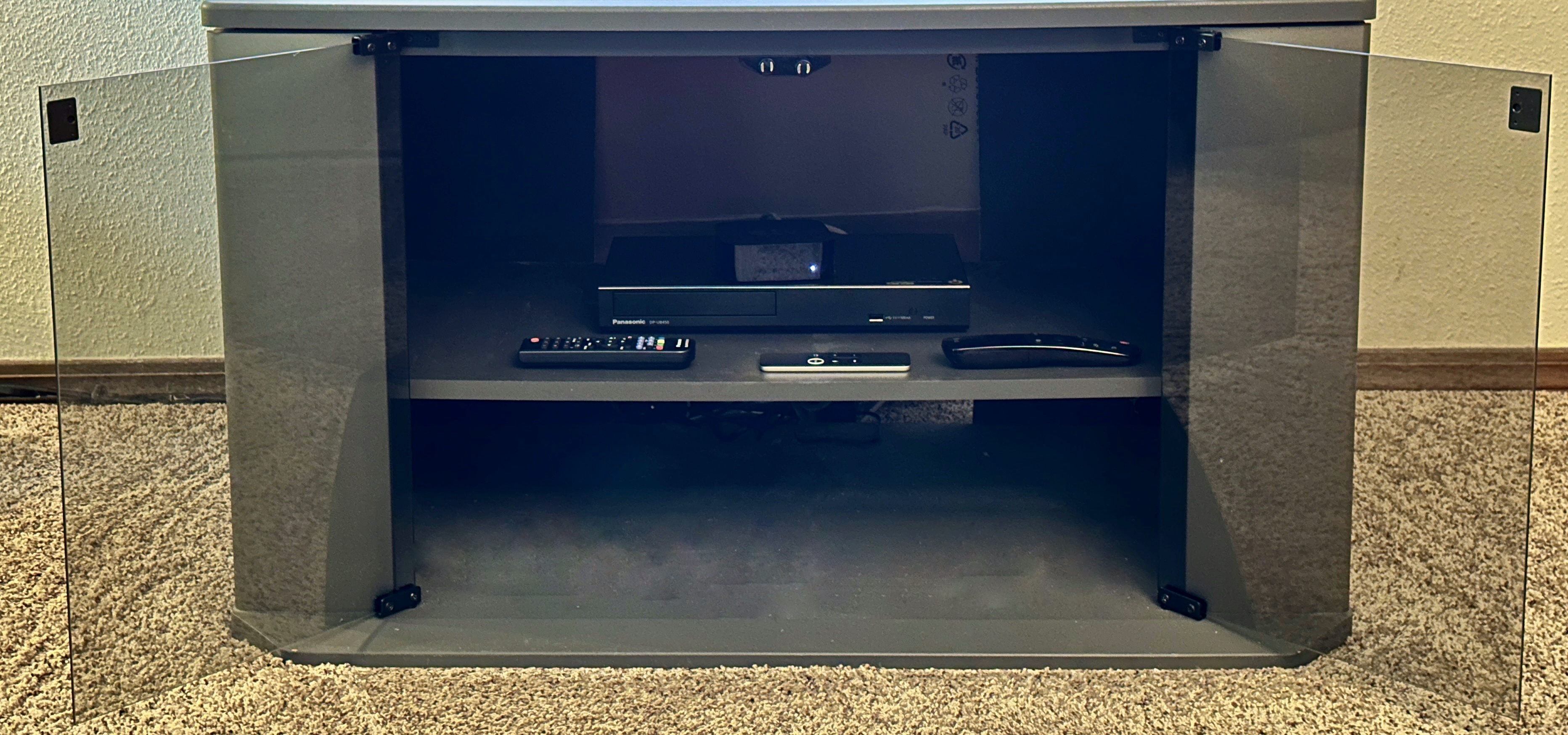
That cabinet now seems almost empty with only the disc player, Apple TV, and not-so-magic remote controls in it. I re-installed its tinted glass doors, which I had removed decades ago since the old system’s center speaker resided in the cabinet. I also replaced the surge protection power strip behind the cabinet with a new one to ensure our equipment is protected by fresh varistors.
The TV cabinet is no longer stuffed with equipment
The upgrade was a success: the system is now much simpler to use. But there was a bit more tweaking to do, as another request Wendy had made was that it be easy to watch broadcast television.
Broadcast Television
The Manor’s 1995 antenna is damaged, but that wasn’t why we had lost some channels
Broadcast television is helpful should the internet go down yet electrical power remain operative. Our chimney sports the VHS/UHF antenna that I mounted on it thirty years ago, but part of its VHF log-periodic dipoles snapped off in a storm years ago, leaving only its Yagi-Uda end-fire array for UHF channels fully intact. I had presumed that was why for the last few years when I would test the system it could not pull in KJRH, the Tulsa NBC affiliate, which still identifies as Channel 2 although it actually broadcasts on digital channel 8.
You might be wondering if the antenna took the bolt. It is connected to a grounding stake I also bought and drove many feet into the earth back in the day, so it is effectively a lightning rod that provides a low-impedence path when a lightning circuit is formed. But I have seen no indications that the recent strike involved our antenna; my guess is that a nearby tree became part of the circuit. The brief issues with our system were more likely just due to the electromagnetic pulse from the nearby bolt.
Anyway, when I tested the antenna this week, the television could also no longer show digital channel 11, which is KOED, the Tulsa PBS affiliate. I checked the antenna’s gamut, and it was only able to pull in 28 channels, which was unusually low.
When I installed the antenna and accessories from Radio Shack back in 1995, I had included a powered signal booster. I wondered if it might have lost some of its mojo over the past 30 years. I still had a second booster I had tried three decades ago and rejected, but not returned, so I wondered if it might now work better. I had the television displaying the signal strength for Channel 11 while I began to unscrew the coaxial cable from the old booster. Suddenly the low signal strength surged to 100% and the high-definition broadcast came through. My guess is that the booster connection had some oxidation.
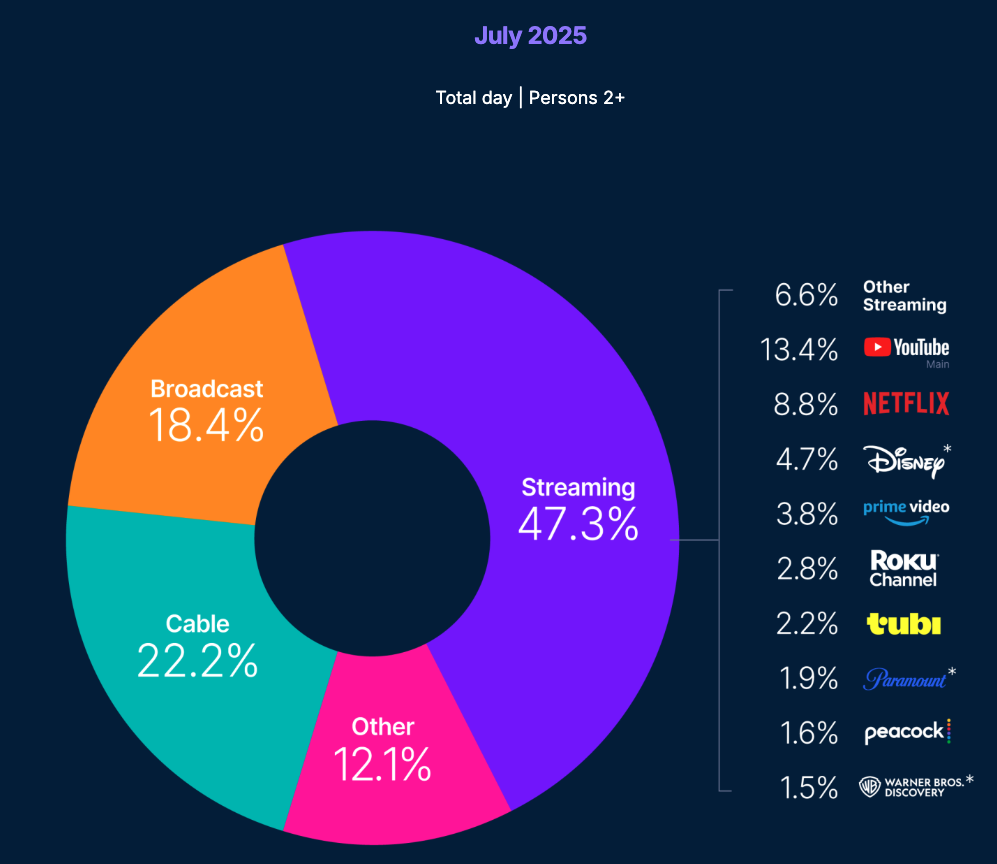
Lo and behold, that also fixed Channel 2, and the aerial is back to picking up 72 broadcast television channels from towers that are up to 63 miles away. Many of those are multiplexed sub-channels with 480-line interlaced broadcasts of vintage content, but we do receive high-definition 1080-line interlaced broadcasts from the local CBS, NBC, and PBS affiliates and 720-line progressive ones from ABC and FOX. I’m frankly surprised that there are still so many broadcast channels, given that broadcast television’s share of viewership is now less than 20%.
The LG television carries a mind-boggling 1,000 internet channels, including many dedicated to reruns of particular shows. I’ve no idea what their viewership is like, but we’ve come a long way since Bruce Springsteen released 57 Channels (And Nothin’ On) in 1992, let alone when I was a youngster in OKC and we received only four television channels on our black-and-white television’s rabbit ears antenna.
The Future
I have a bunch of optical discs awaiting my attention when the weather isn’t cooperative and I’m not otherwise engaged. I have a few seasons left of The Six Million Dollar Man to rewatch fifty years later, plus all of the Bright Knight Batman shows available for sampling. As for movies, I have restorations of The Umbrellas of Cherbourg from 1964, Danger:Diabolik from 1968, Cleopatra from 1963, and 1937’s Un Carnet de Bal stacked up, along with all four of Margaret Rutherford’s Miss Marple films. Perusing the media shelves also reminded me of a slew of unwatched Great Courses videos that I purchased over a dozen years ago.
So much to watch, and so little free time…for about nine more months.



































 Meador Manor