Return to Bromide Hill

December 20-22, 2023 | Photo Album

Meador Selfie Profile Pic

Sulphur Springs Reservation was established in the Chickasaw Nation of Indian Territory in 1902, and it became Platt National Park in 1906. Its national park status was dependent on a deal made with the Chickasaws and Choctaws, who had seen what had happened to the similar hydrotherapy area of Hot Springs in Arkansas. Private entrepreneurs were allowed to build and operate bathhouses there, and the tribes feared they would lose access to the waters of Sulphur Springs unless it was protected.

The city of Sulphur developed directly north of the park, which in the 1930s boasted eighteen sulphur, six freshwater, four iron, and three bromide springs.

The popularity of hydrotherapy waned as more effective treatments were developed for psychological and physical ailments. But Platt remained a popular camping spot, thanks to improvements made by the Civilian Conservation Corps in the 1930s.

Robber’s Roost is a lookout 140 feet above Sulphur on Bromide Hill, and the park’s principal mineral springs once issued from its base. Before I was born, my father and mother visited it with my maternal grandmother and three of my mother’s siblings.

Platt was always a target for removal from the National Parks system, with Secretaries of the Interior recommending in 1913, 1925, and 1933 that it be given to Oklahoma and made into a state park. In 1976 Oklahoma finally lost its only National Park when Platt was combined with the Arbuckle Recreation Area and renamed the Chickasaw National Recreation Area.

In the 1970s, my parents would tow their Yellowstone trailer to what we still called Platt to camp in the Rock Creek area just west of Bromide Hill, a campground which had been developed from 1950 to 1967.

Unfade Pro 2023-08-25 00.59.26.666
Granger at Robber’s Roost above Sulphur in 1977

Recently I came across a 1977 photograph of myself on Robber’s Roost atop the hill, and that prompted me to suggest to Wendy that we return to Sulphur for a brief visit at the start of our 2023 Winter Break. I had introduced Wendy to Sulphur a decade earlier, and we had returned during Spring Break in 2019.

We set out from Bartlesville on the first day of Winter Break, enjoying lunch at Kilkenny’s in Tulsa before heading down the Turner Turnpike/Interstate 44, exiting at Stroud.

Sulphur 2023 Trip Map
Our travel route

Seminole

For our trip to Sulphur in 2019, after passing through Prague we enjoyed diverting westward to Shawnee to tour its art museum and railroad depot. This time we simply drove due south through Seminole, home of First Peoples who were forcibly relocated from Florida in the first half of the nineteenth century.

There were originally 24 towns in the Seminole Nation established in Indian Territory in 1856. In 1892 the Seminole government was dissolved and the nation’s territory divided among three thousand enrolled tribe members. Rampant fraud led to only about 20% of the Seminole lands remaining in Seminole hands by the 1920s, when Seminole county became for a brief time the greatest oil field in the world, producing 2.6% of the world’s oil.

In 1926, Seminole boomed from 854 to over 25,000. The town became a morass of mud.

Motoring through Seminole during the oil boom

Railroad traffic grew so much that on March 18, 1927 the Seminole yards handled over 24,000 freight cars.

Seminole during the oil boom a century ago

A few Seminoles became wealthy, but most of the riches went to whites. The boom was over by the mid-1930s, and the population stabilized at about 11,000 from 1930 to 1960, but then collapsed to less than 8,000 by 1970 and was 7,146 in 2020, when 20% of its population was below the poverty line. Today, over 13,000 of the Seminole Nation of Oklahoma’s 18,800 enrolled citizens live in Oklahoma. Thirty years ago, the Jasmine Moran Children’s Museum was established; it is the town of Seminole’s biggest attraction.

Bowlegs
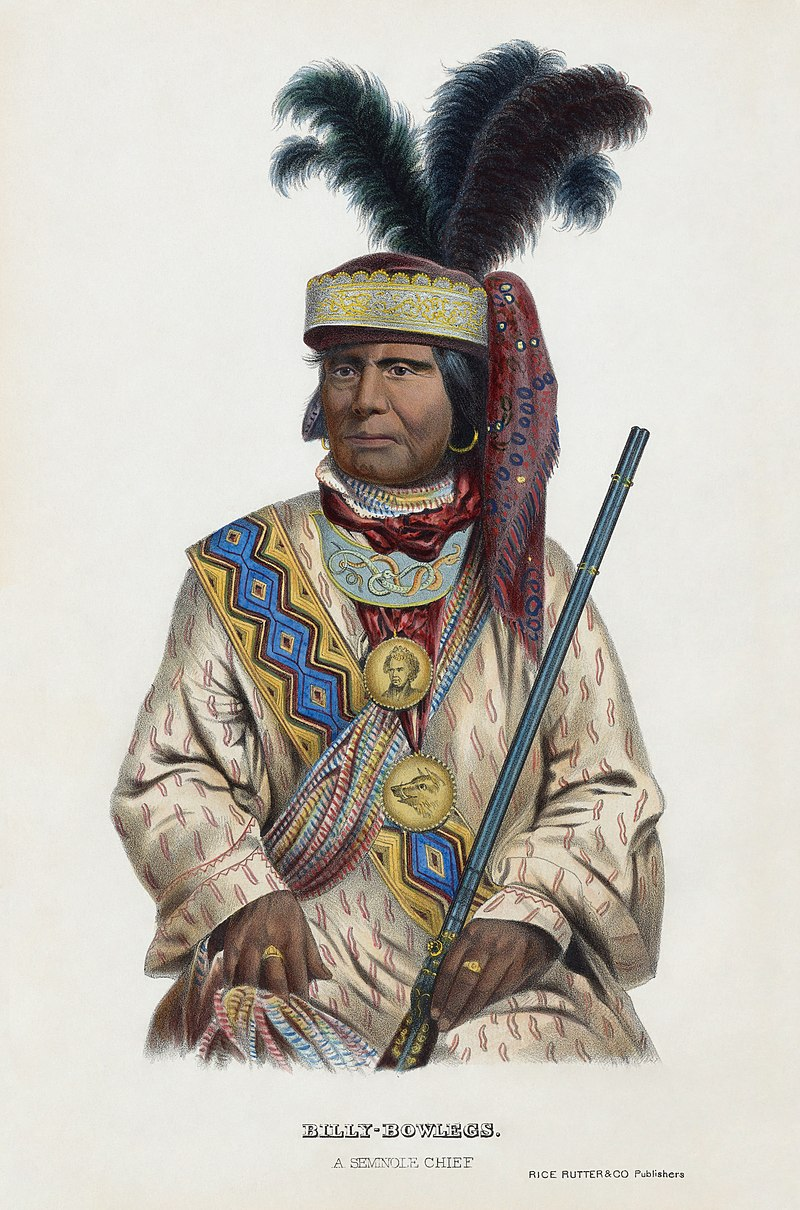
Five miles south of Seminole is Bowlegs, another oil boom town. But when they built highway 377, it bypassed Bowlegs, and there isn’t even a sign on 377 telling you to turn east for about a quarter-mile on highway 59 to reach the notorious former boomtown.

The Indian Territory Illuminating Oil company (ITIO) brought in the first well there in 1926, and the town grew to about 15,000. ITIO was formed in 1901 and was run by H.V. Foster and Theodore Barnsdall, oil barons familiar to folks where we live in northeast Oklahoma. ITIO was a leader in the oil fields of the Osage reservation, Seminole, and Oklahoma City, and was absorbed into Cities Service by 1940.

The town’s name may have come from Billy Bowlegs, a leader in the Seminole wars when the tribe was still in Florida, and that name might be a corruption of Bolek, an earlier Seminole chief. Billy’s tribal name was Holata Micco, meaning Alligator Chief.

The boomtown of Bowlegs had a bad reputation, with one dance hall nicknamed “the Bucket of Blood” due to its many brawls.

The Sinclair Gasoline Plant at Bowlegs was once the largest in the world

Bowlegs declined rapidly after the boom, with only 105 residents in 1946. Today about 350 people live there, with 24% of the residents living below the poverty line.

I was pleasantly surprised by the quality of highway 377 from Stroud through Prague to Seminole. It was mostly a four-lane divided highway with little traffic and a good road surface. It was just a two-lane south from Seminole to the Canadian River, expanding again to a divided four-lane for the short drive from there to Ada. We then took the ridiculous two-lane Chickasaw Turnpike from Ada to Sulphur.

Legislators forced Governor Bellmon to build it in the late 1980s. He knew it would be a big money-loser, so he had it built with only two lanes. It was in poor condition by 2002, an albatross that neither the turnpike authority nor the department of transportation wanted. The turnpike’s pavement was finally rehabilitated in 2006. In 2011, the last four miles of it near Sulphur was transferred to the department of transportation, reducing the weird little toll road to 13.3 miles. It collected $896,000 in tolls in 2020, which was about 0.3% of the tolls collected statewide. The Chickasaw earned a bit more than $67,000 per mile that year, while the original 86.5-mile Turner Turnpike from Oklahoma City to Tulsa earned about $850,000 per mile. Back in 1954, voters approved cross-pledging turnpike revenues, so the sensible turnpikes support the rest.

Sulphur

For our previous stays in Sulphur, I booked the Hollywood Suite at The Artesian hotel. This time, I used VRBO to rent a vacation home a few miles outside of town to the west of the Lake of the Arbuckles. So before going to the cabin, we stopped to buy breakfast and lunch groceries at Sooner Foods.
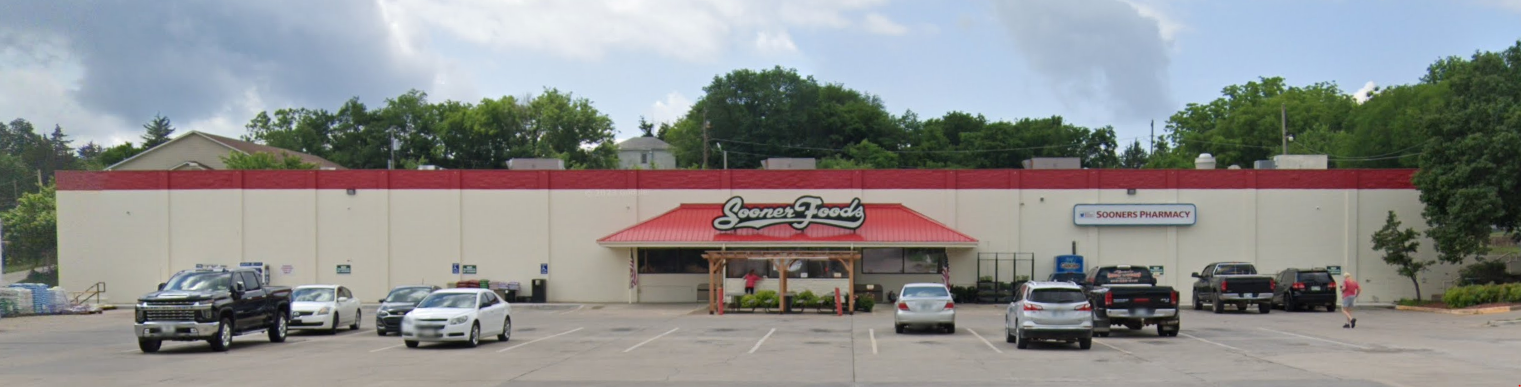
Sooner Foods in Sulphur, a family-owned grocery

I noticed a portrait hanging on the wall by the checkouts, which told me we were dealing with a family-owned business. The portrait was of James Rae Howe, who established the store in 1954. He owned and operated stores in Sulphur, Davis, and Tishomingo, and he rebuilt the Sulphur store after it was destroyed forty years ago in a fire caused by a lightning strike.

James Rae Howe passed away in 2011, and his son Kemper is now President of the chain. I am pleased to note that Sooner Foods has employed many deaf students at the Sulphur store over the years; Sulphur is the home to the Oklahoma School for the Deaf, and Kemper Howe is a member of the Oklahoma School for the Deaf Foundation.

At our rental home, we were thrilled to find a large Christmas tree in the living room.

Rental house Christmas Tree
Christmas tree at the rental house

Wendy promptly spotted a cat without a tail meowing at us on the deck.

Sugar Plum 1
Sugar Plum on the deck

That evening she bought a food-and-water dish and some cat food at the Dollar General for our new feline friend, which she named “Sugar Plum”.

Sugar Plum 2
Sugar Plum enjoying some food and water

We dined in town for two evenings, at opposing ends of the opulence scale. As we drove through town on our way to the rental, Wendy spotted a Carl’s Jr. and mentioned how she missed eating at them. I had avoided the chain for decades, having been repulsed by its ads of hamburgers dripping sauce on clothing in the 1990s. (I haven’t watched television in years, but reportedly the chain shifted to sexually suggestive ads from 2005 to 2017. I can only imagine.)

So we dined at Sulphur’s Carl’s Jr. franchise. Wendy enjoyed a Famous Star cheeseburger, while I had some chicken tenders.

Two extremes in dining in Sulphur

The following night we enjoyed a meal at Springs at The Artesian that cost three or four times as much. I enjoyed a chicken fried steak with country gravy, mashed potatoes, and green beans, while Wendy had a spicy chicken sandwich, and I made sure that we ordered the honey glazed carrots she has always loved there.

Bromide Hill

The primary activity of our trip was a one-mile hike on Bromide Hill. The weather was a thin overcast in the 60s without too much wind, so it was great for hiking.

Bromide Hill Trail Track 2023

We drove up and parked at Robber’s Roost. Junipers around the entry steps had mature seed cones, which look like berries.

Juniper Berries on the tree
Juniper berries are actually seed cones

Many of the cones/berries had fallen onto the steps at Robber’s Roost.

Juniper Berries on the steps
Juniper berries on the steps at Robber’s Roost

There, high above Sulphur, I posed for a shot we could later compare to the one taken of me there 46 years earlier.

IMG_1634
Granger at Robber’s Roost in 1977 and 2023

Wendy then posed for a shot we could later compare to her first visit to the overlook ten years earlier.

IMG_1637
Wendy at Robber’s Roost in 2013 and 2023

Bromide Hill is formed of conglomerate rock of the Vanoss Formation. That material forms the surface of much of the recreation area, with only limited areas having underlying shale and sandstone layers of the Simpson Group.

The first name of the area was “Council Rock,” and the “Robber’s Roost” moniker arose after its use as a hideout for outlaws. Springs along the banks of Rock Creek had a salty taste from bromide in the water, and people took the waters in hopes of curing stomach trouble, nervousness, and rheumatism.

By 1908, over 100,000 people visited the area annually, with many visitors camping in the area for three days or longer, taking the waters. Cliffside Trail was established along the face of Bromide Hill, and in 1912, 4,466 feet of cement walks and stairways were built on the Rock Creek side of Bromide Hill. The walks had iron banister posts and a chain, but the chain soon rusted and flaked onto hikers’ hands. Portions of Cliffside Trail washed away in a flood in 1916.
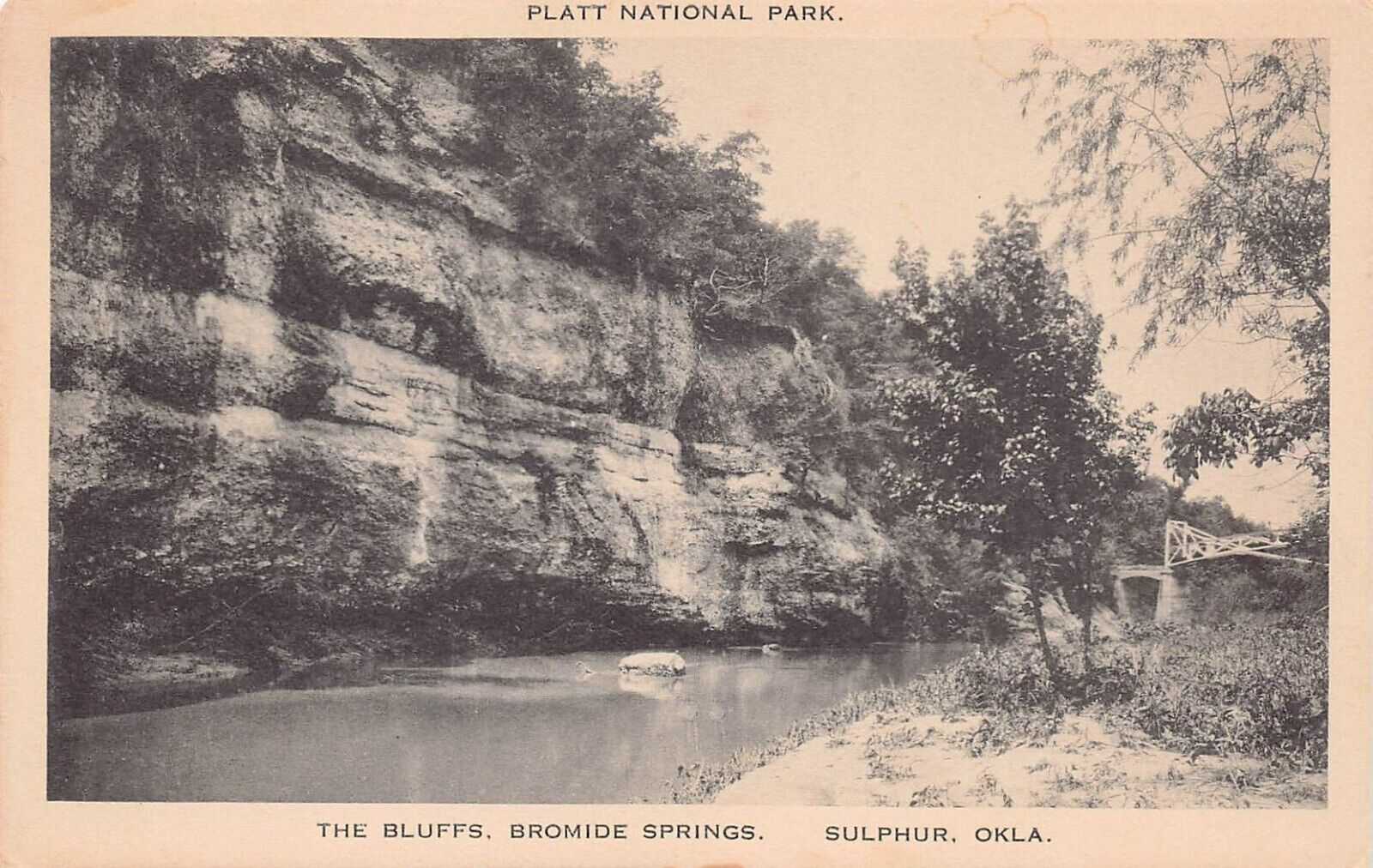
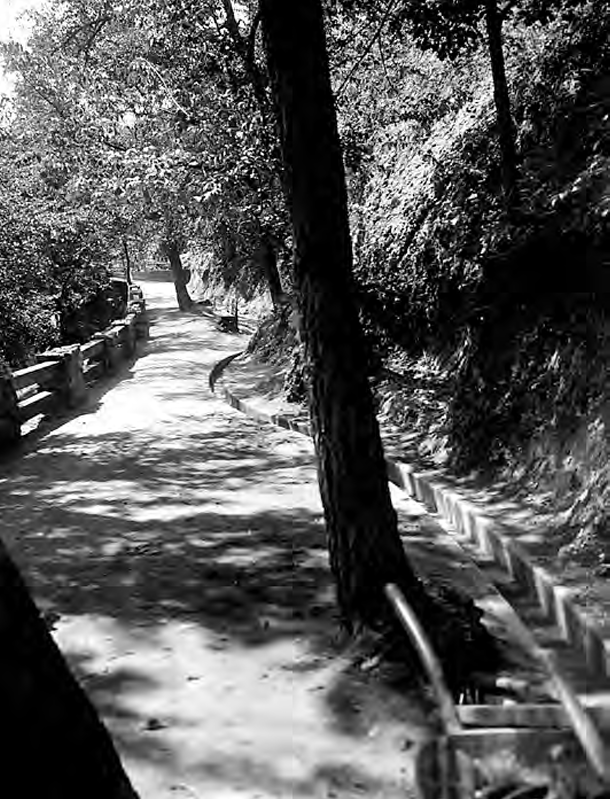
New Bromide Hill trail in 1932

The postcard shows Bromide Hill sometime after 1916, as it includes an iron bridge that was built over the creek after the 1916 flood. It would be dismantled in 1943 and yielded 25 tons of scrap metal for the war effort.

In 1931, a 200-foot retaining wall was constructed at the base of the hill to prevent erosion from Rock Creek and to provide a hiking trail.

Civilian Conservation Corps Camp 808 was authorized for the park in April 1933. 169 young men were set up in tents by the end of May, with another 25 “local experienced men” who were stonemasons, carpenters, plumbers, and tradesmen to teach and supervise the crews.

The park service’s landscape architects judged the park’s trail system to be “antiquated and totally inadequate” and specified trails be constructed 4.5 feet wide with “careful attention to drainage and appearance and gradient”.

The trail up the hillside was completely rebuilt, replacing “flimsy flights of concrete steps” with a long, stone-walled ramp. An 80-foot retaining wall was installed under Robber’s Roost, and the CCC built an extension to the top of the hill in 1935.

In 1937, the Rock Creek Causeway was built below the west end of Bromide Hill. To this day it provides access to the Robber’s Roost parking area up top as well as to the Rock Creek Campground.

By 1941, visitors were less interested in the mineral waters issuing from the hillside spring. In 1943 the park superintendent reported that the trails suffered from erosion, with the trail to the top of Bromide Hill being the most-used and in bad shape. Drainage repairs were made, and the Bromide Trail along the base was rebuilt in 1952.

Bromide Hill in 2002

The flow of Bromide Springs dried up after 1966, with the last trickle from Bromide Springs for two months in 1973. Stone swales with drainage culverts are located along the cliff side of the trail; some of those were constructed in 1990.

After posing at Robber’s Roost, we took the trail down the north side of Bromide Hill. The stone retaining walls always impress me, along with the rock gutters on the cliff side of the trail.

Bromide Hill Trail
Bromide Hill Trail with stone retaining walls and gutters

I clearly recall being intimidated hiking up the long ramping switchback as a child. Thus I led us down the hillside, not up it, to then join the Bromide Trail alongside Rock Creek.

After a 15-minute walk down to the creek, we ventured out onto a pedestrian causeway near the Bromide Pavilion.

Rock Creek
View southeast along Rock Creek

We could see the Rock Creek causeway for vehicles to the northwest.

Rock Creek Causeway
The 1937 Rock Creek Causeway is beyond the fallen tree

I shot some video of the water flowing in the creek.

Then we walked down to the automobile causeway, where I took a shot of Rock Creek flowing onward to the northwest.

Rock Creek west of the causeway
Rock Creek viewed from the automobile causeway

The steep western end of Bromide Hill was to our left as we turned south.

West end of Bromide Hill
The western end of Bromide Hill

The familiar sign for the turnoff to the Rock Creek Campground was there.

Y
The turnoff to Rock Creek Campground

We stayed on the road to the left to gradually wind our way around and up the back side of Bromide Hill. There is no walkway along the road, but it was easy to shift onto the grass shoulder whenever a car approached. That made for a gentle return to the minivan up top.

My tracker informed us that the entire one-mile walk took us 45 minutes, with stops. It was just beginning to mist as we returned to the minivan, reminding us of how rainy it was a decade earlier when I first brought Wendy to the park.

Homeward

Our visit to Sulphur was just a brief getaway. Instead of returning home through Ada, Seminole, and Prague to join the Turner Turnpike at Stroud, we took busy Interstate 35 from Davis north to Norman.

I-35 is quite overloaded south of Norman. Texas is preparing to spend $2.5 billion to widen I-35 to six lanes, with it expanding to eight from Denton to the Oklahoma border within the next 15 years. But Oklahoma only has $492 million in its eight-year plan for widening and improving 35 miles of I-35, whereas there are $3 billion in needs along that 126-mile corridor. In the future, I will consider taking old slow highway 77 to avoid the hectic I-35.

I bought Wendy some shoes at the Brown’s Shoe Fit in Norman, and we had lunch at the old El Chico in Sooner Mall. I ate there regularly throughout college from 1984-1988, when it was Sooner Fashion Mall. The mall was quite busy, which was interesting to see given how our local mall has been moribund for years and over my lifetime I’ve seen the closures of Shepherd Mall and Crossroads in the OKC metro and the Southroads, Eastland, Kensington, and Promenade malls in Tulsa.

We then struggled along I-35 through the metro and then shot along the Turner Turnpike to Tulsa. I’m glad that the Turner will eventually be entirely widened to six lanes to reduce truck jams, but that will take years to accomplish.

We enjoyed our brief excursion to Sulphur, but we will likely hunker down for the rest of the break. Wendy has picked out a 1935 Frank Capra film, a Bette Davis comedy from 1942, and a 1949 Joseph Mankiewicz movie for us to watch. I’ve retaliated with a 1941 Howard Hawks film, an Ealing comedy from 1955, and a Billy Wilder movie from 1961. A couple of them aren’t available to stream on Amazon Prime, YouTube Premium, or iTunes, so I ordered those on optical disc. I am skeptical that we’ll get to them all before we return to work, but we should have fun trying.
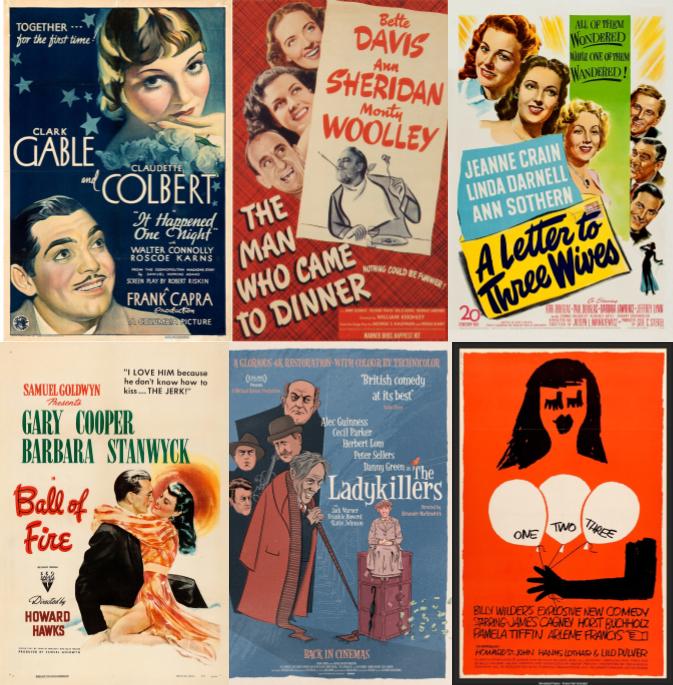
Photo Album

Posted in day hike, history, photos, travel | Leave a comment

2023 Reads & Watches

At the end of 2022, I composed a Book Report on what I read that year, which expanded into an overview of my reading habits. A year later, I’ve decided to broaden the scope of the retrospective to include other media.

Books

I read about 32 books in 2023, the fewest since 2018, but still about double my rate of a decade ago when I was often away on day hikes. The continued slide since the pandemic lockdown high in 2020 is no surprise, given my steady diet of YouTube videos, including many long-form ones.

I continue to enjoy books in both written and audio form. It appears that about half of my fellow Americans don’t read books at all, and WordsRated found that the average number of books read per year increases with age. Their finding was that the average number of books read by Gen-Xers like me was six, and place me among the 17% from that generation who read 11 or more books in a year.

Anecdotally, one of my acquaintances had read 75 books by mid-November this year, while one of my former students read 150 new books this year and re-read about 20 more. So while I read more than the norm, I know folks who easily outpace me.

My favorite book in 2023 was The Man Who Died Twice, the sequel to Richard Osman’s The Thursday Murder Club. I listened to the first book in July, fascinated by the characters populating it and its take on modern life across the pond. Most of the characters live in a luxury retirement village in southeast England and the initial contrivance is that four of the retirees gather to investigate crime cases. The pensioners include a female nurse, a male psychiatrist, a male union activist, and a retired female spy. A young policewoman and older male detective get drawn into their activities, along with a brutally competent Polish immigrant and various side characters.

The initial book, which Osman wrote in 2020, was so delectable that I deliberately delayed devouring the next in the series. I often save what will likely be a great read/listen for later while I explore other works. That way, when my reading becomes frustrating or I suffer from ennui, I can readily return to something by a proven author.

Thus I parcel out the comedic works of P.G. Wodehouse, the mysteries of Edith Mary Pargeter (aka Ellis Peters), and now the Thursday Murder Club books of Richard Osman. I read or listened to eight books, including science fiction, romances, historical novels, another mystery, and two nonfiction works, before taking up the second in the Thursday Murder Club series in October. It was great fun to reconnect with his memorable characters, and I repeatedly paused the audiobook to cackle with glee and ponder where the tale might be going.

Another favorite in a different genre was Attachments, an office romance by Rainbow Rowell. That one was so good that upon finishing it I immediately purchased Landline for my Kindle, saving it for later. I see that is a Christmas love story, so I might wait for some hot and humid summer weather and use it as an escape.

I also greatly enjoyed Ted Chiang’s thought-provoking tales in Exhalation: Stories. As for classics, I took on A Room with a View by E.M. Forster, The Haunting of Hill House by Shirley Jackson, and Reverend Frederick Amadeus Malleson’s translation of Jules Verne’s Voyage au centre de la Terre.

I enjoyed Peter Manseau’s unusual Songs for the Butcher’s Daughter: A Novel sufficiently to later read his The Maiden of All Our Desires: A Novel, which was even better. Manseau is a novelist, historian, and museum curator, being the founding director of the Smithsonian National Museum of American History’s Center for the Understanding of Religion in American History.

I greatly enjoyed listening to two more splendid nonfiction works by Simon Winchester: Land: How the Hunger for Ownership Shaped the Modern World and Knowing What We Know: The Transmission of Knowledge from Ancient Wisdom to Modern Magic. I can never get enough of listening to my favorite living polymath.

I’m currently listening to Ann Napolitano’s Dear Edward and reading Peyton Place by Grace Metalious on my Kindle. The former is much more modern than many of the books I read, and I like not knowing what will happen next with its deeply traumatized title character.

As for Peyton Place, it was notorious in the 1950s as a tale of secrets, sex, and hypocrisy in a small New England town. The opening draws you right in: “Indian summer is like a woman. Ripe, hotly passionate, but fickle, she comes and goes as she pleases so that one is never sure whether she will come at all, nor for how long she will stay. ” I am only 1/4 of the way through it, but I am enjoying its portraits of women struggling with their sexual and social identities that conflict with their town’s social and moral principles. Grace herself led a short and troubled life, and it certainly appears that she heeded the advice to write what you know.

I continue to track my reading at LibraryThing and at GoodReads.

Videos

My main distraction from reading is watching videos on YouTube. I have subscribed to 164 channels, and in 2023, I supported 10 via Patreon. I decided to link my favorite channels for you and to include a representative video or playlist from each in case you want to explore some of them.

Videos on Video

Cars

Books and More

Home Projects

Travel

Old & New Tech

Art

Music

Other Favorites

Other favorite channels this year have been Defunctland for its amazing long-form looks at things Disney, Phil Edwards, formerly of Vox, for his eclectic interests, science with Steve Mould and Veritasium, geology with Myron Cook, and anything that interests Peter Dibble.

And those were just the most interesting 1/4 of my subscribed channels. So while I don’t watch television, I most certainly do watch…a lot! When I was young, our family only had a black-and-white tube television with four broadcast channels, so I feel truly blessed to have so much high-quality focused content readily available on my iPad, and more books than I can handle via Kindle, Audible, and yes, wood fibers.

Posted in books, video | Leave a comment

KC 2023

October 13-14, 2023 | Photo Album

Meador Selfie Profile Pic

My Fall Break 2023 started out rough. The latest COVID vaccine was available, and I had never received the Shingrix vaccine for shingles. So around noon on Wednesday, the day before the break, I got a dose of one in my left arm and the other in my right. In the past I have often felt fatigued the day after a COVID vaccine, and I had been warned that the shingles vaccine often has strong side effects. So Wendy and I had delayed an escape to Kansas City until Friday to give me time to recover. That was a wise decision.

I had the usual sore arms and fatigue, but the shingles vaccine left me with a headache and muscle aches that persisted until 6 p.m. on Thursday. Thankfully I felt much improved by bedtime and was ready to go on Friday. I will need a second dose of Shingrix in a few months, and I will definitely schedule that up against another break.

The Doll Cradle

The Doll Cradle’s ambulance

We reached the outskirts of Kansas City before noon. Wendy has been re-rooting the hair of vintage and newer Barbie dolls for some time, and she wanted to shop for Barbies at a place one of her YouTube contacts had told her to check out: The Doll Cradle in Shawnee, a Kansas City suburb. They have been repairing dolls for over 50 years and even have a fun Doll Ambulance.

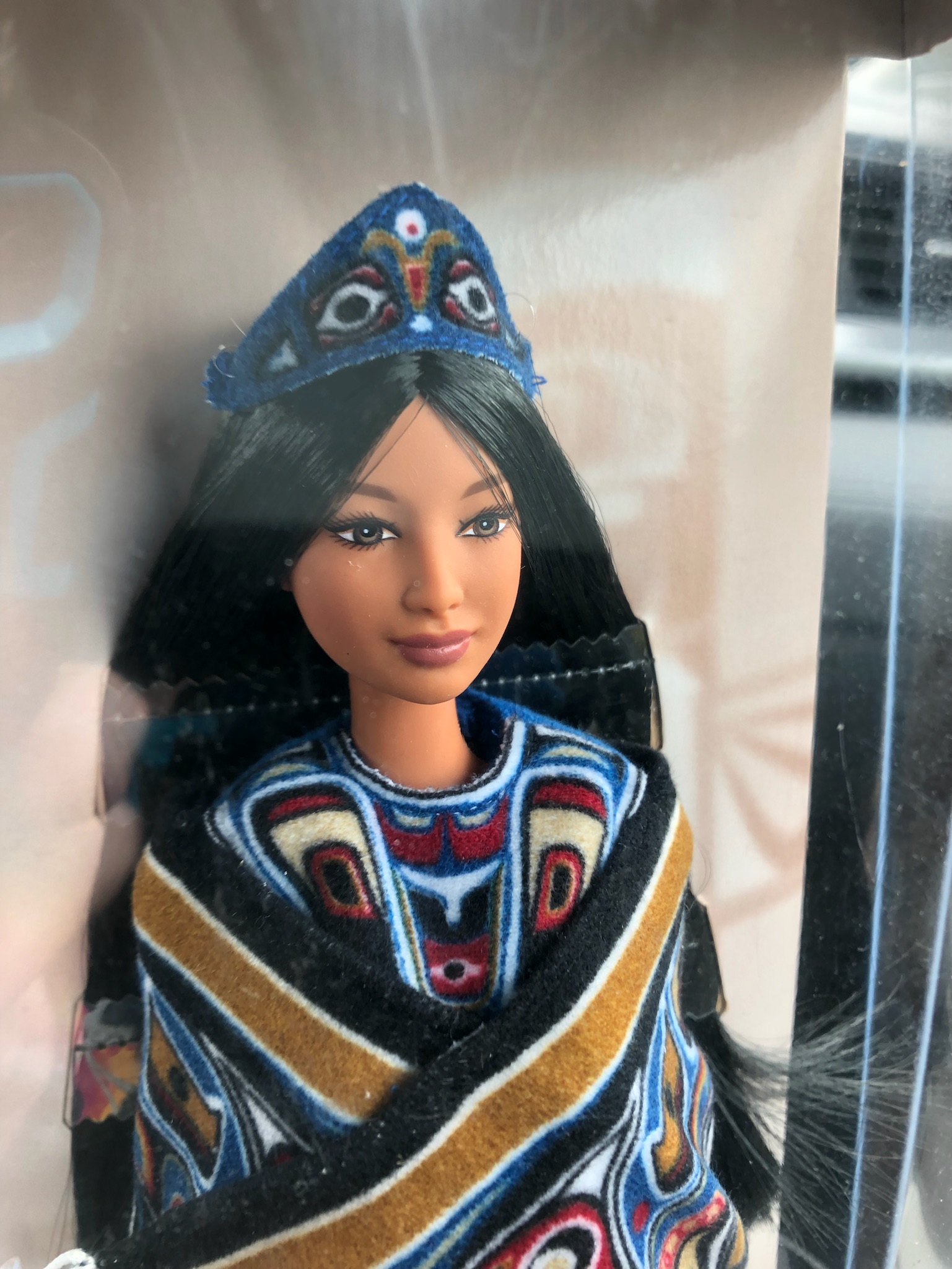
She was rewarded with good deals on two dolls she had been wanting for some time: a Princess of the Incas Barbie and Northwest Coast Native American Barbie.

And here is that doll after Wendy re-rooted her hair, joined by one of Wendy’s paintings:

The doll with new hair

While Wendy hunted for Barbies, I hung out in the front of The Doll Cradle, surrounded by baby dolls. I was doing better than a little one in a bunny suit, although I was a bit unnerved by how one doll winked at me while another explored the uncanny valley.

Winking Doll at The Doll Cradle

Kemper Museum of Contemporary Art

We then drove to the Country Club Plaza for lunch at The Cheesecake Factory, followed by stops at our two favorite art museums: the Kemper Museum of Contemporary Art and the Nelson-Atkins.

Wendy liked two abstract pieces at the Kemper: Coral Wedge and Midnight Shore by Helen Frankenthaler.

Coral Wedge by Helen Frankenthaler
Midnight Shore by Helen Frankenthaler

We both admired Spandita Malik’s Jāḷī: Meshes of Resistance exhibition of photographic portraits of women in northern India who are survivors of domestic and gender-based violence. With the support of nonprofit organizations, they have learned to embroider in styles particular to their regions, offering them a means of greater financial independence, creativity, and self-expression. Each subject was invited to embroider her own portrait.

Parween Devi III by Spandita Malik
Parween Devi III

Parween Devi III is a photographic transfer print on khaddar fabric, with phulkari silk thread embroidery. Saffron and scarlet stitches surround a mirror, drawing your gaze to Parween, who sits on a stool, facing her reflection. Large bolts on her door and windows hint at her domestic circumstance.

Jyoti by Spandita Malik
Jyoti

Jyoti has embroidered her image in rich red silk, tying it to her image in a mirror with gold threads, and she covered the floor in an embroidered design.

Rukmesh Kumari IV by Spandita Malik
Rukmesh Kumari

Rukmesh Kumari‘s flowers spread across a back room of her home, climbing up the walls with her embroidery reflecting the colors of the flowered spread she sits upon. She added a lovely gradient of hues to her border design.

Radha Rani IV by Spandita Malik
Radha Rani

Radha Rani IV shows Radha’s bedroom, with a red stuffed teddy bear as a companion beneath a water-stained ceiling.

Noshad Bee by Spandita Malik
Noshad Bee

Noshad Bee has applied zardozi embroidery on khadi fabric. She painstakingly outlined the flowers on the fabrics, created flowers extending up the walls, and added a golden border. But what you immediately notice are the beautiful flowers she extended from her top across her face to form a veil.

Noshad Bee detail
Noshad Bee’s embroidered veil

We truly enjoyed Malik’s first museum solo exhibition.

Nelson-Atkins Museum of Art

Large Stack by Donald Judd

Our next stop was the Nelson-Atkins. They have long had an installation of Donald Judd’s Large Stack Plexiglass panels from 1968, which came in 32 versions. He refused to be labeled a Minimalist, but his effort to remove all meaning from his sculptures is certainly related to that movement. Lighting is important to the work, as the patterns of the shadows on the wall strike me as integral to it.

Forty years ago, there was something of that sort installed on a wall in the lobby of Dale Hall at the University of Oklahoma, where I would wait to be seated in an introductory psychology class in a huge lecture hall. I’m not surprised to find that facility opened in 1967. It screamed late 1960s to me as early as the mid 1980s.

We wound our way into the Rozzelle Court Restaurant at the museum, but found that we were still too full from the Cheesecake Factory meal to contemplate any dessert.

Wandering through the modern art exhibits, Wendy liked Interior with a Book by Richard Diebenkorn and Masks by Emil Nolde.

Interior with a Book by Richard Diebenkorn

I liked Gaberndorf II by Lyonel Feininger.

Gaberndorf II by Lyonel Feininger

Lodging at Country Club Plaza

Over the years, we have stayed in various hotels near Country Club Plaza. I used to stay at the Best Western Seville Plaza, and later we stayed several times at the Courtyard by Marriott. But the lack of breakfast at those venues led us to try The Raphael Hotel in 2021, where we could get a room service breakfast. This time we stayed at the Hilton, which had a breakfast buffet.

Our room had a view to the southeast across part of the Plaza. In the background was the 20-story Sulgrave Regency Condominiums, built in 1967. North of it along Ward Parkway are a series of impressive century-old apartment buildings which provided the residential density needed to sustain the Country Club Plaza shops.

01f81b6bb699e45855bcb1519e48f26f9d11fe4997

We enjoyed seafood at McCormick and Schmick’s, which was just a short walk from the Hilton.

Scarritt Point and Corinthian Hall

Our final KC adventure for this brief stay was driving eight miles north and east to the Kansas City Museum. It is housed in Corinthian Hall, built in 1910 as the private residence of lumber baron R.A. Long atop the cliffs above the Missouri River.

Corinthian Hall, KC Museum
Corinthian Hall

We parked along Walrond Avenue at Scarritt Point, which was once the home of Nathan Scarritt, a Methodist minister who relocated there in 1862 from Westport to escape Civil War skirmishes, which had marred life in that town which is today a historic neighborhood just north of Country Club Plaza.

Scarritt Point Viewpoint at Kessler Park
Scarritt Point

Scarritt and his wife had nine children and gave them property for homes, some of which still exist in one of the oldest neighborhoods of Kansas City. Some of the downtown skyscrapers peek over the trees at Scarritt Point.

Wendy was impressed by the copper gutters and valleys on one of the nearby homes. Corinthian Hall was donated to the city in 1939 and once focused on natural history with hundreds of stuffed animals. It later gained a planetarium and 1910-style soda fountain. Union Station is now the home of the city’s science museum, and the Long mansion focuses on city history.

Corinthian Hall Entrance
Entrance to Corinthian Hall

There are old photographs showing the mansion when it was still a residence, and modern ones showing what remains of its architectural features. While the displays we saw in the mansion would interest locals, Wendy and I lacked the background to appreciate them.

Nevertheless, we enjoyed our brief escape to Kansas City. We have to agree with Will Parker: Everything’s up-to-date in Kansas City.

Photo Album

Posted in art, history, photos, travel | 1 Comment

Old News

December 2023

When I was a kid, my parents read The Daily Oklahoman newspaper each morning and the Oklahoma City Times in the evenings, both being published for decades by the Gaylord family. The daily editions were over 50 pages and the Sunday could easily exceed 200 if you included the various inserts. The evening paper had a circulation of 123,867 in 1964 and the morning one peaked at over 300,000 statewide. But all that is old news.

The evening paper folded as I was graduating from high school 40 years ago, with a circulation of 82,335. The Gaylords’ politics were anathema to me, but they sold off the paper in 2011, and it was acquired by GateHouse Media in 2018, which acquired Gannett and took its name in 2019.

The morning paper survives under Gannett, but its circulation is only 25,000 daily and 33,000 on Sunday, so about one-tenth of what it once was. When I was a kid, the papers were printed as broadsheets, about 60 inches wide, but that was narrowed to 44 inches in 2008. These days, the paper is a couple dozen pages on weekdays, discounting non-local extra pages tacked onto the electronic edition, while the Sunday edition is 60 or less.

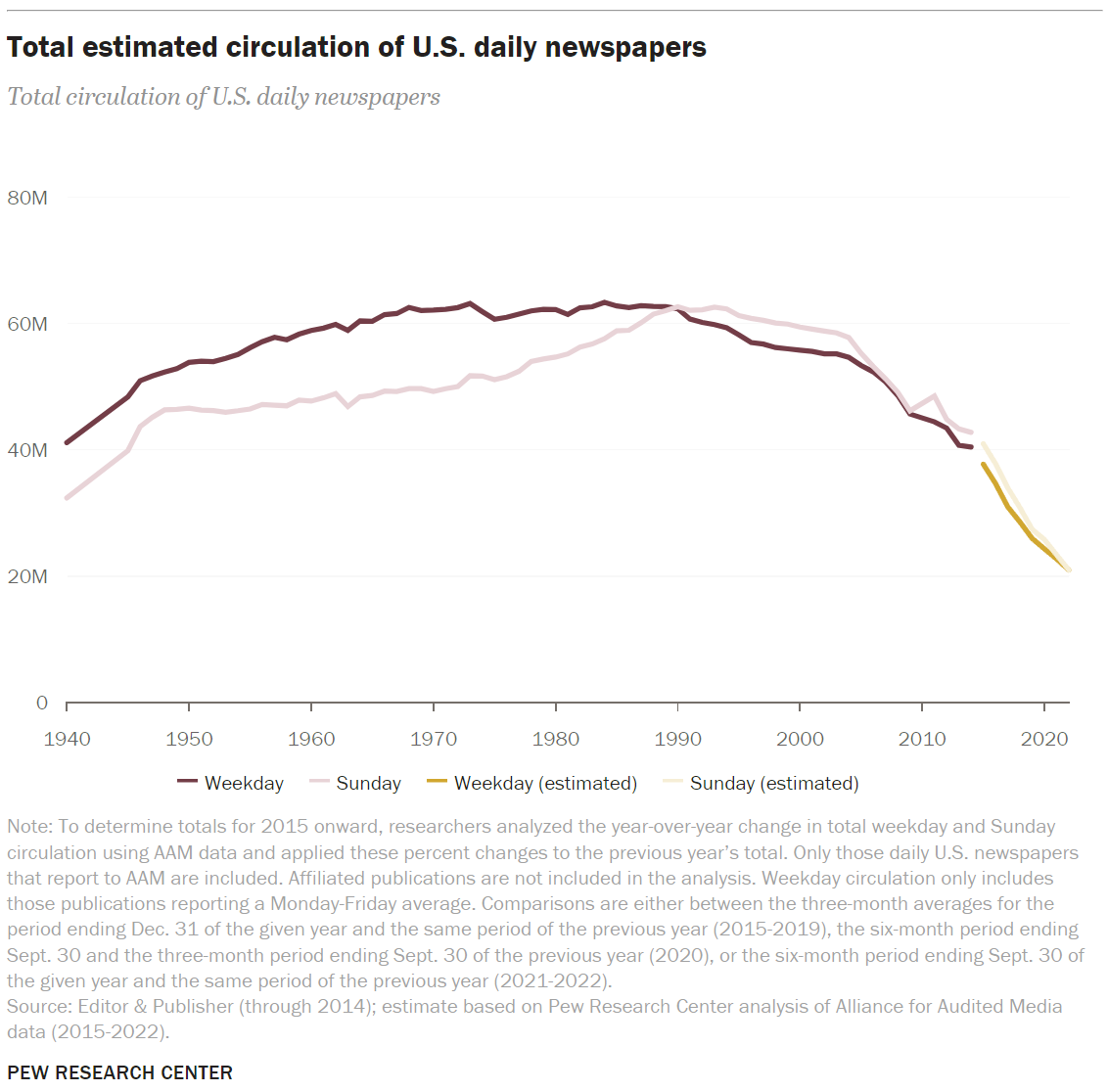
That decline is reflected in daily newspapers nationwide. Their circulation, counting both digital subscriptions and print circulation, has fallen by 2/3 since 1990.

The newspapers I subscribe to on my iPad

As an adult, I followed in my parents’ footsteps, reading a daily newspaper. I currently subscribe to five of them in digital form: the Tulsa World, The Oklahoman, The Washington Post, The New York Times, and the Bartlesville Examiner-Enterprise. I read the first two on my iPad after waking each morning, and occasionally consult the others online.

Originally I just subscribed to the Bartlesville Examiner-Enterprise. But, like most local newspapers, it was hollowed out over time. I am still a digital subscriber, but the “E-E” is down to one local reporter/photographer, and it doesn’t even have a physical office anymore. Nevertheless, it and the Bartlesville Radio news page are my go-to sources for local news.

I subscribed to the print edition of the Tulsa World newspaper for several years, switching to a digital subscription in 2011. It was once a paper of a far higher quality than The Oklahoman. It was owned by the Lorton family from 1911 to 2013, entering a joint operating agreement with the rival Tulsa Tribune in 1941 and acquiring its assets in 1992. At the start of the 21st century, it had a circulation of 160,000 daily and 220,000 on Sundays, and in 2005 it had over 700 employees.

However, the Tulsa World has, like The Oklahoman, declined sharply. By 2012, after a series of layoffs, it had a daily circulation of 95,000 and 133,000 on Sundays. It became part of the BH Media Group in 2013, which was acquired by Lee Enterprises in 2020. I noticed a sad decline in the quality of its copy editing after BH Media took over, and by 2022 the daily circulation was down to 35,000 with 38,000 on Sundays.

Early in the 21st century, newspapers’ advertising revenues collapsed, halving in a few years and continuing to fall so that they are now at the levels of the 1970s, when a dollar would buy almost 7 times what it will today thanks to inflation. They now rely more upon circulation revenue than advertising revenue to stay in business.

Newspapers have gone online, of course, as their printed editions became obsolete. But the average minutes per visit for the nation’s top 50 newspapers was only 2.5 minutes in 2014 and is now down to about 1.5 minutes. I am an outlier, spending 20-40 minutes each day reading my online newspapers.

On top of that, I also subscribe to Apple News+, which shares articles from 44 newspapers and almost 400 magazines, and I frequently peruse its newsfeed. But I don’t know how much longer my local newspaper will even exist, and the decline of the two leading state newspapers is dimming the lights that help disinfect and protect our institutions from the lies, authoritarianism, and corruption of our state’s frequently dreadful politicians.

Realizing that my news-gathering habits are atypical, I looked up how people prefer to get their news these days. Courtesy of Pew Research:

Preferred News PlatformTOTALAges 18-29Ages 30-49Ages 50-64Ages 65+
Television27%8%17%36%50%
News websites or apps25%22%29%27%18%
Search15%22%17%12%7%
Social media12%30%15%5%3%
Radio6%3%8%8%5%
Podcasts6%9%8%4%2%
Print publications5%4%3%4%10%

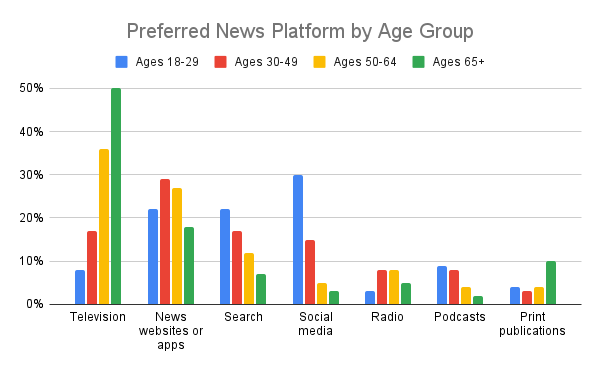
It is helpful to chart the preferred platforms, breaking them down into age groups:

While television is the most dominant preferred platform overall, when you look at age groups, that is only for those 50 and older. I am again an outlier, as I almost never watch television news. I have long viewed it as shallow, violence-focused, and plagued with bias and inaccuracies. The very low interest in television news among those under 30 shows its creeping obsolescence, and local TV news viewing declined from over 4 million in 2016 to about 3 million in 2022, out of a US adult population of 258 million. Its collapse is manifested in how Tulsa’s ABC affiliate has consolidated its news production in Oklahoma City, with only remote reporters in Tulsa.

News websites or apps are the next most preferred platform overall, and presumably will soon surpass television. But still, only 1/4 of adults are like me, preferring to get their news via online news websites or apps.

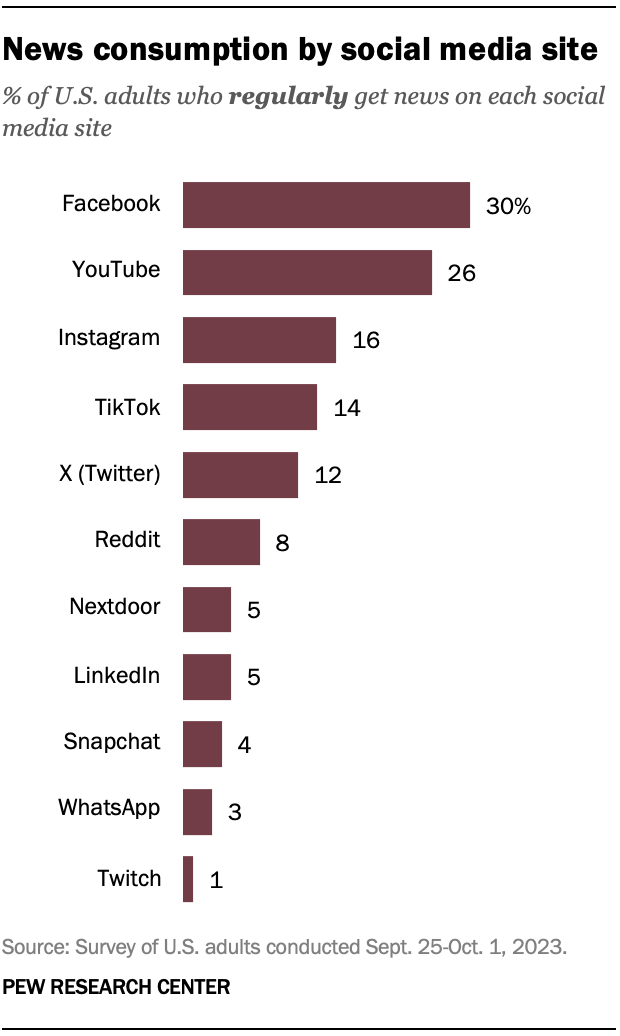
I don’t find it surprising that the most preferred news platform for those under 30 is social media. Other data shows that 19% of U.S. adults often get news from social media, and 31% sometimes get it that way. At right are the percentages of U.S. adults who regularly get news on each social media site. As for trends, the ones showing growth instead of decline in the past few years are TikTok, Instagram, Twitch, and Nextdoor, which are all of low quality.

Reddit, TikTok, and Instagram’s news consumers are mostly those under 30. Facebook’s, X’s (Twitter’s), and YouTube’s news consumers are mostly 30-49, and Nextdoor’s news consumers are generally over 29.

Looking beyond social media, print publications are the least preferred platform for those under 65, hence printed newspapers and news magazines are doomed.

Radio is actually preferred over print by those 30-64, but radio is far more limited in how in-depth it can go across a range of stories. National Public Radio still does some good journalism, and our local radio station offers news in an abbreviated format, but neither tackle some of the issues the newspapers do.

The consequences of the changes in how news is gathered, published, and distributed are stark. Many of my fellow citizens display delusional hypocrisy and have been embracing and electing corrupt authoritarian demagogues. The ongoing erosion of standards and democracy in our great republic is connected to the decline in quality journalism. Over a century ago, the great Walter Lippmann explained what we can now readily observe:

Men who have lost their grip upon the relevant facts of their environment are the inevitable victims of agitation and propaganda. The quack, the charlatan, the jingo, and the terrorist, can flourish only where the audience is deprived of independent access to information. But where all news comes at second-hand, where all the testimony is uncertain, men cease to respond to truths, and respond simply to opinions. The environment in which they act is not the realities themselves, but the pseudo-environment of reports, rumors, and guesses. The whole reference of thought comes to be what somebody asserts, not what actually is.

When I was in junior high, my best friend was a paperboy. When his family went on vacations, I would take over his route. A bundle of papers would be dropped off on a street corner, where I would fold them and put rubber bands on them. Then I would load them into a big bag on my shoulders and awkwardly pedal my bicycle across the neighborhood, doing my best to deliver the paper to the correct addresses in convenient locations.

I wasn’t fast, but I was conscientious.

Those days are now only a distant memory…in more ways than one.

Posted in history, nostalgia, random | Leave a comment

Remembering His Master’s Voice

December 2023

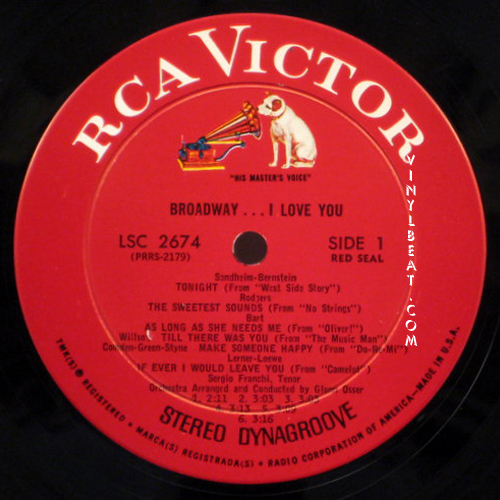
His master’s voice is one of the most memorable corporate phrases and logos. You know, the image of a little dog listening to an old-time gramophone. I grew up associating it with RCA Victor records, with a vague awareness that before that it appeared on the Victor Talking Machine Company’s Victrola records. But it wasn’t until I saw a video about JVC, which invented the VHS videotape, that I learned that the phrase and logo were also used by that corporation (JVC stands for Japan Victor Company) as well as the British HMV (yes, originating from His Master’s Voice). I also learned that the logo originated in England in 1899, where it began as a somewhat different painting.

Francis James Barraud was an English painter. When his older brother, Mark, died in 1887, his dog Nipper was sent to live with Francis. It happened that Francis had purchased an Edison Commercial Phonograph. He noticed how Nipper would sit close to the horn speaker, with his head turned and his ears pricked, listening to the mysterious sounds. The image stuck with him, but there is a false history about the dog sitting on his brother’s coffin, listening to a recording of his master’s voice. The real story follows.

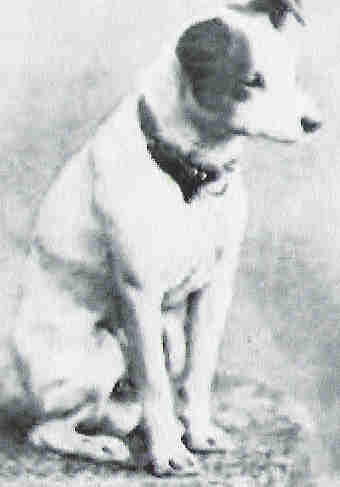
The photograph of Nipper that Francis Barraud used when creating his painting

Nipper died in 1895, so in 1898, when Francis had the idea of painting the dog listening to the phonograph, he had to use a photograph of the dog for his model. He painted an image of the dog listening to his cylinder phonograph on a table. Barraud proceeded to register for a copyright on the painting, but he had no success in having it exhibited at the Royal Academy. When he showed it to various publishers, the only offer was to purchase it for five pounds (equivalent to $670 in 2023).

Barraud took the painting to the Edison-Bell offices in London, where manager James Hough rejected it, saying, “Dogs don’t listen to phonographs.” No doubt Hough later rued the day he passed on what would become one of the most recognized trademarks of the 20th century.

We only know what the painting originally looked like because Barraud had it photographed for his copyright. In 1972, factory worker and gramophone enthusiast Frank Andrews learned that the original painting had been “registered” and realized that a photograph of it might be on file among the “Works of Art” copyright applications in the Public Records Office in London. He found it in a box that hadn’t been opened in over 70 years.

A photograph of the original painting Dog looking at and listening to a Phonograph

After the rejection from Edison-Bell, a friend of Barraud’s then suggested that he brighten up the picture, using a brass horn rather than the dark one he had painted. Barraud went to The Gramophone Company, which was just over a year old and had disc phonographs with brass horns. He asked them to lend him one to paint from.

Luckily, the American William Barry Owen was the manager, acting as the agent for Emile Berliner, the German inventor of the gramophone record. Owen asked if the painting was for sale, and if so whether Barraud would be willing to paint over the Edison cylindrical phonograph with one of their disc gramophones. Barraud agreed, altered the painting, and sold The Gramophone Company the painting for 50 pounds and the transfer of its copyright for another 50 pounds. So he netted the 2023 equivalent of about $13,400.

The altered painting, with a disc gramophone replacing the Edison phonograph

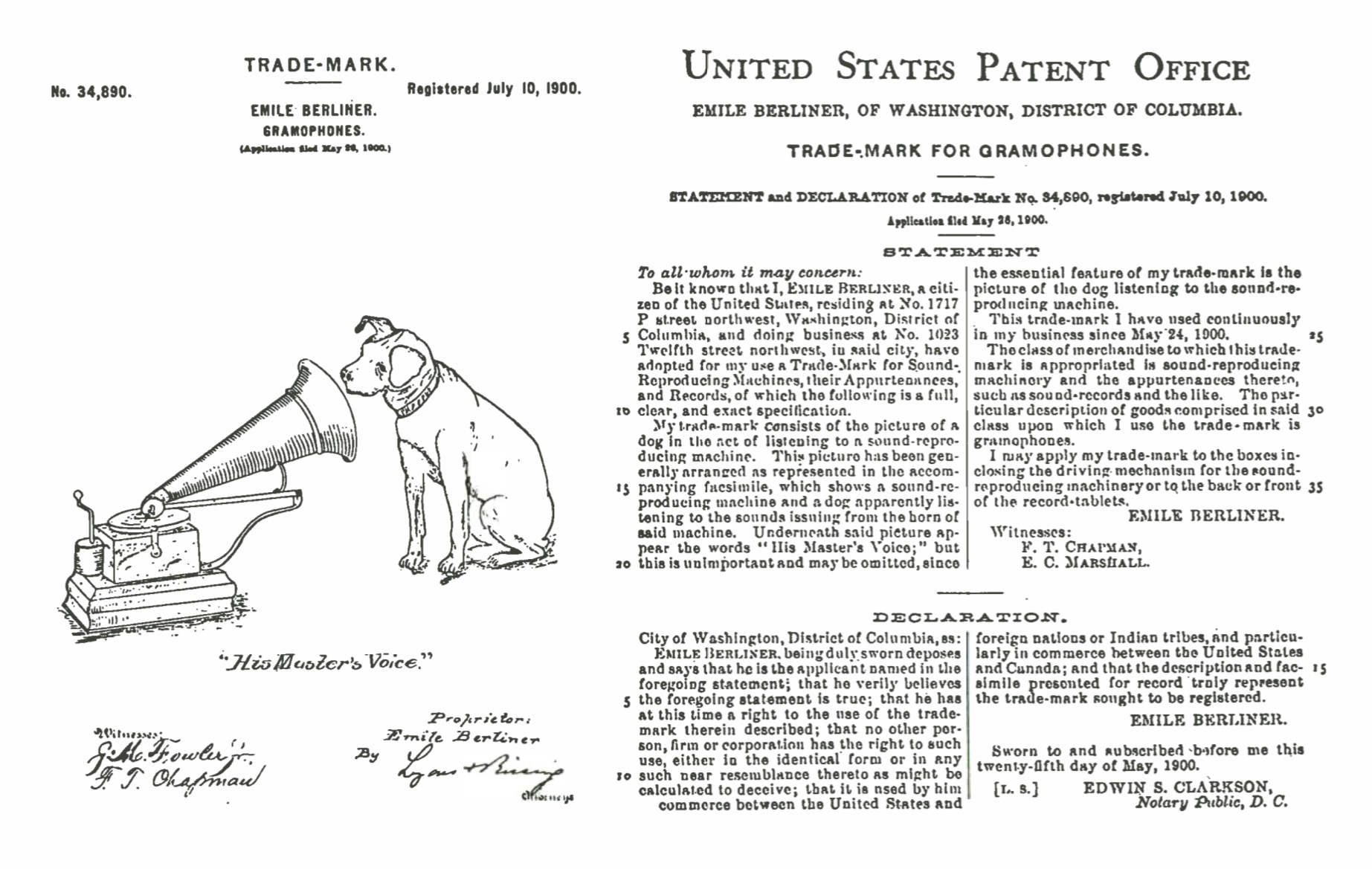
The logo and the phrase “His master’s voice” appeared in advertising literature and sometimes on company stationery. Emile Berliner visited the British office in May 1900, saw the painting, and soon registered it as a trademark over in America. Eldridge Johnson soon took over Berliner’s rights to the trademark for his new Victor Talking Machine Company and began heavily promoting it.

The US trademark from 1900

The British company began using the logo and phrase more in 1909, introducing it on its record labels, and, because it lost the trademark on “Gramophone”, replacing “Gramophone Monarch Record” and “Gramophone Concert Record” on the labels with the caption “His Master’s Voice”.

By 1913, the painter Francis Barraud was in some financial difficulty. The company asked him to make an exact copy of the painting, which he agreed to do for 35 pounds. It was sent to the Victor Company in the USA. In 1914, three directors of the Victor Company commissioned more copies from Barraud, each for 35 pounds.

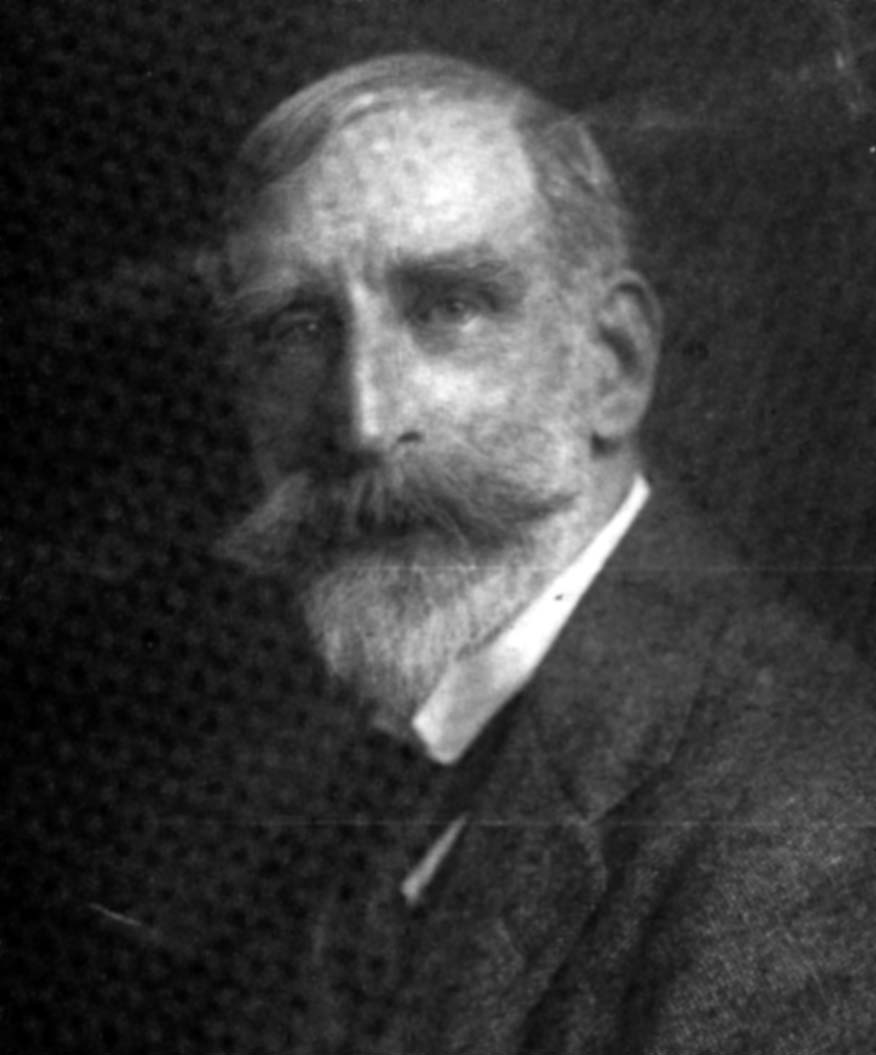
Alfred Clark held Barraud in high esteem

Alfred Clark, who was a cameraman and director at Edison’s first film studio and later joined The Gramophone Company and became the managing director, befriended Barraud. He later recalled, “He was a man of great personal charm, and was beloved by many devoted friends…during the war, in spite of his years, he volunteered to serve his country, and was appointed to a regular position in the recruiting department of the Army. The prolonged hours of attendance and thoroughly hard work undoubtedly affected his health seriously.”

In 1919, The Gramophone Company and the Victor Talking Machine Company agreed jointly to pay Barraud an annuity of 250 pounds per year. In 1921, The Gramophone Company established the HMV company to sell disc records and later radios and televisions, naturally using the logo to accompany the trademarked phrase.

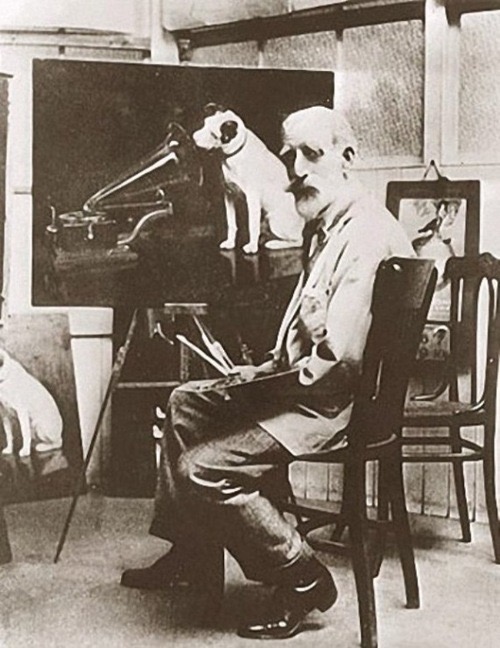
Barraud ended up painting 24 replicas of his original painting in total, including 12 more commissioned from him in 1922 by the Victor Company at 35 pounds each. He even made one free copy that was so exact that he painted in the old phonograph and then painted it over with the gramophone, ensuring the finished work would more closely match the original. That oh-so-exact copy eventually made its way to the Capitol Records tower in Hollywood, while the original hangs at the Gloucester Place headquarters of EMI, which was formed from The Gramophone Company, HMV, and the Columbia Gramophone Company in 1931.

Barraud in 1922, working on his commission for 12 copies of his painting

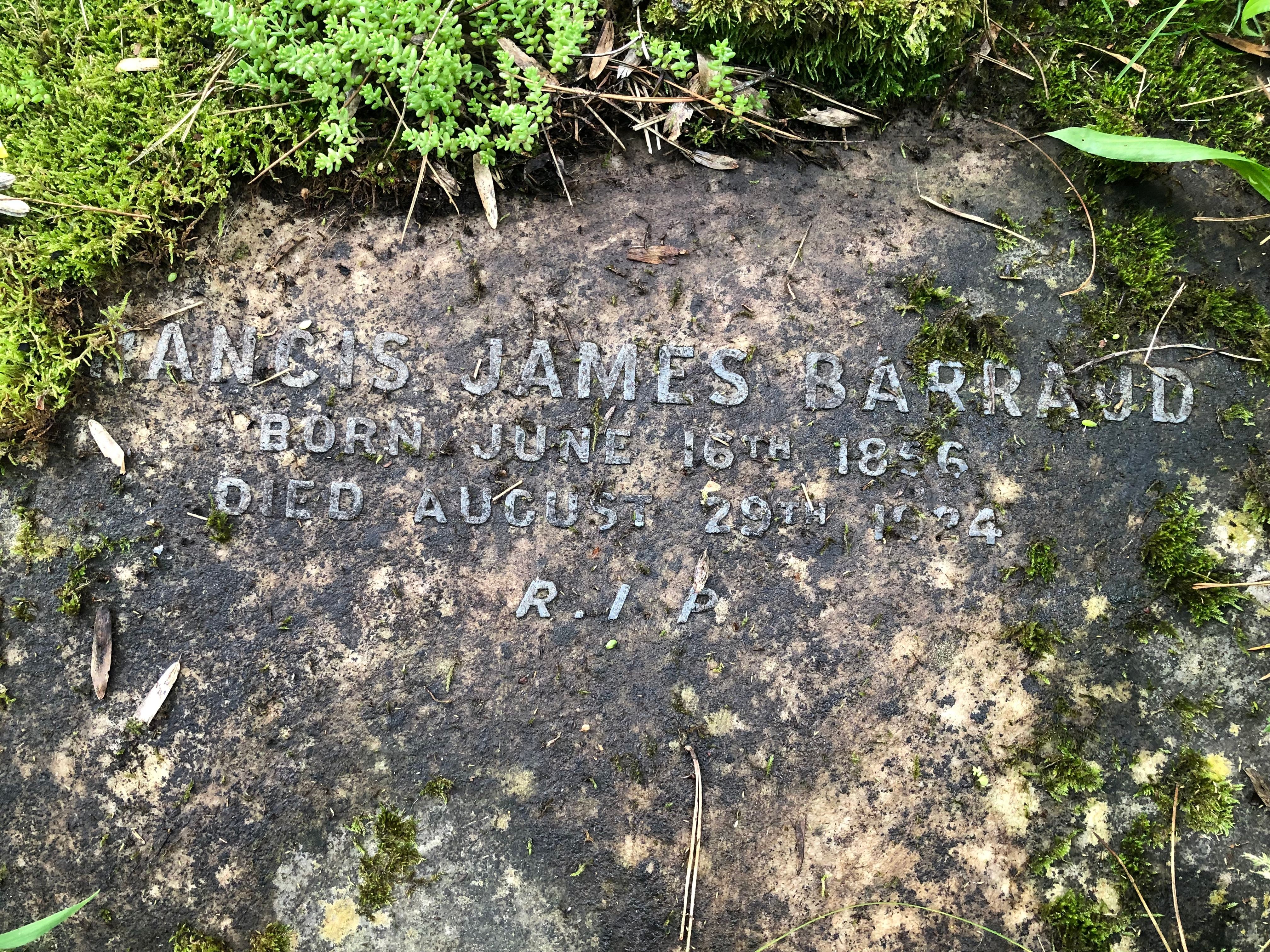
Francis Barraud died in late August 1924, a few months after the two gramophone companies had increased his annuity to 350 pounds. Alfred Clark shared, “His gentle, kindly ways endeared him to all of us. He made his voyage through his life, modestly and simply, leaving behind to his sorrowing friends a feeling of great loss.”

The high regard Barraud had earned is reflected in that, after his death, the companies learned he had been sending 100 pounds of his annuity each year to his sister, who was living at an old age home in Staffordshire. The British and American record companies immediately continued that payment each year until her death in 1929.

In 1927, the Victor Talking Machine Company incorporated a Japanese branch that would become JVC. RCA (Radio Corporation of America) gained control of the phrase and logo in 1929 when it purchased Victor and its foreign subsidiaries. Thus little Nipper and his gramophone continued to grace the products of multiple corporations for decades to come.

Today, if you go to Kingston upon Thames in England, you’ll find Nipper Alley, with a familiar logo on its sign. That’s because down that alley is a parking lot behind a branch of Lloyds Bank. Way back in 1895, that lot was the garden of a house, and when little Nipper died, he was buried there under a mulberry tree.

And what about the man who immortalized Nipper? Francis Barraud’s remains rest eleven miles away, in a neglected overgrown grave in Hampstead Cemetery in greater London.

However, the best remembrance of him are the countless reproductions of his greatest work. As he put it, “It was certainly the happiest thought I ever had.”

Posted in history, nostalgia, random, technology | 1 Comment