There are two roads from Santa Fe to Taos. Each begins in Española, a 30-minute drive north of Santa Fe. The high road is more scenic, winding through the Sangre De Cristo mountains for 105 miles. Wendy and I took it in 2019.
So this time we took the low road, which winds for 70 miles, much of that along the Rio Grande. We stopped at the Rio Grande Gorge Visitor Center, where they had a print of a view from the west rim by Geraint Smith. It was priced at $450, and I’ll allow you to compare it to my own iPhone 14 Pro snapshot of the view from the road.
The Rio Grande is the fourth longest river in the USA. The Missouri is 2,341 miles, the Mississippi is just barely shorter at 2,340 miles, the Yukon is 1,979 miles, and the Rio Grande stretches 1,759 miles from southwestern Colorado to El Paso, Texas where it then forms the southern border of both the state and the country to the Gulf of Mexico.
We enjoyed tamales and tacos at Mante’s Chow Cart SouthSide in Taos, and then headed east on US 64 across the Sangre de Cristo mountains, the southernmost sub-range of the Rocky Mountains. They are generally much lower in New Mexico than in Colorado. The portion in Colorado has ten peaks above 14,000 feet, but there are several peaks over 13,000 feet near Taos and Santa Fe.
The two-lane highway is edged by giant, sandy-colored rocky cliffs with distant green peaks. It follows the Rio Fernando de Taos stream through the mountains for 20 miles to the Moreno Valley. The Angel Fire ski resort is at the south end of the valley, and we drove into town to use a restroom at a grocery store there.
Then we drove north to Eagle Nest and turned east to cross another section of the Sangre de Cristos to Cimarron. That took us across the midsection of the immense Philmont Scout Ranch.
The boundaries of Philmont; we crossed on US 64 across its midsection
Philmont covers over 140,000 acres of wilderness and was donated to the scouts by oil baron Waite Phillips. Waite was based out of Tulsa, and donated his 72-room mansion there to become the Philbrook Museum of Art. When he donated Philmont to the scouts, he not only included its water, mineral, and timber rights, but also endowed it by donating the Philtower building in downtown Tulsa. He was the brother of Frank and L.E. Phillips who founded Phillips Petroleum in Bartlesville.
From Cimarron we drove northeast to intersect Interstate 25, which took us north through Raton, a few miles south of the border with Colorado, and on to Trinidad. Once we could see Fishers Peak, I knew we were close.
Fishers Peak near Trinidad, Colorado
Trinidad
My first visit to Trinidad was in 2012, and I liked it enough to take Wendy there last year. We were pleasantly surprised at the accommodations of the Family Suite at its La Quinta and booked it again for this visit.
We turned off Interstate 25 to follow the route of the old Santa Fe Trail into town. Wendy wanted a sandwich, and TripAdvisor led us to the Sub Shop at the Whistle Stop convenience store. Our sandwiches were top-notch, as was the service.
We had breakfast the next morning at the La Quinta and then drove downtown to return to the A.R. Mitchell museum we had enjoyed last year. We again parked a couple of blocks away in the public lot east of the Most Holy Trinity Catholic Church and the imposing old abandoned brick Schneider Brewery. It was built in 1866 and was one of four breweries in Colorado to survive prohibition by making non-alcoholic beer or malted milk or by bottling soda water.
Old brewery building in Trinidad
The brewery fell into disrepair in the late 1950s and has been mostly vacant for decades. New owners plan to demolish parts of the structure that have become structurally unsound while renovating much of it. We shall see in the coming years if they can make a go of it.
We strolled through the Sister Blandina Wellness Gardens and then along Main Street, popping in at a thrift store so Wendy could see if they had any Barbie dolls. She has been re-rooting the hair on old dolls as a hobby. They didn’t have any dolls, but I loved the melting pot of old phonograph albums they had on display.
Fun old albums at a Trinidad thrift store
The A.R. Mitchell Museum of Western Art was again a treat, with us admiring Robert Martinez’s Blue on Black Coyote.
Blue on Black Coyote by Robert Martinez
Upstairs was a fun exhibit about the Fox West Theatre with old projector equipment and many old movie posters.
Old movie poster from the Fox West Theatre
A juvenile science fiction book that also mixed crystals with Atlantis
I first thought about a book I enjoyed as a youngster: Lester Del Rey’s Attack from Atlantis of 1953. Its premise included crystals from undersea volcanoes that created forcefilm bubbles that excluded liquids and solids with unlimited force. The poster reminded me that Pal’s film also featured crystals, albeit ones that absorbed sunlight and could fire heat rays.
Before I fixated on the poor physics of both works, my mind dredged up that the special effects and miniatures in the film were by Project Unlimited, a group that included Wah Chang. He was the non-union artist who built several creature costumes used in the original Star Trek series, designed the communicator and Vulcan harp props for it, and built the original Romulan spaceship model.
The prop from Demon with a Glass Hand
Then my mental railcar jumped tracks to how Project Unlimited had also built masks, creatures, and special effects for the earlier series The Outer Limits. I wondered if Wah Chang built the eponymous hand for my favorite episode, Demon with a Glass Hand.
To escape the mental ricochets, I strode past the wall of posters to look at a large old sign near the front windows, which thankfully diverted me from science fiction to westerns.
It was an advertisement about Hopalong Cassidy promotional gifts. William Boyd portrayed that fictional cowboy in 66 films from 1935 to 1948 and then in radio and television series until 1952. I’ve never seen a Hopalong Cassidy show nor read any of the stories; my childhood experiences with western series were limited to The Lone Ranger and the genre-blending The Wild Wild West.
But the internet informs me that Boyd’s portrayal of Cassidy was of a clean-cut sarsaparilla-drinking hero who never shot first, while the character in the original novels of Clarence E. Mulford was rude, dangerous, and rough-talking. The name came from his walk, which had a little “hop” in it after he was shot in the leg during a gun fight.
Vintage Hopalong Cassidy promotion
Another exhibit was of framed photographs by Edward S. Curtis. I liked The Rush Gatherer – Arikara, and a photograph of Chief Joseph of the Nez Perce inspired a previous post.
The Rush Gatherer – Arikara by Edward S. Curtis
For lunch, we walked a half-mile up Main Street to Tony’s Diner, where Wendy enjoyed a BLT while I indulged in a French Dip and a chocolate shake.
After lunch, we returned to the minivan. Lowering clouds were an omen of a tornado and hail storm brewing up north, along our path to Manitou Springs.
During my Sunday morning walk, I was listening to Richard Osman’s second Thursday Murder Club book, The Man Who Died Twice. A character remarked:
…it really is very pretty here in the dark. There are a few lamps lighting the paths, and you can hear the animals in the bushes. I could just imagine the foxes thinking, “What’s this old woman up to?” And I was thinking the same.
Whoosh!
My mind was instantly transported from the Pathfinder Parkway in Bartlesville to a destination 137 miles southwest and 38 years in the past: my port in a storm.
The Port
Imhoff Creek drains central Norman, Oklahoma into the sandy expanse of the Canadian River. Four decades ago, there were paved paths along the west side of the creek north of the river. Shaded by trees, sidewalks meandered above the steep bank, alongside timber retaining walls. They were lit by sturdy metal lamps along the sidewalks, sometimes perched in beds above the paths.
It was all part of The Port apartments, which had been built in the early 1980s just northeast of a new golf club, The Trails, built between state highway 9 and the river. The apartments were northeast of the club’s 10th fairway, separated by a large pond. The place had a nautical theme, with heavy ropes, life preservers, etc. The laundry was built on pilings, projecting out above the pond.
The Port in Norman, OK
The complex was built between 1981 and 1983, so it was still quite new when I was hunting for an apartment in 1985, seeking refuge after a stormy freshman year living in a dormitory at OU — the University of Oklahoma.
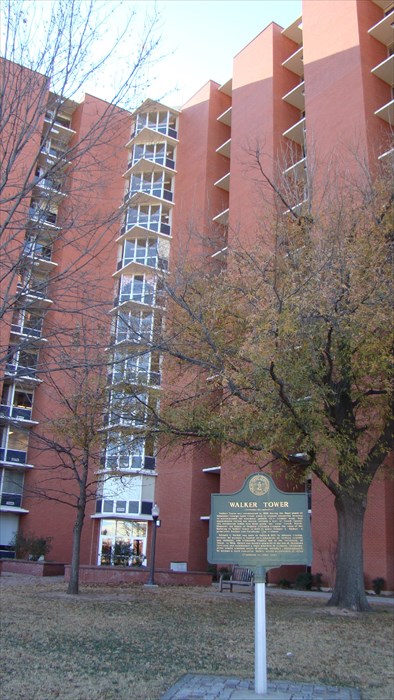
Walker Tower
OU’s three 12-story dormitories
The Walker Tower dormitory opened in 1966 as Couch North and was renamed in 1970 to honor a prominent banker. It housed over 1,400 students in the four wings of its twelve stories. Next door was the Adams Center, built two years earlier and named for K.S. “Boots” Adams of Phillips Petroleum, with four towers connected at ground level. Across the street was the Couch Tower, seemingly identical to Walker, although in 1984 it was rented out by the U.S. Postal Office’s training center.
Walker Tower at the University of Oklahoma
Serving all three gigantic dorms was the circular Couch cafeteria. The food at the cafeteria was poor enough that a few months in we got notices that the cafeteria apologized for itself, had plans to improve, and would be offering us a steak and lobster dinner one evening. I had the steak, which was as you might expect. It was more worthy of catsup than Worcestershire.
Back then, freshmen who didn’t own property in Norman were required to live in the dorms. I had a steady girlfriend for the final two years of high school and first two years of college who escaped living in them because her parents had purchased a condominium in Norman for her and her older brother.
As an introverted only child, I had signed up for a single room with air conditioning and a dorm that didn’t have an entire hallway of residents sharing a communal bathroom. I was assigned to Walker’s 8th floor, the Honors Floor, and I expected to have a single room with a bathroom that I would share with the occupant of the adjoining single room.
I moved in on a sizzling summer day. As I waited for an elevator in what would soon become a familiar wait, I spied orange flyers taped on the walls beside each elevator. They urged me to come to a concert by the Kansas City punk rock group “Orange Donuts” with “Death Puppy” as their local warm-up band. It is interesting what sticks in the mind.
Arriving in my room, I puzzled over the message our Resident Advisor had written on a markerboard in the room: Chill out, guys!
The use of the plural form and the presence of two beds alarmed me. I found the Resident Advisor, who cheerfully told me they had more students than expected, so I had been randomly assigned a roommate and we would be sharing a connecting bathroom with two suitemates: a guy from Nebraska and a fellow from South Dakota.
I returned to my room, fuming. I set up my TRS-80 Color Computer and my microwave oven. Eventually Random Roommate came in with some boxes. He proclaimed, “A microwave? Nice! And a computer? Cool! That will sure come in handy for us.”
At that point, I was anything but chill. So as soon as he left to get more things, I scoured the Honors Floor and located a fellow from my high school who had his own computer. I convinced him to be my new roommate, and we moved his stuff into my room, transferring the boxes my assigned roommate had brought up thus far to my new roommate’s former abode. When Random Roommate reappeared, I informed him of his new room assignment and guided him to it. The Resident Advisor came by later, asking what was going on. I cheerfully told him how to amend the assignments on his clipboard.
Self-confidence can be learned, practiced, and mastered–just like any other skill. Once you master it, everything in your life will change for the better.
Barrie Davenport
I was happy enough in my recruitment of a new roommate, but dorm life was not for me. I was frequently awakened in the middle of the night by slamming steel doors, and we endured multiple middle-of-the-night fire alarm evacuations. The Resident Advisor would come around, opening each room to ensure we evacuated. That meant climbing down the emergency stairwell for eight flights, and then climbing back up it afterward because the elevators would be hopelessly overloaded. The most frustrating was the alarm sounding in the depths of a cold winter night and us freezing outside for a long time only to find out that the alarm was sounded by someone who had seen the steam coming from the vents of the basement laundry and mistaken it for smoke.
So I was excited to go hunting for an apartment in the summer of 1985. My own bathroom, kitchen, and bedroom! I was thrilled when I found The Port, with 128 units on four acres. It had a cute theme, a nice mix of residents, and I was able to secure a 6-month lease for a second-floor one-bedroom unit with a cathedral ceiling, a skylight, and a balcony for $275 per month. That is equivalent to about $782 in 2023.
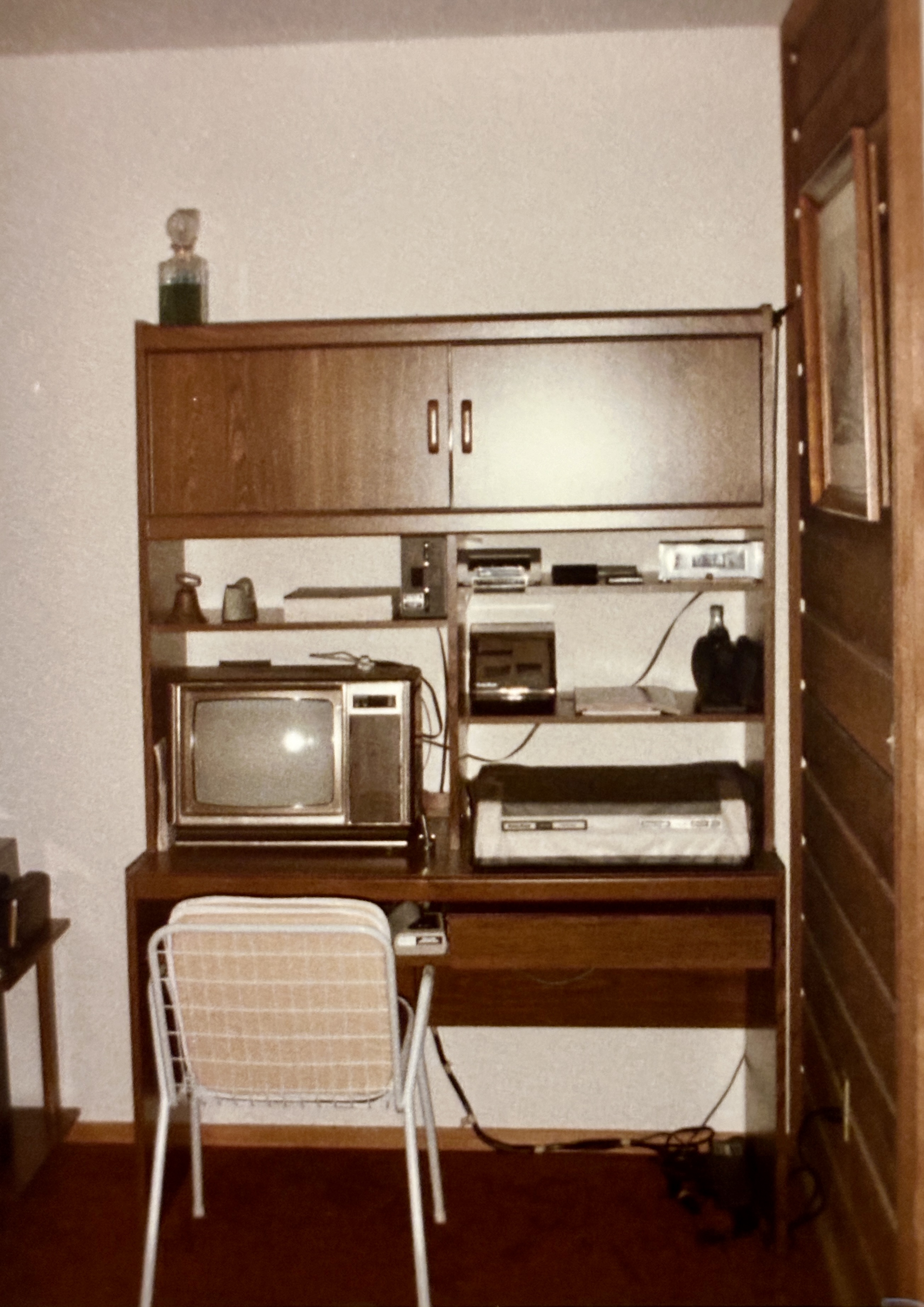
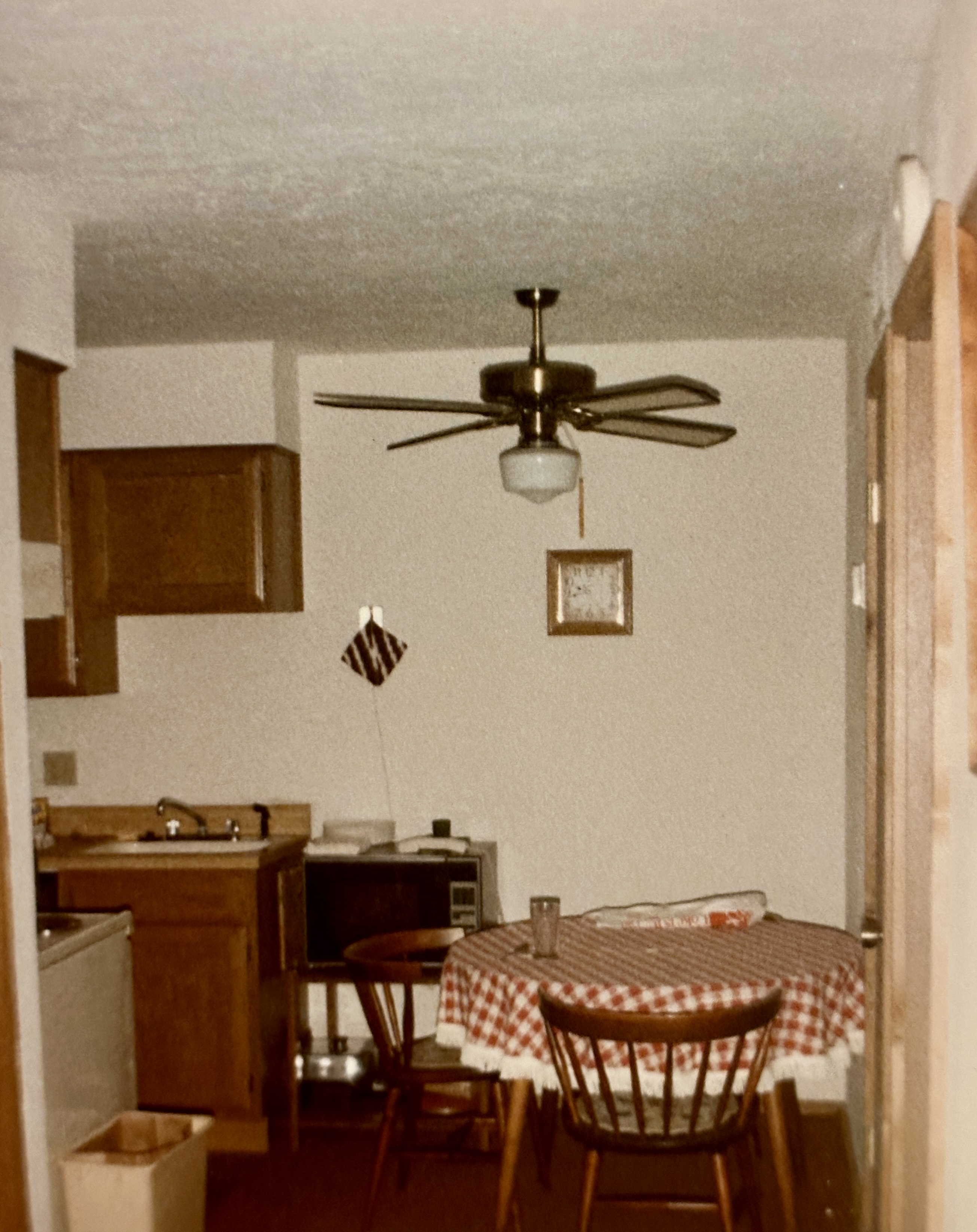
My first apartment was upstairs and to the leftMy computer setup at The PortMy dining room with microwave
I set up my Color Computer again, this time on a pressboard desk and hutch with my 13″ television doubling as its monitor. The setup included a joystick, floppy disk drive, daisy wheel printer, and a modem to connect to the university’s engineering computer as well as CompuServe. I still remember that my CompuServe username was 71460,2557 even though, like Orange Donuts and Death Puppy, CompuServe disbanded long ago.
The living room was also adorned with a dreadfully uncomfortable Papasan chair with a loud 1980s floral print cushion and an old love seat. I squeezed a small mid-century modern wooden table and chairs into the tiny dining area, complete with old Pizza-Hut style checkered tablecloth.
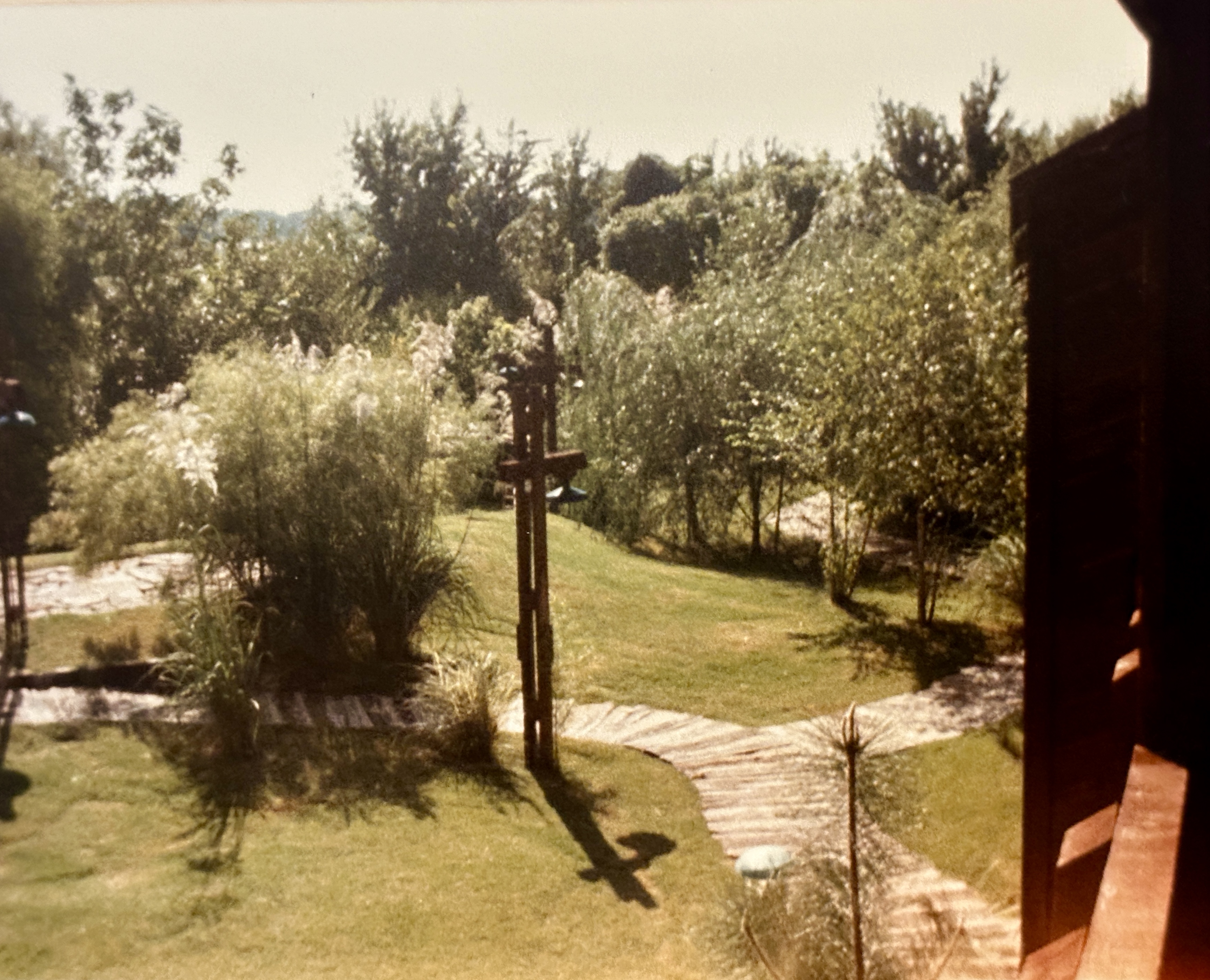
It was nice to escape the small apartment along pathways made out of concrete and railroad ties meandering around plenty of landscaping, with high lights on fancy wooden poles.
The view from my balcony
I was intrigued by the pond and inspired by the nautical surroundings. So I bought an inflatable boat and invited my former roommate to come over and take it out with me on the pond. We plugged its inflator pump into the cigarette lighter of my Toyota Supra, and once it was ready we took the little boat out on the water near the laundry dock.
The pond and laundry at what was The Port in the 1980s but is now The Landing on 9
All went well, with us merrily paddling about the pond, until my roommate saw a snake slithering by in the water. I thought of it as Little Nessie, our water snake, but he thought it looked like a copperhead and insisted that we return to shore. I don’t recall using the boat after that.
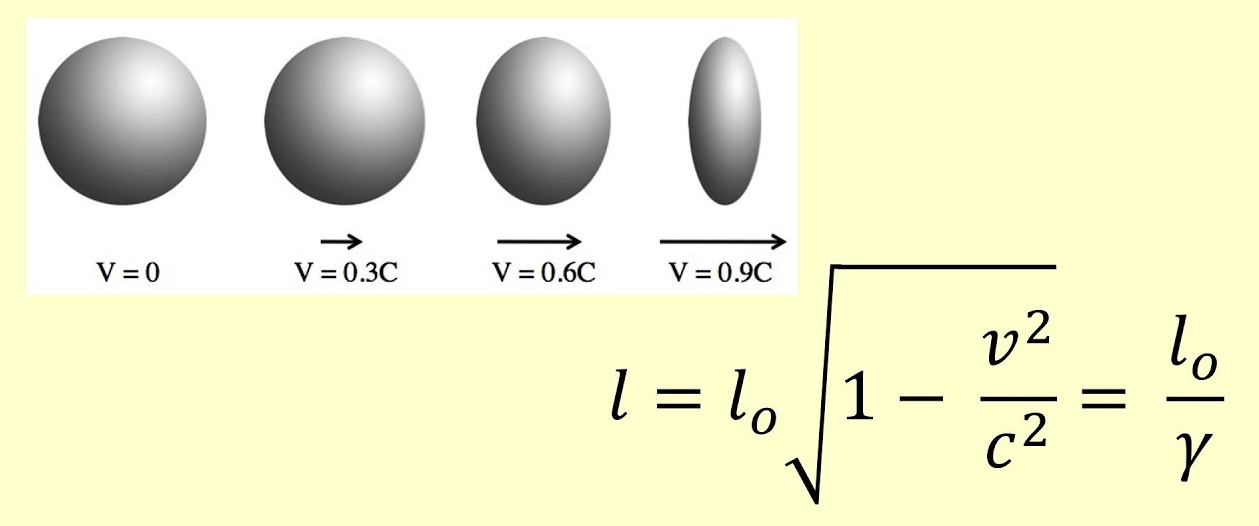
My favorite aspect of The Port was the pathways along its eastern edge in the woods above the creek. I remember once struggling late into the night with a Modern Physics assignment. A problem involved a spacedock with movable doors at each end and a spaceship that was too long to fit inside. I was supposed to do calculations about the ship going fast enough that Lorentz contraction could allow it to temporarily fit inside, and the shift in frames of reference in the problem had me baffled.
An object foreshortens in the direction of motion in a moving frame of reference per the Lorentz contraction
After an hour of struggling through calculations that yielded wrong answers, I got up and went for a walk. I slowly wound my way along the wooden pathways over to the peaceful lighted walkways in the woods. I was already beginning to question my future in Engineering Physics, but then the solution dawned on me. I scurried back along the pathways to my apartment and my calculator.
Early in the next semester, my six-month lease was up. I confidently strode into the office, to be told by the manager that I would be shifting to a $285 month-by-month renewal. I was put out by the $10 per month increase, and retorted that I had been a model tenant and wanted another six-month contract, but reduced by $10 per month to $265. The manager was nonplussed at first, but she then agreed to my demand.
Leaving Port
Life can be fleeting, and I wound up only living at The Port from August 1985 to December 1986. The summer of 1986 was a deflection point for me. Immediately after being named the Outstanding Sophomore in Engineering Physics, I abandoned that major as I was unhappy in most of my sophomore year engineering and physics courses. I switched majors, broke up with my girlfriend of four years, and found a new side job working for the University of Oklahoma Scholars Program.
My second apartment
It was a tumultuous period of reinvention, and I became lonely at the apartment, something I would have not thought possible back in my freshman year in the dorms. So I rented a room at a house owned by a friend from high school and college. Eventually I was ready to be on my own again, and for the rest of my undergraduate years I lived in an apartment across town from The Port. It was cheap and roomy, but its grounds were drab and desolate. I would never again live in a place as charming as The Port.
The Port would soon encounter troubles of its own. It went into foreclosure in 1987 and was sold in 1990 for $1.4 million. It became Port at the Trails and ran down over the decades. In 2006, it was sold for $3.7 million and is now refurbished as the Landing on 9.
Like me, the bones are the same but the finishes are different. The last time I was there was many years ago, and the beautiful old pathways in the woods were long gone. Now I happily walk the Pathfinder Parkway, having successfully weathered a few major course corrections in my journey through space and time. I miss the old walkways at The Port, but as this weekend showed, my mind can revisit them at the turn of a phrase, and as Marcus Aurelius wrote, “Loss is nothing else but change, and change is Nature’s delight.”
In July 2023, I was asked to present about the history of Bartlesville Public Schools at a Thursday Lunch & Learn meeting at the Bartlesville Area History Museum. This spring I began gathering and digitizing thousands of photographs in the district’s Community Relations archives. I had shared hundreds of them in a Facebook group on local history, and that caught the attention of the museum staff.
To study history means submitting yourself to chaos, but nevertheless retaining your faith in order and meaning.
Herman Hesse
My family history with Bartlesville
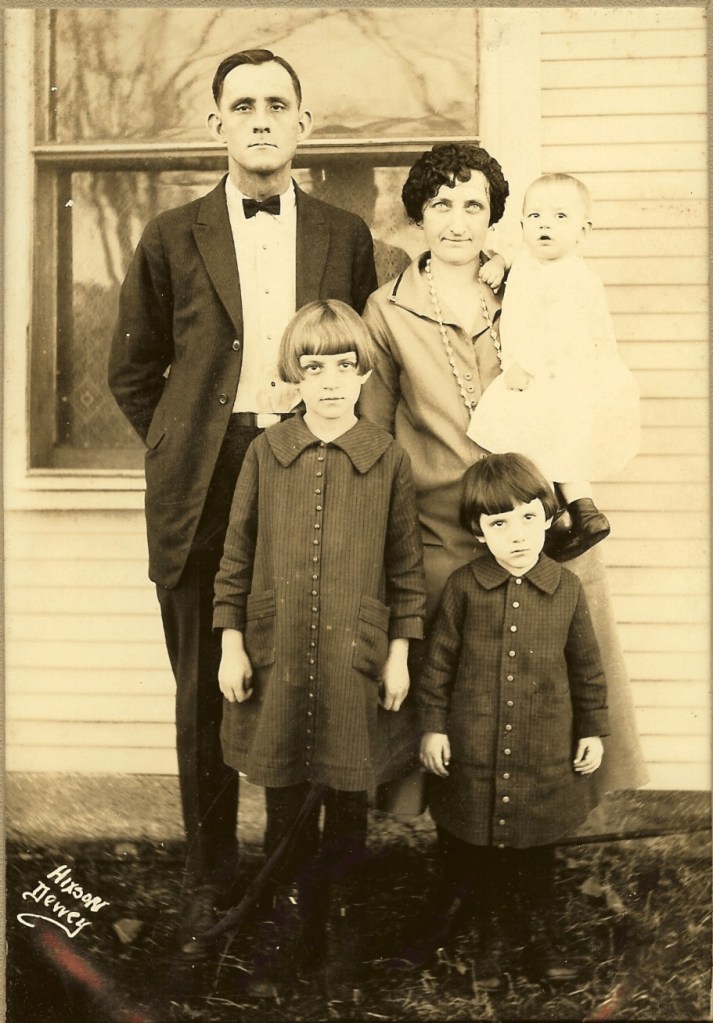
My father as a baby in Dewey, with his parents and two of his sisters
My family connections to Bartlesville go back a century. In 1923, my paternal grandfather and grandmother brought their two daughters to the town of Dewey, Oklahoma, immediately north of Bartlesville. They had left hill farming in southeast Missouri, travelling to Dewey in a horse-drawn covered wagon.
My grandfather hoped to find work at the Dewey Portland Cement Company, where his brother-in-law was a power plant operator. Grandpa Meador got hired on, and my father was born in Dewey in 1925. They moved to a compressor station south of Independence, Kansas in 1936, when my grandfather became a machinist for Cities Service Gas.
So my father had childhood memories of Bartlesville, and it was along the highway route from Oklahoma City, where I grew up, to my grandparents’ home in Independence. We made regular trips to visit our Kansas relatives, and my parents often stopped in Bartlesville to have lunch with Frank and Alice Rice, who had once worked with my father at the Cities Service Gas Company offices in Oklahoma City. The Rices had built a home in the Madison Heights neighborhood in northeast Bartlesville, just south of Sooner High School.
Getting hired to teach in Bartlesville
Fast-forward to 1989, after I had graduated with my bachelor’s degree from the University of Oklahoma (OU) and certified to teach a variety of high school sciences. I had spent the spring substitute teaching at the three high schools in the Putnam City district I had attended for grades one through twelve.
I was looking for a position to teach physics at an Oklahoma high school. Full-time physics positions are a rarity in our state, but I was stubborn and passed up offers to teach other subjects at Moore, Sapulpa, and Ponca City, holding out for physics. Finally, in late July 1989, I got a call to interview in Bartlesville.
As I was growing up, we drove by Sooner High when visiting the Rices in Bartlesville
I was only familiar with a few things in Bartlesville: Highway 75, the Pizza Hut, Sooner High School, and the Madison Heights area. So when Bartlesville High School Principal Ben West asked me if I knew where the high school was, I said, “Sure! It is on Baylor Drive.”
Ben chuckled and explained that in 1982 Sooner High had become a Mid-High serving grades 9 and 10, and he would be interviewing me at Bartlesville High School on the west side of the Caney River.
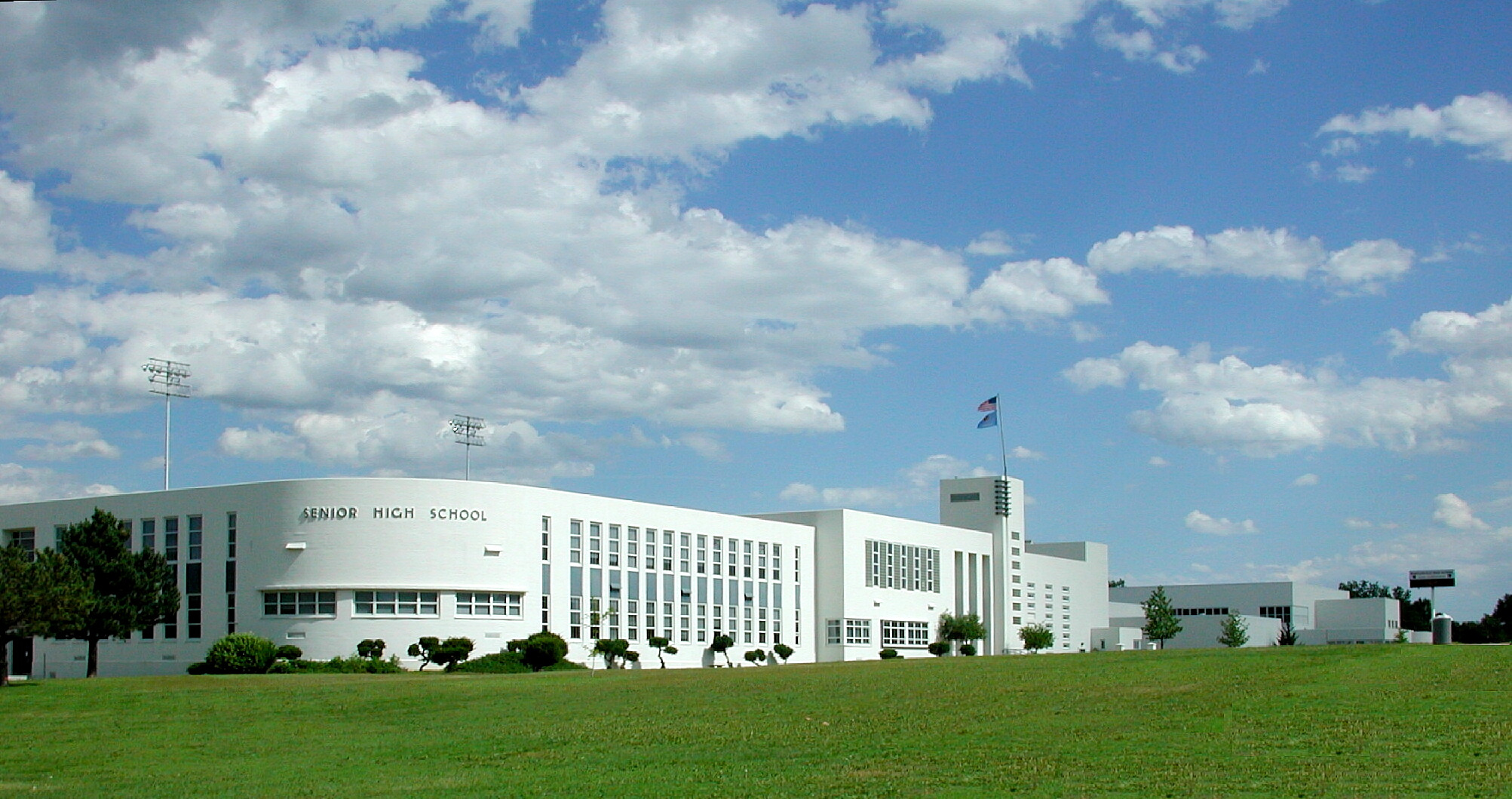
Bartlesville High School, where I taught physics from 1989 to 2017
I drove to Bartlesville, found my way west across the Caney River for the first time, and entered an odd-looking white concrete building that had once been College High. The facility was interesting but quite dated. The science labs and auditorium were pathetic compared to what I had experienced as a student at Putnam City West High School and as a student teacher at Norman High.
However, I had worked for several years for Scholars Programs at OU, advising fellow National Merit Scholars and members of the President’s Leadership Class. So I knew Bartlesville churned out lots of top-notch students with plenty of Advanced Placement credits. Its high socioeconomic status, arising from being the headquarters of Phillips Petroleum, a Fortune 500 company, allowed the small town of 35,000 to punch above its weight in academics as well as cultural opportunities.
So I left the 1,000,000 strong metropolitan area where I had always lived and began looking for an apartment in little Bartlesville.
Family historians
My father was an amateur historian
My father had always enjoyed history. He drew a huge timeline of world history on the backs of a series of natural gas pipeline charts, compiled many notebooks on genealogy, and wrote autobiographies, a biography of my mother, etc.
I enjoyed my high school history classes, and choose my World History teacher to accompany me to Washington, DC when I was named a U.S. Presidential Scholar. In college, I took Honors Seminars on ancient Greece and Rome as well as the mandatory U.S. history course. But I wasn’t a history buff.
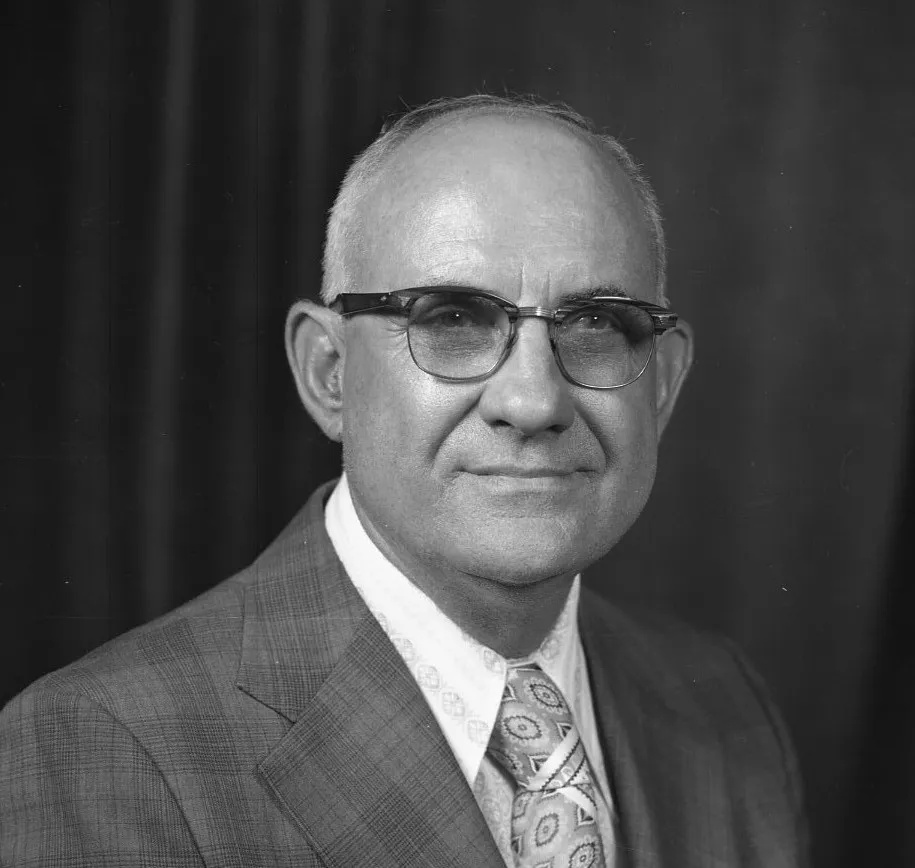
After I moved to Bartlesville, I knew I would eventually see Edgar Weston, my double first cousin once removed. For those needing a translation, Edgar was the son of my paternal grandmother’s brother and the son of my paternal grandfather’s sister.
Edgar was 50 years older than me and an avid historian. He was born in Dewey nine years before my father and helped organize the Washington County Historical Society, raised funds and supervised the restoration of the Dewey Hotel, helped build the Tom Mix Museum, researched and conducted tours of historical sites and landmarks in the county, and wrote a newspaper column about local history. Edgar passed in 2002, but the local paper is now re-running his columns.
Edgar Weston, local historian and my first cousin, once removed
Edgar had been a fixture at the Meador and Weston reunions I had attended in childhood, so in June 1990 when I saw that he was going to host a bus tour of area historical sites as a showcase event for the annual OK Mozart music festival in Bartlesville, I signed up.
Edgar regaled us with stories as we drove around downtown Bartlesville and down south of town to the Tyler-Irwin farm. That kindled my interest in the history of the little town I had made my new home.
Whetting my interest in school history
Teaching at a high school which dated back to 1939, with oddball additions, also roused my curiosity. Why was the building clad in concrete rather than bricks? Why was the annex where I began teaching so oddly built, with its basement numbered as the third floor?
Exploring with Rick
Rick Keen, former BHS custodian
I learned a lot about the old buildings from Rick Keen, the high school head custodian. During my first winter of teaching, I was desperate for more electrical equipment for my physics courses. I asked Rick if he’d seen anything squirreled away somewhere. He grinned and said there was some stuff in an odd place. He could show me, if I was feeling adventurous.
Rick led me outside and down an old stairwell to a room tucked beneath the 1939 field house. He led me under a huge air handler to a hatch in a wall. He opened it and climbed through with his flashlight, located a light switch, and urged me to step carefully through the hatch. I clambered through the narrow opening and found we were standing on the unexcavated soil beneath the 1939 field house.
Back then, scattered on the dirt beyond the ducts, were a bunch of old College High athletic trophies and, relevant to me, some wood cases and boxes of electrical equipment. Rick told me they had come from the old physics lab, which had been turned into a second chemistry lab years before. He thought some of the items dated back to before 1950, when there had been a junior college class in electronics at the school. We hauled the stuff back to my physics lab. That was also when Rick told me about the tunnel connecting to the main building.
Bakelite-encased ammeter
The equipment we scavenged included old gutta percha cables, light bulb circuit boards, and, of particular interest to me, analog ammeters and voltmeters in Bakelite housings. We used those old meters for years in my physics classes, until a generous parent eventually donated funds for me to purchase digital multimeters. I know that some of the old meters eventually found their way to a school in India…one school’s trash is another’s treasure!
That scrounging success led me to eventually explore every nook and cranny of the old buildings. That in turn led me to skim through old yearbooks to figure out how they had evolved. I also started asking Rick for insights about some of the building’s oddities.
One example was how, in the 1939 building, there used to be a metal plunger sticking out of the wall in the student restrooms. You pumped it to get soap, but there was no visible reservoir. So where did the soap come from? There were no custodial closets behind most of those restroom walls.
I asked Rick, and he took me on another adventure. We climbed up inside the tower on the front of the building, where there was still a huge wooden case for what had once been a telescope that they used to wheel out onto the roof back in the junior college days. He led me out onto the roof and over to a barrel way out in the center. It was marked SOAP on the side, and had a line coming out of it down into the roof.
Yes, it was an original centralized soap system. That single barrel fed, via internal conduits, all of the wall spigots in the various 1939 bathrooms. Eventually the entire district started using the now-ubiquitous plastic soap wall dispensers we are all familiar with, and the old spigots were removed, but I remember how they used to do it!
Figuring out the district
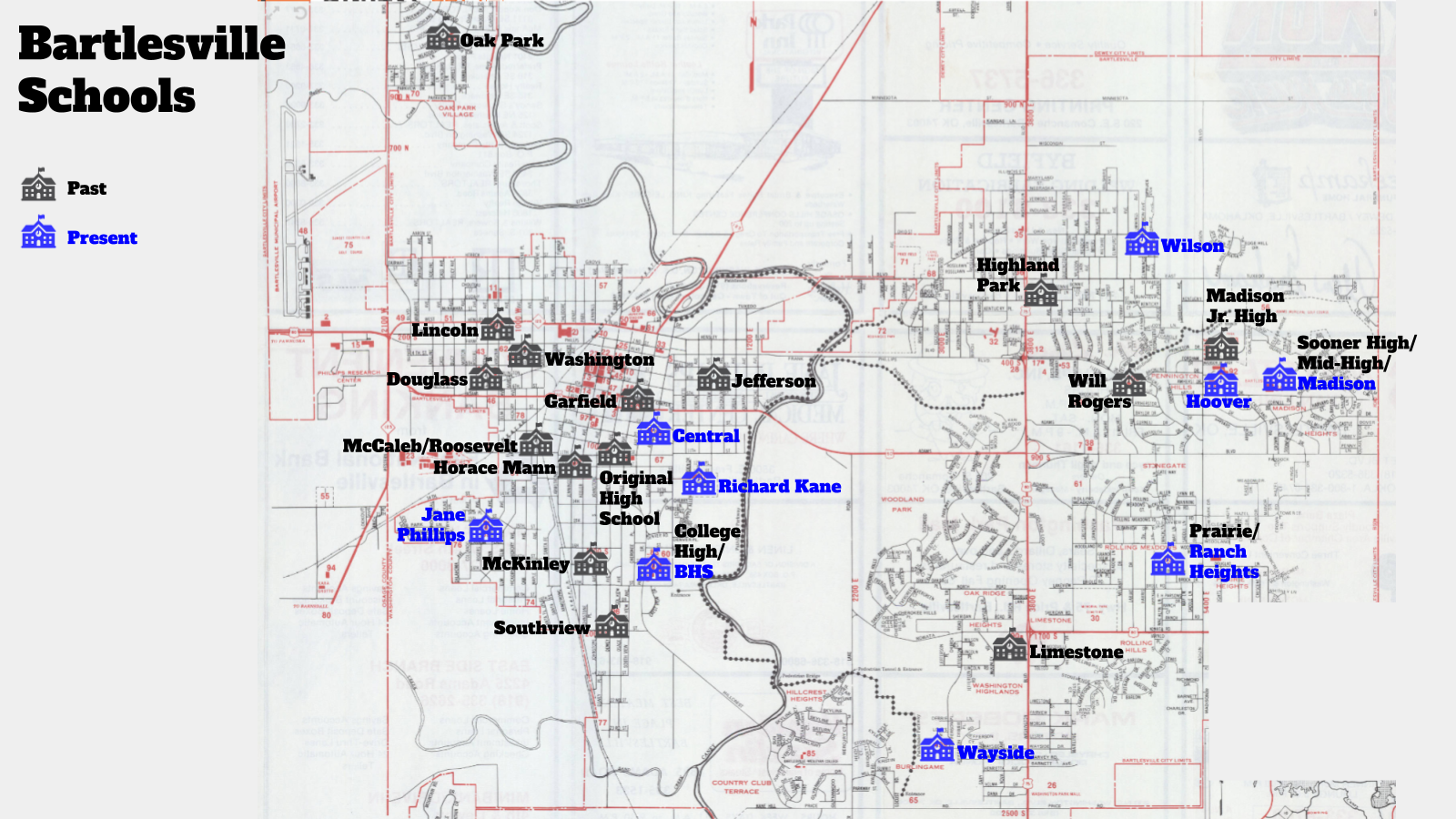
One thing I noticed as I drove around Bartlesville over the years was that it had a LOT of former school buildings. Why were there so many tiny old neighborhood schools? Why had the town built two high schools, only to later consolidate them?
15 of Bartlesville’s public schools were closed over the decades, with 9 currently operating
In the summer of 1997, I decided to get some answers. I went to the public library’s Local and Family History Room. The librarian showed me some publications dating to the 1910s that were from a time before yearbooks. Better still, she told me there were vertical files on the school district. I thumbed through those, finding many old newspaper articles, back-to-school newspaper layouts from decades before, and an old computer printout listing two dozen different school buildings and the years of their construction, various additions, and when many were closed.
The high school website has my historical information
Having gathered a lot of information, I decided to share it in a more modern fashion. On my personal website, I built a page about each school, past or present. I drove around town, taking photographs of every building, to enhance each page. When I built the high school website two decades ago, I included a lot of historical information, and I have migrated that to each new platform ever since.
Over the decades, I purchased a couple dozen books on local history and saved scraps of information I found online. I pieced together how and why the district had changed. This year, I found time to scour the files squirreled away in the district administration building, where I have worked since 2017.
That started a massive project to digitize for a public archive the most interesting documents and thousands of photographs trapped at the district headquarters as uncatalogued dead media: old prints, negatives, slides, and optical discs.
This project ensures that I always have something to do when I’m not helping diagnose technology issues, planning budgets and purchases, handling the district websites and social media feeds, and whatever other Technology and Communications tasks arise.
Making the new history video
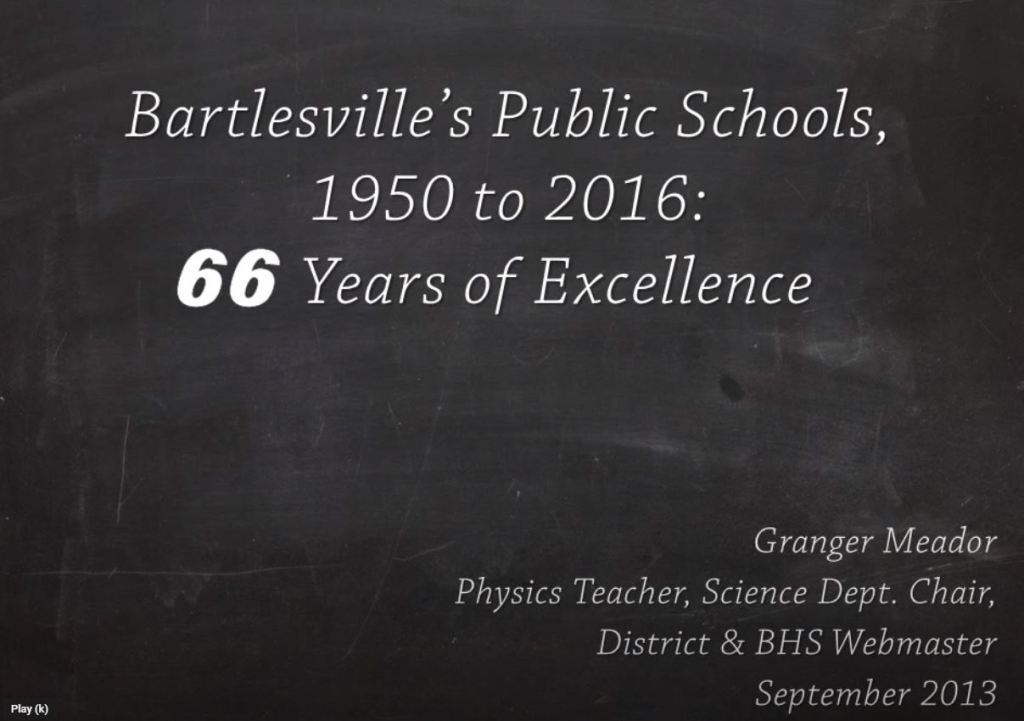
My previous district history video from a decade ago
A decade ago, when I was still teaching physics, I made a video about the district’s history since 1950. It was directly adapted from a PowerPoint presentation I had prepared for some community presentations.
So when I was approached about a new round of presentations, I wanted to go back to the beginnings of the district in 1899 and share what I had gleaned from months of archiving. I again wanted a video for the public to see, but I had watched a lot of YouTube videos during the COVID-19 pandemic. Their higher production values encouraged me to go beyond simply narrating a slideshow.
So I wrote a script and inserted various photographs and charts in the WeVideo online video editing service we make available to all district teachers and all secondary school students. I then animated many of the photographs, in what is often termed the “Ken Burns” style, to boost their visual interest. Recalling Burns’ use of the Ashokan Farewell in his influential series The Civil War, I also experimented with adding period background music, such as ragtime for the first years of the district’s history. But I judged that to be too distracting given my limited experience and patience for mixing audio.
I hope you enjoyed this post, and if it has sparked your curiosity, you might see if my 40-minute video is worth your time. No worries if it is not; there are countless videos out there these days on every imaginable topic. Happy hunting!
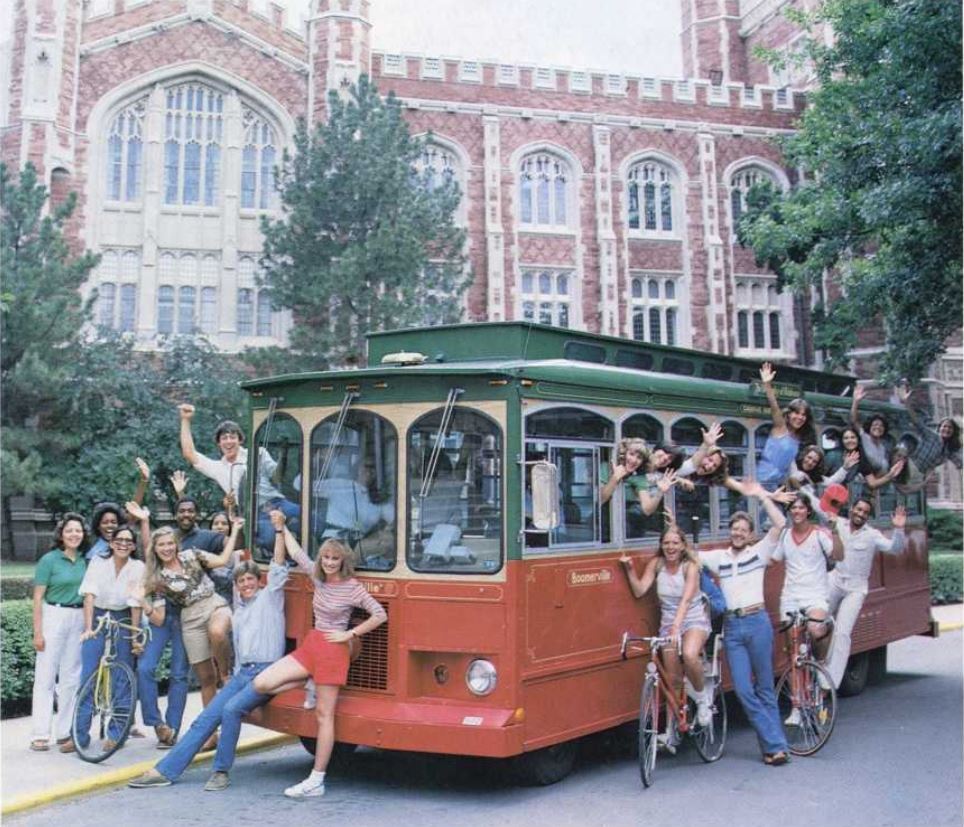
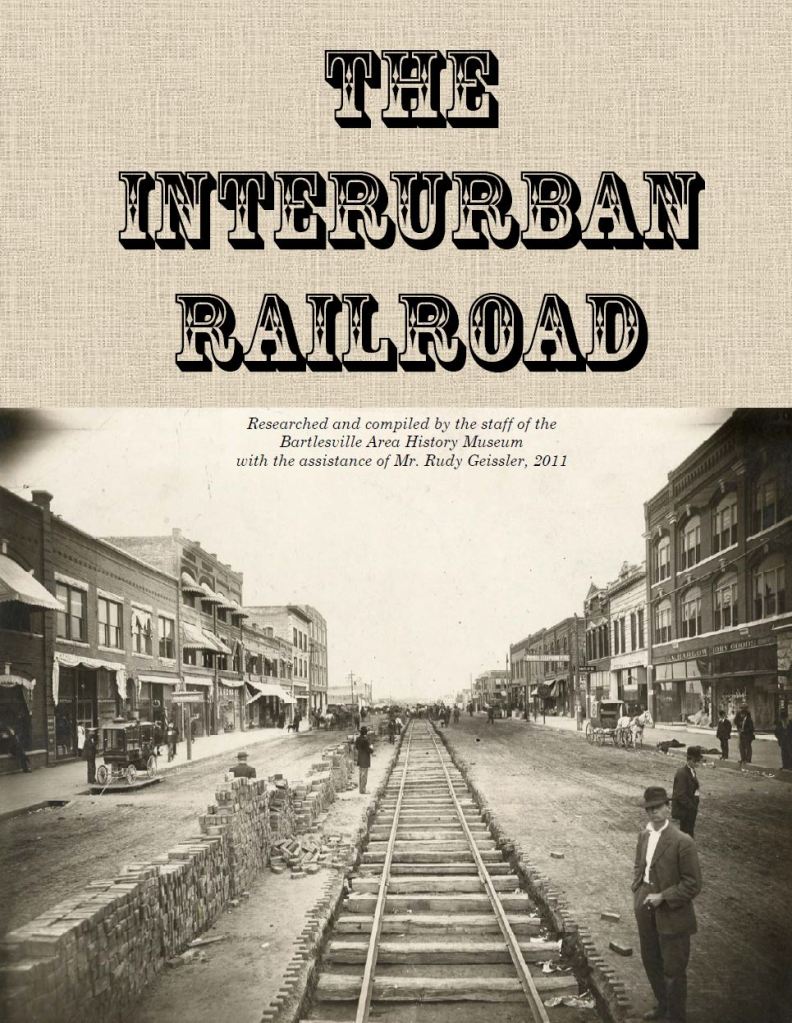
My only regular rides on a “trolley” were as an undergraduate at the University of Oklahoma, which began running the Boomerville “trolley” in 1980. It was made to resemble an old-fashioned trolley, complete with wooden interior seats, but ran around campus on rubber tires, not tracks, and was propelled by an internal combustion engine. There were a few of that style of trolley in the university’s system while I was there from 1984-1988, but they soon added regular coach buses, which I greatly preferred. They had far more comfortable seats and were air conditioned.
The University of Oklahoma started running the Boomerville “trolley” in 1980
I have ridden one actual trolley, the Saint Charles Streetcar Line in New Orleans, which is the oldest continuously operating streetcar line in the world. I’ve seen the Old 300 trolley along the Columbia River in Astoria, Oregon. But I’ve never been to San Francisco, so I have not experienced its famous cable cars.
Real trolleys were once commonplace. Oklahoma City had an extensive system from 1903 to 1947, including interurban lines that stretched north to Guthrie, south to Norman, and west to El Reno. Oklahoma City brought streetcars back in 2018 on new tracks that make a couple of loops downtown, but if you want to experience a historic trolley, you need to go west to El Reno, where the Heritage Express Trolley runs a 1924 car on a 1.5-mile loop.
Tulsa once had three electric railway companies, with service starting in 1906 and peaking in 1923 with 21 miles of rails. An interurban ran to Sand Springs until 1955 and to Sapulpa until 1960.
I’ve posted here before about some of the remains of the interurban one can spot along the Pathfinder Parkway near Robinwood Park, and there is still a diagonal Interurban Drive northeast of the park that follows part of the old route that once led past the unincorporated Tuxedo community as it headed north to Dewey.
My father was born in Dewey several years after the interurban folded. But he still got to ride an interurban trolley in the years before World War II, because his family moved north to rural Kansas.
My grandfather had left farming in southwest Missouri in 1923, bringing his family to Dewey in a covered wagon pulled by a team of horses. His brother-in-law, Enoch Weston, was working as a power plant operator at the Dewey Portland Cement Company, and my grandfather hoped to land a job there.
After a considerable wait, he was hired at Dewey Portland, starting out in the foundry and later becoming a machinist in the plant’s machine shop. In 1936, my grandfather got a job as a machinist for the Cities Service Gas Company. Although Cities Service was headquartered in Bartlesville, and would not leave it until 1968, the job site was an isolated compressor station up in Kansas.
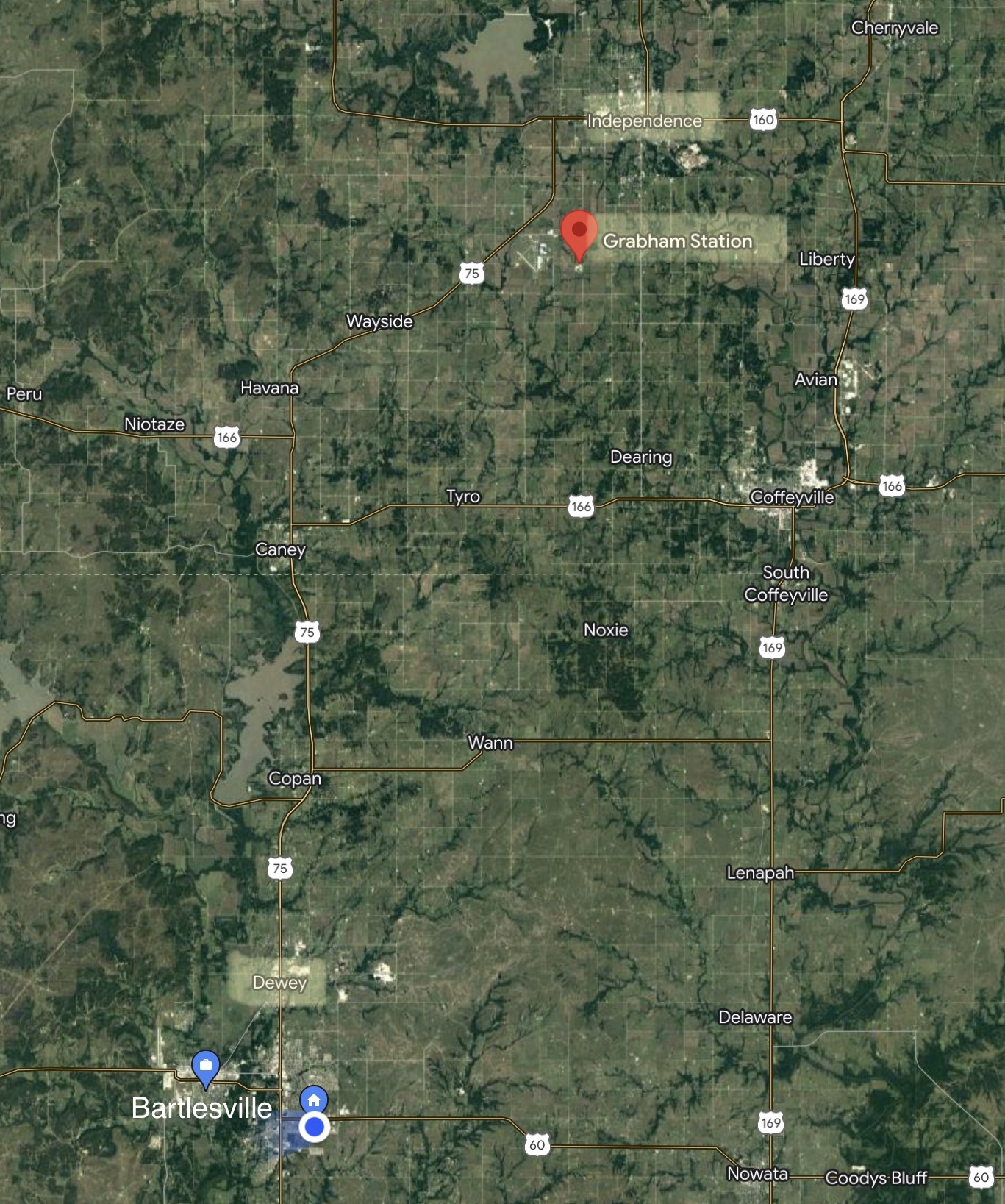
Map to help you locate Bartlesville and Dewey in Oklahoma and Grabham Station and Independence up in Kansas
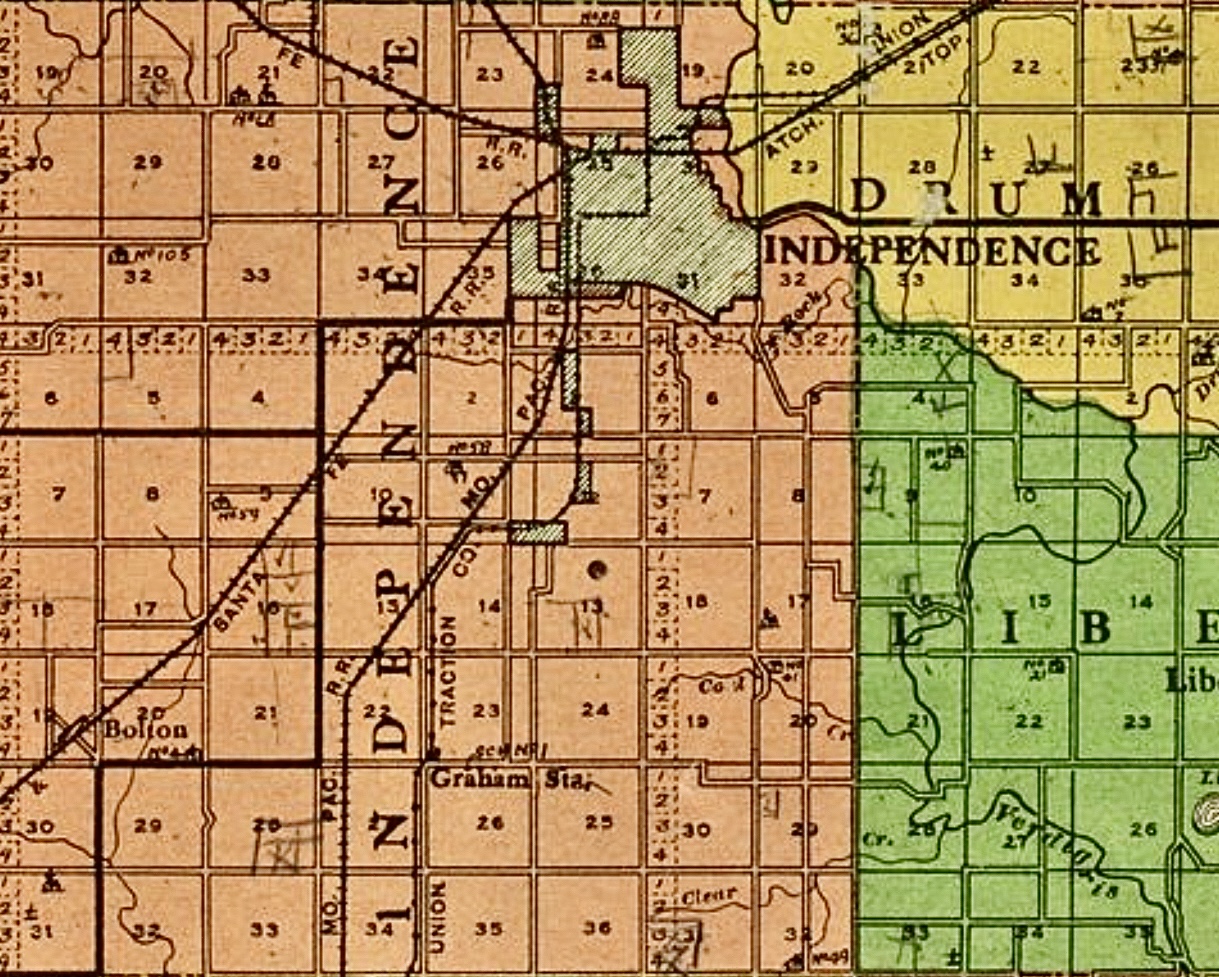
The family moved 27 miles northwest as the crow flies, and maybe 35-40 miles by road, to Grabham Station about five miles southwest of Independence. Dewey was a small town, small enough that the Meadors once packed into their Studebaker Erskine on Saturday nights to drive four miles to Bartlesville to shop and people watch. But Grabham Station wasn’t even a town.
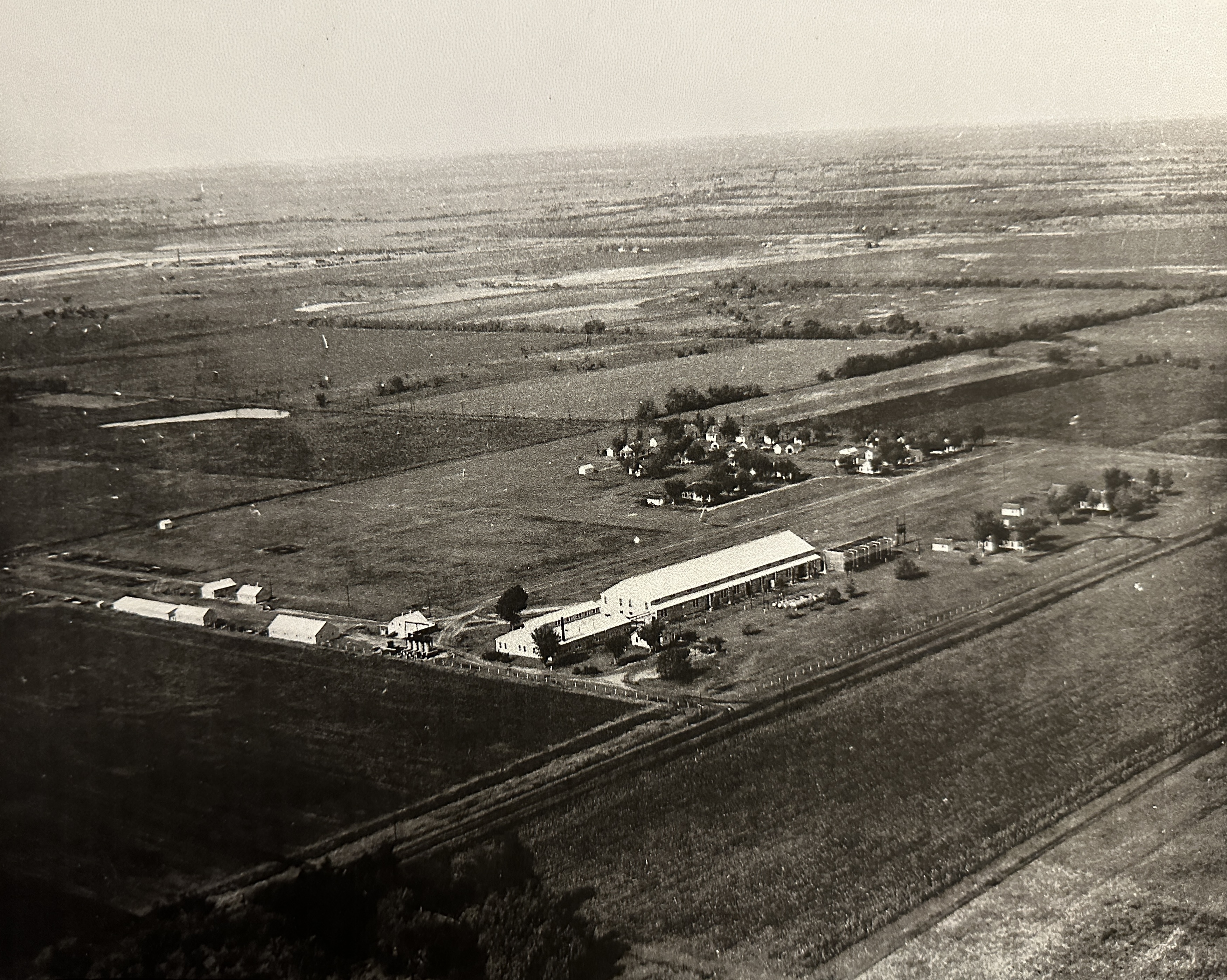
Grabham Station, where my father lived from 1936 to 1943
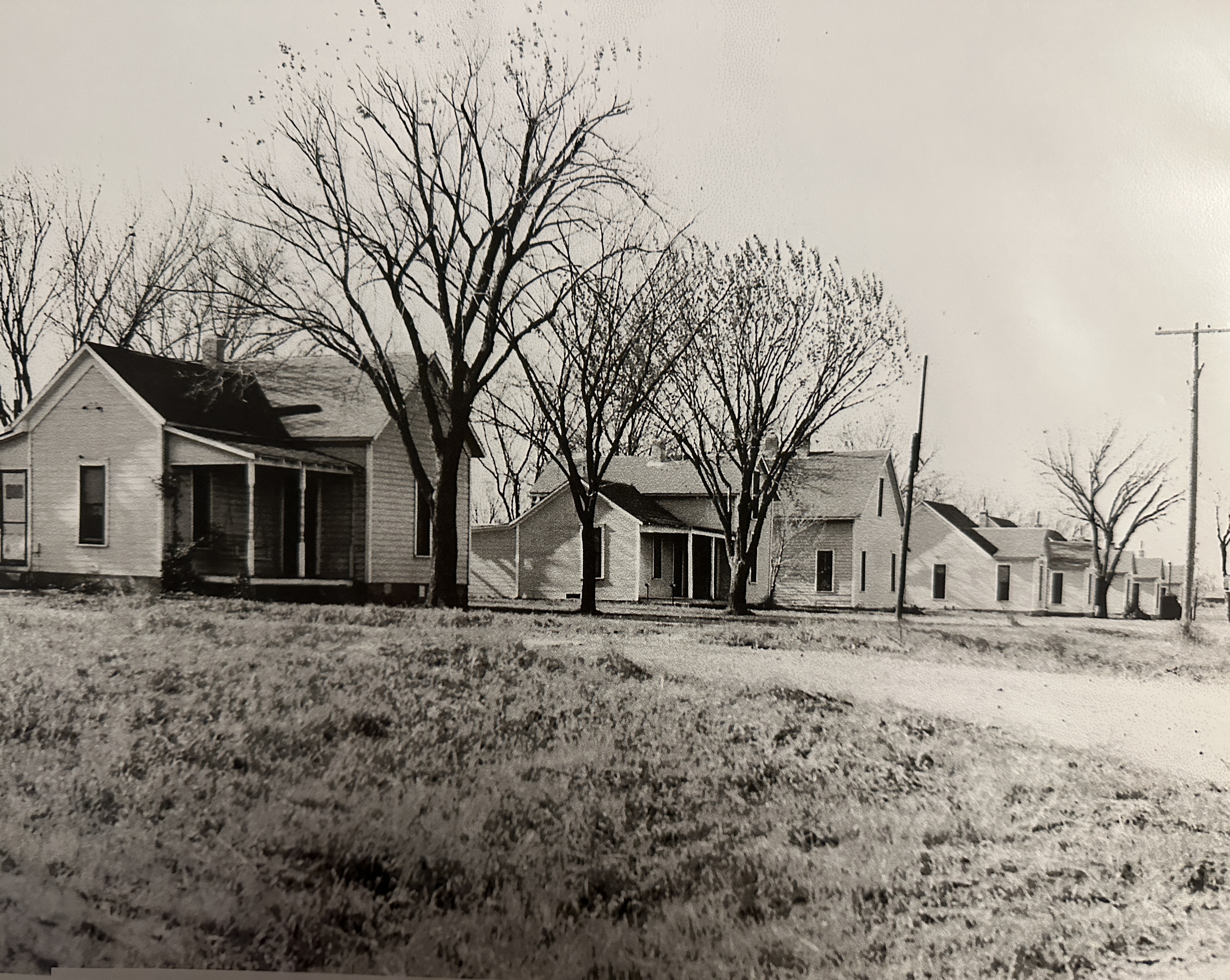
The station compressed natural gas to send it down pipelines to various cities and industries. A pipeline division was stationed there, along with a pipe yard and welding shop. There were about 20 company houses at the station, which employees rented at a modest rate of about $2 per room per month.
Company houses at the Cities Service Gas Company’s Grabham Station
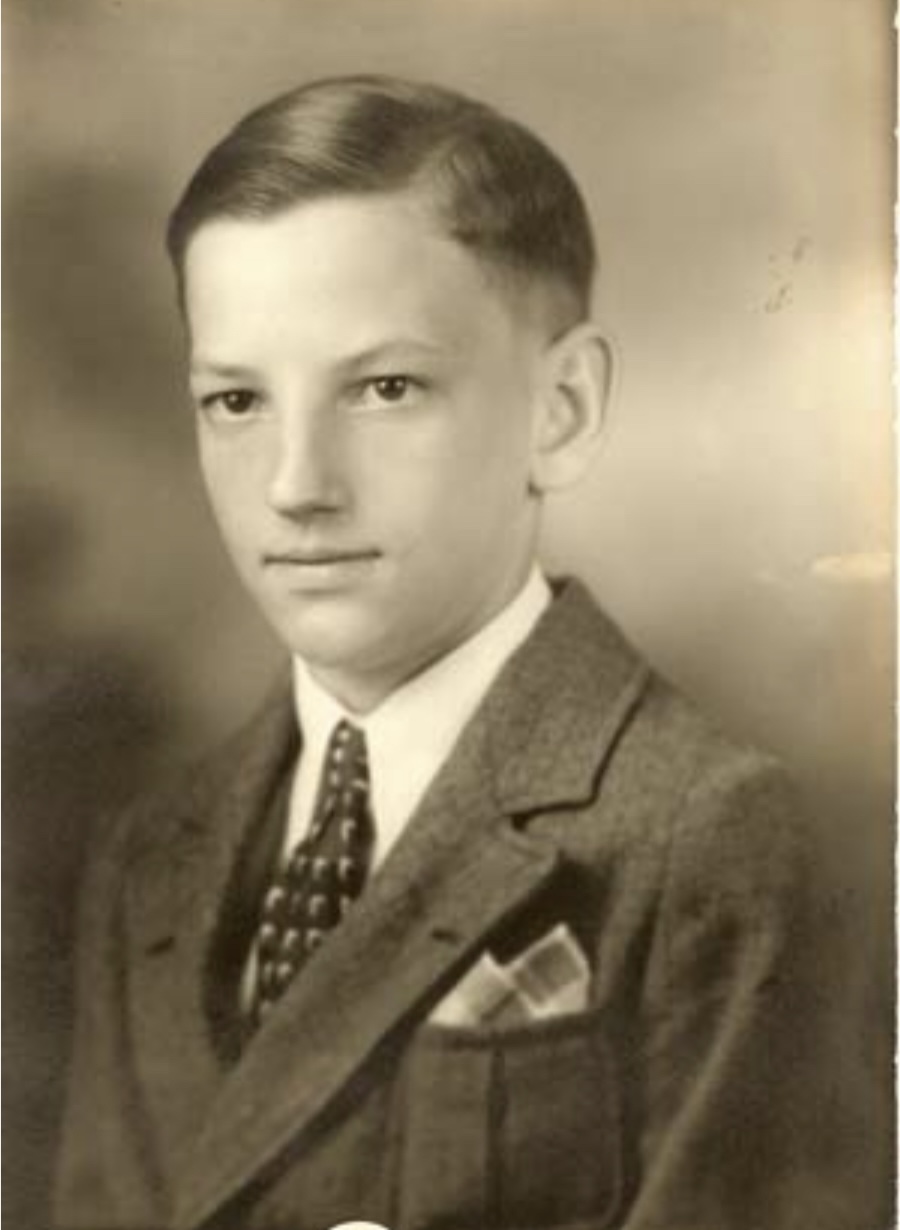
My father’s 8th grade graduation photo in his first suit
I got to know those old houses pretty well, since when he retired, my grandfather purchased two of them and moved them nearer to town and Independence Community College. Those houses were where my grandparents and one pair of my aunts and uncles lived when I was a kid.
My father attended 7th and 8th grades at the Maple Grove one-room schoolhouse about a quarter-mile from the station. As you might guess from the above photos, Dad said there sure wasn’t any grove of maple trees around the school when he attended.
Dad was a pretty smart cookie, being named the 8th grade salutatorian among the 176 rural school 8th graders in Montgomery County. He posed for his 8th grade graduation photo in his first suit.
More to the point for this post, his graduation meant that it was time for him to leave the one-room schoolhouse for high school in Independence.
He could have ridden his bicycle, as he often did in good weather for the quarter-mile to Maple Grove. But to reach Independence, he would have to travel two miles east on a gravel road to then take the paved 10th Street five miles north into town. He only did that a few times, since it was far easier to ride the interurban.
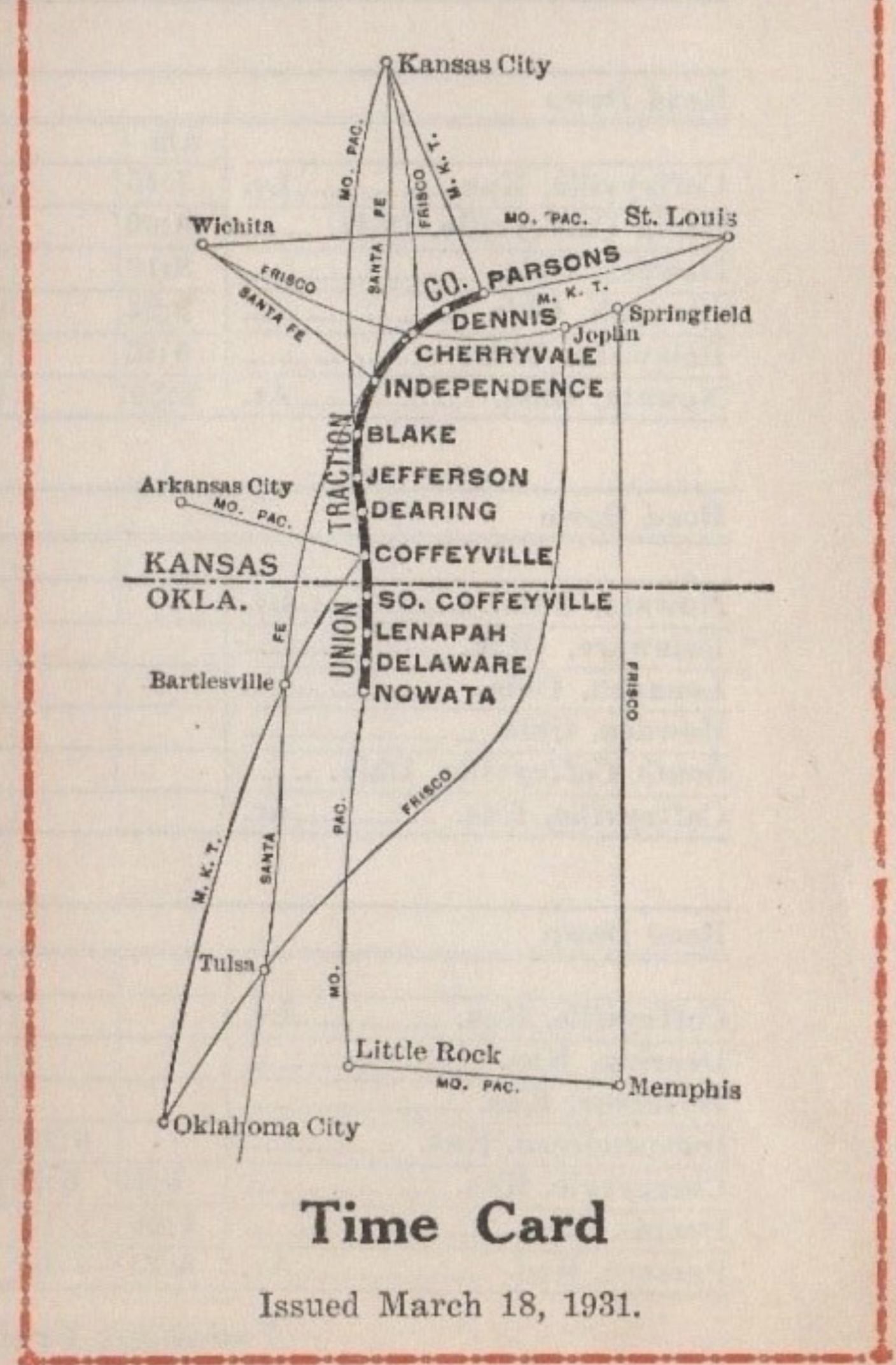
The Kansas interurban my father rode; Grabham Station was just south of Blake
The Union Traction Company was created in 1904 and initially linked Coffeyville, Independence, and Cherryvale, Kansas. By the 1930s it had grown to reach 88 miles from Parsons in the north down to Nowata in Oklahoma. It ran right past Grabham Station, and remained in operation until 1947.
The “Union Traction Co.” is the interurban trolley line, running east of the Missouri Pacific Railroad; this old map misspelled Grabham Station as “Graham”; I recently noticed Google Maps had the same mistake, which I corrected
My father wrote:
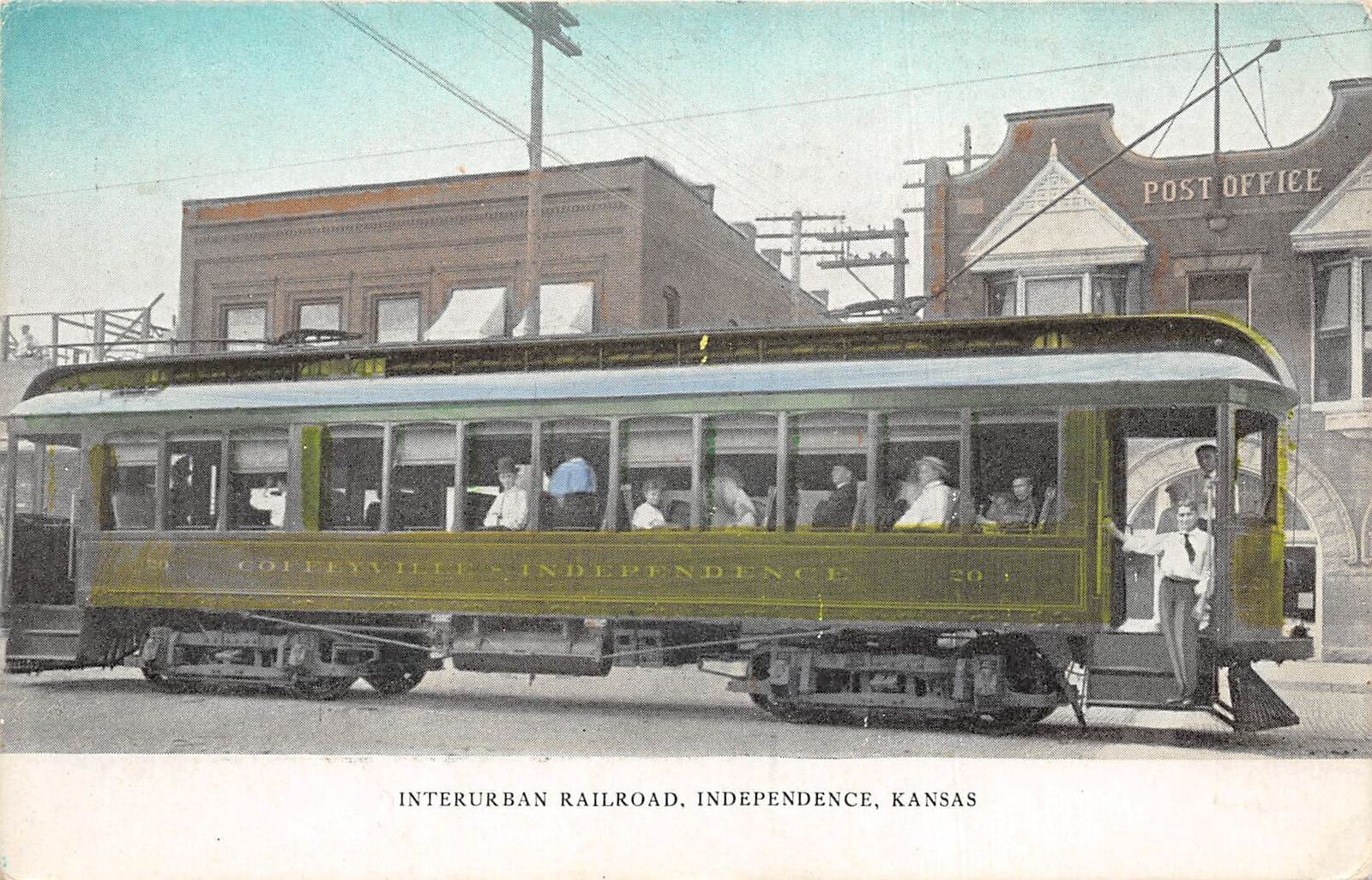
The rural kids that rode this electric trolley were pretty rowdy at times. A small portion at the rear of the car was closed off from the rest of the car. This rear section was called the “smoker” because that was where smoking was allowed. Isolated as it was from the motorman, it became a favorite area for the “wild bunch” to gather. There was lots of cutting up and loud noise back there. A favorite trick to pull on the motorman was for several boys to get off at one stop and, as the trolley pulled away, one of the boys would run behind the trolley and pull down the mast that rode the hot wire above the car. This disconnected the electric power to the car and stranded it. The poor motorman would have to get out and re‐engage the power mast before the car could move on down the track. Of course the boys would have scattered by then and the poor motorman would not be able to tell which one was the culprit. Don’t you know it took a lot of patience to be a motorman?
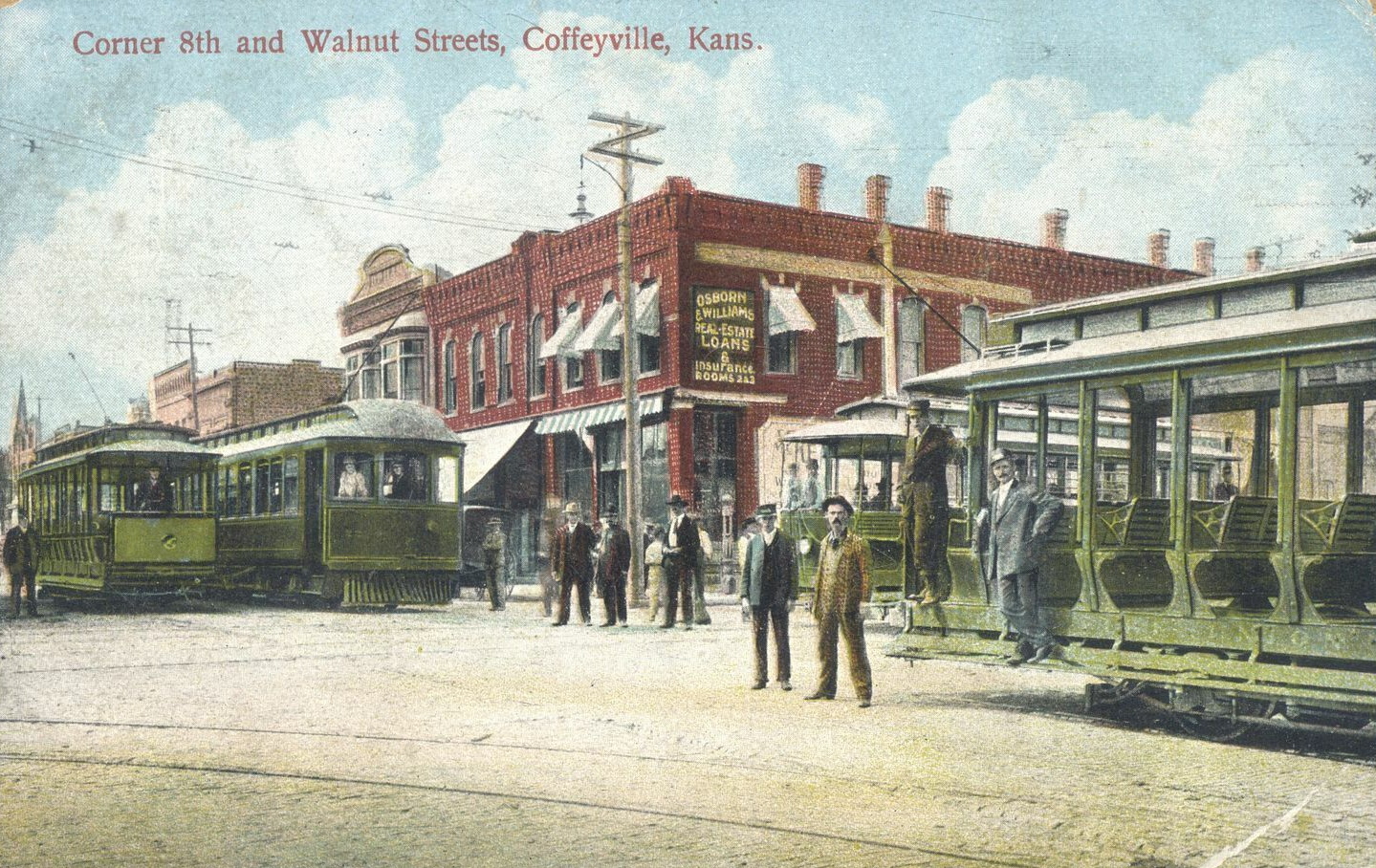
The interurban intersects the city streetcars in Coffeyville; the interurbans were larger and had low grills to protect their wheels
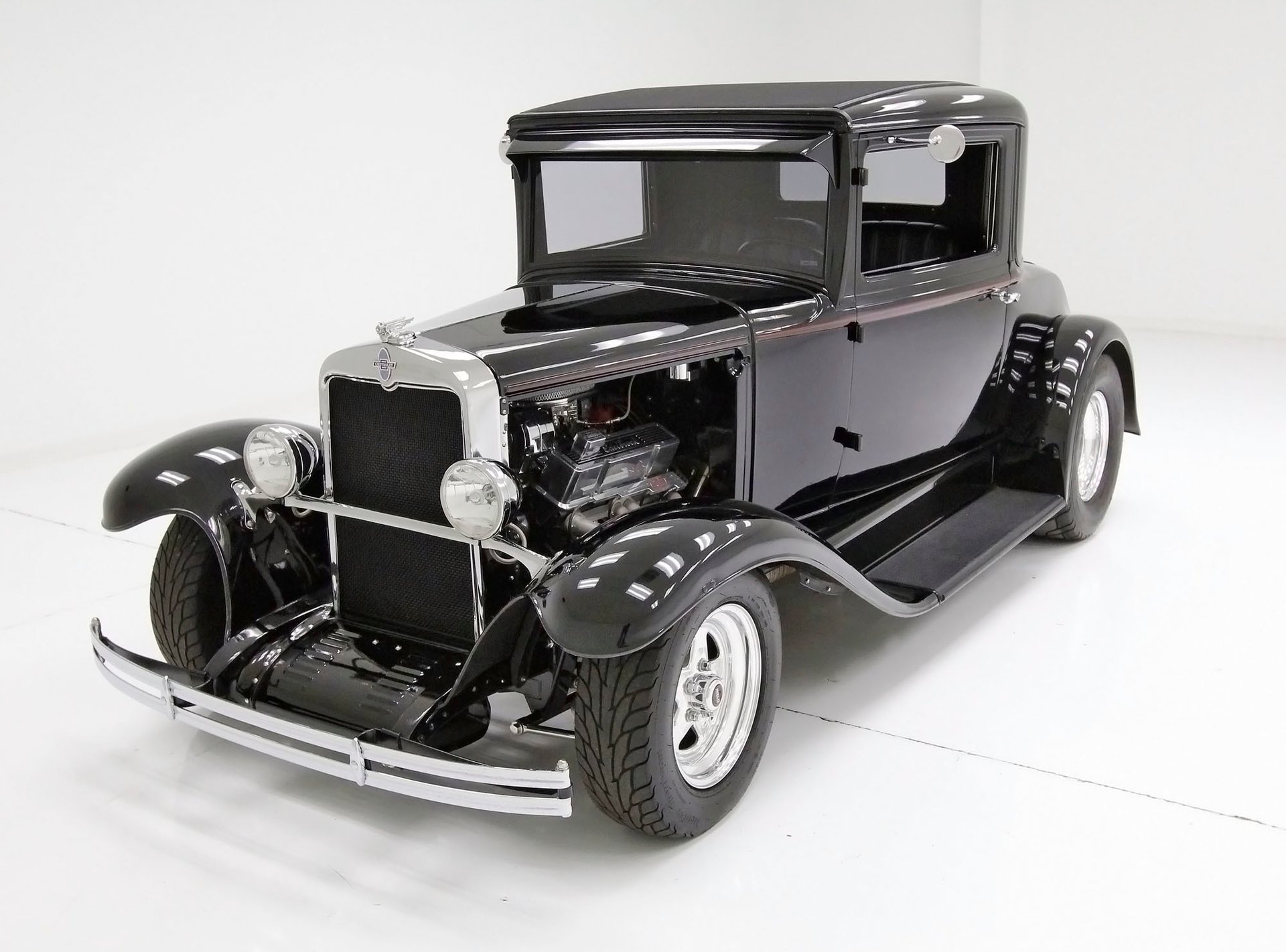
Dad would ride the interurban throughout high school, including for jobs at a couple of grocery stores and a year of junior college, until he was inducted into the U.S. Army in 1943. After service in Denver, Europe, and the Philippines, he returned to Independence before enrolling at Kansas University in Lawrence. He didn’t own a car until he bought a 1930 Chevrolet coupe in 1946. I like a story he told about that first car:
It only ran part of the time. I say that because it had a bad habit of suddenly quitting as I was driving along. I found that by getting out and raising the hood, disconnecting the gas line from the carburetor, back blowing the line to the gas tank by using my tire pump, connecting the line back, and closing the hood, I could be on my way once more. Needless to say, when this occurred in traffic it was not only irritating but quite dangerous.
The problem was solved by my fishing a large silk or rayon rag, that had long streamers of thread along its edges, from the gas tank. The streamers had been periodically floating into the opening to the gas line and stopping the flow of gas to the motor. Problem solved!
Later a valve broke off and exited through the side of the engine block. My father haggled with a shade tree mechanic to replace the valve and braze shut the hole for $35, which he said made the car worth at least $45 at that point! He ended up borrowing $435 from his father to buy a 1929 Ford Model A coupe that served him better for a couple of years.
Despite the hassles of owning and maintaining an automobile, the shift from streetcars to private automobiles was commonplace, with few trolleys surviving for long after World War II. We tend to romanticize trolleys, but most towns are now designed around the automobile, ensuring its continued dominance. Streetcars are now just a rare novelty, and interurbans a distant memory.
Buzz, buzz, buzz went the buzzer Plop, plop, plop went the wheels Stop, stop, stop went my heart strings As he started to leave I took hold of his sleeve with my hand And as if it were planned He stayed on with me and it was grand just to stand With his hand holding mine to the end of the line.
On most recent Wednesday evenings I have shared on my Facebook profile some remembrance from the past. After dutifully applying the #grangerthings and #ThrowbackThursday hashtags, I decide whether a post should be public or instead restricted to my over 1,900 friends on that social media platform. That’s a Hobson’s choice, of course, since once you post anythinganywhere on the internet, you should consider it public. Yet sometimes I apply the restriction as a sort of modesty panel which any of my Facebook friends can flip up with a screenshot.
Mining My Past
For months, I’ve been mining remembrances from the old photograph albums that came to me in April 2022 after my father died and my mother moved from Oklahoma City to an independent living facility here in Bartlesville. It wasn’t practical to plant a huge bookcase packed with photo albums, genealogy notebooks, and the like in her apartment, so it landed in my bedroom.
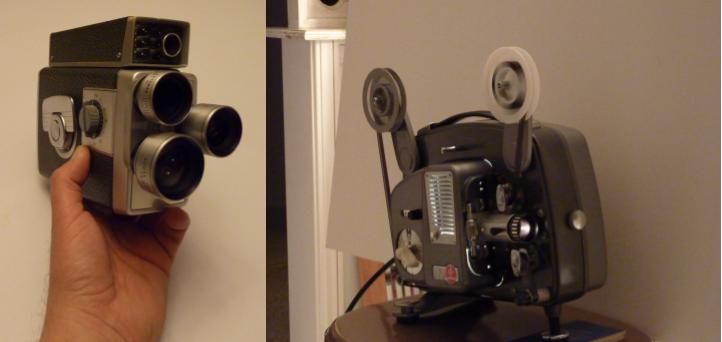
My father’s silent standard 8mm movie camera and projector he purchased in 1961
It took some digging to free my car from the big snow of Christmas 2009 in Oklahoma City
While scrounging for another photo that could prompt a little story from the past, I glanced up at the film reels on the top shelf and remembered something. I visited my folks in Oklahoma City over Christmas in 2009, and a big snow trapped me there for several days until I could dig out.
A few days after Christmas, we were looking for some entertainment. I set up my father’s old projector in their living room, aimed my digital camera at the screen, and we spent a few hours watching the old home movies he had shot.
I captured a few clips from that, and they were stashed somewhere in my digital archive. I located them and noticed one from when I attended preschool at the First Christian Church as a three-year-old. I added some music, and voila: Preschool in 1969.
I’m the towhead in the clip, decked out in my corrective shoes and black socks. But I was a bit at a loss for a story to go with the clip. I was too young to form any lasting memories of preschool. My mother had dutifully recorded in her Our Baby book that my teacher was Mrs. Carol Koop, and that my best friend at preschool was Robbie Deaton. I figure Robbie is the kid in the matching raincoat in the clip who is trying to blow bubbles.
So my thoughts turned to First Christian itself, which was billed as the Church of Tomorrow with its striking egg-shaped sanctuary dome made of thin-shell concrete, its louvered education building, and rocket-shaped bell tower. It was completed in 1956 and was the brainchild of preacher Bill Alexander and the young architects R. Duane Conner and Fred Pojezny. Sadly, the acoustics of the dome were atrocious, and Alexander and his wife were killed in a plane crash in 1960, but his ultramodern church was still thriving when I was at preschool there in 1969.
The Church of Tomorrow
I found a photograph of one of the classrooms when the church was first opened.
Classroom at the Church of Tomorrow
Decline and Demolition
That’s where a typical #grangerthings post would end. But something rather dramatic happened at that location less than a year ago.
The end of the Church of Tomorrow came in 2022
The Church of Tomorrow campus was demolished in 2022. What killed an iconic church that had made the National Register of Historic Places in 1984? The same thing that led to the recent closure of the First Christian Church in Bartlesville.
Now, we’re venturing into religion here, so allow me to reassure you that I’m approaching this dispassionately. I am interested in trends, their symptoms, and causes. I am not at all interested in sharing my personal religious views, how they have changed over my lifetime, nor in proselytizing for or against whatever views you hold.
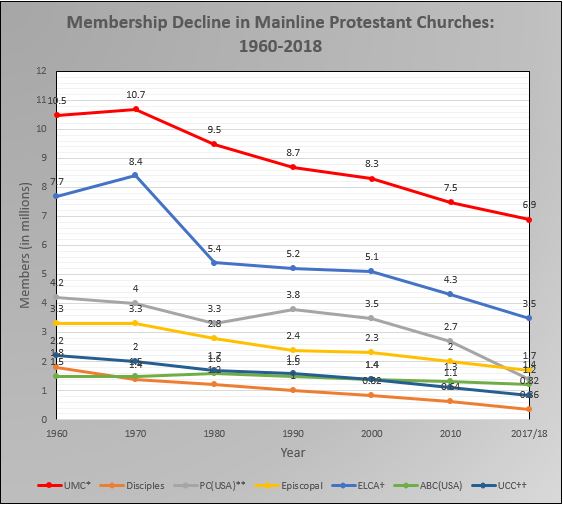
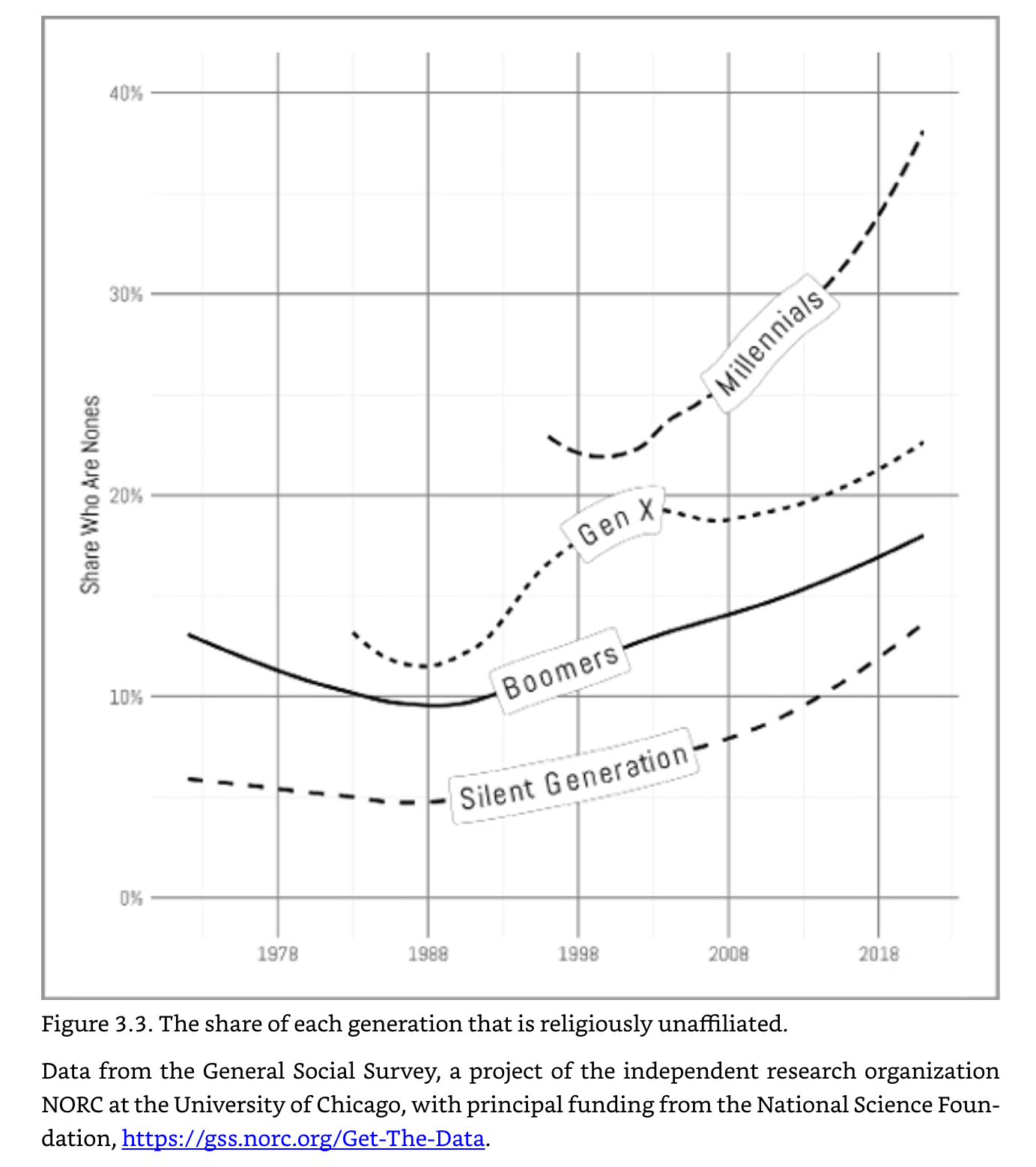
With that perspective in mind, I invite you to consider the membership timeline for the Disciples of Christ since my preschool days.
The Disciples of Christ is one of the “Seven Sisters” of what is called “mainline” protestant churches in the United States of America:
American Baptist Churches USA
Christian Church (Disciples of Christ)
The Episcopal Church
Evangelical Lutheran Church in America
Presbyterian Church (USA)
United Church of Christ
United Methodist Church
They are called “mainline” because they once had churches on most of the main streets of American towns, and when I was in preschool, almost 1/3 of my fellow Americans were members of one of them. At the time, together they outnumbered the Catholics, while less than 1/5 of my fellow Americans were in Evangelical Protestant denominations.
So were folks switching to Evangelical churches? Well, the Evangelicals did experience a surge from 1983 to 2000, fueled in part by televangelists. Their share of the population jumped from 17% in 1972 to a high of 30% in 1993. However, they had dropped to 22% by 2018.
I’ve witnessed this locally, with a growing number of non-denominational congregations even as mainline churches shrink and sometimes close. Ryan Burge is a PhD political scientist with many peer-reviewed publications and he is also a Baptist preacher. His analysis is that a shift from the mainline to non-denominational churches was once a primary factor, but now the non-denominational growth is more due to their attracting people who were raised as Catholics.
However, I must not give you the impression that we’re just seeing a shift from one form of Christianity to another. The total share of Protestants in the USA has shrunk markedly since the 1960s, dropping from around 70% to almost half that in the Gallup Polls, and there is no corresponding rise in Catholicism.
Instead, we have seen a significant rise in the religiously unaffiliated. Overall, the share of Christians in the USA has dropped from about 90% as late as 1992 to about 63% now, while the religiously unaffiliated have increased from 5% when I was a kid to almost 30% today.
Soon there will be more non-religious Americans than Evangelicals or Catholics, and many more mainline churches will disappear. As for why, there are multiple causes. Burge’s analysis is that “secularization, politics, and the internet are the major causal factors” that have given rise to the No Religion surge. He covers this in detail in his book The Nones: Where They Came From, Who They Are, and Where They Are Going.
The shift away from organized religion is most apparent in the younger generations, but all of them show the same trend in the past 15 years.
It isn’t as though a third of Americans have become atheists, however. The Nones don’t engage in religious practices, but their beliefs are diverse. Consider the responses when Americans were asked to choose among six degrees of religious belief.
So as of 2021, only 7% of the population reported themselves as atheists and another 9% as agnostics. Half the population still claimed to be true believers and another one-third still reported some degree of belief in a higher power.
Time changes everything except something within us which is always surprised by change.
Thomas Hardy
I find these sweeping changes fascinating. When I was a kid, over 40% of US adults smoked. That has plummeted to less than 14%. I am similarly surprised by how support for same-sex marriage leaped from 27% in 1996 to over 70% today. Now the USA is steadily de-churching, something that happened in Western Europe decades ago. Having been surprised by earlier sea changes, I shan’t predict the change in religious affiliations during the time I have left.
Fifty-odd years after I left its preschool, the raw red soil of my hometown is again revealed where the Church of Tomorrow once stood.
All that remains of the Church of Tomorrow is a parking lot, and…
Regardless of its causes, I instinctively view that red wound as another sinister signpost of my approaching old age. The elementary schools I attended in Warr Acres have also been razed. Time marches on, and I explore my nostalgia through my weekly remembrances, hopefully without wallowing in it.
When I captured that aerial view, I noticed that the bell tower remains at the northwest corner. So I used Google Street View to view that surviving emblem of what I once knew.
…the bell tower, now used only for cell phone antennas.
It is now just a tower for cellular antennas. How symbolic.





















 Meador Manor