Winter Break 2015, Part 2: Corpus Christi & Padre Island

December 28-29, 2015 | SLIDESHOW | MOSAIC

Meador PostThe Omni

Over the decades I’ve stayed in a wide variety of hotel rooms: dirty and dreary, cheap and clean, elegant and expensive, and other combinations. For our winter break, I opted to book rooms for Wendy and me that were above standard grade but not over-the-top. So instead of the Best Western-style mid-range rooms I’ve usually booked for our vacations, I looked for properties with some outstanding locations or features and booked small suites rather than single rooms. Our favorite room for the trip turned out to be the King Executive Suite at the Omni in Corpus Christi, high above the shoreline of the bay with separate small balconies for the living area and the bedroom. Wendy kids me about my fondness for vistas, and the room provided a nice panoramic view to the north of the Harbor Bridge and the USS Lexington.

Corpus Christi View from the Omni

We arrived after sundown and were tired from the long and dull drive from Austin. So we had dinner at the hotel’s Glass Pavilion restaurant. We celebrated our arrival at the coast with seafood: I had a decent fish and chips, although it was nothing like what you can get on the pacific coast, while Wendy enjoyed most of her crab cake. I suppose we should have had shrimp if we really wanted local cuisine. We were amused by a couple near us who asked a nonplussed waiter snooty questions about the origins of the food. They really should have headed to the Republic of Texas restaurant on the top floor of the hotel for that kind of dining experience.

Up on the Bluff

The next day was bright but chilly, starting with yummy french toast, fancy syrup, and bacon from the friendly room service. Later we ventured out for lunch, walking alongside the bay to the aptly named Shoreline Sandwich Company a couple of blocks south. We discovered it was closed for renovations, but its sister location four blocks east was open. So we perambulated inland, climbing up to North Upper Broadway Street, which runs along the city’s bluff above the bay area. Our sandwiches were good, as was the people-watching.

Corpus Christi Cathedral

Back on Broadway, I noticed a cathedral a few blocks south, so we walked by for photos. The Corpus Christi Cathedral is an appealing edifice, with both a 97-foot bell tower and a 125-foot clock-and-bell tower which are each adorned with pretty glazed terra cotta domes. It was designed by C.L. Monnot of Oklahoma City, who designed a little version of it as Corpus Christi Catholic Church in my hometown.

Selena

Down by the Seawall

We then descended the bluff to walk along the shoreline, noting how various electrical boxes have been adorned with fun artworks. In the early 1990s, the city built eight beautiful gazebos along the seawall, called the Miradors del Mars, or sea watchers. There is also the Mirador de la Flor, or overlook of the flower, built to commemorate Selena Quintanilla-Pérez, the Tejano singer who was killed in the city by a business partner back in 1995. A large white rose sculpture recalls her nickname “The Flower”, and she is represented by a life-size bronze statue, complete with bustier and microphone. The lower seaside section of the mirador has hand-painted floral tiles.

The Mirador de la Flor is at the entry of the People’s Street T-Head, which projects out into the bay with sailboats, stores, and restaurants. Wendy and I enjoyed the Laughing Gulls resting on the pilings, along with the varied accents of the mariners, which Wendy said sounded like Karl in Slingblade.

Laughing Gulls

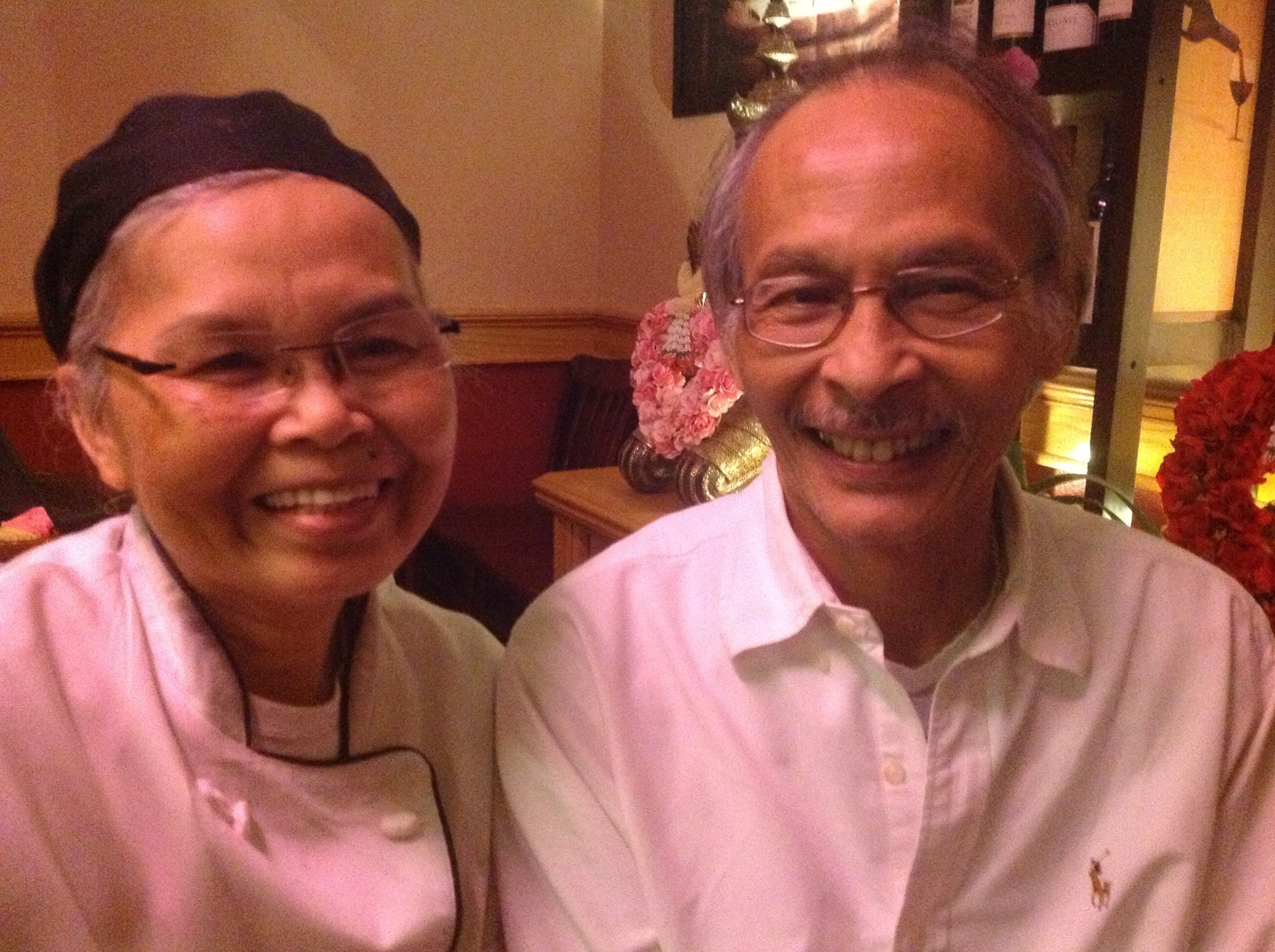
Dinner was at Thai Spice. The couple operating the restaurant were very sweet, and we enjoyed our dishes, which were artfully cut and arranged.

Padre Island

The next day we checked out of the Omni and drove to the Padre Island National Seashore before we headed to San Antonio. Back in college I would hear students say they were “going to Padre” for Spring Break. Being repulsed rather than attracted by the crowded mayhem of wild beach parties, I didn’t pay much attention. So I was a bit puzzled by my first impression of Padre Island. It lacked the wide beaches and development I was expecting; only later did I realize “going to Padre” for Spring Break meant the town of South Padre Island, which is on the opposite end of the island from Corpus Christi. Since it is the world’s longest barrier island, it is almost a three hour drive from Corpus Christi to reach the party beaches down south. And you have to drive there on the mainland, as 70 miles of the island is undeveloped and protected.

Malachite Beach on Padre Island

Enjoying the seashore

The relative calm and lack of extensive development suited us just fine. We drove to the visitor’s center at Malaquite Beach, donning both beach shoes and jackets before we walked past the vegetation onto the long sandy beach. There Wendy delighted in scouring the shoreline for seaborne treasures. I enjoyed the immensity of the ocean before us, with its swells and crashing waves. Some willets entertained us as they dug for food in the sand, and occasional flocks of birds flew in formations overhead.

Wendy had only been to an ocean once before when she briefly visited a foggy beach in Galveston, so this was a special treat for her. We did not stay but for an hour or so, and she said she could have stayed out there for days searching for unfamiliar treasures. But we had to get to San Antonio, so I steered us to Corpus Christi for a late lunch at Five Guys Burgers, which we both enjoy. I assured Wendy that she will again get to explore beaches on our summer honeymoon in the Pacific Northwest.

The drive to San Antonio was through afternoon mist and rain, with us arriving in the crowded downtown area at nightfall, slowly threading through slow pedestrian and car traffic to the Emily Morgan Hotel adjacent to the Alamo. Our stay there is the subject of the next post.

SLIDESHOW | PHOTO MOSAIC

Winter Break 2015, Part 3: San Antonio >

Winter Break 2015, Part 1: A Trek to the Coast

Posted in photos, travel, video | 1 Comment

Winter Break 2015, Part 1: A Trek to the Coast

December 24-27, 2015 | SLIDESHOW | MOSAIC

Meador PostThe trek south to Corpus Christi via Checotah, Oklahoma City, and Austin

Trading a Lake for a Gulf

Wendy and I waited out the first days of Winter Break 2015, declining to make hotel reservations until several days before we had to head out for Christmas visits with relatives. This allowed the weather forecasts to tighten up enough to steer us clear of our tentatively planned retreat to a favorite resort, Sugar Ridge on Beaver Lake in the Ozarks of northwest Arkansas. A strong El Niño pattern would be bringing days of rain to the region, in what would eventually develop into widespread flooding to end the wettest year in our young state’s history. I’m used to the showers of the Ozark woods, but they are not much fun in December; we both prefer water below and beside us to having it come down from above.

I knew that Wendy would not want to take a literal flight to escape the widespread precipitation; she was already trepidatious about our jetting to the Pacific Northwest for our honeymoon next summer. So I determined we should drive south, far south, to the Texas Gulf Coast, even though it meant that after Christmas in Oklahoma City we’d be facing a ten hour drive southward instead of four hours eastward. Two years prior we had enjoyed a Winter Break in San Antonio, liking our stay there so much that we had abandoned plans to drive onward from there to Corpus Christi. It was the time to retrieve that ambition.

24132553066_c20019e44e_z_d

Our Trek to reach the Gulf Coast

Christmas Traditions

The trip necessarily began with Christmastime visits to our parents. We visited Wendy’s mother first, enjoying lunch at the 69 Diner in Checotah. Christmas Eve found us snuggled in at our favorite hotel in Oklahoma City, maintaining our tradition of reading short stories to each other for the occasion. I selected Oscar Wilde’s Nightingale and the Rose to read to my partner, who dearly loves those flowering bushes. Wendy selected Dorothy Parker’s The Waltz for me, with its amusing contrast of inner and outer voices.

Christmas Day featured meals with my parents, with Wendy and me spending mid-afternoon on a one-mile walk at Bluff Creek Park below the north side of the Lake Hefner dam.

23790834469_10cfc94def_z_d

A hike at Bluff Creek

Stormy Southward Trek

The day we embarked for the coast was brooding and wet, as forecasted. We rolled southward down Interstate 35 past the slumping slopes of the Arbuckles, winding through Fort Worth, thankfully avoiding the tornadoes that would later sweep through the metro area. Our closest call was a series of loud tornado warnings from our iPhones as we hurriedly made our way past Itasca, successfully dodging a storm cell that was bearing down on the interstate. We then relaxed with some tasty burgers at Dave’s Burger Barn in Waco.

Interstate traffic had been quite heavy throughout our trip, but it reached stop-and-go levels south of Waco as we approached Temple. The stress was sufficient to convince me to divert onto the far more placid, if less direct, route 95 to the east. We were amused to find ourselves driving through Granger, Texas (I checked, but there is no Wendy, Texas…yet. It’s a big state with a long future ahead of it.) It was too dark and too late for us to gawk much, and we finally diverted west again to secure a room in Austin before we faced the drive onward to the coast.

Austin Interlude

We have friends in Austin who kindly took us out for dinner and fellowship two years earlier, so the next morning we considered trying to meet up with them. But the exhausting drive the day before and the prospect of hours more of travel to reach the coast, along with the proximity to Christmas, convinced us otherwise. We decided that we were better company with each other than becoming disheveled intruders into what might well be holiday family time. We did relax a bit with lunch at Bucca di Beppo, with its amusingly irreverent atmosphere. They fortuitously played our song as we waited for our food, cementing their status with us as a romantic interlude.

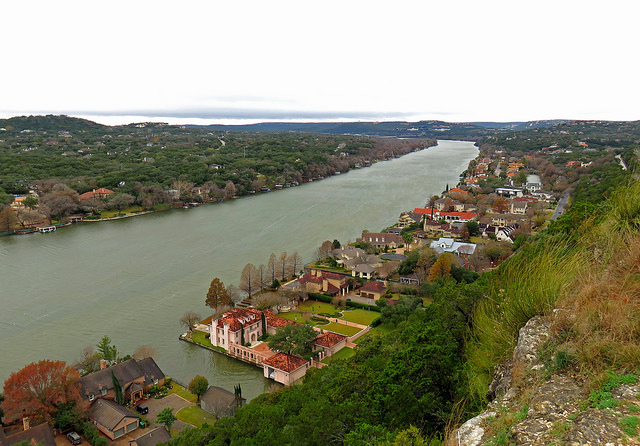
Having decided to continue to avoid the interstate for the drive to Corpus Christi, we needed to head eastward. That provided the opportunity to route ourselves along Mount Bonnell in Austin and make a brief stop to enjoy the expansive views, both north and south, of the Colorado River from the small park up top.

24158648985_f6819aa943_z_d

The Colorado River viewed from Mount Bonnell

I could zoom in with my camera on some of the structures at the University of Texas a few miles southeast from the Mount, and there was a distant view of the skyscrapers of downtown Austin.

We heard varied accents from the brave souls who joined us on the chilly and windy crest. We were glad we had stumbled on the more gradual western trail climb to the top, rather than tackling the long flight of stone steps on the east, which we used for a rapid descent.

Our Journey to the Body of Christ

We then headed southeast on Austin’s highways for our journey to Corpus Christi, which is named after the Feast Day of the Body of Christ. At one point, Wendy suggested we turn onto Route 183, but I vetoed that and stuck with Route 130 for a bit longer, with the rejoinder, “Yeah, but look at the speed limit!” Part of that route has a limit of 85 miles per hour; Texans tend to think big.

We did finally leave 130 behind, at Lockhart, where we were struck by the imposing and beautiful edifice of the Caldwell County Courthouse. It peeked out over downtown at us and demanded that we pull in at the town square and gawk at its creamy limestone, red sandstone, and Second Empire profile.

24158659275_abe6839483_z_d

Caldwell County Courthouse in Lockhart, TX

The remainder of the drive to the coast was rather monotonous, but I was happy to trade an interstate packed with aggressive Texans for a relaxed drive through small oil towns along sleepy roads.

We traveled southeast from Beeville to reach the long 183 bridge between the Corpus Christi and Nueces Bays at sunset. The colorfully lit Harbor Bridge welcomed us into Corpus Christi, where we would spend a couple of days in a lovely room at the Omni hotel on the bayfront.

SLIDESHOW | PHOTO MOSAIC

Winter Break 2015, Part 2: Corpus Christi & Padre Island >

Posted in day hike, photos, travel, video | Leave a comment

Oxley’s North Woods

Trip Date: December 21, 2015; SLIDESHOW | MOSAIC
Post by Granger

Meador PostI spent the first Monday of Winter Break doing some Christmas shopping in Tulsa, but the warm and sunny weather also lured me onto the trails. I’ve walked the trails at Redbud Valley, Turkey Mountain, and the main area of the Oxley Nature Center many times. But I was far less familiar with the separate North Woods section of the Oxley Nature Center, leading me to take a 2.3 mile hike in the woods bordered by Bird Creek, Flat Rock Creek, and Lake Yahola.

Mohawk Park

I drove to north Tulsa’s Mohawk Park. The North Woods Unit trailhead is a short drive west from the Oxley Nature Center’s main entrance. It is on a dike northeast of Lake Yahola, the artificial lake for the Mohawk Water Treatment Plant which is fed water from the Spavinaw Water Project.

Trail Track

Tree Fungi

The Oxbow Lake Trail, which evidently was once called the Beaver Lodge Trail, led between Nelson’s Oxbow and Coot Pond, quickly reaching a turnoff for the Sierra Club Trail. I took that turnoff and followed the new trail north along the east side of Nelson’s Oxbow Lake. The North Woods are a mature oak and hickory forest, and the trails were often completely covered in acorns, along with other nuts. I would pay a price for all of those oak trees – the next day my neck was itching and I found I had received multiple bites from the dreaded oak mites that have been very active in 2015.

The trail wriggled through the woods and terminated at a long flowline cut through the woods. There I turned northwest and followed the flowline to the trailhead for the North Woods Loop Trail. I trekked counterclockwise along the trail, following the north shoreline of Nelson’s Oxbow, noting that a tree tilted over into the water would be great for turtles, although none were evident. Some fallen logs featured large, whitefunnel-shaped fungi, while others sported colorful fungal fans.

Fungal fans

Sunset over Lake Yahola

The trail looped along the south shore of Bird Creek and then followed part of the east side of Flat Rock Creek before heading south back to the flowline. From there I took the Oxbow Lake Trail, which I had turned off earlier, and followed it past Mallard Lake back to Coot Pond. Mallard Lake lived up to its name, with ducks quacking at me and some taking flight when I passed. When I reached the dike, I took the opportunity to climb the side of Lake Yahola to shoot the sunset.

This was a short hike, frequently punctuated not only by bird calls but also by booms from the Tulsa Gun Club located at the opposite end of Mohawk Park and the occasional overhead roar of a small plane from the nearby airport. But I thoroughly enjoyed trading the crazy hustle and dangerous traffic of Christmastime in Tulsa for an isolated stroll through the woods. Wendy and I hope to share a final hike or two in 2015 when we head south to Texas between Christmas and New Years.

SLIDESHOW | PHOTO MOSAIC


Posted in day hike, photos, travel | Leave a comment

Transplanting the Harper Rose

December 21, 2015
Post by Wendy

Wendy's Post

Granger and I just finished building a raised rose bed at his place and transplanting a humongous rose bush. He and I will marry next July, so in the meantime we’ve been organizing as well as purging some of our various belongings. When he makes changes and improvements around his house in preparation of me coming over, he says he is “building his nest,” like a bower bird does to attract a mate. He’s added cabinets both within and without one bathroom to make me more at home. He has also agreed to a lot of gardening tasks that he wouldn’t normally do.Transplanting this climbing rose bush and building a bed for it were quite an undertaking for us both.

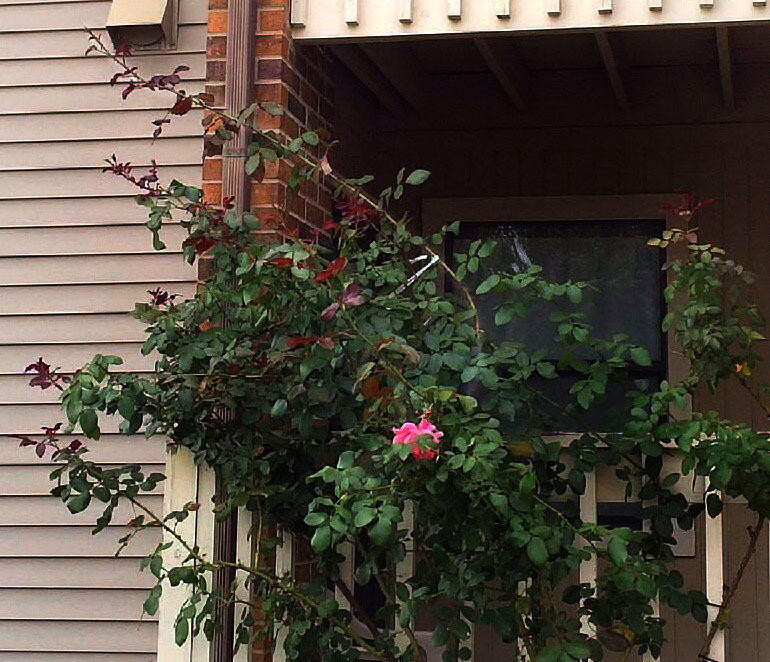
I’ve cared for many roses in the past; at one time I was tending 24 different bushes including hybrid teas, floribundas, grandifloras, climbers, shrubs, and miniatures. When I downsized to my apartment, I kept three of my original rose bushes – Perfume Delight, a deep pink hybrid tea; Dream Come True, a yellow and ruby grandiflora; and Social Climber, a pink climbing rose bush.

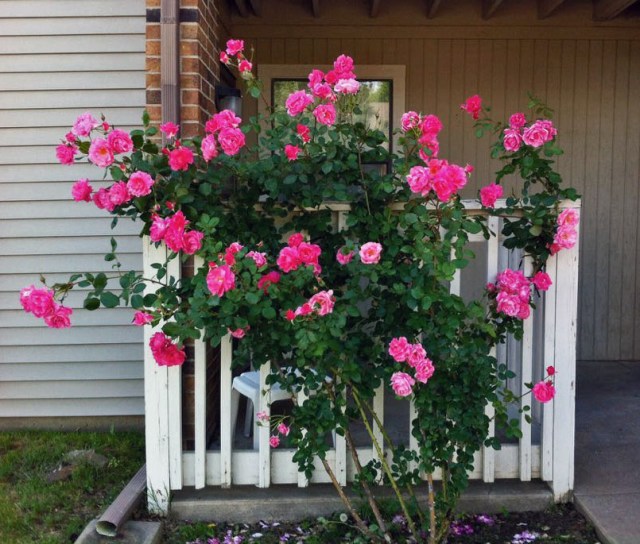
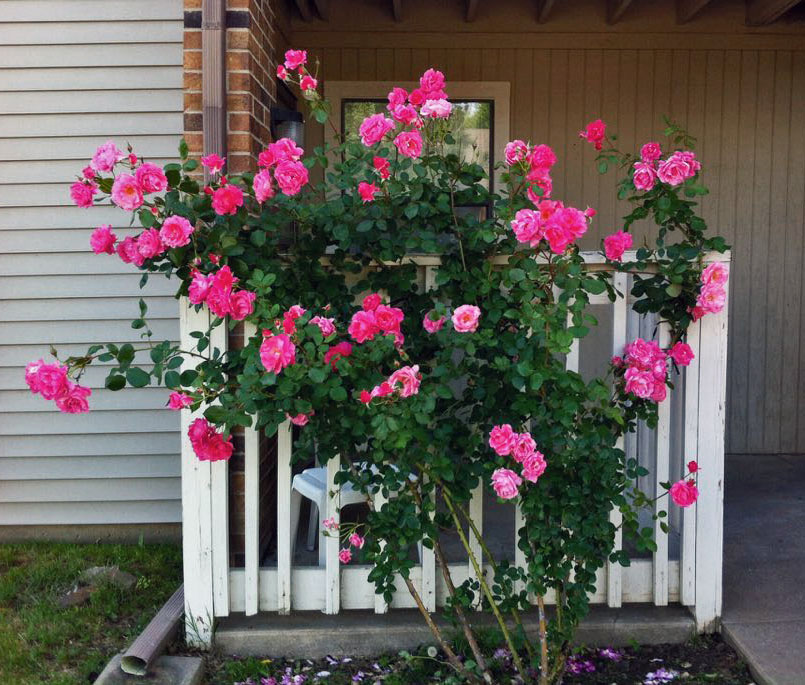
Harper Rose, a Social Climber, at my apartment

Harper Rose, a Social Climber, at my apartment

Social Climber is the commercial name of the pink rose bush I planted in memory of my Grandma Harper. In fact, after she passed away in the early 2000s, I started rose gardening to deal with the grief. So you could say that she got me started on that hobby.
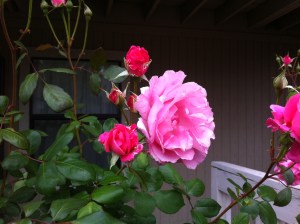
Harper Rose Blooms

Harper Rose Blooms

After moving to Bartlesville, I began adding bushes to my garden and learned many things in the process. Around 2009, I was perusing the Jackson & Perkins Rose catalog and found Social Climber. The pink profusion of roses in the photo reminded me of a birthday card I once got from my grandmother, who we affectionately addressed as “Harper.” When my older sister was very young, she could not say “grandma,” so from that point on, Grandma Harper was called “Harper.”

When I planted the rose bush in her honor back in 2009, I named it the Harper Rose. I received the bare root in the mail and meticulously followed the directions and pointers I’d found online for planting bare root roses.

The Harper Rose bush is very special to me. Since I planted it in her honor, I gave it extra loving care and attention, much as I would give her if she were here. I grew up mostly in East Texas and had both sets of grandparents as neighbors. So my little sister and I spent many days visiting Harper and “Poopah” in their tiny trailer.

Their walls were completely covered with greeting cards that friends had sent. Usually we’d find Harper sitting with a large cloth napkin in her lap, eating stale toast and jelly, reading the Bible, and leaving crumbs everywhere. Writing letters and keeping up with old friends was a duty she took seriously. Kids these days have no concept of writing letters.
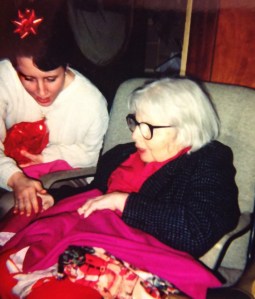
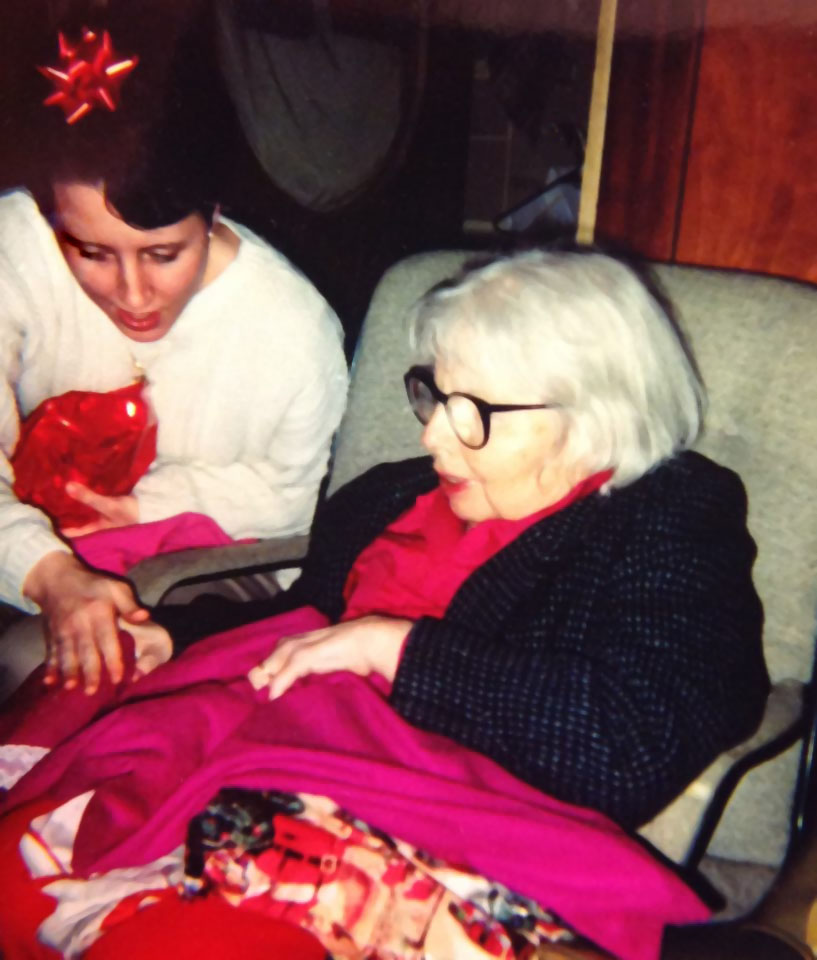
Wendy and Harper

Wendy and Harper

I really admired Harper because even though she had many painful ailments, she never complained. Back when she was middle aged, she tried to erect an American flag on Independence Day, and fell, injuring her elbow. From that point on, into her later years, she had to soak her elbow a few times a day to reduce the pain. To this day, when I smell BenGay, I think of her.

Harper had osteoporosis so bad that her back was humped over, making her look like a turtle. She later had to go to Mayo Clinic to get artificial elbows and knees. If this were not bad enough, she also suffered from glaucoma. I still remember her procedure for the special eye drops. After putting the drops in, she had to keep her eyes closed for a certain amount of time – the amount of time it took her to recite Psalm 23 which begins, “The Lord is my shepherd I shall not want…”

Harper was very dear to me, so as a result, I take great care of the rose bush that is her namesake. I planned a raised bed to be made from cinder blocks and even planned the composition of the dirt. Many years of rose research helped in this endeavor. What I’ve learned about rose-growing has led me to one simple recipe for rose success:  Good sun, good drainage, good dirt, good fertilizer, and water regularly. All of these necessary ingredients were considered when planning this rose bed.

At my apartment, the Harper rose bush got morning sun, which helped it to thrive. Six or more hours of direct sunlight is the usual recommendation, so Granger and I selected a spot in his yard that met that standard.

Building the Raised Bed

This slideshow requires JavaScript.

We measured and dug a shallow, square trench within which to place the first layer of blocks. We saved the clay-rich dirt on an old sheet in the yard. Too much clay is not good for roses as it prevents good drainage. But I wanted to save some of it in case the soil we created ended up having too much drainage. I didn’t want any of that invasive Bermuda grass in the bed, so we spent a lot of time removing clumps of it from the clay dirt.

It is said that roses don’t like to sit in water as it rots their roots. So we first put in gravel to help with drainage. Then we put down some wire mesh, the kind one might use to build a chicken pen or a rabbit hutch. In our case, we put it down to deter the hungry moles who have been taking over the yard. Next, we put down landscaping cloth to keep the weeds out. Finally, we laid down the first layer of cinder blocks and threw in some more gravel.

Putting down those heavy blocks was tiring, so a few days later we put down the second course. Later a third course was placed. In all, there are 27 blocks. We put that heavy clay dirt into the holes in the blocks to make them even more stable. All the while, we were adding various ingredients to the bed soil:  bags of top soil, pine bark mulch, potting soil, enriched garden soil, compost that Granger and I had created over the past year, blood meal, clay dirt, gravel, gypsum rocks from one of our hikes, chopped banana peels, more egg shells that hadn’t made it to the compost barrel, and some wet, partially decomposed dead leaves.

The last step in the construction involved gluing down shorter cinder block caps which matched the lower blocks in two dimensions. They create a place for me to sit when I tend the rose bush.

Transplanting

This slideshow requires JavaScript.

For weeks, I considered the transplanting process and how best to execute it. So many warnings danced around in my head: Keep as many roots intact as possible; keep as much of the native dirt around the roots as possible; don’t let the roots sit out in the air for too long; protect the canes in transport; for climbers, it’s best to avoid pruning the main canes: only prune the side branches; remove all foliage so that the plant uses its energy for growing roots and adjusting to the change of environment; only transplant during the dormant phase…

Well, there is no dormant phase for this bush. It’s a vigorous grower, and even in December, it’s showing new little reddish sprouts of leaves popping out of the canes.  It’s like a happy little dancing child.  But I had to move it.  Ready or not, here we go.

I had no idea how big the root ball would be, but I was about to find out. First I cut up some old shirts into strips and squeezed the canes together as much as I could without breaking them. Those canes are as big around as carrots. The heavy wind made it quite difficult to wrap cloth strips around the spread out and thorny branches; just when I thought I had the strip wrapped around behind the bush, the wind would whip it back out or get it stuck on a thorn.

There was a lot of wrapping of branches, not only to confine them but to protect myself from the huge thorns. I didn’t wear gloves since it is hard to tie things up using bulky elk skin gloves. So my hands got pretty well butchered.

After the wrapping of canes, I got a small blanket and wrapped it around the bush, tying it all up with duct tape. Then with the bush contained and rendered harmless, I got to digging. In a circle about a foot away all around the bush, I’d stand on the shovel wiggling it side to side and then sit on the handle of the shovel. I did this over and over, huffing and puffing, sweating up my coat. Down, under, and up, down, under, and up.  That bush was a beast. I didn’t realize how heavy the plant was until I was on the grass, my arms wrapped around it, pulling it free of its home, panting,“Come on, Harper!  It’s time to go!”

I laboriously hefted it onto the big piece of cloth I’d laid out. Then I got to work, tying that cloth around the root ball. There were two long roots popping out, and I didn’t want to damage them, so I let them stick out freely.

The next big feat was lifting the plant to put it into the shallow rubber basin for transport. Granger had asked me earlier, “Do you want me to come over to your place and help dig up that rose bush?” And I had foolishly told him I could do it myself. With a primal grunt, I lifted rose bush, basin and all, into the trunk of my Impala. I think I used up all of my calories from breakfast in that one lift.
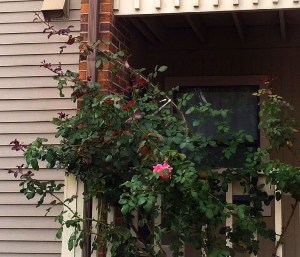
Long Cane

Long Cane

After chugging a Gatorade and replenishing my shaky, depleted body with a snack bar, I carefully wrapped some exposed canes. I did this so that they would not be damaged by the trunk lid, which could have potentially bounced up and down as I drove the three-minute drive over to Meador Manor. Finally I tied a strip of red cloth to the longest cane just in case another car tried to follow too closely. Wouldn’t want them to get gored to death.

Actually that cane had been closer to ten feet long in the past. Recently, it had grown so high that it touched the railing of the floor above my apartment. I had tied it back down so it would not intrude on the upstairs neighbors’ plants. Trying to confine the Harper rose bush to my tiny garden space has been a major chore over the last three years. I’m glad it will have space to roam in its new home. It’s a sprawler.

Worx Aerocart

Worx Aerocart with Wagon Attachment

Once I got the bush to Granger’s place, he helped me unload it into the Worx Aerocart he bought a few months ago for my gardening projects. That cart has been used a lot, what with all of the cinder blocks, loads of loose and bagged dirt, and gravel.

When we got the bush into the back yard, I dug a big hole in the bed of dirt. Then I got some of the clay and heavier dirt and formed a large cone in the middle of the hole.  This helps give the roots something from which to “fan out”. We hefted the bush up and down into the hole, gently pushing it down onto the dirt cone. Then we adjusted it to where those long roots sticking out had a little more room. We adjusted the height where it sat to be sure the bud union was slightly underneath the top layer of dirt. Granger held the bush in place while I adjusted the roots and filled the hole with water. When it was full, I stood back and studied the canes to be sure they would fan out in the proper directions.  For years I’ve been “training” those canes to spread and grow the way I want.

With Granger still holding the bush in place, I started backfilling the hole with dirt, gently packing around the roots to remove all air bubbles. Once we got the plant packed in and all of the dirt in, we went to work unwrapping the canes and cutting off the tie-downs. I tied one cane over to another so that it would not cross and damage an adjacent one. Over time the cane will grow in the direction I desire. I’ve often heard people say that their rose bushes are taking over their place. I tell them to not be afraid to cut on bushes or control errant branches by loosely tying them down. To make that rose bush do what you want, you’ve got to tame it and train it – especially climbers. It’s just like having discipline with kids. Structure and boundaries are paramount.

A Surprise from Granger

A Surprise from Granger

Love and care are also important. Speaking of love and care, two weeks ago, Granger showed up at my front door with a bouquet of red roses and a big smile. I heard a song playing on his iPhone in his pocket.  It was Frank Sinatra singing, “Try a little tenderness…”

Like loved ones, rose bushes need tenderness in the form of regular attention and loving care.  I’m counting on Granger to deeply water the Harper rose bush for the next couple of days. And I’m eager for next summer when we get back from our honeymoon in Oregon and start our married life together. Then I will get to give Granger and Harper the daily love and care that they both need.

Granger has literally “promised me a rose garden” and helped me to build it.  This contrasts with the old song by Lynn Anderson.

[youtube https://www.youtube.com/watch?v=WO4wcNVbYOQ]
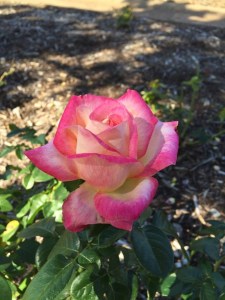
Lynn Anderson Rose

Lynn Anderson Rose

Coincidentally, I recently took a photo of the rose named after Lynn Anderson at the Tulsa Rose Garden. There’s a neat story behind this rose and how it came to be named for the country singer:

As a thank-you gift to the country singer for donating a copy of her 1971 gold album Rose Garden to the American Rose Society’s 100th anniversary convention auction, says Anderson, “they sent me photos of six roses and great descriptions of them to choose from. The one I chose said ‘extremely hardy’ and I thought that description suited me to a ‘T’.” In her xeriscape garden at her home in New Mexico, Anderson grows many plants, including high-altitude wildflowers and cacti. Because she has a dry, rocky soil in combination with a busy travel schedule, Anderson donated several of her rose bushes to the Chamber of Commerce, the local hospital and a women’s center in Taos, N.M. “That way they’re cared for by pros, and lots of people get to see and enjoy them.”

Lynn Rene Anderson (September 26, 1947 – July 30, 2015)


Posted in gardening, roses, Wendy | 2 Comments

Renovated Royalty on the Talimena Drive

November 22-24, 2015   SLIDESHOW | MOSAIC
Meador Post

Our school district shifted to a full week off for Thanksgiving this year. That squeezed my students’ time to cover the material we must complete before the final exam in a few weeks, but it did provide the opportunity for a mini-vacation ahead of Thanksgiving dinner with my folks. Wendy and I chose to spend a couple of days at the recently re-opened Queen Wilhelmina Lodge on the eastern end of the Talimena Skyline Drive.

The Third Revision of the Third Lodge

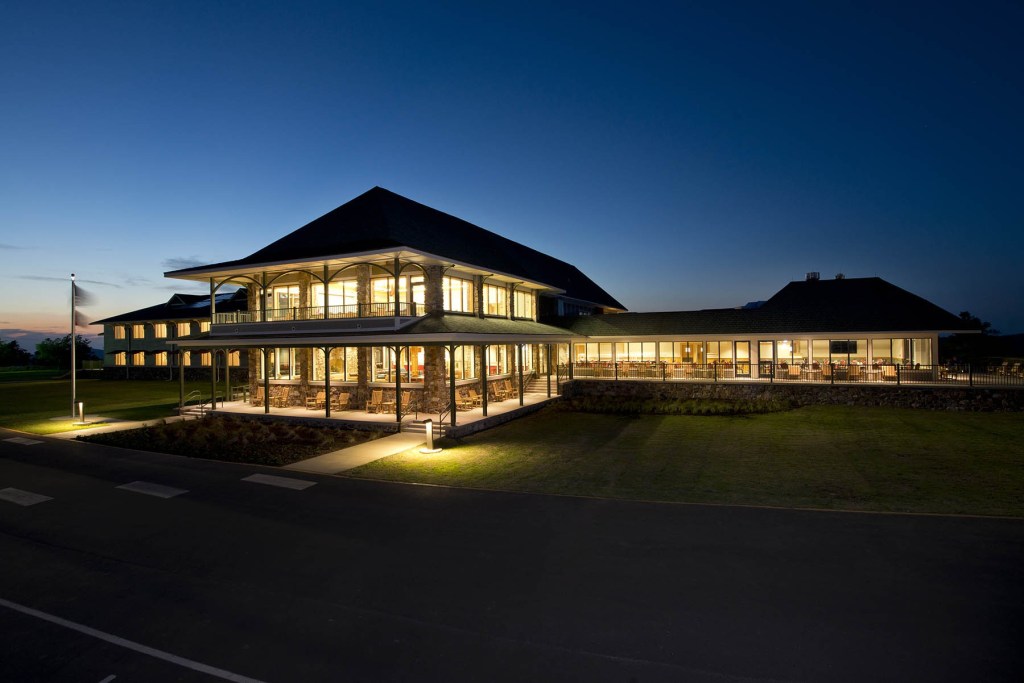
We would be staying in the third revision of the third lodge built on this site atop Rich Mountain. The first lodge was built in 1898 by the Kansas City, Pittsburg and Gulf Railroad. It was named after Queen Wilhelmina of the Netherlands, reflecting how the railroad’s major investors were from Holland. The railroad went into receivership the next year and was sold to become the Kansas City Southern, which still operates the rail line in the valley on the north side of Rich Mountain. The railroad gave up the newly built inn, which operated under different owners until closing in 1910. It fell into ruin, only briefly and partially resurrected in the early 1940s to house a summer music school. In 1957 the site became part of the new Queen Wilhelmina State Park, and the state slowly rebuilt the lodge, using some of the original remaining stonework. The new lodge was completed in 1963 and operated until it burned in 1973. The lodge was rebuilt in 1975, remodeled to some extent in 1981, and that aging structure was the one I stayed in when I hiked the trails there in January 2011.

Queen Wilhelmina Lodges

I can recall how there was no elevator serving the second floor where my room was located, the room was small and old, while the dining room was quite pleasant. The lodge closed in February 2012 and did not re-open until June 2015 after a $9.6 million renovation and expansion. The project was troubled, with long delays and a change in contractors, but the lodge now has an elevator, much larger windows, insulated walls, and grew from 26,300 to 36,500 square feet to expand both the size and number of the guest rooms, add on a new public hearth room and upstairs meeting room on the south side, and remodel the lobby, gift shop, public restrooms, and registration desk. The cost of the project increased to allow for a full re-working of the kitchen as well. But the old high stone chimneys are gone, even though there was a fire of real logs always burning in the hearth room’s new fireplace.

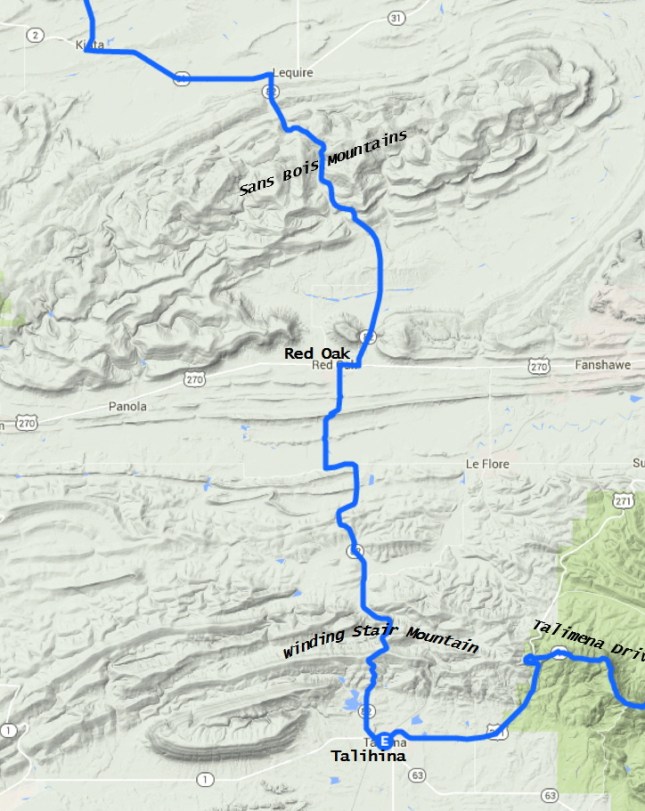
Trip Map

Deciding to Revisit the Queen

For several years I’d been checking repeatedly online to see if the lodge had re-opened, wondering why it was taking years to complete the renovations. Wendy and I enjoyed our stay at beautiful Mount Magazine in June, atop the highest peak in Arkansas. So, when I found the lodge atop the second-highest peak in the state had finally re-opened, we decided that would be our retreat for the start of our break. Having stayed at both concessions, our conclusion is that we’d rather return to Mount Magazine for a future stay, since its spacious and sumptuous lodge is better situated for a dramatic view of the valley below, and its park features more interesting trails. But we still enjoyed our stay atop Rich Mountain.

Our journey began on a Sunday morning, timed so that we could have lunch at the Mazzio’s in Poteau and still arrive at Queen Wilhelmina State Park in time for a tour of its Wonder House, which is located near the lodge. Our spirits lifted along with our car as we climbed the Ouachitas. Having grown up in the flat cross timbers of northwest Oklahoma City and spent many a youthful vacation in a family cabin in the Ozarks, venturing into the mountains always cheers me up. Fittingly, we noted a Kansas City Southern train carrying a large load of coal through the valley below Rich Mountain as we approached our destination; the mountaintop legacy from that rail venture lives on.

Wonder House

Wonder House Porch

We arrived in time for the tour of the Wonder House, a weird combination of two small rock buildings built in the Great Depression by Carlos Hill. He drove up Rich Mountain on a Harley Davidson motorcycle in the early 1930s, living in the area to study at Commonwealth College. He married a local girl, Mary Lance, and they lived on the mountain in a home just east of what would become the Wonder House. Carlos built the first part of the Wonder House as a small rustic cottage for sale. He sold it to oil man C.E. Foster from Muskogee, who paid Carlos and his brother-in-law Phil Lance to add the second structure, which was subdivided into different levels for bedrooms, kitchen, bath, and so forth. The weird structures acquired the Wonder House moniker when they became a souvenir shop in the 1960s.

I’d pondered these sealed-up oddities on my first visit to the park in 2011, wondering what the interiors might look like, given the signage proclaiming that together they housed nine levels, a 21-foot-long bed, and ice-free stairs. Melissa, our tour guide, opened the front building up and let us look around its single room, which had displays about the park and its history. She told us how the exterior stairs to the attic bedroom wrap around the chimney, helping to keep them free of ice in the winter. But our group was not allowed to venture to the cramped upstairs to ponder the 21-foot-long bed where three children once slept head-to-toe. Only children could find that prospect enticing.

Wonder House Levels

Eventually our guide let us into the second building, but I found it quite underwhelming. Its various levels were tiny and built of cheap wood. No one wanted to spend too much time inside, finding the stone work on the exterior of the building and its multitude of windows more interesting. Later I found the property’s documentation for the National Register of Historic Places, which told me that there were once narrow openings between the various levels to allow occupants to pass items from one to another, and there was once an interior ladder in the first building for its bedroom attic. Given the bizarre design and limited functionality of the buildings, I’m not surprised that only one other of Carlos Hill’s houses survives. Melissa said it sits east of the lodge in the employee area and is in need of repairs.

Wendy and I walked around the area, finding remains of stone walls down the hill east of the house, their purpose unknown. Wendy noticed some intriguing frost flowers on some plant stems along our path, and examined the layering of the frost crystal sheets.

First Day at the Renovated Lodge

We drove over to the nearby lodge and relaxed in its spacious hearth room, which has many different tables and settings for small groups of visitors. I enjoyed perusing a binder with photos and articles about the park’s early history and bought a booklet about history of Rich Mountain authored by Bradley H. Holleman. We checked into our room, which had large windows along with a spacious shower in the bathroom. The WiFi had improved since my stay in 2011, with multiple access points along the corridor ceiling, but the internet service was still rather slow. Anything we could get was welcome, however, since cellular service in our room was weak and intermittent.

Wendy was not thrilled by the room’s Keurig coffee maker, and she’d forgotten to pack the old portable coffee pot my father had given her. So we drove down the mountainside into Mena to buy a cheap coffee maker at the Wal-Mart Supercenter and enjoyed a good dinner at The Branding Iron, topping off our chicken fried chicken entrees with some chocolate cream pie.

Lover’s Leap and the Rainbow Forest

We had a late breakfast in the lodge cafe the next day. While the breakfast buffet did have traditional cooked items and was better than some hotel breakfasts I’ve suffered through in recent months, we decided we would order off the breakfast menu the following day so that we could enjoy hot and fresh food. Once the weather warmed sufficiently, with the nippy wind of the day before having died down, we set out on the Lover’s Leap trail for a 1.1 mile loop around the east end of the summit.

Lover's Leap Trail Track
Granger on the trail

This summer I bought a hoodie in Santa Fe, and the chilly weather finally made it feasible for me to wear it on our hike. That prompted a fellow hiker to remark, “Beautiful city!” Wendy would certainly agree, adding, “Great green chile!” I’m excited that we’ll have our summer honeymoon in the Pacific Northwest, but I’m certain that we’ll spend many summer vacations in Santa Fe.

The trail led down the mountainside from the lodge. Through the trees, I could glimpse rainbow hues across the forested valley below. Oranges and red in nearby deciduous trees gave way to green pines and then to the hazy blue mountains beyond. I eagerly sought a clear view for my camera.

Wendy on the Lover's Leap Trail

We admired the stone work of the 1996 trail crew, which forded one of the rock glaciers which moves as a mass instead of rock over rock, preventing the growth of vegetation. Wendy posed for me, and then we climbed our way up and around to the stony projection of Lover’s Leap. The platform there provided a sweeping view of the Rainbow Forest below.

The View from Lover's Leap

The Southern Belle

We then made our way back up to the lodge, with Wendy noticing the spiny red stems of the brambles surrounding us. Up top, the Southern Belle miniature train passed by, its passengers waving at us as they made their way along its 1.5 mile loop. The little train on its 16-gauge tracks has been a part of the park since 1960.

Relaxing with Hitch

Wendy and I had dinner at the lodge, with me enjoying my cheeseburger, augmented by some of the bacon off Wendy’s chicken sandwich. Then we retired to our room, where I hooked up the big flatscreen monitor to the DVD player I’d brought with me so that we could watch Hitchcock’s Family Plot

The next morning, we enjoyed pancakes and French toast with bacon in the lodge cafe, checked out of our room, and headed home.

Talimena Drive

We wondered what autumn colors might be left along the Talimena Skyline Drive, or Talimena Scenic Byway as it is called these days. It stretches for 54 miles along the crest of Rich Mountain westward from Mena, AR on into Oklahoma before ducking over to follow the crest of Winding Stair Mountain on westward, following old truck roads built by the CCC in the 1930s. I’ve driven the route many times over the past 30 years, with fall being my favorite time of year to brave the winding path. Sometimes the route is dangerously foggy as clouds descend to shroud the mountain tops, but this day was bright and sunny, although quite hazy to the south.

Sunset Point Vista on the Talimena National Scenic Byway

The haze meant our best views were to the west and north, with autumnal hues mixing with the green pines and blue hills. Emerald Vista was particularly beautiful on this trip. Wendy and I picked out different views of the same tree in the foreground of our respective shots. I enjoyed signage which noted how the land below had once been so thoroughly deforested by lumber companies that it was sold off to the government as nearly worthless; now that reforested land is a treasure for the eyes, reminding us how a long-term investment in conservation and restoration can re-create what has been destroyed.

Emerald Vista

Elbert Little, Jr. studied several forest sites in southeast Oklahoma over a 60 year period and described the burned out and cutover woods he first witnessed in 1930 as “almost worthless for any purpose, and it would be some time before it was of any value.” By the 1980s, when Little revisited the area, he wrote that he then wished he owned some of it. “The progress in management of southeastern Oklahoma’s forest lands is far greater than anyone would have predicted a half century ago,” he wrote. “The changes, mostly beneficial, are beyond anyone’s imaginations or dreams.”

Highway 82
Highway 82

North Across Two Mountain Ranges

I decided to take an unfamiliar route from the western end of the drive. Instead of heading northeast back toward Poteau, I steered southwest through Talihina, where we laughed at the name of Pam’s Hateful Hussy Diner. We then took Highway 82 north across Winding Stair Mountain to Red Oak. The route was scenic, but the road as winding and difficult as I would expect. Red Oak had an odd purple color scheme on its public works, which Wendy figured out reflected its school colors.

Then we were surprised by the 13 mile stretch of highway 82 leading north from Red Oak across the Sans Bois mountains, east of Robbers Cave, up to Lequire. This section was wide, with multiple lanes and sweeping curves on massive amounts of fill. This unusually modern section of road was not built until the 1990s and is a beautiful drive that seems to belong in another state instead of Oklahoma, with its notoriously poor roads. I don’t know if that highway brought the economic development its promoters hoped, but we certainly appreciated it.

We enjoyed a delicious early dinner at the Oliveto Italian Bistro in south Tulsa and then made our way home. The trip was a blessing, and I give thanks this week for the mountains of southeast Oklahoma and western Arkansas, as well as for the lady I get to share them with.

SLIDESHOW | MOSAIC

Posted in day hike, photos, travel, video | 1 Comment