The second day of our vacation we drove west along I-40 over 250 miles from Oklahoma City to Amarillo, Texas. We broke up the trip with a long stop in Elk City, Oklahoma at their Route 66 and Old Town museum complex.
We had a late breakfast at the IHOP near our hotel before driving a bit over an hour along I-40 to Clinton, where we found their Route 66 museum would not open for several more hours. Not wanting to linger, we drove on to Elk City, which has its own museum complex composed of the National Route 66 & Transportation Museum, Old Town Museum, Farm & Ranch Museum, and Blacksmith Museum. We visited all but the final one, which was unappealing on this hot summer day.
The Old Town Museum featured an opera house, chapel, doctor’s office, rock schoolhouse, grist mill, two sections of buildings housing replicas of early day Elk City businesses, a depot with a miniature train and full-scale caboose, and the Bruening House with its sign for Grubitz Furniture & Undertaking. The evidently deadly furnishings in the various buildings were a bit hodge-podge, and we couldn’t walk through the rooms as we did the day before in Prosperity Junction. The heat and bright sun at Elk City, however, were very real compared to the air-conditioned artificial dusk of the recreated old town in Oklahoma City.
One can, however, walk through the crowded rooms of the former home of a co-owner of the Herring & Young Mercantile stores which once dotted western Oklahoma. We liked an old panoramic photo of Elk City residents showing off all of their then-new Ford Model A’s back in the day. The memorabilia upstairs in the home from the Beutler Brothers rodeos reminded me of the collections from the 101 Ranch one finds in Ponca City.
As we were leaving the museum for a late lunch, we were surprised to see the same Citroën in the lot we’d spied the day before over in Oklahoma City. We enjoyed good BLT and grilled cheese sandwiches at the Home Cookin’ Cafe in the rather rundown Ambassador Hotel on the east edge of town. The Duke showed up as a wall mural above our booth; he looked okay from a distance, but was pretty scary up close.
We scurried along to Amarillo, where we stayed at one of the Holiday Inn Express hotels. Dinner was at the adjacent and rather rowdy Texas Roadhouse, leaving me grateful for the quiet of the hotel room where I struggled to connect my new Canon Powershot SX280 HS with my iPad over the hotel WiFi. Later I would learn to just tell the camera to become a wireless access point for the iPad to connect to.
We would spend the following day at an RV museum and Cadillac Ranch in Amarillo before heading west over 280 miles to downtown Albuquerque, New Mexico.
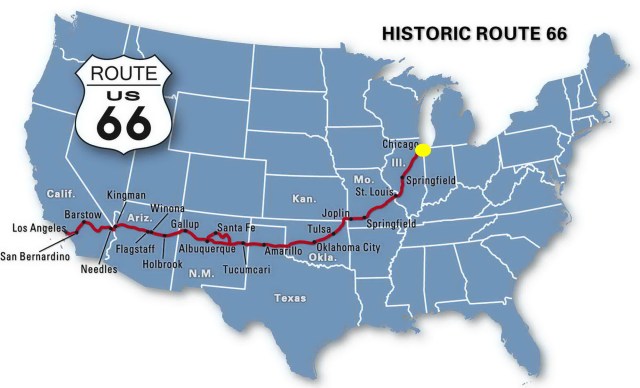
On the first day of our trip west, Wendy and I drove south to Tulsa to begin our journey westward along the modern replacements for historic Route 66, which originally ran almost 2,500 miles from Chicago, Illinois to Santa Monica, California and was immortalized by the song Get Your Kicks on Route 66. Nat King Cole made the song famous, but it has been covered by many artists. As one would hope, Chuck Berry gets the tune rocking, and it remains popular to this day with covers by Asleep at the Wheel and others. But if you want to hear a more complete version of the song, including seldom-heard lyrics, listen to Perry Como’s version.
But for this trip I wanted enough time off the highway to introduce Wendy to one of the major museums in Oklahoma City. So we took I-44 along the Turner Turnpike instead of what is today marked Oklahoma 66. This meant that we, like the vast majority of motorists, bypassed one town after another via the turnpike, towns which are still linked by the old free road: Sapulpa, Kellyville, Bristow, Depew, Milfay, Davenport, Chandler, Warwick, Wellston, Luther, Arcadia, and Edmond. The high-speed limited-access interstate cuts 37 minutes off the 2 hours and 21 minutes it takes to make the journey from Tulsa to Oklahoma City on old 66, never mind how long it must have taken to drive a Model A along the original meandering route in the 1930s or the slow progress of the converted Hudson truck which carried the most famous travelers of Route 66: the fictitious Joad family in Steinbeck’s The Grapes of Wrath, whodidn’t join the Mother Road until they reached Oklahoma City.It was fitting that our own journey along the 66 route began in Tulsa, since that was the home of Cyrus Avery, the Father of Route 66.
Does a Cowboy Hall of Fame by any other name smell as sweet?
Our destination, after a tasty lunch at a TGI Friday’s in Tulsa (the French Dip is back!), was the National Cowboy & Western Heritage Museum in Oklahoma City. I visited it repeatedly in my youth, back when it was new and was called the Cowboy Hall of Fame. Persimmon Hill in northeast Oklahoma City was selected as its location in 1955, but it would be a decade before the museum opened. It declined into receivership by the mid-1980s, but in the 1990s was revitalized and expanded to over three times its former size, changing its name in 2000. My father helped me discover some years ago that the best time to visit the museum is during the annual summertime Prix de West invitational exhibition, with several galleries filled with wonderful paintings and sculptures which are for sale. That event highlighted our visit.
One of several versions of End of the Trail
The museum’s redesign means that what was once the end of a visit is now the beginning: the 18-foot plaster version of James Earle Fraser’s End of the Trail. In 1894 Fraser created a small bronze version of the piece for the World’s Colombian Exposition in Chicago; the monumental reworking in plaster was created for the 1915 Panama-Pacific International Exposition in San Francisco, California. World War I meant that bronze was not available for a casting. While many plaster sculptures for the exposition were destroyed, the residents of Tulare County, California, rescued and restored End of the Trail and placed it in Mooney Grove Park in Visalia, California. In 1968 the Cowboy Hall of Fame acquired Fraser’s studio collection, and the plaster version was acquired by the museum in exchange for having a bronze version cast from it which was placed back in Mooney Grove Park.
Coming Through the Ryerepresents four cowboys mounted on broncos dashing at full gallop, waving their six-shooters over their heads with quirts flying from their wrists. They have the spark of abandon and deviltry in their hollow eyes; and their mouths are open as though in the act of shrieking out some wild Western apostrophe to the red gods of recklessness. The broncos, snorting and straining forward, are shoulder to shoulder, and their flying hooves emphasize the devil-may-care of such a mad ride.
What I wasn’t familiar with was the title of the work. It turns out that Comin’ Thro’ the Rye is a poem/song by Robert Burns with several versions. His bawdy version of the piece, with a certain four-letter verb replacing ‘kiss’, seems in keeping with spirited cowboys riding into town to see their, er, sweethearts. Literary types will know that the poem became widely known in the 20th century because of Holden Caulfield’s misinterpretation of it in Salinger’s The Catcher in the Rye, but I’ve never read that book, already having enough teen angst and alienation in my line of work.
Buffalo Bill
Wendy and I strolled through the grounds, although it was hot. They’ve done a lot of work to make the grounds more refreshing, with many rock ponds and plantings. The old plaza, however, is no longer a big fountain pool. Leonard McMurry’s 33-foot 19-ton statue The Legend of the Westerner, which depicts Buffalo Bill Cody, was added to the grounds in 1976 and once dominated the skyline as one drove past Persimmon Hill on I-44. But the trees have grown up to fully obscure it from the road. My favorite memory of this statue is when it had a wasp nest stuck in the horse’s crack, which explained why it was rearing up!
Canyon Princess
My favorite statue at the museum these days is one they added in 1995: Canyon Princess by Gerald Balciar, a 15-foot-high 8-ton depiction of a female cougar in Colorado yule marble. The beautiful sinuous lines of this cat, contrasting to its blocky bluff, greet you as you enter the main art galleries. I had Wendy pose beside it so you can grasp its scale, and if you look closely you might notice she is fittingly wearing a Grumpy Cat T-shirt.
One of the later parts of our tour was a walk through Prosperity Junction, the recreation in the museum of an old western town at dusk with interesting audio accompaniment. I liked seeing and hearing that again, although I dearly miss the tiny old mine and train tunnel down in the basement of the museum which I loved passing through as a child.
Two displays at the museum that would be echoed repeatedly on our travels on this trip were of cameras of varying vintage and images of John Wayne. I have my own online camera gallery, while I have far less interest in The Duke. I think the only two movies of his I recall beyond their titles are Operation Pacificand The Alamo. I know I’d probably enjoy some of the films he made with director John Ford if I worked up the courage to see them, but I burned out on bad westerns as a child and thus generally avoid that genre.
We exited the museum to find a couple climbing into their old Citroën, a 2CV6, in the parking lot. Little did we suspect we’d see them again the next day when we stopped at the museums in Elk City, Oklahoma to break up the long drive to Amarillo. Our day concluded with a visit with my folks and dinner out with them at Johnnie’s. We spent the night at our hotel of choice in OKC, the Cambria Suites, before heading due west for the four-hour drive to Amarillo in the dry and dusty heart of the Texas panhandle.
Wendy and I have returned from our big summer vacation, which was 11 days along the modern equivalents of historic Route 66 west from Tulsa as far as Albuquerque, New Mexico. Our focus was a long stay in Santa Fe, which also happened to be along the original route of old US 66. As my schedule permits over the coming weeks I’ll be posting about our adventure, narrating photos of our road trip out west.
Wendy and I wanted to get out of town for some summer sightseeing, but not hiking since the weather was hot and humid. We ended up circumnavigating Lake Oologah southeast of Bartlesville as we made tourist stops in Claremore and visited Totem Pole Park east of Foyil.
Hammett House
Do not want
The biggest attraction in Claremore is the Will Rogers Museum, but we had seen it before, albeit separately. Next door is the Hammett House restaurant, which my friends Carrie and Trish introduced me to years ago. Wendy had the Chicken Fried Chicken Salad and I had the Sweddar Chicken Sandwich (swiss and cheddar cheese with bacon on top); both were tasty. For dessert she wisely chose a slice of Buttermilk Chess Custard pie while I unwisely chose the special, a slice of Key Lime Cake from a recipe by Trisha Yearwood. Ugh; I reckon she sings better than she bakes.
Belvidere Mansion
Our next stop was the Belvidere Mansion (yes, that is the spelling). John and Mary Bayless and their seven children moved from Cassville, Missouri to Indian Territory back in 1901. Mr. Bayless had been involved with the railroads in Missouri, Arkansas, and Indian Territory, and was attracted to Claremore over Tulsa because at the time Claremore was larger and also boasted two railroads. There is still a busy rail line running through the heart of town today, which causes traffic jams. The city has been working for years on plans to elevate the tracks, but for now thirty-four daily trains regularly divide the town in two.
Construction of the mansion ran from 1902 until 1907, being finished shortly after John Bayless had died. Mary and the children lived in it until 1919, but in the 1930s it was converted into twelve apartments. It fell into disrepair by the 1980s and was saved from demolition in 1991 when the Rogers County Historical Society purchased it and began restoring the 9,000 square foot home, which originally had six bedrooms and three bathrooms. Here is a video they produced:
The first floor kitchen, dining room, and ladies’ parlor are used as an active tea room for lunch and was quite busy during our visit, while the gentlemen’s parlor is now a gift shop. The foyer has one-inch octagonal porcelain tile, hand-laid by an Italian craftsman. We had earlier noticed the tile on the entry porch. The foyer also has marble wainscoting, while the wood in the home was bought from a World’s Fair. The pressed tin ceilings flow down to pressed tin walls, an unusual feature we noticed.
The foyer has an open central atrium forming a shaft to the upper two floors, topped by a skylight. This worked with the room door transoms as a heat chimney so that three gas fireplaces on the main floor could warm the other rooms. Since the first floor was filled by the tea room and gift shop, we soon climbed the old stairs to the second floor. They leaned, reminding me of the much larger old stairs at the Crescent Hotel in Eureka Springs.
The third floor was the most pleasant, being entirely devoted to a 3,000 square foot ballroom with towers and central skylight. This bright and cheerful space is rented out for parties and weddings.
We enjoyed our visit to the mansion and walked a half block northwest to the former Will Rogers Library, hoping to see the surrey with the fringe on top from the Broadway musical Oklahoma!, but it was closed. I later learned this museum is a work in progress and is open by appointment only. We had to satisfy ourselves with the Lynn Riggs Memorial statue out front.
Lynn Riggs Memorial Statue
Lynn Riggs was born near Claremore and wrote Green Grow the Lilacs, the play upon which Oklahoma! was based. I’m amused to find he wrote the play while living in France on a Guggenheim Fellowship; maybe he was homesick. The statue of him is showing its age; the pages of his book are torn and I think he has skin cancer on his forehead. Not to mention how the poor fellow is growing up out of, um, lilacs? Lynn didn’t explain what was going on, he just sat and stared. It was time for us to venture over to a place I haven’t visited in decades, home of the world’s largest privately owned gun collection.
J.M. Davis Arms and Historical Museum
John Monroe Davis had run a sawmill in Arkansas before he moved to Claremore in 1917 and bought the Mason Hotel, which he and his wife steadily filled with guns, beer steins, and other items. He gave his collection of 11,000 guns and his wife Genevieve donated her collection of 1,200 beer steins and much more to the state in the 1960s, which built a 40,000 square foot museum to house and organize the stuff. J.M. wanted to be buried with his guns, so oddly enough both he and Genevieve are entombed in one of the rooms.
On our way through town we admired a couple of nice exterior wall murals by Steve Stephens. His flowers were pretty, but I really liked his train busting through a wall. We soon were headed northeast on old Route 66 towards Foyil, where we’d turn east and head a few miles over to tour Ed Galloway’s park of folk art.
Totem Pole Park
Ed Galloway wanted to keep busy after he retired in 1937 to some land east of Foyil after teaching woodworking and building in wood and stone at a Sand Springs orphanage for over twenty years. For 11 years he built an enormous concrete totem: a sandstone cone perhaps sixty feet tall or more and of similar circumference, supported by a steel armature and covered with a concrete skin which he decorated with 200 bas-relief images of brightly colored Indian portraits, symbols, and animal figures. It sits on a sculpted turtle as its base and includes some more painting and reliefs on the first level of its interior.
Ed also carved about 300 fiddles, each in a different type of wood, housing them in a nearby house which reflected his folk art. He passed away in 1962 and his Totem Pole Park fell into disrepair. In 1970 many of the items in his Fiddle House were stolen and never recovered, and eventually his house became a ruin. In the 1990s the Rogers County Historical Society acquired the property. The home was rebuilt and the Kansas Grassroots Art Association restored the various sculptures as well as his Fiddle House, which is now a gift shop to help maintain the property. The concrete sculptures require occasional repainting, and in 2010 Virginia Krugloff, a local artist and member of the historical society, repainted the totems. She was in her mid-70s and they only allowed her to climb up two levels of scaffolding on the main totem, so the upper part still needs repainting. What a gal!
The park has a much older cat which Ed carved from stone, various pillars, picnic tables, and more along with the Fiddle House, which we toured and where we chatted with a lady who lives on the grounds. There are about 15 of his original fiddles on display along with historical photos.
One story is how Ed’s wife Survilia “Villa” Hooton (Ed is on the far left in this photo, and his wife is next to him) once taunted him with her own variation of Joyce Kilmer’s poem Trees: “Totem poles are made by fools like thee, but only God can make a tree.” Galloway promptly crafted a 12-ft. concrete tree trunk, with holes for birds to live in; it is in the background of this shot. I found that one less than photogenic, but we did like his shorter tree and its grinning face matched Wendy’s as we headed back home through Chelsea, New Alluwe, and Nowata to complete our Rogers County roundabout.
Wendy and I plan to hike during our trip to Santa Fe, NM in a few weeks. As it had been a month since we’d been out on a real hike, we decided to rectify the situation with a loop on Turkey Mountain down in Tulsa. The forecast called for sun and temperatures in the mid-80s with strong winds, so Wendy wisely called for a hike mostly in shade. I selected Turkey Mountain since most of its trails, except for the Powerline one, are under tree cover. We fortified ourselves at El Chico and then headed over to the mountain to hit the trails.
There are several long trails paralleling the north-south ridge of the mountain. About a year ago Wendy and I hiked the yellow loop and a bit of the pink one; the yellow loop uses the Ho Chi and Ridge trails, and I’ve been on it multiple times. I’d also hiked the Hi Chi trail with some colleagues back in September 2012. I wanted something different on this foray into the urban wilderness, so I studied the very nice River Parks map of the venue, which was made possible by the GPS trail mapping of Ron Haveman, who is listed as #55 on the Tatur running club site.
I opted to take the Lo Chi trail which runs along the shore of the Arkansas River down below the Ho Chi trail but above the paved River Parks trail. When the Lo Chi petered out, we could then climb up to the Ho Chi trail, turn around at the Spider area, and take another trail I’d not ventured down, the Millennium (presumably misspelled as Millenium on the map). I hoped to also follow the Enchanted Forest trail, but made a wrong turn today and instead we negotiated the final leg of our hike on the well-travelled blue trail.
Before setting out, we slathered on some sunscreen and sprayed ourselves with insect repellent. We headed due east on the paved River Parks West trail until I spied the turnoff for the Lo Chi trail, leading off northeast through the tall grass and weeds of a powerline cut. Thankfully it soon entered the forested slopes of the mountain. Two mountain bikers soon passed us and were the only other people we saw on the Lo Chi trail, besides a family who were exiting the trail as we left the paved trail. The trail runs below the tall bluff on which the more popular Ho Chi trail runs; we caught occasional glimpses of the bluff through this urban jungle. We saw a couple of ramps on the trail constructed for thrill-seeking bikers, and made use of one bridge.
We reached the north end of the yellow trail loop and turned about, finding the Millennium trail as the planned alternate to the typical Ridge trail. I was very pleased with this change, as the Millennium trail was narrower, less travelled, and sometimes quite photogenic. A brief foray down an unmapped connector revealed a huge toadstool, while on the main path there was a white mushroom growing out from under a rock and other fungi shaped like a star and a heart.
We missed the intended Enchanted Forest trail to the south, instead following the sandy Blue Trail back to the parking area, where we cleaned up a bit before heading back north to Bartlesville.
That night we attended the Grand Finale Concert at OK Mozart. We’d enjoyed excerpts from The Magic Flute on Wednesday, attended the Sarah Jarosz concert on Thursday, and this night would feature a rousing performance of Beethoven’s Symphony No. 9 in d minor by the festival’s Amici New York orchestra, joined in the spectacular final movement, featuring the Ode to Joy, by the Bartlesville Choral Society, additional choral groups from Stillwater and Tulsa, and four gifted vocal soloists who had sung semi-staged parts in The Magic Flute two days earlier. It was indeed a Grand Finale, with the Community Center thundering with the exuberant sounds of this miracle, which is beloved worldwide and was completed when Beethoven was completely deaf from tinnitus.
What a splendid day it was for us, sharing lunch at our favorite restaurant, followed by a nature hike, and capped off with the Beethoven’s most exciting symphony. Egad!









 Meador Manor