Kicks on 66, Day 5: Kicking Around Albuquerque

July 2, 2014

We spent most of our fifth day directly along old Route 66 in Albuquerque before heading northeast in the afternoon to Santa Fe, with a stop at the ruins of the Kuaua Pueblo in Bernalillo along the way.

Stephen Hawking wrote that he limited himself to only one equation in his bestseller A Brief History of Time, since he was warned that each equation he included would halve book sales. (The physics teacher in me wonders if you can guess which equation he included, and also whispers, “So the number of equations is inversely proportional to book sales.”) I hope something similar doesn’t apply to maps in blog posts, because this post has several, since a sense of place is important to me in this travelogue.

Pillow Vase by Orion Aragon

A Day Along Route 66

Much of this day was spent along Central Avenue, the path of old Route 66 through Albuquerque from 1937 until the highway was decommissioned in 1985. But Central’s history dates back to the 1700s or earlier, when it was a dusty trail that evolved into the city’s major east-west street, which then was called Railroad Avenue. Back in the days before tuberculosis was driven back by antibiotics, some sufferers came to Albuquerque for the dry air, and in 1908 the Presbyterian Sanitorium was built. Although Railroad Avenue had been renamed Central Avenue by then, it came to be called TB Avenue locally. With TB brought under control, the sanitorium’s future was in doubt by the 1950s, but it evolved into the Presbyterian Hospital Center, the largest acute care center in the state and sits at the junction of Central and I-25 between downtown and the University of New Mexico.

Day 5 City Map

Before 1937 there was a big kink in Route 66 which diverted it, travelling east to west, from Santa Rosa up to Santa Fe before returning to Albuquerque. That kink is why we can say we spent almost the entire vacation along Route 66, even though in 1937 the kink was straightened out and The Mother Road began to skip Santa Fe, cutting 107 miles off its length. That era brought many travelers along Central Avenue, and the typical motor courts, restaurants, and curio shops to serve them.

Route 66 once went through Santa Fe

Several motor courts are still hanging in there, and we noticed them the day before when we drove several miles east of the Frontier Restaurant, looking for groceries and extending our search to enjoy more of the old route. Today we’d walk a bit along Central before lunch, then head a few miles east to the university district for lunch, then back west a few miles to the oldest part of Albuquerque.

Albuquerque Districts
I imagine her asleep inside the Telephone Museum

Downtown District

Our day began in the downtown district on the streets around Hotel Andaluz. We intended to walk over a block or so to the Telephone Museum of New Mexico to satisfy my geeky curiosity. The museum says it is only open from 10 until 2 on Wednesdays and Fridays, so this Wednesday morning was our shot! But, sadly, it was shuttered. Perhaps the reconstruction of the street was to blame, but I like to think there is only one docent, an old grandmotherly switchboard operator, who has fallen asleep inside. If only she had posted her telephone number outside, we could have called and roused her.

KiMo Theatre Entrance Ceiling

So we had to content ourselves with examining the exterior of the KiMo Theatre, a Pueblo Deco movie house constructed in 1927 and designed by Carl Boller and George Williamson. The name was coined by Isleta Pueblo Governor Pablo Abeita, who won a prize of $50 for the name, a combination of two Tiwa words meaning “mountain lion” but liberally interpreted as “king of its kind”. Interestingly, the K should be soft, not hard, so it should be pronounced “him-o”.

Like so many inner city theaters, the place fell into ruin by the 1970s and was slated for demolition, but the city saved and restored it. Wendy and I enthused about the wonderful entrance, with every surface decorated. There was splendid tile work on the floor and walls, nice wall imagery, creative overhead plaster work, and custom doors inviting one in. This is the sort of attention to detail that really sells: don’t you just want to yank those doors open and peek inside? I wish a movie had been showing at the KiMo during our brief stay in Albuquerque so we could have seen the interior in person.

University District

Best chicken enchiladas ever, according to Wendy, at El Patio de Albuquerque

Joe Falkner admitted he was jealous we got to follow his advice to eat at the Frontier Restaurant, and followed up with a recommendation for El Patio de Albuquerque, which is situated in an old house about a block away from the Frontier near the university in the Nob Hill neighborhood. Once again we were glad we followed his recommendation.

David Sandoval, a retired engineer and Vietnam War-era Marine, opened El Patio almost 40 years ago after living in Hollywood. His goal was simple: create a restaurant focused on local cuisine but with an environment that could remain edgy and cool so the place could transcend generations and withstand changes to the neighborhood. David is around 70 years old now, and his restaurant continues to thrive. I enjoyed my tacos and my sopapilla was great, while Wendy says her green chile chicken enchiladas were the best EVER. She stopped to take a photo after a few bites, so I believe her.

Old Town

Virgin de Guadalupe carving in cottonwood tree stump near San Felipe de Neri church

After lunch we drove back along Central Avenue, past the Hotel Andaluz, to Old Town. My father took me here over 20 years ago, and, at the time, I was not very impressed. My impression was that it was hot, dusty, and old with lots of shops and little else. Well, it was hot on this visit with mostly shops, but it wasn’t dusty, and a nearby museum was modestly entertaining. Let’s face it, Albuquerque is no Santa Fe in regards to the historic district. But it was a worthwhile stop, especially since I made my big art purchase of the summer while I was there.

In 1706 a group of Spanish families settled in the spot, not far from the Rio Grande, organizing their new town in the traditional Spanish colonial way, with a central plaza anchored by a church. So it is reminiscent of the historic district of Santa Fe, with a plaza and gazebo, old church, shops, and nearby museums. Santa Fe’s plaza dates back to 1610 and boasts the Saint Francis Cathedral, which I’ve admired on previous visits to Santa Fe and was built between 1869 and 1886 on the site of an old adobe church. So Albuquerque’s adobe San Felipe de Neri church, which was built in 1793 after the original church collapsed in a rainy summer, is older and less pretentious. The interior is far less ornate than the Santa Fe cathedral. Outside the Santa Fe cathedral is a striking statue of Saint Kateri Tekakwitha, while Albuquerque’s church has the nearby remnant of a cottonwood tree into which a parishioner carved the image of the Virgin de Guadalupe back in 1970.

Don Francisco Cuervo y Valdés

At the north end of Old Town is an equestrian statue of Don Francisco Cuervo y Valdés, who founded Albuquerque. The Christian Cross stirrups were a bit much, I must say.

Wendy and I strolled the shops, but I did not expect to buy anything. I have two expensive framed photographs in my living room from previous visits to Santa Fe, both the work of the very talented Amadeus Leitner. They are both of New Mexican scenery: one is a gorgeous, painterly take on Shiprock and the other a large panorama from Chimney Rock at Ghost Ranch. I wasn’t looking for another large photograph for this trip; in fact, I wasn’t even thinking about purchasing another art work. Until we passed Gallery 8.

Pillow Vase

In the display window was a pillow vase the staff said was by Diane Aragon of the Acoma Pueblo. I’m no fan of pottery, despite enjoying learning about Maria Martinez a day earlier, but was intrigued by this vase’s overall shape, partially serrated opening, the handle hole filled by a suspended spinnable carved ball (which is a distinguishing characteristic of her work), and most of all by the shading of the airbrushed glaze across the incised carving of an eagle kachina dancer, contrasting with the smooth but richly colored reverse. Diane and her husband Wilbert “Junior” Aragon are both full-bloods of my age, with Wilbert coming from the Acoma pueblo.

Pillow Vase by Orion Aragon

I tried to be casual as I strolled about the shop, conversing with the very friendly and helpful staff. But I couldn’t help returning to that particular pillow vase, knowing it would look splendid on the mantle above my fireplace, next to my glass “Roots and Wings” sculpture. I asked for Wendy’s preference between two different pillow vases, and she favored the same one I did, which is signed “Orion Aragon, Laguna Pueblo N.M.” That sealed the deal, and soon it was being carefully boxed up for me. It is now adorning my mantle as the third beautiful reminder of New Mexico which I see every day.

Albuquerque Museum of Art & History

Not at all true to life

After dropping off my bundle in the car, we walked over to the Albuquerque Museum of Art & History. Well, it is a little light on both counts, compared to what is on offer up in Santa Fe. Wendy and I were both surprised at the number of visitors roaming about, given the rather limited galleries. A Christo exhibit did not impress either of us at all, since his work is almost entirely large-scale, temporary landscape works.  Another gallery had an exhibit about Vivian Vance, famous for playing Ethel Mertz, Lucille Ball’s sidekick on TV. Vivian was born near where I now live, up in Cherryvale, Kansas. She became interested in drama at the Independence, KS high school and rebelliously moved to Albuquerque to become an actress, including performing at the KiMo Theatre we had passed by earlier that day. Vivian’s youngest sister was sitting in the gallery talking to patrons, but I didn’t take the time to ask her about Vivian’s infamous feud with co-star Bill Frawley.

The outdoor sculpture garden was a bust. The only exterior works I liked weren’t in that garden: The Dancer, 1989 by Michael Naranjo, the beautiful stone used for the museum walls, and a decorated entryway into Old Town. But inside the museum’s galleries there were some paintings we liked.

Star Road and White Sun by Ernest L Blumenschein

Wendy liked Landscape – Velarde, New Mexico by Victor HigginsSanta Fe by B.J.O. Nordfeldt, and Painting #231 by Ed Garman. I liked OU graduate John Fincher‘s “Revlon painting” of The Burning of Albuquerque with its very bold colors and unsettling plant in the foreground, creating a sense of tension. The coloration, clarity, and context of Ernest L. Blumenschein’Star Road and White Sun made it a standout, with the younger Taos Pueblo Indian Star Road, in his non-traditional attire, seeming to eclipse the older White Sun, who introduced peyote to the pueblo in 1907. Blumenschein sold this and other “top notchers” to Albuquerque High School for less than a tenth of their value back in the 1940s to support the school’s principal and his efforts to create an art center.

The standout painting, however, full of modern and classic imagery and iconoclasm, was in the corridor of the museum. Patrick McGrath Muñiz filled his 2010 Disneyfication of a Hero with religious, artistic, and pop culture references. Part of his thinking is how we miss some of the iconography in old paintings due to cultural amnesia, so which references in his painting were known in the past and which will be recalled in the future? Wendy and I had a ball finding different references, from Bart Simpson to Bugs Bunny, from Teletubbies to the Death Star. There are references to the Pharos of Alexandria, the destruction of native cultures by imperial Spain, and there’s a cupid with a gun and a video game controller, his bottom obscured not by the traditional ribbon but by unrolling toilet paper. There is much more to see, and this is one painting worth viewing in your web browser at full resolution so you can tell that even the frame is actually painted symbolic figures.

The Disneyfication of a Hero by Patrick McGrath Muñiz

“Disneyfication of a Hero” is one of my largest paintings at the moment. In this piece I have represented various mythic and historical characters in an anachronistic narrative. As the title suggests the painting is about cultural transformation. The term “disneyfication” implies a process by which an object, character, place, artwork or piece of literature is stripped from its original context and meaning and repackaged in a sanitized Disney-like version ready for mass consumption. The central figure is a representation of the classical hero Hercules. As the rat magician rises above a TV screen making a commanding gesture, our hero holds a hair wax removal cream on his left hand. Inspired in Renaissance tradition I created a composition that reflects on a procession of “trumps.” Just like in the Tarot cards and in many pagan and Christian festivities every character is followed by one of a higher rank or position. Behind the hero I have painted allegorical figures that represent Time, Conquest, Childhood, Promised Land, Fame, Fortune and Death. These allegorical figures are accompanied by small Disney-like characters and other consumer culture related icons. The group is about to encounter a fortunetelling gypsy sitting with three Tarot cards. On the background there are other parallel stories taking place. Diego De Landa, a 16th century Spanish archbishop burned countless Mayan scriptures, erasing Pre-Columbian history in the name of Christianity. When placed in the same painting the narratives connect with new meaning. The burning and destruction of books, of history in the past doesn’t seem so distant from our contemporary consumer oriented corporate evangelists.
-Patrick McGrath Muñiz

Kuaua Pueblo

It was time to head to Santa Fe up along I-25, although first we stopped by the Golden Crown Panaderia in downtown Albuquerque to get baked goods. We got “Blue Corn” biscochitos, New Mexico wedding cookies, a lemon empanada, and other treats.

We stopped along I-25 at Bernalillo to visit the Coronado Historic Site, which is more important for its ruins of the Kuaua Pueblo than because Coronado once camped near there. I had planned to use the Culture Passes I purchased in advance, but we arrived so late they just waved us in for free, urging us to look around while we still could.

The pueblo was inhabited by Tiwa-speaking farmers from about 1325 CE to about 1550 CE. Kuaua is a Tiwa word that means “evergreen”, and the Rio Grande and great views of the Sandia Mountains are found on the eastern edge of the site. There are low reconstructed walls from the 1930s showing the layout of the pueblo. It was warm: Wendy’s notes say, “Kivas, heat, murals, heat, Rio Grande, heat.”

Panorama beside the Rio Grande with the Sandia Mountains at Kuaua Pueblo Ruins

The greatest discovery at Kuaua were murals, painted as frescoes over a period of about 75 years in the 15th Century. They were found in kivas and are some of the best examples of Pre-Columbian art ever found in North America. An eager intern led us through a display of them, cautioning us that we could not use flash. Sadly we were too late to climb down into a reconstructed kiva on the grounds where they display what the murals might have looked like centuries ago. The intern described what archaeologists once thought some images represented – ideas which have since been revised. That is a mark of good science: questioning and refining what you think.

Our casita in Santa Fe

Cool Santa Fe

We arrived in Santa Fe around dinnertime and checked into our casita where we would stay five nights. It was within easy walking distance of the plaza and only one block from the Railyard. We were tired and ready to eat, so we strolled through the cool air over to Tomasita’s at the Railyard. We were both giddy from the cool air after the heat of Kuaua Pueblo and being stuck for awhile in a traffic jam on I-25.

At Tomasita’s I had the same thing I had eaten there previously: blue corn chicken enchiladas. Wendy had tamales, which she proclaimed as the best EVER (today was the day for great food!), and she loved the green chile sauce. We had more delicious sopapillas to boot. There is a great story online from Georgia Maryol about how she met Tomasita and took the plunge in 1974 to run a cafe which they built the business into the thriving spot is it today.

We walked to the plaza, feeling the cool air and seeing clouds building to the northeast; the sky was like a painting. Low-riders were rumbling by the plaza, passing the shop windows of curios and artworks. A group was performing at the gazebo, and we listened and relaxed until droplets of rain warned us to return to our casita. We passed the old state capitol, beautifully lit under a swelling sky. A light shower descended, with Wendy using an umbrella and me charging along in my Tilley hat, arriving a bit wet but very happy at our little shelter.

Old State Capitol

The next day we’d venture out to Bandelier National Monument to hike along Frijoles Creek, which was closed by the Los Conchas fire when I first tried to hike there three years previously.

Click here for a slideshow from this day

Day 6 of Kicks on 66 >

< Day 4 of Kicks on 66

Posted in art, photos, travel | Leave a comment

Kicks on 66, Day 4: Albuquerque

July 1, 2014

The fourth day of our vacation was spent in Albuquerque, riding the tram up to the crest of the Sandia Mountains and visiting the Indian Pueblo Cultural Center.

Approaching car

Hotel Andaluz

Hotel Andaluz

For our two nights in Albuquerque, I had selected the Hotel Andaluz downtown, right off old Central Avenue, which is the long stretch of Route 66 through the city. The hotel opened as a Hilton back in 1939 and the $700,000 ten-story structure was the tallest building in New Mexico when it opened and the first with air conditioning. Architect Anton F. Korn designed it in the New Mexico Territorial style, with earth tone stucco, brick coping along the roof line, and southwest-style woodwork and furnishings. Over the years it changed hands at least five times, with a major renovation in 1983 followed by another 30 million dollar renovation from 2005 until it re-opened in late 2009. The renovations decreased the number of rooms from 176 in 1939 to 114 in 1983 and now 107.

The hotel is conveniently situated near the revitalized arts and entertainment district; a Wikipedia photo by Asaavedra32, which I brightened up, shows the colorful murals in the area; the windows of our room at Hotel Andaluz are visible at the center right. I hate valet parking, so I was happy there was a fairly inexpensive public garage adjacent to the hotel; Wendy is fun to travel with, always willing to join me in schlepping luggage.

The hotel’s new name reflects the Andalucia region of southern Spain, and the renovated facility boasts of its Gold LEED certification, achieved in part by low-flow bathroom fixtures which did not impress Wendy. She wasn’t at all fond of the bathroom in our 8th floor Corner Vista Suite, with its door-less shower and no tub and a sliding panel between the sitting area and bathroom, instead of a traditional door or pocket door, which provided limited privacy. She said that a flimsy curtain separating the sitting and sleeping areas would better serve as a shower curtain.

Hotel Andaluz Lobby

Despite these drawbacks, the hotel was quite beautiful. The lobby with surrounding mezzanine was elegant, with a lit central fountain, striking glass panels shielding the elevator area, and a series of sheltered alcoves for private conversations and contemplation. We found it a welcome retreat at the end of a busy day, snacking on chocolate in an alcove which had a water wall lit by soothing patterns of light. The hotel staff were happy and helpful, pampering us. Our suite had its own pretty touches, with a Moorish arch between the sitting and sleeping areas and it lived up to its name, providing particularly nice views to the east.

View from our room at Hotel Andaluz


Breakfast and Art Downtown

We began our day strolling around downtown and discovered that flanking Central Avenue were streets named Gold, Copper, Silver, Lead, Iron, and Coal. We were snooty and ate breakfast at the Gold Street Caffe, not giving one thought to dining on Lead, Iron, or Coal.

Building Mural in Downtown Albuquerque

We passed a colorful and clever building mural, called The Mother Road / El Camino De Los Caminos, designed by Joe Stephenson in 1995. It repurposed a side vent as an airplane engine and cleverly blended with a rock wall on one end and a doorway on the other. A nearby building had its old window strips filled in by large artistic murals. Students of Gorden Bernell Charter School, which serves adults, had painted a Plant Your Futures mural on another wall.

The Occidental Life Building featured beautiful Venetian Gothic Revival architecture with striking white terra cotta. Built in 1917, it burned in 1933. But, like the Johnstone/Sare building in downtown Bartlesville, the exterior walls were left standing up to the roofline and the building was rebuilt behind them. The old Baum Building in Oklahoma City also featured Venetian tropes, but was lost in the misguided urban renewal which destroyed so much of my hometown’s central core. Thankfully the city finally woke up and tried selective re-use over wanton destruction in its successful MAPS projects.

Sandia Peak Tramway

Tramway car arriving at the lower terminal at Sandia Peak

On a couple of previous visits to Albuquerque I had ridden the tram which ascends 3,819 feet to a crest of the Sandia Mountains. But Wendy had never ridden a tram before, so after breakfast we headed over to the mountains, which are a ridge stretching 17 miles north to south along the eastern edge of the city. Their name, Sandia, means watermelon in Spanish. One tram operator said the name came from the appearance of the western side of the ridge, but she also mispronounced mountain as “mou-innn”. It is also said that the Sandia Indians believe that the Spanish who first visited the pueblo in 1540 mistook the native squash being raised there as watermelons and that led to the name.

One of the tram cars was coming into the lower terminal as we drove up. There are only two towers between the lower and upper terminals, which are 2.7 miles apart, so one clear span reaches 7,720 feet; that is the third longest such span worldwide. The tram has two cars, with one rising as the other falls. They can each carry 50 passengers at about 14 miles per hour, but must slow down as they pass each tower, so the trip to the top takes about 14 minutes.

The car windows were heavily tinted and the car operators pointed out various rock formations during the journey. We passed one section of rock which had to be blasted out of the way to provide clearance, and the ruggedness of the canyons and mountainsides made it apparent why one of the tram towers had to be built via helicopter.

Panorama from upper terminal of Sandia Peak Tramway


Approaching car

The panoramic views up top were tremendous, but I was disappointed that the forest service had closed all of the trails due to the high fire danger. The trails would re-open a couple of weeks later, but we missed our chance to hike over to the stone Kiwanis Cabin built by the CCC on one peak. So we posed by the mountains, and I took telephoto shots of the cabin.

A car leaves the top every half-hour, so with the trails closed and part of the upper terminal razed for new construction, we just took in the scenery. I studied the double reversible jigback machinery and shot some video. Pretty cloud formations rose above the desert and a squirrel, and a chipmunk scurried about on the slopes below.

We watched a tram car making the climb to pick us up, riding on a pair of cables which are 40 mm in diameter, pulled in by a 32 mm diameter haul cable. These are not the massless ropes we use in physics class; a track cable weighs 52 tons!

Indian Pueblo Cultural Center

After descending the mountain, we drove across town to the Indian Pueblo Cultural Center, which was created in 1976 by the 19 surviving pueblos of New Mexico. It has 10,000 square feet of museum space and a courtyard where dances are performed. We weren’t in town on the right day for dances but enjoyed the contrasting displays of the artwork produced by each pueblo.

The center is part of a 44-acre site which once was home to the Albuquerque Indian School. Thousands of Native American students attended the boarding school from the 1880s to the 1980s, with a peak enrollment of 1,400 students in the 1930s. The school specialized in vocational training for both Indian boys and girls. In 1982, school programs were transferred to the Santa Fe Indian School, and the Albuquerque school structures eventually fell victim to fire and were razed in 1985. The property was transferred to a council of the 19 pueblos, which has constructed two office buildings on the site and has dreams of much more.

Po'pay by Cliff Fragua

Out front was Matthew Panana’s sculpture, Warriors in Battle, depicting Indian warriors of very different eras. Inside was a sculpture of Po’pay by Cliff Fragua. Po’pay, or Popé, was a religious leader who led the Pueblo Revolt in 1680 against Spanish colonial rule. The sculpture has a knotted cord in his right hand used to determine when the revolt would begin. A bear fetish in his left hand symbolizes the Pueblo religion, while the drum in front symbolizes Pueblo songs and ceremonies. He has medicine bags around his neck, and a broken crucifix represents his proclamation:

The God of the Christians is dead. He was made of rotten wood.

A side gallery had a nice tribute to Esther Martinez Blue Water. She was a teacher at Ohkay Owingeh Pueblo and worked to preserve her own Tewa language and helped other bilingual teachers in preserving their own languages.

The highlight of our visit was taking the time to watch a slow-paced but fascinating 1972 documentary about the potter Maria Martinez from the San Ildefonso Pueblo. She worked with her husband to invent a technique of black-on-black pottery. They were inspired by Edgar Lee Hewett, who urged them to create pottery of the style found in his archaeological digs. Martinez discovered that using dry powdered horse manure to smother the fire during the outdoor firing process would change the pottery from its usual red-brown finish to black. Horse manure has a high carbon content, and the smothering allows the smoke to be trapped and deposited into the clay by vacuum induction.

Maria’s discovery and refinements transformed the economy of her pueblo, which has about 525 residents today. After watching the video, Wendy and I eagerly looked for her pieces in the collection. For the rest of our trip we would repeatedly spot her work.

As we left the center, I admired a wall painting of winter and summer moieties by Dennis Silva and the wonderfully lively deer dancer in the large outdoor mural The Runaway by Tommy Montoya.

The Runaway by Tommy Montoya

The Frontier Restaurant

New Mexico is renowned for good food, and my friend Joe Falkner wrote to us, “If you don’t eat at the Frontier, I will hunt you down. You too, Wendy.” I trust Joe implicitly, so we made sure to drive over on Central Avenue to the University of New Mexico district to sample the offerings at the restaurant which Larry and Dorothy Rainosek have operated since 1971.

Frontier Food

Wendy and I gorged ourselves on delicious New Mexican dishes with wonderful hot tortillas. The restaurant has expanded to occupy multiple rooms, and ours had the restroom. That attracted a large shirtless guy from the street, who at first was accosted by a small restaurant worker but then allowed to go about his business and leave. Later, an unintelligible bum wandered by, trying to chat with us about some nonsense. Wendy, irritated, told him to leave or she would call the cops. She was intent on enjoying the sweet roll, which was made from a recipe by a World War II German prisoner-of-war survivor who ran a restaurant in San Marcos, Texas. The local characters were pretty entertaining, with another woman who was standing in line eagerly awaiting the delivery of a batch of hot tortillas to take home. Oh, and the unintended John Wayne theme of this trip continued, with the restaurant abounding in representations of The Duke.

Romantic Evening

It was the golden hour when we returned to Hotel Andaluz, with the buildings to the east aglow in the setting sun. The view north up 2nd Street, with the city’s ziggurat-like office building rearing up one side, reminded me of an Aztec causeway at Teotihuacan leading past a pyramid.

Thunder and lightning prevented us from venturing out very far by foot, so we relaxed in the lobby and decided to retire to our room to watch an old movie. I wrestled with the hotel television to hook up the DVD player I had brought along so that I could introduce Wendy to Hitchcock’s silly but fun Spellbound, a psychoanalytical thriller starring Ingrid Bergman and Gregory Peck. Just like Brad Brevet, I love the flourishes in it such as the Salvador Dalí dream sequence, the point-of-view shot of Peck drinking a cup of milk, and the shocking finale with its brief burst of red after almost two hours of watching black and white (don’t read about that last shot if you don’t want to spoil the ending of the movie). Wendy agreed with me that Michael Chekhov stole the show with his memorably charming portrayal of Dr. Brulov, delivering wonderful lines from Ben Hecht, who worked on eight of Hitch’s films:

Good night and sweet dreams… which we’ll analyze at breakfast.

My dear girl, you can not keep bumping your head against reality and saying it is not there.

Women make the best psychoanalysts until they fall in love. After that they make the best patients.

Only after the movie ended did Wendy and I realize that we had held hands throughout. Either we’re in love or we both need analysis. We might just be nuts, judging from the crazy photo she took of me down in the hotel library before we watched the film.

Horny Meador

The next day we would visit Albuquerque’s Old Town before heading northeast to Santa Fe, stopping along the way at the ruins of the Kuaua Pueblo.

Click here for a slideshow from this day

Day 5 of Kicks on 66 >

Day 3 of Kicks on 66

Posted in art, photos, travel, video | Leave a comment

Kicks on 66, Day 3: Amarillo

June 30, 2014

Day 3 of our vacation was the last big leap westward, but before setting off down I-40 to Albuquerque we had a few places in Amarillo to see.

Coated

I’ll admit I’ve never enjoyed the long haul from Oklahoma City to central New Mexico, and for years all I knew about Amarillo was the Big Texan Steak Ranch’s gimmick of a free 72 ounce steak if you can choke down that huge slab and fixin’s in an hour. But last year Wendy and I enjoyed the Texas! musical in Palo Duro Canyon south of town and explored the beautiful canyon the following day. So what could we do this time around? It was up to TripAdvisor.

RV Museum

First it led us to the nearby 575 Pizzeria for a delicious lunch. Then we drove over to Jack Sisemore’s Traveland to tour his RV Museum. It was in an un-air-conditioned metal building out back, but thankfully they had big fans roaring to keep the air moving. We walked in to find an array of very old trailers in the first room, including two suspended from the ceiling!

RV Museum Displays

The oldest was one of only five 1921 Ford Lamsteed Kampkars ever made, which would have set one back $535 and was mounted on a standard Model T Ford chassis. Wendy posed beside a 1937 Kozy Kamp, one of the first tent trailers, while a 1936 Alma looked like a larger version of the kind of trailer my paternal grandparents used when they went to coon hunts in Thomas Hollow, Missouri. It brought back memories to see the real wood interior and icebox.

My Dad and I preferred this RV

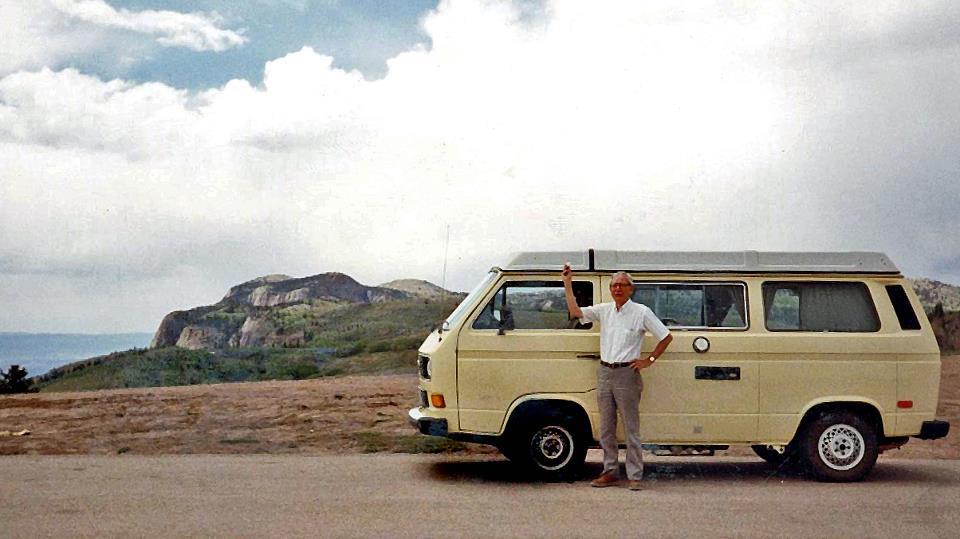
It wasn’t all trailers in there, however. There were motorcycles and a wooden 1963 Chris Craft boat to boot. They had a 1967 VW bus, but no Volkswagen Westfalia pop-top campers; my father went through several of them over the years, and I joined him in one for a long trip out west back in 1991. Yes, I got to sleep up in the popped top.

Interior of 1975 Itasca

As for a serious motor home, Sisemore has the first Itasca motor home ever built by Winnebago Industries, back in 1975. Its interior fabrics were something else.

A 1962 Bethany pop up trailer had a head start on the Itasca, however, as far as grotesque fabric patterns. It was so loud you’d go deaf trying to sleep in there.

I think that pattern would keep me up at night

There were many more RVs at the museum, and after touring them all we wanted to add our own pin to the visitor map, but the continental U.S. was fully filled in. Hooray for Jack Sisemore and his obsessive collecting of recreational vehicles.

Cadillac Ranch

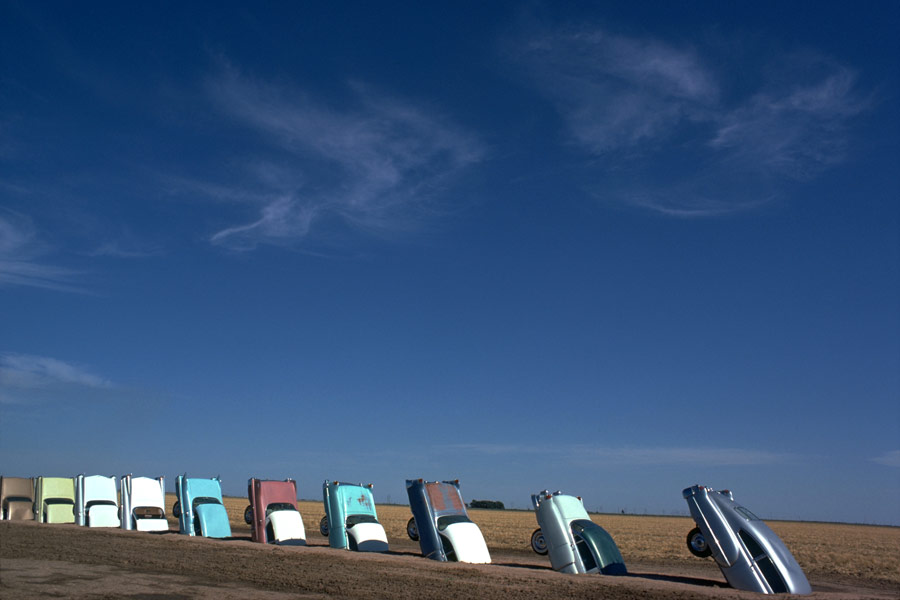
On our way out of town I made sure to stop by Cadillac Ranch. Wendy was unaware of how the Ant Farm art group had buried a series of old Cadillacs nose-first into the Texas prairie back in 1974. The millionaire prankster (and possible pedophile) Stanley Marsh 3 sponsored the effort, and he had passed away less than two weeks before we arrived.

We pulled up and walked over to the cars, which are constantly subjected to graffiti. Folks were milling about, some eagerly spraying paint onto the hulks. Long caterpillars were inching across the dry, cracked, spray-painted ground as I posed amidst spent spray cans. We viewed the tops and the bottoms of the cars, which were thoroughly coated with paint. The hulks are falling apart, but folks were having fun.

Tops of the cars

You can take the installation as a comment on planned obsolescence or the whims of fashion which gave cars meaningless tailfins only to have them atrophy in later years. Let’s see what the incomparable Robert Hughes had to say about these vehicles:

They were designed and marketed as fantasies: as works of art, in fact, in their own right. They were unveiled, like public sculptures, on rotating plinths, under spotlights. Their makers in Detroit rejected the dicta of Puritan heritage behind the early Fordian idea of a black box on four wheels. The fifties car was a rocket, onto which a heavy layer of symbolism and body metaphors was packed. It had things ostentatiously both ways, as both womb and phallus. The dreamboat had the tail of a rocket and the chrome breasts of Jayne Mansfield – a design feature that the designers, in homage to a now forgotten Scandinavian sex bomb of fifties TV, called a ‘Dagmar.’ When you hit the brakes, the whole rear end lit up red, like a robot animal in heat. Ultramatic ride, Dynaflow penetration, Triumph, lust, aggression, and plenty of room for the whole family: the siren song of imperial America. Nothing like them will ever be made again. They’re the rolling baroque public sculpture of a culture that has gone forever.

Leaving Amarillo

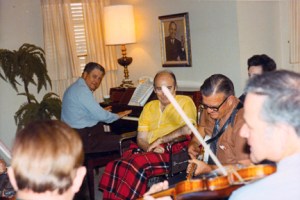
Bob Wills at the jam session before his final recording session with the Texas Playboys
The jam session the day before the last recording Bob Wills (under the plaid blanket in his wheelchair) would make with the surviving Texas Playboys

We now faced the long uneventful drive west to Albuquerque. As we pulled out from Amarillo’s Cadillac Ranch, we recalled an old Bob Wills song: “When you leave Amarillo, turn out the lights.” If you listen to the recording, made with the surviving members of the Texas Playboys in 1973 as Bob directed from a wheelchair, you will hear the velvety crooning rent by Bob’s hollers, reduced to croaks and moans by a hard life. That was the last time Bob hollered: he had a major stroke that night and never regained consciousness. The Playboys were in tears the following day as they re-recorded San Antonio Rose, knowing they’d never play with Bob again.

That was a somber thought as we whizzed westward past towns still struggling to survive after their Route 66 main streets were bypassed by Interstate 40. Amarillo is thriving, but who will be left to turn out the lights in Cuervo or Endee or the like? We’d contemplate that more on our return trip; for now we were focused on reaching Albuquerque before dinnertime.

We celebrated our arrival in the town named after the eighth Duke of Alburquerque with dinner at Buca di Beppo before retiring at the historic Hotel Andaluz, our base of operations for the next day’s exploration of Sandia Peak and the Indian Pueblo Cultural Center.

Click here for a slideshow from this day

Day 4 of Kicks on 66 >

< Day 2 of Kicks on 66

Posted in art, music, photos, travel | Leave a comment

Kicks on 66, Day 2: Elk City

June 29, 2014
Day 2 Trip Map

The second day of our vacation we drove west along I-40 over 250 miles from Oklahoma City to Amarillo, Texas. We broke up the trip with a long stop in Elk City, Oklahoma at their Route 66 and Old Town museum complex.

We had a late breakfast at the IHOP near our hotel before driving a bit over an hour along I-40 to Clinton, where we found their Route 66 museum would not open for several more hours. Not wanting to linger, we drove on to Elk City, which has its own museum complex composed of the National Route 66 & Transportation Museum, Old Town Museum, Farm & Ranch Museum, and Blacksmith Museum. We visited all but the final one, which was unappealing on this hot summer day.

Myrtle the Kachina Doll at Elk City

Myrtle, an immense Kachina Doll made of oil drums and scrap metal, greeted us with a toothy smile at the entrance to the Route 66 museum. She graced Queenan’s Trading Post on Route 66 at the west end of Elk City from 1962 until 1990, when she was renovated and put to work at the Route 66 museum. Her friend Ya’at’eeh is nearby, saying “Hello” in Navajo.

Can I interest you in a tag-along teardrop trailer?

Inside the museum, Wendy bought a Route 66 ball cap and, after I tried to sell Wendy on a 1930s vintage teardrop trailer, we sat in a 1955 pink Cadillac. Two other cars which caught my eye were a black 1953 Lincoln Continental and a white 1962 Studebaker Hawk.

The Old Town Museum featured an opera house, chapel, doctor’s office, rock schoolhouse, grist mill, two sections of buildings housing replicas of early day Elk City businesses, a depot with a miniature train and full-scale caboose, and the Bruening House with its sign for Grubitz Furniture & Undertaking. The evidently deadly furnishings in the various buildings were a bit hodge-podge, and we couldn’t walk through the rooms as we did the day before in Prosperity Junction. The heat and bright sun at Elk City, however, were very real compared to the air-conditioned artificial dusk of the recreated old town in Oklahoma City.

One can, however, walk through the crowded rooms of the former home of a co-owner of the Herring & Young Mercantile stores which once dotted western Oklahoma. We liked an old panoramic photo of Elk City residents showing off all of their then-new Ford Model A’s back in the day. The memorabilia upstairs in the home from the Beutler Brothers rodeos reminded me of the collections from the 101 Ranch one finds in Ponca City.

A large metal building housed the Farm & Ranch Museum, filled with vintage farm equipment. The kindly old docent failed to warn us, however, of the horror show over in the farm kitchen display where a vampiric farmer was dining on berry pie. Egad! That fellow belongs in a Twilight movie.

Vampire farmer eating his pie

As we were leaving the museum for a late lunch, we were surprised to see the same Citroën in the lot we’d spied the day before over in Oklahoma City. We enjoyed good BLT and grilled cheese sandwiches at the Home Cookin’ Cafe in the rather rundown Ambassador Hotel on the east edge of town. The Duke showed up as a wall mural above our booth; he looked okay from a distance, but was pretty scary up close.

John Wayne mural at the Home Cookin' Cafe in Elk City

We scurried along to Amarillo, where we stayed at one of the Holiday Inn Express hotels. Dinner was at the adjacent and rather rowdy Texas Roadhouse, leaving me grateful for the quiet of the hotel room where I struggled to connect my new Canon Powershot SX280 HS with my iPad over the hotel WiFi. Later I would learn to just tell the camera to become a wireless access point for the iPad to connect to.

We would spend the following day at an RV museum and Cadillac Ranch in Amarillo before heading west over 280 miles to downtown Albuquerque, New Mexico.

Click here for a slideshow from this day

Day 3 of Kicks on 66 >

< Day 1 of Kicks on 66

Posted in photos, travel | 2 Comments

Kicks on 66, Day 1: Cowboy Hall of Fame

June 28, 2014
Contrasting Statues

Route 66

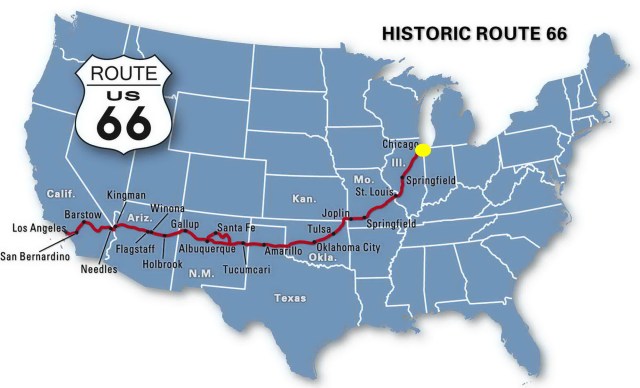
On the first day of our trip west, Wendy and I drove south to Tulsa to begin our journey westward along the modern replacements for historic Route 66, which originally ran almost 2,500 miles from Chicago, Illinois to Santa Monica, California and was immortalized by the song Get Your Kicks on Route 66. Nat King Cole made the song famous, but it has been covered by many artists. As one would hope, Chuck Berry gets the tune rocking, and it remains popular to this day with covers by Asleep at the Wheel and others. But if you want to hear a more complete version of the song, including seldom-heard lyrics, listen to Perry Como’s version.

Wendy and I would be taking Princess the Camry along only one-fourth of the entire route, from Tulsa to the heart of New Mexico, and we would actually take the interstates (I-44, I-40, and I-25) instead of the remnants of the old highway. We did hit actual stretches of America’s Main Street via I-40 business routes in several small towns, but if you want the full meal, aficionados have precisely traced out what remains of the old roadways and documented its fading features. The nation’s longest driveable stretch cuts through my home state, and Thanksgiving 2011 found me following much of the old roadway from Oklahoma City to Tulsa, with a brief stop in Davenport.

Route 66
Route 66

But for this trip I wanted enough time off the highway to introduce Wendy to one of the major museums in Oklahoma City. So we took I-44 along the Turner Turnpike instead of what is today marked Oklahoma 66. This meant that we, like the vast majority of motorists, bypassed one town after another via the turnpike, towns which are still linked by the old free road: Sapulpa, Kellyville, Bristow, Depew, Milfay, Davenport, Chandler, Warwick, Wellston, Luther, Arcadia, and Edmond. The high-speed limited-access interstate cuts 37 minutes off the 2 hours and 21 minutes it takes to make the journey from Tulsa to Oklahoma City on old 66, never mind how long it must have taken to drive a Model A along the original meandering route in the 1930s or the slow progress of the converted Hudson truck which carried the most famous travelers of Route 66: the fictitious Joad family in Steinbeck’s The Grapes of Wrath, who didn’t join the Mother Road until they reached Oklahoma City. It was fitting that our own journey along the 66 route began in Tulsa, since that was the home of Cyrus Avery, the Father of Route 66.

Does a Cowboy Hall of Fame by any other name smell as sweet?

Our destination, after a tasty lunch at a TGI Friday’s in Tulsa (the French Dip is back!), was the National Cowboy & Western Heritage Museum in Oklahoma City. I visited it repeatedly in my youth, back when it was new and was called the Cowboy Hall of Fame. Persimmon Hill in northeast Oklahoma City was selected as its location in 1955, but it would be a decade before the museum opened. It declined into receivership by the mid-1980s, but in the 1990s was revitalized and expanded to over three times its former size, changing its name in 2000. My father helped me discover some years ago that the best time to visit the museum is during the annual summertime Prix de West invitational exhibition, with several galleries filled with wonderful paintings and sculptures which are for sale. That event highlighted our visit.

End of the Trail by James Earle Fraser

One of several versions of End of the Trail

The museum’s redesign means that what was once the end of a visit is now the beginning: the 18-foot plaster version of James Earle Fraser’s End of the Trail. In 1894 Fraser created a small bronze version of the piece for the World’s Colombian Exposition in Chicago; the monumental reworking in plaster was created for the 1915 Panama-Pacific International Exposition in San Francisco, California. World War I meant that bronze was not available for a casting. While many plaster sculptures for the exposition were destroyed, the residents of Tulare County, California, rescued and restored End of the Trail and placed it in Mooney Grove Park in Visalia, California. In 1968 the Cowboy Hall of Fame acquired Fraser’s studio collection, and the plaster version was acquired by the museum in exchange for having a bronze version cast from it which was placed back in Mooney Grove Park.

Coming Through the Rye

The outdoor plaza features a monumental version of Frederic Remington’s original small bronze Coming Through the RyeWendy loved the spirited action of the piece, which Harold McCracken described:

Coming Through the Rye represents four cowboys mounted on broncos dashing at full gallop, waving their six-shooters over their heads with quirts flying from their wrists.  They have the spark of abandon and deviltry in their hollow eyes; and their mouths are open as though in the act of shrieking out some wild Western apostrophe to the red gods of recklessness.  The broncos, snorting and straining forward, are shoulder to shoulder, and their flying hooves emphasize the devil-may-care of such a mad ride.

Contrasting Statues

The plaza sculpture has the riders coming in to party at the museum, in stark contrast to the somber End of the Trail inside. I knew that a sign of Remington’s skill in the original bronze is that only six of the sixteen horse hooves touch the ground; the horses on the ends seem completely airborne. So I paid attention to the monumental version and noticed the sculptors had to cheat on that: two of the four hooves on the right horse are grounded. Physics is everywhere!

What I wasn’t familiar with was the title of the work. It turns out that Comin’ Thro’ the Rye is a poem/song by Robert Burns with several versions. His bawdy version of the piece, with a certain four-letter verb replacing ‘kiss’, seems in keeping with spirited cowboys riding into town to see their, er, sweethearts. Literary types will know that the poem became widely known in the 20th century because of Holden Caulfield’s misinterpretation of it in Salinger’s The Catcher in the Rye, but I’ve never read that book, already having enough teen angst and alienation in my line of work.

The Legend of the Westerner by Leonard McMurry

Buffalo Bill

Wendy and I strolled through the grounds, although it was hot. They’ve done a lot of work to make the grounds more refreshing, with many rock ponds and plantings. The old plaza, however, is no longer a big fountain pool. Leonard McMurry’s 33-foot 19-ton statue The Legend of the Westerner, which depicts Buffalo Bill Cody, was added to the grounds in 1976 and once dominated the skyline as one drove past Persimmon Hill on I-44. But the trees have grown up to fully obscure it from the road. My favorite memory of this statue is when it had a wasp nest stuck in the horse’s crack, which explained why it was rearing up!

Wendy provides scale for Canyon Princess

Canyon Princess

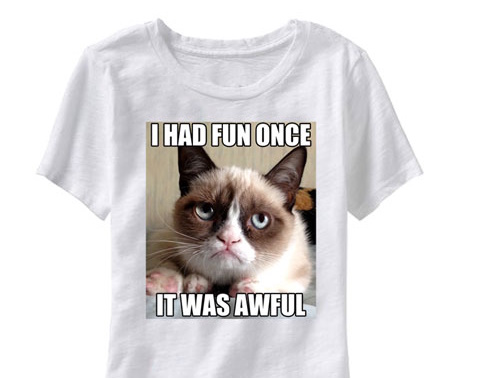
My favorite statue at the museum these days is one they added in 1995: Canyon Princess by Gerald Balciar, a 15-foot-high 8-ton depiction of a female cougar in Colorado yule marble. The beautiful sinuous lines of this cat, contrasting to its blocky bluff, greet you as you enter the main art galleries. I had Wendy pose beside it so you can grasp its scale, and if you look closely you might notice she is fittingly wearing a Grumpy Cat T-shirt.

Prix de West

There were many gorgeous paintings on display in the Prix de West exhibition, but unfortunately photography was prohibited; you can instead take a look at the online catalog. Wendy liked the bright colors of paintings by Walt Gonske. George Hallmark’s Sagrado (Sanctuary) reminded me of Bartlesville’s La Quinta mansion. Jeremy Lipking’s Silence and Sagebrush was a standout, along with the ultra-realism of Kyle Pozin’s Old Souls and Curt Walter’s Gathos ReawakeningA fellow visitor pointed out to us how Craig Tennant includes hidden images in his works, helping us spot tiny images of Christ and the like amidst the rusting trains in his exhibited paintings.

Several works foreshadowed our journey west: flamenco dancingclouds above adobe houses, senoritas, long porches, the pink mountains of Santa Fe, and cliff dwellings.

Bob Wills’ Fiddle

Wendy was awestruck to see Bob Wills’ fiddle in the museum’s collection, which we would reminisce about as we left Amarillo a couple of days later. You can watch him fiddling in a breakdown, although what always makes us grin are his enthusiastic utterances in his performances with the Texas Playboys. His own explanation of what made him holler was disingenuous; clearly it was the music which made him call out, somewhat like how Pérez Prado would call out “¡Dilo!” (Say it!) during his own band’s performances, such as the wonderful Exotic Suite of the Americas.

Bob Wills' Fiddle

Wrapping Up Our Tour

One of the later parts of our tour was a walk through Prosperity Junction, the recreation in the museum of an old western town at dusk with interesting audio accompaniment. I liked seeing and hearing that again, although I dearly miss the tiny old mine and train tunnel down in the basement of the museum which I loved passing through as a child.

Two displays at the museum that would be echoed repeatedly on our travels on this trip were of cameras of varying vintage and images of John Wayne. I have my own online camera gallery, while I have far less interest in The Duke. I think the only two movies of his I recall beyond their titles are Operation Pacific and The AlamoI know I’d probably enjoy some of the films he made with director John Ford if I worked up the courage to see them, but I burned out on bad westerns as a child and thus generally avoid that genre.

We exited the museum to find a couple climbing into their old Citroën, a 2CV6, in the parking lot. Little did we suspect we’d see them again the next day when we stopped at the museums in Elk City, Oklahoma to break up the long drive to Amarillo. Our day concluded with a visit with my folks and dinner out with them at Johnnie’s. We spent the night at our hotel of choice in OKC, the Cambria Suites, before heading due west for the four-hour drive to Amarillo in the dry and dusty heart of the Texas panhandle.

Click here for a slideshow from this day

Day 2 of Kicks on 66 >

Posted in art, music, photos, travel, video | Leave a comment