Alternate histories have been a literary trope for over two thousand years. Livy posed the question, in Parts 17-19 of Book 9 of his From the Founding of the City, “What would have been the results for Rome if she had been engaged in war with Alexander?”
In 1889, Mark Twain wrote of A Connecticut Yankee in King Arthur’s Court. In 1939, L. Sprague de Camp speculated in Lest Darkness Fall on what might have happened if an American archaeologist of his era were transported to 6th Century Rome. In 1962, Philip K. Dick’s The Man in the High Castle explored a timeline in which Nazi Germany and the Japanese Empire won World War II and partitioned the former United States.
In more recent times, we have multiverses in the Marvel and DC comics and their film franchises, in Star Trek, in 2022’s Everything Everywhere All at Once, and many more.
Let’s briefly explore an alternate timeline in which the Oklahoma Territory, organized in 1890, and Indian Territory, which first originated in 1834, rather than being merged into the state of Oklahoma in 1907, had instead been admitted as the respective separate states of Oklahoma and Sequoyah.

The proposal for a State of Sequoyah made it as far as a draft constitution with an election in November 1905 in which 56,279 voted in favor of it, 9,073 voted against it, and many more declined to vote. The concept was doomed, since neither Congress nor President Theodore Roosevelt supported it. The Republican-led government feared that the heavily Native American and Southern-leaning Indian Territory would became a new Democratic stronghold if it were granted statehood, and many whites favored aggressive assimilation of the tribes over preserving their sovereignty.
Thus only one state of Oklahoma was admitted, and it was a Democratic stronghold until the 1990s, as I’ve explored in a previous post.
Below is the State of Sequoyah and its counties as determined in the failed constitution.
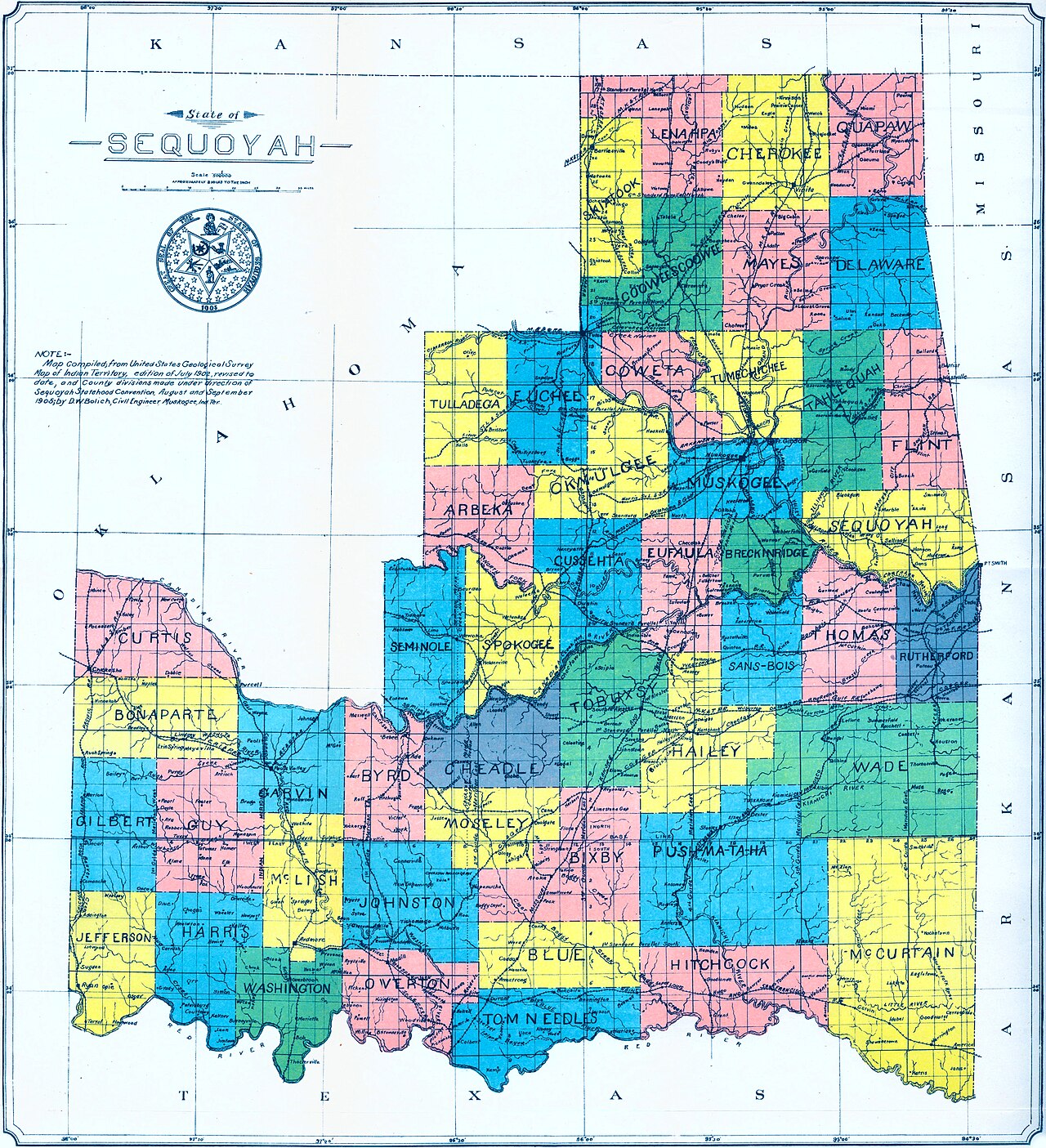
Bartlesville was situated in the proposed Skiatook County, which was a bit wider than modern-day Washington County and considerably truncated to the north and south.
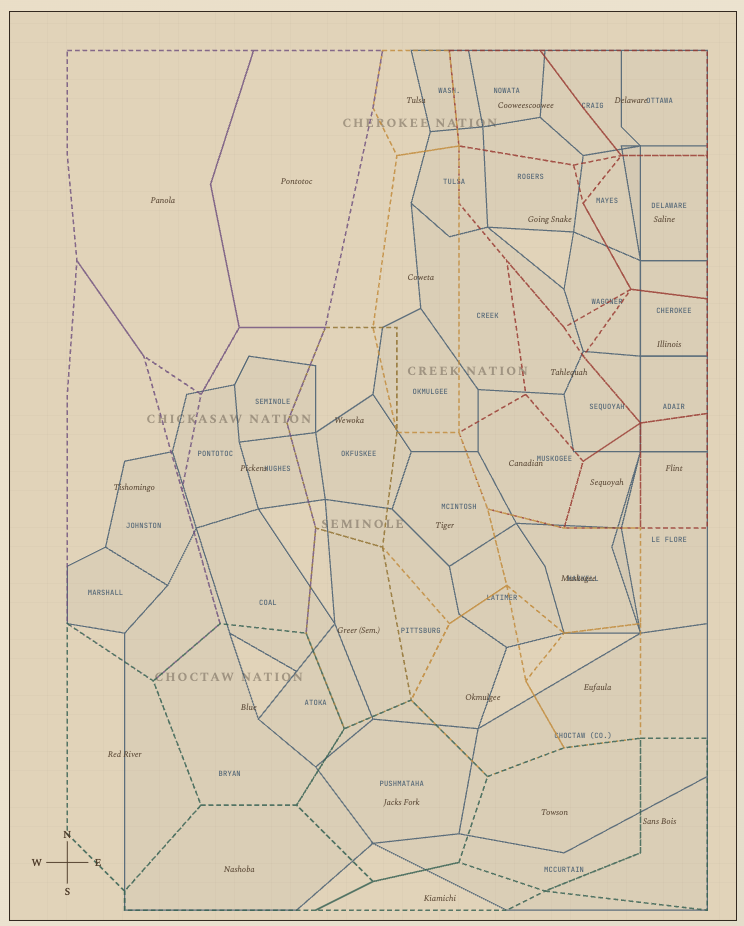
I wanted an overlay map comparing Oklahoma’s northeastern county boundaries to the State of Sequoyah’s counties. I wondered if an artificial intelligence could save me the effort of creating one. The answer at this point, and with my unpaid access, was No when I tried Google Gemini, ChatGPT, and Claude, with the last of those talking a good game yet producing an absurd abomination.
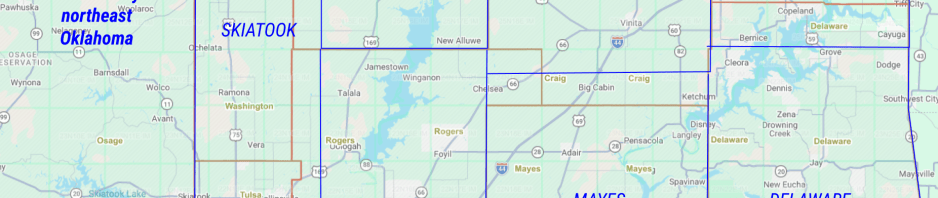
So I overlaid the State of Sequoyah map over one of modern-day Oklahoma which showed county lines in brown. I dialed down the Sequoyah map’s opacity and traced by hand blue outlines of several of the northeastern Sequoyah counties, adding blue labels.
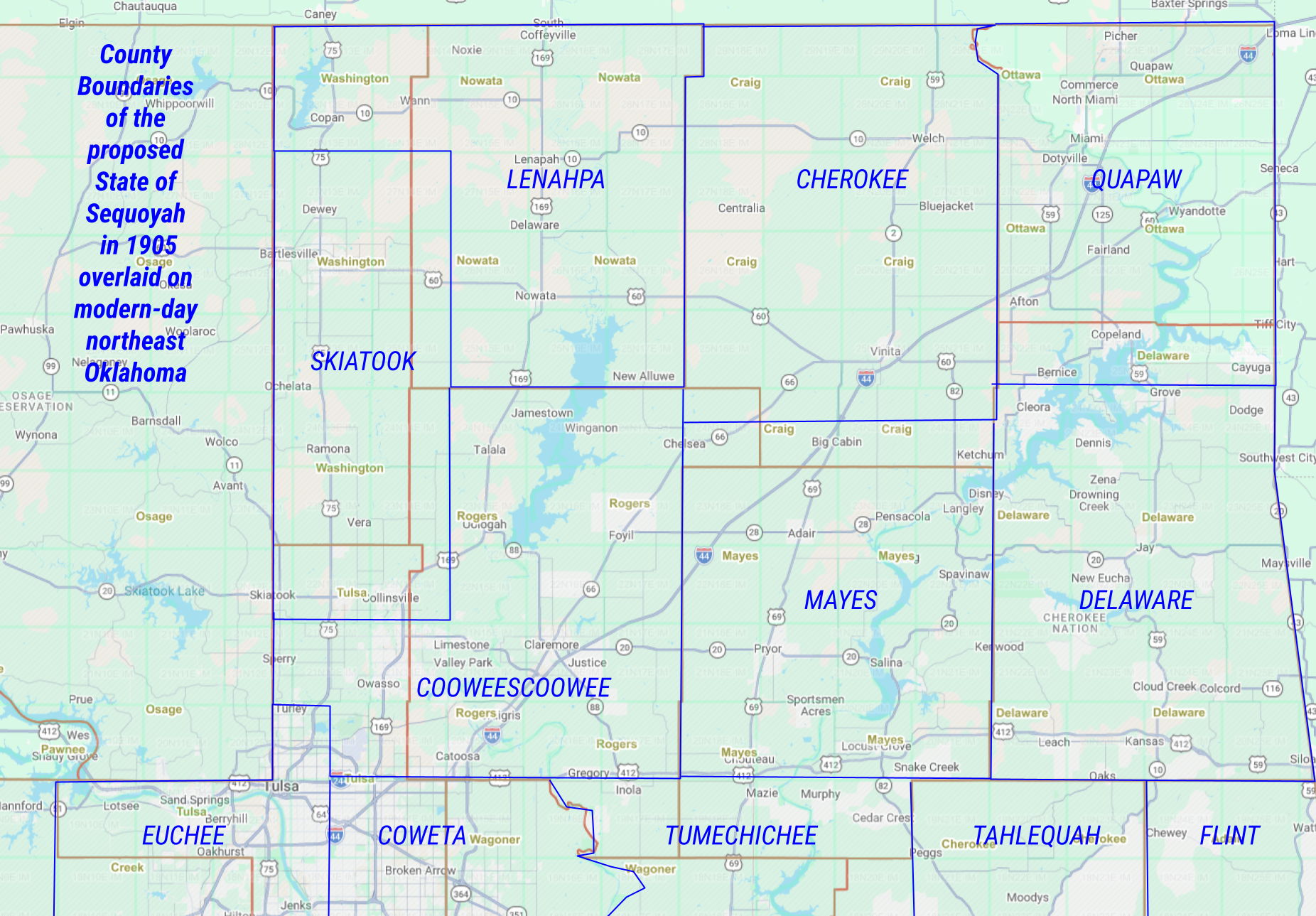
Neither map designated county seats, although we know that Bartlesville has always been the seat of Oklahoma’s Washington County. As for the State of Sequoyah, its constitution held that whichever city in each county received the most votes in the November 1905 election would become the seat.
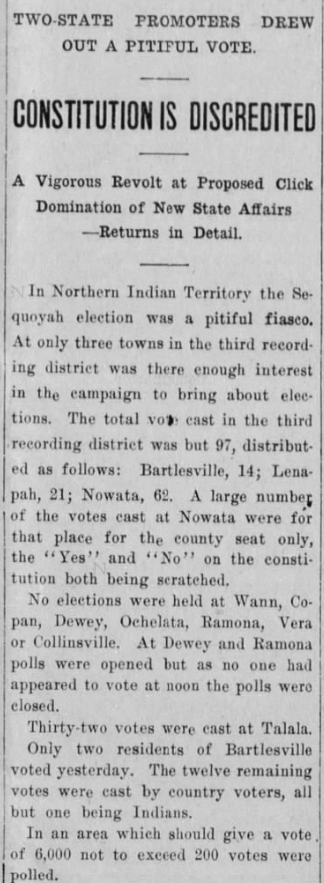
The turnout in “Skiatook County” was pitiful, with only 14 votes cast in Bartlesville, of which only two were residents and the others from country voters, 11 of them from the First Peoples. That in a town which by then had boomed to three or four thousand people, reflecting the disdain many had for two states instead of one being formed from the two territories.
Dewey and Ramona had polls open, but when no one had appeared to vote by noon, they were closed. Other towns in the area, such as Wann, Copan, Ochelata, Vera, and Collinsville, did not even conduct elections.
Skiatook, the county’s namesake, did muster 61 votes, of which 51 favored the constitution and 10 opposed its adoption. Had Congress supported the State of Sequoyah, that would have made Skiatook the county seat, way down in the southwest corner, despite it having perhaps one-tenth of the population of Bartlesville. As it turned out, the town of Skiatook landed in Oklahoma’s Tulsa county, and Washington County also omitted Collinsville while gaining Copan.
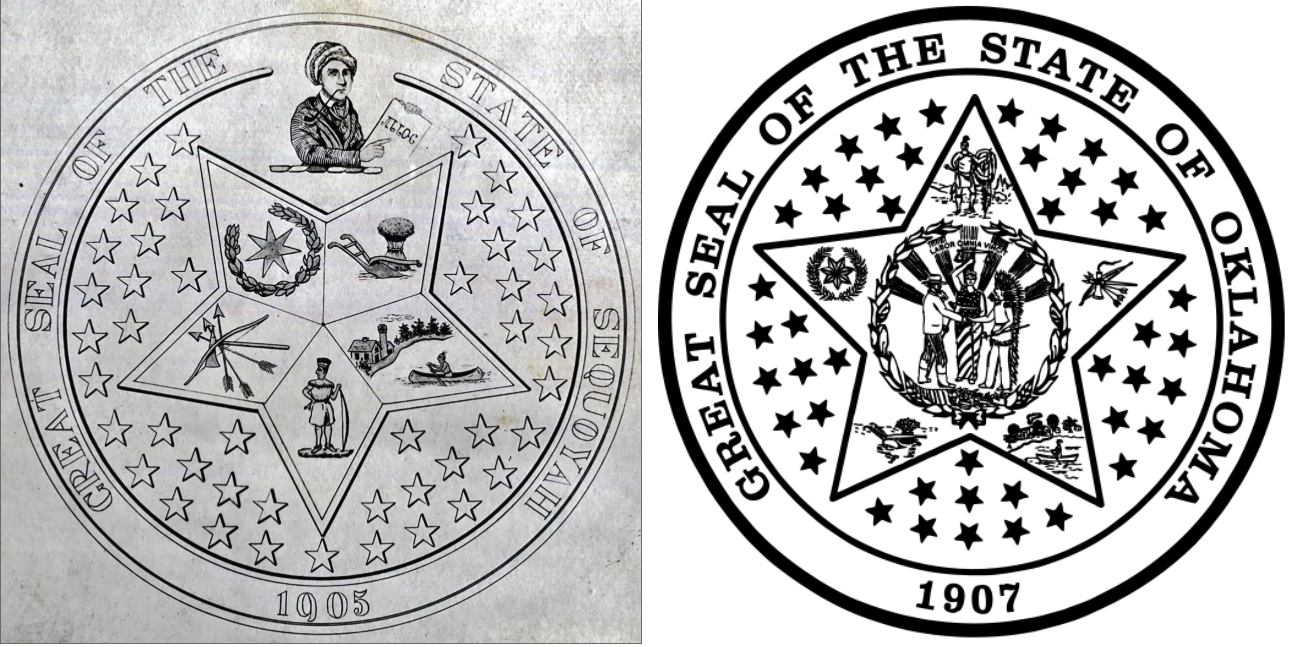
I like the inherent symbolism in how the proposed Great Seal of the State of Sequoyah would have inverted the main star when compared to the Great Seal of the State of Oklahoma that was actually adopted two years later.







 Meador Manor