Puzzled

The oldest item I have from my childhood is a jigsaw puzzle of a boy pasting up posters. When I was very young, I enjoyed putting it together, charmed because it had four “figure pieces” in the shape of objects: a lamp, a duck, a star, and my favorite, a little bell.
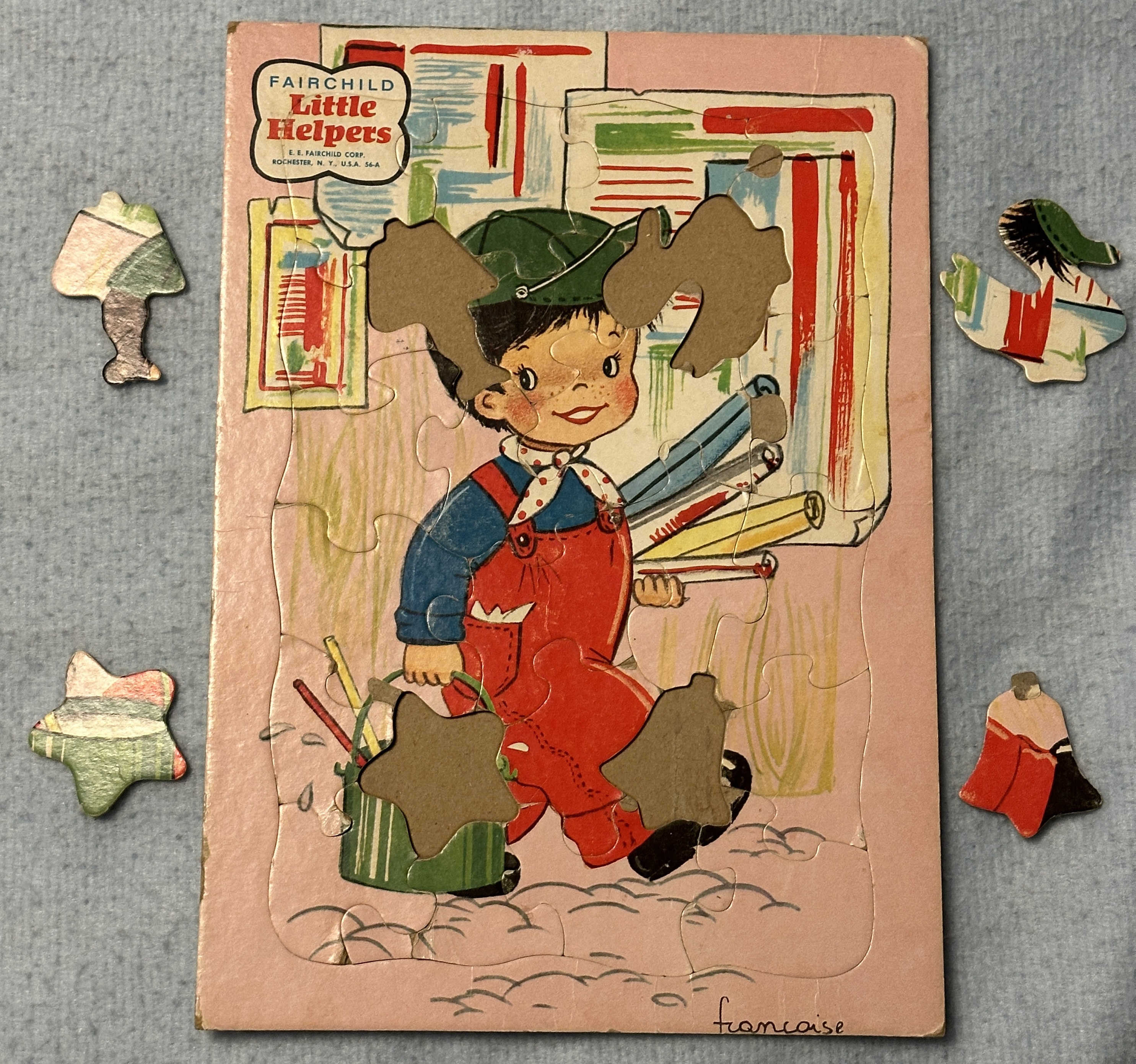

My oldest childhood item is this cardboard puzzle
Little Helpers puzzles

That was one of several such puzzles produced as Fairchild Little Helpers. Henry Alderman and Elmer E. Fairchild formed a company in Rochester, New York in 1900 that initially printed paper goods and cardboard boxes for clients such as candy companies. They branched into games after World War I, constructing a factory in 1926 in the Churchville suburb. Alderman left after 1928 and the E.E. Fairchild Corporation continued to produce paper goods as well as games and jigsaw puzzles under the All-Fair brand, taking advantage of a craze for the latter during the Great Depression.

Elmer passed in 1954, and his son, E. E. Fairchild, Jr. kept the firm afloat making puzzles and card games until a 1974 fire wiped out much of his inventory and a competitor bought out what was left.
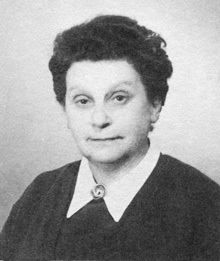
Françoise Seignobosc

My puzzle’s imagery was by children’s book illustrator and author Françoise Seignobosc (pronounced say-nyoh-boh). She was born in 1897 in Lodève, a commune in the département of Hérault in southern France. She emigrated to the United States and wrote over 40 children’s books before she died in 1961. Many of them were tales about a little girl named Jeanne-Marie. Jeanne-Marie Counts Her Sheep was the Book of the Year for the American Institute of Graphic Arts and won the New York Herald Tribune prize for children’s books.

That was a numbers book about a little girl dreaming of how many lambs her sheep, Patapon, would have, and what Jeanne-Marie would be able to buy with the money she made from the lambs’ wool. Patapon agreed that she might indeed have many lambs, but that being in the sunshiny green pasture all day long was all they really needed to be happy. Jeanne-Marie imagined many lambs and many purchases, but it turned out there was just one lamb. In the end, an aged Jeanne-Marie was able to knit only one pair of socks. “But Jeanne-Marie tried to look very happy, anyway, for she did not want Patapon to feel sad. Patapon was so pleased with her one little Lamb!”
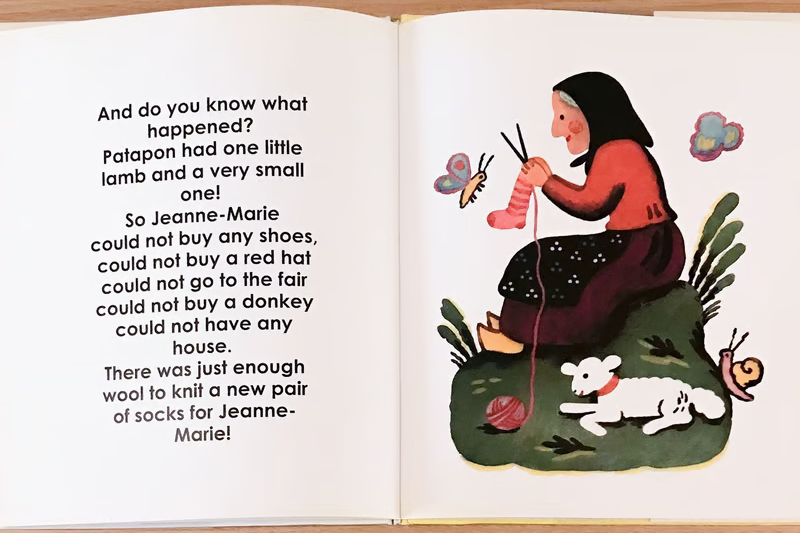

When I was a preschool-age child, I loved puzzles. My mother provided me with a wooden Playskool Winnie-the-Pooh puzzle and various others, but only this Little Helper survived later garage sales and giveaways, as it had been forgotten in an unused side table drawer at our cabin on Table Rock Lake.

Jigsaw puzzles were invented by John Spilsbury, a British cartographer. Around 1767, he pasted one of his maps of Europe onto a piece of wood, cutting sections and countries into individual pieces. He gave the puzzle to schoolchildren to help them learn geography. I can relate to that, as I remember school puzzles of the states of the USA and how some of the small New England states had to share a piece to avoid creating choking hazards. Oklahoma always stood out, thanks to the Panhandle.

Spilsbury’s first puzzles did not interlock, leaving them vulnerable to a slip of the hand or table wobble. Since the jigsaw wasn’t invented until the 1880s, the early puzzles were called “dissected puzzles”.

Jigsaw puzzles play a symbolic role in one of the greatest films ever made: Citizen Kane. At my first viewing, I remember being struck by how thick its wooden puzzles were compared to the cheap cardboard puzzles I was familiar with.

In the early 1900s, lithographic printing, saws, and plywood were combined to create somewhat cheaper high-quality puzzles. From 1907-1911, when Oklahoma became a state, a puzzle craze gripped America’s northeast, but a 400-piece puzzle still cost about $4 at a time when an average worker only earned $12 per week. So puzzles were often shared and swapped.

Some people started wanting more difficult pieces with trick edges, no cover image, and images on both sides. Game manufacturer Parker Brothers entered the puzzle business in 1908, and in 1909 shifted entirely to creating hand-cut wooden puzzles, with 225 puzzle cutters crafting 15,000 puzzles per week. It was producing interlocking, non-interlocking, and color-line cutting puzzles. The latter are ones where piece edges fall along color boundaries, reducing pictorial clues and forcing one to rely much more on the shapes of pieces.

Their Pastime Puzzles were the first commercially successful puzzles that used figure pieces in large single-color areas, in the shapes of animals, flowers, letters, numbers, and geometric shapes. They usually included a dozen figure pieces among every 100 puzzle pieces. The large white area in 1928’s Before Jazz puzzle makes it easy to spot several of its 35 figure pieces.
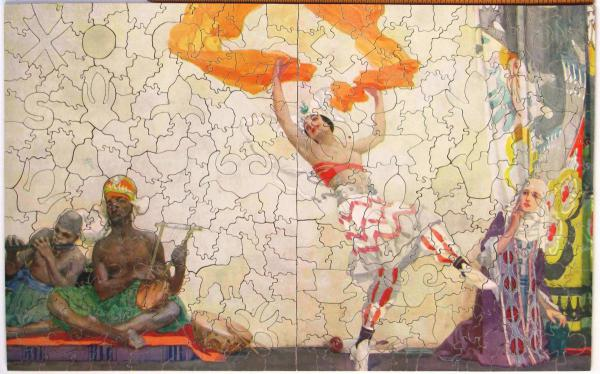

Before Jazz, a 1928 300-piece 15×9″ plywood puzzle, had 35 figure pieces [Source]
In 1932, a toothbrush company offered a low-cost puzzle to buyers, setting off a new advertising trend

The fad faded after a few years, but another craze came in 1932 as people sought distractions during the early years of the Great Depression. A switch to cardboard allowed for a standard die-cut rather than paying teams of women to cut pieces by hand. A 300-piece puzzle could then be had for just a quarter dollar, subsidized by advertising.

By early 1933, 10 million puzzles were produced each week, with 7 million of them being advertising puzzles. Some were themselves ads, some featured just the name of a company on them, and others were double-sided.

That craze also quickly faded, perhaps due to the loosening of prohibition restrictions, or an improving economy, or because puzzles were then being taxed. A third brief craze came in 2020 during the lockdowns of the COVID-19 pandemic.
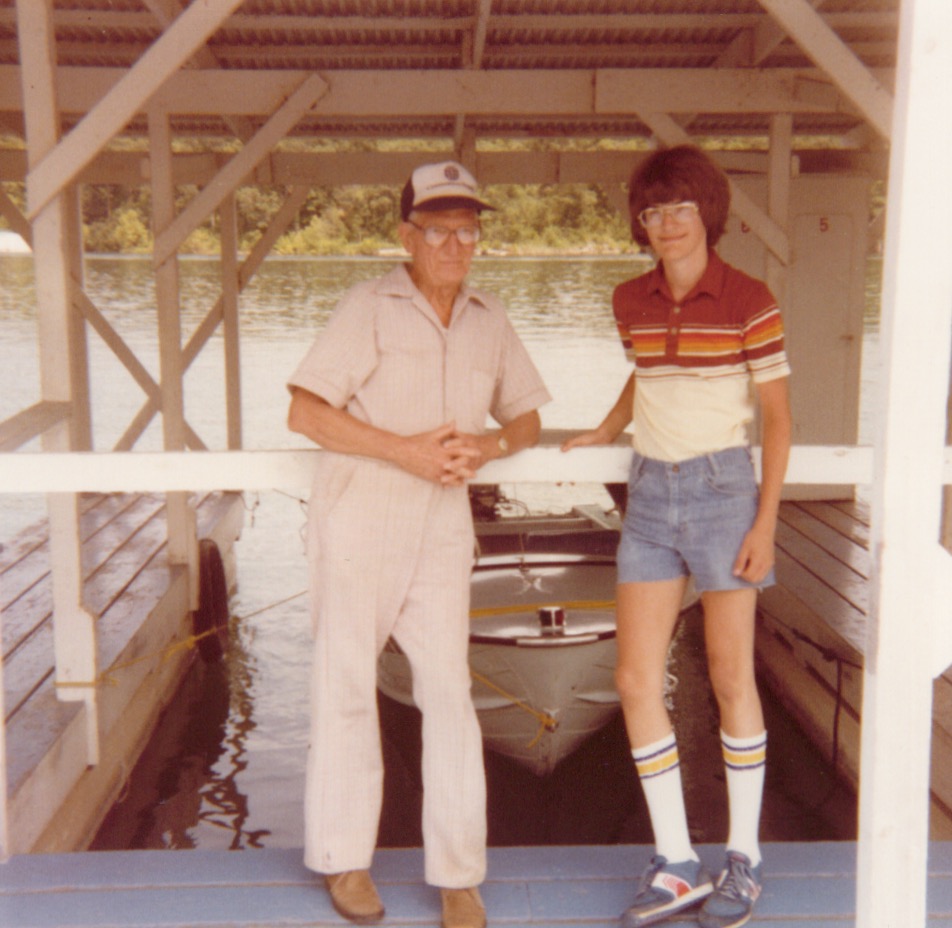
With Truman over 40 years ago and my little Starcraft runabout at the Eagle Rock Marina; Truman would pass away seven years later

My childhood love for jigsaw puzzles did not endure, but I remember how Truman Thompson, a sweet retired high school history teacher who lived near our lake cabin in Missouri, enjoyed them. Since I was a little boy, if he wasn’t out tending the flowers in his bluffside beds, he might be in his home doing a puzzle.

When his frame home burned and was replaced by a mobile home, he had a big picture window in one end looking out over the lake. He had placed a card table in front of it, and I remember him happily seated there, a cigarette burning in an ashtray, as he assembled a picture puzzle, sometimes glancing up to contemplate the ever-changing puzzle of the outside world.

Posted in history, nostalgia, random | Leave a comment

Shift Happens

Pew Research Center periodically examines religious and political beliefs of the populace, and it is interesting to note their shifts over time.

They recently released their latest Religious Landscape Study, a decade after the previous one. It is interesting to note Oklahoma’s proportions of various religious and political beliefs and how they have changed over time and how they compare with national statistics.

Religion

Oklahoma is known as a very religious and politically conservative state, but the study confirms a significant increase in the religiously unaffiliated over the past two decades.

Source

Christians still dominate with 47% of Oklahomans being Evangelical Protestant, 11% Mainline Protestant, 8% Catholic, 4% Historically Black Protestant, and 1% Latter-day Saints (Mormons), while all of the other Christian categories combined are less than 1%.

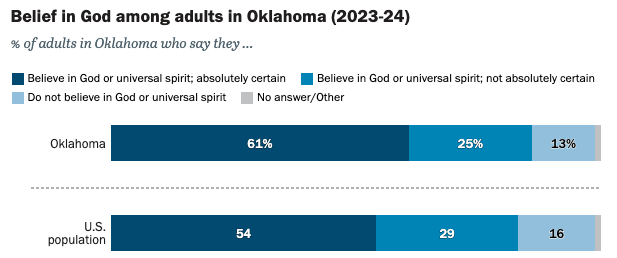
Since 2007, the percentage of Oklahomans who believe in nothing in particular has risen from 9% to 12%, agnostics have risen from 3% to 9%, and atheists have risen from less than 1% to 5%. Another lens to apply is belief in God:

I threw in the nationwide percentages for comparison, and you can examine many other religious beliefs and practices in the study, including religious attendance and belief in heaven and hell.

Politics

The Republican party is particularly dominant in the central and southern states, but I well remember the decades when the Democratic party had a lock on the Oklahoma legislature and most statewide offices. In 2007, most Oklahomans were Democrats, but now the Republicans hold immense sway.

The lopsided party affiliations in Oklahoma in 2024 contrasts to how nationwide 46% identify with Republican politics, 46% with Democratic politics, and 8% with neither.

Back in the day, many Oklahomans were conservative or “Blue Dog” Democrats. In 2007, when most Oklahomans were still affiliated with the Democratic party, 39% of Oklahomans identified as conservative, 36% as moderate, 18% as liberal, and 7% gave no answer. Since then, liberals have increased to 20% and conservatives to 41%.

Notice how nationwide conservatives still outnumber liberals, with the plurality going to moderates. The tendency to overestimate Republican enthusiasm for all conservative ideological stances and Democratic support for all liberal ones is perhaps why some who look at how 46% of Americans lean Republican and 46% lean Democrat then wonder at the current seismic shifts in national politics.

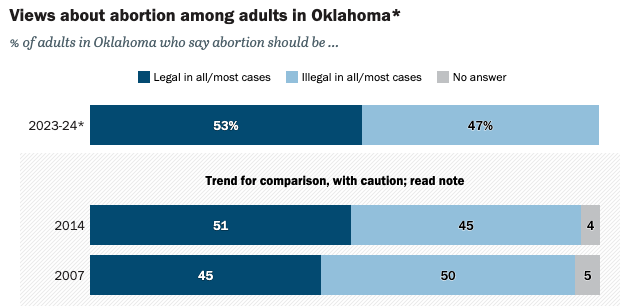
The lopsided politics in Oklahoma have yielded a draconian approach of abortions only being legal if necessary to save the life of a mother. However, it is worth noting that the majority say abortion should be legal in all or most cases.

Such views were in the minority back in 2007.

The study explores other social and political topics, including homosexuality, same-sex marriage, immigration, and evolution. I find it helpful to see actual data about Oklahomans’ views, as opposed to the hyperbole and rhetoric of politicians and the intensely anecdotal and biased posts one finds on social media.

Posted in politics, religion | 1 Comment

Dark Fiber

Our home’s fiber has gone dark, and we are back on coax. When our house was built in 1981, it was connected to Southwestern Bell Telephone with twisted pair cable and also had analog television service via coaxial cable. As soon as fiber optic cable was available in our neighborhood in June 2022, I had that installed. Given that it was a new utility, I was patient with frequent outages, but after over 30 service disruptions across 33 months, I canceled it.

These three types of cable go to our home (not to scale), but now only the coaxial cable is active

I bought our house in 1994, when my internet service was on the twisted pair telephone cable using a 14.4 kilobit per second modem. That was 48 times faster than my first 300 baud modem in 1982, but I was glad to jump up to a 56k modem a few years later. In 2001, my bandwidth increased by a factor of 18 when I subscribed to the Digital Subscriber Line (DSL) service from AT&T, which still ran on the twisted pair telephone wires.

The coaxial cable back then just carried analog television service, but by 2005 it was offering cable modems with five times the bandwidth of DSL, so I switched. In 2008 I ditched the cable television service, but I still relied on the coaxial cable for internet. Over the next fifteen years it gradually evolved from 5 megabits per second to 200 megabits per second as Donrey Cablevision became Cable One and then Sparklight. By 2017, it was offering 1 gigabit per second download service, but that was too pricey for me.

In June 2022, Bluepeak became available in our neighborhood, and I had them install a fiber optic line with symmetrical 1 gigabit per second service for both downloads and uploads. That was almost 70,000 times faster than my telephone modem in 1994 and 200 times faster than my cable modem in 2005. Even better, it only cost $60 per month.

The competitive pressure prompted the cable company to offer me 1 gigabit per second download service for only 2/3 of what it had been charging me for 200 megabits per second service. However, in April 2024, Sparklight was still charging me $94 per month for 1 Gbps download and 50 Mbps upload service compared to $60 per month for symmetrical 1 Gbps download/upload service from Bluepeak over fiber.

I delayed giving up the cable modem since Bluepeak’s fiber service went down much more frequently. It notified me of a whopping 17 service outages between March and October 2023, and there were some before that which didn’t generate texts. However, it followed that dismal performance with only one disruption over six months, so I finally terminated my cable service in April 2024.

Three months later, I had long outages on consecutive days. That irritated me enough, given the home automation that Wendy and I had grown accustomed to, that I drove over to Sparklight’s office to see what they were now willing to offer. Just like AT&T, cable companies won’t advertise their better offerings to existing customers, waiting for you to inquire or threaten them with cancellation to offer better deals.

Competition is important in free enterprise, and my account had been suspended long enough that Sparklight offered me their 1 Gbps download/50 Mbps upload plan at $39 per month for six months, with that then rising to $49 per month, or about half what they had been charging me a few months earlier. In addition to the cable modem, they were willing to provide the same eero router that Bluepeak had provided. That was again considerably better than anything they had previously offered. Unlike Bluepeak, Sparklight did not include an eero mesh network extender unit, but Meador Manor isn’t large enough to need that anyway.

Both Bluepeak and Sparklight provided eero routers

I programmed Bluepeak’s and Sparklight’s eero routers to act as backups for each other. So when Bluepeak went down, Sparklight would take over automatically, and vice versa. That was welcome, as Bluepeak went down three times in August 2024 and reported disruptions in October and November. Over the same period, I only noticed one cable outage, but Bluepeak was always far more communicative about outages than the cable company.

The Bluepeak fiber service cost recently increased from $60 per month to $65. So by March 2025 it was costing 33% more than the cable modem with the same download bandwidth. Running both of the 1 Gbps services was costing me $114 per month, which was about what 200 Mbps cable modem service had cost me from 2019 to 2022.

My frustration with Bluepeak spiked in March 2025 when their little optical network terminal box, which converted the optical signals into electrical ones for the eero router, died. They sent two friendly technicians out who replaced the box, but about an hour after they left it stopped working.

The “Optical” light on the box was blinking red, indicating it couldn’t get a signal. I checked the cables and restarted it multiple times, and it would work for anywhere from a few minutes to a few hours, but eventually it always failed. The eero always switched over to the Sparklight cable backup, but my patience was exhausted.

I called Bluepeak, talked to a friendly representative, and canceled the service. I used their website to print off a return mailing label, boxed up all of their equipment, and sent it off at the post office to their nearest office in Stillwater.

So we’re back to relying on the 1981 coaxial cable for our home internet service. When our cable modem goes down, Wendy and I will have to use our iPhones as cellular hotspots, and our home automation will fail. Our upload bandwidth is less, but that is something we’ll seldom notice. At least now I’ll only be spending $49 per month for our home internet service instead of $114. We might eventually have cause to light the fiber optic cable back up, but for now we’re content to be back on coax.

Posted in technology | Leave a comment

Everyday Workouts

Back in 1993, when I was in my mid-twenties, my skinny days were ending. After spending my entire youth in the bottom quartile in body weight for my age, my metabolism slowed. Rather than adjust my diet, I opted to turn on the television.

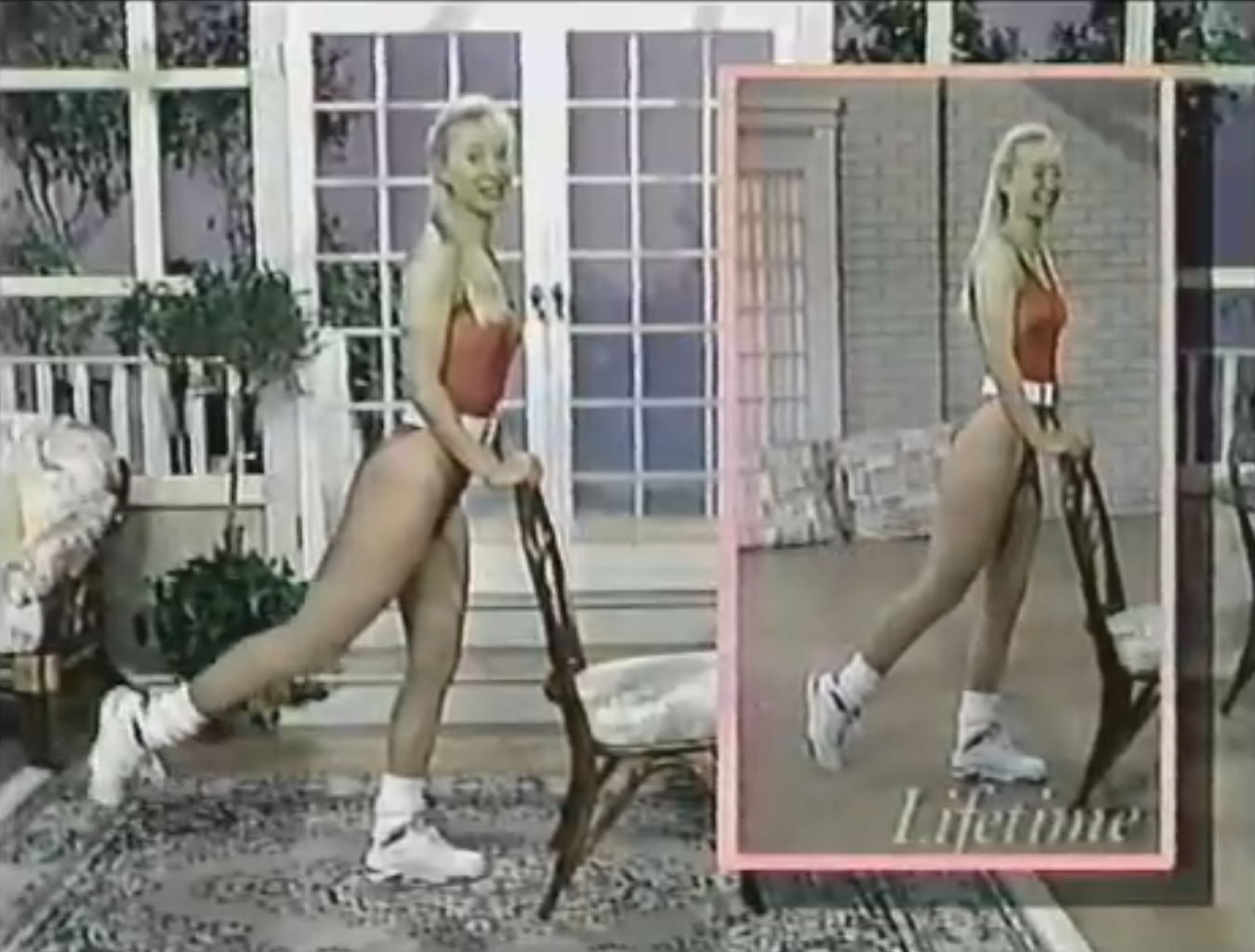
No, that wasn’t so I could lounge, but so that I could exercise. I tuned in the Lifetime cable channel. It was geared toward women, but I never suffered from fragile masculinity, and I took advantage of how at 7 a.m. each morning it offered two successive aerobics workouts: Cynthia Kereluk’s Everyday Workout for thirty minutes followed by Denise Austin’s Daily Workout.

I tried each of them and preferred Kereluk’s. A former Miss Canada, she had been a teacher and aerobics instructor, and I appreciated her stream of advice on proper form, why a particular exercise was helpful, how to avoid strain and injury, etc.

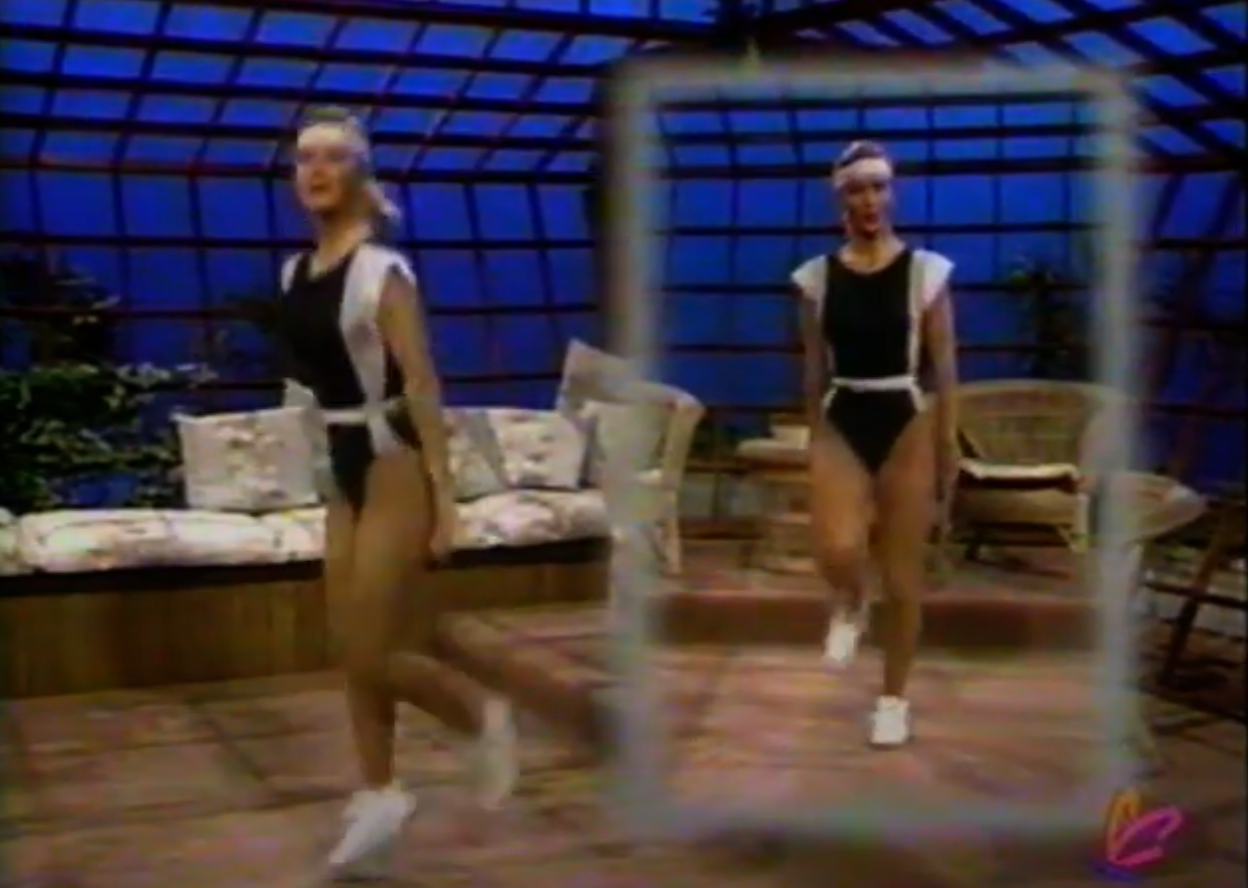
An SOS segment with two levels in Cynthia Kereluk’s Everyday Workout back in 1993

She was then doing her eighth year of shows produced up in Canada, which always had the format of a brief warmup and stretch, about ten to twelve minutes of cardiovascular aerobics, about five minutes concentrating on toning a particular part of the body, and a cool-down. The segments were divided up by commercials.

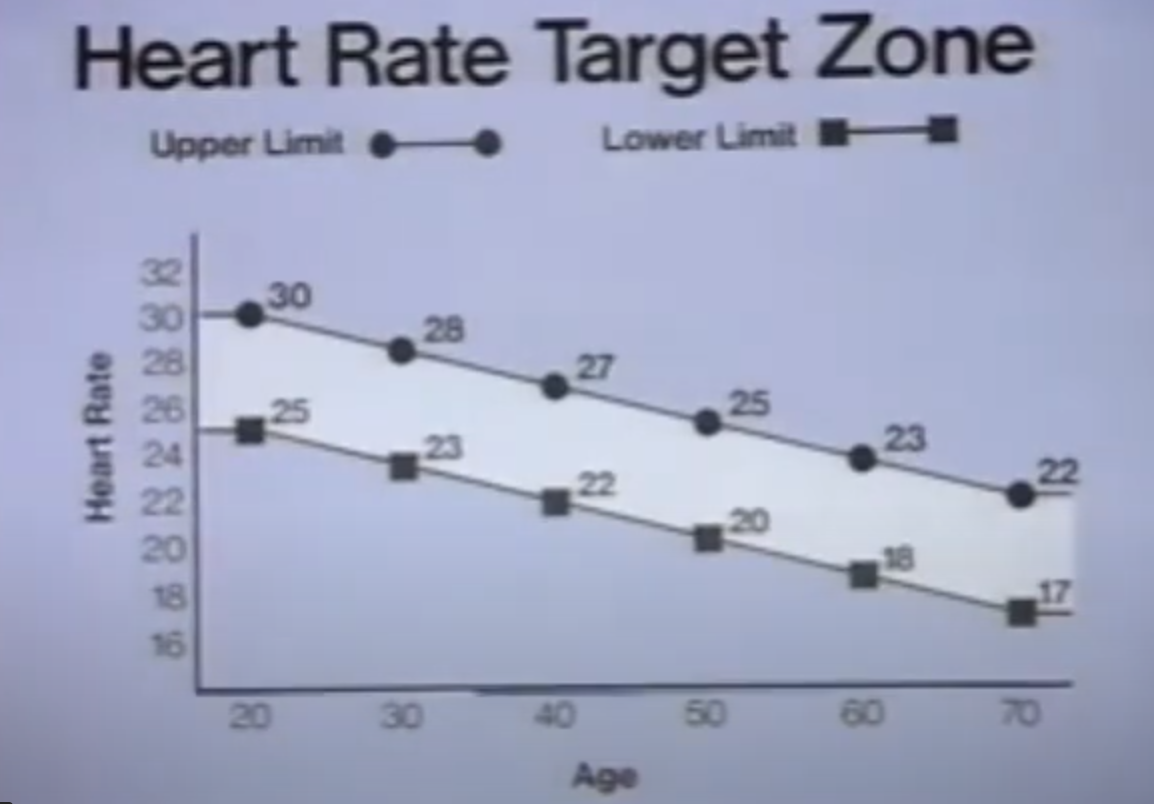
At the end of each cardiovascular segment, she had you take your pulse for ten seconds and compare it to a Heart Rate Target Zone chart.

Often a segment would show two levels, a more intense and a less intense one, with her demonstrating the second level via a picture-in-picture overlay. It wasn’t long after starting the routines that I graduated to the more intense level, and I appreciated how the exercises not only kept me from gaining too much weight but also made me feel better all day. I have now been doing aerobics each weekday morning with her for 32 years and counting.

I was never any sort of athlete, and the only time I’d been in a paid gym was in my teen years when I went with my girlfriend to one of the International Fitness Centers in Oklahoma City. She was a swimmer, twirler, and ballet dancer who worked out there, while I was a skinny kid who could eat whatever he liked without gaining weight, always hated physical education classes, and had no interest in joining a gym.

In my early teenage years, my father had gifted me some vintage weights, but I found weightlifting intensely boring. Years later, as an underpaid Oklahoma schoolteacher, I still had no interest in investing in a gym membership nor in making free use of the school weight room. However, I was willing to do aerobics on workday mornings before school once I captured some shows onto videotape.

I used my videocassette recorder to capture 10 to 12 episodes, in Extended Play mode, onto each tape, accumulating a total of 33 episodes in 1993. I used them each weekday morning, and in 1995 I recorded 55 more episodes, including the 700th episode of Kereluk’s show, which celebrated its 10th year anniversary.

I intended to capture some more episodes in 1996, but her show didn’t air. It reappeared in 1997 after she launched her own production, having been dropped by her station in Canada. I recorded 60 more shows, but after that I never caught the show again, although the internet reports that she kept on producing content until the year 2000. The 148 episodes I had on tape were sufficient for my needs, which I could cycle through for over half a year before repeating.

The Exercise Machine

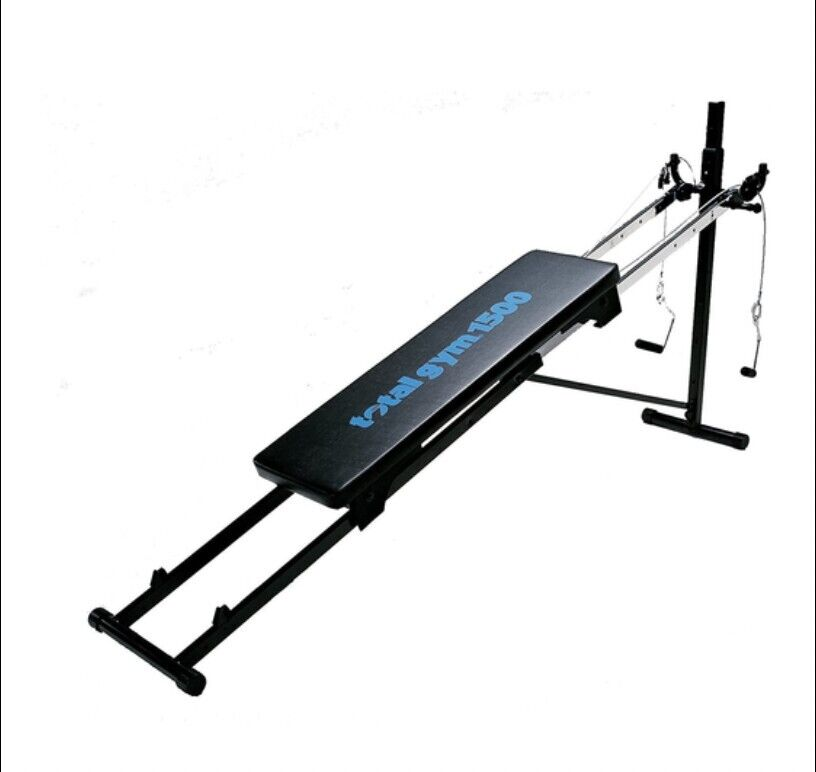
I once used a Total Gym

Eventually I recognized the need for some weight-training. I wanted to exercise at home, but there I wouldn’t have a spotter, so instead of free weights I decided to buy an exercise machine. I didn’t want to spend the money on something pricey like a Soloflex, so I bought a Total Gym 1500.

It had a sliding board, pulleys, and cables with various exercises. My body weight served as the load, and I used it primarily to improve my upper body strength. I used it enough to wear out a couple of sets of pulleys, but I eventually got rid of it after aggravating my lower back and shoulders. All the while, I kept on doing my aerobics each morning.

Push-Ups and Dumbbells

Nowadays I deviate from the Everyday Workout toning segments with my own upper body work twice each week. On Wednesdays, I substitute three sets of 10 slow repetitions of standard plank push-ups. On Fridays, I use low-weight dumbbells in three sets of 10 repetitions of curls, rows, raises, and extensions.

After turning 40, I noticed that I was again gaining weight despite the weekday morning aerobics. My cholesterol levels also weren’t good, so I finally tried modifying my diet.

Dieting

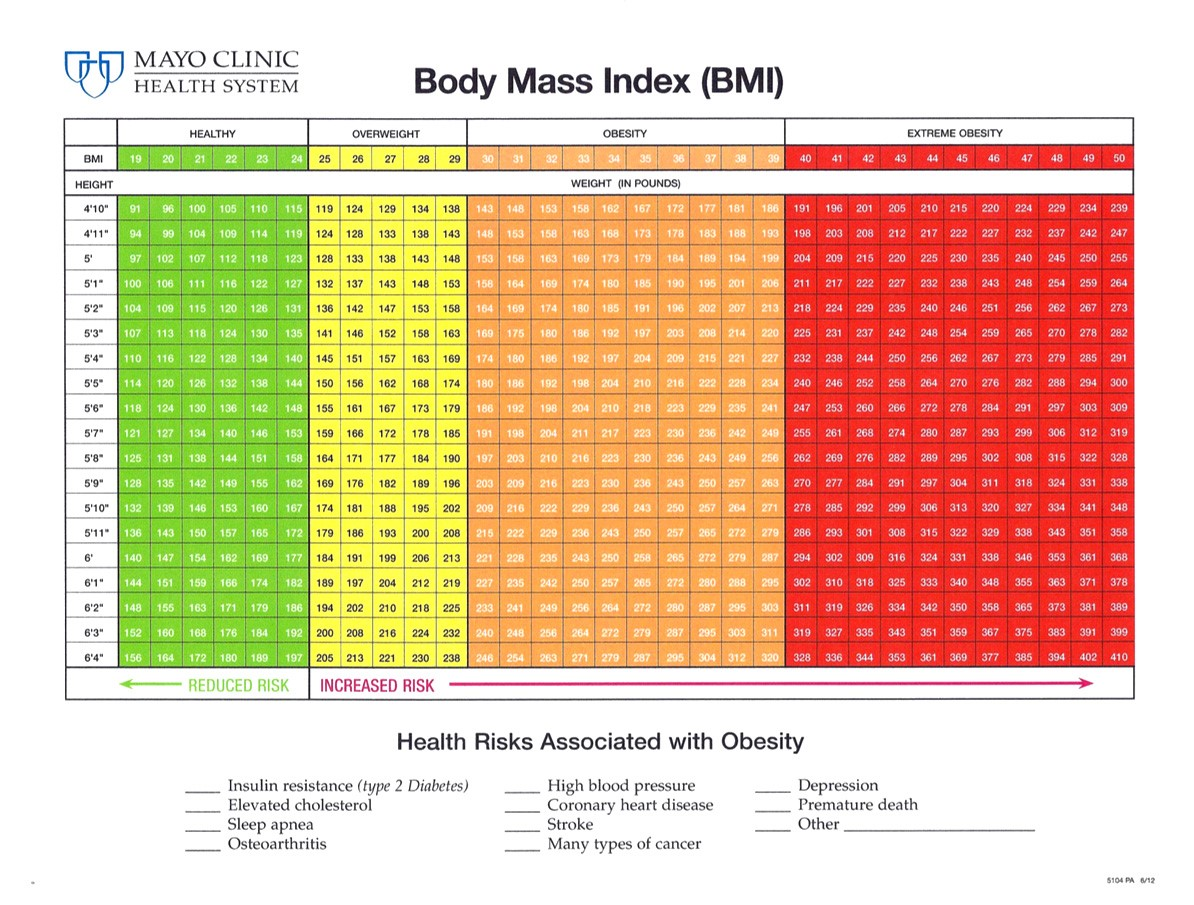
For a year I scrupulously avoided fatty foods, no longer indulging in pizza, hamburgers, or queso dip. I ate more fish, nuts, and vegetables, dealt with hunger pangs with a nightly small bag of low-calorie popcorn, and started drinking Coca-Cola Zero instead of The Real Thing. Over the course of a year, my body mass index (BMI) fell from 26 to 23, but I wasn’t happy and my cholesterol was still unacceptable.

So I went on Atorvastatin and gave up on the restricted diet, although I continued to drink Coca-Cola Cherry Zero or added grenadine to Coke Zero whenever Cherry Zero wasn’t available. I remember how gross my first bite of pizza tasted after a year without it, but I quickly readjusted! I knew, however, that if I didn’t exercise more, I’d eventually have a BMI of 30 or more, with the health risks associated with obesity.

Day Hiking

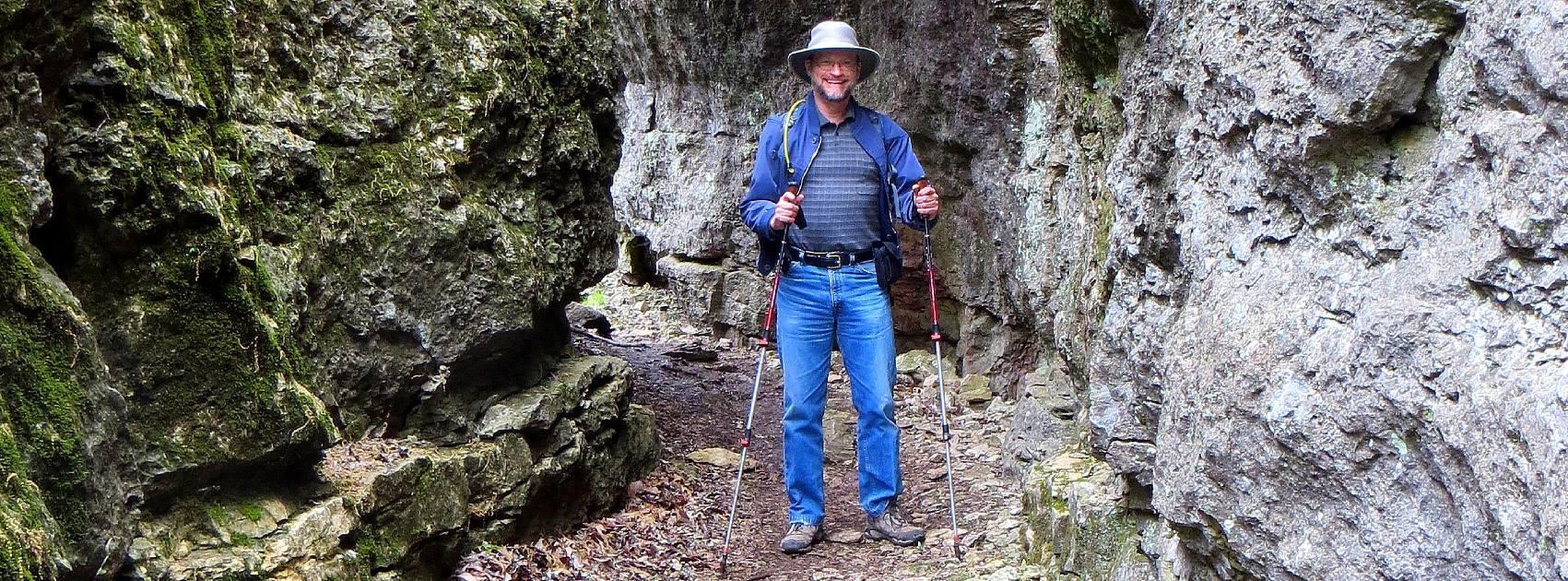
So I took up day hiking. From 2009 to 2012, I hiked over 1,000 miles on trails across seven different states, and I hiked anywhere from 25 to 50 days each year from 2009 to 2015.

I hiked a lot from 2009 to 2015

I originally relied on audiobooks for my solo travels and hikes, listening to tapes of Ellis Peters and Elizabeth Peters, which were pseudonyms for Edith Pargeter and Barbara Mertz, which I checked out from the Tulsa Public Library. I also purchased numerous Great Courses from The Teaching Company. Eventually technology allowed me to shift to listening to Audible books with my smartphone, and I listened to Ken Follett’s Kingsbridge series and all of the works of Agatha Christie.

Osage Hills State Park Map
My Osage Hills trail map from over a decade ago; I need to add an extension to the lake trail

By 2013, when Wendy and I began dating, I had run out of novel trails within driving range. I shared the best trails with her in the years before our marriage in 2016, but I was no longer out hiking every weekend. In 2017 I became a district administrator, and that led to a precipitous decline in my hiking on out-of-town trails, with me instead walking on the Pathfinder Parkway in town.

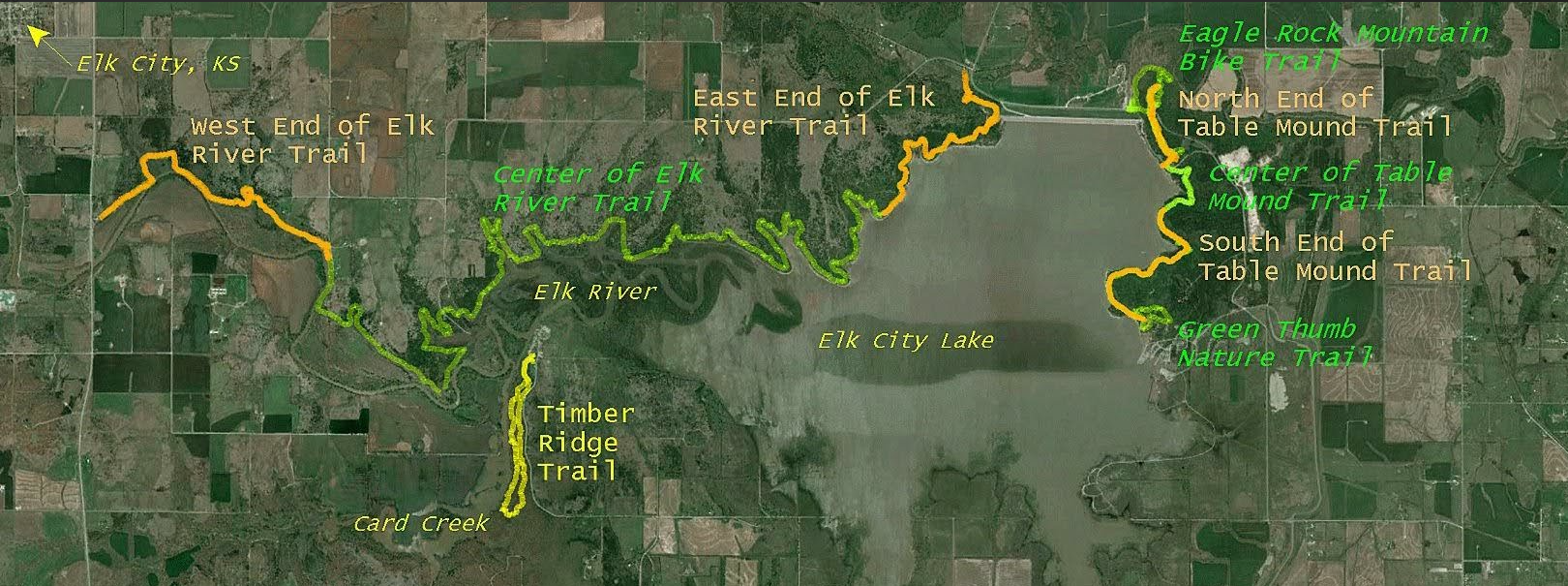
Wendy and I still enjoyed some hikes on our vacations, but the COVID-19 pandemic curtailed our trips from March 2020 through May 2021. During that time, we did hike on the Elk River Trail an hour’s drive north and tried to hike at Osage Hills, which is a half-hour drive to the west. I had long walked and mapped its various trails. However, at that time there were many other folks also seeking a weekend escape, and Wendy and I ended up walking together some in our neighborhood.

Hypertension

In recent years I have mostly just walked on the Pathfinder on weekends, at sunrise in the summer and mid-afternoon in winter. The reduction in walking is one of the reasons my BMI has crept upward. It is still below 29, but stress, genetics, and my diet have now led to me taking three different daily medications to keep my blood pressure under control. That is one of several reasons for my planned retirement in June 2026.

My hypertension medications and aging joints also mean that I can now barely make it into the Everyday Workout Heart Rate Target Zone. I also had to indicate in my Apple Watch Health app that I was on a Beta blocker so it would adjust its own algorithms accordingly and stop warning me about my low heart rate.

Retiring My Videotapes

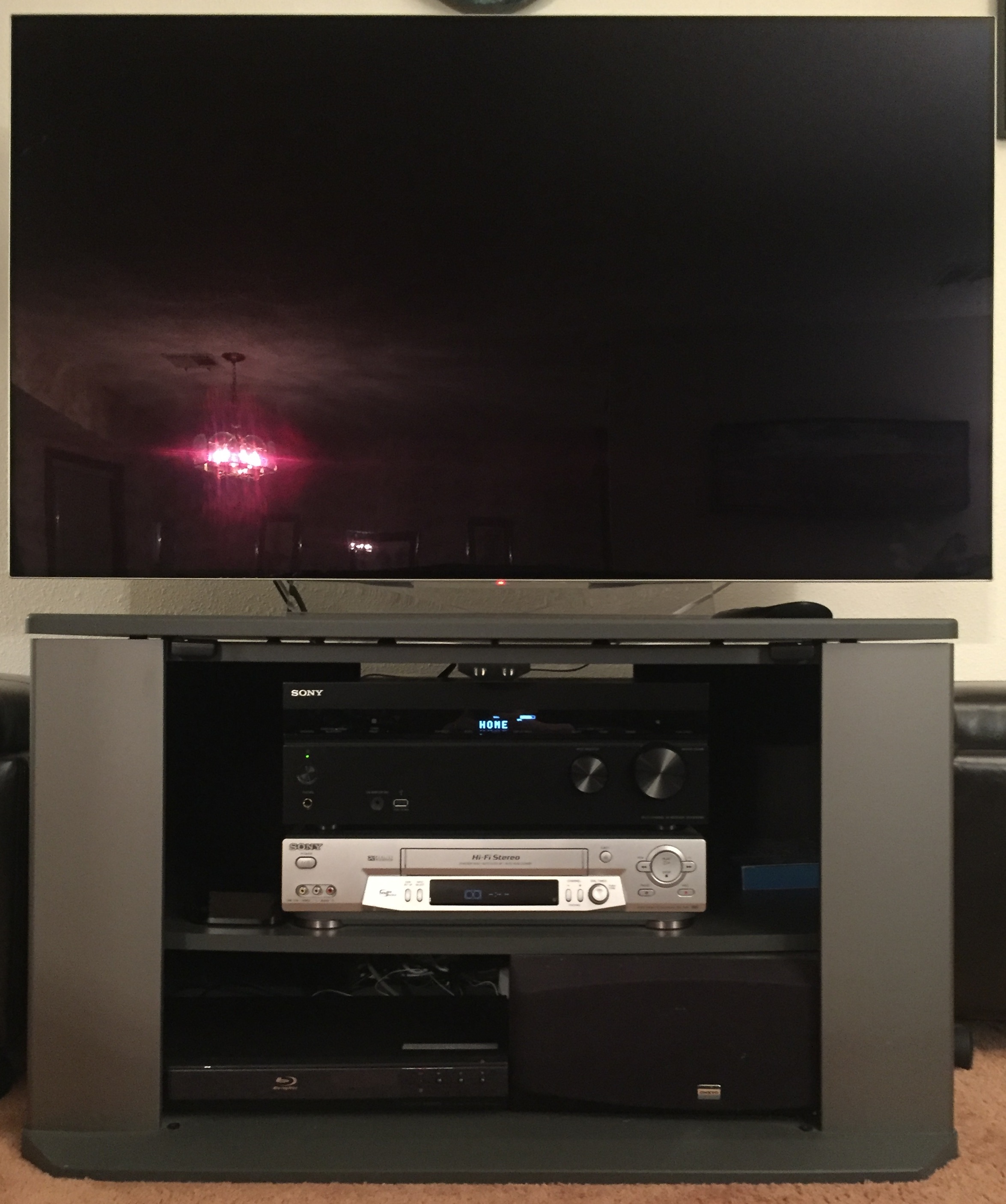
I pulled my 2001 VCR from my media center

I still do my aerobics every weekday morning, and until this year I was still cycling through the 13 videotapes I recorded from 1993 to 1997. Wendy had digitized them for me back when we were dating, but I had misplaced those files. I’ve now digitized them again using a converter dongle and the OBS Studio. I used Microsoft Clipchamp to edit the videos, taking the time to excise the decades-old commercials and replace them with a generic 60-second countdown clip.

I had to connect the VCR to a computer for the digitization, and rather than monkey with a laptop in the living room I pulled my 2001 VCR out of the media center. The time-consuming digitization process could have meant over a month without my morning aerobics, but I wasn’t about to do that.

Years ago, I couldn’t find hardly any of the hundreds of episodes of Everyday Workout on YouTube, but a search this year revealed several dozen. Funly enough, they were from her early years, which I had never seen. So for weeks I played poorly synced episodes from the 1980s that someone had uploaded. She sounds just the same, but there aren’t any commercials and her cardiovascular workouts were pretty intense back then.

At my age, I don’t bounce like a 25-year-old, so I’m grateful for the less intense picture-in-picture variation

Since I’m 35 years older than she was at the time of recording, I usually do something in between the more and less intense levels she was demonstrating, as my knees don’t tolerate me bouncing around like a 25-year-old.

I have long used Shokz OpenRun/AfterShokz Aeropex bone conduction headphones with my iPad around the house, but when I use AirPlay to mirror the iPad to the Apple TV to show the aerobics videos on our television, the television becomes the source of the audio signal. I grew tired of fumbling through menus to change the headphone Bluetooth pairing from the iPad to the TV and back each morning. So I bought a second set of headphones and now have one always paired to the iPad and the other always paired to the television.

My VCR is finally going into retirement

That has worked well enough that I will now use my digitized videos for the workouts once I’ve run through the older ones on YouTube. I respect copyright too much to upload my 148 episodes, but I have them available locally. So I didn’t shove the old VCR back into the media center, but instead I finally stored it after decades of near-daily use.

Next Steps

My own retirement will come in June 2026, and that will reduce my stress and allow me to take more walks and hikes. Lifestyle Interventions and Independence for Elders recommends:

•   At least 150 minutes per week of walking or other moderate intensity exercise

•   Resistance training with weights or machines two or three times a week, but not two days in a row

•   Stretching and other activities that improve flexibility and balance every day

I look forward to not only walking more often on the Pathfinder Parkway but also returning to the trails at Osage Hills and Elk City. I plan to take more advantage of the Bartlesville Trails at Lake Hudson and, since Wendy and I are members, the three trails at Woolaroc.

Elk City has several nice trails an hour’s drive north of Bartlesville

Down south I could walk at Oxley Nature Center, and while I’m disappointed that ecological damage and vandalism have restricted Redbud Valley to limited tours, there are the Keystone Ancient Forest and Turkey Mountain, and I might buy a Member Plus One plan for the Tulsa Botanic Garden.

I still enjoy listening to Audible, and I always have an audiobook underway along with an e-book on my Kindle. In recent years I have been listening to works by Mary Roberts Rinehart and P.G. Wodehouse, and I’ve downloaded a few of the early works of Erle Stanley Gardner and Ross Macdonald as additional series to sample.

I still plan to do my weekday Everyday Workout sessions as well. They’ve served me well for over thirty years, and if I’m lucky, they’ll help me stay fit for a few more decades.

Posted in day hike, random, video | Leave a comment

Living without an internal monologue

Five years ago, in early 2020, interest in the concept of internal monologues spiked after a viral tweet shared how not everyone experiences the phenomenon, which has been described as hearing your own voice talking inside your head, in complete sentences, verbalizing your thoughts.

That prompted Ryan Langdon to post a video interview with a lady who had no such inner monologue, and I remember seeing it at the time. I had missed the tweet because I have always minimized my engagement with Twitter, now called X. I didn’t pay much heed to Langdon’s post, and the statewide shutdown of public schools the next month, due to the COVID-19 pandemic, drove the topic from my mind…which has no inner monologue.

I posted this image when asking my Facebook friends if they had inner monologues; several did

Half a decade later, I saw another mention of the phenomenon, so I finally returned to the topic, taking the time to read descriptions of it. Unsure about my interpretation, I asked my Facebook friends if some of them experienced it. Personally, while I can imagine someone’s voice speaking a given sentence, I don’t recall ever spontaneously hearing such a thing in my head, save for famous media moments, such as FDR’s comments about the attack on Pearl Harbor. I certainly never hear my thoughts being verbalized internally in my own voice.

Immediately several friends confirmed that yes, they hear their thoughts in their head, “spoken” in their own voice. Some experience it frequently.

My psychology background merely consists of a three-credit-hour introductory psychology course and a two-credit-hour educational psychology course almost 40 years ago, plus applying Piaget’s theory of cognitive development in science learning cycles. So I have little understanding of the types of inner thought. Reading that 30-50% of people commonly experience “inner speech” led me to explore the concept and its possible implications in my life.

Types of inner experience

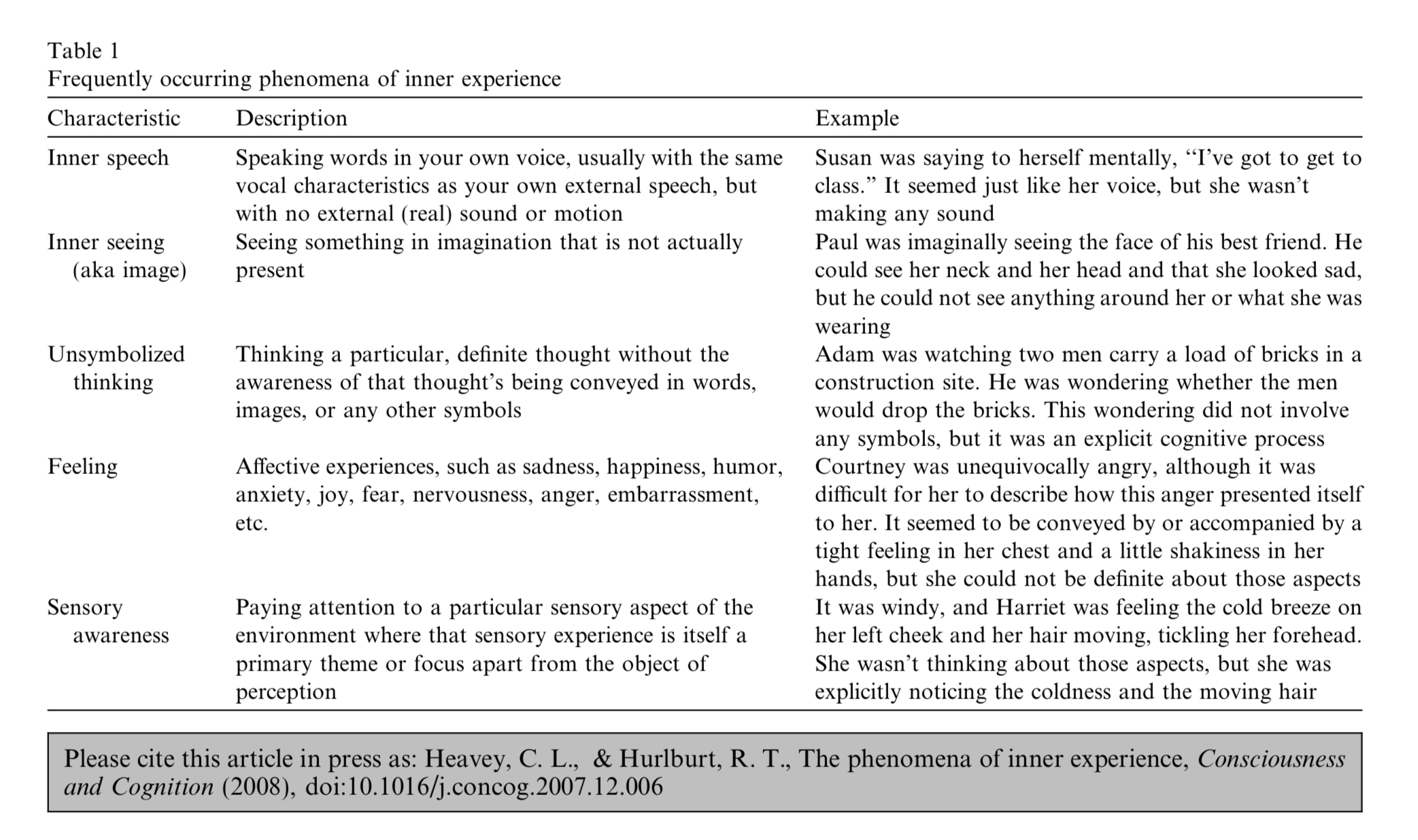
Back in 2007, C.L. Heavey and R.T. Hurlburt identified five frequently occurring phenomena of inner experience, including “inner speech”.

Source

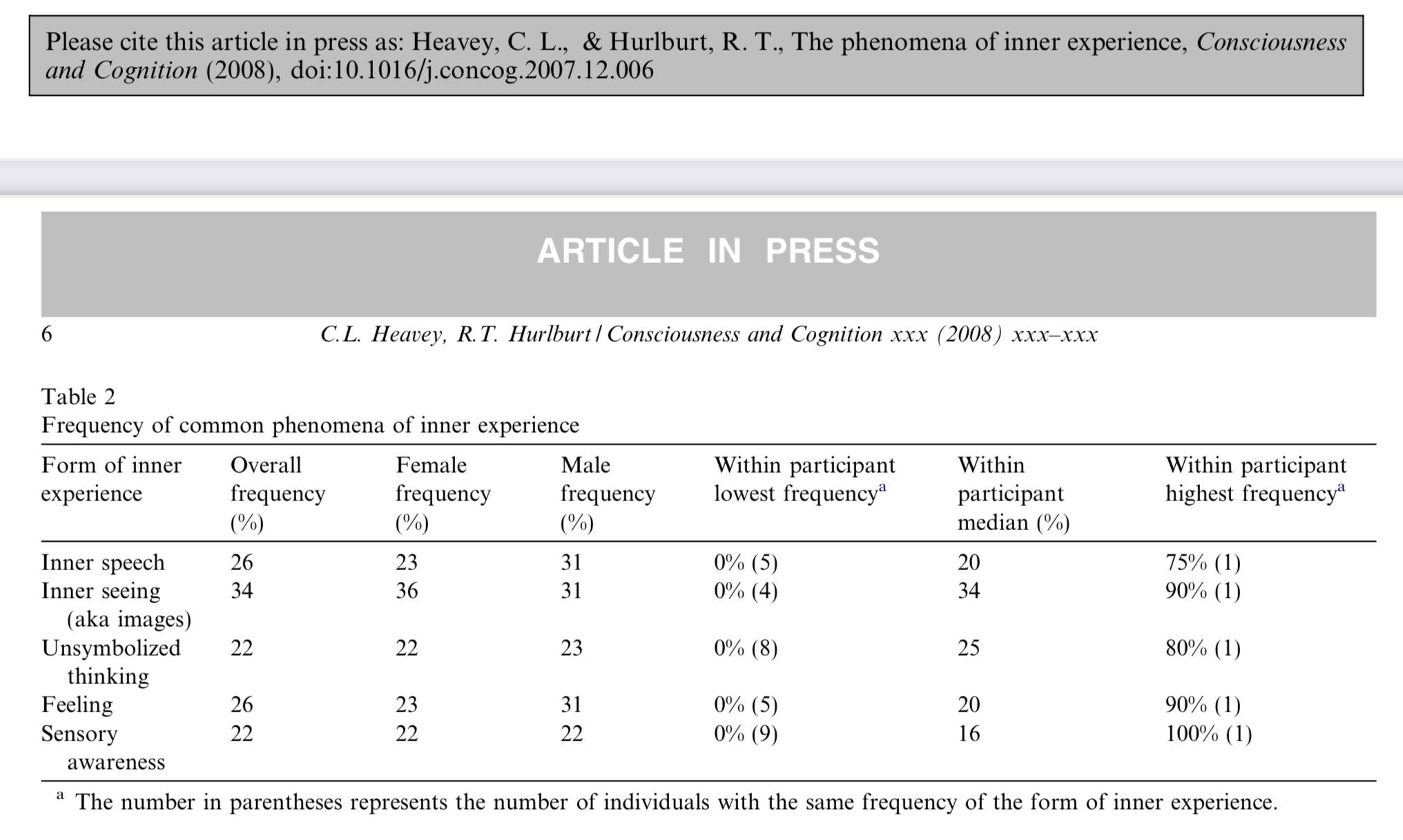
They demographically selected 30 subjects from a pool of over 400 undergraduate students, training them in descriptive experience sampling before equipping them with beepers that triggered randomly to have them note their inner experiences ten times over two days. The subjects might be engaging in simultaneous forms of inner experience at any given moment, so the overall frequencies of the experiences added to over 100%.

Source

I find it fascinating that overall the subjects were engaged in inner speech about 1/4 of the time, although 1/6 of them never experienced it. Hurlburt’s years of research have led him to state that few, if any, people actually engage in inner speech continually, but in some people it can be rather frequent.

I never experience inner speech, but I am familiar with all of the other inner experiences in Heavey & Hurlburt’s study. While I’ve read that some people lacking inner speech also report aphantasia, the inability to visualize mental images, I do not have that rare neurodevelopmental trait. However, rather than inner seeing, I mostly engage in unsymbolized thinking that lacks words, images, or any other symbols.

CAUTION: Scientific jargon ahead, but thankfully it only lasts for two paragraphs.

According to the Stanford Encyclopedia of Philosophy, the Russian psychologist Lev Vygotsky’s theory of cognitive development claimed that inner speech resulted from a developmental process, with children’s linguistically mediated social interactions changed into an internalized “conversation” with the self. Other theorists have argued that it plays a role in reasoning, facilitating abstract thought, etc.

The brain is said to have dorsal and ventral language streams, with the dorsal developing more slowly in childhood and influencing the emergence of inner speech. So it could be that the way my own dorsal stream matured is what prevents me from having an internal monologue.

Personal implications

Throughout my life, I’ve seen portrayals in movies and television of people thinking on screen with a voiceover narration by them of their thoughts. I had always presumed that was just a contructed method of conveying their abstract thoughts, their unsymbolized thinking. Now I realize that for a significant fraction of people, it represents what they actually experience internally.

That is truly strange to me, and it is no surprise that those with an inner monologue may struggle to imagine how people like me think. Perhaps descriptions of unsymbolized thinking would help some of them recognize it as an inner experience they also have, and that would help them understand my most common inner experience.

IQ and Processing Speeds

Otherness is often misrepresented as inferiority, and I’ve seen silly comments, thankfully not from my Facebook friends, that those lacking an inner monologue must be “smooth-brained” or have lower IQs. I’ve also seen on some message boards speculation that an inner monologue slows processing, since the rate of the spoken word lags the typical comprehension rate. I question the validity of such assertions.

The Intelligence Quotient is itself a problematic concept. It claims to measure a person’s cognitive abilities, particularly the capacity for reasoning, problem-solving, and learning. While IQ tests correlate well with academic success, their ability to assess intelligence in a broader sense is highly questionable. The eminent Stephen Jay Gould despised IQ scores, criticizing in The Mismeasure of Man their development and use, charging they reflect two major fallacies: reification, or, “our tendency to convert abstract concepts into entities” and ranking, our “propensity for ordering complex variation as a gradual ascending scale.”

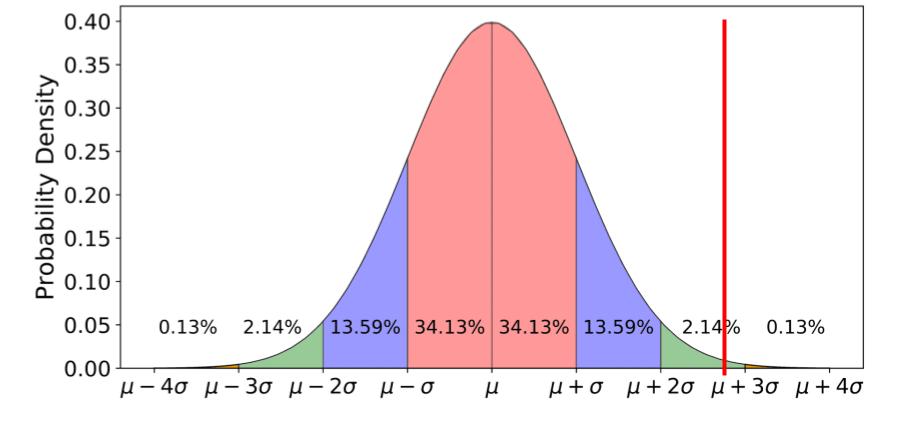
My WAIS-R score in the mid-1980s was at the 99.44 percentile, but IQ scores have limited meaning

When I was an undergraduate, I participated in a psychological research study that included being administered the Wechsler Adult Intelligence Scale examination, and my overall score was at the 99.44 percentile. That matches up with the IQ score I received on a test in grade school. So my lack of an inner monologue didn’t prevent me from having a high IQ, although how much that means is highly debatable, and one should not confuse intelligence for wisdom.

As for processing speeds, some of my Facebook friends commented how subvocalization could hinder their reading speed. I was a very fast reader as a child, racing through 135 books in first grade, exhausting our K-3 school library before I graduated from third grade, and finishing the SRA box of readings and comprehension tests months early in my sixth grade reading class, which greatly frustrated our teacher. I have never “heard” voices when reading, which I suppose might have sped me along without reducing my comprehension. However, as I have aged, the speed at which I read for pleasure has slowed greatly, and my attention span and stamina have shortened.

Internal Dialogues

Of greater interest to me is that around 80% of people report hearing an “inner voice” when reading silently, and over half report hearing distinct character voices most or all of the time. I’ve never had that experience, and I will now wildly speculate on its possible impacts on me. I haven’t tried to back any of the following with scientific evidence.

A miserable high school boy reading a play, by Microsoft Designer

In junior high and high school, I greatly disliked reading plays in literature class, but I was fine when they were performed, either just vocally or in a live or recorded performance. I suspect that not “hearing” the play internally was a block. I suffered my way through reading Julius Caesar, and I didn’t enjoy it until we watched the 1953 epic movie version. I was grateful that we read the play Death of a Salesman aloud in class, despite the faltering readings of some students, as otherwise I would have had no appreciation for it. I didn’t enjoy reading the play The Crucible, but watching it was a treat. However, after reading the novel The Scarlet Letter, watching a movie adaptation of it did nothing for me.

In 1984, when I was in Washington, DC as a U.S. Presidential Scholar, we toured the Folger Shakespeare Library, but I couldn’t imagine why anyone would want to own a single copy of the First Folio, let alone collect 82 of the 235 known surviving copies. I’d be willing to endure a condensed Shakespeare play, and I admire many of his perfect creative expressions and several of his sonnets, but reading a Shakespeare play is torture for me.

As a youngster, I not only loved to read novels and nonfiction, but I also loved to write essays and articles. I would bang out a family newspaper on our manual typewriter, and I was enthusiastic about editing an elementary school magazine. So when I was ten years old, my father engaged a university student as a creative writing tutor for me. She put me through a variety of exercises, but the dialog I wrote was nothing but dreadful cliches. To this day, I have no “ear” for dialog.

Peter Ustinov as Hercule Poirot in 1982

Decades later, when I was going on weekly day hikes, I started checking out audiobooks on cassette tape to listen to on the long drives and sometimes while hiking. I exhausted the downtown Tulsa library’s collection of Ellis Peters and Elizabeth Peters audiobooks and eventually sampled Agatha Christie. I’d seen Peter Ustinov’s movie portrayals of her detective character Hercule Poirot, and I’d read a couple of her books. They hadn’t made much of an impression, but I was dumbfounded when I listened to her audiobooks at how believable and engaging her dialog could be even when directly narrated from the text. After that, I never read another Christie book, but instead I listened to all 66 of her novels and her 153 short stories in audiobook form.

I have tried to read screenplays, but I find I hate them, and when I am reading a short story or a novel, I don’t form a sharp mental image of the characters, even though I might visualize the settings. My dreams are in color and often have detailed settings, scenarios, and some dialog, but I retain no memories of the sound of any vocalizations. When I see movie or television adaptations of books, I am seldom put off by how an actor looks or talks, unless it clearly violates a description of the character in the text, and my mental image of a character subsequently takes the form I saw in the visual medium. If I see multiple portrayals, I stick with my favorite. I was always puzzled when people who had read a book would watch a movie adaptation and remark, “That isn’t how I visualized him/her.” I had barely visualized them at all, and I certainly never created a voice for them in my head.

All of this has greatly affected my own writing. My essay writing earned me various recognitions, but I have always resisted writing short stories, novels, or plays — anything with dialog — instead sticking with essays, research papers, travelogues, and the like. This blog currently consists of almost 800,000 words across almost 800 posts…with almost no dialog.

So if you have an internal monologue, I hope that you enjoy it, and that it speaks to you kindly and gently. My thoughts, in the form of unsymbolized thinking, are with you.

Posted in random | Leave a comment