Fall Break was an Autumn Brake

November 6, 2021 | Photo Album

Meador Selfie Profile Pic

Two weeks before Fall Break 2021, Wendy and I received our third doses of the Pfizer-BioNTech COVID-19 vaccine. That meant our protection against infection would be strengthened for a much-needed brief escape from Bartlesville in mid-October as we temporarily applied the brakes on another go-go school year. Our last real vacation was a getaway to Mount Magazine in June, before the Delta variant struck.

I explored various options, but the nice suites at the Artesian Hotel in Sulphur were booked. The facilities at Quartz Mountain Lodge had been undergoing renovations, but the restaurant wasn’t ready yet. We really needed a change of pace, and it wouldn’t hurt to have a contrast to our mountaintop hermitage back in June. So I pondered, “What about Kansas City?”

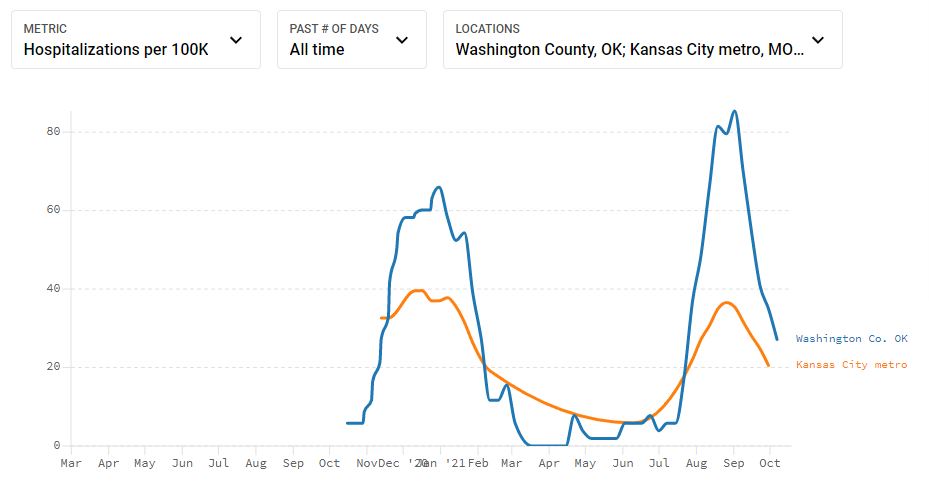
Even with freshly boosted immune systems, would it be wise to spend a few days and nights in a metropolis of over two million people? I’ve been known throughout the pandemic for publishing and interpreting many data graphs, so naturally I created comparisons of Bartlesville’s Washington County to the Kansas City metropolitan area:

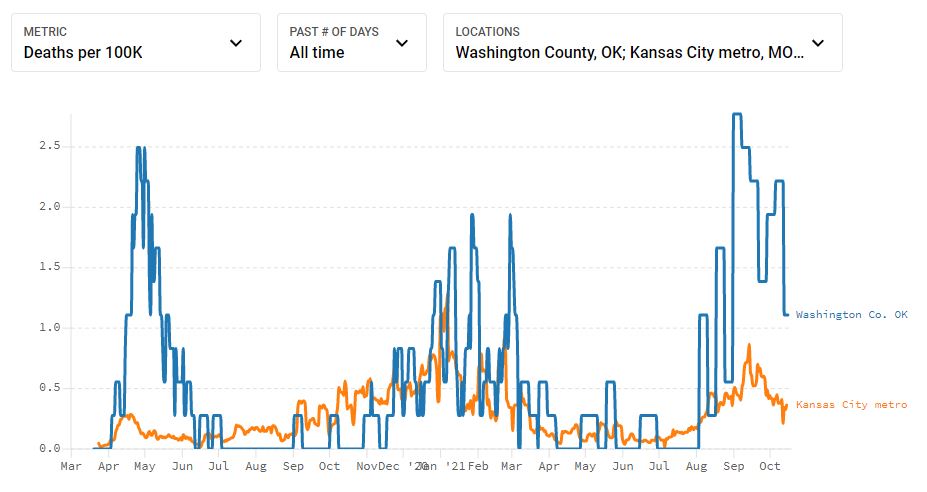
That revealed how, throughout the Delta surge, Kansas City had a significantly lower rate of cases, deaths, and hospitalizations than our county. Those are readily attributed to the higher vaccination rate and mask mandate in Kansas City, which reflect its very different politics.

For years we had been staying at the Courtyard by Marriott at the Country Club Plaza when visiting KC, but it only offers a continental breakfast. I opted to book a Premier Suite for a couple of nights at The Raphael Hotel, another highly rated Marriott property close by, since it has full room service. That would allow us to enjoy a relaxed breakfast in our room in the mornings and walk just a block or two for other meals at the Plaza’s restaurants.

Our Journey North

For us, it is about a four-hour drive north-northeast from Bartlesville to the City of Fountains. I don’t find any of the obvious routes scenic or memorable. (Sorry, Kansas.) I seldom take the simplest route using US 75 and I-35, as I find it particularly boring. So I usually divert east at Independence to take US 169 up to I-35. You see more towns that way, although I dislike the route from Paola to Olathe. I wanted to see some new things along our escape route on this venture, reserving the boring route along I-35 and US 75 for the return home a couple of days later.

We took a more interesting route east and north to Kansas City, saving a faster but less interesting route for our return home

So we departed Bartlesville heading east on US 60 to Nowata and then took US 169 north through Coffeyville to then head east again on US 400 to Parsons. We stopped there at the Hickory Hole for a lunch of pulled pork sandwiches and then continued eastward to Pittsburg. We had never been there, although several friends had earned degrees from Pittsburg State University. So we drove around the perimeter of the campus, noticing many Gus the Gorilla statues at businesses along Business 69. There’s a story behind that.

Then it was a short hop north along US 69 to an attraction I’d found on TripAdvisor: the Lowell Milken Center for Unsung Heroes at Fort Scott. The name alone was enough to intrigue me. Why would one of the infamous Milken brothers fund a museum of unsung heroes in rural Kansas, an hour-and-a-half drive south of Kansas City?

Fort Scott has a population under 8,000 and the center’s origins trace back to an even smaller community, Uniontown, 16 miles west of there. Schools there serve students from Uniontown, Bronson, Hiattville, Mapleton, Redfield, and their surrounding rural areas.

Back in 1999, Uniontown High School history teacher Norm Conrad encouraged his students to work on a National History Day project. He showed two ninth-graders, Megan Stewart and Elizabeth Cambers, and eleventh-grader Sabrina Coons a short clipping from a 1994 issue of U.S. News and World Report that merely stated, “Irena Sendler saved 2,500 children from the Warsaw Ghetto in 1942-43.” He thought that “2,500” might be a typographical error, since he had not heard of that woman or her story. The kids decided to find out more.
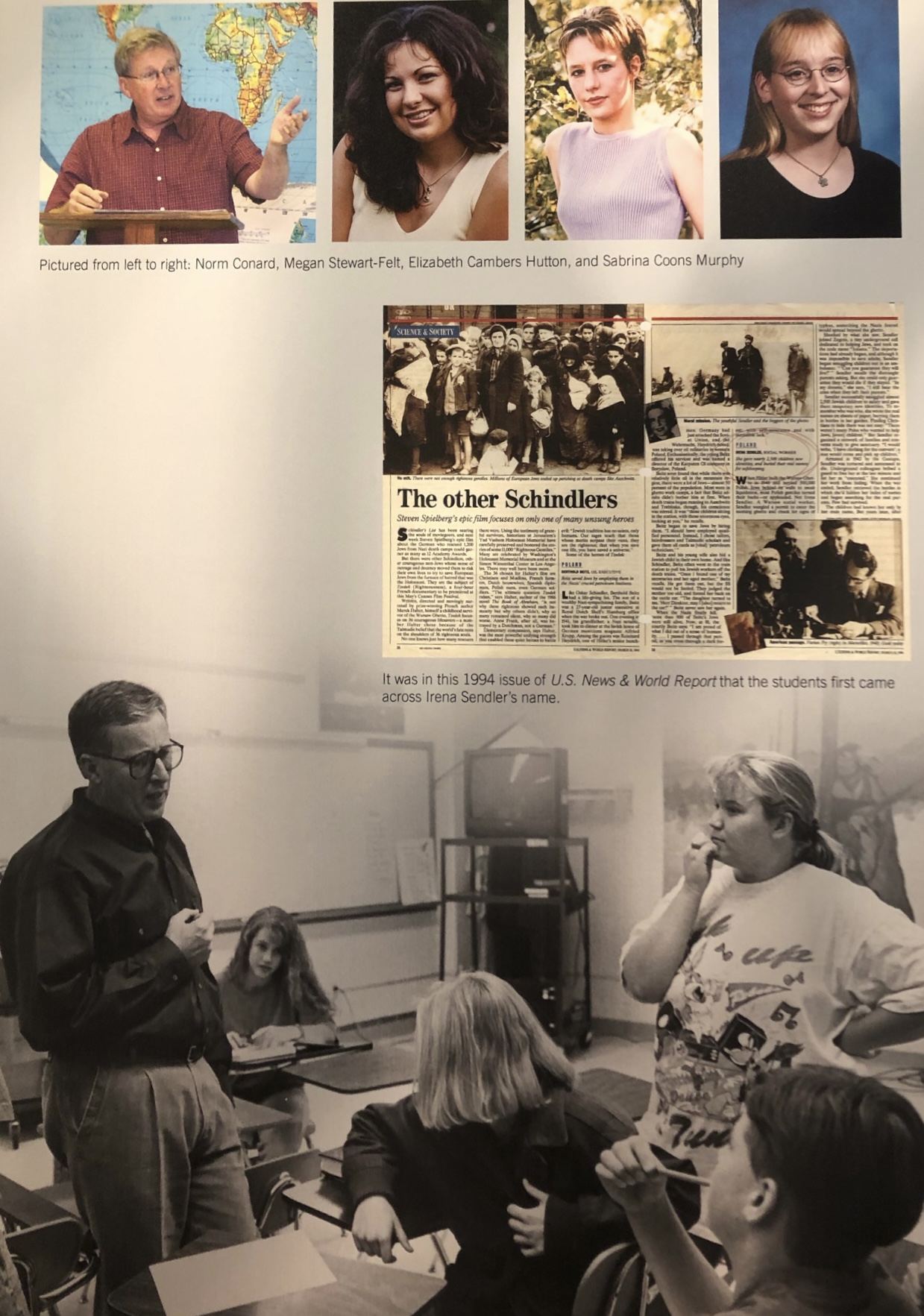
Uniontown teacher Norm Conrad and his students and the brief mention of Irena Sendler in a magazine article that set everything into motion
Irena Sendler meets with Uniontown students

Conrad’s students wound up gathering over 4,000 pages of material about Irena Sendler and the Polish underground resistance organization, Zegota. They wrote and performed a play about her courageous life, which they titled, “Life in a Jar.” It was presented hundreds of times and led to television appearances, a book, a motion picture, and, most touchingly, the students meeting with Irena in Poland several times before she passed away in 2008.

Irena Sendler

The students discovered that Irena’s group created false documents to help Jewish families escape the Warsaw Ghetto. Irena later entered the ghetto disguised as a social worker checking for typhus. She convinced Jewish parents and grandparents to give up their children, who were otherwise destined to die in the ghetto or death camps. Her group of 25 volunteers smuggled the children past Nazi guards using various methods. Irena made lists of the children’s real names on thin tissue paper and hid them in jars she buried under an apple tree across from the German barracks.

Irena Sendlerowa during the war

Eventually Irena was arrested. She was tortured by a young guard. She fed him a cover story, and said she was grateful that the pain from her fractured feet and legs allowed her to pass out without revealing the identities of her fellow Zegota resistance members. Zegota bribed a German guard to help her escape. She would soon see posters around Warsaw listing her as a resistance member who had been shot.

For the remainder of the war, Irena went into hiding like the thousands of children she had helped save. After the war, the Zegota members worked to reunite children with relatives, but almost all of the children’s parents had died at the Treblinka death camp.

When asked why she, a Roman Catholic, risked so much to save Jews, Irena cited her father. He was a doctor who contracted typhus while caring for poor Jewish people in their small Polish town. Before he died, when Irena was seven years old, he told her something she would never forget:

If you see someone drowning, you must jump in to save them, whether you can swim or not.

That spoke to me, given how back in March 2020 the pandemic began for us, and many jumped in to help. We doggie-paddled at first, but over the past 18 months we have learned our strokes and how best to lifeguard others. There are now plenty of life rings floating by, just waiting to be grasped.

But human nature is the same now as it was 80 years ago. In this pandemic there are heroes and villains. A dangerous minority believe the big lies and propaganda from self-serving cranks, politicians, and charlatans, no matter how ridiculous. Some do little to help themselves or others. Some fall prey to the temptations of appeasement, fatigue, or cynicism. But I am hopeful that the worst is now behind us, and I am grateful for those joining me in tossing life rings and teaching swimming lessons, and especially for our modern-day heroes: the doctors and nurses working long hours to save as many as they can.
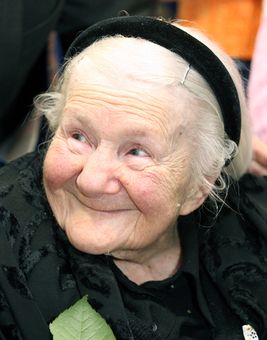
Irena lived by these principles, learned from her father:

  • People can be either good or evil. Their race, origin, education, and estate are not important.
  • You should offer help to anyone in dire straits, even if you are in trouble yourself.
  • The most important things are love, tolerance, and humility.

After the war, Irena worked in the healthcare department, built houses for orphans and the elderly, did family guidance service, and trained civic counselors. After her compulsory retirement in 1967, she worked in a school library for seventeen more years. Hers was a lifetime of service.

The museum docent was most friendly and helpful, telling us the story of Irena and the Uniontown High students. The museum has displays on several more unsung heroes, but thanks to the internet, you don’t have to journey to Fort Scott to read about them.

Kansas City

The Raphael Hotel

The Raphael Hotel

After our tour, we drove north and eventually wound up on Stateline Road in Overland Park, transitioning to the pretty Ward Parkway to make our way to the Country Club Plaza district in Kansas City, Missouri. Our suite at the Raphael was comfortable with some nice amenities, although Wendy missed having a microwave to reheat her coffee, and she used the ice bucket to initially chill my soft drinks as the refrigerator was permanently set to the mid-40s Fahrenheit, which is too warm to keep food from spoiling and too slow to cool down a warm can of soda. There was no housekeeping during our two-night stay, something that the pandemic has made more common in the hotel industry. But we loved the breakfast room service and the location, so we will likely to return to the Raphael for future visits.

We walked across Brush Creek to the Plaza to enjoy dinner at Buca di Beppo, a Kansas City tradition for us. Then we walked down to the Barnes and Noble bookstore to browse. I’ve always liked their four-story Plaza location. We’re not shoppers, so all of our other stops in the Plaza would be restaurants.
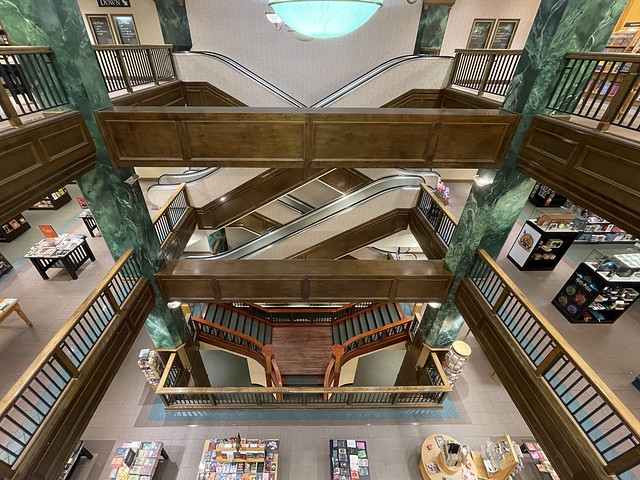
Plaza Barnes & Noble

The big Barnes & Noble bookstore at the Country Club Plaza

One thing we immediately noticed was the adherence to Kansas City’s mask mandate across the venues we visited. Everyone inside the hotels, museums, shops, and restaurants wore their masks unless they were seated at their table to dine. Signs and greeters helped enforce the expectation, and relatively few noses were poking out above the masks. It was a marked contrast to the laissez-faire attitude toward masking in Bartlesville, and the visible precautions made us far more comfortable during our visit.

Long ago we partook of several of the top attractions in Kansas City, such as The Arabia Steamboat Museum and The National World War I Museum and Memorial. Usually we stop by Union Station to see its current exhibition. But the topic this time was Auschwitz, and I had no interest in following up the story of Irena Sendler with more Nazi atrocities.

Toys and miniatures

Wendy’s latest artistic endeavors have been fashioning small items out of resin, so we instead made our first visit to The National Museum of Toys/Miniatures, which was just a few blocks south of our hotel. It was established in 1982 by Mary Harris Francis and Barbara Marshall. Ms. Francis was a former teacher who loved dollhouses, toys, and games, and she assembled the largest toy collection in the Midwest. She was a Guinotte, one of the founding families of Kansas City, and married John Byers Francis, whose father had started the Puritan Company specializing in oxygen and nitrous oxide gas systems, which became Puritan Bennett. Mr. Francis rose to the Presidency of the company, which was a leading producer of ventilator systems, oxygen therapy, and other respiratory products.
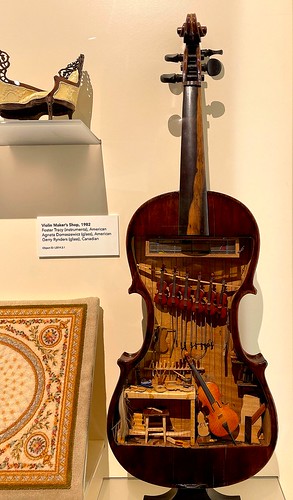
Violins in a violin

A miniature violin maker’s shop…in a violin

Barbara Marshall was a serious collector of fine-scale miniatures. She was one of Hallmark Cards founder J.C. Hall’s three children with his wife, Elizabeth. She worked in the art department at Hallmark and volunteered at the Nelson-Atkins Museum of Art. Her interest in miniatures and her friend Mary Harris Francis’s interest in dollhouses and toys, and their spouses’ desires to relieve their respective homes of the large collections each had built up, led to the creation of the museum.

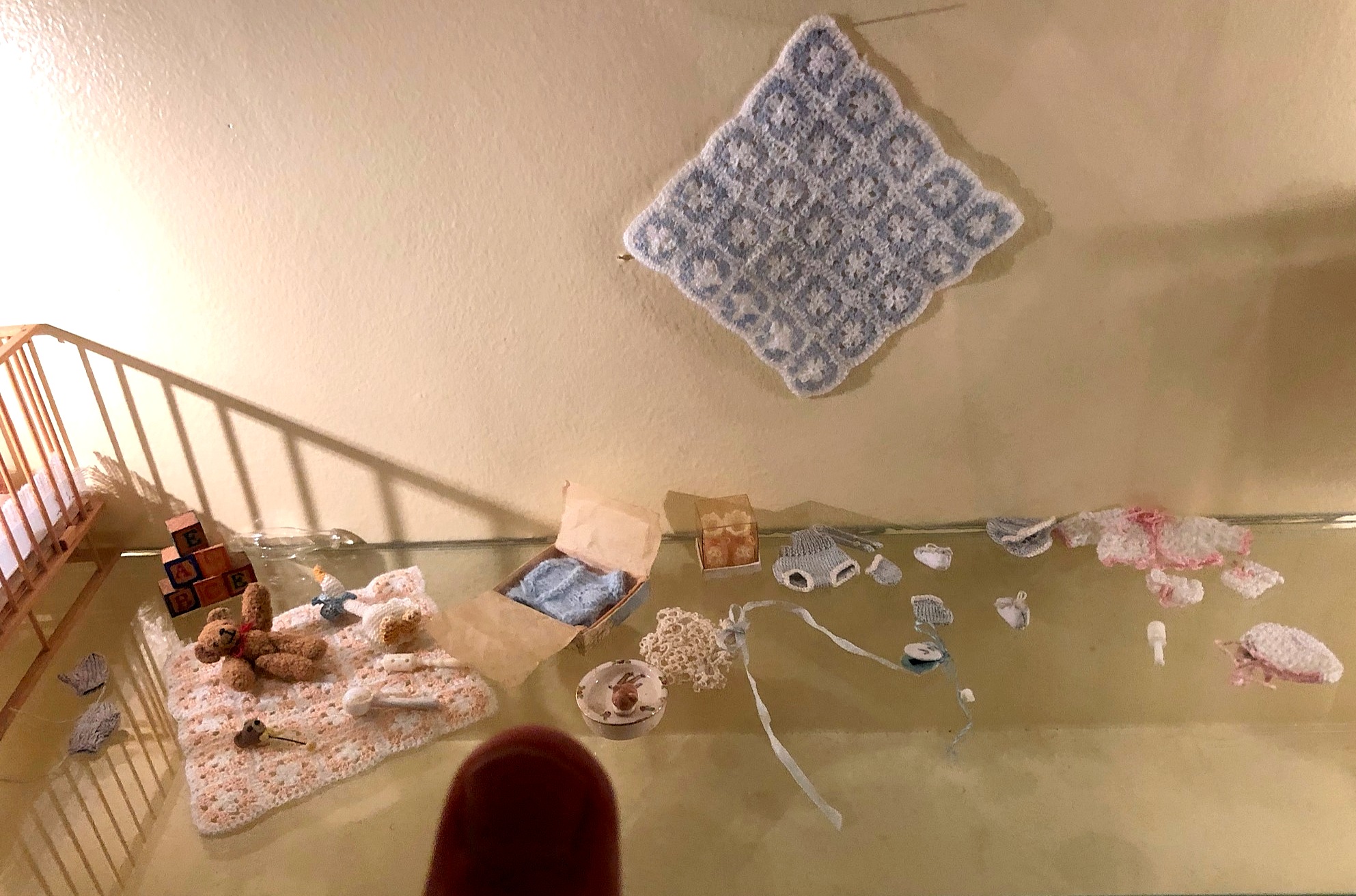
The detailed workmanship evident in the large collection of miniatures was remarkable. Some items were displayed in cases, others helped decorate immense dollhouses. Many items were in the scale of one inch to one foot, but others were smaller.

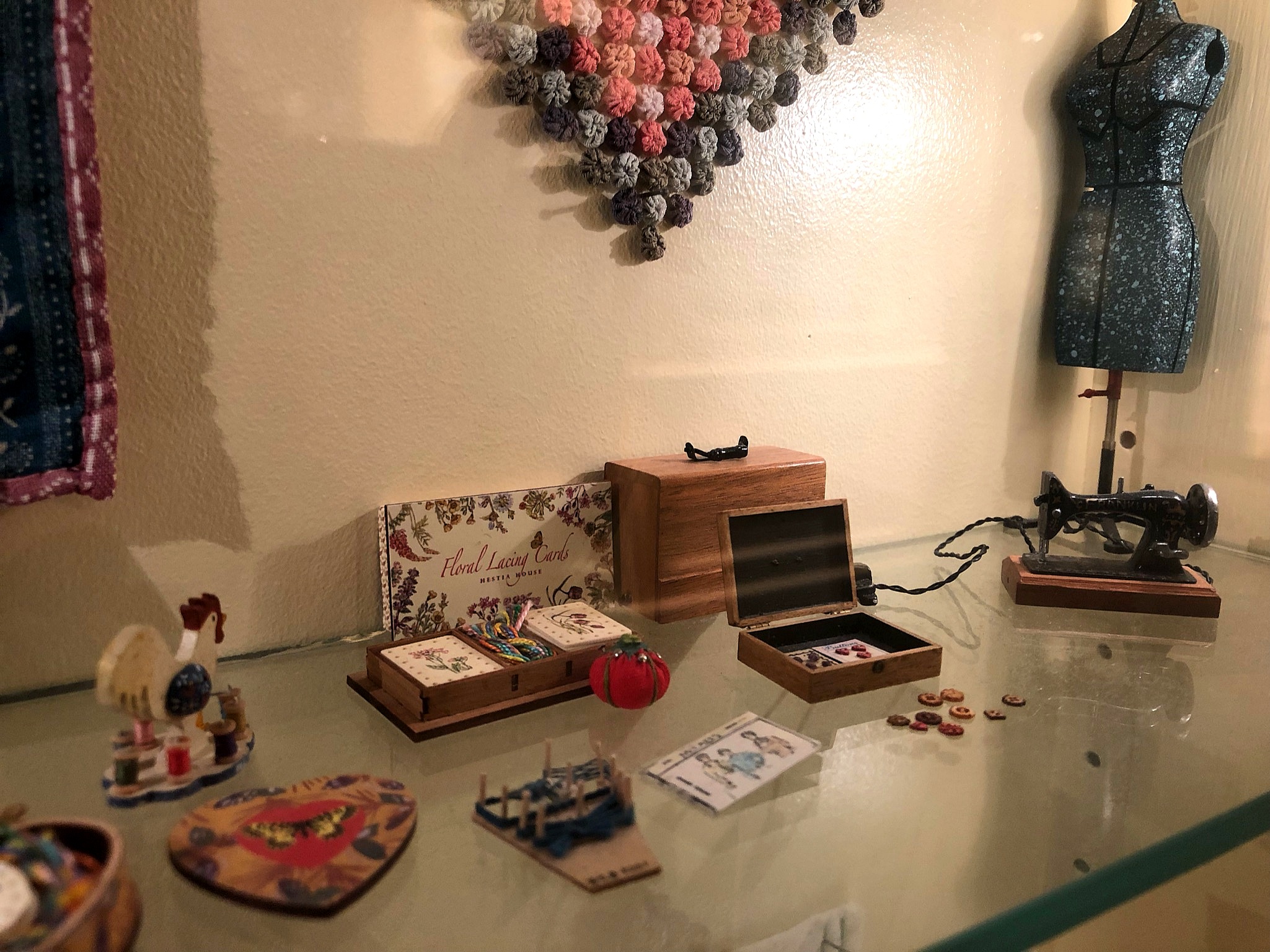
In the first room of miniatures, a violin maker’s shop, with multiple instruments, had been crafted inside a violin.  There were various knitted or crocheted items smaller than one’s thumb, tiny sewing items and buttons, incredibly small plates, cups, and saucers, and blueware.

 

Twin Manors door

Over 200 pieces were assembled to form the front door

Twin Manors was a miniature home in the Georgian style finished in 1989 with incredible detail, from 12,000 hand cut walnut shingles, with all visible nails having square heads, to over 3,000 pegs in its wood floor boards. A display illustrated how the front door consists of 216 different wood pieces.

Two other downstairs displays that were particularly striking to me were an Art Deco Jewelry Store and an English country manor house.

Upstairs were the toys. The displays were curated, but I think I prefer the more overwhelming displays of the Toy and Action Figure Museum in Pauls Valley, Oklahoma. I had not seen a Fisher Price A Frame in decades; I had their Garage playset as a kid. A highlight for me was a wall display of the prizes that once came in Cracker Jack boxes. During my childhood, they had devolved to mostly paper items and temporary tattoos, but in the past there had been plastic and metal toys for the tots in the box with the caramel popcorn and peanuts.

Back to the Bristol

Wendy wanted some seafood in the big city, but we’d already been to McCormick & Schmick’s at the Plaza on previous visits. So I drove us north along Main Street, seeking the Bristol Seafood Grill where I dined back in 2011, in the Power and Light District.

AT&T Long Lines / Toll Building

Main Street was truly a mess. It was narrowed to one lane each way by a maze of traffic cones diverting you from one side to the other for mile after mile. They are busily relocating and refreshing utilities along the corridor from Union Station south to the Plaza for a future extension of the streetcar line. In a few years, we will have the option of catching the streetcar at the JC Nichols Memorial Fountain by the Plaza for a ride north to Crown Center, Union Station, and beyond.

When we finally reached the Power and Light District, we found streets were blocked off for the setup of a carnival. We located parking on the east side of the T-Mobile Center near the old AT&T Toll/Long Lines building. Once filled with heavy frame-relay switch gear and microwave transmitters, manned by 1,700 workers handling long-distance services, modernization has hollowed it out, as with many old AT&T structures around the country. Here’s a glimpse inside from 2010.

Bristol Seafood Grill

We walked over to the Grill, which was large, attractive, and peaceful after the tortuous commute. Our server was friendly and attentive, but Wendy was put off by the surprising amount of corn in her Mini New England Lobster Rolls, although she loved the butter-toasted sweet roll. My Alaskan halibut was quite good, accompanied by whipped Yukon Gold potatoes and grilled asparagus.

Pulse Topology at Kemper

We usually see the exhibitions at the superb Nelson-Atkins Museum of Art, but the current mix didn’t capture my interest. I knew, however, Wendy would want to see whatever was on display at the nearby Kemper Museum of Contemporary Art. Their exhibitions are more miss than hit with me, but she has always enjoyed them, and it never takes long to tour that far smaller venue.

So after lunch we returned south, with me using my iPhone outside the Kemper to register for a slot since appointments were required, and immediately checked in to the small museum. The most interesting work was an interactive installation, Rafael Lozano-Hemmer: Pulse Topology. One of the large galleries was illuminated only by a canopy of suspended lights. Various sensors hung down which, when you held your hand beneath them, would pick up your pulse and translate it into pulses of lights and a pounding beat on one of several speakers. Thus our heartbeats mixed with those of others in the room. There is a video of Lozano-Hemmer talking about his projects.

Pulse Topology installation at the Kemper

I liked one of the museum’s recent acquisitions, the 10′ tall To Access the Places that Lie Beyond by Firelei Báez.

To Access the Places that Lie Beyond by Firelei Báez

Wendy liked River Divide by Wayne Thiebaud. 

River Divide

River Divide by Wayne Theibaud

Wendy’s first creations made with glow-in-the-dark clay

We then braved the maelstrom on Main Street again to reach the Dick Blick art store, where Wendy purchased some glow-in-the-dark clay and other items. She would put the clay to use soon after we returned to Bartlesville, crafting a glowing skull and swirly amulet.

Food and more food

That was enough stimulation for the day for Wendy, so we retreated to the hotel. We ventured out to the Plaza for dinner, wanting something light. So we ate at PF Chang’s, which Wendy had never been to before. I was familiar with their chicken lettuce wraps, so I had those while Wendy enjoyed their shrimp tempura roll sushi. She has made it clear we must visit their Tulsa location so she can have that again.

Later I briefly returned to the Plaza to get some bottled water for Wendy. I stumbled upon a guy bending a knee to a young lady for a marriage proposal in front of the fountain with the statue of Pomona. I’m happy to report that she said yes. I didn’t know the couple, but I celebrated their happy occasion by purchasing a chocolate shake for myself at the Shake Shack. If she had said no, I’d have comforted myself…with a chocolate shake at the Shake Shack.
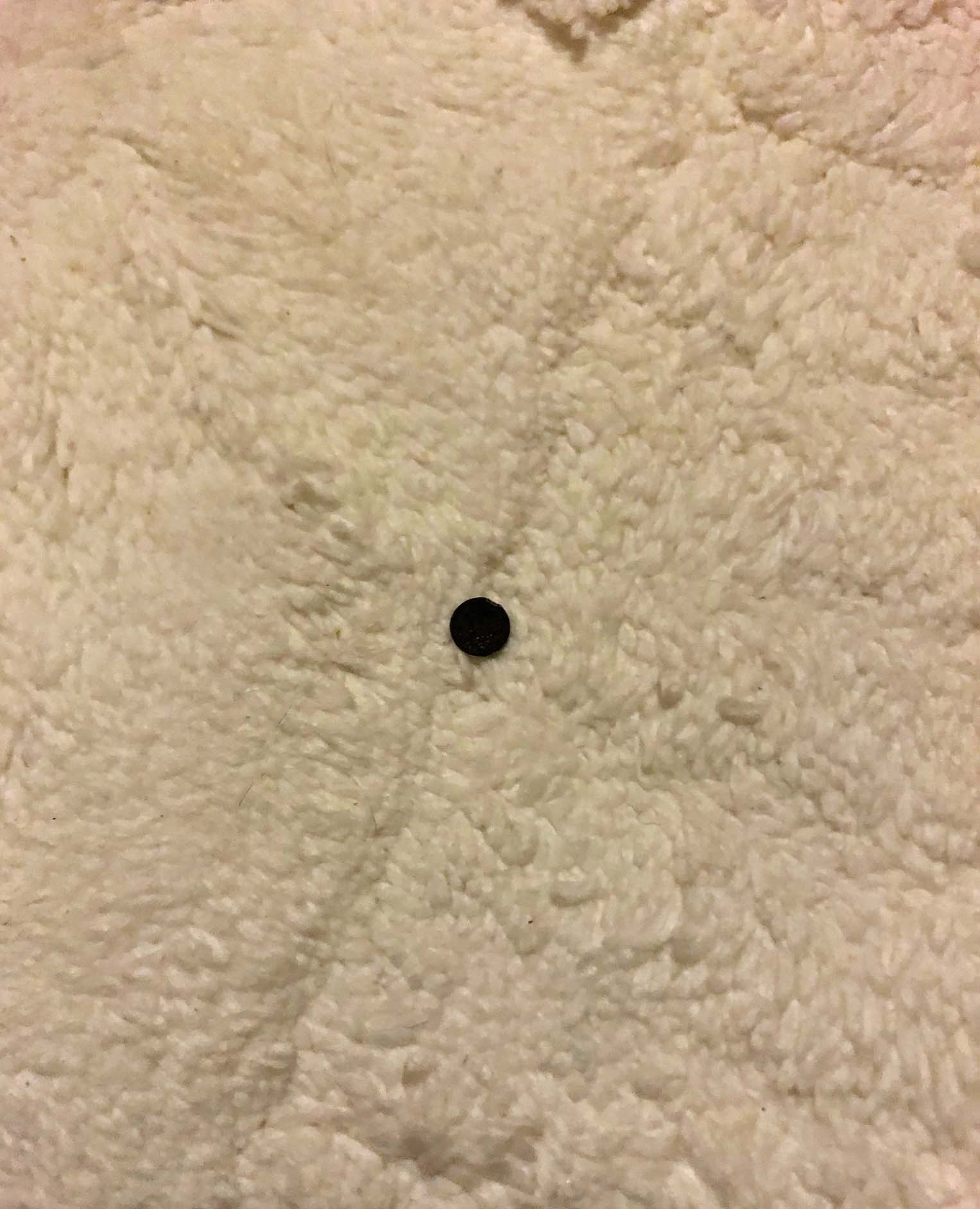
One of the Chromebook screw covers Wendy inadvertently brought to Kansas City

The next day, after another tasty room service breakfast, we took it easy. Wendy laughed at how she kept finding little stickers in the hotel room, which she had inadvertently brought to Kansas City in her clothing. They are sticky little covers for  the screws in the bezels of the Chromebooks she repairs and evidently an occupational hazard.

We eventually packed up and walked back to the Plaza for lunch at The Cheesecake Factory. Neither of us wanted their usual huge portions, so we ordered off their Skinnylicious menu – meaning we had sizable but bearable portions of a crispy chicken sandwich and chicken pasta. I gorged on their bread & butter, as usual. The portions at the restaurant are such that Wendy has never had their cheesecake, and I don’t blame her a bit.

While upstairs at the restaurant, I spied a worker on a lift checking on one of the nearby building domes. Maybe he was checking on the Christmas lights, which will be lit after Thanksgiving.

Turning up roses

Before heading home, we stopped at Loose Park a few blocks south of our hotel. I knew there was supposed to be a rose garden there, but in recent years we’ve seen the rose gardens at Oklahoma City and Tulsa nearly wiped out by a virus. No, not COVID-19, but the rose rosette virus, which is not transmitted by humans but by eriophyid mites. So we didn’t want to get our hopes up.

The first plantings we walked through after parking the minivan were okay, but certainly not roses. My heart sank, but I led us on westward to an oval surrounded by trellises formed by stone columns with long, heavy chains. Lo and behold, it was filled with roses. The surrounding trellised pathways had many different climbers, and the center beds were filled with large blooms from dozens of varieties.

Rose Garden

The Laura Conyers Smith Rose Garden at Loose Park

At 75 acres, Loose is the third largest park in Kansas City. The land was part of the Battle of Westport in the Civil War, back when the property was owned by William Bent, a man who led wagon trains and traded with the Native Americans. Seth Ward bought the land in 1871 after Bent’s death. In 1896, men who had been members of a golf club near Hyde Park leased the land from Ward for a golf course for $1 per year plus taxes.

In 1907, J.C. Nichols purchased land around the course that would form the Country Club District and eventually the Country Club Plaza, which opened in 1923. The project was dubbed “Nichols’ Folly” because back then it just had a day school and pig farms. Nichols employed Edward Buehler Delk to design the shopping district; Delk also designed the LaQuinta Mansion in Bartlesville and the nearby El Rancho de la Codorniz, the Philbrook and Philtower in Tulsa, and Villa Philmonte in New Mexico. I’ve long been impressed by how the Plaza is both beautiful and functional; as the first regional shopping center designed to accommodate automobiles, it has several small parking garages well-integrated into its various structures.

In 1926, J.C. Nichols helped broker a deal where Ella Loose bought the golf course property from the Hugh Ward estate (the son of Seth Ward who died only a few years after his father) to transform it into a park in memory of her husband, Jacob L. Loose, the owner of the Loose-Wiles Biscuit Company, who had passed away in 1923. His company produced Sunshine Biscuits. She donated the park to the city in 1927.

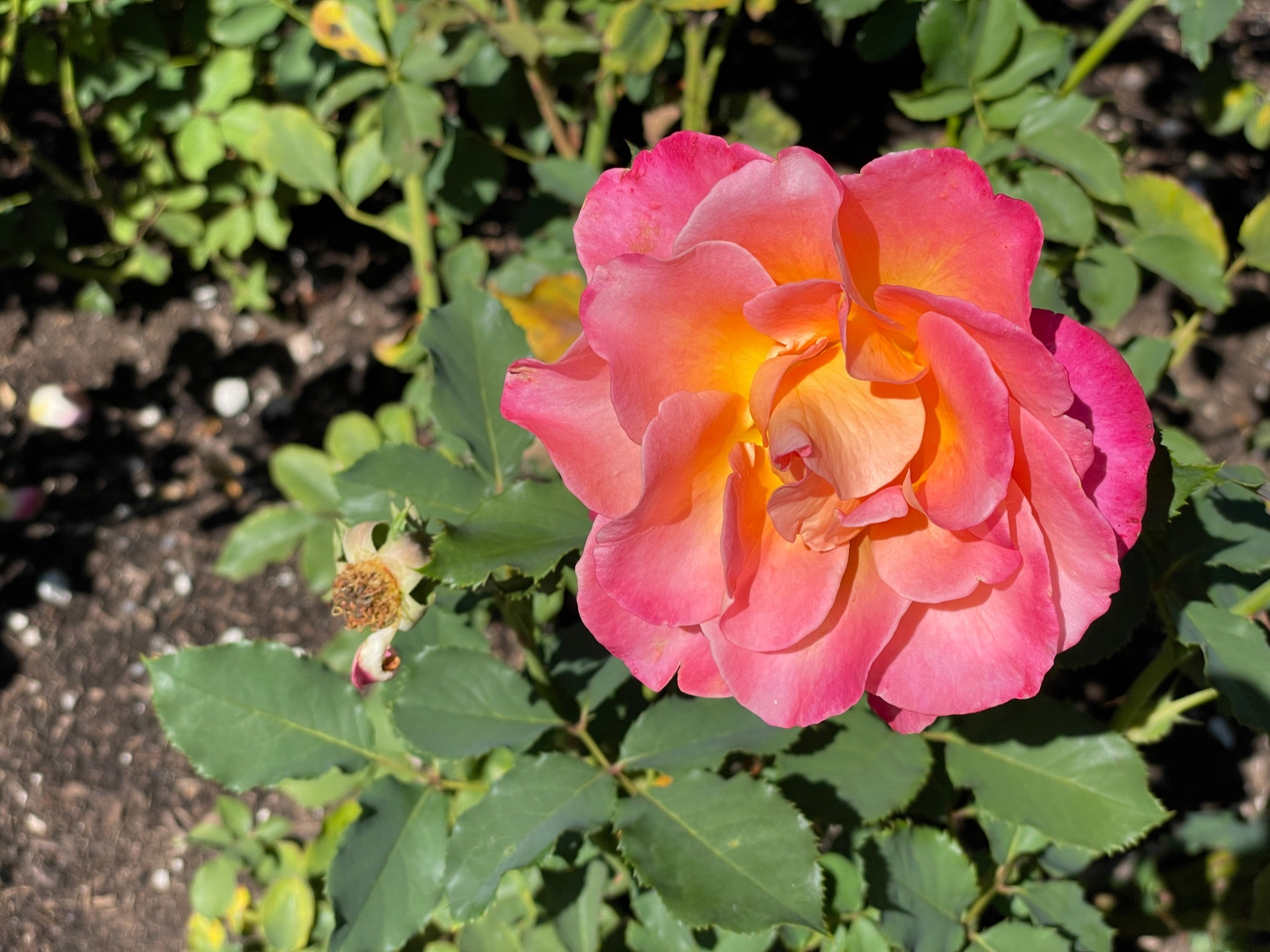
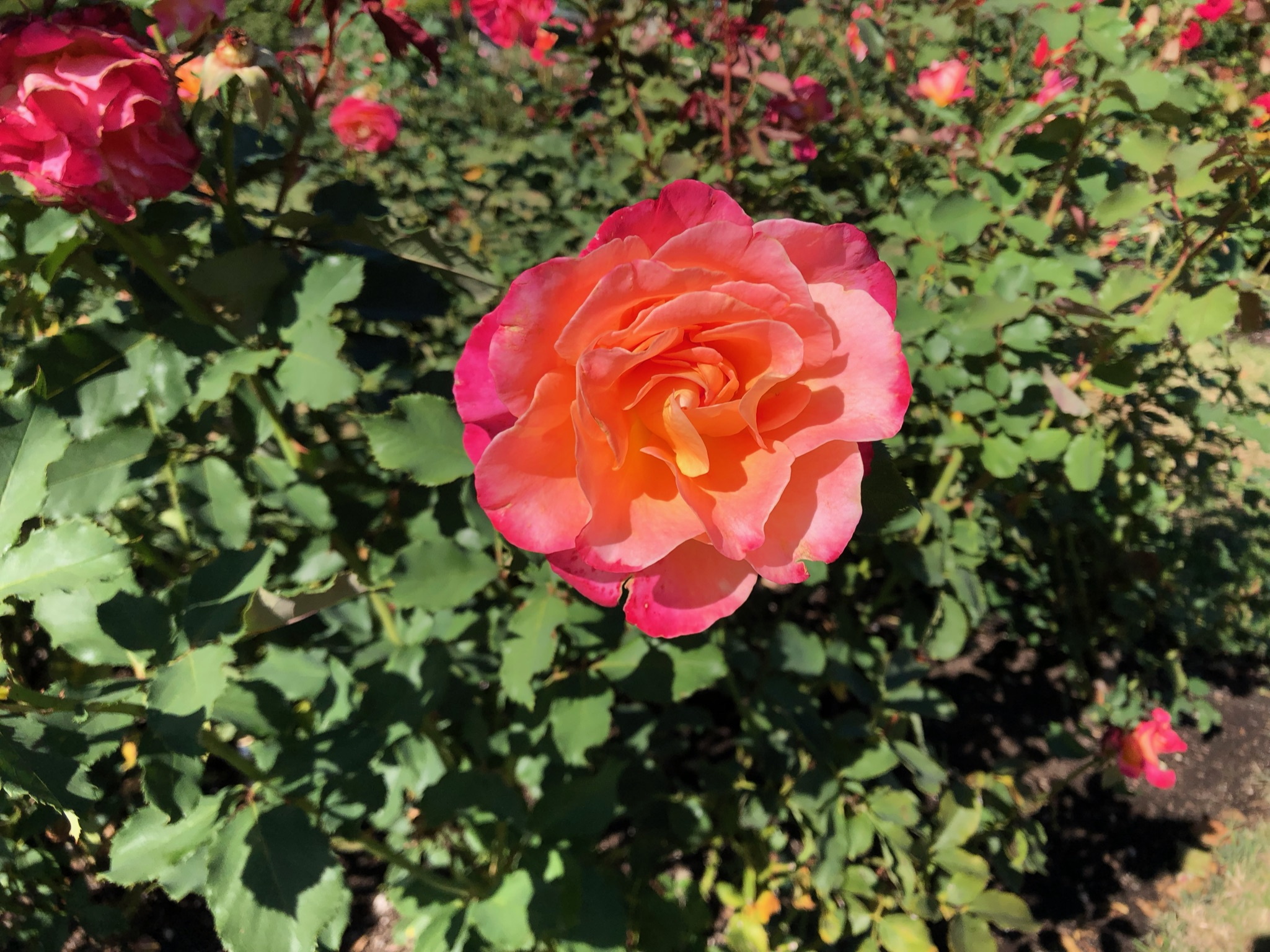
The Laura Conyers Smith Rose Garden was initially built by a group of citizens led by Ms. Smith, and reportedly features thousands of roses of over 100 varieties. It recently underwent a $400,000 renovation which included planting 1,200 new roses and restoring the beds to the original plans. It made for a lovely final present for Wendy from Kansas City.

Homeward

Our journey home was rapid but boring, taking the nicely expanded I-35 southwest from Kansas City all the way to US 75 for the long southward jaunt back to Bartlesville. A typical Sunday at home concluded our Autumn Brake, which then released, allowing the academic year to resume its roll.


Posted in art, pandemic, photos, roses, travel | Leave a comment

A new loop at Lookout Lake

October 30, 2021

Photo Album

The cooler weather drew Wendy and I out for a short hike this weekend. I had first considered going to Elk City, but there were activities there associated with the annual Neewollah festival in nearby Independence. We wanted some solitude, so I instead set course for Osage Hills, which is a short drive west of Bartlesville.

We drove west on US 60 to turn south at the park entrance onto OK 35, which used to be the shortest highway in Oklahoma. It runs about two miles to the park. Today, however, I found out that it has lost that distinction. Now there is a bizarre highway 40A connecting US 177 to Carney, Oklahoma north of Chandler, which is only 0.35 miles long.

Osage Hills Trail Map

Due to recent improvements, I will need to update my Osage Hills trail map.

The park has had several recent improvements, including updated signage. I was glad to see a large sign to help people know about and locate the mountain bike trails. They have never been shown on the outdated online trail map, which led me to create my own map years ago. It has been eight years since I had to update my map, but I found out on this visit that an update is needed. More on that in a bit.

I’d seen on the park’s Facebook page that the old restrooms near the park office had been demolished and replaced with pre-fab units. There are two identical buildings by the office. Each building has a couple of single unisex toilets and a couple of showers. They are a very nice upgrade, offering privacy as well as comfort and convenience. Each building has a mini-split unit providing air conditioning and heating, so they will be open year-round! There are some by the park office, down in the recreational vehicle area, in the picnic area, and up on tent hill.

New restrooms

New toilet and shower units

I was glad to see that the park still had the old pay phone by the restrooms at the office. That is a nice service to still offer to folks who do not have a cell phone or cannot get a signal at the park. I wasn’t surprised to see a couple gawking at it and picking up the receiver to play with it, as in my lifetime they went from being ubiquitous to become rare relics.

The state has never funded its state parks well, and finally resorted to parking fees over a year ago. Now you are supposed to pay to park, with rates that vary by the number of days and if your vehicle has an Oklahoma or tribal license plate. I just pay an annual fee of $60 ($75 if you don’t have an Oklahoma or tribal plate) for unlimited use of any of the state parks in my Camry. I also support the parks via my State Parks Supporter – Pavilion license plate, which cost me $40 new and $36.55 annually. Hopefully at least some of that trickles down to Osage Hills.

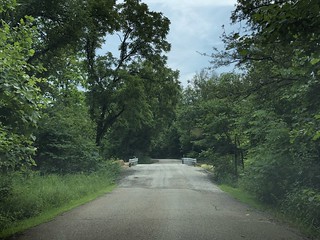
Lookout Lake bridge

The new bridge on the Lookout Lake Road

I knew there had been an organized hike earlier in the day on the Creek loop. After our potty break, we avoided that area and instead drove back to take the short road to Lookout Lake. We crossed the bridge that was the Eagle Scout project of Wendy’s former student, Kenneth Standish, Jr., and parked by the dam.

The park has added some kayaks and canoes along with the old metal boat one can take out onto the tiny lake. A couple of people were out in some kayaks as we began our walk along the branch trail from the dam up to the lake/tower loop. That trail segment was a bit rough. Winds had recently scattered branches across it, and it was clear that the trail is not heavily traveled.

We soon climbed to the main trail and I realized the sign indicating where you can descend onto the branch trail to the dam was missing. No wonder that little segment is not being used much. Hopefully in the ongoing improvements they will have new signage at both ends of the little branch trail to clue people in.

Fork

A new fork!

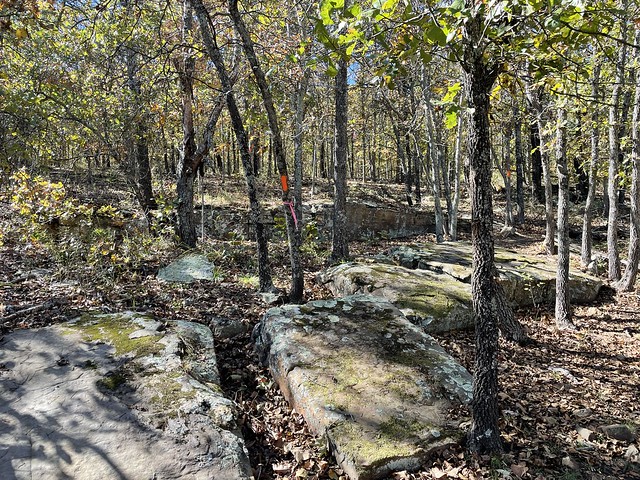
We headed west above the south shore of the lake. We noticed big bright new orange trail blazes along the way. At a waterway, I was puzzled to see the trail continue on a bit to the northwest. What was happening? Soon I saw a trail blaze indicating a turn – a level of sophistication rarely seen on the trails at the park, and a sign about the fork in the new trail. We could turn left for the short way or descend to the right towards the lake. I dimly recalled seeing a post by fellow educator Shelly Buhlinger that her husband, Scott, and his trail steward friends had been working on the trails. But I didn’t realize that included creating a new loop. How exciting!

Trail track

The new Lookout Lake loop trail

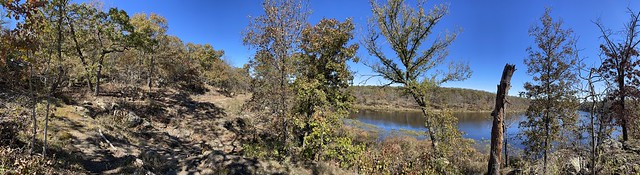
Years ago I bushwhacked my way entirely around the lake just for the heck of it. I knew the park boundaries allowed for a bit of trail west of the lake, but it couldn’t go too far. Soon we reached another hillside waterway above the shallow end of the little lake’s western arm. I took a panorama of the new trail crossing the waterway and the previously obscure part of the lake.

New trail panorama

Panorama along the new loop

It was a real treat to see previously hidden areas of the park along a new well-blazed trail. Eventually, as I had figured, the trail turned left to head back south. I would have been surprised if they had looped around the lake. It was nice to go through the woods north of the old CCC camp’s location.

Through the woods

Through the woods

Soon we reached another junction. We could have turned south toward the old CCC camp, but as this was our first hike in a long time, I opted to take the “short way down” back to the lake to return to our car. I also wanted to map that bit with my iPhone’s Gaia GPS app. The entire hike was only a bit over a mile, but seemed longer given the unfamiliarity with the new loop.

Soon I’ll have to return to the park to follow the entire Tower/Lake Trail loop to track any other changes and note the mileage. Then I can update my trail map. I surely do appreciate the hard work being done to maintain and extend the trail system. Getting out to walk along the Pathfinder Parkway in Bartlesville has been important for my mental health throughout the pandemic, and I look forward to more brief trips in the coming months to Osage Hills to enjoy the improvements out there.

Posted in day hike, photos | Leave a comment

It tasks me, it heaps me, an inscrutable malice sinews it

August 21, 2021

We have begun another school year battered and bruised but not broken by COVID-19. Vaccines now shield most of my colleagues and loved ones from hospitalization and death, even as the Delta variant, pandemic fatigue, and pathological politics have overwhelmed our hospitals and spread contagion in our schools. I remain resilient and resolute, but the pandemic tasks me.

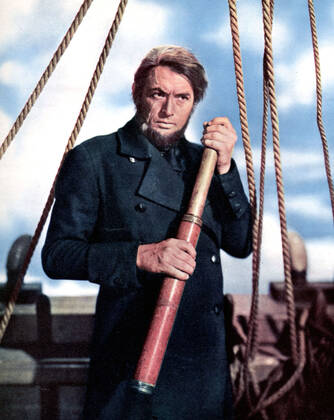
He tasks me; he heaps me; I see in him outrageous strength, with an inscrutable malice sinewing it.

I invoke Ahab’s and Khan’s word purposefully: this pandemic tasks me. For 18 months, helping my school district fight the pandemic has been my top priority. A relentless scouring of reliable sources for insights and expertise, with the continual collection and analysis of data, has guided the development of our protocols, all with tremendous support from across our district. So many have fought so long and so hard in these battles.

But instead of a mighty leviathan, we are fighting a scourge so tiny that one can debate if they are even alive, these genes that escaped their host all dressed up in a protein coat. They bear no inscrutable malice – the only evil arises from ourselves when we lose our grip upon the truth, when we fail to empathize, when we daunt our courage or engage in selfish, hypocritical, or destructive acts.

In the spirit of the times, much of my campaign has been electronic: countless virtual meetings and emails, lengthy district tallies of isolations and quarantines, and steadily accumulating data I gather and chart on the status of our struggle. They say amateurs talk strategy and professionals talk logistics. My talk has been of protocols, procedures, and pragmatism…tempered with compassion and fortitude.

Meanwhile, Wendy led the repair and servicing of our district Chromebooks as we expanded to provide one for every student, teacher, and administrator in the district. We made it through the dark winter to a brighter spring. And then one night in April, a policeman rang the doorbell to tell us we had lost Wendy’s mother. As Edie once sang, “There were hard times.”

But the pandemic subsided; district cases collapsed to single digits. As the school year ended, I took the opportunity to cleanse my Facebook profile of 12 years of posts, leaving behind only happy photos. We had a brief vacation atop a mountain in Arkansas. We visited my parents.

Alpha, beta, gamma…

Delta surged here in July. Less than a third of the people in our county are fully vaccinated, the CDC bungled its mask messaging yet again, and mandatory public health precautions have become a partisan political issue. So, a week into the new school year, we have more COVID-19 positive students than ever. I’m again leery of restaurant dining and travel; I’m back to wearing a mask in the schools. Angry parents say we’re doing too much or too little. I’ve started my second medication for hypertension.

It tasks me. So every Wednesday I post my local charts, and on Thursdays I post the broader update from trusted sources. I am blessed to see and hear the gratitude of those who follow the fight with me. I dream about the day when I can again cleanse my Facebook profile of this pandemic, leaving behind only photos from the Pathfinder Parkway.

We shall manage, we shall adapt, we shall overcome. But when will these battles end? When will we win the war? I have long held that herd immunity was an illusion, a dream undone by mistrust and ignorance. But the pandemic will surely end some day. When enough people have gained sufficient immunity either through vaccination or infection, it will not be eliminated, but it will become endemic.

Those who are most resistant to simple precautions will collectively fare the worst, but their lack of understanding and perspective will bring continued collateral damage and needless suffering. But I do find comfort in that all of the infections they promote do hasten the end.

Hospitalizations and deaths will eventually diminish, and boosters will re-up immunity for the wise. There will still be outbreaks, probably seasonally, but we will resume more normal, albeit changed, lives. As Sarah Zhang wrote, “The coronavirus is not something we can avoid forever; we have to prepare for the possibility that we will all get exposed one way or another.” My loved ones and I will be prepared for that.

We are exposed to four common coronaviruses as children. The resulting disease is mild, and we are likely reinfected every so often, which merely updates our immune response. This fifth coronavirus will eventually assume its position on that hand we are dealt.

I am no Ahab, and our district is not the Pequod. It tasks me, but it shall not destroy me. Our ship is not doomed, and its mission is based on service, not revenge. As I have shared on Facebook and across the district:

When you can’t control what’s happening, challenge yourself to control the way you respond to what’s happening. That’s where your power is.

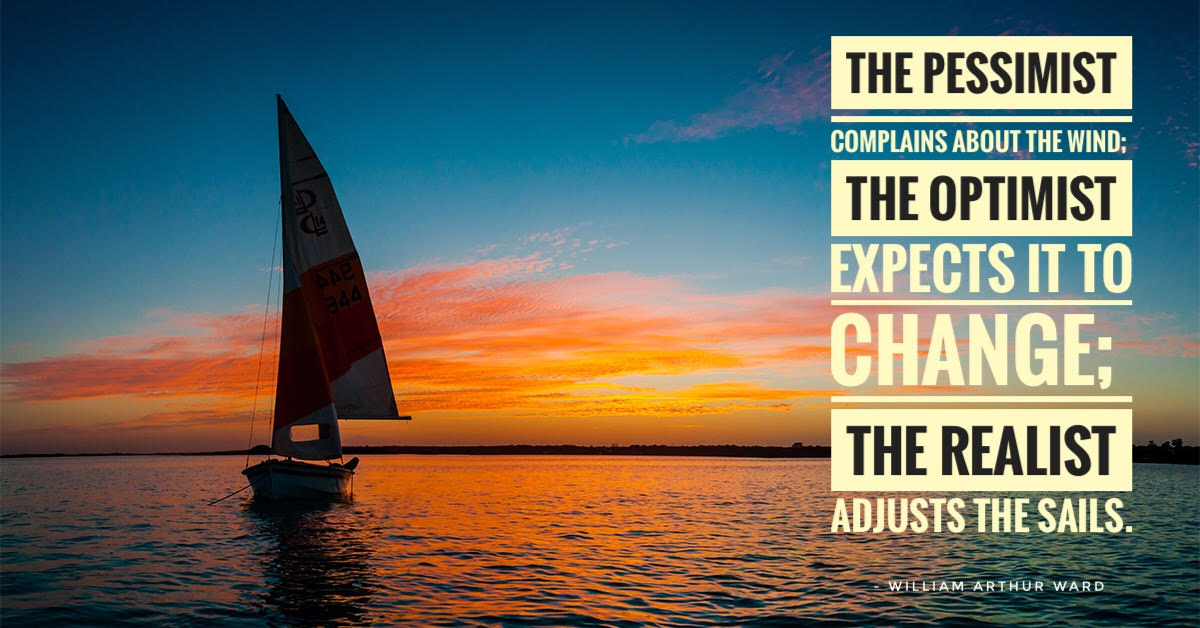
Adjust your sails. Welcome and support those who follow your lead, and be a light, not a judge, for those who follow a different and darker path. They may yet turn and seek the light…let it shine from you.

Posted in pandemic | 2 Comments

Prix de West 2021

June 18, 2021 | Photo Album

We ventured to Oklahoma City to celebrate Father’s Day with my parents. One of the countless fun things my 96-year-old father has introduced me to is the annual Prix de West art show and sale at the National Cowboy & Western Heritage Museum. Wendy and I enjoy this event each summer, although the pandemic prevented us from attending in 2020.

Our visit was free since we used our Woolaroc membership cards, which carry the wonderful NARM benefit that grants us free admission to many of our favorite museums. The receptionist said she usually only sees a NARM admission about once per week, but lately it has picked up.

We both admired the pointillism technique of artist Sonya Terpening. Wendy snapped The Spring in Fall in both a master shot and close-up.

The Spring in Fall by Sonya Terpening

The Spring in Fall by Sonya Terpening

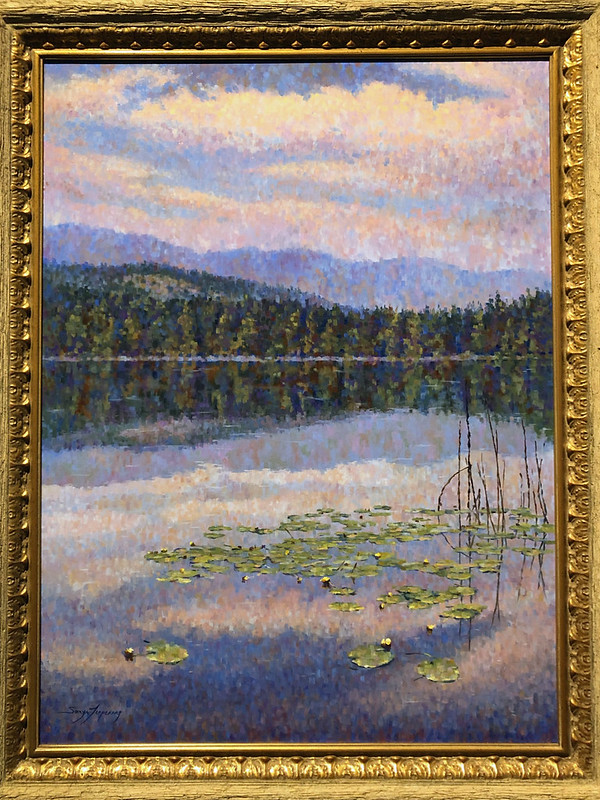
Skyscape with Lilies also nicely shows how one’s vision blends its dabs of paint into a lovely reflective scene.

Skyscape with Lilies by Sonya Terpening

Skyscape with Lilies by Sonya Terpening

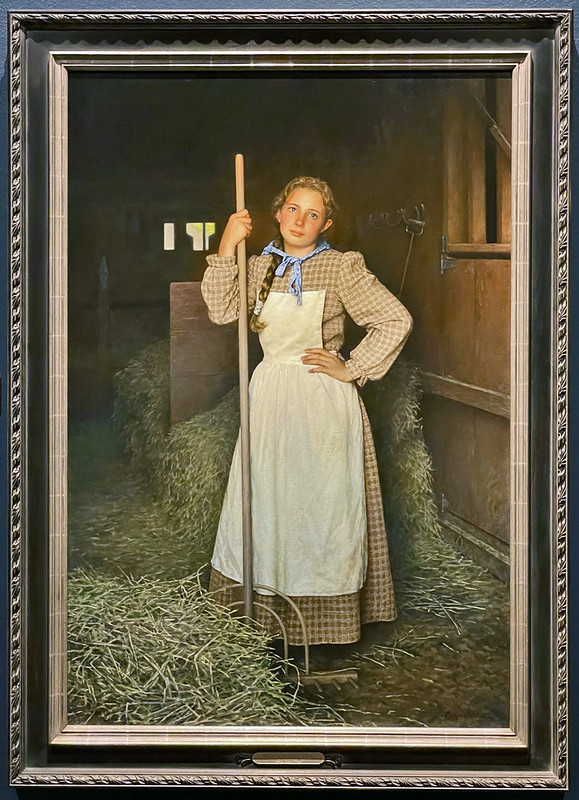
The standout work for me was Benjamin Wu‘s Working in the Old Barn with its masterful portrait, drapery, and lighting.

Working in the Old Barn by Benjamin Wu

Working in the Old Barn by Benjamin Wu

That splendid work reminded me of Daniel Ridgway Knight’s Le Premier Chagrin, which we were fortunate to see at the Brigham Young University Museum of Art in the summer of 2018.

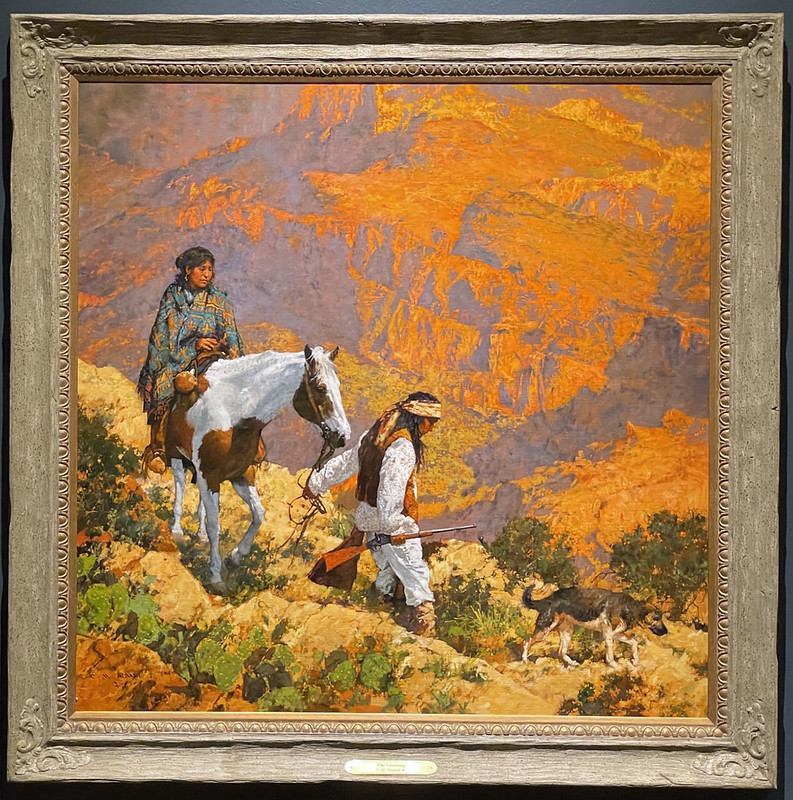
I also was struck by the bold coloring and treatment of the foreground and background in C. Michael Dudash‘s The Crossing. The camera cannot fully capture the effect it created of foreground figures arrayed against canyon walls in the far distance.

The Crossing by C. Michael Dudash

The Crossing by C. Michael Dudash

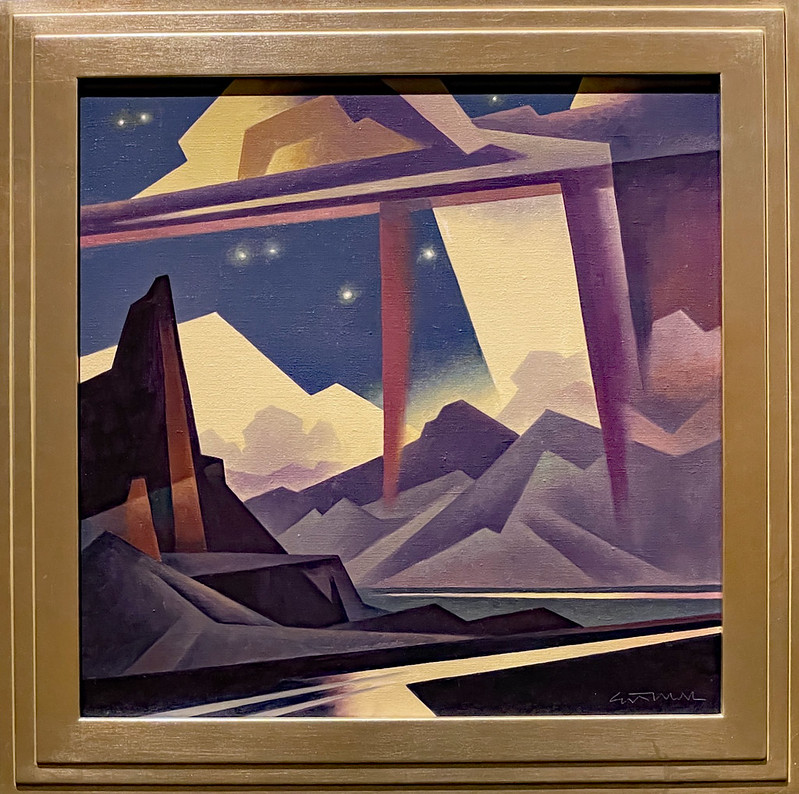
Much of the Prix de West works are realistic, so I was intrigued by Ed Mell’s Nightfall, with its landscape of abstracted geometries.

Nightfall by Ed Mell

Nightfall by Ed Mell

When I introduced Wendy to the museum in 2014, she was amazed to see Bob Wills’ fiddle on display. So I led us back into the permanent collection display to see it again. As we drove past downtown Tulsa on our way to OKC, we saw the new OKPOP museum is under construction just across the street from Cain’s ballroom, which was the home of Bob Wills and The Texas Playboys from 1935 to 1942. We look forward to seeing its future displays of more artifacts from the career of the King of Western Swing.

Our vaccinations have enabled us to venture out into the world of art again, delighted yet wary. As I write, the Delta variant is surging in Arkansas and northern and southwestern Missouri. Far too many Oklahomans likewise remain susceptible. I am reminded of one of H.L. Mencken’s caustic comments: “The older I get the more I admire and crave competence, just simple competence, in any field from adultery to zoology.” I am grateful to have been able to admire more than competence on display at the Prix de West.

Photo Album

Posted in art, photos, travel | 1 Comment

The Misty Mountain

June 2021 | Photo Album

Until June, our 2021 travels were restricted to a brief visit with my parents in Oklahoma City and trips to and from Checotah, Oklahoma to arrange for and attend the funeral for Wendy’s mother. It had been a long hard time since the pandemic shut down our travels in March 2020.

So with summer break finally underway and the Pfizer vaccine protecting us from COVID-19, Wendy and I were eager to take our first real vacation since December 2019. The pandemic had forced us to cancel a cabin we had reserved for spring break 2020 at Mount Magazine in Arkansas, so we chose that as our destination. With Oklahoma exiting an unusually cool and rainy May to enter a hot and humid June, it also seemed a good idea to spend a few days up in the clouds at the highest point in Arkansas, where it is usually about 10° Fahrenheit cooler than the river valley 2,100 feet below.

Ft. Smith Regional Art Museum

We drove down to metropolitan Tulsa to enjoy a Sunday lunch at the Charleston’s restaurant in Broken Arrow. Then we headed southeast on the Muskogee Turnpike, but instead of exiting around Muskogee as we had to do for our previous trips to Checotah, we continued 10 miles south to I-40 and headed eastward to Fort Smith, Arkansas.

Route Map

We had already strolled about the eponymous fort on our 2015 trip to Mount Magazine, so this time we stopped to see the Fort Smith Regional Art Museum. The building was a classic example of Mid-Century Modern design, originally built in 1963 as the Superior Federal Savings and Loan Bank. The floating staircase made me feel like I had been transported back to my childhood when many such structures were springing up in Oklahoma City.

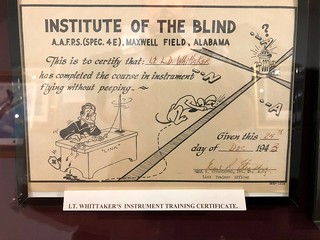
Instrument Flying CertificateWe first toured the temporary exhibition Art in Aviation, although the subject matter was of limited interest to us. Wendy did snap an “Institute of the Blind” certificate awarded in 1943 to Lt. L.D. Whittaker for completing a course in instrument flying. Only 14 years earlier had Lt. Jimmy Doolittle made the first complete flight from takeoff to landing solely by the use of instruments and radio.

Pineapple #19

Pineapple #19 by Robert Burridge

We took the floating staircase up to the second floor exhibit of items from the museum’s permanent collection. Wendy was surprised and pleased to finally see in person two pieces by Robert Burridge, an artist she has long enjoyed watching on YouTube. She had even seen him paint a pineapple in 2019 similar to his Pineapple #19 of 2014 which he donated to the museum, along with Floral Study #147.

Wendy also liked Radishes Encore by Elizabeth Powers, and I admired the aquatint Line Dancing by Wilfred Loring, Jr. Spring on South by Elizabeth Ryan also caught Wendy’s eye.

In the basement’s Dr. W.E. Knight Porcelain Gallery, we toured the collection of Boehm porcelain. I can’t say I am a fan of that company’s porcelain birds and wildlife, but Wendy readily identified and admired their Supreme Peace Rose.

I have always considered Thomas Kinkade‘s paintings to be kitsch, yet I nevertheless admired John Bell, Jr.‘s Cabin at Greenleaf State Park which is quite Kinkade-like with its depiction of a brightly lit cabin beside the lake which features a fellow fishing by lantern light in his boat.

Cabin at Greenleaf State Park

Cabin at Greenleaf State Park by John Bell, Jr.

The overwhelming blue of the painting was striking in its contrast to the fiery cabin. I’ve hiked at Greenleaf several times, and I opted to buy a print in the museum gift shop as a reminder of this happy vacation after the long and successful struggle to avoid the coronavirus. But I will also enjoy its reminder of Joan Didion’s withering yet accurate take on such paintings:

A Kinkade painting was typically rendered in slightly surreal pastels. It typically featured a cottage or a house of such insistent cosiness as to seem actually sinister, suggestive of a trap designed to attract Hansel and Gretel. Every window was lit, to lurid effect, as if the interior of the structure might be on fire.

On the Mountain

I love the views and hikes at all three of Arkansas’ lofty state parks along the Arkansas River Valley to the northwest of Little Rock. Easternmost is Petit Jean, with little Mount Nebo and its girdle of trails only 20 miles away. Another 20 miles west rises mighty Mount Magazine, which is not part of the Ouachita mountains, but has a commanding view of several of their northeastern ridges.

Usually the Skycrest Restaurant at the Mount Magazine Lodge would be an attraction for us to stay there, but I’d been warned by our friend Lynne Shaw that the restaurant was stuck in buffet-only mode, with mediocre fare. So Wendy and I stocked up at the CV’s Family Foods in Paris before driving up the mountain to our cabin.

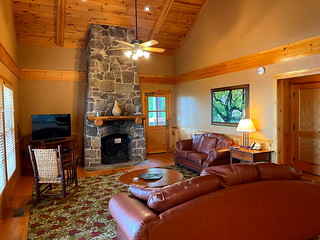
CabinWe had stayed at a room in the lodge in 2015, but we craved more privacy for our return. So I booked one of the 13 cabins arrayed along the mountainside on either side of the lodge. Our cabin was clean and spacious. I noticed that the door onto the deck overlooking the Petit Jean River had a familiar mechanism.  Sure enough, it was a Pella door similar to the one installed a week earlier at Meador Manor when we had all of the windows and the patio door replaced. I wonder how long it will take me to stop noticing Pella windows and doors on my travels.

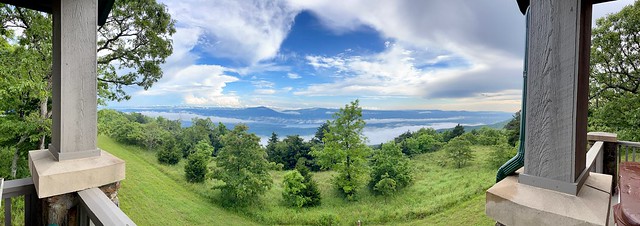
Mount Magazine

The view from the deck

The deck offered a tremendous view of the river valley and Blue Mountain Lake. I enjoyed reading Alastair Reynold’s Revenger trilogy on my Kindle in a rocking chair on the deck, taking breaks from its dark tales of space piracy to enjoy the panorama. Wendy read books by Bill Bryson and Lewis Black during our visit to the mountain.

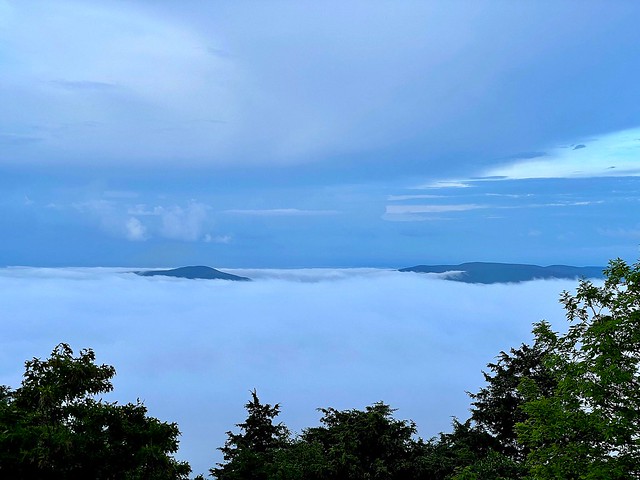
The weather was often overcast during our stay, with the usual morning fog over the valley which would often rise up and envelop the mountaintop. The lodge and cabins are a bit under 2,600 feet in elevation, with the highest point in Arkansas atop Signal Hill north of us at 2,753’ while the Petit Jean River to the south is at 350 feet.

Ouachitas

Peaks of the Ouachitas jutting above the cloud deck

One morning the peaks of the Ouachitas became islands jutting out of the fog. The island peak to the left was that of Potato Hill Mountain, which tops out at 2,226’ while the ridges on the right were Flood Mountain peaking at 2,238’ and Petit Jean Mountain at 2,223’.
The Petit Jean River at 113 miles is the longest river to be contained entirely within the Arkansas River Valley, rising at White Oak Mountain about 22 miles southwest of Mount Magazine and winding its way around Boney Mountain before flowing eastward past Mount Magazine, dammed to form Blue Mountain Lake, on its way to join the Arkansas River just north of Petit Jean State Park.

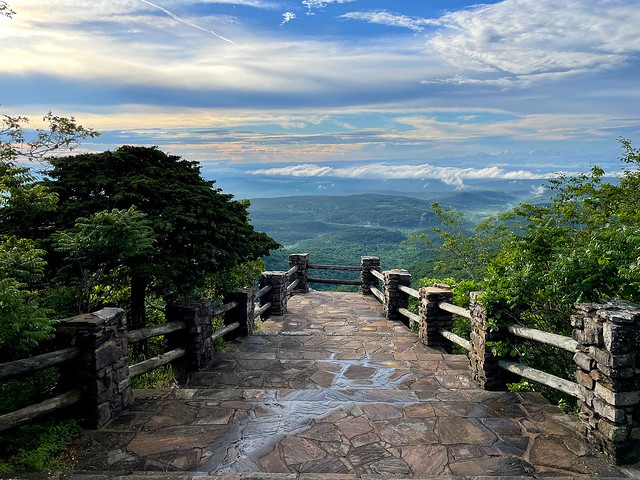
Intermittent rain kept us indoors for much of our respite, but we did venture out to Cameron Bluff on the first evening for the gorgeous view.

Cameron Bluff Overlook

Cameron Bluff Overlook

I didn’t realize that since our last visit they had cleared and restored part of the old CCC amphitheater just north of the main overlook, so we will have to see that on a future visit.

Trail Track

A morning walk

The next morning I braved the mist and drizzle to follow the wide sidewalk past the cabins to the lodge, passing pretty flowers. I reached the central portion of the new lodge, which I now know is perched on the footprint of the original lodge built by the WPA in 1940 which burned in 1971. The Cyclopean stone retaining wall below the lodge is all that remains of the old lodge…or is it? I remembered there was a short trail somewhere below the lodge that doesn’t appear on the park’s trails brochure.

Below the east building with the 60 guest rooms and swimming pool, I found the Old Lodge Trail loop which ventured down the mountainside to a few overlooks. I had my faithful Tilley LTM8 hat to keep my head dry despite the drizzle, but I wasn’t wearing my usual Columbia hiking boots. I hadn’t planned on going off the paved trail, and I’ve recently taken to wearing Kizik shoes. They have a spring-back heel you can easily crush with your foot to pop them on without stooping. I really like the blue Madrid Camo Knit shoes I recently purchased, which are quite comfortable. But because of the rain, I was instead wearing my grey Cupertinos, which look fine and are less likely to be problematic in mud, but did make my feet sore when I walked too far in them along the Pathfinder Parkway last fall.

The old trail was so tempting that I braved it despite my lack of appropriate footwear, stepping cautiously to avoid slipping on wet rocks. I passed spiderwort and daisies before reaching an overlook with the Blue Mountain Lake Dam directly ahead down in the valley.

Old Lodge Trail Overlook

Overlook along the Old Lodge Trail

To the side I could see the palisade of bluffs along the southern flank of the mountain. Stepping stones kept me out of the mud as I made my way along to climb the slope to behind cabin #5. I retraced my steps to the lodge and wandered again off the paved sidewalk to a more challenging overlook above the rock climbing area where I could see the lake framed by the limbs of a dead tree. A large broken stone revealed its red interior normally hidden by its gray and lichen-coated crust.

Openings below ledge

Openings below the rock ledge

I scrambled about for more views and spotted what I will generously call two small cave openings beneath the ledge before making my way back to the cabin as the drizzle became a shower.

There were deer and cottontail rabbits about the cabins, as well as far less welcome flies and large black ants. I entertained myself by occasionally blowing ants off the deck pillars.

Wendy got to see both the deer and rabbits when she ventured out with me on the third day of our stay to walk the paved sidewalk all the way past the lodge to the far end of the row of cabins. Along the way, she noticed the bright yellow and waxy petals of a creeping buttercup. She also spied the bird she had heard during our stay which she had suspected might be a mockingbird from its repeated and varied songs. But it was a brown thrasher, which repeats a song twice before moving on to the next, while mockingbirds sing a song thrice.

We never dined at the lodge restaurant during our vacation. It was too wet to grill, but we enjoyed bacon, eggs, and biscuits for our breakfasts, turkey sandwiches for lunches, and Wendy cooked steaks and baked potatoes with the cabin stove and oven for our dinners.

Return

Rather than return to Ft. Smith along Arkansas highway 23, also known as the True Grit Trail, we drove Wendy’s minivan down the south slope of the mountain to Havana and took Arkansas highway 10 to Greenwood, taking a spur to US 71 to drive into Fort Smith. I had discovered that Calico County, our favorite restaurant in Amarillo, Texas, had a sister restaurant there. We enjoyed chicken fried chicken with vegetables for lunch and then made our way back home.

Throughout our trip, the only time we were required to wear masks was in a recently built Love’s Country Store at Vian, Oklahoma. All of the employees but only a few of the patrons joined us in masking up. Of all our pit stops along the way, however, a convenience store in little Magazine, Arkansas sticks out in my mind because it featured a classic group of old guys gathered around solving the world’s problems…or perhaps it was a Liars Club meeting.

The pandemic is not over; I fully expect a surge among the unvaccinated this winter, especially in areas like our county in Oklahoma where currently only 25% are fully vaccinated. But seasonality and vaccinations have brought us a welcome respite for now. We plan to enjoy it further late this month when I take 12 days away from work. Maybe we’ll venture to Kansas City and/or Crystal Bridges for some short escapes.

Photo Album

Posted in art, day hike, photos, travel | Leave a comment