The highlight of our trip would come at the lowest point in our looping journey: a walk through the Antelope Slot Canyon near Page, Arizona. So we needed to make our way south out of Utah down to the Glen Canyon Dam which impounds Lake Powell. The terrain meant we would have to drive a long arc west, south, and then back east.
Scenic Highway 12 continued to impress as we traveled west toward Bryce Canyon. A few small towns dot the arid Bryce valley. After we found that Foster’s Family Restaurant in Bryce was now the UpTop Steakhouse and only open in the evenings, we backtracked to Tropic for lunch at Rustler’s Restaurant.
Tropic was named by pioneers seeking to promote it as a more temperate location than its competitors. In the late 1880s, the Mormon farmers in the area diverted water from the East Fork of the Sevier River into the often-dry Paria River drainage to irrigate their fields. They dug, mostly by hand, a 15-mile ditch which still runs today. We saw the Sevier River’s water flowing through the Tropic Ditchnear the Mossy Cave Trail at the north end of Bryce Canyon.
The surrounding hillsides had the characteristic look of the famous eroded amphitheaters of Bryce Canyon National Park a few miles to the southwest, which nature carved out of the pink Claron limestone of the Paunsaugunt Plateau. Unlike the Grand Canyon, Bryce was not carved by flowing water, but instead by frost-wedging and chemical weathering.
For 200 days a year the temperature cycles above and below freezing in that area of Utah. During the day, melt water seeps into fractures only to freeze at night, expanding by 9%. The ice exerts a tremendous pressure of 2,000-20,000 pounds per square inch. Over time this “frost-wedging” shatters and pries rock apart. In addition, rain water, which is naturally acidic, slowly dissolves the limestone, rounding off edges and washing away debris. This creates fins of rock jutting out from the cliffsides, which then erode into free-standing hoodoos.
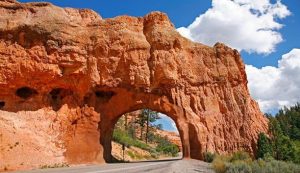
Road Arch at Red Canyon
We shopped for trinkets in Bryce and then continued our journey west. A dozen miles across the northern end of Bryce Canyon, Highway 12 runs through Red Canyon, the western edge of the valley, with its own erosion of the Claron limestone. The road passes through two manmade arches in the rock, which were fun to drive through.
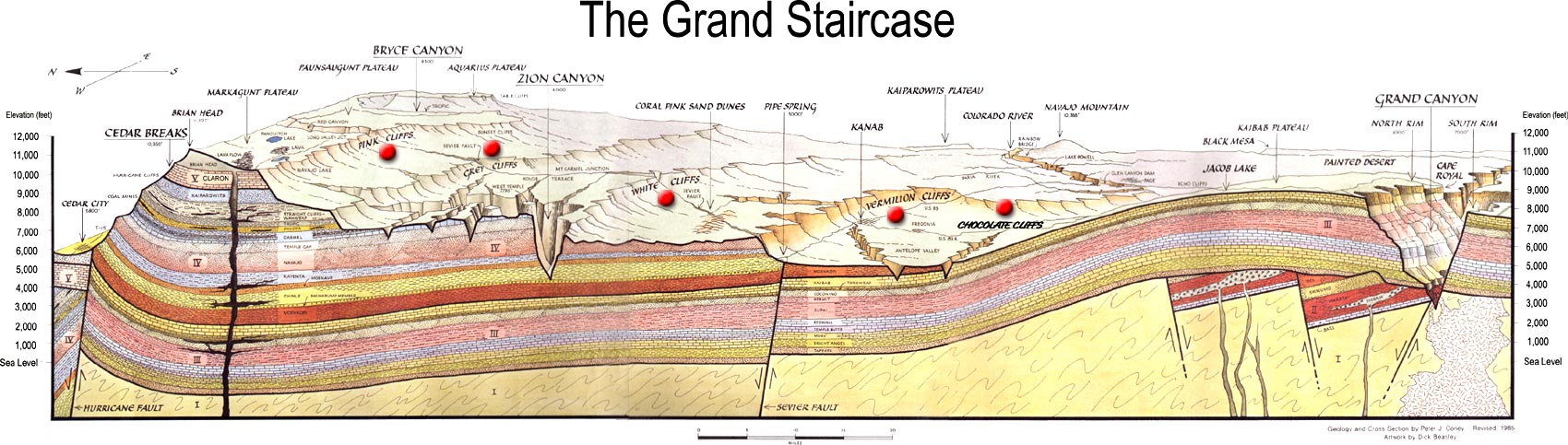
Too soon we left Highway 12, and the rest of the drive to Page was uneventful. We followed highway 89 down the Grand Staircase, a term Clarence Dutton coined for the steady descent, layer by layer, through the sedimentary rock formations from Bryce Canyon south to the Grand Canyon. The pink cliffs of Bryce give way to grey, then white, and eventually the Vermilion Cliffs we had driven by the previous summer, ending in the chocolate cliffs that form the top layer of the Grand Canyon.
The high desert we drove through heading back east in far southern Utah towards Lake Powell was quite inhospitable. It became even more desolate as we dipped south into Arizona. It would never occur to one to stop and stay in Page, Arizona were it not for the formidable Glen Canyon Dam and associated natural and man-made wonders.
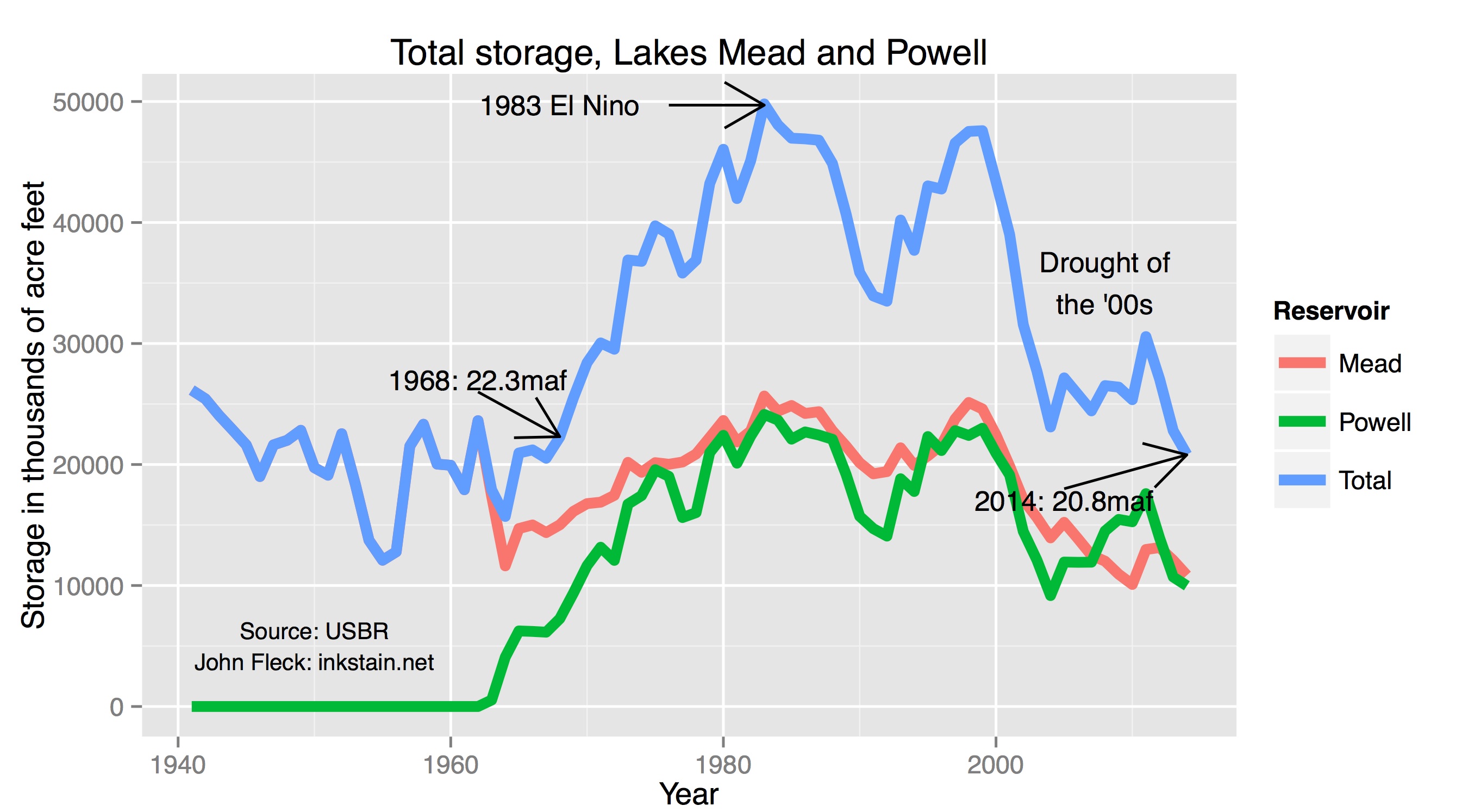
Lakes Mead and Powell have not recovered from the drought of 2000-2005
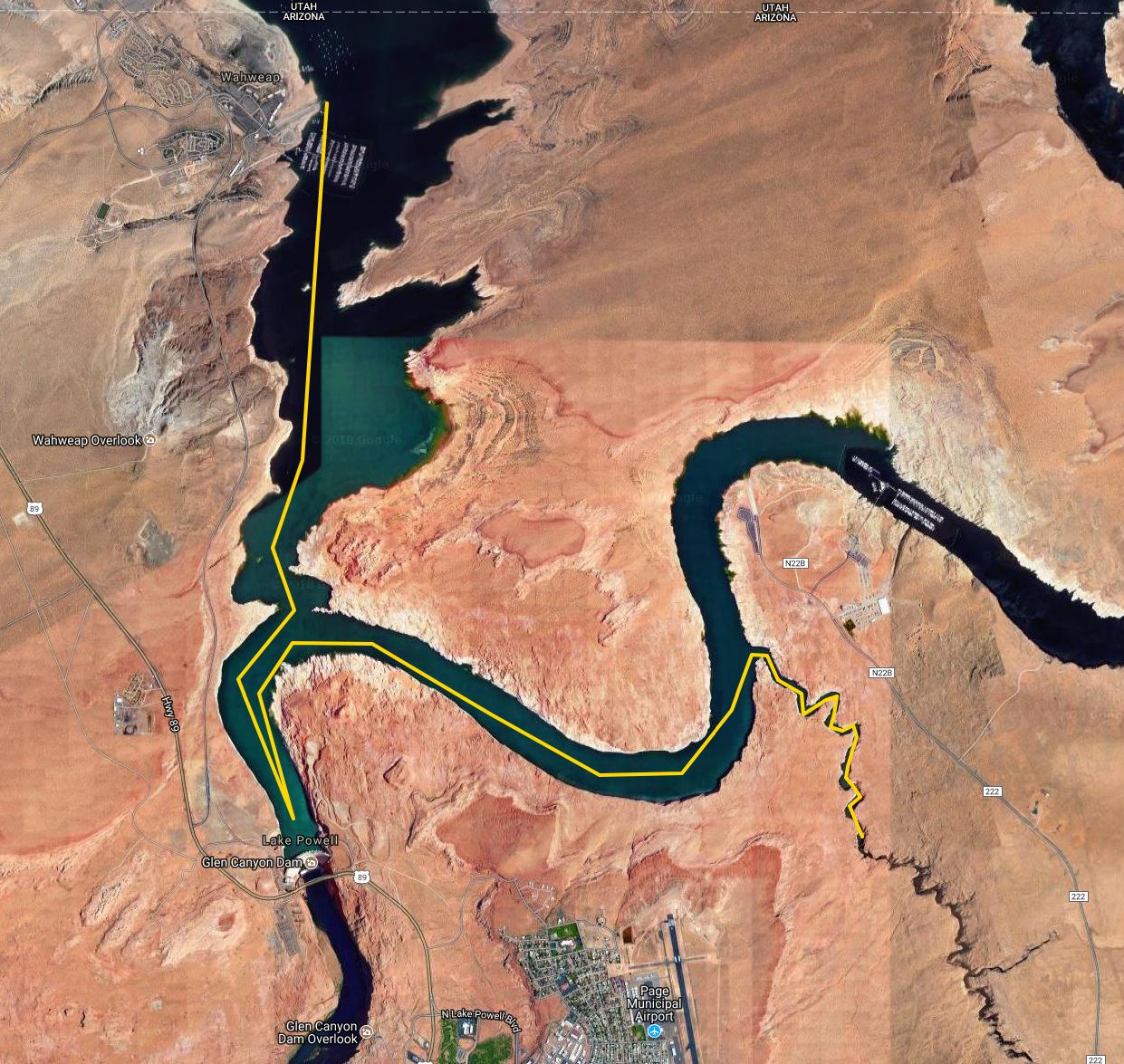
We were glad to arrive at the Days Inn in Page, where we had a nice dinner at the Gone West restaurant. The next morning we drove to the Wahweap Marina for an Antelope Canyon boat cruise. Wahweap is a Paiute word meaning “bitter water” and dates back to when the mineral-laden trickles of water in the area were unattractive. Now all that and much of Glen Canyon is subsumed under the cool clear waters of the lake.
There was quite a crowd in the marina waiting to board the boat, hiding from the brutal sunlight outside. We sat on the upper deck by a retired couple from New Jersey. They were fun to visit with and in the middle of their own adventure out west with some other retirees. I wore my Tilley hat, of course, but made the mistake of wearing shorts and forgetting to protect my legs with sunscreen. The heat and sunlight were intense, leaving me with an itchy sunburn by the end of the 90-minute cruise.
The weathering in some places exposed the layers of sedimentary rock, created hoodoos, and in spots yielded bright orange sand. There were quite a few houseboats on the lake, although for me the intense heat and sunlight, with little vegetation, left me with little desire to linger.
We returned to the marina and struggled to cool off inside the resort before heading back to Page. That afternoon we laundered clothes, and I bought some aloe vera gel for my sunburned legs. The next day we would revisit Antelope Canyon via a guided walking tour through its upper slot canyon.
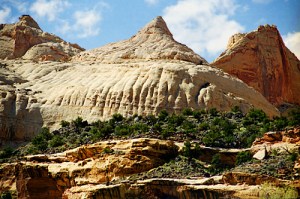
A reef sounds rather out of place in this dry desert land, but locally it refers to a rocky barrier to land travel just as ocean reefs can bar travel on the sea. The national park is a thin strip of land running north-south which encompasses the Waterpocket Fold, a 100-mile long monocline which is an S-shaped warp in the rocks likely formed as continental plates collided to create the Rocky Mountains. Pools in the eroded rocks capture rainwater, and a colorful section near the Fremont River is called Capitol Reef because of white sandstone dome formations that resemble the domes placed upon many capitol buildings.
Capitol Reef viewed from the International Space Station
We didn’t have time to explore or hike in the park, but did drive over to its northern entrance to take in Panorama Point and the Goosenecks Overlook. Highway 24 runs along the base of the stacked red layers in the Mummy Cliffs. A side road took us to a parking area, with a short slickrock trail leading up a rise for the views. Slickrock is smooth, weathered sandstone which sheds water instantly and can be dangerous to hikers as well as horses wearing iron shoes, but is fine for bikes and jeeps. In this area, the sandstone was either slickrock or heavily pockmarked.
Wendy patiently waited while I scampered about taking in the vistas atop the slabs and ridges of sandstone. Then we drove to the Goosenecks Overlook, where she shied away from the quite windy overlooks 800 feet above Sulphur Creek. Over the past six million years the creek has cut its winding way deep into the rock.
Sulphur Creek has cut through the Moenkopi Formation of mud and sand from shallow seas and floodplains of 245 million years ago, on down through the Kaibab Limestone deposited in shallow seas 270 million years ago and which is the top layer of the Grand Canyon 160 miles to the south. The creek has further penetrated to the White Rim Sandstone formed from coastal sand dunes 280 million years ago. This carved layer cake of deposition is quite beautiful, but we were both drying out in the hot dessicating wind.
So we were glad to hop back into our Ford Fusion for the drive along Highway 12 towards Escalante. We found relief from the heat as we drove from the desert up into the forests of Boulder Mountain, climbing from 6,300 feet to over 9,000 feet through large stands of aspen, pine, spruce, and fir. The Larb Hollow Overlook provided a view of the Henry Mountains, the last mountain range to be added to the map of the United States back in 1872. 350 bison roam freely there, one of only three free-roaming and genetically purebred herds left on our public lands. We could see the Lower Bowns Reservoir in the distance as well as jutting rock formations.
The road descended from the mountain to the town of Boulder, and then ran along the Hogback, a razorback ridge of slickrock high above Calf Creek to the west and Boulder Creek to the east. We stopped after that impressive if somewhat harrowing drive to view Calf Creek’scanyon.
It was late by the time we passed through Escalante and reached Slot Canyons Inn, where I had rented the Moonrise Casita while a wedding party had commandeered the remainder of the inn. We were truly remote, with no reliable internet or cell service. That remoteness frustrated our news routines, but did provide dark skies which we could view from the entry deck’s recliners. Wendy treasures privacy and fashioned a blind of paper towels for one high window. I thought she was being a bit paranoid until later in our stay when a small drone buzzed about overhead. Those darn paparazzi follow us everywhere! 🙂
We were not tempted to continue down Hole in the Rock Road to its canyons, instead struggling back north along the 12 miles of rough road to Escalante. Along the way I pondered how the road gets even rougher if you turn south for the 50-mile journey that ends in the Hole in the Rock itself at Lake Powell.
In 1880, an expedition of Mormons trying to settle in southeastern Utah widened that narrow crack in the canyon rim above the Colorado River to reach a ford. The drop to the river was nearly 2000 feet with an average grade of 25 degrees, although some places were as steep as 45 degrees.
Construction of this passageway was very difficult, plagued by lack of wood, forage for cattle, bitter cold, and diminishing food supplies. Blasting powder and picks were used to widen and/or fill various sections of the crevice. At the lower part of the Hole, a road was constructed on the side of a sheer cliff wall. Although a three-foot shelf had already existed, an extension to the shelf was formed by driving two-foot stakes into the rock and piling vegetation and rocks on top. This portion of the trail was nicknamed “Uncle Ben’s Dugway” in honor of its engineer, Benjamin Perkins. After six weeks of picking, chiseling, drilling, blasting, and digging, the Hole-in-the-Rock road had been completed. Even after they finally crossed the Colorado, the pioneers had another 120 miles of arduous travel before they reached Bluff, Utah.
Hikers at Hole in the Rock above Lake Powell
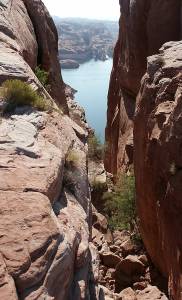
One-third of the Hole in the Rock slit now lies beneath the waters of Lake Powell. The Hole was only used for a year before the settlers shifted the route a few miles over to the better Hall’s Crossing. The incredibly rough “modern” Hole in the Rock Road to the area is one of the most traveled in the monument, but is still hellish despite being graded 20 or more times each tourist season.
The terrain in this region is unforgiving. Later in the week Wendy and I would take the modern route 191 through Bluff as we traveled from Page, Arizona to Moab, Utah. The modern roads make long sweeping arcs to avoid the rough mesas and canyons on either side of the Colorado River.
Upon returning to Escalante, we purchased the most normal food we could find at a hipster grocery. We had already sampled the two major restaurants in town. We had a kindly server at the Circle D while the best thing about Boots Cafe was its large taxidermied bear.
This was the most remote area we visited during our vacation. The lack of services and sparse population allowed me to fully relax, knowing that I was truly away from work. Both Wendy and I preferred to avoid the crowds by shunning the pay areas of the multiple national parks along our route.
The next phase of our trip would take us past Bryce Canyon down to Lake Powell in Arizona, where we would take a sunny boat tour and a shaded guided walk through a picturesque slot canyon.
Giving up a lifetime of summer breaks was part of the package when I became a 12-month school district administrator. But Wendy is still a classroom teacher with summer breaks, so when I mapped out my use of my limited vacation days beginning in July 2017, I made sure to save back enough for a 9-day June vacation for the two of us. In July 2017 we had driven out to the Grand Canyon in Arizona with friends, and Wendy had wanted to visit a slot canyon at the north edge of the state. But our itinerary that year could not accommodate that addition.
So when she again mentioned wanting to see a slot canyon in northern Arizona, following that up by sharing with me online photos of beautiful scenery in southern Utah, I formed a plan. Neither of us had spent any time in Utah, so we would fly out to Salt Lake City and loop our way south to Escalante, lowering the lasso enough to later reach Lake Powell and Antelope Canyon before heading back up and over to Moab as our last stop before returning to Salt Lake to fly home.
Flight & Rental Car
Having only nine days for our tour meant we would need to fly, rather than drive, to Utah. We flew from Tulsa to Salt Lake City in First Class on a Delta Bombardier CRJ-700. The trip was uneventful, although both of us got put through a millimeter-wave body scanner at the Tulsa airport, and Wendy had one leg patted down. I snuck a glance at it on occasion for the rest of our trip, just to be on the safe side. 😉
When I rented a car for our honeymoon a couple of years back, Hertz had failed to honor my prearranged discount. So for our long drives through Utah I was determined to work with a different rental company. I ended up with a good deal from Thrifty, which they fully honored.
We did have a long wait at the rental car counter at the Salt Lake City airport on a Thursday night. We were fourth in line with only one agent, and the couple just ahead of us, who took turns chasing down their wandering toddler, kept having their credit card declined. We didn’t run into that trouble, although that prompted me to file a travel alert with my bank, something Wendy had already done for her own card.
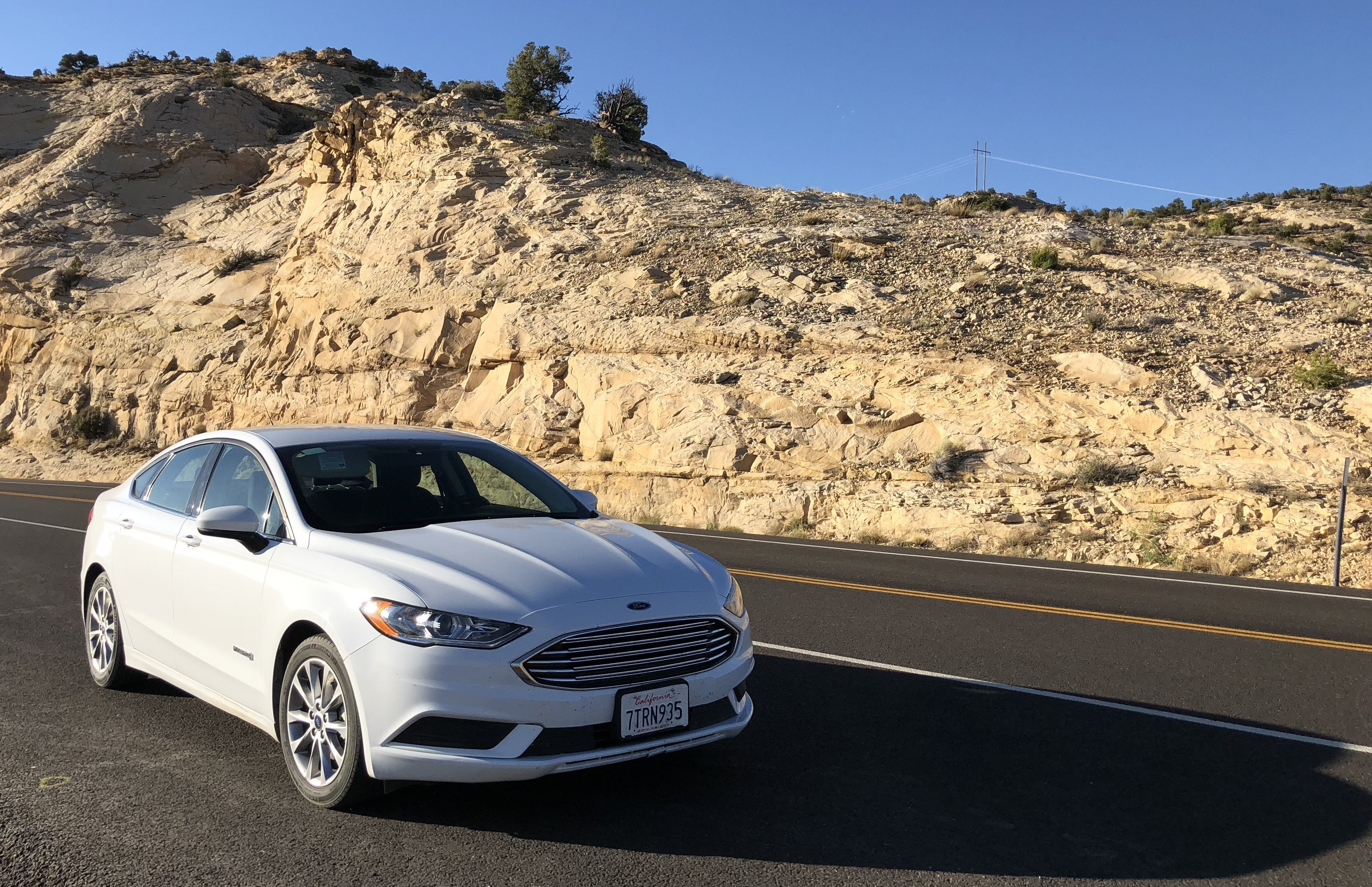
Our Ford Fusion Hybrid rental car
Overall, it took over a half hour for us to finally secure a Ford Fusion Hybrid. I’d never driven a gas-electric hybrid vehicle, so it took me awhile to become accustomed to our second-generation Ford Fusion. I loved its 45+ miles per gallon efficiency, but the large battery reduced the trunk space so much that our largest piece of luggage had to be transported in the back seat. The car was also more sluggish than what I am accustomed to, meaning I had to be cautious about passing other cars on two-lane highways. I did enjoy its coaching on my acceleration and use of the car’s regenerative braking, which helped me increase its efficiency.
Salt Lake City
Years back I read Jon Krakauer’s well-written Under the Banner of Heaven: The Story of a Violent Faith, which told early stories of the Latter Day Saints and their Mormon theology. So I knew about Brigham Young leading the largest sect westward to settle at the Great Salt Lake. I presume many of the folks we met throughout Utah were Mormons, given they comprise 63% of the state’s population. Wendy and I were both struck by how most of the tourists we saw were Asian, followed by a formidable showing of Germans, with a few Australians and Brits in the mix.
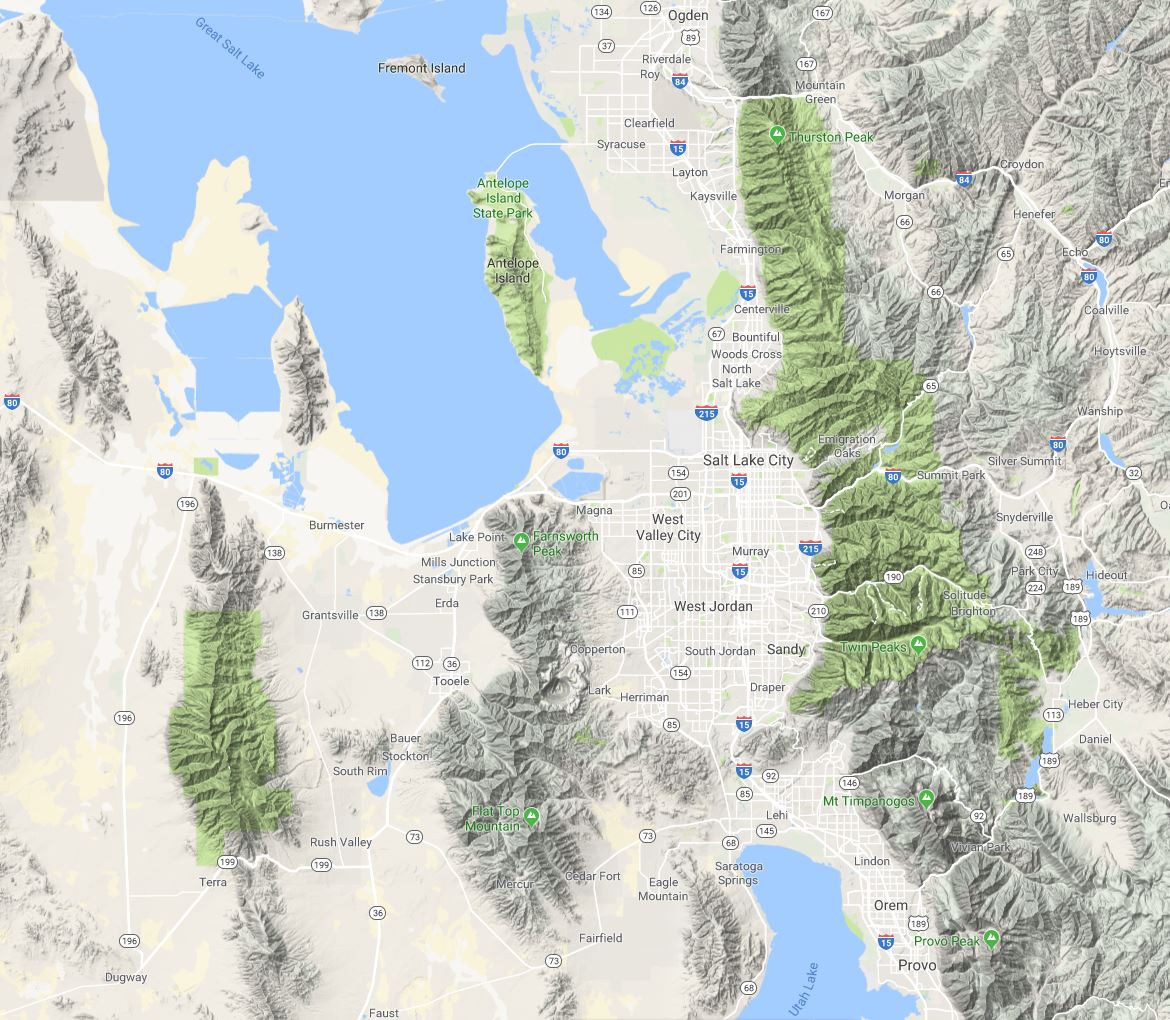
Salt Lake City appears to sit in a bowl with the Wasatch Range to the east and north and Oquirrh Mountains to the west. When I first saw the latter name on a terrain model at the Utah Museum of Natural History, I had no idea how to pronounce it. Only later did I find out you say it as you would “oaker”.
Our coolest weather of the trip was in the city, with us staying at a Holiday Inn Express near Temple Square downtown. Around us were many hipster bars, something that surprised me, given the Mormon prohibition on alcohol. Some research, however, revealed that only half of the city’s residents are members of that faith.
An uncomfortable chaise longue
I did not care for most of the hotel’s decor. It was mid-century modern revival, with an uncomfortable low-back couch and hard chaise longue (that’s the French spelling). Our suite was spacious, but the large kitchen area had a dozen or more empty cabinets, and the living room needed a coffee table. Wendy compensated with our usual travel trick of turning an adjustable ironing board into a narrow low table.
We set off the first morning to walk the few blocks over to the 10-acre Temple Square. We passed a passel of signs out in front of the convention center. They were an art installation called Point of View designed by Maine artist Aaron T. Stephan. Wendy and I both were prompted to think of Signs by Five Man Electrical Band. The “You are here” element when you face the installation head on is a nice added touch.
The Temple Square is surrounded by a 15-foot high wall. Within the grounds is the imposing 222-foot high quartz monzonite temple, built from 1853-1893, as noted by a large panel on its eastern face. We could not venture inside, something reserved for Mormons who are baptized and receive a temple recommend after multiple interviews. A 12-foot tall golden statue of the Angel Moroni adorns the tallest spire. The entire Temple Square features well-tended flowerbeds and plantings.
Nearby we went around Brigham Young’s Lion House of 1856, with its 20 gabled bedrooms for some of his plural wives and their children. It is adjacent to the Beehive House, his 1854 home, named after the sculpture which adorns its top. Utah’s nickname is the Beehive State; Young called the territory he and his fellow Mormon pioneer settled Deseret, which the Book of Mormon says was an ancient word for honeybee. In 1881 the Deseret News explained, “The hive and honey bees form our communal coat of arms…. It is a significant representation of the industry, harmony, order and frugality of the people, and of the sweet results of their toil, union and intelligent cooperation.”
At the Eagle Gate next to the Beehive House we turned back to return to our hotel. I will confess I dislike the 1960s mid-century modern version of the gate, even more than the hotel’s decor. I realize the historic versions of the gate were made obsolete by street widening, but their more conventional pillars seem far less threatening than the current arachnoid creation. More to my liking was part of Dennis Smith’s Counterpoint bronze figure set, with a mother twirling her daughter about in the air.
University Hill
We later drove due east to what I thought of as University Hill, where the University of Utah is draped across the lowest slopes of Mount Van Cott. We ate lunch at The Pie Pizzeria‘s underground location, where legions of university students had scribbled their graffiti across every wall.
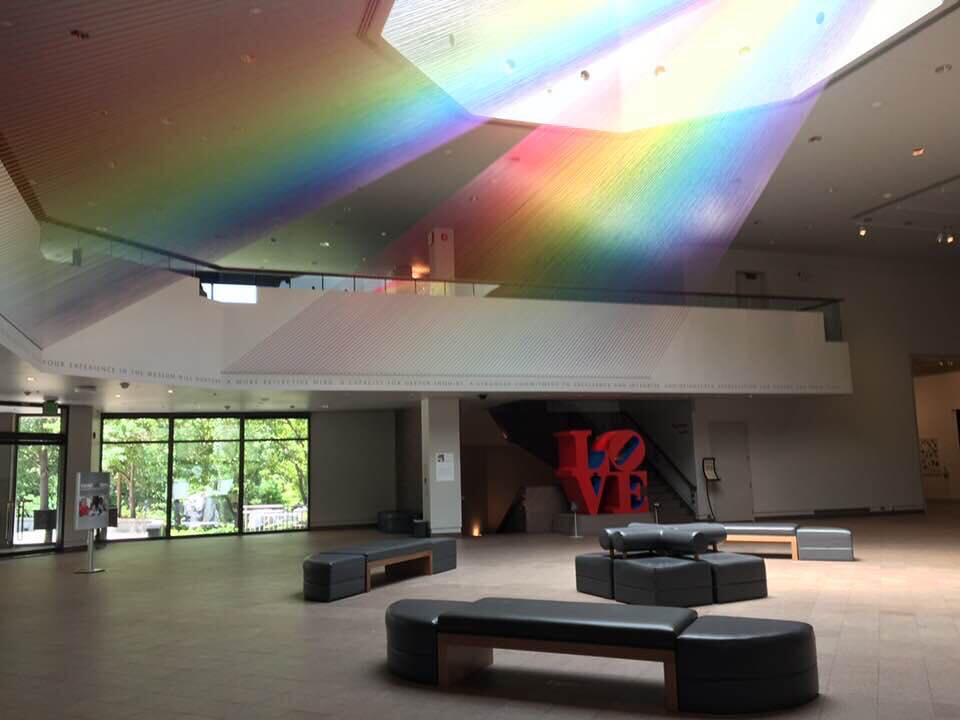
We also ventured to the Utah Museum of Fine Arts. Angela Ellsworth’s Seer Bonnet made me uncomfortable with its thousands of pearl-tipped steel corsage pins creating a beautiful exterior but sharp and dangerous interior. In Ellsworth’s reimagined history, Joseph Smith received prophetic powers via a seer stone while his multiple wives received their own visionary and revelatory powers from their seer bonnets. When I was a little boy my tiny maternal grandmother, who had a hardscrabble garden in Paoli, Oklahoma, used to have me wear a bonnet while I hoed weeds. I am most grateful she did not have me wear a seer bonnet!
Gilgal Garden
A stop on the morning we left town to head south to Escalante was the Gilgal Garden. From 1947 to 1963, Thomas Battersby Child, Jr. filled his backyard with 12 bizarre sculptures and over 70 stones engraved with scriptures, poems, and literary texts. Child was a masonry contractor and a Bishop of a Salt Lake ward of the Latter-Day Saints. In the Bible, Gilgal was the camp where Joshua ordered the Israelites to place twelve stones, one for each tribe, as a memorial after they crossed the Jordan River.
Child identified large stones which he had transported to his garden to be sculpted, adapting an oxyacetylene torch normally used for welding into a tool for reshaping stone. He hired artist Maurice Edmunds Brooks to assist with the project, fashioning a sphinx with the head of Joseph Smith, an offputting shrine to Child’s wife Bertha, and other tableau, including a full-size standing sculpture of Child himself with symbols of his ward and his trade, including brick pants.
“Priesthood” includes a rock arch formation with a keystone with letters Alpha and Omega on it, which are symbolic of Christ’s words: I am the beginning and the end. The granite boulders are for recorded messengers who helped restore the Gospel to the earth, such as Peter, James, John, Elijah and Moses. Cast books include The Book of Mormon, Doctrine and Covenants, and Pearl of Great Price.
Child recognized that his art was eccentric, stating, “You don’t have to agree with me. You may think I am a nut, but I hope I have aroused your thinking and curiosity.” He certainly succeeded, with me pondering his works 55 years after his demise.
Next door a large condominium complex was under construction on the sites of former residences. The Gilgal Garden was threatened with the same fate in 2000, only spared from development by a $679,000 investment by the county and various donors. Volunteers and nonprofits have rejuvenated the property, repairing vandalized pieces and planting the garden with many beautiful roses and other plants.
Salt Lake City is part of the Wasatch Front, a long metropolitan area stretched out along the western side of the Wasatch Range of mountains where 85% of the population of Utah resides. South of there is Provo, known to me as the home of Brigham Young University (BYU) and the birthplace of the WordPerfect software I relied on for over 30 years. I first learned to use WordPerfect at the University of Oklahoma in 1985 and always found it superior to Microsoft Word. While I no longer use WordPerfect itself, I still regularly use the vector drawing portion of the Corel Presentations software which was born from it.
Over the decades I had many superb students who were Mormons. They often chose to receive their higher education at BYU. So I thought it would be interesting to finally glimpse its campus. Our journey south to Escalante included zooming down the massive Interstate 15 past Provo, so we turned off there to visit the art museum on the campus.
I was hoping to see what was described by previous tourists as a nice Escher exhibit, but that was closed. Wendy and I were more than adequately compensated, however, by the inventive, funny, and varied works by Nina Katchadourian on display.
Lavatory Self-Portraits in the Flemish Style
Her Lavatory Self-Portraits in the Flemish Style were quite hilarious. Beginning in 2010, Nina started taking photographs and shooting videos in airplane lavatories, with tissue paper toilet covers and the like adorning her head in the style of 15th-century Flemish portraiture. We could put on headphones and watch her lip-syncing to various songs by groups one definitely does not associate with 15th-century Flemish art.
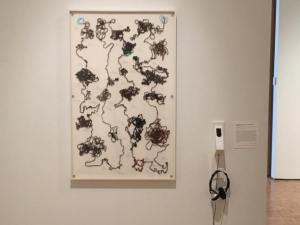
Songs of the Island: Concrete Music from New York
I liked her Songs of the Island: Concrete Music from New York, in which she collected bits of discarded unraveled cassette tapes found in the gutters of the Big Apple, cleaned them up, and spliced them together into a mix tape that is both a wall art installation that shows where she found them and an audio experience in which you can hear the bits of reggae, salsa, Indian pop, punk, rhythm and blues, country-rock, old-school rap, metal, and Vietnamese music she found on them.
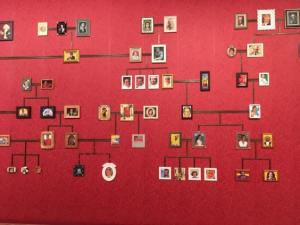
The Genealogy of the Supermarket
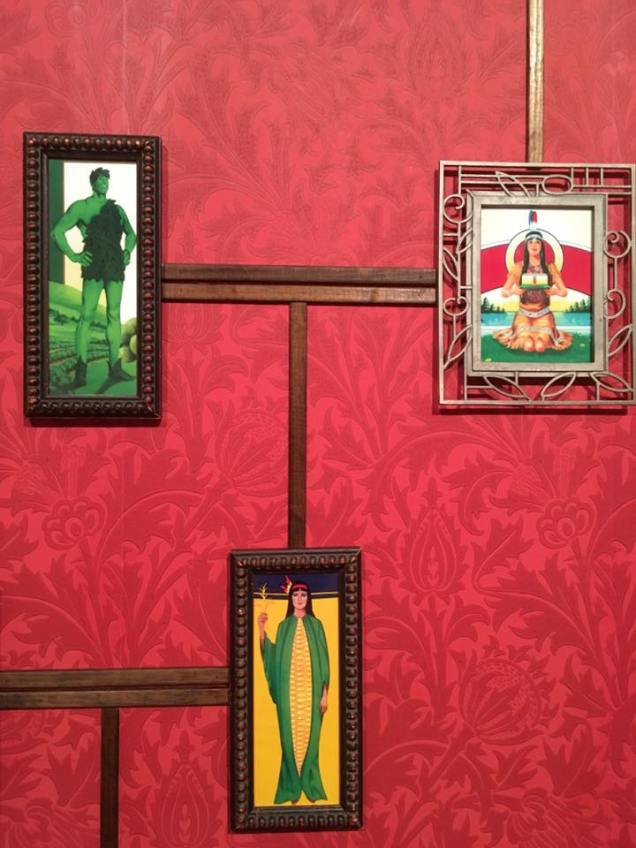
Her delightful The Geneaology of the Supermarket was a huge wall covered by a family tree of fictitious and fanciful relations among various grocery advertising characters. She adds local images to each installation of this piece, so it is alive and growing. Wendy and I guffawed at discovering how Uncle Ben and Aunt Jemima were siblings, the Green Giant and the Land o’ Lakes Butter Maiden were married and the parents of the Argo Corn Starch maiden, and Mr. Clean and the Brawny paper towel guy got married and adopted the Gerber Baby and the Sunbeam Bread girl. Clearly the Mormons at BYU do have a healthy sense of humor.
Did you know that the Green Giant and Land o’ Lakes Butter Maiden were the parents of the Argo Corn Starch maiden?
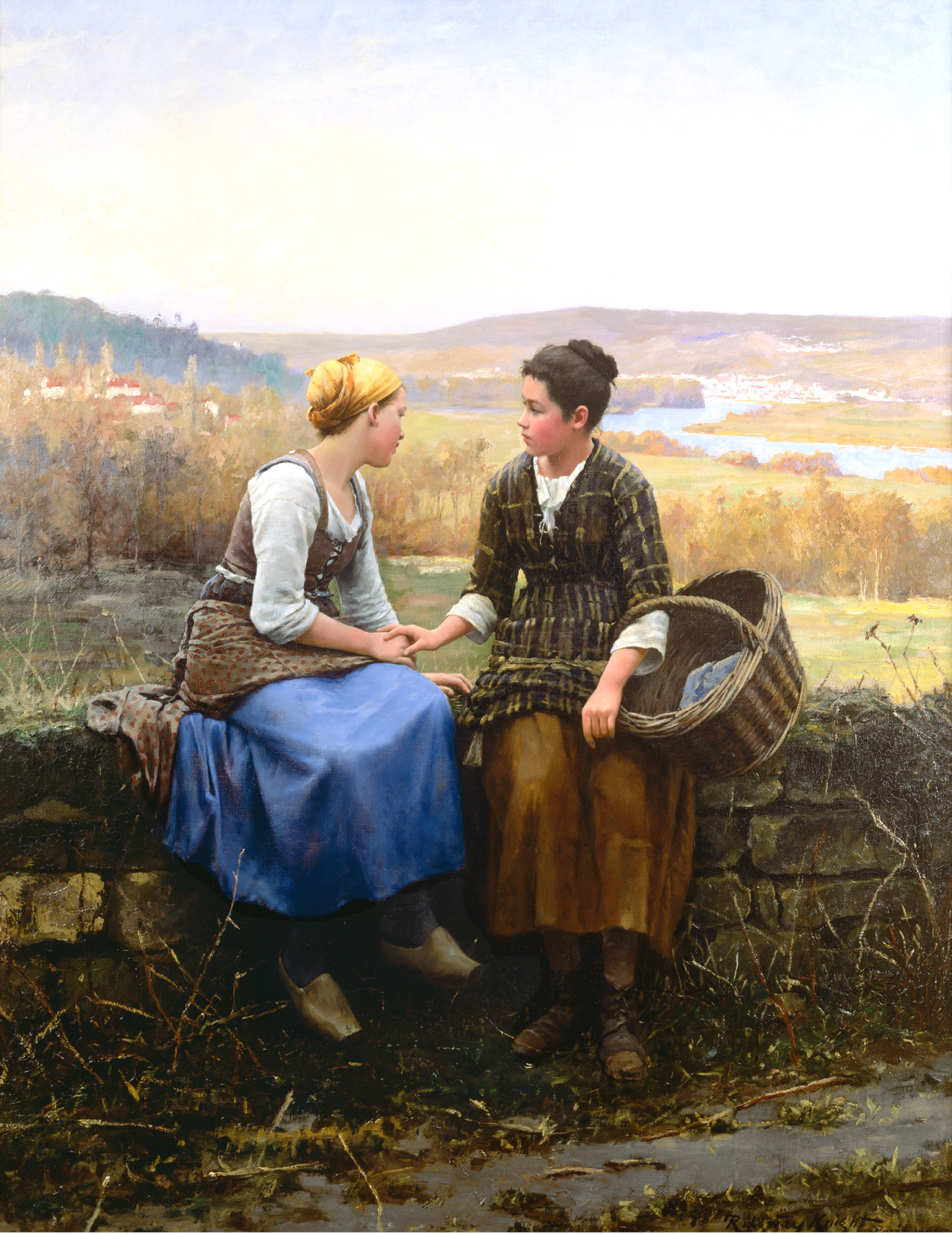
At the museum I also admired the far more traditional, and quite beautiful, Le Premier Chagrin (The First Grief) by Daniel Ridgway Knight. This lovely painting of two French peasant girls was crafted in 1892. Wendy was kind enough to locate a print of it in the art museum’s gift shop for me. It now adorns a wall in my man cave at Meador Manor, across from Tamara de Lempicka’s Portrait d’Ira Perot. The digital version below does not do it justice, but provides a facsimile of its touching beauty.
Le Premier Chagrin by Daniel Ridgway Knight
Eager for lunch, we asked girls working at the museum for a recommendation. That led us to CHOM burgers, where the food was quite tasty even if owner Colton Soelberg admits that “Chom” itself has no meaning at all.
That concluded our adventures in the metro area, with us heading south for the scenery of the tip of Capitol Reef National Park and the Grand Staircase-Escalante National Monument, which we will share in the next post about our Arid Adventures in Utah and Arizona.
In one of those dreams that returns from time to time, I wander through what is purportedly my house, discovering levels and wings that I either had forgotten about or long neglected. It is somewhat disappointing to awaken and realize there are no forgotten rooms to be remembered or revisited.
Some songs offer a similar, but quite real aspect. Consider these lyrics:
She said, ‘I’m home on shore leave,’
though in truth we were at sea
so I took her by the looking glass
and forced her to agree
saying, ‘You must be the mermaid
who took Neptune for a ride.’
But she smiled at me so sadly
that my anger straightway died.
Sound familiar? Can you identify the rhythm in those lines? How about this:
If music be the food of love
then laughter is its queen
and likewise if behind is in front
then dirt in truth is clean
My mouth by then like cardboard
seemed to slip straight through my head
So we crash-dived straightway quickly
and attacked the ocean bed.
Still nothing? Then let me throw in the chorus that falls between those verses:
And so it was that later
As the miller told his tale
That her face, at first just ghostly
Turned a whiter shade of pale
I am interested in how one can, as the above video does, use the entirety of the song to form a somewhat more coherent narrative than with its popular truncated version. However, I still regard the song’s nautical references more as metaphors about a negotiation that ends in a sexual act than being about a man and woman on a ship.
Let’s look at some more forgotten verses, which you have a much better chance of recognizing:
On the shore dimly seen through the mists of the deep
Where the foe’s haughty host in dread silence reposes,
What is that which the breeze, o’er the towering steep,
As it fitfully blows, half conceals, half discloses?
Now it catches the gleam of the morning’s first beam,
In full glory reflected now shines in the stream,
‘Tis the star-spangled banner – O long may it wave
O’er the land of the free and the home of the brave!
This sort of thing reminds me of church hymnals with their plenitude of forgotten verses. As a youth, I was always intrigued when Charles Mohr, the choir director at Western Oaks Christian Church in far west Oklahoma City, would have the congregation sing some of the forgotten verses of popular hymns.
Just as I Am from 1835 has seven verses, but how many times have all seven been sung? Alan Jackson selected verses 1, 3, 4, and 5 for his rendition, as did Tennesee Ernie Ford.
Just as I am – without one plea,
But that Thy blood was shed for me,
And that Thou bidst me come to Thee,
-O Lamb of God, I come!
Just as I am – and waiting not
To rid my soul of one dark blot,
To Thee, whose blood can cleanse each spot,
-O Lamb of God, I come!
Just as I am – though toss’d about
With many a conflict, many a doubt,
Fightings and fears within, without,
-O Lamb of God, I come!
Just as I am – poor, wretched, blind;
Sight, riches, healing of the mind,
Yea, all I need, in Thee to find,
-O Lamb of God, I come!
Just as I am – Thou wilt receive,
Wilt welcome, pardon, cleanse, relieve;
Because Thy promise I believe,
-O Lamb of God, I come!
Just as I am – Thy love unknown
Has broken every barrier down;
Now to be Thine, yea, Thine alone,
-O Lamb of God, I come!
Just as I am – of that free love
The breadth, length, depth, and height to prove
Here for a season, then above,
-O Lamb of God, I come
That seventh verse is often omitted, as the first six appeared as a poem in 1835 and the seventh came a year later, but from the same author, Charlotte Eliot.
And, of course, like The Star-Spangled Banner, a poem can be set to alternate tunes. If you know the hymn as popularized as Billy Graham’s altar call, you probably know the Woodworth version. But here’s the alternate Saffron Waldon version:
Let’s shift back to something secular, although this one is now associated with a Christian holiday. Riddle me this:
Now the ground is white
Go it while you’re young,
Take the girls tonight
And sing this sleighing song;
Just get a bob-tailed bay
Two-forty as his speed
Hitch him to an open sleigh
And crack! you’ll take the lead.
The middle lines of the verse rescued you, I trust. That is the fourth verse of Jingle Bells, although I reckon you might, like me, only truly know the first verse with perhaps a dim recollection of the occasional Fannie Bright enlivening the Christmas season.
But do you feel reality shift a bit when you discover that the song was intended for the Thanksgiving season, not Christmas? And please note how some of the words of the first verse have changed since its composition in 1857:
Dashing thro’ the snow,
In a one-horse open sleigh,
O’er the hills we go,
Laughing all the way;
Bells on bob tail ring,
Making spirits bright, Oh what sport to ride and sing
A sleighing song tonight.
Time has not even left the well-worn chorus fully intact:
Jingle bells, jingle bells, Jingle all the way. Oh! what joy it is to ride In a one-horse open sleigh.
I notice that in many versions they don’t add the “Ha ha ha” I learned to insert after “laughing all the way”. I do find these variations fun…or should I say joyful?
We’ve seen a tune substitution, so let’s consider lyrical substitution as well. Consider this verse:
When you were lonely, you needed a man
Someone to lean on, well I understand
It’s only natural
But why did it have to be me?
Nights can be empty and nights can be cold
So you were looking for someone to hold
That’s only natural
But why did it have to be me?
A very few of you might recognize that is from ABBA’s Why Did It Have to be Me? on their Arrival album, the album which more successfully featured their biggest hit in America, Dancing Queen. Here’s how the song goes for those unfamiliar with it:
Now I’m a big ABBA fan who bought all of their albums on vinyl back in the day. So imagine my surprise when I heard a rare B-side of theirs called Happy Hawaii, which goes like this:
Early this morning I drove in the rain
Out to the airport to get on the plane
Hey Honolulu, we’re going to happy Hawaii
Alice has been there, she said it was fun
Swimming and surfing, enjoying the sun
Hey Honolulu, we’re going to happy Hawaii
After all I’ve had to go through
I’m making no plans (making no plans oh-ooh)
But I, but I believe love gives me a second chance
Guess I’ve been working a little too hard
Need a vacation, I’ll send you a card
From Honolulu, a greeting from happy Hawaii
It’s so exciting, why should I pretend
In a few hours the plane will descend
Hey Honolulu, we’re going to happy Hawaii
I can imagine the beach and the sand
Walking with someone and holding his hand
Hey Honolulu, we’re going to happy Hawaii
After all I’ve had to go through
I’m making no plans (making no plans oh-ooh)
But I, but I believe love gives me a second chance, mmm
I’ve got a feeling the dream will come true
Somebody’s waiting and I’ll forget you
Hey Honolulu, we’re going to happy Hawaii
Do you sense the similarity? It goes far beyond that:
Yes, they completely rewrote the lyrics during the song’s development and gave it a weird Fats Domino vibe for the released version on the album.
I started this post remarking on my dreams of lost rooms. But dreams can sometimes turn into nightmares. There is a forgotten verse of Big Rock Candy Mountain or Hobo’s Paradise that, once you hear it, will change your understanding of the song.
Here’s the version as released:
But perhaps you grew up with the bowdlerized versions where the cigarette trees bore peppermints, the streams of alcohol transformed into lemonade, and there were no lakes of whisky, just soda water fountains? Burl Ives had ridden the rails, but he cleaned up the song considerably, although perhaps his tobacco-chewing pipe-smoking grandmother – who taught him scores of Scottish, Irish, and English folk ballads – led him to leave in the cigarette trees:
Now, those vices are not shocking. But there was a final verse that was understandably omitted. I warn you: don’t read on unless you are prepared for a rude awakening as to what the hobo in the song was about. Here’s the missing final verse Harry McClintock performed when busking with the song in the 1890s:
The punk rolled up his big blue eyes and said to the jocker, “Sandy I’ve hiked and hitched and wandered too, but I ain’t seen any candy I’ve hiked and hiked till my feet are sore, I’ll be god damned if I hike any more To be buggered sore like a hobo’s whore on the Big Rock Candy Mountains.“
Oh, dear. Perhaps some forgotten rooms are best left unexplored. But don’t let the occasional odd turns stop you, for there is much delight to be found in the variations of verse and song.
All good things… was the series finale for Star Trek: The Next Generation
The title for this post comes from the final television episodes of Star Trek: The Next Generation, which ended its run in 1994 after seven years and 178 episodes. It was a great series finale, something the iconic original Star Trek series in the late 1960s never got in its three-year run of 79 episodes.
One’s mind fills in the rest of the title: must come to an end. We can trace the idiom back to Geoffrey Chaucer’s poem Troilus and Criseydeof the mid 1380s:
He song; she pleyde; he tolde tale of Wade. But at the laste, as every thing hath ende,
She took hir leve, and nedes wolde wende.
And while all good things must come to an end, some good things have a very long life. Chaucer’s poem is still with us over six centuries later. Other things have shorter, if still meaningful, lives.
18 years ago I decided to self-publish my Inquiry Physics: A Learning Cycle Curriculum, which was an elaborate refinement and extension of work done by others in the 1980s at the University of Oklahoma and Norman High School. I was initially prompted by requests from other physics teachers for my materials. Over the next 18 years I never advertised that work, relying solely on word-of-mouth and internet searches to drive any sales.
For a couple of years I sold the curriculum as a thick binder of papers with an optional CD-ROM disc. Then I simplified to just selling it on CD-ROMs for a dozen years, updating the curriculum seven times over the decades to incorporate corrections and additions. For the past five years it was a download-only product. Its most recent iteration had 19 units with 213 pages of teaching suggestions, 26 hands-on labs, 98 other student assignments, 175 pages of sample notes, and several multimedia presentations, all compressed into a 600 megabyte archive.
In 2008 I donated all of my net profits to that point, which was only $1,000, to the John Renner Science Education Center at OU, since Dr. Renner’s program under the stewardship of Dr. Ed Marek was where the original learning cycles came from. Coincidentally, that was when a six-year boom in sales began, peaking in 2014 with almost 100 sales and about $2,500 in revenue. That wasn’t my profit, since in addition to website expenses, sales became large enough in the 2010s that I had to file extra tax paperwork, obtain business licenses, and pay over 15% self-employment tax each year on the proceeds.
Inquiry Physics sales chart
I spent most of the profits of the final decade on purchasing website domains for the school district, school-related equipment and materials, and similar pro bono work. Sales declined after 2014, partly because I decided not to update the curriculum for the AP Physics 1 exam which debuted in 2015, only providing a correlation guide. My public retirement from teaching physics in 2017 likely precipitated a drastic decline in subsequent sales.
Since sales in the first half of 2018 have declined to 2009 levels, it is time for another good thing to end. I remain uninterested in updating the curriculum, and by ending sales now I can avoid dealing with self-employment taxes and paperwork next spring. Plus the recent U.S. Supreme Court decision in South Dakota v. Wayfair sets the stage for cities and states to begin directly collecting sales taxes on internet sales rather than hoping consumers will pay use taxes. It wouldn’t make sense for me to invest the time and effort in arranging for the collection and payment of those additional taxes on such meager proceeds.
But over the past 18 years I am surprised and pleased that, without any advertising, I was able to sell 578 copies of my curriculum to teachers in 48 of the 50 states and 14 foreign countries. (The holdouts were North Dakota and Wyoming.) I know almost all of the sales were to teachers, as I verified purchasers’ online presence at school websites. So I can safely presume portions of my materials have been used to teach many more students than the 2,663 I was blessed to have in my own classes from 1989-2017. To help protect the integrity of the assignments for the teachers who still use them, I will not consider releasing the curriculum into the public domain until after I retire from education in 10-15 years.
This is not a tale of a small business destroyed by government taxes. It is the story of a cycle. Just as there is a learning cycle, there are cycles in a business and in a career. This marks the end of my physics cycle, but I’m only one year into a new one revolving around technology and communications.









 Salt Lake City appears to sit in a bowl with the Wasatch Range to the east and north and Oquirrh Mountains to the west. When I first saw the latter name on a terrain model at the Utah Museum of Natural History, I had no idea how to pronounce it. Only later did I find out you say it as you would “oaker”.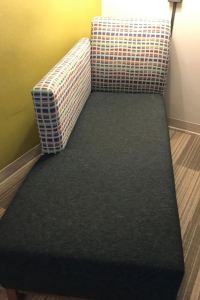



 And so it was that later










 Meador Manor