A Grand Adventure, Day 3: The Petrified Forest

TRIP DATES: June 11, 2017 | SLIDESHOW | PHOTO ALBUM

The third day of our adventure out west in June 2017 was a long drive from Albuquerque, New Mexico to Tusayan, Arizona featuring a drive through the north end of the Petrified Forest National Park.

Trip Map, Day 3

We drove west from Albuquerque through El Malpais, the Badlands of west central New Mexico. Thousands of acres of landscape to the south is broken up by pitch-black, concrete-hard, glassy, sharp rock with many lava tubes and craters. I tried to tour the volcanic landscape back in 2011, but was thwarted by a storm which flooded the unpaved roadway. In the end, I wound up with a muddy mess of a car both inside and out.

Lava field of El Malpais

It turned out we would travel through the Badlands four days later on our eastward return from the Grand Canyon. But for the trip west we forged onward to Gallup for lunch at a Cracker Barrel and onward into Arizona to visit the north end of the Petrified Forest.

I-40 paralleled one of the three transcontinental routes of the Burlington, Northern, and Santa Fe railroad from just east of Grants, New Mexico for over 275 miles to our turnoff to the Grand Canyon in central Arizona. Our fellow traveller John Henderson builds bridges for the BNSF’s main competitor, Union Pacific. Wendy and I marvelled at the frequent long trains with multiple engines which we saw all along the route.

Petrified Forest Northern Map

200 miles west of Albuquerque we turned north off I-40 to visit the northern part of the Petrified Forest. The petrified wood found in that park and the surrounding region is made up of almost solid quartz. A rainbow of colors is produced by impurities in the quartz, such as iron, carbon, and manganese. Over 200 million years ago, logs washed into an ancient river system and were buried quickly and deeply enough by massive amounts of sediment and debris to cut off the oxygen and extend their decay for centuries.

Petrified Wood

Minerals, including silica dissolved from volcanic ash, absorbed into the porous wood over hundreds and thousands of years slowly crystallized within the cellular structure, replacing the organic material as it broke down over time. Sometimes crushing or decay left cracks in the logs where large jewel-like crystals of clear quartz, purple amethyst, yellow citrine, and smoky quartz formed.

I had deliberately included stops at the Petrified Forest on both our way out and back, knowing how much Betty Henderson loves petrified wood. Wendy the rockhound loves the stuff too, of course, and provided several close-up shots. At the visitor center John spotted a huge petrified log we could examine.

Petrified Log

We paid $20 for each vehicle to enter the forest, even though we only had time to visit the viewpoints north of the interstate; the passes were good for a week, so they would serve us again in a few days when we would drive through the park from its southern entrance on our return journey.

Tiponi Point was our first panorama of the Painted Desert. The desert here is composed of stratified layers of easily erodible siltstone, mudstone, and shale of the Triassic Chinle Formation. The iron and manganese compounds in these layers provide the vivid colors that led a troop of men from Coronado’s 1540 expedition, who had been sent to find the Colorado river, to name this area El Desierto Pintado.

Tawa Point Closeup

Next was Tawa Point, with striking color contrasts and multicolored slopes. The Hendersons posed for me there. The road wound around, bringing the Painted Desert Inn into view above Kachina Point.

The Painted Desert Inn

The Inn began as the Stone Tree House by Herbert David Lore, with a top-level lunchroom and area for Indian crafts to be sold, a bottom-level taproom, and six tiny guest rooms. They still sell Native American works in the Inn, and John Henderson bought a lovely bracelet there for John and Betty’s daughter Elizabeth.

Painted Desert Inn Doorway

Mr. Lore built the Stone Tree House with petrified wood and other native stone. Unfortunately, the stones rested on a foundation undermined by a seam of bentonite clay, so the foundation and walls cracked as the clay swelled and shrank. When the Park Service took over the property in the 1930s, architect Lyle Bennett redesigned it in the Pueblo Revival style one sees so much of in Santa Fe, although one can still find the petrified wood used in the old house peeking out around the lower level doorway. The exterior and interior were transformed under Bennett’s direction by CCC workers during the Great Depression.

Painted Desert Inn Mural

The famed Fred Harvey Company, whose hotels and related buildings at the Grand Canyon are prime attractions on its South Rim, took over the property after World War II. Its renowned architect, Mary Colter, added plate glass windows to emphasize the views out to Kachina Point. She also implemented a new color scheme while hiring Hopi artist Fred Kabotie to paint murals on the lunchroom walls.

Continuing structural problems due to the clay underneath the building led the Fred Harvey Company to relocate to the current visitor’s center in 1963. The Painted Desert Inn was threatened with demolition, but a public campaign saved the historic structure. Renovations in 2004-2006 extended its life with thirteen floating roofs, joint-less pipes, and flagstones being re-laid to improve drainage.

I took the time to walk around to the west side of the building and peer into the six tiny rooms, which are little more than cubicles with a corner sink. Some of them were once home to “Harvey girls” who worked at the facility. 

Kachina Point
The Meadors in the Painted Desert

After relaxing at the Inn, we drove on to Pintado Point, where Wendy and I posed in front of the Painted Desert. There is no access to I-40 if one continues through the park, so we turned about for refreshments at the visitor center before continuing our journey west.

With a pit stop at the Flying J outside Winslow and refueling in Flagstaff, we were ready to head to the Best Western in Tusayan, just south of the Grand Canyon. We could not take the direct route from Flagstaff along Highway 180, as it was closed by fire. A lightning strike in early June on the slopes of Kendrick Mountain ignited a wilderness area with many dead and downed trees killed in a wildfire back in 2000. The smoke made Highway 180 impassable, so we had to continue along I-40 west of Flagstaff and take Highway 64 north to Tusayan, from which we could see the smoke billowing from the mountainside.

Fire at Kendrick Peak

I had been pleasantly surprised by the great condition of I-40 in Oklahoma and New Mexico. But the interstate was in very rough shape in Arizona west of Flagstaff. Signs warned of miles of rough road, and they weren’t kidding. The Flagstaff area usually experiences more than 200 daily freeze-thaw cycles each year where moisture seeps during the day into the asphalt overlay and then pops it when it expands upon freezing overnight. Heavy traffic exacerbates the issue. They need to rip out the interstate here and rebuild it with fresh impervious concrete panels.

We pulled into our hotel, the Best Western Premier Grand Canyon Squire Inn. It was a larger facility than most Best Westerns and even boasts a six-lane bowling alley. In recent years it has been overhauled with a new lobby and a ten-year plan will add 438 additional rooms. I appreciated the attractive lobby and pricey but adequate dining options.

Our room at the Grand Canyon Squire Inn

I usually book a suite, or what a hotel bills as a suite, for Wendy and me since she likes to stay up late and sleep in, while I prefer to go to bed early and rise early. I spent an extra $100 per night for this at the Grand Canyon, over the quite comfortable but linear room the Hendersons occupied.

Our “suite” was very spacious with an enormous bathroom, living area, and small kitchen spot, but it had no true separation of the bedroom area from the living area, and you had to pass through the bedroom area to reach the bathroom. Whenever we find a hotel that truly separates the bedroom from the other areas, we make note of it, as that is a real plus for us as we don’t have to worry so much about waking each other up. The best rooms on this vacation in that regard were the Drury Inn in Amarillo and the DoubleTree Airport in Oklahoma City. But Wendy situated herself in the kitchen area each night while I drifted off to sleep, and all was well…except for the pillows, which is a story for a later post.

The next day we’d drive a few miles north for our first of two days at the Grand Canyon’s South Rim.

SLIDESHOW | PHOTO ALBUM

A Grand Adventure, Day 4: The South Rim >

< A Grand Adventure, Days 1 & 2: From Cadillac Ranch to TinkerTown
Posted in photos, travel | Leave a comment

A Grand Adventure, Days 1 & 2: From Cadillac Ranch to TinkerTown
TRIP DATES: June 9-10, 2017 | SLIDESHOW | PHOTO ALBUM
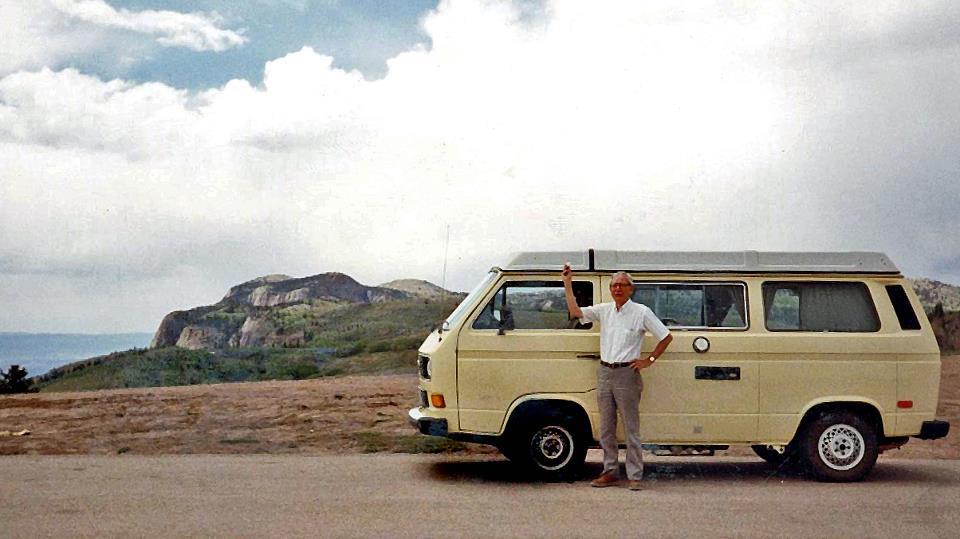
Dad and his camper in 1991 on our trip out West

Over a quarter century ago my father and I went west in his Volkswagen camper, with him showing me highlights of central New Mexico, southwestern Colorado, and Arizona. In 2013 and 2014 I took Wendy to some of the sites in New Mexico and Colorado, such as the Durango-Silverton railroad, the ruins of Mesa Verde, and Sandia Crest above Albuquerque. But we never made it all the way west to Arizona, so she had never visited the incredible Grand Canyon. My friend and colleague Betty Henderson and her husband, John, had also never visited that natural wonder. That led me to formulate a plan.

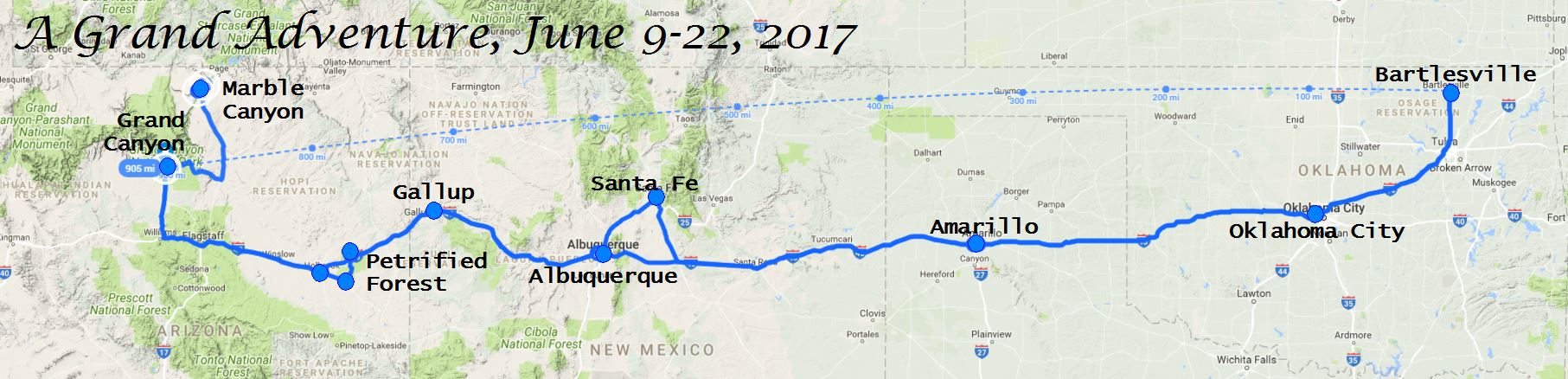
In July 2017 I’d be taking up an administrative job, giving up the traditional summer break of a classroom teacher. So I proposed that the four of us travel west in June to see the Grand Canyon and other sites along the route. Betty and John drove separately so that they could head back home after a week on the road, while Wendy and I would remain in Santa Fe, New Mexico for a few extra days. On June 9, 2017 we set out on a journey of over 2,500 road miles, with the far point being the Grand Canyon, over 900 air miles from home.

Click map to enlarge

Our first stop was in Oklahoma City to have lunch with my parents, who are now 80 and 92, respectively. As usual, I kept my iPhone’s FollowMee app on throughout the vacation, allowing my parents to track our progress and vicariously enjoy our trip. Then the Hendersons followed Wendy and me westward on I-40, the successor to much of the famed Route 66. Our first overnight stop would be in Amarillo.

We pulled into Amarillo for a late and disappointing dinner at the Calico County restaurant we had enjoyed so much on previous trip. Thankfully it redeemed itself with tasty breakfasts when Wendy and I came back through the cowtown twelve days later. We spent our first night at the Drury Inn & Suites, a very nice facility even if the smell created by Amarillo’s livestock wafted into the lobby from time to time.

Cadillac Ranch

Our second day on the road featured our first tourist attraction, the Cadillac Ranch just outside of Amarillo. As usual, visitors were milling about, spray painting the old cars and taking photographs.

Texas Kion

Wendy had brought a little Kion squeezable figurine with her on the trip, but it didn’t take much of my driving for her to squeeze him so much he burst, necessitating a bandage. Little Kion had stopped with us in Groom, Texas during our first day on the road, showing no fear of The Dreaded Red Tigers. While we were at Cadillac Ranch, he hopped on top of one of the wheels, which were encrusted with over 40 years of paint.

Lunch was at the venerable Joe’s Bar & Grill Cantina in Santa Rosa, a place John had visited with a railroad crew years ago. I avoided the chile sauce on my burrito, but enjoyed filling my sopaipilla with honey.

Elvis at Russell's Travel Center

I made sure to stop every hour or so throughout our road travels to give everyone a break. So we stopped in many tourist traps, including Russell’s Travel Center in Endee, New Mexico. Elvis was there alongside a pink cadillac. There weren’t any Stuckey’s along our route, but their Pecan Log Rolls were present, for better or worse.

Clines Corners is the stop on I-40 where Wendy and I usually angle northwest to Santa Fe. Wendy used products from there to outfit Kion with a cowboy hat for Texas and a sombrero to shield him from the strong New Mexico sun.

It was warm throughout most of our vacation, with the exception of a cooler and windy first day at the Grand Canyon. Everyone’s nasal passages dried out in the desert, and Wendy and I were happy to feel the moisture of Green Country upon our return home.

TinkerTown

TinkerTown Museum Exterior

Instead of angling up to Santa Fe at Clines Corners, we drove on west to Albuquerque. We had never been to TinkerTown on the east slope of Sandia Peak, so I led us there to explore the odd structure and admire the wacky and obsessive creations of the late Ross Ward. His motto to “Live Life as the Pursuit of Happiness” was evident in his plethora of dioramas.

TinkerTown Diorama
TinkerTown Sideways Looks
Wendy had a hoot laughing at the expressions on the faces of various figures, including various wagon drivers, politicians at a seamy hotel, bar folk, characters in an ice cream parlor, coffee drinkers, folks at a burial, a Native American family of sideways glances, the Dukes of Hazzard with a wagon rather than the General Lee race car, and general street folk.

A large circus diorama reflected how Ross Ward was a show painter for carnivals for 30 years. Wendy found one of my heroes, Alfred Hitchcock, lurking in a graveyard near TinkerTown’s animated hell, and we found a display depicting teachers on summer vacation, although I think they went to the beach rather than the desert.

Mark Twain's Observations

I appreciated how Mr. Ward highlighted Mark Twain’s sentiment on travel:

Travel is fatal to prejudice, bigotry, and narrow-mindedness, and many of our people need it sorely…broad, wholesome, charitable views…cannot be acquired by vegetating in one’s little corner of Earth.

That comes from Innocents Abroad, which is a great free read if you like travelogues.

Some walls of the ramshackle buildings were built of bottles, showing the influence of Grandma Prisbey’s Bottle Village out in California. There was even a Buddha bottle shrine. Outside, the Hendersons explored Buzzard Gulch, a collection of rusting equipment of the west. Wendy posed for me as Miss TinkerTown.

TinkerTown Jeep

I was touched to find that a Jeep coated in coins, paint, pebbles, and figurines was a project his wife suggested to Ross after his Alzheimer’s symptoms made it unsafe for him to drive. He had been diagnosed with the disease in his late 50s and died in his early 60s. His daughter, Tanya Ward Goodman, wrote a well-received book about his dilemma.

Up to Sandia Crest

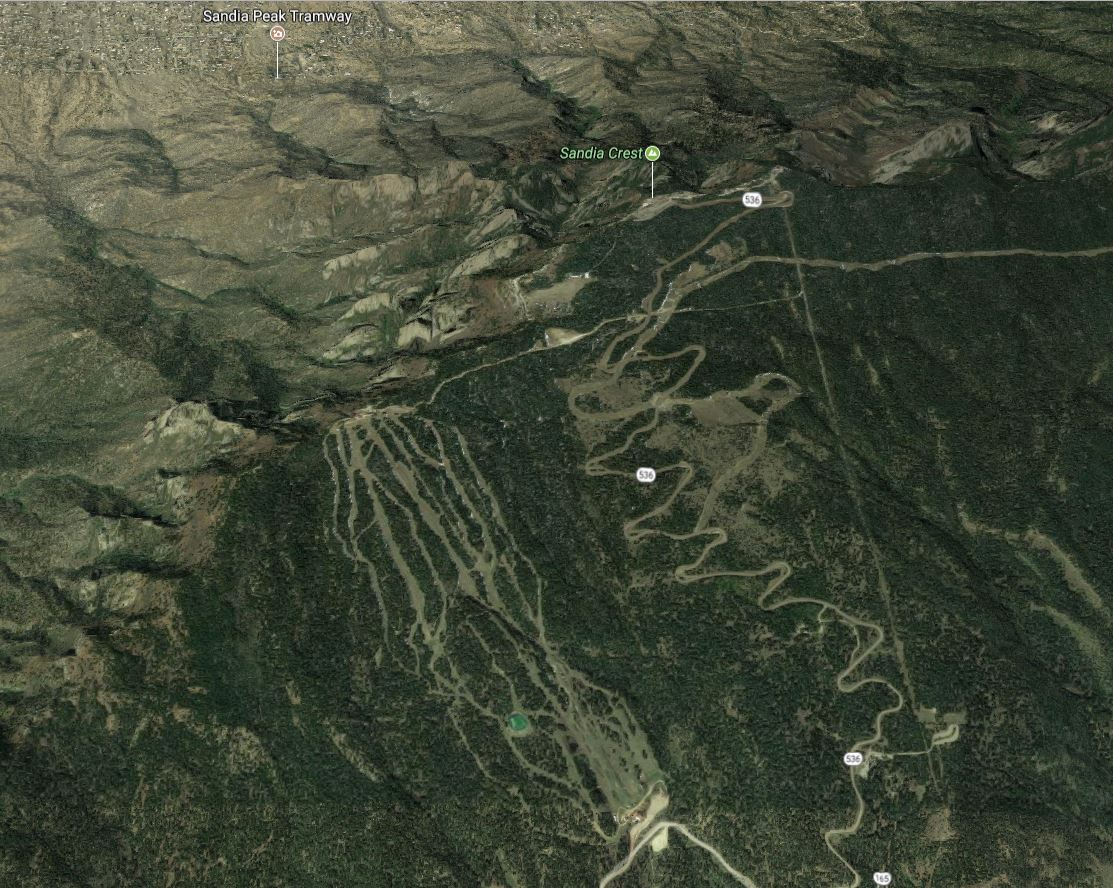
Three years back, Wendy and I rode the tram to Sandia Crest, and we still laugh about how the guide pronounced “mountain” as “mou-ann” during our ride. This time the Hendersons joined us in scaling the peak in our respective Toyota Camrys on a long series of switchbacks up the Sandia Crest Scenic Highway.

The many switchbacks of the road to Sandia Crest
Hendersons on Sandia Crest

Betty and John posed for me up top, with Albuquerque fading into the haze below us and the mountain ridge sloping off to the side.

The altitude at Sandia Crest and New Mexican food at Santa Rosa took their toll on Wendy and me, with us crashing at the hotel near Albuquerque’s Old Town while the Hendersons enjoyed dinner at the St. Clair Bistro.

The next day would bring another long drive west on I-40 from Albuquerque through the north end of the Petrified Forest to Tusayan, just south of the Grand Canyon.

SLIDESHOW | PHOTO ALBUM

A Grand Adventure, Day 3: The Petrified Forest >

Posted in photos, travel, video | Leave a comment

We live in a world with tears

I lost one of my mentors tonight. We had not spoken in years, yet he was and remains, as my wife put it, one of the pieces of the puzzle that is me.

I cried when I learned a few days ago that he was very ill and would soon be going home to die. I mailed a letter to his home, knowing he would likely never get to read it or hear it, but at least his wife and family might receive my acknowledgement of the gifts he shared with me. I wanted them to know his light is not extinguished, for it still shines in me and the many others he supported and tutored.

My letter will arrive there in a day or two. But two late is too late. I have been too preoccupied with my busy life to keep track of his. So now regret burns a hole in my heart even as fond memories flood down to fill it.

My wife can tell you I do not track all that well the lyrics in many songs. But for sad songs I often do, and tonight is a dark night for me. A night for a sad song from Lucinda Williams in which every word speaks to my tears, my skin, my bones.

We live in a world with tears, and I suppose that is for the best. Like time, they are a great teacher. Rest in peace, Stephen Merton Sutherland, and thank you for being a piece of this puzzle.

If we lived in a world without tears
How would bruises find
The face to lie upon
How would scars find skin
To etch themselves into
How would broken find the bones

If we lived in a world without tears
How would heartbeats
Know when to stop
How would blood know
Which body to flow outside of
How would bullets find the guns

If we lived in a world without tears
How would misery know
Which back door to walk through
How would trouble know
Which mind to live inside of
How would sorrow find a home

If we lived in a world without tears
How would bruises find
The face to lie upon
How would scars find skin
To etch themselves into
How would broken find the bones

If we lived in a world without tears
How would bruises find
The face to lie upon
How would scars find skin
To etch themselves into
How would broken find the bones

How would broken find the bones

Posted in music, random | Leave a comment

Overlooking Lake Leatherwood

March 16, 2017 | PHOTO ALBUM | SLIDESHOW

A year ago, Wendy and I visited Lake Leatherwood for the first time, circumnavigating the lake on a four-mile hike on the Beacham Trail. Wendy had enjoyed searching for rocks with crystals along a creekbed at the northwest end of the lake. We made plans to return later for her to search the creekbed for more rocks while I hiked the nearby Overlook Trail. A year later, it was time to implement our plan.

Lake Leatherwood Trail Track

We drove over to the lake and walked up its western side on the Beacham Trail, diverting to the Fuller Trail to reach the creekbed. Wendy began searching for crystals while I returned south on the Point Trail to take the Beacham Trail over to the north end of the Overlook Trail.

The full trail is about two miles long, rising steeply at either end to run along a bench over 300 feet above the lake. The trail climbed steadily up the hillside, passing through a grassy area on its way through the woods. It climbed to about 30-50 feet from the top of the mountain.

The view of the lake from the overlook was obscured by trees and would be hopeless once they leafed out.

From the overlook
Mossy table

The bench trail running southwest from the overlook was quite nice. It featured exposed layers of rock, often smothered in green moss. The leaves covering the ground parted to expose the rocky trail and the large tables and benches of mossy rock.

I did not want to follow the Overlook Trail its full length, as that led over to Mulladay Hollow and would mean a long walk along the road back to the Beacham Trailhead. So I took a connector trail that led straight down the hillside from the Overlook Trail to the trailheads for the Beacham, Fuller, and lakeside trails.

There I opted to start my return north on the Fuller Trail, rather than the Beacham, but crossed over to the latter so that I would end up at the west end of the creekbed Wendy was exploring. Sure enough, I found her not too far from the end, eagerly hunting for crystals.

Triple threat

I joined in the hunt. Wendy found a number of rocks with embedded crystals, and I’m glad to say that I was able to contribute a find or two to her collection. The different colors of crystal and surrounding rocks made for a nice display back at home.

Collection

We began to carry our finds out on the Beacham Trail, but diverted halfway along to the lakeside trail. That way I could say that I’ve walked almost all of the trails on the west side of the lake, leaving many more trails to explore south of there.

Ash Cave Rock

Wendy is such a good rock hound that, a day later, she even found a rock with embedded crystals at Ash Cave, a party spot north of Cassville that has been scoured over for decades. Many flint chips and arrowheads were dug out of that cave decades ago, including an excavation by Dr. Charles Peabody of Phillips Academy at Andover in 1915 which found flint and stone implements, a few bits of crude pottery, and many animal bones, with all of the large ones cracked to get at the marrow, in the ash bank that once graced the front of the cave.

We look forward to return trips to stay at Sugar Ridge, including more hiking and rock hunting at Lake Leatherwood along with a park we’ve not yet visited, Black Bass Lake.

PHOTO ALBUM | SLIDESHOW

Posted in day hike, photos, travel | Leave a comment

Butler Hollow to Radium Hollow

March 15, 2017

For Spring Break 2017, Wendy and I returned to Sugar Ridge Resort on Arkansas’ Beaver Lake for a few days of relaxation. We first stayed there in June 2014, and it has been our Spring Break destination for each subsequent year. This time our usual cabin, #6, was booked, so we stayed at the almost identical cabin #2. Wendy had fun feeding the birds on the balcony, attracting a number of cardinals.

Back in April 2014 Wendy found a lovely small geode near Onyx Cave along the Sugar Camp Scenic Byway west of Eagle Rock, Missouri. (Not to be confused with the nearby commercial cave in Arkansas.) We decided to return there so she could scour the trail area for more pretty rocks.

Butler Hollow

In planning the outing, I mapped out a scenic drive from Sugar Ridge to Onyx Cave via Butler Hollow. For the uninitiated, “hollow” is a term used in New England, Appalachia, and the Ozarks for narrow valleys formed by streams running through mountainous regions, à la The Legend of Sleepy Hollow. Ozark hillbillies call them hollers.

The old Missouri and North Arkansas railway once followed Butler Hollow from Seligman, Missouri to Beaver, Arkansas. My great-grandmother Caldona Tennessee Burnett, who was called Dona, surely traveled this route, albeit not by train, since she was born near Beaver and married James Washington Weston in Seligman. My grandmother Effie was born in a log house her father built on Dona’s father’s place near Seligman.

Our scenic drive to Onyx Cave

Wendy and I drove northeast on state highways from Sugar Ridge to Butler Hollow. But instead of turning right to follow Highway 187 southeast to Beaver, we turned northwest, taking the gravel Farm Road 2285 up the hollow into Missouri until we could turn back east on FR 2280 to reach FR 2270, which is the gravel section of the Sugar Camp Scenic Byway.

We noticed some signs as we drove along Butler Hollow about “saving” the hollow. A later web search revealed that some residents opposed a forest service plan to restore glades in the area via logging, cedar tree removal, and rotating controlled burns. The forest service eventually adopted a plan that scaled down the project from 18,000 to about 3,600 acres; it is Alternative 4 in their online plan. The plan will now address Chute Ridge directly east of Roaring River State Park over to Highway 86 along with Pine Hollow, which is just south of Roaring River State Park and north of the Sugar Camp Byway.

The adopted “Butler Hollow Plan” to thin and burn areas east and south of Roaring River State Park; Butler Hollow actually runs a few miles south of the bottom edge of this map

A few years back there was a controlled burn of Chute Ridge to remove the debris left behind by a cedar tree removal project. I strongly dislike the invasive cedars I see spreading across Missouri, Arkansas, Oklahoma, and Texas. Fire suppression has allowed them to flourish. I’ve seen over the decades the results of a small glade restoration project in Roaring River State Park where the Firetower Trail intersects Highway F. That highlighted for me how the forest in southern Missouri is now quite different from what it was 150-200 years ago. Back then it had fewer but larger oak trees, a canopy that was fairly closed, and a much more open forest floor. Cedars were uncommon, and glades were larger and more frequent.

1937 logging in what would become Mark Twain National Forest

My great-great-grandfather Nathaniel Meador arrived in Barry County, Missouri in 1849. That very year a survey of Butler Hollow in the southern part of the county showed no cedar trees and a large distance of 64 feet between trees. Before European settlement, fire swept the area on average every three years. Most of the area was logged in the early 20th century, with much of the pine and white oak removed. Open-range grazing with frequent burning became the norm until the Forest Service acquired the lands in the 1930s and 1940s, ending most agriculture. The second-growth forest is now dominated by eastern redcedar, black oak, and red oak rather than white oak and post oak.

The Forest Service would like to restore a fraction of the land to pre-settlement conditions, noting that the second-growth forest trees have reached maturity and are now in decline. Red oaks mature at around 60 years and by age 90 nearly all of them will show signs of decline. About half of the tree stands in the forest are now over 90 years old, and the other half almost entirely 50-90 years old.

I understand residents’ worries about the glade restoration project, with its periodic controlled burns and the use of herbicides to prevent cut cedars from returning. The compromise of a smaller project adjacent to the state park seems reasonable. It will be interesting to observe its outcomes in the coming decades.

Radium Hollow

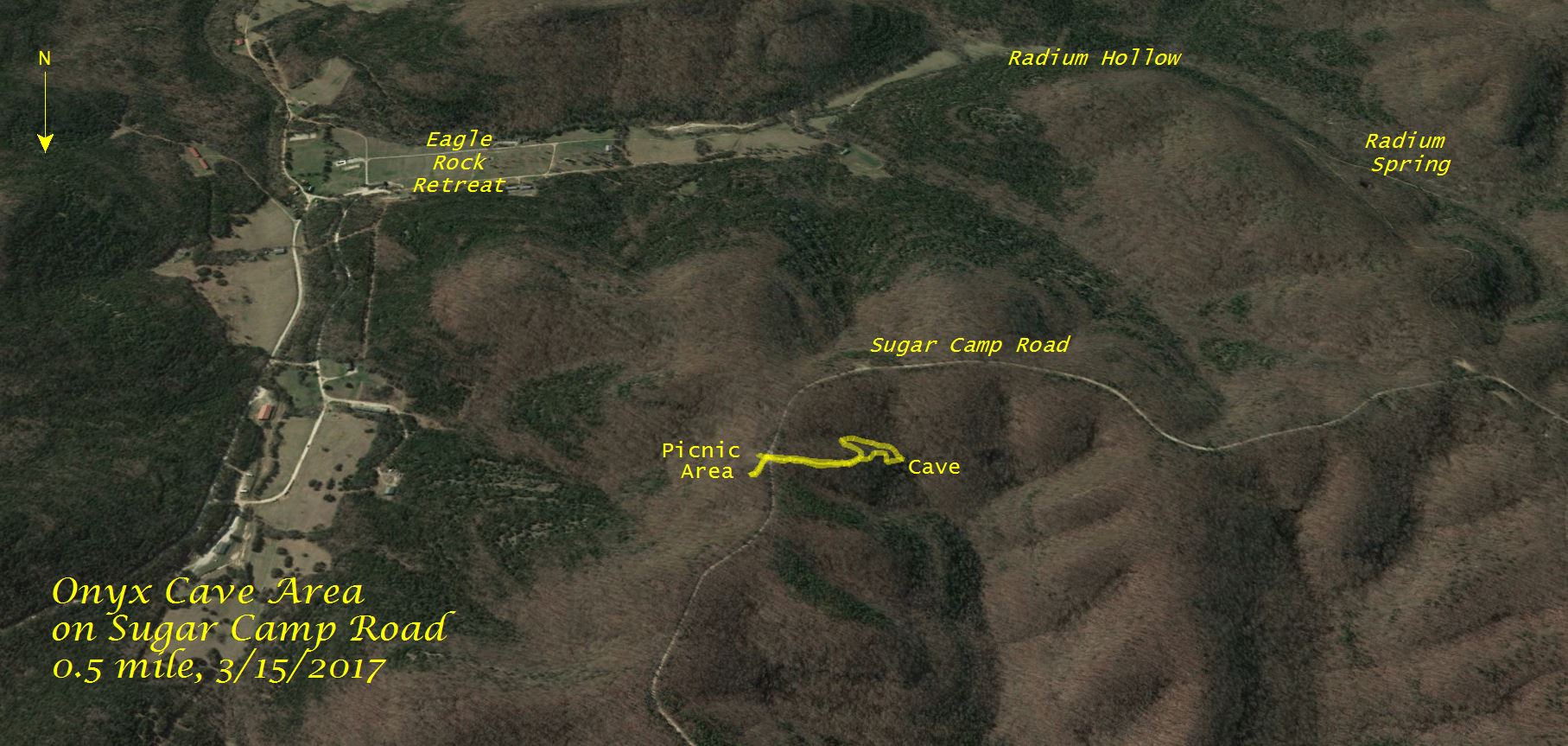
Wendy and I navigated the gravel roads along and up from Butler Hollow without incident, reaching the Onyx Cave picnic area in the late afternoon. It overlooks Radium Hollow, so named because its Radium Spring produces water with detectable radioactivity from particles it picks up in the Chattanooga Shale it flows over.

There is a very tall tale of the discovery of a radium cave in the area. Back in the 1920s Douglas Cloe is said to have bottled five-gallon jugs of the Radium Spring water for its supposed medicinal properties, and in 1950 a group reportedly surveyed the area with an eye toward uranium mining. None of that panned out, but below are photos I found online of the former radium mine and a concrete water tank nearby. Today the hollow to the east of the spring is the site of the Eagle Rock Retreat Christian camp.

Onyx Cave Trail Track

Onyx cave is sealed off

A trail leads down the west hillside from the Onyx picnic area on the Sugar Camp Byway to a blocked-off crawlway called Onyx Cave. It reportedly goes back into the hillside about 100 feet. Wendy and I hiked about half a mile at the site, searching the trail and surrounding hillside for pretty rocks. While she didn’t find any more geodes, Wendy the rockhound still had fun. I joined in the search but also slammed rocks together to break them open and observe their interiors, which were sometimes quite different in appearance from their exterior rind.

We didn’t find much; Wendy would acquire many more rocks with crystals the following day when we returned to Lake Leatherwood, with her hunting rocks in a creekbed while I hiked an overlook trail. That will be the subject of the next blog post.

Our scenic loop

Leaving Onyx Cave, we dropped north out of the forest via FR 2265 and 1162 to make our way across Roaring River and past Munsey Cemetery to reach Highway F. From there we made a dash through Roaring River State Park to Cassville for some supplies before returning to Sugar Ridge via state highways. The loop we ended up making vaguely resembled a north-pointing arrowhead.

It was a fun outing, and someday we might return and venture down the side road off the Sugar Camp Scenic Byway (visible in satellite imagery but not shown in road maps) to Radium Spring.

Posted in day hike, photos, travel | 6 Comments