Jayhawkers Part 1: To Lawrence

Once a year, go someplace you’ve never been before.

So advises the Dalia Lama, and I kept that in mind when planning a three-day outing during our Thanksgiving Break from work. I’ve learned that we do best on our work breaks when we bookend them with weekends at home, and for Thanksgiving Break we wanted to celebrate the holiday at home with my mother.

All that left Monday-Wednesday free, and on travel days, we prefer to only be on the road for five hours or less and that includes a break every half-hour or so for Wendy’s comfort and our mutual health. Familiar destinations satisfying those limitations include northwest Arkansas, the mountains of southeastern Oklahoma, Oklahoma City, Wichita, or Kansas City. We’ve also made jaunts to Sulphur, Hutchinson, and Springfield over the years, but Quartz Mountain really needs four days.
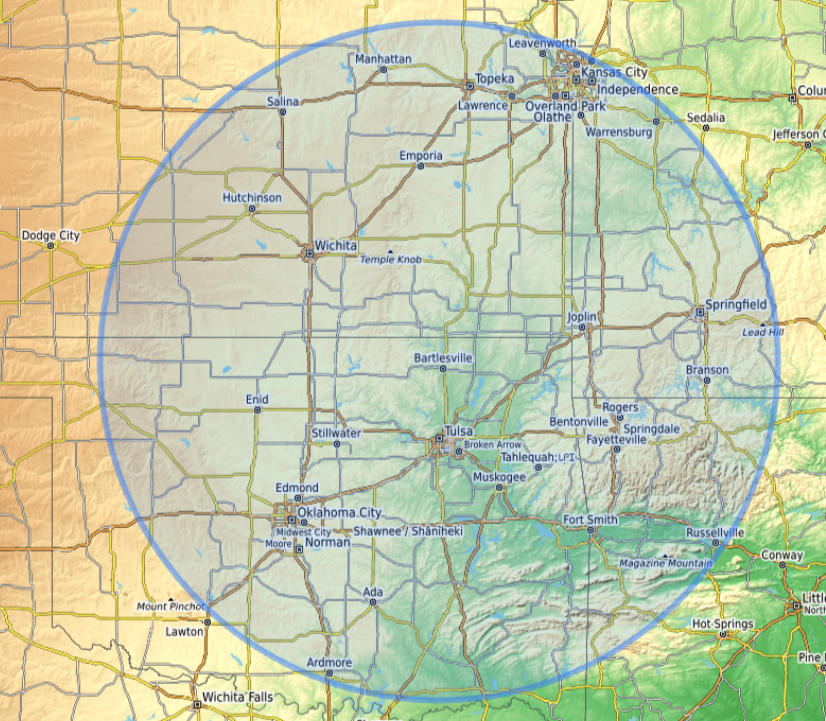
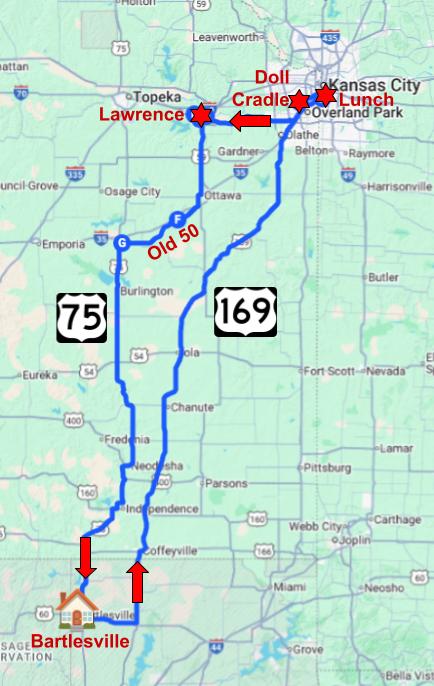
Our travel radius for a short trip

I prefer warmer weather and more leaves on the trees for a dayhike in the topography to the southeast, so I discounted those destinations for late autumn. Knowing Barbie-loving Wendy would appreciate the opportunity to revisit The Doll Cradle shop just west of Kansas City, I gave that some attention.

For decades I have enjoyed the changing exhibits at the splendid Union Station in Kansas City, but this year it has the cleverly titled Titanic: An Immersive Voyage, and Wendy and I already did the Titanic experience in Branson. So while I knew we would enjoy lunching at Country Club Plaza in KC and then we could stop in at The Doll Cradle, I wasn’t excited about following our usual practice of staying at the Marriott Courtyard. As it turns out, that hotel has now closed for a $31 million renovation and rebranding.

My eyes were tracing the route from Kansas City west to Shawnee, and farther west I spied Lawrence, less than an hour west of Kansas City along the Kansas River. What did I know about Lawrence?

So on Monday morning we headed east in Wendy’s minivan along US 60 to Nowata to then turn north and take US 169 up through Coffeyville and past Cherryvale and Chanute, then angling northeast from Garnett to Paola and then north to Olathe. From there we took Interstate 35 to the Shawnee Mission Parkway onto the Ward Parkway to arrive at the Country Club Plaza.

Traffic is steadily worsening in the various urban areas, with my alarm increasing over time at the recklessness of drivers in Tulsa, OKC, and KC, never mind the insanity in DFW. In Kansas City, which has some winding parkways given its age and topography, one vehicle sideswiped another just in front of us at one curvy interchange.

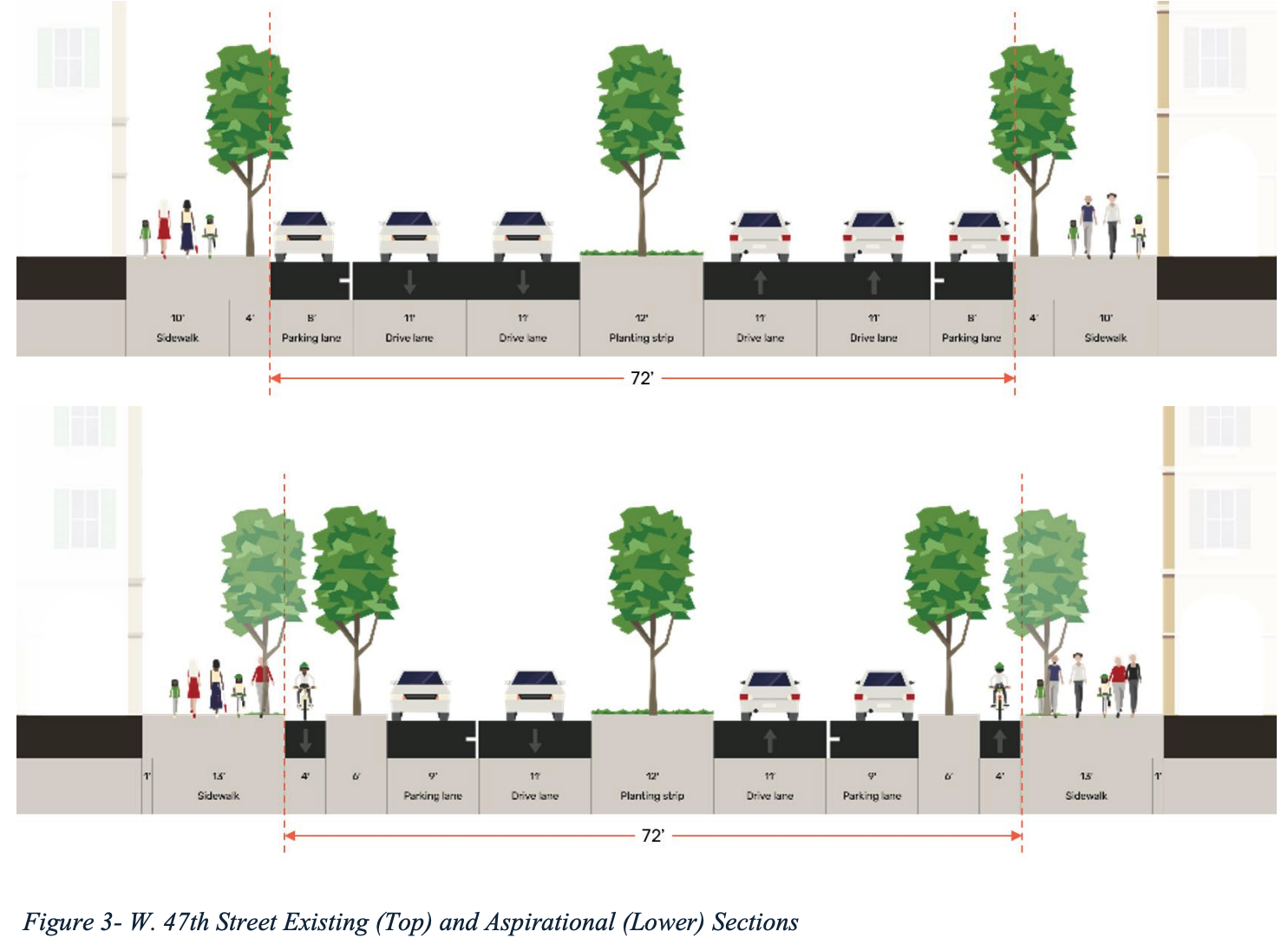
We made it to the parking garage intact, but the vehicular craziness is one reason Gillon Property Group, which acquired the Country Club Plaza in June 2024 for about $175 million, is proposing to reduce 47th Street from four driving to two driving lanes by adding bike lanes along with other traffic calming measures. It is also proposing closing some of the district’s internal streets to vehicular traffic.
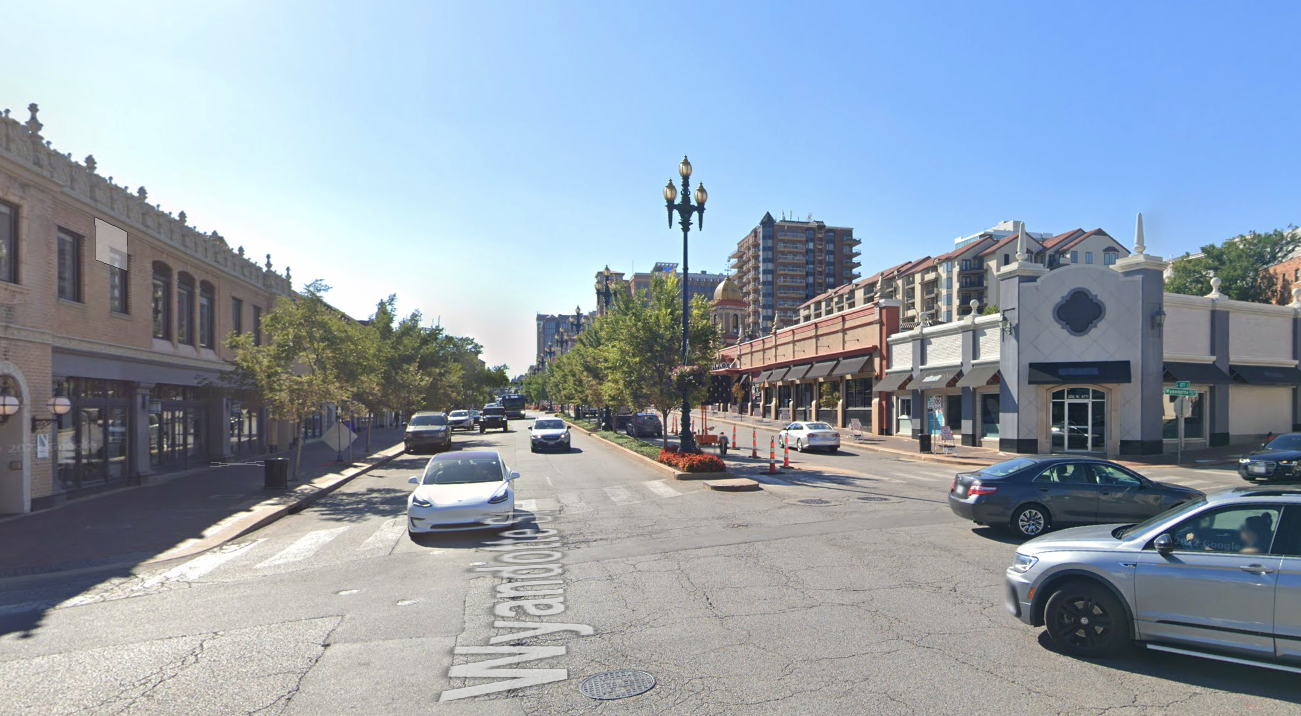
47th Street at Wyandotte Street in 2022
How 47th Street, through the heart of the Plaza shops, might change [Source]

I realize that barbecue is a big dining draw in Kansas City for many, but BBQ is not a favorite for me. We frequent three chain restaurants at the Plaza: McCormick & Schmick’s, Buca di Beppo, and The Cheesecake Factory, with the last one our choice for lunch this time. That might seem odd, given they have a Tulsa location, but in Tulsa we usually eat at El Chico or Kilkenny’s.

I parked the minivan in the free garage within the building that houses The Cheesecake Factory, and I had my usual lunch portion of Orange Chicken while Wendy had the Spicy Crispy Chicken Sandwich.

Our Cheesecake Factory lunch

We enjoyed our lunch, but the portions are such that we never have room for cheesecake. We just had enough time left to drive over to Shawnee and let Wendy shop at The Doll Cradle before it closed at 3 p.m.
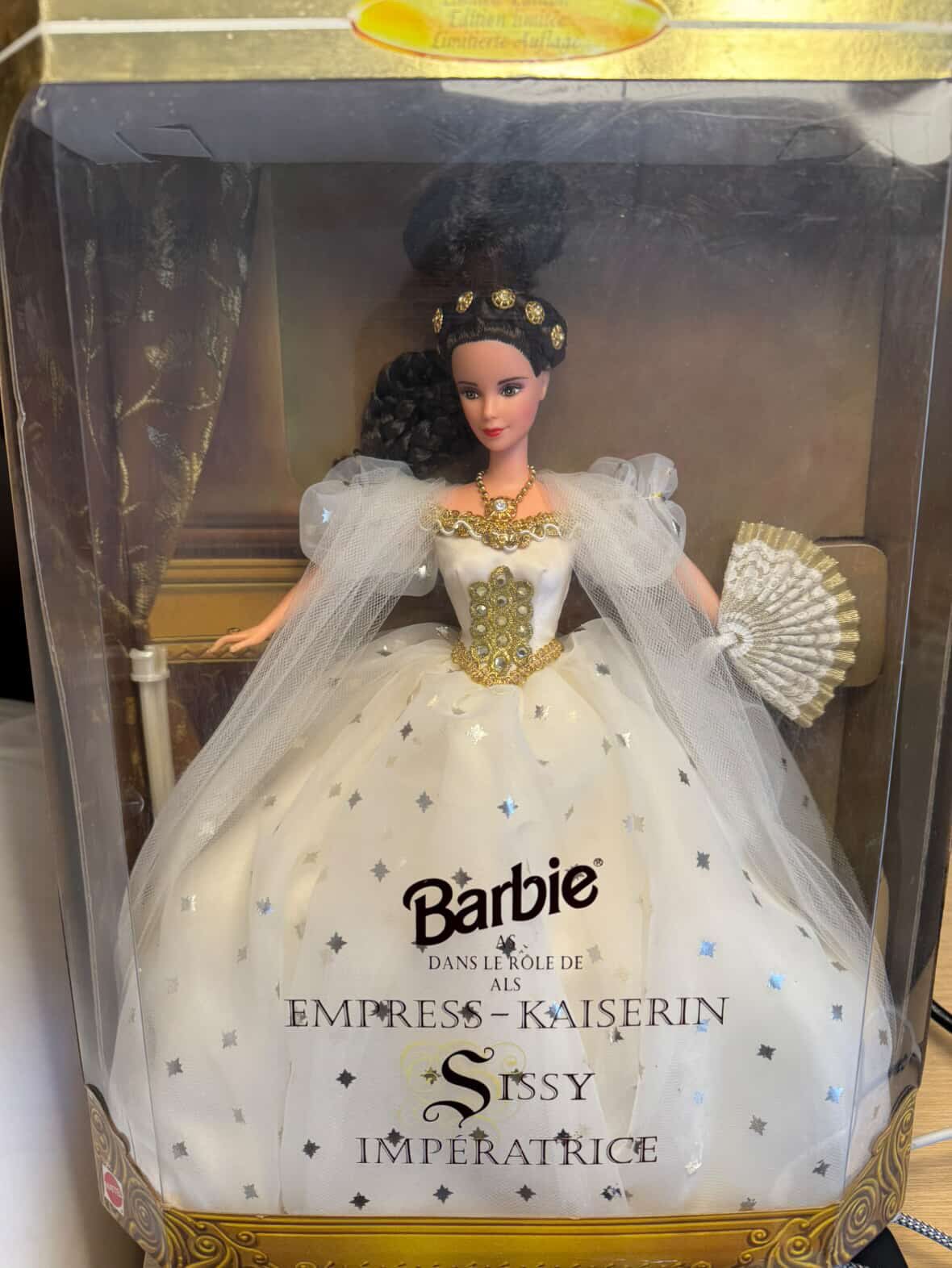

Wendy bought a couple of Barbies there, and I listened to a mother and daughter who came in about having a childhood favorite, a wellworn stuffed elephant, reworked by doll rescuer Connie Harrell. Our first visit to the shop was at Christmas in 2023, and I was relieved to note that the displays had changed, so the uncanny valley doll wasn’t around to unnerve me. Once Wendy had made her purchases, we proceeded southwest on Interstate 35 and then west on Kansas Highway 10 to Lawrence.

The Hogback Hilton
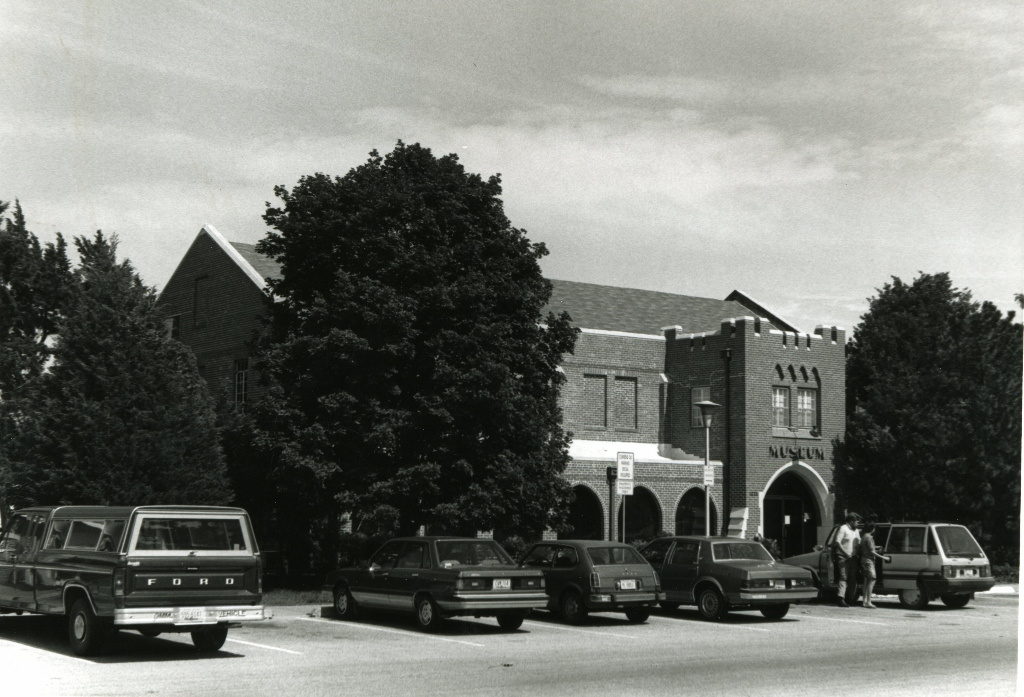
I was on several childhood field trips to the old Stovall Museum in Norman

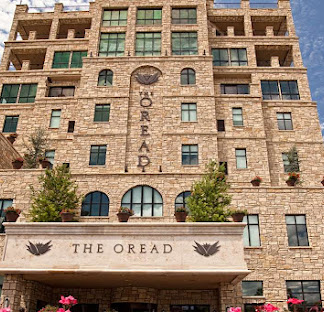
When researching hotels in Lawrence, The Oread, part of the Tapestry Collection by Hilton, caught my attention. It looked impressive, and from it we could easily walk south to the Spencer Museum of Art. The KU National History Museum was also just down the street, but many visits in childhood to the old Stovall Museum in Norman, and its much nicer successor, the Sam Noble Museum, along with various other natural history museums on our travels, made that less appealing to us.
It didn’t go well

The Oread is about eight stories at the front and ten in the back, with multi-story underground parking. It is constructed out of limestone, making it seem much older, but it was built in 2009. I booked a king condo room for two nights for a whopping $1,100. Jeepers, but surely that would mean a great experience. Well, ya don’t always get what ya pay fer.

We first drove north through Lawrence along Massachusetts Street all the way north to the Kansas River. I wanted to scope out the downtown shops and restaurants, figuring we would eat in that historic district during our stay. The drive was a pleasant one, with many Victorian homes painted in light pastels adorning the streets south of downtown. As we approached the unseen river, we turned west to climb Mount Oread to the hotel.

The Mount is a prominent hill that is the foundation for KU, named after the long-defunct Oread Institute women’s college in Massachusetts, founded by Eli Thayer. Lawrence was founded in 1854 by settlers from Massachusetts sent there by the New England Emigrant Aid Company, another creation of Eli Thayer, which transported anti-slavery immigrants into Kansas Territory in a bid to shift the political power there and lead it into becoming a free state rather than a slave state. We were in the heart of what was known as Bleeding Kansas from 1854 to 1859, and the home of the Jayhawkers:

Mount Oread’s earlier name was Hogback Hill, so I’ll say that we parked in the drive at the Hogback Hilton and walked into the lobby, where we were welcomed by an unpleasant sewer smell. The receptionist was nice, but the credit card machine went nuts, beeping continuously, so she had me try another one. Her comment that the reader had been malfunctioning of late wasn’t reassuring.

We were directed to park under the hotel, and that went fine, and we could tell we weren’t back home because multi-story underground garages in much of Oklahoma are a rarity given our high water tables. We found a bank of three elevators, but one was marked out of order, another as private, and the remaining one wouldn’t respond. A hotel worker emerged from a doorway, remarked that maybe a cleaning crew had jammed the elevator, and he took us up to our room on the private service elevator. Again, helpful workers, but another telltale sign of a hotel in trouble.

We got to our room on the sixth floor, with the sewer smell in the corridor thankfully not continuing on into the room. It had a living area with an aging rug, an attractive full kitchen, a bedroom, and a balcony. After stowing our luggage, I ventured out on the balcony in the cold and windy weather, admiring the view of the old courthouse to the east.

Douglas County Courthouse
Our balcony had a nice view

We tried to connect to the Wi-Fi, amused to see SSIDs from nearby apartments that had a distinctly collegiate flavor. We opted not to try connecting to ItStingsWhenIP, (*)(*), or SwampAss.

Wendy needed ice, but we found that the icemaker in the big stainless steel refrigerator was frozen. Then a search of the many cabinets and multiple drawers showed them to be devoid of anything save for a few plates and glasses. No cookware or utensils, rendering the kitchen quite useless. What in the world? Did the management just decide it wasn’t worth keeping their rooms up to snuff? Does the hotel only have its act together when the Jayhawks are playing at the big football stadium a block away or Rock Chalk, Jayhawk is echoing in the Allen Fieldhouse?

Oread King Condo
All outward appearance: this kitchen was not usable

I took the ice bucket and went to look for an ice machine. A corridor sign said ice was only available on floors two and four. The two regular elevators were still out of service, so I presumed the worker’s guess that a cleaning crew was holding one up was wrong. I called the service elevator, only to find upon entering that it had no buttons for floors two or four. I guess it is just intended to service the lobby, kitchen, garage, and the supposedly fancy rooms on the top floors.

So I punched for the lobby and upon exiting the friendly receptionist was passing. I asked about ice, and she said she could get some for me in the kitchen. She took my bucket and soon reappeared with the ice, then headed back to the front desk. I turned to call the service elevator…and there was no call button for it in the lobby. There was no way to get to our room save climbing five flights of stairs.

I went to the front desk, explained the issue, and the receptionist said she would call the service elevator for me from the kitchen side, it having doors on one side for the lobby and on the other for the kitchen. That worked, but when I got back to floor six and made my way through the sewer smell to our room, my mind was made up.

I began searching for other Lawrence hotels, and the TownePlace Suites by Marriott beckoned. I booked a two-bedroom suite for less than half the price of our smaller king condo at The Oread. We packed up, took the service elevator to the garage, and never looked back.

I could have gone to the receptionist and canceled our reservation, demanding a refund. That would make perfect sense to many folks, but that’s just not for me. I’m at the point in my life where I value peace over confrontation, with three different blood pressure medications coursing through my hardening arteries. I’ve learned to just let it go when plans change too late for me to change a reservation or when a hotel turns out to be a dysfunctional mess. I make new arrangements and move on with minimal fuss, having already made the conscious and admittedly privileged choice to absorb a loss without stressing about it.

TownePlace Suites

TownePlace Suites by Marriott
The TownePlace Suites by Marriott were superb
TownePlace Suites Courtyard
Our view was of the back courtyard

We drove a few blocks to the TownePlace Suites by Marriott. We parked by the entry and walked into another lobby, but there were no smells and no malfunctioning technology. There was another underground garage, but also working elevators that whisked us up to a nice spacious suite strategically situated to prevent us from hearing any noises throughout our stay, save for routine housekeeping. We had an ice machine on our floor and a view down into a back courtyard.

The only flaw was that the Wi-Fi never recognized us when given our last name and room number. We could have contacted the front desk for a fix, but the cellular service for our iPhones was adequate enough for us to make do, using them as hotspots for our iPads.

A Mistake on Mass Street

It was time for dinner, and we were only a block from “Mass Street” with various options. I chose poorly on that cold, rainy night, however, leading us to the Fat Shack.

I’d seen online that they had simple fare like chicken fingers, mozzarella sticks, and French fries. Easy enough, and we didn’t need anything elaborate after our nice lunch. What I did not realize, however, was that they throw everything you order into a bun and wrap it up tight.

What in tarnation?

That’s right…our meals came out as tightly wrapped sandwiches, and we were shocked to peel off the wrapping and discover our items all smashed together. If I had seen a photo of the Fat Bronco™ showing me it was a sandwich instead of a combination plate, I would have exited without ordering.

I dissected my sandwich, eating various ingredients, chuckling at the situation. Our meals were meant for Gen-Z college brats, not middle-aged Gen-X tourists. We picked away for awhile and then dumped the rest, venturing back out on quiet Mass Street to return to the hotel.

I felt good about the timing of our trip, having correctly surmised that Lawrence and Mass Street would be relatively serene, with most students already gone for Thanksgiving. It was quite easy to walk or drive anywhere, with few waits, and everyone we encountered was friendly and helpful and seemed grateful to have some customers.

Our trip was off to a mixed start, but the next day would bring a couple of splendid museums. You’ll be able to read about those in subsequent posts.

Jawhawkers Part 2: The Spencer >

Posted in photos, travel, video | Leave a comment

Resisting AI Slop & Brainrot

Long vacations are opportunities to engage in brainrot content, especially when the weather outside is frightful. I find myself having to consciously avoid compulsive, nonsensical, low-quality content that corrodes my mental or intellectual state, including doomscrolling political outrage.

A more recent threat is AI slop, digital content made with generative artificial intelligence that shows a lack of effort, quality, or deeper meaning, and is often associated with an overwhelming volume of production.

Both are commonplace on Facebook and YouTube, and I know they also afflict services I do not frequent, such as TikTok, Instagram, and X. In late 2025, a report from the video editing firm Kapwing found that on a new YouTube account about 1/5 of the first 500 videos in the feed were AI-generated, and 1/3 of the first 500 videos were brainrot.

[Source]

In mid-summer 2025, The Guardian reported that 9 of the 100 fastest growing YouTube channels were only showing AI-generated content. I noticed the trend a few months ago when a channel was showing up in my feed that, at first glance, appeared to be decent-quality long-form content. While the narration did use inflections and avoided the worst mispronunciations, after a few minutes I could tell it was a good AI. I also realized that the videos relied on stock footage and AI animations, and the scripts inevitably became long-winded and repetitive. A check revealed that channel was posting such videos twice per day, a clear sign of AI slop.

Some AI content, in moderation, amuses me, such as There I Ruined It. I also recognize some folks enjoy the escapism and distractions of short-form content. However, my preference is human-created longer-form videos that required some research, such as the varied interests of Phil Edwards or, for the truly stoic, Fall of Civilizations. The latter’s latest video on Persia is 5.5 hours long.

Thus I choose to avoid TikTok and X, as I once shunned Vine and Twitter, and there were years in which I subscribed to The New Yorker and used Longreads for long-form articles. Nowadays I use Apple News, and its News+ service has a My Magazines option where I can seek out long-form articles.

Subscriptions

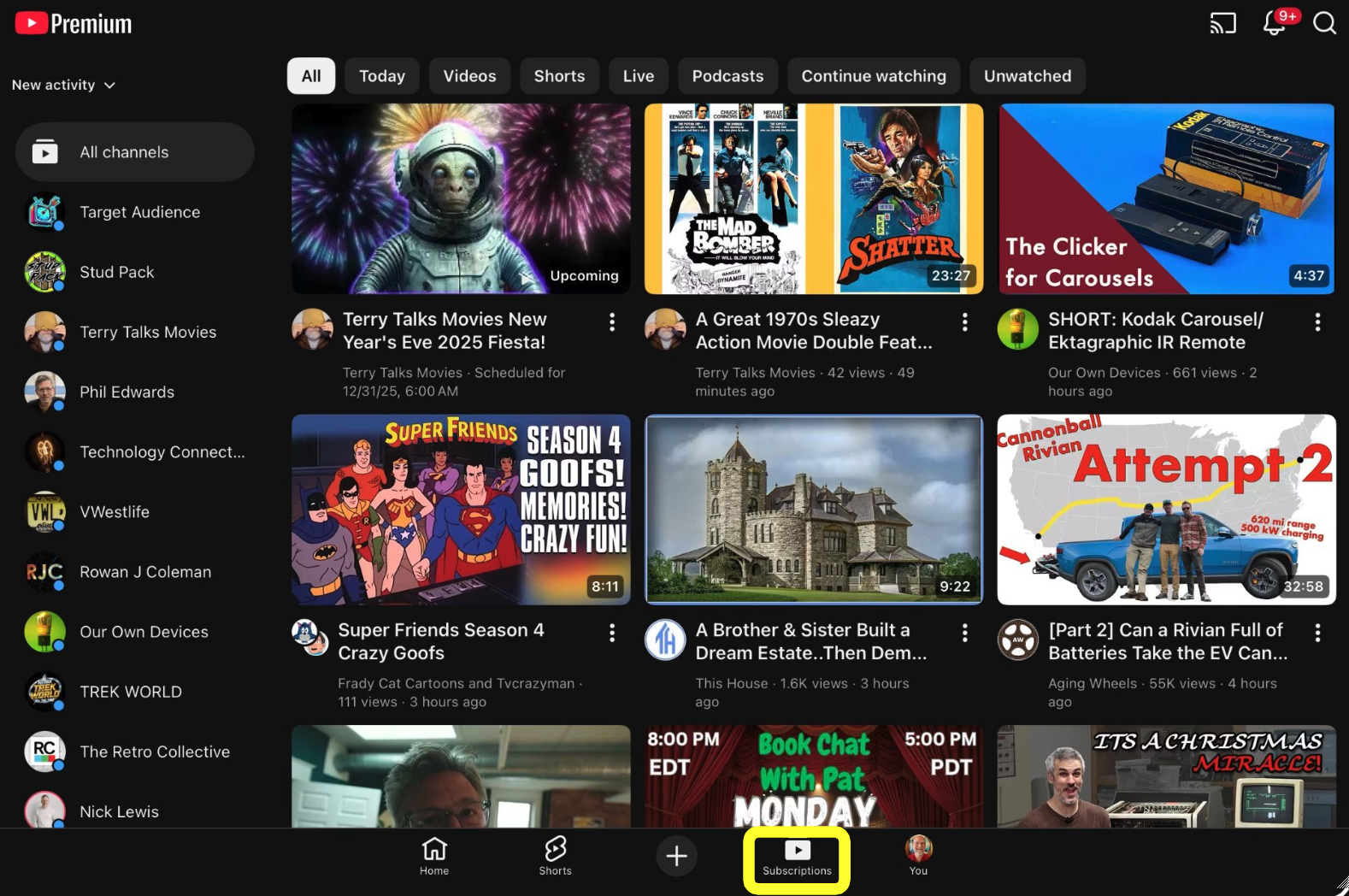
I combat slop on YouTube by relying heavily on subscriptions in which I have manually subscribed to channels I like. I hit the Subscriptions icon in the app to only see videos from my subscribed channels, and there is a control to sort the entries by Most relevant, New activity, or A-Z.

I rely on YouTube’s Subscriptions feature to curate my feed

If I find myself doomscrolling on YouTube’s Home page, let alone refreshing it to see fresh options, I know it is past time for me to put down the iPad and do something else. If I can’t go for a walk, then I need to read a physical or electronic book…or go compose a blog post. 😉

If I ever wanted to kill my YouTube addiction, the surefire cure would be to cancel my YouTube Premium family plan subscription, which for $23 per month eliminates its pre-roll, mid-roll, and other standard advertising for Wendy and me. Mind you, that doesn’t eliminate the embedded ads that many creators are paid to personally host within their videos, but I can fast-forward through those easily enough.

YouTube’s algorithm is going through one of its periodic cycles of change, with many creators reeling from dramatic drops in views, which hurts not only their Google AdSense revenue, but also their ability to get third-party sponsors. Several creators are buoyed by Patreon subscribers, and I have been supporting various channels via that service since 2016. As of this writing, I’m suppporting Bookpilled, Dime Store Adventures, Oddity Odysseys, Phil Edwards, Target Audience, Techmoan, and Terry Frost. If you do provide financial support to a creator on Patreon, try to remember to do that via the web interface, not via the Patreon iOS app, since Apple tacks on a 30% charge.

Friends

Over on Facebook, there is a Friends icon that only shows updates from your Facebook friends (along with the ever-present advertising).

Use Friends on Facebook

I also curate my Facebook feed, unfollowing friends whose posts annoy me, using the Snooze and Hide options, and so forth. Facebook tends to notice my personal vices and feed them via its embedded Reels. I have learned to hit the vertical ellipsis ⋮ and select Hide reel on one after another of those Reels to train it to only show me innocuous cat videos. However, Facebook keeps trying, examining ad tracking and cookies to offer up fresh Reels on occasion to tempt me to engage. When I slip up and watch one, that poisons my feed until I do several rounds of ⋮ > Hide reel on anything that isn’t another silly cat.

Best wishes on combatting brainrot and AI slop in your online accounts. The battle against fake slop is quite real.

Posted in technology, video | Leave a comment

2025 Book Report

The approaching end of the calendar year led me to compose my fourth annual book report.

You can see more details at LibraryThing or Goodreads

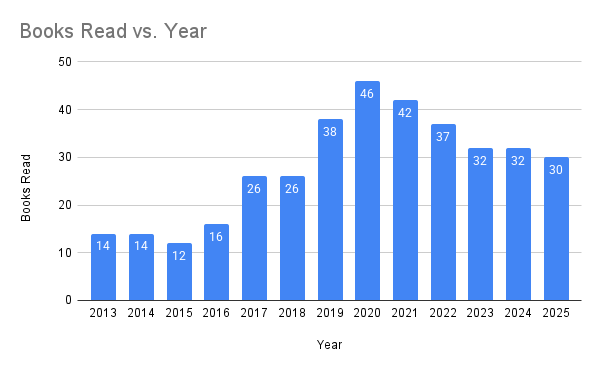
I read 30 books this year, the total reduced a bit by my autumn and winter walks having been impeded by lousy weather on several weekends. It took me about 1/3 of the year to finish my latest audiobook.

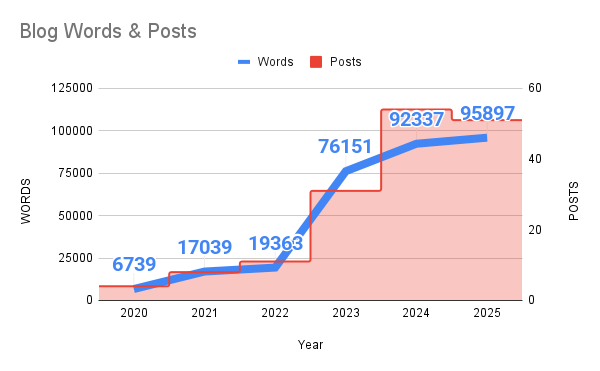
My reading in recent years has also been impacted by my writing, as I have ramped way up from a low of only four blog posts in 2020, thanks to the pandemic, to about one per week, raising my total word count in each of the past three years to novel levels…pun intended.

The dramatic increase in my posts and word count in recent years impacts my reading

The two pursuits can complement each other, however. I wrote a dozen book reviews this year. Admittedly, my individual book reviews garner very little engagement, but I enjoy reading others’ old book reviews on the web, and researching and reflecting on a book to write about it enriches the reading experience for me.

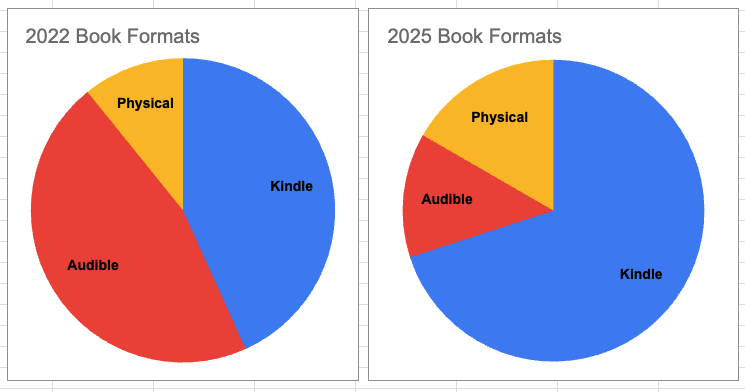
I hadn’t tallied the formats of my reads since 2022, and I discovered that audiobooks were only 13% of the titles in 2025, while back in 2022 Audible and Kindle each accounted for over 40% of the completed titles.

Award-Winning Lit-Rah-Chur

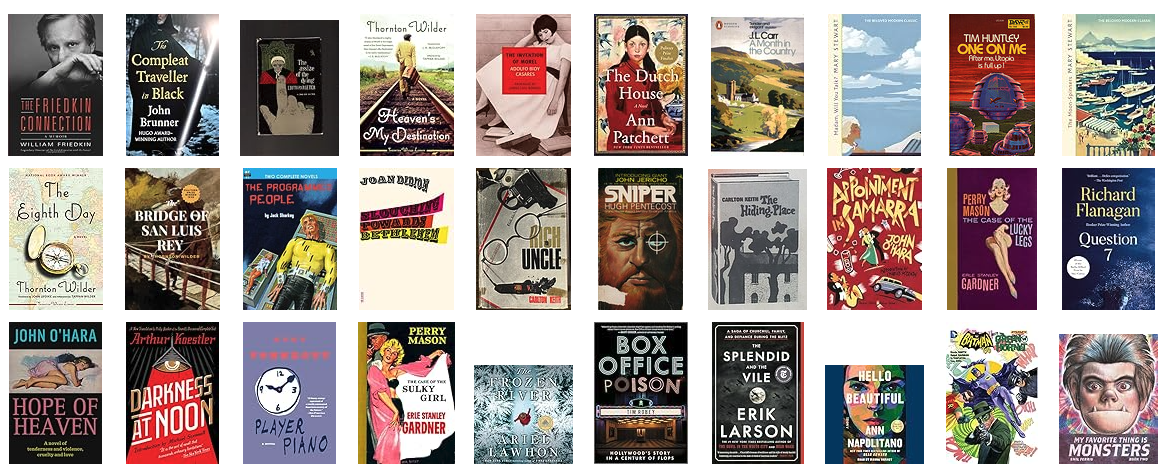
This year I deliberately read more “literature” than in the past, including three novels by Thornton Wilder: The Bridge of San Luis Rey, The Eighth Day, and Heaven’s My Destination. I also read John O’Hara’s Hope of Heaven and his better Appointment in Samarra, along with the disturbing but justifiably lauded Darkness at Noon by Arthur Koestler. More modern award-winning works were Ann Napolitano’s Hello Beautiful, J.L. Carr’s A Month in the Country, Richard Flanagan’s Question 7, and Ann Patchett’s The Dutch House.

Mysteries

Not recommended

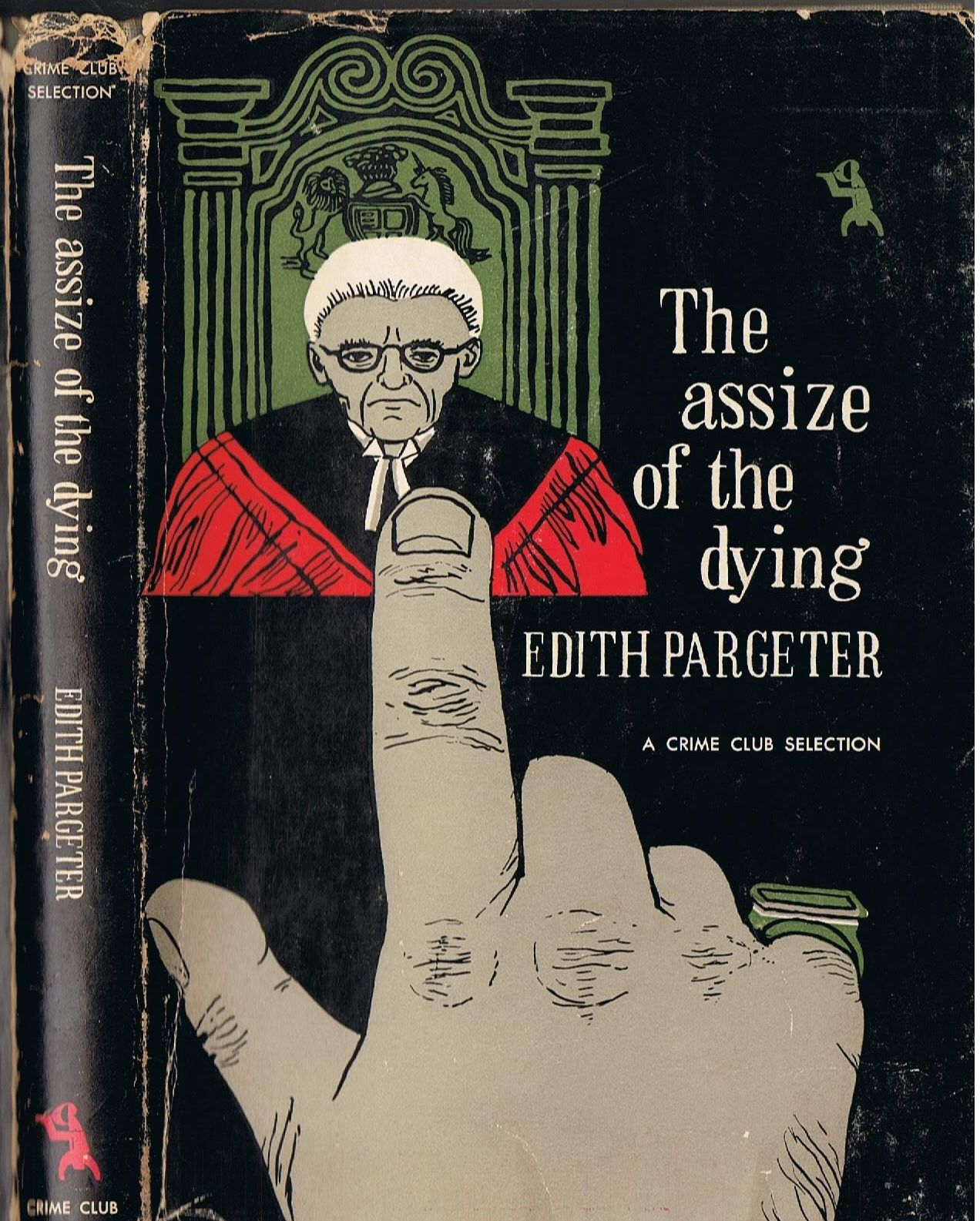
I am a bit surprised to find that I read very little of Edith Pargeter this year, having read about three dozen of her mysteries over the years, including 12 of the 13 George Felse and Family novels from 1951-1978 and all 21 of the Cadfael Chronicles published from 1977 to 1994. I have read several of her standalones, and some were quite good, but this year I only read a novella from 1958, The Assize of the Dying, and while its language could be elegant, the plot was beyond belief and the villain had far too little character development. I think I have about a half-dozen of her mysteries still to go, plus a couple dozen other works in other genres I could explore.

Back in 2024 I read the first of the 57 Perry Mason novels, along with a biography of author Erle Stanley Gardner. This year I read the second and third entries in that series. While I was glad to find none of them centered on the courtroom, unlike my recollection of the old television series starring Raymond Burr, the hard-boiled nature of the works and heavy emphasis on plot wore thin for me. I much prefer Christie (whom I’ve exhausted) or Pargeter, so I’ll be giving Gardner a rest.

This was my favorite of the Jeff Smith series thus far

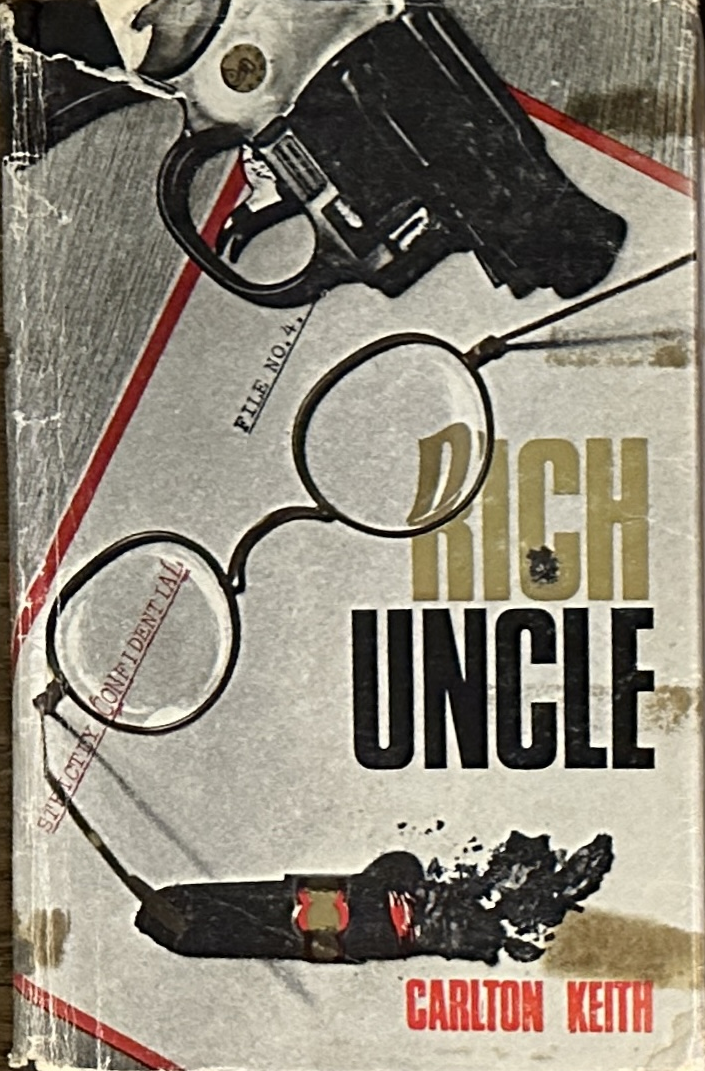
I enjoyed a couple of Carlton Keith mysteries, actually written by Keith Robertson. Rich Uncle was the third of his five Jeff Smith tales, and my favorite thus far. I wouldn’t be surprised if I read another in 2026. They are all long out of print and lack Kindle versions, but I rounded up used copies from across the world back in 2020.

A good ‘un

A very different mystery, and the most memorable of the year, was The Frozen River by Ariel Lawhon, a historical fiction novel set in the long winter from November 1789 to April 1790. It was inspired by the true story of Martha Ballard, an 18th-century midwife in Maine, who kept a detailed diary. The various characters and the setting mattered far more than the mechanics of the plot, and the book left me interested in taking up her The Wife, The Maid, and The Mistress and sampling Code Name Hélène. It isn’t easy to get me to read about old New England, having been traumatized in high school by Hawthorne’s The Scarlet Letter and The House of the Seven Gables, so congratulations to Ms. Lawhon on breaking through the ice.

One mystery for this year is why I never got around to listening to Richard Osman’s fourth installment of the wonderful Thursday Murder Club audiobooks. The solution is that I’ve held onto that treat, waiting for a bad audiobook to put me in need of a sure-fire winner, and I haven’t been out walking as much. It took me months to finish the 19 hours and 20 minutes of film director William Friedkin’s splendid self-narrated memoir The Friedkin Connection, but thank goodness I wasn’t stretching out a mystery for that long.

This year I also read two of Mary Stewart’s romance suspense stories: The Moon-Spinners and Madam, Will You Talk? They were light and fun, with splendid foreign settings, and I look forward to a baker’s dozen of remaining books of that sort which she authored from 1956 to 1997. They strike me as near-perfect escape novels for when I’m out on a patio swing.

Science Fiction & Fantasy

I listened to Kurt Vonnegut’s 1952 debut novel, Player Piano. It was dystopian, odd, but entertaining. He was clearly influenced by Huxley’s Brave New World and Orwell’s 1984, drawing upon his work in General Electric’s public relations department when he interviewed scientists and engineers about their innovations. I need to read more Vonnegut.

The Programmed People by Jack Sharkey was pure pulp, and not in a good way, while Tim Huntley’s obscure One on Me was much better. I also read La invención de Morel, written in 1940 by the Argentine author Adolfo Bioy Casares, and I’ve scheduled a post on that as part of a series of related weekly posts in March 2026.

Formulaic

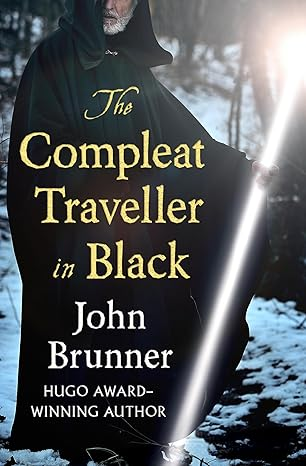
I read little fantasy, but given my increasing sci-fi skepticism, I decided to try five related fantasy stories by John Brunner, a prolific genre author who had a run of spectacular science fiction novels from 1968 to 1975: Stand on Zanzibar, The Jagged Orbit, The Sheep Look Up, and The Shockwave Rider. Over twenty years, starting in 1960, Brunner wrote five short stories about The Traveller in Black, who periodically journeys across a landscape, countering chaos by answering the spoken wishes of people around him, always with consequences they did not foresee. All five stories were collected in 1986’s The Compleat Traveller in Black.

I enjoyed his skill at creating an unsettling mood and a sense of a distant time through his prose. His use of archaic terms and phrases reminded me of Gene Wolfe’s Book of the New Sun series. An example is when he encouters Lorega, a beautiful woman, beside the river Metamorphia, which changes anything that enters it. She urges the Traveller to join her in swimming in the river, as while she is beautiful, she lacks sense, and hopes a swim might change that.

“I shall not. And it would be well for you to think on this, Lorega of Acromel: that if you are without sense, your intention to bathe in Metamorphia is also without sense.”

“That is too deep for me,” said Lorega unhappily, and a tear stole down her satiny cheek. “I cannot reason as wise persons do. Therefore let my nature be changed!”

“As you wish, so be it,” said the traveller in a heavy tone, and motioned with his staff. A great lump of the bank detached itself and slumped into the water. Its monstrous splashing doused Lorega, head to foot, and she underwent, as did the earth of the bank the moment it broke the surface, changes.

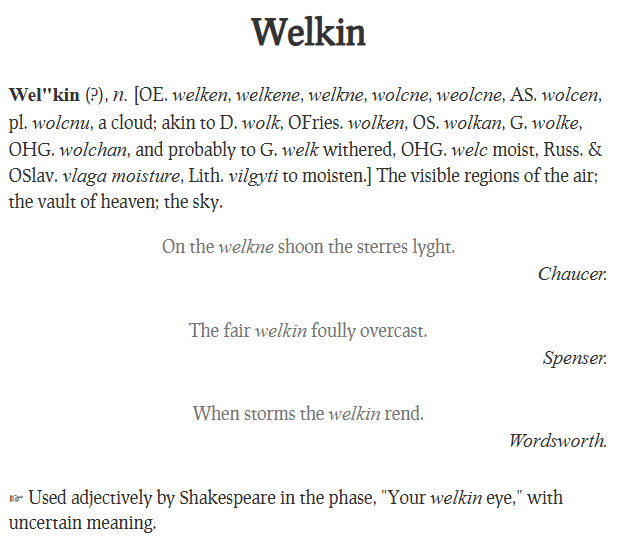
Thoughtfully and a mite sadly, the traveller turned to continue his journey towards Acromel. Behind him the welkin rang with the miserable cries of what had been Lorega. But he was bound by certain laws. He did not look back.

The welkin? Webster’s 1913 explained:

Each story in the collection is a more elaborate variation on the theme. Spread across a couple of decades in various magazines, the tales likely held up, and I am glad that Bruner took the opportunity to make his fifth and final story in the series a finale. However, when collected together they became too formulaic and wore out their welkin.

Nonfiction

Well worth a listen

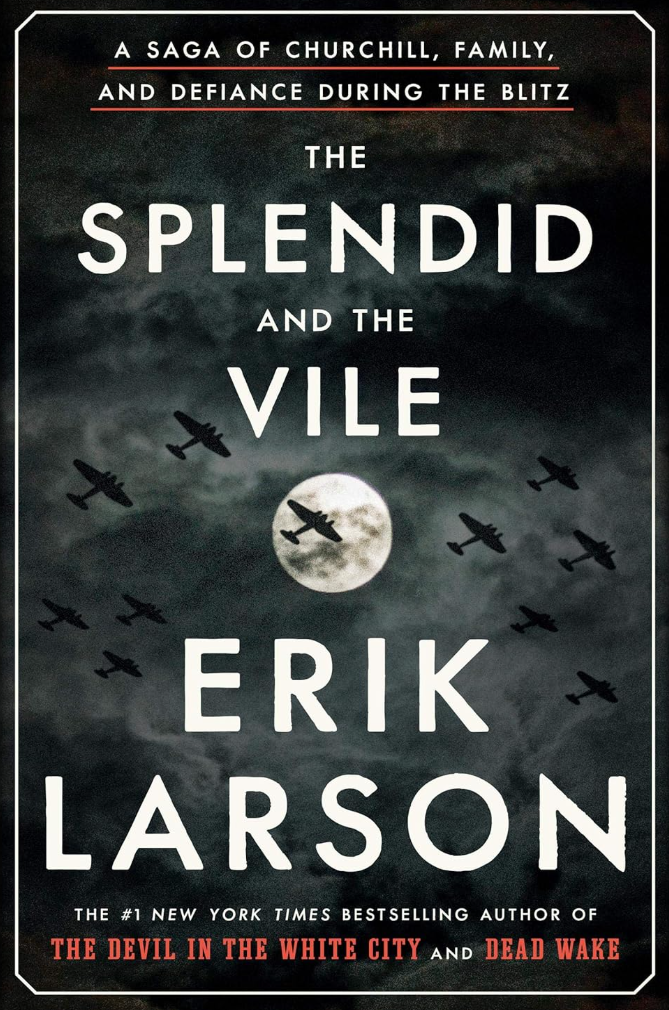
Almost 90% of my reading was fiction this year, a marked change given that from 2007 to 2022 over 40% of my reading was nonfiction. This year’s nonfiction consisted of Joan Didion’s essays in Slouching Towards Bethlehem, Tim Robey’s roll call of cinematic disasters in Box Office Poison, the aforementioned Friedkin Connection memoir, and Erik Larson’s fascinating portrait of Winston Churchill during the Blitz in The Splendid and the Vile.

What a contrast that last saga was to our era of politics. Churchill was an egocentric and eccentric mess, but he saved democracy in Europe with his unwavering wartime leadership against fascism.

I did begin another non-fiction book late in 2025, but I don’t expect to be able to tally it as a finished read until after the new year. It is out of print without a Kindle edition, but I bought the 1999 second edition of Good Vibrations by Mark Cunningham five years ago, and I’m finally getting around to it. Thus far it is quite good.

Posted in books | Leave a comment

A Return to Meador Manor

Back in 1982, my first personal computer was equipped with a 300 baud modem, and I was a high school student who was also a subscriber to the online services CompuServe and Dow Jones News/Retrieval. I also discovered bulletin board systems, regularly dialing into the Milliways BBS in Oklahoma City, which took its theme from the Douglas Adams science fiction comedy installment The Restaurant at the End of the Universe. Tech nerds were geeks in multiple realms.

In junior high, I had enjoyed the book series Alfred Hitchcock & The Three Investigators, and I gradually discovered some of his films on late night television, including Psycho. So, when I decided to start my own BBS, I chose that as a theme. The Bates Motel BBS was filled with silliness such as the menu option to log off the system being labeled Take a shower.

Given my age, that was appropriately juvenile. In college, my friend Sam subscribed to Byte magazine, which introduced me to Jerry Pournelle’s fantastic column, Computing at Chaos Manor. That influenced me to rename my BBS Micro Manor when it became part of the FidoNet dialup network that predated the world wide web. When I moved to Bartlesville in 1989, the Micro Manor BBS came with me.

Meador Manor in the early days of the World Wide Web

In 1995, the dot-com bubble inflated the World Wide Web, and Meador Manor was born on CompuServe a year later. I purchased the MEADOR.ORG top-level domain back in 2000, and Meador Manor shifted from being hosted on CompuServe to Southwestern Bell and then on to CableOne.

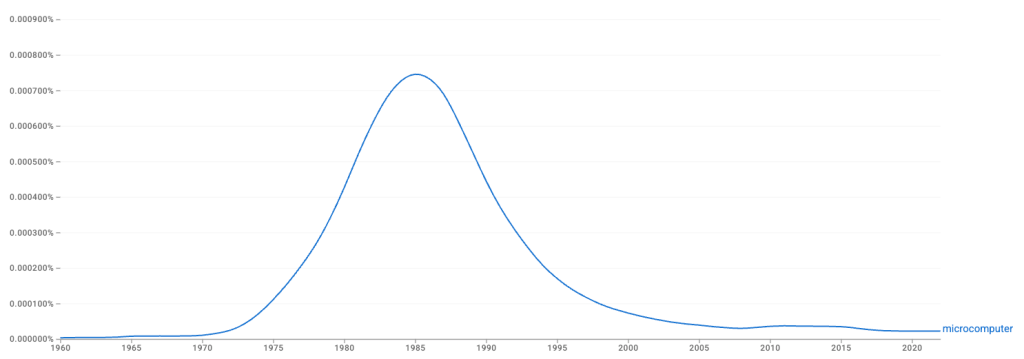
It is just as well that I dropped the Micro Manor name, since the popularity of the term “microcomputers” pretty much followed a bell curve that peaked in 1985.

Google Books Ngram Viewer shows how “microcomputer” peaked way back in 1985

In October 2006, I caved and finally “got a Facebook” but back then most people still found my website through web searches. In 2007, I renamed Meador Manor to MEADOR.ORG so that viewers would more clearly associate the blog with its domain.

Hardly a manor, but it’s paid for!

With Meador Manor no longer referring to my website, I instead used the moniker for my humble abode in Arrowhead Acres. I still enjoyed the alliteration, and it amused me to attach a grandiose name to a house which is smaller than today’s median home size and less than 3/4 of the size of the average new home in 2025.

In 2008, I finally gave up on hand-coding the blog in HTML, and MEADOR.ORG shifted to the Blogger service and a few months later to WordPress, where it has remained ever since. I started with the Garland WordPress theme, switched to Enterprise in 2010, Choco in 2011, and finally Twenty ten in 2016. I’ve stuck with that theme for a decade, and I still prefer it. So I’ve only done some minor tweaks to its menu layouts, sidebar widgets, fonts, and background colors.

The first part of 2026 will be a transition as I draw to a close my 37 years of employment with Bartlesville Public Schools. I will officially retire at the end of June, a day before Wendy and I celebrate our tenth wedding anniversary, and my little spot in the World Wide Web will be 30 years old.

Over half of my blog’s traffic is long tail items discovered via search engines, and around 1/10 of it is driven via Facebook. I never found Twitter or X to my taste, so it drives very little traffic, and I am not active on other social media platforms. Needless to say, driving more traffic to this blog is not a priority. Thus I don’t think having MEADOR.ORG as the title is important, so I’ve decided to return to calling it Meador Manor. I asked the house if that was okay, and it didn’t raise any objections.

So welcome back, in a sense, to Meador Manor. It is still at MEADOR.ORG but you can also surf here via MEADORMANOR.COM or MEADORMANOR.ORG.

Posted in technology, web design | Leave a comment

Avoiding the Nostalgia Trap

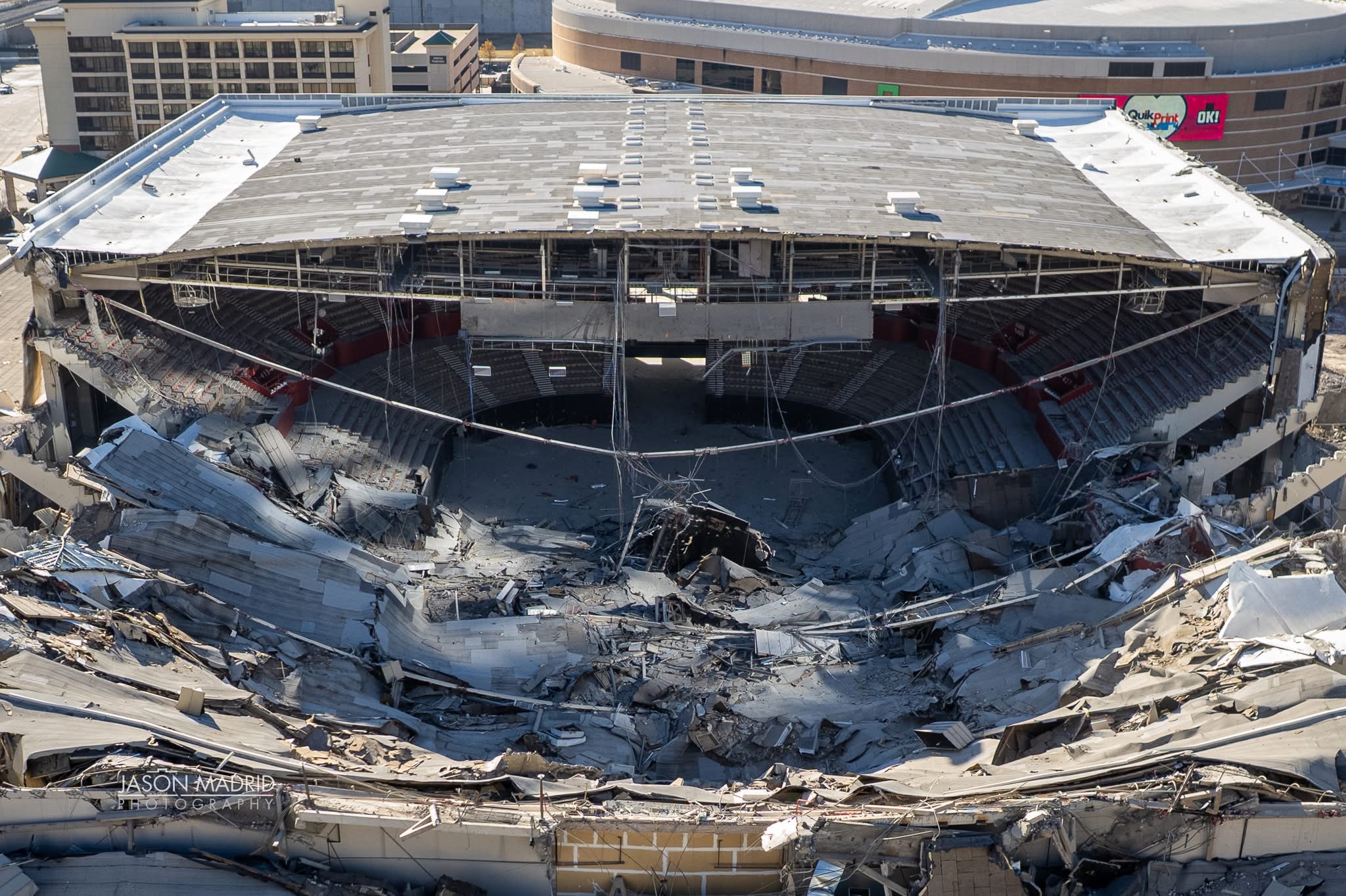
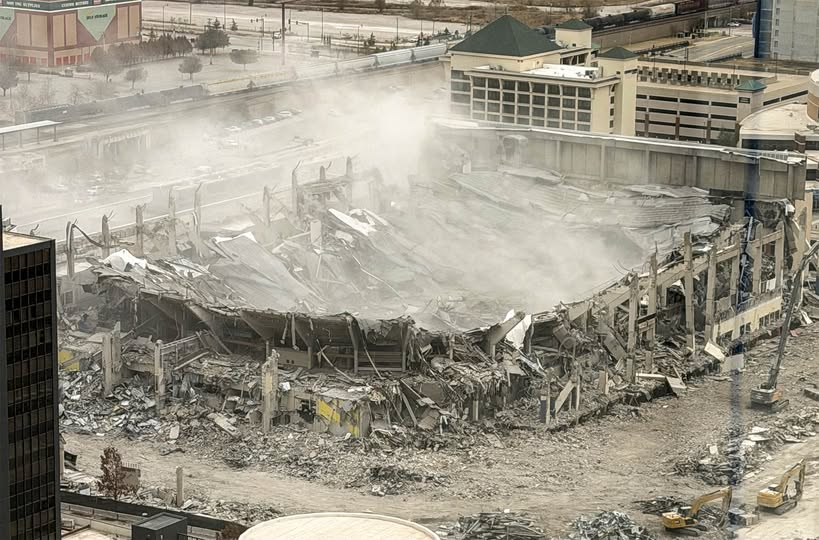
This week they really got going on destroying the old convention center in Oklahoma City. There was a dramatic photograph showing the arena bowl half destroyed, and then they brought the remaining roof down.

The Myriad is coming down [Source]

At the start of 2025, I wrote about the history of that huge facility, which was constructed from 1969-1972. It hosted my junior and senior proms and I gave a speech in it at my high school graduation. I also attended multiple conferences there over the years. The old Myriad is a few years younger than I am, but its time is up.

I’ll confess that it hurt a bit to see the former Allen Morgan Street Memorial Myriad Convention Center destroyed, despite its various shortcomings and obvious obsolescence. The pang I felt reminded me of a similar issue facing Bartlesville when I arrived here in 1989.

My Childhood Library

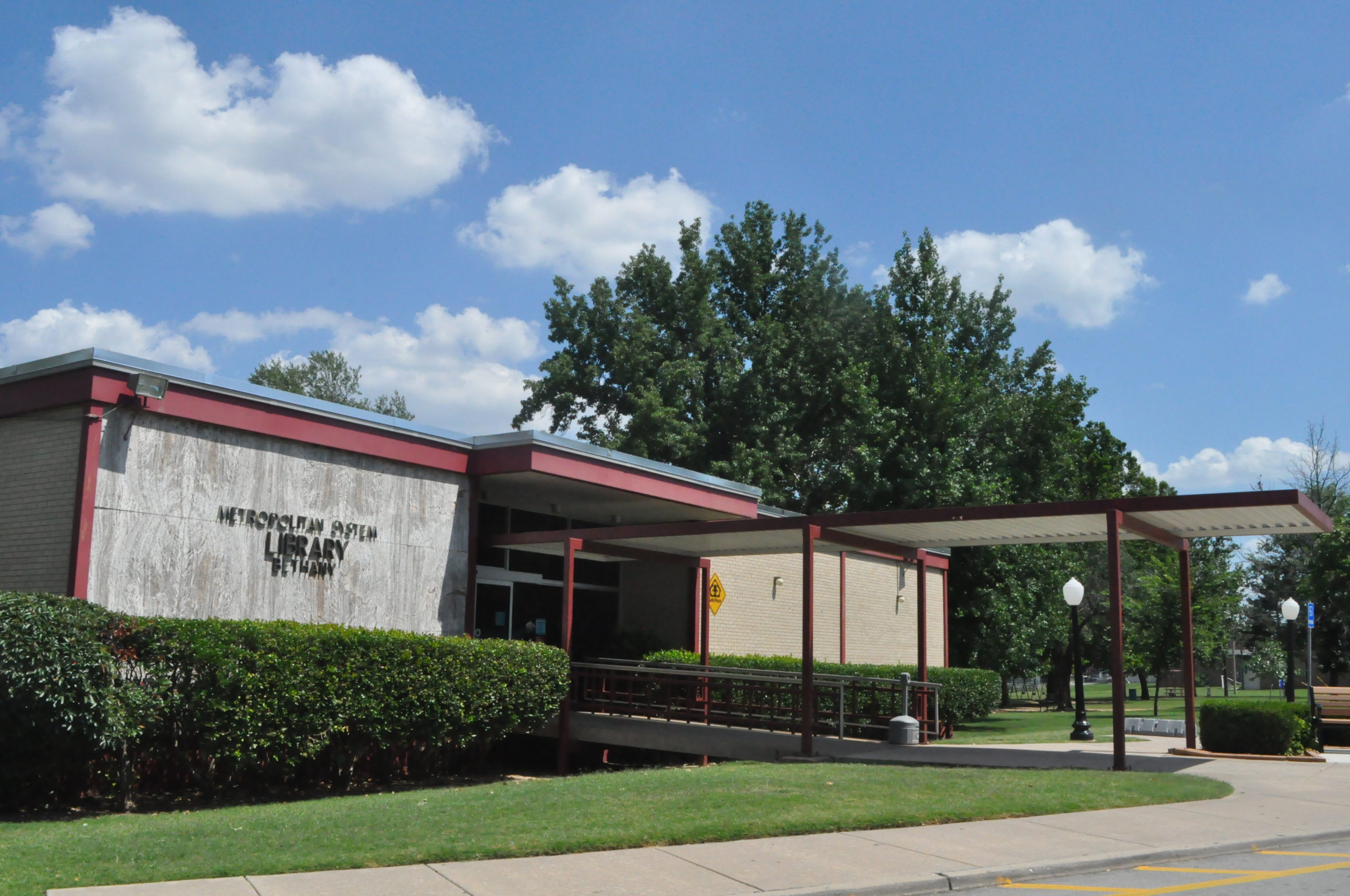
I’m a big fan of public libraries. I’d grown up using the Bethany branch of Oklahoma City’s Metropolitan Library System, and I remember checking out Curious George books there, along with Esphyr Slobodkina’s Caps for Sale. Years later, I prowled its shelves looking for science fair project ideas. I remember the giant checkers game in the children’s area that always caught my eye…but I’ll confess that I never learned to play checkers, let alone chess.

Another thing I noticed as I grew up was the simple elegance of the little branch’s architecture. It had opened in 1965 and was designed by Ray Bowman, the head of the Art Department at what was then Bethany Nazarene College, just blocks away. OkieModSquad posted a nice look back at it in 2017.

The little library I grew up with
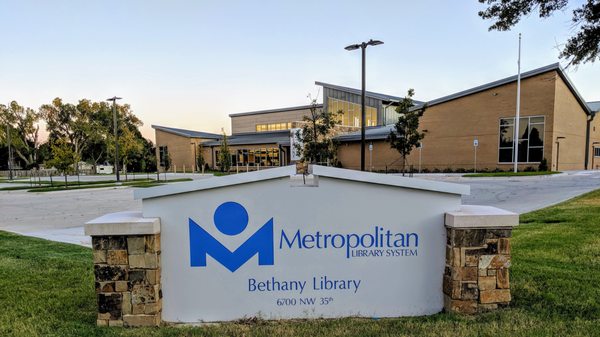
Its 2019 replacement by Dewberry Architects

However, it was only 8,400 square feet and became woefully obsolete for the area’s needs. So it was replaced with a 23,000 square foot facility that opened in 2019, expanding its collection from 58,000 items to almost 90,000.

I have nostalgic memories of happily crossing the little bridge when entering or leaving one of my favorite places from childhood, but nostalgia is a trap. It is a good thing that they razed the old library and built a new and better one. It wouldn’t have made sense, given the money, the lot, etc. to try and expand the old library or repurpose it and build elsewhere.

Bartlesville’s Libraries

So let’s jump to 1989. I was 23 years old and had just moved to Bartlesville. Until then, I’d only caught glimpses of it along Highway 75 and over by Sooner High, since whenever we would head from OKC to Independence, Kansas to visit relatives, we would stop in Bartlesville to have lunch with some retired former coworkers of my parents; they lived in the Madison Heights addition.

I knew Bartlesville as an outlier town, awash in oil money, that produced lots of National Merit scholars and Advanced Placement students I had helped to recruit and advise while working in Scholars Programs at OU. Bartlesville had a symphony orchestra, a magnificent community center, a then-thriving shopping mall, and multiple skyscrapers, despite only having a population of 35,000. Surely its public library would be similarly impressive…right? Well, frankly, not at that time.

The First Bartlesville Library

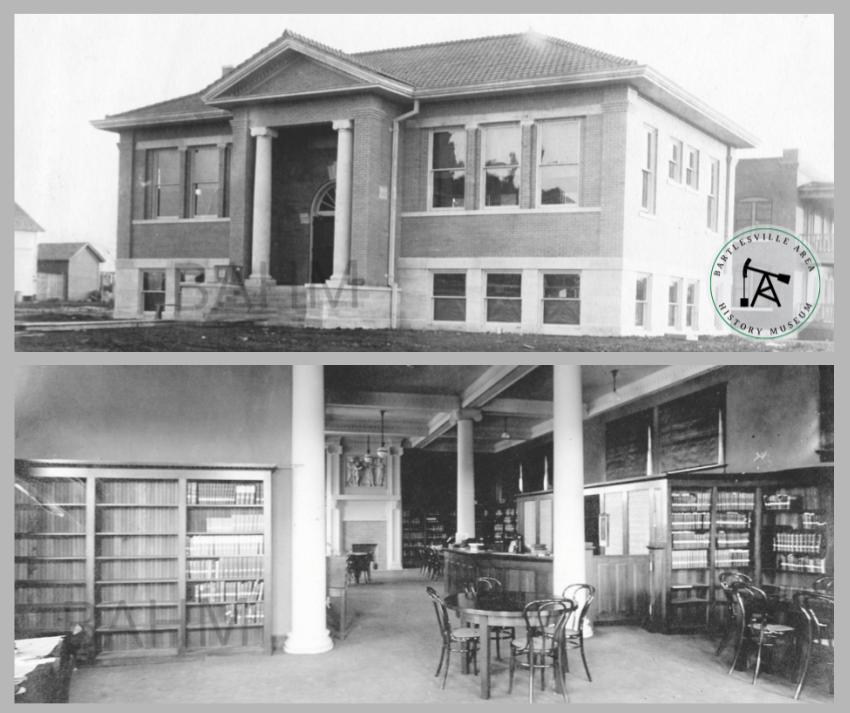
Carnegie Library [Source]

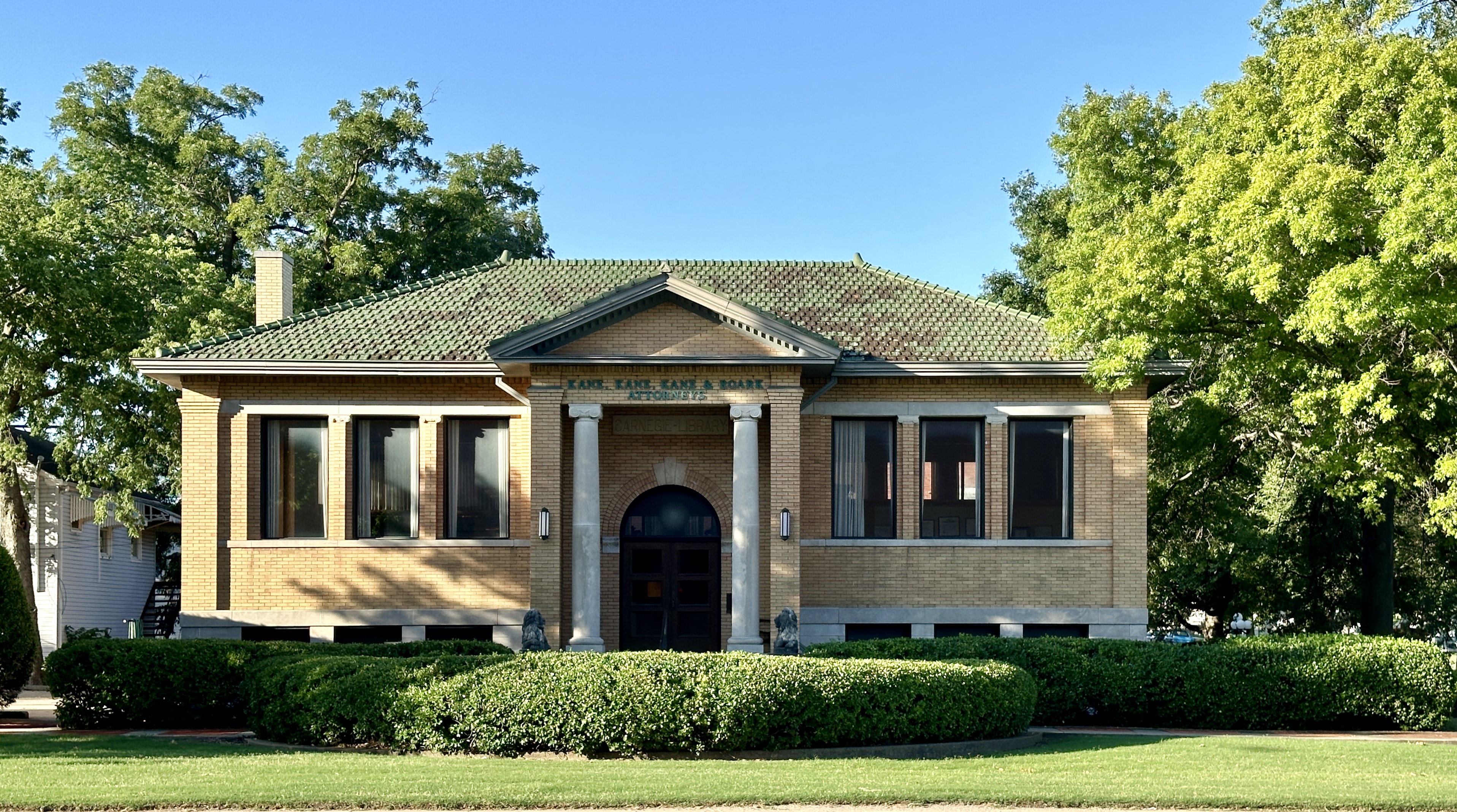
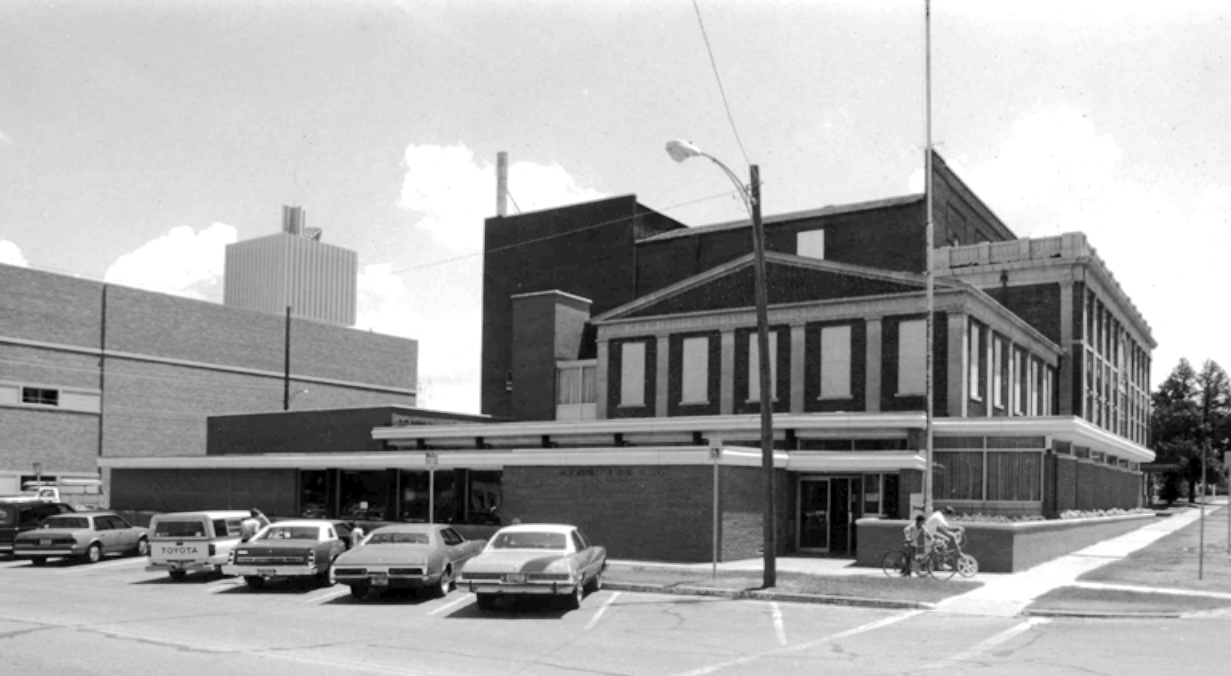
The former Carnegie Library building is just across Adams Boulevard from the Community Center. The town’s Tuesday Club had begun campaigning for a library in 1908, and the Carnegie Corporation provided a $12,500 grant to help build it.

The town grew from 6,000 in 1908 to 21,000 in 1927, and the library’s collection grew with it. From 1913 to 1927, it expanded from 1,250 volumes to over 10,000 and the building was bursting at the seams. In April 1927, a city election for a $25,000 library bond passed with over 75% approval: 2,155 to 689. Frank Phillips promptly pledged another $12,500 to the project, an unconditional gift for the library to use as it saw fit.

However, just days before the election, the Oklahoma legislature passed a law, taking immediate effect, that invalidated full-term bonds like the ones in Bartlesville’s election. That forced a revote in May for serial bonds, which earned over 82% approval: 1,407 to 298.

However, by July the state’s Assistant Attorney General held that the city had no statutory authority to issue bonds for a library. The city had already begun renovating the north wing of the Civic Center, which had opened in 1923, as a temporary home for the library while the original building was prepared for expansion.

The Second Bartlesville Library

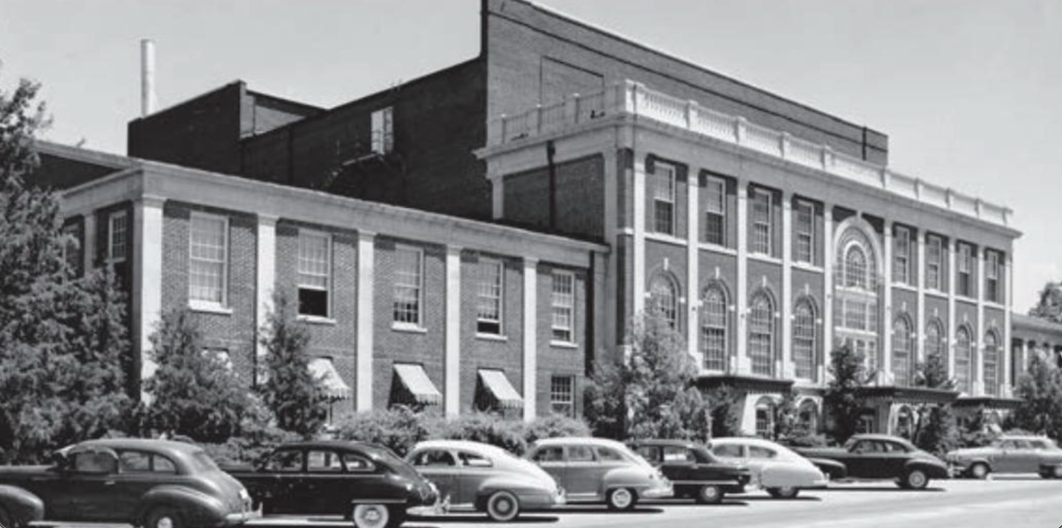
The city library board decided against a third attempt at a bond issue, voting to have local architect Arthur Gorman draw up plans to remodel the ground floor of the Civic Center’s north wing into a permanent home for the library and rid itself of the Carnegie building. I’m guessing they were just relying on Frank Phillips’ unrestricted donation. The move would help popularize the relatively new Civic Center, avoid another bond issue that might encounter yet more technicalities in debt-averse Oklahoma, and reduce the city’s operating expenses by combining facilities.

The north wing of the Civic Center, at left, became the library
The Carnegie Library became law offices

The Red Cross headquarters moved out of the Civic Center’s north wing, which was opened up into one big room, becoming the library’s new home in September 1927. The school system wound up taking over the old Carnegie library, making it an administrative building until 1974, when it was sold off to become law offices.

The library moved into the Civic Center

By the summer of 1930, the library was outgrowing its new quarters, and in March 1931 it was operating branches at three of the schools and the hospital. In May 1931, it opened another branch near the West Side Park that was open on one morning and another afternoon each week.

However, despite heavy patronage, a bond issue to enlarge the library was defeated in 1940, and it was embroiled in controversy in 1950 when Ruth Brown, the librarian since 1919, was fired for her support of Civil Rights, under the pretense of her being a Communist subversive.

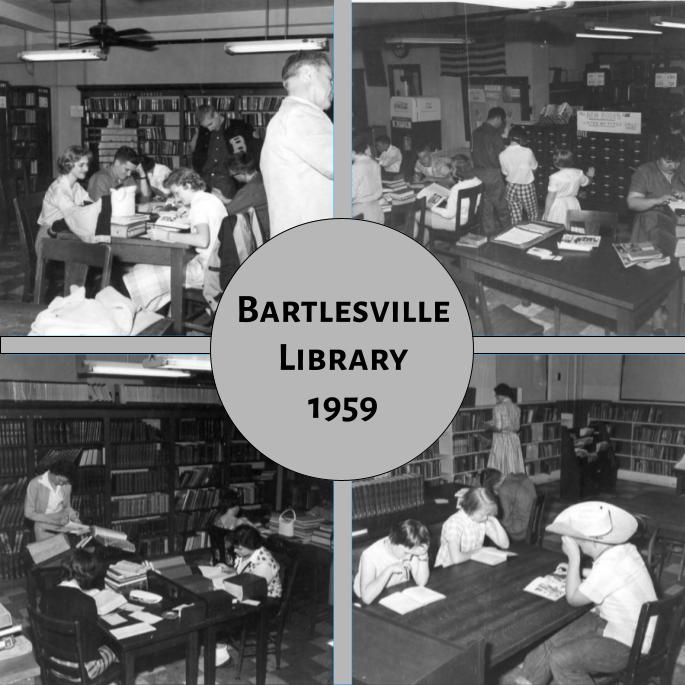
The town continued to grow, but the library was wholly inadequate. Bond elections in 1957 and 1959 failed.

By 1959, the library needed help [Source]


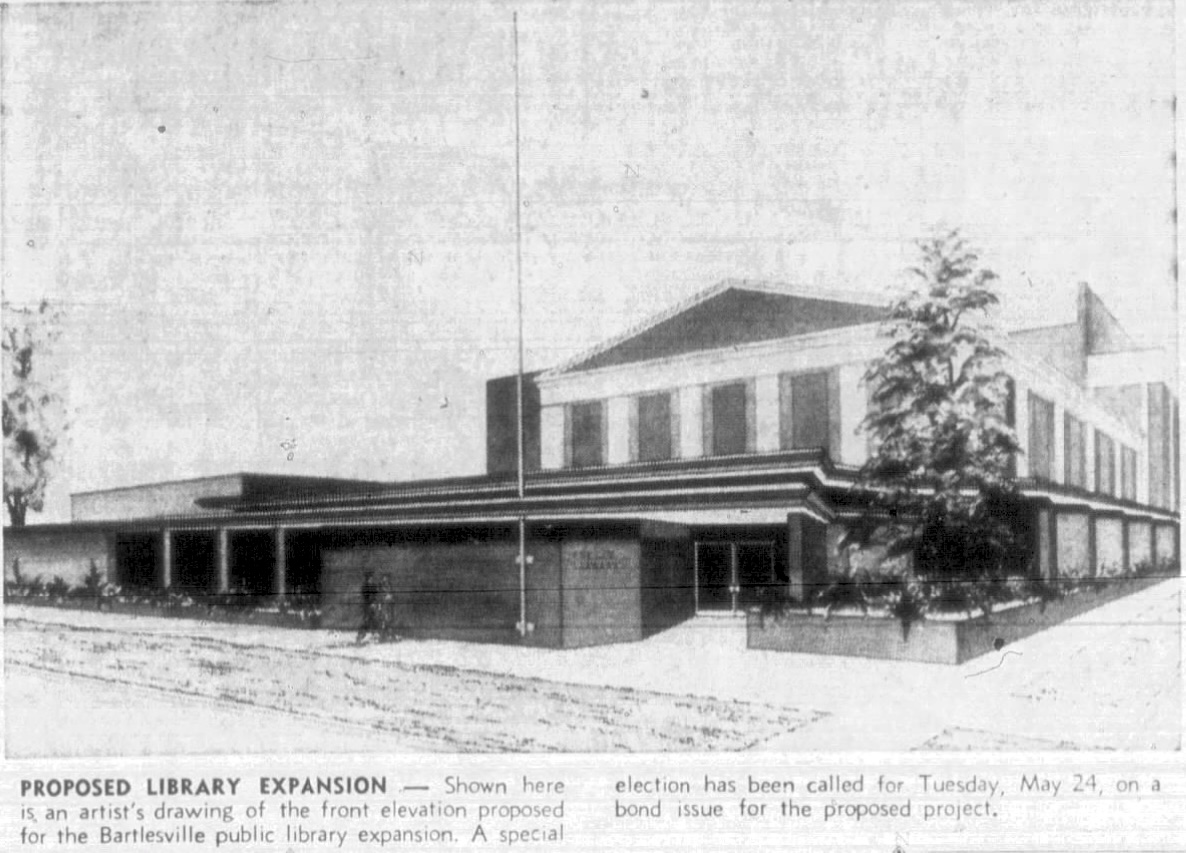
1960 architectural rendering of the proposed library addition

In 1960, 59% of the voters, by 1,873 to 1,275, finally approved a library bond issue. The resulting modernist appendage tripled the library’s size, but it in no way complemented the architecture of the older structure.

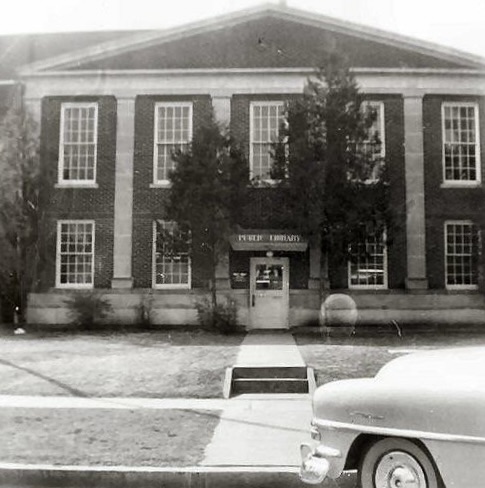
In 1989, Bartlesville still depended on that aging 1960 wraparound on the north end of a 1922 building that had been mostly abandoned for about a dozen years.

I was unimpressed by the public library in 1989 [Source]

The Controversy I Moved Into

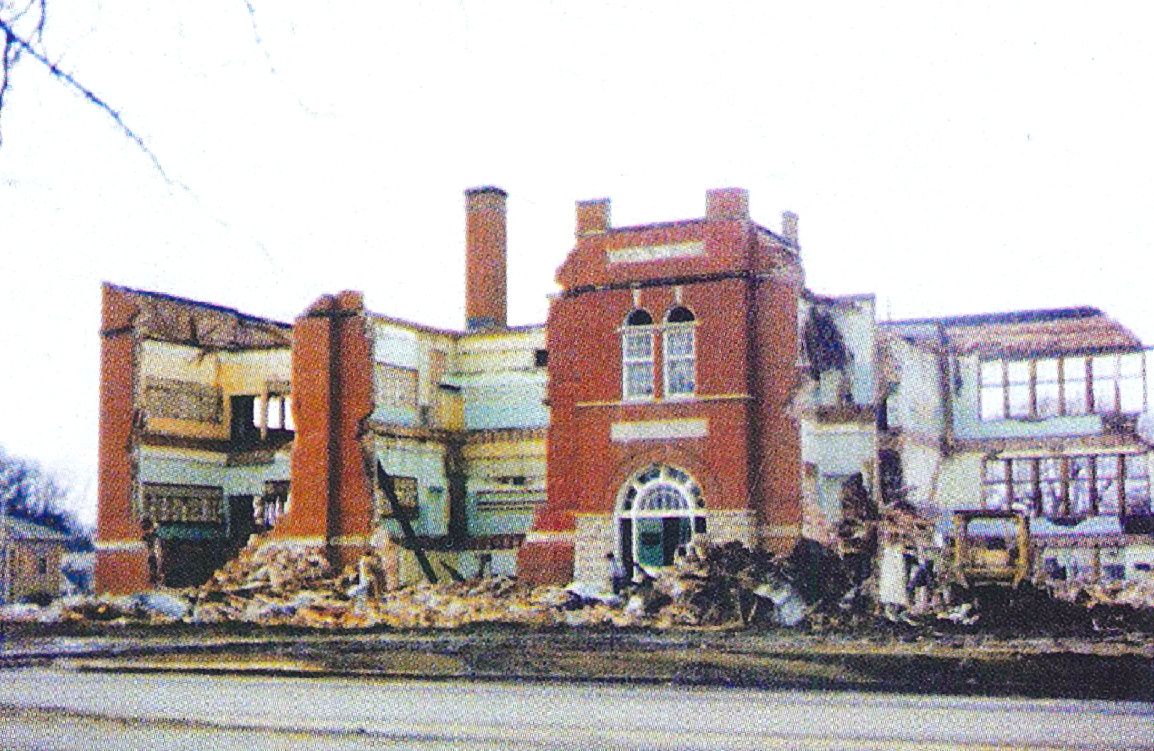
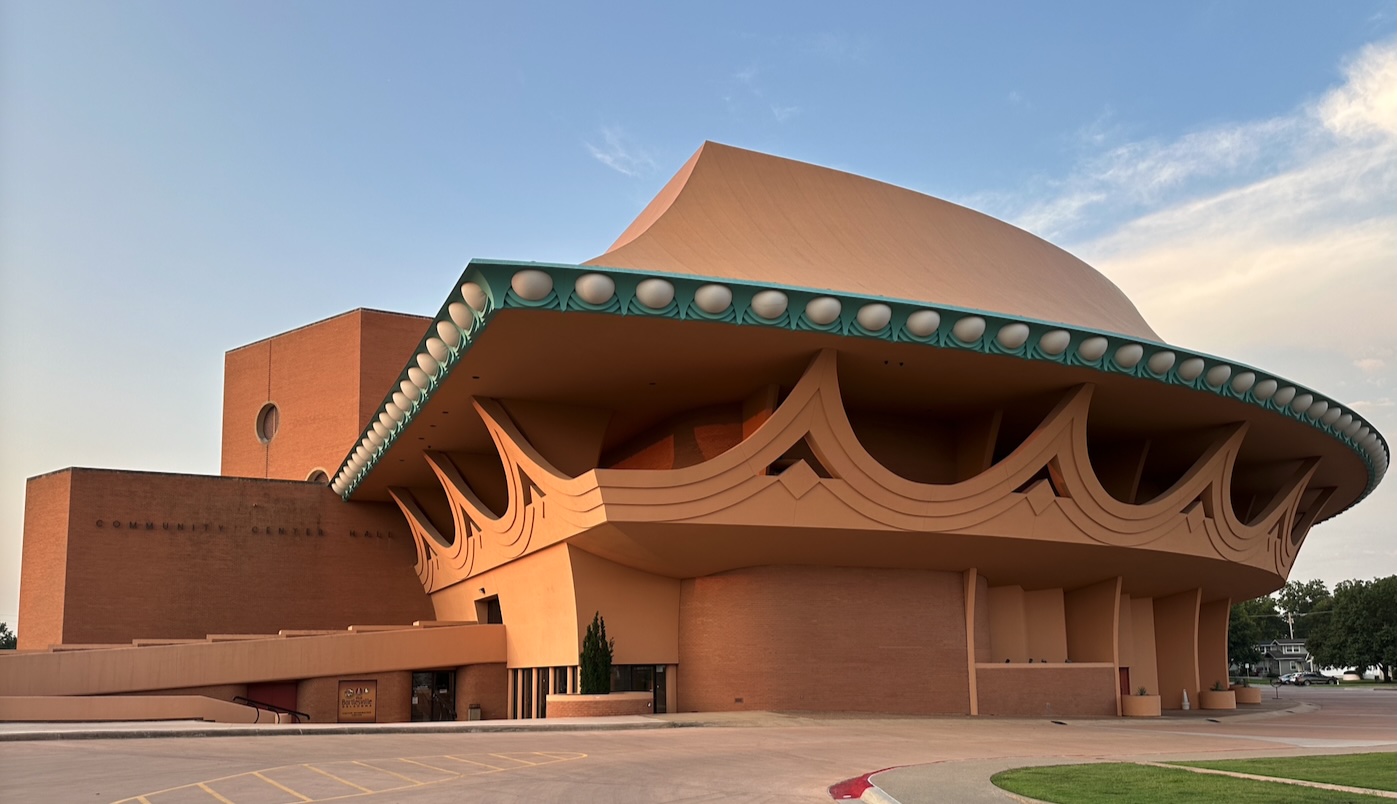
Just a block or so to the east of the old Civic Center was the mothership, the Bartlesville Community Center. Designed by the son-in-law of Frank Lloyd Wright, it featured an impressive 1,700-seat performing arts hall accompanied by a large events room, art display gallery, and basement drama room. The facility was built from 1979 to early 1982 for $13 million, funded by private and corporate donations and a three-year penny sales tax. Space for it was created by razing the city’s first brick school building, Garfield, and the wounds lingered.

The city had abandoned much of the Civic Center in 1976, amidst competing claims about its structural integrity. The new Community Center reflected how Phillips Petroleum, a Fortune 500 company, was then still headquartered in little Bartlesville. An oil boom meant the company was expanding rapidly, and it wanted better amenities to help it attract and retain workers.

However, oil booms are often followed by busts. Phillips peaked in the early 1980s with over 9,000 workers in town but then came decades of downsizing. In 1985, amidst the oil bust, a 3/4-cent sales tax proposal to demolish the Civic Center and build a new library failed with only 36% approval: 3,107 for to 5,455 against. By 1989, Phillips employment in Bartlesville had declined by almost 40%, to about 5,400 workers.
Phillips was still so dominant at the time that when I rented an apartment at The Village, they mistakenly assumed I was a young Phillips hire. They asked me what “grade” I was, and I thought they meant what grades I’d be teaching at Bartlesville High School, so I answered, “Both 11 and 12.” They were puzzled by that response, and it turned out that they were asking about my Phillips employment classification. It was an introduction to life in what was still very much a “company town”.

No Attachments

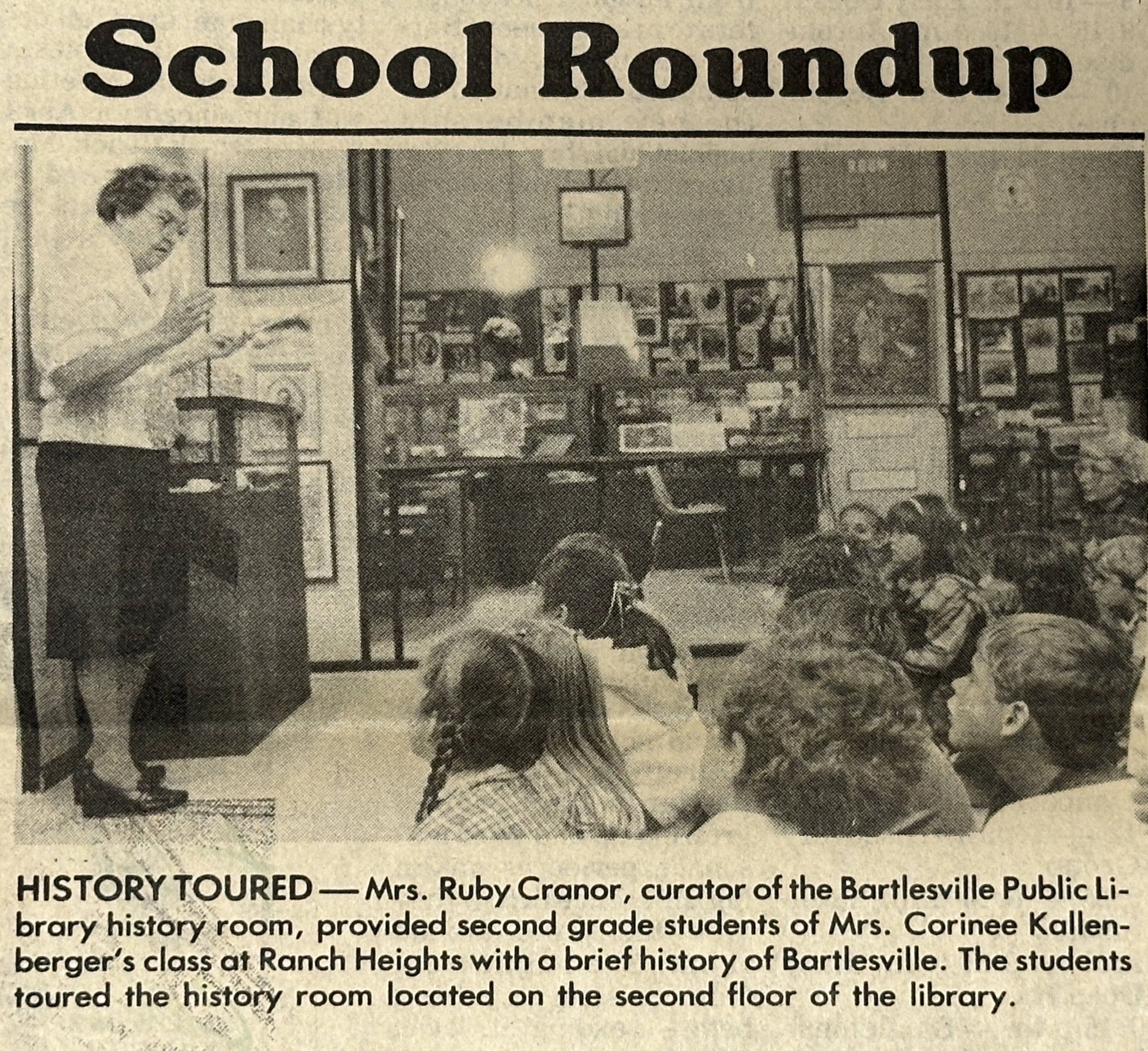
As an outsider moving into town, I explored the library, but considered it quite lackluster amidst the town’s striking amenities. Sure, it was 70% larger than the tiny branch library I grew up with in OKC, and it did feature a history room, over a decade before the Bartlesville Area History Museum would come about.

A glimpse into the library’s history room back in 1982

However, to my eyes, having never been in the Civic Center in its heyday and only seeing it in its partially abandoned state, it was an obsolete eyesore that served no purpose save for an old mismatched library retrofitted into its north end. It made perfect sense to me, having no nostalgia for the structures, that the city should tear it down and build a larger and much more modern library in its place.

Well, some did not agree, because they had been captured by the nostalgia trap, which doesn’t care about economic viability or functional suitability. A retired Phillips employee in his early 60s, not much older than I am while composing this post, organized a 25-member Concerned Citizens of the Bartlesville Area. They collected 1,409 signatures on a petition against demolishing the old Civic Center, demanding a citywide vote on the issue. I did not find a sensible or economically viable proposal from them on what to do with the obsolete and redundant facility, just a demand that it not be destroyed. It would have been very expensive to renovate the entire old Civic Center into an adequate new library, and the result would have been compromised by the mismatch with its original design.

Thus, on September 12, 1989, I participated in my first Bartlesville election, voting Yes on a $2.5 million bond issue to demolish the Civic Center and construct a new library in its place. It passed with 56% approval: 5,161 to 4,061.

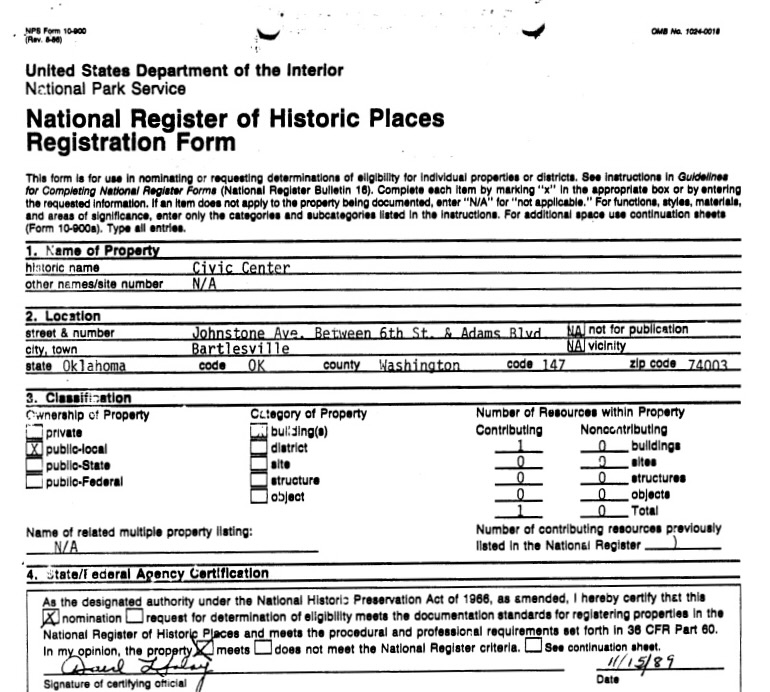
The Civic Center was listed on the National Register of Historic Places, but that did not prevent its destruction

The fellow opposing the demolition finally succeeded in getting the old Civic Center on the National Register of Historic Places, but that recognition didn’t come until November 1989, months after the vote. Contrary to popular belief, such recognition merely encourages preservation by making some properties eligible for rehabilitation tax credits. It does nothing to prevent owners from remodeling, selling, or demolishing a listed property.

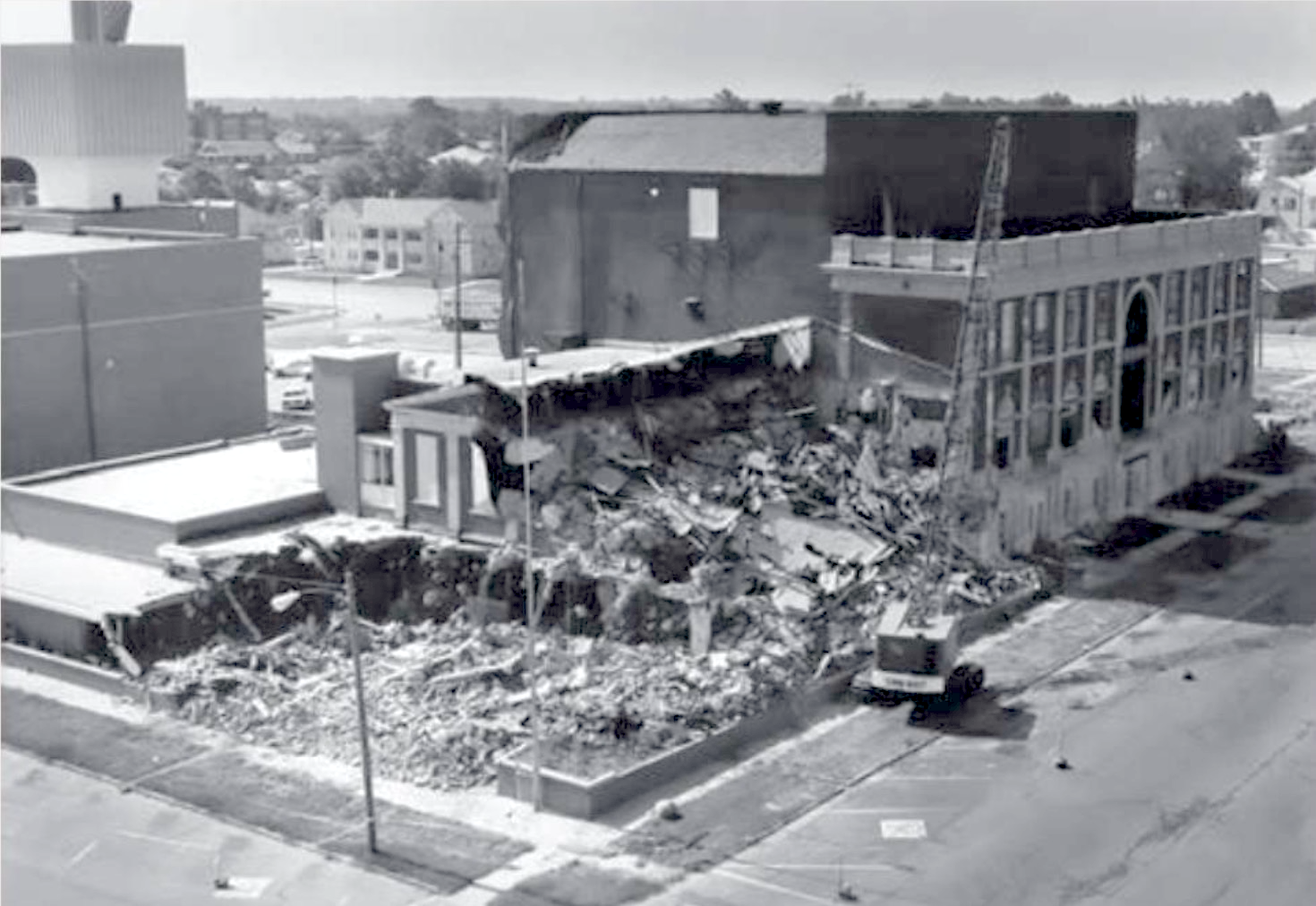
I learned another lesson about Bartlesville politics when another citizen took the city to court, trying to invalidate the election. I, for one, did not take kindly to someone trying to override my vote. I’ve disagreed with the majority in many an election, but I was taught to adapt to, rather than try to subvert, majority rule. The district court ruled against the complaint, but then he appealed to the Oklahoma Supreme Court on various technical grounds. They affirmed the district court in April 1990, and the Civic Center was demolished in the summer of 1990.

This was a heartbreaking time for some Bartians, but not for me

I was very glad to see the library temporarily move into what appeared to be a former T.G.&Y. and for the Civic Center to come down, because I had no experience with nor nostalgia for that old building, while I was genuinely excited for a new library slated to replace it. If I had grown up in Bartlesville, I would still have supported the project, but the destruction would have been much more impactful.

Sound familiar? 35 years later, I get to watch OKC demolish a facility that hosted major events in my life. I couldn’t care less about sports, so the new arena that will replace the old convention center will do little for me, but it will serve many sports fans who are eagerly awaiting the new venue. The tables have been turned!

The Third Bartlesville Library

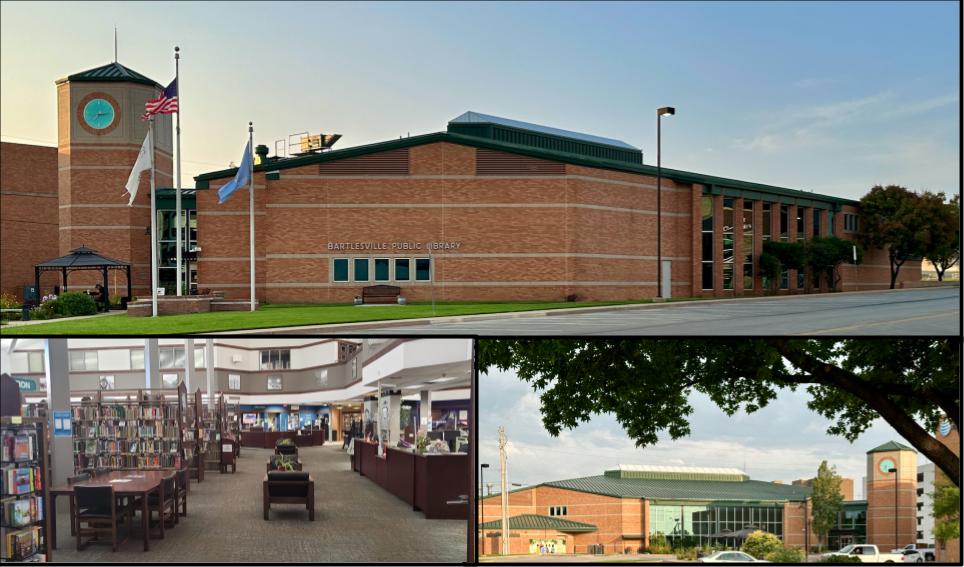
Back in Bartlesville 35 years ago, the library campaign raised another $1.5 million in private donations to augment the bond election, and the project broke ground in February 1991 and the new library opened in January 1992. It was the last project of architect Thomas McCrory, who would soon sell his business to Scott Ambler, who had been heavily involved in the design of the new building. In 2017, Joseph Evans, once one of my physics students at Bartlesville High School, who worked on major additions to that campus in 2015, became the President of Ambler Architects. Now he owns the firm, which in 2025 was renamed HorizonLine Architecture and Interiors. How time flies.

The 1992 library in the mid-2020s

I’ve always appreciated the “new” library, which is still a beautiful and functional space, continuing to adapt to changing times. I am grateful that the nostalgia trap did not prevent its construction.

Avoiding the Trap

[Source]

The nostalgia trap is open and waiting, but it shan’t capture me. I’m impacted, but not upset, that what I knew as the Myriad is going away. I know that it wouldn’t make any sense for the city to preserve it, since a $288 million replacement opened in 2021. The old convention center had plenty of shortcomings throughout its half-century of existence, and the new arena that will replace it was approved by the voters.

Yes, there’s already an indoor arena just to the south, built in 2002 for $89 million. Back in 2008, the city raised over $103 million to improve that facility for the relocated Seattle Supersonics NBA team, which became the Oklahoma City Thunder. (My lack of interest in sports was evident when people starting talking about the team back then: at first I thought they were discussing some sort of weather event.) Now OKC is raising a billion dollars to keep the Thunder playing there for a quarter-century, and I presume the 2002 arena will be redundant once the new one opens in 2029.

Given the significance of the Myriad in my own life, I could decry its destruction. Given the mismatch in interests, I might be tempted to consider a billion-dollar arena a waste of resources. However, I won’t take the bait. I’ll continue to enjoy the public library in Bartlesville, and no doubt many will soon enjoy OKC’s new arena.

The past deserves honor, but not necessarily publicly funded preservation. Oklahoma has always limited its public investments, meaning we must often destroy in order to create. The vote was taken. So be it.

Posted in history, nostalgia | 2 Comments