An Ancient Forest & A Lost City

DAY TRIP DATE: October 3, 2015; SLIDESHOW | MOSAIC

Day Trip (click map for slideshow)

Meador PostYou can walk through an ancient forest and visit a lost city…both just west of downtown Tulsa. Three weeks ago I had recovered sufficiently from my respiratory ailment, and the weather had cooled enough to lure Wendy and me back out onto the trails. I wanted to show her something she had not seen before and explore some trails new to me as well. I checked online and noted that the Keystone Ancient Forest trails west of Sand Springs would be open. So I decided we would make a day trip to Tulsa for a few hikes and late lunch. I happily realized I could actually find some novel trails, despite my 250 day hikes since mid-2009, by driving west to Chandler Park, high above the southern bank of the Arkansas River, to enjoy some short trails on the bluffs there above Avery Drive.

Keystone Ancient Forest

Back in 2007 the Nature Conservancy helped open the Keystone Ancient Forest Preserve in Sand Springs, a few miles northwest of Tulsa. This 1,360 acre plot overlooking Lake Keystone has never been forested nor farmed, so some of its trees date back hundreds of years, including a red cedar more than 500 years old and a post oak over 400 years old. Unlike the ancient redwoods of California, these old trees never grow very large, given the poor soil conditions of the Cross Timbers. That ancient post oak, for example, is only 20 feet tall, about 5% of the height of the tallest redwood.

I wanted to take a more scenic route to the preserve, so we turned off US 75 onto Highway 20 at Skiatook and followed it across Skiatook Lake. Then we turned south to follow county roads across southern Osage County, passing through fields before winding our way through slopes dotted with trees and stripper oil wells. New Prue Road by Lake Keystone featured a growing number of homes on large tracts, and then we reached the ancient forest.

Three trails in the ancient forest

You have been warned

The uselessness of this rugged terrain for typical development is what preserved it for so long, and I’m glad the Nature Conservancy was successful in saving it for the public’s enjoyment. Be aware that you always need to check online to see which Saturdays it is open for hiking, and it is best to arrive in the morning so you have plenty of time to explore before it typically closes at 2 p.m.

I first visited the preserve with John and Betty Henderson back in February 2013. It was interesting to note the differences between a walk here in late winter vs. early fall. In 2013, the Hendersons and I had walked along part of the paved Childers Trail and then taken the entirety of the Frank Trail over to a lake overlook and back. This time, Wendy and I followed the same path until, about a mile into the hike, we reached the newly constructed Wilson Trail. That is a loop which is rated ‘difficult’ since it makes a rather rugged descent of almost 200 feet down a hillside carved by a stream. The trail runs below some bluffs before climbing back up alongside the stream bed to the Frank Trail.

Along the Wilson Trail

The Canon PowerShot SX700 HS

The Canon PowerShot SX700 HS

You’ll note the paucity of shots from this hike. Well, the truth is that I have managed to lose not one, but two different Canon PowerShot cameras in recent weeks. Back in June, I bought a new Canon PowerShot SX700 HS to take on our July vacation. Sometime in September I misplaced it, perhaps permanently. I still had my older Canon Powershot SX260 HS, and it was still limping along despite falling off a cliff at Robbers Cave back in 2012. Well, on this day trip I managed to leave that spare camera in the restroom at the Tulsa Garden Center, and it was not recovered. It wasn’t in great shape, so that’s not too disturbing, but I do wish I had its shots from this day trip.

So the only photos we have from the first half of October are what Wendy and I shot with our respective iPhones. The iPhone 6 takes great photos, but lacks the 30x optical zoom of the latest Canon superzooms. So, before a visit to Roman Nose over Fall Break, I gave up and ordered another Powershot SX700 HS. I opted for that older model over the newer SX710 HS, even paying a price premium for the older model, because a review said the new camera lagged its predecessor in picture quality. We’ll see if I can manage to hang onto it!

I was excited to find the new Wilson Trail at the preserve. It is very rugged, making it a nice contrast to the gentler Frank Trail. The newer trail is named after Chris Wilson of the Nature Conservancy, who was instrumental in creating the preserve. The main trail is named after Irv Frank, the landowner who sold the original property that became the preserve. Returning to the car, Wendy and I veered onto the north side of the Childers Trail loop. That short paved trail is named after another original landowner, Sam Childers.

Food and Flowers

By the time we finished our hike, it was warm and we were both hungry. So we took highway 412 east to the Spaghetti Warehouse, a favorite of mine in downtown Tulsa. After enjoying some pasta and delicious sourdough bread, we needed another walk, but we were not ready for another hike just yet. So we drove over to the Tulsa Municipal Rose Garden at Woodward Park. Wendy loves roses, and gleefully examined everything on offer, snapping photos of various blooms. She is excited about transplanting her own climbing rose to my house this fall, and we’re planning on constructing some raised flower beds next year for the roses she’ll be growing after we are married next summer.

Chandler Park’s Lost City

After we toured the rose garden and took a restroom break at the Garden Center, we drove over to Chandler Park in west Tulsa. Situated just west of the refineries along the Arkansas River, this high bluff above the Arkansas was once called “Lost City” because of its rugged cliffs. Perhaps early settlers thought cliff dwellers once lived there, or the cliff formations resembled a city as viewed from the river below. There have also been persistent rumors through the years that outlaw Jesse James once buried money, wrapped in a leather cloth, among the rocks. I doubt there is any money to be found here, but it is rich in outdoor recreation.

100 acres of this terrain is now Chandler Park. It was donated to Tulsa County in the late 1950s by Claude Chandler, president of Chandler Materials Company. Below the park run three routes: old Avery Drive from Tulsa to Sand Springs, the Burlington Northern Santa Fe railroad, and the Arkansas River itself. Avery Drive is a nice route dating back to 1914, when Cyrus Avery, who was an influential road planner and father to famous Route 66, built what was then called the South River Road along the west bank of the Arkansas River using convict labor from the prison at McAlester, Oklahoma.

My former colleague and dear friend Carrie Fleharty introduced me to both Avery Drive and Chandler Park back when she was living west of Tulsa in Prattville, and the Hendersons once took me to the Scottish Games at the park back before those were relocated to River West Festival Park. But I’d never walked the trails along the bluffs on the park’s northern edge. There are two small signs along the road announcing the “Lost City Trail” and “Rock Room Trail“, and the cliffs down there are popular with rock climbers, while cross-country runners like to zoom along the corridors between the large slabs of rock.

Chandler Park Trails

I didn’t remember where the trailheads were located, so we just parked at the eastern edge of the bluff area above Avery Drive. Just as we were about to take a stairway down to a lower area of the park, I realized I had left my camera back at the Garden Center. A call confirmed they were closed, and Wendy left them a message asking them to call me if they found my camera, but we never heard back from them. So we knew we would be relying on our iPhones to document this hike.

The road for the lower section of the park was closed, presumably to reduce usage and maintenance. Parks around here are always underfunded, and Tulsa County has gone through multiple rounds of closing park pools and the like. We located the eastern terminus of the trails and headed into the Lost City.

Soon we found ourselves zig-zagging through corridors of stone which were reminiscent of the Table Mound Trail at Elk City up in Kansas. A maze of rough trails gave us high and low options as we made our way west along the bluff. I had feared the trail would be marred, and there was some graffiti but thankfully little trash. The layered rock was interesting, although only the uppermost trails were wide and accommodating. There were few flowers, but some fungi.

A lost city?

Rock Room

Tree-covered slabs did somewhat resemble the ruins of lost buildings, and farther west we reached the rock room, a long stretch of broken bluff that formed a corridor of stone. So both trail names were apropos. Along the way we saw a few groups of rock climbers with their ropes and climbing shoes and other paraphernalia. At the lonely western end of the bluff I took us down a steep loop which wound around to the western terminus behind the park’s 16,000 square foot community center.

We were tired and hot from threading our way along cramped trails and took the park road back east to our car. But we plan to return to Chandler Park in late October to further explore this trail system. It is always fun to explore novel trails, and those are increasingly hard to come by close to home.

SLIDESHOW | MOSAIC

Posted in day hike, photos, travel | 2 Comments

By the Backwaters of Elk City Lake

DAY TRIP DATE: September 12, 2015; SLIDESHOW | MOSAIC

A different route to Elk City (click map for slideshow)

Meador PostLast month, Wendy and I drove north for another hike at Elk City Lake. I had already shared all of the shorter trails there with her, but she had never walked the central portion of the 15-mile-long Elk River Trail. I’ve hiked the trails at Elk City Lake almost two dozen times in the past six years, and documented many of those hikes. But even I’ve only been on that center section once before, way back in March 2010.

So when we reached Havana, Kansas just north of Caney, for once we did not angle northeast on US 75 towards Independence. Instead, we headed north on county roads toward tiny Elk City itself. Then we threaded more county roads to the east of US 160 and north of the Elk River to reach the Elk River Trail’s obscure central trailhead, which is located at the never-finished Oak Ridge Day Use Area. That is upstream from the developed Card Creek area, which is located on the opposite south side of the river and features the Timber Ridge Trail.

We pulled into the trailhead parking area, and I was surprised to see a few cars there. One had stickers indicating there was probably a female hiking on the trail who also enjoys rafting and the mountains. The latter are somewhat lacking in Kansas, but online I see that one can find whitewater on the Elk River Falls near Coffeyville. I wonder if that rafting adventurer ever gets that desperate, or sticks with mountain rivers. When we reached a log book stand a few yards along the trail, Wendy signed us in, and we noted that a few of our fellow hikers on this day had registered as well.

Wendy and I wound up hiking 2.8 miles, taking a short access trail to intersect the main Elk River trail. There we headed east, which would eventually take us within view of some flooded backwaters of the lake and would end up winding around one of the inlet streams.

Trail track

There were old short stone walls near the intersection with the main trail, something one finds at intervals along much of the Elk River Trail. I presume these mark old property boundaries rendered obsolete when the land was acquired by the Corps of Engineers. Satellite views show that the old Parker Cemetery is nearby, with a clear delineation between the wooded Corps land around the lake and the flat fields we’d driven through on the county road to reach the trailhead.

We eventually hiked to the lake backwaters and found a spot where you can walk out onto a promontory of the river bluff. Near-vertical cliffs fall off on three sides, and you are level with the top portions of the trees growing from down below. I termed this spot Cliffside.

Wendy at Cliffside

Later the trail turns to hug along an inlet, threading its way through and later hugging a short section of bluff which strongly resembles a rock wall thanks to its cracked layers of stone. The trail reaches a corner in the bluff I called Nature’s Corner, where we stopped to sip our drinks and chat before heading onward along the bluff until the trail finally crossed the stream. We enjoyed the reflections of the large puddles in the streambed.

Crossing the stream

Reflections

The trail wound around a bit in trees before making its way back along the other side of the inlet. Cooler weather had lured us back onto the trails, but it was certainly not a comfortable fall hike. We were quite warm by the time the trail turned to again follow the lake backwaters, and we decided to turn around. Eventually we reached a point along the trail where I was confident we could shorten our return trip by bushwhacking across the inlet area. My instincts (and MotionX GPS app) were on target, with me leading us across to intersect the trail again at Nature’s Corner.

We enjoyed the solitude and quiet on this isolated section of the Elk River Trail; it was a welcome break from the hustle and bustle of the new school year. But the warm weather and a respiratory ailment would keep me off the trails for the next few weeks. Wendy and I would not get out to hike again until early October with hikes at Keystone’s Ancient Forest and along the bluff at Chandler Park in Tulsa, the subjects of my next post.

SLIDESHOW | MOSAIC


Posted in day hike, photos, travel | Leave a comment

An Engagement Out West, Part 6: Monument Rocks

TRIP DATES: July 21-22, 2015

This is the sixth and final post about our July 2015 vacation out west. Wendy composed these posts while I handled the photos and maps. Enjoy!

-Granger

Wendy's Post

Wendy’s Post

Flat farmland and feed lots. That’s all Kansas has to offer. Or is it? Granger was determined to find something else in western Kansas for the final leg of our engagement out west, zigzagging our way along the northern route from Colorado Springs back home to Bartlesville.

Our route (click map for slideshow)

Driving east from the beautiful Garden of the Gods, we zipped through Colorado Springs and quickly found ourselves in the doldrums of a drive across the flat plains of eastern Colorado. We angled up to Limon for lunch, but then Granger decided to forgo Interstate 70 in search of something more interesting along a route through the town of Kit Carson. The town proved to be far less interesting than its namesake.

Snooze Fest

After experiencing the dramatic mountains and mesas of southern Colorado and northeastern New Mexico, it was a snooze fest to drive for centuries through field after flat field of wheat. This sedated expanse is a patchwork quilt of yellow and green accented occasionally by a sad looking silo. Every now and then, Granger and I saw a pasture full of cows. Once we even saw a big pasture completely deserted save for one lonely cow. Granger exclaimed, “Cow, what are you doing out here alone? Don’t you realize you’re a herd animal?!”

Finally we entered the sunflower state. Eventually Granger turned off on a gravel road and drove for miles, with us scanning the horizon to glimpse Monument Rocks rising out of the flat landscape. It was a surreal experience. One moment we were driving down a gravel road listening to Quincy Jones. The next moment we were suddenly surrounded by cows and a large colony of 50 to 70-foot-tall chalky rock stacks. The sedimentary rock chalk was formed 80 million years ago when the land was covered in a vast inland sea. The Smoky Hill River eroded most of the rock, separating it from the nearby bluff.

Monument Rocks

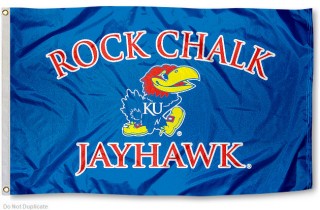
This is the same type of “rock chalk” that inspired the school chant of the Jayhawks of the University of Kansas. Granger’s father is a KU grad who certainly knows the chant, which has an interesting history:

Rock Chalk Jayhawk

The Rock Chalk Chant is perhaps the most distinctive cheer in all of college sports. Some have likened it to a Gregorian chant, but anyone who has been in Allen Fieldhouse and heard the chant start low, then build and roll over the crowd knows that it is much, much more.

The “Rock Chalk” chant dates to 1866, when it was adopted by the University Science Club. A chemistry professor, E.H.S. Bailey and some of his associates were returning to Lawrence from Wichita on a train. As the story goes, they passed the time by trying to create a rousing cheer. The sound of the train’s wheels on the rails suggested a rhythm and a cadence to them. At first, the cheer was “Rah, Rah, Jayhawk, KU” repeated three times.

Even though KU didn’t have a football team until four years later, KU students quickly took up the chant. Later, an English professor suggested “Rock Chalk,” in place of “Rah, Rah” because it rhymed with Jayhawk and because it was symbolic of the limestone, also known as chalk rock, surrounding Mount Oread, the site of the Lawrence Campus. It became the official cheer of the University in 1897.

Teddy Roosevelt pronounced the Rock Chalk Chant the greatest college chant he’d ever heard. It was used by Kansas troops fighting in the Philippines in 1899, the Boxer Rebellion in China, and World War II. At the Olympic games in 1920, the King of Belgium asked for a typical American college yell. The assembled athletes agreed on KU’s Rock Chalk and rendered it for His Majesty.

The words to the chant are simple. “Rock Chalk, Jayhawk, KU” repeated five times. The chant is special not because of the words, but because of the tone in which it is chanted and the distinctive cadence in which each verse is delivered. The only way to really appreciate the chant is to sit in Allen Fieldhouse before a Missouri game…

The chant can be intimidating at sporting events. It is reminiscent of a Gregorian Chant, and indeed, it felt like we were walking into a cathedral when we first gazed up at the gigantic structures at Monument Rocks, which are locally known as the Chalk Pyramids. The owner of the property kindly allows visitors, but if you visit, please be aware of where you walk, since this is a cow pasture.

It was interesting to see the monoliths up close, as they are packed with small fossils. The locals have said that after a rain, the place smells like the ocean. Archaeologists have exhumed a multitude of sea creature fossils from the area.  Most of those are now housed in area museums. We didn’t have time to visit the many fossil museums, but we plan to go at some point. There is the Fick Fossil and History Museum in Oakley as well as the Keystone Gallery north of Scott City, which has a website with a historical timeline for the area. The Sternberg Museum has an extensive collection of fossils of sea life and dinosaurs from Monument Rocks and other parts of Kansas. The most notable exhibit is the Fish Within a Fish fossil. It would be nice to visit these museums on a return trip to Monument Rocks.

Wendy provides some scale

Granger shot a lot of spectacular photos of the rocks. My favorite is the one of the “Keyhole Arch,” which I found out was created by someone who used the thin wall of rock for target practice.

Granger in Keyhole Arch

Eventually, erosion will cause the remaining rock to come tumbling down. I was a bit perturbed to see some cracks in the towering rocks. Even though the Smoky Hill River that originally eroded the rocks has shifted course, the rain and wind will continue to erode the structures. We are lucky to have experienced them.

A Parting Panorama

As evening fell, we drove toward Scott City, listening to the beautiful voice of Israel Kamakawiwo’ole. He was from Hawaii, which is about as different as it gets from the wheat fields of Kansas, but his talent complemented the beautiful skies. We stopped at chef Tate Roberts’ restaurant in Scott City and then spent the night in Dodge City, glad to arrive home the next day after two weeks on the road. Our engagement out west was over, but happily, our life together was only beginning.

End of the engagement out west

Click here for slideshow from this portion of the trip

An Engagement Out West, Part 5: Ruby Mountain & Garden of the Gods

Posted in photos, travel, Wendy | Leave a comment

An Engagement Out West, Part 5: Ruby Mountain & Garden of the Gods

TRIP DATES: July 19-20, 2015

This is the fifth in a series of posts about our July 2015 vacation out west. Wendy is composing these posts while I handle the photos and maps. Enjoy!

-Granger

Wendy's Post

Wendy’s Post

Granger and I have taken many trips in the past few years.  He usually does all of the planning, researching the various stops along the way. It’s just the information hound in him. He likes to read…a lot. So when he was down for the count with food poisoning in Gunnison, I decided to take a cue from him and do some researching of my own.

During this down time, I read about the towns we would pass through once we eventually got on the road again.  Eager gold and silver prospectors founded many of the towns. The railroad promptly joined those places, and when no big lodes were found, everybody moved on, leaving virtual ghost towns.

Two places that caught my interest were Mount Antero and Ruby Mountain. I enjoy digging around for rocks, so those two places seemed promising. Mount Antero is known for aquamarine crystal digging, while the mis-named Ruby Mountain is known for its garnets and Apache tears. My dad had a nice collection of the Apache tears as well as other rocks he gleaned from a trip to Colorado back in the 1970s.

The next leg of our trip

On the morning of July 19th, Granger and I left gut-wrenching Gunnison and started our 170-mile trek to Garden of the Gods Resort in Colorado Springs. Our destination would be a welcome relief from Granger’s trials in Gunnison. Along the trip we saw many flower covered fields and valleys. They reminded me of those pictures of the Swiss Alps surrounded by a rainbow of flowers.

Wendy's Painting-in-Progress

Wendy’s Painting-in-Progress

The winding highway was bordered with patches of yellow, red, purple, white, and coral flowers, which completely blanketed the undulating landscape for as far as the eye could see. When we got back home a few days later, I was inspired to attempt painting this wonderful scene, as I could not successfully capture it using the camera. The painting is still a work in progress.

At one point in the trip, I spied a clump of deep pink wildflowers that I’d never seen before. Granger stopped alongside the road 3 times before I found these flowers again.  I walked out into the high grass and harvested a sprig of these neat looking pinkies. When I took a whiff, they smelled like a combination of gasoline and skunk spray, so I left them there. Looks really can be deceiving! Since then, I’ve spent hours online trying to find the name of those stinkers, but so far, no luck.

RUBY MOUNTAIN: SLIDESHOW | MOSAIC

Arkansas River at Ruby Mountain (click photo for slideshow)

Eventually we got to Ruby Mountain alongside the Arkansas River. Granger still did not feel too well, but we watched rafters fly down the raging Arkansas River. Due to recent heavy rains, the river was filled to the brim. One of the rafters saw me and called, “Hi Mom!” This part of the Arkansas, near its mountain origin, is quite different from the wide bank of sand we see downstream in Tulsa.

Wendy’s finds at Ruby Mountain

After exploring the riverside, we pulled over at a nearby dry creekbed that ran around the base of a hillside, and I went rock hunting. Some of the most unusual rocks I found were coated in what looked like silver. It was probably mica, but it brought back a fond memory from my childhood.

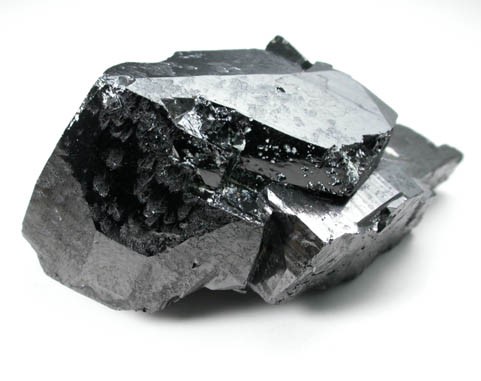
Magnetite

Magnetite

I was around 5 years old, living in Arlington, Texas. My dad found me in the yard digging a big hole. He asked what I was hoping to find, and I told him I was digging for gold. He redirected me to another part of the yard and showed me how to gently scrape and brush away the top layer of soil using a whisk broom. As I brushed away the dirt, a big hunk of silver was exposed. Looking back, it seems like it was magnetite. I think he planted it there, but at the time I was entirely amazed!

Dad passed away at the beginning of school this year. I’m glad to have good memories like us digging for gold. As funerals tend to do, his brought the family together, allowing me to reconnect with siblings and other family members that I have not seen in years.  It’s a good thing, but all of the events related to the reconnection and all of the events related to the start of school have made it hard for me to remember the details of the summer trip.

Granger has been extremely busy since school began, but I asked for his impressions of this leg of the trip.  Thank goodness, or I wouldn’t know what to write at this point except: Yay! Breakfast in bed at Garden of the Gods Resort!

GARDEN OF THE GODS: SLIDESHOW | MOSAIC

The view from our room (click photo for slideshow)

When we finally arrived at Colorado Springs, we were amazed by our spacious, well furnished room with a gorgeous view of the huge red rocks of Garden of The Gods. The resort was immaculately landscaped and well tended by the many rabbits that hopped around the grounds nibbling the vegetation.

That night we had a romantic dinner out on the patio of the on site restaurant with a view of Pike’s Peak as well as the Garden itself. The next day, we had breakfast delivered to our room. I had some scrumptious pancakes with all kinds of berries on top.  Fancy schmancy! I don’t like berries, so I scraped them off. Granger had his regular fare of scrambled eggs and bacon.

Our Hike at the Garden of the Gods

After filling up on a hearty breakfast, we hiked the Garden of the Gods. Granger chose to avoid the asphalt trails that were crowded with people and, instead, opted for the red dirt horse trails. The trails weren’t great due to the heat and the horses (along with their litter). Granger was glad he’d gotten a map, as the trails were numerous. We got a two-mile hike out of it anyway. And of course, I collected a few interesting rocks and snapped photos of the flowers there.

Wendy at the Garden of the Gods

Later we drove up to Manitou Springs, which Granger called “Eureka Springs on steroids.” He was interested in an intimidating, long, steep trail up the mountainside. It didn’t interest me! We got out and about too late to visit Maramont Castle; that will have to wait for a future trip.

The next day we would kick rocks* and travel to Monument Rocks in Kansas.

*Granger: Wendy’s lingo sometimes leaves me consulting Urban Dictionary; “kick rocks” means to move on, walk away, or leave.

An Engagement Out West, Part 6: Monument Rocks >

An Engagement Out West, Part 4: The Silver Thread

Posted in day hike, photos, travel, Wendy | Leave a comment

An Engagement Out West, Part 4: The Silver Thread

Trip Dates: July 17-18, 2015

This is the fourth in a series of posts about our July 2015 vacation out west. Wendy is composing these posts while I handle the photos and maps. Enjoy!

-Granger

Wendy's Post

Wendy’s Post

On July 17th we left peaceful Pagosa Springs and headed toward Gunnison. We crossed over Wolf Creek Pass and then turned at South Fork onto the Silver Thread, a scenic 120 mile stretch of highway 149. Scenic indeed!

Silver Thread through Colorado (click map for slideshow)

SLIDESHOW | MOSAIC

Along the way we saw clear rivers and fields blanketed in wildflowers. We cruised through Creede and stopped to stretch at a pullout where you can see the mountains which create the headwaters of the Rio Grande. Around 50 miles into the trip on the Silver Thread, we pulled over at North Clear Creek Falls for another break. No waterfall was visible from the road, but we were amazed at the power and beauty of North Clear Creek Falls, where the creek plunges a little over 100 feet, heading toward the Rio Grande. The roar of the rushing water was deafening, and I was in awe of the powerful force of the water. I cautiously made my way through the rocks to get closer to see the raging stream down below. It was quite a drop. Granger was happily climbing around on what I thought to be precarious perches, snapping photos of this monster of a waterfall.

North Clear Creek Falls

We then drove 25 miles to Lake City. On the way, we stopped at Windy Point Overlook. While gazing at the snow-topped “fourteeners” (mountains that are over 14,000 ft tall) in the distance, we listened to the quiet rustling of the aspen trees. Then Granger remarked, “You know, Al Packer ate people up here.” What a romantic!

As we continued our trip, we saw more breathtaking terrain. There were many steep climbs, sharp curves, and switchbacks. We stopped along the road high above the emerald colored Lake San Cristobal and drove through Lake City.

Lake San Cristobal

Then we drove alongside the Lake Fork of the Gunnison River to Blue Mesa Reservoir, Colorado’s largest lake. From there, we headed east toward Gunnison, from which we planned to drive over to the Black Canyon of the Gunnison the next day.

Warning Signs

On this almost 200-mile trip, we saw many road signs that indicated animal crossings, sharp turns, and falling rocks. So along with all of the scenic beauty came danger. One of those yellow diamond signs should have predicted a gut-wrenching time in Gunnison, as Granger got a bad case of food-poisoning. We ate at Anejo’s, where Granger had really enjoyed the food on a previous trip. The food was just okay this time, and I think his beef fajitas were a little on the rare side. Granger was seriously ill for over 24 hours. I did my best to make him comfortable. He wouldn’t take any medicine for the symptoms, saying that doing so would make it worse. “I just need to let my body fight this stuff off naturally and get it out of me,” he said.

For the first time ever, he let me drive his car so I could go to town and get supplies. Since it was a rainy day, it was the perfect day for me to learn how to drive his car, since I often got the gear shifter mixed up with the windshield wiper mechanism. I stopped at Dollar General and picked up bland foods like crackers and butter cookies. I also got some Gatorade as well as some ice pops that were already frozen. This is why I like Dollar General – they’re cheap, easily accessible, and they’ve added a frozen section. Just about anything you need from Wal-Mart you can get at Dollar General, and you won’t have to walk 10 miles to get it.

Ice Pops

Ice Pops

Granger was delighted with the ice pops, Gatorade, and crackers. Over the course of the day, he slowly improved. When he asked for his fifth ice pop, I knew he was going to make it. The next day we eased our way eastward to the Garden of the Gods.

Click here for a slideshow from this part of our vacation

An Engagement Out West, Part 5: Ruby Mountain & Garden of the Gods >

An Engagement Out West, Part 3: Pagosa Springs & The Cumbres and Toltec

Posted in photos, travel, Wendy | Leave a comment