Yesterday I posted about how my various websites are a mix of hand-coded HTML and hosted free services. Google Sites offers an option to “Automatically adjust site to mobile phones” which will try to sort things into a single column and scale the graphics accordingly. That works fine on a simple site like the news sites for the high school and district as well as the district technology support site. But the more complex BruinBond.com I created for bond projects looks terrible on a phone screen when I enable that setting.
This MEADOR.ORG site is mobile-friendly, with the menus and sidebars tucked away and posts converted into a stream of text interrupted by same-size embedded images. But the complex sites I coded for the high school and the school district are NOT mobile-friendly. The high school site’s design dates back to 2009 and the district’s to mid-2012. The way folks are accessing those sites have shifted considerably over those time frames, as we’ll see below.
Zooming in on the district site makes navigation difficult
You can zoom, but can you navigate?
Granted, both of those multi-column sites with headers and footers are coded with Cascading Style Sheets (CSS), which means they have a logical structure (created by DIV tags) which mobile browsers can interpret for smart zooming. I can tap on those sites and my iPhone knows which column or graphic to zoom in on. But zooming in means you can no longer operate the navigation menus without a lot of scrolling or going back to the tiny un-zoomed view. That is a real pain on a tiny phone screen.
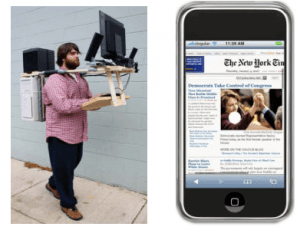
Now most people are mobile when surfing the net
The shift toward mobile web browsing
The rapidly expanding use of smartphones for web browsing means that websites designed only for use on personal computers and large tablets are no longer serving the public well. At the start of this year, mobile apps overtook PCs in U.S. internet traffic. Nielsen supports that finding, with its data that U.S. adults now spend an average of 34 hours per month using the internet via smartphones, while spending only 27 hours per month using the internet with a PC.
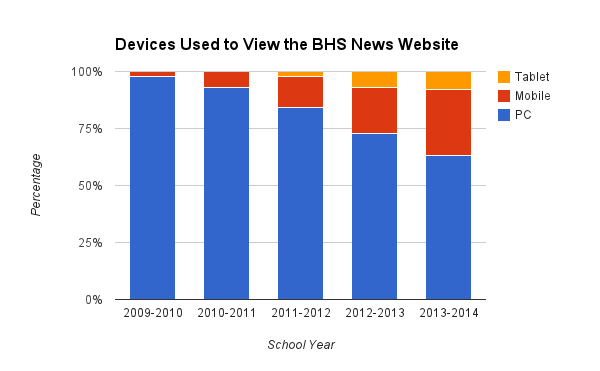
We don’t have good analytics on our main sites, which are hosted locally. But I have run Google Analytics for years on the high school’s separate news site. A review of that data shows a dramatic migration to mobile devices. Four years ago, only 2% of visits were made using a mobile device. Last year 29% were on what Google terms a mobile device, plus another 8% were on tablets. So our existing websites are probably not easily navigated by 29% to 37% of the viewers.
Our audience is shifting to mobile devices
Schools are hardly speed demons when it comes to technology, but eventually we do react. The ever-increasing prevalence of students with smart phones is an indicator every teacher is aware of, but the web statistics show just how much things have shifted in the past few years. That convinced me we had to change our sites to be more mobile-friendly. The challenge was how to accomplish that despite a non-existent budget and my own unfamiliarity with mobile-friendly site design. My next post is about my search for a solution.
This post is a long history of my website development efforts in the school district where I work. I provide a thorough overview of the websites I maintain and how they are hosted and coded. This nerdy navel-gazing retrospective was triggered by the several weeks I spent this summer coding mobile versions of the websites for our school district and high school. This the first of five consecutive blog posts in which I elaborate on that coding adventure.
Frankly, while this history is of interest to me, it really might not interest you. So if you don’t relish reading about every website I run and how it is hosted and some background on why I use various services and software, please feel free to click away from this post. If you’re into visuals, you could pick out a set of my travel photos to peruse. Or check out the big multi-post summer trip travelogue about the trip Wendy and I took along Route 66 this summer, which is chock full of scenery and art.
Okay, that pared things down to the truly nerdy, right? Here we go!
My 1989 bulletin board machine
It Started as a Hobby
I have been hand-coding HTML websites for almost two decades, and before that ran a couple of primitive dial-up bulletin boards dating back to the early 1980s. The only computer courses I ever took were a high school course in BASIC in the early 1980s and a college course in FORTRAN in the mid-1980s. So I acquired my knowledge of HTML from trial-and-error coding based on the source code at various websites, various web tutorials, and good tips back in 1998 from Vincent Flanders’ books based on his venerable Web Pages That Suck website.
I learned HTML by doing, not studying. But learning how to improve and update my code with CSS (cascading style sheets) was another matter. Its nesting and different cascades of styles was bewildering until I picked up and carefully read David Sawyer McFarland’s CSS: The Missing Manual back in 2006. I was using the first edition of that book; I see he’s up to the 3rd edition now and I’ll bet it is just as invaluable.
I recommend this book for learning CSS
I’m hardly a CSS expert, but I can figure out what is going on eventually. It became much easier to cope with when I shifted from an old web editor to Adobe DreamWeaver CS6. I’ve only tapped part of the power of that program, which has many tools to help you figure out what to do and, perhaps more important, what has gone wrong in your code.
But for some websites coding everything by hand is not necessary, or even the wise thing to do. I have written before about my evolving personal websites, with me eventually switching from a hand-coded website, hosted by my cable provider, to the Blogger service and then finally to WordPress.com in 2008. Using the blog services makes creating posts far easier than hand-coding, and I don’t need fancy layouts for blog posts. So long as I can plop in and scale to my liking some linked photos with the text, I’m set for blog posts. I’m still quite happy with the existing design of MEADOR.ORG and the editing capabilities and free hosting at WordPress.com, but I know that someday this site will need another overhaul. But hopefully that is far in the future.
Now It’s More Than a Hobby…A Bit More
I’ve created many websites over the years; some were for my personal hobbies like local history, and several were pro bono public services for local foundations and the like. But I am actually paid to code and update only two websites: the ones for the Bartlesville Public School District and also for Bartlesville High School. Mind you, I’m not paid much for those duties at less than $7 per day for them both, but something is better than nothing for us woefully underpaid classroom teachers in Oklahoma.
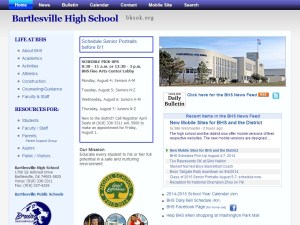
The high school’s homepage
I took over the high school website back in 2004 and have fully re-vamped its look a couple of times, with the last major overhaul back at the start of 2009. Back then I thought I might shift the site to a free hosted service, such as Google Sites, but in the end I only used Google Sites for the news items at the school, since several have to be posted each week. I like the ability to have a scrolling feed of posts on the homepage which visitors can select from.
In February 2012 I did set up a full website via Google Sites, one devoted to instructional technology support for the district’s teachers. That superceded a long series of hand-coded help pages I’d created over the years on the high school site.
A Coder, A Coder, My Website for a Coder
The district’s homepage
Back in 2011-2012, the district’s volunteer webmaster left; yes, the district website was being done pro bono by a helpful district technician. The district’s continuous budget woes meant that it still did not want to invest in a managed content website from a provider like SOCS; we still leave that to richer and bigger districts like Jenks. So the district’s website stagnated and by the end of that school year I was desperate for an update – desperate enough to roll my own version in HTML.
Without anyone’s prompting, I coded a new version of the district website and presented it to the administration. They adopted my replacement version and the very sweet school board members bought me a sizable gift card out of their own pockets. Remember, school board members in Oklahoma do a lot of work for zero pay; most are as altruistic as the teachers they employ.
To its credit, the district then managed to start paying me a stipend for maintaining the district site. That goes along with the stipend my principal pays out of her site budget for me to run the separate high school website. Those stipends have enabled me to keep making steady refinements to the sites and keep up with the many changes in documents and links which everyone needs done.
Out-of-Pocket if not Out of My Mind
Wouldn’t you rather code on this?
Mind you, the district is so underfunded and Oklahoma school finance so restricted that I still am out-of-pocket some expenses. State school finance laws meant that I could only use a district-provided copy of the Adobe Dreamweaver website development software at home if I restricted myself to using it on a years-old school laptop. That’s hardly appealing when I am used to coding on my decent home desktop machine using a 24″ main monitor for coding and a smaller adjacent monitor for previewing. So in September 2012 I spent $179 out of my own pocket to purchase a home copy of Adobe Dreamweaver CS6. I’m still relying on it because Adobe has gone to a subscription model and no longer sells stand-alone copies of DreamWeaver. I’d need their Creative Cloud bundle to get DreamWeaver updates, and that carries a regular price of $30/month. Even with my educator’s discount, it would cost $20/month, meaning I’d have to shell out over 10% of my annual webmaster pay to have the Creative Cloud on my home machine. My webmaster pay is too little to take that kind of hit, given that I’m already shelling out $90/year for my personal subscription to Microsoft 365 for use on my Windows desktop, Macbook Air laptop, and iPad tablet computers.
Why Not Use Cloud Services?
Most of our district sites have switched to MyBigCampus
So the extremely limited budget means that I’m sticking with my old DreamWeaver and free cloud services to keep our sites running. This summer, tired of hand-coding the homepage’s news items, I set up a district headlines site via Google Sites as I had done previously for the high school. And our district’s Instructional Technology Teacher Specialist has been training the elementary and middle schools’ volunteer webmasters to migrate their school websites to the MyBigCampus service our district gets with its LightSpeed internet services contract.
MyBigCampus is far too limited to be used to replace my existing high school and district websites, and while I could try to approximate them in Google Sites, the design limitations and storage restrictions would be onerous. So I’m still hand-coding the suckers. Eventually I suppose the district will pay for a managed-content system that not only makes building and maintaining the district and school websites easier, but more importantly provides teachers with easy ways to build their own course websites and calendars. But until then we’ll be using Google Sites and Weebly and MyBigCampus and the like.
I use Google Sites for the local teachers’ union website
I use several free cloud services for website hosting and development. Google Sites not only handles the district news and technology support sites, but also the site for the local teachers union. Facing a slew of curriculum revisions, I’m thinking of shifting the old hand-coded Science Department website over to Google Sites as well.
There are also more advanced for-pay services out there, such as SquareSpace with its mobile-responsive design and drag-and-drop interface. The catch there is the for-pay part.
BUT…I did learn a lot of new HTML over the past few weeks. Why and how? Because I decided to bite the bullet and tackle a shortcoming of my district and high school websites, one which was becoming very problematic in this age of smartphones. I needed to create mobile-friendly, touch-friendly versions of each site. And I did not know how to do it. So I learned how to do it the way I acquired most of my knowledge of HTML…by playing around with the editor software, scouring the internet for ideas and examples, and doing a heck of a lot of trial…and error.
My next post addresses WHY I needed to tackle this issue; later we’ll get to HOW.
The day after our climactic day hike and flamenco performance, Wendy and I took it easy in Santa Fe. We had an unappealing breakfast at the Flying Star Cafe in the Railyard and walked to the plaza. A stop along the way at the Hilton let me shoot a nice piece of corridor artwork. At the plaza we indulged in cookies and a shake at the Häagen-Dazs. Then we found a place to sit at the plaza amidst beautiful blooms. Wendy tipped a beautiful busker who was playing “Yesterday” and “Blackbird” on a guitar.
I’d considered finally walking along the famous Canyon Road and its galleries, which I’ve never seen, but it was a Sunday, and I figured they might be shut. So I saved that for a future trip and instead walked with Wendy along the northeastern part of the Paseo de Peralta, an old street which encircles downtown. I liked seeing some of the old buildings. It was a sign of the times that the grand old Scottish Rite Temple was up for sale; its 1901 Moorish Revival look doesn’t blend too well with its surroundings, but it is a striking building. Declining membership means the local chapter lacks the cash flow to maintain it.
Out in front of City Hall we passed the statue of St. Francis and his often-petted prairie dog. The saint appears in various places about the city, which was originally called La Villa Real de la Santa Fé de San Francisco de Asís (The Royal City of the Holy Faith of St. Francis of Assisi).
We passed a VW Westfalia camper, something my father would appreciate, on our way back to our casita. My head ached, so I went out for a stroll around the block, finding a statue at the adjacent hotel of a Hopi maiden sporting immense squashblossom whorls. Princess Leia had nothing on her!
Dinner was a delicious pizza at the adjacent Café Café, followed by us relaxing on our patio for our final evening in Santa Fe.
The tenth day began with a wonderful early lunch at Tia Sophia’s downtown. I had beef tacos with Spanish rice, and Wendy loved the tender chicken in her green chile chicken enchiladas. She reported the tamales were good and spicy, if a bit grainy. We enjoyed sopaipillas and honey, bemoaning the fact that we would be leaving behind the wonderful food of New Mexico. Wendy posed for me in a downtown walkway, our last shot in Santa Fe.
Princess the Camry took us southeast to the old Cline’s Corners tourist stop off I-40. The most notable thing was a tremendous collection of horns on a wall. After refreshing ourselves, we headed due east on I-40 back to Amarillo. We pulled off in Santa Rosa to see its famous Blue Hole, an 80-foot-deep pool of 61-degree water which had attracted a number of swimmers. Wendy noted how clear the outflow was.
Just past Santa Rosa, the interstate divides the ghost town of Cuervo; Wendy thought it must be a fake ghost town or movie set, considering the oddity of driving through it on an interstate. But Cuervo is quite real, as are other ghost towns like Endee, Bard, and San Jon. We were puzzled by the names, but they made sense when we found out Endee got its name from the old ND ranch and Bard was probably a ranch name as well: the Bar-D, which reminds me of the chuckwagon show I saw in Durango back in 2011.
We had dinner at the yummy Blue Sky Burgers in Amarillo. Our evening entertainment was Errol Morris’s memorable documentary The Thin Blue Line, which saved a man from death row.
The final day of our trip was a long drive back to Oklahoma City to have dinner with my folks and then onward back home to Bartlesville.
We began with a great breakfast near our hotel in Amarillo at Ye Olde Pancake Station. Before we left Texas, we pulled off I-40 to take old Route 66 through Shamrock to drive by the restored U Drop Inn, which frankly is the best-looking thing in town. Shamrock, like so many other towns along old Route 66, has been bypassed by the interstate and suffered mightily for it.
The sun was setting as we drove up US 75 to Bartlesville, glad to be returning home, but also wishing that we could spend more time having Kicks on Route 66.
The eighth day of our big summer vacation was the climax. Or should I coin the term “climbmax” since we ascended Kitchen Mesa at Ghost Ranch?
My first hikes at Ghost Ranch in June 2012 were stunning, and I outlined the history of the property in that post from two years back. I loved both the Chimney Rock and the Box Canyon trails, but did not have time to try the third major trail, which leads up to the top of Kitchen Mesa. A year later, I took Wendy out to the ranch, and our hike in Box Canyon was her favorite out of all of the different hikes during our first year of dating. So it was obvious that we had to go out to Ghost Ranch this time to hike together up Kitchen Mesa, the rounded and candy-striped mesa looming over the main buildings.
We knew the hike would be challenging for us, since we are acclimated to an elevation of 700 feet above sea level, and this four-hour hike through hot desert terrain would climb from 6,500 to 7,100 feet. That included a 15-foot scramble up a cleft in the mesa to reach the top, and the uneven terrain meant we actually had a total ascent of over 1,200 feet.
So we got around early to hit highway 84 north for the 63 mile drive up to Ghost Ranch. We stopped along the way in Española for breakfast at a McDonald’s. We reached the ranch by 9:00 a.m. and checked in, paying the minimal day use fee. A friendly docent warned us about the cleft we would have to navigate to reach the mesa top and provided directions to the trailhead, which is adjacent to the trailhead for the Box Canyon hike we did last year. This time we avoided the long roadside trudge from the Welcome Center to the trailheads by driving around to park at them.
As we headed out, our target was directly ahead, backlit by the morning sun. We climbed to a hillside which offered a panoramic view north across the greenery of the Rito Del Yeso arroyo. To the right was the mesa below which one will find the ranch’s Camposanto area, which we had seen the previous year along our Box Canyon hike.
Dinosaur Quarry
We crossed over into the ranch’s dinosaur quarry in the red siltstones and mudstones laid down 205 million years ago in the Late Triassic Period, the beginning of the Age of Dinosaurs. Back then this area was about 1800 miles farther southeast of its present location, putting it near the planet’s equator. 95% of the fossils found were of the small carnivorous dinosaur, Coelophysis. It was 6-10 feet long and weighed 50-100 pounds.
Helpful signage explained the layer cake we saw in the rocks around us. The grey layer atop the cliffs is the Todilto Formation of saline sediments deposited by an inland sea in the late Middle Jurassic Period. The orange and yellow cliffs below it are sand dunes of the Entrada Formation, laid down in the Middle Jurassic about 160 million years ago. The rosy-colored mudstones and siltstones of the cliff base are the Chinle Formation deposited about 205 to 230 million years ago. It was in that period that hundreds of Coelophysis were buried, probably in a flash flood.
Another sign explained that David Baldwin discovered bones in 1881 and mailed them to paleontologist Edward Drinker Cope, who had been through the area earlier and named the fossils Coelophysis bauri. Coelophysis means “hollow form” and refers to the lightly constructed bones, while the rest of the name honors Georg Baur, a German morphologist. In 1947 a field crew discovered a dense bonebed of hundreds of skeletons in the area and excavated large blocks of rock, each containing numerous whole and partial skeletons. In 1981, a century after the initial find, the blocks were collected by various institutions.
It was while Wendy and I were crossing a dirt ridge in the quarry, breathing heavily in the thin and hot air, that a petite tanned mother with two children merrily scampered by. They would go up to the top and be on their way back down even as we low-landers were still slowly ascending the mesa. Rather than being discouraged at our relative difficulty, I took heart that if they could make it up there, then we surely could!
We followed the trail across the mesa top and reached the first overlook. Venturing out there provided a stunning view southwest across the Piedra Lumbre. To the north of the Cerro Pedernal mesa, which Georgia O’Keefe was so fond of painting, was a storm cloud spilling rain onto the desert. I hurried over to the edge to shoot a panorama, with the greenery around the Ghost Ranch buildings far below to my right. Farther to my right I could see the eroding layers of the mesa, with the grey saline sediments on top and the compressed orange and yellow sand dunes below that.
The surface changed to the grey saline sediment. Being surrounded by that surface seemed unearthly and strange; Wendy described it as a lunar surface. She was fascinated by the white rocks with black veins and the mica glittering in the sun. A lizard scuttled by, and the final overlook we enjoyed provided a sweeping view of the ranch buildings below and the green vegetation along the course of the Rito del Yeso creek.
Back Down We Go
The rain was approaching; it was time to head back. We traced our way back across the mesa top to the cleft and carefully descended. We were glad to be headed downslope in the heat, passing cholla cactus blooms. Wendy had frozen water in our bottles back at the hotel, a great idea which provided us with cool water throughout the hike. As we passed the huge chunk of rock beside the trail we’d seen earlier, with shattered wood beneath it, I speculated about which cleft in the side of the cliff it had come from.
As we walked, we were bracketed by storms. Dark clouds to the east produced a few flashes of lightning and rumbles of thunder, while approaching from the west was the rain storm. Up on top of the mesa, where I could get cell phone reception, I’d checked the NOAA Radar US app and knew the storm to the east was moving away, but the one from the west would eventually arrive over Ghost Ranch.
We returned to our car, and raindrops began spattering down as we cleaned up and drove back over to the Welcome Center for restrooms and ice cream. A tour was leaving, taking folks to the settings of various paintings by Georgia O’Keefe to compare what they would see with what she captured on canvas. We should take that tour some summer. As we neared the end of today’s trail, I spied the top of Chimney Rock jutting up above the countryside. Although I hiked over to it in 2012, Wendy has not been on that trail.
So we shall certainly return to enjoy the hospitality of the Presbyterians who make these wonders accessible to all. I close this remembrance of our visit with a shot of cholla blooms in front of the distinctive flat top of Cerro Pedernal. Georgia O’Keefe painted that mesa many times:
It’s my private mountain. It belongs to me. God told me if I painted it enough, I could have it.
In a way, she got that wish; Georgia’s ashes were taken to the top of Cerro Pedernal and scattered there.
Capitols of Santa Fe
Tired but happy, we returned to Santa Fe and relaxed before heading out for an early dinner. Wendy clearly wanted more of those “best tamales EVER” at Tomasita’s, and we found it was already crowded at 4:15 p.m. The food was great, and we enjoyed people-watching. To walk off our dinner, we ventured over to see the state capitol.
We’d passed through the original capitol of these lands, the old Palace of the Governors on the plaza, a few days earlier. And we had repeatedly passed the “Bataan Building”, with its distinctive tower, on our way to and from the plaza. It opened in 1900 as a cheap replacement for an expensive territorial capitol, which had burned after only a few years of use. The simple three-story box with a modest silver dome grew over the years, and the dome was replaced by the 105-foot tower in 1950. But in 1966 a very different capitol building superseded it, and the old capitol became the Bataan Memorial Building, named to honor members of the 200th Coast Artillery that served bravely – and met a tragic fate – during the infamous battle and subsequent “Death March” of 1942, in the Philippines.
We were curious to see the adjacent replacement capitol, which is quite inconspicuous. As we negotiated the sidewalks to reach it, Wendy discovered another small rose garden, this one nestled amidst the government buildings. She was impressed by the height of several of the bushes. I was more interested in the panels on the nearby Education Building, which had figures in extreme poses.
The grounds of the capitol itself have been described as, “a lush 6.5-acre garden boasting more than 100 varieties of plants, including roses, plums, almonds, nectarines, Russian olive trees, and sequoias.” But the areas we saw appeared neglected and unappealing. We came across Michael A. Naranjo’sEmergence sculpture, which I am not fond of; it makes me think of a game with a hula hoop. We also saw Doug Hyde’s Buffalo Dancer, which was squat and somewhat comic to me.
I was equally cranky about the new state capitol, a three-story roundhouse which is unique among state capitols and hopefully will stay that way. Wendy, however, was in a playful mood. Inspired by our plan to see flamenco dancing that evening, Wendy stuck a rose in her hair and posed by Glenna Goodacre’s sculpture of two boys playing tug of war with three girls.
Entreflamenco
When planning this vacation, I had considered a performance of Carmen at the Santa Fe Opera. But the tickets were quite pricey, and a long four-act Italian opera hardly seemed in the southwest spirit of our trip. So I was happy to see a listing for Entreflamenco‘s performance in the Maria Benitez Cabaret Theatre at The Lodge at Santa Fe. I had never seen flamenco dancing except on video, and was hoping for an enjoyable evening. Wendy was interested yet skeptical. As it turned out, the performance was riveting, and we were so close to the action that we could see every detail, even the sweat flinging and feathers flying off the incredible dancers.
The stars of the show were Antonio Granjero and Estefania Ramirez. Wendy described Antonio as, “a macho Fred Astaire on crack” with his incredible speed and dramatic gestures and poses. He presented as cocky, powerful, and intense. His performance with Estefania began in an embrace, with graceful movements and then a walk apart on the stage to begin their foot-stomping and elaborate separate dances, to finally end in another embrace. His solo finale included incredibly fast and precise foot tapping and much more. Wendy wrote, “He worked like hell and then swaggered to the foot of the stage, nodded to the audience, and said ‘Hey’, followed by huge applause.”
Estefania Ramirez was incredibly intense, with a slight grin only fleetingly crossing her focused face. One dance was in a white dress with red fringe and Wendy aptly described her performance as, “Sassy, intense, very sexy, and confident.” In her guajira performance, she flicked a fan open and closed and back and forth with incredible precision, a very long skirt flipping and swinging. I could barely imagine someone even walking in such a dress, let alone dancing so energetically. Eventually two other female dances joined in, their movements precisely matching her lead.
There were altogether three other female dancers besides Estefania. A blonde resembled Scarlett Johansson, another dancer was slightly reminiscent of Frida Kahlo, and the third was very Indian in appearance and a bit less sheltered in her expressions. All four female dancers danced together near the start of the show, dressed in wonder-bread-like dresses with bright colorful fringed shawls.
Each of the dancers took his or her performance very seriously, and occasionally we spotted some modern moves in the mix. The experience was intense and emotional, with us sitting in the very front, only a couple of feet from the edge of the stage. Wendy said she could smell the sweat as they performed their intricate high-intensity dances with perfect timing and the flicking of precise gestures. She commented, “Our sweat from the hike at Ghost Ranch was nothing compared to the amount pouring off the dancers.” It was not at all off-putting, but made the experience all the more intense to see, up close, how hard they pushed their bodies in their demanding art.
This fun-filled day was the climax of our trip; we would spend the next day relaxing as we recovered. One more post will close out this travelogue along Route 66.
Last year our stay in Santa Fe was too brief to take Wendy through the small yet wonderful New Mexico Museum of Art. I made sure we visited that, as I love its architecture. It is a Pueblo Revival building, and it influenced the eventual Historical Zoning Ordinance, which mandated the use of the Pueblo style or Territorial Revival style on all new buildings in central Santa Fe. We relaxed in the courtyard, which is my favorite spot in Santa Fe, before viewing the galleries. Many of the paintings reminded Wendy of the style of El Greco and Van Gogh.
International Folk Art
We then walked back to our hotel, passing a fun wall mural along the way. Princess the Camry transported us up Museum Hill to the Museum of International Folk Art. I was lucky enough to see it in 2010 during the annual International Folk Art Market, and knew that Wendy would be fascinated by the intricate pieces in the museum’s Girard collection, which I saw in 2011.
We were greeted at the entrance by an American Indian with a beautifully resonant voice; he clearly was radio-trained. The Girard collection was our first stop, with us picking up the requisite guide book at the entry to identify the pieces on display (yes, I failed to look up that pictured piece). Wendy was prowling for beadwork to photograph and share with my mother, who makes lovely bookmarks with tiny number 11 beads. Wendy found an airy floral grave ornament made for a child’s grave in the Père Lachaise Cemetery in Paris, with strands of beads wound around a latticework. She also located a group of beadwork dolls, of various sizes, from New Mexico and Arizona in our country as well as from Africa’s Cameroon, Zambia, Zimbabwe, South Africa, Swaziland, and Ghana.
I plopped down on a bench to rest my back. As I gazed across the displays opposite me, I had to laugh at the one which caught my eye, a sexy piece of urban African art which Alexander Girard found on the island of Gorée, near Dakar, Senegal. I liked the title he gave it, Once Upon a Time There Were Two Twin Sisters. Make up your own story from there!
We then toured a temporary exhibit of costumes from Brazil. The story behind the Porto Rico Maracatu Nation Queen costume was a bit chilling; the carnival clubs in Recife, Pernambuco trace back to the early 1800s when plantation owners organized their African slaves into “nations” by tribal origins. As part of the Christmas season entertainment, these groups performed dance pageants for the plantation, dressed as members of the Portuguese royal court and dancing to African drumming in polyrhythms called maracatus. That’s a dark history behind a lively and beautiful custom.
There was also an African lancer, called caboclos de lança, representing warriors possessed by Amerindian or African spirits. The performers dance, drop to the ground, and sometimes duel with each other while wearing large cowbells on their backs. A carnival bear costume was another matter entirely, tracing back to Italian gypsies who arrived in northeastern Brazil to work in the sugar mills. Some brought with them trained bears who performed in small traveling circuses, but the bears did not last long in the tropical climate, prompting people to create costumes for dancing bears along with Italian trainers and a hunter. Another exhibit had a variety of colorful Japanese kites.
We stopped at a K-Mart for supplies and had dinner at The Pantry, the decades-old establishment where I had breakfast back in 2011. We both indulged in turkey, with me having an open faced turkey dinner and Wendy eating a turkey sandwich.
As we drove back to our casita, Wendy the rose enthusiast spotted a rose garden in the Railyard Park. We had to stop, of course, and she scampered about, admiring and identifying the bushes. There were red blooms, pink and yellow ones, tight pink clusters, and some pink and yellow blooms with oodles of petals. She was in heaven and said she could spend a happy day tending the bushes.
But we had a big adventure coming up: a challenging hike at Ghost Ranch and an evening with a close-up view of incredible flamenco dancing. Our Kicks on 66 trip would reach its climax on Day 8.

















 Meador Manor
