Last year our stay in Santa Fe was too brief to take Wendy through the small yet wonderful New Mexico Museum of Art. I made sure we visited that, as I love its architecture. It is a Pueblo Revival building, and it influenced the eventual Historical Zoning Ordinance, which mandated the use of the Pueblo style or Territorial Revival style on all new buildings in central Santa Fe. We relaxed in the courtyard, which is my favorite spot in Santa Fe, before viewing the galleries. Many of the paintings reminded Wendy of the style of El Greco and Van Gogh.
International Folk Art
We then walked back to our hotel, passing a fun wall mural along the way. Princess the Camry transported us up Museum Hill to the Museum of International Folk Art. I was lucky enough to see it in 2010 during the annual International Folk Art Market, and knew that Wendy would be fascinated by the intricate pieces in the museum’s Girard collection, which I saw in 2011.
We were greeted at the entrance by an American Indian with a beautifully resonant voice; he clearly was radio-trained. The Girard collection was our first stop, with us picking up the requisite guide book at the entry to identify the pieces on display (yes, I failed to look up that pictured piece). Wendy was prowling for beadwork to photograph and share with my mother, who makes lovely bookmarks with tiny number 11 beads. Wendy found an airy floral grave ornament made for a child’s grave in the Père Lachaise Cemetery in Paris, with strands of beads wound around a latticework. She also located a group of beadwork dolls, of various sizes, from New Mexico and Arizona in our country as well as from Africa’s Cameroon, Zambia, Zimbabwe, South Africa, Swaziland, and Ghana.
I plopped down on a bench to rest my back. As I gazed across the displays opposite me, I had to laugh at the one which caught my eye, a sexy piece of urban African art which Alexander Girard found on the island of Gorée, near Dakar, Senegal. I liked the title he gave it, Once Upon a Time There Were Two Twin Sisters. Make up your own story from there!
We then toured a temporary exhibit of costumes from Brazil. The story behind the Porto Rico Maracatu Nation Queen costume was a bit chilling; the carnival clubs in Recife, Pernambuco trace back to the early 1800s when plantation owners organized their African slaves into “nations” by tribal origins. As part of the Christmas season entertainment, these groups performed dance pageants for the plantation, dressed as members of the Portuguese royal court and dancing to African drumming in polyrhythms called maracatus. That’s a dark history behind a lively and beautiful custom.
There was also an African lancer, called caboclos de lança, representing warriors possessed by Amerindian or African spirits. The performers dance, drop to the ground, and sometimes duel with each other while wearing large cowbells on their backs. A carnival bear costume was another matter entirely, tracing back to Italian gypsies who arrived in northeastern Brazil to work in the sugar mills. Some brought with them trained bears who performed in small traveling circuses, but the bears did not last long in the tropical climate, prompting people to create costumes for dancing bears along with Italian trainers and a hunter. Another exhibit had a variety of colorful Japanese kites.
We stopped at a K-Mart for supplies and had dinner at The Pantry, the decades-old establishment where I had breakfast back in 2011. We both indulged in turkey, with me having an open faced turkey dinner and Wendy eating a turkey sandwich.
As we drove back to our casita, Wendy the rose enthusiast spotted a rose garden in the Railyard Park. We had to stop, of course, and she scampered about, admiring and identifying the bushes. There were red blooms, pink and yellow ones, tight pink clusters, and some pink and yellow blooms with oodles of petals. She was in heaven and said she could spend a happy day tending the bushes.
But we had a big adventure coming up: a challenging hike at Ghost Ranch and an evening with a close-up view of incredible flamenco dancing. Our Kicks on 66 trip would reach its climax on Day 8.
Day 6 of our Kicks on 66 vacation was spent away from any of the various routes of the Mother Road, to the northwest of Santa Fe along the El Rio de los Frijoles in Bandelier National Monument and nearby overlooks of the Rio Grande.
We had breakfast at the Santa Fe Motel and Inn, where we were staying. They have traditional rooms but also reworked three historic district adobe houses into casitas. Those feature thick adobe walls, several with private fenced or walled patios, heavy hand-hewn vigas adorning the ceilings, and traditional terracotta tile floors. Our casita was part of the Salazar House, and during our stay we enjoyed sitting out on the front patio, relishing the cool air. Santa Fe’s elevation means it is often much cooler than most of New Mexico, as shown on temperature maps.
Many people grasp that the Rockies in Colorado will be cooler in the summer, but don’t realize that the Sangre de Cristo mountains extend south into New Mexico, so Santa Fe’s elevation is 7,200 feet, and average highs in June and July are only in the mid-80s Fahrenheit, with average lows in the low to mid 50s. The air is dry despite the July and August monsoon rain; during our stay there were small showers almost every evening, but the humidity never felt high. Back home in Oklahoma, Bartlesville at 700 feet would typically have highs in the upper 90s, lows in the mid-to-high 60s, and much more humidity. So Santa Fe is a relief, albeit not as cool as other places I have fled to in summer such as Gunnison, Colorado or the Pacific Northwest.
Bandelier National Monument
We got up earlier than is our norm for vacations so that we could hike at Bandelier National Monument in the morning; it was about a 40 minute drive to White Rock. There we would have to wait for one of the shuttle buses which in the summer transports visitors to and from the monument every half hour. The parking at the monument has been limited since the Los Conchas fire wiped out the bridges over the Frijoles Creek three years ago.
Adolph Bandlier
I am dirty, ragged, and sunburnt, but of best cheer. My life’s work has at last begun.
-Adolph Bandelier
The monument is named after self-taught anthropologist Adolph F.A. Bandelier (hence the spelling variation from the bandolier ammunition strap). He came to New Mexico in 1880 and lived and worked among different American Indian groups, visiting 166 archaeological sites in the area in his first 18 months. In 1880 men from Cochiti Pueblo guided him to their ancestral homes in Frijoles Canyon. He made it the setting of his novel The Delight Makers, which depicted pueblo life in pre-Spanish times. He left New Mexico in 1892 for studies in South America.
Edgar Lee Hewett
Dr. Edgar Lee Hewett, a prominent southwestern archaeologist, directed several expeditions in Frijoles Canyon in the early 1900s and was instrumental in having the monument established in 1916. He is the man who persuaded Maria Martinez to pursue creating black-on-black pottery.
Evelyn Frey and her infant son came to Bandelier in 1925
In 1907 a private lodge was built, and in 1925 George and Evelyn Frey took it over. There were no roads into the canyon until the 1930s; the early lodge was reached by mules. In the 1930s the CCC built a road along with trails, a visitor center, and a new lodge. The Freys divorced, but Evelyn Frey remained at Bandelier and ran the new lodge until it closed in 1976; she lived on at Bandelier until her death in 1988.
But the 1.5 mile hike we took on the re-opened main loop did allow us to see Tyuonyi close up and visit cliff houses stretched along the north side of Frijoles canyon. The shuttle bus was nearly full, and when we finally arrived at the visitor center we paid a few bucks to keep a guide book about the trail and were careful to visit the only working restroom facilities in the canyon before setting out.
Wendy and I passed a large kiva, one of the partially subterranean round rooms which originally had a wood and earth roof with rooftop ladder entry. Some were decorated inside with images, and rectangular holes in the floor may have been foot drums or used for storage or for sprouting seedlings. This large kiva was separate from three regular-sized ones we would see later on in the ruins of Tyuonyi.
The trail leads right through those ruins, concentric rings of small rooms around a central court which housed about 100 people amidst 400 rooms on a few levels. Construction of it began over 600 years ago. You get a better sense of the place from up on the cliffs, which were occupied contemporaneously. Up there the Indians carved rooms out of the volcanic tuff, often building a stone room in front. You can spot the holes for wooden supports.
The tuff is ash flow from the eruption of the Valles Caldera volcano 1.5 million years ago. It toughens as it weathers, and the consequent hard outside and soft inside made it ideal for cliff dwellings. The tiny cave rooms usually have a blackened ceiling to help toughen the tuff.
The last phase of Indian settlement here was the construction of Tyuonyi and adjacent cliff dwellings. The Indians began to practice agriculture around 1200 CE with fields of corn, squash, and beans grown mostly up on the mesas but also down in the canyon. They left this area in the late 1400s, moving on to pueblos along the Rio Grande, some of which are still occupied.
The paved trail ascended to the cliff face where we could visit some of the caves, winding along the cliffside with short stairs to help us reach the undulating dwellings along the cliff face. The trail was busy as folks paused to explore reconstructions.
Below us we could see flood damage from Frijoles Creek, which now roars with mud from the monument lands since 75% of the canyon burned in the 2011 Las Conchas fire. Fire is nothing new to the area, with fires in 1977 and 1996 together burning 40% of the park.
We left the ruins behind and crossed Frijoles creek on a makeshift bridge. I turned back for a look at the cliffs before we hit the beautiful, and thankfully cooler, creekside trail. We opted not to take the side trail to Alcove House but instead turned back toward the Visitor Center.
We saw more flood damage and caves up in the cliffs to the north. Back at the visitor center, we could see more cliff dwellings behind it. We’d enjoyed our hike, but were hot and hungry. So we boarded the next shuttle. Once it dropped us off back at White Rock, we went to The Bandelier Grill. We wanted a break from southwest food, so Wendy had lasagna, and I had a French Dip, but they had mixed green chiles into it. You can’t get all of the southwest out of the food after all.
My 2001 Camry’s CHECK ENGINE light came on as we descended towards Santa Fe. A week or so earlier it came on back home and prompted a thermostat replacement. The temperature gauge wasn’t complaining, however, so we drove into town. I dropped Wendy off at our casita and drove to an Autozone to have the engine error code read. It was low flow on the exhaust gas recirculation. The car seemed to be driving fine, but I took it by the local Toyota dealer to find out how serious the problem might be. They were very kind, noting that with Independence Day and the weekend they wouldn’t be able to fix the problem for several days at best. The lead mechanic told me to just drive the old girl for the rest of the trip and on home to have her fixed there.
Disastrous Dinner
I returned to our casita, and Wendy and I relaxed before walking over to the Plaza to search for dinner. The place was eerily deserted, with tents set up for a big Independence Day pancake feast the following morning. In desperation I made the poor choice of eating at The Palace Restaurant, which turned out to be a former brothel. The menu was odd, and we decided to try several tapas appetizers, but none of them were to our liking.
We were glad to escape the red rooms of the Palace for a cool walk around the plaza. Some cookies and chocolate from the Häagen-Dazs cleansed our palates as the clouds built overhead. We returned to our casita, planning to spend Independence Day seeing a car show at the plaza and visiting area museums.
We spent most of our fifth day directly along old Route 66 in Albuquerque before heading northeast in the afternoon to Santa Fe, with a stop at the ruins of the Kuaua Pueblo in Bernalillo along the way.
Stephen Hawking wrote that he limited himself to only one equation in his bestseller A Brief History of Time, since he was warned that each equation he included would halve book sales. (The physics teacher in me wonders if you can guess which equation he included, and also whispers, “So the number of equations is inversely proportional to book sales.”) I hope something similar doesn’t apply to maps in blog posts, because this post has several, since a sense of place is important to me in this travelogue.
A Day Along Route 66
Much of this day was spent along Central Avenue, the path of old Route 66 through Albuquerque from 1937 until the highway was decommissioned in 1985. But Central’s history dates back to the 1700s or earlier, when it was a dusty trail that evolved into the city’s major east-west street, which then was called Railroad Avenue. Back in the days before tuberculosis was driven back by antibiotics, some sufferers came to Albuquerque for the dry air, and in 1908 the Presbyterian Sanitorium was built. Although Railroad Avenue had been renamed Central Avenue by then, it came to be called TB Avenue locally. With TB brought under control, the sanitorium’s future was in doubt by the 1950s, but it evolved into the Presbyterian Hospital Center, the largest acute care center in the state and sits at the junction of Central and I-25 between downtown and the University of New Mexico.
Before 1937 there was a big kink in Route 66 which diverted it, travelling east to west, from Santa Rosa up to Santa Fe before returning to Albuquerque. That kink is why we can say we spent almost the entire vacation along Route 66, even though in 1937 the kink was straightened out and The Mother Road began to skip Santa Fe, cutting 107 miles off its length. That era brought many travelers along Central Avenue, and the typical motor courts, restaurants, and curio shops to serve them.
Route 66 once went through Santa Fe
Several motor courts are still hanging in there, and we noticed them the day before when we drove several miles east of the Frontier Restaurant, looking for groceries and extending our search to enjoy more of the old route. Today we’d walk a bit along Central before lunch, then head a few miles east to the university district for lunch, then back west a few miles to the oldest part of Albuquerque.
I imagine her asleep inside the Telephone Museum
Downtown District
Our day began in the downtown district on the streets around Hotel Andaluz. We intended to walk over a block or so to the Telephone Museum of New Mexico to satisfy my geeky curiosity. The museum says it is only open from 10 until 2 on Wednesdays and Fridays, so this Wednesday morning was our shot! But, sadly, it was shuttered. Perhaps the reconstruction of the street was to blame, but I like to think there is only one docent, an old grandmotherly switchboard operator, who has fallen asleep inside. If only she had posted her telephone number outside, we could have called and roused her.
So we had to content ourselves with examining the exterior of the KiMo Theatre, a Pueblo Deco movie house constructed in 1927 and designed by Carl Boller and George Williamson. The name was coined by Isleta Pueblo Governor Pablo Abeita, who won a prize of $50 for the name, a combination of two Tiwa words meaning “mountain lion” but liberally interpreted as “king of its kind”. Interestingly, the K should be soft, not hard, so it should be pronounced “him-o”.
Like so many inner city theaters, the place fell into ruin by the 1970s and was slated for demolition, but the city saved and restored it. Wendy and I enthused about the wonderful entrance, with every surface decorated. There was splendid tile work on the floor and walls, nice wall imagery, creative overhead plaster work, and custom doors inviting one in. This is the sort of attention to detail that really sells: don’t you just want to yank those doors open and peek inside? I wish a movie had been showing at the KiMo during our brief stay in Albuquerque so we could have seen the interior in person.
University District
Joe Falkner admitted he was jealous we got to follow his advice to eat at the Frontier Restaurant, and followed up with a recommendation for El Patio de Albuquerque, which is situated in an old house about a block away from the Frontier near the university in the Nob Hill neighborhood. Once again we were glad we followed his recommendation.
David Sandoval, a retired engineer and Vietnam War-era Marine, opened El Patio almost 40 years ago after living in Hollywood. His goal was simple: create a restaurant focused on local cuisine but with an environment that could remain edgy and cool so the place could transcend generations and withstand changes to the neighborhood. David is around 70 years old now, and his restaurant continues to thrive. I enjoyed my tacos and my sopapilla was great, while Wendy says her green chile chicken enchiladas were the best EVER. She stopped to take a photo after a few bites, so I believe her.
Old Town
After lunch we drove back along Central Avenue, past the Hotel Andaluz, to Old Town. My father took me here over 20 years ago, and, at the time, I was not very impressed. My impression was that it was hot, dusty, and old with lots of shops and little else. Well, it was hot on this visit with mostly shops, but it wasn’t dusty, and a nearby museum was modestly entertaining. Let’s face it, Albuquerque is no Santa Fe in regards to the historic district. But it was a worthwhile stop, especially since I made my big art purchase of the summer while I was there.
In 1706 a group of Spanish families settled in the spot, not far from the Rio Grande, organizing their new town in the traditional Spanish colonial way, with a central plaza anchored by a church. So it is reminiscent of the historic district of Santa Fe, with a plaza and gazebo, old church, shops, and nearby museums. Santa Fe’s plaza dates back to 1610 and boasts the Saint Francis Cathedral, which I’ve admired on previous visits to Santa Fe and was built between 1869 and 1886 on the site of an old adobe church. So Albuquerque’s adobe San Felipe de Neri church, which was built in 1793 after the original church collapsed in a rainy summer, is older and less pretentious. The interior is far less ornate than the Santa Fe cathedral. Outside the Santa Fe cathedral is a striking statue of Saint Kateri Tekakwitha, while Albuquerque’s church has the nearby remnant of a cottonwood tree into which a parishioner carved the image of the Virgin de Guadalupe back in 1970.
Wendy and I strolled the shops, but I did not expect to buy anything. I have two expensive framed photographs in my living room from previous visits to Santa Fe, both the work of the very talented Amadeus Leitner. They are both of New Mexican scenery: one is a gorgeous, painterly take on Shiprock and the other a large panorama from Chimney Rock at Ghost Ranch. I wasn’t looking for another large photograph for this trip; in fact, I wasn’t even thinking about purchasing another art work. Until we passed Gallery 8.
Pillow Vase
In the display window was a pillow vase the staff said was by Diane Aragon of the Acoma Pueblo. I’m no fan of pottery, despite enjoying learning about Maria Martinez a day earlier, but was intrigued by this vase’s overall shape, partially serrated opening, the handle hole filled by a suspended spinnable carved ball (which is a distinguishing characteristic of her work), and most of all by the shading of the airbrushed glaze across the incised carving of an eagle kachina dancer, contrasting with the smooth but richly colored reverse. Diane and her husband Wilbert “Junior” Aragon are both full-bloods of my age, with Wilbert coming from the Acoma pueblo.
I tried to be casual as I strolled about the shop, conversing with the very friendly and helpful staff. But I couldn’t help returning to that particular pillow vase, knowing it would look splendid on the mantle above my fireplace, next to my glass “Roots and Wings” sculpture. I asked for Wendy’s preference between two different pillow vases, and she favored the same one I did, which is signed “Orion Aragon, Laguna Pueblo N.M.” That sealed the deal, and soon it was being carefully boxed up for me. It is now adorning my mantle as the third beautiful reminder of New Mexico which I see every day.
Albuquerque Museum of Art & History
Not at all true to life
After dropping off my bundle in the car, we walked over to the Albuquerque Museum of Art & History. Well, it is a little light on both counts, compared to what is on offer up in Santa Fe. Wendy and I were both surprised at the number of visitors roaming about, given the rather limited galleries. A Christo exhibit did not impress either of us at all, since his work is almost entirely large-scale, temporary landscape works. Another gallery had an exhibit about Vivian Vance, famous for playing Ethel Mertz, Lucille Ball’s sidekick on TV. Vivian was born near where I now live, up in Cherryvale, Kansas. She became interested in drama at the Independence, KS high school and rebelliously moved to Albuquerque to become an actress, including performing at the KiMo Theatre we had passed by earlier that day. Vivian’s youngest sister was sitting in the gallery talking to patrons, but I didn’t take the time to ask her about Vivian’s infamous feud with co-star Bill Frawley.
The outdoor sculpture garden was a bust. The only exterior works I liked weren’t in that garden: The Dancer, 1989 by Michael Naranjo, the beautiful stone used for the museum walls, and a decorated entryway into Old Town. But inside the museum’s galleries there were some paintings we liked.
Wendy liked Landscape – Velarde, New Mexicoby Victor Higgins, Santa Fe by B.J.O. Nordfeldt, and Painting #231 by Ed Garman. I liked OU graduate John Fincher‘s “Revlon painting” of The Burning of Albuquerquewith its very bold colors and unsettling plant in the foreground, creating a sense of tension. The coloration, clarity, and context of Ernest L. Blumenschein’s Star Road and White Sun made it a standout, with the younger Taos Pueblo Indian Star Road, in his non-traditional attire, seeming to eclipse the older White Sun, who introduced peyote to the pueblo in 1907. Blumenschein sold this and other “top notchers” to Albuquerque High School for less than a tenth of their value back in the 1940s to support the school’s principal and his efforts to create an art center.
The standout painting, however, full of modern and classic imagery and iconoclasm, was in the corridor of the museum. Patrick McGrath Muñiz filled his 2010 Disneyfication of a Hero with religious, artistic, and pop culture references. Part of his thinking is how we miss some of the iconography in old paintings due to cultural amnesia, so which references in his painting were known in the past and which will be recalled in the future? Wendy and I had a ball finding different references, from Bart Simpson to Bugs Bunny, from Teletubbies to the Death Star. There are references to the Pharos of Alexandria, the destruction of native cultures by imperial Spain, and there’s a cupid with a gun and a video game controller, his bottom obscured not by the traditional ribbon but by unrolling toilet paper. There is much more to see, and this is one painting worth viewing in your web browser at full resolution so you can tell that even the frame is actually painted symbolic figures.
“Disneyfication of a Hero” is one of my largest paintings at the moment. In this piece I have represented various mythic and historical characters in an anachronistic narrative. As the title suggests the painting is about cultural transformation. The term “disneyfication” implies a process by which an object, character, place, artwork or piece of literature is stripped from its original context and meaning and repackaged in a sanitized Disney-like version ready for mass consumption. The central figure is a representation of the classical hero Hercules. As the rat magician rises above a TV screen making a commanding gesture, our hero holds a hair wax removal cream on his left hand. Inspired in Renaissance tradition I created a composition that reflects on a procession of “trumps.” Just like in the Tarot cards and in many pagan and Christian festivities every character is followed by one of a higher rank or position. Behind the hero I have painted allegorical figures that represent Time, Conquest, Childhood, Promised Land, Fame, Fortune and Death. These allegorical figures are accompanied by small Disney-like characters and other consumer culture related icons. The group is about to encounter a fortunetelling gypsy sitting with three Tarot cards. On the background there are other parallel stories taking place. Diego De Landa, a 16th century Spanish archbishop burned countless Mayan scriptures, erasing Pre-Columbian history in the name of Christianity. When placed in the same painting the narratives connect with new meaning. The burning and destruction of books, of history in the past doesn’t seem so distant from our contemporary consumer oriented corporate evangelists. -Patrick McGrath Muñiz
We stopped along I-25 at Bernalillo to visit the Coronado Historic Site, which is more important for its ruins of the Kuaua Pueblo than because Coronado once camped near there. I had planned to use the Culture Passes I purchased in advance, but we arrived so late they just waved us in for free, urging us to look around while we still could.
The pueblo was inhabited by Tiwa-speaking farmers from about 1325 CE to about 1550 CE. Kuaua is a Tiwa word that means “evergreen”, and the Rio Grande and great views of the Sandia Mountains are found on the eastern edge of the site. There are low reconstructed walls from the 1930s showing the layout of the pueblo. It was warm: Wendy’s notes say, “Kivas, heat, murals, heat, Rio Grande, heat.”
The greatest discovery at Kuaua were murals, painted as frescoes over a period of about 75 years in the 15th Century. They were found in kivas and are some of the best examples of Pre-Columbian art ever found in North America. An eager intern led us through a display of them, cautioning us that we could not use flash. Sadly we were too late to climb down into a reconstructed kiva on the grounds where they display what the murals might have looked like centuries ago. The intern described what archaeologists once thought some images represented – ideas which have since been revised. That is a mark of good science: questioning and refining what you think.
Cool Santa Fe
We arrived in Santa Fe around dinnertime and checked into our casita where we would stay five nights. It was within easy walking distance of the plaza and only one block from the Railyard. We were tired and ready to eat, so we strolled through the cool air over to Tomasita’s at the Railyard. We were both giddy from the cool air after the heat of Kuaua Pueblo and being stuck for awhile in a traffic jam on I-25.
At Tomasita’s I had the same thing I had eaten there previously: blue corn chicken enchiladas. Wendy had tamales, which she proclaimed as the best EVER (today was the day for great food!), and she loved the green chile sauce. We had more delicious sopapillas to boot. There is a great story online from Georgia Maryol about how she met Tomasita and took the plunge in 1974 to run a cafe which they built the business into the thriving spot is it today.
The fourth day of our vacation was spent in Albuquerque, riding the tram up to the crest of the Sandia Mountains and visiting the Indian Pueblo Cultural Center.
Hotel Andaluz
For our two nights in Albuquerque, I had selected the Hotel Andaluz downtown, right off old Central Avenue, which is the long stretch of Route 66 through the city. The hotel opened as a Hilton back in 1939 and the $700,000 ten-story structure was the tallest building in New Mexico when it opened and the first with air conditioning. Architect Anton F. Korn designed it in the New Mexico Territorial style, with earth tone stucco, brick coping along the roof line, and southwest-style woodwork and furnishings. Over the years it changed hands at least five times, with a major renovation in 1983 followed by another 30 million dollar renovation from 2005 until it re-opened in late 2009. The renovations decreased the number of rooms from 176 in 1939 to 114 in 1983 and now 107.
The hotel is conveniently situated near the revitalized arts and entertainment district; a Wikipedia photo by Asaavedra32, which I brightened up, shows the colorful murals in the area; the windows of our room at Hotel Andaluz are visible at the center right. I hate valet parking, so I was happy there was a fairly inexpensive public garage adjacent to the hotel; Wendy is fun to travel with, always willing to join me in schlepping luggage.
The hotel’s new name reflects the Andalucia region of southern Spain, and the renovated facility boasts of its Gold LEED certification, achieved in part by low-flow bathroom fixtures which did not impress Wendy. She wasn’t at all fond of the bathroom in our 8th floor Corner Vista Suite, with its door-less shower and no tub and a sliding panel between the sitting area and bathroom, instead of a traditional door or pocket door, which provided limited privacy. She said that a flimsy curtain separating the sitting and sleeping areas would better serve as a shower curtain.
Despite these drawbacks, the hotel was quite beautiful. The lobby with surrounding mezzanine was elegant, with a lit central fountain, striking glass panels shielding the elevator area, and a series of sheltered alcoves for private conversations and contemplation. We found it a welcome retreat at the end of a busy day, snacking on chocolate in an alcove which had a water wall lit by soothing patterns of light. The hotel staff were happy and helpful, pampering us. Our suite had its own pretty touches, with a Moorish arch between the sitting and sleeping areas and it lived up to its name, providing particularly nice views to the east.
Breakfast and Art Downtown
We began our day strolling around downtown and discovered that flanking Central Avenue were streets named Gold, Copper, Silver, Lead, Iron, and Coal. We were snooty and ate breakfast at the Gold Street Caffe, not giving one thought to dining on Lead, Iron, or Coal.
On a couple of previous visits to Albuquerque I had ridden the tram which ascends 3,819 feet to a crest of the Sandia Mountains. But Wendy had never ridden a tram before, so after breakfast we headed over to the mountains, which are a ridge stretching 17 miles north to south along the eastern edge of the city. Their name, Sandia, means watermelon in Spanish. One tram operator said the name came from the appearance of the western side of the ridge, but she also mispronounced mountain as “mou-innn”. It is also said that the Sandia Indians believe that the Spanish who first visited the pueblo in 1540 mistook the native squash being raised there as watermelons and that led to the name.
One of the tram cars was coming into the lower terminal as we drove up. There are only two towers between the lower and upper terminals, which are 2.7 miles apart, so one clear span reaches 7,720 feet; that is the third longest such span worldwide. The tram has two cars, with one rising as the other falls. They can each carry 50 passengers at about 14 miles per hour, but must slow down as they pass each tower, so the trip to the top takes about 14 minutes.
We watched a tram car making the climb to pick us up, riding on a pair of cables which are 40 mm in diameter, pulled in by a 32 mm diameter haul cable. These are not the massless ropes we use in physics class; a track cable weighs 52 tons!
Indian Pueblo Cultural Center
After descending the mountain, we drove across town to the Indian Pueblo Cultural Center, which was created in 1976 by the 19 surviving pueblos of New Mexico. It has 10,000 square feet of museum space and a courtyard where dances are performed. We weren’t in town on the right day for dances but enjoyed the contrasting displays of the artwork produced by each pueblo.
The center is part of a 44-acre site which once was home to the Albuquerque Indian School. Thousands of Native American students attended the boarding school from the 1880s to the 1980s, with a peak enrollment of 1,400 students in the 1930s. The school specialized in vocational training for both Indian boys and girls. In 1982, school programs were transferred to the Santa Fe Indian School, and the Albuquerque school structures eventually fell victim to fire and were razed in 1985. The property was transferred to a council of the 19 pueblos, which has constructed two office buildings on the site and has dreams of much more.
Out front was Matthew Panana’s sculpture, Warriors in Battle, depicting Indian warriors of very different eras. Inside was a sculpture of Po’pay by Cliff Fragua. Po’pay, or Popé, was a religious leader who led the Pueblo Revolt in 1680 against Spanish colonial rule. The sculpture has a knotted cord in his right hand used to determine when the revolt would begin. A bear fetish in his left hand symbolizes the Pueblo religion, while the drum in front symbolizes Pueblo songs and ceremonies. He has medicine bags around his neck, and a broken crucifix represents his proclamation:
The God of the Christians is dead. He was made of rotten wood.
A side gallery had a nice tribute to Esther Martinez Blue Water. She was a teacher at Ohkay Owingeh Pueblo and worked to preserve her own Tewa language and helped other bilingual teachers in preserving their own languages.
The highlight of our visit was taking the time to watch a slow-paced but fascinating 1972 documentary about the potter Maria Martinez from the San Ildefonso Pueblo. She worked with her husband to invent a technique of black-on-black pottery. They were inspired by Edgar Lee Hewett, who urged them to create pottery of the style found in his archaeological digs. Martinez discovered that using dry powdered horse manure to smother the fire during the outdoor firing process would change the pottery from its usual red-brown finish to black. Horse manure has a high carbon content, and the smothering allows the smoke to be trapped and deposited into the clay by vacuum induction.
Maria’s discovery and refinements transformed the economy of her pueblo, which has about 525 residents today. After watching the video, Wendy and I eagerly looked for her pieces in the collection. For the rest of our trip we would repeatedly spot her work.
New Mexico is renowned for good food, and my friend Joe Falkner wrote to us, “If you don’t eat at the Frontier, I will hunt you down. You too, Wendy.” I trust Joe implicitly, so we made sure to drive over on Central Avenue to the University of New Mexico district to sample the offerings at the restaurant which Larry and Dorothy Rainosek have operated since 1971.
Wendy and I gorged ourselves on delicious New Mexican dishes with wonderful hot tortillas. The restaurant has expanded to occupy multiple rooms, and ours had the restroom. That attracted a large shirtless guy from the street, who at first was accosted by a small restaurant worker but then allowed to go about his business and leave. Later, an unintelligible bum wandered by, trying to chat with us about some nonsense. Wendy, irritated, told him to leave or she would call the cops. She was intent on enjoying the sweet roll, which was made from a recipe by a World War II German prisoner-of-war survivor who ran a restaurant in San Marcos, Texas. The local characters were pretty entertaining, with another woman who was standing in line eagerly awaiting the delivery of a batch of hot tortillas to take home. Oh, and the unintended John Wayne theme of this trip continued, with the restaurant abounding in representations of The Duke.
Thunder and lightning prevented us from venturing out very far by foot, so we relaxed in the lobby and decided to retire to our room to watch an old movie. I wrestled with the hotel television to hook up the DVD player I had brought along so that I could introduce Wendy to Hitchcock’s silly but fun Spellbound, a psychoanalytical thriller starring Ingrid Bergman and Gregory Peck. Just like Brad Brevet, I love the flourishes in it such as the Salvador Dalí dream sequence, the point-of-view shot of Peck drinking a cup of milk, and the shocking finale with its brief burst of red after almost two hours of watching black and white (don’t read about that last shot if you don’t want to spoil the ending of the movie). Wendy agreed with me that Michael Chekhov stole the show with his memorably charming portrayal of Dr. Brulov, delivering wonderful lines from Ben Hecht, who worked on eight of Hitch’s films:
Good night and sweet dreams… which we’ll analyze at breakfast.
My dear girl, you can not keep bumping your head against reality and saying it is not there.
Women make the best psychoanalysts until they fall in love. After that they make the best patients.
Only after the movie ended did Wendy and I realize that we had held hands throughout. Either we’re in love or we both need analysis. We might just be nuts, judging from the crazy photo she took of me down in the hotel library before we watched the film.
The next day we would visit Albuquerque’s Old Town before heading northeast to Santa Fe, stopping along the way at the ruins of the Kuaua Pueblo.
First it led us to the nearby 575 Pizzeria for a delicious lunch. Then we drove over to Jack Sisemore’s Traveland to tour his RV Museum. It was in an un-air-conditioned metal building out back, but thankfully they had big fans roaring to keep the air moving. We walked in to find an array of very old trailers in the first room, including two suspended from the ceiling!
There were many more RVs at the museum, and after touring them all we wanted to add our own pin to the visitor map, but the continental U.S. was fully filled in. Hooray for Jack Sisemore and his obsessive collecting of recreational vehicles.
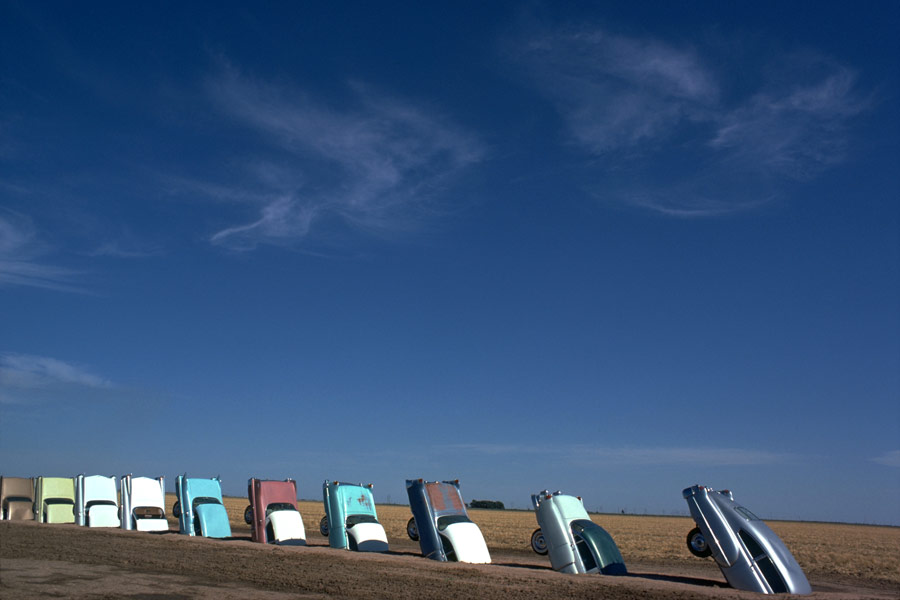
They were designed and marketed as fantasies: as works of art, in fact, in their own right. They were unveiled, like public sculptures, on rotating plinths, under spotlights. Their makers in Detroit rejected the dicta of Puritan heritage behind the early Fordian idea of a black box on four wheels. The fifties car was a rocket, onto which a heavy layer of symbolism and body metaphors was packed. It had things ostentatiously both ways, as both womb and phallus. The dreamboat had the tail of a rocket and the chrome breasts of Jayne Mansfield – a design feature that the designers, in homage to a now forgotten Scandinavian sex bomb of fifties TV, called a ‘Dagmar.’ When you hit the brakes, the whole rear end lit up red, like a robot animal in heat. Ultramatic ride, Dynaflow penetration, Triumph, lust, aggression, and plenty of room for the whole family: the siren song of imperial America. Nothing like them will ever be made again. They’re the rolling baroque public sculpture of a culture that has gone forever.
Leaving Amarillo
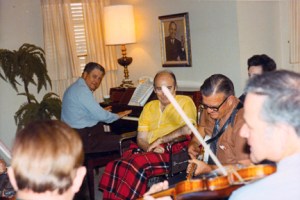
The jam session the day before the last recording Bob Wills (under the plaid blanket in his wheelchair) would make with the surviving Texas Playboys
We now faced the long uneventful drive west to Albuquerque. As we pulled out from Amarillo’s Cadillac Ranch, we recalled an old Bob Wills song: “When you leave Amarillo, turn out the lights.” If you listen to the recording, made with the surviving members of the Texas Playboys in 1973 as Bob directed from a wheelchair, you will hear the velvety crooning rent by Bob’s hollers, reduced to croaks and moans by a hard life. That was the last time Bob hollered: he had a major stroke that night and never regained consciousness. The Playboys were in tears the following day as they re-recorded San Antonio Rose, knowing they’d never play with Bob again.
That was a somber thought as we whizzed westward past towns still struggling to survive after their Route 66 main streets were bypassed by Interstate 40. Amarillo is thriving, but who will be left to turn out the lights in Cuervo or Endee or the like? We’d contemplate that more on our return trip; for now we were focused on reaching Albuquerque before dinnertime.
We celebrated our arrival in the town named after the eighth Duke of Alburquerque with dinner at Buca di Beppo before retiring at the historic Hotel Andaluz, our base of operations for the next day’s exploration of Sandia Peak and the Indian Pueblo Cultural Center.










 Meador Manor

#mediaviewer/File:Downtown_Albuquerque_Route_66.JPG)
#mediaviewer/File:Pei_Plan_Map_highlighted.jpg)