

Back in 1957, the Diffusion of Innovations theory was developed by Joe M. Bohlen, George M. Beal and Everett M. Rogers at Iowa State University. It was originally applied to agriculture and home economics, but it was later applied across disciplines. I generally think of myself as an Early Adopter in technology, but I decided to explore my actual categorizations.
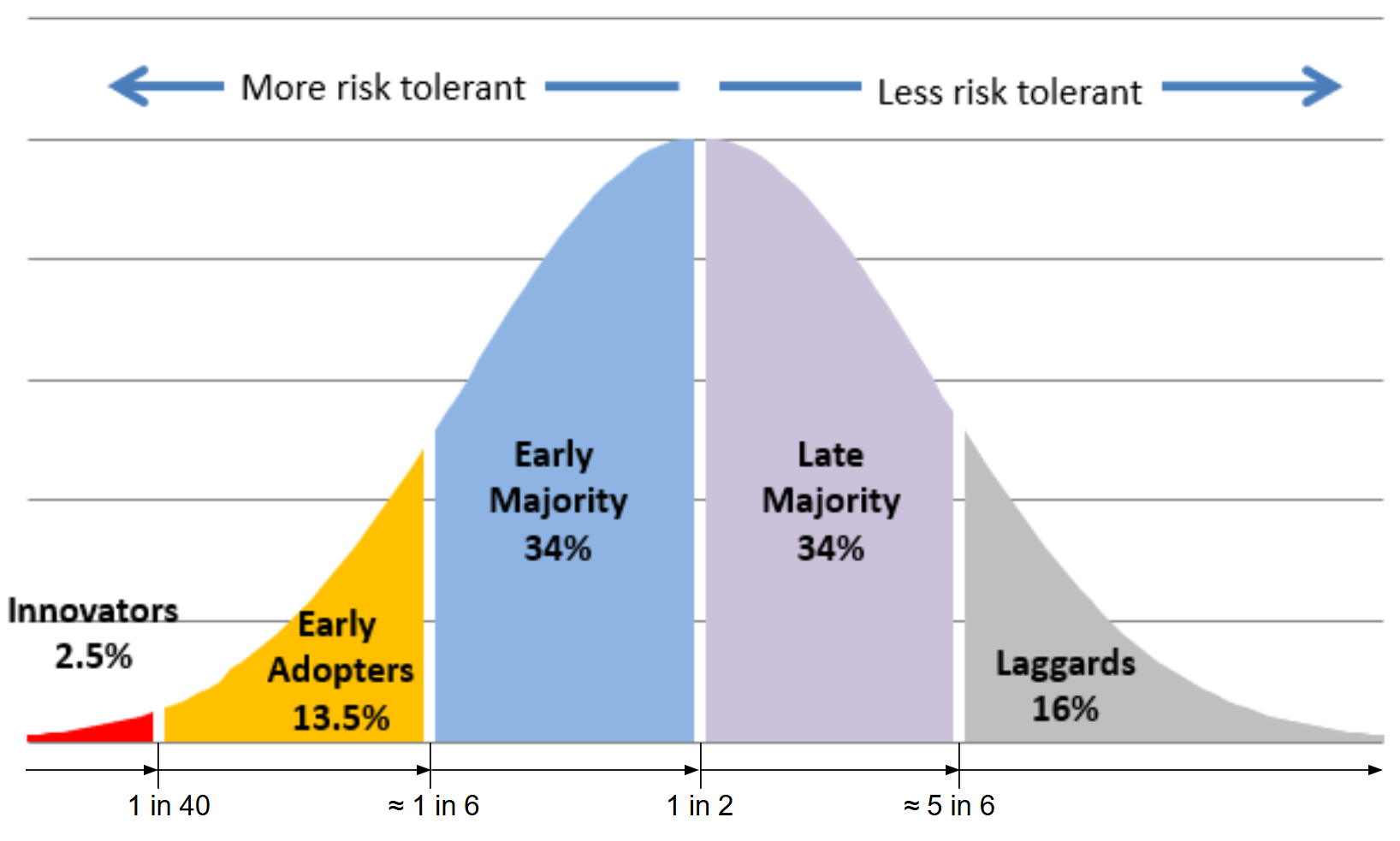
The first 1/6 of folks adopting an innovation are split into a small group of Innovators, who desire to be the first to use the latest technology, and a larger fraction of Early Adopters who enjoy new innovations and are comfortable taking social risks but are largely motivated by how an innovation can drive their success. Another 1/3 are the Early Majority who adopt new innovations only after they are proven, with another trailing 1/3 in the Late Majority who are risk averse conservatives. A final 1/6 are Laggards who only use new technology when forced to do so.
I created a chart for 1980-2025 approximating when various innovative technologies appeared to have been in each stage of diffusion, adding a yellow outline for my initial year of investing in each of them. Please note that some innovations originated before 1980.
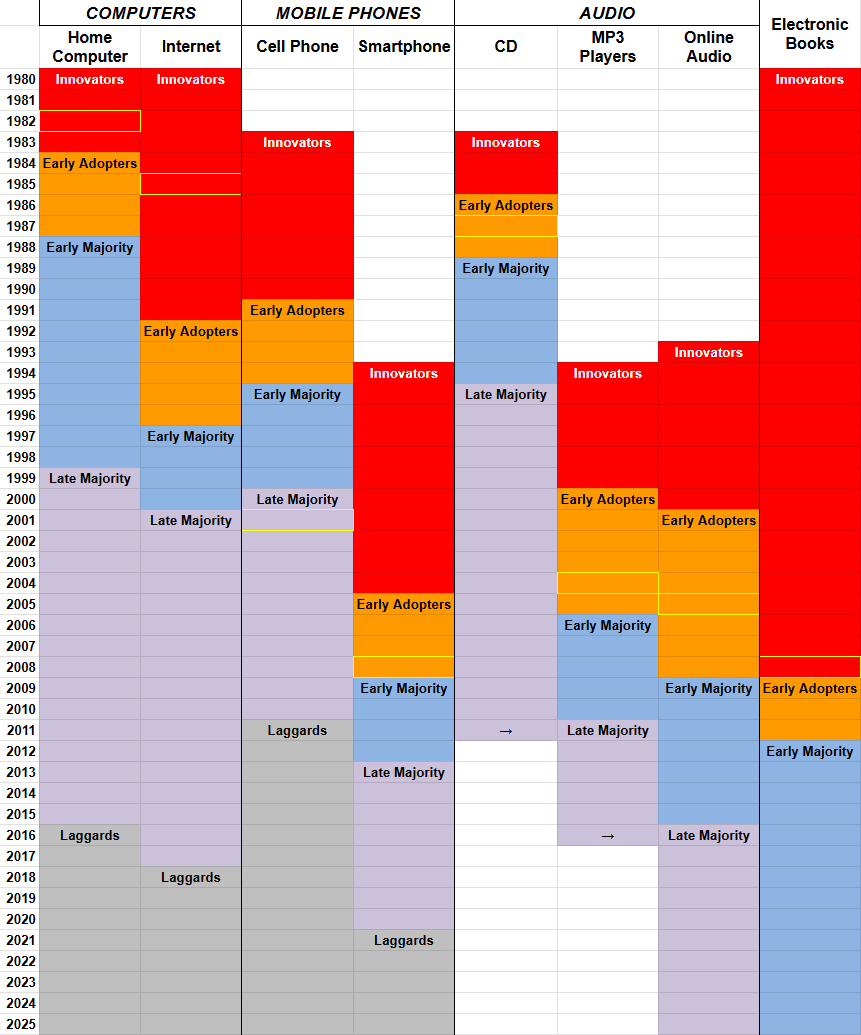
I was an Innovator in home computers, the internet, and electronic books and an Early Adopter of CDs, MP3 players, and online audio. However, my aversion to telephones delayed my purchase of a cell phone until after the majority of American adults already had one, placing me in the Late Majority for that. I made up for that by being an Early Adopter of smartphones, for which telephony was just a minor feature to me.
You’ll notice that some digital audio formats never reached the Laggards stage, as they were steadily supplanted by later ones, as happened previously to the old analog formats of vinyl records, 8-track tapes, and compact cassettes. As for electronic books, they go way back, but they didn’t really get traction until the Amazon Kindle e-ink reader debuted in late 2007, and even now only about 1 out of 4 Americans read them, or about 40% of the 60% who read a book in a given year, so they’ve never even reached Late Majority status.
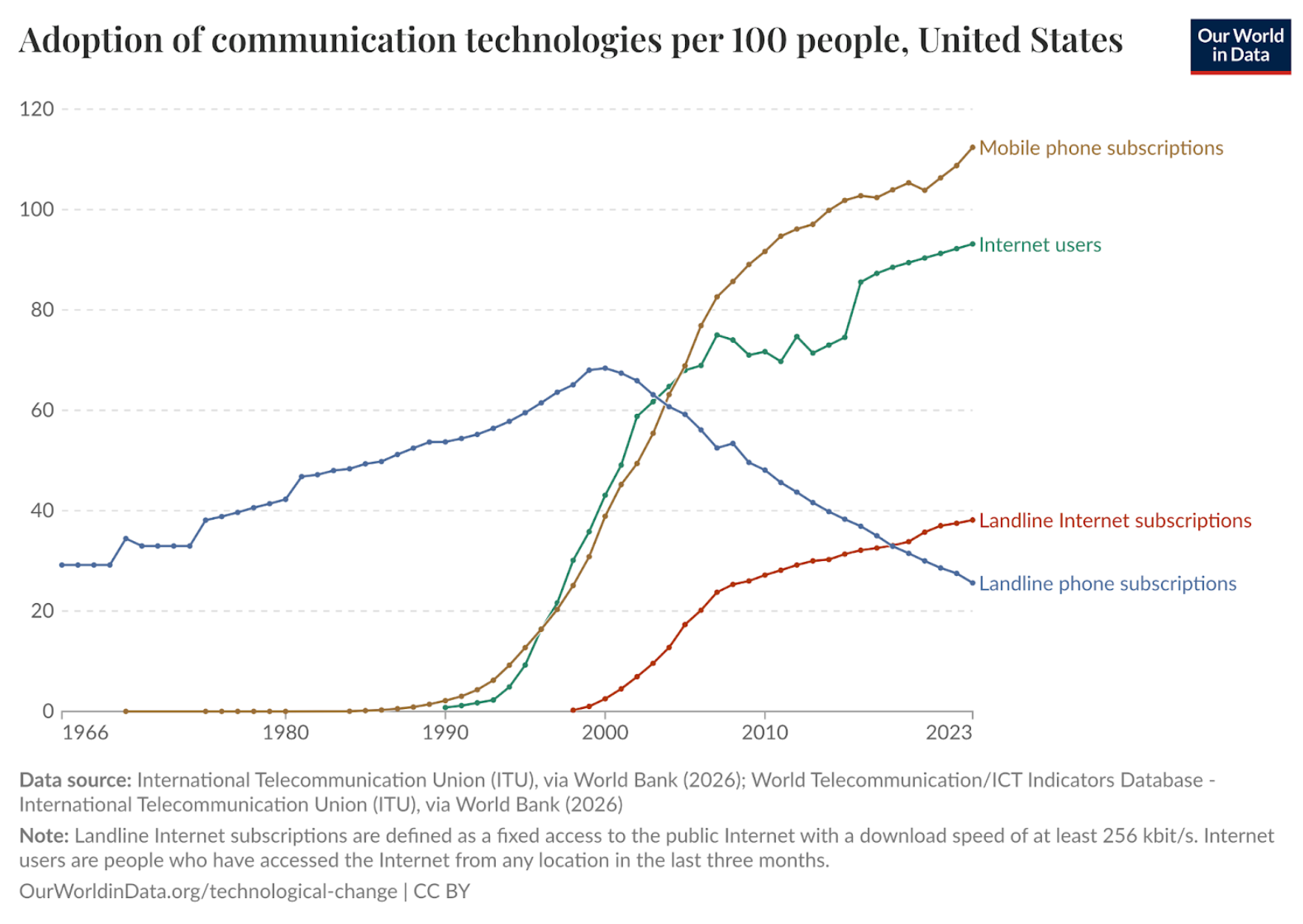
I found some interesting charts that document the rise, and sometimes the rise and fall, of different innovations. Here’s one on communications technologies:
Telephone Service
The earlier chart shows that we have more than one mobile phone subscription per person these days since some people have multiple cell phones or have a subscription for their smartphone but another for a tablet or smartwatch. Pew Research has a different breakdown by adults, showing that in mid-2025 98% of them had a cellphone, with 91% of them having a smartphone.
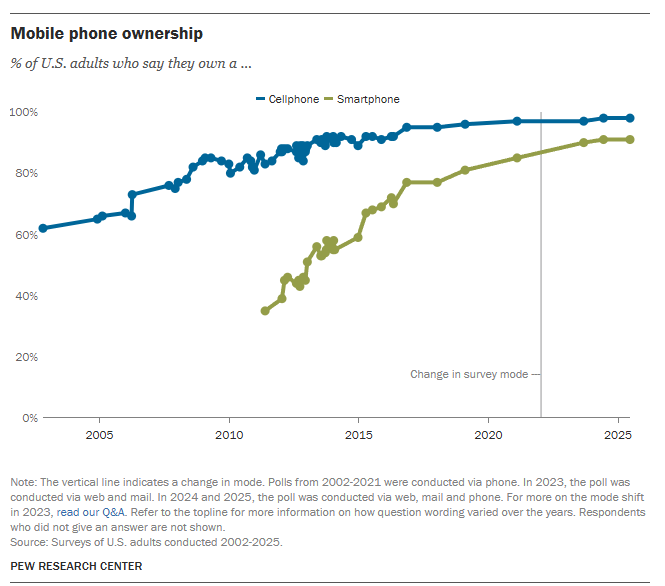
While AT&T will be eliminating traditional landline telephone service in almost all states by 2029, about 1/4 still have fixed telephones, no doubt many of them VoIP (Voice over Internet Protocol) ones that rely on broadband internet. I switch from traditional landline to VoIP at Meador Manor in 2007 and two years later gave up VoIP.
Internet
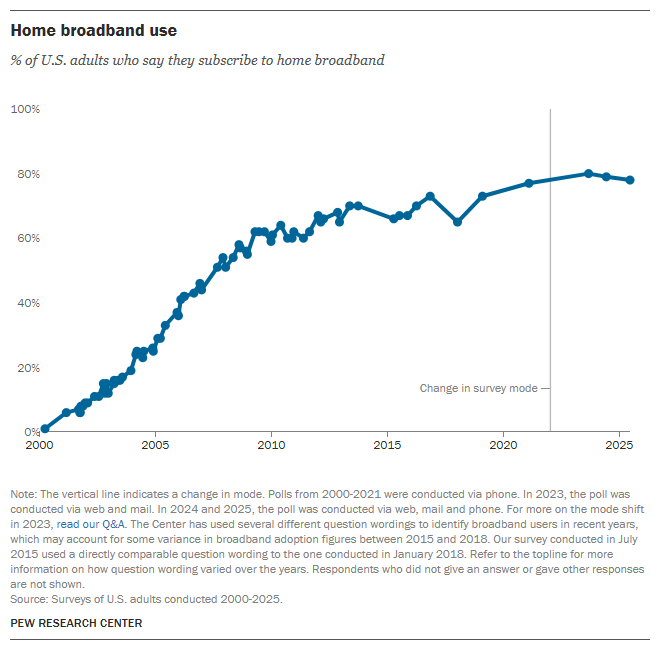
Landline internet subscriptions per person is not as informative as per household. Pew Research showed that in the 2020s we plateaued with about 80% of U.S. adults subscribing to home broadband, and about 15% of U.S. adults don’t use broadband at home but do own a smartphone.
Audio Formats
My parents owned vinyl records and 8-track tapes. When I was in high school and in my early years as an undergraduate, I bought vinyl records and created compact cassette mix tapes for use in my car. I bought my first compact disc player in 1986, and I have absolutely no use for any of the old analog formats, having endured their many limitations throughout my childhood, although I enjoy Techmoan‘s and Technology Connections‘ explorations of vintage audio tech.
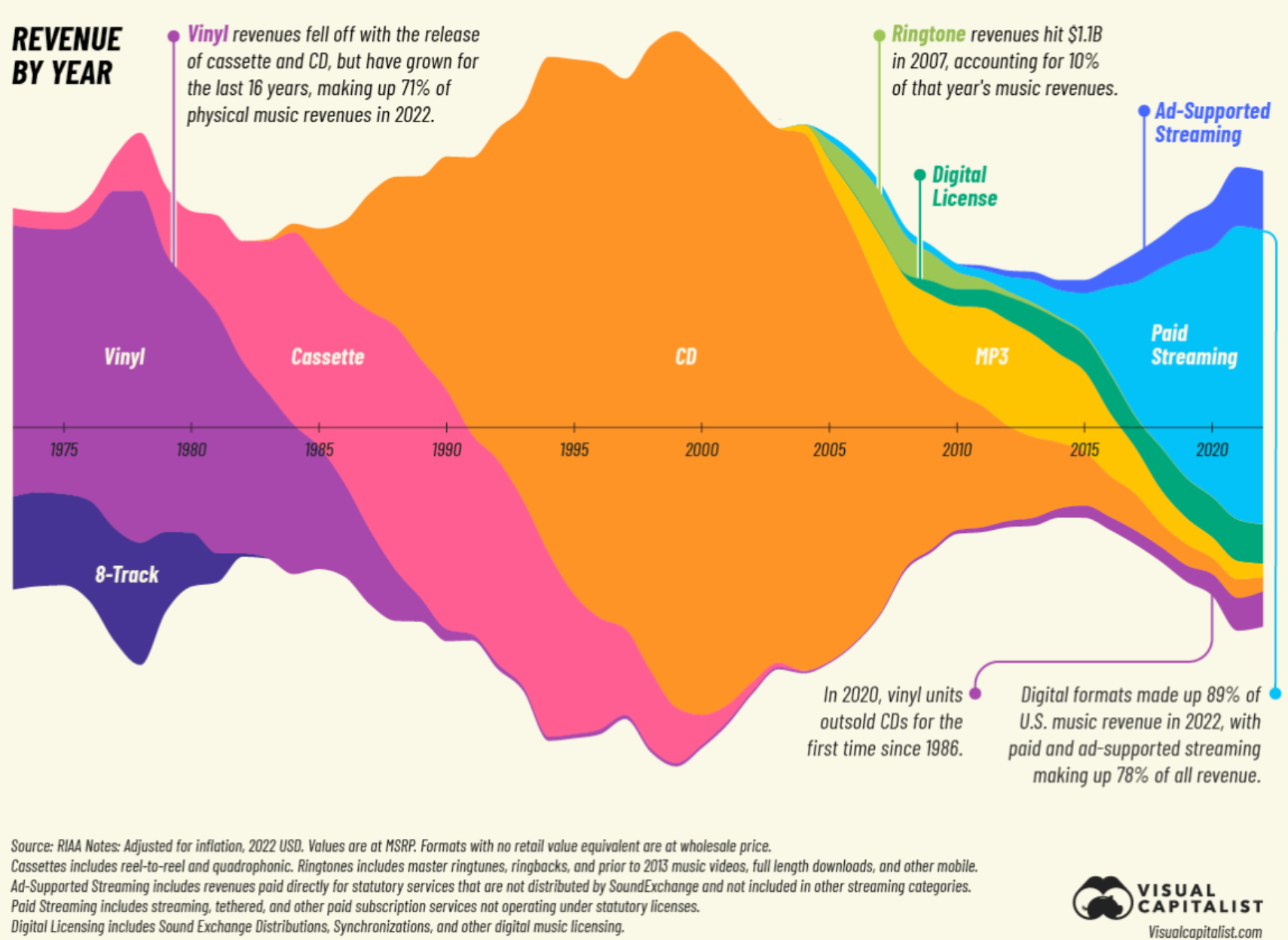
I bought my first iPod back in 2004, making the switch from compact discs to MP3s. They commanded a tiny fraction of music sales revenue at the time, and only about 6% of households had an MP3 player, but Napster and Limewire had made music piracy commonplace at the start of the 21st century and steadily whittled down the immense profits being made on compact discs.
I was never a music pirate, and until 2018 I was listening to over 14,000 music files I had either purchased outright or converted from earlier digital and analog formats. I finally started using some streaming audio when we started using smart home speakers, first with Amazon’s Alexa and later Google Home. To this day, much of my listening is of tracks I purchased for my Apple Music Library, although I mostly stopped purchasing individual tracks before 2020.
Video Formats
I first experienced pre-recorded home video via some short movie excerpts on Standard 8 silent film I checked out from a public library. That was laughably bad, while VHS videotapes seemed a godsend. Until I was a year or more into my undergraduate years, VCRs were still so expensive that I rented them, and on at least one occasion I rented a Sony Betamax since a particular title I wanted to see was available on Beta, but not VHS, at my usual video rental store.
DVDs came out around 1996, and I imagine I was an Early Adopter for those, although I wasn’t an Innovator until HD-DVD came out, which was a mistake. Sometimes my higher risk tolerance does result in setbacks. I bought a Toshiba HD-DVD player in October 2007 amidst a format war between that format and the Blu-ray disc, but HD-DVD lost the war a few months later.
Thus in October 2008 I bought a Blu-ray player, shifting me back into Early Adopter status for the winning format, although I had squandered $350 in 2007 dollars, or over $550 in 2026 dollars, on my HD-DVD misadventure.
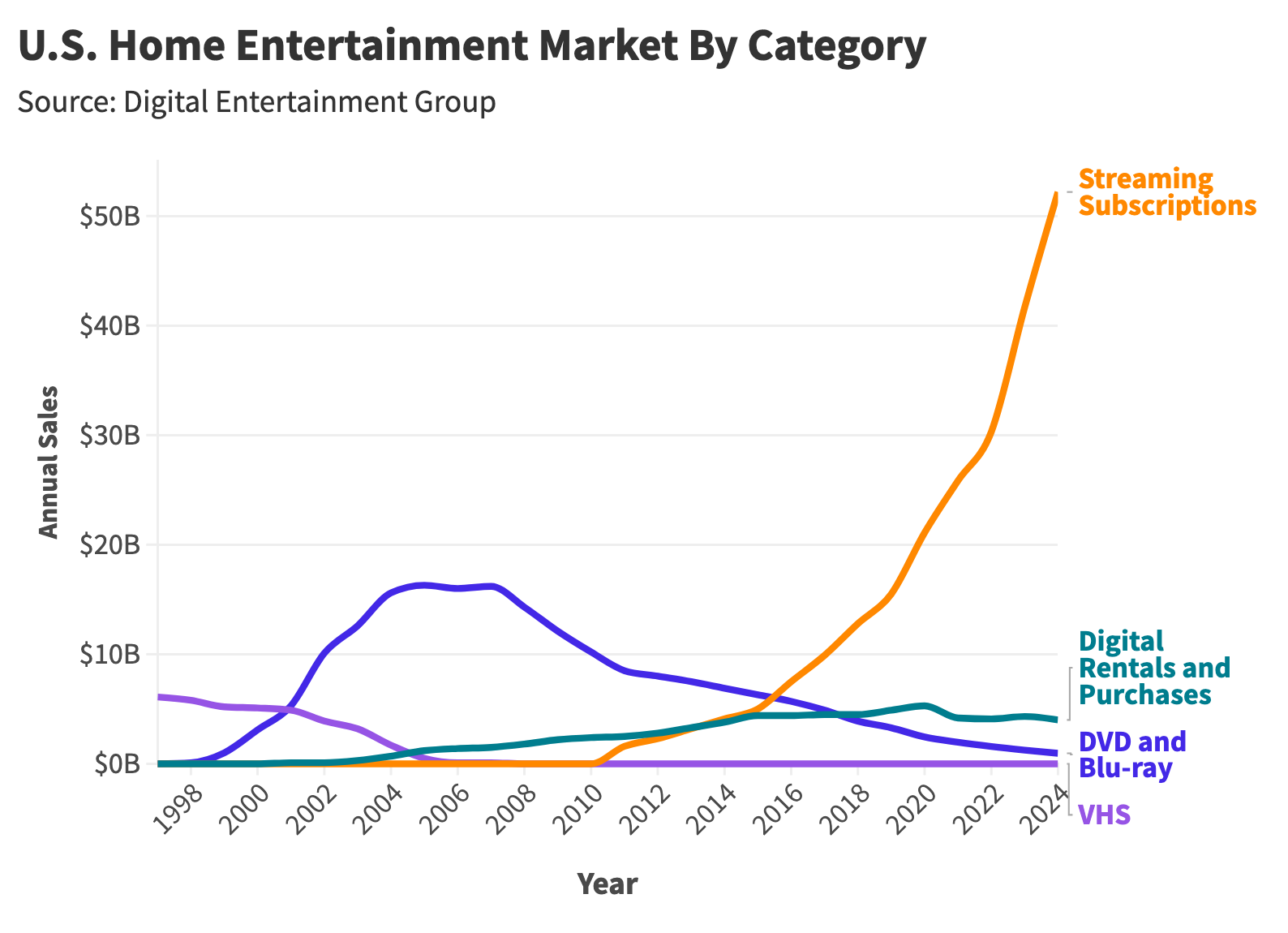
It was about then that physical media sales began their long decline, and the final physical format of Ultra HD Blu-ray never caught on with its sales peaking in 2017 and doing nothing to slow down the shift from physical media to streaming.
The Diffusion of Artificial Intelligence
Over a decade ago, I wrote about the transformations from analog to digital, from scheduled broadcast to on-demand, from fixed to mobile computing, and from local to cloud storage. Each of those trends has continued to amplify, and in the 2020s we are amidst a transformation from machine learning to generative artificial intelligence (AI) with large language models.
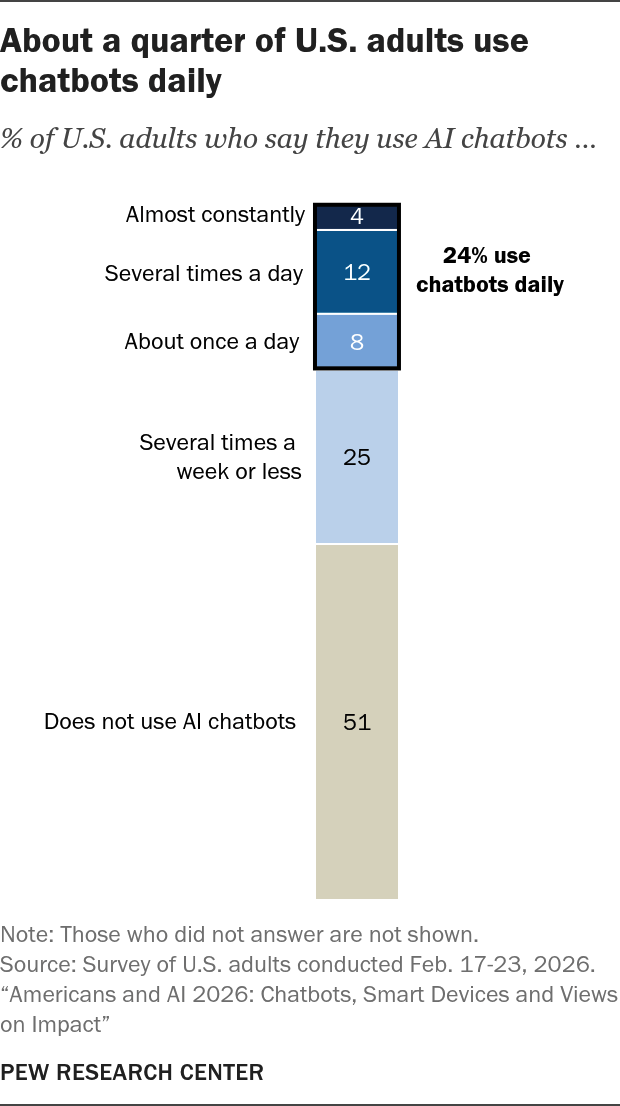
I wrote a year ago about AI’s potential impacts on employment, and a majority of Americans reported interacting with AI at least several times per week by September 2025. By February 2026, almost half of U.S. adults had used AI chatbots, and about 1 in 4 used them daily.
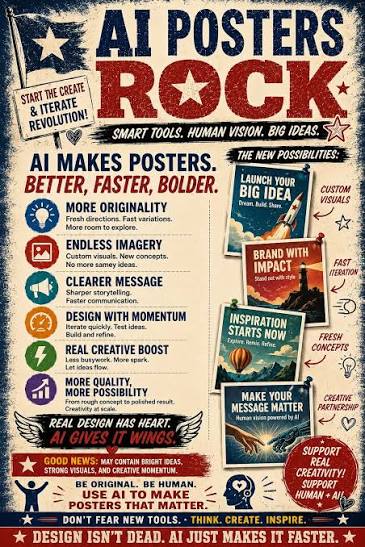
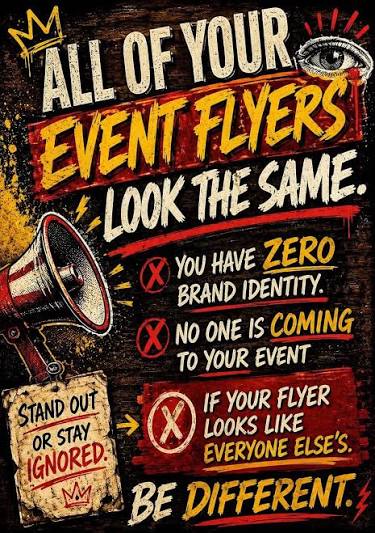
I have used AI to generate illustrative graphics for some of my blog posts, but now its imagery has flooded social media. It is busy, vibrant, glossy, and sterile.
I asked Google Gemini to apply the Diffusion of Innovations theory to the usage of modern AI, and it generated the following table:
| Adopter Category | Cumulative % | Timeframe | Key Characteristics & Milestones |
| Innovators | 2.5% | 2017-2022 | Initial ChatGPT launch; tech enthusiasts and developers. |
| Early Adopters | 16% | 2022-2024 | Integration into professional workflows; “Pro” users and students. |
| Early Majority | 50% | 2024-2028 | Cross-platform integration (Gemini, Copilot); 50% weekly use reached in early 2026. |
| Late Majority | 84% | 2028-2033 (Projected) | Use becomes a social/economic necessity; skepticism remains high. |
| Laggards | 100% | 2033+ (Projected) | Adoption only after the technology is fully embedded and unavoidable. |
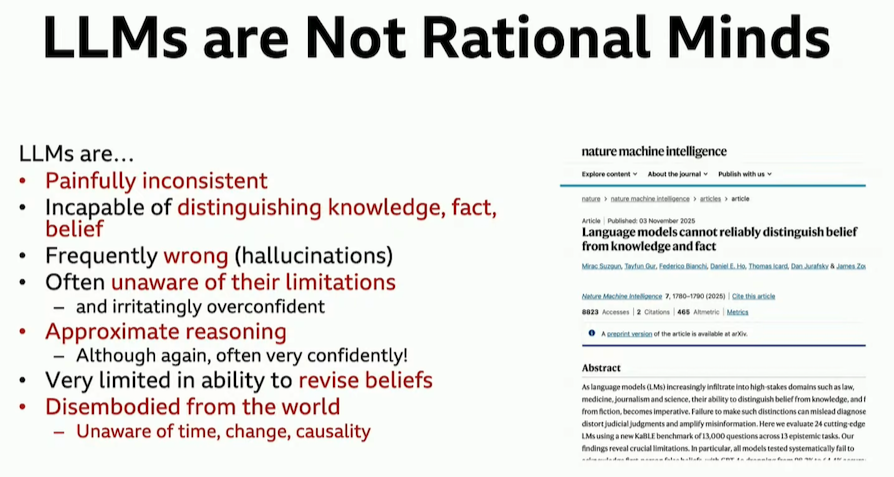
However, as computer scientist Michael John Wooldridge noted in the Royal Society’s Michael Faraday Prize Lecture, large language models are not rational minds, they are not sentient, and they are not algorithmic problem solvers.
Exiting in the Early Majority
I attended multiple technology conference sessions on modern AI in June 2023, when it was still in the Early Adopter stage. I tested an AI chatbot for the school district website in 2024, although ultimately I opted not to deploy it. I led a district AI taskforce that developed a district policy on AI with student and staff usage guidelines and recommended rating scales. A few months out from my retirement, I built some Google Notebook LM tools on district technology and board policies that district administrators can access.
However, I am frankly relieved to have retired before AI enters the Late Majority stage. While I possessed a firm grasp of the impact of earlier technological innovations on our public schools, allowing me to successfully lead us through a 1:1 student computing initiative with learning management systems, I was less sanguine about, and frankly less interested in, adaptations to the world of AI.
I am hopeful that younger folks will be better suited to and more interested in navigating a turbulent time of white-collar job disruptions. In 2024, the Brookings Institution found that more than 30% of all workers could see at least 50% of their occupational tasks disrupted by generative AI, and in 2026 the International Monetary Fund said almost 40% of global jobs are exposed to AI-driven change.
Will I remain an Early Adopter in retirement? Time will tell, but the odds are against it.








 Meador Manor