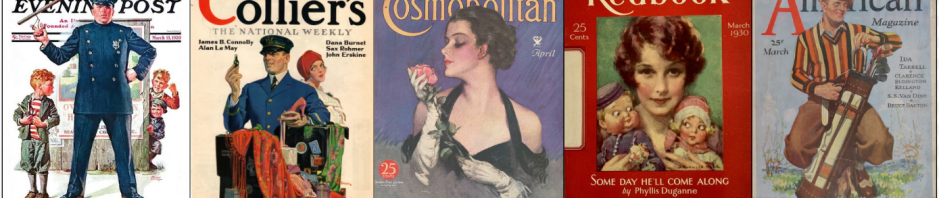

A century ago, many magazines printed shorts stories and serialized or abridged novels. A couple of dozen major commercial “slicks” were printed on glossy paper, joined by hundreds of cheap paper “pulps” which concentrated on genres such as westerns, science fiction, and crime.
The dramatic penetration of television into homes in the 1950s alongside the rise of the mass market paperback destroyed the pulps, and they were extinct by the 1960s. However, mimeographs allowed underground and counterculture magazines to thrive, universities and grants supported many low-print-run journals, and eventually desktop publishing supported niche offerings that finally migrated to the internet.
By 2015 there were only three science fiction magazines that completely supported themselves on the revenue they generated: Analog, Asimov’s, and the Magazine of Fantasy & Science Fiction. The mystery genre could only maintain Ellery Queen’s and Alfred Hitchcock’s. All five were still in print in 2026, although The Magazine of Fantasy & Science Fiction is now a quarterly and the others can now only manage six issues per year. I was a regular reader of only one of them, over 40 years ago, when my junior high school sold magazine subscriptions for some cause, and I subscribed to Alfred Hitchcock’s Mystery Magazine for several years.
As for the slicks, in the 1920s the prominent ones printing literary content included The Saturday Evening Post, Collier’s, Cosmopolitan, The Red Book, and The American Magazine.
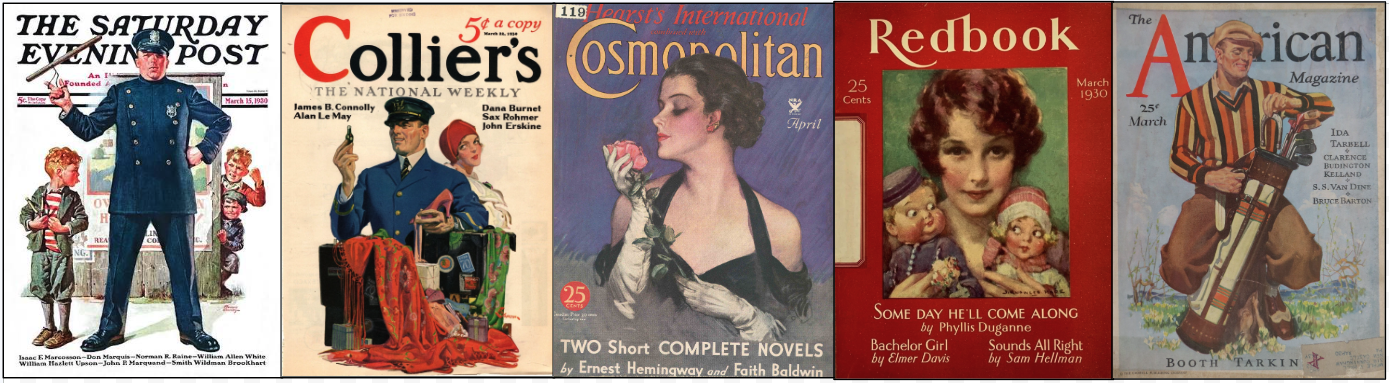
The American died in 1956, and Collier’s early the next year, felled by plunging advertising revenue and rising production costs. The Red Book had become Redbook by the 1930s and in the 1950s concentrated on young adults to survive television, switching to serve a female audience later that decade. It de-emphasized fiction after 1983 and ceased print publication in 2018.
After 1965, Cosmopolitan was turned away from printing fiction by longtime editor Helen Gurley Brown, who transformed it into a magazine for modern single career women, and it survives as a quarterly. So that brings us to The Saturday Evening Post.
The most famous thing about it was over 320 covers painted by Norman Rockwell. J.C. Leyendecker was no slouch, painting over 350, and George Hughes and John Philip Falter each produced over 100 of its covers. Falter lasted until 1968, by which time the editors viewed painted covers as old-fashioned and out of touch, replacing them with cheaper photographic covers.
In 2026, the magazine, which had been reduced to six issues per year some time earlier, announced it was ending its print edition. Its subscriber base, which had peaked at nearly seven million in 1960, had fallen to about 50,000. However, it had died before, back when I was a little kid.
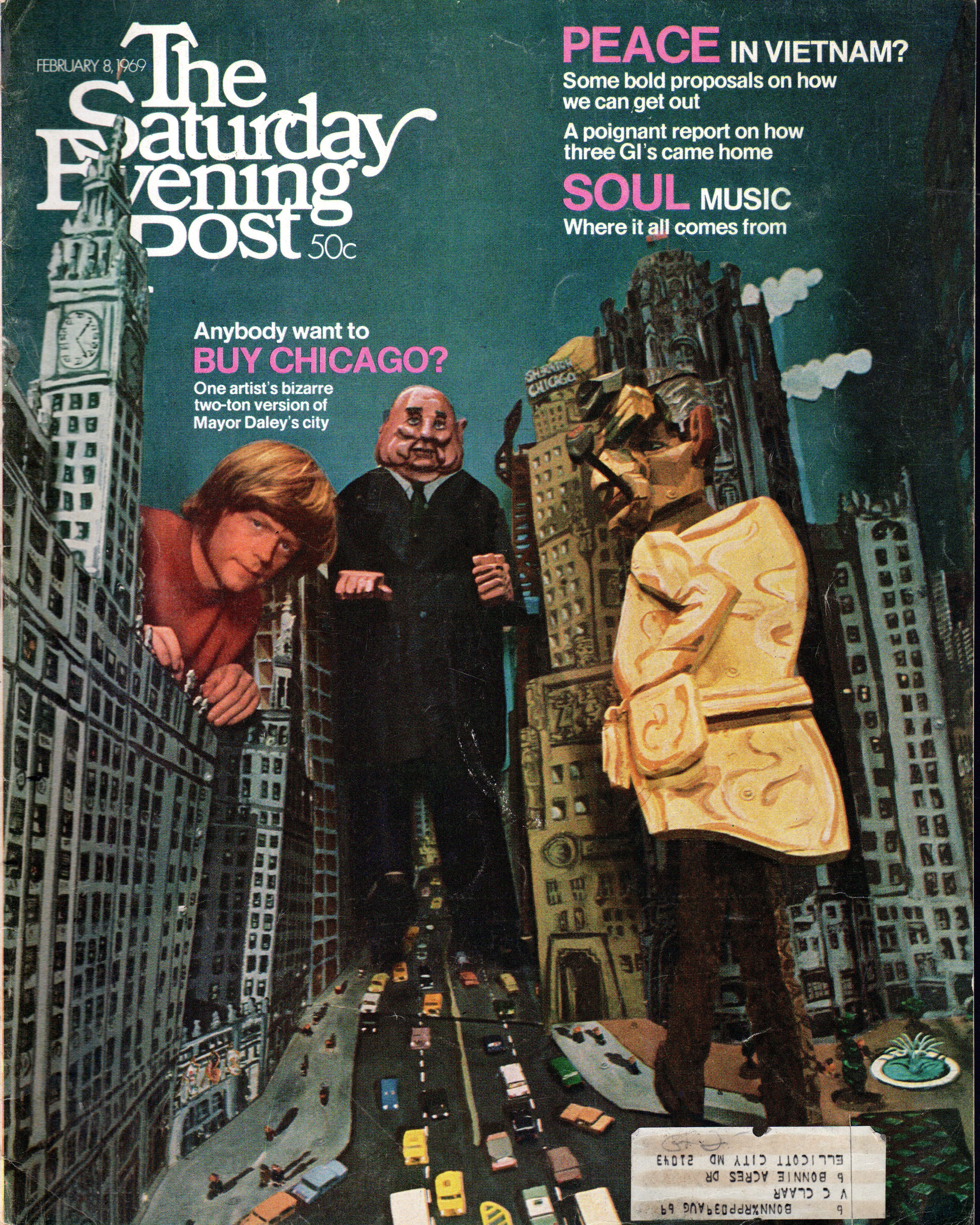
In the turbulent 1960s, the magazine’s conservative politics and values appealed to a declining number of readers. Prominent authors drifted to newer magazines. In 1968, it cut printing costs by cancelling the subscriptions of roughly half of its readers, offering them free transfers to Life magazine. This was perceived as shedding older and more rural readers to appeal more to advertisers, and it wasn’t surprising that the zany effort failed, and The Saturday Evening Post ceased publication with its February 8, 1969 issue.
That would have been the end of it, except that in 1970 the Indianapolis industrialist Beurt SerVaas relaunched it on a quarterly basis as a kind of nostalgia magazine. In 1982, Beurt’s wife, Cory, who was a journalist and physician, revamped it, adding coverage on health and wellness while still providing nostalgic light humor, cartoons, and nods to classic Americana.

In 2013, it launched a major makeover with a new cover design and an effort to increase its profile, given a general public misbelief, which I shared, that it was no longer in existence. I remember catching a glimpse of it on a magazine rack in a library, which tells you how long ago that was, and being surprised to see a modern issue date on it.
As of 2021, an editorial staff of twelve was putting out six issues per year with a claimed circulation of 350,000. It was still publishing fiction, but soon its print runs will be ended for good. So let’s go back to its origins to learn how it got its name.
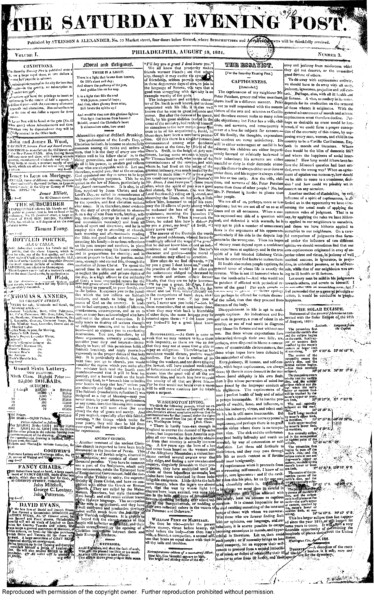
It began in 1821 as a newspaper printed in the former office of Benjamin Franklin’s Pennsylvania Gazette. The print run was timed to be early enough for its delivery to Philadelphians in the Saturday evening mail. Yeah, back then major cities had two daily mail runs.
It was known for printing letters between ex-presidents Adams and Jefferson and then essays, stories, and poems by such notables as Edgar Allan Poe, James Fenimore Cooper, Harriet Beecher Stowe, Washington Irving, and Mark Twain.
In 1897, Cyrus Curtis, who had transformed a farming magazine into Ladies’ Home Journal, the first magazine to reach a circulation of a million, purchased the Post, wanting to make it a man’s version of the Journal. He hired George Horace Lorimer to edit it, and Lorimer proceeded to be one of the first editors to print the work of Joseph Conrad, O. Henry, Rudyard Kipling, and Jack London. The Call of the Wild was first published, in serialized form, in the magazine in 1903.
I enjoy reading old stories and novels, and several significant authors relied on The Saturday Evening Post. P.G. Wodehouse said “the wolf was always at the door” until the Post gave him his “first break” in 1915 by serializing Something New. Erle Stanley Gardner published 16 serialized Perry Mason novels in it, starting in 1937, adjusting his writing style and softening his protagonist’s rough edges to meet the standards of its conservative editors.
The magazine’s largest issue was a whopping 272 pages a few months after the 1929 stock market crash, weighing almost two pounds. The issue generated $1.5 million, the equivalent of almost $300 million in 2026, from 241 national advertisers. It took sixty 45-ton presses three weeks to churn it out. My, but how things have changed.
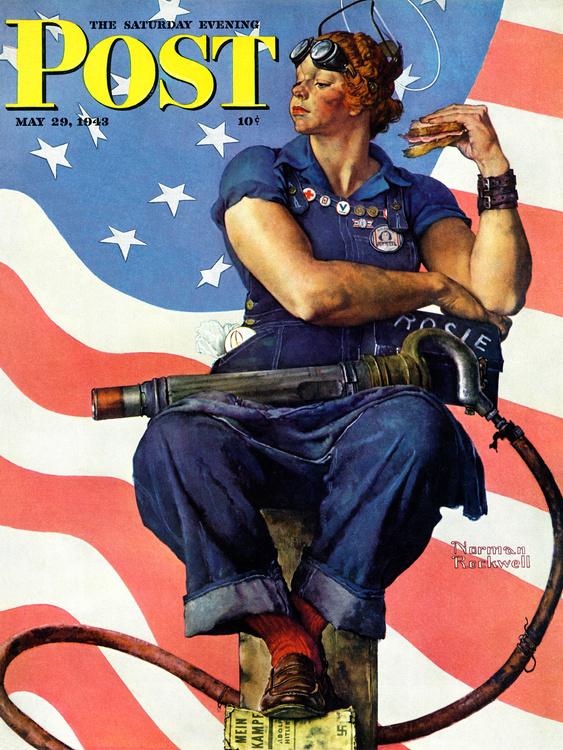
Joan SerVaas inherited control of the magazine in 2008, and in addition to the 2013 revamp, she focused on digitizing its archives. Subscribers can trawl half a million pages and about 3,500 covers. Now, at age 72, SerVaas is shutting down the presses, attributing the decision to “rising production costs, declining advertising revenue and shifting reader habits”. New articles and fiction will still be published online, alongside the preserved archives.
I never read a single issue of The Saturday Evening Post. It was a magazine for earlier generations, and heck, I’m a retiree. So I cannot say I will miss it, but I felt its second death in print deserved acknowledgment.







 Meador Manor